CONTENTS
Figures ……….4
Introduction ……….5
Chapter 1 – Private Time ………10
I. An Atrophy of Experience in “Zone” ………..12
II. Clair’s Ray as Camera and Ubiquitous Shock ………...……....17
Chapter 2 – Time in Hell ……….24
I. Gambling and Compulsion atop the Eiffel Tower ………...26
II. Mechanized Repetition and Communion with Nature …………...…....33
Chapter 3 – Spatial Hierarchies ………...………...40
I. Elevation in “Zone” ……….43
II. Bourgeois Triumph in Paris qui dort ……….48
Conclusion ………...54
FIGURES
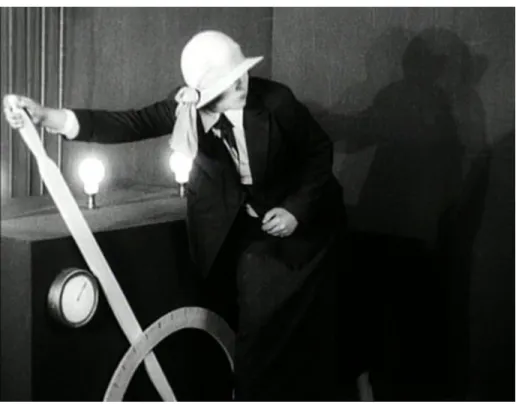
1. Dr. Crase’s niece re-activates the ray………18
2. Albert comes across a man, paralyzed by the ray, about to jump into the Seine………...20
3. The burglar distracts and then steals bank notes from the police officer in a game of poker ...27
4. The pilot folds a bank notes into a paper airplane ………29
5. The two losing poker players run to grab more bank notes from Albert's room ………..31
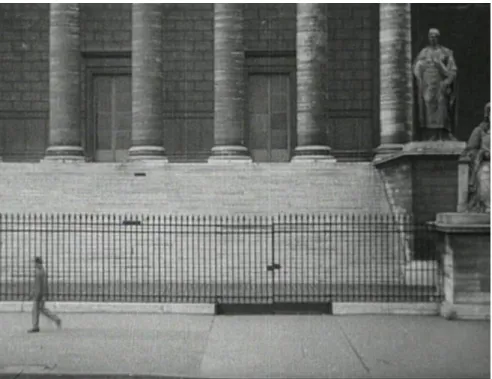
6. Albert walks past La Madeleine ………...49
Introduction
From the Exposition Universelle of 1889 to the aftermath of the Great War, Paris witnessed the promise and horror of a mechanized future, enduring a fundamental upheaval in the nature of urban experience. Developments in engineering which drove the construction of the Eiffel tower and the first airplanes also brought the machine gun and mustard gas, and
production advancements which brought new standards of material well-being expanded consumer culture, promulgated financial speculation, and strengthened means of economic exploitation. Commodification and industrialization permeated deep into the lifeworld by the turn of the century, altering the dynamics of life and thought. While global time became standardized, individual experience was marked by shock, stimulus, and discontinuity.
Traditional spatial hierarchies were leveled as well. Spiritually, the Church ceded power in the face of secularization and physically, limits on human elevation were surpassed through aviation, architecture, and film technology.
essays combine an affinity for the surrealist work of the early twentieth century with a literary exploration of modern Paris, arguing for the triumph of the poet over the philosopher in successfully grasping the nature of contemporary experience. His study of experience and alienation offers a lens through which to explore Paris from the nineteenth century to the
aftermath of the First World War. In Paris, Capital of the Nineteenth Century, the opening series of essays in The Arcades Project, Benjamin tracks the city throughout these decades, studying the bourgeois triumph of Louis Philippe's reign and the subsequent dépaysement of Haussmann’s class driven urbanism. He catalogues the political struggles of the late nineteenth century in the emergence of new forms of spatial division, such as the anti-barricade boulevards, the linking of military barracks to proletariat neighborhoods, and the more intimate effects on private
bourgeois home life. Benjamin refers to the monuments of nineteenth century Paris, which include not just iconic structures but the more encompassing architectural identity and spatial arrangement, as “ruins of the bourgeoisie”, and claims it was the Surrealists who first recognized them as such (The Arcades Project 13). In his essay “Surrealism”, he hails the Surrealists for introducing work that is
the deeply grounded composition of an individual who, from inner compulsion, portrays less a historical evolution than a constantly renewed, primal upsurge of esoteric poetry written in such a way it would be one of those scholarly confessions that can be counted in every century. (Benjamin, 212)
philosophy, Marxist theory and Freudian psychoanalysis to respond to contemporary trauma through avant garde poetic form, rejecting the nineteenth century novel in favor of juxtaposition, automatism, and a return to qualities often lost after childhood. The aim was to achieve liberation by combating rationality, taking cues from the imaginative and spontaneous impulses stamped out in youth and commonly shunned in the mentally ill. Breton ends the manifesto with a call to look beyond the world as it is, proclaiming “l’existence est ailleurs” (64). The surrealist
fascination with dreams and repressed energies found particular resonance with Benjamin, who saw the “wish images of the dreaming collective [as] the utopian longing for a better future whose advent could be promoted, once its content had been articulated” (Cohen 205).
For both Breton and Benjamin, Guillaume Apollinaire showed the revolutionary promise of these new poetic forms, achieving what Benjamin referred to as the “creative overcoming of religious illumination” (“Surrealism”, 209). Apollinaire’s “Zone”, published in the 1913
Such images of utopia and alienation in twentieth century Paris are also found in Paris qui dort, René Clair’s first directorial effort. Clair, whose given name was René Chomette, was
born in 1898 to a bourgeois home in the rue de Halles (Billard 13). In 1917, at the age of 18, he enlisted in the Red Cross, serving as an ambulance driver on the front (Billard 31).1 His
introduction to film came while working as journalist after the war, when a friend informed him that a director was looking for an actor to play a minor role. In his short time as an actor, he adopted the surname Clair and worked under Louis Feuillade, acting in lead roles and
freelancing as a film critic, where he expressed his artistic disagreements with Feuillade’s style and quickly became “one of France’s first serious film critics” (Dale 9-10). A few years later, Clair was introduced to Henri Diamant-Berger, who Clair described as “the classic shoe string producer.” Diamant-Berger promised to finance the aspiring director’s first film, which was released in 1924 under the title Paris qui dort (the distributor’s title was Le Rayon diabolique) (Dale 11-2).
The film is a silent comedy. It begins with a watchman on the Eiffel tower, Albert, awaking to find that all of Paris has been paralyzed. Cars are static, pedestrians are paused mid-stride. Albert then finds the only other people not affected by this trance, a group who has just flown in from Marseille. Eventually they learn that a mad scientist named Dr. Crase has developed a ray which can stop time across the globe and due to their elevation, Albert and the
group from Marseille were out of its reach. Clair shows these characters as they run around the frozen city, offering a reflection on urban life and the spatiotemporal dynamics of modernization. Like Apollinaire, Clair examines novel symbols of the city and uses nonlinearity and advanced artistic technique to render a fragmented portrait of modernity. Both works are self-reflexive as well. Paris qui dort is as much about cinema, the creation and editing of images, as it is about a mad scientist. Similarly, “Zone” places the poet at the center of modernity, with an explicit concern for the act of writing alongside new attempts at spiritual transcendence.
The aim of this project is to examine these works in parallel, using Benjamin’s formulation of experience and his analysis of Surrealism and nineteenth century Paris as a framework through which to view Clair and Apollinaire’s depiction of the optimism and desolation of modernity. Two Benjamin essays, “On Some Motifs in Baudelaire” and
“Surrealism”, and selected excerpts from The Arcades Project are discussed in close readings of “Zone” and Paris qui dort. A comparative analysis of these texts reveals relationships between poetic and cinematic form as they pertain to urban experience while offering literary perspectives from before and after the First World War. This analysis is divided into three chapters. Chapter one discusses both texts in relation to Benjamin’s formulation of experience as elaborated in “On Some Motifs in Baudelaire” and centers on the conflict in each work between centralized
definition of transcendence and arguing for the movement of capital as being central to Clair’s portrait of turn of the century Paris.
This is not the first study of Paris qui dort to include Walter Benjamin’s writing and “Zone”. Annette Michelson’s 1979 essay Dr. Crase and Mr. Clair examines Clair’s self-reflexive cinematic technique and begins a section on the film’s use of the Eiffel tower by quoting the first five lines of “Zone”. The essay incorporates the surrealist responses to the First World War, bourgeois humanism, and the Catholic church and references “The Work of Art in the Age of Mechanical Reproduction" when discussing photographic representation of Parisian streets. Mentions of Benjamin and Apollinaire are brief, however, and the piece does not
Chapter 1 – Private Time Introduction
Time became standardized at the turn of the twentieth century. Myriad local times dissolved as railroad and telegram infrastructure expanded. 1884 saw the Prime Meridian Conference in which the world was divided into 24 times zones, the duration of one day was solidified, and Greenwich became the zero meridian. France adopted Greenwich time six years later and in 1912 Paris hosted the International Conference on Time. The conference aimed to accurately determine, maintain, and transmit time signals across the world. The first global time signal was transmitted from the Eiffel tower on July 1, 1913 (Kern 14-5). Furthermore,
the introduction of World Standard Time created greater uniformity of shared public time and in so doing triggered theorizing about a multiplicity of private times that may vary from moment to moment in the individual, from one individual to another according to personality, and among different groups as a function of social organization. (Kern 33)
The proliferation of standardized time emanating from a centralized authority was occasionally met with anarchic resistance but more broadly saw literary investigations which affirmed and analyzed the contrasting category of private time. Uniform global time and its responses mark a fundamental development in the nature of individual experience. Individuals in turn of the century Paris saw a new relationship between themselves and the world, the French state, and their fellow city dwellers.
individuals and is reversible, discontinuous and fragmented. This analysis will be supplemented by Walter Benjamin’s formulation of experience as developed in his 1940 essay “On Some Motifs in Baudelaire.” The essay examines the nature of urban experience in nineteenth and twentieth century Paris. Benjamin defines two forms of experience, contrasting lived, poetic experience [Erfahrung] with isolated shock experience [Erlebnis].2 Erfahrung denotes the merging of the collective and individual past, whereas Erlebnis negatively refers to an experience of isolated moments. For Benjamin, modernity is characterized by the loss of tradition and aura in Erfahrung amongst the “blinding experience of large-scale industrialism” which proliferates Erlebnis (“On Some Motifs”, 314-5). To give an example, Erfahrung would be the experience of a mechanic who has worked on cars for several decades. Saying he has experience refers to the fluid collection of memories, wisdom, and stories amassed over his life. Erlebnis, conversely, would be the experience of witnessing a car crash: sudden, fixed, and distinct.3
I will use Benjamin’s distinction of experience to show how through the collision of private and centralized time, Clair and Apollinaire confront the proliferation of Erlebnis and the erosion of Erfahrung. Kern’s temporal distinction provides a particular historical context through which to analyze these works, with Benjamin’s formulation offering a phenomenological
framework to study how “Zone” and Paris qui dort document the dynamics of late modern urban
2 Beatrice Hanssen offers informative commentary on Benjamin’s formulation of experience in the second footnote in her essay on Benjamin and language. Hanssen, Beatrice. “Language and mimesis in Walter Benjamin’s work.” The Cambridge Introduction to Walter Benjamin, edited by David S. Ferris, Cambridge University Press, 2006, pp. 70-1
life. This will be conducted through a close reading of two strophes from “Zone”, focusing on Apollinaire’s alternating rhythm, temporal imagery, and self-reflexive poetic writing. Clair’s rendering of experience will be analyzed through the montage of the closing sequence and the film’s continual metacinematic commentary.
This study originates from Benjamin’s assertion in “On Some Motifs” that the poet is capable of what the philosopher can no longer do, namely, to understand the nature of modern experience (314). “Zone” and Paris qui dort confront shock experience as their characters walk through the city and both works exhibit a self-reflexivity that underscores the act of artistic production. Clair and Apollinaire reckon with the disintegration of lived, poetic experience, but while the pre-war “Zone” offers an attempt at recovery, Clair’s work from a decade later is consumed by mechanization and the receding of Erfahrung.
I. An Atrophy of Experience in “Zone”
Apollinaire presents experience as it relates to poetic production in the first substantial strophe of “Zone”, showing what Benjamin refers to as the “increasing atrophy of experience” which characterizes modernity (316). While some poets and philosophers held the possibility of an individual taking hold of his experience to be a matter of chance, Benjamin states that inner concerns are not necessarily private. Private concerns exist as such “only after the likelihood decreases that one’s external concerns will be assimilated to one’s experience” (315). He cites newspapers as an example. For Benjamin, newspapers’ intent is to
connection between the individual news items) contribute as much to this as the layout of the pages and the style of writing…Another reason for the isolation of information from experience is that the former does not enter ‘tradition’. (315-6)
Historic forms of communication, specifically storytelling, where the storyteller does not recount the event but passes on the event as lived experience as it exists in the life of the storyteller, give way to the new form of communication: information by sensation.
Apollinaire opens “Zone” with this tension between old and new forms of communication:
Et toi que les fenêtres observent la honte te retient D'entrer dans une église et de t'y confesser ce matin
Tu lis les prospectus les catalogues les affiches qui chantent tout haut Voilà la poésie ce matin et pour la prose il y a les journaux
Il y a les livraisons à 25 centimes pleines d'aventures policières Portraits des grands hommes et mille titres divers (7)
The church windows watch the speaker, but he cannot confess his sins. His inner concerns retain their private character. Avoiding religion, advertisements and paperbacks serve as empty
The alternation between assonance and consonance depicts the fragmented rhythm of city life. Assonance is present with the i sound in église, t’y, tu lis, affiches, poésie, the repeated il y a, and the final phrase mille titres divers (7). The fluid rhythm this creates complements the lack of punctuation, which is most notable during the unseparated listing of prospectus, catalogues, and affiches. Consonance occurs through the p sounds in Pape Pie X, les prospectus, poésie ce matin et pour la prose, and pleines d’aventures policières / Portraits des grand hommes, with Pape Pie X incorporating both sounds of the assonance and consonance (7). The thousand different titles, examples of isolated experience, are ironically afforded a smooth communion through alliteration. Apollinaire produces urban rhythm in verse, highlighting the effects of industrialization while acknowledging the relationship between poetry and religion as they relate to the withering presence of Erfahrung.
Religion, poetic production, and experience are further examined in the latter half of the poem through a contrast of non-linear and standardized time:
Tu es dans le jardin d'une auberge aux environs de Prague Tu te sens tout heureux une rose est sur la table
Et tu observes au lieu d'écrire ton conte en prose La cétoine qui dort dans le coeur de la rose
Épouvanté tu te vois dessiné dans les agates de Saint-Vit Tu étais triste à mourir le jour où tu t'y vis
Tu ressembles au Lazare affolé par le jour
En montant au Hradchin et le soir en écoutant
Dans les tavernes chanter des chansons tchèques (9-10)
The speaker’s fragmented state is reflected in his appearance in the fluid, fractured agate designs of the Saint-Vit train station, which is the milieu home to the origins of standardized time. The continued use of tu by the speaker to refer to himself adds to the fragmented subject. Using the second person blurs not just the identity of the speaker but the timeline as well. Verbs are in the present tense in the first and last five lines of the strophe, “tu es dans le jardin... tu te sens… tu observes”, but the sixth line switches to the imperfect with “tu étais triste à mourir” (9). The speaker has gone from the streets of Paris to Prague to Saint Vit and then back to Prague in eleven lines. His descriptions could be memories or a real-time account of the present, and he could be speaking to his past self, his present self, or to another subject. Apollinaire presents what Benjamin describes as the “accumulated and frequently unconscious data that flow together in memory [Gedächtnis], which form the structure of Erfahrung” (314). Memories in “Zone” interrupt the present, showing a non-linear temporality at odds with any standardized
timekeeping. The regulated movement of the clock hand and the guaranteed progressive drive implicit in a mechanized urbanity defined by isolated moments are countered by the speaker’s fragmented, fluid portrait of experience.
Fragmentation appears in the rhythm of the strophe as well. The consonants in
jour, l’horloge, and rebours before slowing again in the next line “Et tu recules aussi dans ta vie lentement” (10). Consonance returns in the phrase ta vie lentement, where the pace of the poem
matches the pace of the speaker’s life. The staggered rhythm of the strophe gives way to the gliding alliteration chanter des chansons tchèques in the final line, after which the speaker appears in Marseille, Koblenz, Rome and Amsterdam (10).
The strophe counters the notion of a standardized day, affirming the reality of private time and showing an attempt to look beyond regulated contemporary experience. The speaker is distraught by the day (Tu resembles au Lazare affolé par le jour) and the clock running
backwards (l'horloge du quartier juif vont à rebours) shows a mechanized timepiece repurposed to match the speaker’s individual, non-linear temporality. Its motion opposes standardized time and its presence in the Jewish quarter alongside the reference to Lazarus demonstrates the ancient religious dimension which grounds Apollinaire’s poetic production of experience.
Religious underpinnings are central to what Anca Mitroi identifies in Apollinaire’s unique formulation of modernity, which for her is a paradoxical relationship with Catholicism, challenging the reading of “Zone” as a strict break with the Church in favor of the purely new. Apollinaire
Even in the most modern and seemingly secular places and objects, such as a train station or synchronized clock, ancient religious sentiments can appear (Mitroi 210-1).
Mitroi’s reading of Apollinaire as trying to capture a receding past recalls Benjamin’s focus on the poet as attempting to recover the aura and tradition of Erfahrung in the age of industrialization. In this strophe, the figure of the poet remains central as the speaker documents the nature of contemporary experience. His status as poet is referenced in the contrast of writing, observation, and listening (tu observes au lieu d’écrire ton conte en prose…écoutant/ Dans les tavernes chanter des chansons tchèques). He moves from a blissful memory at a bar (dans le jardin d'une auberge aux environs de Prague/ Tu te sens tout heureux) to being horrified by his reflection (Épouvanté tu te vois dessiné dans les agates) and crazed by the day (affolé par le jour) (9-10). The speaker renders his private time, his memories which interrupt the day, and his fragmented identity through self-reflexive poetic verse.
II. Clair’s Ray as Camera and Ubiquitous Shock
experience. Out of reach from the ray’s emission, Albert, the group from Marseille, and Dr. Crase and his niece are afforded their own private time, discontinuous from the rest of the city. The ray creates a collision between this private time and the centralized time experienced by the rest of Paris. Presenting the ray as camera shows the resonant shock that exists in isolated moments. The ray’s capacities are introduced in Albert’s opening walk through the city. The full consequences of the invention, as well as its cinematic character, are revealed in the final
sequence. Like “Zone”, the rhythm of contemporary urbanity is embedded in the work. Clair’s combination of plot, montage, and fast and slow motion comment on film’s capacity to produce the shock experience of Paris.
Figure 1. Dr. Crase's niece re-activates the ray.
after being taken into custody, Albert tries to explain his situation. A title card reads, “le monde entier a dormi quatre jours.”4 The chief and the arresting officer exchange a few words and then the chief says, “vous dites tous la même chose,” after which the couple are escorted to the next room over, revealing the rest of the group sitting in what appears to be a psychiatric ward. “Nous disons tous la vérité,” the burglar protests, but the guards have no patience for them. The group attempts to affirm their experience of private time but they are treated as mad by the Parisian authorities.
Clair’s presentation of control via the ray recalls Benjamin’s account in “On Some Motifs” of the commonality between all inventions brought forth from the match: “a single abrupt movement of the hand triggers a process of many steps.” He continues:
With regard to countless movements of switching, inserting, pressing, and the like, the “snapping” by the photographer had the greatest consequences. Henceforth a touch of the finger sufficed to fix an event for an unlimited period of time. The camera gave this movement a posthumous shock, as it were. Haptic experiences of this kind were joined by optic ones, such as are supplied by the advertising pages of a newspaper or the traffic of a big city… Thus, technology has subjected the human sensorium to a complex kind of training. There came a day when a new and urgent need for stimuli was met by film. In a film, perception conditioned by shock [chockformige Wahrnehmung] was established as a formal principle. (328)
Viewing the ray as one of Benjamin’s abrupt movement inventions, the film can be read as exploring the shock of modern Paris and, through metacinematic commentary, interrogates the shock experience of film. The ray, like the camera, can fix an event, such as cars passing by the Arc de Triomphe or a burglar running from the police, and Albert, or the viewer, is left with a posthumous shock. This shock is seen in the opening sequence of the film when Albert comes across the suicidal man on the bank of the Seine. In an American release of the film edited in the 1950s, the man’s note reads, “It’s the terrible pace of modern life that has driven me to this. I cannot stand the rush and roar of this city.”5 Not only does the note comment on urban shock, the ray/camera fixes the event such that Albert can observe the afterimage of shock.
Figure 2. Albert comes across a man, paralyzed by the ray, about to jump into the Seine.
The final montage of Parisian traffic joins the haptic and optic experiences of urbanity. Immediately after the group walks out of custody, there is a cut back to Dr. Crase and a visitor fighting in front of the ray. A smoke cloud covers the frame and Paris is sent into a whirlwind. An overhead shot of the place de l’opera shows cars, buses, and pedestrians moving at twice their normal speed. Another overhead shot of a different street shows more cars sped up, followed by a lower angle shot of the place de l’opera. Presenting cars which jolt to life and crowds that move in fast motion engages in the principle of chockformige Wahrnehumg and the inclusion of lever pulling in the montage emphasizes the role of the filmmaker in creating such shock experience. The low angle frame of the place de l’opera is followed by a cut to the top half of the Eiffel tower against an empty sky. Motionless, the tower contrasts the rest of city,
movement. The tower is not shown with a still frame but the juxtaposition of mobility remains. Paul Saint-Amour offers further commentary on Clair’s use of still images within sequences of rapid movement, noting that
although the mimetic content of the image is static, as a visual field it pulses and
coruscates with motion. Standard kinetic shots create the impression of velocity through the use of a series of stills. Clair’s freeze-frames appear to invert this instrumentality, demonstrating that what we experience as the phenomenon of cinematic stillness is really the epiphenomenon of a nonstop cinematic velocity. (Saint-Amour 228)
Saint-Amour is specifically referring to the grainy and shaky quality of the still images in Clair’s montage, such as the cars in front of the Arc de Triomphe. Small scratches are visible, and the frame itself has a slight vibration even though the subjects in the frame do not move forward.6 In the posthumous shock observed in a fixed event, urban stimuli remain. Clair documents
contemporary experience not just by depicting a non-linear time passage but by showing the shocks present within isolated moments. Thus, the film comments both on the shock experience of the Parisian cityscape and on methods of cinematic engagement with shock.
Paris qui dort, like “Zone”, reproduces urban experience in Paris. But there is no
Chapter 2 – Time in Hell Introduction
There is brief passage in the The Arcades Project, Benjamin’s study of nineteenth century capitalist Paris, in which he defines the ‘modern’ as
the time of hell. The punishments of hell are always the newest thing going in this domain. What is at issue is not that "the same thing happens over and over," and even less would it be a question here of eternal return. It is rather that precisely in that which is newest the face of the world never alters, that this newest remains, in every respect, the same. -This constitutes the eternity of hell. To determine the totality of traits by which the ‘modern’ is defined would be to represent hell. (Benjamin, The Arcades Project, 544)
Hell exists in the modern, and its apotheosis is found in a commodified Paris. Max Pensky elaborates this definition of hell, noting that in Benjamin’s analysis “the promise of eternal newness and unlimited progress encoded in the imperatives of technological change and the cycles of consumption now appear as their opposite, as primal history, the mythic compulsion toward endless repetition” (187). The enticement of brand-new objects covers the capitalist compulsion to repeat. This includes fashionable clothing, popular novels, and new gadgets, all of which trigger consumption and subsequent discarding that masks the details behind how those objects are produced through strict class relations. This eternal promise of the new is what defines the modern as hell.
figures were projected onto a wall or screen, phantasmagoria, as Benjamin sees it, stands squarely in a tradition beginning with Karl Marx” (Jennings 13). Marx suggests in Capital that under a capitalist system, commodities are adorned with new capacities akin to religious fetish, that is to say a human made object is held to possess supernatural powers (478-80). The fetish object created in the phantasmagoria can hold power over subjects. This process can “suppress the human rational capacity and appeal instead to the emotions, much as religious fetish appeals to and organizes an irrational belief structure” (Jennings 13). Georg Lukács’s later development of the commodity fetish would prove critical to Benjamin’s understanding of the phantasmagoria (Jennings 13). For Lukács, the series of networks in which fetishized commodities flow
reconfigures relations between subjects and objects, morphing social relations such that they become reified, or “thinglike”. This creates a seemingly real second world, where rational processes and quantification render individuals alienated from themselves and society (Lukács 100-3). This is a world where subjects (e.g. humans) become objects and objects become subjects. Benjamin’s analysis of the French capital, its architecture, fashions, and discarded relics, reveals a utopia of material well-being to be a hell of unfulfillment where the consumption of a distracted collective hides the violent class suppression which makes the commodity world possible (Jeffries 87).
Finally, I will compare both works through their relation to Benjamin’s wish images, relying on Susan Buck-Morss’s interpretation of the utopian imagination as it appears in The Arcades Project. Wish images express a collective desire for life without want or violence. They strive for a break from the compulsion of the commodity world, but, as long as they remain unrealized, this desire is embedded in the latest technologies, and technology as such is incapable of
actualizing this desire (Pensky 192). Wish images link ancient aims of fulfillment with the perpetual novelty of the present, and this link will be examined as it appears in “Zone” and Paris qui dort.
Discussing Benjamin’s description of hell in relation to both texts shows a utopian promise in modernity which characterizes Clair and Apollinaire’s work, as well as key points of difference in their presentations of technology’s relation to such utopian promise. Just as “Zone” suggests the potential of redeemed experience in contrast to the centrality of shock in Paris qui dort, Apollinaire’s poem offers a break from hell less dependent on faith in technological
advancement seen in Clair’s film.
I. Gambling and Compulsion atop the Eiffel Tower
the worker adjusts his own movements to accommodate the automated machine.7 Gambling resembles factory work because in both, experience counts for nothing.8 There is no accumulated wisdom or tradition, as exists in handicraft. According to Benjamin, the “process of continually starting all over again is the regulative idea of gambling, as it is of work for wages” (331). The gambler’s mindset is such that any assimilation into Erfahrung is impossible. Attention rests on the next card to be drawn, the next spin of the wheel (Benjamin 331). The gambler is focused on disconnected, repetitive action.
This experience that counts for nothing, the empty activity which characterizes Benjamin’s hell, is seen midway through Paris qui dort when the group ascends the Eiffel tower. This occurs after their romp through the city, where the group dines at an upscale restaurant, stealing
paralyzed customer’s food and money, and then pillages shops, the Louvre, and the Banque de France. On a tower platform, three men, including the police officer and the burglar, play poker. Banknotes fill the center frame and the men smoke cigars. The burglar in the center points to something in the distance and the two others turn to look. Before the policeman on the right turns back, the burglar grabs some of his banknotes, staring him down with contempt. After a few shots of the other characters, who are resting on the tower, Clair cuts back to the poker table. We see the burglar collecting his winnings while the two other men argue. The policeman holds up a
7 “It is firstly clear that a worker who performs the same simple operation for the whole of his life converts his body into the automatic, one-sided implement of that operation.” Marx. p. 458 8 “Yet, gambling can be said to resemble factory labor insofar as here, too, experience counts for nothing. Each action on the part of the gambler is independent from the one preceding it: the result of the previous game has no bearing on the game that follows it. Each spin of the roulette wheel is an action unto itself, and thus, one is constantly starting over again from scratch. Therefore, there can be no accumulation of knowledge or experience.”
trinket, proposing a replacement for the money, but the burglar shakes his head as he stacks the bills. The two losers run to Albert’s room, after which the winner takes out extra playing cards from his shirt sleeve.
consequence, the emptiness of wage labor. The physical scramble for money shows a comic depiction of greed that can be read through Benjamin's Marxist parallel of gambling and wage slavery.9 Stopping time interrupts the gambler’s impatient focus on the next immediate action. The greed which persists despite the abundance of money highlights the unfulfillment of the gambler’s action and the shots following the poker game probe Benjamin’s empty world of incompletion.
Running into Albert’s room, the two losing gamblers grab banknotes from a bedside table. Two title cards then ask, “mais à quoi sert la richesse...quand on s’ennuie?” Between these title cards, there is a close shot of a hand holding a one-thousand-franc bill. The hand begins folding the note and the image dissolves into a medium shot of the pilot standing behind a series of immobile gears. He occupies the right third and the gears the left third. After folding the banknote several times, the pilot makes a few tears, revealing that he is constructing a paper airplane. He throws it from the tower, briefly observes its flight path, and shrugs. The
background of this shot is white, with the blurred cityscape barely visible. Clair’s use of shallow focus is noteworthy because up until this point, shots located on the Eiffel Tower either feature the city in deep focus or use the steel of the tower to form an abstract background. The blurred white has neither of these visuals. Shots that have the abstracted steel background comment on industry, but this instance is unique due to the presence of gears, symbols of mechanization whose circular design mimics the rotation of a clock and whose immobility calls attention to the state of the city.
9 Michelson describes Paris qui dort as a comic reading of Marx’s Economical and
Figure 4. The pilot folds a bank notes into a paper airplane.
Elaborating on the relationship between time and gambling, Benjamin notes how
in folk symbolism, distance in space can take the place of distance in time; that is why the shooting star, which plunges into infinite space, has become the symbol of a fulfilled wish. The ivory ball that rolls into the next compartment, the next card that lies on top, are the very antithesis of a falling star. (331)
Atop the tower, where the characters find the money they have amassed to be worthless, there is no fulfilled wish, both in their repetitive greed and in the empty experience offered in
Paris, we are not witnessing eternity, but rather a paused mechanized city. Through this pause, we can observe what Benjamin called the “antithesis of time”, time in hell (331).
Beyond the empty experience shown from the card game and banknote airplane, this sequence also confronts Benjamin’s phantasmagoria. In studying the modern as an experience of time in hell he looked not only at methods of production but also objects of consumption (Pesnky 184). Stuart Jeffries describes Benjamin’s focus on how
the endless substitutability of commodities (both things and humans), and our immersion, under capitalism, in a fantasy world of material well-being, ensure we lose sight of the class struggle that underpins this phantasmagoria…that seeming heaven is exposed by Benjamin as a kind of unwitting damnation - a ring of hell in which the consumerist faithful endlessly buy and sell, eternally deluded in believing that this activity will bring fulfillment. (87)
Figure 5. The two losing poker players run to grab more bank notes from Albert's room.
The spoils of the group’s raid of Parisian shops, banks, and museums are on display in Albert’s room just after the poker game when the two losing players run to find more banknotes. Three of the four walls are shown in a wide shot as the men enter from the left. The walls are adorned with hats, coats and, most strikingly, the Mona Lisa. Luxurious pillows and fabrics cover the bed and floor and there is a small table with fine china. Each item has been placed with haste. The Mona Lisa is askew, treated more like a poster than a coveted work of art. Clair keeps all of these items and the men in focus. Every corner of the room is littered with a visual
revert to their true status: as fossils unearthed from an ongoing history of compulsion, violence, and disappointment” (188). After a brief lull of boredom, all five men turn their attention to the woman and follow her around the tower vying for her attention. The competition ends in a slapstick brawl. The compulsion, violence, and disappointment previously hidden in cultural goods is laid bare atop the tower when capitalist progress is interrupted.
II. Mechanized Repetition and Communion with Nature
“Zone” shows the compulsion, disappointment, and masked violence of industrialized Paris explored in Paris qui dort, but offers a connection to pastoral antiquity not seen in Clair’s work. Apollinaire depicts the subject-object inversion of Benjamin’s phantasmagoria, acknowledging unrealized desires for well-being in modernity as well as a liberating potential to achieve such desire. Urban streets in the poem contain a dialectic of hell and utopia.
After walking past a church and describing the “mille titres divers”, the speaker describes an industrial street which contrasts text and poetic verse, emphasizes repetition in modern life, and blurs the distinction between subject and object:
J'ai vu ce matin une jolie rue dont j'ai oublié le nom Neuve et propre du soleil elle était le clairon
Les directeurs les ouvriers et les belles sténodactylographes Du lundi matin au samedi soir quatre fois par jour y passent Le matin par trois fois la sirène y gémit
Une cloche rageuse y aboie vers midi
Les plaques les avis à la façon des perroquets criaillent (7)
Apollinaire’s description of the road as a place where “Les directeurs les ouvriers et les belles sténodactylographes / Du lundi matin au samedi soir quatre fois par jour y passent” evokes the cyclic movement of the workers, going to the office, to and from lunch, and then back home, Monday through Saturday. This concept is compounded by the automated bell and
repetitive siren (Le matin par trois fois la sirène y gémit). As Scott Saul notes, in the industrialized world, people are defined by their jobs and the routine of their work and
consequently, Apollinaire lists the titles of manager, laborer, and stenographer (Les directeurs les ouvriers et les belles sténodactylographes). Like the prose of the newspaper in the previous strophe (Voilà la poésie ce matin et pour la prose il y a les journaux), this is a world defined by mass production (7). This aesthetic extends to people as well. Thus,
Apollinaire describes the sténodactylographes as beautiful, but only with great irony, for even their occupational name is clumsy, mechanical in its implication. And as
stenographers, they simply parrot the words of their bosses: the texts they produce are valuable for their unoriginality. (Saul 162)
Like the newspapers, the billboards and advertisements painted onto buildings offer an empty substitute for poetry. The ads repeat the same unoriginal slogans over and over. The
in Paris qui dort. Their lives are defined by Benjamin’s notion of experience which counts for nothing (Wolin 233).
The symbols of industrialization are not just embodiments of automated repetition, however. They also show a subject-object inversion first established in the poem’s opening lines, where the Eiffel tower is presented as a shepherd and the surrounding bridges as its bleating flock (Bergère ô tour Eiffel le troupeau des ponts bêle ce matin) (7). The street siren does not simply sound three times each morning, it moans (gémit), bringing the object to life with the double entendre of siren/mermaid. Signs and billboards squawk like parrots, and the repetitive behavior of the stenographers matches the behavior of the signs, subjectifying the unoriginal text and objectifying the workers.
Subject-object inversion appears again in the longest strophe of the poem where “Icare Énoch Élie Apollonius de Thyane/ Flottent autour du premier aéroplane” (8). Figures of Ancient
Greece and Christianity, some real, some mythological but all subjects with fantastic qualities, are equated with the quintessential object of mechanized development. Furthermore, listing all four names without punctuation or conjunctions mimics the language of the earlier strophe describing “les prospectus les catalogues les affiches” (7). The airplane not only presents a challenge to antiquity by modernity, the object challenges the men’s status as subjects.
Apollinaire also places the speaker in this struggle between subject and object. While describing the unoriginal prose and repetitive work of the stenographers, the speaker distinguishes himself from the mechanized routine. He “refuses merely to catalogue sensations, and with a memory-jerk he returns nostalgically to a moment of unquestioned faith” (Saul 163), as seen in the
speaker is literally objectified as he observes his life in a painting at a museum (Les étincelles de ton rire dorent le fond de ta vie/ C'est un tableau pendu dans un sombre musée/ Et quelquefois tu vas la regarder de près) (9). Apollinaire does not present himself as untouched by the present condition but simultaneously recognizes a potential for liberation. This liberation is found in the underside of the phantasmagoria. Benjamin’s reading of the commodity world is dialectic, and the inverted hell also contains a utopian face. Pensky underscores that in
their concentration, and reversal, of the dialectical poles of subjectivity and objectivity, commodities express both the hellish and the utopian sides of human consciousness: the transmutation of humans into objects can also be figured as the dream of a reunion with an alienated nature; the transmutation of objects into subjects recalls the religious vision of a nature endowed once again with the ability to signify. (184)
Commodities are hellish in that they represent empty experience and unfulfilled time, and their meaning only comes into being through exchange value. This is the character of the objects in Albert’s bedroom and the paperbacks for sale on Apollinaire’s street. Conversely, Apollinaire’s rendering of the Eiffel tower as shepherd shows a pre-historic communion of man and nature. Just as the objects in Paris qui dort are ripped from the progressive narrative of capitalism, the subjectified objects of “Zone” point “back toward a paradisiacal pre-history and forward toward a revolutionary interruption of the continuum that perpetuates them” (Pensky 184).
Apollinaire’s Paris shows the utopian imagination in its presentation of dialectical
development as the possibility of revolutionary rupture” (116). The cutting across comes from the interaction between mythic nature and mythic consciousness, both of which are present in Apollinaire’s fraught zone between modernity and antiquity where the newest technology battles and integrates with ancient spiritual aims. For nature, “the new is mythic because its potential is not yet realized; in consciousness, the old is mythic, because its desires never were fulfilled” (Buck-Morss 116). One such example is when “Icare Énoch Élie Apollonius de Thyane/ Flottent autour du premier aéroplane” (8). The unrealized potential of the new airplane confronts the
unfulfilled desires of Greek mythology and Christian theology. In conflict, mythic nature and mythic consciousness act to liberate myth from one another. This intersection is where
Benjamin’s “wish images” emerge,10 which are themselves a revolutionary break from the recent past. Wish images are attached to the newest technological forms and by consequence they show a symbolic representation of the human meaning of technological change. This, for Benjamin, gives wish images their radical political character (Buck-Morss 116-17).
Technology’s connection to wish images and its role in the utopian imagination is seen in Paris qui dort too, specifically in Clair’s self-reflexive presentation of filmmaking. Benjamin
10 Benjamin’s first discussion of wish images comes in the opening pages of The Arcades Project, in section 1 of “Exposé of 1935”: “Corresponding to the form of the new means of production, which in the beginning is still ruled by the old (Marx) are images in the collective consciousness in which the old and the new interpenetrate. These images are wish images; in them the collective seeks both to overcome and to transfigure the immaturity of the social product and the inadequacies in the social organization of production. At the same time, what emerges in these wish images is the resolute effort to distance oneself from all that is antiquated – which includes, however, the recent past. These tendencies deflect the imagination (which is given impetus by the new) back upon the primal past. In the dream in which each epoch
states that wish images pertain to a classless society because the “fairy-tale quality of the wish for happiness that they express pre-supposes an end to material scarcity and exploitative labor that form the structural core of societies based on class domination” (Buck-Morss 117) Clair’s film bears this fairy-tale wish for happiness, not simply in the character’s unfulfilling search for material well-being but more broadly in its continual emphasis on the power of the filmmaker. Watching Albert descend the tower in the opening sequence and later seeing all of Paris stop, come back to life, and double its speed, one gets the sense that perhaps anything could be possible through film. Paris qui dort is ultimately a film about film and Clair basks in the well-spring of potential he seems to have found in cinematic technology. This is why Annette Michelson begins her analysis of the film with a diary entry from Soviet filmmaker and
contemporary of Clair Dziga Vertov. He enviously documents how Paris qui dort accomplishes a revolutionary aesthetic and technical achievement that he had been denied the chance to make two years prior (Michelson 32).
Technological development does not achieve the liberation inspired by Benjamin’s wish images, though. For a sleeping public, which Benjamin refers to as the unconscious collective who are unware of the phantasmagoric character of the world, collective wishes are not
phantasmagoria. Should the collective awaken, wish images can inspire the material needs of the people who first dreamt them (Buck-Morss 117-20).
Viewing technology as the actualization of collective desire offers a defining point of comparison between “Zone” and Paris qui dort. Both works show the tracings of the
phantasmagoria, expressing utopian longing within a hell of unfulfimment, and they each
highlight the power of the poet-filmmaker to understand and look beyond this world. Clair’s film acknowledges the character of the public (Paris is said to sleep, after all) but this is not
Chapter 3 – Bourgeois Control and Technical Domination Introduction
In “Haussmann, or the barricades”, a section from Paris, Capital of the Nineteenth Century, Benjamin outlines the mechanisms and consequences of bourgeois control over spatial hierarchies in Paris. He refers to Haussmann’s architecture as “ruins of the bourgeoisie”, citing the boulevards and homogenous facades as brick and motor manifestations of bourgeois power (The Arcades Project, 13). Benjamin claims that the “temples of the bourgeoisie's spiritual and secular power were to find their apotheosis within the framework of these long streets” (24). As Margaret Cohen notes, the bulldozing of proletarian neighborhoods carried out under Haussmann and Napoleon III is “specifically a way to secure bourgeois hegemony, for it responds to the threat to order posed by a large working class population in central Paris, and, moreover, facilitates the flow of troops and munitions around the city, should workers ever repeat their insurrection” (216). In rebuilding the city, bourgeois domination is literally set in stone. Benjamin asserts that the bourgeoisie’s “battle against the social rights of the proletariat dates back to the great Revolution, and converges with the philanthropic movement that gives it cover and that was in its heyday under Napoleon III,” and in doing so he critiques the notion that the Revolution earnestly fought for universal equality, rather than political and economic control of the capital by a specific class (24). Benjamin’s analysis of the urban project reveals that
classes of their homes, and then selling this newly purchased real estate at a premium to the government building its boulevards. (Cohen 216-7)
Like Napoleonic imperialist policies, Haussmann’s work favors investment capital. Benjamin opens the piece on Haussmann by citing the wave of financial speculation which followed the reconstruction of Paris. Haussmannization extended the phantasmagoria of the arcades into the streets, and Benjamin connects the phantasmagoria of space seen in commodified passage ways to the phantasmagoria of time seen in gambling. In gambling, time in converted into a drug, and this phenomenon is extended to the stock trader who speculates with capital linked to
Haussmann’s urban project. The impatient anticipation of the card player is brought to the streets as financiers buy up working class homes and sell the property at a premium to the government for new boulevard construction (Cohen 216-17). Bourgeois control is characterized by the flow of capital and domination of spatial hierarchies. These are the defining qualities of nineteenth century architecture in the French capital.
The opening sequence of Paris qui dort, in which Albert walks through the paralyzed city as he comes to terms with the new state of affairs, presents a montage of nineteenth century architecture. This sequence can be read through Benjamin’s articulation of bourgeois ruins. Viewing the city at stasis emphasizes the products of Haussmann as monuments, making clear the class domination underlying the reconstructed city. Halting time, and consequentially interrupting the global economic rhythm, highlights the pervasive movement of capital that defines Paris.
qui dort symptomatizes in advance the information age’s tendency to replace the narrative of production with the fetish category of ‘flow’—to see capital as flowing from capital, and the commodity as spontaneously generated in shops, museums, and restaurants” (Saint-Amour 17). His work only provides brief commentary on the relation between space, capital and
commodification, however. In this section I will extend this study of capital flow, pairing Benjamin’s historical analysis of bourgeois domination made manifest through
Haussmannization with a close reading of Albert’s initial walk through Paris.
Benjamin claims that the surrealists were the first to recognized the ruins of the
bourgeoisie as such (The Arcades Project 13). In his essay “Surrealism: The Last Snapshot of the European Intelligentsia” he praises the Surrealists for achieving a radical concept of freedom and contrasts this freedom by citing their war against the bourgeois novel, the Catholic church, and rationality. The Surrealists approached the communist answer, and for Benjamin this means “mistrust in all reconciliation: between classes, between nations, between individuals. And unlimited trust only in I. G. Farben and the peaceful perfection of the air force.” (217) His sarcastic praise of German industry comments on the proliferation of technical domination and inadvertently foreshadows the industrial killing of the Holocaust, where I. G. Farben helped manufacture the chemicals used in the gas chamber (Jeffries 71). The air force and chemical conglomerates represent industrialized, rational processes that suppress freedom, a freedom that the surrealists had come close to achieving.
“Zone” confronts this technical domination. Whereas Clair’s film can be read through an examination of the bourgeois establishment of spatial hierarchies in the streets of Paris,
for technical domination with ancient spiritual aims at transcendence. The result is a proto-surrealist reevaluation of space. Apollinaire connects the religious with the secular, the urban with the pastoral to reconfigure the spatial hierarchies of modernity.
“Zone” and Paris qui dort treat modern spatiality in Paris and Benjamin’s analysis of bourgeois and industrial oppression in “Haussmann” and “Surrealism” provides a thematic link between the poem and film, elaborating how fantastical renderings of Paris reveal underlying forces of domination. Where Clair looks to the streets, Apollinaire looks to the sky. In Clair’s film, we see the consequences of reconfigured urban space, while in “Zone” Apollinaire reimagines urban space to create an alternate portrait of elevation that disavows the alleged secularism of modernity.
I. Elevation in “Zone”
“Zone” unmasks the spiritual character embedded within aims at technical dominance. Apollinaire complicates the modern drive towards physical elevation, building taller towers and flying faster planes, with a poetic and theological articulation of elevation. Traditional
hierarchies are disrupted: if the two previous centuries were characterized in part by a movement away from divine right as basis for European government to a more secularized sovereignty and a decline of the Christian metaphysical framework (Kern 178), “Zone” simultaneously engages with and counters this development. Apollinaire’s juxtaposition of religious and technological imagery presents a challenge of the modern against the religious order of antiquity without a clear victor.
Bertrand Lemoine describes Monsieur Eiffel’s vision of the achievement, noting that for the architect “l'esthétique de la Tour… est à la fois purement rationnelle, abstraite, référencée aux lois de la science, et morale, ‘symbole de force et de difficultés vaincues’” (Lemoine 282). Apollinaire’s tower is anything but rational. A pastoral rendering of the tower opposes
abstraction and the laws of science, grounding the tower in the material world through irrational imagery. The image of the shepherd watching over his flock is an allegory for the tower looking down across Paris and the combination of urban and pastoral recognizes the elevation of the tower while diverging from its engineer’s aesthetic, where the conquest of architectural challenges drives an abstracted iron invention as high as man can build. In “Zone”, rationality has not conquered antiquity. Ancient images and aspirations still mark the Paris landscape. For Apollinaire, the tower is not isolated to modernity. The shepherd’s desire to see over all his flock, to achieve a supreme elevation over his domain, finds a contemporary manifestation in Monsieur Eiffel’s project.
Apollinaire presents the ancient transcendental aims of Christianity as achieving this supreme elevation in a modern context. The first two lines of the fifth strophe treat Christianity’s place in Europe at the turn of the twentieth century: “Seul en Europe tu n'es pas antique ô
Christianisme/ L'Européen le plus moderne c'est vous Pape Pie X” (7). The speaker affirms the
religious elements still lingering in modernity while referencing the pope’s attempt to combat
modernism.11 Naming the pope as “modern” highlights the paradoxical nature of Apollinaire’s vision of modernity. Following the French revolution, the nation modeled itself after ancient
Rome and Greece to eradicate the dominance of Christianity. This new paganism used to establish modernity was ancient by the twentieth century, making Apollinaire’s turn to the spiritual and transcendental focus of Christianity paradoxically modern (Mitroi 211-12). Just as the pastoral tower counters the rationalism of engineering, the affirmation of a Christian presence in late modern Paris complicates claims to secularism as a means for establishing spatial
hierarchies. “Zone” offers an alternative paradigm to the traditional narrative of technological progress.
The poem’s proto-surrealist montage of ancient religion and modern technology bears the style so lauded by Benjamin in his essay “Surrealism”, notably the “profane illumination”. He refers to the
bitter, passionate revolt against Catholicism in which Rimbaud, Lautréamont and Apollinaire brought Surrealism into the world. But the true, creative overcoming of religious illumination certainly does not lie in narcotics. It resides in a profane illumination, a materialistic, anthropological inspiration, to which hashish, opium, or whatever else can give an introductory lesson. (Benjamin, “Surrealism”, 209)
Richard Wolin elaborates the character of the profane illumination, saying that
like religious illumination, profane illumination captures the powers of spiritual intoxication in order to produce a ‘revelation,’ a vision or insight which transcends the prosaic state of empirical reality; yet it produces this vision in an immanent manner, while remaining within the bounds of possible experience, and without recourse to otherworldly dogmas. (132)
The quotidian scenery of Paris is transformed into a well-spring of spontaneity and elevation through a montage of surreal imagery. Religious illumination is rooted in looking to other worlds but the profane illumination is grounded in the material world. Apollinaire reconstructs religious illumination to reveal the desire for spiritual elevation still present in modernity.
Elevation is referenced in the poem’s longest strophe, where Christ defeats pilots in an aviation contest (C'est le Christ qui monte au ciel mieux que les aviateurs/ Il détient le record du monde pour la hauteur) (8). The juxtaposition of technological and religious imagery
Tu marches vers Auteuil tu veux aller chez toi à pied Dormir parmi tes fétiches d'Océanie et de Guinée
Ils sont des Christ d'une autre forme et d'une autre croyance Ce sont les Christ inférieurs des obscures espérances (11)
The Christ symbol is fragmented and malleable. It is brought down from heaven. The speaker’s fetish objects are figures from various world religions (autre croyance) but they do not contain the same transcendental potential of the Christian figure. Desire is expressed (obscures
espérances), but these hopes are dashed, too gloomy to achieve elevation. Like the post-revolution kitsch appropriation of Antiquity that prompted Apollinaire’s return to the Church, religious figures of other faiths are poor substitutes for Christ. The transcendental aims of “Zone”, the aims the poem defines as a driving contemporary force in France, are distinctly Christian.
Christianity’s potential is also seen in the references to Greek and Old Testament figures, where the speaker contrasts the two domains of Western Antiquity alongside a continued
juxtaposition of the ancient and the technological:
Les anges voltigent autour du joli voltigeur Icare Énoch Élie Apollonius de Thyane Flottent autour du premier aéroplane
Enoch and Elijah both enjoyed the ultimate transcendental elevation by entering heaven without suffering mortal death (Heb. 11:5, 2 Kings 2:11). Icarus, by contrast, died in his escape from Crete after flying too high. Apollonius of Tyana was a Greek figure and contemporary of Jesus whose status as possessing supernatural powers to perform miracles, heal the sick, and raise the dead was used to challenge the validity of Christ and his followers (Ehrman 208-9). The Greek figures pull down towards Earth while the Christian figures transcend. The acrobats (voltigeurs) challenge angels and the first airplane challenges the prophets but the primacy of Christian spiritual aims is affirmed as the priests lift the host. Modern technological achievement is marvelous but in “Zone”, transcendence is not a linear march towards the rational. Apollinaire’s push for supreme elevation links a priest with sacrament to one of the twentieth century’s foremost innovations, complicating the portrait of modernity and underscoring the relevance of Christian spirit in the poem’s reconfiguration of modern spatial hierarchies.
II. Bourgeois Triumph in Paris qui dort
Like “Zone”, Paris qui dort renders Paris in a fantastic light. In doing so, the film can be studied through driving forces which underlie urban development, namely the flow of capital in relation to bourgeois control of space. A Benjaminian reading of Dr. Crase’s ray reveals the city’s architecture to be a monument to bourgeois suppression of proletarian revolutionary potential. The interruption of economic activity confronts a history of class domination and, like the wish-images embedded in the commodity, the Parisian landscape can be viewed as bearing stifled hopes that are only visible as such in the watchman’s walk through the sleeping city.
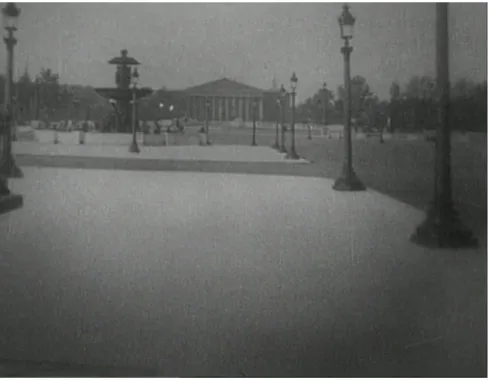
locations, Albert comes to terms with his newfound isolation. He sees the Pont Alexandre III, the Place de la Concorde, and looks from the Louvre to the Champs Elysées. He walks past La Madeleine and the Palais Garnier with no one in sight. The camera alternates between shots of the street in deep focus, which show wide boulevards and symmetric street lights receding into the horizon, and medium shots of Albert alone in the street. When walking in front of the Fontaine de la Concorde and later by the Madeleine, Albert’s figure occupies a small portion of the lower corner. The montage emphasizes his isolation and the framing scales him down. Both effects render the buildings and boulevards as well preserved monuments, even relics, primed for examination.
Figure 7. Place de la Concorde, shown motionless in a still frame.
The boulevards Albert explores were intentionally designed to prevent civil unrest in the wake of series of citizen revolts. Streets were made too wide to barricade and proletariat
neighborhoods were connected to military barracks. Furthermore, as Margaret Cohen observes, “with his grand boulevards that celebrate the spectacle of modern life, Haussmann extends into the street the celebration of the commodity fetish found in the arcades and World Exhibitions” (216). The nineteenth century monuments shown in this sequence are extensions of the
phantasmagoria. Boulevards are the product of Haussmann, the Fontaine de la Concorde and Obelisk emerged during the reign of Louis-Philippe, and the Pont Alexandre III debuted at the Exposition Universelle of 1900, an event in part designed to showcase the achievements of the nineteenth century.
Benjamin asserts that while “Balzac was the first to speak of the ruins of the
Project, 13). Clair is not a surrealist, but his small science fiction offers a similar gaze. Benjamin continues his study by noting how “with the destabilization of the market economy, we begin to recognize the monuments of the bourgeoisie as ruins even before they have crumbled” (13). If time is money, stopping time destabilizes the economy. The ray interrupts the bustle of the city and bourgeois progress of the past century. Through Clair’s montage, we can roam the
boulevards and reflect on the yet to be crumbled ruins that define the spatial hierarchy of Paris streets, where a select class exerts political and economic control over working citizens.
As Albert walks alone down an anonymous road, the film suddenly cuts to a brief montage of the city in movement. Paris jots to life as Albert recalls the city he knew. Cars rush around the Arc de Triomphe, a boat cruises on the Seine, horses and people walk the sidewalks along the Champs Élysées. Two shots place the camera on the hood of a car, highlighting the rapid urban movement before cutting back to Albert, slowly plodding along an empty road. In this sequence, as Paris is said to sleep, Albert walks through a dream world decorated with elements of the nineteenth century. From this period, Benjamin writes,
derive the arcades and the exhibition halls and panoramas. They are residues of a dream world. The realization of dream elements, in the course of waking up, is the paradigm of dialectical thinking. Thus, dialectical thinking is the organ of historical awakening. Every epoch, in fact, not only dreams the one to follow but, in dreaming, precipitates its
awakening. (13)
dream elements of the arcades because it embodies stifled collective hopes. The collective is said to sleep due to the fact that they remain unware of the utopian potential that lies on the other side of the phantasmagoric world. Benjamin defines Haussmannization as dialectic because in
bulldozing proletarian neighborhoods, the class aims of the bourgeoisie are made explicit. This can politicize and mobilize the working class, as seen in the appearance of the Paris Commune following the reconstruction of Paris. Attempts to prevent the erection of barricades result an even larger barricade. As Benjamin notes, “the Commune puts an end to the phantasmagoria that dominates the earliest aspirations of the proletariat. It dispels the illusion that the task of the proletarian revolution is to complete the work of '89 in close collaboration with the bourgeoisie” (24). The economic order is interrupted. Dialectical thinking awakens the sleeping collective by revealing a history of violence, suppression, and domination. In Paris qui dort we can see the dream elements of modern Paris as such and witness the potential for awakening which, as described by Annette Michelson, is emblematic of Dr. Crase’s blend of magic, science, and omnipotence that matches the filmmaker. His “tacit message to us is, ‘Sleepers, awake!’” (Michelson 46).
Michelson refers to the film as Clair’s “celebration of modernity” but this
characterization is limited (44). The treatment of the ray-as-camera extends only so far, and in the opening sequence their correlation is inverted. If the shock of rolling footage calls upon the spectators to awaken and become cognizant of their status as viewers of film, the ray makes such a call by freezing the public, putting the city to sleep. Only at a standstill can we see
awakening through dialectics but also understands Haussmannization as a furthering of the phantasmagoria of space in its connection to bourgeois financial speculation. Paris qui dort
Conclusion
This study argues for a reading of “Zone” and Paris qui dort as depicting the hellish underside of modernity, citing their presentation of the phantasmagoria of time and space, an emphasis on shock experience, and a focus on driving forces of domination in late modernity. Clair and Apollinaire reckon with the marvels of technological achievement, balancing the potential for liberation with a recognition of un-freedom in technical and bourgeois domination. The pre-war “Zone”, while acknowledging a disparate alienation which may expand in the looming future, offers a chance of recovery of the experience lost in industrial development. Clair’s film has no such potential. The power of the ray is a fantastical but small example of the technical omnipotence which proliferates shock experience.
Chapter One studies the erosion of Erfahrung and the proliferation of Erlebnis in both works, with “Zone” suggesting a potential for poetic recovery despite the trauma of urban development in contrast to the ubiquity of shock in Clair’s post-war Paris. In their presentations of experience, each shows the contemporary conflict between personal and standardized time which resulted following the emergence of centralized global time systems. Just as “Zone” captures an ancient religious dimension of French life that was rapidly receding from the foreground at the turn of the twentieth century, Paris qui dort is a document of urban life at a time when both film and the Eiffel tower were novel technological marvels. Benjamin’s “On Some Motifs in Baudelaire” illuminates the character of this epoch. Urban experience is defined by alienation, fragmentation, and isolation. Apollinaire and Clair succeed in doing what
Chapter Two discusses time in hell, using Benjamin’s development of the
phantasmagoria to link Clair and Apollinaire’s use of repetition and subject-object inversion. This discussion furthers Michelson’s analysis of Paris qui dort as a comic reading of Marx’s critique of alienation, extending the application of such analysis beyond Clair’s presentation of money to the parallel of wage labor and gambling. Benjamin’s formulation of time in hell grounds this connection between gambling and industrial work. Clair’s film also demonstrates a faith in industrial progress. This faith is contrasted in “Zone” by the interplay of ancient and modern. Apollinaire’s poem contains a dialectical movement of hell and utopia while showing the warped mythic desires embedded in the latest technology.
Driving forces of domination in the spatial hierarchies of late modernity are evaluated in the third chapter. “Zone” has a continued focus on elevation and Apollinaire complicates the rationality of technical progress by asserting the primacy of Christianity in contemporary
attempts at transcendence. The poem challenges the supremacy of the pope, Monsieur Eiffel, and world-class pilots, reconfiguring spatial hierarchies through what Benjamin calls the “profane illumination” which brings the illuminations of religion to the material world.