An Outreach Model for Diabetes Health Education and Prevention
for Migrant and Seasonal Farmworkers- A Program Plan and Evaluation
(“Diabetes Health Education for the Mobile Poor”)
By
Dana Iglesias, M.D.
A Master’s Paper submitted to the faculty of the
University of North Carolina at Chapel Hill in partial fulfillment of the
requirements for the degree of Master of Public Health
in the Public Health Leadership Program.
Chapel Hill
2011
_________________________________
Advisor:
_________________________________
Date
_________________________________
Second Reader:
Table of Contents
ABSTRACT ... 4
INTRODUCTION ... 5
SYSTEMATIC REVIEW ... 8
Introduction ... 8
Summary of Programs ...11
“Formando” by Cartwright ...11
“Migrant Health Service, Inc (MHSI) Diabetes Program” by Heurer ...12
Campesinos Diabetes Management Program (CDMP) by Ingram ...13
Border Health (Strategic Initiative) ¡SI!, by Ingram ...14
Analysis ...16
Conclusions ...17
PROGRAM PLAN ...18
Overview of Plan ...18
Context of Program Plan ...19
Goals and Objectives ...22
Relevant Program Theory...23
Program Implementation ...25
Timeline ...30
Logic Model ...30
Program Sustainability ...30
EVALUATION PLAN ...32
Rationale for Evaluation ...32
Approach to the Evaluation ...33
Evaluation Study Design ...35
Evaluation Methods ...37
Evaluation Planning Tables ...40
Dissemination Plan ...44
DISCUSSION...45
REFERENCES ...49
APPENDIX ...53
Table 1: Summary of Studies ...53
Table 2: Timeline ...54
ABSTRACT
The North Carolina Farmworker Health Program (NCFHP) works with the state’s networks of providers to improve the health of migrant and seasonal farmworkers. Health care providers are challenged with barriers to care distinctive to farm work. There is usually a short window of time to provide care to farmworkers before they leave the area to find more work. Daily work hours are long, most lack transportation and are unable to pay or qualify for health services. Therefore, outreach services are an important link in order for farmworkers to access health care. Farmworkers also have high rates of obesity and diabetes. Barriers to care cause them to delay care placing them at greater risk for complications. The core of North Carolina Farmworker Health Program’s enabling services is supplied by outreach workers.
Improving diabetes health is a priority for the NCFHP. The program’s outreach workers are faced with the task of delivering quality health education and meeting farmworker’s needs as they arise. The purpose of this paper is to describe the program plan and evaluation called An Outreach Model for Diabetes Health Education and Prevention for Migrant and Seasonal Farmworkers. A review of diabetes education programs targeting farmworkers and
implemented by outreach workers isolated four programs studied in the U.S. The research of existing programs and program theory influenced the final program plan and evaluation. The program plan includes a detailed program plan and evaluation plan, explaining how it fits into the existing components of diabetes education offered by NCFHP. Likely the best implemented plan will include a curriculum implement by outreach workers consisting of multiple diabetes health education sessions. The challenges are implementing this with available staff and how to best evaluate outreach workers and farmworkers after education is delivered. A well
INTRODUCTION
The North Carolina Farmworker Health Program is a voucher program created in 1993 with the purpose of working with local area provider networks to improve the health of migrant and seasonal farmworkers and their families living in North Carolina 1. Voucher programs are needed in areas where migrant health centers are absent. Based on the traditional model of health delivery, needy areas may not meet federal qualifications to establish a migrant health center. Reasons these areas may not meet these qualifications include lower numbers of farmworkers spread over larger geographical areas, shorter harvest seasons for migrant farmworkers in the area, or providers not willing or able to act as a direct grant recipient 2. If other clinical providers are available to offer health care services, then a voucher program can be established to meet the health shortage. Hence, voucher programs are formed in areas where needy populations are less concentrated or more sparsely dispersed and local area providers are willing to meet the need, but do not have the means to do so.
Federal funding from the Bureau of Primary Care supports 18 voucher programs across the United States 2, 3. The North Carolina Farmworker Health Program is the only voucher program in the state. The program supervises funding for twenty-four health care and dental sites 1. The central office staff manages program activities of supervision, funding distribution and technical assistance for these sites. Locations are funded based on the area’s need for farmworker health services and a clinical site willing to provide care. Funded sites are paired with outreach workers who serve as the main force of the program connecting farmworkers to health care services.
The North Carolina Farmworker Health Program serves as an important link to
farmworkers are poor and uninsured. Work is rarely constant, year round. Only eight percent are covered by employer based health insurance. Ten percent of farmworkers’ children are insured. Health centers and clinics provided care for about 700,000 farmworkers and their families in 2002 4-6.
Due to barriers of language, cost, and mobility, obtaining timely and consistent health care is often challenging for farmworkers and their families. Compared to the overall United State population, migrant and seasonal farmworkers earn less, are more likely to be uninsured, and report lower utilization of health services. Their limited use of health care is proportional to their overall health quality. Migrant and seasonal farmworkers experience adverse health outcomes of low birth weight, perinatal complications, increased risk of injuries and pesticide exposure 4, 5.
Community based outreach services offered directly to farmworkers address barriers of access, language and culture 7, 8. Outreach workers in the North Carolina Farmworker Health Program supply the necessary support for farmworkers to access care by visiting migrant
camps, performing health assessments, providing health education and referring to clinical care, including case management when needed 6, 9.
The majority of farmworkers in the United States are Hispanic, and this population is more likely to be obese and have higher rates of diabetes. However, the exact numbers of diabetic migrant and seasonal farmworkers is not known. Additionally, the barriers to care described above make farmworkers more likely to delay care and endure complications from diabetes 10-12.
farmworkers and health outcomes11. Currently the program provides health education as needed to diabetic farmworkers and to those at risk for diabetes. The current components for diabetes care include assessing body mass index and asking farmworkers if they are diabetic or would like to be tested for diabetes. After the assessment, outreach staff decides whether or not to provide diabetes health education. Additional sessions of education are performed as needed. Referrals and clinic appointments are scheduled based on initial assessment. These steps can be tracked on paper or in the program’s electronic health record called FHASES (Farmworker Health Administration System Electronic Services).
Diabetes support and training for the program’s outreach workers includes: educational modules on diabetes care with a pre and post-testing, technical support, program website accessible diabetes resources and presentation sessions given at North Carolina Farmworker Health Program trainings. Currently tracking is not performed for the diabetes module or for program trainings.
A program plan and evaluation called an Outreach Model for Diabetes Health Education and Prevention for Migrant and Seasonal Farmworkers has been created. This integrates elements of the current program curricula with additional components for more effective diabetes health education. This will be applied to all North Carolina Farmworker Health
Program sites currently using outreach workers and performing diabetes care. The goal of the program is to implement a community model of health education utilizing outreach workers to improve the detection, reduce complications and delay illness onset of diabetes in the migrant and seasonal farmworkers served by the North Carolina Farmworker Health Program.
second section provides details of the program plan, rationale and implementation components. The evaluation plan describes the overall approach, methods and detailed plan for evaluating this diabetes program plan. A final discussion will bring all parts together, analyzing the program plan and evaluation, and considering next steps for this diabetes health education program.
SYSTEMATIC REVIEW
Introduction
Outreach workers are vital link for the delivery of health care to farmworkers. In order to link migrant and seasonal farmworkers to care, outreach workers provide education on
prevention, health illness, occupational exposures, and available community health resources. Particularly for diabetes care, management and education outreach workers can serves as an important bridge between the health and lay community13.
I completed a systematic review of the available literature for diabetic education and management programs, implemented in the migrant and seasonal farmworker population and utilizing outreach workers (also known as lay health workers/educators, promotores (as), and community health workers, CHWs in this review). The review produced literature of diabetic education programs employed by outreach in the African American, Hispanic, Latino, rural and border communities. Programs servicing the farmworker population were isolated. Four programs specializing in migrant and seasonal farmworker populations were identified and will be discussed.
education (DSME). These organizations discuss specific recommendations relating to diabetes care and community health workers.
As a leader in public health surveillance the CDC has developed the Division of Diabetes Translation (DDT) which summarizes the current and emerging body of literature and serves as a facilitator for community health worker projects to reduce the burden of diabetes across the United States. The CDC has also created the first database for community health worker programs, the Combined Health Information Database (CHID). The DDT emphasizes the benefits of community health workers and promotores for “high talk” not high tech efforts in social support, outreach, care coordination, community mobilization and education13. As community members working almost exclusive in the community setting, CHWs serve as bridging networks to strengthen existing health care systems. The CDC describes community health workers as uniquely different. They “live in the communities in which they work,
understand what is meaningful to those communities, communicate in the language of the people, and recognize and incorporate cultural barriers (e.g., cultural identity, spiritual coping, traditional health practices) … and promote health outcomes” 13, 14.
The CDC serves as a platform for effective community based community health worker resources and program development in diabetes management and education. The review of program interventions completed in 2003 includes projects for various populations (African American, American Indians, Spanish speaking, Alaska Natives and Brazilian populations), lasting six months to two years and implemented in the united states from 1998 until 2003 13.
1- Support of CHWs and suggest integrating them into diabetes health care teams and programs
2- Creating educational opportunities for CHWs through ongoing technical assistance and diabetes training
3- Acknowledge the contribution of CHWs in educating health care providers about a community’s needs, relevant interventions, and cultural competence
4- Promote sustainable CHW models, applying the seven core services provided by CHWs (described in the National Community Health Advisor study) for CHW-related programs and support evaluation of CHW models for diabetes prevention and care
5- Increase the engagement of CHW theory and practice to strategically reduce and eliminate health disparities by use of databases, best practices and educational networks13.
The American Association of Diabetic Educators (AADE) recognizes the complexity of causal factors influencing diabetes, care management and the need for multiple interventions for education, social support and community programming. Community health workers are seen as unique connectors in the system of diabetes educational support. The following are the AADE’s five positional statements on CHWs and DM education:
1- Diabetes educators and other health care professionals should support the role of CHWs in serving as bridges between the health care system and people with and at risk for diabetes
2- Diabetes educators and other health professionals should support the role of CHWs in primary and secondary prevention
3- CHWs should receive effective training in core diabetes skills and competencies 4- There should be reciprocal exchange of information and support between CHWs and
the health care team to facilitate the best outcomes for people with and at risk for diabetes
Summary of Programs
The reminder of this summary will focus on community based programs for diabetes management targeted to the farmworker population directed by outreach workers or community health workers. Four studies met these criteria. Additional studies fulfilling the criteria of diabetes educational programs in populations and communities similar to the farmworker community (border populations and Latinos) were excluded as it was not clearly stated whether or not the studies included a farmworker population.
“Formando” by Cartwright
Cartwright, et al used a community-based participatory research study model to
investigate an intervention for type 2 diabetes in Hispanic female farmworkers and their families in southeast Idaho. Study subjects with at least one diabetic family member were included in this five year program. The researchers targeted female farmworkers based on their assumed cultural family role as the one in charge of food preparation and changes in the quality and quantity of food consumed 16.
Only the first year of results are reported. The research goal was to increase understanding, prevention and care of diabetes in farmworkers and their families. The intervention named “Formando” included home visits delivered by promotores for all family members, twelve years of age and older, wanting to participate in the program. Visits included objective parameters of fasting blood glucose, blood pressure, height, weight and body mass index (BMI) and discussion of this information. Local terms and culturally specific explanatory models were used to explain the origins of diabetes and treatment. The implemented
including clinic appointment arrangement and interpretation at clinic visits, and they also completed interviews for the research study if needed.
The ”Formando” model provided education and served as exploratory research into farmworkers’ view and cultural understanding of the diabetes process. Therefore the results provided are objective parameters (glucose, BP, height, weight and BMI) and qualitative data informing researchers of the farmworkers’ perceptions of diabetes. The “Formando” reported fasting blood glucose levels to be more elevated as age increased.
Qualitative results identified perceptions contrary to true nutritional health regarding thinness, the meaning of foods, the meaning of fullness, and how food is contextualized during social events and family meals. Individuals with type 2 diabetes did not discuss their disease within the family even if other family members were also diabetic. Researchers viewed this lack of inter-personal communication as a barrier to overcoming true modification in meal
preparation and physical activity. Many farmworkers interviewed recognized folk illness as the cause of diabetes, but were willing and able to understand biomedical causal pathways of diabetes integrating this into their ability to control its symptoms with exercise and diet 16.
The patient population presented challenges to the program. Working with a transient people resulted in an under-representation of farmworkers in the total database. It was difficult to contact families who did not have permanent housing in the area16.
“Migrant Health Service, Inc (MHSI) Diabetes Program” by Heurer
Heurer et al designed a Diabetes program within Migrant Health Services, Inc (MHSI) and its diabetes registry. MHSI includes nine health centers and reported information from 2000 to 2002. All patients were Hispanic migrant farmworkers. The MHSI Diabetes program
program model. DLEs and professional health staff from MHSI were used to implement the five program goals: provide diabetes screening and education for all MHSI patients including its diabetic patients; identify patients with diabetes and obtain a baseline assessment; improve the quality of care and continuity of services provided by MHSI; and evaluate the development and implementation of the Diabetes program17.
The Diabetes lay educators received annual formal diabetes trainings (a 2 day course) and monthly one day sessions. Their responsibilities included: language interpretation; case management; advice and advocacy; and scheduling clinic appointments and facilitating diabetic support sessions. Additionally they completed home visits to personalize and reinforce
information received at clinic, ran support groups and facilitated patient follow and referrals.
Quantitative data were obtained from systematic medical chart audits from the MHSI diabetes registry. Health parameters were reported for the two study period. The number of farmworker patients not receiving at least one HgbA1C significantly decreased over two years, from 40% in 2000 to 6% in 2002. Assessments of co-morbidities and complications related diabetes also significantly increased during the study period17.
Another program goal was to educate program staff on diabetes care in the Latino farmworker culture. This education was presented to health care providers and medical staff at regional conferences. Clinicians at these conferences were open and willing to learn more about the unique aspects of caring for diabetic farmworkers. The MHSI diabetes coordinators and other coauthors have worked to share their overall research with the research community17.
Campesinos Diabetes Management Program (CDMP) by Ingram
describe a promotora directed intervention for diabetes care and evaluate outcomes. The program’s intended effect is to improve self efficacy behaviors by building social supports.
Promotores facilitate this community based intervention through support groups, home and hospital visits, phone support and advocacy. The core activities are weekly or biweekly support groups facilitated by the promotores. In the support groups, promotores provide information, build shared empathy and help to create a network of support. The program was implemented for two years, but the data were reported for the first year of participation. Seventy farmworkers participated during routine physician visits. Pre and post tests were completed to investigate the relationship between promotora contact, perceived support and clinical
outcomes18.
Border Health (Strategic Initiative) ¡SI!, by Ingram
Ingram et al investigated the implementation of a diabetic patient education program lead by community health workers called the Border Health Strategic Initiative working with farmworkers in Yuma and Santa Cruz counties of Arizona. This culturally relevant diabetes outreach educational program is a five week series of diabetes education classes. The goal is for farmworker participants to gain knowledge and the skills needed to become physically active, control diet, monitor blood sugar, take medications and become aware of the potential for disease complications.
changed from “ignorance and fear to acceptance and control.” These attitudes are thought to be critical to improving emotional wellbeing, regardless of the farmworker’s self management practices12.
For both study groups in Yuma and Santa Cruz counties, results for random blood glucose, HgbA1C and blood pressure were most significant for high risk participants at the 6 month study mark. High risk individuals had a HgbA1C greater than 6.9. Random blood glucose was reported for Santa Cruz not HgbA1C; these levels were significantly decreased at 6 months, changing from 225.9 mg/dl to 159.6 mg/dl. Although modest, the HgbA1C levels for Yuma were significantly decreased at six months (HgbA1C from 9.4 to 8.7 or random glucose level of 246.6 to 212.0). Blood pressure in both groups significantly decreased. Systolic blood pressure decreased by 14 mm Hg and diastolic blood pressure by 10.3 mm Hg in Santa Cruz. In Yuma systolic blood pressure decreased by 13.5 mm Hg and diastolic blood pressure by 15.1 mm Hg.
Additionally, significant improvements were noted for self reported diabetes self management outcomes. The Santa Cruz county participants demonstrated increases in self management across all measures (regular exercise, follow diet, check feet regularly, monitor blood sugar, ever had HgbA1C, know HgbA1C level and ever had eye exam), however the only significant parameters were for follows diet and check feet regularly. Yuma county participants showed a significant increase for all self management measures. The Santa Cruz study group had a smaller number of participants than the Yuma group, 135 compared to 306 for health measurements of glucose, HgbA1C and blood pressure and 40 compared to 243 respectively for self management measures12.
improvement in diabetes self management for farmworkers. It is unclear why the two groups had discrepant results for health measurements and self management parameters. Of the four studies review, this is the only on which measured and reported outcomes. Therefore, this study gives the strongest support for an outreach worker led diabetes education program.
Analysis
All four studies contribute to the understanding and development of diabetes educational programs used in the community setting. Each study applied different health educational
curriculum, had different study durations and outcomes measures. Many of the quantitative measures were similar: monitoring HgbA1c, weight, height and BMI. Some additionally collected blood pressure measurements on farmworkers.
The studies are not comparable due to these various differences. Although the curricula are all different, they are generally described as diabetes education programs or self
management for farmworkers. They all required multiple sessions for program completion. The Ingram study utilizing the Campesinos Diabetes Management Program included twelve
sessions. The other Ingram study, Border Health !Si!, had at least 5 sessions for farmworkers with some groups completing more sessions. The other two studies did not quantify the amount of sessions completed; the Cartwright study with multiple visits over 2 years and Heuer with multiple visits during 5 years.
Lastly a consistent observation of all four programs is the multiple responsibilities required by outreach workers. They are involved in diabetes self management education, organizing and leading support groups, providing transportation, language support, advocacy, arranging clinic appointments, case management and follow up and in some cases collecting study interviews and data. It is possible that this highly mobile population requires a primary entity to manage their many social needs. However, when developing a diabetes educational curriculum the outreach workers’ roles should be clearly delineated. Components of an outreach led diabetes education program should include details of their education curriculum and their specific responsibilities for the program.
Conclusions
In conclusion, an outreach worker (lay health educator, community health worker, promatora de salud) implemented diabetes program will be most successful if part of a larger system to integrate farmworkers to clinical care and diabetes management. The diabetes program should also include a specific course for lay health educators in order to effectively educate farmworkers. The explicit job duties of the outreach worker should be clear and
focused for the program. Lastly the curriculum should include multiple sessions for farmworkers to adequately gain diabetes self management knowledge.
PROGRAM PLAN
Overview of Plan
The North Carolina Farmworker Health Program (NCFHP) is a statewide Migrant Health Voucher Program within the Office of Rural Health and Community Care, North Carolina
Department of Health and Human Services. Its mission is to ..."work with a statewide network of service providers to improve the health of migrant and seasonal farmworkers and their families in the state". NCFHP works with local agencies in response to gaps in health care that would otherwise prevent farmworkers from accessing needed care. The program currently extends support to 54 counties in North Carolina 1.
This particular model relies predominately on enabling services, including outreach, case management and health education. Outreach workers provide most of these services for
NCFHP. An outreach model employs the use of persons who are culturally and linguistically skilled to address needs at farms and farmworker camps which serve as the local points of contact throughout North Carolina. Outreach staff perform health assessments, provide health education and assist with medical encounters. Their duties also include identifying farmworkers at risk for environmental and occupational health exposure, identifying workers in need of medical care, providing interpretation and transportation services, and providing health
education. Despite the challenges and barriers to care for farmworkers, the NCFHP provides a model of care best suited and adaptable to the migratory nature of their life and work.
affected by type 2 diabetes. The additional barriers to care experienced by the farmworker population make prevention, treatment and management of diabetes more challenging 10, 11.
Context of Program Plan
Consistency with local, state and national priorities, financial resources, and stakeholders
Farmworker health is a priority for the federal government as demonstrated by funding beginning in the 1990s for migrant health centers and voucher programs. HRSA directly supports 156 Migrant Health Centers across the country 2, 3. Additionally HRSA collaborates with the following local service organizations: Farmworker Justice Fund, Farmworker Health Services, Migrant Clinicians Network, Migrant Health Promotion, the National Center for Farmworker Health, and the National Association of Community Health Centers.
In North Carolina there are about 15 migrant health centers serving farmworkers. Many local organizations supported by HRSA assist in supporting North Carolinas health centers and farmworkers. Currently outreach programs in the state receive funding from HRSA and non profits 4.
Healthy People 2020 recognized the need to address diabetes prevention and
management. Disparities in diabetes risk and barriers to care are identified as problem areas requiring efforts to reduce disease burden. As a whole, minority populations are affected more often by diabetes. Twenty-five percent of adults with diabetes are minorities. The majority of children and adolescents with diabetes are minorities 19.
effective self care, promote centered care and lifestyle change, improve quality and access to care and reduce disparities.
Similarly Healthy Carolinians 2020 identifies diabetes as a disparity and important public health problem. Obesity is also named as a major public health concern. African Americans, Latinos, individuals with lower income, and lower education are more commonly overweight or obese; and Healthy Carolinians suggests strategies to reduce obesity 20, 21.
Technical feasibility
Limited funding for outreach in many clinics puts a burden on the few available workers to provide services and support for farmworkers spread over varies counties. In North Carolina services provided by outreach staff to farmworkers are reimbursed and covered mostly by state and federal funding sources. Funding for continual education and trainings are available consistently, but in lesser amounts compared to other program areas.
As recipients of health services farmworkers have been receptive to cultural and linguistically appropriate health programs. Programs throughout the state of North Carolina employ the use of outreach education and services to increase acceptability and accessibility of clinical and public health resources. Some of the programs operating regionally include: Promotores de Salud on HIV/AIDS prevention, Project Clean Environment for Healthy Kids, the Camp Health Aide program, the Colonia Health Worker Program, the Inf´ormate Teen Health program, the Salud Para Todos program, and the Farmworker Doula program. Additionally MHC and CHC in the state rely on the assistance of outreach to identify and mange the care of farmworkers.
(UDS). The value of medical services is evaluated in a medical quality review of services performed at clinical sites. Voucher programs utilize outreach for most of its services whether enabling or medical. Migrant health centers also heavily rely on outreach, but it may be more complex to isolate services provided by outreach when evaluating utilization and quality.
Many outreach programs serve farmworkers and their families; however few have completed formal evaluation of their program’s efficacy. Even less information is available on the tracking of programs to identify program turnover and program replication.
Political environment
Health care accessibility, affordability and appropriate utilization are all encountered daily by public health professionals. The challenge and current question of debate is how to provide care and how much should it cost. America’s political environment surrounding the creation of the current legislation, Patient Protection and Affordable Care Act (PPACA), highlights how difficult it is to provide care for a nation and decide collectively on a system for the provision of health care. PPACA offers a more comprehensive health care system.
In applying this new comprehensive health care, farmworkers have been left out of the discussion. At times, the context regarding migrant and seasonal farmworkers becomes confused with the nations’ immigration problems. The word migrant is confused with immigrant. Some assume all migrant farmworkers are immigrants and shift the problems of health access to the arena of citizenship causing distraction.
the remainders are citizens of the United States. Although some farmworkers are US born and others are not, their health problems of access difficulty and poor health are similar. All
farmworkers face the same challenges regarding their health as other disparity groups. This is a tenuous time to bring attention to farmworkers, however also an important opportunity to
address health care access and disparities in health care 5, 22.
In a growing undercurrent to increase health care access and improve health disparities through research and collaborations, farmworkers are an optimal population for understanding such disparities. Programs should be prepared to include farmworkers in proposals for funding in disparities research, and culturally competency delivery of care. Farmworkers should be included in opportunities for improved care coordination projects such as the Patient Centered Medical Home (PCMH). These programs require the use of care managers to most effectively utilize services and access, which is similar to the services provided by outreach.
Goals and Objectives
Program Goal: Implement a community model of health education utilizing outreach workers to improve the detection, reduce complications and delay illness onset of diabetes in the migrant and seasonal farmworkers served by the North Carolina Farmworker Health Program (NCFHP).
Short-Term Objectives:
1. Improve baseline knowledge of outreach staff of diabetes education, management and prevention over the next two years.
2. Provide two training sessions focused on obesity/diabetes care over the next two years. 3. 60% of outreach staff will attend obesity and diabetes specific training sessions annually. 4. 60% of outreach staff will complete the NCFHP diabetes modules annually.
5. Increase and improve accessible web-based resources for obesity education and diabetes care/self-management for outreach staff on NCFHP’s website over the next two years. 6. Explore providing diabetes management education at outreach sites over the next two
7. Increase utilization of on-site clinical care and increase referrals to clinical services for diabetic farmworkers served by NCFHP.
Long-Term Objectives:
1. Increase farmworkers’ knowledge of obesity and diabetes (healthy eating and physical activity).
2. Improve diabetes care and outcomes for migrant and seasonal farmworkers.
Relevant Program Theory
An ecological framework helps to identify key interactions and critical challenges present in developing a diabetes health education program for migrant and seasonal farmworkers. I will review this multilevel approach by its different levels: intrapersonal, interpersonal, and
community (including institutional and policy) and examine the factors most vital to creating an effective health education program for diabetic farmworkers.
On an individual level, farmworker’s knowledge, attitudes, and beliefs will influence the overall effectiveness of any diabetes education program. The Theory of Planned Behavior (TPB) model integrates culture and personal environment into the educational learning theory which is critical for farmworkers. The farming environment is distinctive from most populations; many live in migrant camps, which mean living on or near the land in which they work. Some seasonal workers live with their families in privately owned residences. The culture of farming and culture in relation to their country of origin can affect how these workers and their families understand diabetes 23, 24.
beliefs and perceived power will play an integral role in motivating farmworkers to action in their diabetic self care 23, 24.
The Health Belief Model is another model of health education promotion which can be applied to the migrant and seasonal farmworker population for diabetes education. This model can work as a guide for both short and long term behavior change. Some outreach workers only have one contact with a farmworker. Short and focused health motivation is well suited to address necessary behavior change for reducing diabetes risk and preventing worsened disease for this mobile population. Addressing diabetes education from the family and not the individual perspective may be one of the best ways to educate farmworkers about diabetes, especially Latino farmworkers with a strong sense of family connectedness and responsibility. Identifying persons who put themselves and their family at risk due to unhealthy eating and physical activity will better focus the model and produce a more effective model theory 25.
At the interpersonal level of the socio-ecological structure, the focus changes from the individual to relationships and the surrounding influences affecting one’s understanding of health and contributing behavior. The social cognitive theory can be used to appropriately create health behavior change among diabetic farmworkers. This theory acknowledges that environment, behavior and personal factors all influence each other in health problems. For diabetic farmworkers there are many facets to their risk for disease. Demographic variables such as ethnicity and simply being a farmworker, the migratory nature of farmwork, stressful conditions place and other known or unknown personality traits all affect the development of diabetes. Considerations for all of these factors are important in creating education through the social cognitive theory model. The SCT is the underlying theory for dietary change and can be utilized in creating an effective program for diabetes self management. Additionally
challenged with diabetes. Outreach workers can model positive behaviors associated with diabetes such as healthy eating and exercise in the farmworkers’ social environment 23-25
.
Lastly, the community level dynamics affecting migrant and seasonal farmworkers with diabetes are varied. Some environment and political factors include: dependency on farmers and crew leaders due to language barriers, limited income and little knowledge of the
community and awareness of resources; poor living conditions; strenuous work conditions; immigration issues for undocumented farmworkers; and inadequate health care coverage. Programs utilizing outreach workers to educate workers on diabetes will likely include elements of advocacy and legal rights education.
There are a number of factors that make providing health education to migrant and seasonal farmworkers uniquely challenging. However, programs integrating multiple learning theory models will be best suited to create lasting behavioral change. Lastly, organizations working in conjunction with educational programs can help alleviate some of the deep political and systematic strains experience by farmworkers
Program Implementation
Target audience for the program
The North Carolina Farmworker Health Program’s Health Care Plan and clinical measures sets the health priorities for the program’s enabling and medical care services. These health measures are influenced by and in agreement with HRSA’s core measures. Diabetes care is identified as one of the HRSA core health measures for chronic disease management. Recommended ages for monitoring are persons 18-75 years old with type 1 or 2 diabetes mellitus.
Medicaid Services (CMS) in its quality measures. Adults older than 18 year of age should receive screening for obesity by checking: weight, height and calculating body mass index (BMI). Additional follow up should be planned for those who are identified as overweight or obese.
In 2009 NCFHP served 11,133 farmworker patients, and 6,466 received enabling
services. The program would expect to support the same number of patients in the coming year and increase the number of patients identified and assessed in the next year. About 360 of these farmworkers were diabetic.
Program Infrastructure
The current infrastructure for assisting North Carolina’s migrant and seasonal farmworker with diabetes is the state’s Migrant and Community Health Centers, Health Departments, Rural Health Centers, and Free Clinics. As a statewide migrant health voucher program the North Carolina Farmworker Health Program (NCFHP) serves farmworkers throughout the state in areas with limited access to health centers and clinics. The NCFHP began in 1993 with supporting funds from the Bureau of Primary Health Care, and current support for the program is provided by similar federal and state grants.
NCFHP funded healthcare and dental services cover 61 counties in the state of North Carolina. The NCFHP administrative central office overseas its grantees offering program support, grant guidance, financial and clinical care service audits, and technical assistance.
NCFHP sites completing medical care encounters are required to track and report on HRSA’s Core Health Measures and Health Care Plan Measures. Additionally, sites are responsible for documenting and tracking enabling encounters administered to farmworkers at migrant camps.
Enabling services are any service which facilitates a farmworker to improved health. These services include: health education, outreach support and care management. Outreach workers supply the support, knowledge and advocacy necessary for migrant and seasonal farmworkers to receive quality care. Educational and technical support for the outreach staff is administered by NCFHP’s central office. The central office staff is comprised of the program director, medical director, three program consultants and one program assistant.
Program consultants and the medical director offer expertise on various health topics, behavioral health education and other educational models and strategic problem planning for sites. Consultants also work with local organizations serving farmworker’s needs through advocacy, research, and educational planning. All NCFHP program staff collaborates on all projects provided by the program, this includes the diabetes care management and the supervision site providing this care.
Programmatic Activities
additional models of diabetes education delivered by outreach workers which can be used by the program, survey outreach staff to improve the delivery of care, explore implementing a diabetes education program at a few select sites and survey farmworkers for knowledge gained from diabetes education delivered by the program’s outreach workers.
NCFHP’s current resources for diabetes education include a diabetes self-study module and the Enabling Services Outreach Manual (sections directly addressing diabetes care are in managing health protocols and procedures and advanced health screening, Chapter 5). Currently it is unclear how and if staff at using these tools. The diabetes self-study module created by NCFHP provides an adequate overview of diabetes. The program should require current and new staff to complete this module as a part of outreach training. If required this would provide a basic standard of knowledge for all NCFHP outreach workers. The program will also have to consider how completion of the module will be tracked. Currently a pre and post-test is provided with this diabetes module. Individual sites could review the post-test with current and new staff to verify completion. This paper record could be maintained as a record of completion, held at the sites.
Migrant Clinicians network, National Center for Farmworker Health, Migrant Health Promotion, Robert Wood Johnson Foundation-Diabetes Initiative, and the CDC’s Division of Diabetes Translation are potential resources for the care of diabetic farmworkers in an outreach setting. Over the next year NCFHP will continue to research these and other effective
Additional education support focused on diabetes care for farmworkers can be offered during outreach trainings during the next year. This will give supplementary education for a more a complete understanding of obesity and diabetes for outreach staff. Educational models and tools focused on behavior change around nutrition and physical activity will increase the fund of knowledge for outreach staff and better equip them for their work at migrant camps.
Some of the challenges in providing educational support to outreach workers are time and location; staff performs outreach all across the state of North Carolina and work year round. Outreach workers are together during outreach trainings that occur about three to four times annually. The expertise of specialist in diabetes and migrant and seasonal farmworkers such as nutritionists or diabetes educators could be recruited to provide additional perspective of chronic disease management for this special population. Continuing education that is concise,
accessible, practical and immediately applicable is the most meaningful to outreach staff.
Identifying gaps in areas of knowledge in providing health education is a challenge. A staff survey examining barriers to providing diabetes education and exploring motivators or inhibitors may help to address deficits in outreach staff comfort and efficacy in providing education. A focused staff survey can also help to seek out tools and resources staff currently utilizes to strengthen overall program knowledge. Within this survey staff will be asked about willingness and capacity to implement a diabetes self management program. Ideally this will include multiple sessions. Sites will be most challenged with consistent farmworker attendance at sessions. Considering who will deliver these sessions and how to best implement them will be important planning ahead of time.
screened for diabetes and also provide education and referrals. These outreach encounters are tracked on paper and in the electronic tracking record provided by the program called FHASES. The North Carolina Farmworker Health Program tracks all encounters and services provided by outreach workers. However, currently the program does not individually track assessment, education and referral for obesity and diabetes. In order to understand the program’s resources and outreach time utilized for obesity and diabetes, it will be recommended for this to be
itemized and tracked.
Timeline
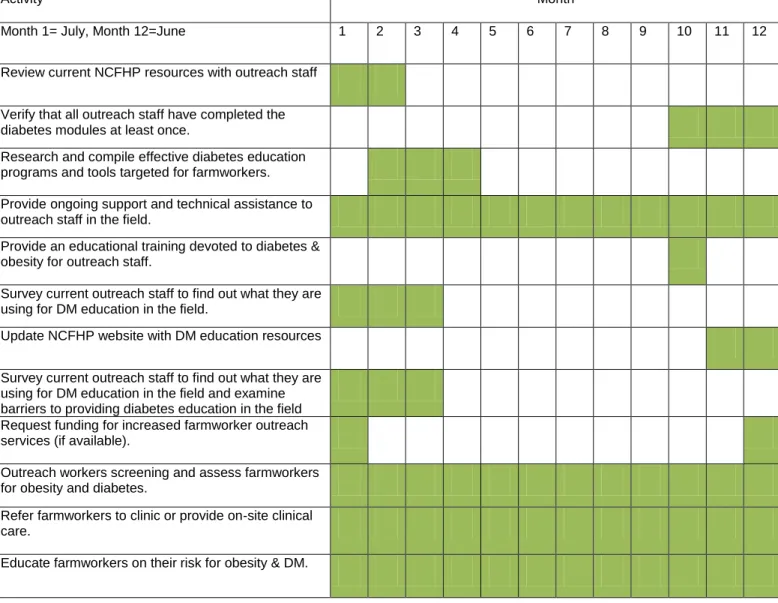
Timeline (Table 2) starts at the beginning of program implementation in July and establishes activities for the first year.
Logic Model
See Table 3 for the Logic Model for An Outreach Model for Diabetes Health Education and Prevention for Migrant and Seasonal Farmworkers.
Program Sustainability
Continual funding for the NCFHP comes from federal grants through HRSA and the Bureau of Primary Care. Additional state appropriations support fee-for-service payments. Fee-for-service payments reimburse for individual primary and specialty clinical care for farmworkers across the state of North Carolina. Total programmatic funds are used for all NCFHP programs activities. Monies are secured for this fiscal year and are not guaranteed for the next year, but have been consistently granted for the last nine years through HRSA. In the last two years, additional funding was acquired from the American Recovery and Reinvestment Act (ARRA). Most of this funding has been used for direct medical and enabling services.
resources are used to supplement existing health care through medical and dental contracts, fee-for-service reimbursement contracts and outreach enabling services.
Overall the NCFHP has a high level of sustainability. Since the program’s inception in 1993, it has been able to maintain federal funding year to year. With existing funding, NCFHP is able to maintain its staff and program activities, thus continuing focus on the program’s priority of improving the health of North Carolina’s migrant and seasonal farmworkers and their families.
Current funding includes a Bureau of Primary Care grant which supports medical and enabling services provided at contract sites; an ARRA grant for increased services and new access points; a state and federal grant for pharmacy assistance (340b drug pricing program); and a Blue Cross Blue Shield of North Carolina Foundation grant for an enabling measures initiative. Over the next fiscal year all the above listed funding sources are expected to continue. State government funds are the only secured monies which may be reduced or eliminated due to state budget limitations. A reduction in state funds would restrict fee-for-service voucher reimbursements for independent sites providing primary and specialty care to farmworkers. The 340b program will continue. State funds were used to initiate the program but federal funding through the NCFHP currently supports the 340b program.
EVALUATION PLAN
Rationale for Evaluation
Diabetes health education is one of many activities provided by the North Carolina Farmworker Health Program outreach workers. The obesity and diabetes education health education performed by outreach workers does not have an evaluation component. The
program tracks the number of encounters completed and services provided by outreach, but the quality of health education is not evaluated. This evaluation plan will address questions
regarding diabetes and obesity education and will focus on implementation and outcome evaluation.
Outreach workers provide a multitude of services in order to assist farmworkers to improved health. Health education is an intricate part of the program and can be delivered in many different ways. The addition of an evaluation component will supply beneficial information to the North Carolina Farmworker Health Program central office staff, outreach workers and clinical sites implementing the program over the state. Understanding whether or not the program is being implemented as it was intended is the important first step before moving on to outcome evaluation. Implementation evaluation will help set consistency in the education provided to all program outreach workers. Identifying the most functional processes in obesity and diabetes health education for NCFHP’s outreach workers will provide a wealth of
information for future program improvement.
Approach to the Evaluation
The primary reason to evaluate this program addressing diabetes prevention and care for migrant and seasonal farmworkers is to determine whether or not it is adequately working towards its goals. This implementation evaluation should monitor progress towards the program objectives.
The role of an evaluator is to understand the key components of the program, the stakeholders, and how the program is currently being implemented. The key concepts
necessary to evaluate this program involve: understanding the working and living conditions of migrant and seasonal farmworkers in North Carolina and how they affect health and health care delivery; HRSA designations of migrant and seasonal farmworkers; understanding the specific barriers to care for MSFW; understanding how outreach workers are utilized is this public health program including the benefits and limitations of outreach care; and understand how voucher programs facilitate care for farmworkers. Evaluation skills key to this program include comfort with qualitative and quantitative data collection and analysis, experience in evaluating health education programs, effective communication with various stakeholders, and cultural
competency.
The program would benefit from either an internal or external evaluator. An internal evaluator would be an asset since this person will have a clearer understanding of the
Outreach staff serving migrant and seasonal farmworkers work in counties across the state. The program reach makes it beneficial to use an internal evaluator who can work seamlessly between different sites and who is known by staff.
However, since staff is spread to far over the state, if program funding allowed, this may be an opportunity to utilize an external evaluator to provide a broad outside perspective and freedom to adequately visit as many sites as necessary for a thorough evaluation. Focused time and skill will be important for sufficient program improvement. Obtaining an external evaluator with expertise in migrant and seasonal farmworker populations would be preferred.
The stakeholders include: program outreach staff, North Carolina Farmworker Health Program central office staff, advocacy agencies and farmworkers. All groups have some similar and contrasting perspectives concerning the health of North Carolina’s migrant and seasonal farmworkers.
education and care for all sites. Central office staff is also concerned with identifying more farmworkers in need of health care and comprehensive care delivered by the program.
All stakeholders could be involved in the implementation and outcome evaluation of the farmworker obesity and diabetes health education program. This includes involving
farmworkers in the evaluation process. All stakeholders should be take part in evaluation design, methods and developing questions for the evaluation. Discussion with all stakeholders about the evaluation results will provide critical insight on how to use this final data.
Contribution from all parties involved in the program plan will allow for complete evaluation.
The challenges already encountered by outreach staff will likely affect evaluation of the program. More than half of the farmworkers in this state are migratory. This means many are seen only one time a season. These same farmworkers may not migrant through North
Carolina the next year. Outreach staffs visit farmworkers at farms or migrant camps located on farms. Most visits occur in the evening hours. This also limits the quantity of education
farmworkers receive.
Lastly, the societal view of migrant and seasonal farmworkers and legal problems associated with undocumented individuals may make farmworkers resistant to stranger and outsiders asking questions.
Evaluation Study Design
The best way to evaluate this program will include a mixture of quasi-experimental and observational study designs. This will help to better understand the overall program
serve as the basis for the evaluation planning using goal based evaluation. Program plan fidelity will be measured by the logic model’s program activities, outputs, short-term and long-term objectives. Within this goal based evaluation design, qualitative and quantitative
observational data collected will help the evaluate progress towards program short and long term objectives. Quantitative data will include the number of outreach staff completing diabetes modules. These modules also include post testing to evaluate knowledge gained from this education module. Outreach staff will be surveyed to find out what they are using, in practice, for diabetes education. They will also be observed performing obesity and diabetes health education.
Outreach training will include qualitative data collection of the outreach worker’s learning experience during the training. Outreach staff will also be interviewed to explore implementing more intensive diabetes management curriculum, including multiple sessions with the same farmworkers to improve diabetes knowledge.
The outcome evaluation will focus more on observational and quasi-experimental designs to look at program effectiveness. Quantitative data will track the education delivered to outreach staff and services outreach staff performs on an annual basis.
called FHASES, year to year. The number of participants will be compared with the number of health education sessions for obesity and diabetes and the number of referrals related to these diseases. Additionally identifying and distinguishing the number of migrant farmworkers from the number seasonal farmworkers will be important because migrant farmworkers are markedly more transient and less likely to receive full program services compared to seasonal
farmworkers. This will help match the number of program contacts with the type of farmworkers served in progress towards program goals.
Evaluation Methods
Informal observation will give the evaluator and opportunity to see outreach diabetes health education in practice. This will give context of how education is performed and a picture of the setting for typical farmworker health provision. Observation will also provide a quality view of health education for obesity and diabetes.
On-line and paper surveys will inquire about outreach workers’ current use of obesity and diabetes health education. Questions will ask how frequently health education is offered to farmworkers, gauge overall comfort with the knowledge to perform education, and explore facilitators and barriers to completing education at migrant camps. Similar surveys will be performed annually over the next 2-3 years to evaluate the change in knowledge and use of health education by outreach workers.
A face–to-face survey with open ended questions will explore the utility of more intensive diabetes curriculum at outreach sites. Outreach staff will be surveyed to explore the desire and need for more intensive diabetes management education, this includes diabetes curriculum delivered by outreach staff to farmworkers over multiple visits/sessions. Outreach sites that have performed diabetes sessions in the past will be interviewed to understand what has
allowed for successful engagement of farmworkers and continuity of visits. Specific educational curriculum and educational tools will be reviewed. We will ask about any additional skills helpful in facilitating clear translation of education to farmworkers.
Quantitative data collection will consist of tracking and annual review of outreach staff completion of diabetes modules and attendance at trainings. Sixty percent of program outreach workers should complete diabetes education modules on a yearly basis. Also 60% of outreach worker should be present at outreach training for diabetes every year over the next two years. About thirty percent of the program outreach workers are temporary staff or interns working during the more high volume farming seasons year to year. All of the staff members are required to attend new outreach trainings and sessions to equip them to perform outreach assessment, education and case management but percentage of staff may not be present annually trainings focused on obesity and diabetes.
The North Carolina Farmworker Health Program electronic health record called FHASES will track of the numbers of farmworkers assessed for obesity, by BMI measurement, and
diabetes annually. FHASES will also track the obesity and diabetes health education delivered to farmworkers. The numbers of referrals for obese and diabetic farmworkers to clinical care will be tracked including the case management referrals for diabetes care.
In the aim of evaluating the long term outcome measure of increase farmworker
a written or verbal (for illiterate farmworkers) paper survey done at migrant camps.
Evaluation Planning Tables
Short Term Objectives
Short Term Objective #1 and #2:
Objective #1: To improve baseline knowledge of outreach staff of diabetes education, management and prevention over the next two years.
Objective #2: Provide two training sessions focused on obesity and diabetes care over the next two years.
EVALUATION QUESTION PARTICIPANT EVALUATION
METHOD Does staff feel they have the knowledge and
resources to assess wt and Ht, BMI and blood glucose?
Outreach staff* Survey or questionnaire Does outreach staff want more training in diabetes
care and obesity? And in what areas? (assessment, counseling/education or screening)
Outreach staff Survey or questionnaire Was outreach staff present at trainings (60% of staff
attended)
Attendance log Do current trainings meet the needs of outreach
staff?
Outreach staff Survey or questionnaire Does training provided helpful education and
improve comfort in providing obesity and DM education to farmworkers?
Outreach staff Survey or questionnaire At the completion of training, does outreach feel
more knowledgeable and are they able to apply this new information?
Outreach staff Survey or
Or pre/post testing How will you use this information the next time you
go out on outreach with farmworkers?
Have outreach workers implemented knowledge learned from trainings?
Outreach staff Survey or questionnaire What improvements would you recommend for the
training process?
Outreach staff Survey or questionnaire Are training based on health topics helpful, too
focused, too long, too short?
Short Term Objective #4: 60% of outreach staff will complete the NCFHP diabetes modules annually.
EVALUATION QUESTION PARTICIPANT EVALUATION
METHOD Have outreach workers completed the NCFHP
diabetes module? (Expect new outreach workers to complete module in first 6months of hire. Current staff complete module if not already done.)
Outreach coordinator
Document review Pre/post test
Has staff completed the post test for the diabetes module? And reviewed by outreach coordinator?
Outreach coordinator
Document review Pre/post test Have outreach workers completed the NCFHP
program stress module? (Expect new outreach workers to complete module in first 6months of hire. Current staff complete module if not already done.)
Outreach staff Document review pre/post test
Has staff completed the post test for the stress module? And reviewed by outreach coordinator?
Outreach coordinator
Document review Pre/post test Do outreach workers find modules helpful for
learning and new knowledge acquisition?
Outreach staff Survey or questionnaire If not, why? (I.e. Are there concepts in the
modules/training that are difficult to understand?)
Outreach staff Survey or questionnaire
Short Term Objective #5: Increase and improve accessible web-based resources for obesity education and diabetes care/self-management for outreach staff on NCFHP’s website by 50% in the next two years.
EVALUATION QUESTION PARTICIPANT EVALUATION
METHOD Has the program researched available resources for
migrant and seasonal farmworkers (MSFW)?
NCFHP Central office staff**
Information Tracking log Have these resources been identified and compiled? NCFHP Central
office staff
Information Tracking log Has central office staff reviewed complied and
identified resources targeted to MSFWs?
NCFHP Central office staff
Information Tracking log Has central office staff posted resources on NCFHP
website? NCFHP Central office staff Test information on program website Has central office staff notified outreach workers
about new available resources on NCFHP website?
Central office staff Test information on program website Are outreach workers utilizing website resources? Outreach staff Survey or
questionnaire Do outreach workers find these resources helpful? Outreach staff Survey or
questionnaire If outreach workers are not utilizing resources, why
not?
Short Term objective #6: Explore providing diabetes management education at outreach sites over the next two years.
EVALUATION QUESTION PARTICIPANT EVALUATION
METHOD
Interview sites currently using any diabetes management curriculum
Do any current sites perform diabetes management? What tools and educational aids are most useful and most frequently used by outreach?
How was this been received by farmworkers? How was this curriculum evaluated?
How many sessions did the outreach worker perform for the diabetes curriculum? And over what period of time (days, weeks?)
How many staff(s) were used for diabetes management curriculum?
Is there a need at other sites for similar education?
Central office staff and outreach staff
Survey or questionnaire
Survey staff for need of diabetes management curriculum
Is there a need for a diabetes management curriculum? Are other sites interested in using diabetes management curricula for farmworkers?
Outreach staff Survey or questionnaire
What is overall the number of DM farmworkers serviced by the program?
Central office staff FHASES – review the
Long-Term Objective
Long term objective #1: Increase farmworkers’ knowledge of obesity and diabetes.
EVALUATION QUESTIONS PARTICIPANT EVALUATION
METHOD What numbers of farmworkers are new and
returning to the program? (Migrant vs seasonal)
Migrant/Seasonal Farmworkers & Outreach staff
Document review in FHASES Survey farmworker knowledge of obesity and
diabetes
--Track surveys over 4-5years of the program to see change
Migrant/Seasonal Farmworkers & Outreach staff
Survey or questionnaire
Sample Survey questions:
--Survey to include, if FW received DM ed the prior year(s)-yes/no
--Do you recall having DM/obesity education in the past from our program?
--What did you learn? Ask questions on obesity/DM
--What does the FW know about DM, some yes/no T/F questions
--How likely are you to change your behavior (to change your eating habits, to eat healthier foods, go to visits if you are diabetic)
Migrant/Seasonal Farmworkers & Outreach staff
Survey
*Outreach staff-include all outreach workers including outreach coordinators. Outreach coordinators supervise outreach workers and other interns at program site.
**NCFHP Central office staff includes: program director, medical director, and program consultants/technical assistants who provide program support and assistance to all NCFHP sites.
***FHASES (electronic NCFHP logging program of encounters called FHASES)
Dissemination Plan
As evaluation data is collected, North Carolina Farmworker Health Program staff including outreach staff will be a part of analyzing and interpreting results, giving input when needed. Aside from the farmworkers, the results will affect these two parties the most.
Outreach workers are the force delivering the service of health education to farmworkers. The NCFHP is the link to continued program improved, funding distribution and dissemination. A participatory approach to data analysis and interpretation will facilitate investment from these important stakeholders and meaningful use of results.
A compiled report of the evaluation methods, data, results and conclusions should be presented and distributed to The North Carolina Farmworker Health Program team including the program director, medical director, program consultants, outreach staffs, clinical sites, board members, and other staff knowledgeable about the program in the Office of Rural Health and Community Care. The contribution of all parties will allow for a complete discussion about the fullest use of results and complete program integration of information. Results should also be presented to other farmworker advocacy and organizations in the state. Agencies can be informed at the annual networking events or through web based newsletters.
Critical finding affecting data reporting and other measures influencing funding should be shared with funders. This can be part of annual briefing briefs normally send to program
funders. Additional presentations directed to funders can also be given.
DISCUSSION
About three million migrant and seasonal farmworkers work in the United States earning about $6,200 annually, in 2000. They are typically employed about two-thirds of the year. Due to the nature of farm work, their health is at considerable risk. Occupational exposures from pesticides, heat illness and injuries (falls, work and mechanical injuries) are more frequent in farm work. Additionally farmworkers experience poorer health outcomes in chronic conditions and injuries4. Diabetes is a major chronic condition among migrant and seasonal
farmworkers10.
In spite of the farmworker’s health risk, only eight percent of farmworkers are covered by employer based health insurance. Twenty percent receive care under federally supported programs. As a result many are without heath care coverage, access or ability to pay for care 4, 5. Included within the federally funded programs are 18 voucher programs 3. The North
Carolina Farmworker Health Program is a voucher program which assists and links farmworkers to care by utilizing outreach workers. These outreach workers go to migrant camps, perform health assessments, provide education and refer farmworkers needing care to clinical services.
included multiple sessions delivered to farmworkers in a group teaching or in their home. The education plans all differed or were not explicitly described.
Outcome evaluations were completed for all studies, but either measured differently or had different measures. The dissimilarity of outcome measures and structure of study programs makes it impossible to make a conclusion about diabetes education and farmworker health outcomes. However all four studies provide descriptive information about the basic necessary components of a diabetes program for farmworkers. Diabetes health educations should be provided a setting which you can link farmworkers to other health services. Outreach worker should complete specific diabetes health education training prior to the start of program
implementation. And farmworker diabetes education should be provided in multiple sessions. Unfortunately the key question is, how many diabetes education sessions are sufficient to achieve farmworker competency? All in all this provides solid information for implementing a diabetes health education program for migrant and seasonal farmworkers. As a voucher
program connecting farmworkers to health care, the North Carolina Farmworker Health Program is well suited to implement a similar program.
Currently the North Carolina Farmworker Health Program’s outreach workers provide informal diabetes health education to diabetic farmworkers or those at risk for diabetes.
The North Carolina Farmworker Health Program tracks the number of health assessments, enabling encounter, medical encounters and case management for diabetic farmworkers. This tracking only includes the quantity of diabetes health education performed, not the quality of health education. The program has not completed a process and outcome evaluation of its diabetes education.
Acknowledgements
I would like to thank the following for their assistance and encouragement in completing this Master’s Paper:
Diane Calleson, PhD
Elizabeth Freeman-Lumbar, MSW, MPH