Pregnancy PREP:
An Educational Curriculum for New Parents
By
Nitasha Menon
A Master’s Paper submitted to the faculty of
the University of North Carolina at Chapel Hill
in partial fulfillment of the requirements for
the degree of Master of Public Health in
the Public Health Leadership Program.
Chapel Hill
2011
__________________________
Advisor:
____________________________________
Date
_________________________________
Second Reader:
1 | P a g e
TABLE OF CONTENTS
Introduction
……….
2
Systematic Review
………
6
Introduction ……… 6
Methods ………. 6
Summary of Programs ………. 7
Analysis ……….. 15
Conclusions ………. 17
Program Plan
………
18
Overview ………. 18
Program Context ………. 19
Goals and Objectives ……….. 24
Theoretical Model ……… 25
Implementation ……… 26
Strategies for Sustainability ……… 29
Evaluation Plan
………
31
Rationale for Evaluation ………. 31
Approach to the Evaluation ……… 31
Evaluation Study Design ……… 32
Evaluation Methods ……… 33
Evaluation Planning Tables ………. 34
Dissemination Plan...……….. 37
Discussion
……….
38
Acknowledgements
………..
40
References
………
41
Appendix
………..
43
Table 1 – Summary of Similar Programs ……….
43
2 | P a g e
INTRODUCTION
As of 2005, North Carolina had the seventh highest infant mortality rate among US
states.
1In 2009, prematurity and low birth weight was the leading cause of infant mortality in
North Carolina, accounting for 23.3% of deaths.
2Though all of these cases are not preventable,
it may be possible to decrease this number through comprehensive education. Furthermore, at a
national level, Healthy People 2020 contains several objectives to improve maternal and child
health.
3At a local level, North Carolina and Orange County specifically have also prioritized
child health and the importance of obtaining prenatal care.
4,
5,
6I created Pregnancy PREP (Providing Resources for Educating Parents) in 2010 as an
educational curriculum for new parents in North Carolina. I realized the need for such a program
after working on a joint effort to build collaboration among various organizations that deliver
important perinatal and neonatal health messages to new parents in North Carolina. This effort
included stakeholders who were leading educational campaigns on topics such as smoking
cessation, safe sleep, breast-feeding, pre-term birth prevention and shaken baby syndrome.
Examples of these health messages include the importance of smoking cessation during and after
pregnancy, and infant safe sleep techniques to decrease SIDS and preventable deaths among
infants. These health messages may be effective in preventing adverse health outcomes. The
2009 North Carolina Infant Mortality Report identifies risk factors and their prevalence.
Approximately 13.2% of live births in 2009 were prior to 37 weeks.
2Certainly, some of these
early births were unavoidable; however, with proper education about the importance of avoiding
delivery before 39 weeks, perhaps we could improve this statistic. This report also identifies the
prevalence of smoking among mothers in NC; 10.2% of live births were to mothers who
smoked.
23 | P a g e
smoking while pregnant and after delivery. As another example, 9.7% and 2.8% of 2009 NC
infant deaths were caused by SIDS and unintentional injuries/accidents, respectively; Pregnancy
PREP will offer education about SIDS, and techniques to decrease the risk of SIDS and
preventable injuries.
2As I was working with the leaders of these various health education campaigns, I learned
about the challenges they face in disseminating best practice messages to new parents and health
care providers. All of the stakeholders agreed that there are many key messages that new parents
need to hear, and also concurred that there is a core group of health care providers that deliver all
of these messages. While the different organizations do not want to overwhelm parents or
providers, there is concern that the key screenings, resources, information and even behavior
modeling are not being routinely delivered to parents. Further, while the messages may seem
simple, the effort to teach and change behavior does take time and resources to work with
parents and providers.
While interviewing stakeholders, I learned about the various challenges that they face, in
delivering these important messages. Group members rely on various funding sources for their
work; most of these sources are earmarked for targeted health issues. Often, criteria are based on
topic-specific deliverables; this makes it difficult to expand and integrate other health messages.
The groups target their messages to clinic and hospital-based providers and thus, face the same
challenges in vying for providers’ limited time and attention.
In addition to these stakeholder concerns, there is some evidence that parents feel that
opportunities for prenatal education are lacking. Parents are interested in a broad offering of
courses throughout pregnancy and the postpartum period.
7Though parents do enjoy the
4 | P a g e
and offers time to practice hands-on skills. This is certainly an area that could benefit from
further research; there is very limited information available, regarding parental preferences for
prenatal education.
Pregnancy PREP was mainly based on my reflections following my time with these
public health leaders, along with a systematic review of comprehensive educational offerings for
new parents. The stakeholders collaborated to create an educational timeline for new parents.
This timeline consisted of key points before, during and after pregnancy when specific messages
should be delivered. They agreed that, though there are many important messages, they do not
all need to be delivered at the same time. They also expressed concern that the existing body of
research is not definitive; there are gaps, especially in regards to the most effective methods of
message delivery. There was a strong collaborative spirit among the various stakeholders, and
there was agreement that working together would help to move their messages forward.
The goal of Pregnancy PREP is to provide parents with a broad education on all of the
vital health topics that are important at each stage of pregnancy and the postpartum period. If the
program is proven to be successful, not only will parents demonstrate increased knowledge, but
measurable behavior changes and health outcomes will also improve. For example, as new
parents learn about alternative methods to calm their baby, it is possible that we may decrease
the prevalence of shaken baby syndrome. Thus, Pregnancy PREP should ultimately improve
maternal and neonatal health in Chapel Hill, North Carolina.
The first section of this paper is a systematic literature review of comprehensive
educational programs for new parents. The goal of the literature search is to determine what
offerings are available, and what techniques have proven to be successful in improving
5 | P a g e
section contains an overview of Pregnancy PREP and a context for how the program fits with
current local and national priorities and the current political environment. This section also
describes the program goals, theoretical models and a description of how it could be
implemented. The section also contains strategies to ensure sustainability. The third section of
the paper comprises an evaluation plan for Pregnancy PREP. As with any program, the
curriculum should be examined to determine whether it is meeting goals of improving education
and health outcomes. Thus, it is important to specify how the program will be monitored for
ongoing success. The fourth and final section of the paper is a discussion about the future of
6 | P a g e
SYSTEMATIC REVIEW
Introduction
The intention of this literature review is to identify existing comprehensive, integrated
programs that educate new parents about various messages essential to maternal and infant
health. The goal is to learn from programs similar to Pregnancy PREP, and to incorporate
elements proven to be successful. The programs identified by this literature review share certain
features with Pregnancy PREP:
1)
Target population is pregnant women and new parents.
2)
Mission is to educate new parents and to disseminate important health information.
3)
Various messages are integrated, including but not limited to, the benefits of
breastfeeding, safe sleep techniques, smoking cessation, the period of purple crying,
decreasing elective deliveries and decreasing SIDS risk.
4)
Educates participants over a period of time.
Once identified, I will analyze these programs to determine the strengths and weaknesses
of their interventions, as well as the impact on relevant outcomes.
Methods
Research Question:
I conducted this literature review with the following research question:
What can be learned from existing programs and incorporated into Pregnancy PREP, an
evidence-based curriculum to educate new parents?
Search Strategy:
I searched multiple databases to identify potential programs, including
PubMED, ERIC, CINAHL and ISI Web of Science. Each database is indexed differently, so I
first searched for interventions that addressed only one health message (i.e. – smoking cessation
7 | P a g e
each database. I then used multiple combinations of search terms to identify comprehensive
programs, as described below. I searched the PubMed online database, using the terms “Health
Education” [MeSH] AND “Perinatal Care” [MeSH], and “Perinatal Care/organization and
administration” [MeSH] AND “maternal health services” [MeSH]. I searched the CINAHL
online database, using the terms “perinatal AND health education”, “family-centered AND
perinatal” and “childbirth education AND family-centered care”. I used these same terms when
searching the ERIC online database, in addition to “parenthood education AND intervention”. I
also used these same terms in my search of the ISI Web of Science database, as well as
“perinatal AND health education AND intervention” and “prenatal information AND health
education AND intervention”. In addition to this systematic searching of terms, I also performed
hand searches of reference lists, in order to identify additional articles. In order to develop a
comprehensive search strategy, I met with a librarian at the UNC Health Sciences Library.
I first reviewed titles to determine relevance. I then reviewed abstracts to determine whether
the program met the following inclusion criteria:
1)
The article is in English.
2)
The article describes a program that has been implemented in the United States.
3)
The program shares key features of Pregnancy PREP.
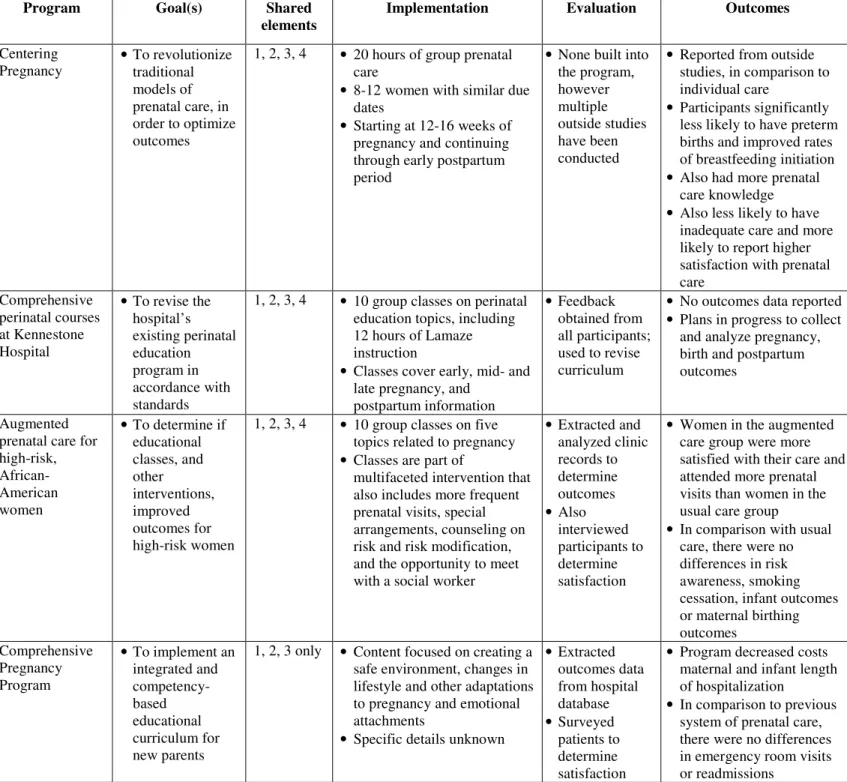
Four programs met inclusion criteria and are summarized and analyzed below, as well as in
Table 1.
Summary of Programs
Centering Pregnancy
8The Centering Pregnancy program was developed by a nurse midwife, as an alternative to
8 | P a g e
Service Expert Panel on Prenatal Care, to build on education provided to pregnant women.
8The
program incorporates ten rules created by the Institute of Medicine in 2001 to guide the
development of prenatal care programs.
8The model for the program is multiple group sessions of prenatal care. More specifically,
there are ten 2-hour sessions; the first session is held between 12 to 16 weeks of pregnancy and
the last one takes place during the postpartum period. During these sessions, the group leader
provides some information through lecture, but the emphasis is on group discussion. Participants
take turns speaking, and they are encouraged to support each other, and to engage in group
problem solving. Each group is composed of 8 to 12 women with similar due dates. Before
starting these sessions, participants undergo a prenatal assessment, complete with standard
laboratory testing.
During the sessions, women are led in discussion by a care provider, who functions as a
group leader. The function of the group leader is to facilitate the flow, but the focus is on group
discussion itself. All group leaders complete training developed by the Centering Pregnancy
program and Parenting Association.
9Participants complete self-assessment forms for each
session, and the results of these assessments are incorporated into the session topics. In this
manner, the focus of each session is tailored to the needs and desires of the participants. The
general topics of these sessions include pregnancy concerns, nutrition, substance abuse, common
gestational changes, preparation for birth and subsequent parenting, infant feeding, and
postpartum issues.
8,9Each group collectively decides who can join the sessions; participants may
be allowed to invite their family members, partners or friends.
In addition to the discussion and educational components of the program, women also
9 | P a g e
by the care provider. In addition to standard testing and medical evaluation, they are also
encouraged to become active participants in their health and thus, are taught self-assessment
skills; they are shown how to measure their blood pressure and weight, and to perform testing on
their own urine.
9If any medical problems or personal issues emerge, participants are scheduled
for individual appointments. Since participants are receiving medical care, their visits are
reimbursed through insurance; this eliminates one of the challenges associated with obtaining
prenatal education.
The first cohort of 111 participants was enrolled in 1993. In comparison to “a similar
group who received traditional [prenatal care] from the same clinic”, participants had fewer trips
to the emergency room during their third trimester. In addition, the vast majority of the
participants (96%) reported that they preferred to receive group prenatal care. Other outcomes
were not significantly different between participants and the similar group, including low-birth
weight, preterm delivery, length of labor, analgesia use, cesarean rates and Apgar scores.
Analysis of this initial cohort was very limited, due to the small sample size and the fact that
participants were neither randomized, nor matched to a control group.
9Two subsequent non-randomized studies have shown mixed results; one reported that
infants born to participants had lower incidence of low birth weight and preterm births.
10The
other study reported that benefits such as a longer gestational period and were increased birth
weights were limited to preterm babies.
11In contrast, term babies born to participants had no
difference in outcomes, in comparison to women who received traditional care.
11Both of these
studies had small sample sizes, and the groups may not have been matched well.
A larger study
12, and the first randomized controlled trial, showed promising results.
10 | P a g e
preterm births (9.8% of infants), in comparison with participants assigned to receive standard
care (13.8% of infants). In addition, they were less likely to have suboptimal care, reported
higher satisfaction with their care, had better knowledge and were subjectively more ready for
labor.
12One of the weaknesses of the Centering Pregnancy program is the lack of evaluation.
The results from various trials have been funded and published by outside evaluators. The
program would benefit from a built-in evaluation that assesses knowledge, in comparison to a
group that receives standard prenatal care, as well as long-term outcomes, such as smoking
cessation during pregnancy and beyond, rates of infant death, breastfeeding initiation and
continuation and rates of elective deliveries before 39 weeks. Another important consideration is
the cost-effectiveness of such an intervention; it seems likely that group prenatal care could
decrease health care spending, but this has not been examined in the evaluations.
The strengths of this program are numerous. First, bringing participants together fosters
a sense of community, and creates a support system of sorts. This setting builds trust in the
facilitator and in other participants, and thus women may feel empowered to discuss their
problems and concerns. Second, the program uses interactive small groups to educate women on
a variety of health issues over time, allowing for participants to absorb and process information,
and to follow-up on questions or uncertainties. In addition, this model can be (and has been)
adapted to special circumstances, such as providing care for teenagers and military families.
12Comprehensive perinatal courses at Kennestone Hospital
13In 1997, Kennestone Hospital in Atlanta, part of WellStar Health System, revised their
perinatal education system. Prior to this change, their program included seven two-hour classes
11 | P a g e
participants, the classes were not standardized and they did not collect feedback to make
changes.
Their revised educational program is based on specified Principles of Family-Centered
Maternity Care, as well as published recommendations from various organizations. Classes
feature topics that are relevant to early pregnancy, mid-pregnancy, late pregnancy, the
postpartum period and parenting topics. In addition, there is one class designed specifically for
fathers. Like the Centering Pregnancy program, interactive small group sessions are utilized, to
facilitate learning. The focus is on group discussions; however, certain sessions focus on manual
skills and include time for hands-on practice with infant mannequins. In addition, the Lamaze
classes incorporate specific instruction on skills such as relaxation, massage, breathing and
positioning.
Potential participants are introduced to the program via a “Perinatal Information
Notebook”. This notebook includes promotional materials for the curriculum and other
information. They are distributed to physicians’ offices and doctors present the notebook to
women at their first or second prenatal care visit. In addition to this notebook, there is also a
workbook for the series and each class has standard handouts.
Class size is limited to 10 to 12 couples, to allow for maximal interaction. Courses are
offered on a continuous basis, so that women can join at any time. Classes are offered at various
locations, so that participants can find one close to them. Classes, and all distributed materials,
are available in Spanish, to meet the needs of a culturally diverse audience. In addition, families
who speak other languages can participate in classes by using a headset for translation.
In order to continuously improve the curriculum, parents are surveyed for feedback.
12 | P a g e
changes. This is one strength of the program, and allows for continuous improvement and
responsiveness to participants’ needs and concerns. However, the authors do not provide any
details about the feedback that they have received. In addition, there is no other data on
outcomes. At the time of publication, the authors noted that they intended to start collecting
outcomes data, but I was unable to find it during my literature search.
Like the Centering Pregnancy program, Pregnancy PREP would benefit from an
integrated program evaluation, to determine whether the program is meeting stated goals.
Augmented prenatal care for high-risk African-American women
14This educational program was just one component of a larger intervention to determine if
augmented care improved outcomes for high-risk African-American women in Jefferson County,
Alabama. Pregnant women were randomly assigned to augmented care or traditional care.
Group educational sessions on five pregnancy-related topics were offered only to the augmented
care group. These 40-minute sessions were offered at each prenatal visit that participants
attended. There were 2 sessions each on the following topics: nutrition, smoking and general
substance abuse, stress reduction and labor and delivery. These sessions emphasized lectures
and a presentation-based teaching style, with less of a focus on discussion than the
aforementioned programs.
In addition to these educational sessions, women in the augmented care group received
detailed information about their risk conditions, as well as techniques and suggestions to reduce
their risk. Smokers were referred to a smoking cessation program and also received personalized
follow-up to reinforce the message. Participants in the intervention group met with a social
13 | P a g e
seen within five minutes of their scheduled visit. They were offered transportation to prenatal
visits, if necessary, and they had access to on-site child care.
Data was collected from participant interviews, and from clinic records, to determine if
augmented care improved participants’ perceptions of care, knowledge of personal risks and
subsequent behavioral change, smoking cessation rates and pregnancy outcomes such as birth
weight, gestational age, low Apgar scores, maternal weight gain, and cesarean section rates.
Study results showed that women who received augmented care were more satisfied with
their care and reported spending more time with their nurse. The intervention group attended
more prenatal visits than did the control group. In addition, multiparous women in the
augmented care group felt their care was superior to the care they received with their previous
pregnancy.
There was no statistically significant difference between the two groups in regards to the
percent of women who reported awareness of their risks, nor was there a difference in the
percent of women who stopped smoking. There were also no differences in birth weight,
gestational age or maternal birthing outcomes. This may be due to the small sample sizes (318
women in the intervention group and 301 women in the traditional care group); the authors
report that they would have needed a cohort five times larger, in order to show such differences.
It is difficult to draw conclusions from this study, since they implemented a multifaceted
intervention. Participants in the intervention group received multiple benefits, in addition to the
educational curriculum that is the focus of this paper. In addition, this study focused on women
with high-risk pregnancies, a specific segment of the population. Therefore, the findings may
14 | P a g e
However, there are multiple lessons that can be learned from this program. One of the
strengths is the provision of transportation and on-site childcare. Such features address the
challenges that pregnant women may face, in committing to a long-term educational curriculum.
Another strength is that the women received counseling on their specific pregnancy risks and
information on evidence-based strategies to decrease their risk. Though Pregnancy PREP will
not focus on high-risk women, this personalization of information is critical to making an impact
on participants.
Comprehensive Pregnancy Program
15The University of Michigan created the Comprehensive Pregnancy Program (CPP) in
1996, in hopes of implementing an integrated and competency-based educational curriculum for
new parents. They based this program on recommendations from “Public Health Service
guidelines, as well as standard texts of obstetrics and gynecology.”
The authors describe three major competencies, or areas of focus, for their educational
curriculum: creating a safe environment, changes in lifestyle and other adaptations to pregnancy
and emotional attachments. However, they do not provide details about the curriculum, and I
was unable to locate any more information through literature and internet searches.
The authors do provide an example of a resource that is distributed to pregnant women,
as part of the program. This chart lists various important topics in each of the above three areas.
For example, the section on lifestyle changes includes topics such as nutritional needs, physical
changes, exercise, preparing for labor and birth, learning to breast-feed and caring for yourself
after delivery. The chart also includes details of when these various topics should be discussed
(i.e. – early, mid- or late pregnancy or early adulthood). For each topic, parents are able to note
15 | P a g e
the authors do not discuss this resource in detail, it is presumably provided to patients, so that
they can chart their progress through the educational curriculum.
The authors conducted a cohort study to compare women who received care through CPP
to women who received care prior to implementation of CPP, to determine if CPP improved
outcomes. Data was collected from the hospital’s database, and from a survey sent to all study
patients in both groups. The results showed that the CPP participants had a 56% decrease in
maternal and infant length of hospitalization, in comparison to the control group (1.63 days vs.
2.19 days for maternal hospitalization and 1.66 vs. 2.01 days for infant hospitalization); this
difference was statistically significant, but perhaps not clinically significant. The intervention
group also had a statistically significant decrease in hospital costs for mother and baby, in
comparison with the control group ($2253 vs. $3206 for maternal costs and $1558 vs. 1742 for
infant costs). There was no statistically significant difference between the two groups in
maternal emergency room visits or readmissions for mother or baby. Patient satisfaction was
high in both groups.
This program is also very difficult to evaluate, since the authors provided little
information about the intervention.
Analysis
The four programs included in this literature review provide some interesting points for
analysis. Three of the four programs offered a series of sessions for new parents, and covered a
variety of topics, spanning from early pregnancy through the postpartum period. The fourth
program may have similar features, but the authors did not provide specific details. All of the
16 | P a g e
to become more comprehensive and outcome-driven. All of the programs are based in
principles, recommendations or standards created by outside organizations.
All of the programs had a goal of creating a standardized system of education. Multiple
programs required that their staff and educators completed training. Standardized program
materials were created and distributed to participants. These handouts seem to be a helpful tool
for participants, allowing them to track their progress through the educational sessions and
providing extra information about various topics. Centering Pregnancy and the program at
Kennestone Hospital limit class sizes, and group participants based on due dates. The other
programs did not mention any efforts to standardize participants in this manner. Though it is
important to tailor sessions to the specific participants, incorporating some form of
standardization is important for a program, especially for evaluation purposes. It also ensures
that all participants have a similar experience, and thus, equal opportunity for similar positive
outcomes.
Three of the four programs collect information from participants, to determine their
satisfaction with their experience. Though Centering Pregnancy, as described in these articles,
does not include surveys as a program component, outside studies have assessed participants’
satisfaction.
12Of the programs, only the one at Kennestone Hospital actually utilizes participant
feedback to improve and revise educational sessions. This is an important aspect of quality
improvement, and more programs should consider implementing a similar policy.
In regards to data collection and analysis, Centering Pregnancy and the perinatal courses
at Kennestone Hospital were not created with an evaluation plan. In contrast, the
Comprehensive Pregnancy Program and the augmented care plan for high-risk women extracted
17 | P a g e
Similarly, Pregnancy PREP will have a pre-specified evaluation plan; in fact, this plan will
inform program development and planning. An important point to keep in mind is that although
some programs showed benefits such as increased satisfaction with prenatal services, decreased
costs and slightly decreased hospital stays, these programs did not affect all outcomes.
Specifically, infant health outcomes and maternal birthing outcomes were not different between
the group who received care under the new system and the traditional care group.
Conclusions
This literature review focused on four programs that attempt to educate new parents,
mainly through informational group sessions. These programs have many similar features to
Pregnancy PREP. There are lessons to be learned, both from their successes and their
weaknesses.
In conducting this literature review, I found very few suitable programs for comparison.
There are certainly a large number of prenatal education programs in existence, throughout the
country. However, many such programs are not published. It is possible that other research
techniques, such as working with experts in the field and reviewing national conferences, may
have yielded more programs. Centering Pregnancy is an example of a program that has been
studied extensively. Though one can access a wealth of information on Centering Pregnancy,
there is very limited published information about other models of comprehensive perinatal care.
This gap in the literature certainly represents an opportunity to impact the field of perinatal
18 | P a g e
PROGRAM PLAN
Overview
Pregnancy PREP (Providing Resources for Educating Parents) is a program to teach new
parents about various topics of importance for maternal health, as well as for infant health and
safety. This will be an alternative to the current approach, in which individual stakeholders
educate new parents only about their individual message. I seek to develop a cohesive program
that incorporates education about multiple issues, such as smoking cessation during pregnancy,
decreasing rates of elective deliveries before thirty-nine weeks, breastfeeding, the period of
purple crying and safe sleep techniques for infants.
For this program, I will focus on pregnant women seeking prenatal care and education at
UNC-Chapel Hill, in the resident, midwifery and faculty practices. Chapel Hill is a relatively
small city, with a limited number of prenatal care providers; it may be easier to implement and
evaluate a program in such a location. In addition, Chapel Hill is an urban area, with a free
transportation system. As such, some of the barriers are removed for potential participants.
However, this may limit the external validity of this program; the results may not be replicable in
more rural settings. In addition, UNC-Chapel Hill treats more high-risk patients than community
practices; this is another potential problem associated with choosing an academic facility, and
may be a confounding factor for the program. I hope that Pregnancy PREP can eventually be
extended to women throughout Orange County, and subsequently, the entire state of North
Carolina. However, I believe that my program should be implemented on a small scale initially,
19 | P a g e
Program Context
I had to take into account several considerations, in creating the program plan for
Pregnancy PREP. In this next section, I will discuss these considerations, along with obstacles
and potential strategies to address them.
Consistency with local, state and national priorities
On a national level, Healthy People 2020 recognizes the importance of maternal and
infant health programming in decreasing maternal and infant mortality. Specific objectives from
Healthy People 2020 fall in line with the health messages that are central to Pregnancy PREP.
One such objective relating to infant health is MICH-1.8, to decrease the infant death rate due to
Sudden Infant Death Syndrome (SIDS) from 0.55 to 0.50 deaths per 1,000 live births. Another
objective is MICH-1.9, to decrease the total rate of unexpected infant deaths from 0.93 to 0.84
deaths per 1,000 live births.
3Teaching new parents about healthy sleep techniques is crucial to
achieving both of these objectives. Another example is the objective MICH-9, with the goal of
reducing preterm births. In 2007, 12.7% of live births were preterm; Healthy People 2020 seeks
a 10% improvement in this rate.
3Again, this falls in line with the health message of decreasing
elective deliveries before 39 weeks gestation. Other examples of Healthy People 2020 objectives
related to Pregnancy PREP are MICH-21 (to increase the proportion of infants who are
breastfed) and MICH-23 (to reduce the proportion of breastfed newborns who receive formula
supplementation within the first 2 days of life).
Healthy People 2020 also takes a stand on issues affecting maternal health. For example,
objective MICH-11.3 is to increase the percent of females abstaining from smoking cigarettes
during pregnancy from 89.6% to 98.6%. In addition, MICH-18 specifies a goal of reducing
20 | P a g e
The national emphasis on maternal and infant health problems is also reflected in local
county and state programming. A 2010 Orange County report identified Child Health as a top
priority. Two programs in Orange County focus on increasing awareness of Shaken Baby
Syndrome, with the intent of decreasing infant injuries. Real Men Rock is a program that
provides information about age-appropriate behavior and techniques to console infants. The
Period of Purple Crying educates parents about infant crying; it also provides training for
healthcare and child care providers.
4In addition, a 2007 Orange County Community Health
Assessment identified the importance of obtaining prenatal care by setting a goal to increase the
proportion of pregnant women who receive care in their first trimester to 90%.
5The state of
North Carolina echoes these initiatives, with goals of reducing neonatal mortality and cigarette
smoking and increasing prenatal care. These are especially important initiatives for the state,
since NC usually has a relatively high infant death rate, in comparison with many other states.
6Pregnancy PREP is also in alignment with the goals of the North Carolina Child Fatality
Task Force. This state-mandated task force is composed of representatives from the North
Carolina legislature and government, as well as community leaders and others. The goal of the
task force is to issue and implement recommendations for various policies to support healthy
development of infants and children in North Carolina. The Perinatal Health Committee, one of
three task force committees, is focused specifically on infant mortality. One of the committee’s
current goals is to examine North Carolina’s perinatal health infrastructure and devise ways to
improve and/or rebuild it.
16As such, Pregnancy PREP is perfectly timed and poised to inform
the recommendations of the committee and to change the way in which perinatal health
21 | P a g e
The political environment
Programming to improve the health and wellness of women and children is usually not
controversial. These two populations are considered vulnerable, and thus tend to receive
bipartisan support. At this current time, there is a local and national emphasis on maternal and
child health, as evidenced by the Healthy People 2020 initiatives and Orange County health
assessments previously discussed.
Acceptability to providers and recipients
Creating an integrated, comprehensive curriculum will likely be viewed favorably by
providers and recipients. Health care providers, such as nurses and physicians, are currently
responsible for educating new parents about multiple health issues. Their specific
responsibilities vary between health systems. Each individual health message is publicized and
chaired by a different organization; this amounts to multiple trainings for providers, and multiple
resources to track and distribute to patients. In comparison, an integrated approach such as that
used by Pregnancy PREP would simplify the educational process for providers. A
comprehensive timeline will be included, spanning from prenatal visits all the way through
postpartum visits for mothers and pediatrician visits for infants. Integrated promotional and
educational materials would be utilized. In addition, there would be no need for multiple
trainings from various organizations. Despite these benefits for providers, they may be
somewhat hesitant in the beginning. Providers are responsible for their clinical duties, in
addition to the extra tasks of education. Providers are often overworked. To this end, a crucial
component of creating this program is the interviews with the staff members who currently
deliver these messages to new parents. It is crucial to discuss the challenges they face and to
22 | P a g e
collaborators and will help them to become invested in Pregnancy PREP. Another potential
solution is to structure our provider training so that they may receive Continuing Medical
Education (CME) credits. This will provide a benefit for participating providers, and may make
them more likely to attend and contribute.
Recipients would also benefit from an integrated curriculum. Currently, new parents are
sent home from the hospital with various materials and messages about various health topics; this
can be overwhelming. The creation of a unified curriculum will help to organize these messages
and allow for the most effective and timely delivery. In addition, Pregnancy PREP will
standardize the education that parents receive and decrease or eliminate educational disparities
between patients.
Possible financial resources
Pregnancy PREP would likely be funded through grant support. Another idea is to create
classes that are reimbursed through insurance companies, which would bring a sustainable
source of income for the program.
Technical feasibility
There are multiple methods for educating new parents. Currently, certain organizations
print educational materials for parents to read; others utilize electronic media such as CDs to
deliver their messages. As part of the program plan, I will conduct research to determine which
format is the most effective.
The target audience for the intervention is pregnant women and new parents at
UNC-Chapel Hill. The choice of one health system, in one city, will simplify the initial program plan;
23 | P a g e
Stakeholders and other factors
Parents are one of the key groups to consider, in designing Pregnancy PREP. As they
will be the participants, their needs and concerns will drive program development and revision.
Parents may face many challenges in becoming involved with this type of intervention. New
parents, and even expecting parents, have many demands on their time and competing priorities.
In addition, there are other programs that aim to address some of these same problems, so it will
be necessary to attract participants’ attention.
In addition, the key stakeholders for Pregnancy PREP are the organizations that currently
deliver these crucial health messages. Though it may be in the best interests of patients to
integrate these messages into one unified curriculum, there may be resistance from these
individual stakeholders. They have been delivering their individual messages for some time, and
it may be challenging to change the methods of their programming, to operate in a more
collaborative fashion. In addition, there may also be some “turf issues” that will have to be
addressed. However, all of these organizations are centered around improving maternal and
infant health. Therefore, if an integrated curriculum proves to be more effective in educating
new parents, and is shown to improve outcomes, stakeholders will likely be supportive. As with
the integration of health care providers, it will be crucial to seek out these stakeholders and
interview them, to learn how their individual programs run. This information will be integral in
developing the program plan, in order to build on their successes and learn from their mistakes.
24 | P a g e
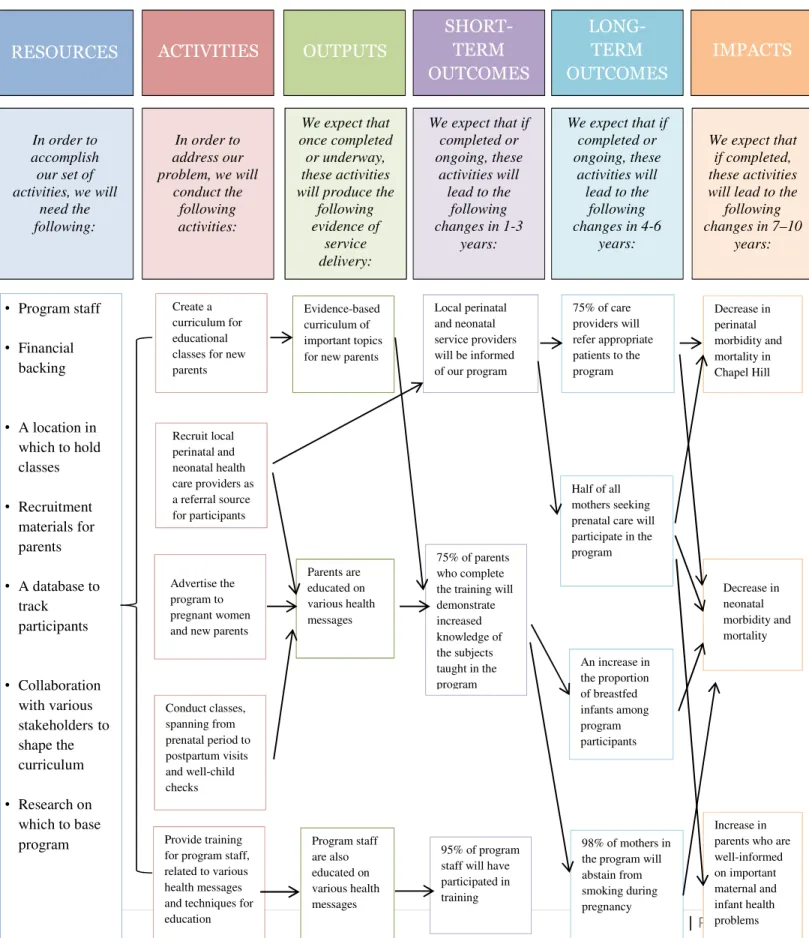
Goals and Objectives
Program Goals:
•
To improve the perinatal and neonatal health of mothers and infants seeking care at
UNC-Chapel Hill in North Carolina
•
To improve perinatal and neonatal health knowledge of families in Chapel Hill
•
Pregnancy PREP will start in June 2011
Program Objectives:
•
Short-term objectives:
o
By June 2012, 95% of Pregnancy PREP staff will have participated in training on
the relevant health issues, and on techniques for educating new parents.
o
By June 2012, Pregnancy PREP staff will inform all of the perinatal and neonatal
care providers at UNC-Chapel Hill about the program for referral.
o
By June 2014, 75% of the parents who complete Pregnancy PREP will
demonstrate increased knowledge of the subjects taught in the program.
•
Long-term objectives:
o
By June 2015, 75% of the prenatal care providers at UNC-Chapel Hill will refer
appropriate patients to Pregnancy PREP.
o
By June 2015, 50% of mothers seeking prenatal care at UNC-Chapel Hill will
participate in Pregnancy PREP.
o
By June 2015, among families participating in Pregnancy PREP, there will be an
increase in the proportion of infants who are breastfed, in comparison to the
25 | P a g e
o
By June 2015, 98% of women participating in Pregnancy PREP will abstain from
smoking cigarettes during and after pregnancy.
Theoretical Model
There are two target audiences for Pregnancy PREP; thus, multiple theories should be
considered to guide the intervention and evaluation design. The first target audience is the health
care professionals who will actually conduct and coordinate the program. For this target
audience, the community organization theory will be most useful to guide the program activities;
the community of health care professionals at UNC-Chapel Hill will be using this integrated
approach to educate new parents.
17Thus, these individuals will be instrumental in shaping the
curriculum. We will conduct interviews with members of organizations that are in charge of
delivering health messages to new parents; it will be crucial to gain information from their
experiences and to determine their views on successful strategies. In addition, by seeking their
opinions, we will empower this community to help new parents and encourage their participation
in the intervention.
The second target audience is the new parents who will be learning from Pregnancy
PREP. As such, the health belief model will be important, as will the precaution adoption
process model.
17The health belief model is relevant because it will address new parents’
motivations and challenges in participating in the curriculum. Identifying the susceptibility and
severity of various infant health problems will allow us to determine the need for an intervention.
Learning about the perceived benefits, cues to action and self-efficacy will enable us to attract
new parents. Once we determine potential participants’ motivations, and determine what they
hope to get out of the intervention, we can structure our activities accordingly. For example, if
26 | P a g e
infants, we can model these techniques in one of the program sessions. Finally, investigating the
costs of this intervention will allow us to determine solutions to avoid these potential barriers.
The precaution adoption process model will also help to guide the program plan. Many
new parents may be unaware of the important health messages that will be contained in the
curriculum. Thus, it is very important to determine an individual’s awareness, along the
spectrum and to develop strategies that take this information into account.
Implementation
There are many considerations in developing an implementation plan for Pregnancy
PREP. Though it will start as a demonstration project, if it is determined to be effective in
meeting short and long-term objectives, perhaps there is a possibility for integration into routine
prenatal care. In this manner, it may eventually be eligible for reimbursement through insurance.
Like many other perinatal education programs, participants will complete classes over the
course of their pregnancy, and even after delivery. The focus will be on small groups and classes
will follow a discussion-based model. The activities necessary for implementation of Pregnancy
PREP fall into five categories: recruitment and training of staff and leaders, development of the
educational curriculum, recruitment of participants, conducting the classes and collecting
post-intervention data.
Recruitment and training of staff and leaders
The first activity will be the recruitment of the program staff. We will need to hire at
least two health educators to develop and implement the curriculum, and one administrative staff
member to coordinate program activities. The health educators should be experienced perinatal
nurses who have experience with educating new parents about health topics. These educators
27 | P a g e
Though the administrative staff member may need to be full-time, the health educators will only
be funded part-time.
All three staff members will need to be trained on health topics that are important for new
parents, including the benefits of breastfeeding, safe sleep techniques and environment, strategies
to prevent shaken baby syndrome, smoking cessation and the importance of decreasing elective
deliveries. The training should be conducted by the experts on these topics, which are the key
organizations that currently deliver perinatal and neonatal health messages to providers and
parents. These organizations include the stakeholder organizations that participated in the joint
effort that preceded this project. Many of these organizations currently train healthcare staff; as
they train the program staff, we will need to consider how to adapt these messages for delivery to
new parents.
Development of the educational curriculum
Pregnancy PREP will cover topics relevant to each part of pregnancy. During the first
trimester, participants will learn about healthy eating habits and nutritional needs, the importance
of smoking cessation, the dangers of substance abuse, and the harms of elective deliveries prior
to 39 weeks of gestation. During the second trimester, the same messages will be echoed;
participants will also learn how to structure a safe sleeping environment for the infant and how to
decrease the risk of SIDS and preventable death. In the third trimester, the curriculum will
incorporate information about breastfeeding. Participants will also receive education about
shaken baby syndrome, and will be given tools to decrease risk, such as learning techniques to
console crying infants. Patients are exposed to this information at the hospital, during and after
labor. By educating participants throughout the course of the pregnancy, the information will not
28 | P a g e
delivery will focus on many of the same topics, such as breastfeeding, education to prevent
shaken baby syndrome, and continued follow-up about the harms associated with substance
abuse. There will also be education about postpartum depression. Participants will learn about
family planning and contraception, to lengthen birth intervals. Participants will be able to
discuss challenges with their peers, and collectively determine solutions.
Though this timeline serves as a template, it will be very important for program staff to
conduct interviews with key stakeholders, such as parents, members of perinatal health
organizations and local care providers, to hone the curriculum. Parents can provide information
on desirable intervention details; organizations and professionals can provide their expertise and
guidance. This will allow us to tailor the program to the needs of the target population.
Another important component of curriculum development is the creation of a handbook
for participants. This handbook will contain information on the full curriculum, as well as
handouts for each class. There will also be a comprehensive list of topics, so that participants
can track what they have learned.
Participant recruitment
Program staff will reach out to all of the prenatal care providers at UNC-Chapel Hill, and
will provide them with information about Pregnancy PREP. Care providers will pass the
information along to all patients; interested patients will contact the program to learn more about
participation. The first cohort of patients will be 8 to 12 pregnant women who are all within the
first trimester of their pregnancy.
Conducting the classes
Program staff will schedule and conduct ten classes, based on the finalized curriculum.
29 | P a g e
knowledge. After each class, participants will complete a post-test, to determine whether they
have learned the information presented.
Though the health educators will lead and facilitate the classes, the emphasis will be on
group discussion. Educators will announce the topics for the day and will ensure that the
relevant information is discussed, but participants will guide the discussion. In this manner, we
will ensure that participants’ concerns are addressed and that their needs are met. After each
class, participants will provide feedback, and the health educators will consider this feedback
and, whenever possible, incorporate it into future classes.
Collecting post-intervention data
In order for the program to be considered effective, we must collect data from and about
the participants. One source of data will be the pre- and post-test scores; analyzing these will
allow us to determine whether the participants mastered the topics presented. We will also
conduct a follow-up survey to gather information on various outcomes, such as initiation and
duration of breastfeeding and smoking cessation rates.
Strategies for sustainability
Pregnancy PREP should be implemented with a foundation to preserve longevity over the
years. If proven to be effective, the program may become a permanent component of prenatal
care at UNC-Chapel Hill. Initially, it is reasonable to strive for a low level of sustainability;
however, if the data demonstrate that the program is effective, this will give the program
30 | P a g e
Vision
It is important for all stakeholders to share the mission of Pregnancy PREP. By seeking their
guidance and involving them in the planning stages of the program, we will help to ensure that
we share a common vision and similar goals.
Results orientation
Pregnancy PREP will be developed and implemented with a focus on obtaining the
desired results. The data on participants’ knowledge and resulting outcomes, relative to
non-participants, will allow us to determine whether the program is effective and has accomplished
its goals of increasing knowledge of vital health messages and decreasing perinatal and neonatal
morbidity and mortality.
Broad-based community support and key champions
As discussed previously, we will seek out stakeholders and involve them in the planning
and implementation phases. This will help to ensure community support.
18We will also reach
out to all prenatal care providers, so they will also be informed of the program and will, in turn,
31 | P a g e
EVALUATION PLAN
Rationale for Evaluation
Pregnancy PREP must be evaluated, to determine the success of the implementation, and
the strength of the outcomes produced. Evaluation would be beneficial for a variety of reasons.
The purpose of the program is to enhance participants’ knowledge of various perinatal and infant
health messages. Data collection and analysis is necessary, in order to ensure that the program is
meeting its goals of increasing awareness of critical perinatal and neonatal health messages.
19In addition, it will be important to evaluate outcomes, to determine if this type of prenatal
program is more effective than other types of educational programs for new parents. If so, that
may inform future designation of resources and funding for perinatal education. However, if
Pregnancy PREP is not effective, and does not achieve better outcomes than traditional prenatal
programs, it would be unwise to continue to devote funding and resources to such a program.
Approach to the Evaluation
Ideally, Pregnancy PREP would use an internal evaluator, as well as an external
evaluator. An internal evaluator, especially one who is employed as an educator, can provide an
insider’s perspective on the activities that are working, and how participants are experiencing the
curriculum and classes. However, an internal evaluator’s perspective may be somewhat biased,
since they will likely be evaluating their own work. Therefore, it would also be beneficial to
work with an external evaluator, who can provide a more objective perspective and a different
level of expertise.
20For both types of evaluators, the most important skill is the ability to listen. During the
process of soliciting feedback from program staff, program participants and key stakeholders,
32 | P a g e
perspectives. In addition, the evaluators should be flexible. It is possible that changes will be
made to the educational curriculum, and the program may undergo revisions. Evaluators may
need to adapt to new circumstances.
20All of the key stakeholders should be involved in the evaluation process; this includes
program staff and members of the target population, as well as representatives from various
organizations that deliver maternal and infant health messages. It is important to seek multiple
opinions and perspectives, especially in the beginning stages of creating evaluation questions.
20It seems likely that the health organizations will be concerned with the delivery of the messages
that they are individually engaged with. For example, representatives from smoking cessation
organizations will be interested in the pre- and post-program smoking rates, to determine
whether the intervention has caused a change in participants’ habits and behavior.
One of the potential challenges of the evaluation process will be overcoming each
organization’s commitment to the delivery of its’ specific message; instead, stakeholders must be
committed to improving overall health of mothers and infants in Chapel Hill.
Another potential challenge is difficulty in recruiting stakeholders to participate in the
evaluation process. With the exception of program staff, stakeholders may not have the time to
commit to this process. Parents may not be interested enough to participate in the process.
Evaluation Study Design
The program evaluation will utilize a quasi-experimental design; it will incorporate a
combination of techniques such as document review, interviews, surveys and analyzing
differences between pre- and post-test scores to assess implementation fidelity.
19The evaluation
33 | P a g e
Ideally, Pregnancy PREP should be tested in an experimental study, in which pregnant
women are randomly assigned to participate in either the curriculum or standard prenatal
education. However, it will be difficult to recruit initial participants to a randomized trial. In
addition, such an experiment would require extra funding and logistical support.
19Although this
may be a consideration at a later time, it will be necessary to first pilot the curriculum, in order to
ensure that it is a valuable program and can contribute to maternal and infant health.
Evaluation Methods
In order to determine whether program activities were carried out as planned, data collectors
will rely heavily on staff interviews and program records to gather information on initial start-up
activities, such as trainings, outreach to local providers and participant recruitment. Document
review will also be important to track the number of participants, as well as their characteristics.
Interviews and surveys will be utilized to determine whether staff members felt they learned
from trainings and whether participants felt they learned from the curriculum. These methods
will also be important to identify problems with program activities and opportunities for
improvement.
Quantitative data will also be collected to assess achievement of outcomes; pre-intervention
and post-intervention testing will be administered to program participants. This will help
evaluation staff determine objectively whether participants learned key concepts from the
curriculum. In addition, epidemiological data will be used to compare outcomes between the
34 | P a g e