a Treatment for Benign Prostatic Hyperplasia: A Systematic Review
of the Literature
By:
Stephen Ernest McKim
A Master’s Paper submitted to the faculty of the University of North Carolina
at Chapel Hill in partial fulfillment of the requirements for the degree of
Master of Public Health in the Public Health Leadership Program.
Chapel Hill, North Carolina
2008
_______________ ____________________
____________________________________
TABLE OF CONTENTS:
Abstract
iii
Master’s Paper
Introduction 01
Methods
13
Results
18
Discussion
23
Addendum
28
Tables
31
ABSTRACT
INTRODUCTION: Benign prostatic hyperplasia (BPH) is a highly prevalent disease that inflicts significant inconvenience upon men afflicted with it and, if left untreated, can progress to
complete obstruction resulting in uremia and kidney failure. The purpose of this paper is to systematically review the published evidence regarding the use of two injectable agents, botulinum toxin (BT) and absolute ethanol (AE), used intraprostatically and to assess their effectiveness as a potential minimally invasive treatment for benign prostatic hyperplasia. METHODS: A comprehensive literature search of several databases including MEDLINE was performed, and articles were selected based on their fitting predefined inclusion and exclusion criteria. These studies were evaluated based on four research questions examining the efficacy of the treatment in relieving subjective and objective elements of BPH, its safety, and
comparisons with traditional treatment options. RESULTS: A total of five studies using BT and six using AE was selected for inclusion in the review. The studies varied significantly in the quality of their design and implementation. Subjective relief of the BPH symptoms was
measured in every study, while resolution of the different objective signs of BPH was measured to a varying degree in each study. Very few significant safety issues were reported in any of these studies. No study using either agent directly compared the therapeutic effects of
INTRODUCTION
Benign prostatic hyperplasia (BPH) is a condition characterized by enlargement of the
prostate gland leading to obstructive urinary symptoms. It occurs naturally as a man ages; the
prevalence of BPH has been suggested to be as high as 50% in men age 51 to 60 and over 80%
in men aged 80 or older.1 Often the clinical presentation of BPH is distinguishable from
carcinoma of the prostate underscoring the fact that this is not a malignant condition and does not
predispose a man to developing prostate cancer. Although the etiology of BPH is complex, it
appears that the most important factor is androgenic stimulation, that is, trophic effects of the
hormone dihydrotestosterone (DHT), a metabolite resulting from the conversion of plasma free
testosterone by 5-alpha-reductase type 2 (5-AR) that takes place within the gland. Studies of
men born with a genetic deficiency of this enzyme have proven the critical role of DHT in the
development of the prostate.2
The symptoms of BPH are thought to result from two distinct processes that occur within
the gland: a “static” process related to prostatic overgrowth as well as a “dynamic” process
associated with smooth muscle contraction. As a man ages, accumulated effects of years of
DHT stimulation cause prostatic enlargement that strains the tough outer capsule surrounding the
gland and compresses the urethra carrying urine through it from the bladder. Meanwhile alpha-1
adrenergic receptors populating the prostate gland and bladder neck mediate smooth muscle
contractions that further obstruct the urethra. The resulting urinary stasis irritates the bladder and
leads to the development of a third, extraprostatic component of BPH – bladder detrusor muscle
dysfunction.3 The bladder becomes sensitive to even small amounts of urine and through
The clinical manifestations of these processes known as lower urinary tract symptoms
(LUTS) include obstructive complaints such as hesitancy (difficulty initiating urination) and a
decreased force of the urinary stream, as well as irritative symptoms such as urgency (the
sensation of imminent urination) and an increased frequency of urination both during the day as
well as at night (called nocturia). These symptoms frustrate patients and can lead to a significant
decrease in their quality of life. Most often this decreased quality of life leads a man to seek
therapeutic relief of his disease, however, if left untreated BPH can cause urinary stasis and
subsequent development of urinary tract infection and calculi, renal dysfunction, hydronephrosis,
and eventual renal failure.
Diagnosis and characterization of disease severity
The recommended diagnostic workup for BPH includes an extensive medical history as
well as a detailed physical exam that includes a digital rectal exam.4, 5 Initial evaluation should
rule out other possible conditions such as urinary tract infection or bladder cancer (irritative
voiding symptoms with concomitant abnormal urinalysis) and urethral stricture (a history of
prior instrumentation, trauma, or previous infection along with a stricture palpable on exam or
visible on imaging studies). The American Urological Association (AUA) recommends that men
with greater than a ten year life expectancy be offered serum prostate specific antigen (PSA)
testing to aid in excluding prostate cancer. However, the diagnostic value of this test is
complicated by the fact that conditions such as benign prostatic enlargement or prostatic or
bladder infection can also increase serum PSA, and thus clinicians should consider further
measurements such as PSA velocity or serum Free PSA to help distinguish between the
test for this should be made by the patient and doctor together. In men with symptoms or signs
of particularly severe BPH, evaluation of renal function via serum electrolytes, BUN, and
creatinine measurements are necessary elements of the diagnostic work up.
Subjective measurements of disease severity
The severity of BPH can be assessed subjectively through the use of either the AUA
symptom score or the International Prostate Symptom Score (IPSS), each of which is quantified
after the completion of a seven-question survey concerning the extent of a patient’s LUTS and its
impact on his quality of life.5, 6 The disease is then classified as either “mild” (score of 0-7),
“moderate” (score of 8-19), or “severe” (score of 20-35). An additional inquiry used to
characterize the impact of the symptoms is the BPH-specific quality of life (QOL) question.
This question is scored on a scale from 0 to 6 (“delighted” to “terrible”) and asks the patient: “If
you were to spend the rest of your life with your urinary condition just the way it is now, how
would you feel about that?” Another validated measure of subjective impact of the disease, the
BPH Impact Index (BII), can be used to measure the effect of the disease on a patient’s activities
of daily living.7 The results of these validated questionnaires help guide treatment decisions.
Objective measurements of disease severity
Diagnostic testing should be used to evaluate objectively the severity of BPH, especially
in those patients considering invasive treatment. One such test is the measurement of the
post-void residual (PVR) volume, that is, the volume of urine remaining in a man’s bladder after
micturition. This can be done easily in the clinic via transabdominal ultrasonography. As a
intra-patient volume variability from one measurement to the next, only large volumes (>300 ml) are
thought to be predictive of bladder dysfunction and the potential for decreased response to
treatment. A second tool used in characterizing BPH is uroflowmetry, a measurement of urine
flow rate over time. The most relevant measure generated by this is the peak maximal flow rate
designated as Qmax. Urine Qmax values greater than or equal to 15 ml/sec with a voided volume
of 150 ml suggest normal physiology, while values lower than 10 ml/sec suggest some form of
obstruction. Historically uroflowmetry has been an office-based procedure, however some have
questioned whether urinating once in a clinical setting is an accurate representation of a man’s
normal voiding. Recently home-based uroflometry methods have been shown to be a reliable
alternative for measuring Qmax that is both acceptable to patients and able to provide more
representative information due to its ability to take multiple measurements.8, 9 Further testing
used in select situations includes the estimation of prostate volume (PV) via transrectal
ultrasonography, measurement of bladder pressure during voiding by pressure-flow studies, and
direct visualization of the lower urinary tract through cystoscopy.
Current treatment options
Although the decision to treat BPH takes into account all of these measurements, the
most useful in stratifying patients to treatment modalities is the AUA symptom score. Unless a
patient with “mild” or asymptomatic “moderate” disease is in danger of developing serious
complications from BPH, generally he can be managed conservatively until the symptoms
become disruptive to his daily life. These patients are encouraged to make lifestyle
modifications such as decreasing fluid intake before going to sleep and decreasing the use of
reevaluate the degree of intrusion the symptoms have on the patient’s life. Some men adapt to
these symptoms over time and continue conservative management for many years, however,
prospective studies in men undergoing observation have suggested that many of these men
eventually seek some form of treatment for their BPH. One study of men with moderate BPH
symptoms estimated that 36% sought surgical treatment within 5 years.10
Active treatment options for BPH include both medical and surgical interventions, and
each is associated with side effects and morbidities. Pharmacologic treatment of BPH has
become a multimillion-dollar industry (see Addendum for discussion of marketing and cost of
medical therapy for BPH) and consists of two distinct classes of drugs, alpha-adrenergic
antagonists (“alpha blockers”) and 5-alpha-reductase inhibitors (ARI). Although each has
specific indications for use, a patient who is not receiving adequate relief from one class alone
can be prescribed the other to work in combination. Long-term use of such combination therapy
has recently been shown to reduce the risk of BPH progression more than with one agent alone.11
Medical treatment: Alpha-adrenergic antagonists
Alpha-adrenergic antagonists such as tamsulosin, alfuzosin, terazosin, and doxasozin
block alpha receptors within the prostate and bladder, inhibiting smooth muscle contractions and
relieving obstructive symptoms by decreasing resistance to the passage of urine. These
medications are often used as first-line treatment for men with BPH due to the rapidity with
which they can reduce symptoms. They require daily administration, however, and often times
the starting dose must be titrated upward over several weeks time in order to provide adequate
relief. Within this group are several different medications that differ from one another based on
selective (such as terazosin and doxasozin) can interfere with blood pressure regulation in
addition to their effects in the prostate, leading to systemic cardiovascular side effect such as
dizziness, headache, asthenia, and orthostatic hypotension. To offset these effects, men are
advised to begin taking them before going to sleep (see Addendum for further discussion of side
effects of treatment with alpha-adrenergic inhibitor).
Medical treatment: 5-alpha-reductase inhibitors
The second class of medications used to treat BPH is the 5-alpha-reductase inhibitors,
finasteride and dutasteride. These drugs block conversion of testosterone to dihydrotestosterone
within the prostate, eliminating the trophic effects of DHT and shrinking the gland. Therefore
these medications are thought to be appropriate only for men with proven prostatic enlargement.
Treatment requires an extended amount of time before the relief of symptoms; maximum
effectiveness often does not begin until at least 3-6 months of daily use. Due to the disruption of
the androgen axis caused by these drugs, their side effect profiles are hormonal in nature and
include sexual consequences such as loss of libido and erectile dysfunction, although these are
uncommon (see Addendum for further discussion of side effects from taking 5-alpha-reducatase
inhibitors). Another concern regarding treatment with ARI relates to screening for prostate
cancer. Use of these medications has been shown to lower serum PSA levels which can
complicate future screening for prostatic malignancy. With this in mind, some have suggested
PSA levels be multiplied by a factor of 2 to correct for treatment of less than 24 months, and by
Surgical treatment
BPH can also be treated surgically, and these interventions are divided broadly into
invasive and minimally-invasive procedures. The oldest invasive treatment is the open simple
prostatectomy which involves removal of the gland under general anesthesia through an
abdominal incision. The most common invasive intervention and the current gold-standard
treatment is the transurethral resection of the prostate (TURP), which also can require general
anesthesia and at least a day of hospitalization, as well as post-procedure catheterization. A
small number of patients are at risk of developing TUR syndrome, a consequence of excessive
absorption of the irrigation fluid used during the procedure that which can lead to severe
neurologic and pulmonary complications. A newer less invasive technique, laser prostatectomy,
is performed similarly to the traditional TURP except with the use of laser pulsing to vaporize
the tissue as opposed to the diathermic cutting with coagulation approach used in TURP. A
recent report has suggested that patients receiving the laser TURP have a quicker recovery period
than those receiving a traditional TURP,13 and often times this procedure can be done in an
outpatient setting. However, the patients receiving the laser treatment had a higher rate of
re-operation than did those receiving the traditional treatment. Other minimally invasive
interventions include transurethral needle ablation of the prostate (TUNA) and transurethral
incision of the prostate. These therapies have shown to be adequate in the short term
management of BPH, although the symptom relief is not nearly as large as with the traditional
Intraprostatic injection: an experimental treatment option
Although both medical and surgical treatments for BPH have proven to be effective
means for providing symptomatic relief from the condition, each is associated with significant
negative aspects. Medical treatments entail the potential for systemic side effects, a risk
especially salient in a population of older men who often possess other comorbidities and take a
host of other medications. Furthermore, the cost of having to take a daily medication for the
treatment of BPH can lessen a patient’s willingness to undergo treatment with these medications.
A recent inquiry showed the price of a year’s worth of 5 mg finasteride to be approximately
$800.14 Besides the monetary cost of purchasing medication, also significant are the opportunity
cost and disutility of taking a pill each day. Moreover, therapeutic success is not assured. A
retrospective study examining patients treated with alpha-blockers over a 3-year period
suggested that treatment is not always effective, finding respective re-treatment rates of patients
with mild, moderate, and severe lower urinary tract symptoms of 27%, 33%, and 70%.15
Surgical treatments for BPH generally have a high rate of short-term symptom resolution, yet
carry the risk of side effects such as impotence, incontinence, and retrograde ejaculation.
Advanced age or comorbid conditions can also prevent some patients with BPH from being
eligible for surgical interventions. Surgical intervention is also more expensive than medical
therapy, both to the patient and healthcare systems, given the costs associated with equipment,
operating room time, anesthesia, and hospitalization. While several authors have examined the
cost effectiveness of traditional treatments for BPH,16-18 a significant amount of research must be
done in this area. One group did find that α-blockers and TURP are the most cost-effective alternatives, for BPH patients with moderate and severe symptoms, respectively.16 These
less invasive alternatives for treating the condition that do not have the high risk profiles of
current treatment methods.
One alternative treatment modality for benign prostatic hyperplasia that has attracted a
great deal of interest over the last decade is that of intraprostatic injection. However, as Plante
and colleagues point out in their review of the history of the intervention,19 the interest in directly
treating prostatic disease percutaneously is not a recent phenomenon but rather stems from
nearly two hundred years ago when an English surgeon, Dr. B.C. Brodie, suggested treating
prostatic abscesses directly via transperineal puncture. Over the next century methods of directly
accessing the prostate and treating prostatic infection became better characterized, and near the
turn of the 20th century an English surgeon serving the Viceroy of India, Sir James Roberts,
began treating the obstructive symptoms of prostatic enlargement with intraprostatic injections of
solutions containing carbolic acid, glacial acetic acid, and glycerin. Modern interest in
intraprostatic injections as a method of treating BPH was sparked by the published reports of
Talwar and Pande in 1966, in which the two surgeons recounted their experience treating a series
of 188 consecutive cases using the intervention taught to them by one of Robert’s trainees.20 For
several years after this, investigators enthusiastically pursued similar procedures, but soon were
forced to abandon the technique due to complications and inconsistent results.21
Absolute Ethanol injection
Recent interest in intraprostatic injection as a treatment modality for BPH was renewed in
1988 after Littrup et al. published results investigating transrectal ultrasound-guided
intraprostatic ethanol injections in canine prostates as a potential treatment for prostatic
causing necrosis of the prostate gland but at the cost of damaging peripheral structures in the
lower urinary tract including the urethra, external urinary sphincter, and bladder mucosa. On a
cellular level, ethanol is thought to exert its effect by diffusing into cells and causing dehydration
that produces protein degeneration, membrane lysis, fibrosis, and thromboembolic occlusion of
local blood vessels.21, 23, 24 However the morbidity shown in this particular study was more a
function of the injection technique rather than the agent itself, and future studies undertaken to
examine the potential of ablation via intraprostatic ethanol injection showed promising results.
Zvara25 and Levy23 demonstrated that both transurethral and transrectal intraprostatic injections
of absolute ethanol caused coagulative necrosis and hemorrhage within the canine prostate
without damage to the bladder or external sphincter. These observations along with favorable
results using injectable ethanol as a chemoablative agent in the treatment of several conditions
including hepatocellular carcinoma and renal cysts26-30 have encouraged investigators to evaluate
further the potential of intraprostatic ethanol to treat BPH in humans.
Botulinum Toxin injection
Another injectable agent that has received attention recently for its potential to treat
human disease is botulinum toxin type A (BT). This neurotoxin produced by the anaerobic
bacteria Clostridium Botulinum acts by inhibiting the release of acetylcholine at the
neuromuscular and neuroglandular junctions causing muscle relaxation and a long-lasting
reversible paralysis. Some have called it “the most potent toxin known to man.”31 At higher
concentrations it has also been found to affect other neurotransmitters as well, including
of skeletal muscle disorders, and since then it has been used effectively to treat a host of
disorders including achalasia, cervical dystonia, axillary hyperhidrosis, and strabismus. The
most well-known usage of the drug, however, remains its applications in cosmetic surgery for
treating wrinkles. The formulation of the toxin most commonly used in the US is known as
Botox and is produced by Allergan. Lately botulinum toxin has found a place in the therapeutic
armamentarium of urologists as well. Recent reviews have shown Botox to be a useful treatment
for such lower urinary disorders as detrusor-sphincter dyssynergia, urge incontinence, and
detrusor overactivity.33, 34
Significant interest in the therapeutic potential of Botox as a treatment for benign
prostatic hyperplasia has also developed. The use of the toxin within the prostate has its roots in
a 1998 study conducted by Doggweiler et al. in which botulinum toxin was shown to reduce the
weight and volume of prostate glands in rats after intraprostatic injection. Histologic analysis
showed generalized atrophic changes as well as increased apoptotic bodies throughout the gland
without any signs of local or systemic toxicity. The investigators theorized that treatment with
Botox chemically denervated the prostate gland and removed trophic neural influence from it.
They further hypothesized that such an intervention in humans could alleviate the static
component of BPH and the obstructive symptoms caused by it.
Subsequent studies in both rats35 and dogs36 have confirmed these results and
demonstrated a down-regulation in the expression of alpha-1 adrenoreceptors in the prostate as
measured by Western blot.35 This suggests another potential route through which therapeutic
botulinum toxin could alleviate the symptoms of the hyperplastic prostate: prevention of the
dynamic component of BPH by decreasing smooth muscle contraction. Finally, after Cui et al.
of formalin-induced pain,37 a recent study using a rat model of nonbacterial prostatitis induced
by intraprostatic injection of capsaicin demonstrated that rats pretreated with Botox showed a
significant reduction in pain-related behavior as well as a decrease in inflammatory changes
within the prostate gland.38 These studies suggest a potential role for botulinum toxin in
mediating nociceptive pathways and reducing the irritative component of BPH. With these
results in mind, several studies have now been performed investigating the potential effects of
botulinum toxin in treating benign prostatic hyperplasia in humans.
Objective
Benign prostatic hyperplasia is a highly prevalent disease that inflicts significant
inconvenience upon the large majority of men afflicted with it. If left untreated, BPH can
progress to complete obstruction resulting in uremia and kidney failure. As current treatment
options for BPH are expensive and can result in morbidity and disutility to men choosing them,
large efforts have been made into finding alternatives to conventional modalities that are
effective in relieving a patient’s symptoms. The idea of treating BPH via intraprostatic
injections is appealing, and recently two agents, absolute ethanol and botulinum toxin, have
received a considerable amount of interest from the scientific community in light of the promise
they have shown in treating prostatic disease in animal studies. The purpose of this paper is to
systematically review the evidence regarding the use of these two therapeutic interventions in
men with BPH and to assess their effectiveness as a potential minimally invasive treatment for
METHODS
Key Questions:
The following research questions were examined:
Regarding intraprostatic injections of absolute ethanol and botulinum toxin as potential therapies
for benign prostatic hyperplasia:
1) Does the agent reduce a patient’s subjective symptoms of BPH?
2) Does the agent reduce objective signs of BPH?
3) Has the agent been tested directly against accepted forms of BPH treatment?
4) What are the treatment comorbidities, harms, and negative side effects associated
with the agent?
Study Inclusion and Exclusion Criteria:
Based on the key questions, a set of inclusion and exclusion criteria was developed. The
novelty of each of the techniques necessitated a lenient set of inclusion criteria as the goal was to
assess all possible reported studies. Study populations included human males aged 50 years or
older of any race, ethnicity or cultural group. The studies could be conducted anywhere in the
developed world and all studies published since 1980 were accepted. This was judged to be an
adequate time period to ensure that all studies using botulinum toxin were included (as it was
first approved by the FDA in 1989), as well as ensuring that all studies were current enough to
have technologic means of visualizing the prostate before injection. Any study design was
accepted. The dosage and route of injection had to be clearly stated, and all studies must have
BPH symptoms using a validated scale (AUA Symptom Score Index or IPSS). All results must
have been reported in absolute rather than relative terms.
Study population:
Human subjects
Male, aged 50 years or older
Any race, ethnicity, or cultural group
Study settings and geography:
Studies conducted in the developed world including North and South America,
Japan, and Europe.
Time Period:
Published from January 1980 to October 2007
Publication Criteria:
English language only
Articles in print or “e-published” stage
Abstracts from scientific meetings were reviewed but were not assigned evidence
ratings
Admissible Evidence (study design and other criteria):
Any type of study design
Follow-up period must be stated clearly; results must include data from at least 1
month post-intervention
The prostate was visualized before injection (using either cystoscopy or
Method of injection was clearly stated in the published article
Dosage of agent was clearly stated in the published article
Subjective BPH symptom score or quality of life score was reported using a
validated scale
Results were reported in absolute terms, not solely in relative (percentage) terms
Literature Search and Retrieval Process:
Databases and Search Terms
Three databases were searched for potential studies to be included in this systematic review. The
MEDLINE database was searched using combinations of the following search terms:
1) Agent: Ethanol
“Ethanol” [MeSH]; “Prostatic Hyperplasia” [MeSH]; “Injections” [MeSH]; “prostatic
ablation”; “ethanol ablation”; “alcohol ablation”; “percutaneous ablation”; “prostate
ablation”; “prostate”; “ethanol”;
2) Agent: Botulinum
“Botulinum Toxin Type A” [MeSH]; “Botulinum Toxins” [MeSH]; “Prostatic
Hyperplasia” [MeSH]; “prostate”
The Web of Science and BIOSIS Previews databases was searched using combinations of the
following search terms:
1) Agent: Ethanol
“ethanol”, “alcohol”, “prostate”, “benign prostatic hyperplasia”, “chemoablation”,
2) Agent: Botulinum Toxin
“Botulinum”, “Botox”, “prostate”, “benign prostatic hyperplasia”, “intraprostatic”,
“injection”
To identify additional relevant literature, the reference lists of identified articles were hand
searched, as were the electronic indices of the following journals using the search terms
mentioned above:
Journal of Urology (1/1995 – 4/2007)
Urology (1/1973 – 4/2007)
European Urology (1/2002 – 4/2007)
European Urology Supplements (1/2002 – 4/2007)
The Prostate (1/1980 – 4/2007)
Prostate Cancer & Prostatic Disease (9/1997 – 4/2007)
Journal of Endourology (9/2000 – 4/2007)
Additionally, electronic abstracts from the following annual scientific meetings were searched:
American Urological Association (2002 – 2007)
Endourological Society (2001 – 2006)
European Association of Urology (2002 – 2007)
Article Selection and Review
The author evaluated abstracts of published articles for fulfillment of the aforementioned
criteria. If an abstract met the criteria, the full text of the article was obtained and reviewed for
inclusion in the study. Because abstracts from scientific meetings did not go through the
peer-review process, those meeting inclusion criteria were not peer-reviewed in this paper but are included
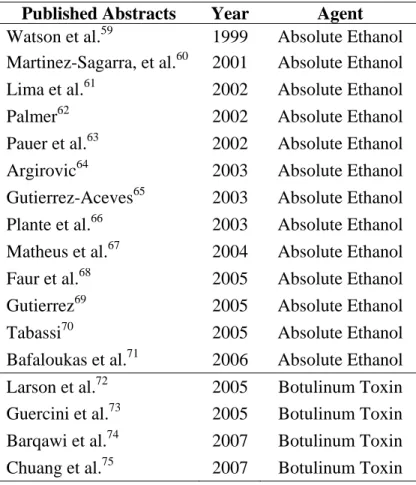
in the Addendum (Table 9).
Evaluation of Study Quality:
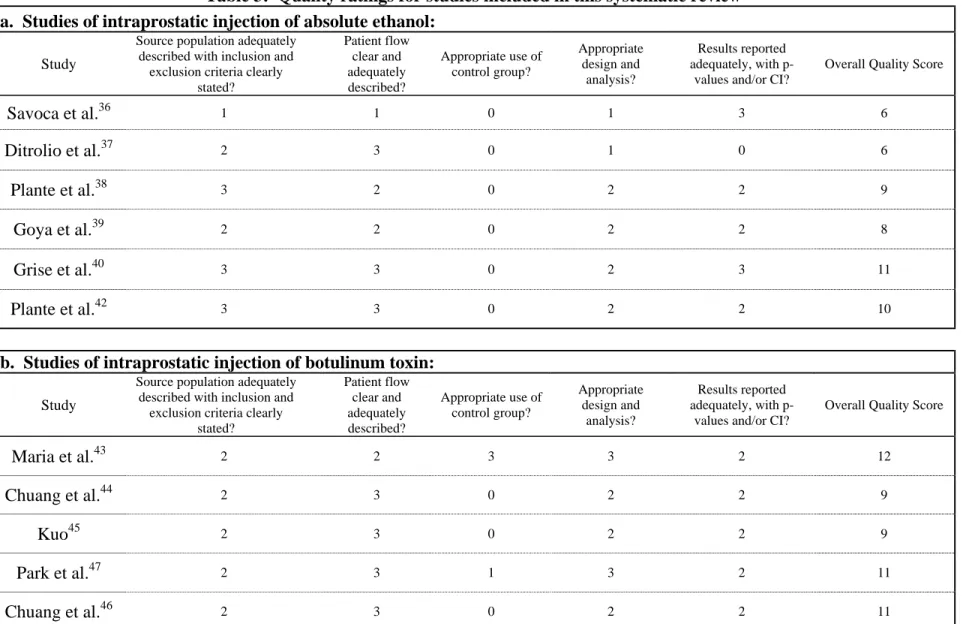
The quality of the selected eleven studies (six for the ethanol intervention and five for the
botulinum toxin intervention) was evaluated as detailed in Table 3. The author graded each
study based on the fulfillment of five quality criteria: the adequacy of the description of the
source population (including a comprehensive discussion of inclusion and exclusion criteria), the
clarity with which patient follow-up and flow was presented, whether data were collected
adequately, whether data were analyzed appropriately, and whether statistical results were
reported completely with p-values or confidence intervals. These quality ratings were then
converted to numeric scores using a 0-3 point scale checklist (0=poor, 1=fair, 2=good,
3=excellent), and an overall quality score (0-15) was produced for each study, with a range from
RESULTS
Systematic Review:
The combined search strategies for the first agent, absolute ethanol, returned a combined
845 articles. Duplicates were removed and full texts were reviewed for 70 of these articles. All
studies as well as abstracts from national scientific meetings were compared to later publications
from the same investigators to assess originality; abstracts or studies found to have been
published later were excluded. After this review, a total of six peer-reviewed articles were found
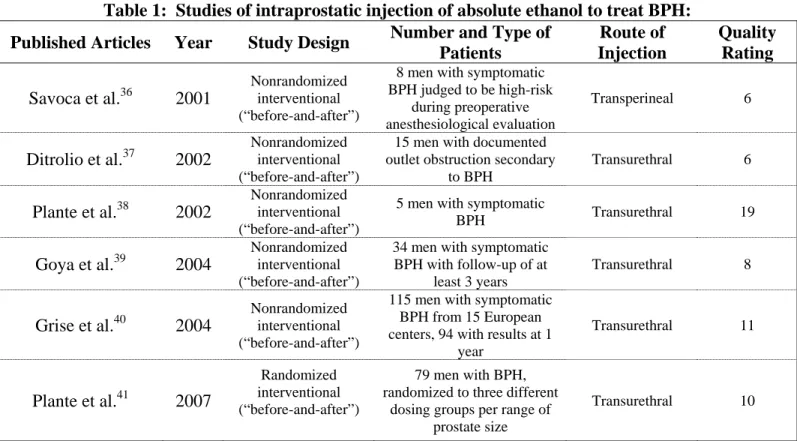
to meet the inclusion/exclusion criteria and were included in this systematic review (Table 1).
This group consists of five nonrandomized, interventional (“before-and-after”) studies39-43 and
one randomized, unblinded interventional trial.44
The combined search strategies for the second agent, botulinum toxin, returned a
combined 111 articles. Duplicates were removed and full texts were reviewed for 40 of these
articles. After this review, a total of five peer-reviewed articles were found to meet the
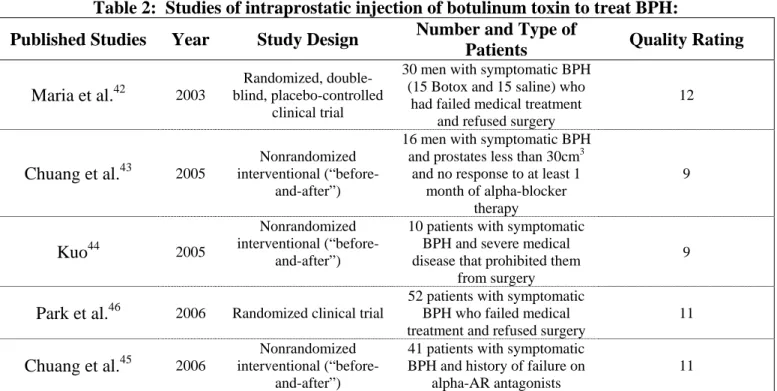
inclusion/exclusion criteria and were included in this systematic review (Table 2). This group
consists of one randomized, double-blind, placebo-controlled interventional trial,45 three
nonrandomized interventional (“before-and-after”) studies,46-48 and one randomized, unblinded
interventional trial.49
Subjective relief of BPH symptoms:
The selected studies differed in the period after injection over which subjective resolution
of BPH symptoms was assessed. Each study reported post-injection follow-up measurements at
the six-month time point. However, range of follow-up assessments reported varied from one
Symptom score (Table 4)
All of the studies using absolute ethanol to treat BPH assessed subjective relief of BPH
symptoms using either the IPSS41-44 or AUA symptom score.39, 40 Each study showed
statistically significant decreases in mean symptom score as compared to baseline at every time
point in which analysis was performed. Decreases were seen as early as one month after
treatment and as three years after treatment. All but one study used statistical analysis.40 Four of
the studies using botulinum toxin to treat BPH assessed subjective relief of BPH symptoms using
either the IPSS46, 48, 49 or AUA symptom score.45
Quality of life indices (Table 5)
Four of the studies using injections of absolute ethanol41-44 and three of the studies using
botulinum toxin46-48 measured disease-specific quality of life. All of these studies found
statistically significant differences in the mean disease-specific QOL index after treatment at
each time point in which analysis was performed. These differences were apparent as early as
one month after treatment in groups receiving injections with each of the two different agents,
and as late as three years in a group receiving injections with botulinum. One study also
measured the BPII and found statistically significant differences from baseline values in all
groups at six months after treatment (results not shown).44
Objective reduction in BPH signs:
Prostate volume (Table 6)
All of the studies included in this review estimated prostate volume in milliliters, grams,
study examined prostate volume at one month after treatment. Three of the five studies that
measured prostate volume at six months after injection and used statistical analysis found
statistically significant reductions in the mean values as compared to baseline.41, 43, 44 Both of the
studies that examined this at one year found statistically significant reductions.42, 43 The only
study that looked at more distant effects found a significant reduction at two years that appeared
to resolve at three years.42 With the botulinum toxin intervention, every study that estimated
prostate volume and analyzed the results statistically found a statistically significant decrease at
the one month,45, 46, 48, 49 three month,46-49 six month46-49 post-injection time points. The only
study which assessed these changes at a later time point found that the statistically significant
decrease in prostate volume remained at one year after injection.48
Post-void residual volume (Table 7)
Four of the studies using ethanol measured post-void residual volume after injection.39, 41,
42, 44 Six months was the only post-injection time point common to each of these studies. The
two largest studies42, 44 found a statistically significant decrease in PVR at this time point while
the two smaller studies did not39, 41. The study by Goya et al. found a statistically significant
decrease in PVR at up to three years after injection with absolute ethanol.42 Treatment with
botulinum toxin led to statistically significant decreases in PVR in two of the four studies
measuring this variable at one month,45, 48 while at 6 months there were statistically significant
decreases found in three of four studies.47-49 This effect diminished at one year in the only study
Peak urinary flow (Table 8)
All of the studies using intraprostatic ethanol that assessed changes in Qmax at one and
three months post-injection and showed statistically significant increases at these times points.39,
42, 43 At the one year time point, two of three studies found this statistically significant trend
continued,42, 43 and the only study that assessed peak urinary flow rate at a later time point found
statistically significant increases at both two and three years after injection.42 Three of the four
studies using botulinum toxin found statistically significant increases in peak urinary flow at the
one month post-injection time point.45, 46, 48 Similarly, all four studies using Botox that measured
peak urinary flow at 3 and 6 months and analyzed results found statistically significant increases
remained at those time points.46-49 The only study that looked at peak urinary flow at a more
remote time point found the trend continued at one year post-injection as well.48
Comparisons with other treatments for BPH
Ethanol
None of the studies using intraprostatic injections of absolute ethanol included a
head-to-head comparison with another accepted treatment for BPH.
Botulinum Toxin
None of the studies using botulinum toxin included a head-to-head comparison with
another accepted treatment for BPH. However, the study by Park et al.49 included a comparison
at the one month time point between a group of patients receiving intraprostatic injection of
botulinum toxin alone with those receiving both the injection of Botox as well as concomitant
treatment with an alpha-adrenergic antagonist for one month. This study found that while both
statistically significantly reduced from baseline values, the only significant difference between
the two groups was in the response to the IPSS-5 question (p=0.034), which states “Over the past
month, how often have you had a weak urinary stream?”
Harms associated with intervention
Ethanol
None of the studies using intraprostatic injection of absolute ethanol reported any
significant harm associated with the intervention. Several investigators monitored blood alcohol
levels, but no evidence of systemic alcohol absorption was found with this intervention. Most
concerns were minor medical issues, including hematuria, irritative voiding symptoms, brief
urinary retention, urinary tract infection, and pain. In each study patients were left with a Foley
catheter in place for approximately a week to reduce stress on the urinary tract.
Botulinum Toxin
None of the studies using botulinum toxin as an intraprostatic treatment for BPH reported
any significant morbidity from use of the intervention. Of principle concern was the possibility
of systemic absorption of the toxin leading to conditions such as respiratory depression or
hyposthenia; none of these studies reported any such systemic manifestations of the drug. Many
reports specifically mentioned the lack of urinary retention, incontinence, urinary tract infection,
DISCUSSION
Based on the published studies identified in this systematic review, intraprostatic
injection of either absolute ethanol or botulinum toxin presents a promising option for treating
men with symptomatic benign prostatic hyperplasia. Each study included in this review
quantified the subjective severity of a patient’s BPH using either the IPSS or AUA symptom
score. These surveys are the most useful tools clinicians have in determining when a patient
should begin therapeutic intervention for his disease. Regardless of the agent used, at every time
point in each study included in this review a statistically significant difference in symptom score
as compared to baseline was found. Similarly, the quality of life index was reduced at every
time point in every study for each agent. These significant improvements in patients’ symptoms
occurred as early as one month after injection for both agents, and persisted through extended
follow-up periods of three years for absolute ethanol42 and one year for botulinum toxin.48 Both
agents also demonstrated the ability to relieve objective signs of BPH as well, however with
much more inter-and intra-agent variability than with the reductions in subjective symptoms.
Both absolute ethanol and Botox were able to cause significant decreases in prostatic size, post
void residual volume, and peak urinary flow rate. The possibility that a single intraprostatic
injection could prolong symptomatic relief of a patient’s BPH for an extended period of follow
up is exciting, and it is likely that if given the choice many patients would be interested in this as
a treatment option rather than taking a daily medication or undergoing more invasive surgical
treatments for their disease.
When comparing intraprostatic injections to other accepted treatment modalities for BPH
the potential advantages are numerous. Perhaps the most significant of these is the ease with
procedures for treating the disease, intraprostatic injection of ethanol or botulinum toxin can be
done in a rapid and seemingly pain-free manner during a clinical encounter. Further, the
technique requires little accessory equipment, is easy to learn, and has a very low rate of
complication. These factors make it an ideal treatment in resource-limited areas where access to
more advanced minimally invasive treatments accessories like the holmium laser or TUNA
system is not available. From the studies included here it also appears that these injections have
a very low incidence of significant adverse events. Finally, the cost of the intervention could be
dramatically less than the cost of other invasive treatments for BPH or daily medications used to
treat the disease. All of these characteristics make intraprostatic injection an ideal treatment
modality for patients with BPH, especially those who do not qualify for or who do not desire
surgical intervention and do not wish to take daily medications for their condition.
However intraprostatic injection is associated with several disadvantages as compared to
traditional treatment modalities for BPH. The issue of durability is the most significant of these.
While long-term data are lacking it is obvious from short-term studies that that the therapeutic
benefits of injection eventually wear off over time, and thus patients undergoing injection
therapy for BPH would require a series of follow-up injections in order to maintain therapeutic
benefit. This stands in sharp contrast to invasive treatments such as TURP, the effects of which
can last for many years. This lack of durability brings with it the additional disadvantage of the
expense entailed in paying for multiple rounds of injection therapy. Because none of the studies
included in this review have post-injection follow-up data longer than one year for botulinum
toxin and three years for ethanol, at this point it is impossible to know how often patients need
Still questions remain with regards to both of the agents studied here. Because none of
the studies included here used any method of quantifying pain or discomfort associated with the
intervention, it is impossible to know what level of pain or discomfort is actually associated with
these therapies. For absolute ethanol, which route of injection is superior, transurethral, or
transperineal, is unclear. Technically, the transurethral route is easier and thus more likely to be
pursued by a larger number of urologists. Savoca39 claims that the transperineal approach
performed via guidance using transrectal ultrasound is “less traumatic,” while Plante41 touts the
fact that the transurethral route “avoids capsular distortion” and potential leakage of ethanol.
Because none of the studies using ethanol compared the two methods and because neither
method produced significant side effects, it stands to reason that in experienced hands neither
method is superior. With regards to botulinum toxin, only one formulation of one form of the
toxin was used (botulinum toxin type A, “Botox”). While this is the form of the toxin used most
frequently in other areas of clinical medicine, it is unclear whether other formulations of the type
A toxin or other types of the toxin would be more successful in treating BPH.
This review has several limitations. Because the clinical use of these interventions is still
in its infancy, the published literature lacks high quality studies using these two agents. The
highest quality study for assessing an intervention is a double-blind, placebo-controlled
randomized trial. Two studies included here, Maria et al.45 and Park et al.,49 were randomized
and methodologically sound, however all the other studies included in this review were
interventional or “before and after” studies that were not blinded. This allows for the possibility
of bias on the part of both the study investigators and the patients, and because part of the effect
of the intervention was measured via subjective elements (i.e. AUA score), a patient’s being
Maria et al. included a control arm. This is a serious flaw in the design of the other studies as
only with a contemporary control group can a prospective study truly establish the effect of an
intervention as directly compared to another. With regards to the quality ratings of the studies
included in this review, because the author was the sole assessor of study quality it is likely that
the quality ratings would differ with the input of a second reviewer. Finally, none of the studies
reviewed here included a head-to-head comparison of intraprostatic injection with any other
traditional treatments for BPH and thus it is impossible to know if this treatment modality is
superior to other methods in treating symptomatic BPH. Only when such studies are performed
can conclusions be drawn about the efficacy of this modality and the appropriateness of its use.
In the studies reviewed here, both intraprostatic absolute ethanol and botulinum toxin
demonstrated the ability to reduce subjective as well as objective features of BPH with limited
amounts of associated morbidity and virtually no significant adverse effects. However, for
injection of either of these agents to become an accepted form of treatment for BPH, significant
research must still be carried out. After proving its viability in case reports and observational
studies, the next step in the acceptance of a potential treatment option is large trials that assess
both the safety and efficacy of the agent. The results of such trial can then be used to identify
patient populations best suited for the intervention, especially as compared to traditional
therapies for BPH. Data from longer follow-up periods also must be gathered so that the
durability of these treatments can be established and optimal time points for repeat injections can
be identified. The Phase I/II trial of absolute ethanol injection presented here41 answers some of
the questions regarding safety of this agent, however, the follow-up on this trial only went to six
months and needs to be carried out further. With regards to botulinum toxin, recently two
potential of intraprostatic Botox as a treatment for BPH.50, 51 When these trials conclude it is
likely that enough information will be available to decide if Botox is in fact a suitable treatment
for men with symptomatic BPH. Until then the results of the studies reviewed here will continue
to encourage both physicians and patients that less invasive yet effective treatments for BPH are
ADDENDUM
Marketing and Cost of Pharmacologic treatments for BPH
Recently television viewers have been treated to a series of advertisements for certain
pharmaceutical products depicting middle-aged men in the midst of hiking, kayaking, bicycling,
or other recreational activities who face constant interruptions caused by their increased
frequency of urination. “Here’s to guys who want to spend more time having fun and less time
in the men’s room,” one commercial states.52 These men are visibly distraught with their
symptoms and situation until a quick visit to their doctor assures them that their “going problem”
is really a “growing problem” known as BPH. Viewers are relieved to see that after these men
receive the advertised medical treatment for this “growing problem” they are once again able to
enjoy a vast array of recreational and social activities without the constant disturbances caused
by frequent urination. This advertisement is just one of a handful aimed at the treatment of such
symptomatic states at an estimated cost in 2006 to pharmaceutical companies of $238.8 million
dollars, an increase of nearly 37% of what was spent in 2005.53 Furthermore, the prevalence of
BPH and the disruptive nature of its symptoms ensure that such expenditures will continue to
rise in the years to come.
Side effects of Alpha-adrenergic inhibitors
A review published in 2005 found that terazosin and doxazosin had a higher association
with both dizziness and orthostatic hypotension than did alfuzosin or tamsulosin.54 A
double-blind study randomizing men to long-term usage of doxazosin (3652 person-years) or placebo
(3489 person-years) showed statistically significant (p<0.05) differences, respectively, in
2.29/100 person-years), and asthenia (4.08 vs. 2.06/100 person-years).11 A systematic review
and meta-analysis of studies in which men with BPH were randomly assigned to either daily
alfuzosin or placebo for at least four weeks duration in men showed a statistically significant
difference in the relative risk ratio between the respective groups in the percentage of men
experiencing dizziness (2.04, 95% confidence interval: 1.29 – 3.22, from six studies looking at
1298 men taking alfuzosin and 1000 taking placebo). It did not find statistically significant
differences in asthenia or impotence, and although the relationship with dizziness approached
statistical significance, it did not reach it.55
A systematic review and meta-analysis of studies in which men with BPH were randomly
assigned to either daily doxazosin or placebo for at least four weeks duration in men showed a
statistically significant difference in the relative risk ratio between the respective groups in the
percentage of men experiencing dizziness (1.92, 95% confidence interval: 1.40 – 2.61, from five
studies looking at 1450 men taking doxazosin and 693 taking placebo), asthenia (3.33, 95%
confidence interval: 1.97 – 5.61, from five studies looking at 1450 men taking doxazosin and 693
taking placebo, postural hypotension (2.72, 95% confidence interval: 1.21 – 6.15, from 4 studies
looking at 1400 men taking doxazosin and 643 taking placebo, and somnolence (2.31, 95%
confidence interval: 1.02 – 5.21, from 2 studies looking at 471 men taking doxazosin and 412
taking placebo.56
Side effects of 5-alpha reductase inhibitors
Several groups have shown the development of sexual side effects after treatment with
finasteride. Uygur et al. showed that in 48 men with BPH taking 5 mg finasteride daily for six
(33%) at six months.57 Nickel et al. randomized 472 BPH patients to daily treatment with either
5 mg finasteride or placebo and found that, after two years, 7.7% of men in the finasteride group
versus 1.7% of men in the placebo group experienced ejaculation disorders, while 15.8% versus
6.3% experienced impotence (p<0.01 for each).58 Tenover et al. randomized 2112 men with symptomatic BPH to either 5 mg finasteride daily (1736 subjects) or placebo (579 subjects) for
one year and found statistically significant differences between these groups in overall sexual
adverse events (12.3% vs. 6.0%, p<0.001), impotence (7.4% vs. 3.3%, p<0.001), decreased
libido (4.9% vs. 2.9%, p=0.038), and ejaculation disorder (3.3% vs. 0.9%, p=0.001).59 However,
only 2.2% of men taking the finasteride withdrew from the study due to experience an adverse
sexual event.
Finally, the Proscar Long-Term Efficacy and Safety Study Group randomized 3040
patients with moderate-to-severe urinary symptoms due to BPHand enlarged prostate glands to
daily treatment with either 5 mg finasteride or placebo and found that after one year men in the
finasteride group had statistically significant differences as compared to placebo in the
occurrence of decreased libido (6.4% vs. 3.4%, p=0.002), impotence (8.1% vs. 3.7%, p<0.001),
decreased ejaculate volume (3.7 vs. 0.8, p<0.001), and ejaculation disorders (0.8% vs. 0.1%,
p=0.002).60 A later analysis of the results of this study reported that drug-related sexual side
effects occurred in the first year in 15% of those taking finasteride, versus 7% of those taking
placebo (p<0.001).61 In years two to four, however, the investigators found no statistically
Table 1: Studies of intraprostatic injection of absolute ethanol to treat BPH:
Published Articles Year Study Design Number and Type of Patients
Route of Injection
Quality Rating
Savoca et al.36 2001
Nonrandomized interventional (“before-and-after”)
8 men with symptomatic BPH judged to be high-risk
during preoperative anesthesiological evaluation
Transperineal 6
Ditrolio et al.37 2002
Nonrandomized interventional (“before-and-after”)
15 men with documented outlet obstruction secondary
to BPH
Transurethral 6
Plante et al.38 2002
Nonrandomized interventional (“before-and-after”)
5 men with symptomatic
BPH Transurethral 19
Goya et al.39 2004
Nonrandomized interventional (“before-and-after”)
34 men with symptomatic BPH with follow-up of at
least 3 years
Transurethral 8
Grise et al.40 2004
Nonrandomized interventional (“before-and-after”)
115 men with symptomatic BPH from 15 European centers, 94 with results at 1
year
Transurethral 11
Plante et al.41 2007
Randomized interventional (“before-and-after”)
79 men with BPH, randomized to three different
dosing groups per range of prostate size
Table 2: Studies of intraprostatic injection of botulinum toxin to treat BPH:
Published Studies Year Study Design Number and Type of
Patients Quality Rating
Maria et al.42 2003
Randomized, double-blind, placebo-controlled
clinical trial
30 men with symptomatic BPH (15 Botox and 15 saline) who
had failed medical treatment and refused surgery
12
Chuang et al.43 2005
Nonrandomized interventional
(“before-and-after”)
16 men with symptomatic BPH and prostates less than 30cm3
and no response to at least 1 month of alpha-blocker
therapy
9
Kuo44 2005
Nonrandomized interventional
(“before-and-after”)
10 patients with symptomatic BPH and severe medical disease that prohibited them
from surgery
9
Park et al.46 2006 Randomized clinical trial
52 patients with symptomatic BPH who failed medical treatment and refused surgery
11
Chuang et al.45 2006
Nonrandomized interventional
(“before-and-after”)
41 patients with symptomatic BPH and history of failure on
alpha-AR antagonists
Table 3: Quality ratings for studies included in this systematic review a. Studies of intraprostatic injection of absolute ethanol:
Study
Source population adequately described with inclusion and
exclusion criteria clearly stated?
Patient flow clear and adequately described?
Appropriate use of control group?
Appropriate design and
analysis?
Results reported adequately, with
p-values and/or CI?
Overall Quality Score
Savoca et al.36 1 1 0 1 3 6
Ditrolio et al.37 2 3 0 1 0 6
Plante et al.38 3 2 0 2 2 9
Goya et al.39 2 2 0 2 2 8
Grise et al.40 3 3 0 2 3 11
Plante et al.42 3 3 0 2 2 10
b. Studies of intraprostatic injection of botulinum toxin:
Study
Source population adequately described with inclusion and
exclusion criteria clearly stated?
Patient flow clear and adequately described?
Appropriate use of control group?
Appropriate design and
analysis?
Results reported adequately, with
p-values and/or CI?
Overall Quality Score
Maria et al.43 2 2 3 3 2 12
Chuang et al.44 2 3 0 2 2 9
Kuo45 2 3 0 2 2 9
Park et al.47 2 3 1 3 2 11
Chuang et al.46 2 3 0 2 2 11
Each study was rated 0-3 for each category with 0 = poor, 1 = fair, 2 = good, 3 = excellent.
Table 4: Change in AUA/IPSS Symptom score (0 – 35) after intraprostatic injection of absolute ethanol [mean ± SD]
Study Baseline N Baseline 1 mo 3 mo 6 mo 1 year 2 year 3 year
Savoca et al.36 8 21±5.2 10±4.4
(p<0.0001)a
9±4.2 (NS)b
Ditrolio et al.37 15 22.4
10.3 (n=14) (NA) 5.5 (n=13) (NA) 5.6 (n=13) (NA) 5.9 (n=13) (NA)
Plante et al.38 5 23.4±5.0 14.2±6.6
(NA) 12.2±5.0 (NA) 11.4±7.5 (NA) 13.8±6.8 (p<0.05)a
Goya et al.39 34 21.8±5.9
14.3±7.8 (n=33) (p<0.001)a 10.4±5.3 (n=34) (p<0.001)a 10.8±5.3 (n=33) (p<0.001)a 9.6±4.6 (n=29) (p<0.001)a 10.4±5.8 (n=19) (p<0.001)a 13.1±6.2 (n=17) (p<0.01)a
Grise et al.40 114 20.6±5.9
13.7±7.1 (n=104) (p<0.05)a 10.3±6.6 (n=94) (p<0.05)a 10.6±6.3 (n=93) (p<0.05)a 10.3±6.2 (n=93) (p<0.05)a
Plante et al.41
Dose 1 Dose 2 Dose 3 27 25 27 22.7±5.2 24.4±5.2 23.7±5.0 12.1±7.8 (n=26) (p<0.05)a 11.0±8.6 (n=22) (p<0.05)a 11.2±4.9 (n=24) (p<0.05)a
Table 4 (cont.): Change in AUA/IPSS Symptom score (0 – 35) after intraprostatic injection of botulinum toxin [mean ± SD]
Study Baseline N Baseline 1 mo 3 mo 6 mo 1 year 2 year 3 year
Maria et al.42 15 23.2±4.1
10.6±1.7 (p=0.00001)a (p<0.05)b 9.1±3.0 (n=17)c (NA) 8.9±3.2 (n=17)c (NA)
Chuang et al.43 16 18.8±1.6 8.9±1.9
(p<0.05)a
7.9±1.7 (p<0.05)a
7.4±1.8 (p<0.05)a
Park et al.46
26 52 23 24.2±8.7 24.3±7.8 24.0±8.3 18.5±8.2 (p=0.001)a 16.9±6.4 (p<0.05)a 14.7±6.0 (p<0.05)a
Chuang et al.45
Dose 1 (100 U)
Dose 2 (200 U)
21 20 18.7±1.3 19.3±1.2 9.8±1.3 (n=21) (p<0.05)a 9.5±2.0 (n=20) (p<0.05)a 8.1±1.6 (n=19) (p<0.05)a 8.3±2.0 (n=17) (p<0.05)a 7.3±2.0 (n=18) (p<0.05)a 5.2±1.1 (n=15) (p<0.05)a 9.0±2.4 (n=13) (p<0.05)a 8.3±1.9 (n=11) (p<0.05)a
Table 5: Change in QOL Index (0 – 6) after intraprostatic injection of absolute ethanol [mean ± SD]
Study Baseline N Baseline 1 mo 3 mo 6 mo 1 year 2 year 3 year
Plante et al.38 5 4.0±0.7 2.4±0.9
(NA) 1.6±0.9 (NA) 2.2±1.6 (NA) 2.8±0.8 (p<0.05)a
Goya et al.39 34 5.0±0.6
(p<0.001)a
3.4±1.5 (n=33) (p<0.001)a
2.6±1.4 (n=34) (p<0.001)a
2.7±1.4 (n=33) (p<0.001)a
2.3±1.4 (n=29) (p<0.001)a
2.4±1.4 (n=19) (p<0.001)a
2.8±1.3 (n=17) (p<0.001)a
Grise et al.40 114 4.4±0.8
2.8±1.6 (n=104) (p<0.05)a
2.2±1.5 (n=94) (p<0.05)a
2.3±1.4 (n=93) (p<0.05)a
2.1±1.3 (n=93) (p<0.05)a
Plante et al.41
Dose 1 Dose 2 Dose 3 27 25 27 4.5±0.9 4.4±1.0 4.2±0.9 2.2±1.7 (n=25) (p<0.05)a
2.2±1.6 (n=22) (p<0.05)a
2.1±1.2 (n=25) (p<0.05)a
Table 5 (cont.): Change in QOL Index (0 – 6) after intraprostatic injection of botulinum toxin [mean ± SD]
Study Baseline N Baseline 1 mo 3 mo 6 mo 1 year 2 year 3 year
Chuang et al.43 16 3.8±0.3 2.1±0.3
(p<0.05)a
1.9±0.3 (p<0.05)a
1.8±0.3 (p<0.05)a
Kuo44 10 4.5±2.7 2.3±2.3
(p<0.0001)a
2.1±1.9 (p<0.0001)a
Park et al.46
26 52 23 4.6±0.9 4.8±0.9 4.7±1.0 3.4±1.3 (p<0.05)a 3.2±1.2 (p<0.05)a 3.0±0.8 (p<0.05)a
Chuang et al.45
Dose 1 (100 U)
Dose 2 (200 U)
21 20 3.9±0.3 4.1±0.2 2.1±0.3 (n=21) (p<0.05)a 2.0±0.3 (n=20) (p<0.05)a 2.0±0.2 (n=19) (p<0.05)a 2.2±0.4 (n=17) (p<0.05)a 1.4±0.3 (n=18) (p<0.05)a 1.8±0.2 (n=15) (p<0.05)a 1.8±0.4 (n=13) (p<0.05)a 2.4±0.6 (n=11) (p<0.05)a a
Table 6: Change in prostate volume (ml, g, or cm3) after intraprostatic injection of absolute ethanol [mean ± SD]
Study Baseline N Baseline 1 mo 3 mo 6 mo 1 year 2 year 3 year
Savoca et al.36 8 40±15 ml 39±14
(NS)a
37±13 (NS)b
Ditrolio et al.37 15 47.5 g 23.3
(NA)
26.4 (NA)
Plante et al.38 5 53.0±19.0 ml 37.2±17.9
(p<0.05)a
Goya et al.39 34 49.3±15.3 ml
47.1±15.1 (n=34) (p<0.001)a 48.6±15.8 (n=33) (NS)a 45.7±16.3 (n=29) (p<0.001)a 48.9±17.8 (n=19) (P<0.001)a 51.4±21.4 (n=17) (NS)a
Grise et al.40 115 45.9±19.9 ml
39.2±20.4 (n=84) (p<0.05)a 38.5±17.9 (n=80) (p<0.05)a
Plante et al.41
Dose 1 Dose 2 Dose 3 27 25 27 46.1±15.4 ml 44.3±13.3 ml 45.2±12.7 ml 39.8±16.2 (n=26) (p<0.05)a 38.7±18.3 (n=23) (p<0.05)a 34.0±16.0 (n=24) (p<0.05)a
Table 6 (cont.): Change in prostate volume (ml, g, or cm3) after intraprostatic injection of botulinum toxin [mean ± SD (No.)]
Study Baseline N Baseline 1 mo 3 mo 6 mo 1 year 2 year 3 year
Maria et al.42 15 52.6±10.6 ml
23.8±6.2 (p=0.0001)a (p<0.05)b 21±7.1 (n=17)c (NA) 20.5±8 (n=17)c (NA)
Chuang et al.43 16 19.6±1.2 cm3 17.0±1.1
(p<0.05)a
16.7±1.2 (p<0.05)a
16.9±1.1 (p<0.05)a
Kuo44 10 65.5±19.5 cm3 45.9±17.2
(p<0.05)a
49.6±17.6 (p<0.05)a
Park et al.46
26 52 23 47.9±27.8 ml 47.2±23.9 ml 47.5±26.4 ml 44.1±25.3 (p<0.001)a 41.0±19.0 (p<0.05)a 40.8±19.1 (p<0.05)a
Chuang et al.45
Dose 1 (100 U)
Dose 2 (200 U)
21 20 21.1±1.1 ml 54.3±4.7 ml 18.0±1.1 (n=21) (p<0.05)a 46.3±3.7 (n=20) (p<0.05)a 18.0±1.0 (n=19) (p<0.05)a 45.0±4.2 (n=17) (p<0.05)a 17.5±0.9 (n=18) (p<0.05)a 45.3±4.1 (n=15) (p<0.05)a 17.0±1.6 (n=13) (p<0.05)a 47.2±4.0 (n=11) (p<0.05)a
Table 7: Change in post-void residual volume (ml) after intraprostatic injection of absolute ethanol [mean ± SD]
Study Baseline N Baseline 1 mo 3 mo 6 mo 1 year 2 year 3 year
Savoca et al.36 8 130±66 27±11
(p<0.01)a
33±9 (NS)b
Plante et al.38 5 118.8±102.7 97.4±84.6
(NA) 89.8±56.5 (NA) 111.4±79.2 (NA) 111.2±76.8 (NS)a
Goya et al.39 34 93±61
51±40 (n=33) (p<0.001)a
34±27 (n=34) (p<0.001)a
30±26 (n=33) (p<0.001)a
35±32 (n=29) (p<0.001)a
23±17 (n=19) (p<0.001)a
28±20 (n=17) (p<0.01)a
Plante et al.41
Dose 1 Dose 2 Dose 3 27 25 27 98.4±69.8 105.1±70.8 106.9±78.3 97.2±75.6 (n=26) (p<0.05)a
88.6±87.6 (n=23) (p<0.05)a
79.6±65.5 (n=23) (p<0.05)a
Table 7 (cont.): Change in post-void residual volume (ml) after intraprostatic injection of botulinum toxin [mean ± SD]
Study Baseline N Baseline 1 mo 3 mo 6 mo 1 year 2 year 3 year
Maria et al.42 15 126.3±38.3
49.6±13.4 (p=0.00001)a
(p<0.05)b
24.2±17 (n=17)c
(NA)
24±18 (n=17)c (NA)
Chuang et al.43 16 67.7±30.0 25.1±4.0
(NS)a
27.3±4.3 (NS)a
26.4±4.3 (NS)a
Kuo44 10 243.0±133.9 53.9±20.1
(p<0.05)a
36.8±34.1 (p<0.05)a
Park et al.46
26 52 23 108.1±129.6 122.7±141.2 108.7±126.7 82.2±63.6 (NS)a 80.7±40.9 (p<0.05)a 59.4±33.4 (p<0.05)a
Chuang et al.45
Dose 1 (100 U)
Dose 2 (200 U)
21
20
64.2±23.0
161.7±48.1
35.7±4.4 (n=21) (NS)a
45.2±8.2 (n=20) (p<0.05)a
24.1±4.8 (n=19) (p<0.05)a
37.6±5.9 (n=17) (p<0.05)a
38.5±8.4 (n=18) (NS)a
45.5±0.9 (n=15) (p<0.05)a
40.0±11.5 (n=13) (NS)a
93.6±36.1 (n=11)
(NS)a
Table 8: Change in peak urinary flow rate (ml/s) after intraprostatic injection of absolute ethanol [mean ± SD (No.)]
Study Baseline N Baseline 1 mo 3 mo 6 mo 1 year 2 year 3 year
Savoca et al.36 8 11±3.5 16±3.1
(p<0.001)a
17±3.4 (NS)b
Ditrolio et al.37 15 5.7 8.5
(NA) 11.7 (NA) 11.7 (NA) 11.9 (NA)
Plante et al.38 5 9.9±2.2 13.0±3.0
(NA) 13.8±3.6 (NA) 13.0±4.2 (NA) 13.1±3.9 (NS)a
Goya et al.39 34 8.3±2.8
11.1±4.3 (n=33) (p<0.001)a
12.5±4.6 (n=34) (p<0.001)a
12.9±5.2 (n=33) (p<0.001)a
13.6±6.0 (n=29) (p<0.001)a
15.2±5.2 (n=19) (p<0.001)a
12.7±3.4 (n=17) (p<0.01)a
Grise et al.40 115 9.9±2.9
12.8±13.8 (n=108) (p<0.05)a
13.4±5.7 (n=105) (p<0.05)a
13.4±8.6 (n=93) (p<0.05)a
13.4±5.8 (n=90) (p<0.05)a
Plante et al.41
Dose 1 Dose 2 Dose 3 27 25 27 8.3±2.6 8.1±2.2 8.6±2.1 11.5±5.1 (n=20) (p<0.05)a
13.5±6.6 (n=21) (p<0.05)a
16.7±10.7 (n=22) (p<0.05)a
Table 8 (cont.): Change in peak urinary flow rate (ml/s) after intraprostatic injection of botulinum toxin [mean ± SD (No.)]
Study Baseline N Baseline 1 mo 3 mo 6 mo 1 year 2 year 3 year
Maria et al.42 15 8.1±2.2
14.9±2.1 (p=0.00001)a
(p<0.05)b
14.6±4.1 (n=17)c
(NA)
15±2.9 (n=17)c (NA)
Chuang et al.43 16 7.3±0.7 11.8±0.8
(p<0.05)a
11.9±1.1 (p<0.05)a
12.5±1.0 (p<0.05)a
Kuo44 10 7.6±3.9 9.9±3.2
(p<0.05)a
11.6±3.5 (p<0.05)a
Park et al.46
26 52 23 9.1±5.9 9.6±6.5 7.4±3.6 10.1±5.6 (NS)a 11.1±5.9 (p<0.05)a 9.4±3.1 (p<0.05)a
Chuang et al.45
Dose 1 (100 U)
Dose 2 (200 U)
21
20
7.9±0.6
7.0±1.1
12.0±0.8 (n=21) (p<0.05)a
10.3±1.1 (n=20) (p<0.05)a
12.7±1.5 (n=19) (p<0.05)a
9.8±1.1 (n=17) (p<0.05)a
12.7±1.1 (n=18) (p<0.05)a
11.9±0.9 (n=15) (p<0.05)a
13.4±0.8 (n=13) (p<0.05)a
11.1±0.9 (n=11) (p<0.05)a
Table 9: Abstracts from Scientific Meetings of studies using intraprostatic injections to treat BPH
Published Abstracts Year Agent
Watson et al.59 1999 Absolute Ethanol Martinez-Sagarra, et al.60 2001 Absolute Ethanol
Lima et al.61 2002 Absolute Ethanol Palmer62 2002 Absolute Ethanol Pauer et al.63 2002 Absolute Ethanol Argirovic64 2003 Absolute Ethanol Gutierrez-Aceves65 2003 Absolute Ethanol
Plante et al.66 2003 Absolute Ethanol Matheus et al.67 2004 Absolute Ethanol Faur et al.68 2005 Absolute Ethanol Gutierrez69 2005 Absolute Ethanol Tabassi70 2005 Absolute Ethanol Bafaloukas et al.71 2006 Absolute Ethanol
![Table 4: Change in AUA/IPSS Symptom score (0 – 35) after intraprostatic injection of absolute ethanol [mean ± SD]](https://thumb-us.123doks.com/thumbv2/123dok_us/8344165.2217067/37.1188.130.1060.134.592/table-change-ipss-symptom-intraprostatic-injection-absolute-ethanol.webp)
![Table 5: Change in QOL Index (0 – 6) after intraprostatic injection of absolute ethanol [mean ± SD]](https://thumb-us.123doks.com/thumbv2/123dok_us/8344165.2217067/39.1188.143.1051.125.534/table-change-qol-index-intraprostatic-injection-absolute-ethanol.webp)
![Table 6: Change in prostate volume (ml, g, or cm 3 ) after intraprostatic injection of absolute ethanol [mean ± SD]](https://thumb-us.123doks.com/thumbv2/123dok_us/8344165.2217067/41.1188.200.1061.119.603/table-change-prostate-volume-intraprostatic-injection-absolute-ethanol.webp)
![Table 7: Change in post-void residual volume (ml) after intraprostatic injection of absolute ethanol [mean ± SD]](https://thumb-us.123doks.com/thumbv2/123dok_us/8344165.2217067/43.1188.123.1064.125.517/table-change-residual-volume-intraprostatic-injection-absolute-ethanol.webp)
![Table 8: Change in peak urinary flow rate (ml/s) after intraprostatic injection of absolute ethanol [mean ± SD (No.)]](https://thumb-us.123doks.com/thumbv2/123dok_us/8344165.2217067/45.1188.122.1062.132.598/table-change-peak-urinary-intraprostatic-injection-absolute-ethanol.webp)