Image from: http://tiki.oneworld.net/energy/energy-‐title.jpg
Table of Contents
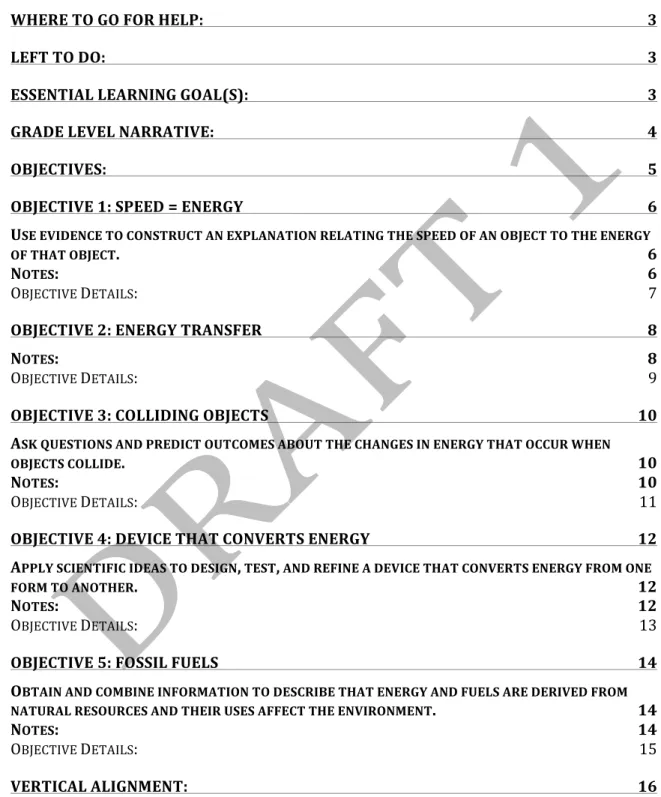
WHERE TO GO FOR HELP: 3
LEFT TO DO: 3
ESSENTIAL LEARNING GOAL(S): 3
GRADE LEVEL NARRATIVE: 4
OBJECTIVES: 5
OBJECTIVE 1: SPEED = ENERGY 6
USE EVIDENCE TO CONSTRUCT AN EXPLANATION RELATING THE SPEED OF AN OBJECT TO THE ENERGY
OF THAT OBJECT. 6
NOTES: 6
OBJECTIVE DETAILS: 7
OBJECTIVE 2: ENERGY TRANSFER 8
NOTES: 8
OBJECTIVE DETAILS: 9
OBJECTIVE 3: COLLIDING OBJECTS 10
ASK QUESTIONS AND PREDICT OUTCOMES ABOUT THE CHANGES IN ENERGY THAT OCCUR WHEN
OBJECTS COLLIDE. 10
NOTES: 10
OBJECTIVE DETAILS: 11
OBJECTIVE 4: DEVICE THAT CONVERTS ENERGY 12
APPLY SCIENTIFIC IDEAS TO DESIGN, TEST, AND REFINE A DEVICE THAT CONVERTS ENERGY FROM ONE
FORM TO ANOTHER. 12
NOTES: 12
OBJECTIVE DETAILS: 13
OBJECTIVE 5: FOSSIL FUELS 14
OBTAIN AND COMBINE INFORMATION TO DESCRIBE THAT ENERGY AND FUELS ARE DERIVED FROM NATURAL RESOURCES AND THEIR USES AFFECT THE ENVIRONMENT. 14
NOTES: 14
OBJECTIVE DETAILS: 15
VERTICAL ALIGNMENT: 16
Where to go for help:
Chris McGee – Science Coordinator Katie French – Avery
Jen Blumenkemper -‐ Bristol
LEFT TO DO:
¨ Assessment¨ Link to Common Core
¨ Experiences
¨ Pacing guide
¨ Materials List
¨ Trade books/Resources
¨ Key Vocab list
Essential Learning Goal(s):
Students apply concepts of energy.
S 4
Student demonstrates innovation, in depth inference(s), or advanced application(s) with the learning goal which may include:
• Provide creative solutions to energy related problems environment,
global, and locally.
3
Students will be able to synthesize:
• Energy’s forms
• Energy’s ability to transfer • Energy’s relationship to motion • Energy from resources
The performance expectations in fourth grade help students formulate answers to questions such as:
What are waves and what are some things they can do? How can water, ice, wind and vegetation change the land?
What patterns of Earth’s features can be determined with the use of maps? How do internal and external structures support the survival, growth, behavior, and
reproduction of plants and animals? What is energy and how is it related to motion?
How is energy transferred?
How can energy be used to solve a problem?
Fourth grade performance expectations include PS3, PS4, LS1, ESS1, ESS2, ESS3, and ETS1 Disciplinary Core Ideas from the NRC Framework.
• Students are able to use a model of waves to describe patterns of waves in
terms of amplitude and wavelength, and that waves can cause objects to move.
• Students are expected to develop understanding of the effects of weathering
or the rate of erosion by water, ice, wind, or vegetation.
• They apply their knowledge of natural Earth processes to generate and
compare multiple solutions to reduce the impacts of such processes on humans.
• In order to describe patterns of Earth’s features, students analyze and
interpret data from maps.
• Fourth graders are expected to develop an understanding that plants and
animals have internal and external structures that function to support survival, growth, behavior, and reproduction.
• By developing a model, they describe that an object can be seen when light
reflected from its surface enters the eye.
• Students are able to use evidence to construct an explanation of the
relationship between the speed of an object and the energy of that object.
• Students are expected to develop an understanding that energy can be transferred from place to place by sound, light, heat, and electric currents or from object to object through collisions.
• They apply their understanding of energy to design, test, and refine a device
that converts energy from one form to another.
The crosscutting concepts of patterns; cause and effect; energy and matter; systems and system models; interdependence of science, engineering, and technology; and influence of engineering, technology, and science on society and the natural world are called out as organizing concepts for these disciplinary core ideas. In the fourth grade performance expectations, students are expected to demonstrate grade-‐ appropriate proficiency in asking questions, developing and using models, planning
and carrying out investigations, analyzing and interpreting data, constructing explanations and designing solutions, engaging in argument from evidence, and obtaining, evaluating, and communicating information. Students are expected to use these practices to demonstrate understanding of the core ideas.
Objectives:
• Use evidence to construct an explanation relating the speed of an object to
the energy of that object.
• Make observations to provide evidence that energy can be transferred from
place to place by sound, light, heat, and electric currents.
• Ask questions and predict outcomes about the changes in energy that occur
when objects collide.
• Apply scientific ideas to design, test, and refine a device that converts energy
from one form to another.
• Obtain and combine information to describe that energy and fuels are derived from natural resources and their uses affect the environment.
Students
apply
concepts
of energy
Use evidence to construct an
explanation relating the speed of an object to the
energy of that object.
Make observations to provide evidence that
energy can be transferred from place to place by sound, light, heat, and
electric currents.
Ask questions and predict outcomes about the changes in energy that occur when objects
collide.
Apply scientibic ideas to design, test, and rebine a
device that converts energy from one form to
another.
Obtain and combine information to describe that energy and fuels are derived
from natural resources and their
uses affect the environment.
Use evidence to construct an explanation relating the speed of an object to the energy of that object.
S 4
Student demonstrates innovation, in depth inference(s), or advanced application(s) with the learning goal which may include:
• Proving kinetic energy equation for a quantified definition of
speed using the formula k=1/2mv2
3 Students will be able to cite evidence that speed of an object relates to the energy of that object. D 2 Students explain that speed and energy are related.
B 1 Students define speed or energy
Notes:
Clarification:
• Assessment does not include quantitative measures of changes in the speed
of an object or on any precise or quantitative definition of energy.
• Energy (specifically kinetic energy) is defined by how fast an object is moving.
Science and Engineering Practices:
• Constructing explanations and designing solutions in 3–5 builds on K–2 experiences and progresses to the use of evidence in constructing
explanations that specify variables that describe and predict phenomena and in designing multiple solutions to design problems.
o Use evidence (e.g., measurements, observations, patterns) to construct an explanation.
Disciplinary Core Idea(s)
• Definitions of Energy
o The faster a given object is moving, the more energy it possesses.
Cross Cutting Concept(s) • Energy and Matter
o Energy can be transferred in various ways and between objects.
Link to Common Core ELA/Literacy
• RI.4.1 Refer to details and examples in a text when explaining what the text says explicitly and when drawing inferences from the text.
• RI.4.3 Explain events, procedures, ideas, or concepts in a historical, scientific,
or technical text, including what happened and why, based on specific information in the text.
• RI.4.9 Integrate information from two texts on the same topic in order to
• W.4.2 Write informative/explanatory texts to examine a topic and convey
ideas and information clearly.
• W.4.8 Recall relevant information from experiences or gather relevant information from print and digital sources; take notes and categorize information, and provide a list of sources.
• W.4.9 Draw evidence from literary or informational texts to support analysis, reflection, and research.
Objective Details:
Assessment
item(s): •
Resource(s): •• Ramps, marbles, cars Videos of car accidents
• Football player hits Website(s): •
Trade
Book(s): •
Make observations to provide evidence that energy can be transferred from place to place by sound, light, heat, and electric currents.
S 4
Student demonstrates innovation, in depth inference(s), or advanced application(s) with the learning goal which may include:
• Compare energy transfer through various media
• Assess the quality or quantity of energy transfer through various scenarios.
3 Students will collect and display evidence that energy can be transferred from place to place by sound, light, heat, and electric currents
D 2 With help students will collect and display evidence that energy can be transferred from place to place by sound, light, heat, and electric currents
B 1 Students are beginning to communicate evidence of energy transfer.
Notes: Clarification
• Assessment does not include quantitative measurements of energy. Science and Engineering Practices:
• Planning and Carrying out Investigations
o Planning and carrying out investigations to answer questions or test solutions to problems in 3–5 builds on K– 2 experiences and
progresses to include investigations that control variables and provide evidence to support explanations or design solutions.
o Make observations to produce data to serve as the basis for evidence for an explanation of a phenomenon or test a design solution.
Disciplinary Core Idea(s)
• Definitions of Energy
o Energy can be moved from place to place by moving objects or through sound, light, or electric currents.
• Conservation of Energy and Energy Transfer
o Energy is present whenever there are moving objects, sound, light, or heat.
o When objects collide, energy can be transferred from one object to another, thereby changing their motion.
o In such collisions, some energy is typically also transferred to the surrounding air; as a result, the air gets heated and sound is produced.
o Energy can also be transferred from place to place by electric currents, which can then be used locally to produce motion, sound, heat, or light.
o Transforming the energy of motion into electrical energy may have produced the currents to begin with.
Cross Cutting Concept(s) • Energy and Matter
o Energy can be transferred in various ways and between objects.
Link to Common Core ELA/Literacy
• W.4.8 Recall relevant information from experiences or gather relevant
information from print and digital sources; take notes and categorize information, and provide a list of sources.
Objective Details:
Assessment
item(s): •
Resource(s): • Circuits, solar panels, sound tubes, etc. Website(s): •
Trade
Book(s): •
Ask questions and predict outcomes about the changes in energy that occur when objects collide.
S 4
Student demonstrates innovation, in depth inference(s), or advanced application(s) with the learning goal which may include:
• Draw conclusions about energy transfer that holds true through
multiple situations and scenarios
3 Students ask questions and predict outcomes about the changes in energy that occur when objects collide. D 2 Students explain the changes in energy that occur when objects collide.
B 1 Students demonstrate that energy changes
Notes:
Clarification:
• Emphasis is on the change in the energy due to the change in speed, not on the forces, as objects interact.
• Basic idea two cars collide and eventually come to a stop
• Assessment does not include quantitative measurements of energy. Science and Engineering Practices:
• Asking questions and defining problems in grades 3–5 builds on grades K–2
experiences and progresses to specifying qualitative relationships.
o Ask questions that can be investigated and predict reasonable
outcomes based on patterns such as cause and effect relationships.
Disciplinary Core Idea(s)
• Definitions of Energy
o Energy can be moved from place to place by moving objects or through sound, light, or electric currents..
• Conservation of Energy and Energy Transfer
o Energy is present whenever there are moving objects, sound, light, or heat.
o When objects collide, energy can be transferred from one object to another, thereby changing their motion.
o In such collisions, some energy is typically also transferred to the surrounding air; as a result, the air gets heated and sound is produced.
• Relationship Between Energy and Forces
o When objects collide, the contact forces transfer energy so as to change the objects’ motions.
Cross Cutting Concept(s) • Energy and Matter
Link to Common Core ELA/Literacy
• W.4.8 Recall relevant information from experiences or gather relevant
information from print and digital sources; take notes and categorize information, and provide a list of sources.
Objective Details:
Assessment
item(s): • Resource(s): •
Website(s): •
Trade
Book(s): •
Apply scientific ideas to design, test, and refine a device that converts energy from one form to another.
S 4
Student demonstrates innovation, in depth inference(s), or advanced application(s) with the learning goal which may include:
• Design inspired presentation that is then communicated to
authentic audience.
• Make improvements to existing designs that transfer energy.
3 Students design, test, construct and refine a device that converts energy from one form to another. D 2 With help students design, test, construct and refine a device that converts energy from one form to another.
B 1 Students explain another’s device that converts energy from one form to another.
Notes:
Clarification:
• Examples of devices could include:
o Electric circuits that convert electrical energy into motion energy of a vehicle, light, or sound
o A passive solar heater that converts light into heat.
• Examples of constraints could include the materials, cost, or time to design the device.
• Devices should be limited to those that convert motion energy to electric energy or use stored energy to cause motion or produce light or sound.
Science and Engineering Practices:
• Apply scientific ideas to solve design problems.
Disciplinary Core Idea(s)
• Conservation of Energy and Energy Transfer
o Energy can also be transferred from place to place by electric currents, which can then be used locally to produce motion, sound, heat, or light.
o The currents may have been produced to begin with by transforming the energy of motion into electrical energy.
• Energy in Chemical Processes and Everyday Life
o The expression “produce energy” typically refers to the conversion of stored energy into a desired form for practical use.
• Defining Engineering Problems
o Possible solutions to a problem are limited by available materials and resources (constraints).
o The success of a designed solution is determined by considering the desired features of a solution (criteria).
o Different proposals for solutions can be compared on the basis of how well each one meets the specified criteria for success or how well each takes the constraints into account.
Cross Cutting Concept(s) • Energy and Matter
o Energy can be transferred in various ways and between objects.
• Influence of Engineering, Technology, and Science on Society and the Natural World
o Engineers improve existing technologies or develop new ones. • Science is a Human Endeavor
o Most scientists and engineers work in teams.
o Science affects everyday life. Link to Common Core
ELA/Literacy
• W.4.7 Conduct short research projects that build knowledge through
investigation of different aspects of a topic
Mathematics
• 4.OA.A.3 Solve multistep word problems posed with whole numbers and
having whole-‐number answers using the four operations, including problems in which remainders must be interpreted. Represent these problems using equations with a letter standing for the unknown quantity. Assess the reasonableness of answers using mental computation and estimation strategies including rounding.
Objective Details:
Assessment
item(s): •
Resource(s): • circuits, robotics Website(s): •
Trade
Book(s): •
Obtain and combine information to describe that energy and fuels are derived from natural resources and their uses affect the environment.
S 4
Student demonstrates innovation, in depth inference(s), or advanced application(s) with the learning goal which may include:
• Develop an argument why society would be best server by
investigating renewable energy solutions.
3
Students will collect and display information to describe that energy and fuels are derived from natural resources and their uses affect the environment
D 2 Students will identify that energy and fuels are derived from natural resources and their uses affect the environment B 1 Students are beginning to define energy and fuels
Notes:
Clarification:
• Examples of renewable energy resources could include: o Wind energy,
o Water behind dams
o Sunlight
• Non-‐renewable energy resources are:
o Fossil fuels
o Fissile materials.
• Examples of environmental effects could include:
o Loss of habitat due to dams,
o Loss of habitat due to surface mining
o Air pollution from burning of fossil fuels.
Science and Engineering Practices:
• Obtaining, Evaluating, and Communicating Information
o Obtaining, evaluating, and communicating information in 3–5 builds on K–2 experiences and progresses to evaluate the merit and accuracy of ideas and methods.
o Obtain and combine information from books and other reliable media to explain phenomena.
Disciplinary Core Idea(s)
• Natural Resources
o Energy and fuels that humans use are derived from natural sources, and their use affects the environment in multiple ways. Some
resources are renewable over time, and others are not.
Cross Cutting Concept(s) • Cause and Effect
o Cause and effect relationships are routinely identified and used to explain change.
• Interdependence of Science, Engineering, and Technology
o Knowledge of relevant scientific concepts and research findings is important in engineering.
• Influence of Engineering, Technology, and Science on Society and the Natural World
o Over time, people’s needs and wants change, as do their demands for new and improved technologies.
Link to Common Core ELA/Literacy
• W.4.7 Conduct short research projects that build knowledge through
investigation of different aspects of a topic.
• W.4.8 Recall relevant information from experiences or gather relevant
information from print and digital sources; take notes and categorize information, and provide a list of
• sources.
• W.4.9 Draw evidence from literary or informational texts to support analysis, reflection, and research.
Mathematics
• MP.2 Reason abstractly and quantitatively. • MP.4 Model with mathematics.
• 4.OA.A.1 Interpret a multiplication equation as a comparison, e.g., interpret 35 = 5 × 7 as a statement that 35 is 5 times as many as 7 and 7 times as many as 5. Represent verbal statements of multiplicative comparisons as
multiplication equations.
Objective Details:
Assessment
item(s): •
Resource(s): • Research project, Energy night event showing problems and creative solutions
PreK ???
K
Forces and Interactions: Pushes and Pulls
• Plan and conduct an investigation to compare the effects of different
strengths or different directions of pushes and pulls on the motion of an object.
• Analyze data to determine if a design solution works as intended to change the speed or direction of an object with a push or a pull
3
Forces and Interactions
• Plan and conduct an investigation to provide evidence of the effects of balanced and unbalanced forces on the motion of an object.
• Make observations and/or measurements of an object’s motion to
provide evidence that a pattern can be used to predict future motion.
• Ask questions to determine cause and effect relationships of electric
or magnetic interactions between two objects not in contact with each other
• Define a simple design problem that can be solved by applying
scientific ideas about magnets.
MS
Forces and Interactions
• Apply Newton’s Third Law to design a solution to a problem involving
the motion of two colliding objects
• Plan an investigation to provide evidence that the change in an object’s motion depends on the sum of the forces on the object and the mass of the object.
• Ask questions about data to determine the factors that affect the
strength of electric and magnetic forces.
• Construct and present arguments using evidence to support the claim
that gravitational interactions are attractive and depend on the masses of interacting objects.
• Conduct an investigation and evaluate the experimental design to
provide evidence that fields exist between objects exerting forces on each other even though the objects are not in contact
HS
Structures and Properties of Matter
• Use the periodic table as a model to predict the relative properties of elements based on the patterns of electrons in the outermost energy level of atoms.
• Plan and conduct an investigation to gather evidence to compare the
structure of substances at the bulk scale to infer the strength of electrical forces between particles
• Develop models to illustrate the changes in the composition of the
nucleus of the atom and the energy released during the processes of fission, fusion, and radioactive decay.
molecular-‐level structure is important in the functioning of designed materials.
Forces and Interactions
• Analyze data to support the claim that Newton’s second law of motion describes the mathematical relationship among the net force on a macroscopic object, its mass, and its acceleration.
• Use mathematical representations to support the claim that the total momentum of a system of objects is conserved when there is no net force on the system.
• Apply scientific and engineering ideas to design, evaluate, and refine a
device that minimizes the force on a macroscopic object during a collision
• Use mathematical representations of Newton’s Law of Gravitation
and Coulomb’s Law to describe and predict the gravitational and electrostatic forces between objects.
• Plan and conduct an investigation to provide evidence that an electric current can produce a magnetic field and that a changing magnetic field can produce an electric current.