Codon bias in Ras-induced tumors: A Drosophila model
By Sarah Paramore
Senior Honors Thesis Biology Department
University of North Carolina at Chapel Hill
April 21, 2015
Approved:
_________________________
Abstract
In humans, members of the RAS gene family are mutated in many cancers. There are three homologous RAS genes: HRAS, NRAS, and KRAS. These genes are greater than 90% identical in amino acid sequence. However, KRAS has a rare codon bias while HRAS and NRAS feature common codons. Interestingly, KRAS is mutated far more frequently in human cancers than either HRAS or NRAS. Therefore, identifying genes regulating codon biased mRNAs or proteins could provide insights into how KRAS functions as a potent oncogene. In order to identify these genes, I took part in a deficiency screen in
Drosophila. By driving either rare or common RAS constructs in the eye, can identify deficiencies that differentially modify the eye tumor phenotype, eventually identifying specific genes. We have currently identified deficiencies that differentially modify the common and rare phenotypes, showing that our model works. Following up on our screen, I have identified Ribosomal Protein S21 as a key gene within a modifying deficiency as our first candidate regulator of RAS codon bias.
Introduction
Codons, which code for amino acids when translating mRNA into protein, are each made up of three nitrogenous bases. Because there are 64 possible codon
frequently in the genome of the organism, while the of rare codons are used much less frequently.
When a point mutation occurs such that it changes a gene’s sequence without altering the amino acid sequence of the final protein it is called a synonymous mutation. These mutations alter codons, but because of the redundancy in the genetic code the codon will still code for the same amino acid. Previously, it was thought that because these mutations were synonymous, they would have no effect on the protein or organism. However, recently it has been shown that in fact, these synonymous mutations can sometimes have adverse effects, and can even be the driver mutations in certain cancers (Supek et al. 2014). Outside of cancer, it has been shown that codon bias affects circadian rhythm (Xu et al. 2013, Zhou et al. 2013) and can determine the mutability and
evolutionary capacity for viruses (Lauring et al. 2012). Clearly, codon bias can have diverse effects that are only beginning to be understood.
Members of the RAS gene family are proto oncogenes that are mutated in many cancers. RAS is an intracellular GTPase that resides at the cell membrane. RAS can be activated by multiple signaling pathways, some of which promote cell growth and survival. Binding to GTP activates RAS, leading to a conformational change in the protein. When RAS is in the “on” conformation, it has a high affinity for various effector proteins, allowing it to continue signal transduction pathways in the cell.
expression is by gene amplification. However, gene amplification cannot account for all KRAS driven tumors. This suggests KRAS protein levels are elevated by unknown mechanisms during tumor progression. Though KRAS is the most frequently mutated RAS family member, it is an inherently weak oncogene due to usage of rare codons.
Interestingly, each of the three RAS family proteins have a highly conserved amino acid sequence (greater than 90% identical) but a very different nucleotide sequence. KRAS has a large bias towards rare codons, while HRAS and NRAS use more common codons (Baines et al. 2011, Lampson et al. 2013). Recently, a study by the Counter and MacAlpine labs in our department found that replacing the rare codons in KRAS with common codons led to larger tumors in mice, even though changing the codons does not affect the actual amino acid sequence of the protein (Lampson et al. 2013). In a follow up paper, it was found that rare codons increase the likelihood of initiating tumorigenesis in vivo in mice, which would explain why KRAS, with its rare codons, is found so much more frequently in human cancers that HRAS or NRAS (Pershing et al. 2015). These two results indicate together that HRAS and NRAS likely induce senescence when they become oncogenic, which helps the organism avoid cancer. However, cells with oncogenic KRAS persist while avoiding senescence, which leads to a far higher rate of tumor formation when KRAS is mutated in animals.
of common codons except for its C-terminus, which has a string of rare codons. Therefore, transgenic flies were created in which a constitutively active version of the Ras gene (RasV12) containing either all common codons, all rare codons, or unaltered codons was placed under control of a UAS promoter. These lines were crossed to a line with a Sevenless-Gal4 driver that drives expression of the Ras transgenes specifically in the developing eye. Flies with the Ras transgene that contained only common codons have a far more severe eye phenotype than those with the rare codon version. Western blots I have performed indicate this difference in phenotype correlates with a difference in Ras protein levels between the common and rare transgenic lines.
In order to determine genes that affect codon bias, we have conducted a
deficiency screen on the entirety of the fly genome. I specifically contributed to a large part of the screen focused on the left arm of chromosome 2 (2L). In our screen, we examined flies expressing our altered Ras genes that are also heterozygous for each deficiency, thus presumably reducing the dose of each gene covered by 50%. Deficiencies that either suppress or enhance the rough eye phenotype of both the rare and common lines are likely general Ras modifiers. Deficiencies could also modify the rough eye phenotype of only the common Ras fly or only the rare Ras fly. Any novel modifier would be interesting, but we were specifically looking for deficiencies that only modify the common or the rare rough eye phenotype, as these deficiencies are more likely to contain genes that regulate codon-biased genes in particular.
The Bloomington Deficiency kit (Cook et al. 2012) was used in the initial
deficiency screen. All fly stocks were from the Bloomington stock center unless indicated otherwise. Transgenic flies with UAS RNAi hairpin constructs were obtained from Vienna TRiP libraries ((Dietzl et al. 2007) to test candidate genes. The RpS21 mutant was
obtained from the Bloomington stock center, stock#11339, genotype P{PZ}RpS2103575
cn1/Cyo; ry506.
2. RasV12 Codon Bias constructs
The rare, common, and unaltered constructs were created using coding exons only. The common and rare sequences were generated using Kasuza Codon Usage Database (Nakamura 2007). The sequences were then physically generated by GENEART. These sequences were then cloned into the pDONR221 Gateway entry vector. The sequences were subsequently cloned into the pBID-UASC-FG destination vector (AddGene Plasmid #35201) (Wang et al. 2012). These vectors facilitate directed genomic insertion via PhiC31. attP40 was the landing site chosen (on chromosome 2). Injections were performed by Model System Injection (Durham, NC).
3. Immunoblotting
cat#T6199). Secondary antibodies were used at a concentration of 1:20,000 (LiCor, Donkey anti-Mouse, lot#C40520-04). The fluorescence signal was detected by a LI-COR Odyssey imager. Three replicates for each sample were used.
4. Deficiency Screen
For all chromosomes except the X, female virgins with the UAS-FLAG-RasV12rare
or UAS-FLAG-RasV12common transgene balanced over Cyo were crossed to male
deficiency/mutant/RNAi flies and raised in a 25ºC incubator. For the X chromosome, virgin deficiency females were crossed to male Ras transgene flies. After 18 to 21 days, all progeny were counted and scored for eye phenotype severity as described in the results. Flies which received the Ras transgene but not the deficiency acted as a built in control to the experimental flies which received both the deficiency and Ras transgene. Eyes were scored as either mild, moderate, or severe. From the resulting data, three separate severity scores were computed. By comparing these scores between control and deficiency siblings, deficiencies were scored as suppressors, enhancers, or non-modifiers. Among the suppressors/enhancers, deficiencies were further scored as differential
modifiers if a modification phenotype was found for only common or only rare transgenes.
Results
1. Modeling Ras codon bias in the Drosophila eye
Although Ras codon bias has been modeled successfully in mice, we set out to create a model in flies that could be more quickly and easily manipulated to elucidate the molecular mechanisms underlying Ras codon bias. However, we had to initially
Drosophila has only Ras gene, we needed to construct codon altered transgenes in order to understand whether codon bias has any impact on Ras in flies.
In order to model codon bias, three transgenes were constructed: UAS-FLAG-RasV12common, which consists entirely of codons common in the fly genome,
UAS-FLAG-RasV12rare, which contains rare codons, and UAS-FLAG-RasV12nonaltered, which
is the sequence of the endogenous fly Ras and serves as a control (Fig. 1A). These sequences all create the same protein, but have divergent nucleotide sequences (Table 1). The FLAG tag in the sequence allows for protein visualization when immunoblotting. Additionally, each of these transgenes is constitutively activated via the V12 mutation, which changes the glycine at position 12 to a valine, rendering Ras constitutively GTP bound.
A previous study in mice demonstrated that an oncogenic KRAS that has been modified to contain common codons produces larger tumors than does ectopically expressed endogenous KRAS, which contains rare codons (Lampson et al 2013). In agreement with this, we found that flies with eyes expressing UAS-FLAG-RasV12common
have far more severe eye phenotype than flies expressing UAS-FLAG-RasV12rare (Fig.
1C).
One explanation for the difference in eye phenotype severity between the rare and common Ras flies could be that the rare Ras flies have less Ras protein than do the
common Ras flies. To test this, I assessed Ras protein levels in the UAS-FLAG-RasV12common, UAS-FLAG-RasV12rare, and UAS-FLAG-RasV12nonaltered lines (Fig.
1D). There was no significant difference between the nonaltered and common lines, which is not surprising because the endogenous version of Ras has a strong common codon bias: 57% of codons are common as opposed to only 17% being rare. However, I found over a two-fold difference between the protein levels of both the rare and non altered lines and the common and rare lines (Fig. 1E), indicating that the difference in eye phenotype severity is likely due to a difference in protein accumulation. This result agrees with the aforementioned study in mice, in which the researchers concluded that a difference in protein level was also responsible for the difference in tumor size they found between KRAS with rare codons and KRAS with common codons (Lampson et al 2013). Thus, we established a model of Ras codon bias in Drosophila which matches findings that have been observed in a mammalian system.
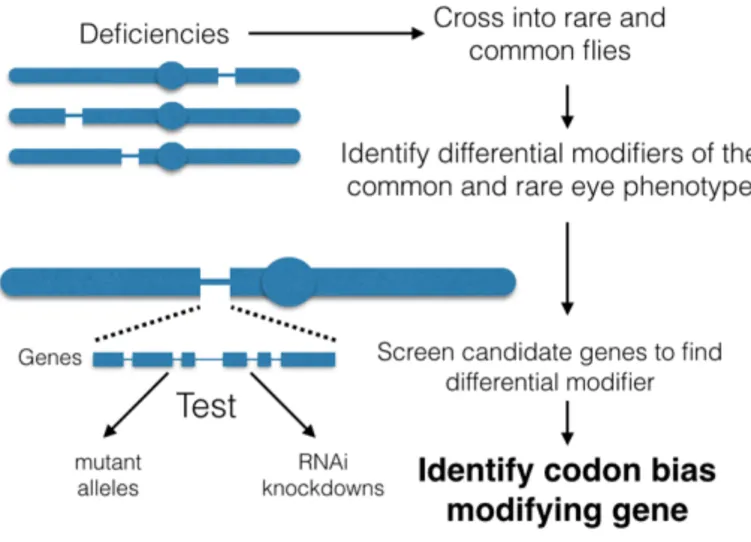
After successfully modeling Ras codon bias in the fly, we conducted a deficiency screen to search for modifiers of the codon biased Ras phenotype (Fig. 2). We specifically chose to do a deficiency screen because genetic screens are unbiased, genome-wide approaches to identifying genetic modifiers and have been successfully used to find modifiers in the Ras pathway (Karim et al 1996). Unlike other deficiency screens, in which deficiencies either enhance or suppress a single phenotype, we were interested in deficiencies that would only modify either our UAS-FLAG-RasV12rare or
UAS-FLAG-RasV12common transgenic flies, but not both. This would indicate that a deficiency was
not modifying the phenotype of Ras in general, but was affecting it in a codon biased manner.
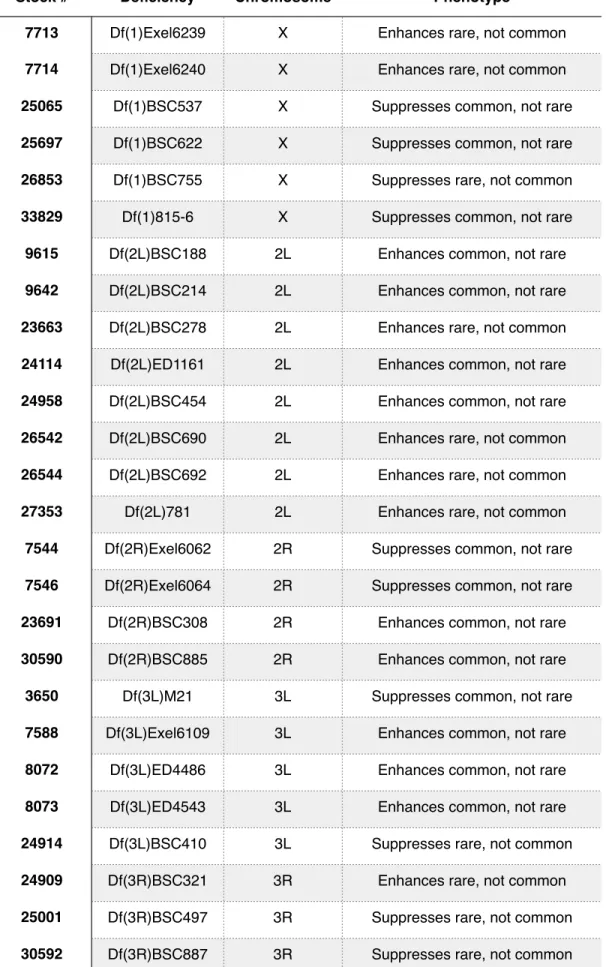
Out of 471 deficiency lines, we successfully identified and confirmed 26 deficiencies that act as differential modifiers. These modifiers act in a range of ways, either enhancing or suppressing the UAS-FLAG-RasV12rare or UAS-FLAG-RasV12common
phenotype (Fig 3B, Table 3). Additionally, we identified 107 deficiencies that act as enhancers and 60 that act as suppressors, confirming that our screen can identify general modifiers of the Ras protein (Fig 3A, Table 2).
2. Identification of Ribosomal Protein S21 as a codon-specific Ras modifier
specific deficiency. I crossed the available mutants to both the UAS-FLAG-RasV12rare and
UAS-FLAG-RasV12common lines to determine if they reproduced the codon biased
phenotype of the parental deficiency.
From this first pass, I identified a gene, Ribosomal Protein S21 (RpS21), which acted as a differential modifier in the same way as its parental deficiency: RpS2103575
heterozygosity specifically enhances the phenotype of the UAS-FLAG-RasV12rare flies
without modifying the phenotype of the UAS-FLAG-RasV12common flies (Fig. 4A). This
gene is found in Df(2L)BSC692 (Stock 26544), which is located on chromosome 2L and contains 10 genes. This result has been repeated six times, confirming that RpS21 is likely the gene responsible for the phenotype of its parental deficiency. This is an important result, as it shows that our approaches can be successful for identifying genes that differentially modify our codon biased phenotype, which will help us more clearly understand the molecular mechanisms that underlie Ras codon bias.
To determine if RpS21 affects the rare transgene phenotype via a change in protein levels, which was likely due to it role in translation, I assessed protein levels of UAS-FLAG-RasV12common and UAS-FLAG-RasV12rare flies heterozygous for the RpS21
mutant allele. In both replicates, no significant difference in Ras protein levels was found between the control and experimental flies of either the rare or common flies (Fig. 4B-D). Thus, RpS21 may regulate Ras codon bias in a manner independent of protein level control.
Discussion
for genes that played a role in the underlying mechanisms of Ras codon bias. We have created transgenic versions of fly Ras that are 100% identical in amino acid sequence, but vary greatly with regards to their codons usage. As has been found in mammalian RAS through work done by the Counter lab (Lampson et al 2013), we see a significant decrease in Ras protein when driving expression of oncogenic Ras using a construct consisting of rare codons, compared to a construct with common codons. This decrease in protein levels is significant (p=0.038), and corresponds to a decrease in the severity of the eye phenotype of animals with the UAS-FLAG-RasV12rare transgene. These results
indicate that we have successfully created a model of Ras codon bias in flies. After screening the genome, we identified 26 separate deficiencies that
differentially modify the codon biased phenotype. Instead of all modifying the phenotype in the same way, we see a broad range of changes, which suggests that there might be a large variety of these codon bias modifying genes that act in different ways. We have also identified a number of enhancers and suppressors of the Ras phenotype, indicating that our screen was successful in finding general Ras modifiers.
in this way, it would explain why we see a more severe eye phenotype in UAS-Flag-RasV12rare flies heterozygous for the RpS21 mutant allele.
In our experiment, RpS2103575 heterozygosity increased the severity of the
UAS-FLAG-RasV12rare phenotype almost two-fold, while it did not alter the
UAS-FLAG-RasV12common phenotype. Initially, we suspected that RpS21 loss led to faster translation
and accumulation of rare Ras protein, which would account for the increase in severity. However, two Western blots measuring Ras protein levels in RpS21 mutants and controls indicated no increase in protein between UAS-FLAG-RasV12rare flies heterozygous for
the RpS21 mutant alleleand control flies. Despite these results, we have not ruled out the possibility that loss of RpS21 works to increase UAS-FLAG-RasV12rare translational
efficiency for two reasons: first, because both of the gels were overloaded with protein, making quantification difficult; second, it is possible that small changes of protein levels within a cell could have large impacts on the eye severity phenotype, and these small changes may not be able to be measured at the level of the Western blot in the way we are assaying it (with whole animal heads). If the latter is the case, we plan to do the
experiments instead in Drosophila S2 cells, which may reduce some of the variability in assessing protein levels that we see in our whole animal model. Ideally, this would lead to a cleaner and more convincing experiment.
of these genes act in much less direct ways, potentially by altering cell fate or
susceptibility of the cell to Ras. Identifying a novel mechanism that regulates only UAS-FLAG-RasV12rare mRNA or protein product but not UAS-FLAG-RasV12common would be
Figure 1. Model of Ras Codon Bias in the Drosophila Eye. (A) Codon biased constructs. (B) Range of eye phenotypes observed in transgenic flies. (C) Severity score comparison of UAS-FLAG-RasV12common and
UAS-FLAG-RasV12rare transgenic flies. (D) Immunoblot showing reduced Ras protein levels in
UAS-FLAG-RasV12rare flies compared to UAS-FLAG-RasV12common flies. (E) Quantification of immunoblot in D
Figure 4. (A) Fold change in severity score of rare and common lines crossed to the mutant RpS21 allele and its parental deficiency, Df(2L)BSC692, compared to their respective controls. (B) Quantification of immunoblot in C, D normalized to α-tubulin. (C) Immunoblot of UAS-FLAG-RasV12common flies heterozygous for RpS21 mutant
allele (experimental) and lacking the RpS21 mutant allele (control). (D) Immunoblot of UAS-FLAG-RasV12rare
Table 1. Nucleotide and Amino Acid Identity of Ras Transgenes
Table 2. Modifiers identified in deficiency screen. Construct Protein Identity with
Drosophila Ras
Nucleotide Identity with
DrosophilaRas
UAS-Flag-RasV12unaltered 100% 100%
UAS-Flag-RasV12common 100% 85%
UAS-Flag-RasV12rare 100% 67%
Chromosome Deficiencies Enhancers Suppressors Differential
X 93 30 (32.3%) 3 (3.2%) 6 (6.5%)
2L 99 28 (28.3%) 8 (8.1%) 8 (8.1%)
2R 92 34 (37.0%) 7 (7.6%) 4 (4.3%)
3L 77 6 (7.8%) 16 (20.8%) 5 (6.5%)
3R 103 9 (8.7%) 19 (18.4%) 3 (2.9%)
4 7 0 4 (57.1%) 0
Stock # Deficiency Chromosome Phenotype
7713 Df(1)Exel6239 X Enhances rare, not common
7714 Df(1)Exel6240 X Enhances rare, not common
25065 Df(1)BSC537 X Suppresses common, not rare
25697 Df(1)BSC622 X Suppresses common, not rare
26853 Df(1)BSC755 X Suppresses rare, not common
33829 Df(1)815-6 X Suppresses common, not rare
9615 Df(2L)BSC188 2L Enhances common, not rare
9642 Df(2L)BSC214 2L Enhances common, not rare
23663 Df(2L)BSC278 2L Enhances rare, not common
24114 Df(2L)ED1161 2L Enhances common, not rare
24958 Df(2L)BSC454 2L Enhances common, not rare
26542 Df(2L)BSC690 2L Enhances rare, not common
26544 Df(2L)BSC692 2L Enhances rare, not common
27353 Df(2L)781 2L Enhances rare, not common
7544 Df(2R)Exel6062 2R Suppresses common, not rare
7546 Df(2R)Exel6064 2R Suppresses common, not rare
23691 Df(2R)BSC308 2R Enhances common, not rare
30590 Df(2R)BSC885 2R Enhances common, not rare
3650 Df(3L)M21 3L Suppresses common, not rare
7588 Df(3L)Exel6109 3L Enhances common, not rare
8072 Df(3L)ED4486 3L Enhances common, not rare
8073 Df(3L)ED4543 3L Enhances common, not rare
24914 Df(3L)BSC410 3L Suppresses rare, not common
24909 Df(3R)BSC321 3R Enhances rare, not common
25001 Df(3R)BSC497 3R Suppresses rare, not common
References
Baines AT, Xu D, Der CJ. 2011. Inhibition of Ras for cancer treatment: the search
continues. Future Med Chem. 3(14):1787-808.
Cook KR, Christensen SJ, Deal JA, Coburn RA, Deal ME, Gresens JM, Kaufman TC,
Cook KR. 2012. The generation of chromosomal deletions to provide extensive
coverage and subdivision of the Drosophila melanogaster genome. Genome
Biology. 13:R21.
Nakamura, Yasukazu, and Toshimichi Ikemura. "Codon Usage Database." Codon Usage
Database. Kasuza Codon Usage Database, 15 June 2007. Web. 06 Apr. 2015.
Dietzl G, Chen D, Schnorrer F, Su KC, Barinova Y, Fellner M, Gasser B, Kinsey K,
Oppel S, Scheiblauer S, Couto A, Marra V, Keleman K, Dickson BJ. 2007. A
genome-wide transgenic RNAi library for conditional gene inactivation in
Drosophila. Nature. 448(7150):151-6.
Karim FD, Chang HC, Therrien M, Wassarman DA, Laverty T, Rubin GM. 1996. A
screen for genes that function downstream of Ras1 during Drosophila eye
development. Genetics. 143(1):315-29.
Kudla G, Plotkin JB. 2011. Synonymous but not the same: the causes and consequences
of codon bias. Nat Rev Genet. 12(1):32-42.
Lampson BL, Pershing NL, Prinz, JA, Lacsina JR, Marzluff WF, Nicchitta CV,
MacAlpine DM, Counter CM. 2013. Rare codons regulate KRas oncogenesis.
Curr Biol. 23(1):70-5.
mutational robustness, evolutionary capacity, and virulence of an RNA virus. Cell
Host & Microbe. 12(5):623-32.
Pershing NLK, Lampson BL, Belsky JA, Kaltenbrun E, MacAlpine DM, Counter CM.
2015. Rare codons capacitate Kras-driven de novo tumorigenesis. J Clin Invest.
125(1):222-33
Supek F, Miñana B, Valcárcel J, Gabaldón T, Lehner B. 2014. Synonymous mutations
frequently act as driver mutations in human cancers. Cell. 156(6):1324-35.
Torok I, Herrmann-Horle D, Kiss I, Tick G, Gabor S, Schmitt R, Mechler BM. 1999.
Down-regulation of RpS21, a putative translation initiation factor interacting with
P40, produces viable minute imagos and larval lethality with overgrown
hematopoietic organs and imaginal discs. Mol Cell Biol. 19(3):2308-21.
Walker, JA and Bernards, A. 2014. A Drosophila screen identifies neurofibromatosis-1
genetic modifiers involved in systemic and synaptic growth. Rare Dis. 2: e28341
Wang JW, Beck ES, McCabe BD. 2012. A modular toolset for recombination transgenesis
and neurogenetic analysis of Drosophila. PLoS One. 7(7):e42102.
Xu Y, Ma P, Shah P, Rokas A, Liu Y, Johnson CH. 2013. Non-optimal codon usage is a
mechanism to achieve circadian clock conditionality. Nature. 495(7439):116-20.
Zhou M, Guo J, Cha J, Chae M, Chen S, Barral JM, Sachs MS, Liu Y. 2013. Non-
Optimal codon usage affects expression, structure, and function of clock protein
FRQ. Nature. 495(7439):111-5.
Acknowledgements