CONCEPTUAL/THEORETICAL PAPER
Cost-effective service excellence
Jochen Wirtz1&Valarie Zeithaml2
Received: 10 October 2016 / Accepted: 3 August 2017 / Published online: 23 August 2017
#The Author(s) 2017. This article is an open access publication, Corrected publication September/2017
Abstract This article integrates relevant literature to develop a
conceptual model on the potential avenues to achieve service excellence at low unit costs, which we termcost-effective service excellence(CESE). To gain a deeper understanding of these strategies, their applicability and interrelatedness, we analyze how 10 organizations have achieved CESE. Our findings show that CESE can be achieved through three core strategies. First, a dual culture strategyprovides a comprehensive set of high-quality services at low cost, largely driven by leadership ambi-dexterity and contextual ambiambi-dexterity. Second, anoperations management approachreduces process variability and thereby allows the increased use of systems and technology to achieve CESE. Third, afocused service factory strategy can enable CESE through a highly specialized operation, typically deliver-ing a sdeliver-ingle type of service to a highly focused customer seg-ment. The use of the three approaches ranges fromBpure^(e.g., mostly pursuing a dual culture strategy) to combinations of the latter two approaches with the dual culture strategy (e.g., a fo-cused service factory strategy combined with dual culture). Our conceptual model provides an integrated view of the strategic
options available to organizations that aim to pursue a strategy of CESE.
Keywords Service excellence . Productivity .
Cost-effectiveness . Dual culture strategy . Ambidexterity . Buffering . Front office minus . Modularization . Self-service technology . Focused service factory
The tradeoff between customer satisfaction and productivity has been widely acknowledged in the service marketing and operations management (OM) literature and remains a key challenge for organizations that strive for both objectives (Anderson et al. 1997; Rust and Huang 2012). These two approaches conflict because too strong a focus on cost reduc-tion associated with productivity can reduce customer satis-faction, and concentration on customer satisfaction is assumed to cost more, thereby reducing productivity (Rust and Huang
2012). Research in marketing has confirmed this tradeoff (Anderson et al.1997; Rust and Huang2012), and it has been shown to be more pronounced in services than in goods, es-pecially when frontline employees are involved (Anderson et al.1997; Marinova et al.2008; Singh2000). In addition to the intangibility and variability of services that make them more difficult to standardize (Chase 1978; Frei 2006), perceived quality in services frequently depends on tomization desired by consumers. High levels of cus-tomization are costly because employees typically play a prominent role in service delivery (Anderson et al. 1997). As expressed by Rust and Huang,Bincreasing service produc-tivity often involves a tradeoff, with better service typically requiring more labor intensity, lower productivity, and higher cost^(2012, p. 47).
Few service organizations seem to be capable of pursuing a strategy focused on customer satisfaction and productivity at
Martin Mende served as Area Editor for this article
Electronic supplementary materialThe online version of this article (doi:10.1007/s11747-017-0560-7) contains supplementary material, which is available to authorized users.
* Jochen Wirtz
Valarie Zeithaml [email protected]
1
National University of Singapore, Singapore, Singapore
2 The University of North Carolina at Chapel Hill, Chapel Hill, NC,
USA
the same time given that they requireBdistinctive organizational systems, structure, and cultural underpinnings^(Rust et al.2016, p. 156). Therefore, pursuing a dual strategy combining service excellence that generates high customer satisfaction and low cost, resulting in high productivity, is likely to be aBdaunting task^for most organizations (Mittal et al.2005, p. 547).
While the general belief is that a tradeoff exists and that service excellence and cost effectiveness are in conflict, ex-amples can be proffered where organizations achieve both and manage to align high productivity and customer satisfaction. For example, Shouldice Hospital simultaneously has 50 to 75% lower costs compared to general hospitals, a failure (reoccurrence) rate equal to 1/6th to 1/12th of industry average and exceptionally high customer satisfaction (Heskett and Hallowell 2004; Heskett et al. 2015, p. 14). Similarly, Singapore Airlines has earned a stellar reputation in the fierce-ly competitive commercial aviation industry by providing cus-tomers with exceptional quality service while it is at the same time one of the world’s most cost-effective full-service airlines (Heracleous and Wirtz2010,2014). Both organizations com-bine the purportedly incompatible strategies of service excel-lence and high productivity.
This conceptual study contributes to marketing theory in piv-otal ways and follows the call to address important, substantive questions (Hauser2017; Houston2016; Tellis2017) whereby we focus on a topic that has rarely been investigated and offer propositions that may lead to surprising findings countering existing wisdom. Specifically, the purpose of this research is to explore the alignment among service excellence and high pro-ductivity approaches to demonstrate ways through which service firms can achieve what we callcost-effective service excellence (CESE). Studies of companies that have achieved a dual strategy demonstrate that it positively affects financial performance (Mittal et al.2005; Swaminathan et al.2014). However, these studies remain silent on how CESE can be achieved. This re-search addresses this gap and explores the options available to achieve CESE by integrating and synthesizing the marketing, management, and service OM literature on the interrelationships among these approaches. Furthermore, we analyze how 10 or-ganizations achieved CESE and integrate the findings with the literature to form a set of propositions and a conceptual model of CESE.
Service excellence, productivity, and organizational
performance
As different streams of literature use various terminology, we clarify key terms in Table1. The main literature used in our review and synthesis is summarized in Table2, with the fol-lowing section reviewing empirical studies on the impact of customer satisfaction and productivity on organizational performance.
Empirical evidence
Literature in marketing shows empirically that using a cus-tomer satisfaction strategy generally improves financial per-formance (Anderson et al.1997,2004; Gupta and Zeithaml
2006; Kamakura et al.2002; Rust et al.1995). This strategy results in superior risk-adjusted equity returns (Aksoy et al.
2008; Fornell et al.2006) largely through the positive effects that customer satisfaction has on repeat purchase, cross-buy-ing, and referrals (for a detailed review see Gupta and Zeithaml2006; Oliver2010), and through increased attitudi-nal loyalty and reduced price sensitivity (Umashankar et al.
2016). Likewise, the OM literature shows that increased effi-ciency can improve business performance through cost reduc-tion (Breyfogle2003; Crosby1979; Deming1986).
Combining these two foci, service organizations can pur-sue three alternative customer satisfaction and productivity-focused strategies: (1) increasing customer satisfaction, (2) increasing productivity, and (3) pursuing a dual strategy whereby they attempt to pursue customer satisfaction and pro-ductivity at the same time. Of the three strategies, limited empirical evidence suggests that organizations focusing on customer satisfaction have a higher financial return than those either focusing on productivity or trying to execute a dual strategy (Rust et al.2002).
Furthermore, and critical for our study, the literature distin-guishes between organizations thatpursuea dual strategy ver-sus those thatactually achieve it(Mittal et al.2005). Empirical evidence suggests that once companies successfully achieve a dual strategy, they reap the highest long-term financial return compared to organizations that focus on either customer sat-isfaction or productivity alone (Mittal et al. 2005). A dual strategy is clearly highly desirable, but very difficult to achieve (Rust et al. 2002). While the financial performance of the strategies has been examined and the desirability of a dual strategy established, there is a wide gap in the literature with regard to how service organizations might be able to achieve it (c.f., Mittal et al. 2005; Rust et al. 2016; Swaminathan et al.2014), which we examine in this study.
Finally, the extant research has examined customer satis-faction as a continuum, whereas we focus specifically on the high end of customer satisfaction, that is, service excellence. A number of studies have shown that the relationship between customer satisfaction and key outcome variables generally follows a linear positive or an inverse S-shaped function, which is convex for high levels of customer satisfaction (Kumar et al. 2013), including for repeat purchase (Mittal and Kamakura2001) and willingness to pay (Homburg et al.
ranked customer satisfaction (Keiningham et al.2015a, b), and customers can become an organization’s Bapostles^ at high levels of customer satisfaction (Jones and Sasser1995). Therefore, we focus on organizations that are at the leading edge in terms of customer satisfaction in their respective industries.
Root causes of the conflict between service excellence and productivity
As we have noted, while a dual strategy is desirable, it is particularly difficult to achieve for service organizations (Anderson et al. 1997; Marinova et al. 2008; Rust and Huang2012; Singh 2000). To explore potential ways to achieve CESE, we examine next the root causes underlying the service excellence-productivity conflict by integrating the service quality and productivity literature.
First, many services are produced through distributed op-erations with real-time production and consumption (e.g., ev-ery fast food outlet, beach resort, and bank branch can be viewed as a mini-factory). Achieving CESE seems
particularly difficult for service firms because distributed op-erations—involving simultaneous production and consump-tion as well as customizaconsump-tion in real-time at the customer in-terface—make industrialization, deskilling, economies of scale, productivity, and quality control difficult to achieve (Chase1978,1981).
Second, customer-introduced input, process, and output variability have been identified as key limiting factors in in-creasing productivity. That is, operations cannot be organized and scheduled at optimum efficiency as customer arrival times, product and feature choices, preferences, capabilities, and customer effort and involvement in service production vary (Chase1978,1981; Frei2006). In marketing, customer variability is often referred to as Bcustomization^ (e.g., Anderson et al.1997). Offering flexibility and the right type of process capacity, employee skills, and supplies Bon demand^and at high quality is challenging and expensive.
Third, the customer’s experience and satisfaction often de-pend on the three additional Ps of services marketing: people, process and physical environment (Booms and Bitner1981). To deliver service excellence, the three functions of Table 1 Definition of key terms
Terms Definitions
Cost-effective service excellence (CESE)
•Refers to a state when an organization delivers simultaneously high levels of customer satisfaction and high levels of productivity. That is, an organization delivers CESE if it simultaneously is among the best performers in its competitive set in terms of customer satisfaction and productivity.
Dual culture strategy •Refers to organizations that achieved CESE through ambidexterity (i.e., leadership, contextual, and structural ambidexterity), making both service excellence and productivity integral parts of the organizational culture. It enables organizations to deploy generic productivity strategies and tools to the extreme while focusing on service excellence. It allows an organization to close the gap between actual productivity and potential productivity at a given level of customer-induced variability.
•The literature uses various terms similar to dual culture strategy, including dual strategy, dual emphasis (Rust et al.2016; Mittal et al.2005; Swaminathan et al.2014), and simultaneous attempts to increase both customer satisfaction and productivity (Anderson et al.1997). We use the term dual culture strategy throughout. Service excellence strategy •We define service excellence as an organizational strategy of delivering high levels of service that generates
high customer satisfaction to its customers.
Customer satisfaction strategy •Service marketing literature uses various terms to describe an organization’s focus on delivering customer satisfaction, including revenue emphasis (Rust et al.2016), customer satisfaction (Anderson et al.1997; Swaminathan et al.2014), and effectiveness (Rust and Huang2012). We focus on the high end of customer satisfaction and use the term service excellence strategy.
Perceived service quality and customer satisfaction
•Perceived service quality is defined asBmeeting or exceeding customer expectations,^which is consistent with the Gaps Model (Parasuraman et al.1985,1988). In this manuscript, we use the terms customer satisfaction and perceived service quality interchangeably when we refer to perceptions of customers.
Productivity •Productivity is defined throughout the manuscript as output/input ratio (Grönroos and Ojasalo2004).
•The literature uses various terms to describe an organization’s focus on productivity, including cost emphasis (Rust et al.2002,2016), cost reduction (Mittal et al.2005), efficiency (Swaminathan et al.2014), and pro-ductivity (Anderson et al.1997).
Customer-induced variability •The term customer-induced uncertainty was used in early service operations research to discuss
efficiency-related challenges in service organizations (Chase1981). More recent work use the term variability (e.g., in arrival times, and requested services and features) which follows a statistical distribution and is not uncertain (Frei2006). In the marketing literature, customer induced variability is typically referred to as
operations, marketing, and human resources therefore need to be tightly integrated. This integration frequently leads to tradeoffs between functional objectives, especially between marketing and operations. These tradeoffs are well document-ed, with marketing typically focusing on service excellence, loyalty, sales, upselling, cross-selling, and market share, whereas operations worries about unit costs, productivity, and capacity utilization (Lovelock1992). Striving for CESE must address these three causes of the customer satisfaction– productivity tradeoff.
Methodology for synthesis of literature and case
analysis
To develop our propositions, we synthesized relevant ma-jor streams of thought from the marketing, management, and OM literature that relate to the constructs of service excellence, service productivity, and profitability. We iden-tified two main streams in the academic literature that provided background for our integration and analysis (Table 2). The first stream, on organizational ambidexteri-ty, is rooted in the management literature and explores how organizations can simultaneously pursue and integrate different, often conflicting objectives. The second stream is based on the OM literature that tackles the root causes of low productivity in service operations and offers potential solutions. We combined both streams of literature to de-velop our propositions.
Furthermore, we used a case-based approach to identify examples of organizations that were successful in achieving CESE to illustrate the propositions. Even though these cases were largely used as examples, they allowed unexpected find-ings to emerge. Ultimately, we combined the literature with the added insights from the case studies to propose ways that organizations can achieve CESE.
To identify potential organizations for our case analysis, we first outlined criteria for service excellence and productivity. Next, we identified organizations from multiple sources, in-cluding the academic literature, published case studies, books by leading academic service experts (e.g., Heskett et al.2015), books about leading service organizations, and the published media. To establish whether these organizations indeed achieved CESE, we compared them to the criteria for service excellence and productivity. Service excellence was assessed by examining publicly available service quality and customer satisfaction indices (e.g., the American Customer Satisfaction Index), service excellence awards (e.g., J.D. Power), industry awards (e.g., Condé Nast Traveler), and other third-party data (e.g., TripAdvisor). Productivity was assessed through mea-sures such as labor productivity (e.g., revenue/full-time equiv-alent employee) and industry-specific productivity measures (e.g., cost/seat mile in an airline context). The organizations
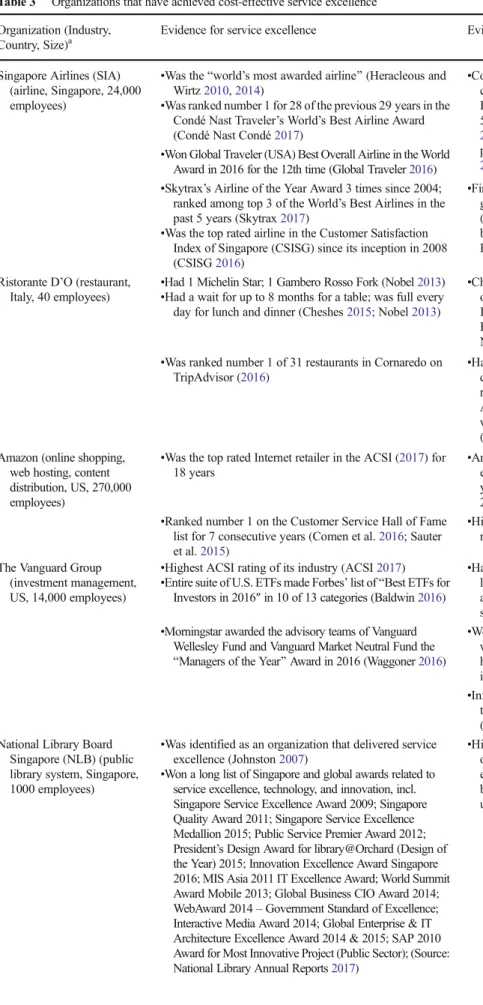
that fit our criteria—which were among the leading organiza-tions in their respective industries in both service excellence and productivity—are provided it Table3.
The selected organizations had extensive materials pub-lished on them, including interviews with senior management, books, case studies, and features in academic articles. We collated and integrated the information from these sources to gain an understanding of whatand howthese organizations achieved service excellence and high levels of productivity until we reached saturation. We then coded each organization on their use of the key CESE strategies identified in our liter-ature review (e.g., had a culture of keeping costs low or used SSTs more extensively compared to industry). The authors coded independently and then discussed their coding for each organization until they reached agreement. Finally, we con-ducted interviews and site visits with three of the smaller and somewhat less publicized organizations (Ristorante D’O, National Library Board, and Narayana Health) to verify our understanding of the organization’s deployment of CESE strategies and confirm our coding. The findings were consis-tent across sources and over time (see theWeb Appendixfor key findings and their sources) and were used for our analysis. Figure1shows the final coding.
The integration of the literature in the following sec-tions suggests a number of specific approaches organiza-tions can pursue to achieve CESE which we grouped con-ceptually into three main categories. The first main cate-gory is an organization strategy which we termed dual culture strategy. It focuses an entire organization on the simultaneous pursuit of service excellence and productivi-ty. The second—operations management approach—is a combination of OM tools that are used to reduce process variability so that systems and technology can be increas-ingly deployed to deliver CESE; they are buffering and front office minus, modularization of service options, and self-service technologies (SSTs). The third is a focused service factory strategy that achieves CESE through a highly specialized operation. These approaches are de-scribed in the remainder of this article in the context of their respective literatures.
Dual culture strategy
The dual culture strategy uses organizational ambidexterity to drive the deployment of generic productivity strategies and tools to the extreme.
Organizational ambidexterity
Table 3 Organizations that have achieved cost-effective service excellence
Organization (Industry, Country, Size)a
Evidence for service excellence Evidence for Cost-effectiveness
Singapore Airlines (SIA) (airline, Singapore, 24,000 employees)
•Was theBworld’s most awarded airline^(Heracleous and Wirtz2010,2014)
•Costs per available seat kilometer (ASK) were 4.6 cents compared to 8–16 cents for full-service European airlines, 7–8 cents for U.S. airlines, and 5–7 cents for Asian airlines (Heracleous and Wirtz
2010,2014). SIA was identified as a cost leader in its peer group measured in cost/ASK (Airline Leader
2014) •Was ranked number 1 for 28 of the previous 29 years in the
Condé Nast Traveler’s World’s Best Airline Award (Condé Nast Condé2017)
•Won Global Traveler (USA) Best Overall Airline in the World Award in 2016 for the 12th time (Global Traveler2016) •Skytrax’s Airline of the Year Award 3 times since 2004;
ranked among top 3 of the World’s Best Airlines in the past 5 years (Skytrax2017)
•Financial performance was better than industry on gross margin, ROA and ROI over the past 30 years (Heracleous and Wirtz2010,2014), and it had never booked an annual loss (Singapore Airlines Annual Report2016)
•Was the top rated airline in the Customer Satisfaction Index of Singapore (CSISG) since its inception in 2008 (CSISG2016)
Ristorante D’O (restaurant, Italy, 40 employees)
•Had 1 Michelin Star; 1 Gambero Rosso Fork (Nobel2013) •Charged about 1/3 or less of competitors’prices. Price of a typical meal at 1-Michelin star restaurants in Italy was 130 Euros; D’O price for lunch was 20–25 Euros and 45–50 Euros for dinner (Cheshes2015; Nobel2013; Pisano et al.2013)
•Had a wait for up to 8 months for a table; was full every day for lunch and dinner (Cheshes2015; Nobel2013)
•Was ranked number 1 of 31 restaurants in Cornaredo on TripAdvisor (2016)
•Had less than half of the number of employees compared to similar Michelin-one-star-rated restau-rants in Europe (i.e., 14 employees compared to 36). Although Ristorante D’O paid higher than average wages, it enjoyed significant savings in labor costs (Nobel2013; Pisano et al.2013)
Amazon (online shopping, web hosting, content distribution, US, 270,000 employees)
•Was the top rated Internet retailer in the ACSI (2017) for 18 years
•Amazon had the lowest prices for almost any product enabled by scale and intense cost control (Stone2013), yet operating margins of its retail business were 3.1% in 2016 (CSIMarket2017), suggesting high productivity •Ranked number 1 on the Customer Service Hall of Fame
list for 7 consecutive years (Comen et al.2016; Sauter et al.2015)
•Highest sales/employee p.a. ($1.2 million) of online retailers in 2016 (CSIMarket2017)
The Vanguard Group (investment management, US, 14,000 employees)
•Highest ACSI rating of its industry (ACSI2017) •Had an average expense ratio of 0.12% which was the lowest in its industry and compared to an industry average of 1.01% (Bogle2011; Vanguard2017), suggesting high productivity
•Entire suite of U.S. ETFs made Forbes’list ofBBest ETFs for Investors in 2016″in 10 of 13 categories (Baldwin2016) •Morningstar awarded the advisory teams of Vanguard
Wellesley Fund and Vanguard Market Neutral Fund the
BManagers of the Year^Award in 2016 (Waggoner2016)
•Won the CIO 100 Award from CIO Magazine in 2015 which recognized organizations that exemplified the highest level of operational and strategic excellence in IT (CIO Magazine2016)
•InformationWeek magazine named Vanguard one of the top innovators in IT in 2014 in the US (InformationWeek2014)
National Library Board Singapore (NLB) (public library system, Singapore, 1000 employees)
•Was identified as an organization that delivered service excellence (Johnston2007)
•Highest labor productivity compared to peers in terms of number of library visitations and borrowing per employee (authors’analysis based on data provided by global benchmark libraries; data will be provided upon request)
simultaneously pursue courses of action along different, often conflicting dimensions. Dimensions that have been studied include exploitation versus exploration, incremental ver-sus radical innovation, continuous verver-sus radical change, and efficient versus flexible organizational structure (for
a review see Raisch and Birkinshaw 2008), but not yet cost-effectiveness versus service excellence, which we advance in this section. Furthermore, robust findings link ambidexterity to organizational performance (O’Reilly III and Tushman 2013).
Table 3 (continued)
Organization (Industry, Country, Size)a
Evidence for service excellence Evidence for Cost-effectiveness
Google (Internet-related services and advertising, US, 57,000 employees)
•Achieved the top industry ACSI rating since its inaugural coverage in 2002 except for one year (ACSI2017)
•Second highest sales/employee p.a. ($1.7 million) in the internet and social media industry and third highest in the technology sector (CSIMarket2017) •Won Tech Brand of the Year at the TrustedReviews
Awards 2016 (TrustedReviews2016)
•Extremely cost-effective on aBper customer^orBper transaction^basis as it employed very few service employees and relied on scalable self-service solutions and user communities (Cutts2011; Krazit2009) United Services Automobile
Association (USAA) (fi-nancial services, US, 28,000)
•Top-ranked in The Customer Experience Index by Forrester Research in the bank, credit card, and insurance categories 2013 to 2016 (Forrester2016)
•Operating expense ratio was almost half of industry average; it was 21% compared to 39% in 2015 (USAA Annual Report2015)
•Top-ranked company in Net Promoter Index of Customer Loyalty from 2009 to 2016 in the Satmetrix benchmarks in the banking, automotive and home insurance categories (Satmetrix2016)
•Competitive pricing, with the lowest price in the market for the majority of its products (Heskett et al.
2015, p. 56; Weliver2014)
•Named Customer Service Champion 2014 (JD
Power 2014)
•Low annual customer churn rate of 2.2% (Lal and
Fisher 2014) Narayana Health (healthcare,
India, 16,000 employees)
•Frost and Sullivan India Healthcare Excellence Awards– Healthcare Provider Company of the Year 2012 (Frost and Sullivan2012)
•Won Economist Business Process Reengineering Award 2011 forBreducing health-care costs using
mass-production techniques; performs more heart op-erations at a lower cost and a lower mortality rate than leading American hospitals.^Dr. Shetty was called the
BHenry Ford of Healthcare^(Economist2011) •Winner of Gold Award in Customer Service by Asian
Hospital Management Awards 2014 (Hospital Management Asia2014)
Mortality rate 30 days after open heart surgery 1.4% vs. 1.9% in the US (Anand2009)
•Cost was as low as $800 for an open heart surgery in its new facility in Mysore, India (Global Health and Travel2014)
Shouldice Hospital (healthcare, Canada, 100 employees)
•Lowest recorded failure rate (reoccurrence rate) in the world which was 1/6th to 1/12th of industry average (Frei and Morriss 2012, p. 129; Heskett and Hallowell 2004)
•50 to 75% lower price compared to general hospitals while it was highly profitable (Heskett and Hallowell
2004; Heskett et al.2008, p. 62–63), suggesting high productivity
•Exceptionally high customer satisfaction and bonding with patients (Frei and Morriss2012, p. 126; Heskett and Hallowell2004)
•Low nurses to patient ratio of 1:14, compared to an industry average of 1:4 (Heskett and Hallowell2004) •Ranked as one of the top 10 global hospitals by
healthcareglobal.com(Sarma2013) JetBlue Airways (airline, US,
18,000 employees)
•Had the highest ACSI rating of its industry since its inaugural coverage since 2012 except for one year where it tied with Southwest Airlines (ACSI2017)
•Offered fares of up to 65% lower than legacy carriers, but added comfort features such as more leg room, leather seats, individual video screens, free Wi-Fi, and flew into major airports (Hoyt et al.2010; Huckman and Pisano2011; Jacobs2013), and was positioned asBbest service at low prices^(Smyth and Pearce2006, p. 13)
•Rated as the top low-cost airline for customer satisfaction for the 12th consecutive year in 2016 (JD Power2016)
•Low cost per seat available mile, which were significantly below network carriers and equal to or only marginally higher than low frills low cost carriers (Harris2015; Smyth and Pearce2006, p. 18; Trefis Team2015)
a
To be ambidextrous, organizations must resolve internal conflicts for resources as well as shift demands in their task environments. While earlier studies viewed these tradeoffs as insurmountable, more recent research has presented three or-ganizational approaches to support ambidexterity (Benner and Tushman2003; Raisch and Birkinshaw2008). First, structur-al ambidexterityinvolves separating organizational units to allow units with different competencies to address inconsis-tent demands (Benner and Tushman 2003; Gibson and Birkinshaw2004).
Second,contextual ambidexterityinvolves achieving align-ment and adaptability by pushing the integration of conflicting goals to the individual employee (Gibson and Birkinshaw
2004, p. 209). Individual-level behavior is then shaped by the context (i.e., systems, processes, and beliefs), which is designed to enable and encourage individual employees to exercise their own judgment in dealing with conflicting de-mands (Gibson and Birkinshaw2004).
Third,leadership ambidexterity can enable organizations to manage conflicting demands (Lubatkin et al.2006; Smith and Tushman 2005). Senior management’s paradoxical frames lead to aBboth/and logic^ rather than an Beither/or logic^ (Collins and Porras 1994, pp. 43–45; Smith et al.
2016). This view enables positive conflict and allows leaders to embrace rather than avoid contradictions (Smith and Tushman2005). Leaders then play a critical role in putting the systems in place that allow supportive contexts for ambi-dexterity to emerge, and focus and energize the organization
on these key ideas, role model the desired ambidextrous be-haviors, and then reinforce them with rewards and recognition (Gibson and Birkinshaw2004).
Based on the literature and our case observations we propose in the following sections that an organization’s simultaneous focus on service excellence and cost-effectiveness is akin to other potentially conflicting goals studied in the organizational ambidexterity literature.
A dual culture focused on service excellence and cost-effectiveness
We used the lenses of structural, contextual, and leadership ambidexterity to examine whether and how our 10 case orga-nizations achieved CESE. All 10 orgaorga-nizations focused on service excellence, of which five pursued a dual culture strat-egy where they consciously drove a simultaneous focus on both service excellence and productivity (i.e., Singapore Airlines, Ristorante D’O, Amazon, Vanguard, and Narayana Health; see Fig.1for the coding, and theWeb Appendixfor the detailed case evidence). Interestingly, of the three ways to achieve ambidexterity, leadership ambidexterity was evident in all five of these case organizations, and structural ambidex-terity, which arguably received the most attention in academic research, featured least prominently, if at all.
First, theleadership of all five organizations pushed and even rallied their organizations to pursue a dual culture, Singapore Airlines
Organizations
Dual Culture
Strategy Front Office Buffering & Minus
Self-service Technology
Focused Service Factory
Modulari-zation of Service
Use of Strategies/Tools: Extensive Moderate Little/Not at all Ristorante D’O
National Library Board Singapore Amazon
Google Vanguard
USAA
Narayana Health
Shouldice Hospital
JetBlue
Note: Coding is relative to the respective industry an organizations operates in.
OM Approaches Based on Reduced Process Variability
typically through internal communications, training, and in-centive systems (c.f., Gibson and Birkinshaw2004). For ex-ample, Jeff Bezos, Amazon’s CEO, was known to put the needs of its customers first and was infamous for becoming enraged when individual customers complain, requiring that anxious employees chase down solutions immediately. At the same time, he role-modelled and communicated frugality on anything that did not relate to customers (Stone2013, p. 330– 331).BCustomer obsession^andBfrugality^were core values at Amazon (Stone2013, p. 88). John Bogle, Vanguard’s foun-der and former CEO, emphasized the organization’s strategy toBprovide the highest quality of investor services, at the lowest possible cost[sic]^ (Bogle2002, p. 138). Vanguard emphasized frugality even when recruiting by looking for crew members whoBunderstand and sympathize with the need for frugality^(Heskett et al.2015, p. 77).
Dr. Devi Shetty, founder and chairman of Narayana Health, explained,BThe notion that‘if you want quality, you have to pay for it’went out the window a long time ago at Narayana Health^ (Global Health and Travel2014, p. 44). His senior employees received daily text messages detailing the previous day’s expenses to keep them conscious of the need to keep costs low and motivate them to generate ideas for cost savings and process improvements (Govindarajan and Ramamurti
2013). Chef Davide Oldani, founder and head chef of Ristorante D’O, was passionate about making the Michelin-starred restaurant accessible to a broad audience and constant-ly communicated this to key stakeholders (Cheshes 2015; Pisano2013).
Finally, Singapore Airlines’leadership, internal communi-cations, and training continuously emphasized that profit is a function both of service excellence (which drives the loyalty of demanding business travelers, its core target segment) and costs (the other side of the profit equation). To reinforce that message, Singapore Airlines offered bonuses of up to 50% of employees’annual salaries depending on the airline’s profit-ability but also cut basic pay by up to 20% when it was making losses. The result was a culture that became exceedingly customer-centric and that internalized the idea that anything that touched the customer must be consistent with Singapore Airlines’premium positioning, whereas everything behind the scenes was subject to extreme cost control with employees focusing intensely on managing costs and improving produc-tivity (Heracleous and Wirtz2010,2014).
Second, contextual ambidexterity is obvious in many of our dual culture strategy cases where it governed employees’ thinking and decision making about when to focus on service excellence, when to emphasize cost-effectiveness, and—ideally—how to integrate both objectives synergistically. Often, both objectives were aligned and could be pursued at the same time, but sometimes tradeoffs had to be made. Here, employees needed to know how to make such decisions, and an internalized dual culture
provided this governance mechanism. For example, Singapore Airlines served Krug Grande Cuvée and Dom Pérignon in first class. To minimize costs, cabin crews offered whichever bottle was open unless a passenger specifically requested the other brand. No cost seemed too small to reduce (Heracleous and Wirtz2010,2014).
Narayana Health had an intense focus on surgery quality and success rates. Yet its surgeons constantly compared and generated ideas across their network on how to cut costs, such as through the routine reuse of medical devices that were sold as single-use products. For example, the $160 steel clamps that were employed during open-heart surgeries were sterilized and reused up to 80 times (Govindarajan and Ramamurti2013).
Similar observations were also made with Amazon and Vanguard, where tradeoff decisions were pushed to decision makers to integrate the conflicting objectives. As stated in Amazon’s leadership principles:BFrugality–We try not to spend money on things that don’t matter to cus-tomers. Frugality breeds resourcefulness, self-sufficiency and invention^(Stone2013, p. 330). It seems that leadership and contextual ambidexterity go hand-in-hand in our case examples.
Third, we also found some evidence that structural ambidexterity was used to achieve CESE. For example, Singapore Airlines centralized its innovation department in a separate unit that emphasized developing the next industry-leading in-flight service innovation (Heracleous and Wirtz
2010; Heracleous et al.2009).
Our case findings together with the literature review suggest that organizational ambidexterity and its mech-anisms to implement it are also applicable to the simul-taneous pursuit of the different and often conflicting objectives of cost-effectiveness and service excellence. This context has not been studied in the organizational ambidexterity literature before and leads to our first proposition:
P1: Mechanisms for achieving organizational ambidexterity (i.e., leadership, contextual, and structural ambidexteri-ty) allow organizations to simultaneously achieve ser-vice excellence and cost effectiveness.
travelers: the seat could be flipped over and turned into a flat bed with a duvet and bigger pillows. Because theBflipping^ was done manually, the number of heavy and engineering-intensive motors in a seat was reduced and provided significant savings in fuel, repair and maintenance, and purchase costs (Heracleous and Wirtz 2010).
Second, although not completely separated structurally, du-al culture organizations distinguish between the customer-facing front office and the back office. The front office is generally more customer- and service excellence-focused than the back office. Even in Singapore Airlines, the cost squeeze was less intense when related to in-flight service excellence and cabin crew—all of whom had extensive training, reason-able travel allowances, and expensive uniforms. In the back office, Singapore Airlines drove distributed innovation throughout the organization. As these departments were large-ly not customer-facing, their focus tended to be on cutting costs. But again, potential customer impact was always con-sidered so that service excellence would not be compromised (Heracleous and Wirtz2010,2014). That is, the front and back office are both customer-centric and cost-conscious at the same time, and the cost- and service excellence-foci differs only in degree and not in substance. In conclusion, while structural ambidexterity has a supporting role, we do not find that it is a key enabler for CESE, whereas leadership and contextual ambidexterity are pervasive and clearly visible in all five cases.
It seems intuitive that contextual ambiguity supported by strong leadership ambidexterity are key to addressing the challenges related to distributed operations, customer-in-duced variability, and the required integration of func-tions that are common to service organizafunc-tions. Also, our finding that leadership ambidexterity is present in all our dual culture organizations is consistent with work by Rust et al. (2016) who suggest that cost emphasis comes from the top and found that the companies that are successful in their cost emphasis tend to have it pushed down. In sum, senior management must build a culture of cost-consciousness and intense service excellence simultaneously (Mittal et al.2005; Anderson et al.1997). CESE permeates all aspects of our case organizations and is more complex than the typical exploration (e.g., innovation) and exploitation (e.g., running robust and efficient processes) conflict. We summarize the preceding discussion in the following proposition:
P2: Because the root causes of the productivity–satisfaction tradeoff (i.e., distributed operations, customer-induced variability, and integration of functions) permeate the entire service organization, leadership ambidexterity and contextual ambidexterity are most critical in achiev-ing CESE with structural ambidexterity playachiev-ing a less important role.
The focus on service excellence, while difficult to achieve, is a corporate mission that is more attractive to employees than one focusing on cost-cutting and frugality. It is easier to es-tablish buy-in from employees for the former, largely because they typically feel proud to be part of an organization that delivers excellence (Gouthier and Rhein2011). This is true in all of our five cases. However, when asked to be cost-effective at the same time, employees find this mission more difficult to accept. For example, in spite of Amazon’s top American Customer Satisfaction Index (ACSI) ratings, it did not appear anywhere on the lists of best companies to work for and was even been accused of achieving its high level of productivity by squeezing employees. One source reported that workersBwere pushed harder and harder to work faster and faster until they were terminated, they quit or they got injured^ (Nocera2015). Also, Amazon’s limited employee benefits did not help; it was said that the only free benefit workers received was aspirin (Streitfeld and Haughney
2013), bonuses were back-loaded, and there was no subsi-dized parking, no subsisubsi-dized meals (employees had to pay for snacks at vending machines), and all had to fly economy class (Stone 2013, p. 112, 329, 330). Similarly, Singapore Airlines walked a fine line between employee satisfaction and keeping costs low as indicated by periodic employee com-plaints of unhappiness over pay, bonuses (Heracleous et al.
2009, p. 159–161), and medical leave policies that were viewed as stingy (Kaur2017).
Our findings suggest that high productivity and cost-effectiveness combined with customer centricity can put a strain on employees. The organizations in our sample addressed this by emphasizing various rationales for expecting cost-effectiveness and service excellence at the same time, to obtain buy-in from their employees. Examples include a mission to provide the best custom-er value (Amazon), recognition that the company operates in a hyper-competitive industry that challenges survival (Singapore Airlines), appreciation that em-ployees are working for members (Vanguard and USAA), making Michelin-starred food affordable (Ristorante D’O), and supporting a charitable cause (Narayana Health). It seems that a dual culture strategy requires a strong rationale for employees concerning why cost-effectiveness is critical in addition to service excellence. That is, employees appear to need a credible Brallying cry^ to be willing to subscribe to a dual cul-ture strategy. We advance the following proposition from the preceding discussion:
Dual culture as a driver of the extreme use of generic productivity strategies and tools
The OM literature distinguishes between actual and potential efficiency at a given level of variability. It identifies variability in terms of input (e.g., customer arrival patterns), process (e.g., customer process preferences), and output (e.g., customer re-quests) as the key factors that determine the potential level of efficiency (Chase1978,1981). Service organizations that want to improve efficiency can reduce the gap between their actual and potential levels of efficiency at the current level of variability, which we called generic productivity strategies and tools. These include cost control, reduction of waste, training and motivation of employees to do things faster, better, and cheaper, better capacity utilization, redesign of customer ser-vice processes (Breyfogle2003; Crosby1979; Deming1986), outsourcing of non-core activities (Wirtz et al.2015), and tiering of service to allocate resources better to more important customer segments (Frei2006).
Many of these strategies and activities that drive cost-effectiveness are not in conflict with service excellence. In fact, productivity improvements frequently bring with them quality improvements at the same time. For instance, if cus-tomer service processes are redesigned to be leaner, faster, and more convenient by eliminating non-value-adding work steps, then both productivity and customer satisfaction improve con-currently (Rust et al.2016). These are the initial types of quick wins every process redesign or lean six sigma initiative likes to pursue. These strategies keep the current business model unchanged and adopt best practices to achieve the same output—a largely unchanged customer experience—with less input.
However, the service OM literature is typically not con-cerned specifically with service excellence, and these generic productivity strategies in themselves do not necessarily lead to service excellence. For this, a culture of service excellence is required at the same time. Integrating these two literatures, one can argue that a dual culture strategy allows organizations to drive these generic productivity tools to the extreme (Heracleous and Wirtz2010,2014). That is, employees in a dual culture strategy will focus on closing the gap between potential and actual efficiency while maintaining service excellence.
Based on our case observations, dual culture organizations are masters of generic productivity strategies and tools to cut costs to the bone and boost productivity, while managing for service excellence. All five of our case organizations that pursed a dual culture strategy examined every aspect of their operation to reduce costs and used the full gamut of manage-ment, operations, and technology tools to boost productivity. For example, Ristorante D’O examined every aspect of the restaurant operation to reduce costs. It introduced multi-tasking with the chefs serving the food and therefore did not
employ waiters, leading to a significant reduction in labor costs. It chose glasses and plates that withstand breakage to reduce replacement cost. It is also located in a low rent area (situated 20 km away from the city with rent estimated to be half of the restaurants in the center of Milan) and ran at 100% capacity utilization for all lunch and dinner shifts to reduce unit costs (Pisano et al.2013; Pisano2013).
Vanguard streamlined its entire operations—including back office, distribution, and marketing—to remove all un-necessary costs (Bogle2002, p. 193; Heskett et al.2015, p. 76–77). Narayana Health introduced a host of measures to lower cost such as redesigning the processes before and after surgery to allow the use of operating theatres for 20 hours a day (Anand 2009; Global Health and Travel 2014; Govindarajan and Ramamurti2013). Examples for Amazon and Singapore Airlines were discussed in the previous section. In sum, we posit that a dual culture strategy is accompanied by the highly effective use of generic productivity strategies and tools while pursuing service excellence.
P4: A dual culture strategy enables organizations to deploy generic productivity strategies and tools to the extreme and allows these organizations to minimize the gap be-tween actual and potential efficiency at an excellent level of service.
OM approaches to reduce process variability
Organizations can increase their potential level of efficiency by reducing process variability, which then allows them to deploy specialization and industrialization tools (Frei 2006; Levitt1972,1976). Much of the research in service operations centers on how organizations can increase the level of effi-ciency by reducing customer-induced variability. From a cost-effectiveness point of view, these approaches typically require a reduction in process flexibility that involves changes both in customer behavior (e.g., giving customers a tighter script which integrates them more into the service process) and cus-tomer choice (e.g., offering modular options rather than full customization). The key approaches advanced in the literature are: (1) isolating and industrializing the back office, and shifting activities from the expensive front to the mechanized back office (Chase 1981), (2) modularizing service through reduced customer choice (Chase1978; Frei2006; Shostack
1987), and (3) deploying SST (Meuter et al. 2000,2005). These strategies lower process variability and thereby reduce potential conflicts between productivity and service excel-lence. We discuss the three approaches next followed by our case examples.
higher productivity in the back office as it can operate without customer-induced variability (Chase1981). Firms can then operate the back office in a much more cost-effective manner by deploying technology and systems, leading to a reduction of fluctuations in workload and capacity utilization. The back office can focus on productivity and process quality, and the front office can provide customer satisfaction and sales. This plant-within-a plant approach generally results in overall higher productivity and better service quality. However, decoupling can affect the customer experience as buffered activities move from real-time interactions between the front-line and customers to off-line transactions executed by the industrialized back office.
Second, a buffered and reduced front office can be further simplified and variability lowered by reducing customer choice, interaction flexibility, and contact in the front office through modularization of service, allowing an increased de-ployment of systems and technology also in the front office (Chase1978,1981; Frei2006). Furthermore, reducing com-plexity (i.e., number and intricacy of the steps involved) and divergence (i.e., executional latitude customers and em-ployees have) reduce variability and lead to uniformity that can enable higher productivity, but also reduces customization and customer choice (Shostack1987).
Third, once processes and products have low complexity and are modularized, the deployment of SSTs becomes easier. SSTs provide great opportunities for increasing service pro-ductivity (Frei2006; Meuter et al.2000,2005). However, deploying such technologies and systems, including web-and app-based services web-and approaches to co-creation, can have a significant impact on the customer experience and require careful management of customer behavior (Collier and Sherrell2010; Lovelock and Young1979; Meuter et al.
2005; Wunderlich et al.2012).
Five of our case organizations relied heavily on these OM approaches to increase productivity (i.e., Amazon, Vanguard, National Library Board, Google, and USAA; see Fig.1). While theoretically the three approaches can be pursued in isolation, they tend to build on another, and our five case organizations pursued all approaches at the same time. Of these organizations, the National Library Board (NLB) had the most extensive physical customer-organization contact, which Lovelock (1983) referred to as people-processing ser-vices. Buffering front office activities from the back office (e.g., book drops, RFID-enabled dropping of books into mail-boxes of Singapore Post, auto-sorting systems, and robot-assisted shelf-reading all helped to reduce waiting times, im-prove availability of titles, and enhance convenience), and modularization of service (e.g., payments were accepted only through a low-fee cashless system) enabled the pervasive de-ployment of SSTs. NLB’s heavy focus on SSTs resulted in constant experimentation and innovation (e.g., with app-delivered services, digital services, and self-service
reservation systems via lockers), and it became a globally leading library in SST deployment. For example, it was the first library to implement RFID to automate check-out, returns, and sorting. NLB managed to simplify, modularize, and automate its service processes to an extent that allowed it to operate some of its branches entirely through SSTs without customer-facing employees even being present (Choh2003; Heracleous and Johnston 2009; Ramchand et al. 2005; Tay
2013). Related to SSTs, NLB also made heavy use of crowdsourcing, peer-to-peer, community, and volunteer-delivered services. For example, its Citizen Archivist Project used crowdsourcing to provide captions and transcribe 15,000 photos and documents (National Archieves of Singapore
2017; Spring Singapore2016).
Vanguard too decoupled its customer-service processes, modularized them, and then moved them to self-service plat-forms. It had no branches and relied almost entirely on the Internet, apps, phone, and mail to interact with its customers. The result was that the typical Vanguard client required little direct contact with the company (Heskett et al.2015, p. 78). Even for personal interactions, technology augmented each client’s relationship with a financial adviser using its Personal Advisor Service (an Internet-based financial advisory service) which depended on portfolio analytics to match the investment strategy with a customer’s fi-nancial goals and dramatically reduced the time needed to generate a client’s financial plan while enhancing advisory quality (Sunderam et al. 2015).
USAA extensively used remote delivery channels and SSTs, with the vast majority of service transactions being transacted through cost-effective SSTs. A highly successful example is its pioneering of remote deposit capture (Deposit@Home) that allowed members to photograph a check and instantly deposit it, eliminating the need for phys-ical check processing at USAA (Heskett et al.2015, p. 55–57; Lal and Fisher2014; Quittner2011).
Likewise, Amazon and Google reduced their front office, used pervasive SSTs, and operated highly industrialized back offices. Amazon’s business model was built on the Internet, with a strong focus on SSTs (e.g., for search, selection, pay-ment, account managepay-ment, and reviews) facilitated by mod-ular services (i.e., highly structured processes with a few, clear options), a minimal front office (mostly its website) and an almost completely buffered back office that could run highly efficient fulfilment services (McGee et al.2017; Peters2006; Stone2013).
developers and users (Girard2009, p. 89–95; Hamel2007, p. 102), which allowed Google to standardize its digital offer-ings—such as AdWords—so well that customers could self-serve without requiring direct interaction with employees (Cutts2011). Google had very few frontline employees rela-tive to the number of paying customers (i.e., advertisers), con-tent providers (e.g., publishers), and users (e.g., search engine end-users). For this reason, the company was extremely cost-effective on aBper customer^orBper transaction^basis (Cutts
2011; Girard2009). The preceding discussion is summarized in the following propositions:
P5: Three key OM-based approaches—i.e., (1) isolating and industrializing the back office, and shifting activities from the expensive front to the mechanized back office; (2) modularizing service; and (3) SSTs—increase the level of efficiency by reducing customer-induced pro-cess variability and the related conflicts between produc-tivity and service excellence.
P6: Unlike a pure dual culture approach, OM-based ap-proaches require changes in the customer interface and tend to reduce customer choice, interaction flexibility, and contact.
P7: The three OM-based approaches create a natural flow of steps from (1) isolating and industrializing the back of-fice, and shifting activities from the expensive front to the mechanized back office, to (2) modularizing service, and to (3) SSTs, whereby each step eases the implemen-tation of the next and leads the approaches to be used in tandem.
Focused service factory strategy
In general, it is more costly to satisfy heterogeneous than homogeneous customer preferences (Fornell1992), particu-larly in services where customer preferences are often fulfilled through customization provided by employees in distributed operations. We advance that one way to drastically increase productivity and customer satisfaction simultaneously is to tailor a single solution to meet the exact needs of a specific segment. This approach draws from the focused factory, which typically delivers a single product to a homogeneous segment (Skinner1974). Simplicity, repetition, homogeneity and experience in a focused factory breed competence and the Bfocused factory will out produce, undersell, and quickly gain competitive advantage over the complex factory^ (Skinner
1974, p. 116). We argue that a focused factory is even more effective in a service context with its distributed operations, customer-induced variability, and need for functional integration.
Levitt (1972,1976) extended the idea of the focused fac-tory to high-volume services delivered through a highly
predictable system (i.e., customer-induced variability is mini-mized) that allows industrialization of service through planned, controlled and automated processes. Here, tightly-integrated hard, soft and hybrid technologies together replace and deskill labor, thereby leading to high levels of productiv-ity and consistency in qualproductiv-ity. That is, Beverything is built integrally into the machine itself, into the technology of the system^(Levitt1972, p. 46). Three of our case organizations pursued a focused service factory strategy (i.e., Narayana Health, Shouldice Hospital, and JetBlue).
Narayana Health and Shouldice Hospital both focused on a single surgery each, cardiac surgeries for the former, and sim-ple external hernias for the latter. Both operated focused ser-vice factories and, compared to general hospitals, pursued highly targeted business models. Narayana Health’s focus en-abled it to concentrate on surgery quality (i.e., on success rates) and innovation (e.g., it pioneeredBbeating open heart surgery^) (Global Health and Travel 2014; Khanna et al.
2011). The sheer volume of similar surgeries enabled detailed analysis and continuous improvement. Doctors received com-parative performance data for their own hospital and 21 others in the group, encouraging them to share best practices. Centralization of surgeries in a few hospitals at larger facilities allowed concentrated utilization, low unit costs, and drove learning and innovation. Narayana drove a hard bargain with suppliers—especially for equipment and consumables—due to its bargaining power generated from its high market share. Its hospitals performed about 12% of India’s open heart sur-geries (Anand 2009; Global Health and Travel 2014; Govindarajan and Ramamurti2013; Khanna et al.2011).
Similarly, Shouldice Hospital operated a focused service factory and targeted a highly homogenous customer base, providing a single type of surgery for external, simple hernia repairs. These did not require general anesthesia, and they attracted a homogenous customer base ofBhealthy^patients that did not require medical attention beyond the hernia sur-gery and who could largely self-serve in the hospital (Frei and Morriss 2012, p. 126–129; Heskett and Hallowell2004; Heskett et al. 2008, p. 62–63). Its processes were production-lined and industrialized to reduce surgery time and costs, and operations theater costs (Heskett and Hallowell2004). As patients were healthy and mobile, self-service was encouraged and widely used with peer-to-peer help designed into the process. Before their surgeries, new patients met other patients who already had undergone the procedure to build confidence and reduce counseling time by nurses and doctors (Frei and Morriss2012, p. 126–129; Heskett and Hallowell 2004; Heskett et al.2008, p. 62–63,
2015, p. 14–15).
in low maintenance costs. The airline also operated longer-haul overnight flights to increase aircraft utilization. Its oper-ating model resulted in low costs per seat mile while deliver-ing higher quality service than full service airlines and other low-cost carriers (Harris2015; Smyth and Pearce2006, p. 18; Trefis Team2015). Based on the preceding discussion we advance the following proposition:
P8: The focused service factory serves the largely homoge-neous needs of a tightly-defined target segment. The resulting low variability in its operations enables organi-zations to achieve both service excellence and high productivity.
Integrative framework
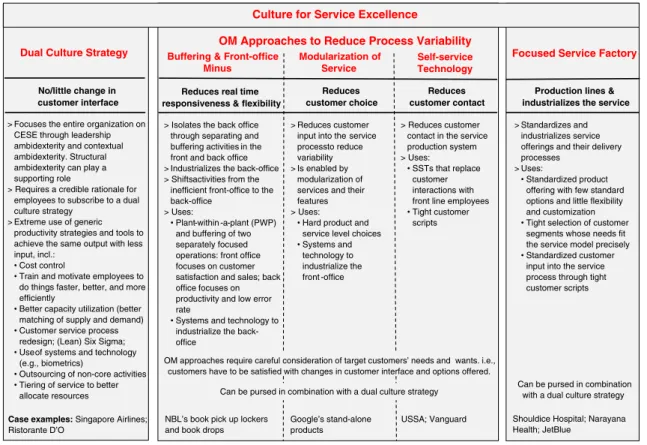
We integrate the literature review and case analyses into the conceptual framework shown in Fig.2. This framework pro-vides a cohesive view of three core strategic options available to organizations that aim to pursue a strategy of CESE.
First, the dual culture strategy aims to provide high levels of service (including costly customization) at top quality and low cost. Here, the service offering is wide, processes are not highly structured and standardized, and customer service is flexible and customized. This type of full service is typically expensive and inefficient to deliver. The dual culture strategy is akin to
ambidextrous organizational approaches in the management literature (Raisch and Birkinshaw2008) with a focus on lead-ership ambidexterity (Smith et al.2016; Smith and Tushman
2005) and contextual ambidexterity (Gibson and Birkinshaw
2004). The organizations in our sample that successfully achieved the dual culture strategy combined an intense focus on costs with equally passionate customer centricity and focus on service excellence. Specifically, they showed an extreme deployment of generic strategies and tools that allowed them to minimize the gap between actual and potential efficiency while delivering service excellence. Furthermore, the dual cul-ture approach in our case organizations required a rationale employees could buy into as it seemed counterintuitive to offer great service externally, but be stingy internally. It seems that being cost conscious, including on employee salaries and ben-efits, must be sold effectively to employees.
The second core strategy addresses the root causes of inef-ficiencies in service processes through OM approaches that reduce customer-induced variability and thereby reduce po-tential conflicts between productivity and service excellence. Unlike a pure dual culture approach, these OM approaches typically require some degree of change in the customer inter-face. They include (1) isolating and industrializing the back office, and reducing the front office, (2) modularization of service, and (3) SSTs.
Finally, the focused service factory strategy enables CESE through a highly specialized operation, typically delivering a
No/little change in customer interface
Reduces real time responsiveness & flexibility
Reduces customer choice
Production lines & industrializes the service
> Focuses the entire organization on CESE through leadership ambidexterity and contextual ambidexterity. Structural ambidexterity can play a supporting role
> Requires a credible rationale for employees to subscribe to a dual culture strategy
> Extreme use of generic productivity strategies and tools to achieve the same output with less input, incl.:
•Cost control
•Train and motivate employees to do things faster, better, and more efficiently
•Better capacity utilization (better matching of supply and demand)
•Customer service process redesign; (Lean) Six Sigma;
•Use of systems and technology (e.g., biometrics)
•Outsourcing of non-core activities
•Tiering of service to better allocate resources
Case examples: Singapore Airlines; Ristorante D’O
Modularization of Service
NBL’s book pick up lockers and book drops
Google’s stand-alone products
Shouldice Hospital; Narayana Health; JetBlue
> Isolates the back office through separating and buffering activities in the front and back office > Industrializes the back-office > Shifts activities from the
inefficient front-office to the back-office
> Uses:
•Plant-within -a-plant (PWP) and buffering of two separately focused operations: front office focuses on customer satisfaction and sales; back office focuses on productivity and low error rate
•Systems and technology to industrialize the back- office
> Reduces customer input into the service process to reduce variability > Is enabled by
modularization of services and their features > Uses:
•Hard product and service level choices
•Systems and technology to industrialize the front -office
> Standardizes and industrializes service offerings and their delivery processes
> Uses:
•Standardized product offering with few standard options and little flexibility and customization
•Tight selection of customer segments whose needs fit the service model precisely
•Standardized customer input into the service process through tight customer scripts
Focused Service Factory
Reduces customer contact
> Reduces customer contact in the service production system > Uses:
•SSTs that replace customer interactions with front line employees
•Tight customer scripts
Self-service Technology
Culture for Service Excellence
Dual Culture Strategy Buffering & Front-office
Minus
OM Approaches to Reduce Process Variability
USSA; Vanguard
Can be pursed in combination with a dual culture strategy OM approaches require careful consideration of target customers’ needs and wants. i.e.,
customers have to be satisfied with changes in customer interface and options offered.
Can be pursed in combination with a dual culture strategy
single type of service to a highly focused customer segment. That is, the focused service factory features tightly-defined and industrialized service processes targeted at a highly ho-mogeneous customer base. As a result, the focused service factory delivers reliably exactly what its target customers want. It also reduces customer-induced variability to a mini-mum—customers tend to receive a single, highly standard-ized, and excellent service offering.
Combining strategies to achieve CESE
Conceptually, one could expect the CESE strategies to be used in a modular manner that allows a mixing and matching of tools and puts different degrees of emphasis on them depend-ing on the industry context and organizational objectives. However, examining Fig.1suggests that our three core strat-egies can stand alone (e.g., pursuing a dual culture strategy like Singapore Airlines, or a focused service factory strategy such as Shouldice Hospital), but the OM approaches and the focused service factory strategy can also be combined with a dual focus strategy. For example, Narayana Health aimed to deliver healthcare to the poorest in India and therefore had an intense cost focus to keep prices low. Wealthier patients cross-subsidized poor ones, and low overall costs allowed wider coverage. In contrast, no particularly strong cost focus could be observed at Shouldice Hospital beyond the savings that were hard-wired into its business model. Similarly, Amazon and Google both heavily relied on OM approaches, but only Amazon also pursued a dual culture strategy at the same time. It is noteworthy that none of our configurations show a combined full OM and focused service strategy approach. Perhaps the OM and focused service strategy both deliver a reduction in customer-induced variability so that their combi-nation does not result in significant enough further incremen-tal gains in productivity. For example, organizations such as Google and Amazon have such highly standardized processes that pursuing the focused service factory strategy does not add significant further efficiency gains through a reduction in customer-induced variability. Likewise, organizations that pursue a focused service factory strategy such as Shouldice Hospital have such low variability in their processes that OM approaches are not essential in driving the productivity poten-tial further. In contrast, the dual focus strategy may still squeeze out further cost savings in organizations that either pursue OM approaches or a focused service factory strategy if that is deemed important by senior management. This discus-sion leads us to the following proposition:
P9: The three main approaches to CESE can be pursued as Bpure^strategies, and both the OM approaches and fo-cused service factory strategy can be pursued effectively in combination with the dual culture strategy.
Implementation and potential incremental gains of a dual culture strategy
Of the three core strategies, the pure dual culture strategy seems the hardest to execute. Service excellence, while complicated particularly in large organizations (Zeithaml et al.2017), seems a more natural focus of service employees (Gouthier and Rhein
2011), but cost-effectiveness is a harder sell to employees. The organizations in our sample that pursued a dual culture strategy had strong leadership rationales and motivations that enabled them to sell cost-consciousness to their employees. As we found in our case organizations, se-nior management has to drive a culture of cost-consciousness and service excellence simultaneously, which is difficult (c.f., Mittal et al.2005). In contrast, as organiza-tions pursue OM approaches or the focused service factory strategy, the systems and technology increasingly hardwire productivity and cost-effectiveness into the business model and employees can focus on service excellence without hav-ing to focus so heavily on costs and incremental productivity gains (e.g., Google and Shouldice Hospital).
P10: OM approaches and the focused service factory hardwire productivity and cost-effectiveness into the operating model making them easier to implement than a dual culture strategy.
Furthermore, the incremental gains a dual culture strategy offers seem reduced as the business model moves towards an OM approach or a focused service factory strategy. A full-service business model, such as Singapore Airlines or Ristorante D’O, must painstakingly identify and implement efficiency gains and cost savings in all its operations. In con-trast, an organization that follows the focused service factory strategy has already dramatic cost savings from the business model itself, and the incremental savings of a dual culture tend to be small compared to the savings the focused system al-ready offers.