First-in-Human Phase I Study of GSK2126458, an
Oral Pan-Class I Phosphatidylinositol-3-Kinase
Inhibitor, in Patients with Advanced Solid Tumor
Malignancies
Pamela Munster
1, Rahul Aggarwal
1, David Hong
2, Jan H.M. Schellens
3, Ruud van der Noll
3,
Jennifer Specht
4, Petronella O. Witteveen
5, Theresa L. Werner
6, E. Claire Dees
7,
Emily Bergsland
1, Neeraj Agarwal
6, Joseph F. Kleha
8, Michael Durante
9, Laurel Adams
8,
Deborah A. Smith
8, Thomas A. Lampkin
8, Shannon R. Morris
8, and Razelle Kurzrock
2Abstract
Purpose:GSK2126458 (GSK458) is a potent inhibitor of PI3K (a, b,g, andd), with preclinical studies demonstrating broad antitumor activity. We performed afirst-in-human phase I study in patients with advanced solid tumors.
Materials and Methods:Patients received oral GSK458 once or twice daily in a dose-escalation design to define the maximum tolerated dose (MTD). Expansion cohorts evaluated pharmacody-namics, pharmacokinetics, and clinical activity in histologically and molecularly defined cohorts.
Results:One hundred and seventy patients received doses ranging from 0.1 to 3 mg once or twice daily. Dose-limiting toxicities (grade 3 diarrhea, n ¼4; fatigue and rash,n¼1) occurred in 5 patients (n ¼ 3 at 3 mg/day). The MTD was 2.5 mg/day (MTD with twice daily dosing undefined). The most common grade 3 treatment-related adverse events included diarrhea (8%) and skin rash (5%). Pharmacokinetic
analyses demonstrated increased duration of drug exposure above target level with twice daily dosing. Fasting insulin and glucose levels increased with dose and exposure of GSK458. Durable objective responses (ORs) were observed across multiple tumor types (sarcoma, kidney, breast, endometrial, oropharyngeal, and bladder cancer). Responses were not asso-ciated withPIK3CAmutations (OR rate: 5% wild-type vs. 6% mutant).
Conclusions:Although the MTD of GSK458 was 2.5 mg once daily, twice-daily dosing may increase duration of target inhibi-tion. Fasting insulin and glucose levels served as pharmacody-namic markers of drug exposure. Select patients achieved durable responses; however, PIK3CAmutations were neither necessary nor predictive of response. Combination treatment strategies and novel biomarkers may be needed to optimally target PI3K.
Clin Cancer Res; 22(8); 1932–9.2015 AACR.
Introduction
The PI3K pathway is an important mediator of glucose olism, and in tumors, of cancer cell growth, survival, and metab-olism (1–4). Upregulation of the pathway via activating muta-tions (e.g.,PIK3CA), loss of suppressor proteins (e.g., PTEN), or activation of upstream receptor tyrosine kinases (e.g., Insulin-like growth receptor and HER family) has been implicated in the
initiation and progression of numerous cancer subtypes, suggest-ing its role as a therapeutic target across multiple solid tumor malignancies and in preclinical models (5–9).
Several agents targeting the PI3K pathway (e.g., TORC1 inhi-bitors) of various potency as well as narrow-target specificity have been tested (10). GSK2126458 (GSK458) is a reversible, selective, pan-PI3K ATP-competitive inhibitor with aKifor the catalytic
p110asubunit in the subnanomolar range, with similar potency against three somatic "hotspot" mutant forms of PI3K p110a (E542K, E545K, and H1047R).
In vitrostudies indicated antiproliferative effects of GSK458 across a broad panel of cancer cell lines. Breast cancer cell lines harboring activating mutations inPIK3CAwere among the most sensitive to GSK458, whereas cell lines harboringRAS/RAF muta-tions were associated with poor response. Preclinical pharmaco-dynamic analyses demonstrated a dose-dependent decrease in phospho-AKT, a key downstream mediator of the PI3K signal transduction pathway.In vivo, GSK458 displayed dose-dependent delays in tumor growth across a range of xenograft models and tumor regression in HCC1954 xenografts (PIK3CA-mutant and KRASwild-type breast cancer cell line). The biologic relevance of wild-type or mutatedPIK3CAand the correlation with on-target side effects such as glycemic dysregulation has remained an unanswered question.
1University of California, San Francisco, California. 2MD Anderson
Cancer Center, Houston, Texas.3The Netherlands Cancer Institute,
Amsterdam, the Netherlands. 4Fred Hutchinson Cancer Research
Center, Seattle, Washington.5Cancer Center University Utrecht, the
Netherlands.6Huntsman Cancer Institute, University of Utah, Salt Lake City, Utah.7UNC Lineberger Comprehensive Cancer Center, Chapel Hill, North Carolina.8GlaxoSmithKline, Research Triangle Park, North Carolina.9GlaxoSmithKline, Collegeville, Pennsylvania.
Note: Supplementary data for this article are available at Clinical Cancer
Research Online (http://clincancerres.aacrjournals.org/).
Corresponding Author:Pamela Munster, University of California, San Francisco, 1600 Divisadero Street, Rm A719 Box 1711, San Francisco, CA 94143-1711. Phone: 415-353-7287; Fax: 415-353-7779; E-mail: [email protected]
doi:10.1158/1078-0432.CCR-15-1665
2015 American Association for Cancer Research.
The primary objective of thisfirst-in-human phase I dose-escalation study was to determine the recommended phase II dose (RP2D) of GSK458; secondary objectives included charac-terization of pharmacokinetic and pharmacodynamic profiles and to explore the relationship between pharmacokinetics, phar-macodynamics, response prediction biomarkers, and clinical out-comes. Pharmacodynamic biomarkers included 2[18F]fl uoro-2-deoxy-D-glucose (FDG)–PET, immunohistochemical assessment of intratumoral protein phosphorylation of downstream effectors of the PI3K pathway (AKT, ERK, and S6), and fasting serum insulin and glucose levels.
Materials and Methods
Patient population
Patients were required to have advanced solid tumor malig-nancies that had progressed on standard therapy, an Eastern Cooperative Oncology Group (ECOG) performance status of 0 or 1, and adequate organ function including absolute neutrophil count >1.5 109/L, total bilirubin< 1.5 ULN, creatinine
<2 mg/dL or creatinine clearance>40 mL/min, fasting serum glucose<126 mg/dL, and cardiac ejection fraction>LLN. Patients with prior treatment with a PI3K inhibitor were excluded.
Study approval was obtained from the ethics committees at the participating institutions and regulatory authorities. All patients gave written informed consent. The study followed the Declara-tion of Helsinki and good clinical practice guidelines.
Study design and treatment schedule
This was a phase I, multicenter, open-label, single-agent, dose-escalation study of GSK458. The starting dose of GSK458 was 0.1 mg/day. The initial once-daily dosing schedule was based uponin vivoxenograft data demonstrating improved efficacy with once or twice-daily dosing compared with every 2-day dosing schedule. Twice-daily dosing of GSK458 was subsequently tested after initial pharmacokinetic/pharmacodynamic data suggested that once-daily dosing did not achieve target serum concentra-tions over a 24-hour interval.
The dose-escalation portion of the study used a 3þ3 escalation schema, and also took into account predicted doses as determined by Escalation with Overdose Control Bayesian Adaptive Design Methodology (11). The MTD was defined as the exposure expected to produce some degree of medically unacceptable
dose-limiting toxicitiy (DLT,q). For this study, the probability of DLT (q) was set asq¼0.25.
Additional patient cohorts consisted of the following: (i) pharmacodynamic expansion cohorts, including (a) patients who underwent paired tumor biopsies and (b) patients who under-went FDG-PET scans, (ii) predictive marker cohorts including PIK3CA-mutated breast and urothelial carcinoma andKRAS wild-type endometrial carcinoma, (iii) safety profile expansion cohort to better characterize safety profile and define RP2D, (iv) explor-atory cohorts consisting of patients with renal cell, bladder, and endometrial carcinoma enrolled without selection based upon tumor genotyping. Dosing for the expansion cohorts occurred at or below the MTD defined by the dose-escalation cohorts. Avail-ability of archival tumor tissue was required for patients enrolled into the predictive markers cohorts and optional for all others.
Sample size justification
The planned total sample size was between 175 to 225 patients. The sample size of the dose-escalation cohort was based upon the 3þ3 dose-escalation schema as outlined above. Up to 12 patients per dose level were enrolled in the safety expansion cohorts to better define the safety profile and RP2D of GSK458. The planned sample size of each planned pharmacodynamic cohort was 15 evaluable patients to achieve 80% power with a ¼ 0.05 in detecting an effect size of 0.7 in percent change from baseline in prespecified pharmacodynamic markers.
For each predictive and exploratory cohort, it was assumed that the maximum objective response (OR) rate for an ineffective drug was 0.1, and the minimum OR rate for an effective drug was 0.3. Simon optimal two-stage design was used to test the null hypoth-esis of 10% response proportion with 80% ata¼0.05. If one or fewer responses were observed in thefirst 10 patients enrolled per cohort, and also upon review of the number of additional patients with tumor regressions classified as stable disease, the cohort was closed to accrual.
The actualfinal planned analyses were performed after 167 patients completed study treatment and the database was locked on December 12, 2012.
Safety and efficacy assessments
Clinical and laboratory assessments were conducted at baseline and weekly during cycle 1 (28-day cycle length) and once per cycle thereafter. Ambulatory blood glucose monitoring occurred daily during cycle 1. Tumor response by RECIST 1.0 criteria was assessed at baseline and every 2 cycles thereafter. Adverse events were graded using Common Toxicity Criteria version 3.0.
Pharmacodynamic assessments
In selected pharmacodynamic cohorts, paired tumor biopsies and FDG-PET scans were performed within 14 days prior to starting GSK458 and repeated during days 2 to 4 of cycle 1. Pre- and post-dose biopsies were evaluated by IHC for protein expression of total and phosphorylated forms of AKT, ERK, and P70s6K, phospho-histone 3, phosphorylated proline-rich AKT, and Ki67 proliferation index. Serial fasting glucose and insulin samples were collected.
Pharmacokinetic assessments
Blood samples for GSK458 concentrations were obtained pre-dose and up to 24 hours postpre-dose on days 1 and 15 of cycle 1 for patients treated with the daily dosing schedule. For the twice-daily
Translational Relevance
dosing schedule, samples were obtained up to 12 hours after each dose (am and pm) on days 1 and 15. GSK458 blood concentration was determined using validated LC/MS-MS. The lower limit of quantification of GSK458 was 0.5 ng/mL. Standard pharmacoki-netic parameters were computed by noncompartmental methods (WinNonLin). Values assessed were area under the plasma-con-centration time curve from time 0 to 24 or 12 hours (AUC0–24)
and (AUC0–12) for once- or twice-daily dosing, respectively, and
maximum blood concentration (Cmax) and time toCmax(tmax).
Accumulation was determined by AUC day 15/AUC day 1.
Results
Study population
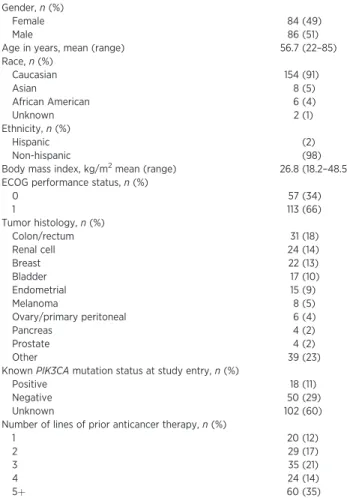
A total of 170 patients were enrolled between September 2009 and August 2012. Baseline characteristics of the enrolled patients are shown in Table 1. Seventy percent of patients received three or more prior lines of therapy in the advanced setting. Overall, PIK3CA mutation status was known in 68 patients (40%), of which 18 patients (26%) harbored somaticPIK3CAmutations at the time of study enrollment.
Patient disposition is shown in Table 2. Sixty-five patients (38%) enrolled onto the daily or twice-daily dose-escalation phase, and 105 patients enrolled into one of the prespecified expansion cohorts. The majority (79%) of patients discontinued study therapy for disease progression. Two patients remained on study treatment (>4 years' duration).
Determination of MTD
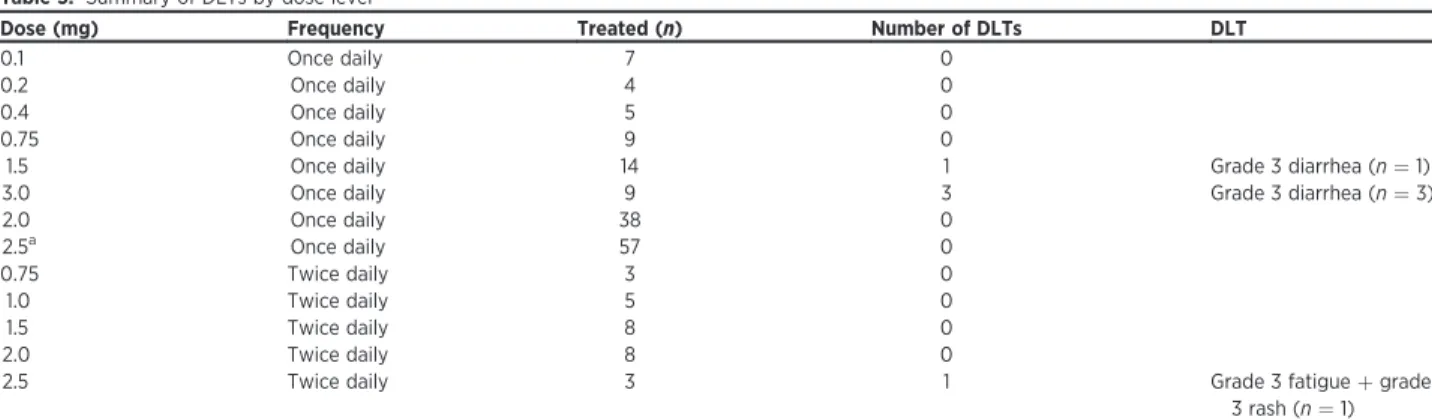
In the once-daily dose-escalation part of the study, 8 dose levels were explored (Table 3). Thefirst DLT (grade 3 diarrhea) occurred at the 1.5 mg once-daily dose. This cohort was expanded without further dose limiting events. Three DLTs (all grade 3 diarrhea events) occurred at the 3 mg once-daily dose level, rendering this the nontolerated dose (NTD). Patients were subsequently treated at dose levels of 2 mg and 2.5 mg once daily without any observed DLTs, establishing 2.5 mg as the MTD with once daily dosing schedule.
Because of the observation of a shorter duration of GSK458 drug levels above target range with daily dosing, twice-daily dose esca-lation was initiated at a dose of 0.75 mg twice daily, and 5 dose levels were studied (Table 3). No DLTs were observed at the 2 mg twice-daily dose level. One of the three patients experienced a DLT (grade 3 fatigueþgrade 3 rash) at 2.5 mg twice daily; however, due to the decision to discontinue single-agent testing of GSK458, further patients were not treated at this dose level; and therefore, the MTD with twice-daily dosing could not be determined.
Safety results
The most common adverse events (any grade severity) experi-enced on study were fatigue (45%), diarrhea (45%), nausea (42%), decreased appetite (30%), and vomiting (26%; Table 4). The most common grade3 adverse events included diarrhea (8%), hyperglycemia (>250 mg/dL; 6%), and skin rash (5%). Nine patients (5%) experienced a treatment-related serious adverse event, including four patients with diarrhea. Diarrhea appeared to be an intermittent, self-limiting event for most patients, with resolution reported in 82% of patients. Rash was noted in 21 patients (12%), with most patients experiencing a single occurrence (81%). The most common type of rash was maculopapular in appearance; acneiform rash was rare (2 patients). Hyperglycemia was noted in 37 patients (22%), was mostly grade 1 or 2 in severity, and did not require dose adjust-ment in the majority of patients (92%). Cardiac toxicity was minimal with 2 (1%) patients experiencing post-baseline decreases in ejection fraction below the lower limit of normal and>10% from baseline. There were no significant effects on mood noted. There were no treatment-related grade 5 adverse events.
Table 1. Patient characteristics (N¼170) Gender,n(%)
Female 84 (49)
Male 86 (51)
Age in years, mean (range) 56.7 (22–85) Race,n(%)
Caucasian 154 (91)
Asian 8 (5)
African American 6 (4)
Unknown 2 (1)
Ethnicity,n(%)
Hispanic (2)
Non-hispanic (98)
Body mass index, kg/m2mean (range) 26.8 (18.2–48.5) ECOG performance status,n(%)
0 57 (34)
1 113 (66)
Tumor histology,n(%)
Colon/rectum 31 (18)
Renal cell 24 (14)
Breast 22 (13)
Bladder 17 (10)
Endometrial 15 (9)
Melanoma 8 (5)
Ovary/primary peritoneal 6 (4)
Pancreas 4 (2)
Prostate 4 (2)
Other 39 (23)
KnownPIK3CAmutation status at study entry,n(%)
Positive 18 (11)
Negative 50 (29)
Unknown 102 (60)
Number of lines of prior anticancer therapy,n(%)
1 20 (12)
2 29 (17)
3 35 (21)
4 24 (14)
5þ 60 (35)
Table 2. Patient disposition
Number of subjects enrolled per cohort,n(%)
Daily dosing–escalation cohort 43 (25) Twice-daily dosing–escalation cohort 22 (13)
Safety expansion cohort 20 (12)
PD expansion cohort 36 (21)
Exploratory cohort (renal, endometrial, and bladder cancer) 40 (24) Breast cancer withPIK3CAmutation 9 (5) Reasons for study discontinuation,n(%)
Disease progression 136 (80)
Withdrawal of consent 12 (7)
Adverse event 9 (5)
Other 11 (7)
Therapy ongoing 2 (1)
Number of patients included in study populations,n(%)
Safety/toxicity 170 (100)
PK population 166 (98)
PD (blood) 170 (100)
PD (tumor) 25 (15)
Pharmacokinetic analyses
Following single daily dosing, the mediantmaxranged from 1 to
4 hours. Mean AUC0–24hrsandCmaxincreased approximately in
proportion with doses from 0.1 to 0.4 mg daily and then from 0.75 mg to 3.0 mg/day but not across the whole dose range (Supplementary Table S1 and Fig. 1A). As expected due to accu-mulation of GSK458, the mean AUC0–12hrsandCmaxwere
gen-erally higher following the second dose versus the first dose with the twice-daily dosing schedule. The average time spent >20 ng/mL (the target dose level based on preclinical data) was greater with twice-daily than once-daily dosing (21.2 hours at 2 mg twice daily vs. 14.5 hours at the once-daily MTD of 2.5 mg; Fig. 1B). The terminalT1/2and AUC0–>¥could not be determined due to the large %AUC extrapolation in>20% of patients. Because of between-subject variability, pharmacokinetic values overlapped across doses.
The repeat dose (day 15) pharmacokinetics of GSK458 dem-onstrated that predose (Ctau) levels generally increased with dose,
but values were variable and overlapped across doses.Ctauvalues
were higher on twice-daily versus once-daily dosing schedule for
comparable cumulative daily doses (e.g., 2 mg daily vs. 1 mg twice daily). The mean accumulation ratio with daily and twice daily dosing schedules was approximately 1.4.
Pharmacodynamic analyses
Putative biomarkers of the PI3K signaling pathway were pro-spectively investigated. The approach included measurement of phosphorylation levels of various downstream kinases in a pro-spectively identified cohort of patients harboring tumors with activating somaticPIK3CA mutations. Baseline and post-dose tumor biopsies for immunohistochemichal analysis were obtained in a total of 24 patients, with 13 patients having paired evaluable biopsies. Eleven of the 13 patients were treated with GSK458 once daily. The percent change from baseline in p-AKT H-score was inconsistent and did not correlate with thePIK3CA mutation status or with dose level of a patient (Fig. 2A).
For the subset of patients with both pharmacokinetic and pharmacodynamic data available, the correlation between drug exposure (AUC) and percent change from baseline in phosphor-ylated-AKT H-score by IHC was weak and not significant
Table 3. Summary of DLTs by dose level
Dose (mg) Frequency Treated (n) Number of DLTs DLT
0.1 Once daily 7 0
0.2 Once daily 4 0
0.4 Once daily 5 0
0.75 Once daily 9 0
1.5 Once daily 14 1 Grade 3 diarrhea (n¼1)
3.0 Once daily 9 3 Grade 3 diarrhea (n¼3)
2.0 Once daily 38 0
2.5a Once daily 57 0
0.75 Twice daily 3 0
1.0 Twice daily 5 0
1.5 Twice daily 8 0
2.0 Twice daily 8 0
2.5 Twice daily 3 1 Grade 3 fatigueþgrade
3 rash (n¼1) a2.5 mg once daily established as MTD for single daily dosing. MTD for twice-daily dosing schedule not determined.
Table 4. Summary of adverse events (any grade severity) in10% of patients across dose levels
Subjects,n(%)
Once-daily dosing Twice-daily dosing
0.1 0.2 0.4 0.75 1.5 2.0 2.5 3.0 0.75 1.0 1.5 mg 2.0 mg 2.5 mg Total
Event n¼7 n¼4 n¼5 n¼9 n¼14 n¼38 n¼57 n¼9 n¼3 n¼5 n¼8 n¼8 n¼3 N¼170
Any event 7 (100) 4 (100) 5 (100) 9 (100) 14 (100) 38 (100) 57 (100) 9 (100) 3 (100) 5 (100) 8 (100) 8 (100) 3 (100) 170 Diarrhea 0 0 0 6 (67) 3 (21) 15 (39) 32 (56) 6 (67) 0 2 (40) 6 (75) 4 (50) 3 (100) 77 (45) Fatigue 2 (29) 1 (25) 1 (20) 2 (22) 9 (64) 14 (37) 32 (56) 5 (56) 1 (33) 2 (40) 3 (38) 2 (25) 3 (100) 77 (45) Nausea 2 (29) 0 0 2 (22) 6 (43) 17 (45) 28 (49) 4 (44) 1 (33) 3 (60) 3 (38) 3 (38) 2 (67) 71 (42) Decreased appetite 1 (14) 1 (25) 0 1 (11) 5 (36) 9 (24) 17 (30) 4 (44) 1 (33) 4 (80) 4 (50) 3 (38) 1 (33) 51 (30)
Vomiting 0 0 0 1 (11) 4 (29) 10 (26) 23 (40) 4 (44) 0 0 0 2 (25) 0 44 (26)
Hyperglycemia 0 1 (25) 1 (20) 0 2 (14) 5 (13) 12 (21) 4 (44) 0 1 (20) 2 (25) 2 (25) 1 (33) 31 (18)
Dyspnea 1 (14) 0 0 2 (22) 2 (14) 8 (21) 10 (18) 2 (22) 0 1 (20) 0 1 (13) 0 27 (16)
Pyrexia 1 (14) 0 1 (20) 1 (11) 5 (36) 1 (3) 12 (21) 2 (22) 0 1 (20) 1 (13) 0 0 25 (15) Constipation 0 1 (25) 0 0 1 (7) 7 (18) 7 (12) 2 (22) 2 (67) 2 (40) 1 (13) 1 (13) 0 24 (14)
Mucositis 0 0 0 0 1 (7) 5 (13) 6 (11) 4 (44) 0 2 (40) 4 (50) 1 (13) 1 (33) 24 (14)
Back pain 0 1 (25) 0 2 (22) 0 7 (18) 8 (14) 0 1 (33) 3 (60) 0 1 (13) 0 23 (14)
Urinary tract infection 1 (14) 0 0 0 2 (14) 5 (13) 10 (18) 1 (11) 0 0 2 (25) 2 (25) 0 23 (14) Abdominal pain 0 0 0 1 (11) 1 (7) 3 (8) 11 (19) 1 (11) 1 (33) 1 (20) 1 (13) 0 0 22 (13)
Rash 0 0 0 1 (11) 0 4 (11) 7 (12) 4 (44) 0 0 1 (13) 1 (13) 3 (100) 21 (12)
Cough 0 0 0 1 (11) 0 3 (8) 10 (18) 3 (33) 1 (33) 0 0 1 (13) 1 (33) 20 (12)
Peripheral edema 0 0 0 0 1 (7) 5 (13) 11 (19) 0 0 1 (20) 1 (13) 1 (13) 0 20 (12)
Anemia 0 1 (25) 0 1 (11) 2 (14) 4 (11) 5 (9) 3 (33) 2 (67) 0 0 1 (13) 0 19 (11)
Headache 2 (29) 0 1 (20) 3 (33) 1 (7) 3 (8) 3 (5) 2 (22) 0 1 (20) 2 (25) 1 (13) 0 19 (11) Aspartate
aminotransferase
(r¼ 0.27; Fig. 2B). Similar patterns were observed for phos-phorylated P70s6K and ERK (data not shown).
Paired FDG-PET scans were performed in 14 patients, all of whom were treated with GSK458 once daily (Fig. 2C). Overall, decrease in FDG avidity upon initiation of GSK458 treatment was observed in 28 of 38 evaluable metastatic lesions (74%). There was no consistent dose–effect relationship on FDG-PET scans by metastatic lesion. The median change from baseline in sum of SUVmaxby patient varied from3.1 to 0.1 across the 0.75 mg to 3
mg once-daily dosing levels.
In contrast, the percent change from baseline in fasting plasma glucose levels on day 1 of study therapy was significantly asso-ciated with GSK458 dose level (Fig. 2D). Likewise, the fold increase in insulin from baseline to 6 hours postdose on cycle 1 day 1 was significantly associated with dose and serum con-centration of GSK458 (data not shown).
Efficacy analyses
The maximum percent change from baseline in tumor mea-surements is shown in Fig. 3. Forty-three patients (25%) had nonmeasurable disease and/or discontinued study prior tofirst restaging scans and thus were not evaluable for assessment of OR. Overall, ORs were seen in 9 patients (5%; Supplementary Table S2). Two of the nine ORs were observed in the twice-daily dosing
cohort (N¼27; 7% response rate). In the expansion cohort of 84 patients enrolled with breast, renal cell, bladder, or endometrial cancer, there were a select group of patients with prolonged OR or disease stabilization, including 5 (6%) patients treated with GSK458 for greater than 6 months without disease progression (Supplementary Fig. S1). Two patients with bladder and renal cell carcinoma remain on therapy with ongoing partial and complete responses, respectively, for more than four years duration.
Importantly, there did not appear to be enrichment for tumor responses or prolonged disease stabilization inKRASwild-type endometrial cancer patients or in patients with tumors harboring somaticPIK3CAmutations, with objective tumor response rates of 7% and 6% respectively in these two prespecified expansion cohorts.
Discussion
The dose-escalation/expansion study of the pan-class I PI3K inhibitor GSK458 demonstrates that targeting the PI3K pathway directly with this small-molecule inhibitor is well tolerated and associated with single-agent activity in a small percentage of patients across multiple tumor types in a heavily pretreated patient population. Prolonged objective tumor responses and disease stabilization was observed in several tumor types includ-ing bladder and renal cell carcinoma. Overall, however, limited single-agent activity was observed anda prioriselection of molec-ularly defined tumor subtypes includingPIK3CA-mutant breast and bladder cancer and KRAS wild-type endometrial cancer did not enrich for tumor response or prolonged disease stabili-zation. In accounting for thesefindings, several points warrant consideration.
First, in contrast to prior reports (12–17), activating somatic PIK3CAmutations did not appear to be a predictive biomarker of clinical benefit in the expansion cohort, and the responses seen in nonmutated patients suggest that in our population, PIK3CA mutations were neither predictive nor necessary for response. Baseline and early changes in FDG uptake on PET scan were likewise neither associated with dose nor with subsequent clinical response. The PI3K pathway is essential for many cellular func-tions, and the on-target effects of GSK458 treatment on plasma glucose and serum insulin levels suggest a strong inhibition of the wild-type PI3K pathway. These results highlight the need for more effective biomarkers to predict which subset of tumors are highly dependent on PI3K/mTOR signaling for proliferation and there-fore more likely to respond to targeted PI3K inhibition. Without such biomarkers, the clinical development of targeted PI3K/ mTOR pathway inhibitors will be hindered.
Emerging evidence indicates that PI3K inhibitors may have limited single-agent activity in tumors withPIK3CAmutations due to compensatory activation of alternative signaling pathways including mitogen-activated protein (MAP) kinase, particularly in tumors harboring coexisting RAS mutations (18). Othera isoform-specific and pan-class inhibitors of PI3K, including BYL719 and BKM120, respectively, have also demonstrated lim-ited single-agent activity across a variety of solid tumor malig-nancies including those harboringPIK3CAmutations (19, 20). In contrast to activating mutations in other oncogenes (e.g.,EGFR andBRAF) in which significant single-agent activity is observed, combination treatment strategies may be necessary to effectively target the PI3K pathway. In a prior retrospective review ofPIK3CA -mutant tumors treated with single-agent PI3K inhibitors versus 0
0 25 50 75 100 125
Mean vs. Time
Mean vs. Time 0.1 mg 0.2 mg 0.4 mg 0.75 mg 1.5 mg 2.0 mg 2.5 mg
0.75 mg 1.5 mg 1.0 mg 2.0 mg 2.5 mg 3.0 mg
Mean GSK2126458 b
lood concentration (ng/mL)
Mean GSK2126458 b
lood concentration (ng/mL)
150
A
B
0 25 50 75 100 125 150
5 10
Time (h)
15 20 25
0 5 10
Time (h)
15 20 25
Figure 1.
combination therapy (including cotargeting of MAP kinase pathway), progression-free survival was significantly longer with combination therapy (18). A prospective clinical trial combining GSK458 with the MEK inhibitor trametinib recently
demonstrat-ed prolongdemonstrat-ed disease stabilization in a subset of tumors harboring KRASmutations (21).
The study results also highlight the importance of pharmaco-kinetic/pharmacodynamic data to define the optimal biologic
*1.5 mg BID
A
B
C
D
*1.5 mg BID *3 mg/day *2.5 mg/day 2.5 mg/day 2.5 mg/day 2.5 mg/day 2.5 mg/day 2.5 mg/day 2.5 mg/day 2.5 mg/day 2 mg/day 0.75 mg/day
–100
–40 –30 –20 –10 0
Percent change in SUVmax
0.75 mg QD 1.5 mg QD 2 mg QD 2.5 mg QD 3 mg QD
10 20 30 40 50 60
0
1 H 2 H 4 H 6 H 12 H
2 4
6 0.1 mg QD0.2 mg QD
0.4 mg QD 0.75 mg QD 1.5 mg QD 2 mg QD 2.5 mg QD 3 mg QD 1.5 mg BID 2 mg BID
–50 0 50 100
–60% –40% –20% 0%
0 200 400
r = –0.27
600 800
20% 40% 60% 80% 100%
Percent change from baseline H-score
Mean change from baseline glucose (mmol/L)
*PIK3CA mutant
Figure 2.
A, change from baseline in level of expression of phosphorylated AKT by dose level andPIK3CAmutation status. B, percent change from baseline in phospho-AKT by H-score versus drug exposure (AUC;N¼7 patients evaluable). C, maximal percent SUV change from baseline on FDG-PET by metastatic lesion
(N¼14 patients). D, change from baseline in fasting glucose levels on cycle 1 day 1 dosing. QD, once daily.
–100% –50% 0% 50% 100%
PIK3CA Status:
Mutant
Wild type
Unknown
Figure 3.
dose in afirst-in-patient study of a targeted anticancer therapy. Pharmacokinetic/pharmacodynamic modeling using mouse BT474 xenografts yielded a sustained mean target serum concen-tration of>20 ng/mL as the expected IC67for AKT
phosphoryla-tion with range of 6.6 to 60 ng/mL to account for potential translation differences between mice and humans. Pharmacoki-netic data from the daily dosing schedule suggested that the target serum concentration of>20 ng/mL was not being sustained over a 24-hour interval. In addition, significant interpatient var-iability in drug exposure was observed across the once-daily dosing levels. These two factors likely contributed to the lack of dose- and exposure-dependent effect observed in the pharmaco-dynamic analyses with daily dosing of GSK458 and may have impacted the observed antitumor activity. The twice-daily dosing schedule achieved more consistent serum levels above the target exposure. Whether twice-daily dosing of GSK458 translates into more effective target inhibition and enhanced antitumor activity requires further clinical evaluation as pharmacodynamic analyses were nearly entirely limited to the once-daily dosing cohort and the MTD was not reached with twice-daily dosing.
GSK458 was fairly well tolerated. The frequency of adverse events appeared to be similar with once-daily versus twice-daily dosing. Diarrhea was a common clinical event; however, it was largely grade 1–2 in severity for most patients, with grade 3 diarrhea (>7 stools above baseline/day) observed in 8% of enrolled patients. Diarrhea appeared to be self-limiting and responsive to temporary dose interruptions and resolved in more than 80% of patients at the time of last study reporting. Hyperglycemia, a class effect (and potential pharmacodynamic biomarker) of PI3K pathway inhibition, was observed in 18% of patients on study and was mostly grade 1–2 in severity. Hyperglycemia was commonly managed with oral agents (e.g., metformin); the initiation of insulin during protocol therapy was a rare event. Other class effects of PI3K pathway inhibition were observed, including rash and mucositis, both managed effectively with temporary dose holds and/or initiation of topical steroid treatment. Interestingly, in contrast to other PI3K inhibitors such as BKM120, effects on mood were uncom-mon, suggesting potentially a differential penetration across the blood–brain barrier or other off-target differences in recep-tor inhibition (20).
Conclusion
The MTD with daily dosing of GSK458 is 2.5 mg/day. However twice-daily dosing may optimize target inhibition across a 24-hour interval. Pharmacodynamic analyses showed a dose-dependent increase in fasting insulin and glucose levels that may serve as a pharmacologic biomarker of drug exposure. Antitumor activity of GSK458 was not enriched inKRAS
wild-type endometrial cancer or inPIK3CA-mutant cancers in this study, highlighting the need for more effective predictive bio-markers of the PI3K signaling pathway. GSK458 is being evaluated in combination with other targeted agents as well as in noncancerous indications in which PI3K upregulation is implicated in disease etiology (e.g., idiopathic pulmonary
fibrosis; NCT01725139).
Disclosure of Potential Conflicts of Interest
P.N. Munster reports receiving commercial research grants and other com-mercial research support from GlaxoSmithKline. E.C. Dees reports receiving commercial research grants from Bayer, GlaxoSmithKline, Lilly, Merck,
Novar-tis, and Pfizer; and is a consultant/advisory board member for Novartis.
E.K. Bergsland is a consultant/advisory board member for Celgene and Novartis. L.M. Adams reports receiving commercial research grants from line. D.A. Smith holds ownership interest (including patents) in GlaxoSmithK-line. T.A. Lampkin is an employee of and holds ownership interest (including patents) in GlaxoSmithKline. R. Kurzrock is an employee of and holds own-ership interest (including patents) in RScueRX; reports receiving other com-mercial research support from Foundation Medicine, Genentech, Guardant,
Merck Serono, Pfizer, and Sequenom; and is a consultant/advisory board
member for Sequenom. No potential conflicts of interest were disclosed by
the other authors.
Authors' Contributions
Conception and design:P. Munster, J.H.M. Schellens, E.C. Dees, J.F. Kleha, L. Adams, D.A. Smith, S.R. Morris, R. Kurzrock
Development of methodology:P. Munster, J.H.M. Schellens, J.F. Kleha, M. Durante, L. Adams
Acquisition of data (provided animals, acquired and managed patients, provided facilities, etc.):P. Munster, R. Aggarwal, D. Hong, J.H.M. Schellens, R. van der Noll, J. Specht, P.O. Witteveen, T.L. Werner, E.C. Dees, E. Bergsland, N. Agarwal, J.F. Kleha, L. Adams
Analysis and interpretation of data (e.g., statistical analysis, biostatistics, computational analysis): P. Munster, R. Aggarwal, J.H.M. Schellens, P.O. Witteveen, N. Agarwal, J.F. Kleha, M. Durante, L. Adams, D.A. Smith, T.A. Lampkin, S.R. Morris, R. Kurzrock
Writing, review, and/or revision of the manuscript:P. Munster, R. Aggarwal, D. Hong, J.H.M. Schellens, R. van der Noll, J. Specht, P.O. Witteveen, T.L. Werner, E.C. Dees, E. Bergsland, N. Agarwal, J.F. Kleha, M. Durante, L. Adams, D.A. Smith, T.A. Lampkin, S.R. Morris, R. Kurzrock
Administrative, technical, or material support (i.e., reporting or organizing data, constructing databases):J. Specht, J.F. Kleha, M. Durante
Study supervision: D. Hong, J.H.M. Schellens, N. Agarwal, J.F. Kleha, M. Durant, L. Adams, T.A. Lampkin, S.R. Morris
Grant Support
Financial support for this study was provided by GlaxoSmithKline Pharmaceuticals.
The costs of publication of this article were defrayed in part by the payment of
page charges. This article must therefore be hereby markedadvertisementin
accordance with 18 U.S.C. Section 1734 solely to indicate this fact.
Received July 14, 2015; revised September 30, 2015; accepted October 12, 2015; published OnlineFirst November 24, 2015.
References
1. Cantley LC. The phosphoinositide 3-kinase pathway. Science 2002;296:
1655–7.
2. Engelman JA, Luo J, Cantley LC. The evolution of phosphatidylinositol 3-kinases as regulators of growth and metabolism. Nat Rev Genet 2006;7:606–19.
3. Katso R, Okkenhaug K, Ahmadi K, White S, Timms J, Waterfield MD. Cellular
function of phosphoinositide 3-kinases: implications for development,
homeostasis, and cancer. Annu Rev Cell Dev Biol 2001;17:615–75.
4. Courtney KD, Corcoran RB, Engelman JA. The PI3K pathway as drug target
human cancer. J Clin Oncol 2010;28:1075–83.
5. Campbell IG, Russell SE, Choong DYH, Montgomery KG, Ciavarella ML,
Hooi CSF, et al. Mutation of thePIK3CAgene in ovarian and breast cancer.
Cancer Res 2004;64:7678–81.
6. Samuels Y, Wang Z, Bardelli A, Silliman N, Ptak J, Szabo S, et al. High
frequency of mutations of thePIK3CAgene in human cancers. Science
7. Lee JW, Soung YH, Kim SY, Lee HW, Park WS, Nam SW, et al.PIK3CAgene is frequently mutated in breast carcinomas and hepatocellular carcinomas.
Oncogene 2005;24:1477–80.
8. Li J, Yen C, Liaw D, Podsypanina K, Bose S, Wang SI, et al.PTEN, a putative
protein tyrosine phosphatase gene mutated in human brain, breast, and
prostate cancer. Science 1997;275:1943–7.
9. Hollander MC, Blumenthal GM, Dennis PA. PTEN loss in the continuum of common cancers, rare syndromes, and mouse models. Nat Rev Cancer 2011;11:289–301.
10. Carracedo A, Ma L, Teruya-Feldstein J, Rojo F, Salmena L, Alimonti A, et al. Inhibition of mTORC1 leads to MAPK pathway activation through a
PI3K-dependent feedback loop in human cancer. J Clin Invest 2008;118:3065–74.
11. Babb J, Rogatko A, Zacks S. Cancer phase I clinical trials: efficient dose
escalation with overdose control. Stat Med 1998;17:1103–20.
12. Ihle NT, Lemos R Jr, Wipf P, Yacoub A, Mitchell C, Siwak D, et al. Mutations in the phosphatidylinositol-3-kinase pathway predict for antitumor activ-ity of the inhibitor PX-866 whereas oncogenic Ras is a dominant predictor for resistance. Cancer Res 2009;69:143–50.
13. Torbett NE, Luna-Moran A, Knight ZA, Houk A, Moasser M, Weiss W, et al. A chemical screen in diverse breast cancer cell lines reveals genetic enhancers and suppressors of sensitivity to PI3K isoform-selective inhibition. Biochem J 2008;415:97–110.
14. Meric-Bernstam F, Akcakanat A, Chen H, Do K, Sangai T, Adkins F, et al. PIK3CA/PTEN mutations and Akt activation as markers of sensitivity to
allosteric mTOR inhibitors. Clin Cancer Res 2012;18:1777–89.
15. Janku F, Wheler JF, Westin SN, Moulder SL, Naing A, Tsimberidou AM, et al. PI3K/AKT/mTOR inhibitors in patients with breast and gynecologic
malig-nancies harboringPIK3CAmutations. J Clin Oncol 2012;30:777–82.
16. Janku F, Wheler JJ, Naing A, Falchook GS, Hong DS, Stepanek VM, et al. PIK3CAmutation H1047R is associated with response to PI3K/AKT/mTOR signaling pathway inhibitors in early-phase clinical trials. Cancer Res 2013;73:276–84.
17. Juric D, Infante JR, Krop IE, Kurkjian C, Patel MR, Graham RA, et al. Evaluation of tolerability and anti-tumor activity of GDC-0032, a PI3K
inhibitor with enhanced activity against PIK3CA mutant tumors,
administered to patients with advanced solid tumors. Eur J Cancer 2013;49:S168.
18. Janku F, Hong DS, Fu S, Piha-Paul SA, Naing A, Falchook GS, et al. Assessing PIKCA and PTEN in early-phase trials with PI3K/AKT/mTOR inhibitors.
Cell Rep 2014;6:377–87.
19. Bendell JC, Rodon J, Burris HA, de Jonge M, Verweij J, Birle D, et al. Phase I, dose-escalation study of BKM120, an oral pan-class PI3K inhibitor, in
patients with advanced solid tumors. J Clin Oncol 2012;30:282–90.
20. Juric D, Argiles G, Burris HA, Gonzalezo-Angulo AM, Saura C, Quadt C,
et al. Phase I study of BYL719, an alpha-specific PI3K inhibitor, in patients
withPIK3CAmutant advanced solid tumors: preliminary efficacy and
safety in patients withPIK3CAmutant ER-positive metastatic breast cancer
[abstract]. In: Proceedings of the 35th Annual CTRC-AACR San Antonio Breast Cancer Symposium; 2012 Dec 4-8; San Antonio, TX. Philadelphia (PA): AACR; 2006. Abstract nr P6-10-07.