MONETARY POLICY IN A ZERO LOWER BOUND ENVIRONMENT
Laura E. Jackson
A dissertation submitted to the faculty of the University of North Carolina at Chapel
Hill in partial ful…llment of the requirements for the degree of Doctor of Philosophy in
the Department of Economics.
Chapel Hill
2014
Approved by:
Neville Francis
Michael Owyang
Richard Froyen
Eric Ghysels
ABSTRACT
LAURA E. JACKSON: MONETARY POLICY IN A ZERO LOWER BOUND
ENVIRONMENT.
(Under the direction of Neville Francis.)
In the wake of the Great Recession, the Federal Reserve lowered the federal funds rate
(FFR) target to zero and resorted to unconventional monetary policy. With the nominal FFR
constrained by the zero lower bound (ZLB), empirical monetary models cannot be estimated
as usual. First, in joint work with Neville Francis and Michael Owyang, we consider whether
standard models of monetary policy can be preserved without breaks. We consider whether
alternative policy instruments can be considered substitutes for the FFR over the ZLB period.
Furthermore, we construct a shadow rate via the methods proposed in Krippner (2012) and Wu
and Xia (2014) to proxy for the stance of policy. We ask whether the shadow rate is a su¢ cient
representation of the policy instrument or if the …nancial crisis requires other modi…cations.
We …nd that, if using a dataset that spans the pre-ZLB and ZLB environments, the shadow
rate acts as a fairly good proxy for monetary policy by producing impulse responses similar
to what we’d expect based on the non-ZLB benchmark. However, the linear model exhibits a
structural break at the onset of the ZLB and the shadow rate may be insu¢ cient for examining
the ZLB period in isolation.
Second, I describe the joint dynamics of bond yields, monetary policy and macroeconomic
variables within a no-arbitrage a¢ ne term structure framework while explicitly modeling the
ZLB using the shadow rate. I include data on the unemployment gap and in‡ation to build
a more comprehensive stance of policy, incorporating the in‡uences of unconventional
instru-ments introduced to combat the Great Recession. I …nd that shadow rate models incorporating
macroeconomic factors suggest a more negative shadow rate and a longer expected duration
allows the model to better capture the shift in policy focus towards targeting longer-term
yields. Finally, the shadow rate produces a proxy for the stance of policy that suggests the
unconventional programs achieved a substantial accommodation, in excess of that prescribed
ACKNOWLEDGMENTS
This project would not have been possible without the help and support of several people.
I am indebted to my advisors, Neville Francis and Michael Owyang for their guidance and
invaluable feedback. They have contributed immensely to my success in the economics
pro-fession. I would also like to thank each of the other members of my dissertation committee,
Richard Froyen, William Parke, and Eric Ghysels, whose comments and suggestions helped to
improve my work substantially. I bene…tted from conversations with Anusha Chari, Jonathan
Willis, Lutz Hendricks, and the research department of the Federal Reserve Bank of Kansas
City. Furthermore, I thank the participants of the Macro-Money seminar at UNC-Chapel Hill,
and the 22nd Symposium of the Society for Nonlinear Dynamics and Econometrics for their
constructive feedback. I completed part of this work as a CSWEP (Committee on the Status
of Women in the Economics Profession) Summer Economics Fellow in the Research Division
of the Federal Reserve Bank of Boston and as a Dissertation Intern at the Research Division
of the Federal Reserve Bank of Kansas City. These opportunities contributed immensely to
my progress as a research economist and I am grateful for their hospitality.
Lastly, I could not have completed the journey through graduate school without the
un-conditional love and support of my family and friends. I thank my parents, Jay and Sheri, for
their encouragement and always trusting and believing in me, even when my own belief may
have waivered. My brother, JJ, has always given me inspiration to see the best in the world
and this consistent focus helped me to persevere through the most di¢ cult of times. Finally,
I thank Eric for always supporting me in pursuit of my dreams and for reminding me of what
TABLE OF CONTENTS
LIST OF TABLES
. . . viii
LIST OF FIGURES
. . . .
ix
1
FOREWORD
. . . .
1
1.1
Literature on Monetary Policy in a ZLB Environment . . . .
4
2
MONETARY POLICY ANALYSIS AFTER THE FINANCIAL CRISIS
.
7
2.1
Introduction . . . .
7
2.2
The Benchmark Speci…cation . . . .
9
2.2.1
Testing for Parameter Instability . . . .
12
2.3
Monetary Policy at the ZLB . . . .
13
2.3.1
Adding Alternative Monetary Instruments . . . .
13
2.3.2
Shadow Short Rates . . . .
15
2.3.3
Model Performance . . . .
20
2.3.4
The Bottom Line . . . .
21
2.4
Conclusions . . . .
22
3
MONETARY POLICY AND MACRO FACTORS AT THE ZLB
. . . . .
24
3.1
Introduction . . . .
24
3.2
Empirical Methodology
. . . .
29
3.2.1
Central Bank Policy Rate and Observable Macroeconomic Indicators . .
30
3.2.2
Macro-Finance Model . . . .
34
3.2.3
Macro-Monetary Model . . . .
35
3.2.4
Finance Model . . . .
37
3.3
Data . . . .
38
3.4
Estimation
. . . .
39
3.5
Shadow Rate Estimation Results . . . .
40
3.5.1
Macro-Finance Model . . . .
40
3.5.2
Macro-Monetary Model . . . .
41
3.5.3
Finance Model . . . .
42
3.5.4
In-Sample Yield Curve Forecasting . . . .
43
3.6
Macro-Finance Shadow Rate and Policy Rules
. . . .
46
3.7
What Do Markets Expect?
. . . .
48
3.8
Conclusion
. . . .
51
A TECHNICAL APPENDIX
. . . .
53
A.1 Standard GATSM Methodology . . . .
53
A.1.1 Estimation of Parameters with the Kalman Filter
. . . .
54
A.2 Constructing the Shadow Term Structure . . . .
55
A.3 MCMC Algorithm for Drawing Parameters and Latent Factors . . . .
59
A.3.1 Likelihood . . . .
60
A.3.2 Drawing the Latent Factors (
f
t)
. . . .
61
A.3.3 Drawing the State Transition VAR Dynamics . . . .
61
A.3.4 Drawing the Risk Neutral Dynamics . . . .
62
A.3.5 Drawing the Observable Dynamics . . . .
63
A.3.6 Estimation of the Short Rate Dynamics . . . .
63
A.4 Extended Kalman Filter
. . . .
64
B TABLES AND FIGURES
. . . .
67
LIST OF TABLES
B.1 Bayes Factor Comparison for Parameter Instability . . . .
67
B.2 Kullback-Leibler Divergence . . . .
68
B.3 Prior Parameterization for MCMC Estimation Algorithm . . . .
68
B.4 Root mean-squared errors: model-implied yields versus observed data
. . . . .
69
LIST OF FIGURES
B.1 Impulse Responses with the Federal Funds Rate: 1960-2013 . . . .
71
B.2 Impulse Responses with the FFR and Policy Announcements: 1960-2013 . . . .
72
B.3 Quarterly Federal Funds Rate and Estimated Shadow Rates: 2006 - 2013 . . .
73
B.4 Impulse Responses Over the Full Sample with Shadow Rates: 1960-2013 . . . .
74
B.5 Impulse Responses in the ZLB Environment with Shadow Rates: 2008-2013 . .
75
B.6 Monthly Macro Data 1985-2014 . . . .
76
B.7 Plot of E¤ective Federal Funds Rate and Filtered Shadow Rates: 1985-2014 . .
76
B.8 E¤ective Federal Funds Rate and Three-Factor Shadow Rates: 2000-2014 . . .
77
B.9 Macro-Finance Shadow Rate Model Components . . . .
77
CHAPTER 1 FOREWORD
The global recession of 2008-2009, driven mainly by the …nancial crisis in the U.S., triggered
unprecedented responses in both …scal and monetary policy. Traditional economic theory
suggests that, in normal times, the short-term interest rate (Federal Funds rate) provides a
clear indicator of the stance of monetary policy and allows consumers and investors to discern
the intent of the central bank. The Federal Reserve targets a lower (higher) policy rate in order
to stimulate (contract) the economy in response to business cycle ‡uctuations. To combat the
recent recession, the Fed lowered short-term interest rates to near-zero levels to make it easier
for businesses and households to borrow and invest. Nominal interest rates cannot become
negative if currency exists since money pays zero interest and investors would rather hold
cash than earn a negative return. Therefore, the Federal Funds rate (henceforth referred to
as FFR) being near zero for an extended period forced the adoption of alternative policies to
drive economic growth.
The Fed introduced programs such as quantitative easing and large-scale purchases of
long-term assets, including mortgage-backed securities. In doing so, the Fed sought to lower interest
rates in the housing market and on other long-term …nancial assets to ease borrowing costs and
encourage investment. These unconventional programs represent a diversion from traditional
policy as described by models of monetary economics. Therefore, these models must either
include more policy instruments or introduce some sort of transitional structural change in the
operating procedures of the Fed during this time.
Economists are tasked with rede…ning the “policy rate” to absorb the e¤ects of these
alternative programs and thus give a more accurate description of the stance of monetary
policy. To this end, my research expands upon current models of estimating a shadow policy
central bank. Although market interest rates are necessarily nonnegative, the shadow rate
may become negative during periods of extremely loose monetary policy. One can construct
this shadow rate by estimating a model of the term structure of interest rates, anchored by
the Fed’s policy rate. Typical term structure models do not control for the inability of
short-term rates to fall below zero. This dissertation estimates various models accounting for this
constraint and analyzes how the alternative programs a¤ected the true and perceived stances
of monetary policy throughout the Great Recession.
In Section 1.1, I summarize the existing literature on measuring monetary policy at the
ZLB. Many studies have sought to discern the e¤ects of unconventional policy instruments by
conducting event-studies around their introduction.
In Chapter 2, joint work with Neville Francis and Michael Owyang, we consider whether
the standard empirical model of monetary policy can be preserved without breaks. We test
whether alternative policy instruments (e.g., the size of the balance sheet) can be considered
substitutes for the FFR over the ZLB period. That is, we ask whether, during the ZLB
period, there exists a relationship between the FFR and the alternative instruments so that
the standard monetary policy vector autoregression (VAR) dynamics can be preserved. We
propose controlling for the size of the Fed’s balance sheet and information on alternative
policy announcements to represent policy action during the ZLB period from 2009:Q1 through
2012:Q4. We included these additional variables in a VAR to determine whether we could
produce the same impulse responses of key macroeconomic indicators in the ZLB environment
as those generated in baseline post-WWII macroeconomic models. We found that the balance
sheet and policy events appear to produce an accurate representation of policy during this
period but may be ine¢ cient to use for future empirical work once we return to a normal,
non-ZLB environment and these policies are no longer in use. Next, we test whether the shadow
rate is a su¢ cient representation of the policy instrument or if the …nancial crisis requires
other modi…cations to the monetary model. We …nd that the shadow rate acts as a fairly good
proxy for monetary policy, if using a dataset that spans the pre-ZLB period throughout the
ZLB environment, and produces impulse responses of macro indicators similar to what we’d
for examining the ZLB period in isolation.
In Chapter 3, I expand this framework using economic indicators to establish the
rela-tionship between interest rates, monetary policy and macroeconomic ‡uctuations. I construct
a macro-…nance shadow rate model which extends the current shadow rate methodologies to
incorporate information on key macroeconomic indicators when constructing the perceived
stance of policy through the ZLB period. An expansive literature has developed which
recog-nizes the value of modeling the macroeconomy and …nancial markets together. The Fed sets
policy to in‡uence the availability of money and credit, thus establishing a direct channel
link-ing policy and …nancial market activity. Furthermore, actions of the Federal Open Markets
Committee (FOMC) are closely watched by …nancial markets while the FOMC itself extracts
information about the current state of the economy from interest rates before setting policy.
I construct three di¤erent versions of the shadow rate model, di¤ering in the extent to which
I allow the macro data to in‡uence term structure dynamics. First, in the “Macro-Finance
model”, I incorporate macro ‡uctuations as factors which directly in‡uence the shadow
short-term rate. According to this interest rate reaction function, the Fed sets monetary policy in
response to the current state of the economy and makes adjustments according to changes in
in‡ation and real activity. Including a latent factor to represent unobserved shocks to policy, I
anchor the term structure with a shadow short rate directly in‡uenced by macro ‡uctuations.
Secondly, in the “Macro-Monetary model”, I restrict the observable dynamics to describe the
shadow rate as only a function of latent …nancial factors, prohibiting the macro factors from
directly feeding back into the term structure. Based upon a standard monetary VAR, I model
the unemployment gap and in‡ation as responding to lagged policy rates. I extract additional
information from observations on macro indicators each period to …lter the path of the shadow
rate. Finally, for comparison to existing studies, I construct the shadow rate using only interest
rate data in the “Finance model”.
The results suggest that it is inappropriate to use only the Federal Funds rate to represent
policy in a dataset which spans both normal and ZLB environments. The shadow rate model
produces a more comprehensive measurement of monetary policy at the ZLB by capturing how
Furthermore, utilizing macro data in a reactionary way, as in the Macro-Monetary model,
is more appropriate than models allowing the macro ‡uctuations to feedback into the term
structure. Finally, the shadow rate produces a proxy for the stance of policy that suggests
the unconventional policy programs achieved a substantial accommodation, in excess of that
prescribed by a standard policy rule.
1.1
Literature on Monetary Policy in a ZLB Environment
Bernanke & Reinhart (2004) discuss various strategies for stimulating the economy facing
the ZLB when the short-term policy rate cannot be lowered any further. These strategies
include the use of forward guidance to assure investors that the Fed will hold short-rates low
for a longer period into the future than may be expected by …nancial markets, changing the
composition of the Fed’s balance sheet to adjust the relative supplies of securities of di¤erent
maturities available in the market, and quantitative easing to increase the size of the balance
sheet beyond that required to keep the policy rate near zero. The use of these alternative tools
signals to the public that the Fed can still enact e¤ective policy even when traditional policy
in not applicable. In related work, Bernanke et al. (2004) use a variety of empirical …nance
methods to gauge the potential e¤ectiveness of unconventional monetary policy programs in
a ZLB environment. The authors conduct an event-study analysis to measure the response
of …nancial markets to various central bank announcements. Also, they estimate di¤erent
no-arbitrage VAR models of bond yields using only observable macroeconomic factors to describe
the term structure. In the VAR models, they establish a direct link between the term structure
and observable economic conditions which makes it easy to see how unconventional policies
can be e¤ective. They …nd that policymakers still can in‡uence expectations of future policy
even when the current FFR falls to zero. By convincing …nancial markets that it will maintain
low policy rates for longer than expected, the Fed can reduce long-term interest rates and
stimulate real economic activity.
Williams (2010) discusses the implications of extended ZLB episodes for the e¢ cacy of
monetary policy. In the wake of severe, prolonged recessions accompanied by de‡ation,
monetary authority must seek alternative sources of stimulus. In response to a sluggish
recov-ery and de‡ationary scare, the Fed incorporated recommendations from mainstream research
and cut the policy rate to a very low level. Once exhausting its traditional policy instrument,
the FOMC used policy statements to communicate expectations for the contour of the future
path of policy. Also, the FOMC communicated its patience in removing policy accommodation
by stating that it anticipated economic conditions would warrant exceptionally low levels of
the FFR for an extended period. This language remained vague enough to avoid committing
to speci…c values of the policy rate and to avoid forcing market expectations to abide by a
particular timeline.
A key motivation of the large-scale asset purchase (LSAP) programs was to lower interest
rates paid by households and businesses to support consumption and investment spending.
Wright (2011) conducts an event-study analysis to determine how …nancial markets responded
to the FOMC news. After November 2008, estimated monetary policy shocks signi…cantly
a¤ected 10-year Treasury yields and long-maturity corporate bond yields but the e¤ects lasted
only a few months. Furthermore, policy shocks had a small e¤ect on 2-year Treasury yields.
The existence of a relationship between aggregate demand and long-term interest rates would
suggest that unconventional monetary policy at the ZLB had a stimulative e¤ect on the
econ-omy, albeit rather modest.
Swanson & Williams (2013) measure the e¤ects of the ZLB on interest rates of all
matu-rities by examining the sensitivity of interest rates to announcements about macroeconomic
conditions. Over the period from 2008 through 2010, yields on Treasuries with more than one
year to maturity were very responsive to macro news, indicative of how monetary and …scal
policy were as e¤ective as in normal times. By late 2011, once the ZLB environment had
per-sisted for an extended period, the sensitivity fell considerably and almost entirely muted the
responsiveness of interest rates to macro news. The authors o¤er the explanation that market
participants may have begun to expect the FFR target to be above zero four quarters in the
fu-ture so medium- and long-term yields ceased to respond to cyclical news. The unconventional
policy actions of the Fed may also have helped to o¤set the e¤ects of news announcements.
constraint by promising accommodative monetary policy in the future once the constraint no
longer binds.
Bauer (2011) performs another event-study analysis of U.S. policies implemented in the
ZLB environment. He constructs a simple three-factor GATSM that accounts for heterogeneity
of shocks to interest rates stemming from di¤erent types of macro news announcements and
policy surprises. Daily interest rate changes are driven mostly by news announcements due to
changes in expectations of future policy rates and unexpected changes in risk-premia. Also,
news about in‡ationary pressures can move the long end of the term structure. The event-study
of Gagnon et al. (2011a) examines changes in interest rates within one-day windows around
o¢ cial communications regarding asset purchases. The authors …nd evidence that LSAP’s led
to economically meaningful and persistent reductions in longer-term rates. This was likely
driven by lower risk premiums and lower expectations of future short rates. Furthermore,
Neely (2013) …nds that announcements of LSAP’s by the Fed had substantial global e¤ects
and reduced international long-term yields and the spot value of the dollar.
This further
suggests that central banks can enact e¤ective monetary policy even when constrained by the
CHAPTER 2 MONETARY POLICY ANALYSIS AFTER THE FINANCIAL
CRISIS
2.1
Introduction
Since the onset of the Financial Crisis and Great Recession, monetary policy in the U.S. and
around the world has taken unprecedented measures in an e¤ort to stimulate the economy.
The Federal Reserve, for example, lowered its primary policy instrument— the federal funds
target— essentially to zero.
1At that point, this instrument became ine¤ective due to the
nominal bound at zero and the Fed was forced to resort to unconventional monetary policy.
2From the standpoint of academics, this period presents an important problem for assessing
the e¤ects of monetary policy. Many monetary models use the e¤ective nominal fed funds
rate as the primary policy instrument. With the nominal funds rate constrained by the zero
lower bound (ZLB) for an extended period, empirical monetary models cannot be estimated
as usual.
The empirical literature o¤ers a number of remedies. First, we could treat the ZLB period
as special, using either breaks or dummies to represent changes in economic relationships.
3Second, we could include alternative policy instruments, such as the size of the balance sheet or
dummies representing the implementation of unconventional policies. These two alternatives
1
Friedman (2010) describes a detailed timeline of the sequence of steps taken by the Fed along with signi…cant market events. Williams (2011) presents a review of the unconventional monetary policy tactics employed to combat the …nancial crisis.
2Unconventional monetary policy used in the U.S. included quantitiative easing (QE), large scale asset purchases (LSAPs), and forward guidance. Walsh (2010) discusses the channels through which quantitative easing could stabilize the economy. Wright (2011) analyzes how long-term interest rates respond to LSAP’s in a ZLB environment. Gagnon et al. (2011b) present the mechanisms through which these purchases a¤ect the overall macroeconomy. Campbell et al. (2012) discuss the e¤ects of forward guidance.
3
have the disadvantage of increasing the number of estimated parameters for a period that,
presumably, represents a short sample. Third, we could replace the FFR as the conventional
stance of monetary policy with a proxy that is allowed to violate the ZLB and that captures
the e¤ects of both conventional and unconventional policy.
Since the …nancial crisis, academics have proposed such measures of the accommodation in
monetary policy when the short rate is at the zero lower bound. Recently, Krippner (2012) and
Wu & Xia (2014) have used the shadow rate methodology to construct alternative measures
of the stance of policy. Krippner (2012) builds on Black (1995) and Gorovoi & Linetsky
(2004), modeling interest rates as options by calculating the value of a call option to hold
cash.
4The modi…cations in Krippner (2012) generate closed-form solutions for bond prices
and yields. Rather than describing yields in a ZLB environment directly, Wu & Xia (2014)
construct an analytical approximation of forward rates in discrete time. This allows for a more
straightforward estimation approach than the other shadow rate methodologies and produces
closed-form expressions for the shadow forward rates. Both models calculate a shadow
short-term interest rate which would be seen in …nancial markets if the cash option did not exist. In
principle, the Fed may have dropped the fed funds rate further if not for the nominal bound
at zero. The shadow rate has been considered a proxy for the stance of monetary policy in an
environment in which the zero lower bound is binding. From this foundation one can develop
a full model of the shadow term structure based upon the shadow short rate depicting the
fundamental policy objectives.
Most previous empirical models of the e¤ects of policy were linear. If these shadow short
rates are proper measures of the monetary accommodation, the underlying model would, in
the best of worlds, still be linear and consistent across sub-periods. In this paper, we compare
some of these new measures of monetary policy. We consider whether the standard empirical
4
model of monetary policy can be preserved without breaks by using these measures. That is, we
ask whether, during the ZLB period, there exists a linear relationship between the alternative
instruments and standard macroeconomic variables so that the standard linear VAR can be
preserved.
The question going forward is whether these new alternative shadow short rates are su¢
-cient representations of monetary policy or if the …nancial crisis requires other modi…cations
to the monetary model. We ask the following questions: (1) How large are the biases in the
estimated impulse responses if one uses the FFR for the full sample? (2) Does adding policy
dummies and the balance sheet of the Fed mitigate these biases? (3) Does replacing the
e¤ec-tive funds rate a shadow short rate mitigate these biases? (4) Which shadow short rate does
a better job at mitigating these biases?
We …nd that the shadow rate acts as a fairly good proxy for monetary policy, if using
a dataset that spans the pre-ZLB period throughout the ZLB environment, by producing
impulse responses of macro indicators similar to what we’d expect based on the post-WWII,
non-ZLB benchmark. However, the linear model exhibits a signi…cant structural break at the
onset of the ZLB and the shadow rate may still be insu¢ cient for examining the ZLB period
in isolation.
The balance of the paper is organized as follows: Section 2.2 establishes the benchmark
speci…cation using standard empirical models to describe Fed policy in a normal, pre-ZLB
environment.
Section 2.3 examines how we can model some of the actions taken by the
Fed at the zero lower bound in these standard models. In this section, we consider whether
standard empirical models of monetary policy can be salvaged, either using new measures of
policy, allowing for breaks in the e¤ects of policy, and/or accounting for unconventional policy
instruments. Finally, Section 2.4 concludes.
2.2
The Benchmark Speci…cation
The short rate— often, an overnight rate— is one of the primary instruments for conducting
monetary policy. When adverse shocks are large, monetary accommodation can drive the short
zero since agents can substitute out of bonds into cash. This feature of nominal interest rates
can prevent a proper evaluation of the stance of monetary policy when the short rate is at or
near zero and other instruments must be relied upon to conduct policy. In this section, we
estimate a standard monetary VAR for the pre-crisis period (1960:I-2007:IV) and then naïvely
extend the analysis with data for the …nancial crisis period.
Before we can determine whether empirical models of monetary policy have changed, we
must …rst establish a baseline. We estimate a quarterly four-variable VAR(4) in output,
in-‡ation, commodity prices, and a policy instrument.
5For the baseline model, we include the
e¤ective FFR as the policy instrument:
Y
t=
A
(
L
)
Y
t 1+
"
t;
where
A
(
L
)
is a polynomial in the lag operator,
"
tN
(0
;
)
, and we suppress the constant
and any trends for notational simplicity. The monetary shock is identi…ed by assuming that
FFR can react to macro variables but the macro variables cannot contemporaneously react to
shocks to the FFR. Partitioning
A
(
L
)
into blocks will facilitate exposition: Let
X
trepresent
the three macro variables of interest and
R
trepresent the FFR. Then, we can rewrite the VAR
as:
2
6
4
X
tR
t3
7
5
=
2
6
4
A
X
(
L
)
A
RX(
L
)
A
XR(
L
)
A
R(
L
)
3
7
5
2
6
4
X
t 1R
t 13
7
5
+
2
6
4
"
x t"
r t3
7
5
;
where
A
X(
L
)
represents the e¤ects of changes in the lagged macro variables on each other,
A
RX(
L
)
represents the e¤ects of policy on the macro variables,
A
XR(
L
)
represents the
feed-back from macro variables to policy, and
A
R(
L
)
represents the possible persistence in FFR.
The baseline data sample covers the period from 1960:I to 2007:IV, which starts after the
Korean War price control period and ends prior to the …nancial crisis and generally corresponds
with the standard VAR used for monetary analysis prior to the FFR hitting the zero lower
bound.
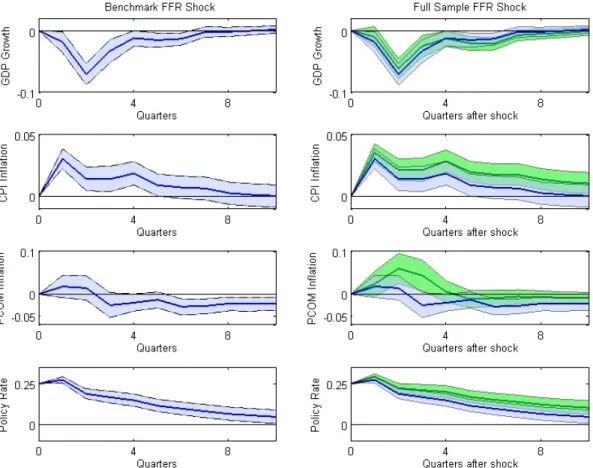
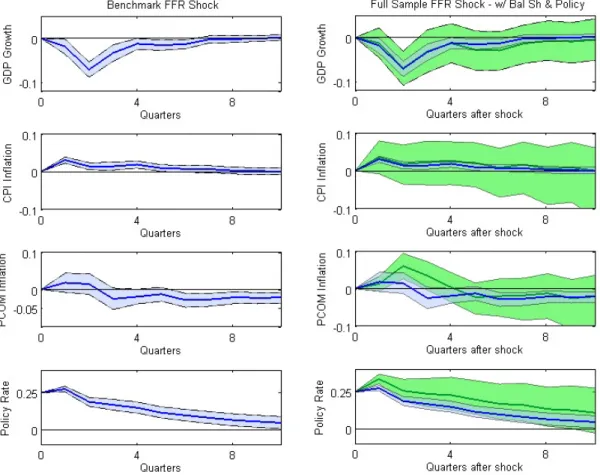
6The …rst column of Figure B.1 shows the impulse responses for the VAR(4) outlined above
using the e¤ective nominal FFR as the policy instrument and data for the period ending in
2007:IV. The responses shown are to a 25 basis point shock to the e¤ective nominal FFR
ordered last in the VAR and identi…ed using the Cholesky decomposition. The responses are
computed for each draw of the sampler, generating the posterior coverage. The plots show
the median response (black line) as well as the 95-percent posterior coverage intervals (blue
shaded regions). The impulse responses are as expected: An increase in the policy rate causes
output to fall and in‡ation to rise in the short run.
We next examine one of the challenges faced by academics posed by the ZLB period.
We …rst estimate a linear VAR for the full sample (1960:I-2013:III) to show how the impulse
responses would change if one did not account for the use of alternative monetary instruments.
This VAR is what one would obtain by naïvely extending the sample through the ZLB period
without accounting for the use of alternative monetary instruments.
The second column of Figure B.1 shows the impulse responses for the VAR(4) outlined
above using the e¤ective nominal FFR as the policy instrument through the ZLB period.
The plots show the median responses (dark green line) as well their associated 68-percent
posterior coverage intervals (green shaded region) for the naive full-sample VAR extending
the data through 2013:III. The thick dark blue lines and blue shaded regions give the impulse
response median point estimates and their 68-percent posterior coverage for the benchmark
speci…cation in which the data end in 2007:IV. The responses resemble those of the baseline in
both quantitative and qualitative terms— a contractionary policy shock results in a decrease in
output, a recognizable price puzzle with increasing in‡ation, and increasing commodity prices.
The nominal funds rate does not move during the ZLB period. The ZLB period does not
qualitatively change the resulting impulse responses to a monetary shock but does produce a
slight quantitative bias. However, this exercise does not tell us much about the ZLB period
6
itself since the conventional policy instrument e¤ectively does nothing during this period.
While the estimates are slightly biased, we can still e¤ectively describe what happens in normal
times but we do not know what happens in the ZLB period.
2.2.1
Testing for Parameter Instability
To model the ZLB period, one could impose a break at the time that the e¤ective nominal
funds rate hit the bound.
7We compare the pre- and full-sample VAR by conducting formal
tests to determine the extent to which the model changed during the …nancial crisis. First,
we compare Bayes Factors to determine the likelihood of parameter instability between the
pre-ZLB and the crisis/ZLB period. We construct a dummy variable to indicate data from the
crisis and post-crisis recovery ZLB period and test for varied responses of macro variables to
the policy instrument over the transition to the ZLB environment. In each of the …rst three
VAR equations, we include an interaction between the ZLB dummy variable and all lags of
the policy rate. Therefore, the break model allows for a change in the VAR coe¢ cients on the
policy rate.
8We take twice the log of the Bayes Factor comparing the break model to the no-break
model in order to convert the test statistic into a scale comparable to that of the likelihood
ratio test statistic. Let
(
Y
j
M
i)
be the marginal likelihood of the data, given model
M
iand
de…ne model
M
0and
M
1as the no-break and break model models, respectively.
9Therefore,
the Bayes Factor is computed as:
B
01=
(
Y
j
M
i)
(
Y
j
M
0)
;
(2.1)
7
We assume that the onset of any potential paramter instability would take place after 2007:IV. Throughout 2008, the U.S. economy experienced substantial negative shocks, forcing the Fed to make drastic cuts in the FFR towards the ZLB. Once dropping the FFR target as low as possible at the end of 2008, the Fed sought unconventional measures to produce additional stimulus. We seek to measure how the overall macroeconomic dynamics may have changed throughout this transition.
8This treatment is equvalent to modelingARX(L)of the VAR in Section 2.2 di¤erently in each period. 9
and we compute
B
01= 2 ln (
B
01)
:
(2.2)
We use the scale suggested in Je¤reys (1961) to interpret the strength of evidence against
model
M
0and in favor of model
M
1, where values of
B
01>
6
are considered strong evidence in
favor of the break model. Negative values of
B
01indicate that the no-break model is preferred.
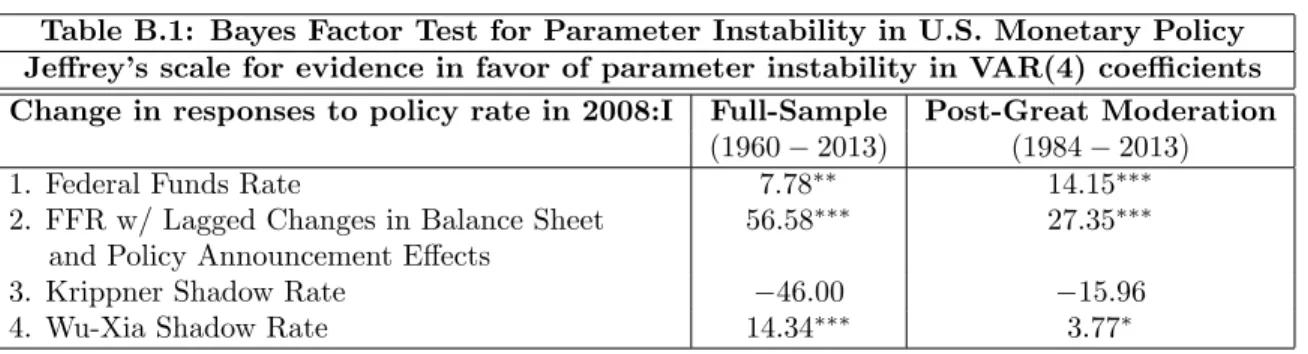
The …rst line of Table B.1 shows
B
01for the model comparison using the e¤ective FFR as the
monetary instrument for the entire post-war sample (1960:I-2013:III) and for the post-Great
Moderation sample (1984:I-2013:III). We …nd strong evidence against the model with constant
parameters using each of the two sub-samples, respectively. The results favor the model with
parameter instability over the baseline model, thus suggesting some added explanatory value
by allowing the parameters to change when the economy encounters the ZLB.
2.3
Monetary Policy at the ZLB
Ideally, we want to be able to account for the e¤ects of the Fed’s unconventional policy action
during the times in which the FFR does not ‡uctuate. Using the FFR alone to represent policy
would suggest that the Fed was inactive during the depths of the …nancial crisis and did little
to stimulate the recovery. Therefore, we need a way to incorporate the policy accommodation
associated with the balance sheet liquidity programs and the use of forward guidance. In the
next section, we augment the VAR with announcement e¤ects and the Fed’s balance sheet to
determine whether accounting for alternative policy instruments are su¢ cient to preserve the
dynamic responses suggested by the benchmark VAR model. Finally, we estimate a shadow
rate and use this as a proxy for the policy instrument during the ZLB period.
2.3.1
Adding Alternative Monetary Instruments
As we mentioned above, during the ZLB period, the Federal Reserve began to utilize alternative
policy measures. These measures were intended to provide temporary injections of liquidity and
often targeted yields for longer maturity assets. These policies also represented a substantial
policies is include them directly in the VAR by using dummy variables.
Augmenting the standard VAR model to account for the use of these instruments is not
straightforward. The policies are often thought to have both implementation e¤ects and
an-nouncement e¤ects— that is, the stance of policy could be thought to change both at the times
the programs were announced and at the times the balance sheet actually changed.
10One way
to add these instruments into the model is to include event dummies for announcements and
to include changes in the size of the Fed’s balance sheet. Let
B
trepresent the di¤erence in the
size of the Fed’s balance sheet from
t
1
to
t
and let
P
tbe a dummy variable that indicates
the announcement of a future Fed action. Then, the VAR becomes
2
6
4
X
tR
t3
7
5
=
2
6
4
A
X
(
L
)
A
RX(
L
)
A
XR(
L
)
A
R(
L
)
3
7
5
2
6
4
X
t 1R
t 13
7
5
+
2
6
4
A
BX
(
L
)
A
P X(
L
)
0
0
3
7
5
2
6
4
B
t 1P
t 13
7
5
+
2
6
4
"
X t"
Rt3
7
5
;
where the zero restrictions impose orthogonality between the unconventional policies and the
e¤ective funds rate.
We can then determine whether accounting for alternative policy instruments is su¢ cient to
preserve the structure of the VAR into the ZLB period: Does including
A
BX(
L
)
and
A
P X(
L
)
make the VAR consistent across the ZLB period? The second line of Table B.1 shows the
results of the Bayes Factor comparing VAR’s with exogenous controls for
B
tand
P
tin the
equations for
X
t, with and without parameter instability at the ZLB. The evidence against
the model with constant parameters is even stronger than when using only the FFR, as in the
previous section. The additional
B
tand
P
tterms come into play primarily around the early
stages of the …nancial crisis and over the period witnessing drastic cuts in the FFR towards
the ZLB. Incorporating these additional dynamics emphasizes the variation underlying the
structural form of the model and ampli…es the importance of allowing for parameter instability.
This very strong evidence favoring changing coe¢ cients over constant coe¢ cients suggests
that accounting for the unconventional policy via event dummies is not su¢ cient to maintain
linearity.
Figure B.1 compares the impulse responses to a shock to the FFR in the benchmark to the
VAR that includes
B
tand
P
t. As in the previous analysis, the right-hand column shows the
median point estimate and 68-percent posterior coverage intervals for the impulse responses
estimated using the full-sample VAR, with
B
tand
P
t. The dark blue lines and blue shaded
regions replicate the benchmark results. The median point estimates of the full-sample seem
to deviate only slightly from the benchmark, with a more signi…cant change for the response
of commodity prices, but the posterior coverage is considerably wider. Introducing additional
structure into the model and requiring estimation of the coe¢ cients on
B
tand
P
tdegrade the
precision with which the rest of the model parameters are estimated.
Similar to the results above, accounting for the FFR, the balance sheet, and signi…cant
policy events produces a su¢ cient representative of policy for the full post-war period, including
a majority of non-ZLB data. However, augmenting the model in this way may be an ine¢ cient
approach for future empirical work once the policy environment returns to a normal,
non-ZLB environment and these unconventional policies are no longer in use. The Fed has a
variety of alternative policy programs in its arsenal but does not need to use them when it can
adjust the FFR e¤ectively. Including
B
tand
P
tintroduces more parameters to estimate and
more structure in the model, especially if imposing identifying restrictions in terms of their
relationships with the other variables in the model. In response to this, we pose the question:
can we …nd a proxy measurement of
R
tthat captures the stance of policy across all periods?
We attempt to answer this question in the remainder of the paper.
2.3.2
Shadow Short Rates
One of the Fed’s stated objectives in conducting unconventional monetary policy was to a¤ect
interest rates for longer maturity assets, suggesting that examining the term structure of
interest rates could uncover a potential alternative policy instrument. Because the nominal
short rate is constrained during the ZLB period, Black (1995) proposed a model with a …ctitious
shadow bond with the same maturity as the policy instrument and an unconstrained shadow
shadow short rate,
r
t, and zero:
R
t= max
f
r
t;
0
g
:
(2.3)
When the nominal rate binds at the ZLB, the shadow rate is unconstrained and can fall below
zero. Krippner (2012), Wu & Xia (2014), and Christensen & Rudebusch (2013) estimate
versions of this shadow rate using …nancial market data spanning the full term structure.
Krippner (2012) modi…es the Black (1995) framework of modeling interest rates as options by
calculating the value of a call option to hold cash. This methodology includes two latent factors
with a series of restrictive normalizations in order to apply the option-pricing framework.
Krippner (2012) uses numerical integration to generate closed-form solutions for bond prices
and yields within the shadow term structure. Christensen & Rudebusch (2013) apply the
option-based pricing approach formalized by Krippner (2012) to estimate the …rst three-factor
shadow rate model using data on Japanese government bond yields. Alternatively, Wu & Xia
(2013) construct an analytical approximation of forward rates in discrete time. This allows
for a more straightforward estimation approach than the other shadow rate methodologies.
The authors include three latent factors and apply the normalization technique introduced by
Joslin et al. (2011).
Krippner (2012) and Wu & Xia (2014) argue that the shadow rate can be used to measure
the stance of monetary policy when nominal rates hit the ZLB. The shadow rate, however, is a
purely …nancial construct that does not take into account its e¤ects on macro variables. If we
are to use the shadow rate in empirical models of monetary policy, we need to know whether
standard VAR models can be extended through the ZLB period by replacing the e¤ective FFR
with the exogenously constructed shadow rate or if the ZLB period, in and of itself, requires
an alternative model.
Following the methodology of Krippner (2012), we construct the shadow rate use data on
the full yield curve, out to the 30-year Treasury bond. The dataset spans 1986:IV through
2013:III so, in principle, we can derive a shadow rate for this entire period. However, we will
only need the shadow rate values to proxy for the FFR once hitting the ZLB. The details
method generates a monthly shadow rate. However, in order to use this as the policy
instru-ment in the VAR(4) analysis, we aggregate over the quarter by averaging the estimated values
for the shadow rate over each quarter. The shadow rate developed in Wu & Xia (2014) is
made publicly available on Federal Reserve Bank of Atlanta website. We convert the monthly
frequency to a quarterly frequency in the same way as with our version of Krippner’s shadow
rate.
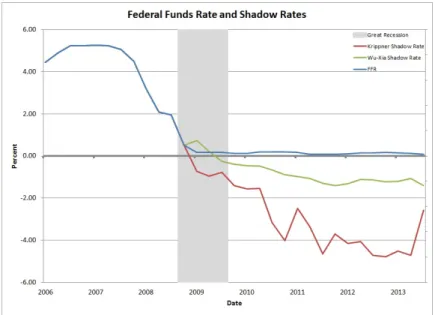
Figure B.3 shows a sub-sample from 2006:I-2013:III of the quarterly policy instruments
used for estimation in the VAR. Prior to 2009:I, all policy instruments use observed values of
the nominal FFR. From 2009:I through the end of the sample, we substitute the two shadow
rate measures for the e¤ective fed funds rate in separate VAR’s. By construction, when the
nominal FFR is su¢ ciently far from zero, it and the shadow rate move consistently together.
The shadow rate should be equal to the nominal short rate when the nominal short rate is
positive and the model preserves this relationship up to a small measurement error. However,
once the FFR e¤ectively reaches the ZLB in 2008:IV, the shadow rate becomes increasingly
more negative as the Fed took action to jump-start the economy.
Therefore, as a third alternative treatment option for the ZLB period, we estimate the
same VAR(4) as above with this new hybrid policy measurement. Lines 3 and 4 of Table 1
show results of the Bayes Factor model comparisons using both the Krippner (2012) and Wu
& Xia (2014) shadow rates as the policy instrument, respectively. Similar to the case with
using the FFR, the linear VAR using the Wu & Xia (2014) shadow rate still favors the model
incorporating parameter instability around 2008:I, after the onset of the …nancial crisis. There
is very strong evidence in favor of the model allowing for a shift in the macro responses over the
entire post-war sample. The evidence is still positive, but much less strong for the post-Great
Moderation subsample. Conversely, when using the Krippner (2012) shadow rate, the results
favor the constant parameter model for both the full post-war or the post-Great Moderation
samples. This shadow rate exhibits much richer dynamics over the crisis and ZLB periods,
taking on greater negative values. It appears that this variation, in contrast to the FFR or
the smoother path of the Wu & Xia (2014) shadow rate, allows the Krippner (2012) shadow
These results elicit the question: is the shadow rate a su¢ cient proxy for the stance of policy
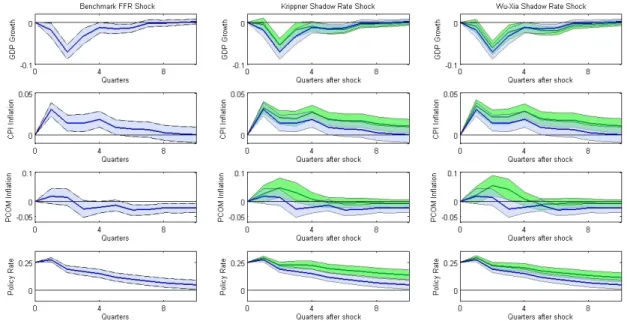
to preserve the linearity in the monetary models? Figure B.4 shows the impulse responses of
the VAR using the shadow rates substituted for the e¤ective funds rate at the ZLB. The
…rst column repeats the benchmark using the FFR from 1960:1-2007:IV from Figure B.1.
The center column estimates the VAR with the Krippner (2012) shadow rate as the policy
instrument from 2009:I-2013:III and the right column estimates the VAR with the Wu &
Xia (2014) shadow rate as the policy instrument. Using either shadow rate to represent policy
generates posterior coverages for the responses of all macro variables similar to the benchmark.
The median benchmark responses fall within the posterior coverage for the full-sample analyses
in all cases except for a small bias on the persistence of the policy shock’s e¤ect on the policy
rate itself. Again, the ZLB period itself is very short compared to the entire sample and the
lack of signi…cant di¤erences in responses may be due to the stronger in‡uence of pre-ZLB data.
Even with the subtle di¤erences noted here, the shadow rates seem to preserve the qualitative
(and much of the quantitative) relationships between our macroeconomic indicators and the
e¤ects of monetary policy actions.
We are interested in whether the shadow rate provides a su¢ cient proxy for monetary policy
in the ZLB environment, in particular to explain the e¤ects of policy throughout the economic
contraction of the recent recession. The objective is to use the shadow rate to represent the
signi…cant policy stimulus associated with unconventional policies when the FFR does not
deviate from the ZLB. The substantial downward movement of the shadow rate occurs in the
early stages of the Great Recession, with increasingly negative shadow rates while the FFR is
near zero.
Wu & Xia (2014) treat this period di¤erently than the subsequent ZLB period once the
economy is no longer in recession but the FFR is still near zero and unconventional policies
are still in use. They argue for using the shadow rate to model policy action only after the
recessionary conditions subside. We would like to construct a comprehensive measure of policy
even during the recessionary period. The large negative shocks that pushed the economy into
recession and drove the FFR towards zero are important for determining the validity of the
We re-estimate the VAR and include only the period after the onset of the ZLB to look
speci…cally at economic conditions when the shadow rate should provide more information
than the FFR alone.
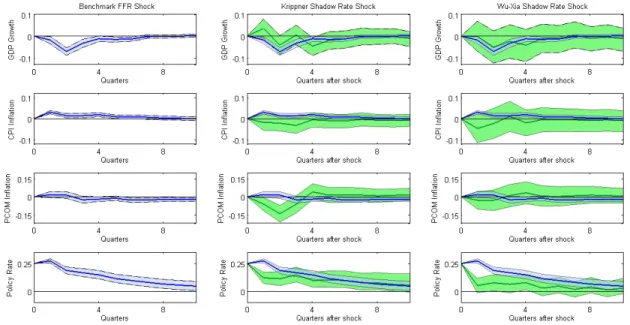
11Figure B.5 shows the impulse responses of the benchmark VAR(4)
and then using the shadow rates over the period from 2008:I through 2013:III, isolating the
period during which we model the ZLB as binding. During this time the nominal FFR hardly
‡uctuated from zero and thus could not e¤ect much change itself on the overall economy. The
shadow rates incorporate other external in‡uences on both current policy as well as market
expectations of future policy and future economic conditions. Thus, the responses of macro
aggregates to shocks to this alternative policy measurement illustrate more comprehensive
policy action during the severe economic contraction.
The impulse responses are estimated with much less precision and the posterior coverage
is considerably wider for the VAR shadow rate estimation using only ZLB data than for the
benchmark. As a result, the median benchmark responses tend to fall within the considerably
wide posterior coverage. The median point estimate of the response of output is comparable
when examining the benchmark and using the Wu-Xia shadow rate over the ZLB period. The
Krippner shadow rate does not induce a contractionary response until after one period but then
moves in a similar fashion to the benchmark. Not surprisingly, the median responses of in‡ation
and commodity prices still ‡uctuate from the benchmark. The response of in‡ation implies a
price puzzle in the benchmark but neither of the shadow rates replicate this type of response
during the ZLB period. Contractionary policy shocks are associated with falling in‡ation
using either shadow rate. As we previously discussed, the shadow rate may incorporate future
expectations as it extracts data from interest rates and investment decisions. Finally, while
the response of the policy rate to its own shocks dissipates more quickly with the shadow rates
than the benchmark, the qualitative nature of the response matches that of the FFR in normal
times.
121 1
Of course, given the data limitations for this period, error bands are expected to be large and results will be only suggestive.
1 2
2.3.3
Model Performance
Finally, we test whether there are appreciable di¤erences in the impulse responses to a shock
to the shadow short rate estimated over the full sample versus the responses to a shock to the
FFR in our benchmark pre-ZLB sample. In order to do this, we construct the Kullback-Leibler
Divergence (KLD) between the posterior distribution of the benchmark VAR parameters and
the posterior distribution of the VAR parameters estimated using the alternative policy
in-struments.
13We can think of the KLD as a type of loss function that measures deviations
between distributions. We take the benchmark, pre-ZLB posterior parameter distributions as
the truth and measure the extent to which the posterior distributions di¤er from this when
using the shadow rate proxies. Ideally, we want to look at the di¤erence in the distributions of
the impulse responses themselves. However, since there is a one-to-one mapping between the
impulse responses functions and the VAR coe¢ cient and covariance matrices, we can use the
output of the Gibbs sampler to analyze the posterior distribution of the parameter estimates
directly.
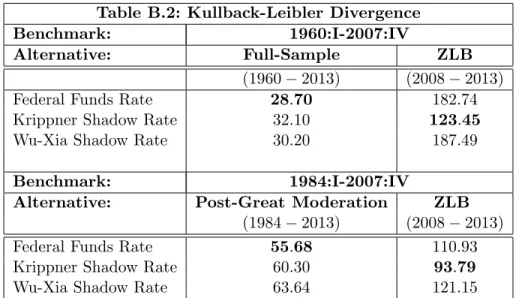
Table B.2 gives the values of the KLD between the post-war, pre-ZLB benchmark
(1960:I-2007:IV) and the full-sample (1960:I-2013:III) when using the FFR and each of the two shadow
rates. When including both the pre-ZLB and ZLB periods within the sample, the model
in which the FFR is used to represent policy the entire time produces the smallest KLD,
thus showing the smallest deviation from the benchmark. This is in agreement with our
previous results using the full-sample with a majority of non-ZLB data. However, when looking
speci…cally at the ZLB period, the posterior distribution of VAR parameters estimated with the
shadow rate of Krippner (2012) has the smallest KLD, thus exhibiting less variation than the
distributions using the FFR or the shadow rate of Wu & Xia (2014). The results are the same if
we adjust the benchmark to only consider data after the end of the Great Moderation, therefore
estimating the VAR using data from 1984:I-2007:IV to establish our basis for comparison.
responses using the FFR and the shadow rates.
Again, the KLD produced from the FFR is smaller than those of the other two models for
both the full, post-Great Moderation (1984:I-2013:III) sample. Furthermore, the KLD using
the Krippner (2012) shadow rate is smallest for the ZLB sub-sample. Removing the in‡uence
of pre-ZLB data in the dataset by excluding the …rst 24 years of data allows for the shadow rate
modi…cations at the ZLB to achieve greater success at merging a comprehensive, continuous
representation of policy between these two periods.
We cannot compute the impulse responses of macroeconomic variables to the FFR during
the ZLB period alone as the policy instrument did not exhibit meaningful variation over this
time. When at the ZLB, the shadow rate of Krippner (2012) more closely recovers some
of the benchmark macro dynamics of the pre-ZLB period and these are further preserved if
we employ a full dataset over the entire post-war period, including the years at the ZLB.
We have also found that controlling for the size of the Fed’s balance sheet and signi…cant
policy announcements regarding alternative policy programs allows for recovering our baseline
dynamics and provides options to researchers seeking to model economies in which the central
bank is constrained by the ZLB. Having these anomalous years of data between extended
episodes of normal economic activity does not seem to prohibit the use of standard VAR
analyses for the e¤ects of monetary policy.
2.3.4
The Bottom Line
The ZLB period poses an interesting dilemma for empirical researchers. At the outset, we
posed a series of questions for the future empirical study of monetary policy, assuming that
the FFR is the policy instrument when normalcy returns. First, how large are the biases in
the estimated IRF’s if one uses the FFR for the full sample? When estimating the linear VAR
model over a long time span, inclusive of a period at the ZLB, we …nd that it is su¢ cient to
simply use the FFR as the policy instrument. While the results will be slightly biased, the
biases appear to be small. Once the economy lifts-o¤ from the ZLB and returns to normal
conditions, this bias should be mitigated and the majority of non-ZLB data should dominate
the results.
biases? Representing the policy instrument with a combination of measurements of the FFR,
changes in the size of the Fed’s balance sheet, and indicator variables for signi…cant policy
events within the VAR over the full post-war period still produces similar, if not larger, biases
to those produced by the model using only the FFR. This exercise requires estimation of
additional parameters associated with policies unique to the ZLB environment and thus may
introduce ine¢ ciencies when using a dataset consisting of predominantly non-ZLB data.
Third, does exchanging either shadow short rate mitigate these biases? We …nd that should
one wish to substitute a shadow rate proxy for the policy instrument during the ZLB period,
hoping to maintain consistent model dynamics throughout the time series, one must recognize
that the shadow rate methodology does not achieve a consistent model in all circumstances.
The choice over which shadow rate to incorporate will dictate whether or not accounting for
structural change is required.
Finally, which shadow short rate does a better job at mitigating these biases? Interestingly,
should one attempt to examine particular ZLB periods in isolation, neither the FFR nor the
shadow rate serve as an adequate representation of policy and do not produce the expected
relationship between e¤ective monetary policy and macroeconomic ‡uctuations. Therefore,
modeling this unique period requires further adjustments and a linear model may not su¢ ce.
2.4
Conclusions
Researchers attempting to measure the e¤ects of monetary policy during the …nancial crisis
and subsequent recession beginning in 2008 have encountered di¢ culties when trying to use
the FFR which essentially ‡atlines at zero for much of the period under consideration. We
have proposed using the shadow rate as a measurement of policy which is able to ‡uctuate to
negative values when the e¤ective central bank policy rate faces a binding constraint at zero.
Our results suggest that the shadow rate acts as a good proxy for monetary policy throughout
the ZLB environment only if using a dataset that spans the pre-ZLB period throughout the
ZLB environment. However, the shadow rate is and insu¢ cient proxy for a comprehensive
measurement of monetary policy when examining the ZLB period in isolation.
the monetary authority has indeed been successful at implementing expansionary policy albeit
through alternative mechanisms. An important point to note is that the economy has witnessed
a break in the instrument used to enact policy but not a break in the e¤ects of monetary
policy on the macroeconomy. Economic researchers use the FFR as a measurement of the
policy instrument for the post-WWII era even though the Fed targeted non-borrowed reserves
from 1979-1982 and borrowed reserves from late 1982 through the mid-1980’s. It did not stop
targeting M1 until 1987 and M2 until 1993 and began announcing formal targets for the FFR
only in 1994. Similarly to that change in the behavior of central bankers, the ZLB period
beginning in December 2008 has rendered the traditional policy tool impotent for stimulating
economic activity. The Fed has successfully utilized balance sheet items as instruments and
introduced a much more expansive period of alternative policy measures than the time spent
targeting non-borrowed/borrowed reserves. In order to accurately represent monetary policy
CHAPTER 3 MONETARY POLICY AND MACRO FACTORS AT THE ZLB
3.1
Introduction
The impaired functioning of …nancial markets, leading to the …nancial crisis and recession of
2008 and 2009, triggered substantial policy action in major economies around the world. For
the …rst time since the Great Depression, U.S. interest rates faced the binding constraint of
the zero lower bound (ZLB), sti‡ing the e¢ cacy of e¤orts of the Federal Reserve to stimulate
economic activity using its standard policy instrument. This forced the adoption of alternative
monetary policy instruments to combat the recession. The Fed broadened its lender-of-last
resort policies, implemented multiple rounds of quantitative easing and used carefully selected
language as forward guidance in its FOMC statements to steer market expectations.
The FOMC policy rate has been pegged e¤ectively at zero since December 2008.
Short-term nominal interest rates have traditionally been considered an indicator of the stance of
monetary policy - looser policy coincides with lower interest rates. However, when interest rates
face a binding constraint at zero, the true policy stance becomes obscured. Tallman & Zaman
(2012) highlight that most Taylor-type rules for monetary policy would have recommended a
negative policy rate starting in 2009 through 2012. This suggests that since the nominal FFR
could not fall below zero, policymakers faced substantial constraints regarding the deviation of
the desired path of the policy rate from that which was feasible. Bernanke & Reinhart (2004)
discuss various strategies for stimulating an economy facing the ZLB. In order to mitigate
this restriction, the Fed began targeting lower long-term interest rates through purchases of
longer-term securities with quantitative easing (QE1 and QE2) and the Maturities Extension
Program (Operation Twist).
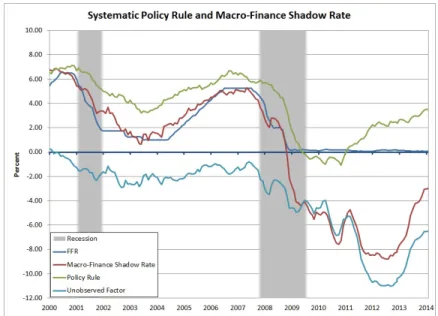
1Such unconventional policy measures can ease the perceived
1