The Early Grade
Reading Assessment:
Applications and Interventions to
Improve Basic Literacy
Edited by Amber Gove and Anna Wetterberg
THE EARLY GRADE READING
ASSESSMENT:
Applications and Interventions
to Improve Basic Literacy
Edited by Amber Gove and Anna Wetterberg
is a registered trademark and a trade name of Research Triangle Institute. The RTI logo is a registered trademark of Research Triangle Institute.
This work is distributed under the terms of a Creative Commons Attribution-NonCommercial-NoDerivatives 4.0 license (CC BY-NC-ND), a copy of which is available at https://creativecommons.org/licenses/ by-nc-nd/4.0/legalcode.
Library of Congress Control Number: 2001012345 ISBN 978-1-934831-08-3
RTI Press publication No. BK-0007-1109
https://doi.org/10.3768/rtipress.2011.bk.0007.1109 www.rti.org/rtipress.
Cover photos
Top: Swadchet Sankey administers an early grade reading assessment in Hausa to a student in Sokoto State as part of the USAID-supported Nigeria Northern Education Initiative project. Photographer: Alison Pflepsen, RTI International
Middle: Liberian teacher Patience Sieh, trained under the USAID-supported EGRA Plus project, leads a class in an early literacy activity. Photographer: Medina Korda, RTI International
Bottom: Liberian students enjoy early reading materials provided by the USAID-supported EGRA Plus project. Photographer: Medina Korda, RTI International
This publication is part of the RTI Press Book series. RTI International
3040 Cornwallis Road, PO Box 12194, Research Triangle Park, NC 27709-2194 USA [email protected]
www.rti.org
information about RTI research, analytic tools, and technical expertise to a national and international audience. RTI Press publications are peer-reviewed by at least two independent substantive experts and one or more Press editors.
Contents
Foreword: Learning for All v
Ellen Johnson Sirleaf, Nobel laureate and President of the Republic of Liberia
Acknowledgments vii
Chapter 1. The Early Grade Reading Assessment: An Introduction 1 Amber Gove and Anna Wetterberg
Chapter 2. Using EGRA as a National Reading Diagnostic:
Nicaragua and Senegal 39
Jessica Mejía and Sarah Pouezevara
Chapter 3. Gauging Program Effectiveness with EGRA: Impact
Evaluations in South Africa and Mali 83
Wendi Ralaingita and Anna Wetterberg
Chapter 4. Teachers’ Use of EGRA for Continuous Assessment:
The Case of EGRA Plus: Liberia 113
Marcia Davidson, Medina Korda, and Ollie White Collins
Chapter 5. Mother Tongue and Reading: Using Early Grade Reading Assessments to Investigate
Language-of-Instruction Policy in East Africa 139
Benjamin Piper and Emily Miksic
Chapter 6. Using Information and Communication Technologies
to Support EGRA 183
Sarah Pouezevara and Carmen Strigel
Chapter 7. Motivating Early Grade Instruction and Learning:
Institutional Issues 227
Luis Crouch
Appendix A. Early Grade Learning Community of Practice
Members 251
Appendix B. EGRA Subtask Examples 253
Glossary 275
About the Authors 277
v
Foreword:
Learning for All
After 14 years of conflict, Liberia’s children now fill our schools. Seeing them on their way to class each morning is one of my greatest pleasures, and a reassuring sign that Liberia has regained stability. But we need more than schools filled with children and teachers; our country’s hopes for sustained peace and economic development depend, instead, on learning and on an educated citizenry.
When I became President in 2006, one of my biggest challenges was to respond to the expectations of a people long denied the opportunity to learn. During the years of our civil conflict, schools were destroyed, and teachers either fled or were killed. Our Administration responded by building schools, recruiting certificated teachers, and making public primary education free and compulsory. Students responded in the hundreds
of thousands, filling our classrooms. The recent signing into law of the Education Reform Act of 2011 extends free education through grade 9, and is aimed at keeping more children in school, especially girls.
Despite our efforts, a recent assessment of early reading shows that many teachers are ill-equipped to teach reading—the foundation of learning. Sobering statistics from 2008 reveal that 34 percent of Liberian students who were tested at the end of grade 2 could not read a single word. As shocking as these data are, they are not unique to Liberia. Similar assessments of early reading throughout sub-Saharan Africa have shown that many children spend two, four, and even six years in school without learning to read.
This book highlights the experience of Liberia in both assessing and improving reading in primary schools. As a result of an Early Grade Reading Assessment, the Ministry of Education and partners, including the United States Agency for International Development, came together to identify and develop strategies for improving reading in our schools. Over the course of a year, the partnership provided support and training to teachers, reading books for students, and collaborated with parents to instill a culture of reading in the community. These efforts paid off; the share of students in program-supported schools that are reading with understanding more than tripled, while the results in a comparison group remained nearly flat.
Critical to this process was the use of data to inform decision making. Without information about which areas need improvement, we cannot decide which course of action to take. Assessments such as those described in this book are especially important as they identify which skills need reinforcement—information that can directly inform teaching and learning. With training and support, teachers can then use this information to improve their practice in schools and monitor student progress toward achieving goals and standards. Information can also help parents and communities to pressure for and support improvement in schools.
Teachers and communities cannot fight these battles alone. National-level leadership and support are needed if countries are to ensure learning for all. As a demonstration of my commitment to education, in addition to the Education Reform Act, our investment in education now accounts for nearly 12 percent, the second largest item of our national budget. Resources alone will not guarantee that all children will learn. However, continuous assessment of progress helps to adjust the course we take on the path to “Learning for All.”
The future of Liberia, and of our continent, depends on ensuring that all children learn. If we are to thrive as a nation, we cannot ignore this challenge.
Ellen Johnson Sirleaf
vii
Acknowledgments
First and foremost, this book is rooted in the daily efforts of teachers in schools around the world to introduce their students to the fundamentals of reading. It is on these educators that we rely for the early literacy skills that lay the groundwork for successful later learning. We are likewise indebted to the many young learners who participated in the assessments and for whom learning to read well at an early age can mean a concrete difference in available opportunities later in life.
We also owe much to partners in governments, donor agencies, civil society organizations, and schools who were instrumental to the assessments described here. We are grateful to USAID for providing the funding for EGRA since its inception and to the staff of Ministries of Education, USAID Missions, and World Bank offices in Kenya, Liberia, Mali, Nicaragua, Peru, Senegal, South Africa, and Uganda for their support in the field. Other collaborators include, among many others, Penelope Bender, Vanessa Castro Cardenal, Paula Gains, Ward Heneveld, Liberian Education Trust (LET), the Liberian EGRA Plus staff, coaches and teachers, Sylvia Linan-Thompson, Lynn Murphy, Saeeda Prew, Carol da Silva, and the William & Flora Hewlett Foundation. RTI International has also contributed a substantial amount of its own research and development funding to advance and improve the technical rigor of the early grade reading assessments; we are grateful to RTI leadership for believing in the effort and its willingness to support our open-source approach to collaboration in the name of improving reading for all.
Like all edited volumes, the writing of the book has been a collaborative effort. We are grateful to Melinda Taylor for her ongoing support of the project and detailed review of each chapter. Kathleen Lohr took her role as RTI Press Editor seriously, turning her critical eye on all aspects of the book, which significantly improved it. Karen Lauterbach, Joanne Studders, Sonja Douglas, and Alisa Clifford were critical to producing the book, and went out of their way to help us meet our deadline.
Erin Newton edited multiple drafts of each chapter before submission and after revisions in response to reviewers’ comments. She improved not only the style and flow of the writing, but also drew on her extensive experience with EGRA publications to align facts and contribute substantively. Without Erin, the volume would not have been completed.
The Early Grade Reading Assessment:
An Introduction
Amber Gove and Anna Wetterberg
During the 1990s, many low-income countries committed to the United Nations Education for All goals of ensuring universal access to primary education and students’ completion of all primary grades. Since that time, with support from donors, some countries have made impressive strides toward expanded access to schooling. Much of the progress has stemmed from additional inputs—such as classrooms, teachers, and textbooks. The assumption was that, with enough inputs, learning would naturally follow.
Improvements in enrollment rates, however, have not always translated into high-quality education—or even basic learning. To illustrate, the United Nations Educational, Scientific, and Cultural Organization (UNESCO) tracks both enrollment and quality in its Education for All Development Index. These data show that Nicaragua, for instance, has a 97 percent enrollment rate but scores below 50 percent on the quality indicator. Similarly, Cambodia’s enrollment rate is 89 percent, but quality lags considerably at 62 percent (UNESCO, 2010).
Teaching young children to read is the cornerstone of improving
is 0.3 percentage points higher than it would otherwise be for that country (Hanushek & Woessman, 2009).
Assessment data of early grade literacy in low-income countries, although still limited, reveal that many students are not mastering the basic skills of reading. In some countries a majority of students at the end of grade 2 are unable to read a single word of a simple paragraph in the language in which they are being taught (Gove & Cvelich, 2011).
To shift the focus of education improvement from access to achievement, it is critical to determine how serious and widespread low learning levels are among a country’s students. As a first step, measuring how well students read can make policy makers, educators, and donors more aware of how low reading levels are and what the implications are for future learning. Such awareness can lay the foundation for discussions of how to best address the problem.
The early grade reading assessment (EGRA)1 is one tool used to measure students’ progress toward learning to read. It is a test that is administered orally, one student at a time. In about 15 minutes, it examines a student’s ability to perform fundamental prereading and reading skills. Since 2006, RTI International, with the support of a range of donors, has worked with education experts (see Appendix A) to develop, pilot, and implement EGRA in more than 50 countries and 70 languages. Although these assessments have shown very low levels of basic literacy skills in many countries, the results have prompted policy makers and educators to search for solutions to address the shortcomings, including developing teaching and learning strategies and materials. Many of these efforts have resulted in impressive advances in reading levels (see Chapters 3 and 4).
Because interest in EGRA has grown quickly in a short period, this book aims to take stock of the substantial amount of information and experience generated. Its purpose is twofold. First, it seeks to elucidate particular aspects of the EGRA approach, to describe and explain how teachers, communities, development practitioners, and policy makers have applied and adjusted different elements and approaches to conducting early reading assessments. Drawing from these descriptions, the authors point to challenges and
advantages of these adaptations. Second, this book also analyzes why the EGRA
approach has been effective (or not) in specific contexts. Most of the chapters in this book discuss implementation in multiple countries to point to the underlying characteristics and factors that influence outcomes.
This book is addressed to multiple audiences. We hope that practitioners working on improving reading skills in low-income countries will use it both to learn how EGRA has been applied in other contexts and to generate ideas for using reading assessments to address urgent problems in their own countries. Such readers are likely to find Chapter 2, on the national reading diagnostic, instructive and they may also learn from the experience with continuous assessment in the classroom (Chapter 4). The developments in information and communication technology that can enhance EGRA applications could also be useful to practitioners who will carry out and analyze assessments (Chapter 6).
Policy makers at both national and local levels may also value the insights gathered in this volume for identifying investment priorities as well as curriculum and professional development needs in their countries. Previous experiences with impact evaluation may be useful to these readers for thinking about how to identify and monitor the impact of particular interventions designed to improve fundamental reading skills (Chapter 3). Further, the chapter discussing language-of-instruction issues analyzes the effects on educational outcomes when learners are not taught or tested in their first language, which could have implications for curricula in many countries (Chapter 5).
International donors—including those that have supported the development and implementation of many of the assessments described in this book—may also find new knowledge in the chapters. The contrasts between country cases demonstrate the conditions under which different applications of EGRA can be most effective. In particular, the chapter on transforming early grade reading and instruction describes the contexts in which reading assessments are particularly likely to shift educational approaches toward focusing on outcomes (Chapter 7).
regional variations and inform national policy and curriculum development. Such national or system-level diagnostics can deepen policy dialogue and identify particular instructional needs. EGRA has also been used to evaluate the impact of specific reading interventions, such as in South Africa and Mali (Chapter 3). Such evaluations can identify specific instructional approaches that, if more widely adopted, could dramatically improve learning outcomes. Then, to explain how assessment results can be used in the classroom, Chapter 4 outlines teachers’ experiences in Liberia. In this application, EGRA has been used for mastery checks, which allow teachers to verify that students are learning to read, and for progress monitoring, to keep parents and the community aware of outcomes.
The second section of the book puts EGRA in the context of broader issues and developments in literacy and education. In many countries, the language of instruction is not the same as that spoken in students’ homes. This situation presents particular hurdles for improving reading; EGRA has highlighted some of these issues in Kenya and Uganda (Chapter 5). Also, information and communication technologies are playing an increased role in literacy development and assessment. Chapter 6 points to the benefits, as well as limitations, of some of these technologies, with implications for the use of EGRA and other reading assessments. This chapter also describes potential approaches to data analysis and software use in administering and analyzing the results of EGRA. Finally, Chapter 7 describes the political, social, and economic factors that affect both applications of EGRA instruments and policy makers’ willingness to make effective use of assessment findings. Experiences in Kenya, South Africa, and Liberia demonstrate how a match with the existing curriculum, sense of crisis, and predisposition to data use can facilitate early adoption of assessment methodology and results.
In isolation, these Figure 1.1 Gross primary school
considerable gains in enrollment enrollment in high-income
appeared to signal sizable and low-income countries, 2000–2008
educational improvements in
100
low-income countries. However, the share of children in low-income countries who complete
Per cen t enr ollmen t 90 80 70
primary school was still only about two-thirds that of
high-income countries as of the late 60
2000s. Furthermore, progress has 50
been slow; at this pace, it would
take another three decades to 2000 2001 2002 2003 2004 2005 2006 2007 2008 reach completion rates similar to
those in high-income countries (Figure 1.2).
Underlying these low completion rates is a
combination of factors, including economic hardship and low school quality. Attrition begins
High income Low income
Source: The World Bank, EdStats Query, 2010.
Figure 1.2 Primary school completion in high-income and low-income countries, 2000–2008
100
early: In sub-Saharan Africa and in South and West Asia, 9 and 13 percent of students, respectively, will become dropouts before the end of their
first year of school (UNESCO, Per
cen t c ompletion 90 80 70 60
2010). In household surveys 50
conducted around the world, financial difficulties top the
2000 2001 2002 2003 2004 2005 2006 2007 2008
High-income Low-income
reasons listed for children dropping out before completing
Source: The World Bank, EdStats Query, 2010.
primary school.
costs of lost labor, sibling care, and household work, direct outlays even the poorest parents must absorb include those for school uniforms, materials, books, and in some cases transport. In exchange for their efforts parents expect the most basic of returns—a child who can read and write.
The available evidence indicates that average student learning in most low-income countries is quite low. Evaluation of World Bank education lending shows that improvements in student learning are lagging significantly behind improvements in access to schooling (World Bank: Independent Evaluation Group, 2006). The leading international assessments on literacy and numeracy (Progress in International Reading Literacy Study [PIRLS] and Trends in International Mathematics and Science Study [TIMSS]) show that the average student in low-income countries is at the bottom of the learning curve in high-income countries, only performing at the 5th percentile, worse than 95 percent of the students in Organisation for Economic Co-operation and Development (OECD) classrooms (Crouch & Gove, 2011).
From these results, we can tell what students from low-income countries did not know, but we cannot ascertain what they did know (often because they scored so poorly they were below the “floor” of the test). Furthermore, most national and international assessments are paper-and-pencil tests administered to students in grades 4 and above; thus, they assume students can read and write. Evaluators cannot always tell from the results of these tests whether students score poorly because they lack the knowledge tested by the assessments or because they lack basic reading and comprehension skills.
In the context of these questions about student learning and continued investment in Education for All, education officials and development professionals at the World Bank, the United States Agency for International Development (USAID), and other institutions called for the creation of simple, effective, and low-cost measures of student learning outcomes (Abadzi, 2006; Center for Global Development, 2006; Chabbott, 2006; Wagner, 2003, 2011; World Bank: Independent Evaluation Group, 2006). Some analysts advocated for the establishment of a global learning standard or goal, in addition to the existing Education for All and Millennium Development Goals (Filmer et al., 2006).
and paragraphs. Development of EGRA began in October 2006, when USAID, through its Education Data for Decision Making (EdData II) project, contracted with RTI International to develop an instrument for assessing early grade reading. The objective was to help USAID partner countries begin the process of measuring, in a systematic way, how well children in the early grades of primary school are acquiring reading skills; ultimately the aim was to spur more effective efforts to improve performance in this core learning skill.
Based on a review of research and existing reading tools and assessments, RTI developed a protocol for what eventually became known as EGRA. Our process included an exhaustive review of the literature and existing assessment approaches in English and other languages, including such well-known tools as DIBELS (Dynamic Indicators of Basic Early Literacy Skills), CTOPP (Comprehensive Test of Phonological Processing), the Woodcock-Johnson Tests of Achievement, and the Peabody Picture Vocabulary Test. We also examined tools developed by nongovernmental organizations (NGOs), university researchers, and research institutions for various research and development projects. Drawing lessons from these tools and the available research evidence, RTI developed a flexible protocol that could be adapted to the particular linguistic requirements of each language but would maintain similar characteristics to facilitate reporting across countries and languages.
To obtain feedback on this protocol and to confirm the validity of the overall approach, RTI (with USAID and the World Bank) convened a meeting in November 2006 of cognitive scientists, experts in early grade reading instruction, research methodologists, and assessment experts to review the proposed key subtasks of the instrument. During this workshop, participants were charged with bridging the gap between research and practice—that is, merging advances in the reading and cognitive science research fields with assessment practices from around the world. Researchers and practitioners presented evidence on alternative ways to measure reading acquisition within the early primary grades. In addition, they were asked to identify the key issues to consider in designing a multicountry, multilanguage, early grade reading assessment protocol. Participants included more than a dozen experts from a diverse group of countries and some 15 observers from governments, donors, NGOs, and universities, such as the William and Flora Hewlett Foundation, George Washington University, the South Africa Ministry of Education, and Pratham, among others.
(English), while USAID supported the application in Nicaragua (Spanish). In addition, national governments, USAID missions, and NGOs in South Africa, Kenya, Haiti, Afghanistan, Bangladesh, and other countries began to experiment with applying certain subtasks of the assessment (with and without the involvement of RTI).
In the interest of consolidating these experiences and developing a reasonably standardized approach to assessing children’s early reading acquisition, the World Bank requested that RTI develop a “toolkit” that would guide countries beginning to work with EGRA in such areas as local adaptation of the instrument, fieldwork, and analysis of results. Toolkits are available in English, Spanish, and French (RTI International, 2009a, 2009b, 2009c) at the EdData II project website, www.eddataglobal.org. A Portuguese version will be completed by 2012. Because many of the stated objectives of this chapter overlap with the guidance provided in the toolkits, we struggled to strike a balance between referring readers to an external document and repeating what had been stated elsewhere. We hope that readers will refer to the toolkits whenever they seek additional, more detailed descriptions.
As noted earlier, as of January 2011, EGRA had been applied in nearly 50 countries and 70 languages. (RTI and USAID maintain a list of EGRA applications, including the intended purpose, sample size, and other key information, at www.eddataglobal.org.) The rapid expansion and deployment of the tool was made possible by a vibrant community of practice working together, with varying degrees of affiliation, toward the common goal of improved learning in the early grades in low-income countries (see Appendix A for members of the Early Grade Learning Community of Practice). This community of practice, consisting of staff from ministries of education, local and international NGOs, foundations, and donor agencies, has been instrumental in advancing the cause of early reading assessment and improvement; much of the work described in this book has benefited from the shared lessons of this dedicated group of practitioners.
Underlying Conceptual Framework of the Early
Grade Reading Assessment
1998], among others), two main principles underpin EGRA. First, learners acquire early reading skills in (sometimes simultaneous) phases; the level of complexity of a language affects how long students need to acquire these skills. Second, reading assessment (and its complement, instruction) is complex, but sufficient research evidence supports the development of specific assessment tools to understand which critical skills require additional reinforcement, regardless of the method by which students are being taught. Each of these principles is explained in detail below.
reading Is acquired in phases
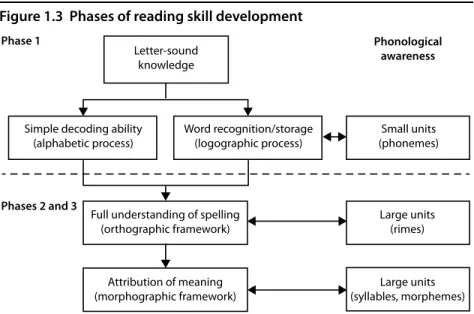
Acquiring reading skills is a multiphased process. Reading acquisition takes longer in some languages than others, with the length of time determined by the level of correspondence between the written language, or orthography (represented by graphemes [letters and symbols]), and the spoken language (represented by phonemes [sounds]). In spite of differences in the amount of time it takes to acquire reading skills, EGRA is based on the premise that learners of all alphabet-based languages pass through the same phases. EGRA concentrates on the assessment of foundational skills, as shown in Figure 1.3.
According to Seymour et al. (2003), for alphabetic languages, learners acquire reading in three phases (Figure 1.3).2 In the first phase, basic skills such as letter-sound knowledge (the ability to map each letter to its corresponding sound or sounds), word recognition (logographic process), and simple decoding of letters into sounds (alphabetic process) are established. The learner is acquiring a knowledge of the smallest building blocks of reading, by recognizing letter sounds (grapheme-phoneme correspondence) and their combination into simple words. Crucial to the development of the foundation laid in this first phase is identifying and storing familiar words by creating a bank of automatic or “sight” words—those that children can recognize on sight. Equally important is the establishment of fluent decoding, the ability to decipher new or unfamiliar words through an understanding of letter-sound correspondence.
In the second and third phases, children encounter printed text that reinforces and helps them internalize language complexities—including rules
Although the model is based on research on alphabetic languages (both Latin and non-Latin scripts), some similarities exist in reading acquisition for logographic languages (e.g., Chinese). Nonetheless, debate continues regarding the extent to which learning is parallel between these different forms of language (Chow et al., 2005).
Figure 1.3 Phases of reading skill development
Small units (phonemes) Word recognition/storage
(logographic process) Simple decoding ability
(alphabetic process)
Phase 1
Phases 2 and 3
Letter-sound knowledge
Large units (rimes)
Large units (syllables, morphemes)
Phonological awareness
Full understanding of spelling (orthographic framework)
Attribution of meaning (morphographic framework)
Source: Adapted from Seymour et al., 2003.
and language patterns that they may know from the oral form of the language. Learners build an orthographic framework as they acquire a full understanding of the spelling system and fluency with rimes (larger units of letter-sound correspondence). Subsequently, learners progress to fluency with morphemes (an association of phonemes with semantic meaning), building a framework that involves not only decoding letters into sounds but also, crucially, attributing meaning to written text. Regardless of the order of phasing, the model highlights the need for children to learn a large number of complex skills in order to become successful readers.
of cross-language differences in reading acquisition have confirmed this hypothesis (see Sprenger-Charolles et al., 2006; Zieger & Goswami, 2005). Results from dozens of applications of EGRA lend further support.
Of course, the level of complexity of a given language is but one (albeit critical) influence on the rate of reading acquisition. Use of instructional time, availability of materials, and whether students are being taught in their mother tongue are all important factors that determine how soon children learn to read. The important lesson, however, is that regardless of language, successful readers are likely to pass through each of the phases depicted in Figure 1.3. An additional implication of this principle is that comparison of results across languages that differ in their orthographic complexity is complicated by the differences in the rate at which children typically learn to read in those languages. The difficulty of comparing results across languages is discussed in more detail below.
To draw this discussion back to EGRA, the phased process of reading acquisition implies that, although differences in complexity may affect rates of acquisition, commonalities exist in the building blocks of early reading across languages. EGRA draws on this insight by breaking down each assessment into subtasks corresponding to the building blocks of reading acquisition. Rather than bluntly gauging whether a learner can read or not, EGRA enables a nuanced identification of the prereading and reading skills that a specific child has already acquired and those that the child still must master to become a competent reader in the language in which he or she is being taught to read.
assessing early reading: Common Foundations,
Flexible Design
With the knowledge that reading is acquired in phases and that the rate of acquisition is likely to vary by language and context, how is it possible to design an assessment approach that can capture the range of skills that are foundational to reading acquisition? Our response is codified in the second basic principle underlying EGRA: Learning to read in all alphabetic languages requires acquisition of similar foundation skills, but the importance of each of those skills may vary by language. As a result, EGRA has a reasonably common approach based on core foundation skills, but it is flexible in its design based on the linguistic context.
As an example, English is notorious for its association of multiple sounds with a single letter, described in linguistic terms as high orthographic
language (the number of phonemes varies depending on the source, country, and region, as different dialects have different pronunciations). Vowels in English are particularly complex: the letter “a” has approximately 11 different possible sounds. In comparison, the 27 letters of the Spanish alphabet have approximately 35 phonemes, and Spanish vowels have only one sound each (the letter “a” always sounds like the “a” in “father”).
Regardless of these differences, in both Spanish and English learning to read requires the knowledge that each letter (or group of letters) in a word can be associated with a particular sound. This holds true whether the student is learning to read “cat” or “gato” (cat in Spanish). The implication of this fact for assessment is that whereas students learning English will require more instructional time than their Spanish-speaking peers to internalize these rules, knowledge of letter sounds is nonetheless a critical foundation skill in both languages, as is the case for any alphabetic language. This principle—that the critical foundation skills are important for all alphabetic languages, but that less instructional time may be needed in more regular languages—is true for all of the skills tested in EGRA; it has important implications for the interpretation of the results of each assessment.
Table 1.1. EGRA subtasks and skills
Skill and Skill demonstrated by
approximate timing EGRA subtask students’ ability to:
Emergent literacy: Birth to grade 1
Concepts about print Indicate text direction, concept of word, or other basic knowledge of print
Phonemic awareness: identification of onset/ rime sounds; phoneme segmentation
Identify initial or final sounds of words or segment words into phonemes (words are read aloud to student by assessor)
Oral vocabulary Point to parts of the body or objects in the room to indicate understanding of basic oral vocabulary
Listening comprehension* Respond correctly to questions about a passage read aloud to the student by the assessor
Decoding: Beginning grade 1
Letter identification: names and/or sounds*
Provide the name and/or sound of upper- and lowercase letters presented in random order
Syllable naming Identify legal syllables presented in random order
Nonword reading* Identify nonwords composed of legal syllables presented in random order Familiar word reading Read a list of words drawn from a
corpus of frequent words presented in random order
Confirmation and fluency: End of grade 1 to end of grade 3
Oral reading fluency (paragraph reading) with comprehension*
Read a narrative or informational text with accuracy, with little effort, and at a sufficient rate and respond to literal and inferential questions about the text they have read
Dictation Translate sound to print and spell correctly
Maze or cloze Silently read a passage and select an appropriate missing word (multiple choices are provided in the case of maze)
* Core EGRA subtasks included in nearly all assessments conducted by RTI International. Remaining subtasks vary depending on country and language.
EGRA Subtasks: Content, Purpose, and
Implementation
This section describes each EGRA subtask and its assessment objectives. Examples of subtasks drawn from completed EGRAs are shown in
Appendix B. More information is also available in the EGRA toolkits available on www.eddataglobal.org (RTI International, 2009a, 2009b, 2009c).
Concepts about print
One subtask that EGRA developers initially tested was derived from Marie Clay’s (1993) Concepts About Print assessment. In several countries, use of three of Clay’s items (3 through 5, directional rules concerning where to begin reading, which direction to read, and where to read next) demonstrated ceiling effects (that is, nearly all children successfully completed the task). Print awareness, however, appears to have little ability to predict later reading skills; it mainly serves as a proxy measure for print exposure and literacy environments (Paris & Paris, 2006). In environments where print awareness is very low, this subtask (see Appendix B for an example) is useful for raising awareness and documenting access to printed materials. Students are presented with a short paragraph and are told not to read the text, but to point with a finger in response to three questions that the assessor asks orally, as follows:
1. Where would you begin reading? 2. In which direction would you read?
3. When you get to the end of the line, where would you read next?
phonemic awareness
EGRA has tested phonemic awareness in two ways: phoneme segmentation and identification of onset and rime sounds (first and last sounds, respectively). For evaluating phoneme segmentation, the assessor reads aloud a series of 10 words, asking students to divide each word into its component sounds (“cat,” for example, would be divided into the sounds: /k/ /a/ /t/; see Appendix B for an example). For identifying onset and rime sounds, the assessor either reads aloud a single word, asking the student to identify either the first or last sound, or reads aloud three words, asking the student to identify the word that begins or ends with a different sound. For example: “What is the first sound in ‘map’? and “Which word begins with a different sound: top, touch, stand?” The assessor times the student and records the number of correct sounds identified in 1 minute. Appendix B provides examples of both ways of identifying onset sounds.
Oral Vocabulary
Oral vocabulary tests are most frequently used in contexts in which the language of instruction is not the student’s first language; this approach assesses the child’s receptive oral vocabulary and helps the child to warm up to the assessment with a simple achievable task. Students are asked to carry out a series of 5 to 10 simple commands in the language of instruction, such as “point to your head” or “touch the table” (see Appendix B for an example). Poor performance on an oral vocabulary assessment indicates either that children simply do not have the basic vocabulary or that they have difficulty processing what they hear (or possibly both).
Listening Comprehension
Letter Identification
In this EGRA subtask, assessors present students with a sheet listing between 50 and 100 letters of the alphabet (in some languages, graphemes, or sets of letters and/or symbols representing a single sound, are presented—e.g., in French, “é” is presented separately from “e”). Students are asked to provide the names or the sounds (depending on the language in question) of all the letters that they can in 1 minute (see Appendix B for examples of both types of letter identification subtask). The full set of letters of the alphabet is listed in random order, 10 letters to a row, using a clear, large, and familiar font in horizontal rows with each letter presented multiple times. EGRA developers select letters for the instrument based on the frequency with which the letter occurs in the language in question. Adjustments are made to accommodate each letter at least once. Randomization is used to prevent students from reciting a memorized alphabet—that is, to test for actual automaticity (a level of fluency that no longer requires concentrating on the separate steps) of letter recognition and translation of print to sound.
Syllable Naming
Building on the letter identification exercise, some EGRA test developers have created syllable naming tasks for countries where syllables are the most common way to teach initial reading. In languages with limited legal syllable combinations, assessing nearly all of the more frequent syllable combinations can be done within a standard 50- or 100-item assessment (e.g., in Kiswahili, legal combinations containing the letter “k” would include “ka,” “ke,” “ki,” “ko,” and “ku”). Students are asked to name as many syllables as they can in 1 minute. The syllables are listed in random order, 10 syllables to a row. Syllables are selected for the instrument based on the frequency with which they occur in the language in question and are randomly ordered; legal syllable combinations that are actual words are avoided.
Nonword reading
age 10 has been associated with the “fourth-grade slump” in the United States (Hirsch, 2003). Considerable evidence suggests that memorization of text is a significant problem in many low-income countries as well.
To be successful readers, children must combine both decoding and sight-recognition skills; tests that do not include a decoding exercise can overestimate children’s ability to read unfamiliar words (as the words tested may be part of the sight-recognition vocabulary). This portion of the assessment includes a list of 50 one- and two-syllable nonwords, five per row, with the following patterns of letters (C = consonant, V = vowel): CV, VC, CVC. (This may be adjusted by language.) Forms are legal for the language, using letters in legitimate positions (e.g., not “wuj” in English because “j” is not used as a final letter in English), they stick to combinations that are typical of the language, and they are not homophones of real words (not “kab,” a homophone of “cab”). They are arranged in rows (five nonwords per row), using clear, well-spaced print. Examples in English include “fet,” “ca,” “ut,” and “bleb.” Students are asked to read as many of these nonwords as they can in 1 minute; the assessor times the student and records the number of correct (non)words read per minute (see Appendix B for an example).
Familiar Word reading
Oral reading Fluency (paragraph reading) with
Comprehension
Oral reading fluency is a measure of overall reading competence: the ability to translate letters into sounds, unify sounds into words, process connections, relate text to meaning, and make inferences to fill in missing information (Hasbrouck & Tindal, 2006). As skilled readers translate text into spoken language, they combine these tasks in a seemingly effortless manner
(automaticity); because oral reading fluency captures this complex process, it can be used to characterize overall reading skill.
Tests of oral reading fluency, as measured by timed assessments of correct words per minute, have been shown to have a strong correlation with more complex assessments, for example a correlation of 0.91 with the Reading Comprehension subtest of the Stanford Achievement Test (Fuchs et al., 2001). Poor performance on a reading comprehension tool suggests that the student had trouble with decoding, with reading fluently enough to comprehend, or with vocabulary.
To develop the paragraph, examiners review one-paragraph stories from children’s reading materials, avoiding copying directly from the school textbook. A narrative story has a beginning section that introduces characters, a middle section containing some dilemma, and an ending section with an action resolving the dilemma. It is not a list of loosely connected sentences. Typical character names from the school textbook are avoided as students may give automated responses based on the stories with which they are familiar. Names and places reflect the local culture. Texts contain some complex vocabulary (inflected forms, derivations, etc.) and sentence structures. Large, clear, familiar print and good spacing between lines are used to facilitate student reading. No pictures are included (see Appendix B for an example).
Assessors ask students to read the story, stopping them after 1 minute and recording the number of words read. Subsequently, students are asked comprehension questions that include direct fact-based questions as well as at least one question requiring inference from the text.
Dictation
the alphabetic process. Several assessment packages offered by commercial test development specialists give teachers instructions on how to develop and score their own assessments. The EGRA dictation subtask is inspired by models promoted by the Educational Testing Service (2005) and Children’s Literacy Initiative (2000) and supported by research by the International Reading Association (Denton et al., 2006). The dictation sentence is at most 10 words long and contains at least one difficult or irregular word (see Appendix B for an example).
Maze/Cloze
Teachers commonly use maze and cloze assessments in the classroom to assess comprehension. To develop a maze test, examiners create a 60- to 100-word paragraph. They leave the first and last sentences of the paragraph intact, but delete every fifth word of the sentences in between. Two alternative choices of legal replacement words, together with the correct word, appear in place of each deleted word. For example, if the correct word deleted from the story is “mice,” the options presented could be “cat,” “house,” and “mice.” Students are then asked to identify (usually by circling) the correct replacement word that goes in the blank. They have a limited time frame (usually 3 to 5 minutes, depending on the length of the passage) in which to complete the exercise.
For a cloze assessment, the examiners again leave the first and last sentences of the paragraph intact and delete every fifth word of the remaining sentences, but instead of replacing the deleted words with a choice of three words, they leave blanks in place of the missing words. The blanks are of equal length regardless of the word removed. The students are asked to read the passage orally and provide the word that would fit given the context of the story.
Fit for Purpose: Choosing the Right EGRA
Application
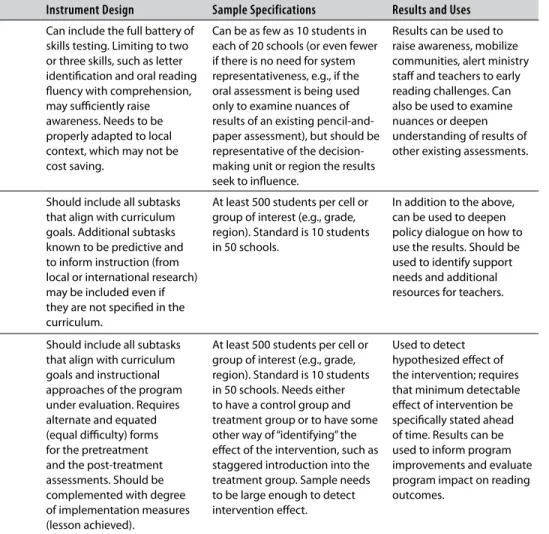
Instrument Design Sample Specifications Results and Uses
Can include the full battery of skills testing. Limiting to two or three skills, such as letter identification and oral reading fluency with comprehension, may sufficiently raise awareness. Needs to be properly adapted to local context, which may not be cost saving.
Can be as few as 10 students in each of 20 schools (or even fewer if there is no need for system representativeness, e.g., if the oral assessment is being used only to examine nuances of results of an existing pencil-and-paper assessment), but should be representative of the decision-making unit or region the results seek to influence.
Results can be used to raise awareness, mobilize communities, alert ministry staff and teachers to early reading challenges. Can also be used to examine nuances or deepen understanding of results of other existing assessments.
Should include all subtasks that align with curriculum goals. Additional subtasks known to be predictive and to inform instruction (from local or international research) may be included even if they are not specified in the curriculum.
At least 500 students per cell or group of interest (e.g., grade, region). Standard is 10 students in 50 schools.
In addition to the above, can be used to deepen policy dialogue on how to use the results. Should be used to identify support needs and additional resources for teachers.
Should include all subtasks that align with curriculum goals and instructional approaches of the program under evaluation. Requires alternate and equated (equal difficulty) forms for the pretreatment and the post-treatment assessments. Should be complemented with degree of implementation measures (lesson achieved).
At least 500 students per cell or group of interest (e.g., grade, region). Standard is 10 students in 50 schools. Needs either to have a control group and treatment group or to have some other way of “identifying” the effect of the intervention, such as staggered introduction into the treatment group. Sample needs to be large enough to detect intervention effect.
Used to detect hypothesized effect of the intervention; requires that minimum detectable effect of intervention be specifically stated ahead of time. Results can be used to inform program improvements and evaluate program impact on reading outcomes.
The EGRA instrument was first developed to be a sample-based “system diagnostic” measure. Its purpose was to document student performance on early grade reading skills to inform ministries and donors regarding system (including national, state, or district) needs for improving instruction (see Chapter 2). This system-level version of EGRA was not intended either for direct use by teachers or for screening of individual students. It was also not intended to be a high-stakes accountability measure for making funding decisions or determining student grade passing.
Table 1.2 Early grade reading assessment approaches
Type of Assessment Purpose Pros and Cons
Reading Quickly examine reading levels to raise Pros: minimum design and cost
Snapshot awareness and spur policy makers, for maximum impact.
(this chapter) donors, and civil society into action. Cons: low statistical significance, cannot make generalizable claims.
National or Thoroughly examine gaps in reading
System-Level competencies among students (and
Diagnostic instructional approaches among
(Chapter 2) teachers) to inform the improvement of teacher professional development and preservice programs.
Pros: statistical significance
(accurate or narrow confidence intervals) ensured by adequate sample size; careful randomization assures representativeness.
Cons: higher technical
requirements and large sample sizes lead to higher costs.
Impact Evaluation
(Chapter 3)
Conduct baseline—or “pretreatment”— assessment to gauge reading levels before intervention takes place. Monitor progress of programs that aim to improve reading instruction and outcomes. Compare to endline—or “post-treatment”—assessment to isolate change that may be attributable to a specific intervention used in treatment locations.
Pros: can detect change
over time resulting from an intervention.
Cons: higher technical
Table 1.2 Early grade reading assessment approaches
Type of Assessment Purpose Pros and Cons
Reading Snapshot
(this chapter)
Quickly examine reading levels to raise awareness and spur policy makers, donors, and civil society into action.
Pros: minimum design and cost
for maximum impact.
Cons: low statistical significance,
cannot make generalizable claims.
National or System-Level Diagnostic
(Chapter 2)
Thoroughly examine gaps in reading competencies among students (and instructional approaches among teachers) to inform the improvement of teacher professional development and preservice programs.
Pros: statistical significance
(accurate or narrow confidence intervals) ensured by adequate sample size; careful randomization assures representativeness.
Cons: higher technical
requirements and large sample sizes lead to higher costs.
Impact Evaluation
(Chapter 3)
Conduct baseline—or “pretreatment”— assessment to gauge reading levels before intervention takes place. Monitor progress of programs that aim to improve reading instruction and outcomes. Compare to endline—or “post-treatment”—assessment to isolate change that may be attributable to a specific intervention used in treatment locations.
Pros: can detect change
over time resulting from an intervention.
Cons: higher technical
requirements and more effort in creating equated or alternative forms; sample size needs to be larger.
Since the first EGRA application at the system level, however, the EGRA subtasks have been used to fulfill a diverse range of assessment needs,
including screening, diagnostic, and progress-monitoring purposes (Table 1.2). The differences among these uses lie in the scope of the sample, frequency and comprehensiveness of use, and target audiences for the results.
Table 1.2 provides a brief overview of the structure and purpose of each of these approaches; system level, impact evaluation, and teacher level approaches are documented in depth in Chapters 2 through 4. In each of these cases, evaluators adapted the instrument (and sampling scheme) to reflect the purpose of the assessment (a critical aspect to consider in constructing and
Instrument Design Sample Specifications Results and Uses
Can include the full battery of skills testing. Limiting to two or three skills, such as letter identification and oral reading fluency with comprehension, may sufficiently raise awareness. Needs to be properly adapted to local context, which may not be cost saving.
Should include all subtasks At least 500 students per cell or In addition to the above, that align with curriculum group of interest (e.g., grade, can be used to deepen goals. Additional subtasks region). Standard is 10 students policy dialogue on how to known to be predictive and in 50 schools. use the results. Should be to inform instruction (from used to identify support local or international research) needs and additional may be included even if resources for teachers. they are not specified in the
curriculum.
Should include all subtasks At least 500 students per cell or Used to detect that align with curriculum group of interest (e.g., grade, hypothesized effect of goals and instructional region). Standard is 10 students the intervention; requires approaches of the program in 50 schools. Needs either that minimum detectable under evaluation. Requires to have a control group and effect of intervention be alternate and equated treatment group or to have some specifically stated ahead (equal difficulty) forms other way of “identifying” the of time. Results can be for the pretreatment effect of the intervention, such as used to inform program and the post-treatment staggered introduction into the improvements and evaluate assessments. Should be treatment group. Sample needs program impact on reading complemented with degree to be large enough to detect outcomes.
of implementation measures intervention effect. (lesson achieved).
Can be as few as 10 students in each of 20 schools (or even fewer if there is no need for system representativeness, e.g., if the oral assessment is being used only to examine nuances of results of an existing pencil-and paper assessment), but should be representative of the decision-making unit or region the results seek to influence.
Results can be used to raise awareness, mobilize communities, alert ministry staff and teachers to early reading challenges. Can also be used to examine nuances or deepen understanding of results of other existing assessments.
Instrument Design Sample Specifications Results and Uses
Informal mastery checks of student progress. Should reflect scope and sequence of instruction of each teacher and how the teacher intends to meet curriculum and standards.
Whole class. Results used to inform instruction at the individual classroom level so teachers can modify their practice. Develop teacher capacity to use regular classroom-based assessment measures to identify student needs and to inform and modify reading instruction.
Should reflect scope and sequence of instruction of each teacher and how each teacher intends to meet curriculum and standards.
Subset of class; can target children experiencing difficulties on general outcome measure.
Results used to inform instruction at the individual classroom level and to communicate to school community about classroom progress.
Table 1.2 Early grade reading assessment approaches (continued)
Type of Assessment Purpose Pros and Cons
Classroom Teachers conduct regular (weekly or
Assessment: monthly) checks to verify that all students
Mastery Checks are learning skills that have been taught.
(Chapter 4)
Classroom Teachers conduct regular progress
Assessment: monitoring assessment (every 2 to 3
Progress months, including at beginning and
Monitoring end of school year) to compare student
(Chapter 4) progress against norms and benchmarks for grade.
Pros: can be used to drive
teaching improvement; low cash cost (although cost in use of teacher time).
Cons: could be misused for
excessive assessment; danger that aggregated results, reported up, could be inappropriately used for national reporting and averaging or for bureaucratic accountability pressure.
Pros: can be used to
communicate to school director and parents on a regular basis about progress against benchmarks.
Cons: could be misused for
excessive assessment; danger that aggregated results, reported up, could be inappropriately used for national reporting and averaging or for bureaucratic accountability pressure. Source: Adapted from Gove & Cvelich, 2011.
using any assessment tool; American Educational Research Association et al., 1999; Hasbrouck & Tindal, 2006; Kame’enui et al., 2006; Kaminski et al., 2006). In many of these applications, relevant EGRA subtasks are complemented by a short series of contextual questions that help analysts break down results by groups of interest, such as socioeconomic status, parents’ education or reading ability, language used in the home, reading materials found in the home, or other factors.
Table 1.2 Early grade reading assessment approaches
Type of Assessment Purpose Pros and Cons
Classroom Assessment: Mastery Checks
(Chapter 4)
Teachers conduct regular (weekly or monthly) checks to verify that all students are learning skills that have been taught.
Pros: can be used to drive
teaching improvement; low cash cost (although cost in use of teacher time).
Cons: could be misused for
excessive assessment; danger that aggregated results, reported up, could be inappropriately used for national reporting and averaging or for bureaucratic accountability pressure. Classroom Assessment: Progress Monitoring (Chapter 4)
Teachers conduct regular progress monitoring assessment (every 2 to 3 months, including at beginning and end of school year) to compare student progress against norms and benchmarks for grade.
Pros: can be used to
communicate to school director and parents on a regular basis about progress against benchmarks.
Cons: could be misused for
excessive assessment; danger that aggregated results, reported up, could be inappropriately used for national reporting and averaging or for bureaucratic accountability pressure. Source: Adapted from Gove & Cvelich, 2011.
Instrument Design Sample Specifications Results and Uses
Informal mastery checks of Whole class. Results used to inform student progress. Should instruction at the individual reflect scope and sequence classroom level so teachers of instruction of each teacher can modify their practice. and how the teacher intends Develop teacher capacity to meet curriculum and to use regular classroom-standards. based assessment measures
to identify student needs and to inform and modify reading instruction.
Should reflect scope and sequence of instruction of each teacher and how each teacher intends to meet curriculum and standards.
Subset of class; can target children experiencing difficulties on general outcome measure.
Results used to inform instruction at the individual classroom level and to communicate to school community about classroom progress.
more words (Abadzi et al., 2005). Although it was a small study that was not nationally representative, the poor reading results generated sufficient awareness to make reading a topic of a debate during presidential elections. A video (Para mejorar la educación hay que comenzar por la lectura [To improve education one must start with reading], available from the EdData II website) further provoked discussions about how to measure and improve reading among students in the early grades.
A reading snapshot often includes only a small number of subtasks, to focus attention and limit the cost of the assessment. In Peru, for example, students were asked only to read a paragraph aloud and answer questions about the passage (oral reading fluency with comprehension subtask).
makers’, researchers’, and the public’s attention to severe but often ignored problems with fundamental reading skills. This application of EGRA can be used to mobilize decision makers and resources to improve early reading instruction. Because of its limited scope, however, the snapshot cannot provide a reliable guide to priority areas for interventions that could be effective in the classroom. For these ends, we must turn to other EGRA approaches.
2. National- or System-Level Diagnostic. EGRA was originally designed to provide a representative picture of reading levels within a country to help identify priority areas for instructional improvement and teacher training. Researchers can use this application of EGRA to establish a national baseline for reading levels against which any future progress may be measured. A national- or system-level diagnostic application requires larger sample sizes and often includes more subtasks than an EGRA snapshot, and it brings accompanying increases in data reliability and nuance but also in cost. Chapter 2 contrasts the implementation of this type of EGRA in Nicaragua and Senegal.
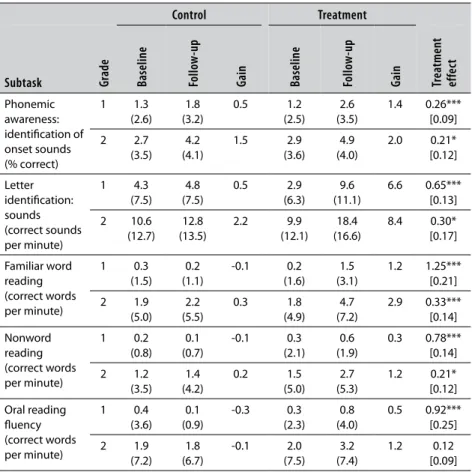
3. Impact Evaluation. Over time, RTI and others have adopted EGRA as a means of gauging the effects of particular instructional interventions on reading skills (see Chapter 3). EGRA can capture more subtle impacts from specific teaching approaches than pencil-and-paper tests, as it incorporates subtasks that measure prereading skills. Compared with other uses of EGRA, impact evaluations require relatively large sample sizes and are often costlier, as they need both pre- and post-intervention assessment.
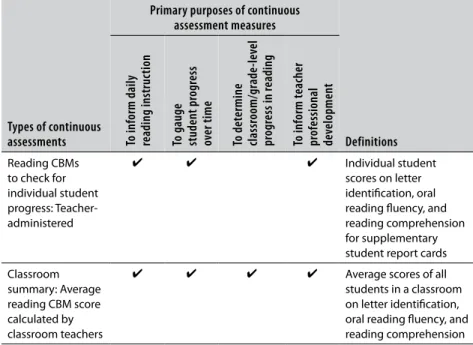
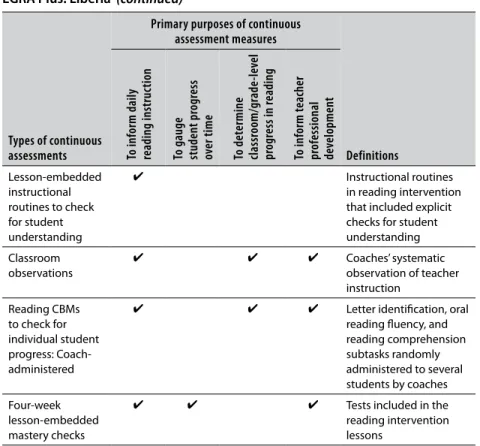
4. Classroom Assessment: Mastery Checks and Progress Monitoring. The most recent use of EGRA is in the classroom; it helps educators, parents, and school administrators track progress and identify needs for additional instruction for specific classes and individual students. In contrast to other EGRA purposes, such as informing policy decisions, classroom uses are intended for teachers and can, in some cases, assess individual student progress. RTI used this approach in Liberia under the EGRA Plus project (Chapter 4).
only the relevant subtasks. Mastery checks can help teachers identify specific areas of student knowledge and skills that require instructional improvement and alert them to areas that need further reinforcement before they proceed to more advanced instruction.
RTI has used EGRA in the classroom to monitor progress against established curricular benchmarks. In contrast to mastery checks, which teachers apply frequently to verify learning of specific skills, progress monitoring measures student achievements as compared with more general expectations for their grade at regular points throughout the school year. Evaluators can then aggregate the results to examine progress at the classroom or school level, or they can identify individual students who need assistance.
Cutting across these applications of EGRA is the use of assessment data for social mobilization at local and national levels. Concrete information on general reading levels, school performance, and individual student progress can spur officials, educators, activists, and parents to agitate for improvements. At the policy level, snapshot or national diagnostic uses of EGRA are
particularly likely to spur change to existing curriculum or teaching practice, to the extent that stakeholders develop a sense of crisis based on the tangible quantitative data that EGRA produces (Chapter 7). At the community level, classroom use of EGRA can provide parents with data both to hold schools accountable and to mobilize additional support for teachers and students. Impact evaluation data can help educators and policy makers identify specific instructional interventions for which to mobilize financial and political support.
Although these groups may have had a vague sense of slow progress and dissatisfaction in the past, reliably demonstrating specific shortfalls and urgent needs for additional interventions can catalyze collective action. Clear data can also help disparate actors coalesce into a movement pushing for concrete changes. As in many other areas of development, however, this type of information is necessary but not always sufficient to instigate change.
effects that language-of-instruction policies can have when official languages do not correspond to those that students speak at home.
Implementation
Using the established EGRA subtask examples, stakeholders can adapt the instrument to suit specific linguistic and instructional contexts and needs. Although the purposes for using EGRA may differ, with implications for data analysis and presentation, the preparations for EGRA implementation share characteristics. Below we briefly describe these common implementation steps (more details may be found in the EGRA toolkits (RTI International, 2009a, 2009b, 2009c).
translation and adaptation
Assessor instructions for EGRA subtasks (that is, the oral guidance assessors give to students regarding the format of each particular subtask) remain essentially the same across assessments and languages. Thus, test developers can translate them directly for use in a new context. The subtasks themselves, however, require adaptation, rather than straight translation, for several reasons.
EGRA in any given application needs to reflect the specific rules of a language, correspond with local curricula, and assess students on locally and culturally appropriate words, texts, and concepts. The need for and focus of adaptation varies by subtask. For instance, the structure of stories for the oral reading fluency subtask is essentially the same across languages. Stories should, however, use names and subjects typical in the local context. For this subtask and the familiar word reading subtask, test developers must start by locating or constructing lists of words common in the local context to ensure that students’ results reflect their reading abilities, rather than a lack of familiarity with words used in the assessment.
EGRA instruments that RTI and others have adapted to date, for a range of languages and countries, are freely available for download from the EdData II website (www.eddataglobal.org). RTI and the other contributors ask only that users acknowledge the source of their instruments and that they donate newly developed and adapted instruments to the EdData II website for reference and use by others. Guidelines for adapting specific subtasks appear in the EGRA toolkits.
family characteristics, reading habits and languages spoken at home, family assets, and similar variables—help analysts break down results by groups of interest.
In addition to instrument adaptation, users need to construct the sampling frame to fit the specific purpose, populations of interest, local conditions (such as distribution of students across schools and regions), and the desired level of confidence in estimates for a particular study. Sample sizes are likely to be constrained by limited funding and time. General sampling guidelines for specific EGRA purposes are in Table 1.2. An annex in each of the EGRA toolkits offers detailed instructions for identifying an appropriate sample size.
training
Training staff who will be administering EGRA is critical to the reliability of EGRA data. Assessors need to become familiar with administration of an oral interview and with the specific implementation and coding practices associated with EGRA. For instance, assessors must be able to simultaneously listen to student responses, code them, and monitor elapsed time. Further, EGRA is individually administered by assessors who record student performance; it is not done in a group setting by having students complete a paper-and-pencil test. For that reason, interrater reliability (consistency of administration across assessors) is crucial. Thus, all assessors must code students’ responses in the same way to ensure that data consistently reflect collective standards for reading abilities, rather than assessors’ personal evaluations of skills.
Techniques for testing interrater reliability during training include (1) having two assessors simultaneously score the same student, (2) playing video or audio recordings of student assessments to multiple assessors, who simultaneously score the recorded student, and (3) arranging for adult trainers or assessors to play the role of student while two or more assessors score their reading performance. Subsequently, trainers collect scoring sheets and determine how closely the results match the standard set by an experienced assessor (interrater reliability). Assessors whose scoring deviates substantially from the mean require additional instruction to ensure that assessment results are reliable. Section V of the various language versions of the EGRA toolkit provides more information on these procedures.
Fieldwork
results require analysis by a psychometrician, or test specialist, to check for consistency and appropriateness of the constructed test. Pilot testing is also an opportunity for assessors to gain valuable hands-on experience with EGRA implementation and for trainers to identify gaps in assessor understanding and skills before scale-up to full implementation.
The amount of time for the actual fieldwork in the final sample of schools depends on the geographic coverage and on the numbers of assessors and supervisors deployed, schools sampled, and children tested. Other chapters in this book offer examples of team composition (number of teams, supervisors, assessors) and give additional information on fieldwork logistics (see especially Chapter 6), as do the EGRA toolkits.
Data analysis and reporting
The analysis and reporting of results from an EGRA depend largely on the purpose of the assessment (Table 1.2). For example, for a national-level diagnostic, analysts might focus on examining differences in regional or urban/rural outcomes; summarizing grade-level averages; and comparing reading levels by sex, ethnic group, socioeconomic class, or other large social categories. In contrast, for classroom mastery checks, teachers use EGRA results to gauge reading progress of individual students. Chapter 6 of this book provides more guidance on the use of information and communication technologies in EGRA applications and analyses.
Challenges and Constraints
EGRA has many strengths—such as its standardized but flexible design—but the approach also has some inherent challenges.