Cultural Trauma of 287(g) and the Growth of Solidarity in the Latino Community
Carmen Huerta-Bapat
A thesis submitted to the faculty of the University of North Carolina at Chapel Hill in partial fulfillment of the requirements for the degree of Masters in the Department of Sociology.
Chapel Hill 2012
Approved By:
Karolyn Tyson
Jacqueline Hagan
ii ABSTRACT
CARMEN HUERTA-BAPAT: Cultural Trauma of 287(g) and the Growth of Solidarity in the Latino Community
(under the direction of Karolyn Tyson)
Section 287(g) of the Illegal Immigration Reform and Responsibility Act of 1996
authorizes local police officers to detect, detain and deport undocumented immigrants
during routine patrols (Vaughan & Edwards, 2009). This program is producing a
considerable increase in deportations, obstructing the daily activities of documented and
undocumented Latinos alike, and limiting their interactions with public institutions.
Using Sztompka’s (2000) framework of “cultural trauma,” I conducted 20
semi-structured in-depth interviews with adult Latin American immigrants living in two
adjacent cities in North Carolina. Long Hill is known as a “sanctuary” location since
287(g) is not enforced by local police officers; Montgomery City, on the other hand,
actively enforces the program. I found that rather than incapacitating Latinos, 287(g) has
provided an impetus for increased Latino solidarity across nationalities and has advanced
iii
TABLE OF CONTENTS
LIST OF TABLES iv
Chapter
I. INTRODUCTION 1
287(g) and the Latino Community 2
287(g) as Cultural Trauma 5
II. DATA AND METHODS 9
The Sample and Recruitment Techniques 11
The Informants 12
Data Analysis 15
Themes 15
III. RESULTS 17
Knowledge of the Law 17
Fear and Frustration 22
Need to Drive 27
Cooperation 29
Plan of Action 33
IV. DISCUSSION AND IMPLICATIONS 35
APPENDIX 38
iv
LIST OF TABLES Table
1. Long Hill 13
I. Introduction
In 1996, the Illegal Immigration Reform and Responsibility Act (IIRIRA)
amended the Immigration and Nationality Act by adding section 287(g). This amendment
allowed the federal government to create a partnership with state and local law
enforcement offices and US Immigration and Customs Enforcement. These official
partnerships, commonly known as Memorandums of Agreement, authorize local police
officers to detect, detain and deport undocumented immigrants during routine patrols
(Vaughan & Edwards, 2009). The implementation of this program is producing a
considerable increase in deportations. By 2011, local authorities identified 186,000
individuals for removal (Parrado, 2011). Some interpret the increase in deportations as a
success while critics of the program argue that it violates the human rights of the
undocumented immigrants. These critics claim that 287(g) gives local authorities
incentives to racially profile and stop Latinos for minor traffic violations in order to
increase their number of deportations (Capps, Rosenblum, Rodriguez, & Chisti, 2011;
Vaughan & Edwards, 2009).
The implication of this argument is that 287(g) obstructs the daily activities of
Latinos and limits their interactions with public institutions. However, the effect of the
law on the Latino community remains largely underexplored (Capps, Rosenblum,
Rodriguez, & Chisti, 2011). While many studies simply assume that the law incapacitates
2
community. This study examines how members of the Latino community respond to the
implementation of 287(g). I argue that 287(g) is an example of a cultural trauma that
affects nearly every aspect of the daily lives of documented and undocumented Latinos.
The key question of interest is how members within this community have responded to
this cultural trauma. Using interview data, I demonstrate that rather than incapacitating
the group, 287(g) has increased the solidarity of Latinos of various nationalities and
advanced a sense of linked fate (Dawson, 1995), which has resulted in a marked level of
intra-group cooperation.
This study proceeds in four steps. First, I discuss the recent work on 287(g) and
make the case that the enactment of this law produced a cultural trauma for the local
Latino community. Second, I will discuss the expectations from the literature on cultural
traumas for how the Latino community should respond to 287(g). I next outline my
research design and discuss the execution of my interviews with the Latino community in
the state of North Carolina. I conclude by discussing the results from my interviews,
which demonstrate that while 287(g) does represent a cultural trauma, it has not
incapacitated the community. Instead, the trauma of 287(g) has increased the sense of
linked fate among Latinos and produced a series of cooperative interactions aimed at
increasing their collective security.
287(g) and the Latino Community
Traditionally, the task of regulating immigration across borders is the
responsibility of the national government (Torpey, 1998). Although the federal
3
this responsibility is shifting more toward localities and other sub-state actors (Armenta,
2011). The Illegal Immigration and Immigrant Responsibility Act of 1996, which
previously served as the federal government’s tool to control the movement of
populations across national borders, has now been extended by the addition of key
provisions designed to empower local governments to assume these responsibilities.
287(g), or the delegation of authority program of the Immigration and Nationality Act,
represents the partnership designed to increase ties between state and local law
enforcement offices and US Immigration and Customs Enforcement. Theoretically, the
partnership between the federal and local levels of government is intended to create a
more equitable distribution of responsibility and authority when enforcing crime and
immigration controls (Nguyen and Gill 2010). Proponents of the program praise its
ability to successfully detect and deport visa over-stayers (Baker McNeill, 2009). On the
other hand, a developing literature indicates that the shift in the focus of policing from the
border to the interior has produced several detrimental consequences for the Latino
community (Gilbert, 2009; Weissman and Headen, 2009; Nguyen and Gill, 2009; Miller,
2008).
Fear, distrust of police and avoidance of public spaces by immigrants are some of
the consequences resulting from the widespread policing in immigrant neighborhoods
and the processing of traffic violations through the 287(g) program (Capps, Rosenblum,
Rodriguez, & Chisti, 2011). Additionally, a comprehensive report on 287(g), conducted
by the American Civil Liberties Union of North Carolina and the Immigration and
Human Rights Policy Clinic at the University of North Carolina at Chapel Hill, indicates
4
heightened levels of racial profiling, and numerous civil rights violations (Weissman and
Headen, 2009). Police efforts to restrain and control immigrant communities are most
evident in the strategic placement of what is commonly referred to in the Latino
community as “retenes” or roadblocks around locations most frequented by immigrants.
For example, in Alamance County, Gill (2010) mentions the placement of “retenes”
outside Sunday morning Spanish church services, Latino grocery stores, and
neighborhoods. These barriers often affect the way Latinos structure their daily activities
by limiting their interactions with different public institutions (Capps, Rosenblum,
Rodriguez, & Chisti, 2011).
While the literature identifies rising tensions between police and immigrant
groups as a result of 287(g), very little has been done to explore the consequences of
these conditions for the day-to-day activities of individual immigrants in the U.S.
Several scholars refer to the consequences of increased policing as the politics of
incapacitation (Gilbert, 2009; Legomsky, 2007). According to Gilbert, “in entering the
realm of immigration politics which had previously been exclusively a federal domain,
local governments have taken a wide range of measures designed to deter and
incapacitate (unauthorized) migrants from settling within national borders” (Gilbert,
2009:32). The consequences of these targeting schemes by local police officers are
devastating in the Latino community. Specifically, the targeting schemes have changed
simple tasks such as driving to the grocery store, taking a family member to a doctor’s
appointment, or transporting a child to school into complicated, fear inducing events
5
287(g) as Cultural Trauma
Over the years, 287(g) has produced an aggressive and targeted program of
enforcement by local authorities against the Latino community. The law, coupled with a
sharp decrease in the levels of trust and cooperation between Latinos and police officers,
has substantially increased the daily challenges of the community (Capps, Rosenblum,
Rodriguez, & Chisti, 2011). Since the enactment of 287(g) has led to a sharp increase in
policing against the Latino community, the passing of this law fits the definition of a
trauma. In medical terminology, the term trauma is defined as the impact of an “event
leaving long term, destructive effects on the body, incapacitating it in some important
respect” (Sztompka, 2000: 451).
While the concept of trauma is traditionally utilized in the medical/psychiatric
field to explain the impact of a debilitating event on the body and mind, the concept was
extended to the sociological domain in the late twentieth century (Caruth, 1995, 1996;
Maruyama, 1996; Neal, 1998). In the pioneering work, Pitrim Sorokin explained the
adverse effects of the ‘trauma’ of change on the ‘body’ of the changing society
(Sztompka 2000). Following this extension, Sorokin (1967) analyzed the effects of the
Soviet Revolution of 1917 on the sociological rubric of the society, and found that the
trauma of the revolution contributed to declining fertility rates, the onset of famine,
spreading of disease, and increased instances of mental disturbances.
Recent studies further discuss a phenomenon known as cultural trauma
(Sztompka, 2000; Hughson & Spaaij, 2011). The use of the cultural trauma concept as a
6
significant breakdown and dislocation to ways of living” (Hughson & Spaaij, 2011: 284).
Sztompka highlights numerous events as likely to elicit trauma in a society, including
revolution, market collapse, radical economic reform, ethnic cleansing or genocide,
terrorism, new revelations about the past, revisionist interpretations of a heroic traditions,
collapse of empires, and forced migration or deportations. An event must possess the
following four general characteristics in order to be able to elicit a traumatic response.
The occurrence must be (1) sudden, (2) radical and altering to the core, (3) imposed (4)
and perceived as shocking and repulsive by the receiving community (Sztompka, 2000).
It is important to mention that Sztompka believes that the conceptualization of trauma is
both a subjective and objective endeavor and consequently asserts that the trauma elicited
by an event varies significantly. He believes that the trauma elicited by genocide,
extermination, mass murder or deportation is not the same as the trauma that a crash on
the stock exchange can bring about to a society, yet this does not mean that there are no
traumatic implications in the society.
Sztompka argues that there are six conditions necessary for an event to cause a
traumatic outcome. At the outset, a structural condition must be present for the
emergence of a trauma. Sztompka mentions a clash between two cultures significant
enough to cause tension and a sense of despair in the collective identity of a group as a
possible structural condition. The second stage involves a disruption in the day-to-day
activities of those affected. The third stage focuses on the collective conceptualization of
trauma. Sztompka argues that the process of defining, framing and interpreting a
traumatic event does not occur in a vacuum but rather emerges from the surrounding
7
where a cultural trauma is defined as a ‘social fact’, where “its wounds affect people
collectively” (Hughson & Spaaij, 2011). The fourth stage suggests that the disruption can
potentially lead to a complete restoration of their routines as well as their patterns of
acting and thinking (Sztompka, 2000). The fifth stage in Sztompka’s sequence highlights
that different societal groups vary in both their sensitivity and response to culturally
traumatic events, while the sixth stage suggests that groups may exhibit four types of
responses to cultural traumas. Building on the work of Merton (1938), groups may pursue
innovation, where they adopt legal and illegal ways to improve their levels of social
capital to insulate the group against trauma. Alternatively, groups may engage in
rebellion against their culture, embrace their culture to an even greater extent through
ritualism, or pursue retreatism and attempt to forget about the trauma entirely.
The enactment of 287(g) meets the four necessary characteristics mentioned by
Stzompka for an event to elicit a traumatic outcome, and the evidence from several
studies in the literature suggests that this trauma effectively incapacitates the Latino
community. Capps et al. (2011) cite evidence that the increased roadblocks and traffic
stops lead immigrant populations to avoid public places. Some law enforcement officials
participating in this study further indicated that Latinos were less likely to report crimes,
and that overall satisfaction with the police among Latinos sharply declined following the
implementation of the law. The results of a study by Nguyen and Gill (2009) provide
greater evidence that pressures from 287(g) incapacitate local Latino populations. The
results from their survey of fifty Latino and non-Latino respondents residing in North
Carolina indicate that Latinos are increasingly reluctant to report crimes and/or cooperate
8
crime victims. Weissman and Headen (2009) further argue that fears of law enforcement
cause Latinos to avoid cooperating or reporting crimes to the police despite the
increasing criminal activities against this community.
Each of these studies suggests that 287(g) incapacitates Latinos by heightening
the threat of deportation. However, while this conclusion is reasonable given the
evidence, Sztompka (2000) argues that different societal groups vary in both their
sensitivity and response to culturally traumatic events. If Sztompka’s analysis is correct,
we cannot be certain as to what extent 287(g) has incapacitated the Latino community. It
is possible that while 287(g) does incapacitate Latinos to some extent, individuals within
the community may exhibit greater levels of innovation, ritualism, or rebellion.
Therefore, in order to understand the effect of 287(g) on the undocumented community,
we require a more in depth study of how Latinos live with the pressures of 287(g).
In this study, I capitalize on the natural laboratory that North Carolina provides in
terms of the range of enforcement of 287(g) across local municipalities to investigate the
impact of this legislation on the daily activities of individual immigrants. North Carolina
represents an ideal location in that it has a higher number of local jurisdictions,
commonly known as non-sanctuary cities, implementing the program than any other state
while simultaneously containing a wide range of sanctuary cities where 287(g) is not
enforced. I am particularly interested in exploring whether the local enforcement of
287(g) has incapacitated immigrants in any specific way, and how this provision affects
II. Data and Methods
In order to study the impact that 287(g) has on the day-to-day activities of
immigrants, I conducted semi-structured interviews with adults over the age of 18 who
have immigrated to North Carolina from Latin America. To explore whether the
day-to-day activities of Latino immigrants is influenced by 287(g), I sought participants from
two locations that have different enforcement mechanisms of 287(g)1. Southeastern city
Long Hill is known as a “sanctuary” location since 287(g) is not enforced by local police
officers. Montgomery City, on the other hand, actively enforces the program. I recruited
ten participants from Long Hill and ten from Montgomery City. Long Hill is located in
the southeast corner of Apple County, enclosed on the west by the town of Marrboro and
on the northeast by Montgomery City. According to the 2010 U.S Census, it is among the
top 20th largest cities in North Carolina with a population of 55,000 people living in
21,000 households. The current racial composition of Long Hill is 73% White, 10%
African American, 12% Asian and 7% Latino. This is an increase from the 5% of Latinos
residing in Long Hill in 2000 (U.S Bureau of the Census 2010).
Montgomery City is contiguous to Long Hill and it is located less than 30 miles
from the Virginia border in the northeast corner of North Carolina’s central Piedmont
region. According to the 2010 Census, it is among the top 10th largest cities in the state
with 228,000 residents living in 105,000 households. The racial composition of
1The actual names of the sanctuary and non-sanctuary cities are not presented to protect the confidentiality
10
Montgomery City is 47% White, 40% African American, 5% Asian and 15% Latinos,
which is a significant increase from the 8% of Latinos residing in Montgomery City in
2000 (U.S Bureau of the Census 2010).
The decision to interview rather than to conduct surveys or focus groups is purely
driven by the questions that I seek to answer. Since I will be exploring immigrants’
understandings of and experiences with 287(g) and their responses to its implementation,
the rigidity of survey work where questions and answers are pre-established not only
serves as a “crude” instrument for data collection, but also fails to capture the uniqueness
of each individual's experience (Becker and Geer 1957).
When participants are forced to select from a pre-established set of responses, the
researcher is precluded from hearing how each participant verbalizes his/her experiences
(Lofland et al. 2006). On the other hand, conducting open-ended semi-structured
interviews allowed me to document the unique experience, voice and need of each
participant. Due to the sensitive topics discussed, it was important to use a method that
provided me with the flexibility necessary to change the wording and/or order of
questions as deemed necessary (Lofland et al. 2006). This method allowed me to observe
the participants' verbal and physical cues and to adapt my questions based on their
characteristics and individual responses. For example in some interviews, the respondents
felt the need to switch languages (from English to Spanish) in order to better convey their
responses. I am a Latina immigrant from Mexico, so being bilingual and bi-cultural
allowed me to quickly adjust my questions and follow up responses to enhance
11
The Sample and Recruitment Techniques
During the spring and summer of 2011, I conducted 20 semi-structured in depth
interviews with immigrants residing in two local North Carolina communities (Long Hill
and Montgomery City). I recruited subjects from two different networks via a snowball
sampling technique. This can potentially lead to selection bias, because the sample may
consist of subjects with similar demographic characteristics. However, because
immigrants can constitute a hard to access population, obtaining referrals though personal
networks for interviewees was the best method of gaining access.
One network was established through the Human Rights Center in Long Hill. In
the Fall of 2009, I volunteered at the Human Rights center where I met Marta. Marta and
I became friends and over time she introduced me to her core group of friends. Over the
past year, I attended multiple social gatherings where I was introduced to the Long Hill
Latino community. I had the opportunity to serve as their translator, tutor and friend to
many individuals within this community. Most of the people interviewed for this project
were found on a referral basis. Typically, a mutual friend would introduce me to them,
discuss my project, and ask individuals to call if interested in participating.
I established a second network while conducting participant observations at a
shopping center in Montgomery City, where I met a group of Latinos. They were local
fixtures at this shopping mall as they diligently passed out church fliers every Sunday
afternoon. As they became more familiar with me, they referred more people to my
12
The Informants
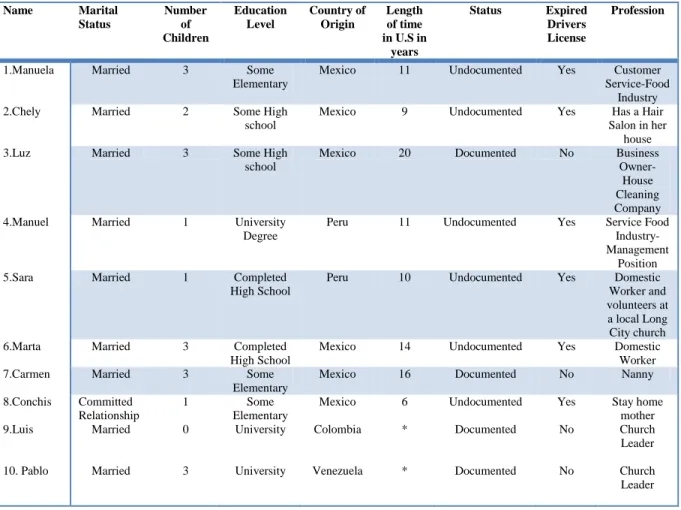
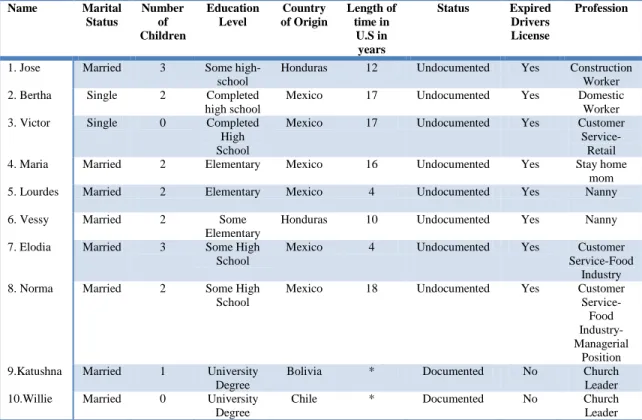
The informants are immigrants from various Latin American countries, including
Mexico, Honduras, El Salvador, Venezuela, Colombia, Peru and Bolivia (see Tables 1
and 2). Out of the twenty informants, six are males and the remaining fourteen are
females. The vast majority of them are married, the exceptions being a participant in a
committed relationship, a single mother, and one single adult under the age of 25. The
professions represented in the sample are restaurant and food service, customer service,
house cleaning services, homemakers and program managers at various non-profit
associations and churches. Fourteen of the participants self-reported as undocumented
within the first ten minutes of the interview and six reported having legal status in the US
to live and work. All of the fourteen undocumented participants volunteered to share
their legal status.
In order to calm the nerves of the informants, I would start the interview with a
light and causal conversation about the weather or something recently mentioned on the
Spanish news. Once I felt that they were more comfortable, I asked them a few
demographic questions such as: How long have you been at your current residence? Most
of the time they responded by giving me the exact date of their arrival to the U.S. This
allowed me to probe into their country of origin.
When they finished recounting their vivid memories of their arrival into the U.S.,
I would steer the conversation to their day-to-day routines in the U.S. as recent
immigrants. I asked the following questions: Tell me about your daily routine. Tell me
13
do you get to work? Do you have a vehicle? Do you use public transportation? Do you
share transportation with someone in your household? How about with someone outside
your household? Do you currently have a North Carolina driver’s license? After asking
about their daily routines, they all would inevitably mention the problems that they had
with obtaining a valid driver’s license. This was a natural transition for me to inquire
about the challenges that they faced and to ask whether they had ever been stopped by the
local police while driving2.
Table 1: Long Hill
Name Marital
Status Number of Children Education Level Country of Origin Length of time in U.S in
years
Status Expired Drivers License
Profession
1.Manuela Married 3 Some
Elementary
Mexico 11 Undocumented Yes Customer
Service-Food Industry
2.Chely Married 2 Some High
school
Mexico 9 Undocumented Yes Has a Hair
Salon in her house
3.Luz Married 3 Some High
school
Mexico 20 Documented No Business
Owner-House Cleaning Company
4.Manuel Married 1 University
Degree
Peru 11 Undocumented Yes Service Food
Industry-Management
Position
5.Sara Married 1 Completed
High School
Peru 10 Undocumented Yes Domestic
Worker and volunteers at a local Long City church
6.Marta Married 3 Completed
High School
Mexico 14 Undocumented Yes Domestic
Worker
7.Carmen Married 3 Some
Elementary
Mexico 16 Documented No Nanny
8.Conchis Committed Relationship
1 Some
Elementary
Mexico 6 Undocumented Yes Stay home
mother
9.Luis Married 0 University Colombia * Documented No Church
Leader
10. Pablo Married 3 University Venezuela * Documented No Church
Leader
14
Table 2: Montgomery City
Name Marital
Status Number of Children Education Level Country of Origin Length of time in U.S in years
Status Expired Drivers License
Profession
1. Jose Married 3 Some
high-school
Honduras 12 Undocumented Yes Construction
Worker
2. Bertha Single 2 Completed
high school
Mexico 17 Undocumented Yes Domestic
Worker
3. Victor Single 0 Completed
High School
Mexico 17 Undocumented Yes Customer
Service-Retail
4. Maria Married 2 Elementary Mexico 16 Undocumented Yes Stay home
mom
5. Lourdes Married 2 Elementary Mexico 4 Undocumented Yes Nanny
6. Vessy Married 2 Some
Elementary
Honduras 10 Undocumented Yes Nanny
7. Elodia Married 3 Some High
School
Mexico 4 Undocumented Yes Customer
Service-Food Industry
8. Norma Married 2 Some High
School
Mexico 18 Undocumented Yes Customer
Service- Food Industry-Managerial
Position 9.Katushna Married 1 University
Degree
Bolivia * Documented No Church
Leader
10.Willie Married 0 University
Degree
Chile * Documented No Church
Leader * Missing
The interviews lasted from one hour to two hours and were conducted in the
language of the informant’s choice: Spanish or English or a combination of both. Fifteen
interviews were conducted in Spanish, one interview was conducted in English and four
were conducted in a combination of English and Spanish. I conducted the interviews in
the privacy of a participant’s homes or at a location of their choice. Eight were conducted
at a participant’s home; six at a public space such as a coffee shop or park and six were
conducted at the participant’s work site. With the participant’s consent, all interviews
15
Data Analysis
The interview transcripts and field notes were analyzed using an ongoing and
interactive approach to data analysis and interpretation known as modified grounded
theory. According to Glaser and Strauss (1967) analytical codes and categories are
created from the data and used to re-conceptualize the focus of the study and/or the
questions asked. This approach requires the researchers to note emerging patterns and to
explore the relationships between categories (Glaser and Strauss 1967).
After transcribing each interview, I began the open coding process by reading
“line by line” though each interview (Emerson et al. 1995). As I coded more and more
interviews, and begun seeing emerging patterns I proceeded with a more focused coding
approach which allowed me to better “synthesize and explain larger segments of data”
(Charmaz 2006:57). This approach allowed me to note overarching themes and to
maintain ongoing descriptive and analytical memos to document the current research. I
also used these memos to help me re-focus the direction of the research (Emerson et al.
1995). The following are a selected list of the coding themes that emerged from the data.
Themes
Knowledge of the law
Fear and Frustration
Need to drive
Cooperation
Plan of Action
After creating a list of themes I went back through the interview transcripts numerous
times and extracted the quotes that better exemplified the themes described. I added the
16
theme. I also identified several characteristics of interest such as length of residence in
the U.S, gender, legal status, possession of a valid driver’s license, city of residence,
knowledge of 287(g) in order to further analyze emerging patterns. The following section
III. Results
Despite the fact that 287(g) gives local police officers the tools to act as
deportation agents by allowing them to ask for proof of legal status when stopping
immigrants during traffic violations, it is not the law itself, but rather the lack of a valid
driver’s license that appears to traumatize the Latino community with the fear of possible
deportation. Previous literature discusses the “politics of incapacitation” as an outcome
facing the immigrant community. Yet, my research presents evidence to the contrary, in
that while immigrants appear aware of the potential implications of not having a license,
their strategies suggest anything but incapacitation. Instead, immigrants’ awareness of the
possible negative outcomes not only allows them to exhibit agency at the individual level,
but also at the community level as they cope with the daily challenges. Immigrants
appear undeterred by threats of deportation, and utilize community cohesiveness and at
times extralegal activities to manage the risks associated with their daily activities,
particularly driving. The following sections will explore each of the themes listed above
in greater detail.
Knowledge of the Law
The majority of the informants (70%) self reported that they were undocumented
within the first ten minutes of the interview. The vast majority of the immigrants
interviewed have resided in the U.S for over 10 years. Only four of the participants
18
ID Act of 2005, requiring every individual applying for a driver’s license to present a
social security number, prevented the majority of them from renewing their North
Carolina driver’s license. All of the respondents immediately mentioned the mental
hardship of driving without a valid driver’s license and their constant fear of deportation.
Interestingly, those who had a valid driver’s license also expressed concern about the
immediate threat that those without a license face on a daily basis. One participant with a
valid driver’s license told me “it is very sad to see them worry, even though I have a
license, la mayoria se mueve sin licensia.” (the majority of them move around without a
license). (Luis, male documented immigrant from Long Hill).
In discussing 287(g), it became apparent that the respondents were unfamiliar
with the specifics of the law, but overwhelmingly identified 287(g) as the “licensing
issue”. Although 287(g) allows local police officers to access national databases to search
for a person’s immigration status when stopped for a minor traffic violation, the
participants overwhelmingly associated the fear of deportation with being stopped by
police officers and being unable to show a valid driver’s license. According to most of
the informants, they were detained because they were unable to provide a valid form of
identification or as Jose states:
-“Conozco a varios incluso los han deportado…porque los han agarrado manejando sin licencia y han ido a la carcel y los han deportado. Me platican que los pararon que la policia los paro que les checo la licencia y ya estaba vencida y los llevo a la carcel y los agarro migracion y los deporto.” – Jose, male, undocumented immigrant from Long Hill
19
Interestingly, only nine of the respondents demonstrated specific knowledge of
287(g) by describing it, as Sara (female, undocumented immigrant from Long Hill) did,
as the law “…used to detain immigrants who have a warrant for their arrest or those with
previous crimes on their records.” All of the informants with a college degree were
familiar with the specifics of 287(g) and were able to articulate that the original intent of
287(g) was to target those with a criminal record.
A surprising finding from the interviews is that there was no evidence to suggest
that living in a non-sanctuary city increases an immigrants’ specific knowledge of 287(g).
While it makes sense to assume that immigrants living in “hot spots” or locations with
higher enforcement levels should be more aware of their ensuing dangers, and as such be
more likely to possess concrete knowledge of 287(g), this was not the case. Familiarity
with 287(g) was roughly equal in both sanctuary and non-sanctuary cities. One
explanation to this conundrum can be the contiguous location of Long Hill and
Montgomery City. Under these circumstances, immigrants are likely to cross city
borders when conducting their normal day-to-day activities, and also less likely to be
aware of its implications.
Furthermore, four of the fourteen undocumented respondents reported familiarity
with the specifics of 287(g), compared to the five of six documented respondents. Thus,
documented respondents appear to be better informed about the particulars of 287(g).
Additionally, as the number of years in the U.S. increases, respondents appeared to have
more specific knowledge of 287(g). Lastly, male respondents are better informed about
the specifics of the law than female immigrants. Almost all of the male respondents were
20
respondents had higher levels of education, and that education is a better indicator of how
informed immigrants are.
The results from the interviews indicate that specific knowledge of 287(g) is more
prevalent among males, those with a college degree, those with legal status and those
with more time spent in the U.S. However, it was clear that while not all of the
respondents specifically knew what the law was, and tended to refer to it as ‘the licensing
issue’, each was aware that local law enforcement appeared to be accelerating
enforcement of immigration law. Participants in this study described the rising tensions
between Latinos and the receiving community over the past few years. According to
Bertha, “cuando yo llegue aqui todo el mundo trabajamos de ilegales y con papeles de
otra gente…pero hace unos anos se empezo a poner mas dificial la situation por los
documentos ya que nos pedian la identificacion del estado y empezaron a checar en los
trabajos ya todo eso” (When I first arrived to the U.S., we all worked as illegals and used
someone else’s legal documents…but a few years ago things started to get really hard.
Employers and everyone else started asking for state ID’s)3 .
Additionally, the passage of 287(g) altered the daily routines of local immigrants.
Latinos residing in both sanctuary and non-sanctuary cities reported being unable to do
the same things that they previously in the past. For example, to some of them the simple
act of going to the grocery store to buy sweet bread for dinner became a complicated cost
analysis calculation. Chely tells me that every time that she went to the “panaderia” or
3The qualitative interviews conducted by Nguyen and Gill further corroborate the notion that life
21
bread store to buy bread for her family, she would ask herself whether it was worth the
mental trauma of being potentially stopped by a police officer or best case scenario to
receive a fine of 200 dollars. The “bread that would normally cost you 10 dollars ended
up costing you 200 dollars, in addition to all of the mental trauma”, explains Chely.
Maria shared with me how she had been pulled over by a police officer for allegedly not
making a full stop. She states, “me dijeron que no habia hecho un stop y me dio risa
porque si alguien es cuidadoso de respetar las reglas soy yo.” (The officer told me that I
had not made a full stop and I simply laughed to myself because I know that if anyone is
careful to follow the rules its me.) (Maria, female, undocumented immigrant from
Montgomery City). A large majority of the participants mentioned the placement of
roadblocks in locations most frequented by them. Manuela, a female undocumented
immigrant from Long Hill, told me that she was afraid to go to church because she was
once pulled over at a roadblock located outside of her church, whereas Maria informed
me that there are roadblocks outside of local Latino supermarkets where she has been
pulled over in the past. The common experience of the participants in the study is that
local police officers seem to be waiting for them to make one small mistake to pull them
over, and that if this does not occur they are willing to fabricate mistakes.
Each of the interviewees, including the six that were documented, articulated
similar concerns that 287(g) had suddenly altered their social patterns and was imposing
considerable stress on their daily activities. The interviews suggest that the ‘licensing
issue’ does indeed represent a cultural trauma. The change in legislation was sudden
since most interviewed respondents associated the inability to provide a valid driver’s
22
scheme. The event was radical as it affected their daily activities and driving became a
fear-inducing event. The cultural trauma was imposed and repulsive as participants
detailed the use of roadblocks to be one of the most frequented methods of detention. The
interviews further indicated that the implementation of 287(g) brought about a change in
the daily routines of immigrants as they have developed strategies to avoid encounters
with the local government4. The law fundamentally altered the interaction between local
law enforcement and the Latino community by increasing distrust and hostility, while
simultaneously producing incentives for local law enforcement to profile Latinos. This
enforcement of the law further contributed to changing routines and patterns of behavior,
as Latinos sought to avoid encounters with local law governments to avoid their
increasingly aggressive deportation efforts. Taken together, we see from the statements
that the participants viewed the accelerated enforcement of 287(g) as a rapid and radical
change that fundamentally altered their lives, which is consistent with the definition of a
cultural trauma. The following section will explore this theme in greater detail.
Fear and Frustration
The majority of the participants expressed to me a sense of frustration when
driving. Jose, a male undocumented immigrant from Montgomery City shared with me
what he had recently discussed with a close friend. According to Jose,
“Ya llevo tres anos manejando sin licencia”. Precisamente ayer estabamos hablando yo con un amigo mio y yo le platicaba que cuando yo tenia mi licencia yo me sentia seguro en las carreteras seguro completamente seguro y ahora siento temor manejar pero le pido a Dios que siempre que ande manejando que me ayude que no vaya a estar involucrado en un accidente, caer en un reten de licencias y eso y gracias a Dios durante todo ese tiempo que llevo manejando yo manejo todos los dias gracias a Dios no he tenido problemas.”
23
“I have been driving without a license for three years now. Just yesterday, I was telling a friend of mine that when I had a license, I felt secure and now I am scared. Every time I drive I pray to God to help me, I ask that he helps me stay away from getting involved in a car accident, falling prey of a roadblock. Thanks to God, nothing has happened to me during all of this time”
Along the same lines, Manuel a male immigrant from Long Hill informed me that
with his license having expired three years ago, he feels very “frustrated just like
everyone else out there feels.” Elodia expressed her frustration with the police. Her
perspective seemed to resonate with many of the participants who discussed the
arbitrariness of the police when detaining immigrants. According to Elodia, “sometimes
people are stopped because the police sees that they have dark skin, not necessarily
because they have committed a traffic violation but because they are dark and the police
knows that they most likely don’t have a valid driver’s license” (Elodia, female,
undocumented immigrant from Montgomery City). When I asked participants to
elaborate on why they were frustrated, the most common response was their fear of being
potentially deported. This was a very valid concern, as almost all of the informants in the
study knew someone who had been deported or was in the process of being deported after
being stopped during a minor traffic violation.
The participants’ fear and frustration concerning deportation became clearer after
I asked informants to elaborate on what happened to their friends who were deported
after being stopped for a minor traffic violation, their responses were very similar. Norma
explained what happened to a friend when the police stopped him.
24
“They detained him and his family could not see him when they went to the local jail. They sent him to another jail and he is now in Mexico. Usually they take you to Atlanta and tell you for the felony you had, you will have to pay $200 and you pay $200 thinking you will be able to go home but as soon as you start walking out, migration officers are waiting for you to detain you.”- Norma, female, undocumented immigrant from Long Hill
Additionally, Luz, informed me of the timetable immigrants experience when detained by
police officers.
“Por ejemplo cuando arrestan a alguien por ejemplo, si arrestan a alguien el fin de semana que lo agarran borracho, la gente dice apurense a sacarlo de la carcel porque el lunes llega migracion a las carceles a llevarselos a los que no tienes papeles entonces tu tienes que moverte a sacar a tu familiar antes del lunes para que no se lo lleven a Atlanta. Y de Atlanta si no lo recoges, esperan hasta que llenen el camion porque no van a gastar gasolina y pueden durar tres cuatro meses en Atlanta y ya de Atlanta ya se van para Mexico.”-Luz, female, undocumented immigrant from Long Hill.
“For example, when they arrest a person over the weekend for let’s say drinking and driving, people out there know that you need to hurry up and get him out of jail soon because immigration comes to the jails every Monday to take those without legal papers. Therefore, one needs to hurry up and try to get them out of jail. If not they will transfer him to Atlanta. And in he makes it to Atlanta he might have to wait 3 months waiting to be deported to Mexico. They wait this long because they need to make sure that they fill up a bus of deportees. I mean they are not going to waste gas on sending only a few of them.”- Luz, female, undocumented immigrant from Long Hill.
While deportation clearly represented the participants’ ultimate fear and worst
case scenario, the respondents also expressed to me the fear they have of the immediate
consequences of being stopped by a police officer. This became even more palpable as
almost all of the informants (14) without a valid driver’s license in the study were
stopped by a police officer for a minor traffic violation within the past year. Some
identified “roadblocks” as the primary reason why the police stopped them. The
remaining gave a mix of reasons, including drunk driving and racial profiling. During the
respondent’s first violation, the police officer gives them a ticket and asks them to apply
for a driver’s license. Bertha, a female, undocumented immigrant from Montgomery City
stated, “I am not sure why they do this since they know we cannot apply for a license
25
this ticket since the fine ranges from $150 to $200. The common response was that they
“don’t make that kind of money in a week.” Respondents were all given the choice to
appear in court and contest the fine, but none of them, with the exception of Bertha,
reported to have actually contested the violation. The other participants mailed in the fine
and hoped that it would not happen again. From the information they shared with me,
contesting the fine was perceived as a way of attracting unwanted attention to their
undocumented legal status.
The majority of the participants were stopped more than once within the last six
months, and shared with me what typically occurs during such a stop. After receiving a
ticket, the officer updates them on their exact count of traffic violations and warns them
that after the third or fourth violation they would be reported to immigration personnel5.
Each time the participants were stopped by police, regardless of the number of traffic
violations on record, the officer would ask them to call someone with a valid driver’s
license that could pick them up and drive their car home. The majority of participants
conveyed how difficult it was to find a person to do this. For the most part, their
immediate family members were also undocumented and consequently did not have a
valid driver’s license. Additionally, the few friends who had a valid driver’s license were
working and unable to leave their job. Their inability to find someone on a last minute
basis to help them became more evident to me when one of them called and asked me to
drive her car after she had been stopped by a police officer. She pleaded,
5 Some informants mentioned three times and some mentioned four times as the potential threshold of the
26
“Carmen, mira no tengo a nadie que me pueda recoger ahorita y si no viene alguien la grua se va a llevar mi dinero, porfavor ayudame.”- Elodia, female immigrant from Long Hill.
“Carmen, I don’t have anyone that can pick up the car at this moment and if no one comes, they will tow it, please help me.” –Elodia, female immigrant from Long Hill6
The informants explained what happens to them if they are unable to find
someone immediately. In the best case scenario, they are forced to leave their cars on the
side of the road and walk long distances back home. In the worst case scenario, the
officer tows their car. Both options present great inconveniences but the latter one brings
a high monetary imposition to their already limited budgets. None of the informants
interviewed reported being stopped by police officers more than four times and none had
been asked by police officers to show proof of citizenship.
The interviews indicate the profound effect of 287(g) has on the lives of the
participants, and the palpable sense of fear the law has created in this population. The
participants expressed that fear of local authorities as something that causes constant
anxiety and concern. The theme of fear and frustration expressed by each of the
participants supports the conclusion that 287(g) does indeed represent a cultural trauma
for this population. Consistent with Stompka’s description, the interviews indicate that
287(g) has created significant and widespread tension within the community, and that this
anxiety is shared across the entire population, including those that are documented. The
individual interviews reveal the extreme sense of anxiety within the population and the
sense of hopelessness at the hands of the local authorities. The consistency of the theme
of fear provides further evidence that the increased enforcement of 287(g) represents a
cultural trauma that affects all aspects of the lives of the participants’ community. These
27
observations lead to the discussion of the next three themes: Need to Drive, Cooperation,
and Plan of Action.
Need to Drive
Given that I could clearly observe fear in the participants’ eyes when they
described their deportation concerns, I asked why they continued to drive at all, despite
the obstacles they face. Most participants explicitly stated at some point during the
interview that “driving is key to their everyday survival”. Carmen’s opinion below was
shared by almost all of the informants:
“Aqui si no tienes carro no te puedes [mover] bueno si hay muchos bus pero no hay como tener tu carro y ir pa donde quiera.”-Carmen, documented immigrant from Long Hill.
“Here in the US, if you don’t have a car you can’t go anywhere, yes there are buses but given what we do, there is nothing like having your own car and being able to move freely.”-Carmen, documented immigrant from Long Hill.
Since the majority of the respondents have jobs in the service industry where they
clean houses, serve as waiters, or take care of children, they work odd hours or have
unstable work schedules that makes it impossible to rely on public transportation.
According to the respondents, some jobs require them to arrive to work by 5 AM, while
others require them to be on call from 8:00 AM to 11:00PM. In addition, the majority of
the respondents are also the main caregivers in their families and as such need to be able
to pick up their children from different schools at different times throughout the day.
Marta’s case provides an important example for understanding immigrants’ need
to drive. Marta claimed that since she works cleaning houses, it would be impossible for
28
earn enough money to feed her three daughters. When I asked why she was so convinced
about this, she explained that she had actually tried taking the bus before but it did not
work out. It had taken so much time to get from one side of the town to the other side
where her second house was located that she was unable to complete her job before she
had to leave to take the bus again to pick up her daughter from school. Since house
cleaning earns her anywhere from sixty to one hundred dollars per house, she needs to be
able to clean at least two houses per day to be able to pay the bills and buy food for a
family of five. Similarly, Conchis, currently a homemaker who used to work two jobs to
support her family, told me that it was very hard to rely on public transportation. Often
times her need to work was so great that she needed to be permanently on call. This
meant that she could be asked to come in at any time and needed to have the flexibility to
drive to work. These two cases illustrate how difficult it is for immigrants to sustain
themselves and their families without being able to drive.
The interviews indicated that the daily struggles of the interviewed immigrants
are very similar regardless of their country of origin. Whether they were from Mexico,
Honduras, El Salvador, Venezuela, Colombia, Peru or Bolivia, respondents appeared to
face similar effects from the cultural trauma of 287(g) in that all indicated driving is very
risky. Yet, it was interesting that all of the respondents remained committed to driving,
given that they viewed it as the key to survival in the U.S. This raised the question of how
immigrants were able to cope with the stress of driving given their trauma. The
participants indicated that while driving was risky, they were able to mitigate the danger
and risk of driving by cooperating with other members of the community. The following
29
Cooperation
Almost all of the people interviewed reported to have helped a family member or
a friend by calling or texting him if they happened to come across a roadblock. Chely, a
female, undocumented immigrant from Long Hill, shared with me, “You need to be
watching out and making phone calls. Tell people, there is a roadblock over there, don’t
go. You can either send a text to an individual or to all of the people on your contact list.”
Similarly, Marta declared, “If we are out and see that there are cops doing a roadblock,
and we specifically know people that will be driving through this location and don’t have
valid driver’s license, we call them right away. This is how Latinos help one another.”
Interestingly, even immigrants who had a driver’s license felt the need to help
others in the community. One informant with a valid license, Luz, reported that on
multiple occasions she has been called or texted by “conocidos, familia y hasta por
desconocidos” (friends, family and random people) and asked a favor. According to Luz,
“since I am one of the few people that has legal papers, people call me and tell me to
confirm whether the cops are located in the Long Hill plaza for example. I go and check
if there is anyone from immigration present. Then I call them back and tell them yes or
no.”
According to the respondents, it is common practice for police officers to place
themselves at locations frequented by immigrants and conduct a roadblock. These
“retenes” (road-blocks) require that each individual driving a car and wishing to pass
through this location present his/her driver’s license to the officer. One of the more
30
know, called her and said to her, “I don’t know you but I know you are Mela’s mom,
please be nice to me, I know you have papers, can you please go check if there is a reten
near my apartment complex. I need to go home.”
According to Luz, this woman was waiting for hours parked outside her job and
was desperate to get home because her children were home alone. She received a text
with the warning of an ongoing “reten” near her home. Luz said that despite being very
late, 11:00 PM, she immediately drove to the location and checked the veracity of the
warning. It turned out that the “roadblock” was cleared and only its remains were visible.
I asked what she meant by this and she told me that it is known in the community that
seeing abandoned cars along the side of a street often signifies that there had been a reten.
According to many interviewees, seeing cars lined up on the side of the road causes
extreme anxiety in the people driving by who fear for the safety of their loved ones,
“especially when we know they need to drive by this location.”
The interviews revealed that the extreme strain to which the subjects are exposed
creates a sense of cohesion. Knowing the routes most frequented by friends and family
and religiously calling them when the threat arises, suggests a significant level of
community cohesion and solidarity. When I asked informants why they did this, their
response invariably was: ‘si no nos ayudamos los unos con los otros entonces quien nos
va a ayudar?’ (If we don’t help each other then who will help us?).
It was interesting to see the initiative they exhibited to helping one another avoid
police encounters. According to various participants, it is common practice to call local
31
disseminate this information to the public by using humor and saying, “cuidado porque la
suegra ahi anda” and providing specific information of potential roadblocks (Be careful
because your mother in law is on the run). These examples indicate that informants are
willing to cooperate to pool risk in an effort to protect themselves as a community.
These behaviors correspond to the description of how groups should respond to
cultural traumas. Sztompka argues that groups can respond to cultural traumas by
increasing their levels of social capital. In this case, we see that the Latino community is
responding to the cultural trauma of 287(g) by increasing cooperative efforts to mitigate
the risk of deportation. The interviews indicate that cooperation was pervasive within the
Latino community, regardless of both legal status and country of origin. Interestingly,
the interviews revealed that those with documented status would often take extraordinary
steps to assist those that were undocumented. A frequently discussed example illustrating
this pattern is the way the undocumented participants manage to get their cars registered
without a valid driver’s license. In North Carolina, one is required to have a Social
Security card, proof of insurance, and a driver’s license in order to register a car with the
Department of Motor Vehicles. Since all undocumented immigrants lack these
requirements, they rely on friends, family and even strangers who posses a valid license
to register their cars. Driving an unregistered car would call even more attention from the
local police and consequently heighten participants’ chances of being stopped and
possibly detained. For example, in one interview, one of the my informants named
Conchis told me:
32
“We have two cars of our own but we might as well not because they legally belong to two other people.”
Another informant, Elodia, reported that the mother of a colleague volunteered to
register her car so that she could drive it. Elodia had purchased a car six months before
but was unable to drive it because it was not registered. She was looking for a person to
“hacerme el favor” (do me the favor) of registering it under their name. In order to avoid
receiving a ticket, she came up with the creative idea of moving the car from place to
place in order to avoid raising suspicion as to why the car had been parked in one
location permanently. One day, she was sharing this story with a worker and her
co-worker said that she would ask her mother, who had a valid license, if she could help her
out. According to Elodia:
-“Yo a esta senora no la conocia, conocia a su hija que trabajaba conmigo yo le dije mira tengo mucho tiempo con el carro y no esta asegurado y le dije no encuentro quien me asegure mi carro tu mama no querra hacerme el favor. Ya despues me dijo dice mi mami que sit e hace el favor ay dije sin conocerla ni nada. Pues me hizo el favor de poner el carro a su nombre y de sacarme la aseguranza entonces yo a ella cada medio ano le pago lo de la aseguranza. Ella me ensena el papel y me dice es tanto y yo ya se lo pago.”
“I did not know this lady. I knew her daughter. She worked with me and I told her that I had had the car uninsured for a long time and that I was looking for someone to help me insure it and asked her if her mom could help me out. Later, she told me that her mom agreed to help me out without knowing her. She insured my car under her name and every six months I give her money to pay for the insurance. She simply shows me the bill and I giver her a check for that amount. “
It takes an incredible amount of trust to agree to do this for another person, as the
legal obligations of any violation would fall to the insurer. Yet, every person that I
interviewed who does not have a driver’s license has been able to find a volunteer for
this. This strongly suggests that the cultural trauma of 287(g) has heightened solidarity
within the Latino community to the point where those with status are willing to assume
33
status could potentially use their position to exploit those without legal standing, possibly
through extortion. However, rather than use their position in an exploitative manner, the
interviews indicate that those with legal status identify with the difficult situations faced
by those without and are willing to take considerable personal risks to assist these
members of their community. This strongly supports the conclusion that the collective
cultural trauma of 287(g) that has increased policing across the entire community has
increased solidarity and cooperation within it. However, driving is not a careless decision
and participants face the trauma of 287(g) by actively planning for deportation. The
following section will explore this theme.
Plan of Action
In addition to relying on a community support system to navigate the challenges
presented by local authorities, the respondents revealed that each individual develops
their own plan of action in the event of deportation. Manuela named a close friend as the
person responsible for the well being of her three children in the case of her deportation.
Katushna, an interviewed community organizer at a local church in Montgomery City,
has organized seminars on how to complete a document that will legally determine the
actions needed to take place in case of a deportation. This document assigns guardianship
to an emergency contact person and assures people that their children will not be sent to a
foster home. The success of this program, according to Katushna, has risen over the past
six years. Her church has steadily secured the participation of lawyers working on a
pro-bono basis as deportation cases impacting her constituents have drastically grown over
34
Other immigrants with a valid driver’s license report being the main contact
person at various schools. While contingency plans in the event of deportation do not
involve formal documents, the planning is very real. Luz told me , “yo soy el contacto de
varias personas en las escuelas, por si las deportan, yo puedo recogerles a los nino”. (I
am the contact person for children at various schools in case the parents get deported.
That way I can pick up the children without any problems.) The observation that
immigrants with driver’s licenses are willing to serve this function and in essence provide
a public good to their community, when there is no apparent individual rational incentive
to do so, again highlights how the pressure on this group only serves to enhance the
collective sense of community developed over the years.
The results indicate that the Latino community is responding to the cultural
trauma of 287(g) by increasing its intra-group cooperation, which is consistent with
Stompka’s strategy of innovation to increase social capital. We see that the although each
participant is clearly fearful of law enforcement and appears to suffer from the collective
trauma, individuals are willing to continue with their daily routines while simultaneously
assisting others within their community to do the same. The interviews present evidence
that the law has produced a strong sense of linked fate (Dawson, 1995) between those
that have documented status and those without, to the point where those that are
documented are willing to assume the risk of engaging in illegal behavior. Further, while
this reliance on documented immigrants might create opportunities for those with legal
statuses to exploit those without, the interviews provide very little evidence that this is
occurring. Instead, the interviews support the conclusion that those immigrants with legal
IV. Discussion and Implications
Although this study was conducted using a small sample, it does reveal several
important insights into how the immigrant community is responding to the trauma created
by 287(g). First, the study demonstrates evidence that contradicts the argument that
immigrants are incapacitated by the law. Instead, the interviews indicate that although the
law increases the stress on individuals within the group, the individuals believe they have
no choice but to assume the risks associated with their daily routines. Given that these
individuals need to work to sustain themselves, the response suggested by incapacitation
is simply infeasible. Instead, the interviews demonstrate that individuals manage the risks
created by increased local enforcement by strengthening their community ties to other
Latino immigrants.
The study indicates that the immigrants routinely assist each other by passing
information about police actions, assisting each other in registering their cars and creating
plans of action in case of a deportation. If we consider that 287(g) creates an enormous
stress and trauma on each individual, it essentially leaves the immigrants no choice but to
strengthen their collective ties in order to sustain themselves. The observation that certain
situations produce strong bonds that strengthen both community cohesiveness and a sense
of linked fate is consistent with other studies in the literature. In the book, Behind the
Mule, Michael Dawson explores a particular type of group consciousness known as