2015 Big Data Survey:
Current Implementation
Challenges
INTRODUCTION
The amount of data in both the private and public domain is experiencing exponential growth. Mobile devices, sensors, audio and video feeds, social media, and what has become known as the “Internet of Things” are all contributing to this increase in
information variety, volume and velocity. The significant increase in data in recent years, coupled with the development of new techniques and technologies to analyze it (“Big Data”), enables disruptive business models to flourish and is now spreading into the more traditional corporate models and activities.
To better understand the challenges faced by organizations trying to leverage Big Data, Knowledgent recently conducted a survey designed to gauge the levels of difficultly experienced in key areas that, in Knowledgent’s perspective, are potential pain points. In this survey, we asked questions relative to the status of Big Data initiatives and projects and the value being received by these efforts.
The survey found that:
• Big Data continues to grow in importance despite significant obstacles.
• The combination of traditional and more unstructured data sources, combined with advanced analytics, are contributing to the development of new business insights.
• Big Data initiatives are transitioning from Proofs-of-Concept to production.
Over 60% of respondents indicated that Big Data initiatives were either very or extremely important to their organizations. However, even with Big Data’s growth and benefits, there are still significant challenges to organizational adoption:
• Resources, both human and other, continue to be a major constraint.
• Putting together an overall “production grade” program, particularly those aspects related to standardizing process, is a notable challenge.
IMPLEMENTATION STATUS
Based on the survey results, it is clear that Big Data is moving out of the experimental stage. The results indicate that by the end of 2015, the majority of respondents expect to be utilizing Big Data in a production environment.
• Over 60% of respondents indicated that Big Data initiatives were either very or extremely important to their organizations.
• On an industry basis, the Financial Services and Healthcare sectors attributed more importance to Big Data than other sectors, while Insurance trailed.
• 25% of respondents reported having already implemented a Big Data solution, while most other respondents indicated they were within six months of doing so.
• Over 75% of respondents view Big Data as having gone from proof-of-concept to production.
Figure 1: Priority of Big Data initiatives
0 10 20 30 40 50
Percentage of Respondents
60 70
Overall
Extremely Unimportant Very Unimportant Somewhat Important Very Important Extremely Important
Financial Services
Healthcare
Insurance
WHAT IS THE PRIORITY OF BIG DATA INITIATIVES IN YOUR ORGANIZATION?
Figure 2:
Big Data Implementation Timeline Implementation Status of Big Data Technology Figure 3:
Percentage of Respondents
WHAT IS YOUR ORGANIZATION’S TIMEFRAME FOR IMPLEMENTING
BIG DATA INITIATIVES?
BIG DATA TECHNOLOGY HAS MOVED FROM A PROOF-OF-CONCEPT TO A PRODUCTION CAPABILITY
WHAT IS THE VALUE BEING REALIZED?
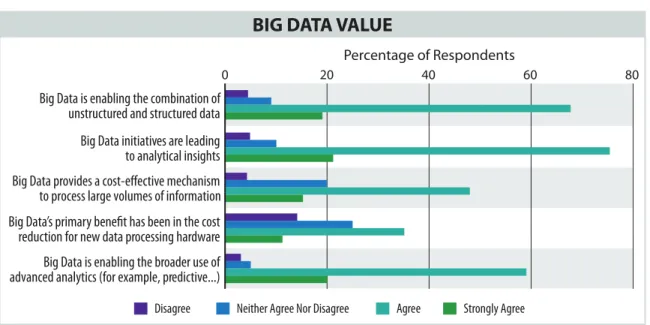
In the early stages of Big Data evolution, there was an emphasis on the cost savings to be realized by open-source software and commodity hardware. However, it has always been Knowledgent’s observation that the biggest value comes from gaining new analytical insights, particularly those gained by the combination of traditional, structured data and newer, non-tabular data formats.
• Most respondents agreed that Big Data is effectively enabling the combination of structured and unstructured data.
• Most respondents agreed that Big Data is driving the use of advanced analytics and leading to new analytical insights.
• There was a split opinion on the value of Big Data as a data processing hardware/software cost-reduction strategy.
Figure 4: Realization of Big Data Value
0 20 40
Percentage of Respondents
60 80
Disagree Neither Agree Nor Disagree Agree Strongly Agree
BIG DATA VALUE
Big Data is enabling the combination of unstructured and structured data Big Data initiatives are leading to analytical insights Big Data provides a cost-effective mechanism to process large volumes of information Big Data’s primary benefit has been in the cost reduction for new data processing hardware Big Data is enabling the broader use of advanced analytics (for example, predictive...)
WHAT ARE THE CHALLENGES?
The survey showed that there is very broad agreement that many aspects of
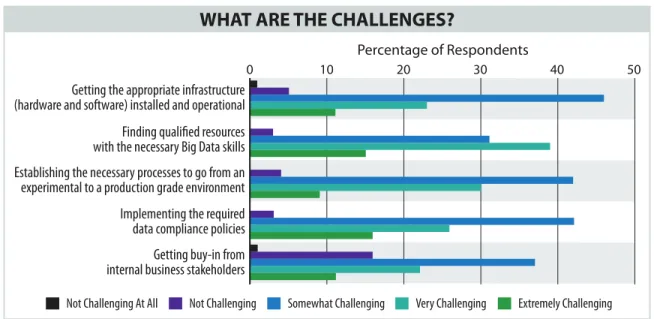
implementing a Big Data solution remain at least somewhat challenging. The biggest task continues to be in finding experienced resources.
• Over 55% of respondents identified finding resources with the required Big Data skills as either very or extremely challenging
• Gaining buy-in from business stakeholders scored as the least challenging in this category
Figure 5: Big Data Challenges
0
Percentage of Respondents WHAT ARE THE CHALLENGES?
Getting the appropriate infrastructure (hardware and software) installed and operational Finding qualified resources with the necessary Big Data skills Establishing the necessary processes to go from an experimental to a production grade environment Implementing the required data compliance policies Getting buy-in from internal business stakeholders
10 20 30 40 50
BIG DATA – IT MANAGEMENT PERSPECTIVE
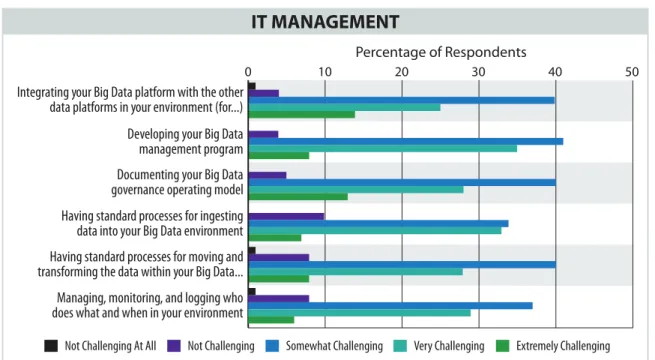
Respondents, perhaps unsurprisingly given the maturity of the domain, are finding the greatest challenges in the overall program development and management of Big Data initiatives. Under this umbrella, it seems that standard processes for data ingestion and transformation are still evolving.
• On average, at least 75% of respondents noted that many aspects of managing and operating a Big Data environment still remain at least somewhat challenging
• The most challenging aspect noted was in developing the overall program • The least challenging was in controlling access and privileges
Figure 6: Challenges Faced by IT Managers
0
Percentage of Respondents
IT MANAGEMENT
Integrating your Big Data platform with the other data platforms in your environment (for...) Developing your Big Data management program Documenting your Big Data governance operating model Having standard processes for ingesting data into your Big Data environment Having standard processes for moving and transforming the data within your Big Data... Managing, monitoring, and logging who does what and when in your environment
10 20 30 40 50
BIG DATA – END-USER SUPPORT PERSPECTIVE
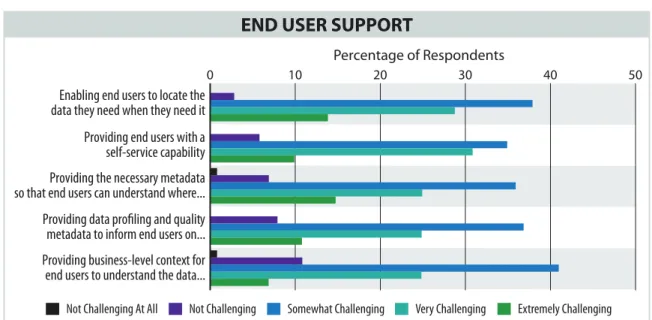
Knowledgent crafted the questions in this section based on field observations across multiple projects, particularly those with some flavor of the “Data Lake” architecture. We have noted end-user challenges with locating data, understanding data, and
requisitioning data for analytical use. We wanted to gauge if our observations were being more broadly experienced.
• In this category, all aspects questioned remain at least somewhat challenging for at least 75% of respondents
• This is entirely consistent with Knowledgent’s experience and one of the reasons we developed Kariba, our data and analytics platform.
Figure 7: End User Support Challenges
0
Percentage of Respondents
END USER SUPPORT
Enabling end users to locate the data they need when they need it Providing end users with a self-service capability Providing the necessary metadata so that end users can understand where... Providing data profiling and quality metadata to inform end users on... Providing business-level context for end users to understand the data...
10 20 30 40 50
New York, New York • Warren, New Jersey • Boston, Massachusetts • Toronto, Canada
KARIBA
Kariba is Knowledgent’s innovative software product that provides a Data and Analytic Self-Service platform. Kariba’s powerful keyword, faceted, and semantic search capabilities revolutionize users’ ability to quickly and accurately find not only structured data like files and tables but also unstructured data like social media posts, chat logs, and web logs. In addition, users learn to trust and understand the data by viewing the quality and lineage of the data and through additional information obtained from the broader user community, such as reviews and common use cases.
From an IT management point-of-view, Kariba provides utilities to rapidly ingest new data into the Data Lake. Typically, the development of a new ingestion process can be a lengthy, customized development task. Kariba’s configuration-driven ingestion mechanism provides a high level of automation and reuse, enabling easy and secure content ingestion from new sources. For more on Kariba visit: http://knowledgent.com/kariba/
SURVEY METHOD AND DEMOGRAPHICS
The Big Data survey was a one-time survey conducted from March 12 to April 9, 2015 by Knowledgent. The survey was targeted at IT practitioners with some exposure to Big Data technology. Survey candidates were asked to complete an online questionnaire of 27 questions hosted on Knowledgent’s website. The questions were closed ended with answer options along a Likert scale.
A broad range of respondents took the survey. They represented many industry sectors and sizes of organization.
• Almost 100 people responded to the survey. Over one-third of the respondents came from the financial services sector. The Healthcare, Insurance, and Life Sciences sector made up a further 30%.
• More than 50% of those taking the survey came from companies with a $1B or more in revenue.