Astrophysics and Space Science Proceedings 56
Rouven Essig
Jonathan Feng
Kathryn Zurek
Editors
Illuminating
Dark Matter
Astrophysics and Space Science Proceedings
Volume 56
Rouven Essig
•Jonathan Feng
•Kathryn Zurek
Editors
Illuminating Dark Matter
Proceedings of a Simons Symposium
Editors Rouven Essig
C.N. Yang Institute for Theoretical Physics Stony Brook University
Stony Brook, NY, USA
Jonathan Feng
Department of Physics and Astronomy University of California, Irvine Irvine, CA, USA
Kathryn Zurek
Theoretical Physics Group
Lawrence Berkeley National Laboratory Berkeley, CA, USA
ISSN 1570-6591 ISSN 1570-6605 (electronic) Astrophysics and Space Science Proceedings
ISBN 978-3-030-31592-4 ISBN 978-3-030-31593-1 (eBook) https://doi.org/10.1007/978-3-030-31593-1
©Springer Nature Switzerland AG 2019
This work is subject to copyright. All rights are reserved by the Publisher, whether the whole or part of the material is concerned, specifically the rights of translation, reprinting, reuse of illustrations, recitation, broadcasting, reproduction on microfilms or in any other physical way, and transmission or information storage and retrieval, electronic adaptation, computer software, or by similar or dissimilar methodology now known or hereafter developed.
The use of general descriptive names, registered names, trademarks, service marks, etc. in this publication does not imply, even in the absence of a specific statement, that such names are exempt from the relevant protective laws and regulations and therefore free for general use.
The publisher, the authors and the editors are safe to assume that the advice and information in this book are believed to be true and accurate at the date of publication. Neither the publisher nor the authors or the editors give a warranty, expressed or implied, with respect to the material contained herein or for any errors or omissions that may have been made. The publisher remains neutral with regard to jurisdictional claims in published maps and institutional affiliations.
This Springer imprint is published by the registered company Springer Nature Switzerland AG The registered company address is: Gewerbestrasse 11, 6330 Cham, Switzerland
Preface
The identity of dark matter is one of the great scientific mysteries of our time. The
field is currently undergoing a transformation. The odds-on favorites from earlier decades, WIMPs—while not excluded—are being increasingly squeezed by the lack of positive signals in direct detection or at the LHC. The other classic can-didates, sterile neutrinos and axions, are being reexamined, with qualitatively new possibilities (especially as concerns detection) emerging. In the last decade, the community has dramatically broadened the range of dark matter theories it has studied, motivating new searches, including experiments that are remarkably small, cheap, and fast, but nevertheless provide sensitive probes of these new ideas. At the same time, the era of precision astrophysics and cosmology is placing powerful new constraints on dark matter candidates through the observation of dark matter clustering on small scales, an example of the microscopic dynamics of particles imprinting itself on macroscopic scales. These developments together make clear that thefield is unlikely to look very similar in one decade to how it looks today. The Simons Symposium on Illuminating Dark Matter sought to move the dis-cussion forward at this pivotal point in time. It brought together 23 researchers to take a fresh look at dark matter. The meeting’s participants spanned the wide range of fields that are now connected with dark matter, with interests ranging from astrophysics and cosmology to particle physics, and even to condensed matter and atomic physics. Each participant contributed a 30-minute talk, which was followed by ample time for discussion. Participants were encouraged to consider different time periods (short, medium, long) and how their subfields could progress during each of these periods. In the afternoon, the Symposium included organized, but free-ranging, discussions, in which participants discussed hot and controversial topics in more depth and with more explanation than is usual at conferences. In this way, the Symposium, which was simultaneously informal and intense, bridged many divides, for example, between astrophysicists and particle physicists, and between theorists and experimentalists.
A major topic of discussion at the Symposium was the extent to which the small-scale structure of the distribution of dark matter in the universe could con-strain or motivate new particle dark matter properties. Manoj Kaplinghat argued that a variety of disagreements between small-scale structure simulations and observations, particularly the diversity of halo distributions, could be taken as evidence for strongly self-interacting dark matter. Alyson Brooks, Phil Hopkins, and Julio Navarro showed the promise—and limitations—of simulations for con-straining dark matter interactions and structure. Through debate and discussion, it became clear that baryon and dark matter dynamics are still difficult to disentangle in their impact on the dark matter distribution of halos like the Milky Way and dwarf satellites. Thefield of simulations is not yet at the point that robust upper limits on dark matter self-interactions (in the presence of baryons) can be quoted, but it was emphasized in the discussion that a sign of precision in simulations would be robust upper bounds on dark matter interaction strengths that monoton-ically decrease with time. Jo Bovy showed that a particularly promising avenue for determining the clustering of dark matter on the smallest scales are narrow stellar streams in the halo of the Milky Way. Neal Dalal and Neal Weiner discussed how sensitive new gravitational lensing measurements could also dramatically increase our understanding of the small-scale structure of dark matter. Because different dark matter candidates leave different imprints in the small-scale structure, one might be able to differentiate between dark matter candidates this way.
Particularly interesting are light dark matter particles and dark sectors with masses in the meV to GeV range, which could explain many puzzles. Moreover, several mechanisms exist that can naturally generate dark matter with the correct relic abundance in this mass range. Recent years have seen an explosion of new ideas to detect such light dark matter particles. These ideas have often emerged from theoretical physicists thinking across several disciplines, including particle physics, condensed matter physics, cosmology, and atomic, molecular, and optical physics. But these ideas also require expert experimentalists and instrumentalists to sharpen these ideas and bring them to fruition. These developments are allowing physicists to explore vast new regions of dark matter parameter space.
Several concrete experimental proposals have been developed to tackle the detection of these theories of dark matter. Rouven Essig discussed techniques, focused on electronic excitation and ionization in atoms and in semiconductors, to detect dark matter with mass in the MeV to GeV range. Javier Tiffenberg showed that an experiment using CCDs based on these ideas was near to being realized. Rafael Lang emphasized that, although it is important to pursue hidden sector dark matter, the WIMP endures and it is important to pursue the detection of this can-didate all the way down to the neutrino background. Adam Ritz discussed how sub-MeV dark matter can be accelerated in the Sun to higher velocities and then be probed in direct-detection experiments on Earth. Roni Harnik discussed how dark matter detectors can be used to probe nonstandard neutrino interactions, and how neutrino detectors can probe novel dark matter candidates.
In addition to detecting the presence of dark matter through its scattering off normal matter, dark matter can also be discovered by producing it in particle accelerators and colliders. This approach has been known for a long time, but the growth of interest in light dark matter has opened a vast array of new possibilities. Bertrand Echenard presented a comprehensive review of sub-GeV dark matter searches at accelerators, surveying the many new initiatives around the world with an emphasis on the proposed LDMX experiment, searching for invisible dark mediator decays with unprecedented sensitivity. Mauro Raggi focused on the possibility of discovering dark matter and dark sectors with positron beams, for example, through resonant searches for eþe!X!eþe, where X is a new particle. In particular, PADME is starting to take data and may be able to defi ni-tively test many new physics explanations of the 6:8r beryllium 8 anomaly. Jonathan Feng reviewed motivations for the new emphasis on light dark sectors, emphasized the genericity of non-renormalizable portal interactions, and described FASER, a small and inexpensive proposed experiment that will extend the LHC’s sensitivity to light and weakly interacting new particles.
While much of the discussion focused on the myriad of new experiments and probes being proposed (by both theorists and experimentalists), several talks emphasized that rich model building avenues remain. Kathryn Zurek considered a simple dark sector of asymmetric dark matter in the absence of a dark analogue of electromagnetism, and showed that huge bound states, as heavy as 1019 GeV, are observationally and cosmologically viable and give rise to unique experimental signatures. Tomer Volansky discussed what the properties needed for dark matter to explain the recent 21 cm observation and also how dissipative dark matter could enhance the growth rate of supermassive black holes. Josh Ruderman sought to build a simple hidden sector dark photon model that also could explain the recent 21 cm observation. Jessie Shelton focused on cosmological and terrestrial signa-tures of hidden sectors with a dark radiation bath.
Finally, new progress was reported on a number of classic dark matter candi-dates. The recent observations of gravitational waves by LIGO have renewed interest in primordial black hole (PBH) dark matter. Bernard Carr reviewed the fascinating history of PBHs, the three open windows at intermediate sublunar, and asteroid masses, and stressed the interesting implications of PBHs even if they account for only some of the dark matter. Alex Kusenko presented a new paradigm for production of black holes in the early universe and noted that PBH dark matter can contribute to r-process nucleosynthesis, as well as lead to striking signatures, such as kilonova without gravitational wave counterparts and fast radio bursts. Aaron Chou reviewed the classic motivations for axion dark matter, presented“hot off the press” results from ADMX that have reached the DFSZ limit for masses around 2leV, and discussed a number of new ideas from quantum metrology to enable higher mass searches. Finally, Kev Abazajian discussed sterile neutrinos, the original dark fermions, and shed light on the tantalizing 3.5 keV line seen from galaxies and clusters of galaxies and its natural explanation in the context of sterile neutrino dark matter.
The following proceedings contributions capture a bit of theflavor of the Simons Symposium on Illuminating Dark Matter. We hope that it will serve as an inter-esting snapshot of a field in rapid transition, and perhaps that some of the talks presented here will be seen in the future to contain some seeds of insight that ultimately blossomed into the identification of dark matter.
Stony Brook, USA Rouven Essig
Irvine, USA Jonathan Feng
Berkeley, USA Kathryn Zurek
July 2018
Participants
The Simons Symposium on“Illuminating Dark Matter”took place on May 13–19, 2018 at Schloss Elmau, in Elmau, Krün, Germany.
Kevork Abazajian, UC Irvine Jo Bovy, University of Toronto Alyson Brooks, Rutgers University
Bernard Carr, Queen Mary, University of London Aaron Chou, Fermilab
Neal Dalal, Perimeter Institute
Bertrand Echenard, California Institute of Technology Rouven Essig, Stony Brook University
Jonathan L. Feng, UC Irvine Roni Harnik, Fermilab
Phil Hopkins, California Institute of Technology Manoj Kaplinghat, UC Irvine
Alexander Kusenko, UCLA and Kavli IPMU Rafael F. Lang, Purdue University
Julio Navarro, University of Victoria Mauro Raggi, Rome La Sapienza Adam Ritz, University of Victoria Joshua Ruderman, New York University
Jessie Shelton, University of Illinois at Urbana-Champaign Javier Tiffenberg, Fermi National Accelerator Laboratory Tomer Volansky, Tel Aviv University
Neal Weiner, New York University
Kathryn Zurek, Lawrence Berkeley National Laboratory
Contents
Sterile Neutrino/Dark Fermion Dark Matter: Searches in the X-Ray
Sky, the Nuclear Physics Laboratory and in Galaxy Formation . . . 1 Kevork N. Abazajian
Constraining the Small-Scale Clustering of Dark Matter with Stellar
Streams . . . 9 Jo Bovy
Understanding Dwarf Galaxies in Order to Understand
Dark Matter. . . 19 Alyson M. Brooks
Primordial Black Holes as Dark Matter and Generators of Cosmic
Structure . . . 29 Bernard Carr
Quantum Metrology Techniques for Axion Dark Matter Detection. . . . 41 Aaron S. Chou
Light Dark Matter Searches at Accelerators and the LDMX
Experiment. . . 49 Bertrand Echenard
Direct Detection of Sub-GeV Dark Matter: Models and Constraints . . . 59 Rouven Essig
FASER and the Search for Light and Weakly Interacting Particles . . . 69 Jonathan L. Feng
Interplay of Dark Matter Direct Detection and Neutrino
Experiments. . . 77 Roni Harnik
Why I Think That Dark Matter Has Large Self-interactions. . . 85 Manoj Kaplinghat
Primordial Black Holes as Dark Matter: New Formation Scenarios
and Astrophysical Effects. . . 91 Alexander Kusenko
Versatile Physics with Liquid Xenon Dark Matter Detectors. . . 97 Rafael F. Lang
The Origin of Galaxy Scaling Laws in LCDM. . . 103 Julio F. Navarro
Searching for Light–Dark Matter with Positron Beams. . . 109 Mauro Raggi
Some Direct Detection Signatures of Sub-MeV Dark Matter. . . 115 Adam Ritz
21 cm Absorption as a Probe of Dark Photons . . . 121 Joshua T. Ruderman
Some Minimal Cosmologies for Dark Sectors. . . 129 Jessie Shelton
The SENSEI Experiment. . . 137 Javier Tiffenberg
Indirect Probes of Light Dark Matter . . . 143 Tomer Volansky
Halometry from Astrometry: New Gravitational Methods to Search
for Dark Matter. . . 153 Neal Weiner
Complex Dark Sectors and Large Bound States of Dark Matter. . . 161 Kathryn M. Zurek
Sterile Neutrino/Dark Fermion Dark
Matter: Searches in the X-Ray Sky, the
Nuclear Physics Laboratory and in
Galaxy Formation
Kevork N. Abazajian
Abstract The possibility of dark matter being a particle involved in the generation of neutrino mass has been of interest for over 25 years. Sterile neutrinos—or in the contemporary parlance—dark fermions, are among the simplest and most cited particles which can provide a mechanism for neutrino mass. If one particle of this class has a small mixing, it can be quasi-thermally or nonthermally produced in the early Universe, affect cosmological structure formation, and be detected by X-ray telescopes or laboratory nuclear experiments. A candidate line was detected in 2014, and I review the status of the line and its implications for galaxy formation, proposals for future observations, and laboratory detection.
1
Introduction
One of the most significant discoveries in the past two decades in particle physics was that neutrinos have mass and oscillate between flavor states [1]. The presence of mass requires a mass generation mechanism, and many mechanisms have been proposed [2]. One of the simplest and prevalent mechanisms has been the introduction of Majorana and Dirac type mass terms into the Standard Model Lagrangian:
L⊃ −hαiLαNiϕ− 1
2Mi jNiNj+H.c., (1)
where hαi are the Yukawa couplings for the flavor statesα=e,μ,τ and Mi j =
Mj i (i,j=1,2, ...) are the Majorana masses. The extra particles involved in this mechanism were labeled “sterile neutrinos” due to the lack of their involvement in Standard Model interactions. In a sense, the introduction of these sterile neutrinos was one of the first instances of invoking dark fermion fields to solve a problem in
K. N. Abazajian (
B
)Department of Physics and Astronomy, Center for Cosmology, University of California, Irvine, CA 92697, USA
e-mail:[email protected]
URL:http://www-physics.uci.edu/~kevork
© Springer Nature Switzerland AG 2019
R. Essig et al. (eds.),Illuminating Dark Matter, Astrophysics and Space Science Proceedings 56,https://doi.org/10.1007/978-3-030-31593-1_1
2 K. N. Abazajian particle physics. In the contemporary parlance, they would be referred to as “dark fermions” from a “hidden sector” and I interchanged these names below.
This mechanism can be embedded in what is described as the seesaw mechanism, where the smallness of neutrino mass is due to the generation of Majorana masses
mi j = λi jH 2
MN
∼ m2D
MN. (2)
ForMN large,mi j mD, providing small neutrino masses, as observed relative to
charged lepton masses. The high-scale completion of this mechanism determines the type of seesaw mechanism [3]. The relation in Eq. (1) can be considered simply phenomenologically, and this is dubbed the “new Standard Model” or “neutrino
Standard Model” (νSM) [4] or the “neutrino Minimal Standard Model” (νMSM) [5].
In this mechanism, there are only two “heavy”MN required to produce the observed
atmospheric and solar oscillation mass scales. If there is a symmetry in flavor between the “dark sector” fermions (sterile neutrinos) and the Standard Model fermions, we
get an extraMNfor free. This dark fermion (sterile neutrino) can have arbitrary mass
and mixings, except for where there are constraints on sterile neutrino mixings. In fact, the mixing for this dark fermion (sterile neutrino) can be arbitrarily small, since
the lightest mass eigenstate,mαof the neutrinos may be arbitrarily small
θ∼
mα
MN 1. (3)
The arbitrarily small mixing angle is of interest because production and the candidate
signals in X-ray indicate mixing angles of order 10−7–10−10. Note that the simplest
models of this form cannot accommodate both dark fermions (sterile neutrinos) being dark matter as well as a short baseline neutrino [5]. More complicated models can accommodate both [6].
2
Sterile Neutrino/Dark Fermion Dark Matter: Production
and Indirect Detection
It was realized in 1992 that such an extra dark fermion could be dark matter [7], via scattering induced production in mixing with an active neutrino—dubbed the Dodelson-Widrow case. In 1998, this was extended to use a Mikheyev-Smirnov-Wolfenstein resonant production method in universes that could have a nontrivial lepton asymmetry in active neutrinos—dubbed the Shi-Fuller case [8]. Nonresonant Dodelson-Widrow production occurs at temperatures of approximately 100 MeV, where above that temperature the scattering rate to Hubble expansion rate decreases
with increasing temperatures asΓ /H ∝T−9and below that temperature, the rate
Sterile Neutrino/Dark Fermion Dark Matter: Searches in the X-Ray Sky … 3 can still be some production via the nonresonant production, but the production is enhanced by resonance at higher temperature due to the presence of lepton asymme-try. Therefore, the Shi-Fuller case can produce the requisite total dark matter density with even smaller mixing angles.
In my collaboration with Fuller and Patel, we explored the full parameter space of mixing, mass, and lepton number, where the latter is what connects the two mech-anisms of Dodelson-Widrow and Shi-Fuller [9]. (As the lepton number approaches zero, Shi-Fuller becomes Dodelson-Widrow.) We included the effects of the quark-hadron transition that occurs during peak production of the dark matter in much of the parameter space. That work also explored all of the constraints on the dark fermion/sterile neutrino dark matter, including structure formation constraints due to the “warmness” of the dark matter, the cosmic microwave background spectral distortions due to decay, big bang nucleosynthesis, the diffuse X-ray background, and supernova cooling. The strongest constraint was found by Abazajian, Fuller, and Patel to be likely from X-ray emission as observed in relatively local struc-tures like galaxies and clusters of galaxies observed by the contemporary X-ray
telescopesChandraandXMM-Newton. This is due to the radiative decay of the dark
fermion/sterile neutrino, which has no GIM suppression: Γγ(ms,sin22θ)≈1.36×10⁻³⁰s−1
sin22θ
10−7
ms 1 keV
5
, (4) for the Majorana case. This decay was first pointed out and calculated by Shrock [10] and independently by Pal & Wolfenstein [11], and for the Majorana case by [12]. The
level of constraints fromVirgo Cluster XMM-Newtonobservations were explored in
Abazajian et al. [13]. In that work, we also explored future sensitivities by the at the
time proposedConstellation-Xmission, as well as pointing out that an equivalent
exposure to that large mission “could be obtained by a stacking analysis of the spectra of a number of similar clusters.” In the subsequent thirteen years, there was a long history of searches for the line in X-ray data, with no conclusive evidence (for a review, see [14]).
In 2014, Bulbul et al. [15] used a stack of 73 clusters to search for dark matter
decay lines, and discovered a≈5σline in the sample, in several subsamples, with
both detectors aboardXMM-Newton. They also saw evidence for the line in
Chan-draobservations of thePerseusCluster. This detection was followed up in several
searches, with evidence for the line from Andromeda [16], the Milky Way Galactic
Center (withXMM-Newton) [17], withSUZAKUX-ray Space Telescope data toward
Perseus [18], in 8 more clusters at>2σsignificance [19], and inNUSTAR[20] and
Chandra[21] deep fields’ exposure to the Milky Way Galactic Halo, as shown in
Fig.1.
The line was not detected in claimed sensitive observations of stacked galaxies, though the systematic uncertainties in the continuum were of order the signal [22]. It was also not detected in MOS observations of Draco, though the authors of the analysis state the observations do not exclude a dark matter decay interpretation [23].
4 K. N. Abazajian
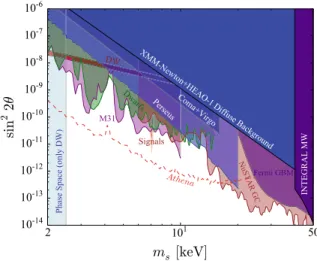
Fig. 1 The full parameter space for sterile neutrino dark matter is shown, for the case where it comprises all of the dark matter. Constraints arise from M31 Horiuchi et al. [24], as well as stacked dwarfs [25]. Also shown are constraints from the diffuse X-ray background [26], and individual clusters “Coma+Virgo” [27]. At higher masses, we show the limits from Fermi GBM [28] and INTEGRAL [29]. The signals near 3.55 keV from M31 and stacked clusters are also shown [15,
16]. The vertical mass constraint only directly applies to the Dodelson-Widrow model being all of the dark matter, labeled “DW,” which is now excluded as all of the dark matter. We also show forecast sensitivity of the plannedAthena X-ray Telescope[30]. This figure is from Ref. [14]
3
Galaxy Formation
There has been considerable interest in this candidate because of the “warmness” of sterile neutrino dark matter, which may alleviate problems in galaxy formation,
namely the central density orToo Big To Failproblem [32,33]. This was explored
in ranges of the parameter space of the signal, showing how sterile neutrino/dark fermion dark matter could be differentiated from thermal warm dark matter in dark
matter only simulations [34, 35], as well as recent full hydrodynamic simulations
[36]. It should be emphasized that the fraction of dark matter need not by 100% in
order to produce the candidate line but could be as little as 7×10⁻⁴in low reheating
universe scenarios [14]. In the case of a small fraction of the dark matter being the signal producing sterile neutrino/dark fermion, the dynamics of galaxy formation would be dominated by the predominant form of dark matter, whether it is cold dark
Sterile Neutrino/Dark Fermion Dark Matter: Searches in the X-Ray Sky … 5
Fig. 2 X-ray line detections consistent with sterile neutrino dark matter are shown here. The dark colored regions are 1,2 and 3σfrom the MOS (blue) and PN (red) stacked clusters by Bulbul et al. [15], the Bulbul et al. core-removed Perseus cluster (green), and M31 (orange) from Boyarsky et al. [16]. Also shown are the 1 and 2σregions of the detection in the Galactic Center (GC) [17] as well as the>2σ line detections in 1. Abell 85; 2. Abell 2199; 3. Abell 496 (MOS); 4. Abell 496 (PN); 5. Abell 3266; 6. Abell S805; 7. Coma; 8. Abell 2319; 9. Perseus by Iakubovskyi et al. [19]. Numbers in the plot mark the centroid of the regions, with MOS detections in orange and PN in purple. We also show, in purple, the region consistent with the signal inChandraDeep Field observations, with errors given by the flux uncertainty, i.e., not including dark matter profile uncertainties [21]. The lines show constraints at the 90% level fromChandraobservations of M31 (14) [24], stacked dwarf galaxies (M14) [25], and Suzaku observations of Perseus (T15) [31]. Stars mark models studied in Ref. [32]. This figure is from Ref. [14]
4
The Future
Several follow-up observations and experiments are planned. On the laboratory experiment side, the KArlsruhe TRItium Neutrino (KATRIN) experiment has
sen-sitivities down to mixing angles of∼10−8 atms ≈7 keV [37], and the atom trap
experiment Heavy Unseen Neutrinos from Total Energy-momentum Reconstruction (HUNTER) aims to be even more sensitive via energy-momentum reconstruction of
K-capture131Cs [38].
Future searches on the sky include theMicro-XandXQCsounding rocket
exper-iments, which can be sensitive to the signal parameter space, with campaigns that could occur from the southern hemisphere in the summer of 2019 [39]. Large
mis-sions such as ATHENA [30] and theX-ray Surveyorwill be very sensitive to the
candidate signal parameter space, but are a decade or more away from launch (2028
launch forATHENAand later forX-ray Surveyor). Sooner would be the replacement
mission forHitomi, the X-ray Recovery Mission (XARM), which is scheduled for
launch in March 2021, and would be sensitive to the velocity broadening of the line [15].