Full Terms & Conditions of access and use can be found at
http://www.tandfonline.com/action/journalInformation?journalCode=rwar20
Download by: [University of Nottingham] Date: 10 May 2017, At: 03:03
World Archaeology
ISSN: 0043-8243 (Print) 1470-1375 (Online) Journal homepage: http://www.tandfonline.com/loi/rwar20
Fair game: exploring the dynamics, perception and
environmental impact of ‘surplus’ wild foods in
England 10kya–present
Naomi Sykes
To cite this article: Naomi Sykes (2017): Fair game: exploring the dynamics, perception and environmental impact of ‘surplus’ wild foods in England 10kya–present, World Archaeology, DOI: 10.1080/00438243.2016.1269666
To link to this article: http://dx.doi.org/10.1080/00438243.2016.1269666
© 2017 The Author(s). Published by Informa UK Limited, trading as Taylor & Francis Group.
Published online: 23 Jan 2017.
Submit your article to this journal
Article views: 211
View related articles
Fair game: exploring the dynamics, perception and environmental
impact of
‘
surplus
’
wild foods in England 10kya
–
present
Naomi Sykes
Department of Archaeology, University of Nottingham, Nottingham, UK
ABSTRACT
This paper brings together zooarchaeological data from Neolithic to post-medieval sites in England to explore the plasticity of cultural attitudes to the consumption of wild animals. It shows how, through time, game has been considered variously as‘tabooed’and‘edible’, each having implications for patterns of biodiversity and wildlife management. The essential points being made are that deeper-time studies can reveal how human perceptions of
‘surplus foods’ have the potential to both create and remedy problems of environmental sustainability and food security. Perhaps more significantly, this paper argues that understanding the bio-cultural past of edible wild animal species has the potential to transform human attitudes to game in the present. This is important at a time when food security and the produc-tion of surplus are pressing naproduc-tional and global concerns.
KEYWORDS Wild resources; game; medieval; food security; edibility; taboo
Introduction
Today, food security and sustainable over-production are prime concerns for governments world-wide as they struggle with the economics and environmental impact of providing sufficient sustenance to feed a growing human population, estimated to reach >9 billion by 2050 (Hoffman and Cawthorn2013, 764). In order to meet global demands, attention has focused on increasing the productivity of a narrow range of domestic animals (e.g. cattle, sheep, pigs, chickens) and crops (e.g. barley, wheat, maize, rice) with species transported from one country to another, being farmed intensively in regions far beyond their native range. However, it is becoming apparent that a key to the provision of food surplus may be for humans to tap resources that are already plentiful but, due to cultural taboos, are considered ‘unedible’ (Cawthorn and Hoffman2014; Farouk et al.2015; Gruber2016; Meyer-Rochow, Megu and Chakravorty 2015).
The same case for broadening horizons could equally be made for archaeological research concerning food surplus. In keeping with studies of modern production regimes, archaeological analyses have also centred on the traditional domesticates, in particular plant species, with emphasis placed on how their spread and intensive management enabled the emergence of social complexity and change (Bogaard et al.2009; Chesson and Goodale2014; Kuijt and Finlayson 2009; Smith2006). Less attention has been paid to species that contribute little to human diet in the West today (e.g. Fritz2007). For instance, the horse, so vital to subsistence strategies in many areas of the world–present and past–is seldom considered within archaeological discussions of
CONTACTNaomi Sykes [email protected] http://dx.doi.org/10.1080/00438243.2016.1269666
© 2017 The Author(s). Published by Informa UK Limited, trading as Taylor & Francis Group.
food because, as the 2013‘horse-meat scandal’demonstrates, it is not considered‘edible’ across much of Europe (Poole2013). The same is true for many wild animal species: they are given short shrift in archaeological discussions of food even though in the past they made a significant contribution to human diet and were often translocated and managed alongside animals that became the true‘domesticates’(e.g. Vigne, Daujat and Monchot2015; Carden et al.2012; Carden 2012; Stanton, Mulville and Bruford2016).
In some respects, wild resources are the ultimate surplus food. In societies that have plentiful access to agricultural produce, wild resources often represent luxury goods: it is for this reason that the management, procurement, distribution and consumption of wild animals is often correlated with social hierarchy and power-structure complexity, all themes that this volume seeks to address (Allen 2014; Barringer 2001; Cartmill 1993; Griffin 2007; Hamilakis 2003; Sykes 2014a). In other cultures where agricultural production is less reliable, wild plants and animals represent ‘risk buffers’, low-input resources used to increase human nutrition in times of need (Brashares et al. 2004; Grant 1981; O’Shea 1989). Given the potential food-shortage that is currently facing humanity, perhaps it is time to consider carefully whether, in some contexts, wild resources might represent important sources of food for the future. This is not to suggest that the human population should return wholesale to subsistence hunting as this has certainly had a detrimental impact on global wildlife populations; for instance, the bush-meat trade has been shown to have a negative effect on biodiversity (Brashares et al. 2004; Jenkins et al. 2011). Indeed, there is a growing literature showing how zooarchaeological data can highlight issues of over-exploitation and be used to inform on conservation policy (e.g. Dietl et al. 2015; Emery 2007; Wolverton and Lyman 2012; Valenzuela et al. 2016). However, zooarchaeological data can also provide information concerning the mechanisms of sustainable harvesting (e.g. Etnier2007) and this is particularly applicable to modern situations where wild animals are abundant and even considered to be pests (Cawthorn and Hoffman 2014).
The intention of this paper is to demonstrate that deep-time investigations can reveal how human attitudes to‘surplus’, and the strategies put in place to generate over-production, have the potential to remedy, but also to create, problems of environmental sustainability and food security. More significantly, I will argue that understanding patterns of wild resource management in the past can have implications for attitudes to ‘edibility’ and surplus production in the present day.
Methods
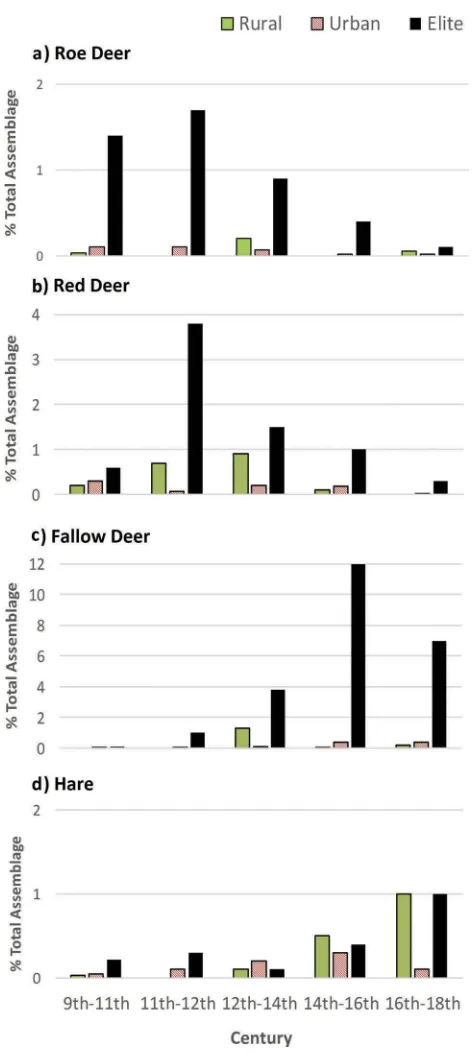
In order to examine broad shifts in patterns of wild animal exploitation, zooarchaeological data from 815 English animal bone assemblages dating from the Neolithic to post-medieval periods were synthesized. In addition to the species mentioned above, data pertaining to the aurochs (Bos primagenius) and wild boar (Sus scrofa) were included in the synthesis. These data derived from the work of Sykes (2007b), Hambleton (2008), Allen (2010), Poole (2010) and Serjeantson (2011), all of which used broadly comparable methods (e.g. all are based on number of identified specimens and include only assemblages with >100 identifiable specimens). The exception is that shed antlers, which do not reflect exploitation for food, were included in Serjeantson’s (2011) and Hambleton’s (2008) datasets but excluded from those of Sykes (2007b), Allen (2010), Poole (2010)– thus wild animal exploitation is artificially inflated for the Neolithic to Iron Age periods compared with the Roman and medieval data. The data for the medieval period (219 assemblages) are shown in more detail in Table 1, which specifies the site type and number of assemblages used to calculate the changing representations of red deer, roe deer, fallow deer and hare between the ninth and eighteenth centuriesAD (Figure 2(a–d)).
10,000 years of wild foods in England
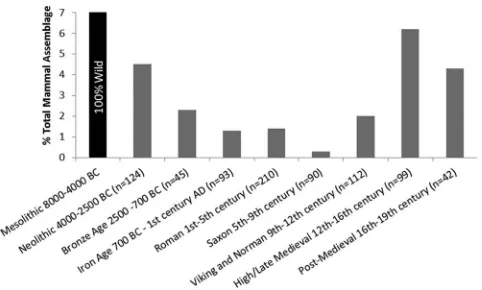
The diachronic variation in the frequency of wild animals represented in English zooarchaeological assemblages is summarized in Figure 1. It can be seen that, by contrast to the Mesolithic period where assemblages are composed almost entirely of wild animals, those from Neolithic sites in England contain less than 5 per cent (Serjeantson2011; Schulting2013). Furthermore, where wild animal remains have been recovered on Neolithic sites, they consist primarily of shed antlers from red deer so cannot be seen evidence for venison consumption (Serjeantson2011).
[image:4.536.60.479.603.646.2]It is unlikely that Neolithic people were ambivalent about wild animals; on the contrary, close relationships must have existed to motivate the many translocations of wild ungulate species that occurred during the period. Recent zooarchaeological and genetic studies make clear that it was in the Neolithic that red deer and wild boar were first introduced to Ireland (Carden et al. 2012; Carden 2012) and several Scottish Isles saw the importation of red deer (Mulville 2010; Stanton, Mulville and Bruford 2016). Some of these islands may have functioned as self-sustaining game reserves, the animals being left to roam and breed without fear of natural predation so that they
Table 1.Sample sizes for medieval England–number of animal bone assemblages by date (centuryAD) and site
type
Site Type 9th–11th 11th–12th 12th–14th 14th–16th 16th–18th
Rural 5 3 8 4 2
Urban 19 19 27 18 21
could be hunted on occasions of human visitation. Certainly, some assemblages from the Scottish Isles show heavy exploitation of red deer (Mulville2010). These Scottish data bring into relief the dearth of evidence for wild animal exploitation in England, strengthening suggestions that a cultural taboo over the consumption of all wild resources – mammals, birds and fish – may have existed during the Neolithic (Richards and Schulting 2006; Pollard2006; Serjeantson 2011; Sykes2014b).
The apparent lack of wild animal exploitation in England seemingly endured through the Bronze Age and Iron Age, for, although rates of representation are artificially inflated by the inclusion of shed antlers (Figure 1), they continue to fall steadily. As in the Neolithic period, however, wild animals were translocated, the brown hare seemingly being introduced to Britain at some point during the Bronze Age or Iron Age (Sykes 2014b, 88–90). The brown hare does not appear, initially, to have been considered‘edible’since Caesar’s account of the Britons, stated that
‘hare. . .they think it unlawful to eat’ (V.12–trans. Handford1982, 111). In the absence of human exploitation, it must be assumed that populations of wild animals were kept in balance by predation from the wolves (Canis lupus), bears (Ursus arctos) and lynx (Lynx lynx) that still inhabited England at this time (Hammon2010; Hetherington2010; Pluskowski2010). The situation began to change, however, with the rise and expansion of the Roman Empire, which brought with it new cultural attitudes to the natural world.
[image:5.536.149.390.51.196.2]Across the Roman Empire, the exploitation of wild animals became part of elite culture (e.g. Anderson1985; Dunbabin 2004). Although the zooarchaeological representation of wild animals does not appear to increase dramatically on Roman sites in England (Figure 1) this is partly an artifice created by the exclusion of shed antlers from the dataset for this period. Those who have studied the faunal evidence in detail have demonstrated a clear Iron Age to Roman increase in the utilization of wild resources, particularly in large villas and military centres (Allen 2014). Populations of brown hares were cultivated in enclosures known asleporaria, with newly imported fallow deer herds being maintained in larger parks calledvivaria(Sykes2010). The hunting culture transported by the Romans was not to last however: following withdrawal of the Roman Empire
from Britain, cultural attitudes to wild animals appear to have reverted to the pre-Roman situation, with the re-emergence of a taboo over their consumption (Sykes2014b). Genetic data suggest that any established fallow deer populations became quickly extinct (Sykes et al. forthcoming), and brown hare populations presumably escaped their leporaria to become feral in the wider landscape.
After approximately four centuries of limited exploitation, the concept that wild animals might represent‘food’gradually returned in the medieval period, starting in about the ninth centuryAD and reaching an apogee between the twelfth and sixteenth century (Figure 1). Before examining this period in detail, it is interesting to reflect upon the changing attitudes to the consumption of wild animals. At the most basic level, trends in exploitation can be seen as charting attitudes to the natural world, which in turn are related to levels of trade as well as settlement and social complexity (Sykes2014b). For instance, it is noticeable that the two periods in which wild animals were regularly consumed – Roman and medieval (ninth-fifteenth centuries) – were also those characterized by internationalism, imperialism, urbanism and social hierarchy, combined with belief systems that put humans at the top of the‘chain of being’, thus entitling them to dominate nature. These factors put in place the mechanisms for obtaining and distributing exotic species but also for supporting the non-productive populations who wished to express their elite identity through the production, distribution and consumption of game. In England, the links between wild animal exploitation and elite status are particularly evident in the context of feudal structure of the medieval period, to which we now turn.
The medieval legacy
Figure 2shows the changing representation of roe deer, red deer, fallow deer and hare through time and according to site type. Altogether it clearly demonstrates that the emergence of wild animal exploitation was driven by the social elite, with high-status sites consistently indicating a higher representation of hare and deer bones than is seen at other site types. Initially, the two native deer species were the focus of hunting: roe deer were the principal quarry between the ninth and eleventh century, with red deer becoming more heavily exploited species between the eleventh and twelfth century. It seems possible that over-hunting during this period was respon-sible for the population declines that are indicated not only by the zooarchaeological record (Figure 2(a, b)) but also, in the case of roe deer, by genetic studies (Baker 2011). Attempts to establish more accessible sources of venison may have been the motivation for the reintroduction of fallow deer, which reappear in English zooarchaeological assemblages during the eleventh century (Figure 2(c)). Genetic analysis of ancient and modern fallow deer indicates that, following their post-Roman extirpation, populations were imported to England from the eastern Mediterranean (Sykes et al. in prep.). The evidence points to contact with the Byzantine Empire, where the elite passion for hunting and the emparkment of wild ungulates persisted unbroken from the Roman period (Ševčenko2002) and was most likely introduced to England around the time of the Norman Conquest (Sykes2007b).
deer parks were created, at great expense, to enable the production of surplus venison: it is estimated that by 1300ADmore than 3,000 had been established, covering about 2 per cent of the total area of countryside (Rackham1986, 123; Sykes et al.2016). Within these parks, warrens were also set up for keeping hares and rabbits, the latter having been introduced to England in late twelfth century as a source of food (Sykes and Curl2010). Efforts by the elite to preserve game were not only limited to the transformation of the English landscape and its biodiversity (with the introduction of new species) but also involved the eradication of top predators that competed for these sought-after resources: by the end of the medieval period England’s bear, wolf and lynx populations had all been become locally extirpated (Hammon 2010; Hetherington 2010; Pluskowski 2010). Figure 2(c, d) provides an indication of how successful these measures were, with both fallow deer and hare frequencies reaching unprecedented levels in fourteenth– six-teenth-century assemblages.
Ironically, the efforts that the elite went to in order to maintain a ready supply of game can be cited as the very factors that led to the demise of game consumption within English culture. With what was essentially the farming of deer, hares and rabbits, game became easier to acquire as it percolated into the urban black market and even became a staple of peasant feasts (Birrell1992, 1996; Sykes2007a).Figure 2(c, d) shows evidence of increased representation of fallow deer and hare on lower-status rural and/or urban sites in the later medieval periods. As soon as game was no longer the preserve of the elite, it lost its status associations and the aristocracy began to scale down their parks and warrens, reducing their consumption of game, as can be seen particularly in Figure 2(c). Of course, once the elite lost interest in game, the lower social echelons soon did likewise and the levels of exploitation gradually declined across the board. This overarching cultural shift away from game is highlighted inFigure 1, which shows a substantial drop in the frequency of wild animal representation in assemblages dating between the sixteenth and nine-teenth centuries, a downward trend in exploitation that has continued in England to the present day (Sykes and Putman2014; Riminton2013).
Surplus for the present?
The last 500 years have seen perhaps the greatest change in cultural attitudes to the natural world, arguably a more dramatic change than has been witnessed in the entirety of human history (Thomas1983). Across Europe, the rapid growth of internationalization, urbanization and intensive farming has seen human populations expand and become increasingly divorced from traditional rural practices and concerns (Sykes and Putman 2014). Whereas the archaeological record would suggest that, as in the Roman and medieval periods, these conditions are conducive to fostering elite hunting cultures, the collapse of feudalism altered both perceptions and expressions of social identity. Rather than desiring to‘dominate’nature, modern English attitudes to the natural world show similarities to those of the Neolithic and Iron Age, with the general public seeing wild animals as sacred icons of the wilderness and, therefore, above human exploitation.
animals ought to contribute more to the human food chain in England (Riminton2013). Similar calls are being made for other regions of the world, particularly where wild animals were translocated by past generations and now represent ecological problems (Nugent and Fraser 1993; Cawthorn and Hoffman 2014). In New Zealand, for instance, non-native deer that were released in the 1800s were traditionally considered a conservation problem until they were recently ‘rebranded’ as a food resource. New Zealand venison is now exported globally and is more likely to be present on English supermarket shelves than locally sourced English venison (Riminton2013; Nugent and Fraser 1993).
It is bizarre that New Zealand venison is being imported to Britain, while locally obtained venison is, in turn, exported to mainland Europe (Riminton2013). There would seem to be a need to recalibrate British perceptions of wild foods and one way this might be achieved is to present to the public the deep-time evidence and the biodiversity issues unwittingly created by the actions of the medieval elite and the landed estate deer collections of the nineteenth century (MacMillan and Phillip 2008; Riminton2013; Sykes and Putman 2014). Another way forward may be to actively promote the democratization of game, as its enduring elite associations serve only to strengthen public opposition to wild animal consumption (Riminton2013). In other European countries, such as Norway and Sweden, the exploitation and consumption of wild animals is socially widespread and undertaken on a more egalitarian basis (Apollonio, Andersen, and Putman2010). To a large extent, this situation reflects the socio-political history of Scandinavia and it would be difficult to superimpose a similar approach in England, where current attitudes are ingrained and equally linked to the country’s socio-political past. As such, the outlook for wild mammal exploitation and management in England is concerning. However, studies of the past provide some comfort in this regard since the zooarchaeological record demonstrates that attitudes to the management and consumption of wild animals can change, have changed repeatedly in the past, and will certainly continue to do so.
Conclusions
Cultural attitudes towards foodstuffs are dynamic, with perceptions of edibilityfluctuating through time, as is the case for wild animals. Although the ‘received wisdom’ is that ancient civilizations gained large quantities of their subsistence through hunting, the zooarchaeological evidence suggests that this was not the case in England. In fact, based on the English evidence, humans appear to have spent the majority of the last 10,000 years deliberately avoiding the consumption of wild animals. There is still a cultural tendency towards avoidance; however, today, the para-meters have changed: the humans of the Roman and medieval periods left a legacy of exotic animal establishments (hares, fallow deer and rabbits) and extinctions (bears, lynx, wolves) that now require intervention.
At the same time, the zooarchaelogical record contains warnings about the human capacity to over-exploit‘surplus’resources. For instance, the fallow deer introduced during the Roman period were quickly brought to extinction, and there is growing evidence that over-hunting during the medieval period extirpated English red deer and roe deer populations (e.g. Baker2011; Sykes and Putman2014). These past examples need to be kept in mind as there is every possibility that the same could happen again if management strategies were unchecked.
The approach presented here–to interrogate zooarchaeological data and bring the results to bear on modern-day issues–requires the evidence to be considered within its unique bio-cultural context. It would not be possible for the results of this case study to be applied, say, to East Africa where hunting for bush meat as food surplus is devastating biodiversity (Brashares et al. 2004; Jenkins et al.2011). Nor are they applicable even to Scotland where the country’s socio-cultural development has evolved a very different attitude to wild resources, with its own unique set of problems. Nevertheless, while the results of this paper are not transferable, the approach is. And it has the potential to enable zooarchaeologists not only to generate insights about past cultures and their attitudes to the natural world but also to effect change in the present.
Acknowledgements
I am grateful to Amy Bogaard for encouraging and supporting this article, to Graham Riminton for his comments on the draft and to the two anonymous reviewers whose feedback not only improved this article but also gave me ideas and readings for future research. Thank you.
Disclosure statement
No potential conflict of interest was reported by the author.
Funding
This work was supported by the Arts and Humanities Research Council [grant numbers AH/I026456/1, AH/N004558/1].
Notes on contributor
Naomi Sykesis associate professor in zooarchaeology at the University of Nottingham and co-editor of the
International Journal of Osteoarchaeology. Her research focuses on human-animal-landscape interactions and how they inform on the structure, ideology and environmental impact of societies, past and present.
References
Allen, M. 2010. “Animalscapes and empires: New perspectives on the Iron Age/Romano-British transition.” PhD diss. University of Nottingham.
Allen, M. G. 2014. “Chasing Sylvia’s Stag: Placing Deer in the Countryside of Roman Britain.” InDeer and People, edited by K. Baker, R. F. Carden, and R. Madgwick, 174–186. Oxford: Windgather Press.
Anderson, J. K.1985.Hunting in the Ancient World. London: University of California Press.
Baker, K.2011. “Population genetic history of the British roe deer (Capreolus capreolus) and its implica-tions for diversity and fitness.” PhD thesis. School of Biological and Biomedical Sciences, Durham University, UK.
Barringer, J. M.2001.The Hunt in Ancient Greece. Baltimore: JHU Press.
Birrell, J.1992.“Deer and Deer Farming in Medieval England.”Agricultural History Review40 (2): 112–126. Birrell, J.1996.“Peasant Deer Poachers in the Medieval Forest.”InProgress and Problems in Medieval England:
Essays in Honour of Edward Miller, edited by R. Britnell and J. Hatcher, 68–88. Cambridge: Cambridge University Press.
Birrell, J.2006. “Procuring, Preparing and Serving Venison in Late Medieval England.” InFood in Medieval England: History and Archaeology, edited by C. Woolgar, D. Serjeantson, and T. Waldron, 176–188. Oxford: Oxford University Press.
Bogaard, A., M. Charles, K. C. Twiss, A. Fairbairn, N. Yalman, D. Filipović, and J. Henecke.2009.“Private Pantries and Celebrated Surplus: Storing and Sharing Food at Neolithic Çatalhöyük, Central Anatolia.”Antiquity83 (321): 649–668. doi:10.1017/S0003598X00098896.
Brashares, J. S., P. Arcese, M. K. Sam, P. B. Coppolillo, A. R. E. Sinclair, and A. Balmford. 2004.“Bushmeat Hunting, Wildlife Declines, and Fish Supply in West Africa.” Science 306: 1180–1183. doi:10.1126/ science.1102425.
Carden, R. F.2012.“Review of the Natural History of Wild Boar (Sus Scrofa) on the Island of Ireland.”Report for the Northern Ireland Environment Agency, Northern Ireland, UK, National Parks & Wildlife Service, Department of Arts, Heritage and the Gaeltacht, Dublin, Ireland and the National Museum of Ireland – Education & Outreach Department.
Carden, R. F., A. D. McDevitt, F. E. Zachos, P. C. Woodman, P. O’Toole, H. Rose, and C. J. Edwards.2012.
“Phylogeographic, Ancient DNA, Fossil and Morphometric Analyses Reveal Ancient and Modern Introductions of a Large Mammal: The Complex Case of Red Deer (Cervus Elaphus) in Ireland.”
Quaternary Science Reviews42: 74–84. doi:10.1016/j.quascirev.2012.02.012.
Cartmill, M. 1993. A View to A Death in the Morning: Hunting and Nature through History. Cambridge, MA: Harvard University Press.
Cawthorn, D.-M., and L. C. Hoffman. 2014. “The Role of Traditional and Non-Traditional Meat Animals in Feeding a Growing and Evolving World.”Animal Frontiers4 (4): 6–12. doi:10.2527/af.2014-0027.
Chesson, M. S., and N. Goodale. 2014. “Population Aggregation, Residential Storage and Socioeconomic Inequality at Early Bronze Age Numayra, Jordan.” Journal of Anthropological Archaeology 35: 117–134. doi:10.1016/j.jaa.2014.02.002.
Dietl, G. P., S. M. Kidwell, M. Brenner, D. A. Burney, K. W. Flessa, S. T. Jackson, and P. L. Koch. 2015.
“Conservation Paleobiology: Leveraging Knowledge of the past to Inform Conservation and Restoration.”
Annual Review of Earth and Planetary Sciences43: 79–103. doi:10.1146/annurev-earth-040610-133349. Dunbabin, K. M. D.2004.The Roman Banquet: Images of Conviviality. Cambridge: Cambridge University Press. Emery, K. F.2007.“Assessing the Impact of Ancient Maya Animal Use.”Journal for Nature Conservation15:
184–195. doi:10.1016/j.jnc.2007.05.002.
Etnier, M. A.2007.“Defining and Identifying Sustainable Harvests of Resources: Archaeological Examples of Pinniped Harvests in the Eastern North Pacific.”Journal for Nature Conservation15: 196–207. doi:10.1016/j. jnc.2007.04.003.
Farouk, M. M., J. M. Regenstein, M. R. Pirie, R. Najm, A. E. D. Bekhit, and S. O. Knowles.2015.“Spiritual Aspects of Meat and Nutritional Security: Perspectives and Responsibilities of the Abrahamic Faiths.”Food Research International76: 882–895. doi:10.1016/j.foodres.2015.05.028.
Fritz, G. J.2007.“Pigweeds for the Ancestors: Cultural Identities and Archaeobotanical Identification Methods.” In The Archaeology of Food and Identity, edited by K. C. Twiss, 288–307. Carbondale: Southern Illinois University Carbondale.
Grant, A.1981.“The Significance of Deer Remains at Occupation Sites of the Iron Age to the Anglo-Saxon Period.”InThe Environment of Man: the Iron Age to the Anglo-Saxon Period (British Archaeologocal Reports, British Series 87), edited by M. Jones and G. Dimbleby, 205–213. Oxford: Archeopress.
Griffin, E.2007.Blood Sport: Hunting in Britain since 1066. Bury St Edmunds: Yale University Press. Gruber, K.2016.“Rodent Meat–A Sustainable Way to Feed the World?”EMBO reports17 (5): 630–633. Hambleton, E.2008.Review of Middle Bronze Age to Late Iron Age Faunal Assemblages from Southern Britain.
Hamilakis, Y. 2003. “The Sacred Geography of Hunting: Wild Animals, Social Power and Gender in Early Farming Societies.”InZooarchaeology in Greece: Recent Advances, edited by E. Kotjabopoulou, Y. Hamilakis, P. Halstead, C. Gamble, and V. Elafanti, 239–247. London: British School at Athens.
Hammon, A.2010.“The Brown Bear.”InExtinctions and Invasions: A Social History of British Fauna, edited by T. O’Connor and N. Sykes, 96–103. Oxford: Windgather Press.
Handford, S. A.1982.Caesar: the Conquest of Gaul. London: Penguin.
Hetherington, D.2010.“The Lynx.”InExtinctions and Invasions: A Social History of British Fauna, edited by T. O’Connor and N. Sykes, 75–82. Oxford: Windgather Press.
Hoffman, L. C., and D. Cawthorn.2013.“Exotic Protein Sources to Meet All Needs.”Meat Science95 (4): 764– 771. doi:10.1016/j.meatsci.2013.04.027.
Jenkins, R. K. B., A. Keane, A. R. Rakotoarivelo, V. Rakotomboavonjy, F. H. Randrianandrianina, H. J. Razafimanahaka, S. R. Ralaiarimalala, and J. P. G. Jones. 2011. “Analysis of Patterns of Bushmeat Consumption Reveals Extensive Exploitation of Protected Species in Eastern Madagascar.” PLoS ONE 6: e27570. doi:10.1371/journal.pone.0027570.
Kuijt, I., and B. Finlayson.2009.“Evidence for Food Storage and Predomestication Granaries 11,000 Years Ago in the Jordan Valley.”Proceedings of the National Academy of Sciences106 (27): 10966–10970. doi:10.1073/ pnas.0812764106.
MacMillan, D. C., and S. Phillip. 2008. “Consumptive and Non-Consumptive Values of Wild Mammals in Britain.”Mammal Review38 (2-3): 189–204. doi:10.1111/j.1365-2907.2008.00124.x.
Meyer-Rochow, V. B., K. Megu, and J. Chakravorty.2015.“Rats: If You Can’t Beat Them Eat Them! (Tricks of the Trade Observed among the Adi and Other North-East Indian Tribals).” Journal of Ethnobiology and Ethnomedicine11 (1): 1. doi:10.1186/s13002-015-0034-2.
Mulville, J.2010.“Red Deer on Scottish Islands.”InExtinctions and Invasions: A Social History of British Fauna, edited by T. O’Connor and N. Sykes, 43–50. Oxford: Windgather Press.
Nugent, G., and K. W. Fraser. 1993. “Pests or Valued Resources? Conflicts in Management of Deer.” New Zealand Journal of Zoology20 (4): 361–366. doi:10.1080/03014223.1993.10420359.
O’Shea, J.1989.“The Role of Wild Resources in Small-Scale Agricultural Systems: Tales from the Lakes and the Plains.” In Bad Year Economics, edited by J. O’Shea and P. Halstead, 57–69. Cambridge: Cambridge University Press.
Pluskowski, A. 2010.“The Wolf.” InExtinctions and Invasions: A Social History of British Fauna, edited by T. O’Connor and N. Sykes, 68–74. Oxford: Windgather Press.
Pollard, J.2006.“A Community of Beings: Animals and People in the Neolithic of Southern Britain.”InAnimals in the Neolithic of Britain and Europe, edited by D. Serjeantson and D. Field, 135–148. Oxford: Oxbow. Poole, K.2010.“The Nature of Society in England AD 410-1066.”PhD diss. University of Nottingham. Poole, K. 2013.“Horses for Courses? Religious Change and Dietary Shifts in Anglo-Saxon England.”Oxford
Journal of Archaeology32 (3): 319–333. doi:10.1111/ojoa.2013.32.issue-3. Postnote 325.2009.http://www.parliament.uk/documents/post/postpn325.pdf
Rackham, O.1986.The History of the Countryside. London: Phoenix Press.
Richards, M. P., and R. Schulting.2006.“Touch Not the Fish: The Mesolithic-Neolithic Change of Diet and Its Significance.”Antiquity80 (308): 444–456. doi:10.1017/S0003598X00093765.
Riminton, R. G.2013.“Wild Food Networks: A Case Study Exploration from Central and East England.”PhD diss. University of Nottingham.
Schulting, R.2013.“On the Northwestern Fringes: Early Neolithic Subsistence in Britain and Ireland as Seen through Faunal Remains and Stable Isotopes.”InThe Origins and Spread of Domestic Animals in Southwest Asia and Europe, edited by S. Colledge, S. Connoly, K. Dobney, K. Manning, and S. Shennan, 313–338. California: Left Coast Press.
Serjeantson, D.2011.Review of Animal Remains from the Neolithic and Early Bronze Age of Southern Britain. Portsmouth: English Heritage.
Ševčenko, N. P. 2002.“Wild Animals in the Byzantine Park.”In Byzantine Garden Culture, edited by A. R. Littlewood, H. Magiure, and J. Wolschke-Bulmahn, 69–86. Washington DC: Dumbarton Oaks.
Stanton, D. W. G., J. A. Mulville, and M. W. Bruford. 2016.“Colonization of the Scottish Islands via Long-Distance Neolithic Transport of Red Deer (Cervus Elaphus).”Proceedings R Social B283: 1828. doi:10.1098/ rspb.2016.0095.
Sykes, N.2010.“Worldviews in Transition: the Impact of Exotic Plants and Animals on Iron Age/Romano-British Landscapes.”Landscapes10 (2): 19–36. doi:10.1179/lan.2010.10.2.19.
Sykes, N.2014a.“Hunting and Hunting Landscapes.”InEncyclopedia of Global Archaeology, 3592–3611. New York: Springer.
Sykes, N.2014b.Beastly Questions: Animal Answers to Archaeological Issues. London: Bloomsbury Press. Sykes, N., G. Ayton, F. Bowen, K. Baker, P. Baker, R. F. Carden, C. Dicken, et al.2016.“Wild to Domestic and Back
Again: the Dynamics of Fallow Deer Management in Medieval England (C. 11th-16th Century AD).”STAR: Science & Technology of Archaeological Research2 (1): 113–126. doi:10.1080/20548923.2016.1208027. Sykes, N., K. Baker, T. Higham, and A. R. Hoelzel.Forthcoming.Population Dynamics of the British Fallow Deer
from the 1stto the 21stCentury. Paper not yet submitted.
Sykes, N., and J. Curl.2010.“The Rabbit.”InExtinctions and Invasions: A Social History of British Fauna, edited by T. O’Connor and N. Sykes, 116–126. Oxford: Windgather.
Sykes, N., and R. Putman.2014.“Management of Ungulates in the 21stCentury: How Far Have We Come?”In
Behaviour and Management of European Ungulates, edited by R. Putman and M. Apollonio, 267–289, Dunbeath: Whittles Publishing.
Sykes, N. J.2007a.“Taking Sides: the Social Life of Venison in Medieval England.”InBreaking and Shaping Beastly Bodies: Animals as Material Culture in the Middle Ages, edited by A. Pluskowski, 149–160. Oxford: Oxbow.
Sykes, N. J.2007b.The Norman Conquest: A Zooarchaeological Perspective. Oxford: Archaeopress.
Thomas, K.1983.Man and the Natural World: Changing Attitudes in England 1500-1800. London: Penguin. Valenzuela, A., K. Baker, R. F. Carden, J. Evans, T. Higham, A. R. Hoelzel, A. Lamb, et al.2016.“Both Introduced
and Extinct: The Fallow Deer of Roman Mallorca.”Journal of Archaeological Science: Reports9: 168–177. doi:10.1016/j.jasrep.2016.06.038.
Vigne, J. D., J. Daujat, and H. Monchot.2015.“First Introduction and Early Exploitation of the Persian Fallow Deer on Cyprus (8000–6000 Cal. BC).”International Journal of Osteoarchaeology26 (5): 853–866.