
Highway Traffic Noise: Frequently Asked Questions
Highway Traffic Noise
Frequently Asked Questions
1.
What is Noise?
Noise is described as unwanted sound. The general principle on which most noise acceptability criteria are based is that a change in noise is likely to cause annoyance whenever it intrudes upon the existing noise from all other sources. Essentially, the level of annoyance depends upon the noise that exists before the introduction of a new noise generating source or a modification of an existing noise-generating source.
2.
What metric is used to describe noise?
• The decibel (dB) is a unit of measure of noise level.
• The human ear does not perceive all sound frequencies equally well. For traffic noise purposes the A-weighted scale, which closely
approximates the range of frequencies a human ear can hear, is used. The A-weighted decibel is abbreviated dB(A).
3.
How is a change in noise perceived?
The average person’s ability to perceive changes in noise levels is well documented.Generally:
• changes in noise levels of less than 3 dB(A) would barely be perceived by most people,
• a 5 dB(A) change is readily noticeable, and
Highway Traffic Noise: Frequently Asked Questions
4.
What are noise sources?
• Noise sources are equipment or processes directly responsible for the sound generation. • The two main types of noise sources are mobile and stationary noise
sources.
o Mobile noise sources are those that move in relation to a noise-sensitive receptor, such as vehicles, aircraft, and trains.
o Stationary noise sources are those that do not move in relation to a noise-sensitive receptor, such as mechanical equipment.
• Roadway traffic is one of the more dominant sources of noise in urban and rural areas of Florida.
• Sound produced by highway traffic comes mainly from the tires, engines and mufflers of cars and trucks.
5.
How is traffic noise typically described as?
As few noises are constant, methods have been developed to describe varying noise levels over extended periods. Traffic sound levels are never constant due to the changing number, type and speed of vehicles. A single value is used to represent the fluctuating noise heard over a specific period as if it were a steady, unchanging sound, expressed as the Leq.
Highway Traffic Noise: Frequently Asked Questions
6.
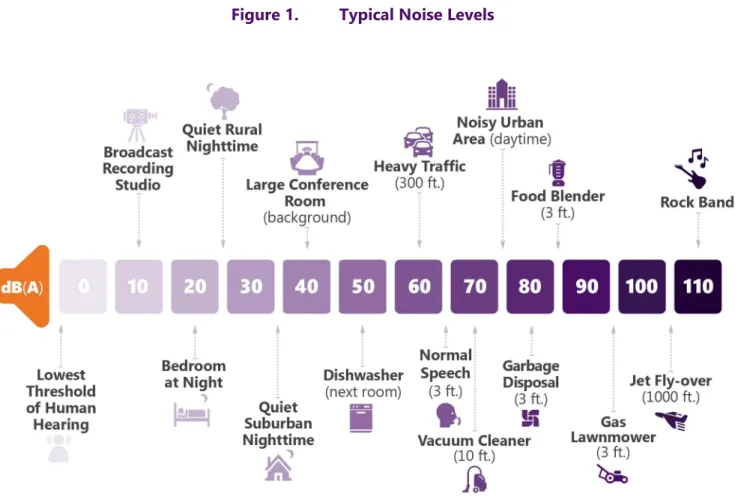
How does traffic noise relate to other sources of noise?
Figure 1 illustrates how traffic noise levels relate to other sound sources.
Highway Traffic Noise: Frequently Asked Questions
7.
How is the noise level from each source combined to
determine the total noise level?
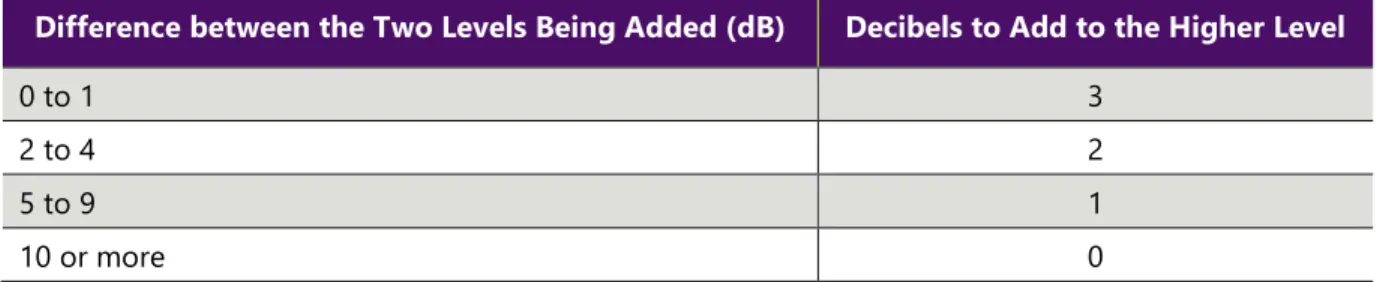
Decibels are logarithmic units and are not added arithmetically.
Table 1 provides general procedures for decibel addition. The resulting noise level from two sources with the same noise level is 3 dB(A) greater than the noise level of just one source. So, two vehicles producing 60 dB(A) each combine to produce 63 dB(A), not 120 dB(A). The resulting noise level from one vehicle producing 70 dB(A)
and another vehicle producing 65 dB(A) would be equal to 1 dB(A) greater than the loudest source, resulting in a combined noise level of 71 dB(A). The resulting noise level from one vehicle producing 70 dB(A) and another vehicle producing 50 dB(A) would be equal to the loudest source, 70 dB(A).
Table 1: Rules of Thumb for Adding Sound Levels Together
Difference between the Two Levels Being Added (dB) Decibels to Add to the Higher Level
0 to 1 3
2 to 4 2
5 to 9 1
10 or more 0
Source: Highway Traffic Noise Analysis and Abatement Policy and Guidance, U.S. Department of Transportation Federal
Highway Administration, June 1995.
8.
How are noise impacts evaluated?
To evaluate potential noise impacts, a noise study consists of the following steps:
• Identify the land use activity areas along the corridor that may be impacted by traffic noise • Using the Federal Highway Administration (FHWA) Traffic Noise Model (TNM)
− Determine existing noise levels at receptors based on existing conditions (topography, roadway alignment, elevation, receptor location, traffic volume, speed and vehicle types, etc.)
− Determine predicted future noise levels at receptors under conditions with and without the proposed project
Highway Traffic Noise: Frequently Asked Questions
9.
What is a noise receptor?
• The subject of most noise analyses are noise-sensitive receptors. These are existing locations or locations permitted for construction where human activity may be adversely affected by an increase in noise levels.
• In determining traffic noise impacts, primary consideration is given to exterior areas where frequent human use occurs, unless no exterior activities are likely based on field
observation.
10.
How is noise reduced from the roadway to a
receptor?
Sound intensity is loudest at the noise source (roadway) and decreases as it travels away from the source. The decrease of the noise as it travels varies
dependent on the type of noise source, the topography and the presence of obstructions, such as buildings and walls.
11.
Are noise measurements obtained to perform a noise
study?
Noise measurements are obtained for the purpose of validating that the computer model that is being used to perform the highway traffic noise analysis (TNM) can accurately predict the existing traffic noise. The levels are obtained at several locations within the
project limits. The recorded traffic data during each noise measurement period, as well as information about the location where the measurements are made are ‘re-created” in the computer model. Noise analysis is based on FDOT policy that states, the model will be considered validated within an acceptable level of accuracy if the measured and predicted noise levels are within a tolerance standard of 3 dB.
Highway Traffic Noise: Frequently Asked Questions
12.
When is noise abatement (mitigation) necessary?
The FHWA Noise Abatement Criteria (NAC), listed in Table 2, provide the noise level, depending upon activity land use category, at which noise abatement should be considered for an
impacted receptor.
According to FDOT policy, noise abatement is considered if predicted noise levels for one or more receptors are:
• within 1 dB(A) of the appropriate FHWA abatement criteria; OR • 15 dB(A) or more higher than the existing noise levels.
Table 2. Noise Abatement Criteria [Hourly A-Weighted Sound Level – decibels (dB(A))]
Activity Category
Activity Leq(h)1
Evaluation
Location Description of Activity Category
FHWA FDOT
A 57 56 Exterior
Lands on which serenity and quiet are of extraordinary significance and serve an important public need and where the preservation of those qualities is essential if the area is to continue to serve its intended purpose.
B2 67 66 Exterior Residential
C2 67 66 Exterior
Active sports areas, amphitheaters, auditoriums, campgrounds, cemeteries, day care centers, hospitals, libraries, medical facilities, parks, picnic areas, places of worship, playgrounds, public meeting rooms, public or nonprofit institutional structures, radio studios, recording studios, recreational areas, Section 4(f) sites, schools, television studios, trails, and trail crossings.
D 52 51 Interior
Auditoriums, day care centers, hospitals, libraries, medical facilities, places of worship, public meeting rooms, public or nonprofit institutional structures, radio studios, recording studios, schools, and television studios.
E2 72 71 Exterior Hotels, motels, offices, restaurants/bars, and other developed lands, properties
or activities not included in A-D or F.
F --- --- Exterior
Agriculture, airports, bus yards, emergency services, industrial, logging, maintenance facilities, manufacturing, mining, rail yards, retail facilities, shipyards, utilities (water resources, water treatment, electrical), and warehousing.
G --- --- --- Undeveloped lands that are not permitted.
Highway Traffic Noise: Frequently Asked Questions
13.
What is a noise abatement measure?
A noise abatement measure is an action taken to reduce the impact of noise on a land use activity area.
14.
What type of noise abatement measures are typically
considered for traffic noise in an urban environment?
The most common type of traffic noise abatement measure is the construction of a noise barrier. Other noise abatement measures typically considered include traffic management measures, and modifications to the alignment or height of a roadway.
15.
What are noise barriers and how do they work?
Noise barriers are one of the most effective means of mitigating noise. Noise barriers are built between the noise source (highway) and the impacted land use area
to reduce noise levels.
16.
What types of noise barriers are there?
Noise barriers are typically solid wall-like structures, usually constructed of concrete or masonry. However, barriers can also be formed from earth piled into a large mound or berm (earth berm). Berms require a large area to reach the height required to be effective. Vegetation such as trees, shrubs and grasses, offer little reduction in noise levels.
Highway Traffic Noise: Frequently Asked Questions
17.
Will a noise barrier completely eliminate all traffic
noise?
The purpose of a noise barrier is to reduce noise levels for people nearby. This is achieved by blocking the sound from the receptor. Sound produced by highway traffic comes mainly from the tires, engines and mufflers of cars and trucks. However, no barrier can eliminate all traffic noise.
18.
How are noise barriers designed?
During the PD&E phase of a project, the approximate noise barrier location and height
information is determined based on the highway traffic noise analysis, using TNM. Noise barrier design is a very complex process that takes into consideration:
• highway features and distances between the highway and land use areas • number and category of impacted receptors
• access to land use areas from the highway for routine and emergency traffic • adequate visibility around noise barriers to ensure motorist and pedestrian safety • ability of the noise barrier (height, length and material) to effectively reduce noise level • reasonable cost of construction and maintenance
• avoidance of utilities and easements
• meeting the FDOT feasibility and reasonableness criteria • desires of the public
19.
What are the FDOT feasibility and reasonableness
criteria?
When considering noise barriers for noise abatement, the feasibility and reasonableness factors must be evaluated.
Highway Traffic Noise: Frequently Asked Questions
− The feasibility of providing noise abatement is focused on the ability of the noise barrier to provide a reduction of 5 dB(A) or greater at two (2) or more impacted receptors.
• Reasonableness:
− Once a noise abatement measure is determined to be feasible, the reasonableness of noise abatement is then determined.
− "Reasonableness" addresses the use of common sense and good judgment when considering noise abatement.
− The following reasonableness factors must collectively be achieved in order for the noise abatement measure to be deemed reasonable:
1. Consideration of the viewpoints of the benefited property owners and residents; 2. Cost effectiveness of the highway traffic noise abatement measure; and
3. Achievement of the FDOT noise reduction design goal
− The FDOT noise reduction goal is focused on the ability of the noise barrier to provide a reduction of 7 dB(A) or greater at one or more of the impacted receptors.
− In addition, barriers are considered to be cost reasonable if the cost per benefited receptor is no more than $42,000 (using a unit cost of $30 per ft2).
20.
Are noise barriers right for everyone?
Noise barriers are not always right for all people. They could result in: • Restricted views
• Feelings of confinement
• Loss of air circulation, sunlight and night lighting • Limited access to nearby streets
![Table 2. Noise Abatement Criteria [Hourly A-Weighted Sound Level – decibels (dB(A))]](https://thumb-us.123doks.com/thumbv2/123dok_us/8520984.2287534/6.918.75.824.457.981/table-noise-abatement-criteria-hourly-weighted-sound-decibels.webp)
