Online Journal of Applied Knowledge Management
A Publication of the International Institute for Applied Knowledge Management
Volume 1, Issue 1, 2013
42
On-page search engine optimization
analysis
Tanja Krunić, The Higher Technical School of Professional Studies, Novi Sad, Serbia, [email protected]
Abstract
Posting a Website on the Internet is not sufficient to promote business successfully. It is well-known that users mainly enter Websites only if they are listed among the first two search engine result pages. Search engine optimization is a set of steps to be performed in order to be well ranked by search engines. This is a continuous process and consists of two main groups of steps called on-page optimization and off-page optimization. This paper deals with several aspects of on-page optimization of Websites in practice. A survey is conducted on a sample of approximately 500 top 5 Google ranked Websites for relevant Keywords from different categories and countries.
Keywords: Search engine optimization; On-page factors; Keyword strategy; Heading optimization; Content optimization
Introduction
At the early stage of the Internet, having a Web presentation posted was a prestige reserved for the world's leading business companies. Nowadays, it is hard to imagine the existence of any company without having an appropriate Website. Companies post their presentations on the Web in order to advertise and sell their products, enlarge their business and create new contacts with potential business partners. On the other hand, the use of computers and the Internet also has exponentially grown. People surf the Internet to communicate, to have fun, to get information, etc. Using the Internet enables people to perform a lot of actions much faster. For example, only two decades ago, getting scientific information for a student meant spending hours in the library. Through the Internet, one can reach information in only a few minutes. Another example would be the customers. Nowadays, customers can choose and buy products using on-line catalogues and web stores. This takes significantly less time than walking through the city and entering numerous shops.
Search Engines
What makes it so easy to find the appropriate information for the user? It is the usage of search engines. The five most popular search engines are Google, Bing, Yahoo, Ask, and AOL. Figure 1 shows the number of their estimated unique monthly visitors in February 2013, announced by (eBusiness Knowledgebase, 2013). As we can see, Google is definitely the most popular.
with the input keywords. Of course, this list is indeed a weighted list, which means that all the appearing Websites are assessed by the search engines and ordered accordingly. Naturally, people search for information onl
Figure 1. Estimated uique monthly visitors of the most popular search engines
According to (Hayes, 2012), 62
41% will change their query if they don't find the desired information on the first page of the result list. So, if users are not able to find your company’s Website easily by using the most popular search engines like Google, it is as if your Website did not exist on the Web (Olsen, 2011). One can easily conclude that it is of great interest for a
(two) search engine result pages. Being highly ranked by the mos
even more advantages. Namely, in a survey (Hayes, 2012), 36% of search engine users claim to believe that the top ranked companies are the top brands in their field. This means that a top position can improve the company’s busi
has the possibility to accept another company’s advertisement banner and to enter into a pay per click contract (Thies, 2011).
Search Engine Optimization
In order to get indexed and ranked as highly as
web master should perform a number of steps known as Search Engine Optimization (SEO). It is the process of getting traffic from the listings on search engines. Web pages and other content such as videos or local listings are shown and ranked based on what the search engine considers most relevant to users (Search Engine Land
for page ranking, but the strategy of optimization for all of them is similar (Thies,
other hand, one should refer mainly to the optimization for Google, since it obviously has the largest number of users.
Google Bing Yahoo Ask
Aol 33,000,000
with the input keywords. Of course, this list is indeed a weighted list, which means that all the appearing Websites are assessed by the search engines and ordered accordingly. Naturally, people search for information only among the top five to 10 positioned Websites.
Estimated uique monthly visitors of the most popular search engines
According to (Hayes, 2012), 62% of search engine users click on results on the first page and 41% will change their query if they don't find the desired information on the first page of the result list. So, if users are not able to find your company’s Website easily by using the most ular search engines like Google, it is as if your Website did not exist on the Web (Olsen, 2011). One can easily conclude that it is of great interest for a Website to be listed on the first (two) search engine result pages. Being highly ranked by the most popular search engines has even more advantages. Namely, in a survey (Hayes, 2012), 36% of search engine users claim to believe that the top ranked companies are the top brands in their field. This means that a top position can improve the company’s business reputation. Also, a highly ranked
has the possibility to accept another company’s advertisement banner and to enter into a pay per
Search Engine Optimization
In order to get indexed and ranked as highly as possible by the most popular search engines, a web master should perform a number of steps known as Search Engine Optimization (SEO). It is the process of getting traffic from the listings on search engines. Web pages and other content ocal listings are shown and ranked based on what the search engine considers Search Engine Land, 2013). Every search engine has its own algorithm for page ranking, but the strategy of optimization for all of them is similar (Thies,
other hand, one should refer mainly to the optimization for Google, since it obviously has the
165,000,000 160,000,000 125,000,000 33,000,000
Estimated Unique Monthly Visitors
43
with the input keywords. Of course, this list is indeed a weighted list, which means that all the appearing Websites are assessed by the search engines and ordered accordingly. Naturally,
positioned Websites.
Estimated uique monthly visitors of the most popular search engines
of search engine users click on results on the first page and 41% will change their query if they don't find the desired information on the first page of the result list. So, if users are not able to find your company’s Website easily by using the most ular search engines like Google, it is as if your Website did not exist on the Web (Olsen, to be listed on the first t popular search engines has even more advantages. Namely, in a survey (Hayes, 2012), 36% of search engine users claim to believe that the top ranked companies are the top brands in their field. This means that a top ness reputation. Also, a highly ranked Website owner has the possibility to accept another company’s advertisement banner and to enter into a pay per
possible by the most popular search engines, a web master should perform a number of steps known as Search Engine Optimization (SEO). It is the process of getting traffic from the listings on search engines. Web pages and other content ocal listings are shown and ranked based on what the search engine considers , 2013). Every search engine has its own algorithm for page ranking, but the strategy of optimization for all of them is similar (Thies, 2011). On the other hand, one should refer mainly to the optimization for Google, since it obviously has the
Online Journal of Applied Knowledge Management
A Publication of the International Institute for Applied Knowledge Management
Volume 1, Issue 1, 2013
44
SEO consists of two groups of steps – on-page SEO and off-page SEO. On-page SEO is a strategy for modifying the content in order to attract search engine crawlers to index the Website. When we are talking about the content, we mean content, code and design (SEO Innovators, 2012).
The on-page SEO strategy concerning content consists of selecting the appropriate keywords and phrases for the Website. There are a few keyword research tools available on the Web, such as Google Adwords and Wordtracker, see (Adwords, 2013) and (Wordtracker, 2013). These tools can help find the most popular keywords from the desired field. But these keywords alone do not help much in SEO. A Web master should write a unique content using the keywords in the text, headings, and links. In the process of Web designing, one should provide an appropriate title, alt attribute and description for every image, because search engines cannot read images. Also, it is very important to use tile tags for every page by choosing the appropriate keywords relevant to the page. This is important because the title of the page appears in the search engine results as a clickable link. However, it should not be too long, as only the first 65 characters are displayed in the browser. Similarly, the Meta description tag should contain a short description about the content of the Website in order to attract the user’s attention. Again, it should contain some important keywords. Due to the same reason as with the title tag, the description of the page should contain at most 155 characters. But the Meta description tag is not only there for the user, it also tells the crawlers what the page is about. According to (Schachinger, 2012), if the description is poor, inappropriate or inaccurate, Google replaces it with its own version of what is on the page. This definitely could be an unpleasant surprise for SEOs with bad intentions. In spite of the expected, the Meta keywords tag is not important for the page ranking any more. The majority of search engines ignore them completely, except Microsoft Bing (Schachinger, 2012). But they also use them for detecting spam. So, making efforts to optimize this tag is definitely a waste of time.
Using XML site maps can help search engines crawl a Website. An XML site map is an XML file that contains information about the URLs on a Website, (Kyrnin, 2012). The site map can also contain information about the date when the file was last modified, how often it was modified and about the priority of the page.
45
box, (Submit Edge, n.d.). Of course, in order to target a group of potential users, the article theme should be close to your Website content.
Being active at social networks like Facebook, Twitter, Linkedin or MySpace can also help increasing your Website traffic. If you continually update your social network page and have a lot of contacts and visits, this can attract users to your Website, (SEO Chat, n.d.).
However, the most effective SEO strategy in 2012 is claimed to be an integrated approach, which means the promotion of quality on-page optimized content within the main social media channels (Direct Traffic Media, 2012).
The On-page SEO Survey
During the period from October 2012 to December 2012, a team of a Web design teachers and senior students of the Web design department of the Higher Education Technical School of Professional Studies conducted an investigation in the field of on-page SEO.
We used three online SEO analysis tools - lipperhey, alexea, and seomoz, (see the references section for the Web address of these tools) and checked 495 Websites from 7 different countries: Serbia, Croatia, Bosnia and Herzegovina, Australia, Canada, USA, and UK. We chose the top five Websites from the following 23 categories: toy stores, book stores, furniture, cars, clothes, confectionery, cosmetics, sporting goods departments, printing offices, newspapers, foreign language schools, watch stores, eyeglasses stores, home care, dental clinics, bicycle stores, health food stores, tourist agencies, banks, hotels, flower shops, computer shops. The aim herein is to realize trends of on-page optimization among the top ranked Websites in practice. The obtained data can serve as a recommendation on what on-page SEO steps SEOs (people who work on SEO) should pay more attention to. These recommendations could also be very useful for increasing usability, since as already mentioned, many on-page optimization factors also influence usability. In addition to a future off-page analysis and their comparation, this data can give us information on the role of on-page optimization within the complete SEO process.
Let us first explain the sample of Websites used in our investigation. First, we made a list of 23 random categories among the most frequently used search terms. Then, for four to five of the above-mentioned countries, we analysed the top five Websites for each category using one of the three SEO analysis tools listed above. Among many other available data, we were interested in the percentage of optimization of the following HTML elements:
• Meta description,
• Meta keywords,
• Title tag,
• H1 – tag,
• Other subheading tags,
• Text content,
Online Journal of Applied Knowledge Management
A Publication of the International Institute for Applied Knowledge Management
Volume 1, Issue 1, 2013
46 • Alt text, and
• The total optimization of the Website.
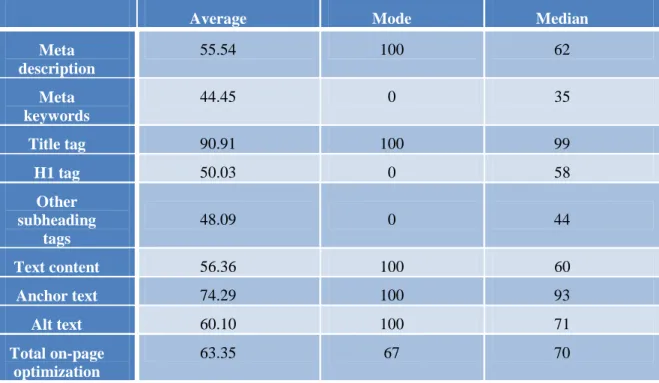
Besides, we were interested in the fact if the analyzed Websites had an XML site map. The obtained results are given in Table 1. The first column of the table represents the average values of every above-listed on-page SEO issue for all Websites from the survey, i.e. the sum of all obtained optimization values for each issue divided by 495. The second column in the table represents the mode values and other optimization issues. The mode in a list of numbers refers to the list of numbers that occur most frequently. The so-called ‘middle values’ or medians of the listed optimization issues are given in the third column. In order to obtain the median of a list of values, one has to sort the list in an increasing order. Then, if the totals of the list are odd, the median is just the middle entry. Otherwise, if the totals of the list are even, there appear to be two middle entries. To get the median one, has just to sum them and divide by two. For more details about the average, mode and median values of a statistical sample, we refer to (Russel, 2013).
Average Mode Median
Meta description
55.54 100 62
Meta keywords
44.45 0 35
Title tag 90.91 100 99
H1 tag 50.03 0 58
Other subheading
tags
48.09 0 44
Text content 56.36 100 60
Anchor text 74.29 100 93
Alt text 60.10 100 71
Total on-page optimization
63.35 67 70
Table 1. Results of the on-page SEO analysis
As we can see from Table 1, it seems that SEOs pay more attention on title tag optimization, since the average optimization percentage of all analysed Websites is 90.91%.
47
Figure 2. The distribution of the title tag optimization
Anchor text is also well optimized in a high average percentage, 74.29%. Figure 3 shows the distribution of the anchor text optimization. This time, the sample is more dissipative than in the case of title tag optimization.
Figure 3. The distribution of anchor text optimization
The Meta keywords tag holds the lowest percentage of optimization, 44.45%. But we will not pay too much attention to this data, since, nowadays, the majority of search engines ignore the meta keywords tag.
The h1-tag (50.03%) and other subheadings (48.09%) seem to be a weakness for SEOs; see Figure 4 and 5.
0 20 40 60 80 100
0 100 200 300 400 500
Pe
rc
e
n
ta
g
e
o
f
o
p
ti
m
iz
a
ti
o
n
Number of websites
Title tag optimization
Title tag optimisation
0 20 40 60 80 100
0 100 200 300 400 500
Pe
rc
e
n
ta
g
e
o
f
o
p
ti
m
iz
a
ti
o
n
Number of websites
Anchor text optimization
Online Journal of Applied Knowledge Management
A Publication of the International Institute for Applied Knowledge Management
Volume 1, Issue 1, 2013
48
Figure 4. The distribution of h1-tag optimization
Figure 5. The distribution of subheading optimization
An XML site map was found only on 106 Websites, i.e. on 21.44% of the analyzed Websites, as shown in Figure 6.
0 20 40 60 80 100
0 100 200 300 400 500
Pe
rc
e
n
ta
g
e
o
f
o
p
ti
m
iz
a
ti
o
n
Number of websites
h1 optimization
h1 optimisation
0 20 40 60 80 100
0 100 200 300 400 500
Pe
rc
e
n
ta
g
e
o
f
o
p
ti
m
iz
a
ti
o
n
Number of websites
Other headings optimization
Figure 6.
Conclusions and Further
Knowledge is a key factor for the success of any company. An appropriate knowledge management team in the company enables profitability and customer satisfaction, (Knowledge Management, 2012). Regarding this, any knowledge management team that cares about company's reputation has to deal with SEO, no matter if they will do it by themselves or hire SEO experts.
Considering the above presented results of our on main weakness of on-page SEO in practice are XML
useful for SEO; they can also help the user, so more effort should be put in their promotion. Therefore, Web design students should be taught how to implement XML site maps. Also, heading tags should be more carefully
On the other side, it can be seen from the presented data, SEOs mainly take care about title tag optimization. It is quite clear why it is so. The title tag appears as a clickable link in the search result list. It also has to tell the user what
correct title tags without knowing much about SEO. So, one can easily conclude that the title tag can be optimized even if no one actually took care about its optimization.
Our following investigation will
we omitted the obtained data concerning off
In order to realize the real impact on on/off page optimization, our aim is to conduct a survey about low ranked Websites and to compare the obtained results with the results herein.
plan is to make a comparative analysis on on countries. A comparative analysis of on
enables more page ranking. But any of the obtained results would not minimize efforts on any part of SEO.
The author of this paper will use this data to improve the SEO lectures taught to senior Web design students.
Figure 6. Percentage of Websites with an XML site map
Conclusions and Further Investigation
Knowledge is a key factor for the success of any company. An appropriate knowledge management team in the company enables profitability and customer satisfaction, (Knowledge Management, 2012). Regarding this, any knowledge management team that cares about company's reputation has to deal with SEO, no matter if they will do it by themselves or hire
Considering the above presented results of our on-page SEO analysis, we can easily conclude the page SEO in practice are XML site maps. The XML maps are not only useful for SEO; they can also help the user, so more effort should be put in their promotion. Therefore, Web design students should be taught how to implement XML site maps. Also, heading tags should be more carefully optimized.
On the other side, it can be seen from the presented data, SEOs mainly take care about title tag optimization. It is quite clear why it is so. The title tag appears as a clickable link in the search result list. It also has to tell the user what to expect on the page. Web designers mainly give correct title tags without knowing much about SEO. So, one can easily conclude that the title tag can be optimized even if no one actually took care about its optimization.
llowing investigation will result in a similar analysis about off-page SEO. In this paper, we omitted the obtained data concerning off-page SEO in order not to exceed the paper length. In order to realize the real impact on on/off page optimization, our aim is to conduct a survey
s and to compare the obtained results with the results herein. plan is to make a comparative analysis on on-page and off-page SEO concerning the above countries. A comparative analysis of on-page and off-page SEO could show us which of them enables more page ranking. But any of the obtained results would not minimize efforts on any
The author of this paper will use this data to improve the SEO lectures taught to senior Web
21%
79%
XML site map
49
Percentage of Websites with an XML site map
Knowledge is a key factor for the success of any company. An appropriate knowledge management team in the company enables profitability and customer satisfaction, (Knowledge Management, 2012). Regarding this, any knowledge management team that cares about the company's reputation has to deal with SEO, no matter if they will do it by themselves or hire
page SEO analysis, we can easily conclude the site maps. The XML maps are not only useful for SEO; they can also help the user, so more effort should be put in their promotion. Therefore, Web design students should be taught how to implement XML site maps. Also,
On the other side, it can be seen from the presented data, SEOs mainly take care about title tag optimization. It is quite clear why it is so. The title tag appears as a clickable link in the search to expect on the page. Web designers mainly give correct title tags without knowing much about SEO. So, one can easily conclude that the title tag
page SEO. In this paper, page SEO in order not to exceed the paper length. In order to realize the real impact on on/off page optimization, our aim is to conduct a survey s and to compare the obtained results with the results herein. Also, our page SEO concerning the above-listed could show us which of them enables more page ranking. But any of the obtained results would not minimize efforts on any
The author of this paper will use this data to improve the SEO lectures taught to senior Web
Online Journal of Applied Knowledge Management
A Publication of the International Institute for Applied Knowledge Management
Volume 1, Issue 1, 2013
50 References
Alexea SEO Analytics Tool. (2012). Retrieved January 1, 2013 from http://www.alexa.com.
Directory Submission. (2010). What is directory submission? Retrieved August 02, 2012 from http://www.directorysubmission.net/blog/what-is-directory-submission.
Direct Traffic Media. (2012). On-page optimisation (SEO) vs. off-page optimisation. Retrieved January 13, 2013 from http://www.directtrafficmedia.co.uk/blog/on-page-seo-vs.-off-page-optimization.
Eaves, D. (2006). What is off-page SEO? Retrieved January 29, 2012 from http://www.seoco.co.uk/seo-articles/off-page-seo.html.
eBusiness Knowledgebase. (2013). Top 15 most popular search engines | February 2013. Retrieved February 27, 2013 from http://www.ebizmba.com/articles/search-engines.
Google Adwords Keyword Tool. (2012). Retrieved December 20, 2012 from https://adwords.google.com/select/KeywordToolExternal.
Hayes A. (2012). First page search engine results: Be first page in search engine results. Retrieved December 11, 2012 from http://www.ahfx.net/weblog/71.
Khurana, A. (n.d.). What is link building? Retrieved January 02, 2013 from
http://ecommerce.about.com/od/Ecommerce-SEO/a/What-Is-Link-Building.htm.
Knowledge Management. (2012). Retrieved December 11, 2012 from
http://www.thewebconz.com/knowledge-management/knowledge-management.html.
Kyrnin, J. (2012). What is a site map? Retrieved July 30, 2012 from http://webdesign.about.com/ od/sitemaps/a/aa010807.htm.
Lipperhey SEO Analytics Tool. (2012). Retrieved January 05, 2013 from http://www.lipperhey.com.
Off Page SEO. (2011). Off page search engine optimisation: How important off page optimization is? Retrieved October 24, 2012 from http://pageseo.org/off-page-seo.
Olsen, S. (2002). Does search engine's power threaten Web's independence? Retrieved September 03, 2011 from http://news.com.com/2009-1023-963618.html.
51
Search Engine Land. (2013). What is SEO / search engine optimization? Retrieved January 26, 2013 from http://searchengineland.com/guide/what-is-seo.
Schachinger, K. (2012). How to use HTML meta tags. Retrieved September 08, 2012 from http://searchenginewatch.com/article/2067564/How-To-Use-HTML-Meta-Tags.
SEO Chat. (n.d.). Social networking SEO tips and techniques. Retrieved January 28, 2013 from http://www.seochat.com/c/a/Website-Marketing-Help/Social-Networking-SEO-Tips-and-Techniques.
SEO Innovators. (2012).What is on-page SEO. Retrieved November 17, 2012 from http://www.seoinnovators.com/what-is-on-page-seo.
Seomoz Analytics Tool. (2012). Retrieved December 25, 2012 from http://www.seomoz.org.
Submit Edge. (n.d.). What is article submission? Retrieved July 30, 2012 from http://www.submitedge.com/ Articles-AS/What-Is-Article-Submission.html.
Thies, D. (2011). SEO fast start: A simple, step by step system for better results. Retrieved August 21, 2012 from http://dant-seorl.s3.amazonaws.com/SEOFS2011Free.pdf.
Wordtracker. (n.d.). Retrieved February 14, 2013 from http://www.wordtracker.com.
Biography
Tanja Krunić is a lecturer at the Advanced Technical School, Novi Sad, Serbia. She teaches