381
EXPERIMENTAL RESEARCHES ON EXTRUSION PROCESSING OF
SOYBEAN SEEDS FOR THEIR SUPERIOR CAPITALIZATION IN ANIMAL
FEEDING
ANIŞOARA PĂUN1, CARMEN BRĂCĂCESCU1, GEORGE BUNDUCHI1, DUMITRU
MILEA1, ALEXANDRU ZAICA1, COSTIN MIRCEA1
1National Institute of Research-Development for Machines and Installations Designed to
Agriculture and Food Industry, INMA Bucharest, Romania [email protected]
Keywords: seeds, soybean, extrusion, fodder ration
ABSTRACT
The extrusion technology is one of the perspective and efficiency processes, combining hydrothermal and mechanical processing of raw material (soybeans seeds), allowing obtaining new-generation products and components with predetermined properties, with a new structure called instant products, which are successfully used in animals fodder ration. This paper presents the installation for soybean seeds superior capitalization -IVSS (consist of screw conveyor, supply system, extruder, cooling system, mobile belt conveyor and a unit for command and control) and the experimental research in the establishment of its optimal operating parameters. Taking into consideration all this aspects, this project designed at INMA Bucharest tries to transform typical farmer in professional livestock farmer which capitalize on the innovative technologies established by research.
INTRODUCTION
Progresses in livestock field had shown that fodder rations containing soybean may be supplemented with vitamins eliminating the need for adding animal protein in the ration and soy grit an important protein component in animals fodder ration (Halga P. & col., 2005).
By its amino acid content, soybean completes together with cereals the ration of these animals, which leads to the production of mixed fodder, balanced in terms of essential amino acids and makes possible to achieve performance and economic potential of the respective animals (Pӑun A., Gӑgeanu P., Danciu A., 2009; Nagalakshmi D., Reddy D.N., 2008). Therefore, it is important to obtain a product rich in nutrients (energy and usable proteins) and free of anti-nutritional factors.
Currently, by producing top machinery, there is the possibility to obtain the two types of soy grit (of peeled and unpeeled soybeans) as well as “full fat” soybean product by processing soybeans without extracting the oil. Improving extruders has been a permanent concern of manufacturers and users (Koleva A.Zh., 2012; Pӑun A. &col., 2006, Riaz M.N., 2000).
MATERIAL AND METHOD
382
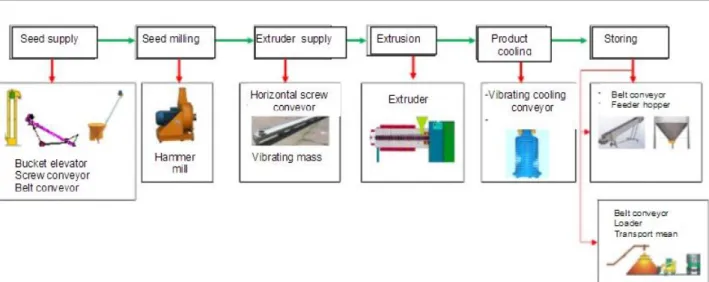
Fig.1. The technological scheme of soybean seeds extrusion processing
The main advantages of this soybean seeds extrusion technology (figure 1) compared to traditional methods are:
- reducing production costs (consumption of heat, electricity, raw materials, labour costs and capital investments)
- intensification of production process - high productivity and automation - extruders ensure continuous processing of raw materials and can be partially or completely automated;
- adaptability: the process can be very easily modified to make new products, according to consumers’ demand;
- high quality products - extrusion is a process that takes place at high temperature in a short time, and because of this, degradation of nutrients in raw materials is minimal; - minimum waste: the process of extrusion does not generate or generates only an insignificant volume of by-products as waste, thus with zero ecological impact;
- increasing the use of raw material;
- getting food products ready for consumption or creating components for them; - reducing the microbiological contamination of products;
Fig. 2. Installation for soybean seeds superior capitalization – IVSS / INMA Bucharest 1-Inclined screw conveyor; 2- Supply system; 3- Extruder; 4- Cooling system; 5- Mobile belt
conveyor; 6- Command and control system
383
approach a strategy on: choosing fodder recipes depending on the animals in the farm, using own fodder and not only, the technical base necessary to the farm, and in the same time they will meet the requirements according to which agriculture no longer serves only to produce wheat, corn, milk and other agricultural products, but it also provides environment conservation and product consumers food safety.
Fig. 3. Areas of the extruder
Dry extrusion of soybean seeds is a process that occurs due to the high oil content of seeds. During the extrusion process, the product can reach temperatures of approx. 140-150°C. As a result of the combination of temperature and pressure is ensured the distortion of anti-nutritional factors, oxidative enzymes and the release of oil from the cells by breaking the cell walls (Cioica N. Balc G., Ionuţ V., 2005). One of the main functions of the extruder, beside the transport (and sometimes boiling) one, is to create a certain pressure necessary for the processed material to pass through the die orifice (figure 3).The main extrusion process parameters are: temperature of processed material melt, time of material being within the extruder, pressure of processed material melt and shear strength. The screw, beside the function of conveying the material from the supply hopper to the die entrance, influences, by its geometry, the mixing, shearing, the amount of mechanical energy dissipated in the heat and the pressure developed before the die.
The IVSS installation designed at INMA Bucharest, using soybean seeds dry extrusion as processing method, ensures:
• reduction of raw material processing losses on food chain; • realization of complex fodder receipts;
• increase of raw material use degree;
• obtaining food products ready for consumption or creating components for them, having high thickening and water and fat retention capacity;
• assimilability increase and reduction of products microbiological contamination.
RESULTS AND DISCUSSIONS
384
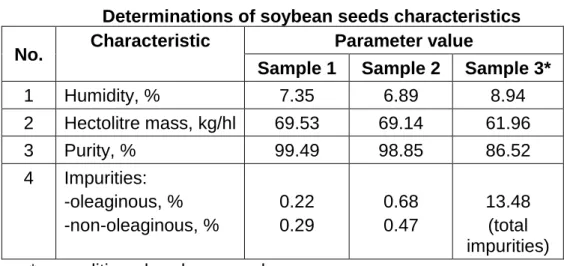
Table 1
Determinations of soybean seeds characteristics
No. Characteristic Parameter value
Sample 1 Sample 2 Sample 3*
1 Humidity, % 7.35 6.89 8.94
2 Hectolitre mass, kg/hl 69.53 69.14 61.96
3 Purity, % 99.49 98.85 86.52
4 Impurities: -oleaginous, % -non-oleaginous, %
0.22 0.29
0.68 0.47
13.48 (total impurities) *unconditioned soybean seeds
Final product parameters were calculated using the following relations [1, 3]:
▪ The expansion degree characterized by:
- final product density;
- apparent specific volume
𝑉𝑠 = 4
𝜋𝐷𝑒𝐿𝑠𝑒 (1)
where: De–outer diameter of expanded product;
Lse - specific average length (for 1g of extruded product).
▪ Expansion index characterized by:
- transverse expansion index (IET)
IET = (De/Dm )2 (2)
where: De– outer diameter of extruded product;
Dm – diameter of die hole
Table 2
Final product parameters
No. Parameter
Parameter value
Sample 1 Sample 2 Sample 3
1
Outer diameter of expanded product, De [mm]
9.5 9.2 8.8
2
Specific average length (for 1g of extruded product), Lse [mm/g]
26.49 25.49 26.17
3
Apparent specific volume, VS [g/mm2]
385
CONCLUSIONS
The extrusion technology is one of the perspective and high efficiency processes, combining hydrothermal and mechanical processing of raw material –soybean seeds, allowing obtaining a new-generation products and components with predetermined properties, with a new structure: instant products.
The installation for soybean seeds superior capitalization –IVSS tries to transform typical farmer in professional livestock farmer who would make a superior capitalization of the technologies established by research, develop the farm in close connection with the processing units and provide high quality productions by capitalizing the production of cereals and technical plants of their own cultures.
ACKNOWLEDGEMENT
This paper was financed with the support of National Agency for Scientific Research and Innovation, Programme NUCLEU, no. 8N/09.03.2016, Addendum No. 1/2016, Project PN 16 24 03 01 – “Innovative technology and installation for soybean seeds superior capitalization in animal feeding”.
BIBLIOGRAPHY
1. Cioica N., Balc G., Ionut V., 2005 -Thermal transitions by directly expanded extruded
maize grits. Food processes and technologies, Vol.XI, No.2, Agroprint
PublishingTimisoara, ISSN 1453-1399, pp.255-260;
2. Halga P. & col., 2005 - Animal nutrition and feeding. Alfa Publishing House, Iasi , Romania;
3. Koleva A.Zh., 2012 - Dry pet food. Part 2. Hydrothermal processes for production. Scientific Works of the University of Food Technologies-Plovdin, Bulgaria;
4. Nagalakshmi D., Reddy D.N., 2008 - On farm evaluation of expander-extruder
processed complete diet containing maize cobs in Murrah buffaloes. Indian Journal of Veterinary Research, Bareilly, India;
6. Păun A., Găgeanu P., Danciu A ., 2009 - Impact of Technologies of Obtaining Concentrated Fodder Upon Animal Nourishment and Environment. Bulletin of University of Agricultural Sciences and Veterinary Medicine Cluj-Napoca, Vol.66 No.1;
7. Păun A., Pirnă I., Cojocaru I., Găgeanu P., Brăcăcescu C., 2006 - Optimization and