68
TEACHING GRAMMAR-IN-CONTEXT AND ITS IMPACT IN MINIMIZING STUDENTS’ GRAMMATICAL ERRORS
Yadhi Nur Amin
State Islamic Senior High School (MAN) of Lasem – Rembang, Indonesia
Abstract: This study is conducted to determine the effectiveness of teaching grammar-in-context to
minimize students‘ grammatical errors in writing. The design of the study was a quasi-experimental with a non-randomized pretest-posttest control group. The samples of the study were taken from the population of the tenth-grade students. The control group was taught by conventional grammar which was separately given with writing skills. Likewise, the experimental one was treated by teaching grammar-in-context. The results of the study showed that the mean score in the post-test was higher than that in the pretest; and the mean score of experimental group increased 16.20 point after the treatment. This result indicated that teaching grammar-in-context is considered to be effective in minimizing
students‘ grammatical errors in writing.
Keywords: grammar-in-context, grammatical errors
INTRODUCTION
sentences. And one of teacher activities involves teaching students grammatical patterns and functional rules. Because of the shortage of grammar knowledge, the students, even writers, still make many grammatical errors in their writing. So, it is reasonable that grammatical errors in the process of learning English as foreign language needs more attention to correct or, at least, reduce to minimum.
The problem can be revealed through the errors posited as indication that the problem or difficulty in learning English still occurs. Thus, apparently, a correct grammar also plays an important role in EFL writing. As a proof relating to grammar, Mukminatien (1999) observed the students‘ writing performance, in this case in
PDETP, S1-Equivalent Program and Regular S1 students, showing that they were grammatically incompetent due to the errors they had made. Furthermore, having conducted an observation by giving writing test to the tenth-grade students of MAN Lasem on the 7th of February 2015, it was found that the students still felt confused of what they were going to write; they wrote with many grammatical errors on account of very little mastery in grammar. This is one of
examples of their writing. ―Last semester, I had Ø semester holiday. I *wented to my grandmother* house. I took* a hour to go there. There * is many mango*es tree*. ØMango*es trees * is *more bigger than my mango*es tree. My grandmother *gived a mango*es to me. I did not *ate it because my stomach Ø full. I also *visit rice field. I * sawed *harvest rice there. I *am happy *spend my holiday there”.
70
as “There is many ….”, “…my stomach full.”, I am happy …”, etc. belong
to syntactical errors.
In accordance with the background and problem faced by the
students, the research problem is stated as, ―Do the students taught
by grammar-in-context make less grammatical errors in their writing than those who are taught by grammar conventionally?‖
This research is intended to find out the effectiveness of teaching grammar-in-context to minimize students‘ grammatical errors in writing. The findings of this study are expected to provide useful information about the effectiveness of teaching grammar-in-context so that the students can learn grammar associated with writing skill (in association with genre). Other significance is to give a practical contribution to teaching learning English in secondary schools, mainly the teaching of grammar in context associated with the teaching of writing skill. Furthermore, it is hoped that other researchers in the same areas can use the findings as additional references in their research.
LITERATURE REVIEW
Teaching Grammar-in-Context
Lock (1996) stated that practice exercises in many textbooks of the 1950s, 1960s, and 1970s typically involved manipulation of sentence-level structures, with little or no context. At that time, structural grammar influenced language teaching. In some cases, the exercises could be successfully completed without the learners even understanding the meanings of the forms they were manipulating. As a result, in writing or speaking the learners did not understand what they wrote or spoke, so that many grammatical errors were made.
grammar. Widdowson (Lock, 1996) has written that a proper understanding of the concept of communicative competence would have revealed that it gives no endorsement for the neglect of grammar.
Unfortunately, for some teachers, the teaching grammar has come to be seen as a minor part of the development of communicative competence, even this time when Competence –
Based Curriculum (CBC) has been applied. In CBC (actually has same
purpose as CLT), ―genre‖ – some call text type – is put forward. Grammar can, in fact, play its role in text level practice because it is easier to build up strong associations between structures and their meaning in context, which makes it likely that the students are able to select appropriate structures in similar context. In this case, the teaching grammar in context is meant to relate grammar to text type. For example, when a teacher explains recount text, s/he also explains past tense, and so forth.
Teaching grammar-in-context is actually much more inspired by Contextual Teaching Learning (henceforth, it is called CTL). CTL is an approach of teaching and learning that relates the materials and classroom activities to real situation and actual experience focusing on the learning process leading to creativity, critically thinking, and problem solving and being able to apply their knowledge in their daily lives (Nurhadi, 2004).
In relation to the principles of CTL, teaching grammar-in-context attempts to adapt its principles. First, in inquiry, the teachers can observe and progress students‘ understanding of grammar and
the students analyze grammar from text given by the teachers.
Second, in questioning, they guide and assess the student‘s
72
other, and collaborate with others to produce some texts. Sixth, in authentic assessment, they measure their knowledge and skill (grammar knowledge in writing skill) from relevant and contextualized tasks; process and products can both be measured. The last, in reflection, both of them review and respond to activities and experiences, and record what they have learned. In this case, the
teachers correct the students‘ grammatical errors, and the students
improve their grammatical accuracy in their writing.
In addition, as a part of language, grammar-in-context can relate grammar teaching to situational context. It is because language is used in context of situation as well a context of culture (Hammond, 1992). It means that language can be easily understood in relation to the context in which it is used. So does grammar; it can be easily understood or used by students in their writing if it is taught in relation to the context in which grammar is used.
Writing, Grammar, and Errors
Writing is considered as such a complex subject that it is sometimes difficult to teach and to learn (Heaton, 1989). It requires mastery not only of grammatical and rhetorical devices but also of conceptual and judgmental elements. It can also be meant that writing has very close relationship with grammar. Raimes (1983) proposes that writing is considered as a means of reinforcing and manipulating grammatical and rhetorical structures, not as a tool for communication. Through writing, students can reinforce the grammatical structures, idioms, and vocabulary that they have learned. Thus, grammar plays the most important aspect in writing. Bad grammar makes writing imprecise or ambiguous. Collinson (1986) states that without grammar, that is without rules to govern the arrangement of words and making of their plurals, tense, and so on, meaning could not be made clear by writers or understood by readers.
Grammar is worth studying because it can help us to express our ideas clearly and effectively in both speech and writing. Weakness in writing – particularly incorrectness of sentence structure
– is often due to insufficient understanding of grammar. However, the complexity of grammar leads the students to make errors both in spoken and written English. In an observation, a Senior High School student who has been learning English is good at vocabulary mastery and at developing his ideas, on the contrary, he is bad at grammar. So, when he expressed his ideas “Beberapa Muslim tidak sering pergi ke
74
the mosque every Friday.” After being taught some rules of present tense, and regularly memorizing and practicing the rules, he could produce negative sentences of present tense such as “Some Moslems do not go to
the mosque every Friday.” However, he just remembered putting do not
in the negative sentence and ignored the changing of Vs/-es into
infinitive verb. As a result, he wrote, ―My friend *do not *goes to the
mosque every Friday.” instead of “My friend does not go to the mosque
every Friday.” This illustration shows that we need to know grammar
when we want to write a sentence or text correctly. In other words, grammar is also very important in writing. Nevertheless, the complexity of grammar often leads the students to make some errors. In fact, making errors in grammar is common problem not only for the students of ESL/EFL but also for the native speakers, and even the professional writers never free of grammatical errors in their writing (Brereton, 1986). Politzer and Ramirez, Burt and Kiparsky (in Dulay et. al., 1982) had proved that several thousand English errors had been made by students learning English in foreign as well as host environments.
Likewise, it does not mean that grammatical errors made by the students can be taken heed. Grammatical errors should be reduced or minimized, and reducing grammatical errors is one of the
teacher‘s responsibilities. Mukminatien (1997) suggests that to help
the students improve grammatical accuracy, a teacher can make use
of the students‘ errors as a base to determine the types of activities that the students should do in class. This is because errors analysis based on an adequate data will show the common weaknesses with which the students need help. Thus, it is worthwhile for the teacher to diagnose the students‘ grammatical errors in order to determine
the kind of activities to give for the students for the sake of
minimizing the students‘ grammatical errors in writing. Because of
help the students minimize their grammatical errors, and one of the techniques is teaching grammar-in-context.
METHOD
This study was a quasi-experimental research which applied a non-randomized pretest and posttest control group design as introduced by Ary, et al. (2006). They state that research in classroom setting is an example of settings in educational research in which it is difficult to conduct a true-experimental research. The experimental group was taught by using a method of teaching grammar-in-context integrated to writing skill, and the control group was taught by grammar in conventional technique separated from writing skill. Before the experiment was conducted, a pretest was administered to the control and experimental group, and then treatment was given to the experimental group. Meanwhile, the control group was about to be taught by conventional grammar which was separately given with writing skills. In the end, a posttest was given to both groups.
The target population of this study was the tenth-grade students of one State Islamic Senior High School in Rembang - Indonesia in the academic year 2015/2016. Because of too large number of population, the sampling technique was implemented to make the study feasible and representative. The results of the randomization were class X-Science-1 as experimental group and class X-Science-2 as control group.
Based on the research design chosen, the procedures of the research consisted of four phases: pre-test, diagnosing, treatment, and posttest. Pretest was given for both groups, but designing lesson plans and applying strategy were only addressed to the experimental group. After a certain period of treatment, posttest was administered for the two groups. Briefly, the procedures of the research were as follows: (1) the administration of pretest was to measure grammatical errors of the two groups, and enabled the researcher to get
76
compare between pretest and posttest‘ scores whether there was a
significant difference between the result of control group and that of experiment one, (3) the designing of lesson plan of teaching grammar in context was focused on the fields in which the students were taught using grammar-in-context teaching, (4) exposing the experimental group of the research by teaching the students using grammar in context integrated with writing skill for 6 meetings, (5) the administration of posttest for the two groups was to measure grammatical accuracy in their writing, and (6) the degree of the effectiveness of teaching grammar in context was determined by using ANOVA to compare the mean scores of the two groups.
To obtain the students‘ data on grammatical accuracy on
writing skill through teaching grammar in context, writing test was decided to use as the instrument of this study. The instruction of the test was asking the students to write a recount text. Based on the research design chosen, the procedures of the research consisted of four phases: pre-test, diagnosing, treatment, and posttest. Data were collected from writing products made by both groups. The data of grammatical errors are, technically, collected from each writing product by doing the following activities. Each piece of writing was first read thoroughly, accurately and critically to identify the errors as questioned in the research problem. Then, previous identified errors were rewritten in the separate lists of data corpus for further analysis. The list of data corpus was respectively the data corpus of errors in the tenth-grade students‘ writing from both groups in pretest and posttest.
FINDINGS AND DISCUSSION Findings
The discussion of this research finding is to know the difference between the mean score of the control group and that of the experimental group. If the mean score of the experimental group is higher than that of the control one, the strategy proposed is considered as an effective strategy. To make an ease in analyzing statistically the result of the study, the hypothesis is conversely put
into null hypothesis, that is, ―The students taught grammar -in-context do not make less grammatical errors in their writing than
those who are taught grammar conventionally.‖
Pretest Results from Control and Experimental Groups
The pretest was given at the very first meeting in preliminary
study. It was conducted to see the students‘ grammatical errors and
grammatical accuracy at once in their writing in both control and experimental group before the treatment was given to the experimental group. In this stage, the researcher gave the students three different topics and they chose one. The result of the pretest showed that the students from the control group made 1008 errors out of 1600 total use of words (63% errors) in their writing; specifically 719 errors were syntactical errors and 289 errors were morphological ones. Meanwhile, 976 errors out of 1600 total use of
words were (61% errors) detected in the experimental group‘s
compositions; specifically 660 errors of syntactical errors and 316 words errors of morphological ones. These results indicated that the students in both group still made many grammatical errors in their writing.
Posttest Results from Control and Experimental Groups
The posttest was given to both the control group and the experimental group at the end of meeting in the experiment. It was
conducted to see the students‘ grammatical errors in their writing
78
given to the experimental group. In this stage, the researcher also gave the students three different topics and they chose one. The result of the posttest detected that grammatical errors from the experimental group were quite significantly reduced to the minimum level compared to the control one. In this posttest, the students from the control group made 1067 errors out of 1700 total use of words (62.76% errors) in their writing; specifically 795 errors were syntactical errors and 272 errors were morphological ones. Meanwhile, 882 errors out of 1800 total use of words (49% errors)
were detected in the experimental group‘s compositions; specifically
606 errors were syntactical errors and 276 errors were morphological errors. The results show that the experimental group made less grammatical errors than the control one.
In conjunction with the results of the posttest, the data were analyzed to find out the result of reliability, data normality testing, hypothesis testing, and general tendency of the research. Those results are then used to prove the effectiveness of teaching grammar-in-context in relation to minimizing students‘ grammatical errors in
their writing.
Results of Scoring Reliability Analysis
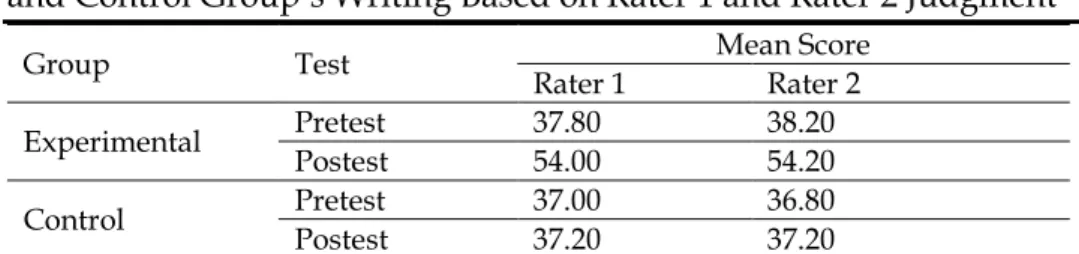
The main objective of scoring reliability analysis is to find out whether the scores produced by two raters were consistent or not. By observing the scores produced by the two raters in the experimental group, it was found that the difference of the set of the score was 0.4 in the pretest and 0.2 in the posttest. It could be said that the two products were about similar in the mean score of grammatical
accuracy in students‘ writing. For clarification, Tables 1 presents the
Table 1 The Comparison between the Mean Score of Experimental
and Control Group‘s Writing Based on Rater 1 and Rater 2 Judgment
Group Test Mean Score
Rater 1 Rater 2
Experimental Pretest 37.80 38.20
Postest 54.00 54.20
Control Pretest Postest 37.00 37.20 36.80 37.20
Table 1 reveals that the difference between the mean scores based on the judgment of the rater 1 and rater 2 for the experimental group in the pretest was 0.4 and in the posttest was 0.2. Meanwhile, for the control group, the difference between the mean scores in the pretest was 0.2 and in the posttest was also 0.2. It seems that the scores produced by the two raters were not too far different.
Consequently, there was no need to reassess the students‘ products;
then one of them was reliable to be used for further data processing. In this case, for the sake of hypothesis testing, the product of the first rater was chosen. It is also proven by the coefficient of interrelation reliability (r) as shown in Table 2.
Table 2 Coefficient of Reliability
Group Coefficient of reliability (r)
Pretest Posttest
Experimental 0.89 0.73
Control 0.99 0.99
Table 2 shows that the coefficients obtained from the experimental group were respectively 0.89 from pretest and 0.73 from posttest. Meanwhile, the coefficient from the control group was 0.99
80 The Result of Data Normality Testing
The criteria of data normality testing in the study used the level significance .05 in Kolmogorov – Smirnov Scale. The coefficients of the normality of the data in this scale are between .05 and .200. If the obtained coefficient is more than or equal to .05, it can be interpreted that the distribution of the data is normal.
In this study the data comprised four groups of data: two groups of the scores yielded by the experimental group (pretest and posttest) and two groups produced by the control one. The result of the testing is summarized in Table 3.
Table 3 The Result of Data Normality Testing
Component Experimental group Control Group
Pretest Posttest Pretest Posttest
Grammar .079 .063 .92 .128
Table 3 shows that the obtained value was .079 for experimental group and .092 for control group in the pretest. Furthermore, in the posttest, the experimental group got .063 and .128 for the control one. Since the obtained value exceeded .05 (the level of significance; in this case. .079, .092, .063, and .128 > .05), this revealed that the data did not deviate from a normal distribution. As the distribution of data was normal, then, the data fulfilled the criteria to be used for testing the hypothesis.
Result of Hypothesis Testing
The hypothesis was formulated as tentative answer of the research problem. It was tested using statistical procedure. The presentation of the hypothesis can be stated in the form of statistical hypothesis as follows:
Ho is accepted if F-ratio < F-table Ho is rejected if F-ratio > F-table
students taught grammar-in-context do not make less grammatical errors in their writing than those who are taught grammar conventionally.
The result of the analysis indicated that the obtained F-ratio was 17.969, and F-table was 3.963. By using the same way, comparing the ratio to table as used in testing the hypothesis, the obtained F-ratio was higher than F-table (17.969 > 3.963, sig. .000 < .050). Thus, there was enough evidence to reject the null hypothesis; as a result, the hypothesis was accepted. Therefore, it could be concluded that the students treated by teaching grammar-in-context make less grammatical errors in their writing than those who are taught grammar conventionally. In other words, teaching grammar-in-context was accepted as an effective strategy to minimize
grammatical errors in students‘ writing.
General Tendency of the Research
The general tendency of the research in this study is an illustration of the degree of the students‘ writing ability, in
82 Discussion
The effectiveness of teaching grammar in context can be seen from the results of the test revealing that the experimental group, which was taught grammar-in-context integrated with writing skill, makes less grammatical errors in writing. This is because the students in this group directly practice grammatical items after they analyze and learn the grammatical items in the text. In this study, the students were given some recount texts. Then, they paid attention a lot to the grammatical items used in the recount texts. The following activity was that the students were guided by the teacher to deepen their knowledge about those grammatical items in the recount texts by doing some exercises. After that, they were asked to practice those grammatical items in writing a recount text. As a result, most of students make less grammatical errors. It was shown by the increase of mean score and their grammatical errors in writing were significantly reduced. In addition, the control group made 62.76% of grammatical errors while the experimental one made 49% of grammatical errors in the posttest. Furthermore, the experimental group made 61% in the pretest and 49% of grammatical errors in the posttest. It means that the experimental group reduced the grammatical errors to 12%. Thus, it indicated that teaching grammar-in-context is proved to be an effective method to minimize
grammatical errors in students‘ writing.
used in recount text. As a result, the students get easier in applying grammar directly in writing a recount text.
In connection with the theory of grammar, writing, and errors in which writing, as a complex skill, needs grammar to construct sentences and as students still make some errors because of the complexity of grammar, teaching grammar-in-context can afford to
minimize students‘ grammatical errors in their writing.
CONCLUSION
Based on the findings and discussion presented in the previous explanation, it can be concluded that teaching grammar-in-context is
effective in minimizing grammatical errors in students‘ writing. It is proved by the significant improvement of the experimental group‘s
mean score. Additionally, the F-ratio obtained from the analysis exceeded the critical value. Clearly, since there is enough evidence to reject the null hypothesis and accept the working hypothesis, it could be concluded that teaching grammar in context can reduce more
grammatical errors in students‘ writing.
Based on the findings, some suggestions are recommended for English teacher, for Islamic Senior High School students, and for the future researchers. It is suggested that English teachers implement this technique to their writing classes by teaching grammatical items integrated with writing skill, and the students need special efforts to find an appropriate technique in order to able to practice correct grammar in their writing. To have the paragraph correct, they can find the grammatical items in the recount texts made by outstanding writers in many textbooks.
The study has provided the basis for future researchers since teaching grammar-in-context has been proved effective in reducing
grammatical errors in students‘ writing; the findings of the research
will be very helpful for the improvement of the students‘ writing
84 REFERENCES
Ary, D., Jacobs, L.C., Razavieh, A., Sorensen, C. (2006). Introduction to research in education (7th Edition). New York: CBS College
Publishing.
Dulay, H., Burt, M., Krashen, S. (1982). Language two. New York: Oxford University Press, Inc.
Gebhard, J. G. (1996). Teaching English as a foreign or second language: A teacher self-development and methodology guide. Michigan: The University of Michigan Press.
Hammond, J. (1992). English for social purposes. Sidney: NCLTR Macquarie University.
Heaton, J. B. (1989). Writing English language tests; Longman handbooks for language teachers. New York: Longman Group, Ltd.
Lock, G. (1996). Functional English grammar. New York: Cambridge University Press.
Mukminatien, N. 1999. The premature use of English grammar by EFL learners. TEFLIN Journal, 10 (1), 103 – 113.
Nurhadi. (2004). Pendekatan kontekstual: Contextual teaching and learning (CTL). Jakarta: Departemen Pendidikan Nasional.
Raimes, A. (1983). Techniques in teaching writing. Oxford: Oxford University Press.
Shaw, H. (1986). Errors in English andwWays to correct them. New York: Harper & Row.