Geometry and Spatial Reasoning Activity: Prefixes Are Important in Geometry, Too!
TEKS: (2.7) Geometry and spatial reasoning. The student uses attributes to identify two- and three-dimensional figures. The student compares and contrasts two- and three-dimensional geometric figures or both.
The student is expected to
(A) describe attributes (the number of vertices, faces, edges, sides) of two- and three-dimensional geometric figures such as circles, polygons, spheres, cones, cylinders, prisms and pyramids, etc;
Overview: This is a beginning geometry lesson. Students will learn attributes of two-dimensional figures. Students will also learn the prefixes for polygons. Students will develop an organization of subset regarding two-dimensional figures.
Based on the work of two Dutch educators, Pierre van Hiele and Dina van Hiele-Geldof, Van de Wall (2007) says that how students think about geometry occurs at different levels. These levels include:
a) Level 0 Visualization b) Level 1 Analysis
c) Level 2 Informal Deduction d) Level 3 Deduction
e) Level 4 Rigor
This lesson intends to lead students from Level 0 through Level 2.
Materials: Prior to Lesson
Prefix Cards master
Two-dimensional Figure Labels master
Polygons master
Polygon Cards master Various colored cardstock
Lesson
Prefix Cards
Two-dimensional Figure Labels
Polygon cut-outs
6 or 7 pieces of yarn or string cut into 3-yard lengths Bell or chime
Polygon Cards
Geoboards Geobands
Grouping: Part I: Whole Group
Part III: Whole Group
Time: 30-45 minutes (each part)
Lesson:
Procedures Notes
1. Prior to Lesson
Create a Polygon Bulletin Board Display.
Cut out different polygons.
Make class set of polygon cards.
This bulletin board will eventually represent a graphic organizer showing the sets and subsets of polygons. Post the Polygon Labels at the top of the board. Randomly place the Prefix Cards on the bulletin board. Other parts of the bulletin board will be added throughout the lesson.
See Polygons handout for some examples. You will want to cut out figures so that both regular and irregular polygons are illustrated. These figures will be used in Part II of the lesson and added to the bulletin board during Part III. You will need one per student.
Copy Polygon Cards onto cardstock. Laminate cards for durability. Keep cards separated into sets to be distributed to students during lesson. 2. Part I
Draw several figures on the board making most of the figures closed and with sides that are not equal. Then add figures that are rounded and non-closed figures. 1. Have students look for patterns and relationships that occur between the shapes. The students should sort the figures by closed and not closed. Redraw the non-closed figures to the side of the board and erase the original non-closed figures. Have students
You may have to lead the students to sort the shapes by closed and “not closed” figures, but do not just tell them. This lesson is designed for students to use deduction to define polygons.
Procedures Notes
describe the attributes of each of these figures.
2. After writing attributes of non-closed figures, refocus the students on the figures that remain. Ask the students to sort those figures. They should sort the figures on the attributes of round and not round. Redraw the circle and other rounded figures and list attributes underneath the drawings.
3. The students should have a group of two-dimensional figures with
connecting lines. Once they have the figures’ attributes defined, introduce the word polygon.
A polygon is a closed plane figure bounded by three or more line segments (polygon, n.d.)
A polygon is a closed figure made by joining line segments, where each line segment intersects exactly two others. (Conrad, S. & Flegler, D., n.d.).
3. Part II– Day 1
1. Explain that polygons are named by the number of sides they have. Draw students’ attention to the bulletin board display. Explain that if they learn the prefixes for each number, they will be able to identify the name of the
polygon. Discuss the relationship between number of sides and number of angles.
Use the bulletin board as the focus of this part of the lesson.
*You may wish to share with your students that most geometry terms have their origins in Greek and a few in Latin. Geometry is one of the oldest branches of
mathematics. September
"sept/hept" seven, was once the seventh month, October was once the eighth month "oct" eight, November "nova/nona" nine, and December "deca" ten. When July and August were added to the Julian calendar the months were pushed back to their present order as the 9th, 10th, 11th and 12th months and thus disrupting the
Procedures Notes
2. Read The Greedy Triangle by Marilyn Burns. While reading, have students predict what two-dimensional figure the triangle will change into next.
3. Using the polygons from Part I, go through the group and identify the type of polygon by counting its sides. Post the Two-dimensional Figure Labels on the board and have students redraw shapes under the appropriate title.
prefix meanings that placed them in sequential order.
As you are reading the book, be sure to discuss the two-dimensional figures found on each of the pages. This step will reinforce the students’ understanding of the levels of organization of the two-dimensional figures.
4. Part II – Day 2
Divide the students into groups of 3 or 4, and give each group a 3-yard length of yarn or string.
Directions for activity:
a. Students are informed that they may not talk to team members at anytime. Team members may use hand
signals to communicate with their teammates. A point will be deducted if they talk while creating figure. b. Students may use feet, hands,
elbows, or heads to make a vertex (the point where two sides meet). c. The teacher will hold up a prefix card. d. Each group is to quickly form a
polygon with the number of sides the prefix represents.
e. When a group finishes making the figure they may then shout,
“Finished!”
f. It is possible for all teams to gain a point for each round. After the teacher checks for correctness, he/she should announce if the team received a point for making the correct polygon with the correct number of sides. If they did not make
Use a chime or bell to announce the beginning of a new round.
This activity should take half of your designated math time.
This is best done outside or in a wide hallway away from regular hall traffic.
Procedures Notes
the correct figure, the team looses a point.
Have students play Build a Polygon. Group students into pairs. Give each pair a set of Polygon Cards.
Directions for Build a Polygon a. Students shuffle cards.
b. Shorter of the two students selects a Polygon Card.
c. Students build the polygon designated by the card on the geoboard.
d. Students check partners’ answer. e. Play continues until the end of class. f. If students build each of the figures,
they reshuffle cards and begin again. g. Students cannot build the same figure
as they did in previous round.
Materials needed for Build a Polygon include Polygon Cards, geoboards, and geobands.
5. Part II – Day 3
Divide students into four groups. Students will work in centers reviewing previously taught geometric concepts.
Center 1: Build a Polygon (same activity as Part II – Day 2)
Center 2: Computer Center
Students work in pairs on computers. Websites appropriate to use are given in the notes.
Teacher will act as a facilitator and will walk around answering
questions and observing students for possible misconceptions.
Everyday Math Resources for 2nd grade -
http://www.center.k12.mo.us/edtech /edm/2.htm
National Library of Virtual
Manipulatives: Geometry (Grades PreK-2 -
http://nlvm.usu.edu/en/nav/category _g_1_t_3.html
Project Interactive: Venn Diagram Shape Sorter -
http://www.shodor.org/interactivate/ activities/ShapeSorter/
Procedures Notes
Saxon Math: Polygons and Non-polygons -
http://www.haelmedia.com/html/sg_ m2_001.html
AAA Math: Polygons -
http://www.eyepleezers.com/aaama th/geo318x4.htm
AAA Math: Polygons II -
http://www.eyepleezers.com/aaama th/geo318x1.htm
Illuminations: Shape Cutter -
http://illuminations.nctm.org/Activity Detail.aspx?ID=72
Nuts About Geometry: Discovering Polygons -
http://library.thinkquest.org/J002441 F/polygons.htm
On the next four links, teachers can create customized games/activities using specific vocabulary but will be required to open a free 30-day instructor trial account.
Quia: Geometric Terms Matching Game
-http://www.quia.com/mc/65535.html
Quia: Geometric Terms Flashcards -
http://www.quia.com/jfc/65535.html Quia: Geometric Terms
Concentration -
http://www.quia.com/cc/65535.html Quia: Geometric Terms Word Search -
Procedures Notes
Center 3: Vocabulary Development a. Geometry Concentration: Have
students use Two-dimensional Labels
and Prefix Cards to play a game of Concentration. Students randomly place cards face down on table. Students take turns turning two cards over attempting to match
Two-dimensional Labels with corresponding Prefix Cards. b. Polygon Crossword Puzzle: Have
students complete the crossword puzzle.
c. Polygon Word Scramble: Have students unscramble the letters to form vocabulary terms.
Center 4: Polygon Sorting Activity Students sort Polygon Figures into
correct category. Students have to justify their reasoning for selecting the category.
This is not an inclusive list, but only a sampling of what is available on the web. See the following website for more virtual manipulative sites:
http://www.lane.k12.or.us/insttech/vt c/math_interactive.html
Students need Two-dimensional Labels, Prefix Cards, Polygon Crossword Puzzle, and Polygon Word Scramble to complete these activities.
Students need Two-dimensional Labels and Polygon Figures to complete this activity
6. Part III
Distribute polygon cut-outs to students. Have the students identify their figure as a triangle, quadrilateral, pentagon,
hexagon, heptagon, octagon, nonagon, or decagon and justify the reasoning for identifying the figure. Have students place the figures under the correct two-dimensional figure label on the bulletin board.
Place Two-dimensional Figure Labels on bulletin board under the
Prefix Cards. This activity can be repeated over several days to give a more complete assessment of student learning.
Use Second Grade
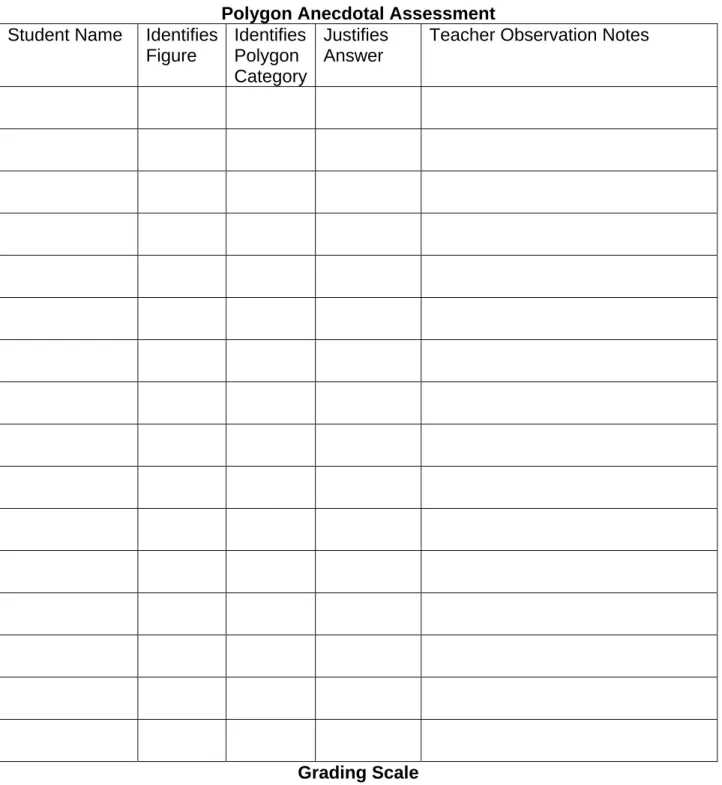
Polygon Anecdotal Assessment to assess student learning.
Homework: Part II, Day 1 Instruction: Ask the students to find five other words that use these prefixes and to explain or illustrate each one.
Part II, Day 2 Instruction: Have students take home library book on polygons to read to a family member. See Children’s Literature List for possible book titles.
Part II, Day 3 Instruction: If students are unable to complete Polygon Word Scramble and/or Polygon Crossword Puzzle during class, have students complete them for homework.
Assessment: Second Grade Polygon Anecdotal Assessment
Extensions: Using a specifically named polygon have the students make a T-chart showing the total number of sides for up to 6 or 7 examples of that polygon.
Support materials: Polygon Talk Tiles, written and sold by Marcy Cook, http://www.marcycookmath.com
This a wonderful site developed by NCTM for students to highlight 3-D figures attributes. The student can click on an attribute and it will be highlighted and student can turn the shape by clicking and holding down on the mouse. It should be preceded with introductory lessons for each attribute—faces, edges, vertices.
http://illuminations.nctm.org/LessonDetail.aspx?ID=L406
Resources: Bell, M., Balfanz, R., Carroll, W, Hartfield, R., McBride, J., Saecker, P., (1998),Everyday Mathematics Student Reference Book, Everyday Mathematics
Bell, J. Bretzlauf, J., Dillard, A., Hartfield, R., Isaacs, A., Pitvorec, K., Saecker, P., & McBride J. (2002) SRA/McGraw-Hill, Everyday Mathematics Teacher Reference Manual, Grades 4-6.
Burns, M. (1994). The Greedy Triangle. New York: Scholastic, Inc. Conrad, S. & Flegler, D. (2006, August). Figures and polygons.
Retrieved November 11, 2006, from Math League Website:
http://www.mathleague.com/help/geometry/polygons.htm#polygon
Polygons. (n.d.). The American Heritage® Dictionary of the English Language, Fourth Edition. Retrieved November 11, 2006, from Dictionary.com website:
http://dictionary.reference.com/browse/polygons
Van de Walle, J. (2007). Elementary and middle school mathematics: Teaching developmentally (6th ed.). Boston, MA: Allyn & Bacon.
Weisstein, Eric W. (2006). Heptagon. Online at MathWorld--A Wolfram Web Resource, http://mathworld.wolfram.com/Heptagon.htm
Two-dimensional Figure Labels
Polygons
Triangles
Quadrilaterals
Pentagons
Hexagons
Heptagons
Octagons
Nonagons
Decagons
Prefix Cards
Tri - Three sides
Quad - Four sides
Penta - Five sides
Hexa - Six sides
Hepta - Seven sides
Octa - Eight sides
Nona - Nine sides
Deca - Ten sides
Polygon Cards
Triangle
Hexagon
Pentagon
Quadrilateral
Heptagon
Octagon
Name _______________
Polygon Word Scramble
Please unscramble the words below.
1 ynlogpo
2 pgtaeonn
3 Naoogtc
4 talngeir
5 axghneo
6 nnnoago
7 qelaalutrdari
8 pnohaget
9 denaocg
Name ______________
Polygon Crossword Puzzle
1
2
3
4
5
6
7
8
9
ACROSS DOWN
3. six-sided figure 1. three-sided figure 4. four-sided figure 2. five-sided figure 6. a closed figure made by joining
line segments where each line segment intersects exactly two others.
5. nine-sided figure
7. eight-sided figure 8. seven-sided figure 9. ten-sided figure
Name _______________
Polygon Word Scramble
Answers
Please unscramble the words below.
1 ynlogpo
Polygon
2 pgtaeonn
Pentagon
3 naoogtc
Octagon
4 talngeir
Triangle
5 axghneo
Hexagon
6 nnnoago
Nonagon
7 qelaalutrdari
Quadrilateral
8 pnohaget
Heptagon
9 denaocg
Decagon
Name ____________
Polygon Crossword Puzzle
Answers
T
P
R
H E X A G O N
I
N
Q U A D R I L A T E R A L
N
A
N
G
G
O
P O L Y G O N
O C T A G O N
E
N
A
H E P T A G O N
O
D E C A G O N
ACROSS DOWN3. six-sided figure 1. three-sided figure 4. four-sided figure 2. five-sided figure 6. a closed figure made by joining
line segments where each line segment intersects exactly two others.
5. nine-sided figure
7. eight-sided figure 8. seven-sided figure 9. ten-sided figure
Second Grade
Polygon Anecdotal Assessment
Student Name Identifies Figure Identifies Polygon Category Justifies Answer
Teacher Observation Notes
Grading Scale
S - Struggling: Student does not identify shape and polygon category and is unable to justify answer.
E - Emerging: Student can identify shape and polygon category, but is unable to justify answer.
D - Developed: Student identifies shape and polygon category and is able to justify answer.