ETSI TS 129 502
V15.3.0
(2019-07)
5G;
5G System;
Session Management Services;
Stage 3
(3GPP TS 29.502 version 15.3.0 Release 15)
Reference
RTS/TSGC-0429502vf30
Keywords
5G
ETSI
650 Route des Lucioles
F-06921 Sophia Antipolis Cedex - FRANCE Tel.: +33 4 92 94 42 00 Fax: +33 4 93 65 47 16
Siret N° 348 623 562 00017 - NAF 742 C Association à but non lucratif enregistrée à la
Sous-Préfecture de Grasse (06) N° 7803/88
Important notice
The present document can be downloaded from:
http://www.etsi.org/standards-search
The present document may be made available in electronic versions and/or in print. The content of any electronic and/or print versions of the present document shall not be modified without the prior written authorization of ETSI. In case of any
existing or perceived difference in contents between such versions and/or in print, the prevailing version of an ETSI deliverable is the one made publicly available in PDF format at www.etsi.org/deliver.
Users of the present document should be aware that the document may be subject to revision or change of status. Information on the current status of this and other ETSI documents is available at
https://portal.etsi.org/TB/ETSIDeliverableStatus.aspx
If you find errors in the present document, please send your comment to one of the following services:
https://portal.etsi.org/People/CommiteeSupportStaff.aspx
Copyright Notification
No part may be reproduced or utilized in any form or by any means, electronic or mechanical, including photocopying and microfilm except as authorized by written permission of ETSI.
The content of the PDF version shall not be modified without the written authorization of ETSI. The copyright and the foregoing restriction extend to reproduction in all media.
© ETSI 2019. All rights reserved.
DECT™, PLUGTESTS™, UMTS™ and the ETSI logo are trademarks of ETSI registered for the benefit of its Members. 3GPP™and LTE™ are trademarks of ETSI registered for the benefit of its Members and
of the 3GPP Organizational Partners.
oneM2M™ logo is a trademark of ETSI registered for the benefit of its Members and
of the oneM2M Partners.
Intellectual Property Rights
Essential patents
IPRs essential or potentially essential to normative deliverables may have been declared to ETSI. The information pertaining to these essential IPRs, if any, is publicly available for ETSI members and non-members, and can be found in ETSI SR 000 314: "Intellectual Property Rights (IPRs); Essential, or potentially Essential, IPRs notified to ETSI in respect of ETSI standards", which is available from the ETSI Secretariat. Latest updates are available on the ETSI Web server (https://ipr.etsi.org/).
Pursuant to the ETSI IPR Policy, no investigation, including IPR searches, has been carried out by ETSI. No guarantee can be given as to the existence of other IPRs not referenced in ETSI SR 000 314 (or the updates on the ETSI Web server) which are, or may be, or may become, essential to the present document.
Trademarks
The present document may include trademarks and/or tradenames which are asserted and/or registered by their owners. ETSI claims no ownership of these except for any which are indicated as being the property of ETSI, and conveys no right to use or reproduce any trademark and/or tradename. Mention of those trademarks in the present document does not constitute an endorsement by ETSI of products, services or organizations associated with those trademarks.
Legal Notice
This Technical Specification (TS) has been produced by ETSI 3rd Generation Partnership Project (3GPP). The present document may refer to technical specifications or reports using their 3GPP identities. These shall be interpreted as being references to the corresponding ETSI deliverables.
The cross reference between 3GPP and ETSI identities can be found under http://webapp.etsi.org/key/queryform.asp.
Modal verbs terminology
In the present document "shall", "shall not", "should", "should not", "may", "need not", "will", "will not", "can" and "cannot" are to be interpreted as described in clause 3.2 of the ETSI Drafting Rules (Verbal forms for the expression of provisions).
Contents
Intellectual Property Rights ... 2
Legal Notice ... 2
Modal verbs terminology ... 2
Foreword ... 7
1 Scope
... 8
2 References
... 8
3 Definitions
and
abbreviations
... 9
3.1 Definitions ... 9
3.2 Abbreviations ... 9
4 Overview
... 9
4.1 Introduction ... 9
5
Services offered by the SMF ... 10
5.1 Introduction ... 10
5.2 Nsmf_PDUSession Service ... 10
5.2.1 Service Description ... 10
5.2.2 Service Operations ... 11
5.2.2.1 Introduction ... 11
5.2.2.2 Create SM Context service operation ... 11
5.2.2.2.1 General ... 11
5.2.2.2.2 EPS to 5GS Idle mode mobility using N26 interface ... 13
5.2.2.2.3 EPS to 5GS Handover Preparation using N26 interface ... 15
5.2.2.3 Update SM Context service operation... 16
5.2.2.3.1 General ... 16
5.2.2.3.2 Activation and Deactivation of the User Plane connection of a PDU session ... 17
5.2.2.3.2.1 General ... 17
5.2.2.3.2.2 Activation of User Plane connectivity of a PDU session ... 17
5.2.2.3.2.3 Deactivation of User Plane connectivity of a PDU session ... 19
5.2.2.3.2.4 Changing the access type of a PDU session from non-3GPP access to 3GPP access during a Service Request procedure ... 19
5.2.2.3.3 Xn Handover ... 20 5.2.2.3.4 N2 Handover ... 22 5.2.2.3.4.1 General ... 22 5.2.2.3.4.2 N2 Handover Preparation ... 22 5.2.2.3.4.3 N2 Handover Execution ... 23 5.2.2.3.4.4 N2 Handover Cancellation ... 24
5.2.2.3.5 Handover between 3GPP and untrusted non-3GPP access procedures ... 25
5.2.2.3.5.1 General ... 25
5.2.2.3.5.2 Handover of a PDU session without AMF change or with target AMF in same PLMN ... 25
5.2.2.3.6 Inter-AMF change or mobility ... 26
5.2.2.3.7 RAN Initiated QoS Flow Mobility ... 26
5.2.2.3.8 EPS to 5GS Handover using N26 interface ... 27
5.2.2.3.8.1 General ... 27
5.2.2.3.8.2 EPS to 5GS Handover Preparation ... 27
5.2.2.3.8.3 EPS to 5GS Handover Execution ... 28
5.2.2.3.8.4 EPS to 5GS Handover Cancellation ... 28
5.2.2.3.9 5GS to EPS Handover using N26 interface ... 28
5.2.2.3.10 P-CSCF Restoration Procedure via AMF ... 29
5.2.2.3.11 AMF requested PDU Session Release due to duplicated PDU Session Id ... 29
5.2.2.3.12 AMF requested PDU Session Release due to slice not available ... 29
5.2.2.4 Release SM Context service operation ... 30
5.2.2.4.1 General ... 30
5.2.2.5 Notify SM Context Status service operation ... 31
5.2.2.6 Retrieve SM Context service operation... 32
5.2.2.6.1 General ... 32
5.2.2.7 Create service operation ... 33
5.2.2.7.1 General ... 33
5.2.2.7.2 EPS to 5GS Idle mode mobility ... 34
5.2.2.7.3 EPS to 5GS Handover Preparation ... 35
5.2.2.8 Update service operation ... 36
5.2.2.8.1 General ... 36
5.2.2.8.2 Update service operation towards H-SMF... 36
5.2.2.8.2.1 General ... 36
5.2.2.8.2.2 UE or visited network requested PDU session modification ... 37
5.2.2.8.2.3 UE requested PDU session release ... 37
5.2.2.8.2.4 EPS to 5GS Handover Execution ... 37
5.2.2.8.2.5 Handover between 3GPP and untrusted non-3GPP access (Home Routed PDU session) ... 38
5.2.2.8.2.6 P-CSCF Restoration Procedure via AMF (Home Routed PDU session) ... 38
5.2.2.8.3 Update service operation towards V-SMF... 38
5.2.2.8.3.1 General ... 38
5.2.2.8.3.2 Home network requested PDU session modification ... 39
5.2.2.8.3.3 Home network requested PDU session release ... 40
5.2.2.8.3.4 Handover between 3GPP and untrusted non-3GPP access, from 5GC-N3IWF to EPS or from 5GS to EPC/ePDG ... 40
5.2.2.8.3.5 EPS Bearer ID assignment ... 41
5.2.2.9 Release service operation ... 41
5.2.2.9.1 General ... 41
5.2.2.10 Notify Status service operation ... 42
5.2.2.10.1 General ... 42
5.2.3 General procedures ... 43
5.2.3.1 Transfer of NAS SM information between UE and H-SMF for Home Routed PDU sessions ... 43
5.2.3.1.1 General ... 43
5.2.3.1.2 V-SMF Behaviour ... 43
5.2.3.1.3 H-SMF Behaviour ... 44
6 API
Definitions
... 44
6.1 Nsmf_PDUSession Service API ... 44
6.1.1 API URI ... 44 6.1.2 Usage of HTTP ... 44 6.1.2.1 General ... 44 6.1.2.2 HTTP standard headers ... 44 6.1.2.2.1 General ... 44 6.1.2.2.2 Content type ... 44 6.1.2.3 HTTP custom headers ... 45 6.1.2.3.1 General ... 45 6.1.2.4 HTTP multipart messages ... 45 6.1.2.5 HTTP/2 request retries ... 46 6.1.3 Resources ... 46 6.1.3.1 Overview ... 46
6.1.3.2 Resource: SM contexts collection ... 47
6.1.3.2.1 Description ... 47
6.1.3.2.2 Resource Definition ... 47
6.1.3.2.3 Resource Standard Methods ... 47
6.1.3.2.3.1 POST... 47
6.1.3.2.4 Resource Custom Operations ... 49
6.1.3.3 Resource: Individual SM context ... 50
6.1.3.3.1 Description ... 50
6.1.3.3.2 Resource Definition ... 50
6.1.3.3.3 Resource Standard Methods ... 50
6.1.3.3.4 Resource Custom Operations ... 50
6.1.3.3.4.1 Overview ... 50
6.1.3.3.4.2 Operation: modify ... 50
6.1.3.3.4.2.1 Description ... 50
6.1.3.3.4.2.2 Operation Definition ... 50
6.1.3.3.4.3.1 Description ... 51
6.1.3.3.4.3.2 Operation Definition ... 51
6.1.3.3.4.4 Operation: retrieve ... 52
6.1.3.3.4.4.1 Description ... 52
6.1.3.3.4.4.2 Operation Definition ... 52
6.1.3.5 Resource: PDU sessions collection (H-SMF) ... 52
6.1.3.5.1 Description ... 52
6.1.3.5.2 Resource Definition ... 52
6.1.3.5.3 Resource Standard Methods ... 53
6.1.3.5.3.1 POST... 53
6.1.3.5.4 Resource Custom Operations ... 55
6.1.3.5.4.1 Overview ... 55
6.1.3.6 Resource: Individual PDU session (H-SMF) ... 55
6.1.3.6.1 Description ... 55
6.1.3.6.2 Resource Definition ... 55
6.1.3.6.3 Resource Standard Methods ... 55
6.1.3.6.4 Resource Custom Operations ... 55
6.1.3.6.4.1 Overview ... 55 6.1.3.6.4.2 Operation: modify ... 55 6.1.3.6.4.2.1 Description ... 55 6.1.3.6.4.2.2 Operation Definition ... 55 6.1.3.6.4.3 Operation: release ... 56 6.1.3.6.4.3.1 Description ... 56 6.1.3.6.4.3.2 Operation Definition ... 56
6.1.3.7 Resource: Individual PDU session (V-SMF) ... 57
6.1.3.7.1 Description ... 57
6.1.3.7.2 Resource Definition ... 57
6.1.3.7.3 Resource Standard Methods ... 57
6.1.3.7.3.1 POST... 57
6.1.3.7.4 Resource Custom Operations ... 58
6.1.3.7.4.1 Overview ... 58
6.1.3.7.4.2 Operation: modify ... 58
6.1.3.7.4.2.1 Description ... 58
6.1.3.7.4.2.2 Operation Definition ... 58
6.1.4 Custom Operations without associated resources ... 59
6.1.5 Notifications ... 59
6.1.5.1 General ... 59
6.1.5.2 SM Context Status Notification ... 60
6.1.5.2.1 Description ... 60
6.1.5.2.2 Notification Definition ... 60
6.1.6 Data Model ... 60
6.1.6.1 General ... 60
6.1.6.2 Structured data types ... 62
6.1.6.2.1 Introduction ... 62 6.1.6.2.2 Type: SmContextCreateData ... 63 6.1.6.2.3 Type: SMContextCreatedData ... 67 6.1.6.2.4 Type: SMContextUpdateData ... 68 6.1.6.2.5 Type: SMContextUpdatedData ... 73 6.1.6.2.6 Type: SMContextReleaseData ... 74 6.1.6.2.7 Type: SMContextRetrieveData ... 75 6.1.6.2.8 Type: SMContextStatusNotification ... 75 6.1.6.2.9 Type: PduSessionCreateData ... 76 6.1.6.2.10 Type: PduSessionCreatedData ... 80 6.1.6.2.11 Type: HsmfUpdateData ... 83 6.1.6.2.12 Type: HsmfUpdatedData ... 86 6.1.6.2.13 Type: ReleaseData ... 87 6.1.6.2.14 Type: HsmfUpdateError ... 88 6.1.6.2.15 Type: VsmfUpdateData ... 89 6.1.6.2.16 Type: VsmfUpdatedData ... 92 6.1.6.2.17 Type: StatusNotification ... 92 6.1.6.2.18 Type: QosFlowItem ... 93 6.1.6.2.19 Type: QosFlowSetupItem ... 93
6.1.6.2.20 Type: QosFlowAddModifyRequestItem ... 93 6.1.6.2.21 Type: QosFlowReleaseRequestItem ... 94 6.1.6.2.22 Type: QosFlowProfile ... 94 6.1.6.2.23 Type: GbrQosFlowInformation ... 95 6.1.6.2.24 Type: QosFlowNotifyItem ... 95 6.1.6.2.25 Type: Void ... 95 6.1.6.2.26 Type: Void ... 95 6.1.6.2.27 Type: SMContextRetrievedData ... 95 6.1.6.2.28 Type: TunnelInfo ... 96 6.1.6.2.29 Type: StatusInfo ... 96 6.1.6.2.30 Type: VsmfUpdateError ... 97 6.1.6.2.31 Type: EpsPdnCnxInfo ... 97 6.1.6.2.32 Type: EpsBearerInfo ... 98 6.1.6.2.33 Type: PduSessionNotifyItem ... 98 6.1.6.2.34 Type: EbiArpMapping ... 98 6.1.6.2.35 Type: SmContextCreateError ... 98 6.1.6.2.36 Type: SMContextUpdateError ... 99 6.1.6.2.37 Type: PduSessionCreateError ... 100 6.1.6.2.38 Type: MmeCapabilities ... 100 6.1.6.2.39 Type: Void ... 100
6.1.6.3 Simple data types and enumerations ... 100
6.1.6.3.1 Introduction ... 100
6.1.6.3.2 Simple data types ... 101
6.1.6.3.3 Enumeration: UpCnxState ... 101 6.1.6.3.4 Enumeration: HoState ... 101 6.1.6.3.5 Enumeration: RequestType ... 102 6.1.6.3.6 Enumeration: RequestIndication ... 102 6.1.6.3.7 Enumeration: NotificationCause ... 102 6.1.6.3.8 Enumeration: Cause ... 102 6.1.6.3.9 Enumeration: ResourceStatus ... 103 6.1.6.3.10 Enumeration: DnnSelectionMode ... 103 6.1.6.3.11 Enumeration: EpsInterworkingIndication ... 103 6.1.6.3.12 Enumeration: N2SmInfoType ... 104 6.1.6.3.13 Enumeration: MaxIntegrityProtectedDataRate ... 104 6.1.6.4 Binary data ... 104 6.1.6.4.1 Introduction ... 104 6.1.6.4.2 N1 SM Message ... 104 6.1.6.4.3 N2 SM Information ... 105
6.1.6.4.4 n1SmInfoFromUe, n1SmInfoToUe, unknownN1SmInfo ... 106
6.1.7 Error Handling ... 108 6.1.7.1 General ... 108 6.1.7.2 Protocol Errors ... 108 6.1.7.3 Application Errors ... 108 6.1.8 Feature Negotiation... 111 6.1.9 Security ... 112
Annex A (normative):
OpenAPI specification ... 113
A.1 General ... 113
A.2 Nsmf_PDUSession API ... 113
Annex B (Informative):
HTTP Multipart Messages ... 144
B.1 Example of HTTP multipart message ... 144
B.1.1 General ... 144
B.1.2 Example HTTP multipart message with N1 SM Message binary data ... 144
Annex C (informative):
Change history ... 145
Foreword
This Technical Specification has been produced by the 3rd Generation Partnership Project (3GPP).
The contents of the present document are subject to continuing work within the TSG and may change following formal TSG approval. Should the TSG modify the contents of the present document, it will be re-released by the TSG with an identifying change of release date and an increase in version number as follows:
Version x.y.z where:
x the first digit:
1 presented to TSG for information; 2 presented to TSG for approval;
3 or greater indicates TSG approved document under change control.
y the second digit is incremented for all changes of substance, i.e. technical enhancements, corrections, updates, etc.
1 Scope
The present document specifies the stage 3 protocol and data model for the Nsmf Service Based Interface. It provides stage 3 protocol definitions and message flows, and specifies the API for each service offered by the SMF other than the Session Management Event Exposure service.
The 5G System stage 2 architecture and procedures are specified in 3GPP TS 23.501 [2] and 3GPP TS 23.502 [3]. The Technical Realization of the Service Based Architecture and the Principles and Guidelines for Services Definition are specified in 3GPP TS 29.500 [4] and 3GPP TS 29.501 [5].
The Session Management Event Exposure Service is specified in 3GPP TS 29.508 [6].
2 References
The following documents contain provisions which, through reference in this text, constitute provisions of the present document.
- References are either specific (identified by date of publication, edition number, version number, etc.) or non-specific.
- For a specific reference, subsequent revisions do not apply.
- For a non-specific reference, the latest version applies. In the case of a reference to a 3GPP document (including a GSM document), a non-specific reference implicitly refers to the latest version of that document in the same Release as the present document.
[1] 3GPP TR 21.905: "Vocabulary for 3GPP Specifications".
[2] 3GPP TS 23.501: "System Architecture for the 5G System; Stage 2". [3] 3GPP TS 23.502: "Procedures for the 5G System; Stage 2".
[4] 3GPP TS 29.500: "5G System; Technical Realization of Service Based Architecture; Stage 3". [5] 3GPP TS 29.501: "5G System; Principles and Guidelines for Services Definition; Stage 3". [6] 3GPP TS 29.508: "5G System; Session Management Event Exposure Service; Stage 3". [7] 3GPP TS 24.501: "Non-Access-Stratum (NAS) protocol for 5G System (5GS); Stage 3". [8] 3GPP TS 24.007: "Mobile radio interface signalling layer 3; General aspects".
[9] 3GPP TS 38.413: "NG Radio Access Network (NG-RAN); NG Application Protocol (NGAP)". [10] IETF RFC 2387: "The MIME Multipart/Related Content-type".
[11] IETF RFC 8259: "The JavaScript Object Notation (JSON) Data Interchange Format".
[12] IETF RFC 2045: "Multipurpose Internet Mail Extensions (MIME) Part One: Format of Internet Message Bodies".
[13] 3GPP TS 29.571: "5G System; Common Data Types for Service Based Interfaces; Stage 3". [14] IETF RFC 7540: "Hypertext Transfer Protocol Version 2 (HTTP/2)".
[15] OpenAPI Initiative, "OpenAPI 3.0.0 Specification", https://github.com/OAI/OpenAPI-Specification/blob/master/versions/3.0.0.md
[16] 3GPP TS 29.274: "3GPP Evolved Packet System (EPS); Evolved General Packet Radio Service (GPRS) Tunnelling Protocol for Control plane (GTPv2-C); Stage 3".
[18] IETF RFC 6749: "The OAuth 2.0 Authorization Framework". [19] 3GPP TS 29.510: "Network Function Repository Services; Stage 3".
[20] 3GPP TS 29.518: "5G System; Access and Mobility Management Service; Stage 3". [21] 3GPP TS 23.380: "IMS Restoration Procedures".
[22] 3GPP TS 32.422: "Telecommunication management; Subscriber and equipment trace; Trace control and configuration management".
[23] IETF RFC 7807: "Problem Details for HTTP APIs". [24] 3GPP TS 23.527: "5G System; Restoration Procedures".
[25] 3GPP TS 32.255: "Charging management; 5G data connectivity domain charging; stage 2". [26] 3GPP TS 32.291: "Charging management; 5G system, charging service; Stage 3".
3 Definitions
and
abbreviations
3.1 Definitions
For the purposes of the present document, the terms and definitions given in 3GPP TR 21.905 [1] and the following apply. A term defined in the present document takes precedence over the definition of the same term, if any, in 3GPP TR 21.905 [1].
3.2 Abbreviations
For the purposes of the present document, the abbreviations given in 3GPP TR 21.905 [1] and the following apply. An abbreviation defined in the present document takes precedence over the definition of the same abbreviation, if any, in 3GPP TR 21.905 [1].
DNN Data Network Name
HR Home Routed
JSON Javascript Object NotationNAS Non-Access Stratum LADN Local Area Data Network
SM Session Management
SMF Session Management Function
4 Overview
4.1 Introduction
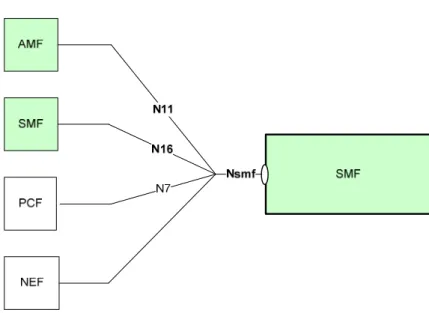
Within the 5GC, the SMF offers services to the AMF, other SMF (V-SMF or H-SMF), PCF and NEF via the Nsmf service based interface (see 3GPP TS 23.501 [2] and 3GPP TS 23.502 [3]).
Figure 4.1-1 provides the reference model (in service based interface representation and in reference point representation), with focus on the SMF and the scope of the present specification.
Figure 4.1-1: Reference model – SMF
The functionalities supported by the SMF are listed in subclause 6.2.2 of 3GPP TS 23.501 [2].
5
Services offered by the SMF
5.1 Introduction
The SMF supports the following services.Table 5.1-1: NF Services provided by SMF
Service Name Description Example
Consumer
Nsmf_PDUSession This service manages the PDU sessions and uses the
policy and charging rules received from the PCF. The service operations exposed by this NF service allows the consumer NFs to establish, modify and delete the PDU sessions.
V-SMF, H-SMF, AMF
Nsmf_EventExposure This service exposes the events happening on the PDU sessions to the consumer NFs.
PCF, NEF, AMF
The Nsmf_EventExposure service is specified in 3GPP TS 29.508 [6].
5.2 Nsmf_PDUSession
Service
5.2.1 Service
Description
The Nsmf_PDUSession service operates on the PDU Sessions. The service operations exposed by this service allow other NFs to establish, modify and release the PDU Sessions. The following are the key functionalities of this NF service:
- Creation, modification and deletion of SM contexts for PDU Sessions upon receiving N1 message notification from AMF carrying the NAS SM messages; an SM context represents an association between the NF Service Consumer (e.g. AMF) and the SMF for a PDU session;
- Retrieval of SM contexts of PDU sessions, e.g. to move PDU sessions towards the EPC using the N26 interface; - Creation, modification and deletion of PDU sessions between the V-SMF and H-SMF, in HR roaming scenarios;
- Association of policy and charging rules with PDU Sessions and binding the policy and charging rules to flows; - Interacting with the UPF over N4 for creating, modifying and releasing user plane sessions;
- Process user plane events from the UPF and apply the corresponding policy and charging rules. The Nsmf_PDUSession service supports the following service operations.
Table 5.2.1-1: Service operations supported by the Nsmf_PDUSession service
Service Operations Description Operation
Semantics
Example Consumer(s)
Create SM Context Create an SM context in SMF, or in V-SMF in HR roaming scenarios, for a PDU session.
Request/Response AMF Update SM Context Update the SM context of a PDU session
and/or provide the SMF with N1 or N2 SM information received from the UE or from the AN.
Request/Response AMF
Release SM Context Release the SM context of a PDU session when the PDU session has been released.
Request/Response AMF Notify SM Context
Status (see NOTE 1)
Notify the NF Service Consumer about the status of an SM Context of a PDU session (e.g. the SM Context is released within the SMF).
Subscribe/Notify AMF
Retrieve SM Context (see NOTE 2)
Retrieve an SM context of a PDU session from SMF, or from V-SMF in HR roaming scenarios, for 5GS to EPS mobility.
Request/Response AMF
Create Create a PDU session in the H-SMF, in HR
roaming scenarios.
Request/Response V-SMF
Update Update a PDU session in the H-SMF or
V-SMF, in HR roaming scenarios.
Request/Response V-SMF, H-SMF
Release Release a PDU session in the H-SMF, in HR
roaming scenarios.
Request/Response V-SMF Notify Status
(see NOTE 3)
Notify the NF Service Consumer about the status of a PDU session (e.g. the PDU session is released due to local reasons within the H-SMF).
Subscribe/Notify V-SMF
NOTE 1: This corresponds to the SMContextStatusNotify service operation defined in 3GPP TS 23.502 [3]. NOTE 2: This corresponds to the ContextRequest service operation defined in 3GPP TS 23.502 [3]. NOTE 3: This corresponds to the StatusNotify service operation defined in 3GPP TS 23.502 [3].
5.2.2 Service
Operations
5.2.2.1 Introduction
See Table 5.2.1-1 for an overview of the service operations supported by the Nsmf_PDUSession service.
5.2.2.2
Create SM Context service operation
5.2.2.2.1 General
The Create SM Context service operation shall be used to create an individual SM context, for a given PDU session, in the SMF, or in the V-SMF for HR roaming scenarios.
It is used in the following procedures:
- UE requested PDU Session Establishment (see subclause 4.3.2 of 3GPP TS 23.502 [3]);
- EPS to 5GS Idle mode mobility or handover using N26 interface (see subclause 4.11.1 of 3GPP TS 23.502 [3]); - EPS to 5GS mobility without N26 interface (see subclause 4.11.2.3 3GPP TS 23.502 [3]);
- Handover of a PDU session between 3GPP access and non-3GPP access, when the target AMF does not know the SMF resource identifier of the SM context used by the source AMF, e.g. when the target AMF is not in the PLMN of the N3IWF (see subclause 4.9.2.3.2 of 3GPP TS 23.502 [3]), or when the UE is roaming and the selected N3IWF is in the HPLMN (see subclause 4.9.2.4.2 of 3GPP TS 23.502 [3]);
- Handover from EPS to 5GC-N3IWF (see subclause 4.11.3.1 of 3GPP TS 23.502 [3]); - Handover from EPC/ePDG to 5GS (see subclause 4.11.4.1 of 3GPP TS 23.502 [3]). There shall be only one individual SM context per PDU session.
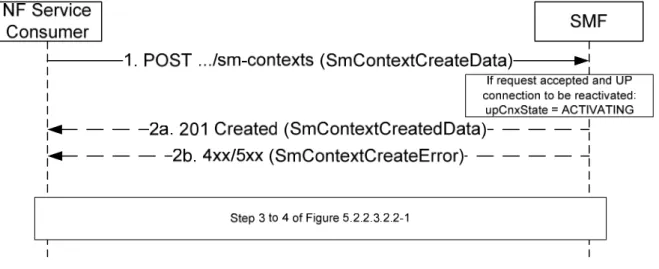
The NF Service Consumer (e.g. AMF) shall create an SM context by using the HTTP POST method as shown in Figure 5.2.2.2.1-1.
NF Service
Consumer
SMF
1. POST .../sm-contexts (SmContextCreateData)
2a. 201 Created (SmContextCreatedData)
2b. 4xx/5xx (SmContextCreateError) or 3xx
Figure 5.2.2.2.1-1: SM context creation
1. The NF Service Consumer shall send a POST request to the resource representing the SM contexts collection resource of the SMF. The payload body of the POST request shall contain:
- a representation of the individual SM context resource to be created;
- the Request Type IE, if it is received from the UE and if the request refers to an existing PDU session or an existing Emergency PDU session; the Request Type IE may be included otherwise;
- the Old PDU Session ID, if it is received from the UE (i.e. for a PDU session establishment for the SSC mode 3 operation);
- the indication that the UE is inside or outside of the LADN (Local Area Data Network) service area, if the DNN corresponds to a LADN;
- a subscription for SM context status notification; - the servingNfId identifying the serving AMF;
- trace control and configuration parameters, if trace is to be activated (see 3GPP TS 32.422 [22]).
For the UE requested PDU Session Establishment procedure in home routed roaming scenario (see subclause 4.3.2.2.2 of 3GPP TS 23.502 [3]), the NF Service Consumer shall provide the URI of the Nsmf_PDUSession service of the H-SMF in the hSmfUri IE and may provide the URI of the Nsmf_PDUSession service of additional H-SMFs. The V-SMF shall try to create the PDU session using the hSmfUri IE. If due to
communication failure on the N16 interface the V-SMF does not receive any response from the H-SMF, then: - depending on operator policy, the V-SMF may try reaching the hSmfUri via an alternate path; or
- if additional H-SMF URI is provided, the V-SMF may try to create the PDU session on one of the additional H-SMF(s) provided.
The payload body of the POST request may further contain:
- the name of the AMF service to which SM context status notification are to be sent (see subclause 6.5.2.2 of 3GPP TS 29.500 [4]), encoded in the serviceName attribute.
2a. On success, "201 Created" shall be returned, the payload body of the POST response shall contain the representation describing the status of the request and the "Location" header shall be present and shall contain the URI of the created resource. The authority and/or deployment-specific string of the apiRoot of the created
resource URI may differ from the authority and/or deployment-specific string of the apiRoot of the request URI received in the POST request.
If the Request Type was received in the request and set to EXISTING_PDU_SESSION or
EXISTING_EMERGENCY_PDU_SESSION (i.e. indicating that this is a request for an existing PDU session or an existing emergency PDU session), the SMF shall identify the existing PDU session or emergency PDU session based on the PDU Session ID; in this case, the SMF shall not create a new SM context but instead update the existing SM context and provide the representation of the updated SM context in the "201 Created" response to the NF Service Consumer.
The POST request shall be considered as colliding with an existing SM context if:
- it includes the same SUPI, or PEI for an emergency registered UE without a UICC or without an authenticated SUPI, and the same PDU Session ID as for an existing SM context; and
- this is a request to establish a new PDU session, i.e. the RequestType is absent in the request or is present and set to INITIAL_REQUEST or INITIAL_EMERGENCY_REQUEST.
A POST request that collides with an existing SM context shall be treated as a request for a new SM context. Before creating the new SM context, the SMF should delete the existing SM context locally and any associated resources in the UPF and PCF. If the smContextStatusUri of the existing SM context differs from the
smContextStatusUri received in the POST request, the SMF shall also send an SM context status notification (see subclause 5.2.2.5) targeting the smContextStatusUri of the existing SM context to notify the release of the existing SM context. For a HR PDU session, if the H-SMF URI in the request is different from the H-SMF URI of the existing PDU session, the V-SMF should also delete the existing PDU session in the H-SMF by invoking the Release service operation (see subclause 5.2.2.9).
If the Request Type was received in the request and indicates this is a request for a new PDU session (i.e. INITIAL_REQUEST) and if the Old PDU Session ID was also included in the request, the SMF shall identify the existing PDU session to release and to which the new PDU session establishment relates, based on the Old PDU Session ID.
2b. If the request does not include the "UE presence in LADN service area" indication and the SMF determines that the DNN corresponds to a LADN, then the SMF shall consider that the UE is outside of the LADN service area. The SMF shall reject the request if the UE is outside of the LADN service area.
On failure, or redirection during a UE requested PDU Session Establishment, one of the HTTP status code listed in Table 6.1.3.2.3.1-3 shall be returned. For a 4xx/5xx response, the message body shall contain an
SmContextCreateError structure, including:
- a ProblemDetails structure with the "cause" attribute set to one of the application error listed in Table 6.1.3.2.3.1-3;
- N1 SM information (PDU Session Reject), if the request included N1 SM information, except if the error prevents the SMF from generating a response to the UE (e.g. invalid request format).
5.2.2.2.2
EPS to 5GS Idle mode mobility using N26 interface
The NF Service Consumer (e.g. AMF) shall request the SMF to move a UE EPS PDN connection to 5GS using N26 interface, as follows.
Figure 5.2.2.2.2-1: EPS to 5GS Idle mode mobility using N26 interface
1. The NF Service Consumer shall send a POST request towards the SMF (+PGW-C) of each UE EPS PDN connection, as specified in subclause 5.2.2.2.1, with the following additional information:
- UE EPS PDN connection, including the EPS bearer contexts, received from the MME, representing the individual SM context resource to be created;
- pduSessionsActivateList, including the PDU Session ID of all the PDU session(s) to be re-activated. 2a. Upon receipt of such a request, if a corresponding PDU session is found based on the EPS bearer contexts (after
invoking a Create service operation towards the H-SMF, for a Home Routed PDU session) and if it is possible to proceed with moving the PDN connection to 5GS, the SMF shall return a 201 Created response including the following information:
- PDU Session ID corresponding to the default EPS bearer ID of the EPS PDN connection; - allocatedEbiList, containing the EBI(s) allocated to the PDU session;
and, if the PDU session that is derived by the SMF based on the EPS bearer contexts was requested to be re-activated, i.e. if the PDU Session ID was present in the pduSessionsActivateList:
- upCnxState attribute set to ACTIVATING;
- N2 SM information to request the 5G-AN to assign resources to the PDU session (see PDU Session Resource Setup Request Transfer IE in subclause 9.3.4.1 of 3GPP TS 38.413 [9]), including (among others) the transport layer address and tunnel endpoint of the uplink termination point for the user plane data for this PDU session (i.e. UPF's GTP-U F-TEID for uplink traffic).
The "Location" header shall be present in the POST response and shall contain the URI of the created SM context resource.
The NF Service Consumer (e.g. AMF) shall store the association of the PDU Session ID and the SMF ID, and store the allocated EBI(s) associated to the PDU Session ID.
NOTE: The behaviour specified in this step also applies if the POST request collides with an existing SM context, i.e. if the POST request includes the same SUPI, or PEI for an emergency registered UE without a UICC or without an authenticated SUPI, and the default EPS bearer ID received in the UE EPS PDN connection is the same as in the existing SM context.
2b. Same as step 2b of figure 5.2.2.2.1-1. Steps 3 to 4 are skipped in this case.
If the SMF determines that seamless session continuity from EPS to 5GS is not supported for the PDU session, the SMF shall set the "cause" attribute in the ProblemDetails structure to "NO_EPS_5GS_CONTINUITY". 3. Same as step 3 of figure 5.2.2.3.2.2-1, if the SMF returned a 201 Created response with the upConnectionState
set to ACTIVATING and N2 SM Information, 4. Same as step 4 of figure 5.2.2.3.2.2-1.
5.2.2.2.3
EPS to 5GS Handover Preparation using N26 interface
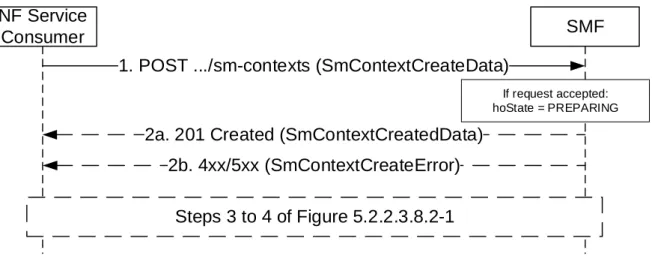
The NF Service Consumer (e.g. AMF) shall request the SMF to handover a UE EPS PDN connection to 5GS using N26 interface, as follows.
NF Service
Consumer
SMF
1. POST .../sm-contexts (SmContextCreateData)
2a. 201 Created (SmContextCreatedData)
If request accepted: hoState = PREPARING
Steps 3 to 4 of Figure 5.2.2.3.8.2-1
2b. 4xx/5xx (SmContextCreateError)
Figure 5.2.2.2.3-1: EPS to 5GS handover using N26 interface
1. The NF Service Consumer shall send a POST request, as specified in subclause 5.2.2.2.1, with the following additional information:
- UE EPS PDN connection, including the EPS bearer contexts, representing the individual SM context resource to be created;
- hoState attribute set to PREPARING (see subclause 5.2.2.3.4.1);
- targetId identifying the target RAN Node ID and TAI received in the Forward Relocation Request from the source MME.
2a. Upon receipt of such a request, if a corresponding PDU session is found based on the EPS bearer contexts (after invoking a Create service operation towards the H-SMF, for a Home Routed PDU session) and it is possible to proceed with handing over the PDN connection to 5GS, the SMF shall return a 201 Created response including the following information:
- hoState attribute set to PREPARING and N2 SM information to request the target 5G-AN to assign resources to the PDU session, as specified in step 2 of Figure 5.2.2.3.4.2-1;
- PDU Session ID corresponding to the default EPS bearer ID of the EPS PDN connection; - allocatedEbiList, containing the EBI(s) allocated to the PDU session.
The "Location" header shall be present in the POST response and shall contain the URI of the created SM context resource.
The NF Service Consumer (e.g. AMF) shall store the association of the PDU Session ID and the SMF ID, and store the allocated EBI(s) associated to the PDU Session ID.
NOTE: The behaviour specified in this step also applies if the POST request collides with an existing SM context, i.e. if the POST request includes the same SUPI, or PEI for an emergency registered UE without a UICC or without an authenticated SUPI, and the default EPS bearer ID received in the UE EPS PDN connection is the same as in the existing SM context.
2b. Same as step 2b of figure 5.2.2.2.1-1 with the following additions. Steps 3 to 4' are skipped in this case. The error response shall include the following additional information:
- hoState attribute set to NONE.
If the SMF determines that seamless session continuity from EPS to 5GS is not supported for the PDU session, the SMF shall set the "cause" attribute in the ProblemDetails structure to "NO_EPS_5GS_CONTINUITY".
5.2.2.3
Update SM Context service operation
5.2.2.3.1 General
The Update SM Context service operation shall be used to update an individual SM context and/or provide N1 or N2 SM information received from the UE or the AN, for a given PDU session, towards the SMF, or the V-SMF for HR roaming scenarios.
It is used in the following procedures:
- PDU Session modification (see subclause 4.3.3 of 3GPP TS 23.502 [3]);
- UE or network requested PDU session release (see subclause 4.3.4.2 and subclause 4.3.4.3 of 3GPP TS 23.502 [3]);
- Activation or Deactivation of the User Plane connection of an existing PDU session, i.e. establishment or release of the N3 tunnel between the AN and serving CN (see subclause 5.6.8 of 3GPP TS 23.501 [2] and subclauses 4.2.2.2, 4.2.3 and 4.2.6 of 3GPP TS 23.502 [3]);
- Xn and N2 Handover procedures (see subclauses 4.9.1 of 3GPP TS 23.502 [3]);
- Handover between 3GPP and untrusted non-3GPP access procedures (see subclause 4.9.2 of 3GPP TS 23.502 [3]);
- Inter-AMF change due to AMF planned maintenance or AMF failure (see subclause 5.21.2 of
3GPP TS 23.501 [2]), or inter-AMF mobility in CM-IDLE mode (see subclause 4.2.2.2 of 3GPP TS 23.502 [3]); - RAN Initiated QoS Flow Mobility (see subclause 4.14.1 of 3GPP TS 23.502 [3] and subclause 8.2.5 of
3GPP TS 38.413 [9]);
- All procedures requiring to provide N1 or N2 SM information to the SMF, e.g. UE requested PDU Session Establishment procedure (see subclause 4.3.2.2 of 3GPP TS 23.502 [3]), session continuity procedure (see subclause 4.3.5 of 3GPP TS 23.502 [3]);
- EPS to 5GS Idle mode mobility or handover using N26 interface (see subclause 4.11 of 3GPP TS 23.502 [3]); - 5GS to EPS Handover using N26 interface (see subclause 4.11.1.2 of 3GPP TS 23.502 [3]);
- PDU Session Reactivation during P-CSCF Restoration procedure via AMF (see subclause 5.8.4.3 of 3GPP TS 23.380 [21]);
- AMF requested PDU session release due to a change of the set of network slices for a UE where a network slice instance is no longer available (see subclause 4.3.4.2 of 3GPP TS 23.502 [3]);
- AMF receives an "initial request" with PDU Session Id which already exists in PDU session context of the UE (see subclause 5.4.5.2.5 of 3GPP TS 24.501 [7]);
- Secondary RAT Usage Data Reporting (see subclause 4.21 of 3GPP TS 23.502 [3]).
The NF Service Consumer (e.g. AMF) shall update an individual SM context and/or provide N1 or N2 SM information to the SMF by using the HTTP POST method (modify custom operation) as shown in Figure 5.2.2.3.1-1.
NF Service
Consumer
SMF
1. POST .../sm-contexts/{smContextRef}/modify
(SmContextUpdateData)
2a. 204 No Content or 200 OK (SmContextUpdatedData)
2b. 4xx/5xx (SmContextUpdateError)
1. The NF Service Consumer shall send a POST request to the resource representing the individual SM context resource in the SMF. The payload body of the POST request shall contain the modification instructions and/or the N1 or N2 SM information. If the request contains EBI(s) to revoke, then the SMF shall disassociate the EBI(s) with the QFI(s) with which they are associated.
2a. On success, "204 No Content" or "200 OK" shall be returned; in the latter case, the payload body of the POST response shall contain the representation describing the status of the request and/or N1 or N2 SM information. The SMF may indicate to the NF Service Consumer that it shall release EBI(s) that were assigned to the PDU session by including the releaseEbiList IE, e.g. when a QoS flow is released.
2b. On failure, one of the HTTP status code listed in Table 6.1.3.3.3.2-3 shall be returned. For a 4xx/5xx response, the message body shall contain an SmContextUpdateError structure, including:
- a ProblemDetails structure with the "cause" attribute set to one of the application error listed in Table 6.1.3.3.3.2-3;
- N1 SM information, if the SMF needs and can return a response to the UE; - N2 SM information, if the SMF needs and can return a response to the NG-RAN. The following subclauses specify additional requirements applicable to specific scenarios.
5.2.2.3.2
Activation and Deactivation of the User Plane connection of a PDU session
5.2.2.3.2.1 General
The upCnxState attribute of an SM context represents the state of the User Plane connection of the PDU session. The upCnxState attribute may take the following values:
- ACTIVATED: a N3 tunnel is established between the 5G-AN and UPF (F-TEIDs assigned for both uplink and downlink traffic);
- DEACTIVATED: no N3 tunnel is established between the 5G-AN and UPF;
- ACTIVATING: a N3 tunnel is being established (5G-AN's F-TEID for downlink traffic is not assigned yet). Subclauses 5.2.2.3.2.2 and 5.2.2.3.2.3 specify how the NF Service Consumer (e.g. AMF) request the SMF to activate or deactivate the User Plane connection of the PDU session, e.g. upon receiving a Service Request from the UE requesting to activate a PDU session or upon an AN release procedure respectively.
In scenarios where the SMF takes the initiative to activate or deactivate the User Plane connection of the PDU session, e.g. during a Network Triggered Service Request or CN-initiated selective deactivation of the User Plane connection of a PDU session respectively, the SMF invokes the Namf_N1N2MessageTransfer procedure with the inclusion of N2 SM Information (and optionally of a N1 SM Container) as specified in 3GPP TS 23.502 [3] to request the establishment or release of the PDU session's resources in the 5G-AN. The Update SM Context service operation is then used as specified in subclause 5.2.2.3.1 to transfer the response to the SMF.
Subclause 5.2.2.3.2.4 specifies how the NF Service Consumer (e.g. AMF) indicates to the SMF that the access type of a PDU session can be changed from non-3GPP access to 3GPP access, during a Network Triggered Service Request initiated for a PDU session associated to the non-3GPP access, if the PDU Session for which the UE was paged or notified is in the List Of Allowed PDU Sessions provided by the UE and if the AMF has received N2 SM Information only or N1 SM Container and N2 SM Information for that PDU session from the SMF in step 3a of subclause 4.2.3.3 of 3GPP TS 23.502 [3].
5.2.2.3.2.2 Activation of User Plane connectivity of a PDU session
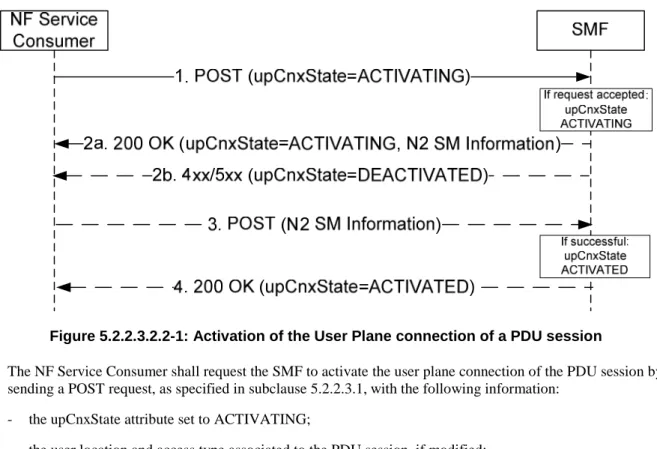
The NF Service Consumer (e.g. AMF) shall request the SMF to activate the User Plane connection of an existing PDU session, i.e. establish the N3 tunnel between the 5G-AN and UPF, as follows.
Figure 5.2.2.3.2.2-1: Activation of the User Plane connection of a PDU session
1. The NF Service Consumer shall request the SMF to activate the user plane connection of the PDU session by sending a POST request, as specified in subclause 5.2.2.3.1, with the following information:
- the upCnxState attribute set to ACTIVATING;
- the user location and access type associated to the PDU session, if modified;
- the indication that the UE is inside or outside of the LADN service area, if the DNN of the established PDU session corresponds to a LADN;
- other information, if necessary.
2a. Upon receipt of such a request, if the SMF can proceed with activating the user plane connection of the PDU session (see subclause 4.2.3 of 3GPP TS 23.501 [2], the SMF shall set the upCnxState attribute to
ACTIVATING and shall return a 200 OK response including the following information: - upCnxState attribute set to ACTIVATING;
- N2 SM information to request the 5G-AN to assign resources to the PDU session (see PDU Session Resource Setup Request Transfer IE in subclause 9.3.4.1 of 3GPP TS 38.413 [9]), including the transport layer address and tunnel endpoint of the uplink termination point for the user plane data for this PDU session (i.e. UPF's GTP-U F-TEID for uplink traffic).
If the SMF finds the PDU session already activated when receiving the request in step 1, the SMF shall delete the N3 tunnel information and update the UPF accordingly (see step 8a of subclause 4.2.3.2 of
3GPP TS 23.502 [3]).
2b. If the request does not include the "UE presence in LADN service area" indication and the SMF determines that the DNN corresponds to a LADN, then the SMF shall consider that the UE is outside of the LADN service area. The SMF shall reject the request if the UE is outside of the LADN service area.
If the SMF cannot proceed with activating the user plane connection of the PDU session (e.g. if the PDU session corresponds to a PDU session of SSC mode 2 and the SMF decides to change the PDU Session Anchor), the SMF shall return an error response, as specified for step 2b of figure 5.2.2.3.1-1. For a 4xx/5xx response, the SmContextUpdateError structure shall include the following additional information:
- upCnxState attribute set to DEACTIVATED.
3. If the SMF returned a 200 OK response, the NF Service Consumer (e.g. AMF) shall subsequently update the SM context in the SMF by sending POST request, as specified in subclause 5.2.2.3.1, with the following
information:
- N2 SM information received from the 5G-AN (see PDU Session Resource Setup Response Transfer IE in subclause 9.3.4.2 of 3GPP TS 38.413 [9]), including the transport layer address and tunnel endpoint of one or
two downlink termination point(s) and the associated list of QoS flows for this PDU session (i.e. 5G-AN's GTP-U F-TEID(s) for downlink traffic), if the 5G-AN succeeded in establishing resources for the PDU sessions; or
- N2 SM information received from the 5G-AN (see PDU Session Resource Setup Unsuccessful Transfer IE in subclause 9.3.4.16 of 3GPP TS 38.413 [9]), including the Cause of the failure, if resources failed to be established for the PDU session.
Upon receipt of this request, the SMF shall:
- update the UPF with the 5G-AN's F-TEID(s) and set the upCnxState attribute to ACTIVATED, if the 5G-AN succeeded in establishing resources for the PDU sessions; or
- consider that the activation of the User Plane connection has failed and set the upCnxState attribute to DEACTIVATED" otherwise.
4. The SMF shall then return a 200 OK response including the upCnxState attribute representing the final state of the user plane connection. If the activation of the User Plane connection failed due to insufficient resources, the cause IE shall be included in the response and set to "INSUFFICIENT_UP_RESOURCES".
5.2.2.3.2.3 Deactivation of User Plane connectivity of a PDU session
The NF Service Consumer (e.g. AMF) shall request the SMF to deactivate the User Plane connectivity of an existing PDU session, i.e. release the N3 tunnel, as follows.
Figure 5.2.2.3.2.2-1: Deactivation of the User Plane connection of a PDU session
1. The NF Service Consumer shall request the SMF to deactivate the user plane connection of the PDU session by sending a POST request, as specified in subclause 5.2.2.3.1, with the following information:
- upCnxState attribute set to DEACTIVATED; - user location and user location timestamp;
- cause of the user plane deactivation; the cause may indicate a cause received from the 5G-AN or due to an AMF internal event;
- other information, if necessary.
2. Upon receipt of such a request, the SMF shall deactivate release the N3 tunnel of the PDU session, set the upCnxState attribute to DEACTIVATED and return a 200 OK response including the upCnxState attribute set to DEACTIVATED.
5.2.2.3.2.4 Changing the access type of a PDU session from non-3GPP access to 3GPP access during a Service Request procedure
The NF Service Consumer (e.g. AMF) shall indicate to the SMF that the access type of a PDU session can be changed as follows:
NF Service
Consumer
SMF
1. POST (anTypeCanBeChanged=true)
2a. 204 No Content or 200 OK (SmContextUpdatedData)
2b. 4xx/5xx (SmContextUpdateError)
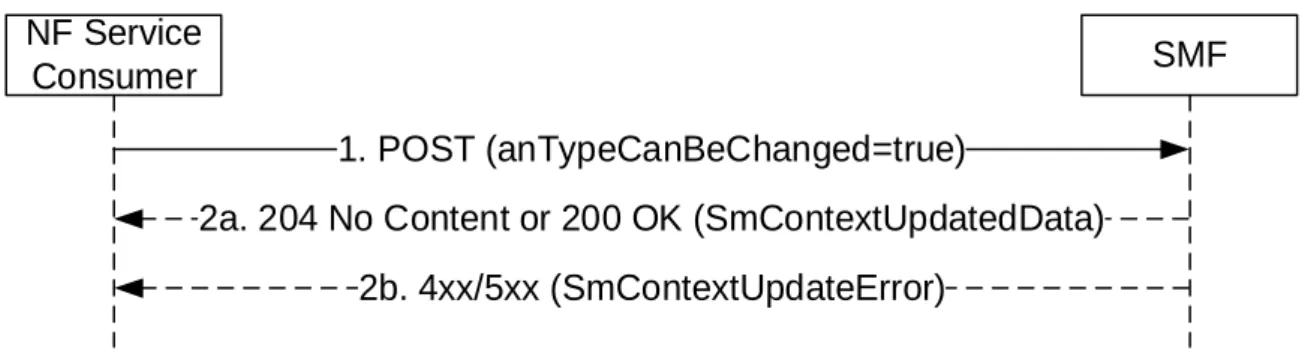
Figure 5.2.2.3.2.4-1: Indicating that the access type of a PDU session can be changed 1. The NF Service Consumer shall indicate that the access type of a PDU session can be changed by sending a
POST request, as specified in subclause 5.2.2.3.1, with the following information: - anTypeCanBeChanged attribute set to "true";
- other information, if necessary. 2a. Same as step 2a of figure 5.2.2.3.1-1. 2b. Same as step 2b of figure 5.2.2.3.1-1.
NOTE: This is used during a Service Request procedure (see subclause 4.2.3.2 of 3GPP TS 23.502 [3]), in response to paging or NAS notification indicating non-3GPP access, if the PDU Session for which the UE was paged or notified is in the List Of Allowed PDU Sessions provided by the UE and if the AMF has received N2 SM Information only or N1 SM Container and N2 SM Information for that PDU session from the SMF in step 3a of subclause 4.2.3.3 of 3GPP TS 23.502 [3].
If the PDU Session is moved from the non-3GPP access to 3GPP access (i.e. N3 tunnel for the PDU Session is established successfully), the SMF and NF Service Consumer (e.g. AMF) updates the associated access of the PDU Session.
5.2.2.3.3 Xn
Handover
The NF Service Consumer (e.g. AMF) shall request the SMF to switch the downlink N3 tunnel of the PDU session towards a new GTP tunnel endpoint as follows.
Figure 5.2.2.3.3-1: Xn handover
1. The NF Service Consumer shall request the SMF to switch the downlink N3 tunnel of the PDU session towards a new GTP tunnel endpoint by sending a POST request, as specified in subclause 5.2.2.3.1, with the following information:
- the indication that the PDU session is to be switched;
- N2 SM information received from the target 5G-AN (see Path Switch Request Transfer IE in subclause 9.3.4.8 of 3GPP TS 38.413 [9]), including the new transport layer address and tunnel endpoint of the
downlink termination point for the user data for this PDU session (i.e. 5G-AN's GTP-U F-TEID for downlink traffic);
- additional N2 SM information received from the source 5G-AN (see Secondary RAT Usage Report Transfer IE in subclause 9.3.4.x of 3GPP TS 38.413 [9]), if any;
- the user location associated to the PDU session;
- the indication that the UE is inside or outside of the LADN service area, if the DNN of the established PDU session corresponds to a LADN;
- other information, if necessary.
2a. If the SMF can proceed with switching the user plane connection of the PDU session, the SMF shall return a 200 OK response including the following information:
- N2 SM information (see Path Switch Request Acknowledge Transfer IE in subclause 9.3.4.9 of
3GPP TS 38.413 [9]), including the transport layer address and tunnel endpoint of the uplink termination point for the user data for this PDU session (i.e. UPF's GTP-U F-TEID for uplink traffic).
If the request does not include the "UE presence in LADN service area" indication and the SMF determines that the DNN corresponds to a LADN, then the SMF shall consider that the UE is outside of the LADN service area. The SMF shall proceed as specified in subclause 5.6.5 of 3GPP TS 23.501 [2].
2b. If the SMF cannot proceed with switching the user plane connection of the PDU session, the SMF shall return an error response, as specified for step 2b of figure 5.2.2.3.1-1, including:
- N2 SM information (see Path Switch Request Unsuccessul Transfer IE in subclause 9.3.4.20 of 3GPP TS 38.413 [9]), including the cause of the failure.
For a PDU session that is rejected by the target RAN (i.e. a PDU session indicated as failed to setup in the PATH SWITCH REQUEST), the NF Service Consumer (e.g. AMF) shall indicate the failure to setup the PDU session in the target RAN as follows.
NF Service
Consumer
SMF
1. POST (Failed To Be Switched Indication, N2 SM Information)
2a. 204 No Content
2b. 4xx/5xx (SmContextUpdateError)
Figure 5.2.2.3.3-2: Xn handover – PDU session rejected by the target RAN
1. The NF Service Consumer shall indicate to the SMF that the PDU session could not be setup in the target RAN by sending a POST request, as specified in subclause 5.2.2.3.1, with the following information:
- the indication that the PDU session failed to be switched;
- N2 SM information received from the target 5G-AN (see Path Switch Request Setup Failed Transfer IE in subclause 9.3.4.15 of 3GPP TS 38.413 [9]), including the cause why the session could not be setup;
- additional N2 SM information received from the source 5G-AN (see Secondary RAT Usage Report Transfer IE in subclause 9.3.4.x of 3GPP TS 38.413 [9]), if any;
- other information, if necessary.
2a. Upon receipt of such a request, the SMF shall return a "204 No Content" response. The SMF shall decide whether to release the PDU session or deactivate the user plane connection of the PDU session, as specified in subclause 4.9.1.2 of 3GPP TS 23.502 [3].
5.2.2.3.4 N2
Handover
5.2.2.3.4.1 General
The hoState attribute of an SM context represents the handover state of the PDU session. The hoState attribute may take the following values:
- NONE: no handover is in progress for the PDU session;
- PREPARING: a handover is in preparation for the PDU session; SMF is preparing the N3 tunnel between the target 5G-AN and UPF, i.e. the UPF's F-TEID is assigned for uplink traffic;
- PREPARED: a handover is prepared for the PDU session; SMF is updated for the N3 tunnel between the target 5G-AN and UPF, with the target 5G-AN's F-TEID to be assigned for downlink traffic upon handover execution; - COMPLETED: the handover is completed (successfully);
- CANCELLED: the handover is cancelled.
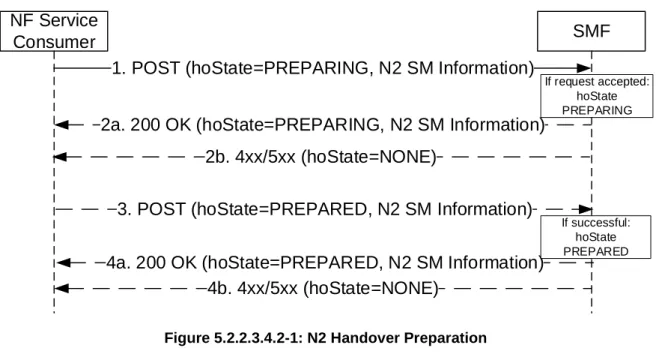
5.2.2.3.4.2 N2 Handover Preparation
The NF Service Consumer (e.g. AMF) shall request the SMF to prepare the handover of an existing PDU session, i.e. prepare the N3 tunnel between the target 5G-AN and UPF, as follows.
NF Service
Consumer
SMF
1. POST (hoState=PREPARING, N2 SM Information)
2a. 200 OK (hoState=PREPARING, N2 SM Information)
3. POST (hoState=PREPARED, N2 SM Information)
4a. 200 OK (hoState=PREPARED, N2 SM Information)
If request accepted: hoState PREPARING If successful: hoState PREPARED
2b. 4xx/5xx (hoState=NONE)
4b. 4xx/5xx (hoState=NONE)
Figure 5.2.2.3.4.2-1: N2 Handover Preparation
1. The NF Service Consumer shall request the SMF to prepare the handover of the PDU session by sending a POST request, as specified in subclause 5.2.2.3.1, with the following information:
- updating the hoState attribute of the individual SM Context resource in the SMF to PREPARING; - targetId identifying the target RAN Node ID and TAI received in the Handover Required from the source
NG-RAN;
- targetServingNfId set to the target AMF Id, for a N2 handover with AMF change;
- N2 SM information received from the source NG-RAN (see Handover Required Transfer IE in subclause 9.3.4.14 of 3GPP TS 38.413 [9]), indicating whether a direct path is available.
2a. Upon receipt of such a request, if the SMF can proceed with preparing the handover of the PDU session (see subclause 4.9.1.3 of 3GPP TS 23.501 [2]), the SMF shall set the hoState attribute to PREPARING and shall return a 200 OK response including the following information:
- hoState attribute set to PREPARING;
- N2 SM information to request the target 5G-AN to assign resources to the PDU session (see PDU Session Resource Setup Request Transfer IE in subclause 9.3.4.1 of 3GPP TS 38.413 [9]), including (among others) the transport layer address and tunnel endpoint of the uplink termination point for the user plane data for this PDU session (i.e. UPF's GTP-U F-TEID for uplink traffic).
The SMF shall store the targetServingNfId, if received in the request, but the SMF shall still consider the AMF (previously) received in the servingNfId IE as the serving AMF for the UE.
2b. If the SMF cannot proceed with preparing the handover of the PDU session (e.g. the UE moves into a non-allowed service area), the SMF shall return an error response, as specified in step 2b of figure 5.2.2.3.1-1. For a 4xx/5xx response, the SmContextUpdateError structure shall include the following additional information: - hoState attribute set to NONE.
3. If the SMF returned a 200 OK response, the NF Service Consumer (e.g. AMF) shall subsequently update the SM context in the SMF by sending POST request, as specified in subclause 5.2.2.3.1, with the following
information:
- hoState attribute set to PREPARED;
- N2 SM information received from the target 5G-AN (see Handover Request Acknowledge Transfer IE in subclause 9.3.4.11 of 3GPP TS 38.413 [9]), including (among others) the transport layer address and tunnel endpoint of the downlink termination point for the user data for this PDU session (i.e. target 5G-AN's GTP-U F-TEID for downlink traffic), if the target 5G-AN succeeded in establishing resources for the PDU session; - N2 SM information received from the target 5G-AN (see Handover Resource Allocation Unsuccessful
Transfer IE in subclause 9.3.4.19 of 3GPP TS 38.413 [9]), including the Cause of the failure, if resources failed to be established for the PDU sessions.
4a. If the target 5G-AN succeeded in establishing resources for the PDU sessions, the SMF shall set the hoState attribute to PREPARED and return a 200 OK response including the following information:
- hoState attribute to PREPARED;
- N2 SM information (see Handover Command Transfer IE in subclause 9.3.4.10 of 3GPP TS 38.413 [9]) containing DL forwarding tunnel information to be sent to the source 5G-AN by the AMF if direct or indirect data forwarding applies (see step 11f of subclause 4.9.1.3.2 of 3GPP TS 23.502 [3]).
4b. If the SMF cannot proceed with preparing the handover of the PDU session (e.g. the target 5G-AN failed to establish resources for the PDU session), the SMF shall set the hoState to NONE, release resources reserved for the handover to the target 5G-AN, and return an error response as specified in step 2b of figure 5.2.2.3.1-1. For a 4xx/5xx response, the SmContextUpdateError structure shall include the following additional information: - hoState attribute set to NONE;
- N2 SM information (see Handover Preparation Unsuccessful Transfer IE in subclause 9.3.4.18 of 3GPP TS 38.413 [9]) indicating the cause of the failure;
- the cause in the error attribute set to HANDOVER_RESOURCE_ALLOCATION_FAILURE, if the target 5G-AN failed to establish resources for the PDU session.
5.2.2.3.4.3 N2 Handover Execution
The NF Service Consumer (e.g. AMF) shall request the SMF to complete the execution the handover of an existing PDU session, upon being notified by the target 5G-AN that the handover to the target 5G-AN has been successful, as follows.
NF Service
Consumer
SMF
1. POST (hoState=COMPLETED, N2 SM Information)
2. 200 OK (hoState=COMPLETED)
hoState NONE
Figure 5.2.2.3.4.3-1: N2 Handover Execution
1. The NF Service Consumer shall request the SMF to complete the execution of the handover of the PDU session by sending a POST request, as specified in subclause 5.2.2.3.1, with the following information:
- updating the hoState attribute of the individual SM Context resource in the SMF to COMPLETED; - servingNfId set to the new serving AMF Id, for a N2 handover with AMF change;
- the indication that the UE is inside or outside of the LADN service area, if the DNN of the established PDU session corresponds to a LADN;
- N2 SM information received from the source 5G-AN (see Secondary RAT Usage Report Transfer IE in subclause 9.3.4.x of 3GPP TS 38.413 [9]), if any;
- other information, if necessary.
2. Upon receipt of such a request, the SMF shall return a 200 OK response including the following information: - hoState attribute set to COMPLETED.
The SMF shall complete the execution of the handover, e.g. switch the PDU session towards the downlink termination point for the user data received from the target 5G-AN (i.e. target 5G-AN's GTP-U F-TEID for downlink traffic), set the hoState to NONE and delete any stored targetServingNfId.
If the request does not include the "UE presence in LADN service area" indication and the SMF determines that the DNN corresponds to a LADN, then the SMF shall consider that the UE is outside of the LADN service area. The SMF shall proceed as specified in subclause 5.6.5 of 3GPP TS 23.501 [2].
5.2.2.3.4.4 N2 Handover Cancellation
The NF Service Consumer (e.g. AMF) shall request the SMF to cancel the handover of an existing PDU session, e.g. upon receipt of such a request from the source 5G-AN, as follows.
Figure 5.2.2.3.4.3-1: N2 Handover Cancellation
1. The NF Service Consumer shall request the SMF to cancel the execution of the handover of the PDU session by sending a POST request, as specified in subclause 5.2.2.3.1, with the following information:
- updating the hoState attribute of the individual SM Context resource in the SMF to CANCELLED; - cause information;
- other information, if necessary.
2. Upon receipt of such a request, the SMF return a 200 OK response including the following information: - hoState attribute set to CANCELLED.
The SMF shall cancel the execution of the handover, e.g. release resources reserved for the handover to the target 5G-AN, set the hoState to NONE and delete any stored targetServingNfId.
5.2.2.3.5
Handover between 3GPP and untrusted non-3GPP access procedures
5.2.2.3.5.1 General
The handover of a PDU session between 3GPP and untrusted non-3GPP access shall be supported as specified in subclause 4.9.2 of 3GPP TS 23.502 [3]. Such a handover may involve:
- the same AMF, or a target AMF in the same PLMN as the source AMF (see subclauses 4.9.2.1, 4.9.2.2, 4.9.2.3.1 and 4.9.2.4.1 of 3GPP TS 23.502 [3]); or
- a target AMF in a different PLMN than the source AMF (see subclauses 4.9.2.3.2 and 4.9.2.4.2 of 3GPP TS 23.502 [3]).
For a Home-Routed PDU session, the target AMF may be located in the VPLMN, or in the HPLMN when the N3IWF is in the HPLMN.
5.2.2.3.5.2 Handover of a PDU session without AMF change or with target AMF in same PLMN
In these scenarios, the same V-SMF is used before and after the handover.
The NF Service Consumer (e.g. AMF) shall request the SMF to handover an existing PDU session from 3GPP access to untrusted non-3GPP access, or vice-versa, as follows.
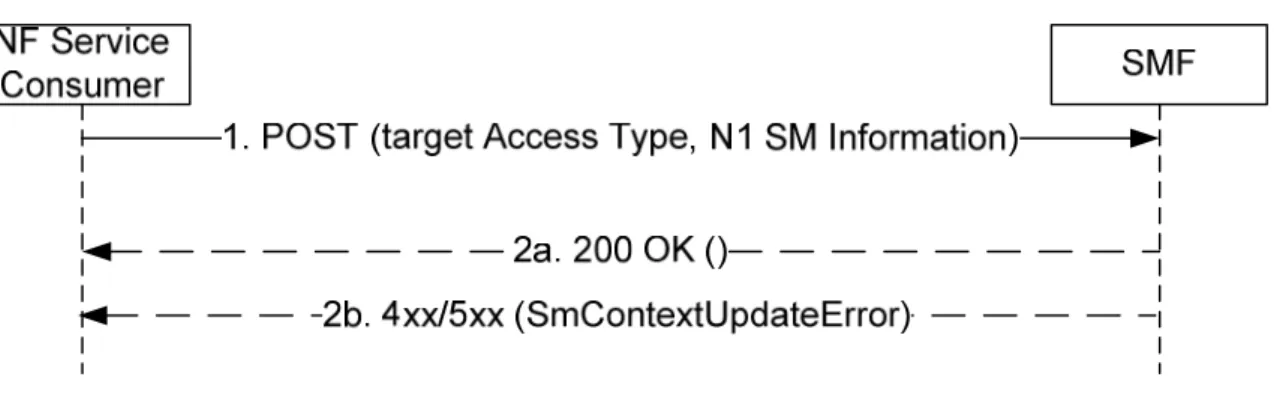
Figure 5.2.2.3.5.2-1: Handover between 3GPP and untrusted non-3GPP access
1. The NF Service Consumer shall request the SMF to handover an existing PDU session from 3GPP access to untrusted non-3GPP access, or vice-versa, by sending a POST request, as specified in subclause 5.2.2.3.1, with the following information:
- updating the anType attribute of the individual SM Context resource in the SMF to the target access type, i.e. to 3GPP_ACCESS or NON_3GPP_ACCESS;
- other information, if necessary. 2a. Same as step 2a of Figure 5.2.2.3.1-1.
2b. If the SMF cannot proceed with handing over the PDU session to the target access type, the SMF shall return an error response, as specified for step 2b of figure 5.2.2.3.1-1. For a 4xx/5xx response, the SmContextUpdateError structure shall include the following additional information:
- N1 SM Information to reject the UE request.
5.2.2.3.6
Inter-AMF change or mobility
The NF Service Consumer (e.g. new AMF) shall inform the SMF that it has taken over the role of serving the UE (e.g. it has taken the responsibility of the signalling towards the UE), when so required by 3GPP TS 23.501 [2]
and 3GPP TS 23.502 [3], as follows.
Figure 5.2.2.3.6-1: Inter-AMF change or mobility
1. The NF Service Consumer shall update the SMF with the new serving AMF, by sending a POST request, as specified in subclause 5.2.2.3.1, with the following information:
- servingNfId set to the new serving AMF Id;
- other information, if necessary, e.g. to activate the user plane connection of the PDU session (see subclause 5.2.2.3.2.2).
2a. Same as step 2a of Figure 5.2.2.3.1-1. 2b. Same as step 2b of figure 5.2.2.3.1-1.
5.2.2.3.7
RAN Initiated QoS Flow Mobility
The NF Service Consumer (e.g. AMF) shall request the SMF to transfer QoS flows to and from Secondary RAN node, or more generally, handle a NG-RAN PDU Session Resource Modify Indication, as follows.
Figure 5.2.2.3.7-1: RAN Initiated QoS Flow Mobility
1. The NF Service Consumer shall request the SMF to modify the PDU session, as requested by the NG-RAN, by sending a POST request, as specified in subclause 5.2.2.3.1, with the following information:
- N2 SM information received from the 5G-AN (see PDU Session Resource Modify Indication Transfer IE in subclause 9.3.4.6 of 3GPP TS 38.413 [9]), including the transport layer information for the QoS flows of this PDU session (i.e. 5G-AN's GTP-U F-TEIDs for downlink traffic);
2a. Upon receipt of such a request, if the SMF can proceed with switching the QoS flows of the PDU session, the SMF shall return a 200 OK response including the following information:
- N2 SM information (see PDU Session Resource Modify Confirm Transfer IE in subclause 9.3.4.7 of 3GPP TS 38.413 [9]), including the list of QoS flows which were modified successfully.
2b. If the SMF cannot proceed with switching the QoS flows of the PDU session, the SMF shall return an error response, as specified for step 2b of figure 5.2.2.3.1-1, including:
- N2 SM information (see PDU Session Resource Modify Confirm Transfer IE in subclause 9.3.4.7 of 3GPP TS 38.413 [9]), including the list of QoS flows which failed to be modified.
5.2.2.3.8
EPS to 5GS Handover using N26 interface
5.2.2.3.8.1 General
The NF Service Consumer (e.g. AMF) shall request the SMF to handover a UE EPS PDN connection to 5GS using N26 interface, following the same requirements as specified for N2 handover in subclause 5.2.2.3.4 with the modifications specified in this subclause.
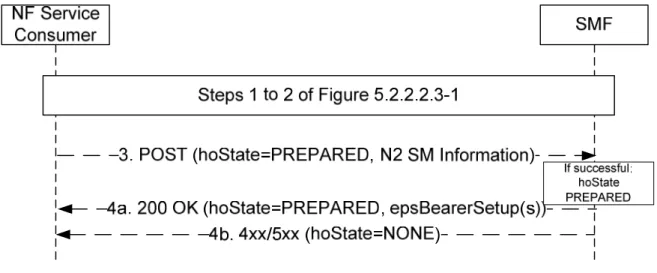
5.2.2.3.8.2 EPS to 5GS Handover Preparation
The requirements specified in subclause 5.2.2.3.4.2 shall apply with the following modifications.
Figure 5.2.2.3.8.2-1: EPS to 5GS Handover Preparation 1. Same as step 1 of Figure 5.2.2.2.3-1.
2a. Same as step 2 of Figure 5.2.2.2.3-1. 2b. Same as step 2b of figure 5.2.2.3.1-1. 3. Same as step 3 of Figure 5.2.2.3.4.2-1.
4a. Same as step 4 of Figure 5.2.2.3.4.2-1, with the following modifications:
The 200 OK response shall not include N2 SM information for DL forwarding tunnel setup, but shall additionally contain:
- the epsBearerSetup IE(s), containing the list of EPS bearer context(s) successfully handed over to the 5GS and the CN tunnel information for data forwarding, generated based on the list of accepted QFI(s) received from the 5G-RAN;
5.2.2.3.8.3 EPS to 5GS Handover Execution
The requirements specified in subclause 5.2.2.3.4.3 shall apply, with the following modifications.
In step 2 of Figure 5.2.2.3.4.3-1, for a Home Routed PDU session, the SMF shall complete the execution of the handover by initiating an Update service operation towards the H-SMF in order to switch the PDU session towards the V-UPF (see subclause 5.2.2.8.2.3).
5.2.2.3.8.4 EPS to 5GS Handover Cancellation
The requirements specified in subclause 5.2.2.3.4.4 shall apply.
5.2.2.3.9
5GS to EPS Handover using N26 interface
The NF Service Consumer (e.g. AMF) shall request the SMF to establish indirect data forwarding tunnels during a 5GS to EPS handover, as follows.
Figure 5.2.2.3.9-1: 5GS to EPS Handover using N26 interface (data forwarding tunnels setup) 1. The NF Service Consumer shall send a POST request, as specified in subclause 5.2.2.3.1, with the following
information:
- dataForwarding IE set to true;
- EPS bearer contexts received from the MME in the Forward Relocation Response.
2a. Upon receipt of such a request, the SMF shall map the EPS bearers for Data Forwarding to the 5G QoS flows based on the association between the EPS bearer ID(s) and QFI(s) for the QoS flow(s), and shall return a 200 OK response including the following information:
- N2 SM information providing the 5G-AN with the CN transport layer address and tunnel endpoint (i.e. UPF's GTP-U F-TEID) for Data Forwarding and the QoS flows for Data Forwarding for this PDU session.
2b. If the SMF cannot proceed with the request, the SMF shall return an error response, as specified for step 2b of figure 5.2.2.3.1-1.
The NF Service Consumer (e.g. AMF) shall request the SMF to release indirect data forwarding tunnels, as follows.