2015-16
Table of Contents
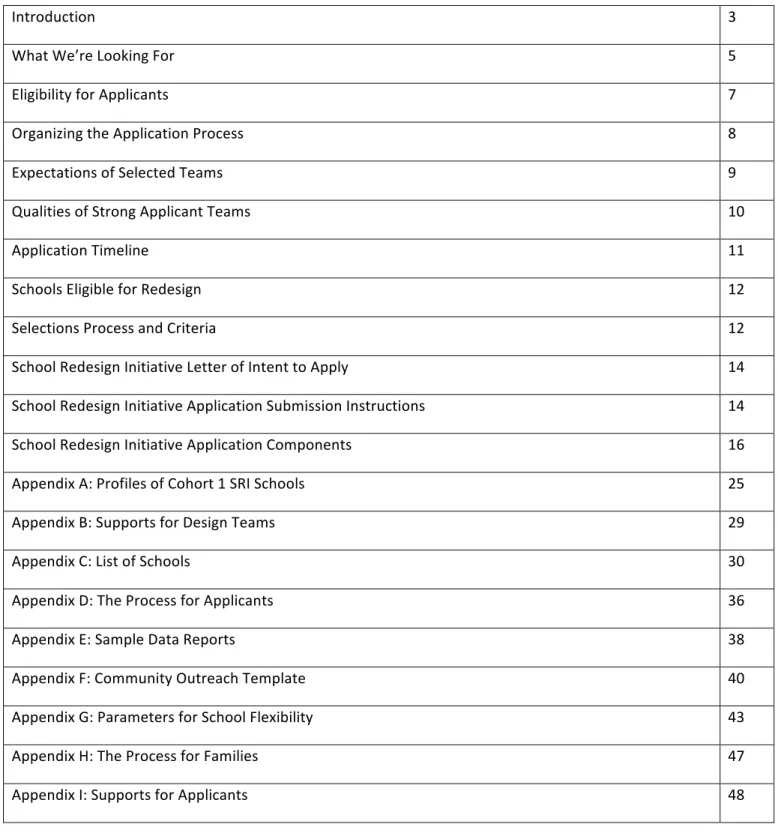
Introduction 3
What We’re Looking For 5
Eligibility for Applicants 7
Organizing the Application Process 8
Expectations of Selected Teams 9
Qualities of Strong Applicant Teams 10
Application Timeline 11
Schools Eligible for Redesign 12
Selections Process and Criteria 12
School Redesign Initiative Letter of Intent to Apply 14
School Redesign Initiative Application Submission Instructions 14
School Redesign Initiative Application Components 16
Appendix A: Profiles of Cohort 1 SRI Schools 25
Appendix B: Supports for Design Teams 29
Appendix C: List of Schools 30
Appendix D: The Process for Applicants 36
Appendix E: Sample Data Reports 38
Appendix F: Community Outreach Template 40
Appendix G: Parameters for School Flexibility 43
Appendix H: The Process for Families 47
Appendix I: Supports for Applicants 48
We are making our schools great. Join Us.
Introduction
The District is guided in each decision it makes by its vision as articulated in Action Plan 3.0:
The School District of Philadelphia will deliver on the right of every child in Philadelphia to an excellent public school education and ensure all children graduate from high school ready to succeed.
To realize this vision, the District put forth Action Plan 3.0, a comprehensive strategic plan to dramatically improve the number of high-‐quality learning experiences available to all students in Philadelphia. With a renewed commitment to ensuring equitable access to rigorous, relevant, and joyful learning, Action Plan 3.0 illuminates the District’s path for academic improvement for all students. As a part of this responsibility to ensure high-‐quality schools for all children, the District reaffirms its commitment to identify and implement innovative approaches to instructional design and school operations by announcing a Call for Quality School Designs available to highly talented and highly committed innovators and educators. The Call for Quality School Designs seeks the best leadership teams and best ideas for starting new schools (http://newschools.philasd.org/), and for reimagining existing schools through the School Redesign Initiative
(schoolredesignphiladelphia.org).
Last year, we launched the School Redesign Initiative with an aim to infuse new energy into our effort to improve our neighborhood schools. Four outstanding teams were selected to participate in the first cohort of this initiative, and they are currently working diligently to implement their proposed redesigns (see appendix A).
Through our work with this first cohort, we have learned a great deal about how to support the successful development and implementation of redesign plans. The learning from this first outstanding cohort of schools includes but is not limited to: lengthening the application window; providing additional and different learning and networking opportunities during the application process; revising the application itself to add clarity, reduce redundancies, and to focus more of teams’ initial energy on stakeholder engagement; streamlining the submission process; adjusting the timing and content of ongoing support sessions; and adjusting district systems, processes, and timelines to support redesign efforts. We are excited to use the learning from this first round to drive an improved second round of the redesign initiative.
We are seeking exceptional partners to join us on the second phase of this journey. Through the School Redesign Initiative, the District invites partners with a talent and passion for school improvement to submit a proposal to redesign a school. Exceptional applicants that are able to leverage advances in research, technology, and instructional practice to put forth innovative ideas for how to engage all students in learning for the 21st century -‐ as well as to demonstrate a commitment to
the school community, an ability to lead effectively, and strong instructional expertise -‐ will be selected to assume the management of a District school beginning in the fall of 2016. In the interim, selected applicants will spend the year working with the local school community to tailor the academic program to the needs of the students at the school. Selected applicants will be provided with a small amount of grant funding to support their design year, as well as
networking opportunities and connections to local and national experts to inform the design process. See appendix B for more information on supports for design teams. Schools involved in this process will remain District schools situated within
2015-16
their existing neighborhood learning network, and will continue to serve the students currently attending the school. The District will work closely with selected design leaders to ensure that District processes, systems, and policies are aligned in support of redesign efforts.
We know that Philadelphia is a city that abounds with diverse talents, innovative ideas, and inspiring passion. The District is excited to work with educators, parents, and community partners in the collective redesign of our schools for the
betterment of our children’s education. We know that the District is not the sole source of great ideas, and that by leveraging the assets of talented parents, educators, and advocates in our communities, we can bring about powerful change in the lives of our students. Visit schoolredesignphiladelphia.org for more information and to download an application. Final proposals are due by 11:59 pm, October 2, 2015.
What We’re Looking For
At The School District of Philadelphia, we are making our schools great. To bring the latest advances in educational research, technology, and instructional practice to life in our schools, we need evidence-‐based, bold and innovative ideas from talented, committed educators and community members. We invite applications to redesign schools that incorporate the proven principles listed below into the core of school design.
Mission and Culture – The District seeks proposals that communicate a clear and compelling vision and mission, and that intentionally work to build a school culture among students and staff in line with the school vision. Strong proposals will illustrate the kinds of consistent adult and student behaviors the school will seek to instill. Strong proposals will also outline the approaches that the school leadership team will take to ensure that the school’s vision, mission, and culture are shared across stakeholder groups and embodied in all aspects of the school.
Instructional Model – The District seeks instructional models that focus strongly on personalized learning for all students. Proposals should document how the proposed design will seek to personalize learning by connecting learning activities and the learning environment to the individual needs, interests, and goals of students. Proposals should outline how students will continuously be challenged to meet rigorous standards, and how the instructional program will incorporate regular opportunities for students to demonstrate mastery of their learning objectives. Proposals should also describe the systems and practices that will be put in place to ensure transparent communication to students of their progress toward mastery and advancement.
Youth Development – The District seeks proposals that demonstrate high expectations for student learning. Strong proposals will include as a part of their design a description of the systems and school culture the team seeks to instill in order to promote student responsibility over their own learning and student voice in school decision-‐making. Strong proposals will demonstrate how the school will be proactive in cultivating caring and positive relationships among students and between students and adults.
Mission&and& Culture:& !!Purpose,*goals,*and* culture* !!Embodied*in*all* aspects* Instruc2onal& Model:& !!Personalized*learning* !!Rigorous*standards* !!Demonstra9on*of* mastery* !!Communica9on*of* student*progress* Youth& Development:& !!High*expecta9ons* !!Student*contribu9ons* !!Posi9ve*rela9onships*
!!Student*responsibility* Community&Family&and& Engagement:& !!Family*par9cipa9on* !!Integra9on*of* Community* !!Partnerships* Talent:& !!Effec9ve*teams* !!Personalized*PD* !!Leadership* development* !!Recruitment*and* selec9on* Con2nuous& Improvement:& !!Performance*data* !!Performance*goals* !!Feedback* !!Efficient*opera9ons*
Talent – The District seeks proposals that put forth creative strategies to use time, people, and technology in ways that optimize teachers’ ability to support student learning. Strong proposals will communicate a desire and strategy to build effective teacher teams, to provide teachers with personalized professional development and leadership opportunities, and to develop a culture of accountability for student learning. Strong proposals will outline the methods and the frequency by which teachers receive feedback on both their and their students’ performance. The District is also looking for designs that clearly identify the types of teachers that the school would need to recruit, retain, and develop, along with the systems the school would put in place to make sure that all staff members are bought into and positioned to be successful in the school’s approach to learning.
Family and Community Engagement – The District seeks proposals that will actively promote family participation in the school. Strong proposals will describe the integration of families and of community participation, assets and culture into the life of the school through a variety of methods, including but not limited to the following: developing strong parent networks; working with families and the community to support academic achievement and positive habits of mind outside of the school day; and providing opportunities for family and community members to take on leadership roles in service of the school. Strong proposals should additionally outline the approach the school will take to building strategic and
meaningful partnerships with community members and organizations in support of the school.
Continuous Improvement – The District seeks proposals that outline the ways in which the school will use performance data and analytics to improve curriculum, instruction, and operations. Strong proposals will describe the systems the school will put in place to measure, analyze, report, and act upon data related to these goals. Strong proposals will also put forth a suggested model of school governance that can effectively hold school leaders and staff accountable for meeting their goals.
The District seeks proposals that offer research-‐based approaches to bringing these principles to life in a school. SDP encourages applicants to visit and/or seek out the advice of existing schools that have been successful in improving student performance, and to incorporate any relevant learning into their proposals.
In addition, SDP encourages potential applicants to consider innovative options for school structure and management. The ways in which students are grouped and in which teachers interact with students do not need to adhere to a strictly traditional model of schooling. In a similar vein, school management does not need to reside within a traditional structure, such as a single principal, but could extend into alternative management models such as multi-‐stakeholder boards of management, or teacher leadership teams.
Eligibility for Applicants
Parties interested in applying to redesign an SDP school may be comprised of a wide-‐array of stakeholders passionate about improving educational outcomes for our students. Applicants and applicant groups could include:
• Current school leadership teams • Teacher led teams
• Community collaborations between school families, community organizations, and/or universities in partnership with educators
• Other groups with a passion and a talent for designing effective instructional systems
Current school leadership teams – Existing leadership teams at schools may have great ideas for bringing innovation to life in their school to serve their students in new and better ways. The District hopes to support exceptional teams to develop and refine these ideas, and empower them to implement innovations in their schools. Teams that fall into this category will likely include the current principal and some set of teacher or other administrative leaders in the school. For example, the principal, counselor, teachers, and a parent leader at ABC Elementary school could team up to propose a plan to redesign the school around a shared vision for instruction.
Teacher led teams – Teams of teachers may come together to propose a redesign of their current school. These teams must designate a leader (or co-‐leaders if using a co-‐leadership model) from among their team who is eligible to assume the responsibilities commonly associated with the principalship. For example, four teachers at ABC Middle School could team together to propose a plan to redesign ABC Middle School around a shared vision for instruction.
Community collaborations between school families, community organizations, and/or universities in partnership with educators – Family members, community organizations, and/or university partners may collaborate with educators to lead the redesign of an existing school. These teams must designate a leader (or co-‐leaders if using a co-‐leadership model) from among their team who is eligible to assume the responsibilities commonly associated with the principalship. For example, a group of parents from ABC High School may work with a group of teachers from ABC High School, a professor from the local university and with a group of local community based organizations that provide an array of academic and social support services to propose a plan to redesign the school’s instructional program around a shared vision for instruction.
Other groups with a passion and a talent for designing effective instructional systems – Other arrangements of talented, committed stakeholders and stakeholder groups may also apply. These teams must designate a leader (or co-‐leaders if using a co-‐leadership model) from among their team who is eligible to assume the responsibilities commonly associated with the principalship.
All applications must be able to demonstrate that the team has among its members a person or people with a strong background in instruction and instructional leadership. It is not required that the applying party have a current or former principal among its members; however, there must be at least one person from each applicant group who holds or who can demonstrate the ability to obtain a Pennsylvania principal certification prior to July 2016. For the purposes of this
application, teams should consist of no fewer than three and no more than eight named members.
Organizing the Application Process
While each applicant team will take a different process to prepare its application, all teams should be prepared to do the following over the course of application preparation.
• Gather stakeholder feedback: Strong applications will demonstrate a deep understanding of the successes and
challenges currently being experienced by students, families and partners in the school. Teams should be prepared to dedicate a significant amount of time to distributing surveys and conducting interviews, focus groups,
observations, and other stakeholder feedback sessions with students, family members, and community partners. A strong application will be able to demonstrate that the proposals it puts forth embody the thoughts and feelings of a representative set of the school’s various stakeholder groups. Incorporating feedback from 50-‐100 or more students and families at a given school (depending on size) is a good target for teams to shoot for. While surveys are an important instrument for this process, personal conversations and direct observations should also be a key component of this stakeholder feedback gathering. It is strongly suggested that teams plan for and distribute the work of gathering this feedback at the outset of the process, before outlining the proposal itself.
• Conduct research: Strong applicants will have a solid research base on which to base their proposed changes.
Teams should be prepared to immerse themselves in the bodies of literature most relevant to their needs and ideas. All teams should research literature on culture change in organizations. Additionally, teams should seek out the most current research related to their instructional methodologies. For instance, a team looking to use technology in creative ways to create a new, more effective learning environment would be well-‐served to become knowledgeable about research on best practices for digital learning environments. It is strongly suggested that teams identify relevant research and plan for conducting and synthesizing this research to inform their proposal.
• Learn about and/or visit model schools: Strong applicants will draw inspiration from high-‐performing schools that
currently employ methods that are similar to the ones they seek to cultivate. During the application process, teams should take the opportunity to learn more about these schools and their practices, and where possible, interview school leaders and visit these schools.
• Reach out to potential partners: There are many organizations -‐ local, regional, and national – that can provide expertise and assistance of various forms to teams seeking to improve educational options for students. Teams may be well-‐served to distribute the work of reaching out to organizations and individuals that may be able and willing to lend expertise to their application (and perhaps to the eventual implementation).
• Proofread the final application prior to submission: Strong teams will submit proposals that address all of the
requested components in the application, that are clearly and concisely written, and that contain few if any
technical errors. It is strongly suggested that each team identify a proofreader or set of proofreaders – who may or may not be part of the design team – and establish a timeline by which the proofreader will review and give
feedback on the proposal well before the final deadline.
Expectations of Selected Teams
Teams that are selected as design teams are expected to commit to the following:
• Interview Day -‐ During the interview process, teams will need to attend one of the School Redesign Initiative interview days, tentatively scheduled for Saturday, October 24 and Sunday, October 25 (these dates are subject to change if necessary). Teams should expect to spend approximately one half of a day, either a morning or
afternoon, participating in interview exercises.
• Monthly Convenings – Throughout the design year, the School Redesign Initiative cohort will gather approximately
one time per month for approximately two hours in the evenings to engage in collective learning, review and share progress, and connect with members of other teams. Team members should make all efforts to attend each monthly session.
• Ongoing Communication – Team members should commit to maintain ongoing and timely communication with the
District office regarding their redesign efforts.
• Adherence to Deadlines – The District will work closely with each team to establish timelines by which the various elements of each team’s proposal may be implemented. Team members should be willing to commit to adhere as closely as possible to established deadlines.
• Documentation of Progress and Implementation Plan – Throughout the design year, teams will be expected to
document -‐ and eventually to present on -‐ the progress that they have made during the course of the design year. Documentation to be completed and presented on may include, but is not limited to, the following:
o A description of the team’s design process o An overview of the school’s chosen curricula
o An overview of the team’s approach to professional development, including a scope and sequence where applicable
o An overview of the team’s chosen assessments, including methods and frequency of providing feedback to students and families
o An overview of the team’s approach to family and community engagement o A proposed school schedule and calendar
o A description of the team’s metrics of success and how they will be tracked and reported o Ongoing team work plans to prepare for successful implementation
o An analysis of budgetary expenditures and additional resource needs
Qualities of Strong Applicant Teams
To be considered a strong applicant team, team members should be able to demonstrate the following:
Instructional Expertise
Successful applicants will demonstrate that there are members of the team who are deeply knowledgeable of effective pedagogical practices and are well-‐versed in the Pennsylvania Core State Standards. Applicants must be able to demonstrate successful achievement outcomes with students, particularly students in urban settings, as well as with students with special needs and English language learners.
Ability to lead and manage effectively
Successful applicants will demonstrate that members of the team have had past success in leadership efforts, and/or that members of the team have the technical and interpersonal ability to assume leadership effectively. This is particularly true of the person or persons identified as the eventual leaders of the redesigned school. Instructional leadership can take many forms including, but not limited to: leading a school as a principal or assistant principal; coaching teachers as an academic dean, a consulting teacher, a school-‐based teacher leader, or similar role; providing professional development to staff; leading a professional learning community.
Creative Thinking and Problem-‐Solving
Successful applicants will demonstrate an ability and willingness to employ creative and innovative ideas to solve problems and create high-‐quality learning environments.
Passion for Personalized Learning
Successful applicants will demonstrate the ability and willingness to develop learning experiences and operational systems that enable students to engage in learning tailored to their needs, interests, and goals.
Drive for Results
Successful applicants will demonstrate a relentless focus on student learning. Successful applicants will be adept at using data to inform continuous improvement, and will be able to demonstrate resilience in the face of setbacks.
Ability to Build Relationships and Influence Others
Successful applicants will demonstrate an ability to forge strong interpersonal relationships in service of the vision and mission of the school community. Successful applicants will demonstrate an ability to influence and motivate all stakeholders in the school community, including students, parents, community organizations, and partners. Successful applicants will demonstrate the ability to engage with others in cultural and behavioral change processes.
Application Timeline
Date(s) Activity
April 20, 2015 Opening of application process
April 2015 School Redesign Initiative information sessions
April 2015 –
September 2015 Application supports
June 30, 2015 Priority deadline for letter of intent (See p. 14 for more information on the priority deadline)
July 30, 2015 Final deadline for letter of intent
October 2, 2015 Final proposals due
October 3, 2015 –
October 18, 2015 Proposal review
October 20, 2015 Selection of finalists
October 21, 2015 –
October 30, 2015 Finalist interviews and vetting
October 24-‐25, 2015 Finalist interview days
November 6, 2015 Selection of design teams
November 2015 –
August 2016 Design year
March – April, 2016 Formal approval of design teams
Schools Eligible for Redesign
The District will accept and review applications for all District schools except Promise Academies.
Information on the performance level for each school can be found at http://webgui.phila.k12.pa.us/offices/s/strategic-‐ analytics/annual-‐reports/school-‐progress-‐reports. The School Progress Report (SPR) scores for each school based on the data from the 2013-‐2014 school year will be posted at this link when they become available.
Please see appendix C for a list of SDP schools with their locations and most recent SPR data.
Selections Process and Criteria
SDP will carefully review each submitted application accompanied by an approved letter of intent, and those that rate the strongest in the areas below will be selected as finalists by October 20, 2015. The District will then further engage with finalists to gain deeper understanding of their instructional philosophy, their connections to the community, and the professional histories of each team member. For more information on the vetting process, see appendix D of this document. After this vetting process, the District will announce the teams that will be awarded with support for a design year to refine their proposal in ongoing consultation with school students and families. Announcement of the design teams will occur by November 6, 2015. Throughout the design process, the District will maintain close connections with design teams and will assess each team’s progress on meeting their design year goals. In the Spring of 2016, if the design team has been able to demonstrate development of a strong, viable school plan, the design team will be formally approved to
implement their model in the school beginning in the 2016-‐2017 school year.
In selecting finalists, the District will seek to holistically assemble the best cohort of schools for redesign. Because it is important to consider factors such as schools’ current levels of performance and need, geographic distribution, types of schools (eg: elementary, middle, high school), and other elements, the selection of the redesign cohort will necessarily take these factors into account.
Applications will be assessed in the following areas:
• Rationale for selecting the chosen school for redesign
• Strength of proposal in accordance with the established design principles • Strength of the applicant team
• Team connections to the school, and quality of family and community outreach in the proposal process • Quality of the proposed design year process
• Ability of the proposal to be implemented within the existing budget constraints
Rationale for selecting the chosen school for redesign – SDP will assess the extent to which the applicant team is able to express a clear understanding of the strengths and needs of the selected school and to link those identified strengths and needs to a clear rationale for engaging in a redesign process.
Strength of proposal in accordance with the established design principles – SDP will assess the extent to which applicant teams offer viable, research-‐based approaches to implementing the established design principles outlined earlier in this document.
Strength of the applicant team -‐ SDP will assess the leadership ability of the applicant team, with particular focus on those individuals designated to be the leader or leaders of the redesigned school when it launches its redesigned model.
Team connections to the school, and quality of family and community outreach in the proposal process – SDP will assess the extent to which the applicant team is able to demonstrate credible, established connections in the selected school
community that would increase the likelihood that the design team will be able to galvanize local support for its efforts. The District will also assess the extent to which the team is able to reach out to a representative group of families and community members over the course of its application process.
Quality of the proposed design year process – SDP will assess the quality of the team’s proposed activities during the design year.
Ability of the proposal to be implemented within the existing budget – Schools in the redesign process will not be allocated additional funding (beyond the possibility of a small allocation in year one to cover start-‐up costs for the new instructional model). Therefore, the proposal must be able to demonstrate that the model could be sustained under the current monetary allocations given to all schools.
School Redesign Initiative Letter of Intent to Apply
Prospective applicants must submit a letter of intent in order to be eligible to apply. There are two deadlines by which a letter of intent may be submitted – a priority deadline and a final deadline. Interested applicants may choose to submit a letter of intent by the priority deadline of 11:59 pm on June 30, 2015. Submission of the letter of intent by the priority deadline will enable teams to be verified as eligible earlier in the process, and will enable teams to be notified of upcoming events and opportunities for support earlier in the process. Submission by the priority deadline will not impact the team’s standing in the final review process.
The final deadline for all letters of intent is 11:59 pm on July 30, 2015. The letter of intent can be accessed from the District’s Office of Procurement website at https://webapps.philasd.org/procurement/view or by following the links found on the SRI website at http://www.schoolredesignphiladelphia.org/application-‐materials.html. Completed letters of intent must be submitted electronically to the District’s Office of Procurement following the instructions laid out on the website link listed above as well as in the letter of intent itself. In the letter of intent, you will be asked to identify the school you propose to redesign, to provide a brief rationale for choosing this school, to list prospective team members and their current roles, to describe the team’s connection to the school community, and to identify who among the team has or will be readily able to obtain a principal certification. Only one letter of intent is required per team. The letter of intent is not a binding commitment to apply. Team members may be added or removed after the submission of the letter of intent.
School Redesign Initiative Application Submission Instructions
Application Tips
The School Redesign Initiative application process is meant to serve as a chance for teams to engage deeply with their school communities, to learn about innovative school practices, and to generate new ideas for serving students and accelerating academic achievement. The application that results from this process should provide clarity to the reader regarding the school’s proposed changes, and should closely align with the design principles set forth in this document. While ideas can and will change during the course of implementation, strong applications will have clear ideas of the changes that they will be seeking to implement in each area. The design year will primarily be an opportunity for teams to deepen knowledge related to the various areas of their proposal through technical assistance, model school visits, and further research. It will also be an opportunity for teams to try out various elements of their proposal on a small scale, get feedback from students, families, and staff, and make improvements on their ideas prior to full launch.
Application Submission Instructions
Completed applications must be submitted via email to [email protected] by 11:59 pm on October 2, 2015. Please save the application along with any appendices as a single Microsoft Word file. In order to incorporate artifacts such as student work samples, data reports, or other components of the application that may not originally be in Word Format, please copy and paste them into your word document. Please save the document in the following filename format:
schoolname_lastnameofateammember.docx (example: mainstreetelementary_smith.docx). The team may choose the last name of any team member to include in the filename.
The video response must be uploaded at sri.philasd.org by 11:59 pm on October 2, 2015. The file should not exceed 1 GB. Please save the video using the following filename format: schoolname_lastnameofateammember_video.mp4 (example: mainstreetelementary_smith_video.mp4). Most common video file formats will be acceptable. The team may choose the last name of any team member to include in the filename.
Please email the budget template to [email protected] by 11:59 pm on October 2, 2015. Please save the budget template using the following filename format: schoolname_lastnameofateammember_budget.xlsx (example:
mainstreetelementary_smith_budget.xlsx). The team may choose the last name of any team member to include in the filename.
Teams that experience technical difficulties in submitting their materials must email [email protected] at least 24 hours prior to the submission deadline.
Formatting Notes:
For the application, please respond to the prompts that follow using Calibri 11 point font with 1-‐inch margins and 1.15 line spacing. Please adhere closely to all character limits. Citations should be footnoted with reference to the author of the work, the title, and the year of publication. A works cited page should be included at the end of the application. Teams may include brief appendices.
An application template in Word format may be downloaded at http://www.schoolredesignphiladelphia.org/application-‐ materials.html.
Appendices should be used solely for the purpose of providing supplemental information regarding the application. They should not be used to augment the existing word count with core information. For example, a one-‐page proposed daily schedule would be acceptable to include in an appendix. A two-‐page description of a proposed instructional model would not be acceptable for an appendix, and should instead be included as a part of the instructional model design narrative. As a rule of thumb, if the information in the appendix is absolutely critical for the reader to have a reasonable understanding of the proposal, then it should be included within the designated section, and not the appendix. If the information in the appendix serves to provide additional insight into an already clear explanation, then it may be an appropriate appendix item.
Please direct any questions regarding application submission to [email protected].
School Redesign Initiative Application Components
Cover Page
Please include a cover page that includes a title for the proposal, the name of the school proposed for redesign, the names of the team members, and the date of submission.
Table of Contents
Please include a table of contents that lists the beginning page numbers for each section and appendix.
Section 1: Names and background information of applicants
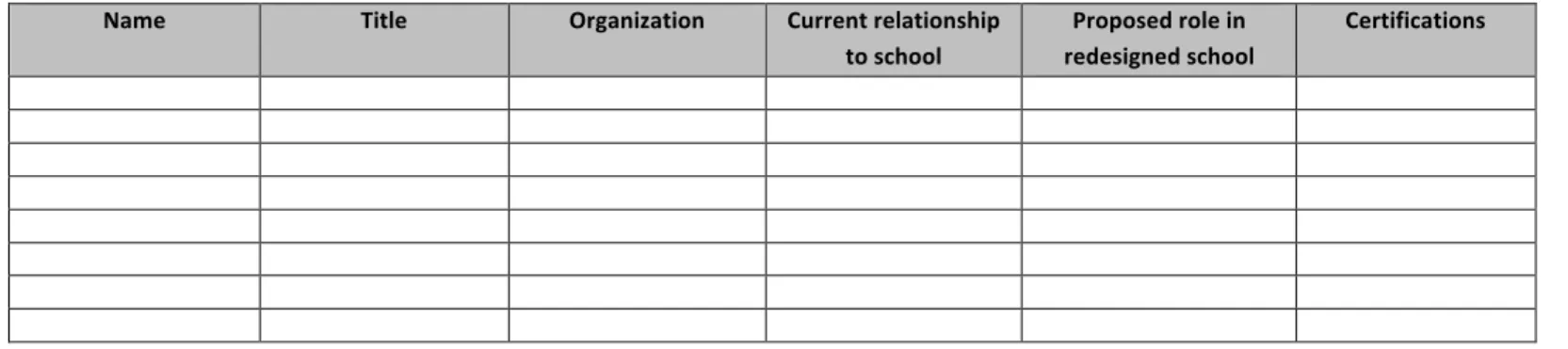
For each applicant, please provide the following information using the table format below. You may copy and paste this table into the application. A separate electronic version of this table is available at
http://www.schoolredesignphiladelphia.org/application-‐materials.html. As noted in the “Eligibility for Applicants” section, teams should consist of no fewer than three and no more than eight named members. (Note: the table uses 8 and 9 point fonts, which are acceptable for this portion of the application):
• Name
• Current title
• Current organization
• Current relationship to the school proposed for redesign (eg: Principal, parent, teacher, resident of the community, volunteer, etc. Write “none” if no relationship currently exists)
• Proposed role in the redesigned school (eg: Principal, co-‐leader, teacher leader, teacher, community partner, parent leader, etc)
• Education certifications held (including certification type, state of issuance, and school or issuing entity)
Names and background information of applicants
Name Title Organization Current relationship to school
Proposed role in redesigned school Certifications
Section 2: Short Answers
1) Please provide a brief synopsis of your reason or reasons for identifying this school for redesign (1,100 character limit – approximately 150 words. You will have a chance to more fully elaborate on this topic elsewhere in the application).
2) Please provide a brief description of your proposed approach to instruction and why you feel it is appropriate for this school (1,100 character limit – approximately 150 words. You will have a chance to more fully elaborate on this topic elsewhere in the application).
3) Please provide a brief description of your group’s connection to this school and/or the school community (1,100 character limit – approximately 150 words. You will have a chance to more fully elaborate on this topic elsewhere in the application).
Section 3: Extended Answers (Note: Please keep the responses to the questions posed in each section contained within that section. For example, please do not answer a question posed in section 1d as a part of your response to section 2b. Each section will be scored individually, and it will be difficult for reviewers to rate
responses that span multiple sections).
Strength of proposal in accordance with the established design principles
1a) School Vision and Mission (13,000 characters maximum – approximately 4 pages)
Please describe the process that you went through to develop the vision for your redesigned school, and include explicit reference to the various groups of stakeholders that were consulted during the process. Please write your school’s vision and/or mission statement. Please provide a description of what the school will look like for students, for staff members, for family members, and for community partners when it has realized its vision, making clear connections back to the input received during the stakeholder engagement process.
1b) Instructional Model Design (19,500 characters maximum – approximately 6 pages)
Please describe the current student instructional experience with explicit reference to information and feedback obtained from student and family interviews, review of school data, and/or direct observations. Describe why you feel that this current experience is not optimally effective. Please describe the instructional experience you seek to create, with specific reference to research, stakeholder feedback, and/or existing successful schools and educators that have influenced your thinking. In this description, highlight how this instructional approach creates a more personalized learning environment (connects to students’ interests, needs, and goals), holds students to rigorous standards, provides regular opportunities for students to demonstrate mastery of learning, and ensures that students receive regular feedback on their performance. Please provide a brief hypothetical walkthrough of a school day (or series of days, if more appropriate) for a highly proficient student, a student with special needs, a student learning English, and a student that is academically more than two grade levels behind in reading.
1c) Youth Development (16,250 characters maximum – approximately 5 pages)
Please describe how students and families currently conceive of the school’s academic and behavioral expectations and the school culture, making explicit reference to student and family feedback received during the application process. Please describe how you envision students and families describing the school’s expectations and culture in the redesigned school. Please describe your team’s philosophy about the best ways to bring about changes in the culture of a school. Describe specific changes in routines, rituals, uses of time, expectations, activities, language, relationships, student tasks,
assessments, accountability structures, and/or the physical environment you might leverage to develop a culture of success in this school. Please provide an illustration of how your proposal will provide students with the opportunity to take
responsibility for their own learning and with a voice in the decision-‐making processes of the school. Please describe the approaches you will take to ensure that all children have positive relationships with adults in the building, as well as with other students. Please reference any research, models of exemplary practice, and/or stakeholder feedback that informs your thinking or approach to this topic.
1d) Talent (13,000 characters maximum – approximately 4 pages)
Please provide an overview of your plan for professional development. In this overview, please describe the content focus areas of your professional development and/or how you plan to determine the content, as well as the forums and routines in which you plan to engage staff in professional development (eg: peer coaching, whole-‐staff workshops or seminars, online PD, inquiry-‐driven learning teams, individual professional learning playlists, project-‐based PD, etc…). If this plan envisions significant structural changes to the organization of the school day, please provide a brief description of what those changes might be. Describe how this plan would serve the needs of the school as a whole as well as the professional development needs and goals of individual staff members. Provide an illustration of what constitutes a high-‐performing teacher team in the redesigned school, and describe strategies you plan to put in place to cultivate this type of performance among all teacher teams. Please describe the types of teachers that the school would need to recruit based on its vision. Please describe the process a new teacher will go through to be positioned for immediate and long-‐term success in the school. In your responses, please reference any research, models of exemplary practice, and/or stakeholder feedback that informs your decision-‐making in this area.
1e) Family and Community Engagement (9,750 characters maximum – approximately 3 pages)
Describe the assets present in the school community. List your goals for family and community engagement in the
redesigned school with explicit reference to feedback from families and community partners. Please describe the metrics by which you will measure progress toward these goals. Please describe approaches you plan to take to achieve these goals. Please list events through which the school will seek to attract the participation of families. Please describe the approaches you will take to build strategic and meaningful partnerships with community members and organizations in support of the school’s vision. Please describe actions the school plans to take to with regard to any or all of the items below that are relevant to the redesign proposal:
• Providing opportunities for family members to take on leadership roles in service of the school
In your responses, please reference any research, models of exemplary practice, and/or stakeholder feedback that informs your decision-‐making in this area.
1f) Continuous Improvement (3,250 characters maximum – approximately 1 page)
In addition to state test results, district benchmark results, and attendance and suspension records, describe the data that the school will need to collect to know whether or not the school is making progress toward its vision. Describe the
processes that the school will put in place to collect, analyze, and report on the array of key data on school performance. In your responses, please reference any research, models of exemplary practice, and/or stakeholder feedback that informs your decision-‐making in this area.
Strength of the applicant team
2a) Team Members (1,300 characters maximum per team member for the personal statement – approximately ½ page; 3,250 characters maximum description of performance data and student work per team member – approximately 1 page; data reports for principals and teachers should not exceed 3 pages)
For each team member, please submit a personal statement that describes the following: • Your personal reasons for applying to redesign the chosen school
• The role you intend to play in the design year process, the role you intend to play when the redesigned school initiates its programming in the fall of 2016, and the role you envision yourself playing in five years
• The reason why you would be a good fit for this team and this school
Additionally, based on current role, each team member should also submit the following:
• Teachers: Please submit a summary of your most recent student performance data on the state standardized test. See appendix E for an example of a report that can be provided. Please also provide a two page maximum sample of student work that you feel exemplifies what you consider to be evidence of high quality learning. Please provide a one page maximum statement describing the test results and the student work, your interpretation of them, and why you feel the student work exemplifies high quality learning. If you do not have accessible student performance data, please provide a one page maximum description of your instructional assignment(s) and the most significant accomplishments that demonstrate excellent teaching performance. Please ground these accomplishments in available data to the greatest extent possible. Teachers without standardized test data should still also submit the student work sample and associated narrative about the student work as described above. In all submissions, please redact all student names and identifiers.
• Principals and assistant principals: Please submit your last year of school performance data on the state standardized test. See appendix E for an example of a report that can be provided. Please provide a two-‐page maximum artifact that provides evidence of what you consider to be a high quality learning experience that has taken place in your school. Artifacts could include but are not limited to an exemplary lesson or unit plan, a sample of student work, anecdotal observational notes, student performance data, lesson reflections, and other materials that may provide insight on the learning experience in question. Please provide a one page maximum statement describing the test results and the chosen artifact, your interpretation of them, and why you feel the artifact exemplifies high quality learning. If you do not have school performance data, please provide a one page maximum description of your school leadership assignment(s) and the most significant accomplishments that demonstrate excellent school leadership performance. Please ground these accomplishments in available data to the greatest extent possible. Principals and assistant principals without standardized test data should still also submit the artifact of high quality learning and associated narrative about the artifact as described above. In all submissions, please redact all student and teacher names and identifiers.
• Other school staff: Please submit a one page maximum description of your role and the most significant
accomplishments that demonstrate excellent performance in your role. Please ground these accomplishments in available data to the greatest extent possible.
• Representatives of a partner organization: Please provide a 6,500 character maximum (approximately 2 page) summary of your organization’s mission/vision statement(s), a brief summary of the organization’s scope of work, a list of recent clients, and a summary of the organization’s performance on its own key performance indicators. • Family members: Please provide a 3,250 character maximum (1 page) description of the skills, relationships,
resources, and perspectives that you add to the team in service of the team’s redesign effort.
• Other team members: Please provide a 3,250 character maximum (1 page) description of the skills, relationships, resources, and perspectives that you add to the team in service of the team’s redesign effort.
When submitting the application, please arrange this section such that each team member’s personal statement is followed immediately by that team member’s data and student work (or description of skills added to the team) followed by the member’s description of their data (if applicable). For example, please arrange it such that Team Member #1 (who in this example is a principal) leads with their personal statement, immediately followed by Team Member #1’s data, followed by Team Member #1’s description of their data; then Team Member #2 (who in this example is a family member) leads with their personal statement followed by their description of skills added to the team; etc…
2b) Anticipated challenges and responses (3,250 characters maximum -‐ approximately 1 page)
Please describe the three biggest challenges you anticipate in the implementation of the school redesign, and how you would address these challenges.