2007 Ethiopia
Telecommunications Sector Performance Review
a supply side analysis of policy outcomes
Lishan Adam
Research ICT Africa! (RIA!)
fills a strategic gap in the development of a sustainable information society and network knowledge economy by building the ICT policy and regula-tory research capacity needed to inform effective ICT governance in Africa. The network was launched with seed funding from the IDRC and seeks to extend its activities through national, regional and conti-nental partnerships.The establishment of the RIA! network emanates from the growing demand for data and analysis necessary for appropriate but visionary policy required to catapult the continent into the information age. Through net-work development RIA! seeks to build an African knowledge base in support of ICT policy and regulatory design processes and monitor and review policy and regulatory developments on the continent.
The research, arising from a public interest agenda, is made available in the public domain and individuals and entities from the public and private sector and civil society are encouraged to use it for teaching, further research or to enable them to participate more effectively in national, regional and global ICT policy formu-lation and governance.
The network is hosted at the Witwatersrand University, LINK Centre, under the directorship of Professor Ali-son Gillwald. Each member country has a nodal member responsible for coordinating RIA! activities in his/her respective country. There are further regional coordinators for East Africa, Dr Lishan Adam, and for West Africa, Dr Olivier Nana Nzèpa.
For further information contact the RIA! coordinator Beki Nkala on [email protected] or go to
www.researchICTafrica.net
Benin – CEFRED, Université d’Abomey Calavi Botswana – University of Botswana
Burkina Faso – CEDRES, University of Ouagadougou Cameroon – University of Yaounde II
Côte d’Ivoire – CIRES, l’Université Nationale de Côte d’Ivoire Ethiopia – University of Addis Ababa
Ghana – STEPRI of CSIR Kenya – University of Nairobi
Mozambique – Universidade Eduardo Mondlane Namibia – Namibia Economic and Policy Research Unit Nigeria – University of Lagos
Rwanda – KIST (Kigali Institute of Science, Technology and Management Senegal – CRES
South Africa – LINK Centre, University of Witwatersrand Tanzania – Tanzania Communications Regulatory Authority Uganda – University of Makerere
Zambia – University of Zambia
East Africa Regional Manager: Dr Lishan Adam West Africa Regional Manager: Dr Olivier Nana Nzépa
SERIES EDITOR:
Alison Gillwald
Other country studies in this series are available on
www.researchICTafrica.com.
Proof reading: Beki Nkala
Benin: Augustin Chabossou
Botswana: Sebusang Sebusang, MP Makepe andTD Botlhole
Burkina Faso: Pam Zahonogo
Cameroon: Olivier Nana Nzèpa and Robertine Tankeu
Côte d’Ivoire: Arsene Kouadio
Ghana: Godfred Frempong
Kenya: Tim Waema
Mozambique: Americo Muchanga and Francisco Mabila
Namibia: Christoph Stork and Mariama Deen-Swarray
Nigeria: Ike Mowete
Rwanda: Albert Nsengiyumva and Annet B Baingana
South Africa: Steve Esselaar and Alison Gillwald
Tanzania: Ray Mfungayma and Haji Semboja
Uganda: FF Tusubira, Irene Kaggwa-Sewankambo, Apolo Kyeyune, Ali Ndiwalana, Annrita Ssemboga
List of Abbreviations
ADB African Development Bank
ADSL Asymmetric Digital Subscriber Line BFWA Broadband Fixed Wireless Access
COMESA Common Market for Eastern and Southern Africa
CTIT College of Telecommunication and Information Technology DSL Digital Subscriber Line
GATS General Agreement of Trade in Services GDP Gross Domestic Products
GSTIT Graduate School of Telecommunication and Information Technology EBA Ethiopian Broadcasting Agency
EICTDA Ethiopian ICT Development Authority ETA Ethiopian Telecommunications Agency ETC Ethiopian Telecommunications Corporation ICT Information and Communication Technology FWA Fixed Wireless Access
IGAD Inter-governmental Authority on Development MPLS Multi Protocol Label Switch
PPP Purchasing Power Parity
PSTN Public Switched Telephone Network ISP Internet Service Providers
RIA Research ICT Africa! Network RFP Request For Proposal
SPR Sector Performance Review
TRE Telecommunications Regulatory Environment UNDP United Nations Development Programme VISP Virtual Internet Service Providers VOIP Voice Over IP
VSAT Very Small Aperture Terminal WTO World Trade Organisation
TABLE OF CONTENTS
List of Abbreviations 6
Introduction and Summary 9
Socio-economic contexts 15
Policy, Institutional and Regulatory Frameworks 18
Market Structure and Investment 30
Access to ICTS 37
Pricing of ICTs 43
Telecommunications Regulatory
Environment Perception in Ethiopia 57
Conclusion: Responding to Policy and
Regulatory Challenges 60
Introduction
The Ethiopian Telecommunications Sector Performance Review (SPR) 2006 builds on the SPR of 2004. It aims to measure the success of the communications sector policy and the realisation of targets set by the government against what was achieved by the incumbent operator. The report explores the progress that was made in rolling out advanced ICT services such as a broadband multimedia network and promoting rural infrastructure. The purpose of the review is to provide a balanced overview of the performance of the ICT sector in Ethiopia based on the available data in 2006, to empower all the stakeholders (regulators, gov-ernment, private sector, civil society groups, business and academia) to improve the ICT sector governance in the country.
The Sector Performance Review is informed by the Ethiopian govern-ment’s ICT sector programme but it focuses on the telecommunications sector. The objectives of the government’s ICT programme are:
To create an enabling policy, regulatory and legal environment for the growth and utilisation of ICTs;
To develop the necessary ICT human resources, infrastructure, rural access, ICT standards, and local content;
To strengthen various national ICT policy, regulatory and advocacy institutions to facilitate the mainstreaming of ICTs for socioeconomic development;
To facilitate the use of appropriate technologies for development of applications and content for rural development, good governance, and service delivery in priority sectors.
Ethiopia does not have a specific high-level programme or policy for the telecommunications sector. Its telecommunication sector policy is rooted in Council of Ministers’ regulation No. 10/1996 that empowers the incumbent operator to retain a monopoly status. The Ethiopian Telecommunications Corporation receives a monopoly licence from the regulator, the Ethiopian Telecommunications Agency (ETA) in an exchange for efficiency and quality of service requirements and infra-structure expansion targets. The targets are set by the ETC itself and
approved by its influential Board of Directors and the regulator. In the absence of other public policies or programmes on telecommunications, the ETC’s own strategic plan serves as the only tool against which the performance of the telecommunications sector could be measured. The ETC’s Strategic plan 2004-2006 set the following modest but realis-tic targets:
Increase fixed-line telephone penetration to 1.7% by 2006;
Increase telecommunications point of presence to 5 000 locations and make telephone services available to 10% of the population within walking distance of 5 km;
Expand mobile penetration by 3% in 2006;
Migrate to an IP-based broadband network;
Establish a core fibre along six major routes;
Establish a second international gateway.
The incumbent has made substantial progress in almost all of these areas. The fixed line penetration has reached 1% in 2006, and mobile penetration 1.15%. Progress was also made in the rural access front, particularly in connecting rural towns that did not have access, and ETC’s own stations were expanded to around 904 places, mostly in rural towns. About 5 000 villages were linked to modern communications. The incumbent has also rolled out about 4 000 km of fibre backbone in five directions from the capital. The fibre network is expected to expand the vital connectivity to rural areas while also improving the quality of domestic and international links. The ETC has also migrated to an IP-based network and established a second international gateway.
Building on its apparent success, the incumbent issued another strate-gic plan for 2005-2010 with focus on improving customer services to a very high standard and upgrading infrastructure to Next Generation Network. The 2005-2010 plan pledges the following targets:
Raising teledensity to 3%;
Providing universal access to communications to 40% of the popula-tion within a distance of 5 km;
Improving mobile penetration to 6%;
Increasing the number of Internet subscribers to 150 000 by 2010;
Providing access to 15 000 rural villages; and
Completion of 8 000 km fibre link throughout the country.
However, observation shows that ETC’s focus on infrastructure rollout had a negative impact on the quality of service. The ETC became yet another government outlet where customers queue to pay their commu-nications bills at its payment centres. A failure of a billing system in 2006 did not only cost the incumbent hundreds of thousands dollars, but also raised concerns about the validity of original government assumption that a change in the top management could actually make a monopoly
service provider more efficient. The ETC changed most of its manage-ment in 2006 following the fiasco with the billing system. The new man-agement promised a significant improvement in services and launched a Request for Proposal for upgrading the infrastructure to meet the tar-gets cited above through vendor financing.
P
OLICY ANDR
EGULATORYE
NVIRONMENTThe telecommunications policy reform process began in 1996 with the issuing of proclamation 49/1996 that established the regulator, the Ethiopian Telecommunications Agency. The Council of Ministers’ Regu-lation No. 10/1996 that established the Ethiopian Telecommunications Corporation as a public enterprise with monopoly over telecommunica-tion services followed this. The public monopoly policy environment has changed only slightly since then. The regulator remained too weak to enforce quality of service targets, set tariffs and carry out major regula-tory functions.
At the same time, Ethiopia went through a series of ICT policy formula-tion initiatives prompted mainly by regional and internaformula-tional organisa-tions. A series of meetings that took place between 1998 and 1999 led to discussions of various policy issues and a draft policy document circu-lated by the Ethiopian Science and Technology Commission. A parallel process by the ICT unit at the Prime Minister’s office had also success-fully developed strategies for increasing ICT use in the public sector. The two initiatives were merged in 2001 following the government reshuffle and the calls for the reduction of the duplication of effort. The govern-ment established the Ethiopian Information and Communications Devel-opment Authority (EICTDA) in 2003. EICTDA has developed the latest version of the ICT policy which is now publicly available at its web site
www.eictda.gov.et
P
UBLICA
CCESSFollowing the establishment of the EICTDA, the Ethiopian Government launched several high-profile ICT projects in 2004 including a Schoolnet programme to connect around 560 secondary schools, the Woredanet network that linked 611 districts to regional and central government and an Agrinet project that connected agricultural research institutions. The government has also introduced ICT vocational training and advanced education at college and university levels. Advanced degree programmes in computer science, electronics, telecommunications and information theory, software engineering and programming, technical management and management information systems were introduced. These projects have contributed to the improvement of the ICT sector and created awareness about the potential of ICTs for development.
While still minimal by global standards, public sector access to commu-nication services has improved significantly due to these projects and
various donor funded ICT programmes at institutional and national lev-els. Telephone penetration at public institutions stands at about 8% in 2006 while access to computers has reached 10%. The majority of dis-tricts and schools now have access to the Internet, boosting the number of civil servants that could potentially own an e-mail account. An esti-mated 10% of the 424 067 civil servants could potentially have access to email accounts by 2006.
However, while the massive rollout has increased access and awareness of the implication of ICTs in teaching, learning and public administra-tion, much still remains to be done to improve ICT impact on the ground or bring about ICT assisted development. The key challenges to Ethiopia are:
Improving the understanding of the weakness and strength of infor-mation and communication technologies when they are applied to solve complex problems of education, public administration and research, and the conditions that should be met for ICTs to be effec-tive in these areas;
Building skilled human resources to manage complex socio-technical projects such as Schoolnet and Woredanet;
Carrying out ongoing analysis of the cost benefits of various invest-ments to correct failures. For example, a mid-term or regular review of Schoolnet and Woredanet projects would be useful to build on suc-cess and correct failures.
P
ERFORMANCE ANDG
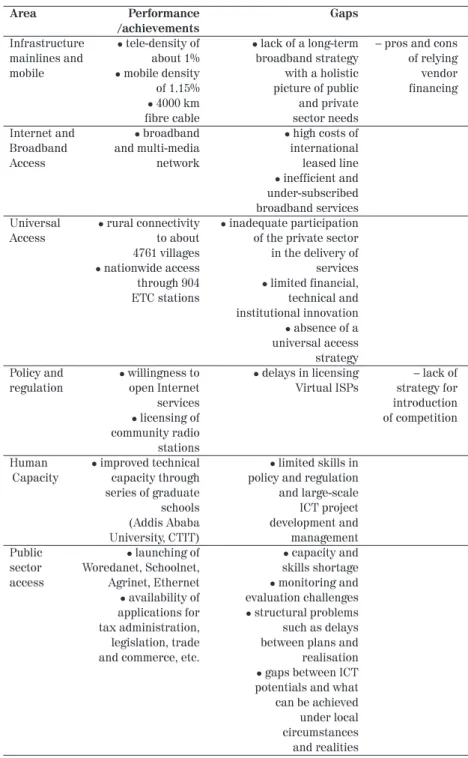
APSEthiopia has made some notable progress between 2004 and 2006 in the ICT sector. The availability of fibre connection to major towns and mul-timedia broadband network connections to schools and all districts, establishment of a government data center and availability of mobile SIM cards at government-licensed shops are some of the notable suc-cesses over the last three years. The progress has also exposed various gaps on the policy, regulatory, infrastructure and human resources fronts. Table 1 presents an overall performance of the sector and some of the emerging gaps.
TABLE 1.SECTOR PERFORMANCE AND GAPS
Area Performance Gaps
/achievements
Infrastructure tele-density of lack of a long-term – pros and cons mainlines and about 1% broadband strategy of relying mobile mobile density with a holistic vendor of 1.15% picture of public financing
4000 km and private fibre cable sector needs Internet and broadband high costs of Broadband and multi-media international
Access network leased line
inefficient and under-subscribed broadband services Universal rural connectivity inadequate participation Access to about of the private sector 4761 villages in the delivery of
nationwide access services through 904 limited financial, ETC stations technical and institutional innovation
absence of a universal access strategy
Policy and willingness to delays in licensing – lack of regulation open Internet Virtual ISPs strategy for
services introduction
licensing of of competition community radio
stations
Human improved technical limited skills in Capacity capacity through policy and regulation series of graduate and large-scale
schools ICT project
(Addis Ababa development and University, CTIT) management Public launching of capacity and sector Woredanet, Schoolnet, skills shortage access Agrinet, Ethernet monitoring and
availability of evaluation challenges applications for structural problems tax administration, such as delays
legislation, trade between plans and and commerce, etc. realisation
gaps between ICT potentials and what
can be achieved under local circumstances and realities
It is important for the government to build on the achievements and its commitment, cited above, to roll out communication infrastructure as a
public benefit and bridge some of the gaps outlined in Table 1. Policymak-ers need to:
Speed up a gradual participation of the private sector in the provision of communication services;
Strengthen the regulator so that it carries out its duty in guiding the ICT industry;
Carry out regular independent analysis of the ICT sector in order to develop strategies that meet growing challenges and local contexts and capabilities;
Improve the capacity and the legitimacy of the regulator.
Building the skills of policymakers and middle managers on the implica-tions of global, regional and national ICT markets, policy and regulation is important to bring Ethiopia closer to other countries and to speed up ICT assisted social and economic growth. Policymakers also need to sup-port, participate and utilise research results for decisionmaking in the ICT sector.
Socio-economic Contexts
Ethiopia is a federally organised country with about 75 million people, characterised by a wide range of ecological and climatic conditions. It is landlocked in east Africa between the Sudan, Eritrea, Djibouti, Somalia, and Kenya, all of which (other than Eritrea and Somalia) have a substan-tial information and communication infrastructure. Many parts of the country are isolated due to mountainous terrain and a weak road infra-structure. Nearly 80% of the population (63 million) lives in rural areas and is dependent on agriculture. The share of the rural population within two kilometres of an all-season road is about 17%.
This agrarian setting poses a significant challenge to the delivery of affordable communications. Ethiopian topography and income levels make universal access strategies built around innovative business and technological solutions very important. The current “one-size fits all” approach by the incumbent operator to connect rural villages through a rural connectivity project needs to be rethought from business, technol-ogy and sustainability perspectives.
Being one of the world’s least-developed nations with a per capita income of about US$130, Ethiopia’s economy has had to respond to the ongoing impact of drought and problems of poverty and disease. The country faces security challenges with its neighbours, particularly with Somalia and Eritrea. The poverty cycle has put a significant strain on its economic growth. Ethiopia’s real GDP was about US$8 billion in 2004 with agriculture accounting for 48%, industry 10% and the service sec-tor 42%. The economy has recovered after the end of the war with Eritrea in 2002. The real GDP grew by 11% in 2003/2004 and 8.8% 2004/05, according to the African Development Bank.
The World Bank African Development Indicators for 2006 rank Ethiopia as one of those countries with sustained economic growth over the last ten years. Its economy grew by 5.5% in 2005. Ethiopia has also received about US$3.5 billion debt service relief that it began investing in infrastructure development and social services such as providing clinics and schools in rural areas. Substantial progress has been made in school enrolment and the extension of health services to rural areas over the last decade, as can be observed from hundreds of schoolchildren flooding streets of major towns and rural villages in the mornings and afternoons. The desire for new communication technologies that address education, health, jobs and pub-lic administration needs is therefore enormous.
Notwithstanding these improvements, Ethiopia’s human development indicators are the lowest in the world. The UNDP 2005 Human Develop-ment Report ranked Ethiopia 170 out of 174 countries in terms of the
Human Development Index (HDI) and the poverty gap continues to widen. The poor in Ethiopia are extremely vulnerable to exogenous shocks, especially flooding (as seen in the month of October 2006 in the eastern town of Dire Dawa), drought, price shocks and poverty-related diseases like HIV/AIDS, malaria and tuberculosis.
Population pressure has also had an obvious impact on the Ethiopian economy. The fertility rate remains high, together with consistently high poverty levels. Although UNDP HDI data on expenditure and consump-tion show that the incidence of poverty has fallen from 44% in 2000/2001 to 36% in 2004/2005, poverty still remains rampant. The consumer price index (1995=100) was 165. The cost of living has risen steeply in recent years, particularly in 2006 following adjustments to the price of fuel. For many the cost of living has become unbearable, a relatively new phenom-enon in the country where poor but resourceful people have survived economic challenges for centuries.
The communication sector is one of those that was hit by the rising cost of living. The high incidence of poverty and rising cost of living will con-tinue to have a direct impact on the spending on communication serv-ices. For example, the Annual Revenue Per User for cellular line has shown a significant decline from US$15 in 2004 to US$7 in 2006. The falling ARPU is in line with continental trends. A tariff revision study that was launched in 2007 is expected to bring the ARPU further down. While this is good news for the consumers, service levels need to improve to widen the revenue base of the incumbent. Increase in tariffs will undoubtedly put a lot of economic pressure on household incomes. A fur-ther fall of ARPU is expected as communications reach the bottom pyra-mid of the population.
TABLE 2.SOCIO-ECONOMIC INDICATORS OF ETHIOPIA
Socio-economic indicator Data
GDP Per Capita US$130 (2006, estimated) GDP Per Capita (PPP) US$900 (2005, estimated)
Population (2006) Total 75 067 000
Rural 62 895 000 Urban 12 172 000 Consumer Price Index (1995=100) 165
Percentage of urbanisation 16.2% Exchange rate Birr 8.69 = US$1 Implied PPP Conversion Rate (IMF) 1.23
Households Total 15 013 400
Urban 2 434 400 Rural 12 579 000 Source: IMF, World Bank, CIA, World Fact Book, Ethiopian Central Statistical Agency
The political and governance landscape has also some bearings on the diffusion of information and communication technologies. Ethiopia has a four-tier system of government: the Federal Government; Regional Gov-ernments; Zonal and Woreda Administrations. The country is divided in nine regions. Regions are divided into 66 zones, which are further divided into about 611 districts (Woredas). The Woreda is the main unit of government responsible for provision of public services. All the Woredas have now been connected to new information and communica-tion technologies (telephone, fax, Internet) but the majority of Woredas do not have the staff with basic skills and resources to make the best use of these technologies. The extent to which the Woredas become comfort-able with new technologies will be the yardstick of the ICT uptake by the public sector nationwide.
Policy and Regulatory Framework
T
ELECOMMUNICATIONP
OLICYEthiopian telecommunication policy is fixed to a monopoly of communi-cation service by the government. The policy reform process in the telecommunication sector began in 1996 with the adoption of a proclama-tion that provides for the regulaproclama-tion of telecommunicaproclama-tions services (49/1996) (as amended), in which the government created the regulator, the Ethiopian Telecommunications Agency (ETA). The Council of Minis-ter’s Regulation No 10/1996 that followed this established the Ethiopian Telecommunications Corporation as a public enterprise with monopoly over telecommunication services. The current policy and regulatory envi-ronment of the telecommunication sector is summarised in Table 3. In effect, the Council of Ministers’ Regulation merely extended the man-date of the former Ethiopian Telecommunication Authority that had monopoly over telecom services. Since then, the ETC has remained a state-owned corporation operating for “profit” with direct governmental budget assistance for rolling out the infrastructure.
However, no external and thorough cost benefit analysis of ETC’s invest-ment has been made over the years to suggest that it is actually operat-ing at a profit. The ETC has a positive cash flow that it reports at the end of every Ethiopian calendar year (subtracting expenditure from rev-enue), but that does not suggest it operates at a profit or loss. It uses an accounting system for reporting purposes, but lacks a systematic cost/pricing regime for its investment and revenue and disaggregated figures for its different “profit centres” – fixed, mobile and Internet serv-ices. For example, it is not clear by what factor Internet connection is profitable over mobile segment or fixed line. A stringent cost-pricing regime using modern telecommunications accounting models is critical for the public and government to have an overview of the contribution of telecommunications investment to development and for the incumbent to maximise its profit.
The ETC receives a monopoly licence from the regulator; for that it must meet efficiency, quality of service and infrastructure expansion targets. Each year the ETC must submit a performance and business report to the regulator and to its influential board of directors. The government does not directly intervene in the day-to-day operations of the ETC and the reg-ulator has not been empowered to take sanctions against missed targets. The ETA’s Strategic plan for 2004-2006 set the following targets:
Increase fixed line telephone penetration to 1.7% by 2006;
Increase telephone access to 5 000 locations and make telephone serv-ices available to 10% of the population within walking distance of 5 km;
Expand mobile penetration by 3% in 2006;
Migrate to an IP-base broadband network;
Establish a core fibre along six major routes;
Establish a second international gateway.
While improvements have been made between 2004 and 2006 in terms of network rollout to 4 764 villages, establishing of 4 000 km fibre, migrat-ing to IP-based broadband network and the mobile and fixed line targets were not met. The regulator does not take action even if the incumbent misses targets or customers complain continuously of the substandard services.
TABLE 3.REGULATORY AND POLICY HIGHLIGHTS
Source: ETC Strategy paper 2004-2006, Council of Ministers Regulation No. 10/1996, Proclamation No. 49/1996; Proclamation No. 116/1998 and Council of Ministers Regulation 47/1999
Telecommunication services
Fixed line and mobile services
Internet services Downstream value added services such as call center, cyber café and messaging services Call back and other long distance services that use modern technologies VSAT
VoIP
Telecommunications equipment
Policy
ETC is the sole provider of fixed and mobile services. The services are bundled together
ETC is the sole provider of Internet service; Virtual ISPs are allowed to buy bandwidth and resell Internet
Downstream value added services such as call centres, pay phones and messaging services are allowed for competition. However, there are a few legally registered phone shops;Cyber café services are allowed
Call back or use of modern technology to divert the international traf-fic is not allowed and is punishable by fines and imprisonment. Individuals and enterprises are not allowed to own VSATs. Interna-tional organisations are allowed to own VSAT with payment of traffic compensation or “landing right” fees on case by case basis. The regu-lator is being empowered to license VSATs
VoIP is not allowed
I
NSTITUTIONALA
RRANGEMENTSThe regulator, the Ethiopian Telecommunications Agency (ETA), was legally established in November 1996, but it was not operational until December 1997 when the General Manager was appointed by the Minis-ter of Transport and Communications. The establishment of the regula-tor as a viable institution with adequate and skilled staff took another two years. This was followed by change of the ETA management in 2001, with two acting General Managers over the period of a year, until the cur-rent general manager was formally appointed in 2002.
The ETA has no independent board of directors or commissioners. The minister who allocates its budget appoints the General Manager. More-over, the Council of Ministers’ Regulation on Telecommunications Ser-vices issued in 1999 (proclamation 47/1999) gives the Ministry of Trans-port and Communications the power to issue directives without recourse to the regulator. Without distinction on whether the directives are of pol-icy or operational nature, the Ministry can direct the sector without involving the ETA if it deems necessary. Effectively, the ETA acts as a department within the ministry.
The communication sector governance framework and institutional arrangement comprises a number of players that have influence on the regulatory environment. These include the Prime Minister, who makes ultimate decisions on policy and regulatory matters, and the Council of Ministers who approve communications regulations and set the budget of the Ethiopian Telecommunications Agency. The Ministry of Transport and Communications defines the policy framework, directs the regulator and oversees the activities of the incumbent operator. The ministry appoints the General Manager of the ETA and the Chief Executive Offi-cer of the ETC.
The ICT sector falls within the Ministry of Capacity-Building that defines the national ICT strategy and promotes ICT in public services. The Ministry hosts the Ethiopian ICT Development Agency (EICTDA) that is responsible for the development and implementation of the national ICT policy. The ICT Development Agency works closely with the regulator but does not always take into account telecommunications sector issues in its policy provisions. A separate ministry, the Ministry of Information, deals with the broadcast-ing sector and oversees the activities of the Ethiopian Broadcastbroadcast-ing Agency (EBA.) The Ethiopian Broadcasting Agency was established recently and has begun to issue radio licences after a protracted debate over the open-ing up of the broadcastopen-ing sector to enterprise.
The telecommunication sector is largely managed by an influential ETC Board of Directors that supervises the Ethiopian Telecommunications Corporation. The Board sketches the telecommunications strategy of the country and appoints senior managers of the ETC. Although the board
does not interfere much with the work of the regulator, it is far more influential in making decisions with regard to the telecommunications sector. Figure 1 shows the governance framework for the communication sector in Ethiopia
FIGURE 1.INSTITUTIONAL ARRANGEMENTS
The regulator has no board of directors or councillors; nor does it have sufficient human resources to deal with complex regulatory challenges such as licensing, frequency assignment and monitoring, setting and enforcing tariffs, dispute resolution, maintaining quality of service and promoting universal access. It has been unable to attract and retain skilled employees with legal, regulatory, management and technical skills, partly due to low public sector remuneration. In effect, there is a gross absence of those skills in the country.
The public monopoly of telecommunication services leaves ETA with lit-tle to regulate. So far the focus of the regulator has been confined to the collection of licensing fees from small scale service providers such as telephone service resellers, and importers of communications equip-ment that were authorised under Proclamation No. 281/2002. In the broadcasting sector the government established the Ethiopian Broad-casting Agency that regulates frequency assignment and content in that sector. EBA has recently issued licences to a community radio and com-mercial FM stations to increase access to news and entertainment and promote community empowerment.
ETA’s capacity in executing its mandate is currently being improved through proposed legislation that permits the regulator to cover the telecommunications and postal sectors. This will raise additional chal-lenges, since ETA is entering into the new territory of a postal sector that requires maintaining the availability of an affordable, high quality, uni-versal postal service, improving the quality of service by setting targets for delivery of mail, reviewing domestic and international tariffs,
responding to consumer complaints and developing various guidelines for different courier services.
Overall, the legitimacy of the regulator is central to the policy and regu-latory environment in Ethiopia. An effective and legitimate reguregu-latory body cannot be achieved without competition; and competition cannot be achieved without good regulatory institutions. Government policy actions to gradually introduce competition would strengthen the regulator, and this will in turn promote further competition.
WTO GATS C
OMMITMENTSEthiopia has not committed to the General Agreements on Trade in Ser-vice, nor has it accessed the WTO to date. The government has been work-ing on membership of the WTO for some time. Ethiopia’s request for accession to the WTO was circulated in January 2003 The General Coun-cil established a Working Party on Ethiopia’s accession within a month of February 2003 with the UK as chair, to consider its application. Although the government was scheduled to submit a memorandum of foreign trade regime, laws and tariffs within a year, the process took some three years before Ethiopia’s memo was accepted by the Council, with some strong reservations, in November 2006. One aspect of this reservation was the government’s stance on a grace period of eight years before it opens its financial and telecommunication sector to competition.
In an effort to analyse the implications of competition to the telecommu-nications sector and to equip itself with evidence against telecommuni-cations liberalisation at the WTO negotiations, the Ministry of Trade and Industry issued a Request for Proposal and selected an American firm, Nathan Associates, to study the impact of liberalisation of the telecom sector. The preliminary result of the study was released in early 2007, suggesting the government unbundle the services and introduce compe-tition in the mobile and Internet segments. However, it is unlikely that the government will open up the sector in a short period.
N
EWP
OLICYD
EVELOPMENTRecent ICT policy development in Ethiopia is driven by a growing recognition of the role of information technology for development and pressure from the international financial institutions like the World Bank. Ethiopia’s own experience in implementing high profile projects like Woredanet and applications in the public sector (tax management, legal information systems, debt management, utilities management) has increased its commitment to ICT-assisted development. Interna-tional institutions that are supporting these efforts are very keen to see the government create an enabling environment for private sector’ par-ticipation in the delivery of communications services. The World Bank, for example, has attached the following conditions to one of its loans for the ICT sector:
Opening up the Internet sector and licensing ISPs by September 2005;
Opening up competition in rural communication and licensing quali-fied, autonomous, legally established entities as rural connectivity providers within two years of the start of the project;
Opening up the broadcasting sector and licensing qualified autonomous, legally established entities as Community Radio providers by October 2005.
International pressure and government’s own commitment have yielded four major policy initiatives during the last two years:
N
EWT
ELECOMMUNICATIONSA
CTThe Ministry of Communications and Transport has been working on a new communications Act that is expected to empower the regulator to assume a stronger role in regulating the postal and telecommunication sectors. The Act is expected to give more power to the regulator in licens-ing VSAT service providers and playlicens-ing a key role in regulatlicens-ing univer-sal access and tariffs.
A NEWICT POLICY ANDSTRATEGY FOR THEICT SECTOR
Ethiopia has been working on its national ICT policy for over a decade. The ICT policy paper of 2003 was the basis for establishment of the Ethiopian ICT Development Authority (EICTDA), which is mandated with overseeing the development and implementation of a new national ICT policy and strategy. EICTDA has produced a new policy document in 2006. Although the policy document has not been ratified it serves as a key government document for managing the ICT sector.
LICENSINGCOMMUNITYRADIOOPERATORS
A significant effort was made by the Ethiopian Broadcasting Agency to strengthen its institutional capacity to assume a major role in regulating the broadcasting sector in recent years. EBA has licensed public radio stations for Addis Ababa, Amhara, Debub, Harari and Dire Dawa regions and upgraded the status of two stations to commercial broadcasters. It has issued licences to two new commercial radio operators – Zami Pub-lic Connections (ZPC), and Tisae Fine Arts & Adei Promotion in Febru-ary 2006 and to a community broadcaster located in the south of the country in September 2006. This has improved awareness of community and commercial broadcasting and opened the airways to some extent.
EFFORTSTOWARDS THEINTRODUCTION OFCOMPETITION IN THEINTERNET
SECTOR
Following the commitment to the World Bank, the Ethiopian Telecommu-nications Agency issued a directive for licensing Virtual Internet Ser-vices Providers (VISP) that lease capacity from the ETC and sell it to the public. This in part was in response to increasing demand for Internet service, and following the installation of high-capacity and high-speed
Broadband Internet Network by the ETC with a huge amount of invest-ment capital. The possibility of the ISP market opening up has created some enthusiasm and opened opportunities for private sector, individu-als and organisations that had been waiting for participation in the Ethiopian communication sector for some time.
However, the incumbent operator and the regulator did not implement the directive as hoped, due to some difficulties in appreciating the Inter-net market. The directive requires certain levels of education and expe-rience from potential providers. Moreover, interconnection between VISPs through exchange points is prohibited. It is expected that licences will be issued in 2007 to prospective ISPs, which will be likely to struggle to provide services to users under very stringent conditions.
The above initiatives have brought some hope that the policy and regu-latory environment will embrace competition in the medium term. How-ever, analysis of progress so far shows confusion with regard to the direction of the ICT sector policy in general and the telecommunications and Internet services regulation in particular. On one hand the govern-ment has shown strong commitgovern-ment to improve the infrastructure and create an enabling policy and regulatory environment, on the other, it did not soon enough allow the private sector to share the burden of capital investment in the sector.
There has been some attempt to attract private sector investment in the communication sector in recent months. The incumbent floated a bid for a US$1.5 billion investment through vendor financing for expansion of fixed-line capacity to 4 million, and a mobile network to 7 million, con-struction of 10 000 km fibre routes and linking 10 000 villages in Novem-ber 2006. The detail of how this can be achieved is not clear. The current market dynamics and the incumbent’s experience suggests that a com-bination of competition and vendor financing may bring substantial ben-efit to the economy in the longer term through improved network rollout, innovation and savings to public resources.
P
UBLICS
ECTORU
SE OFI
NFORMATION ANDC
OMMUNI-CATION
I
NFRASTRUCTUREThe public sector is one of the growing users of communication net-works. Recent government commitment to public sector reform and ongoing informatisation of the civil services have contributed to improve-ment in access to ICTs by the governimprove-ment.
POLICIES ANDPROGRAMMES FORICTS IN THEPUBLICSECTOR
The government has shown a strong commitment to the promotion of efficient communication between various tiers of the public sector as part of its civil service reform. The civil service reform ICT strategy emphasises:
Consolidation and integration of civil and public service computeri-sation projects at Federal and Regional Governments levels
Setting up nationally integrated sectorally and regionally distributed information systems;
Connecting Federal and Regional Governments through Local and Wide Area Networks up to the district (Woreda) levels
Identifying, designing and implementing Government Information systems and networks and setting up a government portal;
Improving the web presence of Federal and Regional Government bodies;
Developing a national network and information exchange systems between sectoral ministries and regional institutions responsible for different sectors;
Promoting community access to online government services;
Strengthening information and knowledge management in public administration in order to deliver services in trade, commerce, legal systems, business registration, tax payment etc.
Setting up programmes that will strengthen ICT-supported governance and service delivery at Federal and Regional Government levels. To implement these civil service ICT objectives, the government has launched an ICT-Assisted Development Programme with a series of e-government initiatives like Woredanet, intended to link districts to the federal government. Table 4 shows a list of major projects that con-tributed to public sector connectivity over the last five years.
TABLE 4. MAJOR PUBLIC SECTOR ICT PROJECTS
The introduction of information and communication technologies to dis-trict level was the major achievement in Ethiopia’s quest to improve access to communication to the public sector. Previously, official reports would take months to reach the capital. Often early warning signs of famine, such as falling livestock prices, would not get through until a
cri-Project name Woredanet Schoolnet Ethernet Agri-net Healthnet e-Applications Achievements
Linking up of 611 districts to a national data centre located in Addis Ababa. Woredas (districts) have access to Internet, telecommunication, video confer-ence and databases at national level
Connecting of 560 secondary schools including Technical and Vocational scholls to the Internet and launching technology-mediated distance education Connection of 13 public universities to high speed data network and the Internet Connection of 30 agricultural research institutions
Linking up of regional hospitals and introduction of telemedicine applications Implementation of applications on tax registration, national accounts, business registration and legal management information systems by various bodies of the government such as the Ministry of Internal Revenue, National Statistical Agency, the Ministry of Trade and Industry and Ministry of Justice.
sis had developed. While Woredanet has not yet been tested in such cir-cumstances, access to communications at remote district level has empowered officials who would not otherwise have been able to link up with zonal, regional and federal government bodies.
The Ethiopian ICT Development Authority is in the process of setting up an e-government portal and deploying an ICT master plan and e-appli-cations to support the Woredanet project and improve access to e-gov-ernment applications by the public. There are also plans to produce a national ICT master plan that would lead to the connection of govern-ment offices nationwide.
ACCESS TOTELEPHONES
Despite these efforts, access to communications in government is very low except for the federal government, where telephone access is rela-tively high. Data on public sector access to communication are scarce and difficult to obtain. The total number of fixed telephone lines accessi-ble to government staff was about 45 366 in 2003 and 41 855 in 2004. This was very limited compared to a staff base of about 800 000 (including about 400 000 civil servants, and additional government staff such as mil-itary and police). The teledensity of the public sector is estimated to be around 8% in 2006.
TABLE 5.PUBLIC SECTOR ACCESS TO TELEPHONES
Year 2003 2004
Number of civil servants 389 563 398 148 Estimated total government staff base 780 000 800 000 including police, military and contact personnel
Number of Mainlines accessible to government staff 45 366 41 855
Government staff tele-density 6% 5%
Source: ETC, Federal Civil Service Commission and World Bank estimates
ACCESS TO THEINTERNET
The situation is similar with regards to Internet access. There were about 389 563 civil servants in Ethiopia in 2003 of whom about 2 200 had e-mail accounts (based on 735 government EthioNet accounts each hav-ing 3 users). This implies that about 5% of civil servants had e-mail access at the time. The figure is small if one takes all government employees, including military and police, into account. The situation has improved slightly over the last three years with the completion of the var-ious e-government projects cited above, and an estimated 10% of 424 000 civil servants have potential access to an email account by 2006.
ACCESS TOCOMPUTERS
There has been a strong desire to use computers in the public sector in Ethiopia. Discussions with ICT private sectors that service government networks and applications indicate that access to computers is not a major problem in public institutions in the country. According to the director of a private sector company “computers are not the issue at the moment, but usage is.” There are an estimated 6 000 computers in pub-lic institutions throughout the country and about 10% of the pubpub-lic sec-tor staff have some access to computers.
However, the EICTDA and UNDP survey in 2004 shows that only 20% of those who own computers had some form of networks. About 40% who owned computers indicated that they did not have budget for the ICTs, suggesting that access to computers is either externally funded or they did not have budget to maintain ICTs for that year. The remaining major-ity (54%) said they spend less than 10% of their budget on ICTs.
CHALLENGES TOICTSUSE IN THEPUBLICSECTOR
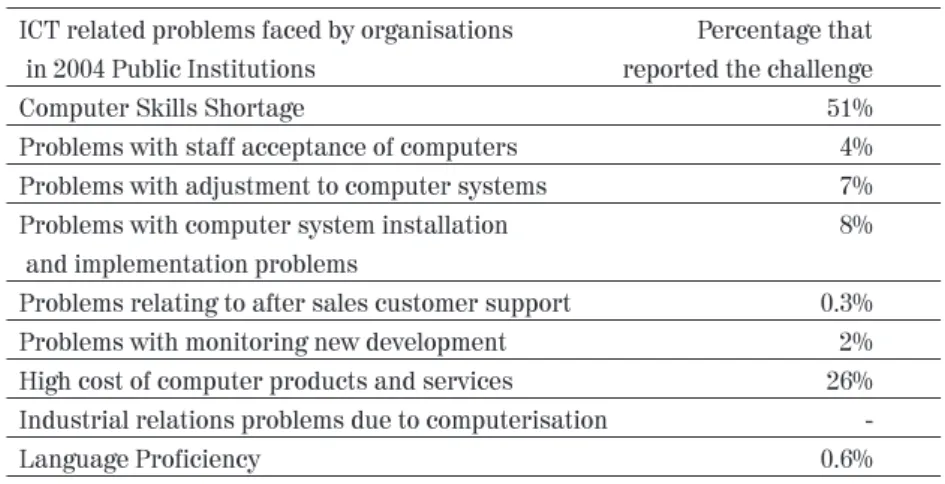
Lack of resources and advanced skills are the main challenges to the applications of ICTs in public administration. The shortage of skilled personnel is severe outside of the capital. Resources for the purchase of computers, implementing and maintaining applications were also regarded as important by government institutions that often rely on donor funding.
TABLE 6. ICT USE CHALLENGES IN THE PUBLIC SECTOR
ICT related problems faced by organisations Percentage that in 2004 Public Institutions reported the challenge
Computer Skills Shortage 51%
Problems with staff acceptance of computers 4% Problems with adjustment to computer systems 7% Problems with computer system installation 8%
and implementation problems
Problems relating to after sales customer support 0.3% Problems with monitoring new development 2% High cost of computer products and services 26% Industrial relations problems due to computerisation
-Language Proficiency 0.6%
Source UNDP/EICTDA, 2004, – The Ethiopian ICT Baseline Study – Volume III- Deployment and Exploitation of ICT in the Public and private sectors: A Comparative Analysis, Unpublished
Discussions with the private sector and some public institutions suggest that skills and resource shortages are the main bottlenecks to ICT devel-opment in 2006. Overall assessment of the ICT usage by the public sec-tor in Ethiopia indicates:
A significant public sector investment in ICTs over the last five years through donor funding to individual institutions and through govern-ment ICT programmes such as Schoolnet, Woredanet, Agrinet and Ethernet. This has improved access to communications at all levels and awareness of opportunities;
Lack of credible cost-benefit analysis to suggest that ICT assisted development is achievable. Monitoring and evaluation are essential to build on strengths and mitigate failures;
A significant skills shortage at all levels – to implement projects at district level and to manage a complex socio-technical ICT pro-gramme at national level. As a result there is lack of appreciation between what ICTs actually do for the public sector and what is pos-sible under different circumstances at different levels – geographic or institutional. It is not obvious to many experts that ICT assisted development is not only about the technology – that it requires a new way of doing things, incentives, skills and moreover, improvisation and iteration at local levels;
The participation of local private sector and experts in major public sector projects has been very low. The policy and regulatory environ-ment should be improved to allow the private sector to participate in the delivery of ICT applications and communications services.
R
EGIONALC
OOPERATION ONP
OLICY ANDR
EGULATIONThe foregoing domestic ICT policy and regulatory environment has had substantial implications for Ethiopia’s participation in regional policy and regulatory forums. While Ethiopia has played a significant role in hosting major regional events that have made important decisions on ICT development in Africa, by virtue of the fact that Addis Ababa is a major African capital, the country has not benefited from this exposure or from good practices in other countries.
Ethiopia’s state-owned communications market structure has been the main deterrent to its contribution to and benefit from regional regulatory innovation. For example, COMESA’s model guidelines on interconnection, licensing and radio frequency management were not applicable to the sit-uation in Ethiopia where there is no competition. Ethiopia has remained a passive participant in regional workshops rather than engaging actively with its counterparts in key policy and regulatory decisions.
Conversely, regional efforts of ICT policy and regulation remained shal-low in addressing member state’s needs. Regional ICT policy and reg-ulatory initiatives do not take into account difficulties in understand-ing what countries have achieved and what is needed. For example, there is some mismatch between what Ethiopia intends to achieve in its ICT policy and COMESA’s model ICT policy. Ethiopia’s national ICT strategy focuses mainly on improving the capacities of the public sec-tor to achieve government decentralisation goals, while COMESA’s
model policy aims to achieve a host of issues from increasing competi-tion to the development of a sustainable ICT sector. Furthermore, regional cooperation mandates the adoption of a common telecommu-nications policy as a strategy for the development of the national and regional telecommunications infrastructure that has proved difficult to achieve.
The participation of Ethiopian institutions in regional bodies is coordi-nated through the Ministry of Foreign Affairs or Ministry of Finance and Economic Development. This means local institutions have to receive authority from these ministries in order to participate in regional ICT-related matters. This often makes it difficult for relevant institutions to take decisions and promote effective coordination. Moreover, regional organisations like COMESA and IGAD do not have mechanisms for involving the civil society organisations and private sector. Limited par-ticipation of CSOs, media and marginalised groups in domestic ICT pol-icy meant that they were not consulted when regional decisions were made. Ethiopia’s participation in regional ICT policy has continued to be influenced by its progress in trading with other countries in the region and the extent of competition in its domestic communications market.
Market Structure and Investment
M
ARKETS
TRUCTUREEthiopia’s telecommunications industry is characterised by a vertically integrated market run by a state owned enterprise outside the realm of competition. The Ethiopian Telecommunications Corporation has a monopoly over all telecom services including fixed, mobile, Internet and other value added service. Although the investment proclamation No. 116/1998 encourages private sector’ participation in the telecommunica-tion services in partnership with the Government, this was not imple-mented. A search for a strategic investor that could generate fresh cap-ital and transfer technical expertise, implementation experience and management skills was activated in 2002. The possibility of selling part of the ETC shares to private partners was also explored by engaging a consulting firm, PricewaterhouseCoopers, that undertook audits of ETC assets in the same year. This was followed by an attempt to partially pri-vatise the incumbent through offering a sale of 30% of the ETC equity. However, the selling-off of shares of the incumbent was not pursued, for various reasons including “lack of interest from investors”, uncertain-ties about strategic partnership and the government’s apprehension about the impact of telecommunications liberalisation on the economy, not least on power relationships. The government resorted to overhaul-ing the management of the ETC and adopted a “wait and see” mode rather than pursuing the originally planned strategic partnership route. Under a new management, the ETC issued a strategic plan with focus on upgrading the technology to the Next Generation Networks, diversifying services to meet the growing demand for broadband connectivity, busi-ness process improvement, and up-skilling its human resources to be able to deal with IP-enabled services.
Progress so far indicates that despite pressures from international financial institutions for competition, and in the absence of local initia-tive for liberalisation of the communication sector, Ethiopia’s telecom-munications market structure will continue to be state owned for a few years to come. Telecommunications are viewed as strategic assets for the economy and national security. Ethiopia has been negotiating for a grace period of eight years with the WTO before opening its telecommu-nications and financial sector for foreign investment.
The government has been reluctant to open up the telecommunication sector. Senior policymakers have been cautious when it comes to intro-duction of competition. The main line of argument so far was that “liber-alisation will not result in positive net changes to poor people due to the profit motives of the multinational companies that are interested in the cream telecom market”. This argument is invalid, since private
invest-ment versus subsidy auction (where investors bid for lower subsidy to provide services in rural areas) has now become particularly effective in developing countries like Chile and Uganda. RIA! household and focus group studies show that poor people often pay more than the wealthier section of the society, in terms of time and fees, to make phone calls and therefore rural access is profitable for small and large players alike. The incumbent argues that telecommunications infrastructure is a pub-lic good and the government is best placed to promote universal access. The government also feels it has the obligation to deploy communication networks to rural areas as per its decentralisation programme, and the incumbent operator should do this. Other factors such as employment and labour disputes are also taken into account in the argument against competition. There is merit in some of the arguments, particularly in gov-ernment’s role in rolling out broadband infrastructure that underpins Ethiopia’s future economic growth, but clinging to inefficient services will not serve the development purpose.
Another obvious reason why the government would like to hold on to the state owned enterprise is its interest in recouping the massive invest-ment in recent years. The ETC has spent large amounts of capital to develop its monopoly network. Significant investment of time, financial and other resources encourages risk-aversion and promotes sustaining the status quo. This was not counterbalanced by the assessment of the potential positive impact that private investment might have on cost of business, economic growth or potential fiscal revenues through taxation. Nevertheless, policymakers are conscious of the fact that good service delivery and profit cannot be achieved through the current monopoly arrangement. The main mechanism against ineffectiveness of the ETC so far was to change the management and see if that could lead to effi-cient state owned enterprise. This mechanism faltered in 2006 with three major reshuffles of management. The ETC board appointed new man-agers early in the year, followed by the firing of the chief executive offi-cer in June 2006. More senior managers were dismissed in September 2006 over the failure in the billing systems. Simultaneously, the quality of service reached its lowest level in 2006. Critics argue that the change in management would not change the structural problem of public monopoly – its inefficiency and ineffectiveness. What government needs is a well-thought out plan that builds on its achievements and enables it to deploy better infrastructure and services through carefully-crafted public and private sector partnerships.
M
ARKETI
NVESTMENTEthiopia’s investment in the telecommunication sector has seen a sub-stantial increase in recent years. Capital investment jumped from US$29.1 million in 2002 to US$128 million in 2003. The capital budget doubled in 2004 to US$300 million and rose to about US$500 million in 2005. As a result, progress was made in rolling out broadband infrastruc-ture, particularly fibre links to rural towns, a direct high-speed connec-tion to Sudan, Djibouti and Kenya, installaconnec-tion of a broadband multime-dia network and improvement of mobile access throughout the country. Connection to rural villages was also improved. Terrestrial access to Sudan has now cut down over-dependence on satellite connectivity for international Internet bandwidth.
However, it has become clear that the government will not be able to tinue investing in massive infrastructure rollout in the long term. To con-tinue such an infrastructure rollout, the ETC issued a request for pro-posals worth US$1.5 billion through vendor financing in November 2006. The project aims to expand fixed-line penetration to 5% to about 4 mil-lion lines and 7 milmil-lion cellular lines, install 10 000 km optical fibre and connect 10 000 rural villages, including installation of CDMA wireless local loop and optical backbones.
Given the current telecommunications industry where vendors have become more selective about which companies and countries they help finance, it was difficult for Ethiopia to attract many vendors to invest US$1.5 billion except for the low-cost telecom equipment manufacturers such as Huawei and ZTE of China. Critics of the approach of vendor financing argue that the scheme could lead to a few vendors with limited experience providing services and undercutting established vendors from Europe, America and Asia that may bring more value, standards and quality of service. Those in favour of vendor financing argue that the scheme will bring the needed finance and could help the government to fast track the rolling out of infrastructure, since the vendors will not be bound by traditional public sector procurement regulations. Table 7 summarises the arguments and counter-arguments against vendor financing of the communications infrastructure development in Ethiopia.
TABLE 7.ARGUMENTS AND COUNTER-ARGUMENTS ABOUT VENDOR FINANCING
Pros Cons
– fast-track rollout of infrastructure – locks into a few vendors with limited – financing easily accessed experience and technology
– maintains government’s ownership – reduces opportunity for standardisation of the sector and innovation, if ETC does not build its – improves efficiency of network capacity to follow up with the
develop-rollout since vendors won’t be ment of new technologies
bound by traditional bureaucracy – undercuts established vendors that – easily managed and administered may bring better technology, reliable
network, quality or management style to the country
– may increase cost of networking at the beginning in order to attain compatibility with existing switching network and vendor technology
Given the uncertainty of the telecommunications environment, it is important for the government to craft a policy that combines vendor financing with competition, so as to benefit from fast-track infrastruc-ture rollout, technological excellence and innovations, at the same time maintaining compatibility with existing networks, rather than locking itself up with one or two vendors. Introduction of competition in the mar-ket would also reduce the burden of vendor credit (which has to be paid by the public) in the longer term.
C
ONTRIBUTION TOG
ROWTHThe contribution of the telecommunications sector to GDP is still low in Ethiopia. The GDP at market price has improved significantly between 2000 and 2005 while the contribution of the telecommunications sector changed only slightly. Telecommunications revenue was 1.3% of the GDP in 1996 and grew to about 2.3% in 2005. In contrast, the investment in the telecommunications sector as a percentage of GDP has jumped substan-tially since 2003. This shows that despite significant investment, the direct contribution of the telecommunications sector in economic growth is still very low.
TABLE 8. CONTRIBUTION OF THE TELECOMMUNICATIONS SECTOR TO THE GDP 2000 2001 2002 2003 2004 2005 GDP at market price 6528 6,268 6,400 6650 8250 9020 (millions) Telecommunications 37.3 46.3 29.0 128 300 500 investment Telecommunication .59 0.73 0.45 1.9 3.6 5.5 investment as % of GDP Telecommunication 87.7 107.8 104.4 121 144 210 revenue (millions) Telecommunication 1.4 1.7 1.6 1.8 1.75 2.3 revenue as % of GDP
Source ITU World Telecommunications Indicators Database (2003), ITU African Telecommunications Indicators (2004), World Bank, ETC Annual Statistical Bulletin 2005/2006
C
ONTRIBUTION TOE
MPLOYMENTThe contribution of telecommunications to employment is significant. The ETC is one of the largest public sector employers in the country with 11 234 employees in 2006 of which about 7.4% had university degrees. About 2.6% of the 424 607 civil servants are employed by the ETC. The bulk of ETC employees (32%) did not complete secondary education. About the same number have college diplomas, and the rest are high school graduates. The proportion of male to female remained the same, hovering around 70:30 for almost a decade. The ETC was unable to improve the gender gap, despite the recent increase in the number of women attending college and tertiary education. Table 9. shows the state of employment in the telecommunications sector.
TABLE 9.STATE OF EMPLOYMENT IN THE TELECOMMUNICATIONS SECTOR Year 1999 2000 2001 2002 2003 2004 2005 2006 Male 4 267 4607 4 868 5 058 5 416 5 897 6 290 7 764 Female 2 306 2 476 2 502 2 522 2 497 2 632 2 803 3 470 Total 6 573 7 083 7 370 7 580 7 913 8 529 9 093 11 234 % of women 35 35 34 33 32 31 31 31 Fixed 194 494 231 945 283 683 353 816 404790 494 008 610 347 725 046 lines Mobile 6 740 17 757 27 500 50 369 100 000 155 534 410 630 866 709 lines Total 201234 249 702 311 183 404 185 504 790 649 542 1 020 977 1 606 959 phones All Phones 31 35 42 53 64 76 112 149 /employees
Figure 6 reveals that the proportion of telephone lines to the number of staff has improved over the last ten years. However, it is important to note that ETC does not have disaggregate data and clear operational lines between its fixed, mobile and Internet services; therefore it is diffi-cult to gauge whether the enterprise is actually efficient or not. Observa-tion shows that the incumbent is grossly over-staffed with under-skilled employees, but does not have adequately trained staff to manage the complex telecommunications network and business in a dynamic telecommunications market environment.
FIGURE 2.NUMBER OF FIXED LINES PER EMPLOYEE
Source: Ethiopian Telecommunications Corporation, Annual Report 2005/2006
In an effort to improve the human resources capacity for the deployment of the new generation networks, the ETC has upgraded its fifty-year-old Ethiopian Telecom Training Institute to a graduate College of Telecom-munications and ICT-CTIT in 2004. The CTIT has begun training in telecommunications engineering and telecommunications management and the first trainees are expected to graduate in 2007. However, there is still a wide gap in the capacity of the incumbent operator in strategic planning, project management implementation and in dealing with the complex policy and regulatory challenges facing the telecom sector and the telecommunications market dynamics. Telecommunications man-agement requires exposure to new ideas, knowledge and situations, access to good mentors, iteration and improvisation that cannot be gained through graduate education alone.
Otherwise, the employment that was created outside the ETC itself has been important. Although it is difficult to quantify, the expansion of mobile phones and Internet to rural towns did not only increase the num-ber of small businesses but also created employment opportunities for secondary school and college leavers, particularly for women who would otherwise not have job opportunities due to the male-dominated job envi-ronment in Ethiopia. Likewise, the contribution of telecommunications
sector to rural employment has been remarkable; as the ETC continued to outsource construction and earthmoving work to private participants, often to families owning the land where fibre-optic lines cross. Over 5 000 daily labourers often benefit from ETC’s construction work annually.
Access to ICTs
N
ETWORKC
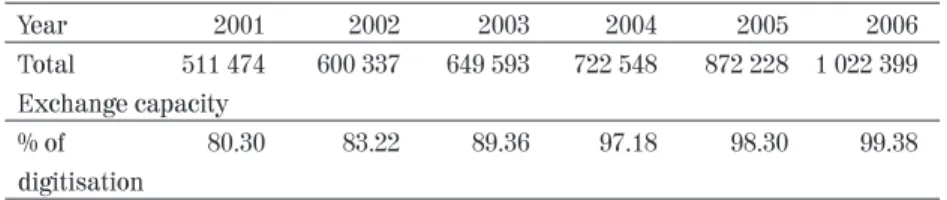
APACITYThe network capacity has grown over the last five years. The fixed-line telephone capacity has doubled off a small base of 511 474 in 2001 to 1 022 399 in 2006. The incumbent now has almost full digitisation of its cir-cuits. The percentage of digital lines to analogue has grown from 83.22% in 2001 to 99.4% in 2006. Table 10 presents progress made in improving network capacity and achieving full digitisation.
TABLE 10. EXCHANGE CAPACITY AND PERCENTAGE OF DIGITISATION OF THE NETWORK Year 2001 2002 2003 2004 2005 2006 Total 511 474 600 337 649 593 722 548 872 228 1 022 399 Exchange capacity % of 80.30 83.22 89.36 97.18 98.30 99.38 digitisation
Source: ETC Annual Statistical Bulletin 2005/2006
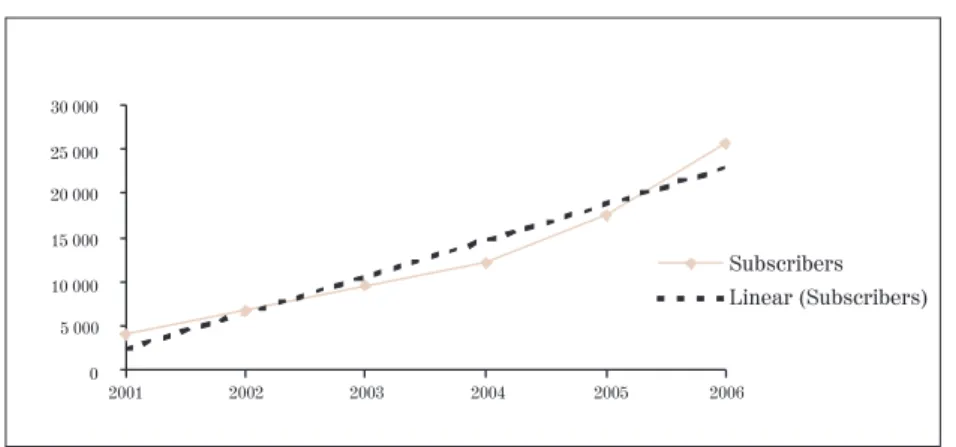
N
ETWORKC
OVERAGE ANDS
UBSCRIBERN
UMBERSFIXEDLINE
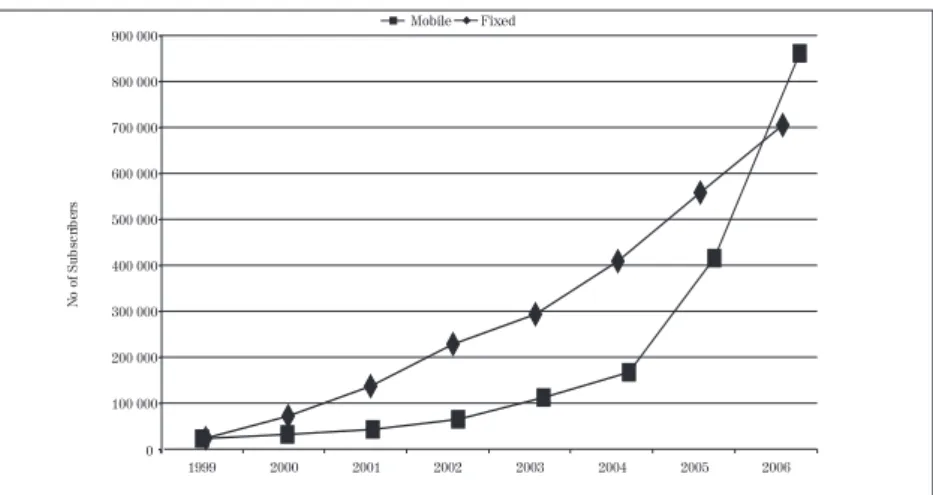
Ethiopia’s mainline teledensity stands at less than 1% and is still low compared to the African average of about 2.5%. The national telecommu-nication switching capacity stands at 1 022 399 lines of which about 725 046 were connected in September 2006. This represents an annual growth of about 13% from 610 347 lines in 2005. Although fixed line growth has seen a substantial increase from 0.25% in 1996 to almost 1% in 2006, there is still a large unsatisfied demand. There were 56 053 reg-istered subscribers on a waiting list for fixed lines at the end of Septem-ber 2006, slightly fewer than the 58 755 in 2005. Figure 3 shows that the ETC began attend to the waiting list in 2005.
FIGURE 3.WAITING LIST AND NUMBER OF MAIN LINES
However, it is important to note that the waiting list could actually be misleading, because it does not account for needs where the incumbent does not have network coverage and offices. About 5% of the population (4 million) could be waiting for fixed telephone lines if the network cov-erage were available throughout the country. The incumbent’s plan to extend fixed lines by 4 million by 2010 is expected to satisfy this short-term demand.
RURAL ANDUNIVERSALACCESS
Ethiopia has neither a written universal access strategy nor a univer-sal access fund. The regulator was not entrusted with defining the uni-versal access strategy. However, there is an overall policy that recom-mends that all rural areas receive reasonable access to telephones based on the government decentralisation framework to district (Woreda) and village (Kebele) levels. The present universal access strategy was designed around reaching out to the last level of public administration structure, the Kebeles. There are around 18 000 Kebe-les in Ethiopia that were formed during the ousted socialist regime. Kebeles continued to function as key points for community self-admin-istration and development.
In the absence of a well-defined universal service strategy, the ETC launched rural access using two major approaches:
Incremental roll-out of services to rural areas using VSAT, Digital Radio Multi Access System, UHF, VHF, Long line and RF radio; and
Implementation of a rural connectivity project based on government’s decentralisation framework.
The incremental rolling out of services to rural areas, particularly the use of VSAT, was able to improve access in some remote areas. There were 904 stations by September 2006, of which 391 were connected to digital automatic telephone exchanges, 377 were pay stations & Rural Radio Communication (RRC). The remaining 136 were manual exchange stations that employed semi-automatic facilities.
The rural connectivity project was aimed at complementing the incre-mental approach of setting up ETC stations throughout the country. It was planned to connect about 18 000 farmers’ associations in two phases – 3 000 in 2005, 15 000 in 2006, using wireless local loop technol-ogy and VSAT. Each rural station will be provided with a PC, phone, fax and Internet access. It was envisaged that each station costs between US$8 000 and US$15 000 to set up. The incumbent also planned to hire 36 000 graduates of technical and vocational schools to operate village communication centres and provide all ranges of communication serv-ices to customers.
By 2006, rural connectivity was far behind its original goals. The ETC underestimated the challenges of rolling out networks to 18 000 stations around the country within two years. Only 4 674 villages were connected by September 2006. There are plans to extend connectivity to the remain-ing 10 000 villages by 2010. This seems to be more realistic compared to the original plan of connecting all Kebeles by 2006.
While connecting villages will undoubtedly improve equity and universal access to communications infrastructure, it is not clear whether the approach to connect each Kebele makes business sense or will be sus-tainable. The RCP was based on conviction that the same technology works for everyone and that rural people wish to access similar commu-nication tools. Ethiopia lacks a well-thought out and sustainable univer-sal access plan driven by demand, technological and business innova-tions and quality of service. The RCP did not take small players such as rural cooperatives, the private sector and resellers (eg women) into account. Extending connectivity to all rural towns where the community assembles for buying and selling would make economic sense, followed by reaching out to villages where demands are high. It is unlikely that the ETC can sustain an additional 36 000 staff in addition to its current bloated workforce.
Allowing small players would alleviate the sustainability problem; at the same time it creates more employment and societal benefits. The involvement of rural cooperatives and entrepreneurs in the delivery of rural communication would not only relieve the incumbent from manag-ing a large-scale and complex distributed project, but would also create opportunities for the regulator to play a key role in licensing and regu-lating service providers and in carrying out research on cost, infrastruc-ture and technology options and capacity issue. In short, the participa-tion of the private sector in rural communicaparticipa-tions projects would enable the regulator to regulate. The process could unleash creativity in estab-lishing a universal access fund and financing rural communications, using various approaches ranging from the popular reverse auction to rural cooperatives.
Given the historical experience with rural cooperatives in Ethiopia dur-ing the socialist regime, models that are built around cooperatives and those that involve women could also be very attractive. Micro-lending that has shown some success in other areas could be adopted to the pro-vision of communication services. Different models of shared access facilities such as telecentres in schools, libraries and clinics, etc, should be explored by the regulator and policy makers in order to promote access, employment opportunities and bring spill-over effects in bring-ing public sector e-applications, such as land registration, to those who need the