269
THE APPLICABILITY OF HYBRID SYSTEMS IN SUPPORT OF
THE CORPORATE MANAGEMENT PROCESS: A REVIEW OF
SELECTED PRACTICAL EXAMPLES
Ziora L., Nowicki A., Stanek S.
Abstract: The aim of the paper is presentation of hybrid systems application in the support of decision processes including its practical application in such areas of business activity as marketing, production planning, retail banking. The considerations were directed at dynamically growing research area concerning hybrid cognitive architecture.
Key words: hybrid systems, management process support, cognitive architecture, decision support, corporate management
Introduction
In S. Zieliński’s definition, “management is a continuous decision-making process which involves the use of adequate, pre-processed information, and of which performance depends on the presence of an efficient, well-suited information system that meets all of the key requirements” [28, p.1 ]. The management process, as well as the decision-making process itself, can be supported by a variety of information systems, such as decision support systems, management information systems, business intelligence systems, expert systems, alongside a number of methods and techniques based on artificial intelligence. A combination of several techniques, methods and/or systems that make up a hybrid solution can be deployed to the decision-making process in a specific enterprise in an effort to accelerate it and improve its quality and efficiency. Z. Klonowski argues that “within an information system, all the processes of message transformation – viz. recording, gathering, storage, processing – as well as the decision-making act itself, composed of the stages of definition (of a set of decision variants), evaluation (of each decision variant), selection (of a single variant), decision-making, and decision implementation, constitute integral parts of decision-making processes.” Hybrid approaches, where algorithmic and heuristic methods work in unison, are intrinsic to the way decisions are made in poorly structured, ill-structured and unstructured environments [8]. Hybrid systems are characterized by an emergent (synergetic) property of adaptiveness which enables them to operate under conditions that were not anticipated or even present at the time the system was designed. These observations have inspired a rapidly growing body of research on hybrid cognitive architectures (the term “cognitive architecture” does not have a commonly agreed and unambiguous designation, although it can be found in
Leszek Ziora, PhD., Prof. Adam Nowicki, Czestochowa University of Technology, Faculty of Management, Prof. Stanisław Stanek, Department of Systems Engineering, Tadeusz Kosciuszko Military Academy of Land Forces
270
Wikipedia: “It proposes (artificial) computational) [cf. e.g. Year Sun 2012, Deutch 2011, Lang 2010, Becker-Asana 2008]. In an attempt to further enhance the adaptive effect by exploiting the patterns inherent in social systems, research has also been undertaken on e.g. perception, deliberation, communication, and interaction with the environment.
The paper aims to present the applicability of hybrid systems in decision support and their practical exemplifications in such areas of business activity as marketing, production planning, and retail banking. Attention is centered on the robustly growing strand of research focused on hybrid cognitive architectures.
The conception of a hybrid system: the rationale for the design and
development of hybrid systems; their tasks and functions; the notion of
hybridity
J. Zabawa argues that hybrid systems are “characterized by an ability to process diverse types of knowledge expressed through different technologies of knowledge representation and employing different inference and aggregation methods. The rationale for the design and implementation of hybrid systems is associated with the possibility to conduct economic analyses using a mix of complementary methods which were not hitherto considered in conjunction, e.g. quantitative and qualitative methods, genetic algorithms and inference algorithms, connectionist and rule-based knowledge representation methods, simulation and visualization, etc.”. Further, in line with G. and R. Kilgour from the University of Otago, he maintains that “a hybrid system can be identified with any computer system that utilizes more than a single technique to address a problem” [2 , p. 172].
In providing his general definition of a hybrid, E. Radosiński claims that “a hybrid is an entity that brings together diverse types, constructs, methods, technologies, etc. which have so far been treated as independent or standalone, and combines them as its integral parts. There is ample evidence that hybridization results in the emergence of structures in which the positive features of its constituents prevail. Quite often, the combination produces a synergy effect whereby the hybrid demonstrates characteristics which could be hardly found in the original components” [19, p. 25 ]. “The creation of such ‘hybrids’ is driven by the idea that by fusing multiple applications one can enhance the system performance (i.e. its efficiency and functionality) and, in the first place, increase the scope of problems it is capable of resolving” [12]. B.F. Kubiak argues that “by traversing and combining different domains of artificial intelligence (neural networks, genetic algorithms, expert systems), hybrid systems elevate the potential of management information systems beyond whatever can be attained by any single method applied in handling heterogeneous and complex problems. Hybrid system applications involve the processing of enormous amounts of digital data that can hardly be described by an accurate analytical model. Other difficulties arise in
271 describing the cause-effect relationships that need to be recordable as rules in an expert system’s knowledge base” [9].
Hybrid systems can be composed of such intelligent components – technologies and methods – as supervised and unsupervised neural networks, regression and data reduction techniques, fuzzy logic, genetic algorithms, case-based reasoning, expert systems, decision trees, artificial life, modeling and simulation methods. J.S. Zieliński believes that different intelligent techniques forming parts of a hybrid system “may have many complementary features and properties, hence their integration can be expected to lead to the development of better and stronger methods” [28, p. 266]. In addition, hybrids systems can make use of knowledge representation methods involving rough sets, type 1 fuzzy sets – which permit formal definition of imprecise and ambiguous notions – and type 2 fuzzy sets, which can be – as has been demonstrated by L. Rutkowski – used to build fuzzy inference systems [20, p.132]. The most common components of hybrid systems include neural networks, genetic (evolutionary) algorithms, and different types of neuro-fuzzy systems – Mamdani, Takagi-Sugeno or logical ones.
Since rich literature is available on neural networks, the paper will only briefly outline their structure and operating properties. Their central feature is that they mimic the functions of the brain and the nervous system – whose basic element is the neuron. Neurons can be easily trained via different algorithms, i.e. they can be assigned a weight; for example, neurons of the Adeline type can be taught by the recursive least squares method (RLS), alike sigmoid neurons taking their name from the activation function, which assumes shapes resembling the unipolar and bipolar sigmoid function. Artificial neurons are interlinked, thus creating multi-layer neural networks [20, p.172]. Evolutionary (genetic) algorithms, on the other hand, “represent a problem-solving approach which is based on natural evolution and specifically focused on optimization problems” [1 , p.27]. Genetic algorithms use binary strings of fixed-length and only two basic genetic operators. Evolutionary algorithms differ from traditional optimization methods in that: they do not convert the parameters of their assignment directly, but process their
encoded form instead,
in conducting a search, they set out not from a single point, but from a population of points,
they only use the objective function, but not its derivatives or any other auxiliary information,
they use probabilistic, not deterministic selection criteria.
M. Stanek claims that the reason why hybrid systems have come to be applied in the domain of artificial intelligence is: “to be able to utilize all available knowledge concerning a specific problem and multiple information types (symbolic, numerical, inaccurate), to offer a variety of reasoning schemes and more adequate answers, to increase overall system performance and eliminate the downsides of individual methods, and to create efficient and powerful reasoning systems” [1 ]. Other hybrid system components that can be applied to support corporate
272
management include Hopfield networks, where feedback output by one neuron becomes input for others, Hamming networks, which are two-layer networks, and multi-layer perceptrons.
Types of hybrid systems
With regard to functional relationships between modules, the following types of hybrid systems could be distinguished [28, p. 268-269]: function replacing hybrids, intercommunicating hybrids, and polymorphic hybrids (using a single processing architecture). In terms of system structure and component integration, J. Zieliński distinguishes five categories of intelligent hybrid systems: stand-alone models, transformational models, loosely-coupled models, tightly-coupled models, and fully integrated models.
Zadora and Wolny discriminate between two general approaches to hybrid system development: Computational Intelligence, and Soft Computing. They assert that “a system is compatible with the Computational Intelligence approach when it solely processes low-level numerical data, contains elements of pattern recognition, and does not use knowledge in any sense that is defined within the framework of artificial intelligence. Moreover, it exhibits a capability of self-adaptation, resistance to computational errors, response times approximating human performance, and error rates comparable to those typical of humans. These criteria are fulfilled by systems incorporating the following methods: neural networks, genetic algorithms, fuzzy logic, evolutionary programming, and simulations of life. The second approach represents an important advance in the evolution of hybrid system design theory and concerns systems employing artificial intelligence methods. It assumes that any advisory system being developed will process additional structured information – i.e. one whose structure, hierarchy and semantics are known. The incorporation of knowledge processing technology should not bear either on the scalability of the hybrid model as a whole or on its flexibility in adapting to future changes in the way the organization functions” [27]. Within hybrid models, aspects of two approaches are merged (cf. Vernon et al. 2007):
1) Cognitive Approach, in which a human designer supplies the system with knowledge in the form of internal symbolic representation. These systems can tackle problem domains that are well-determined and stable. Examples of such systems include SOAR or EPIC.
2) Emergent Approach, where the system commences operation by learning about both the environments as well as about its own impacts and interactions. In this instance, all that the developer provides is a rudimentary framework for the cognitive model, which is further built up based on feedback received via sensors. Solutions such as IBCA or NOMAD can be mentioned as examples of this approach.
273 Although most hybrid systems use symbolic (cognitive) representation, the way they develop is through interaction and exploring their environment rather than by a priori specification or programming.
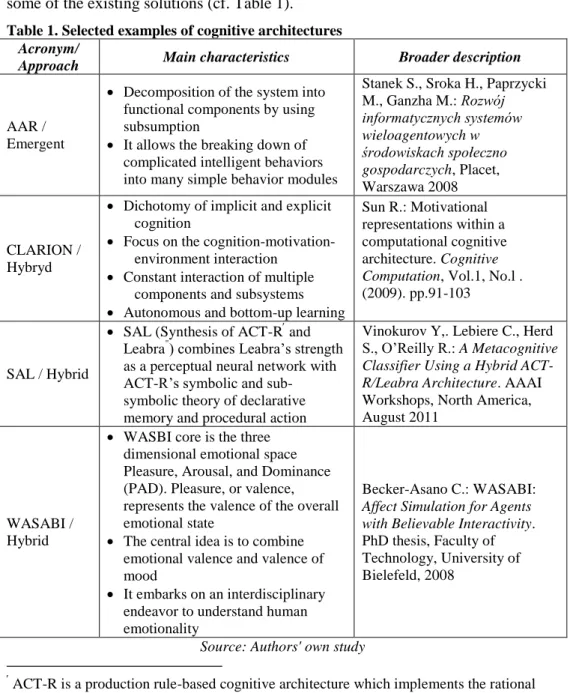
Further insights into previous findings and outcomes can be obtained by examining some of the existing solutions (cf. Table 1).
Table 1. Selected examples of cognitive architectures Acronym/
Approach Main characteristics Broader description
AAR / Emergent
Decomposition of the system into functional components by using subsumption
It allows the breaking down of complicated intelligent behaviors into many simple behavior modules
Stanek S., Sroka H., Paprzycki M., Ganzha M.: Rozwój informatycznych systemów wieloagentowych w środowiskach społeczno gospodarczych, Placet, Warszawa 2008 CLARION / Hybryd
Dichotomy of implicit and explicit cognition
Focus on the cognition-motivation-environment interaction
Constant interaction of multiple components and subsystems
Autonomous and bottom-up learning
Sun R.: Motivational representations within a computational cognitive architecture. Cognitive Computation, Vol.1, No.l . (2009). pp.91-103
SAL / Hybrid
SAL (Synthesis of ACT-R and Leabra") combines Leabra’s strength as a perceptual neural network with ACT-R’s symbolic and sub-symbolic theory of declarative memory and procedural action
Vinokurov Y,. Lebiere C., Herd S., O’Reilly R.: A Metacognitive Classifier Using a Hybrid ACT-R/Leabra Architecture. AAAI Workshops, North America, August 2011
WASABI / Hybrid
WASBI core is the three dimensional emotional space Pleasure, Arousal, and Dominance (PAD). Pleasure, or valence, represents the valence of the overall emotional state
The central idea is to combine emotional valence and valence of mood
It embarks on an interdisciplinary endeavor to understand human emotionality
Becker-Asano C.: WASABI: Affect Simulation for Agents with Believable Interactivity. PhD thesis, Faculty of Technology, University of Bielefeld, 2008
Source: Authors' own study
ACT-R is a production rule-based cognitive architecture which implements the rational analysis theory developed by Anderson
"
Leabra is a set of algorithms for simulating neural networks which combine into an integrative theory of brain (and cognitive) functions
274
An opinion voiced by Duch et al. can be quoted to sum up the discussion of cognitive architectures: “Cognitive architectures play a vital role in providing blueprints for building future intelligent systems supporting a broad range of capabilities similar to those of humans” [5].
Application areas and practical examples of hybrid system applications
in corporate management
Hybrid systems may have manifold applications in business management. They can be, for example, deployed in the area of marketing, but they can be used just as well in forecasting stock price indexes or in the assessment of loan applications. Their application in GIS system design is notable, too. “Ontology is a popular option in addressing support to the development of hybrid systems. Under a GIS system, it functions as a normative element for the knowledge representation process. The use of an ontology to define the knowledge system’s structure facilitates combination of existing ontology elements with new ones” [18]. Zieliński presents an example of how hybrid systems can assist the analysis and assessment of loan applications. “The non-linearity of neural networks”, he observes, “makes it possible to circumvent the requirement that individual criteria be independent of one another, which is an assumption made in the case of scorecards” [28, p. 27 ]. Further, Zieliński describes a solution dedicated to mortgage loan application assessment, which employs heuristic modeling methods and historic data analyses, alongside an expert system performing preliminary tests for compliance with the bank’s eligibility criteria.
A. Chluski argues that “methods based on neural networks can be applied just as well as other classical discriminatory methods in bank customer credit rating (scoring), with only a minor loss in efficiency. Neural networks are not very demanding in terms of input data pre-processing, nor do they have any other stringent requirements that need to be met when using statistical methods. Difficulty in justifying the decision to use a neural network should not matter much in the case of consumer loans, which banks perceive as a mass and standard product” [ ]. Witkowska also emphasizes that methods based on neural networks are complementary to statistical methods [25].
A. Ławrynowicz depicts an application of the hybrid approach employing expert systems and genetic algorithms in the area of production management, or more specifically – in supply chain management. The author demonstrates the ways artificial intelligence can be used to optimize production plans – maximizing utility and minimizing time consumption – which clearly represents an improvement over traditional planning and control methods [11]. Hybrid intelligent systems are also systems in which intelligent program agents solutions were applied. D. Jelonek presented the conception of the hybrid multi-agent environment monitoring system of e-enterprise. This paper underlined that in electronic markets in the role of „radars of the environment” can be applied systems of intelligent program agents
275 which are able to function autonomously in this environment for the purpose of planned goal achievement. [7, p. 47-56]
One more application of hybrid systems is in forecasting demand for electric power, where expert and neural modules may be combined sequentially. In a manner which is typical for data pre-processing, one module is responsible for preliminary data handling, while the other performs the actual assignment. This form of integration is epitomized by cases where neural networks are used for feature extraction and filtering the system input. In the case of data post-processing, solutions generated by either component are subject to final processing by another. An example of this approach would be an expert system which is employed to interpret output from a neural network. Within multi-stage processes, individual peer-to-peer system components will execute subsequent processing stages. This kind of architecture can be exemplified by an expert system making decisions based on indicators prognosticated by a neural network [28, pp. 273-274]. Among other application areas, one that certainly merits attention is the application of intelligent hybrid systems to support decisions relating to water resources management [7].
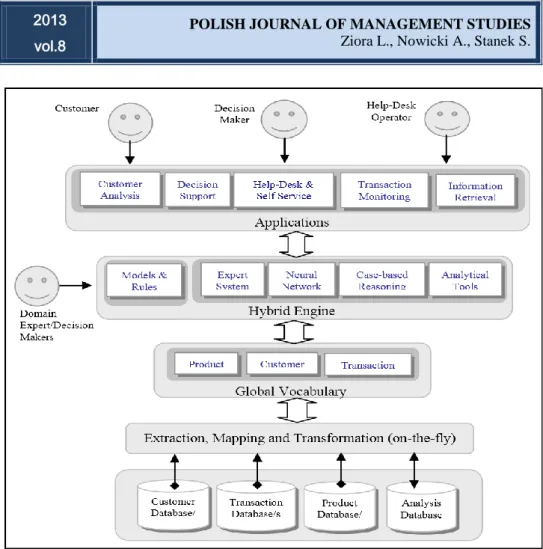
Rajendra M. Sonar [21] provides an account of a hybrid approach involving business intelligence systems implemented in retail banking. What he recommends is that instead of using one intelligent technique to solve a given problem, such as an expert system or a neural network, we can integrate them into a single model. A combination of analytical methods and intelligent systems the benefit of having and being able to use knowledge required for problem resolution to solve the problem with the use of different mathematical modeling methods. The main benefit of combining these two types of systems that e.g. quantitative results are transformed into qualitative ones, which makes them easier to understand by decision makers. Sonar proposes a generic approach to intelligent hybrid systems in the retail banking sector and classifies all functions of retail banking other than transaction support. As shown in Figure 1, he first distinguishes customer analysis, which is preoccupied with learning about consumer preferences, profiling and segmentation, in an effort to identify opportunities for the use of specific sales strategies, such as e.g. cross-selling (where products or services come bundled with some complementary goods) and up-selling (which consists in offering the customer better and more expensive services or products). Further, he distinguishes decision support, encompassing consumer evaluation: credit rating, which assesses an individual or corporate customer’s solvency, and credit scoring, which uses a point-scale to express a potential borrower’s creditworthiness. Finally, he isolates the functions of help-desk and self-service, transaction monitoring for suspicious and abnormal activity, and information retrieval, i.e. fast and easy access to information.
276
Figure 1. Generic Hybrid Intelligent System Approach to Retail Banking Source: Sonar R.M.: Business Intelligence through Hybrid Intelligent Approach: Application to Retail Banking, „Contributions – Volume 1” A collection of papers on
banking, finance & technology, Banknet India Publications, 2006
Information on customers, products and transactions is extracted from databases, mapped and transformed into so called ru nning instances. This kind of approach entails the use of a rule-based expert system, neural networks, case-based reasoning and analytical methods libraries. Models, as well as the rules for their application, are properly grouped according to application requirements. The hybrid system described by Sonar plays a key role in analyzing new and existing customers. For example, combining an expert system with case-based reasoning makes it possible to define groups of customers at which a given product is targeted, by simply following rules to allow for customer preferences. A combination of several methods and techniques stands for a product’s or service’s better alignment with customers’ needs, surpassing anything that a single method or technique could ever afford. It helps understand such characteristics as the customer’s age profile, the kind of products specific customers tend to purchase, and the channels of communication to which they are most likely to respond [21].
277 The evolution of cognitive platforms technology is progressing toward embracing such needs as greater system autonomy and adaptability to changes in the environment, and toward support for recognition of the decision maker’s cognitive context, which may contribute to improved decision support in situations where an unsupported decision maker is caught in the so called decision-making traps.
Summary
Hybrid systems have found applications in a number of areas, e.g. in retail banking, where a combination of an expert system with neural networks and case-based reasoning accounts for better decision-making in the sector, corresponding to better lending decisions and policies and an ability to offer services that are better tailored to specific customers’ needs. Expert systems can not only function alongside neural networks, but they can also be instrumental in training the latter. Accelerated decision-making and efficient enterprise management support can be achieved by deploying the right methods and techniques of data mining, which is part of business intelligence systems [cf. 14]. The proliferation of studies on hybrid cognitive architectures marks the advancement of research toward these emergent properties: autonomy, adaptiveness, and recognition of the human user’s cognitive context. This research strand continues to grow rapidly.
References
[1]. Becker-Asano C., WASABI: Affect Simulation for Agents with Believable Interactivity, PhD thesis, Faculty of Technology, University of Bielefeld, 2008 [2]. Becker-Asano C., Wachsmuth, I., Affective computing with primary and secondary
emotions in a virtual human. Autonomous Agents and Multi-Agent Systems, 20(l):32-49, 2009
[3]. Chluski A., Możliwości wykorzystania sieci neuronowych w ocenie scoringowej kredytobiorcy, Pr.Nauk.AE Wroc. nr 1150 Inf.Ekon. nr 10, Wrocław 2007
[4]. Deutch, T., Human Bionically Inspired Autonomous Agents, PhD thesis, Vienna University of Technology, 2011
[5]. Duch W., Oentaryo D., Pasquier M., Cognitive Architectures: Where do we go from here?, http://www-anw.cs.umass.edu/~barto/Cog-Arch-review.pdf
[6]. Hinclriks, K., Programming rational agents in goal. In: Multi-Agent Programming: Languages. Tools ami Applications. Springer I'S (2000) 119 157
[7]. Jelonek D. Monitorowanie otoczenia e-przedsiębiorstwa. Roczniki Kolegium Analiz Ekonomicznych, z. 16, 2006
[8]. Kazeli H., Keravnou E., An Intelligent Hybrid Decision Support System for the management of water resources, International Journal of Pattern Recognition and Artificial Intelligence, Vol. 17, No. 5 (2003) 837 World Scientic Publishing Company 2003
[9]. Klonowski Z.J., Systemy Informatyczne Zarządzania Przedsiębiorstwem. Modele rozwoju i właściwości funkcjonalne. Oficyna Wydawnicza Politechniki Wrocławskiej, Wrocław 2004
278
[10].Kubiak B.F., System Zarządzania Wiedzą we współczesnej organizacji, http://ekonometria.wzr.pl/res/konferencje/300505/referaty/kubiakbernard.pdf
[11].Roland Lang. A Decision Unit for Autonomous Agents Based on the Theory of Psychoanalysis. PhD thesis, Vienna University of Technology, 2010
[12].Ławrynowicz A., Hybrid approach with an expert system and genetic algorithm to production management in the supply net. Intelligent systems in accounting, finance and management, 59Intell. Sys. Acc. Fin. Mgmt. 14, 59–76 (2006)
[13].Małachowski A., Kościół S., Hybrydowe Inteligentne Środowisko wspomagania zarządzania przedsiębiorstwem, SWO 2007
[14].Michalewicz Z., Algorytmy genetyczne, struktury danych, programy ewolucyjne, Wydawnictwo Naukowo-Techniczne, Warszawa 1999
[15].Nowicki A., Ziora L., The application of data mining models and methods in enterprises. Review of selected financial and telecommunication industry case studies, Prace Naukowe UE Katowice 2012
[16].Sun, R (ed.), Grounding Social Sciences in Cognitive Sciences, MIT Press, Cambridge, MA. 2012
[17].Stanek M., "Systemy Hybrydowe. Wprowadzenie" 21 styczeń 2005: http://mstanek.blogspot.com/2009/02/sztuczna-inteligencja-systemy-hybrydowe.html [18].Stanek S., Sroka H., Paprzycki M., Ganzha M., Rozwój informatycznych systemów
wieloagentowych w środowiskach społeczno gospodarczych, Placet, Warszawa 2008 [19].Stanek S., Pańkowska M., Sołtysik A., M. Żytniewski, Zastosowanie architektur i
technologii hybrydowych w projektowaniu systemów GIS ,http://www.ptzp.org.pl/files/konferencje/kzz/artyk_pdf_2009/116_Stanek_Pankowsk a_Soltysik_Zytniewski.pdf
[20].Radosiński E., Systemy informatyczne w dynamicznej analizie decyzyjnej. Systemy wspomagania decyzji. Modelowanie symulacyjne. Techniki inteligentne., Wydawnictwo Naukowe PWN, Warszawa 2001
[21].Rutkowski L., Metody i techniki sztucznej inteligencji, Wydawnictwo Naukowe PWN,Warszawa 2006
[22].Sonar R.M., Business Intelligence through Hybrid Intelligent Approach: Application to Retail Banking, „Contributions – Volume 1” A collection of papers on banking, finance & technology, Banknet India Publications, 2006
[23].Sun, R., Motivational representations within a computational cognitive architecture . Cognitive Computation. Vol.1. No.l. pp.91-103. 2009
[24].Sun, R., Grounding Social Sciences in Cognitive Sciences. MIT Press. Cambridge. MA. 2012
[25].Vernon, D., Metta, D., Sandini, G., A Survey of Artificial Cognitive Systems: Implications for the Autonomous Development of Mental Capabilities in Computational Agents, IEEE Transactions on Evolutionary Computation, 11(2):151-180, 2007
[26].Witkowska D., Sztuczne sieci neuronowe i metody statystyczne. Wybrane zagadnienia finansowe, Wyd. C.H. Beck, Warszawa 2002
[27].Zabawa J., Podejście hybrydowe w analizie ekonomicznej przedsiębiorstwa, Praca doktorska, Wrocław 2005
[28].Zadora P., Wolny W., Hybrydowe Systemy Wspomagania Decyzji jako nowa forma Inteligentnych Systemów Wspomagania Decyzji, SWO 2007, Prace Naukowe UE Katowice 2007
279 [29].Zieliński J.S., Inteligentne systemy w zarządzaniu. Teoria i praktyka, Wydawnictwo
Naukowe PWN, Warszawa 2000
ZASTOSOWANIE SYSTEMÓW HYBRYDOWYCH DO WSPARCIA KORPORACYJNYCH PROCESÓW ZARZĄDZANIA: PRZEGLĄD
WYBRANYCH PRZYKŁADÓW PRAKTYCZNYCH
Streszczenie: Celem artykułu jest prezentacja zastosowań systemów hybrydowych we wspomaganiu procesów decyzyjnych w tym praktyczna egzemplifikacja ich wykorzystania w takich obszarach działalności biznesowej jak m.in. marketing, planowanie produkcji, bankowość detaliczna. Rozważania zostały ukierunkowane na dynamicznie rozwijający się aspekt badawczy dotyczący architektury hybrydowo poznawczej.
Słowa kluczowe: systemy hybrydowe, wspomaganie procesu zarządzania, architektura poznawcza, wspomaganie decyzji, zarządzanie korporacyjne.
混合動力系統在支持企業管理程序的適用性:選定現實的例子綜述
摘要:本文的目的是在決策過程中,包括在商業活動等方面的實際應用,市場營, 生產計劃,零售銀行的支持下呈現混合動力系統的應用。代價乃直指關於混合動力 的認知結構動態增長的研究領域。