DESIGNING EFFECTIVE HINTS SYSTEMS
BY
REN-JAY WANG
THESIS
Submitted in partial fulfillment of the requirements for the degree of Master of Science in Computer Science
in the Graduate College of the
University of Illinois at Urbana-Champaign, 2017
Urbana, Illinois
Adviser:
ii ABSTRACT
Hint systems are designed to provide users with assistance with a complicated or difficult task. However, modern-day hint systems are frequently ineffective at assisting users, forcing them to consult external help. One flaw in current systems is that they fail to anticipate user needs as well as accommodate different types of users. In our study, we discovered key factors to designing an effective hint using a notoriously difficult puzzle game as our experimental object. We found that abstract hints are perceived as worse than no hint because they do not provide sufficient help for the player. In contrast, we found that concrete hints are perceived as more helpful, but ultimately that player experience attributes primarily depend on the characteristics of the game. In addition, we give players the choice to pick their own hint and find that it does not significantly alter player experience. We conclude our paper with a discussion on how we can apply these lessons to hints in non-game applications.
iii
TABLE OF CONTENTS
CHAPTER 1: INTRODUCTION………1
CHAPTER 2: BACKGROUND………..3
CHAPTER 3: RESEARCH QUESTIONS AND HYPOTHESES...………...….6
CHAPTER 4: EXPLORATORY STUDY………..……..10
CHAPTER 5: FOLLOW-UP STUDY………...………....21
CHAPTER 6: RESULT SUMMARY………...……37
CHAPTER 7: DISCUSSION……….39
CHAPTER 8: CONCLUSION………..44
REFERENCES………..45
APPENDIX A: EXPLORATORY STUDY PAGE DETAILS……….…..…..47
APPENDIX B: FOLLOW-UP STUDY PAGE DETAILS………...51
1
CHAPTER 1: INTRODUCTION
In the modern world, user-focused applications are pervasive. People from almost every background and occupation make use of computer applications; for example, consider aircraft control systems, Fitbit devices and online games. There is a large range of proficiency among these users; thus, every such application must design measures to assist struggling users. For example, old versions of Microsoft Word included “Clippy,” an intelligent office assistant designed to assist new users by offering tips on how to perform basic tasks such as performing spell check and writing a letter. Despite research indicating that Clippy had a reasonably good recommendation algorithm, the assistant received a notably negative response from its users, leading to its removal from the application in Office 2007 and onwards. Later research indicated that this was due to the interface being perceived as annoying or impolite [1]. This is just one example of an application that had a poor hint interface, but it shows the difficulty of designing an effective hint system.
This has led to many researchers exploring the question of what makes a good hint or tutorial system. Existing research has focused on educational tutoring systems such as Computer Aided Instruction (CAI) or Intelligent Tutoring Systems (ITS), but have been mostly
inconclusive. Many such studies have shown that it is important to adapt the tutorial system to the student’s preferred learning style [9, 10]. However, there is no consensus for what tutorial methods are effective for different learning styles, as results remain inconsistent across different studies [9]. Other research done specifically on educational games has also been inconclusive, showing that while some experiments show that hints increase play time (i.e. are beneficial), other experiments show that they decrease completion and play time (i.e. are harmful) [2].
2
While previous studies mainly focus on metrics such as assignment completion or speed as a goal, our study takes a player-centric approach to determine what is a good hint, measuring subjective factors such as player enjoyment, boredom, fun and frustration. In addition to these factors, there are many other interrelated factors that contribute to a hint’s success, such as player age, gender, preferred learning style and motivation, which up to this point have not been studied or have been studied inconclusively. Previous studies have shown that player behavior is often counterintuitive, necessitating the use of experiments to confirm hypotheses regarding these complex, interwoven factors [17]. In this paper, we choose to manipulate hint complexity for a puzzle game in order to evaluate its effect across these different variables. In addition, in our experiment we provide half the participants with a choice of what kind of hint they would like, abstract or concrete, which to our knowledge is the first of any such study. Doing so allows us to control for differences between users as well as evaluate how having the option of choosing hint type affects player experience.
In this work, we provide three main contributions: First, we evaluate hint effectiveness with a focus on player experience over a novel combination of factors. We perform two case studies and find that although players prefer concrete hints, player experience largely depends on the game characteristics. Second, we design and test a new form of hint evaluation scheme. Finally, we provide practical suggestions for hint design as well as inform future study in this area.
3
CHAPTER 2: BACKGROUND
As mentioned previously, most of previous research in this area has focused on Intelligent Tutoring Systems (ITS), although some recent research has also investigated hint design for educational games. We will consider each in turn.
HINT DESIGN IN INTELLIGENT TUTORING SYSTEMS (ITS)
Intelligent Tutoring Systems (ITS) are computer systems that provide instruction to learners for subjects such as math [3], physics [11] and computer programming [12], as well as other areas. These systems attempt to emulate the effect of a human tutor, and thus present the information in the form of a tutoring dialog. Since these systems are designed to be used without immediate human feedback, hints and tutorials are essential to assisting struggling students. Studies for mathematical tutor systems have shown gender to be a factor in tutorial effectiveness, with girls preferring interactive hints (learning by doing) and boys preferring non-interactive, low-intrusive hints (learning by being told) [3]. In addition, the perceived gender of the ITS learning companion also impacts learning outcomes, with each gender naturally preferring its own gender [4]. However, these studies focused exclusively on elementary to high school students, which limits the generalizability of the results.
One key part of ITS is the hint structure. In ITS, hints usually are given on demand and are scaffolded, meaning that as the student requests more and more hints, the hints give away more and more of the answer until they “bottom-out” into a hint that simply gives the whole answer away [6, 8]. Unfortunately, this on-demand system can lead to students manipulating the system by quickly jumping to the “lowest-level” hint. Other students will refuse to request hints even when they need them. Although ITS emphasize giving the user control over their own
4
learning experience, research has shown that people are frequently poor judges of when they need a hint [5]. Thus, designers of hint systems must take into consideration that users will not
know the optimal time for a hint. The time at which users request hints is something we investigate in our study.
Personalization is another key part of ITS. Having a personalized learning experience has been long established to be quite beneficial to learning outcomes [9, 10, 13, 14]. It is possible to mine user data to automatically generate hints using techniques such as Markov decision
processes [6]. However, these methods may not be extensible to every kind of tutoring system, and may not be able to generate hints 100% of the time. In our work, we consider how
demographic differences between participants affects hint effectiveness but leave hint personalization to a future study.
Research in ITS has also inspired research in hints for video games, which we will consider in our next section.
HINT DESIGN IN VIDEO GAMES
One branch of video games that has been studied extensively is educational games. Educational games are a powerful alternative teaching tool and have therefore received
increasing amounts of scholarly attention [15]. However, educational games differ from ITS in that the goal of the system is not just task completion, but also game experience. It has been shown that for an educational game to be successful in teaching the learner, it must be a game first and a tutor second [15]. In other words, it must integrate education into the game without distorting the nature of the game. Thus, when providing assistance to the learner, the game must be careful not to be overly invasive [16]. Studies have shown that it is possible to provide such
5
non-invasive, adaptive help to the player using a rule-based recommendation engine. However, similar to ITS, this approach may be difficult to generalize to games of all genres.
Game complexity is also a factor for how effective hints can be. For example, in a study performed by Andersen et al. using the game Refraction, Andersen et al. found that the presence of a help button decreased player game completion and play time [2]. Yet, in the same study, they found that tutorials increased play time in a separate, more complicated game, Foldit. These results show that game complexity in addition to hint presentation is an important factor to consider when developing tutorials for games.
Our study largely builds off a similar study performed by Helen Wauck that investigated the use of data-driven hints in puzzle games. Wauck found in her study that puzzle square exploration was correlated with user fun, so she designed a hint that prompted users to explore more squares. However, most users felt that this hint was too abstract, despite it correlating with behaviors that improved user experience, and thus rated it as unhelpful. In her study, the players who did find the hints helpful were those who eventually won the game, suggesting that there is a placebo effect for players who win the game that causes them to perceive hints as helpful regardless of how much the hint actually helped them to win. One limitation of this study was that it did not use more concrete hints to help users solve the puzzle. In addition, it did not analyze how players with different levels of game experience or how player game preference affects hint perception. These are some measures we investigate in this study.
6
CHAPTER 3: RESEARCH QUESTIONS AND HYPOTHESES
RESEARCH QUESTIONS
In our study, we choose to manipulate hint complexity as our independent factor. Hint complexity refers to the amount of direct help that a hint provides to a user. In other words, a complex, abstract hint will not make connections with real life objects, but rather will give general advice designed to guide the person to the right direction. On the other hand, a simple, direct hint will give concrete next steps to solving the problem that refer to real life objects that the user is working with. Our hypothesis is that, similar to previous studies, males will prefer more concrete hints, and females will prefer more abstract, interactive hints [3].
However, it is clear from previous work that there is no single factor that determines the success of a hint. Rather, many complex interwoven factors from both the player and the game affect the effectiveness of a hint [17]. Thus, to avoid oversimplifying these factors, we choose to combine our analysis of self-reported player experience, player demographics and game
performance and provide a more holistic evaluation for hint design. Some areas that we will consider in our study include:
• Player Game Preference: Player ability is an important categorization to consider when developing hints. Previous studies have shown that, when using a mathematics tutor, higher cognitive students do better with highly symbolic hints vs lower cognitive students who struggle with these hints [3]. In line with these results, our hypothesis is that
experienced players (i.e. those who prefer puzzle games) will prefer more symbolic interactive hints, whereas all other players will prefer concrete, direct hints. Since it is
7
difficult for us to directly measure player cognitive ability, we will use the players’ video game preference as an indication of their puzzle game ability.
• Player Game Experience: Our hypothesis is that game experience has no effect on what kind of hint a player prefers, because it seems from previous works that a player’s personality and personal traits matter more than game experience [3].
• Player Motivation: Most of the literature in designing hints has focused on learning, whether it is through ITS or educational video games. Although these studies have already shown that hints and tutorials can help to improve learning outcomes [4], they do not address the effect of hints for non-educational games. Thus, we would like to
investigate the effect of player motivation in a non-educational setting. In addition, we have already seen that hint effectiveness may depend on how much time a player is willing to spend playing the game [2]. In Andersen’s study, tutorials helped the most for the most complex and unconventional game. One possible explanation is that there was a higher barrier to play the game (participants needed to download the game); thus, only those players who were motivated enough to download the game played the game and read through the tutorial. Following this line of thought, our hypothesis for our study is that motivated players who play the game for a challenge will prefer more abstract, interactive hints, whereas all other players will prefer concrete, direct hints. We will measure this by directly asking participants how much they would like to be challenged prior to any gameplay.
In addition, some questions that we will look to answer include:
• Game Context: Research in mobile game-based learning is a new, relatively unexplored field. Mobile devices are an interesting research platform because
8
they are very context sensitive, meaning that they have capacity to gather data that is unique to the user’s current time and location [18].In our study, we are
interested in how the context of what the player was doing affects their perception of a hint. For example, will players who were just browsing the internet be more receptive to interactive hints than those who were taking a walk?
• Hint Timing: Wauck recommends that game designers first implement on-demand hints to see at what times and at what points players ask for help [17]. This is important for designing personalized hints, which have been shown to be effective for improving learning outcomes [9, 10, 13, 14]. For our study, we will initiate this process by analyzing at what point players are most likely to ask for hints. • Hint Choice: In all previous hint literature, the hint that a player will receive is
determined prior to the player participating in the study [2, 17]. We are interested if allowing the player to choose their own type of hint will affect player
experience. Does allowing the player a choice between hint types provide for a better player experience?
OUR APPROACH
In order to answer these questions, we make use of the same puzzle game from Wauck’s study [17]. This is done to provide a direct comparison between the hints in her experiment and our experiment. In order to get a feel for the effectiveness of our new abstract hint, we first conduct conduct an exploratory study on a mobile platform. The follow-up study uses the results from the exploratory study to fine-tune the hint through the data and player feedback, and moves the experiment to a web platform.
9
For our studies, using a web game is advantageous because of its accessibility, allowing us to easily recruit many participants. However, we first develop the game for Android in order to investigate the question of game context. Afterwards, we move the study to a web platform to increase the number of participants we can recruit. In order to answer our hypotheses, we ask participants to fill out optional pre-game and post-game surveys, where participants can provide their demographic data prior to playing, and player experience feedback after playing the game (see Appendices A and B). Participants are recruited through fliers and online advertisements, and are not compensated in any way. Each study is run for approximately one month.
10
CHAPTER 4: EXPLORATORY STUDY
EXPLORATORY METHODS
In our experiment, we use the same puzzle game from Wauck’s paper, which was originally taken from The Legend of Zelda: Twilight Princess [17]. “The Master Sword Puzzle”, as it is called in its game, is notorious for being very difficult and thus frustrating for players to solve, leading many players to simply Google search for the answer. We choose this puzzle for two reasons. First, the difficulty of the puzzle and lack of hints in the original game make it a good target for us to try to improve by incorporating hints in the game. Secondly, there are 64 different solutions to this puzzle, meaning that there is variance in how each player reaches the solution. This models real life applications, in which there frequently are multiple correct ways to solve a single problem. For the sake of clarity, we will refer to this as the “Three Body Puzzle” for the remainder of this paper.
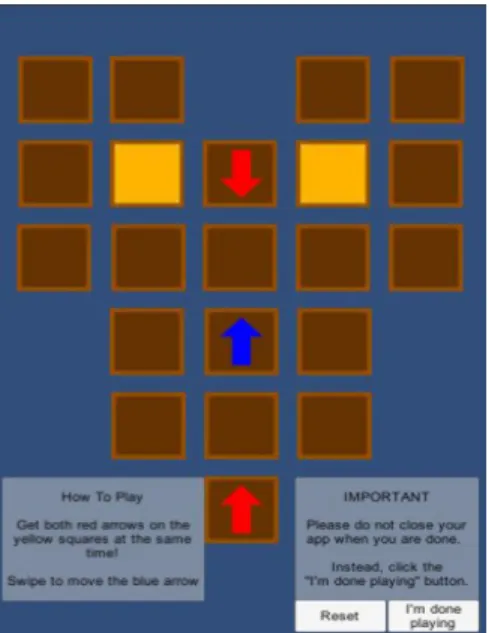
In Figure 1, we show the starting position of this puzzle as a participant in our study would see it. In the Three Body Puzzle, the player controls a blue arrow, and must get both red arrows into the designated yellow spots. One red arrow moves synchronously with the player and the other moves the opposite direction. Since the blue arrow cannot move onto a space where a red arrow is, it is possible for a player to maneuver the blue arrow into a corner and get stuck.
11
Our experiment consisted of an exploratory study and a follow-up experiment. For the exploratory study, we created the game using Unity and ported it to an Android platform. The reason we chose an Android platform instead of web was to investigate how user motivation affects hint perception. For example, we wanted to see if there was a difference based on if users were playing the game at home (to have fun/have a challenge), at a bus stop (to kill time), etc. We felt that using a web platform makes it difficult to test for these different scenarios.
In order to recruit participants, we distributed fliers around the University of Illinois, Urbana-Champaign campus. These fliers encouraged anyone interested in playing a puzzle game for research to download an Android application from the Google Play store titled “Puzzle Game Study”. These fliers included a scannable QR code as well as a link to the Google Play store. Fliers were left in public areas for roughly one month. In addition, advertisements for the study were placed on the r/samplesize subreddit, an email newsletter and Facebook. All participants recruited were at least 18 years old, anonymous and participated without any compensation.
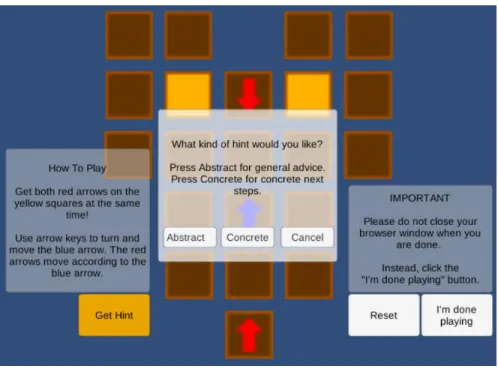
After downloading the application, the participants would first be brought to a consent form describing the purpose of the study, the procedure of the study and the researchers’ contact information (see Appendix A). Once completed, the participant would be asked to fill out a brief survey on his or her demographics and game experience. After filling out as many questions as he or she was comfortable answering, the participant would then be brought to the game (see Figure 1). This screen included a “How to play” instruction box on the bottom left corner of the screen, as well as buttons allowing the participant to reset the game and exit whenever desired. For players under the “hint” condition, a hint button was visible on the bottom of the screen, which would display a hint when pressed. After exiting the game, the user would then be directed to a brief survey where he or she could rate his enjoyment, boredom, easiness and
12
frustration on a 5-point Likert scale. In addition, the player could provide a rating on the hint’s helpfulness (if a hint was seen or used) and an explanation for the rating. No further feedback was requested and no further contact was made with participants after this point unless they emailed the researchers.
For our exploratory study, we designed a hint that was more concrete than Wauck’s hint. Wauck’s original hint, when triggered, showed the users which squares had not been explored and prompted the player to explore them. We will refer to this hint throughout this paper as the “explore” hint. Since the feedback from her experiment indicated that this was insufficient in directing the user to a
solution, we created a hint that displayed an
“intermediate” stage to the user. This “intermediate” stage was found by finding the path to the closest solution and providing the step approximately 2/3 of
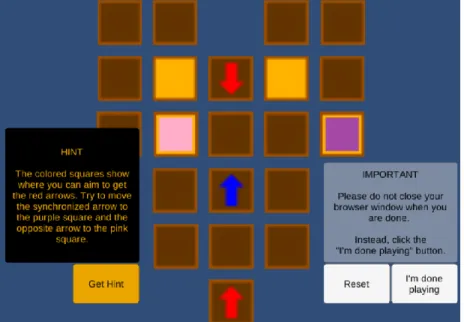
the way to the solution. For example, in Figure 2, there are 12 steps remaining to the closest solution. The purple and pink squares indicate where the red arrows should be in the game state approximately 4 steps away from that solution. We created this hint in hopes that an intermediate stage would break the problem of solving the puzzle into more manageable chunks. This hint was also chosen because we hypothesized that users would perceive a direct path to the solution too easy, and that an intermediate step would be sufficiently challenging while still providing the
13
user with some guidance on how to progress. For the sake of brevity, this hint will hereafter be referred to as the “intermediate” hint.
EXPLORATORY RESULTS
Preliminary Demographic Evaluation
Ultimately, we recruited 50 participants. Before performing analysis, we removed one player who had to leave before she could finish (P78), leaving 49 players’ data available for analysis. Excluding those who did not provide their gender data, there were 10 female
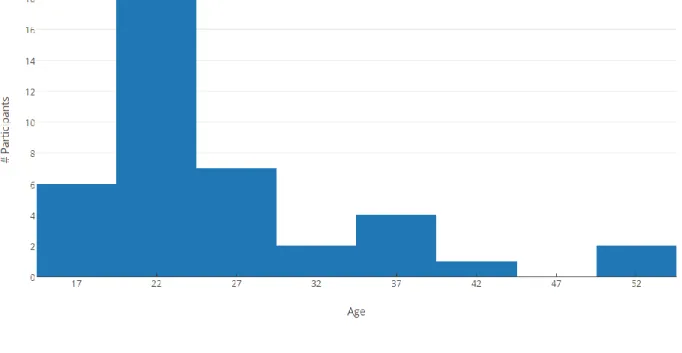
participants and 31 male participants. The average number of moves made was 88.12, and the median number 65. The average number of attempts was 3.06 and the median number 3. We also collected data on participant age, number of hints requested, time spent and preferred game genre. Since our participants were mostly recruited on a college campus, the distribution of age is skewed towards 18-22 (see Figure 3). The average age was 25.93, but the median age was 22.
14
We also see that most participants did not request a hint, and the most number of hints requested by any participant was 3 (see Figure 4 below). Of those 5 participants that requested three hints, 4 of them were under the “intermediate” hint condition.
Figure 4: Exploratory Study # Hints Requested Histogram
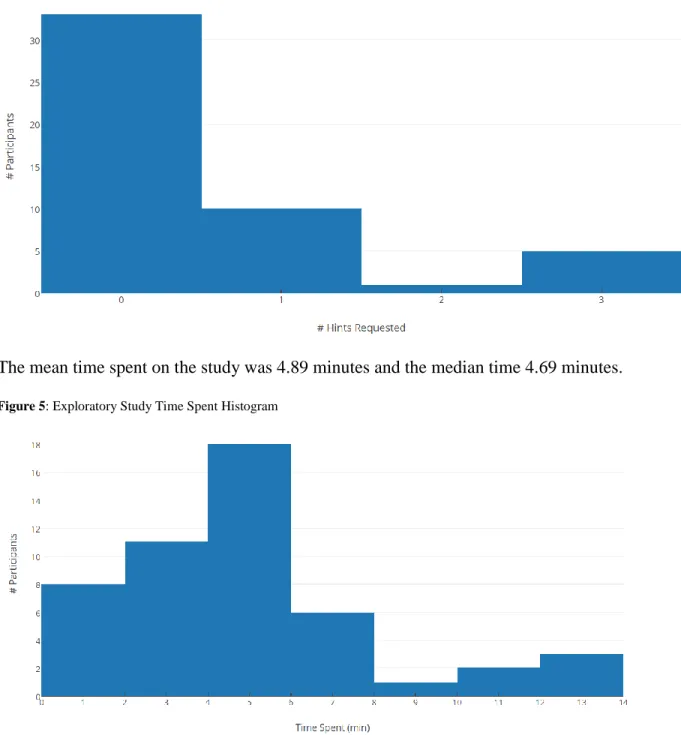
The mean time spent on the study was 4.89 minutes and the median time 4.69 minutes.
15
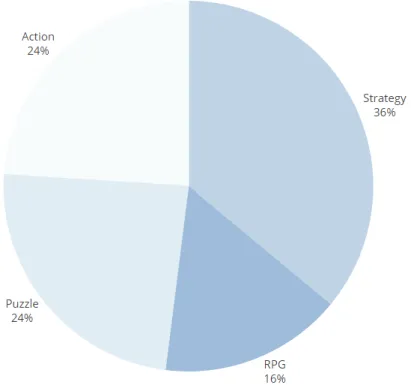
29 participants provided data on games they preferred, which we coded into the categories “Action”, “Puzzle”, “RPG” and “Strategy” post experiment.
Figure 6: Exploratory Study Preferred Video Game Genre (coded post-experiment)
“Intermediate” Hint Evaluation
When analyzing the results for the new hint condition, we found that there was no significant correlation found between the new intermediate condition and any of the player experience metrics (i.e. fun, boredom, frustration, easiness). In addition, the intermediate hint condition did not improve success rate.
The player qualitative explanations shed some light on why the new condition was not effective. Some sample responses from players who gave a hint helpfulness rating less than 3 include:
16
“I couldnt get the arrows to the hint boxes either” (P113)
“I was looking for a hint explaining how to move. Didnt know you had to swipe twice.” (P76) “didnt know what was the point” (P61)
Thus, it seems that although the hint was less abstract than the one from Wauck’s study, players were still not able to use it effectively to solve the puzzle.
Factor Analysis
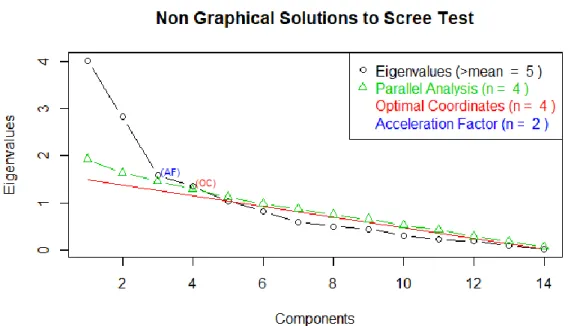
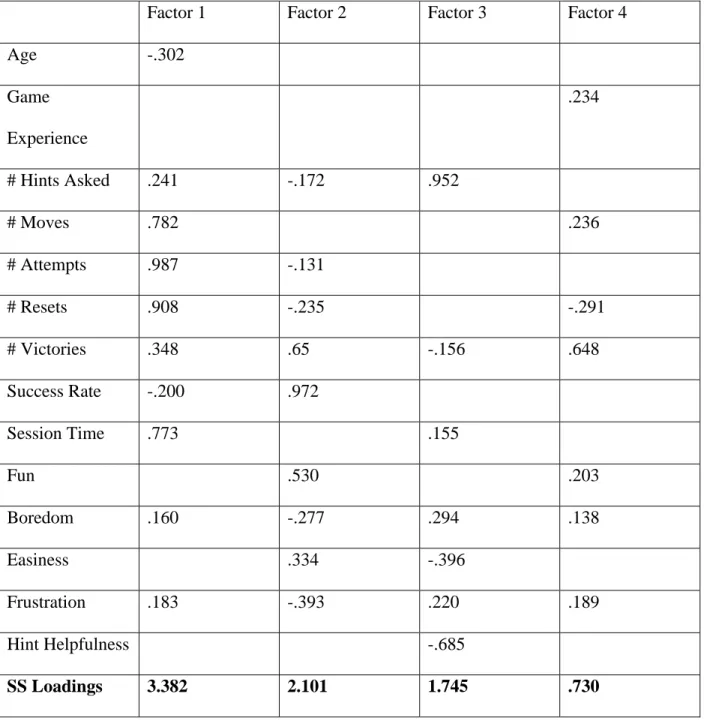
An exploratory factor analysis on the players sheds some light on why this is the case. To find the factors, we used the R factor analysis function with the varimax rotation. An experimental analysis indicated that 4 factors provided the best fit for our data, while maintaining a p-value above .05.
17
Table 1: Exploratory Study Factor Analysis
Factor 1 Factor 2 Factor 3 Factor 4
Age -.302 Game Experience .234 # Hints Asked .241 -.172 .952 # Moves .782 .236 # Attempts .987 -.131 # Resets .908 -.235 -.291 # Victories .348 .65 -.156 .648 Success Rate -.200 .972 Session Time .773 .155 Fun .530 .203 Boredom .160 -.277 .294 .138 Easiness .334 -.396 Frustration .183 -.393 .220 .189 Hint Helpfulness -.685 SS Loadings 3.382 2.101 1.745 .730
Factor 1 had a high loading for number moves (.782), number attempts (.987) and session time (.773), and a moderate negative loading for age (-.302) and success rate (-.200). These players spent a lot of time spent a lot of time in the game and made a lot of moves and attempts, with a low success rate.
18
Factor 2 had a high loading for victory (.655) and success rate (.972), and thought the game was fun (.530), not boring (-.277), easy (.334) and not frustrating (-.393). These players did not ask for many hints (-.172) and therefore seemed naturally good at the game.
Factor 3 had a high loading for number of hints asked (.952), a moderately low victory rate .156) and moderately high boredom (.294), frustration (.220) and low easiness ratings (-.396). These players had a high negative hints helpfulness rating (-.685), indicating that these players struggled more with the game and found the hints markedly unhelpful.
Factor 4 consisted of players who had a high victory rate (.648) like Factor 2, but put in more slightly more moves (.236) and had slight boredom (.138), fun (.203) and frustration (.189). These players put in slightly more effort than those players in Factor 2.
Looking at these factors, we can see why the new condition was not effective. The players who asked for the most hints (Factor 3) also gave the lowest hints helpfulness ratings. These players also struggled the most with the game. Thus, we can conclude that the hint was not effective because only those players who had no idea how to progress in the game or who could not formulate a solution depended on the hint, and the hint was not concrete enough to push them in the right direction.
Looking at when players requested hints, out of the 28 players who asked for a hint, 8 asked for it right away and 3 asked for it when they were stuck (and had to reset). When the player was not stuck, the average number of moves left to the closest solution was 11.36. Since the number of moves from the starting state to the closest solution is 12, we can conclude that most players ask for hints in the beginning stages of the game. This indicates that when most players ask for a hint, they have no idea how to progress. Therefore, an appropriate hint must be concrete enough to lead them in the right direction.
19 Game Context Evaluation
One of our goals for the exploratory study was to investigate game context, meaning we wanted to see how the context in which the participant played the game affected player
experience or performance. In our exploratory study, we did this by asking players what there motivation was for playing the game. We split player motivations into four main categories: for fun, for a challenge, boredom, and because they were asked to play by a friend (obligation). Players who came to the game looking for challenge or fun found the game more boring than players who were playing out of obligation (F(2,11)=16.151, p=0.0005). This may be due to player expectations – players who are playing out of obligation are less likely to be judgmental of a game than those who are looking for fun or a challenge. In addition, players who played the game for a challenge spent more time (F(2,11)=4.723, p=0.033) and made more moves than other players (F(2,11)=11.876, p=.001); in addition, these players made more attempts than the players who were asked by their friends to play the game (F(2,11)=5.690, p=.020). This indicates that players who are looking for a challenge invest more time and effort into the game; since these players are more likely to be sensitive to poor game design, hint designers should target these players when designing hints.
This is further corroborated by the fact that players who play video games a lot (at least once a month) felt that the progress hint was less helpful than no hint (F(2,49)=6.266, p=0.004). This means that when designing a game for video gamers, designers should be especially careful that game hints are helpful enough. In addition, among players with the new hint condition who asked for hints, there was a strong negative correlation (r=-.690, p=.027) between number of unique hints asked for and player enjoyment. Again, this indicates that players went to the hints for help, and they were not helpful enough.
20
Finally, similar to how Wauck found that there is a placebo effect where hint helpfulness is associated with winning in our study we found that fun is has a moderately positive association with winning (r=.433, p=.002). In addition, a high success rate is moderately associated with game easiness (r=.31, p=.0307), less frustration (r=-.42, p=.0024) and less boredom (r=-.30, p=.0378). Like Wauck’s exploratory study, which found an association between exploring more squares and fun, we found a positive association between making moves and winning (r=.55, p<.0001). There is a negative correlation between resetting and winning (r=-.37, p=.0088), indicating that we could detect struggling players by the number of attempts they make. Result Summary
Our goal for the exploratory study was to produce a concrete hint condition that would actually help players, in light of previous feedback on the same puzzle [17]. However, we found that even a slightly more concrete hint was perceived as confusing, unhelpful and even worse than no hint. This is because it is typically those players who struggle the most that depend on these hints. It may be that when players see an on-demand hint, they expect it to be more
concrete and helpful than a hint that is triggered automatically. Thus, for the follow-up study, we include a more concrete hint that will allow even players who are struggling to win.
We had many factors that we wanted to look at, including game experience, game
preference, gender and age. However, none of these variables had any noticeable effect on player experience, performance or hint helpfulness ratings. This is likely due to our low sample size in collaboration with our unhelpful hint. In addition, game time was not significantly affected by our new hint condition. Thus, it seems that for any such study, it is necessary to have far more than 50 participants to mine statistically significant results. In order to gather these participants, we move our study to web for our follow-up study.
21
CHAPTER 5: FOLLOW-UP STUDY
FOLLOW-UP METHODS
In our follow-up study, we made several key changes from our exploratory study: Platform
The first major change we made was to move the platform of the game from mobile to web. Initially we chose to have the study on mobile in order to investigate how the context of the user’s participation (e.g. waiting at a bus stop, taking a break from work, etc) would affect player experience, and felt that a mobile platform would provide a wider variety of responses. However, the mobile platform proved to be overly inaccessible and limited the number of participants we could recruit.
Questions
We chose to add several questions to the pre-survey from our exploratory study. These questions included:
• How much of a challenge are do you want from the game? • What were you doing prior to participating in this study?
These questions were added to more directly help answer our research questions. To see the updated pages, see Appendix B.
22 Hint Presentation
A key change we made in this study was to alter the hint system. Based on the feedback from the exploratory study, we designed a second more “concrete” hint. When triggered, this hint tells the user the next 2-3 steps towards the
closest solution. Since this hint can be easily abused to find the answer, we consider this a “bottom-out” hint. In addition, we changed the hint system so that instead of the participant
being randomly assigned a hint, half of our participants would instead see a dialog asking them to choose between an abstract hint and a concrete hint (see Figure 8 above) when pressing the Get Hint button. This abstract hint was the “intermediate” hint from the previous study, and the concrete hint was the hint described above, which will hereafter be referred to as the “concrete” hint. The other half of the participants received a randomly
Figure 8: The choice dialog
23
assigned hint condition between the “explore” hint, the “intermediate” hint and the “concrete” hint (see Figure 9).
Aside from these changes, the layout of the study remained the same as the exploratory study. Recruitment was done by posting advertisements for the study on the /r/samplesize subreddit, an email newsletter, various computer science Facebook groups, and by word of mouth. No physical fliers were used due to physical limitations. In total, 247 participants were recruited, of which 234 had not participated before. Participants filled out a consent form and a brief survey before playing the game. After completing the game or giving up, participants filled out two brief exit surveys. All participants were adults 18 years or older, had their data collected anonymously and received no compensation of any kind.
FOLLOW-UP RESULTS
In our study, we focused our analysis on two main groups of attributes: “player experience” attributes which were self-reported and include fun, boredom, easiness and
frustration, and “player performance” attributes which include number of attempts made, number of moves made, time spent and player win rate. In our analysis, we had to remove 13 participants who had already participated in the study, leaving 234 total participants.
24 Preliminary Demographic Data
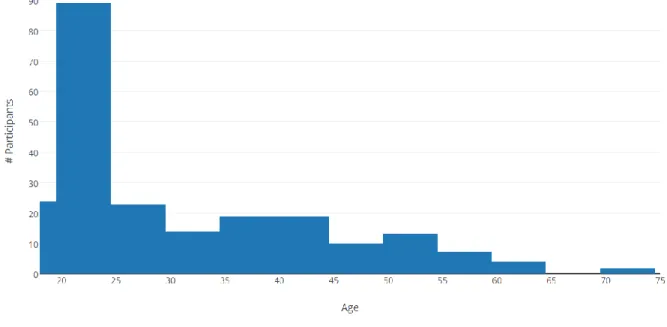
Here we present a summary of our demographic data. 101 participants identified as female, and 128 as male. The average age was 30.49 years old, and the median age was 24. This indicates that we still had a large concentration of young participants (see Figure 10 below). However, this is slightly older than our exploratory study because much more of our participants noticed our study from an email advertisement for our follow-up study.
Figure 10: Follow-Up Study Age Histogram
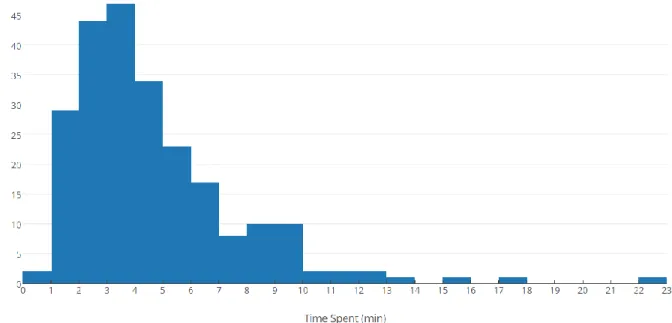
The average time spent on the game was 4.65 minutes, whereas the median time was 3.90 minutes. This is slightly lower than the time from our exploratory study (4.89 and 4.69 respectively), but this can be explained by natural variation as well as inherent difficulties in navigating a mobile platform versus a web platform.
25
Figure 11: Follow-Up Study Time Spent Histogram
We also see that most of our participants chose not to request a hint, with 131 of 234 participants requesting no hints. This is slightly less than that from our exploratory study, where 33 of 49 participants did not request hints. This is difficult to explain, but may be due to natural variation or difficulty in navigating the mobile interface. Of those that did request a hint, the average number of hints requested for the follow-up study was 3.53 hints and the median number was 2 hints.
26
Figure 12: Follow-Up Study # Hints Requested Histogram
In our follow-up study, we provided users with a drop-down menu to choose which video game genre they preferred. This allowed us to avoid any coding errors, and provided us with much more data. We see below that approximately one third of players who participated in our study prefer puzzle games. This is rather different from our exploratory study, where strategy games were the most popular. This is most likely due to our low sample size for players who provided their game preference data in the exploratory study.
27
Figure 13: Follow-Up Study Preferred Video Game Genre
Finally, we collected data on the player provided desired challenge level, number moves made and number attempts made. These numbers are very similar to those from the exploratory study (# Moves Made was 88.12, 65 respectively and # Attempts was 3.06 and 3 respectively) with the exception of the challenge level which we did not collect in the exploratory study.
Table 2: Additional Game Data (NR = Not Relevant)
Category Mean Median Mode
Desired Challenge Level 3.48 3 3
# Moves Made 87.43 74 NR
28 “Concrete” Hint Condition
Contrary to our expectations, the new hint condition did not change the player experience or performance in any significant way. Between the players who were randomly assigned a hint between explore, intermediate and concrete, there was no significant difference in self-reported fun, boredom, easiness or frustration. Even between the “choice” players, who could choose which kind of hint they wanted, there was no significant different in any of the player experience measures. Thus, there was no difference across all players with regards to the different hints’ effects on player experience or performance. These results indicate that hints had less of an impact on these factors than the game itself.
However, among participants who were randomly assigned a hint condition who viewed a hint, there was a significant difference between the different hint conditions in terms of hint helpfulness as revealed by an ANOVA (F(2,57)=11.239, p=.000077). Pairwise Tukey Tests showed that players in the concrete hint condition provided higher hint helpfulness ratings than players in both intermediate and explore hint conditions (p < .05), and the players in the
intermediate hint condition provided higher hint helpfulness ratings than those in the explore hint condition (p < .05). This shows that more concrete hints are perceived as more helpful by players even if they do not significantly affect the overall game experience.
Player Game Preference
There were also no significant differences when splitting the players based on their game preference. Out of the “choice” players, none of the different player-indicated game preferences, out of Action, Action-Adventure, Puzzle, RPG, Sports and Strategy, had any significant different in player experience, player performance or perceived hint helpfulness.
29
In addition, allowing players to choose which hint they wanted gave some insight into what kind of hints different players preferred. We hypothesized that more experienced puzzle players would prefer a more abstract hint. Among players who requested hints, the average number of hints requested by a player with a preference for non-puzzle games was .366
intermediate hints and .803 concrete hints. For puzzle players, these numbers were .6 and 1.171 respectively. This indicates that more experienced players were more likely to request both kinds of hints. In addition, we see that players of all kinds preferred to request the concrete hint,
indicating that a concrete hint is usually more desirable than a challenging, abstract hint. Player Game Experience
We found no significant difference between the different game experience groups with regards to player experience attributes as well as perceived hint helpfulness. Players with less game experience tended to request fewer hints in general, whereas players with more experience requested more hints with a strong preference for concrete hints. Thus, it seems that our
hypothesis was incorrect; players with more game experience are more likely to prefer a concrete hint. This may be because more experienced players know how to take advantage of hints in a game to reach a victory condition.
Player Motivation
We asked players to report what level of challenge they desired from the puzzle game, from a scale of 1-5, where 1 indicates “None” and 5 indicates “A lot”. No players reported a level of 1, and only 5 of 106 players reported a level of 2, so we will focus on challenge levels from 3-5. The results are reported in the table below:
30
Table 3: Mean and standard deviation for number of hints requested per session
Hint Type Challenge level Intermediate Concrete 3 μ = .571, σ=.912 μ = 1.357, σ=.3.048 4 μ =.314, σ=.932 μ =.571, σ=1.313 5 μ =.3, σ=.483 μ =.1, σ=.316
These results show that players who are seeking more of a challenge will request less of both kinds of hints. In addition, players who are seeking less of a challenge tend to request more concrete hints, whereas the players who sought “a lot” of challenge requested significantly less concrete hints than other groups. However, an ANOVA test show that these differences are not statistically significant. Thus, this may be due to random variation.
For the players who had hints automatically assigned to them, analysis was done separately based on the three different hint conditions. For the explore hint condition, easiness had a slight positive correlation with challenge level (r=.360, p=.030). For intermediate hint condition, fun had a slight positive correlation with challenge level (r=.345, p=.019), and frustration had a moderate negative correlation (r=-.525, p=.0001). For the concrete hint condition, boredom had a slight positive correlation with challenge level (r=.365, p=.025). Game Context
We asked every player what they were doing prior to participating in our study. We allowed participants to write their answers in a free response format, so we received a large variety of responses, some major ones being “eating”, “gaming” and “checking my email”. Due to the large variety of responses, we coded responses into either “relaxing” activities or “work”
31
activities. Of the 234 participants, 195 provided a response that could be classified into one of these categories. Of these, 148 were classified as relaxing activities and 47 as work activities. We found that players who were doing relaxing activities prior to the study found the game easier (p=.0033) and less frustrating (p=.014) than those who had just worked. This indicates that players who are coming from a relaxing activity may be less judgmental and more able to enjoy a game than those who are coming from a more stressful activity.
Hint Timing
Similar to the exploratory study, most hints were requested when the player was still far from the solution. Out of 364 hints requested, 77 were requested when the player was stuck. Of the remaining hints, the average number of steps left until the nearest solution was 9.92 steps. For some perspective, the number of steps from the starting state to the nearest solution is 12 steps. This shows that most players will request a hint when they are quite far from the solution. Hint Choice
We found no statistically significant difference in any of the player experience or player performance attributes between the players who could choose their own hint and those who were randomly assigned a hint condition. However, a two-tailed t-test showed that players who could choose their own hint provided higher hint helpfulness ratings than those under the “explore” condition (t(52)=3.856, p=.0003) and slightly higher ratings than those under the “intermediate”
condition (t(63)=1.829, p=.072). This makes sense intuitively given that the concrete hint condition provided the highest hint helpfulness rating out of the three independent hint conditions, and that the choice condition essentially provides a mashup of the concrete and intermediate hints. In addition, we found that for “choice” players the player-provided challenge level has a slight positive correlation with enjoyment (r=.290, p=.003) and a slight negative
32
correlation with boredom (r=-.225, p=.021). This shows that those players who are seeking a challenge are more likely to enjoy the game and less likely to be bored.
Gender
We found no significant difference between male and female players with regard to any of the player experience, player performance or hint helpfulness attributes. When looking at the types of hints requested by each player, we found that among those players who had seen hints, the average for male and female was roughly the same, with the average female requesting 1.12 intermediate hints and 2.24 concrete hints, and the average male requesting 1.2 and 2.8
respectively. However, more females requested hints than males; 24 out of 46 female participants requested a hint whereas only 16 out of 55 male participants did.
Factor Analysis
We also performed an exploratory factor analysis on the players, using the R factor analysis function with the varimax rotation. An experimental analysis indicated that 6 factors provided the best fit for our data, while maintaining a p-value above .05.
33
Table 4: Follow-up Study Factor Analysis
Factor 1 Factor 2 Factor 3 Factor 4 Factor 5 Factor 6
Age -.143 -.144 .554 Game Experience .286 -.177 Challenge Level .112 .159 .873 # Moves .833 .139 .111 -.230 # Attempts .707 .147 -.194 .148 # Victories .321 .549 .252 -.157 .217 Session Time .839 .109 .114 -.112 .503 Fun .119 .259 .688 .130 .129 Boredom -.826 Easiness .789 Frustration -.100 -.609 -.206 -.127 .125 Hint Helpfulness .104 .124 .633 # Hints Requested .246 -.117 -.104 . .405 SS Loadings 2.125 1.469 1.315 0.954 0.740 0.676
Factor 1: Players with high levels of Factor 1 had large positive loadings for number of moves, number of attempts and session time. These players had small positive loadings for victories, fun
34
and number of hints requested. However, examining the factor scores does not give any indication that there is any particular demographic group that has a high level of this factor
Factor 2: Players with a high level of Factor 2 had high positive loadings for victories, easiness and negative loadings for frustration. They also had slight positive loadings for fun and challenge level and slight negative loadings for number hints requested. This indicates that these players were naturally talented at the game, and thus were able to win easily without many hints.
Factor 3: Players with high levels of Factor 3 had high positive loadings for fun and negative loadings for boredom. They also had mild positive loadings for number of victories and negative loadings for frustration.
Factor 4: Players with high levels of Factor 4 had high positive loadings for challenge level and slight positive loadings for challenge level and number of attempts.
Factor 5: Players with high levels of Factor 5 were older players with a moderate positive loading for session time and slight negative loadings for number of moves, number of attempts and slightly positive loadings for frustration.
Factor 6: Players with high level of Factor 6 had moderate to high positive loadings of hint helpfulness and number of hints requested. They also had slight positive loadings of number of attempts, victories and fun.
These factors highlight once again that hint helpfulness and player experience are largely separate. We see that those the players with the highest loading for Fun also has one of the lowest loadings for number hints requested. This indicates to us that if hints are expected to significantly affect player experience they must be integrated into game play rather than only be present as an option.
35
A correlation analysis with these new factors does not reveal any significant correlation outside of the loadings mentioned above. We believe that is once again due to hints not being used by half of our participants.
Results Summary
We began the follow-up study with a large focus on improving the player experience by providing a very obviously helpful concrete hint. This focus was manifested in a hint that directly provided the next few steps to the player; if pressed again and again, this hint could theoretically allow any player to win. However, this new hint condition did not improve player experience or player performance. It did improve the hint helpfulness rating, showing that more concrete hints are perceived as more helpful than abstract hints.
We had a lot of expectations regarding how different groups of people prefer different kinds of hints. However, our results indicate that most players prefer concrete hints over abstract hints. In fact, across every game preference group, gender group, and all levels of game
experience, concrete hints were preferred over abstract hints. The only subgroup of participants that preferred abstract hints over concrete hints was the group of participants who indicated that their desired challenge level was the maximum level of 5 (“a lot”). However, since we had a low number of participants who chose this level, this may be due to random variation.
There were also several additional areas that we wanted to investigate in our study, including game experience, game preference and gender. We were interested in how people among different groups in these categories (e.g. men vs women, gamers vs non-gamers) would be affected by the different hint conditions in our game. For the most part, we found that these different groups react the same. There was no significant difference in player experience or player performance for men vs women, for participants who prefer different games or for
36
participants with different levels of game experience. This is inconsistent with what we have seen in ITS and game literature, but may be due to the different nature of the game. A frustrating educational game may be forgiven due to player expectations, but a frustrating recreational game may not receive the same treatment. Our results show that for most of the participants who could not win, the puzzle game was perceived as very frustrating and not very enjoyable. Thus,
designers of games should take care to avoid frustrating game scenarios to begin with rather than try to mitigate them than with well-designed hints.
37
CHAPTER 6: RESULT SUMMARY
From the exploratory study, we saw that contrary to expectations, providing a hint can negatively impact player experience if the hint is not sufficiently helpful. Participants who played video games at least once a month found the intermediate hint less helpful than no hint at all. However, among all the participants, there was no significant difference in terms of player enjoyment, boredom, easiness or frustration. Through the factor analysis, we see that the reason for this is because the players who are requesting hints are those who are struggling with the game, and that the abstract nature of the hint only serves to further confuse them.
Going into our study, we had many hypotheses regarding concrete and abstract hints. We believed that males would prefer concrete hints over abstract hints. We believed that players with puzzle game experience would prefer abstract hints over concrete hints. We also believed that players who desired more of a challenge would prefer abstract hints to concrete hints. However, our results indicate that only the last of these hypotheses was true. In contrast, almost every subgroup we analyzed preferred concrete hints over abstract hints. Thus, when developing games, concrete hints are the far more reliable choice when looking to assist players. However, it is notable that neither the concrete hints nor the abstract hints helped to significantly improve player experience. Thus, if the content of an application can be revised, it is probably more efficient to improve the application itself rather than work on hints.
We expected that gender may make some difference in how hints are perceived and used by players. However, gender played less of a role than expected in both studies. We did find that males prefer to make more moves, and to ask for fewer hints. This may indicate that it is possible
38
to customize automatic hints depending on gender. In every other aspect, males and females did not differ significantly.
We were also interested in how player context affects hint perception. For example, do players who have just come back from work perceive hints differently from players who have just taken a nap? We found that although enjoyment, boredom and frustration remained the same for both kinds of players, players who had just relaxed perceived that game as easier than those who had just worked. This one difference is not enough to make a decisive conclusion on this area, so we leave further investigation to future studies.
Finally, we were interested in how giving players the option to choose their hint affects game experience. Our results show that it does not significantly affect player experience or player performance. However, players who were given the choice to choose their own hints perceived hints as more helpful than those who were assigned a “explore” hint or an
“intermediate” hint. This shows once again how the new more concrete hint condition produces higher hint helpfulness ratings. In addition, allowing our participants to choose what kind of hint they wanted also revealed that most players will prefer to choose a concrete hint over an abstract one. Despite this, there are no significant differences between the hint conditions in terms of player enjoyment, boredom, easiness or frustration.
39
CHAPTER 7: DISCUSSION
HINTS IN OTHER APPLICATIONS
The most interesting discovery we made when reviewing player data was that several players indicated that they found the hints helpful (hint helpfulness rating >= 4) but still rated the game as frustrating (frustration rating >= 4). This indicates that players evaluate “frustration” primarily from the game design or gameplay. The player explanations shed some additional light:
“I was at first disappointed because it told me I was stuck and had to reset the game...” (P92) “I couldnt solve it without the hint which was frustrating because I am smart enough that it should have been easy” (P149)
“i tried several times without the hint, but was not able to complete the puzzle. The hint was nice to point me in the right direction.” (P183)
From these responses, we can see that although the hints helped, the difficulty of the game itself causes frustration for the player. Thus, before looking to provide hints, it is more effective to reduce the difficulty of tasks so that users can comfortably complete them.
However, this may depend on the type of application. For large and established systems such as air traffic control systems, it may be impractical to try to change the application. In these scenarios, our results indicate that the most effective way to assist users is with a very concrete hint. It makes no sense to provide an abstract hint because for these practical user applications, the user goal is simply to complete the task.
However, the users’ intentions are very important. After feedback from the initial study indicating that hints were not concrete enough, we sought to provide a hint that could directly
40
lead users to the solution if necessary. Although this succeeded in increasing the hint helpfulness rating, several users were still unhappy with the hint:
“It was helpful in the literal sense by giving the next few steps, but that doesnt really help strategize or help with big-picture thinkers (such as myself). It was interesting concept for a game, but a bit to [sic] difficult/frustrating for me.” (P220)
“It was helpful in helping me solve the particular puzzle but it didnt explain the motive behind a move, so that Id get insight into how to play the game without its assistance later.” (P54)
To our surprise, even users who won were not completely satisfied with the hint. Their feedback indicates that an ideal hint would provide the user with enough insight to beat the game, but also with the knowledge to complete it again later without the hint’s assistance.
This aligns well with previous work on hint development in ITS. These systems typically use an on-demand scaffolding system that slowly reveal parts of the solution until it eventually bottoms-out into an answer [6, 8]. The hint scaffolding assists students in making the necessary connections themselves and thus indirectly teaches them. If the student still cannot figure out the problem, the system releases the answer and avoids further student frustration. In ITS, it is advantageous to provide feedback that allows students to construct a correct representation of the goal tree themselves. This way, when the hints are removed, the students can still solve the problems [7]. Although these results have been shown on intelligent tutoring systems, our results indicate that a teaching approach like this would be very appropriate for game applications. We see from the player feedback that players not only want to win, but also want to learn how to keep winning. This is a key principle that any hint designer should use in order to create an effective and useful hint.
41
Hint designers must consider a lot of factors when designing an effective hint. We have seen how gender [3], invasiveness [16] and game complexity [2] are all factors that can change the effectiveness of a hint. Although these factors are all important, our study shows that the first thing to consider when designing a hint are user goals and the game itself. What the user is planning to do with the application makes a key difference in how hint helpfulness is perceived, as we can see with the above feedback. In addition, a great hint may not save a frustrating game from being frustrating. Sometimes the application must be changed before a hint can be made to improve user experience. These are things that must be considered by any researcher planning to perform a study on hints or tutorial systems.
LIMITATIONS
There are many factors that we considered when performing the studies but could not investigate due to lack of time and resources. One big factor that we did not vary was the game genre. Due to time constraints, we only worked with the Three Body Puzzle, but it would be very interesting to see if the conclusions made in this paper generalize to other types of applications. In addition, the way the hint was presented was never varied between participants. For example, it would be interesting to see if player perception of the hint would vary if it was presented without the specific word “hint”, but instead as a side bar.
The way the study was advertised may also have biased our participant pool. Both the exploratory and follow-up study were advertised primarily to college students or college faculty known to the researchers. Thus, the age of our participants was slightly biased towards college age students; for our secondary study, the median age was 24 and the mean age was 30.49. In
42
addition, many of our participants participated in the study directly after checking their email due to the way the study was advertised, which may have slightly biased our results.
Our experimental sample size was another limiting factor; 50 participants for our exploratory study and 247 for our follow-up study. However, even with this low number of participants, our results are useful for informing future studies regarding hints. The area of hint development is often clouded by numerous intricate interrelated factors, so it is useful to know which factors to focus on in future studies.
Finally, we tested three separate hint conditions in our follow-up study, but there are, of course, many kinds of hints that could have been designed for this puzzle. We believe that the concrete hint we provided was one of the most direct ways we could help the participant, but it is one of many different ways to approach this problem. The player feedback gives us some
interesting insight on how to design future hints. We leave the challenge of optimizing this hint to future research in this area.
FUTURE WORK
From both of these studies, it seems that our method of measuring player experience was flawed. Most of the players interpreted “fun”, “boredom”, etc. primarily in the context of the game, with the hints as a secondary consideration. Since we were most interested in measuring the effects of the hints, it would have been better to frame the questions in terms of how the hints affected player experience.
Alternatively, since it seems that the player experience attributes are tightly coupled with the game itself, it would be interesting to alter the game to see if hints could have a greater effect on a less frustrating game. As mentioned previously, games of different genres have not been
43
studied. Moving the game genre from a puzzle game to an action-adventure game, for example, could drastically affect the perception of hints. Moving the focus from games to software applications would also be an appropriate and interesting research topic.
One drawback from our study was that many of our participants (134/234) did not use the hint even when it was available to them. One possible explanation is that players felt more accomplished if they solved the puzzle without any hints (see the feedback from participant P149 above). Although this mirrors real world applications, it limits the power of our analysis. Thus, we suggest designing automatically triggering hints when performing such studies. However, as previous studies [17] have suggested, it may be wise to first run an exploratory study with on-demand hints to learn when players typically request help.
Finally, one thing we did not try for our experiments was personalized hints. It has been shown that such hints can be very beneficial for learning outcomes [9, 10, 13, 14], but designing such a hint was out of the scope of this work. It would be interesting to gather categorical
information (e.g. male or female), analyze the player’s game state (e.g. succeeding or struggling) and provide a dynamic, adaptive hint. This kind of hint has its own unique pitfalls [17], so a full study on this kind of hint may prove necessary.
44
CHAPTER 8: CONCLUSION
This work contributes to the hint design literature in three ways. First, we show in our study that although player experience heavily depends on the features of the game being studied, players of all kinds prefer concrete hints over abstract ones. Second, we design and perform a case study in hint design in which we allow players to choose their own hint. In this study, we show that providing player choice does not significantly alter player game experience. Finally, we provide our suggestions for designing hints as well as related future studies.
45
REFERENCES
1. Murphy-Hill, Emerson, and Gail C. Murphy. "Recommendation
delivery." Recommendation Systems in Software Engineering. Springer Berlin Heidelberg, 2014. 223-242.
2. Andersen, Erik, et al. "The impact of tutorials on games of varying
complexity." Proceedings of the SIGCHI Conference on Human Factors in Computing Systems. ACM, 2012.
3. Arroyo, Ivon, et al. "Macroadapting Animalwatch to gender and cognitive differences with respect to hint interactivity and symbolism." International Conference on Intelligent Tutoring Systems. Springer Berlin Heidelberg, 2000.
4. Arroyo, Ivon, et al. "Gender differences in the use and benefit of advanced learning technologies for mathematics." Journal of Educational Psychology 105.4 (2013): 957. 5. Aleven, Vincent, and Kenneth R. Koedinger. "Limitations of student control: Do students
know when they need help?." International Conference on Intelligent Tutoring Systems. Springer Berlin Heidelberg, 2000.
6. Barnes, Tiffany, and John C. Stamper. "Automatic Hint Generation for Logic Proof Tutoring Using Historical Data." Educational Technology & Society 13.1 (2010): 3-12. 7. McKendree, Jean. "Effective feedback content for tutoring complex skills."
Human-computer interaction 5.4 (1990): 381-413.
8. Graesser, Arthur C., et al. "Intelligent tutoring systems with conversational dialogue." AI magazine 22.4 (2001): 39.
9. McNulty, John A., Beth Sonntag, and James M. Sinacore. "Evaluation of computer‐aided instruction in a gross anatomy course: A six‐year study." Anatomical sciences education 2.1 (2009): 2-8.
10.Koedinger, Kenneth R., and Albert Corbett. Cognitive tutors: Technology bringing learning sciences to the classroom. na, 2006.
11.Albacete, Patricia L., and Kurt VanLehn. "The Conceptual Helper: An intelligent tutoring system for teaching fundamental physics concepts." International Conference on
Intelligent Tutoring Systems. Springer Berlin Heidelberg, 2000.
12.Lazar, Timotej, and Ivan Bratko. "Data-driven program synthesis for hint generation in programming tutors." International Conference on Intelligent Tutoring Systems. Springer International Publishing, 2014.
13.Conlan, Owen, and Vincent P. Wade. "Evaluation of APeLS–an adaptive elearning service based on the multi-model, metadata-driven approach." International Conference on Adaptive Hypermedia and Adaptive Web-Based Systems. Springer Berlin Heidelberg, 2004.
14.Brusilovsky, Peter. "Methods and techniques of adaptive hypermedia." Adaptive hypertext and hypermedia. Springer Netherlands, 1998. 1-43.
46
15.Van Eck, Richard. "Building artificially intelligent learning games." Games and
simulations in online learning: Research and development frameworks. IGI Global, 2007. 271-307.
16.Peirce, Neil, Owen Conlan, and Vincent Wade. "Adaptive educational games: Providing non-invasive personalised learning experiences." Digital Games and Intelligent Toys Based Education, 2008 Second IEEE International Conference on. IEEE, 2008. 17.Wauck, Helen, and Wai-Tat Fu. "A Data-Driven, Multidimensional Approach to Hint
Design in Video Games." Proceedings of the 22nd International Conference on Intelligent User Interfaces. ACM, 2017.
18.Huizenga, Jantina, et al. "Mobile game‐based learning in secondary education: engagement, motivation and learning in a mobile city game." Journal of Computer Assisted Learning 25.4 (2009): 332-344.
47
APPENDIX A: EXPLORATORY STUDY PAGE DETAILS
48
49
50
51
APPENDIX B: FOLLOW-UP STUDY PAGE DETAILS
52
Figure 20: Pre-Game Survey
53
54