School Categorisation Learner
Performance
The Power of Ethos
By
CHARMAINE
PRAMMONEY
STUDENT NO: 204300071
Supervisor: Professor Labby Ramrathan
DECLARATION
I, Charmaine Prammoney declare that this dissertation is my own. All sources consulted has been acknowledged. It is submitted to the Faculty of Education in fulfillment of the requirements for the Philosophy of Education degree at the University of KwaZulu Natal (Edgewood). It has not been submitted before for examination in any other university.
_____________________ Charmaine Prammoney Durban
July 2018
Acknowledgements
Firstly, I want to thank God, The Alpha and Omega for making the impossible, possible.
This research is dedicated to my Higher Power, God Almighty, for endowing me with perseverance, ability, strength and hope during this journey of success.
My sincerest appreciation goes out to every individual that assisted, guided and encouraged me in the preparation and submission of this dissertation. Special thanks must be made to the following people:
My husband, Ushendra Prammoney, for all his understanding, support, patience and wisdom throughout my studies. I owe this achievement to you. I am indeed blessed.
My gracious thanks are extended to my family namely my parents Mr and Mrs E. Pragalath for their encouragement and unconditional support and prayers during the process of the attainment of this qualification. Thank you for your guidance.
My sons Keshav and Shrinaav Sahadev for their invaluable inputs and assistance.
My daughter Dhiyajal S. Prammoney for your assistance.
My faithful baby Chloey, who accompanied me through the long, arduous nights, never leaving my side.
Nirasha and Ashika, for their invaluable support.
And finally I also would like to express my sincere appreciations and gratitude, to a phenomenal human being, my supervisor Professor Labby Ramrathan (Faculty of Education: University of KwaZulu-Natal) for his sincere, professional support and guidance. Thank you for your unstinting guidance, expertise and assistance and
patience throughout the whole research process. You are indeed a priceless gem. Without you I would not have completed this interesting and intensive research topic.
I extend my sincere thanks to all the participants who willingly and enthusiastically shared information that led to the culmination of this project. I remain humbled by the realities of your life worlds. The experiences you shared with me are greatly valued. Sincerest thanks to all of you. These include the Principals of the sampled schools for allowing me to conduct this research and to the educators, my heartfelt gratitude to you, for participating so willingly in my study.
I thank all those involved directly and indirectly for offering their support and guidance in this endeavour.
ABSTRACT
South African schools and, indeed, across the world, are categorised according to several dimensions. For example, schools within South Africa are categorised, amongst others, in terms of quintile rankings, geography, fee paying and non-fee paying, performing and non-performing schools. These categories are often used in reporting of the outcomes of schools within a country, but very little focus on how these categories influence teaching and learning with the school that accounts for its learner performance. This study takes this vantage point and explores the relationship between school categorisation, school ethos, teaching and learning and learner performance. Through a case study of two schools of different quintile rankings and working within the confines of an interpretivist paradigm, the study attempted to explore the school ethos as experienced by the school leadership and teachers. The examination was conducted by means of observations and interviews.
Through a process of purposive sampling the principal, one head of department (HOD) and three level one educators each from two primary schools were chosen. The data was generated with the use of semi- structured interviews and observation. The data gathered was reviewed, coded and organized into themes and sub-themes. Content analysis was used to analyse the data. The research finding emanating from the data showed that school ethos influences what happens within schools. The study also confirmed that poverty, impacts negatively on academic performance. In addressing the needs of the learners from impoverished communities, schools also pay attention to the socio-economic needs of the learners with a view to providing holistic education. The impact of such holistic education is on the ability to deliver the planned curriculum. The teachers are not able to deliver the curriculum as planned, rather they focus on the curriculum as lived within an inclusive ethos, and this focus on the curriculum influences how teaching and learning takes place which ultimately reflects on the learner performances. On the other hand, the study found that in a school where the focus was on teaching the curriculum as planned, the ethos of the school is defined by functionality. Adherence to the school curriculum influenced how the school functioned, how teaching and learning unfolded and how such management processes influenced learner performance in schools. The study,
therefore, revealed that school ethos influences teaching and learning within a school and can account for why the learners perform the way they do.
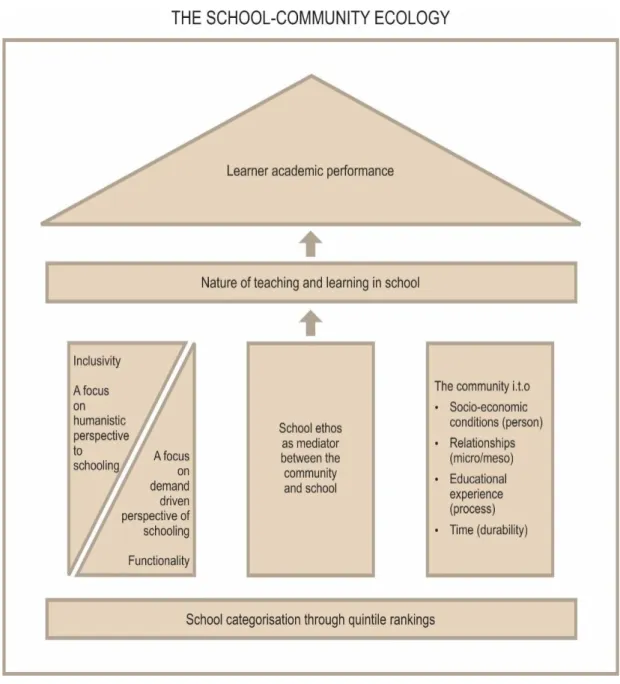
The findings of the study has implications for school leaders and the community to understand the nature and role of schools in their communities with a view to providing relevant education to their learners that takes into consideration the realities of their socio-economic situations and align their educational needs with the schools’ focus, that which is guided by its ethos. The study introduced a school-community ecology conceptual model that can be used to guide what happens within schools in terms of teaching, learning, learner performance and school categorisations.
Contents
Chapter One ... 1
1. Background and context ... 1
1.1. Introduction...1
1.2. Background 2
1.3 Focus and purpose of study ... 4
1.4 Problem statement ... 5
1.5 Objectives ... 6
1.6 Critical questions ... 6
1.7 Method of research - Research design and methodology ... 7
1.8 Chapter demarcation ... 8
1.9 Summary ... Error! Bookmark not defined. Chapter Two ... 11
2. Literature Review ... 11
2.1 Introduction ... 11
2.2 Local and international literature that surrounds and supports the study ... 12
2.3 School categorisation: What is school categorisation and quintile ranking? ... 15
2.4 What is school ethos? ... 21
2.5 Key elements of school culture/ethos ... 25
2.5.1 Content related to culture ... 25
2.6 The importance of school culture or ethos for academic performance ... 26
2.7 The influence of hegemony on school ethos ... 27
2.8 Finance and its influence of schooling ... 28
2.9 Socio-economic status and its influence on schooling ... 29
2.10 Concluding comments of school ethos ... 30
2.11 Factors that affect/influence learner performance ... 30
2.11.1 Home support and care ... 31
2.11.2 Language as a barrier to learning ... 34
2.11.3 Non-Formal education ... 36
2.11.4 Inclusivity / What is inclusion? ... 39
2.12 Challenges facing teachers in the implementation of inclusive education in schools ... 42
2.13 Managing the classroom ... 46
2.14 High performing schools ... 48
2.15 Summary ... 50 Chapter Three ... 51 3. Theoretical Framework ... 51 3.1 Introduction ... 51 3.2 History of Bronfenbrenner ... 53 3.3 Bronfenbrenner’s theory ... 53
3.4 Background of Bronfenbrenner and Ecological Systems Theory ... 53
3.5 Systems structures in Bronfenbrenner’s theory ... 63
3.5.1 The Microsystem ... 63
3.5.2 The Mesosystem ... 65
3.5.3 The Exosystem ... 66
3.5.4 The Macrosystem ... 67
3.5.5 The Chronosystem ... 68
3.5.6 Concluding comments on the ecological systems of Bronfenbrenner ... 69
3.6.1 Process ... 69
3.6.2 Person ... 70
3.6.3 Context ... 71
3.6.4 Time ... 72
3.6.5 Concluding comments on the PPCT model ... 72
3.7 Different perspectives of the theory ... 73
3.8 Criticism of Bronfenbrenner’s models ... 75
3.9 Misuses of Bronfenbrenner’s Theory ... 75
3.10 Summary ... Error! Bookmark not defined. Chapter Four ... 79 4. Research methodology ... 79 4.1 Introduction ... 79 4.2 Underpinning conceptions ... 80 4.3 The Ontology ... 80 4.4 Research design ... 81
4.5 The interpretivist paradigm ... 82
4.6 Research approach ... 83
4.6.1 Qualitative approach ... 83
4.6.2 Research methodology ... 84
4.7 Background of the researched schools ... 86
4.8 Research participants ... 87
4.8.1 Selection of participants ... 87
4.9 Research instruments ... 88
4.9.1 Selection of data production methods ... 88
4.9.2 Process of data collection ... 90
4.9.3 School level observations ... 91
4.9.4 Classroom level observations ... 91
4.9.5 Semi-structured interviewing ... 92
4.10 Analysis of data ... 93
4.10.1 The processing of the data ... 94
4.10.2 Process of analysis of recorded data ... 94
4.11 Triangulation ... 96
4.12 Validity and reliability issues ... 96
4.12.1 Trustworthiness ... 96
4.12.2 Biases and how it was minimised ... 97
4.13 Ethical issues ... 98
4.14 Limitations ... 100
4.15 Summary ... Error! Bookmark not defined. Chapter Five ... 102
5. Data Analysis ... 102
5.1. Introduction ... 102
5.2. Differences between Sections 20 and 21 schools ... 103
5.2.1. Section 20 schools ... 104
5.2.2. Section 21 schools ... 104
5.3. Biographies of participants and that of the selected schools ... 105
5.4 Context of the researched school ... 109
5.5 School ethos across school rankings ... 112
5.5.1 Aster Primary: Inclusivity as an expression of the school ethos. 113
5.5.3 Concluding comments on school ethos within Aster Primary
school ... 121
5.5.4 Daisy Primary: Functionality as an expression of the school ethos . 122
5.6 School ethos and its influence on learner performance ... 126
5.6.1 Classroom observation ... 127
5.7 Classroom observation at Daisy Primary...134
5.7.1 Routine at Daisy Primary...135
5.7.2 Concluding comments on the observation of both the researched schools 137
5.8 Conclusion ... 138
Chapter Six ... 139
6. Theorising Chapter ... 139
6.1 Introduction ... 139
6.2 Summary of the key findings of the study ... 139
6.2.1 Key findings related to school ethos and teaching and learning 139 6.2.2 Key findings related to school curriculum and school ethos ... 145
6.2.3 Concluding comments on the key findings ... 146
6.3 Introducing a conceptual model to the findings of the study ... 146
6.4 The research focus of the study ... 150
6.5 A response to the Research Questions ... 151
6.6 Significance of the study and recommendations arising out of the study ... 152
6.7 Recommendations drawn out of the findings of the study ... 154
6.7.1 Findings: Features influencing Ethos of schools ... 154
6.7.2 Findings: Collaboration ... 155
6.7.3 Findings: Curriculum as influenced by the school ethos ... 155
6.7.4 Findings: Learner performance across quintiles ... 156
6.8 Contribution to the literature ... 156
6.9 Further research ... 157
6.10 Limitations ... 157
6.11 Concluding comments ... 158
Figures, Tables and Appendices
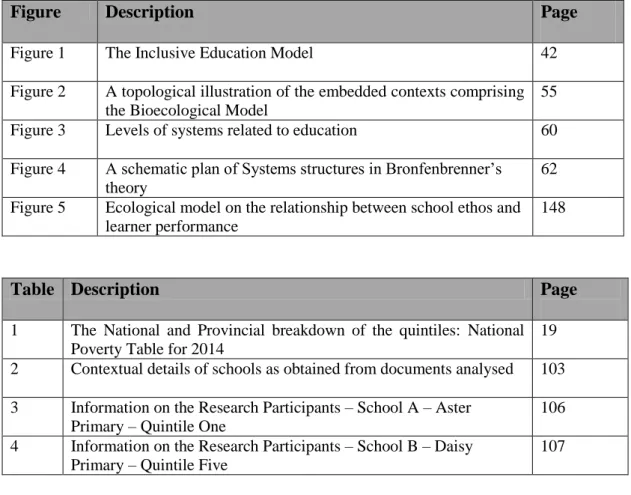
Figure Description Page
Figure 1 The Inclusive Education Model 42
Figure 2 A topological illustration of the embedded contexts comprising the Bioecological Model
55 Figure 3 Levels of systems related to education 60 Figure 4 A schematic plan of Systems structures in Bronfenbrenner’s
theory
62 Figure 5 Ecological model on the relationship between school ethos and
learner performance
148
Table Description Page
1 The National and Provincial breakdown of the quintiles: National Poverty Table for 2014
19 2 Contextual details of schools as obtained from documents analysed 103 3 Information on the Research Participants – School A – Aster
Primary – Quintile One
106 4 Information on the Research Participants – School B – Daisy
Primary – Quintile Five
107
Appendices
Appendix Description Page
1 Ethical clearance certificate 183
2 Turn it in report 184
3 Letter: Language editor 185
4 Consent Forms
A)Gate keepers’ informed consent form 186
B) Letter to the Principal 189
C) Informed consent letter for School Management Team participating in the research project
192 D) Informed consent letter for teachers participating in the research project
195
Chapter One
1. Background and context
There are no known limits to the kinds of talent the human psyche can demonstrate and to the heights to which it can climb in any talent domain. But the mind is not motivated to achieve every possible form of excellence. The cultural milieu makes that decision in the broadest possible sense. Tannenbaum (2000, p. 24)
1.1. Introduction
If the children and youth of a nation are afforded opportunity to develop their capacities to the fullest, if they are given the knowledge to understand the world and the wisdom to change it, then the prospects for the future are bright.
Urie Bronfenbrenner (1981, p. 38)
This thesis reports on a study that examined the relationship between academic performances, school ethos and school categorisation. The aim was to develop better understanding of school ethos/cultures that promise to facilitate high-quality academic performance and, in the practice, extend enhanced understanding of control implications for the development of such school ethos/cultures (Danişman, Tosuntaş, & Karadağ, 2015). To achieve these outcomes, a study was conducted on two sampled schools of varying quintile ranking. The decision to study schools of varying quintile ranking was prompted by a passion that a comparison of the schools' ethos/cultures and associated leadership would help expose issues related to learner performance. It is important to point out at this stage that the focus resting on the relationships linking academic performance and school ethos and between school ethos and school leadership was not prompted by a cause and consequence postulation on the relationships. Instead, the view was that school ethos plays an important role in providing contexts that either enable or disable engagements in activities that may result in good academic performance for particular communities and that, in the same way, school leadership relates differently to particular contexts.
This chapter highlights the context within which this study was undertaken, the rationale, aims and objectives, key research questions, theoretical framework, value of the study and the configuration of the thesis.
1.2 Background
Prompting focus on academic performance in schools was, as already implied, not only the continued poor performance at the schools but also the implications of the poor performance for national reconstruction. Focus on school ethos and associated leadership itself was brought about by a conviction that the two hold the key to solving the problem of poor academic performance at the schools. Leading to this conviction were findings by numerous studies that healthy and sound school ethos correlates robustly with augmented learner accomplishment and incentive along with educator efficiency and fulfilment (Stolp & Smith, 1995; Beare, Caldwell & Millikan, 2018; Bennis, 1991; Torrington & Weightman, 1993; Hargreaves, 2012; Christie, 2001; Prosser, 1999). What studies have also been finding is that critical to the development and maintenance of school ethos is school leadership (Schein, 1985; Russel, 2003; Stolp & Smith, 1995; Elmore, 2005; Lumby, 2003). A conclusion drawn from the findings is that by intensifying their comprehension of school ethos, school leaders will be better capable of shaping the principles, philosophy, and approach compulsory to endorse an unwavering and encouraging learning environment (Stolp & Smith, 1995).
Even though the priority of the post 1994 national Department of Education ‘proved to be the issues surrounding the governance, organisation, and funding of schools’ (Hartshome, 1999, p. 112), the department also displayed immediate awareness of the importance of school ethos for transforming education through improved academic performance. A substantial number of South Africa's schools have for some time been plagued by poor academic performance, as reflected by poor matriculation examination results at the secondary school level. Indicative of the poor performance at the primary school juncture exists pitiable scores in tests such as the TIMMS-R tests on Mathematics and Science; GTZ 3 tests on Numeric and Literacy; JET Grade 3 and Grade 6 tests on Numeric and Reading; MLA on Numeric, Literacy and Life Skills and JET (QLP) and Eric Scholar tests on Mathematics, Reading and Writing (Taylor & Cranton, 2012). These publicly acknowledged poor performances have been prompting post 1994 education ministries to initiate policies intended at improving the value of the educational experiences in schools and classrooms’ (Taylor, Muller & Vinjevold, 2003). One such policy was the so-called ‘Culture of Learning, Teaching and Service’
The position of formal education in a country is often seen as a barometer of the type of society that country is. ‘Position’ in this instance refers to whether education is free and compulsory and to what level it is free (Mouton, Louw & Strydom, 2012). It also refers to how well schools are resourced, both in terms of teaching staff as well as physical resources. This ‘position’ also indicates the level of inequality in that society. South Africa is no exception in this regard (Mouton et al., 2012). Of immediate concern to the democratic government when it came to power in 1994 was a national reconstruction it hoped to achieve through education. As a result, the government's national education department immediately set about introducing policies intended at changing the schooling organisation towards meeting the challenges. Doubts about the appropriateness and effectiveness of ensuing policies proliferated. For Mouton et al. (2012) the inappropriateness began with the oft-cited ‘improvement’ concept. Mouton et al. (2012) view is that the term ‘improvement’ does not begin to do justice to governments’ proposed education changes. Their view is that the term ‘educational transformation’ is a more appropriate description of the educational changes with which the government has been hoping to transform the education system so it could serve ‘the interest of all South Africans in a democratic and equitable manner’ (Mouton et al., 2012).
The 1994 elections also brought about transformation such as democratisation, egalitarianism, non-discrimination, justice and equalisation, as well as the Reconstruction and Development Programme (RDP) (Chapman & Harris, 2004). The latest education system, post-apartheid, demands that no unwarranted discrimination may come to pass against any person on the subsequent basis: age, sexual category, ethnicity, lingo, class, disability, HIV or other infectious diseases. Every learner, despite their impairments, ought to be housed in the conventional schools.
The South African Constitution stipulates that every person has the right to fundamental edification (Section 29 of the Constitution) and that therefore the government ought to make provision for basic education from grade 1-9. The government allocates funds to schools using the Norms and Standards formula for school funding. These allocations do not meet all the requirements for schools. For example, disadvantaged schools still need financial resources for basic learner support materials and for general improvement of the school infrastructure and other resources (Murillo & Roman, 2011). The government is mindful of the resource constraints and insists that, every parent is encouraged to make financial contribution to add quality to their children’s education, but individuals must not be deprived of right of entry to edification because of their parents’ inability to pay (Caldwell & Millikan, 2018).
Public schools charge school fees at their own discretion. There are no constraints regarding the fees amount, as long as the majority of parents approve of it at an annual budget meeting. Once this has been agreed upon, it becomes compulsory for every parent to pay regardless of their financial status. Since parents are the main source of income it is evident that there are wide inequalities between public schools as they compete for quality education, achievable through financial feasibility (South African Schools Act, 1996). Disadvantaged schools take many learners whose parents cannot afford school fees (Pretorius & Machet, 2004). The major problem facing the schools is that they must ensure that all children gain access to education while the majority of parents come from poor socio-economic backgrounds.
The school fees requirement discourages learner enrolment to some extent and evidence suggests a decrease in enrolment is associated with a sharp increase in school fees (Azuma, 2011). There is a need for schools to look for other avenues so that they do not depend solely on the state and parents as the only source of income.
1.3Focus and purpose of study
Learner poor performance within the South African context seems to be a topical issue across the education sector and is a concern of everyone associated with education (Prammoney, 2012). At the point of matric results being released annually, there seems to be hype around learner performance with the state arguing that the matric pass rates are signalling an improvement in the quality of school education while others are questioning the authenticity and credibility of the pass rates (Bloch, 2009). Researchers Bloch (2009) and Jansen (2001), amongst others, have critiqued the status of education in South Africa and pointed in the direction of areas that need serious intervention within the provisioning of quality school education. While several attempts have been made to improve the quality of school education through policy formulation, curriculum changes, teacher development and infrastructural improvements, the issue of learner poor performance continue to destabilise the school education systems. This study acknowledges these interventions and attempts to contribute to the discourses on school learner performance by taking another lens to exploring this phenomenon.
Schools within South Africa are variously categorised. These categories include an infrastructural gaze through quintile rankings, geography gaze of school location (rural, urban, township), a
performance gaze of performing schools and underperforming schools, and many other systems of categorisations. These categorisations have largely been used for the purpose of identification, reporting, monitoring and intervention. What seems to be lacking is to understand how these categorisation influence the school operations and functioning, beyond just identification, reporting, monitoring and intervention. It is within this focus area that this study is conceptualised.
International studies in Ghana and Australia over the past two decades have highlighted the quick turn down in the educational performance of learners from lower quintile ranking public schools in rural hamlets. Government labours to alleviate the state of affairs have not capitulated any continuing constructive results (Atta-Quayson, 2007; Scadding, 1989). In the experience of South African education transformation, the fundamentals are unclear; required instructional exercises are neither elucidated plainly nor sufficiently. To thwart this transformation from deteriorating, a weathered and expanded representation of excellent instructional exercises founded on and firmly positioned in conjectural and pragmatic policies, needs to be provided. This study, therefore, aims to assess the representation of the power of school ethos and learner performance in unison and in accordance with superior teaching and quality teaching exercises in the different quintile ranking schools.
1.4Problem statement
The aim of a problem statement in qualitative research is to propose a justification or prerequisite for studying a particular problem (Creswell, 2012). This research intended to identify, the power of ethos in schools through the lens of the educator practices (from different quintile ranking schools) to establish what endorses successful teaching and learning and the academic attainment of learners. Investigation in the field of leadership has largely centred on leadership styles and leadership problems. Despite these illuminations; little progress has been made with respect to learner performance through a school leadership perspective. Of note is the varying difference between school types and learner performance (Spaull, 2013). Is there a relationship between leadership, school performance, school ethos and school categorisation? (Spaull, 2013). This study will explore such relationships with a view to contributing to the discourse on how to resolve the issue of poor learner poor performance. Danişman, et al. (2015) argued that the best input of principals to the performance of their educators and learners is their capacity to construct significant, combined ethos in their schools. They stressed that when principals are proficient in remodelling and reshaping their school establishment through combined ethos and configuration inside and outside the school and
construct dynamic relations with parents and the neighbourhood, they fortify the efficacy and success of the establishment. Du Plessis and Conley (2007) postulate that when teachers are motivated they are, then, stimulated to encourage enhanced academic learner performance.
School categorisation within our school education system seems to be quite ingrained with categorisation in terms of, amongst others, infrastructure (quintile rankings), financial (fee paying); geography (rural, urban, townships); poverty (feeding scheme); performance (NSLA and non NSLA). How have these categorisations impacted on schools’ ethos, their performance and their identity. There has been little studies related to school categorisation and its influence on schooling within the South African context. The school categorisations are largely used in reporting, intervening and monitoring of school performances. Spaull (2013) alludes to two schools’ worlds existing within South African school systems, one being that of quintile 5 schools and the other being all other public schools, and he bases this claim on an analysis of literacy and numeracy performance of grade 6 learners world ranking tests (ANA). More recently, school performance has been used by the Department of Basic Education to refer to NSLA schools and non-NSLA schools to direct intervention strategies. Very few studies, as recorded within the South African context over the last two decades, have focused on the implications of school categorisation and its influence on how the school scrutinises itself (identity), its ethos and how these (identity and ethos) influences what ensues within that school environment. This study hopes to initiate such discourses within our school education systems, with the purpose of exploring how these categorisations influence school performance, both in learner achievements as well as in educator management of the classroom.
1.5Objectives
1. To determine learner performance difference across quintile ranked schools as well as how the school quintile rankings influenced the school ethos.
2. To determine the nature of school ethos across quintile ranked schools and how has school ethos influenced learner performance.
1.6Critical questions
2. What is the nature of school ethos across quintile ranked schools?
3. How has the school quintile rankings influenced the school ethos?
4. How has school ethos influenced learner performance?
1.7Method of research - Research design and methodology
In line with the above framework, the methodology by means of which this study was conducted was relativist and underpinned by a pragmatism that sought to generate a theory grounded on collected data rather than on advanced hypotheses. Resulting from this conception was a decision to study two sample schools of varying quintile ranking by means of observation and semi-structured interviews.
The study adopted the qualitative approach, as the most appropriate move towards to this study. The aspects of this research was largely descriptive in nature as it sought to establish trends and patterns of observances, and then relied on qualitative enquiry that sought to establish interpretations and reasons for such observances. The qualitative aspect of this research is largely informed by a phenomenological approach (Creswell, 2012).
A phenomenological advancement was used to emphasise the specific phenomena and to recognise phenomena through how they were professed by the performers in the site. Epistemologically, phenomenological approaches are founded in a concept of private understanding and partisanship, and emphasised the significance of individual standpoint and elucidation. In isolation they are influential for accepting prejudiced experiences and acquiring insights into people’s drive and behaviours (Denzin & Lincoln, 2018). One of the rewards of this approach was that it allowed the researcher to achieve an understanding of societal phenomena from participants’ viewpoints in their normal surroundings (McMillan & Schumacher 2010; Denzin & Lincoln, 2018). The main aim of the study was evocative and investigative.
This study adopted an interpretivist, case study research comprising of two schools. This research made an attempt to position the researcher in the place of the participants in a bid to comprehend the realism of the participants from their own standpoint. Thus, its idealistic deportment or theoretical standpoint was interpretivism, which incorporated phenomenology (Creswell, 2008; Denzin & Lincoln, 2018), hermeneutics (Wiersma, 2000; Patton, 2002) and symbolic interactionism (Wiersma,
2000; Patton, 2002). While phenomenology has a spotlight on attaining a profound appreciation or connotation of daily occurrences, hermeneutics stressed on the significance of understanding the environment, the way of life, the planned connotations, the situations and backdrop of the participants in construing occurrences and communications (Patton, 2002). Likewise, figurative or communal interactionism emphasised the noteworthy power of verbal communication, interrelationships and society on our insight, our stance and ethics (Norviewu-Mortty, 2012). This study is positioned on this theoretical perspective. Qualitative research aims to produce rounded and contextual understandings on the basis of rich, fine distinction and thorough data (Mason, 2017) thus providing an auxiliary rationale for choosing this approach.
Interpretive research designs permit the researcher to work together closely with the participants in order to achieve insights and structure comprehensible understandings (Wiersma, 2000). Interpretivism does not have to rely on entire engagement in a situation and can contentedly sustain a study which employs interview methods and other methods. Epistemologically, interpretivism is anti-positivist in nature (Cohen, Manion & Morrison, 2007). Epistemology may also be founded on the basis that dissimilar kinds of settings, circumstances and communications disclose data in multidimensional ways, and it is likely for a researcher to be an exponent or ‘knower’ in these state of affairs specifically because of shared understanding and involvement. Positivist paradigm assumes that there is just one reality and that it is stable (Henning, van Rensburg & Smit, 2004; Cohen, Manion & Morrison, 2007). The results of qualitative research will be descriptive and analytic rather than predictive (Flick, 2006). Denzin and Lincoln (2018) refer to qualitative researchers as visitors in the concealed places of the globe.
1.8Chapter demarcation
This research study is divided into six chapters.
Chapter One provides a general background and overview of the key aspects of this study. The focus and purpose of this study; the problem statement; the rationale for pursuing this study, the critical questions, method of research which includes a brief description of the research design and methodology, chapter demarcation and finally the conclusion is presented.
Chapter Two focuses on the literature reviewed which provides perspectives on this study with regard to international and national literature, on the key focus of this study. A review of studies on ethos, categorisation and its impact on learner performance in other countries as well as in South Africa is elucidated. This provides the theoretical location of this study.
Chapter Three discusses the theoretical framework. It outlines Bronfenbrenner’s systems theory, an ecological framework. This framework is used to support the exploration of issues related to school categorisation, poor learner performance and ethos and the associated elements that is possibly present in different contexts.
Chapter Four discusses the methodological orientation that includes the major components which is the research design and methodology of this study. It focuses on methodology, providing motivation for and justification of the qualitative approach. It also examines case study as a research tool and its limitations. The research instrument, sampling techniques and ethical issues significant to this study are then presented, a brief narrative on the sampling procedures used to select participants for interviewing, and the procedure for data collection and analysis is also provided. Ethical considerations and a model for ensuring trustworthiness is also outlined. Detailed description of sampling, research instruments, data collection and data analysis is provided.
Chapter Five outlines the qualitative data gathered. It focuses on the presentation, analysis, findings and discussion of the data gathered from the interviews and observations. The data is first presented. Thereafter, the emerging patterns from the data are discussed. The findings in this study have been outlined, interpreted and discussed.
Chapter Six discusses theorising the findings in relation to the theoretical framework. Thereafter, some recommendations are presented. It provides a general overview of the findings. It presents the conclusions of the research by presenting a cohesive whole of the entire process.
1.9Summary
This chapter has focused on setting the scene for this research in discussing the background and problem statement regarding school categorisation, learner performance and school ethos. This research aims to develop an understanding of the role of the school leaders in the management of learner problems and their contribution to the alleviation of these problems. This chapter has outlined
the: background of the study and overview of the key aspects of this study; statement of problem, focus of study, critical questions, method of research and finally an overall exposition of the study. The next chapter outlines the literature reviewed with regard to this study.
Chapter Two
2. Literature Review
2.1Introduction
The literature review section forms the basis for understanding the problem being researched; it also builds a logical framework within the context of related studies. This chapter unfolds from an exploration of what constitutes categorisation, school ethos and academic performance and how it affects learner performance. The focus of this chapter is also on national legislation and policies related to categorisation and the interconnection with education. The discussion on education policies highlights specific aspects like the national minimum norms and standards for school infrastructure and school status, funding and nutrition. A focus on the demographics, contributes to a more detailed view of the geographical area. The final part of the literature review will concentrate on the impact of poor academic performance. It proceeds to investigate how policies in a country play a facilitative or restrictive role in promoting academic performance for education. The review offers a perspective of the South African context in terms of categorisation policy and implementation. The focus then narrows down to school ethos/culture and academic performance. Here, specifically the impact of ethos will be brought under close scrutiny in term of what impact it has on the academic performance of learners. In order to understand school ethos from a broad perspective this chapter reviews literature pertaining to national and international literature.
Patton (2015) while acknowledging that the strength of qualitative methods is its inductive inquisition strategy, which entails liberalism, argues for an organising representation of the phenomena to be explored, called a conceptual framework (Patton, 2015). It is proposed that the set of ideas may be vague or clearly formulated ideas or theories or frameworks about the nature of the phenomena (Patton, 2015). It is thus against this background and from a phenomenological viewpoint that this study explores concepts such as ethos, categorisation, academic performance, factors affecting academic performance, inclusivity, language as a barrier, home-school link and care and finally managing the classroom.
2.2Local and international literature that surrounds and supports the study
The dawn of the democratic dispensation in South Africa in 1994 brought along inventiveness to redress the imbalances created by the apartheid regime in education. Since 1994, the government’s efforts to redress historical imbalances and achieve equity were fundamental policy mechanisms to restructure South African education (Norviewu-Mortty, 2012). For forty eight years, under the leadership of the Nationalist Party, the South African education system was marked by disparities in the allocation of resources in public schools. The allocations of resources in schools were influenced by racial lines (Mtshali, 2014).
In late 1980s political change began to challenge segregation and schools began to amalgamate, allowing Black learners to enroll in previously White, Coloured and Indian schools. In 1994 the new Government of National Unity brought the different education sections together. This did not however, guarantee the equalisation of the former white and black schools (Mtshali, 2014). Impartiality restructurings in post-apartheid South Africa anticipated to equalise funding among provinces, schools and socio-economic groups. These objectives are demonstrated in numerous education policies, such as no-fee schools, post-provisioning norms, rationalisation and redistribution of educators, exclusions on school fees, monetary responsibilities allocated to principals and governing bodies, the National Norms and Standards for School Funding (NNSSF) (South Africa, 1998a) and other practical intrusions.
This was commenced through national policies that would direct state financial support to public schools. The most noteworthy legislation was the National Education Policy Act (South Africa, 1996b), the South African Schools Act (South Africa, 1996a) and the Employment of Educators Act (South Africa, 1998b). The main themes of the White Paper on Education and Training (South Africa, 1995) also articulated the basic principles for transformation, namely open admission to quality education and restoring of educational inequalities. Most Black schools still suffer from gross shortfalls ranging from inadequate resources and infrastructure, to a lack of school counsellors (Norviewu-Mortty, 2012). Therefore, poverty within black education has to be understood against this background. In South Africa, the absence or dearth of a policy relating to the relationship between poverty and education has meant that many struggles that relate to or are a direct result of social stratification are still in the closet and not discussed. Poverty remains a universal feature of Black schools that has brutal effects on the educational ambitions and career prospects of learners
South Africa’s smooth evolution to democracy established worldwide endorsement and recognition, which to this day, serves as a model for other countries undergoing difficult and prolonged political transitions. The United Nations Educational, Scientific and Cultural Organization (UNESCO) (2008) assert that education transformation in South Africa has been characterised by principles of social justice and impartiality, non-racism and non-sexism, Ubuntu and reconciliation. Many years after the dawn of democracy and the post-apartheid era in South Africa, teachers, learners and the government all agree that there is still a long way to go in terms of determining the disparities in education (Mtshali, 2014). Due to financial constraints, government policy was changed during the final years of apartheid to permit schools to set their own fees (Mtshali, 2014). The separate education ministries with their separate budgets for different racial groups vanished more than two decades ago. The greatest struggle, since the early-post-apartheid days, has been the attempt to undo the economic legacy of the system of racial exclusivity (Prammoney, 2012). The National Constitution, which is a product of multi-party negotiations, was finalised in 1996. The National Constitution sought to address two principles, which are equality and equity.
Equity and redress have been recognised as the prepared building blocks for the realisation of social justice in education. In 2005 the Department of Education (DOE) broadcast plans to excuse parents suffering intense poverty from school fees in an endeavor to make certain that no child is barred from the right to education (Norviewu-Mortty, 2012). Mtshali (2014) observed that ushering in the new democracy brought with it not only the restructuring and reshaping of education, but also the development and implementation of a policy framework which aims to provide for the redress of past inequalities and the stipulation of equitable, high quality and relevant education. The Department of Education also introduced legislation to declare certain public schools in poor provinces such as KwaZulu-Natal, Limpopo and the Eastern Cape “no fee” schools (Mtshali, 2014).
As posited by GroundUp (2015), a school allocation for public schools was established through the 1998 publication of the National Norms and Standards for School Funding. These norms and standards for school funding were put into operation in 2001 by all Provincial Education Departments. This was a major innovation in South African schools in terms of financing systems and pro-poor resourcing.
Many schools experience a lack of funding which resulted in some poor schools becoming even poorer with learners paying no school fees, which schools used for basic running costs. Although these schools are perhaps impoverished, in many cases the education offered is good, even though
educators lack adequate resources such as textbooks, chalkboards and writing materials (Mestry, 2004). Prammoney (2012) observed that schools in indigent communities often cannot afford even basic facilities like clean water, toilets, electricity and telephones. Furthermore, the physical structure and environment of the school is often in a bad state of disrepair. The classroom setting in numerous instances is not favourable to effective teaching and learning. According to GroundUp (2015), several exceptionally impoverished schools have just one brick classroom and several with mud walls; after hard rains, the mud-walled classrooms need reconstruction. These schools have only a handful of desks and when winter rain falls, the cement floors become cold and wet; learners have to do their written tasks and even their examinations standing. Normal days see most of the learners sitting on plastic containers and old, plastic mealie bags (GroundUp, 2015).
South African society consists of diverse racial groups, which were historically ranked according to a power hierarchy. Until recently, black people occupied inferior positions at the base of the hierarchy. The apartheid regime segregated education and prescribed what was to be taught in Black schools through the Bantu Education system. The aim of apartheid education was to ensure that Black people remained in inferior positions (Norviewu-Mortty, 2012). Little research has been conducted in South Africa on how school categorisation affects school ethos. Proof of this is the fact that the South African Department of Education has done away with feeding schemes in secondary schools. Secondary school children are in need as with primary school children and they belong to the same impoverished socio-economic class (Khanare & De Lange, 2017). The situation in other countries is somewhat different from the South African experience (Pryor, Akyeampong, Westbrook & Lussier, 2012).
Policymakers and school system authorities are keenly interested in the issue of school learner performance and school efficiency. Much of this interest stems from the view that some higher quintile ranking schools are doing a much better job than others in promoting high achievement levels and producing better learner outcomes (Norviewu-Mortty, 2012). However, it is not feasible to reach this conclusion by looking at simple raw comparisons of learner differences in outcomes. There are many dynamics that influence performance in schools including learner background characteristics that are related to the families and communities in which learners live. These influences need to be considered in comparing schools in order to identify particular school ethos/culture, school features and school policies that may be delivering better outcomes for young people (Pryor, Akyeampong, Westbrook & Lussier, 2012). This study seeks to examine some of the
problems of how the schools quintile ranking affects the learner performance, ethos and the reasons why learners perform poor academically and how school managers are managing these problems.
2.3School categorisation: What is school categorisation and quintile ranking?
The National Department of Education conducted two major assessments in 2001 and 2003 with a focus on school allocations. The assessments carried out by the National Department of Education led to the 2003 Plan of Action. This plan of action sought to advance admission to free and quality basic education for all. These were the documents that the state used to build a post-apartheid schooling system that advocates the principles of equality and equity in education provisioning in our country. In honouring its constitutional obligation to arrive at equality and equity, the National Government of South Africa introduced a distributional approach of resources in public schools in 2003. Many schools in poor rural and urban working-class hamlets still experience the legacy of large classes, appalling physical conditions and the absence of learning resources, despite a major Reconstruction and Development Programme (RDP), the National School Building Programme and many other projects paid for directly from provincial budgets (Mtshali, 2014). Yet, educators and learners in poor schools are expected to achieve the same levels of teaching and learning as their compatriots in wealthier areas (Prammoney, 2012). Such inconsistency within the similar public school system probably reflect past prejudiced investment in schooling and vast disparity in personal income of parents (Khanare & De Lange, 2017).
It is upon this approach that the former National Minister of Education, Mrs. Naledi Pandor, introduced the system of categorising public schools into five quintiles. The poorest schools were ranked quintile one schools while the least poor schools were ranked quintile five schools. In terms of Section 34 of the South African Schools Act, the state is mandated to fund public schools from public revenue on an impartial basis in order to ensure proper exercise of the rights of learners to education and remedy of past inequalities in educational provision. The Act also makes provision for school governing bodies (SGBs) to supplement state funding by way of school fees and fundraising initiatives.
The system of quintiles then gave birth to the declaration of certain public schools into no-fee schools in 2006. To address impartiality in funding school education, the South African government introduced the National Norms and Standards for School Funding (NNSSF) policy (South Africa, 1998a). In 2009, a review of the system of quintiles was implemented by the government. The
NNSSF policy provides a statutory basis for school funding in that schools are now classified into wealth quintiles and subsidised accordingly. In this review it was gazetted that quintile one to three schools were declared into “no fee” schools. Schools serving poorer communities must obtain more state funding than schools serving better-off communities. According to Myende and Chikoko (2014), declaring schools into “no fee” schools was aimed at combating poverty through an increased access to quality education and to make sure that resources are distributed on an equitable basis in all public schools. This then meant that the school governing body of a public school that was declared a “no fee” school should not levy a compulsory school fee to households. The scale of changes in policies such as the NNSSF policy has inevitably placed great stress on SGBs, school management teams (SMTs), teachers and district officials, resulting in a significant disjuncture between policy intention and practice, and a growing divide between what the government expect schools to do and what schools are in fact able to do.
The state declared quintile one to three schools into “no fee” schools in order to put the section 29(1) of the Bill of Rights in the Constitution (South Africa, 1996c) into effect which reads:
Everyone has the right
(a) to basic education, including adult basic education and
(b) to further education , which the State, through reasonable measures, must make progressively available and accessible
As stated above, the government commenced with these reform initiatives in the post-democratic era in education in an effort to move towards equity and equality. In the past Apartheid regime, a big slice of educational resources were channelled towards white schools with the remaining portion to black schools.
The quintilling of schools were done to ensure that households suffering the effects of poverty benefit from schooling that is adequately funded by the state. This is in line with the provisions of the Freedom Charter (1955, p. 4) which clearly spelt out that: “Education shall be free, compulsory, universal and equal to all.” The declaration of certain public schools into “no-fee” schools came with a number of pitfalls and flaws which continue to plague the education system of our country. On the other hand, the declaration of some public schools as no-fee schools, also brought along a sigh of economic relief to households suffering the effects of poverty so that they enjoy free education. The
implementation of the policy on no fee schools brought along some implications for the general management of public schools in our country.
The implications according to CREATE (The Consortium for Research on Educational Access, Transitions and Equity) is a programme of research, subsidised by the UK Department for International Development (DFID) (CREATE, 2009) research suggest that there are two distinct systems of education quality in South Africa: one is that of fee-charging schools, most of which were formerly reserved for white learners, and the other is that of no-fee schools, almost all former black African schools, located in the poorer communities. The persistence of fee-charging schools alongside no-fee schools also helps to maintain a class-differentiated education system, and the recent extension of no-fee schooling to approximately 60% of schools has arguably reduced the five-quintile system to a two-tier system. The no-fee schools policy may encompass important encouraging effects in terms of creating greater access by poorer learners to schools, but such improved access has not necessarily been access of better quality (Sayed & Motala, 2012). It is along this demarcation of schools (two tier schools) that have influenced my choice of the sampled schools for the study. Thus, while the objectives of the state to attend to impartiality and social justice are commendable, there is a long way to go in accomplishing high-quality education, predominantly for underprivileged and disadvantaged schools (Prammoney, 2012).
According to the Myende and Chikoko (2014) the announcement of certain public schools as no fee schools has been marked with a massive decline of the general performance of a number of public schools. Some parents no longer feel responsible for the education of their children as they did before the declaration of certain schools into no-fee schools came into effect. On the other hand certain communities have applauded the Government for introducing free education (Mtshali, 2014). The performance of schools is prejudiced by a number of factors, one being the adequate provisioning of financial resources. Another influential factor to the general performance of public schools is how best to use these allocations for curriculum improvement.
The researcher has compared the systems of school funding between South Africa, the United States of America and India in order to establish the link between the schools’ performances and the socio-economic status where the school is located. According to Sadker and Sadker (1997, p 369), poor families in America, who live in marginalised economic existences, are particularly hurt by a high sales tax, a fraction which is used to fund schools. As positioned by Mackey, Al-Khalil, Atanassova, Hama, Logan-Terry and Nakatsukasa (2007) many states in the United States of America use federal
funds to support the provisioning of services to eligible children, which includes children who are physically and mentally challenged. The declaration of certain schools, into no-fee schools, brought along tough economic pressures on the federal states. This is a factor that affected the delivery of quality education in terms of resource allocation.
The Indian government which also introduced free education is also suffering the effects of the policy on no-fee schools. According to Tilak (1996, p. 362), the inter-state variations and an unequal distribution of resources in the Indian education system have an impact on the quality of education in primary schools. The author argues against variations in the allocation of physical infrastructure like laboratories and libraries. As indicated by Myende and Chikoko (2014), geographical differences and inequalities are in some sense inequitable, unfair and unjust and that programmes should seek to eliminate these imbalances. This is also true of the South African education system even in the post-apartheid era. In some cases, schools in the same geographical location, with the same socio-economic status are still categorised differently in terms of quintiles.
The paper budget allocations, which are a governmental grant, are still marked with inequalities. As indicated by GroundUp (2015), the poor rural and working class communities still experience the legacy of large classes, deplorable physical conditions and the absence of learning resources. It is however commendable that the government of South Africa carries the plight of the poor at heart and embrace equality and equity as the cornerstones of our democratic constitution. In order to foster better quality education the state had established the Primary School Nutrition Programme in 1994, which was later, renamed the National School Nutrition Programme to address malnutrition and hunger of children from poorer communities (South Africa, 1996c). This also added some value to the notion of free education.
All South African public ordinary schools are categorised into five groups, called quintiles, largely for intent of the distribution of financial resources.. These poverty rankings are determined nationally according to the poverty of the community around the school, as well as, certain infrastructural factors. Each quintile, nationally, contains 20% of all learners, but not 20% from each province (Naong, 2013).
The quintile ranking establishes the amount of money that a school receives. The poorest schools obtain the greatest per-learner allocation, based on the supposition that schools in wealthier
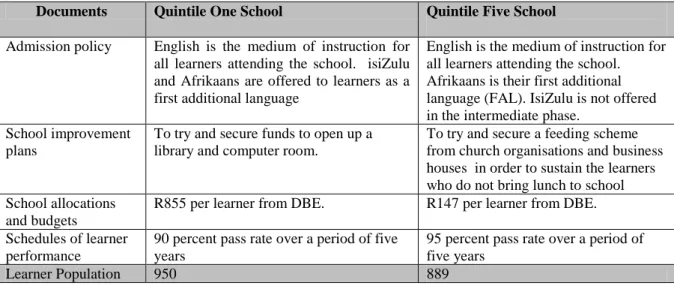
Subsidies are allocated to all schools. Control over the subsidy is dependent on whether the school is designated a Section 21 or Non-Section 21 school. Since the schools selected for this study was awarded the status of a Section 20 and 21 respectively school, it is worth discussing briefly what this means in terms of its functioning. All schools should adhere to section 20 functions. Schools have the option of applying for section 21 functions. Hence section 21 or non-section 21 schools.
The South African Schools Act 84 of 1996 caters for public schools with different levels of functions, Section 20 and Section 21 schools. The key difference between the two categories of schools is that the Section 21 schools manage their own finances while with the Section 20 schools, the state controls the finances on behalf of the school (supplies for the school is handled through the DoE procurement processes). Two of the added functions amongst others, for Section 21 schools, are to maintain school property and buildings and to pay for services at the school. The school can negotiate directly with service providers. The allocation of Section 21 status is dependent on the managerial capacity of the school which includes School Governing Body, Principal and Senior Management Team. With the Section 20 schools there is little or no leverage for incidental expenditure unless the school has funding from other sources. It seems that this arrangement could place the school administration in a position of dependency which may perhaps impact on the level of efficiency with which the school operates (Mtshali, 2014).
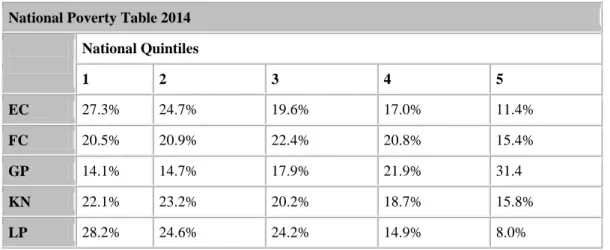
Table 1: The National and Provincial breakdown of the quintiles: National Poverty Table for 2014
The National and Provincial breakdown of the quintiles is as follows:
National Poverty Table 2014 National Quintiles 1 2 3 4 5 EC 27.3% 24.7% 19.6% 17.0% 11.4% FC 20.5% 20.9% 22.4% 20.8% 15.4% GP 14.1% 14.7% 17.9% 21.9% 31.4 KN 22.1% 23.2% 20.2% 18.7% 15.8% LP 28.2% 24.6% 24.2% 14.9% 8.0%
MP 23.1% 24.1% 21.5% 17.7% 13.5%
NC 21.5% 19.3% 20.7% 21.4% 17.1%
NW 25.6% 22.3% 20.8% 17.6% 13.7%
WC 8.6% 13.3% 18.4% 28.0% 31.7%
SA 20.0% 20.0% 20.0% 20.0% 20.0%
(Minister Donald Grant, Minister of Education, Western Cape, 14 October, 2013 in Naong, 2013).
The above table represents the percentage of schools in each province according to their quintiles. A schools quintile ranking is significant as it determines the amount of funding that it receives each year and whether or not the school can charge fees. Hence, in order to reimburse these schools for their loss in fee income, the state grants them a larger Norms and Standards allocation than schools classified as “fee-paying” schools in quintiles 4 and 5. Quintile 1, 2 and 3 schools obtain the same amount per learner. The recommended per learner allocation for each quintile is determined by the National Department of Basic Education (Naong, 2013).
In the 2009 budget speech, the former Minister of Finance, Trevor Manual, indicated that principles like protecting the poor, generating employment and investing in infrastructure amongst others had informed the budget planning (Manuel, 2012). He said that the greatest adjustment to spending plans is towards poverty reduction as well as education and healthcare, school nutrition programme and provision of basic services. He asserted that relief does not come from the money spent on the programmes; satisfaction is knowing that we are reducing poverty when the “quality of life of the poor are improving, that children are being properly educated and when learners have access to food in schools…” (Manuel, 2012, p. 8).
It is evident that government has measures in place like designating schools from some of the poorest communities as “no-fee schools” and the establishment of a nutrition programme, to supplement the care of children from poorer communities. These measures are designed to ensure that children are properly educated but they are rendered meaningless if the education of children is thwarted by other extenuating factors (GroundUp, 2015).
The resource allocation to schools is then utilised by schools to finance various school items and disbursements such as:
Municipal services - such as water and electricity.
Stationery and learning support materials – such as textbooks and readers.
Equipment - such as a fax, photo copiers and duplicating machines for administrative purposes.
Repairs and Maintenance.
The education legislation and policies weigh heavily in favour of addressing access to schooling and improving quality of the educational experience of children. It is noteworthy that several great strides have been made by the state to improve access to education like designating some schools as “no-fee schools” and the introduction of the National School Nutrition Programme to schools serving poorer communities. The different funding arrangements regarding the management of the school subsidies are also another way that the state has attempted to assist schools. This study will pay careful attention to the quality of the educational experience, the conditions and situations (ethos) that prevail, taking into account the attempts by the state to improve access to schooling and the (academic achievement of learners) quality of education (GroundUp, 2015).
The allocations differ considerably between quintile 4 and 5 and quintiles 1 to 3. Quintile 4 and 5 schools charge school fees, which make up for the additional funding needed to run the school (Naong, 2013). This is premeditated during the budget and fee setting processes by the School Governing Body (SGB) and accessible at a meeting of parents. However, given the state of affairs of some schools, their quintile ranking of 4 and 5, does not work in their favour (Ndou, 2012).
For instance, the national data that has been used to ascertain their poverty status does not take into account the demographics of specific schools. There are schools which do not draw their predominant enrolments from the local area (there may not be children of school going age in the area). Some of these schools then educate considerable number of children from families which cannot meet the fee arrangements at their children's schools. This is a significant source of financial pressure for these schools (Naong, 2013).
2.4What is school ethos?
School ethos and school culture are often used synonymously in literature. Maslowski (2006) postulates school culture or ethos can be defined as “the basic assumptions, norms and values, and
cultural artefacts that are shared by school members, which influence their functioning at school” (cited in Gün & Çağlayan, p. 6, 2013). Its roots can be traced back to Waller’s (1932) The Sociology of Teaching. As early as 1932, Waller noted that schools “have a culture that is definitely their own. There are, in the school, complex rituals of personal relationships, a set of folkways, mores, and irrational sanctions, amoral code based upon them” (p. 103). Although the interest in school culture among educational scholars lay dormant for several decades after Waller’s (1932) treatise, it gained renewed attention in the 1970s since it was seen as a barrier for educational change (Goodlad, 1977; Sarason, Zitnay & Grossman, 1971; Tye, 1974). During the 1980s, school culture became a significant theme in school administration for both practitioners and academics (Beare, Caldwell & Millikan, 2018; Kottkamp, 1984; Ortiz, 1986; Owens, Steinhoff & Rosenbaum, 1989; Papalewis, 1988; Rossman, Corbett & Firestone, 1988; Willower & Smith, 1986). In these studies the notion of school culture was further explored and related to educational leadership and educational change, both of which were subject to continued research in the 1990s (Prosser, 1999; Sashkin & Walberg, 1993).
However, despite the growing number of publications on school cultures over the last three decades, our knowledge of cultural types of schools is still rather limited. This limited insight is primarily due to the fact that most empirical research into the culture of schools has been qualitative and interpretative in nature, collecting data from a small sample of schools.
The formation of culture, according to Schein (1995), is related to cluster development. It can be argued, for instance, from a practical standpoint, that values associated with the human relations orientation will be more apparent in relatively small organisations, as staff members are more thrown onto each other’s company. Similarly, big organisations will have a more elaborate structure, as well as more regulations and procedures to coordinate the performance of individual staff members. In these organisations, set of laws will be an important prerequisite for the smooth functioning of the school. Staff members, therefore, are likely to be more inclined to value these rules and procedures (Beare, Caldwell & Millikan, 2018).
In order to explore these practical imperatives, the relationship between school culture and school magnitude was examined. Naidoo and Petersen (2015) found that large schools tend to be more change oriented. A justification for this may be that educators in large schools are likely to have less independence than their colleagues in smaller schools, and are thus used to implementing regulations