DUNE: DigitalUNE
All Theses And Dissertations Theses and Dissertations
8-1-2016
Teacher Preferences On Technology Use Using the
iTEaCH Implementation Model: A Case Study In
A Tanzanian Private School
Julia Keegan
University of New England
Follow this and additional works at:http://dune.une.edu/theses
Part of theEducational Administration and Supervision Commons,Educational Assessment, Evaluation, and Research Commons,Educational Leadership Commons,Educational Methods Commons, and theTeacher Education and Professional Development Commons
© 2016 Julia Keegan
This Dissertation is brought to you for free and open access by the Theses and Dissertations at DUNE: DigitalUNE. It has been accepted for inclusion in All Theses And Dissertations by an authorized administrator of DUNE: DigitalUNE. For more information, please [email protected]. Preferred Citation
Keegan, Julia, "Teacher Preferences On Technology Use Using the iTEaCH Implementation Model: A Case Study In A Tanzanian Private School" (2016).All Theses And Dissertations. 75.
TEACHER PREFERENCES ON TECHNOLOGY USE USING THE iTEaCH IMPLEMENTATION MODEL:
A CASE STUDY IN A TANZANIAN PRIVATE SCHOOL
By
Julia Keegan
HDE (University of KwaZulu-Natal, Natal at Edgewood College of Education) 1981
BA (University of South Africa) 1985 BEd (University of South Africa) 1987 MBA (University of Leicester, UK) 2004
Presented to the Affiliated Faculty of
The College of Graduate and Professional Studies at the University of New England
Submitted in Partial Fulfillment of Requirements
For the degree of Doctor of Education
Portland & Biddeford, Maine
Copyright by Julia Keegan
Julia Keegan July, 2017 Educational Leadership
TEACHER PREFERENCES ON TECHNOLOGY USE USING THE ITEACH IMPLEMENTATION MODEL:
A CASE STUDY IN A TANZANIAN PRIVATE SCHOOL
Abstract
To advance both transformative school leadership skills and the use of ICT integration in this school, while aiming to enhance positive school change, this study used the iTEaCH (ICT-Technogogy-and-Collegiality) Implementation Model proposed by Choy (2013) to investigate, quantitatively, teacher perceptions of ICT use in a case study school in Tanzania. The iTEaCH Implementation Model provides focus on teachers’ choice of technology use, desire for
technology use, pedagogy perceptions, and collegiality to identify gaps that might be used to inform teachers and school leaders of technology provision, professional development, and collegial support needs in the school.
Using a slightly modified version of the Choy and Ng (2015) data gathering tool (Appendix A) data were collected to investigate the teachers’ use of technology across three dimensions, namely; types of technology available in the school, teachers’ pedagogical
preferences, and the level of teacher support or collegiality experienced by teachers in the school. Specifically, the study intended to investigate the research questions:
2. How can the teachers’ attitudes about a change in practice be used by school leadership to design a working model for ICT integration in the school?
The results showed that teacher use of technology in the classroom was positively correlated with three research variables namely; with a teacher’s desire to use technology; teachers feeling that they have the pedagogic skills to use technology in the classroom, and teachers having colleague/school support to use technology in the classroom. Also, teacher use of technology in the classroom was significantly different between types of interactive learning.
The results from the the iTEaCH Implementation Model survey provided data that could be used to assist the school leadership plan budgets for technology provision and for the
concomitant professional development of staff. Additionally, the selective focus of this model allowed for the empowerment of both teacher and school leadership to focus on and possibly identify technological, pedagogical and collegial interventions that are needed in the school to better meet the need of 21st-century teaching and learning.
Keywords: ICT integration, iTEaCH Implentation Model, 21-st century learning, Tanzania, transformative school leadership, teacher preferences, professional development.
University of New England
Doctor of Education Educational Leadership
This dissertation was presented by
Julia Keegan
It was presented on 28 July 2016 and approved by:
Grania Holman, Ph.D. Lead Advisor, University of New England
Ella Benson, Ed.D. Secondary Advisor, University of New England
Sherry Russell, Ph.D. Affiliate Committee Member,
ACKNOWLEDGEMENTS
To my fellow doctoral dissertation travelers with whom I have shared much, from whom I have learned abundantly, and for the moral support they have afforded me, thank you: John Buffin, Mark Jacobsen, Susan Keogh and Michael Maschi.
To the academic support team from the University of New England for their patience, wisdom and stimulation, deep appreciation and thanks: my Lead Advisor, Dr. Grania Holman; Secondary Advisor, Dr. Ella Benson; and Affiliate Committee Member, Dr. Sherry Russell. Professor Michelle Collay whose patience and dedication to supporting me during the Ed.D. programme has been magnanimous in the extreme: profound thanks.
To my nearest and dearest who love and support me when I least deserve it: my beloved husband of 35 years, my steadfast rock and eternal source of encouragement, Dr. Arthur Brian Keegan; my son and inspirational metronome, Nathan Clifford John Keegan; my brother Clifford Malcolm Hall whose encouragement via cyberspace from Australia has kept me strong.
To my darling son, Caleb Arthur Malcolm Keegan (1990 -2014), who delighted in my doing this degree although he was not able to join in the ultimate celebration of its completion: his courage and fortitude during his difficult illness will inspire me forever as he lives on daily in my thoughts and memories: may he rest in peace.
To my late parents Irene and Clifford Frederick Hall who gave their all to motivate me to be the best I could be throughout the years we shared together: may they rest in peace.
TABLE OF CONTENTS
CHAPTER 1: INTRODUCTION ... 1
Statement of the Problem………. 2
Purpose of the Study……… 5
Research Questions……….. 7
Conceptual Framework……… 8
Assumptions, Limitations and Scope……….. 11
Significance………... 13
Conclusion………. 13
CHAPTER 2: LITERATURE REVIEW ... 15
Theoretical framework………. 16
What is Technology Integration in a School?... 17
Role of School Leadership in Technology Integration in a School………. 17
What are 21st-Century Learning Skills?... 19
Role of Teachers in Technology Integration in Classrooms……… 23
Factors affecting teachers’ use of technology……….. 23
Teachers’ perceptions of technology integration……….. 24
Technology Integration in the Developing World Context………. 27
Technology Integration in the Tanzanian Context……….. 28
Technology Integration Models………... 28
Conclusion……… 31
CHAPTER 3: METHODOLOGY ... 32
Participants/Sample……….. 36
Data……….. 36
Participant Rights……….. 37
Potential Limitations of the Study……… 38
CHAPTER 4: DATA ANALYSIS AND RESULTS……….. 39
Research Questions and Hypotheses……… 40
Participants/Study Variables………. 41
Tests for Normality……….. 42
Statistical Results………. 43 Research question 1………. 43 Research sub-question 1……… 43 Research sub-question 2……… 43 Research sub-question 3……… 44 Research sub-question 4……… 44 Research question 2……... 46 Summary………. 46 CHAPTER 5: CONCLUSION……….. 47
Summary of the Study……… 47
Teachers’ responses to the iTEaCH technology implementation model survey… 48
Discussion of the Results……… 48
Addressing gaps in ICT implementation using the iTEaCH Implementation Model... 48
by school leadership to design a working model for ICT integration
in the school?……… 49
Recommendations for Further Study……… 51
Conclusion………. 52
REFERENCES……… 54
APPENDIX A. SURVEY QUESTIONNAIRE……….. 67
LIST OF TABLES
1. Summary of Responses for Each Study Variable ... 42 2. Summary of Technology Use Responses by Types of Interactive Learning ... 45
LIST OF FIGURES
1. 21st Century Student Outcomes and Support Systems………. 20 2. The Expanded iTEaCH Implementation Model (Choy & Ng, 2015)……….. 30
CHAPTER 1 INTRODUCTION
On conducting a needs analysis in a private school in Dar Es Salaam, Tanzania, what seemed to be frustration in teachers who were yearning for the possibility to integrate
Information Communication Technology (ICT) into their lessons and advance their pedagogic skills in that regard, were noted. Also, the apparent lack of focus by school leadership regarding ICT integration was evident. In an endeavor to gain objective information regarding the
teachers’ perceptions of ICT integration, this study intends to be a quantitative, explanatory case study in that single private school in Dar Es Salaam, Tanzania.
In 2007, Hew and Brush identified general barriers to ICT integration faced in K-12 schools in the United States and other countries when integrating technology into the curriculum for instructional purposes. That study analyzed existing empirical studies documented in the literature from 1995 to 2006. Six categories of barriers were identified, four that might be regarded as first-order barriers such as resources, the institutions, subject culture and assessment, and four second-order barriers such as teacher attitudes and beliefs, knowledge and skills. The initial assumption in this case study school is that some of the barriers to ICT integration
identified by Hew and Brush (2007) would likely be at play in the case study school in Tanzania. To advance both the school leadership skills and the use of ICT integration in this school, while aiming to enhance positive school change, this study used the iTEaCH (ICT-Technogogy-and-Collegiality) Implementation Model proposed by Choy (2013) to investigate, quantitatively, teacher perceptions of ICT use. The iTEaCH Implementation Model focuses on the choice of technology use, pedagogy, and collegiality to identify gaps that might be used to inform teachers
and school leaders of technology provision, professional development, and collegial support needs in the school.
A relationship exists between leaders and followers. Greenleaf (1977) emphasized that servant leadership is a moral authority represented by a reciprocal choice between leader and follower. Greenleaf (1977) espouses the notion that leaders have a role to play as servants to those they are leading. Servant leadership emphasizes that leaders be attentive to the concerns and needs of their followers, empathize with them and nurture their followers (Northouse, 2012). Specifically, this study serves to draw leaders’ attention to the need for them to respond to their followers if change in a school is to be effected.
Specifically, by studying the teacher requirement for ICT integration in relation to the three domains of teacher perceived needs of technology provision, pedagogical support, and collegial support, it is expected that school leadership focus in the case study school can be drawn into to the reciprocal relationship between leaders and followers. Attention will also be drawn to the need for school leaders to play a role as digital leaders.
Using a single private school as a case study offers the advantage of being able to independently conduct research without having to answer to local authorities. Furthermore, when results become known the school leadership alone can make investment decisions regarding technology acquisition and provision of professional development for staff.
Statement of the Problem
Human interaction with digital technology is an integral part of all aspects of 21st-century life and applications of ICT in education are a crucial element in 21st-century education (Light & Pierson, 2013; Metiri 2014; Prensky, 2012). Fullan and Donnelly (2013) advocate for a coming together of understandings of technology, pedagogy and change knowledge. Choy and Ng
(2015), suggest that in the light of the variety of technology available today, that an
understanding of teachers’ beliefs toward technology, pedagogy, and collegial support might allow for school leaders to have a more informed and targeted approach to the implementation of ICT integration in their schools, and for teachers to feel more empowered in understanding their own technology, pedagogic and collegial needs.
In many regions of the world, this digital human interaction extends to being an integral part of teaching and learning at all levels of education. Equally, over broad swathes of the globe, technology in any form is not commonplace in classrooms. In Tanzania, technology use in classrooms is the preserve of a few private schools. Furthermore, the level of technology facilities available and teachers’ use in private schools in Tanzania vary widely. The global thrust is for digital technology to be effectively integrated into teaching and learning in schools as researchers have demonstrated that effective ICT use can help deepen students’ content knowledge, engage them in constructing their own knowledge, and support the development of complex thinking skills (Light & Pierson, 2013; Tamim, Bernard, Borokhovski, Abrami, & Schmid, 2011). Societal shifts in the use of technology require profound changes in approaches to teaching and learning (Fullan, 2013; Groff, 2013; Metiri Group, 2006; Schleicher, in Intel, 2014; Sheninger, 2014; Voogt, Erstad, Dede, & Mishra, 2013; Zhao, 2009). In some countries, school leaders are leveraging available technologies to enhance teaching and learning
opportunities in their schools as change imperatives with moral and transformative responsibility.
The challenge is for school leaders to function as servant leaders, and as leaders
concerned with their moral responsibility to the purposes of schooling (Sergiovanni, 1992). The moral imperative of reciprocity between the leader and the lead highlights that the teachers also
have a moral imperative in their purposes of schooling. Specifically for transformative leaders in schools, as leaders concerned with their moral responsibility to the purposes of schooling and their service to the wider society, the challenge is to focus on preparing students to be
individually successful in the 21st -century environment, as well as to be thoughtful, well-adapted, caring, successful, engaged citizens of the global community (Shields, 2013).
As the debate rages on regarding the efficacy of integrating technology into teaching and learning, one thing remains certain: technology is not going to disappear from the society as a whole (Sheninger, 2014). Schools have the responsibility to authentically engage students in activities that will equip them for success in the wider society and this implies school leaders and teachers accepting their role as digital leaders and accepting this as a moral purpose in the
process of school change (Fullan, 2011; Fullan & Langworthy, 2014; Sheninger, 2014). Whilst focusing on equitable change in inclusive, optimistic learning environments for all students, and advocating for equitable change encompassing educational and societal transformation,
education leaders have a moral imperative to set the vision and context for technology
implementation for equity and its use in a school, whilst also being a role model of technology use (Anderson & Dexter, 2005; Brockmeier and Gibson, 2009; Carstens & Pelgrum, 2009; Flanagan & Jacobsen, 2003; Gibson, 2002; Hew & Brush, 2007; Hargreaves & Fullan, 2012; International Society for Technology Education, 2002; Sheppard, Seifert, & Wakeham, 2014; Shields, 2013; Slowinski, 2003).
For teachers, the challenge is to incorporate digital technology into their didactic and pedagogical repertoire as they adopt new teaching and learning practices (Fullan & Langworthy, 2014; Prensky, 2012; Sheninger, 2014). The need for teachers to become digital leaders in their classrooms, whilst adopting new teaching and learning practices, also has implications for the
nature and provision of professional development provided by school leaders to teachers (CDW-G, 2007; Howard, 2013; Law, Pelgrum & Plomp, 2008; Lawless & Pellegrino, 2007; Sheninger, 2014). In a meta-analysis of more than one thousand studies, Hattie (2009) indicated that teacher professional development had an effect size of .67 on student learning. In 2012, Hattie, based on the meta-analysis of more than one thousand studies, noted that simulations/gaming and web-based resources appeared to have a weak impact on student learning. Fullan and Donnelly (2013) suggest that these findings might be explained by how the teacher uses these forms of technology in the lesson. Fullan and Donnelly (2013) point to Hattie’s effect size results: technology used with teacher-as-facilitator had an effect size of .17 on student learning, and when employed in the teacher-as-activator context, the effect size was .60. This information suggests that how the teacher uses technology impacts student learning outcomes.
Furthermore, the transformative school leader also has a role to play in ensuring the professional development offered to teachers in their schools is mapped to the teacher perceived needs to empower teachers to become digitally-able practitioners who have the pedagogical skills and collegial support required to integrate technology into the teaching and learning milieu of their classrooms (Choy & Ing 2015; Fullan & Donnelly, 2013; Fullan & Langworthy, 2014; Sheninger, 2014).
Purpose of the Study
Very little research exists on technology integration in private schools in Tanzania. In 2014, the World Bank indicated Tanzania to have a population of 50.76 million, and it is regarded as a low-income country. Economy Watch, in September 2015 described Tanzania as one of the world’s poorest per capita economies. In 2013, the school enrollment data for Tanzania as recorded by the World Bank was 90%. Education provision in Tanzania is
extremely impoverished except for that of private schools (Tedre, Bangu & Nyagava, 2009). Most schools in Tanzania do not have electricity except for a few private schools (Kemppainen & Tedre, 2012). In private schools, electricity supply is intermittent, and only the wealthiest can afford generator backup to ensure the consistent supply needed for WiFi and computer use (Kemppainen & Tedre, 2012). Consequently, in most Tanzanian schools, ICT integration in schools is currently a pipe dream, and even in most private schools, computer functionality is intermittent. It is thus understandable that little research is available on ICT integration in teaching and learning in Tanzania (Kemppainen & Tedre, 2012; Swarts & Wachira, 2010).
A quantitative understanding of teachers’ preferences for ICT integration along with teachers’ perceived pedagogic training and development needs for the effective use of
technology in teaching and learning, and teachers’ perceived need for collegial support might assist the school leadership plan budgets for technology provision and for the concomitant professional development of staff. Similarly, by introducing the school leadership to the iTEaCH Implementation Model, school leadership may gain insight into the mapping of teacher needs with planned technology and professional development provision within the school thus advancing their digital leadership skills.
The case study school is a private, coeducational, non-denominational day school in Dar Es Salaam, Tanzania providing K-13 education. Throughout this study, the school is referred to as Private School Dar Es Salaam (PSD). The school has nursery, primary and secondary
sections offering the International Baccalaureate Primary Years Programme (PYP) in the nursery and primary years, and in the secondary years the Cambridge International General Certificate of Secondary Education (ICGSE), the International Baccalaureate Diploma Programme (IBDP) and
the Tanzania National Program (NECTA). The school currently serves approximately 1,700 students aged two to 18 years old.
PSDemploystwo School Heads, serving the nursery and primary section, and secondary school respectively, and100 teachers. Of these, 14 (14%) teach pre-primary, 35 (35%) teach primary, and 51 (51%) teach secondary and higher secondary across both the national and international streams. The teaching body consists of a majority of local Tanzanian staff (69%), 14% East Africans (13% Kenyan; 1% Ugandan) and 17.5% expatriate staff: in all staff are currently from nine countries. Non-teaching administrative and support staff include three deputy heads and 20 administrative staff which include librarians, laboratory technicians,
secretaries, reception and accounts staff. Of the 102 staff employed 15% of the staff are master’s degree holders, 72% hold bachelor’s degrees and 13 % are diploma holders.
In light of the stated vision and mission statements, and fact that PSD is an International Baccalaureate curriculum school in the primary phase and years 12 and 13 (International
Baccalaureate Diploma Program), it could be expected that ICT integration into the teaching and learning, for the development of twenty-first century learning skills would be an expected
educational standard.
Research Questions
A slightly modified version of the Choy and Ng (2015, p.18 - 19) data gathering tool will be used to conduct this quantitative, explanatory case study investigating teacher preferences in the use of technology in the classroom, in a private school in Tanzania. Specifically, the study aims to answer the following research questions:
Research Question 1. How do teachers respond to the iTEaCH technology implementation model survey?
Sub Questions:
Sub Question 1. What is the association between teacher use of technology in the classroom and that for which teachers desire to use technology?
Sub Question 2. What is the association between teacher use of technology in the classroom and a teacher having the pedagogic skills to use technology in the classroom?
Sub Question 3. What is the association between teacher use of technology in the classroom and a teacher having colleague/school support in technology use? Sub Question 4. What is the difference in teacher use of technology in the classroom for
different types of interactive learning?
Research Question 2. How can the teachers’ attitudes about a change in practice be used by school leadership to design a working model for ICT integration in the school?
Conceptual Framework
Human interaction with digital technology is an integral part of all aspects of 21st-century life (Schleicher, in Intel, 2014; Sheninger, 2014). Although disparities exist between developed and developing countries regarding technology integration in teaching and learning, many of the same challenges and concerns face both developed and developing nations; namely teacher resistance and lack of motivation toward technology integration in teaching and learning, lack of infrastructure, hardware, software, technical support, and the same challenges of teacher training for learner-centred pedagogical practices, and assessment of ICT integration effectiveness (Light & Pierson, 2013; Winthrop & Smith, 2012).
In Tanzania, technology use in classrooms is the preserve of private schools.
greatly. The global thrust is for digital technology to be integrated into teaching and learning in schools as there is an abundance of research suggesting that use of digital technology in the teaching and learning milieu can improve quality of and access to instruction whilst also motivating students and reaching students of a wide variety of learning styles and learning
difficulties (Chapman & Mähick, 2004; Haddad & Draxler, 2002; Yu, Yuen, & Park, 2012; Zhao & Frank, 2003).
Societal shifts in the use of technology require profound changes in approaches to teaching and learning (Fullan, 2013; Fullan & Langworthy, 2014). In some countries, school leaders are leveraging available technologies to enhance teaching and learning opportunities in their schools. The ubiquitous availability of digital technology and its integration into the daily lives of school going students , along with its concomitant cornucopia of inventive-for-purpose applications, has implications for all schools’ stakeholders including school leaders, teachers, parents and students (Sheninger, 2014). In addition, digital technology is suited to promoting the 21st-century learning skills of creativity, communication, critical thinking and collaboration (Partnership for 21st Century Learning). The challenge is for transformative school leaders to accept their role in digital leadership. This show be viewed by school leaders as a moral
imperative in the setting of the vision and context for technology implementation for equity and its use in a school whilst also being a role model of technology use (Anderson & Dexter, 2005; Fullan & Langworthy, 2014; Hope & Stakenas, 1999; International Society for Technology Education, 2002; Johnson, Adams Becker, Estrada, & Freeman, 2014; Sheninger, 2014; Shields, 2013). For teachers the challenge is to incorporate digital technology into their didactic and pedagogical repertoire as they adopt new teaching and learning practices (Fullan, 2013; Johnson et al., 2014). The need to become digital leaders in their classrooms whilst adopting new
teaching and learning practices also has implications for the nature and provision of professional development provided to school leaders and teachers (Schrum & Levin, 2009).
Current thinking on the most effective method of ICT integrated learning is to engage students in constructivist learner-centered tasks such as peer discussion platforms and resource sharing portals (Chapman & Mähick, 2004; Fullan & Donnelly, 2013; Fullan & Langworthy 2014). This contrasts with teacher-directed approaches, which require a more passive role being played by students, and it implies that ICT integration becomes a collaborative tool and not simply a tool for transmission of subject content (Choy & Ng, 2015).
The transformative school leader also has a role to play in ensuring that the professional development offered to teaching staff in their schools is mapped to the teacher perceived needs, whilst empowering teachers to become digitally-able practitioners having the pedagogical and technological skills, and the collegial support required to integrate technology into the teaching and learning milieu of their classrooms (Choy & Ng, 2015; Fullen & Langworthy, 2014; Jhurree, 2005; Senge, Cambron-McCabe et al. 2003; Sheninger, 2014; Shields, 2013; Wagner, Kegan, Lahey, Lemons, Garnier, Helsing, Howell & Rasmussen, 2006).
It is thus clear that in the 21st century classroom, where there is to be deep learning
(Fullan & Langworthy, 2014) by students borne out of new pedagogies implemented by teachers, there is an implied link between teachers’ preferences for ICT integration for teaching and
learning, and school leaders’ provision of technology, and the professional development
provided to support teachers in the acquisition of skills in the use of the technology available in the school. Chapman and Mähick (2004) indicated that educators and government officials lacked clear models of successful technology use at the primary and secondary levels. They also highlighted that only when education leaders understand the issues associated with the
effective use of technology in instruction can the leaders effectively guide the technology integration process. The TPCK (Technological Pedagogical Content Knowledge) framework, was first published in Teachers College Record by Mishra and Koehler (2006). It is now known asTPACK(Technological Pedagogical Content Knowledge), aims to provide a model or
framework forconnecting technology to curriculum content and to provide specific pedagogical approaches and describes how teachers’ understandings of these three knowledge bases can interact with one another to produce effective teaching using educational technologies (Koehler, Shin & Mishra, in Ronau, Rakes & Niess, 2012). Koehler, Shinand Mishra, in Ronau et al., 2012, summarised efforts to empirically measure the TPACK framework. They concluded that the TPACK framework was complicated.
Choy and Ng (2015) used the iTEaCH (ICT-Technogogy-and-Collegiality)
Implementation Model developed by Choy (2013) to investigate the teachers’ use of technology across three dimensions of technology integration namely; types of technology available, teachers’ pedagogical preferences, and the level of teacher support/collegiality experienced by teachers in the school.
This research intends to use the iTEaCH Implementation Model (Choy, 2013) and a slightly modified version of the Choy and Ng (2015) data-gathering tool to investigate teacher
preferences in the use of technology in the classroom, in a school a private school in Tanzania. Assumptions, Limitations and Scope
This study was intended to be a quantitative, explanatory investigation of narrow scope, limited to investigating only the case study school, which is a private school with a current limited availability of computers and an intermittent electricity supply. Case study research will provide knowledge on the group behavior at PSD, i.e. in the case study school, in the context of
the research questions asked (Yin, 2014). It will also allow the researcher to retain a real-world context in terms of leadership and ICT integration in schools (Yin, 2014).
The researcher was cognisant of the dangers of seeking to use a case study to substantiate a preconceived idea (Yin, 2014) and the need to avoid bias by striving to observe the highest ethical standards while doing the research (Creswell, 2012; Yin, 2014).
A modification of the iTEaCH data gathering tool used by Choy and Ng (2015), was used to obtain information on: i) teachers’ current use of ICT in the teaching and learning experiences offered in their classrooms; ii) teacher preferences for use of ICT in their
classrooms which may or may not be currently available to them; iii) teachers’ own assessment of their pedagogic skills for integrating ICT into their lessons; iv) teachers’ assessment of how the school leadership and their colleagues support them in the integration of ICT into the teaching and learning in their classrooms.
This study quantitative, explanatory study gathered data which were statistically analyzed (Creswell, 2012). Descriptive and correlational statistical analyses were conducted. The data-gathering tool allowed for the collection of responses to preset questions that were converted into numeric data (Creswell, 2012). It expected was expected that the data gathered would allow for the use of descriptive statistics including measures of spread and central tendency to describe and summarize patterns that might exist in the population data. Correlational analyses might also allow for description of and measures of degree of association between two or more variables (Creswell, 2012). Although quantitative research allows for gathering numerical data and generalizing it across groups of people, in single case study research such as this study it is understood that result generalization will only be applicable to the case study school, PSD, and not beyond as the context of the study is specific to PSD. It was expected that the knowledge
gained of the group behavior at PSD would be able to inform leadership decision making, specifically for digital leadership decision making.
Significance
Conducting a single case study of very narrow scope provided information on the use of ICT in a private school in Tanzania. This preliminary study may provide inspiration for further studies relating to ICT integration in Tanzania, and it may bring ICT use in Tanzanian schools into focus.
It was hoped that the information gathered would be timely in assisting the school leadership focus on digital leadership and enhance the provision of both technology and the professional development of staff, as well as to concentrate on the role of collegiality in the process of ICT integration. Furthermore, it was hoped that the iTEaCH Implementation Model might assist school leadership by informing decisions for digital leadership. Specifically, leadership attention might be drawn to providing for teacher professional development mapped to teacher preferences for technology use and thus enhancing the equity of ICT provision in the school while bringing ICT integration and digital leadership into the spotlight.
Conclusion
The use of the iTEaCH Implementation Model (Choy, 2013) might result in the coming together of understandings of technology, pedagogy and leadership in the context of change knowledge and assist the leadership in the case study school in Tanzania to implement change. This change may advance the 21st-century learning experiences for students while also allowing teachers to be better empowered with new pedagogies for ICT integration. A literature review of thematic, narrative typology (Baumeister & Leary, 1997; Grant & Booth, 2009) follows this
chapter. After that, the methodology of the study is discussed. The results and conclusion of the study highlight the key findings of this research.
CHAPTER 2 LITERATURE REVIEW
This literature review is of a thematic narrative typology (Baumeister & Leary, 1997; Grant & Booth, 2009), with focus on both a framework review and the identification of concepts (Callahan, 2014).
In an effort to advance both the school leadership skills, and the use of information and communication technology (ICT) integration in a private school in Tanzania, this study was underpinned by the use of the iTEaCH Implementation Model developed by Choy (2013), to investigate if a discrepancy exists between the types of technology available for teachers to use in their classrooms and those they would prefer to use. This study also planned to determine the types of learning for which the teachers investigated choose to use ICT integration in their lessons, if any; and to explore teachers’ perceptions of their current pedagogic skills and
collegial support for ICT integration in the teaching and learning they offer in their classrooms. The purpose of this quantitative, explanatory case study was to investigate teacher preferences in the use of technology in the classroom in a single case study school in Tanzania.
Although technology is ubiquitous in our daily lives, where computers or other IT technology such as WiFi has been made available to teachers, there has not been a 100% uptake by teachers to integrate technology in their pedagogy and students’ learning experiences (CDW-G, 2007; Kopcha, 2012; Lawless & Pellegrino, 2007; Majumdar, 2005; National Centre for Education Statistics, 2002; Yu et al. 2012). In countries reporting frequent use of IT
(Information Technology) suchas Chile and Canada, maximally 40% of teachers report using IT (Pelgrum & Voogt, 2009 cited in Kreijns, Vermeulen, Kirschner, Van Buuren, & Van Acker,
2013). IT remains “external to traditional school curricula” (Punie, Zinnbauer, and Cabrera, 2006, cited by Biagi and Loi, 2013, p.37).
Theoretical framework
Anfara and Mertz (2006, p. xxvi) believe that a theory has a “substantive role” to play in the research process. They define a theoretical framework as “any empirical or quasi-empirical theory of social and/or psychological processes, at a variety of levels (e.g., grand, mid-range and explanatory), that can be applied to the understanding of phenomena”.
Anfara and Mertz (2006) emphasize that theory and the underlying epistemologies and methodologies of the theory “serve as lenses from and through which the researcher looks at the study” (Anfara & Mertz, 2006, p. xxvii). Anfara and Mertz (2006, p. xxvii) explain that a theory allows the researcher to clearly “see and understand aspects of the phenomenon being studied while concealing other aspects”.
The three theoretical frameworks, which guided this study, are Activity Theory (AT), Unified Theory of Acceptance and Use of Technology (UTAUT), and Complexity Leadership Theory (CLT). Anfara and Mertz (2006, p. xvii) suggest that a “useful theory is one that tells and enlightening story about some phenomenon”. In this study, the activity theoretical framework enlightens the way in which the leaders and teachers as participants in the study engage with the context in which they work (Nardi, 1995). The Unified Theory of Acceptance and Use of Technology (UTAUT) developed by Venkatesh, Morris, Davis, and Davis (2003), details the key constructs playing a significant role as direct determinants of user acceptance and usage behavior. Furthermore, drawing from complexity science, the overarching framework for the study is of complexity leadership theory (CLT), focusing on the enabling of the learning,
creative, and adaptive capacity of complex adaptive systems (CAS) within a context of knowledge-producing organizations (Uhl-Bien, Marion, & McKelvey, 2007).
What is Technology Integration in a School?
In this research, technology integration is taken to mean the use of digital technology, specifically computer technology, that can be leveraged using WiFito access the Internet and the media opportunities this affords, for example using Google Apps, wikis, blogs and Facebook, to allow students to apply computer skills in meaningful ways to enhance their learning in the classroom and beyond (Yu,Yuen, & Park, 2012). Technology integration does not refer to “the mechanical application of various new computer hardware and software devices during the process of instruction” (Okojie, Olinzock, & Okojie-Boulder, 2006). Technology integration is the use of technology as an integral part of pedagogy and is not the teaching of hardware and application software unrelated to learning activities focussed on higher order learning such as investigation and problem-solving (Istance & Kools, 2013; Okojie et al., 2006; Prensky, 2012).
Role of School Leadership in Technology Integration in a School The role of school leadership impacting school effectiveness for improved student learning is well documented (Afshari, Abu Bakar, Luan, Abu Samah & Fooi, 2008; Fullan, 2001; Hallinger & Heck, 1996; Hallinger & Heck, 2002; Leithwood & Jantzi, 1990; Leithwood & Riehl, 2003). Although Anderson and Dexter (2005) proposed that it is more appropriate to view technology leadership as an attribute of schools, rather than individuals, the literature heavily supports the notion that it is the school leader who has to set the vision, context for technology implementation and its use in a school whilst also being a role model for technology use (Brockmeier & Gibson, 2009; Carstens, & Pelgrum, 2009; Flanagan & Jacobsen, 2003; Gibson, 2002; Hew & Brush, 2007; Hope & Stakenas, 1999; International Society for
Technology Education, 2002; Sheppard et al., 2014; Siu, 2009). Slowinski (2003) proposed that it is the role the school leader to be proactive in ensuring that technology is effectively integrated in their school to positively affect student learning outcomes by not only focusing on the provision of technology but by also ensuring that teachers are fully able to integrate
technology into their curriculum. Schiller (2003) highlights that school principals have a major responsibility to initiate and implement school change with the use of ICT in their schools, and they have a role to play in facilitating decisions to integrate ICT into learning, teaching and administration.
Importantly, Hargreaves and Fullan (2012, p.54) went a step further by highlighting the role of leaders as that of taking schools from “best practice” to “next practice”. Prensky (2012, p. 2) suggests that leadership of 21st-century teaching and learning needs leadership with a vision for “better people, better equipped to face the challenges of the world they live in”. He highlights that as technology becomes ever more omnipresent, education leadership will have a significant part in facilitating complex decisions related to technology in schools, and he underlines that technology should “not dominate the vision”; it should support improved life and learning opportunities. Also, twenty-first century leaders must have skills to manage change by creating the conditions, context and support for employee success while building employee capacity to impact successful school outcomes (Fullan, 2008), while working in a VUCA (volatile, uncertain, complex, ambiguous) world (Prensky, 2012; Shields, 2003). Kowch (2013) builds further on this and supports the notion that education leadership development requires leaders with an understanding of educational technology theory, practice, and research. He advocates that school leadership programs should develop adaptive leaders that can function as “architects” rather than “managers” (Kowch 2013, p.33). Furthermore, 21st-century school leaders must have
a clear understanding of what 21st-century learning skills are and how to advance them in their schools.
What are 21st-Century Learning Skills?
Globalization and technology developments have resulted in the defining of 21st-century learning skills (Zhao, 2009), although a universally recognized concise, concrete definition still does not exist. Twenty-first century learning skills describe the knowledge and skills believed needed to become a successful citizen in the 21st century. They include critical thinking, creativity, collaboration, self-direction, information literacy, global and cultural awareness (Groff, 2013; Metiri Group; Partnership for 21st Century Skills). The Partnership for 21st Century Skills (p21), articulate their framework for 21st century teaching and learning as a holistic approach which blends specific skills, content knowledge, expertise and literacies supported by innovative systems, “to help students master the multi-dimensional capacities needed of them in the 21st century and beyond”. The Partnership for 21st Century Skills Framework represent their approach to learning in terms of 21st Century student outcomes and support systems in the following graphic (Figure 1):
Figure 1. 21st Century Student Outcomes and Support Systems
(From Framework for 21st Century Learning. Partnership for 21st Century Learning Skills. Retrieved 13 July 2014 from
http://www.p21.org/storage/documents/1.__p21_framework_2-pager.pdf Reprinted with permission from Partnership for 21st Century Learning)
Similarly, since the 1980s, the OECD has advocated for the “recontextualisation” of school environments”, rejects the “technology-centered” approach as they have been working to develop an integrated view of learning environments incorporating technology, as opposed classrooms (Istance & Kools, 2013, p.43). Although they did not refer to the specific term 21st
-century learning skills, the “Schooling for Tomorrow” project of the OECD highlighted that digital literacy including information handling skills and evaluation of Internet materials is fundamental to learning (Istance & Kools, 2013, p.43). Additionally, they concluded that in the Internet age there is a need for curricula focusing on skills-based, student-centered approaches to learning that are supported by ICT (Istance & Kools, 2013).
The International Society for Technology in Education (ISTE) points to six concepts that they identify as twenty-first century skills namely; Creativity and Innovation, Communication and Collaboration, Research and Information Fluency, Critical Thinking, Problem Solving, and Decision Making, Digital Citizenship; and Technology Operations and Concepts (International Society for Technology in Education, 2013).
More than digital literacy being a process in 21st-century learning results from a large-scale study found that the number of computer activities engaged in, irrespective of the intensity of computer use, did result in a positive correlation with proficiency in PISA scores in all three domains tested (Biagi & Loi, 2013). Prensky (2012) highlights that the 21st-century learning context goes beyond defining 21st-century skills and the concomitant curriculum to favoring a new teaching paradigm. Prensky (2012, p.128) advocates for the moving away from the ‘old’ pedagogy that embraced teachers telling, to a ‘new’ pedagogy of students teaching themselves with teacher guidance (Would Socrates have regarded this as ‘new’ pedagogy?). Similarly, Groff (2013) makes the point that dramatic advances in educational technology and the new world context requires educators to meet the challenge of reconsidering, imagining, and re-inventing learning environments.
Leadership style and its impact on technology integration have received attention in past research. Transformational leadership behaviors play a role in determining the extent to which
technology is implemented in a school (Schepers, Wetzels & De Ruyter, 2005, cited in Afshari, Bakar, Luan, & Siraj, 2012). Additionally, McColl-Kennedy and Anderson (2002) highlight that transformational leadership style correlated with a positive influence on teacher optimism
although this was not linked to the uptake of technology use by teachers.
In her discussion of transformative leadership, Shields (2013), draws attention to the need for “equitable education outcomes for all students” (p.19) and she makes clear that a
transformative leader:
…combine careful attention to authentic, personal leadership, a focus on more collaborative, dialogic and democratic processes of leadership; and at the same time, attend simultaneously to goals of individual intellectual development, and goals of collective
sustainability, social justice, and mutually beneficial civil society. (p.19)
Twenty-first-century leaders must have skills to manage change by creating the conditions, context and support for employee success while building employee capacity to impact successful school outcomes (Fullan, 2008). Additionally, today’s leaders are functioning in a VUCA (volatile, uncertain, complex, ambiguous) world also characterized by accelerated change (Prensky, 2012; Shields, 2013). Prensky (2012, p. 2) advocates that technology
integration in a ‘new’ pedagogy, is best suited to meeting the need of 21st-century learning, and meeting equity needs within the classroom.
School leaders, as change agents, have the responsibility of leading technology
integration in schools, and they are feeling the pressure to do so albeit that many do not always have the required skills (Deryakulu & Olkun, 2009; Flanagan & Jacobsen, 2003; Schiller, 2003).
School principals perceive ICT integration into schools as being complex and fraught with difficulties (Kannan, 2011; Schiller, 1997 cited in Schiller, 2003). There are variations between principals regarding their use of ICT, in their perceived competencies, and in their preferences for learning about ICT although most often it has been reported that they do perceive their need for their own professional development on ICT integration in schools (Schiller, 2003).
Role of Teachers in Technology Integration in Classrooms Factors affecting teachers’ use of technology
Teachers are the interface between the technology integration and the 21st-century learning process (Kopcha, 2012). Although technology is ubiquitous in our daily lives, it is not available in all schools in all countries. Even where computers or other ICT technology, such as WiFi, has been made available to teachers, there has not been a 100% uptake by teachers to integrate technology in their pedagogy and students’ learning experiences (CDW-G, 2007; Kopcha, 2012; Lawless & Pellegrino, 2007; National Centre for Education Statistics, 2002; Yu, Yuen, & Park, 2012).
In countries reporting frequent use of ICT suchas Chile and Canada, maximally 40% of
teachers report using ICT (Pelgrum & Voogt, 2009 cited in Kreijns, Vermeulen, Kirschner, Van Buuren & Van Acker, 2013). To date, a 100% uptake of technology by teachers remains an high ambition as several teachers still report their limited use of technology (Kennisnet, 2011 cited in Kreiijns et al., 2013; Law et al., 2008; Yu et al., 2012; Zhao & Frank, 2003).
Numerous factors affect teachers’ use of technology. Based on a comprehensive literature review, Hew and Brush (2007) identified teachers’ barriers to technology that they integrated into five main categories namely; resources, attitudes, and beliefs, knowledge and skills and impact of technology integration on assessment. Technology
availability and the quality of available technology have an impact on the ability of teachers to choose to integrate technology into teaching practice (Anderson & Dexter, 2005; Hew, & Brush, 2007; Hughes, 2005). Some teachers still show resistance to integrating technology in their practice, as the potential benefits of technology integration to student learning are not entirely clear to them (Zhao & Frank, 2003). This uncertainty has led teachers to feel they may be risking teaching time and student achievement when incorporating new technology into their teaching (Howard, 2013; Zhao & Frank, 2003). Also, the lack of teaching skill and the lack of professional development related to technology integration is frequently cited by teachers as their reason for not making any use or better use of technology in their classrooms (CDW-G, 2007; Law et al., 2008; Lawless & Pellegrino, 2007).
Lovejoy (2009 cited in Yu et al., 2012, p. 206) explains there seems to be a digital divide between “Luddite teachers” and “digital native students”. Yu et al. (2012, p. 206) goes on to quote from Lovejoy’s work highlighting that teachers are consumed by their daily work that they have “little time or initiative to become as tech-savvy as their students”, and many “lack the confidence to learn from their most tech-savvy students”.
Factors affecting teachers’ use of technology also impact teacher perceptions of the value of technology integration in the teaching and learning process (Perrota, 2013).
Teachers’ perceptions of technology integration
Teachers who believe technology to be advantageous to the students learning outcomes are more likely to incorporate technology in their teaching, and other teachers remain
determinedly resistant to technology integration (Perrota, 2013). Williams (2008, cited in Perrota, 2013) points to some teachers responding negatively to technology because of the perceived threat of technology changing existing teaching practice: they are clinging to the status
quo. Howard (2013) investigated teachers’ perceptions of risk and found that resistance to technology use might be related to risk perception and uncertainty. To mitigate against this, Howard (2013) recommends provision of risk communication through professional development and continuous school-based support. Specifically, she recommends the issue of risk perception be addressed from two main domains: teachers’ knowledge and use of technology, and the use of technology in teaching.
Kopcha (2012) points to teachers’ perceptions of the unreliability of technology even when it is available, citing the work of Clark, 2006; Lim and Khine, 2006; Zhao, Pugh and Beyers, 2002. Additionally, Kopcha (2012) explains that teachers who frequently use
technology for administrative tasks are more likely to use it in the classroom and are less likely to abandon technology in the classroom when they encounter challenges. Planning for
technology integration into lessons is perceived by teachers to require more preparation time, as well as requiring more of their time to deal with student misbehavior (Johnson, et al., 2014; Judson, 2006; Kopcha, 2012;).
Kopcha’s 2012 study highlighted the positive effects of sustained professional development, and in particular, “situated professional development activities” (p. 1118) on technology integration, pointing to professional development affecting teachers attitudes towards common barriers such as preparation time, access, and lack of technological and pedagogic skills. Furthermore, Kopcha (2012) found that in situ professional development played a key role in teachers’ perceptions of the barriers, with a collegial mentoring environment positively
impacting the teachers’ views of technology integration in teaching and learning. Overall Kopcha (2012) highlighted that despite training, mentoring, and development of effective
routines and attitudes towards the majority of barriers, teachers maintained the negative perceptions towards time barriers.
Using The Technology Acceptance Model, Teo (2012), focused on factors affecting teachers’ intentions towards technology use and reported that teachers’ perceived usefulness of technology, their attitude toward use and conditions facilitating use have a direct influence on their behavioral intention to use technology. Teo (2012) highlighted that if teachers perceived the technology as useful for increasing their productivity then their intention to use the
technology increased significantly.
In a study conducted by Sheppard et al. (2014) of exemplary users of technology
integration in schools, from self-taught to graduate degree holders, they pointed to several factors influenced their technology use. They identified the following barriers to technology use:
inadequate focus on teacher education for implementation of emerging technologies in support of student-centered learning; limited access to technology hardware and software; limited
professional development opportunities; insufficient access to technology hardware and software resources and expertise; limited planning time; and professional isolation.
In summary, a key problem to address in the advancing the use of ICT for the promotion 21st-century learning skills is the question of adequate expertise regarding knowledge, skills and attitude on the part of the teachers. Specifically, if negative teacher perceptions of technology integration are to be overcome, teachers need professional development that will enable them to integrate technology into pedagogy and facilitate ICT-assisted interactive teaching and learning at the classroom level (Johnson, et al., 2014; Judson, 2006; Kopcha, 2012; Majumdar, 2005; Perrota, 2013; Sheppard et al., 2014; Teo, 2012; Zhao and Frank, 2003).
Technology Integration in the Developing World Context
A digital divide is recognized between developed and developing nations (Tiene, 2004). Addressing the digital divide in schools in the developing world is challenging as costs can be considerable and school budgets are generally limited (Tiene, 2004). International schools in developing nations may have the ability to provide technology in school although that provision can only be supplied in the context of the information communication technology (ICT)
infrastructure available in that country. These schools can provide student access to information technology within the school although equity issues arise in the context of what each student’s home can provide beyond the classroom.
Research has focused on providing mobile technology in the developing world. Mobile technology (handheld or palmtop devices), could have a significant role to play in educational development in the “Global South” (Mahruf, Shohel, & Power, 2010). New wireless systems offer a way to reduce the cost of technology provision and have the advantage of avoiding labor and expense associated with installing and maintaining wired ICT systems (Tiene, 2004).
Technology provision is not the only challenge facing technology integration in
developing countries (Tiene, 2004). Education leaders and teachers remain central to achieving a quality education and technology integration in the teaching and learning process (Kowch, 2013; Teo, 2013; Yates, 2007, cited in Mahruf et al., 2010).
Bush and Oduro 2006, cited by Onguko, Abdulla, & Webber, 2008, point out that in the African context, school leaders and teachers rarely receive appropriate preparation for their roles.
In the developing world, technology integration in schools is dependent not only on the technology provided, but also is tightly related to the education programs provided for school leaders and teachers (Tedre et al., 2009).
Technology Integration in the Tanzanian Context
As in other developing nations, provision of technology integration into Tanzanian schools is breaking new ground. In 1996, the Ministry of Science, Technology and Higher Education of Tanzania published The National Science and Technology Policy for Tanzania with the purpose of promoting “ science and technology as tools for economic development, the improvement of human, physical and social well-being, and for the protection of national sovereignty”, and to “inculcate a Science and Technology culture in the Tanzanian society” (Tedre et al., 2009, p. 8). Just before the publication of this policy, Internet services arrived in Tanzania in 1995, and international fiber connectivity became available in 2009 (Sheriff, 2007).
In Tanzania, several challenges face ICT integration in classrooms although Internet and WiFi technology is available. The cost of connectivity is high compared with developed countries (Sheriff, 2007). Also, electricity supply is erratic although establishments that can afford it can install automatic switch over electricity generators. Almost all government schools lack the provision of ICT. Private schools may provide ICT facilities, and this varies depending on individual school philosophies and budgets.
As pointed out by Tiene (2004), technology provision is not the only challenge to integrating technology use into classrooms. It is expected that education leaders and teachers, and their education, will a play major role in determining the level of ICT integration that may occur in the learning environments (Tiene, 2004).
Technology Integration Models
Chapman and Mähick (2004) indicated that educators and government officials lacked clear models of successful technology use at the primary and secondary levels. They also
highlighted that only when education leaders understand the issues associated with the effective use of technology in instruction can the leaders effectively guide the technology integration process. The TPCK (Technological Pedagogical Content Knowledge) framework, first published by Mishra and Koehler (2006) in Teachers College Record, and now known as TPACK (Technological Pedagogical Content Knowledge), aims to provide a model or
framework forconnecting technology to curriculum content and to provide specific pedagogical approaches and describes how teachers’ understandings of these three knowledge bases can interact with one another to produce effective teaching using educational technologies (Koehler, Shin & Mishra, in Ronau, Rakes et al., 2012). Koehler et al., in Ronau, Rakes et al., 2012, summarised efforts at empirically measuring the TPACK framework. They concluded that the TPACK framework was complicated.
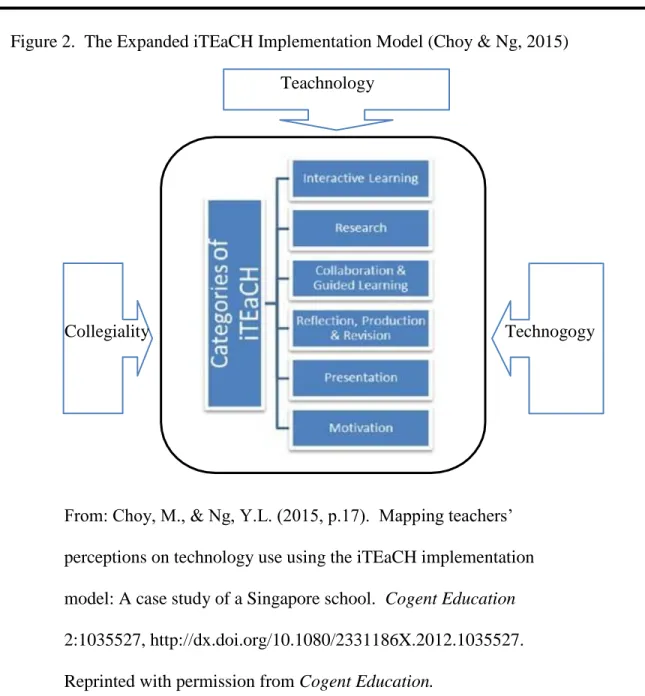
Proposing to address the gaps of other ICT implementation models, Choy (2013) developed the iTEaCH (ICT-Technogogy-and-Collegiality) ICT implementation model. This model incorporates the types of technology available to teachers for integration into teaching and learning which he terms “Teachnology”, teachers’ pedagogical preferences which he terms “Technogogy”, and the level of teacher support or “Collegiality”. Choy’s model intends Teachnology to be the technology teachers use to achieve specific teaching and learning purposes.
Technogogy, Choy (2013) takes to mean teachers pedagogical skills to be able to use ICT for teaching and learning purposes, and Collegiality refers to the support from management, colleagues, and students for ICT integration in teaching and learning. This model emphasizes how ICT is integrated into the teaching and learning process rather than on what technology is used. Choy (2013) posited that the iTEaCH model can be used to advance five categories of
teaching and learning using ICT namely; interactive learning; collaboration, research and learning guidance; reflection, production and revision; presentation; and motivation. Choy and Ng (2015) expanded and modified the iTEaCH implementation model to include interactive learning; research; collaboration and guided learning; reflection, production and revision; presentation; and motivation. The diagrammatic representation of the Choy and Ng expanded iTEaCH Model is shown in Figure 2.
Figure 2. The Expanded iTEaCH Implementation Model (Choy & Ng, 2015) Teachnology
Collegiality Technogogy
From: Choy, M., & Ng, Y.L. (2015, p.17). Mapping teachers’ perceptions on technology use using the iTEaCH implementation model: A case study of a Singapore school. Cogent Education
2:1035527, http://dx.doi.org/10.1080/2331186X.2012.1035527. Reprinted with permission from Cogent Education.
Choy and Ng (2015) used this iTEaCH Implementation Model to investigate the teachers’ use of technology across three dimensions of technology integration namely; types of technology available, teachers’ pedagogical preferences, and the level of teacher support/collegiality
experienced by teachers in the school.
Conclusion
The possible coming together of understandings of technology, pedagogy and leadership in the context of change knowledge has the possibility of enabling the case study school in Tanzania to implement change in IT provision and concomitantly the teaching and learning through the use of ICT integration in lessons. This change may advance the 21st-century learning experiences for students while also allowing teachers to be better empowered with new
pedagogies for ICT integration. As such, the purpose of this quantitative, explanatory case study was to investigate teacher preferences in the use of technology in the classroom using the
iTEaCH Model (Choy & Ng, 2015), and to explore the use of the data resulting from the
quantitative investigation of the teachers’ preferences in the use of technology in the classroom, to develop suggestions aimed at guiding decisions for digital leadership regarding both the provision of technology and professional development of teachers in the private school in Tanzania.
Although the results of this study will not be generalizable to other populations beyond the case study school, as pointed out by Yin (2014) case studies are generalizable to theoretical propositions and thus have research value and are contributive to the research community.
CHAPTER 3 METHODOLOGY
In an effort to advance both the school leadership skills and the use of information and communication technology (ICT) integration in a private school in Tanzania, this study
investigates if a discrepancy exists between the types of technology available for teachers to use in their classrooms and those they would prefer to use. This study also plans to determine the types of learning for which teachers currently choose to use ICT integration in their lessons, if any; and explores teachers’ perceptions of their current pedagogic skills and collegial support for ICT integration in the teaching and learning they offer in their classrooms. As such, the purpose of this quantitative, descriptive case study is to investigate teacher preferences in the use of technology in the classroom. The researcher plans to use a slightly modified version of the Choy and Ng (2015) data gathering tool (Appendix A) to collect data on the variables of interest. Choy and Ng’s (2015) data gathering tool was developed as a “goodness of fit” model to
investigate the teachers’ use of technology across three dimensions, namely; types of technology available, teachers’ pedagogical preferences, and the level of teacher support or collegiality experienced by teachers in the school. Specifically, the study intended to investigate the following research questions and sub questions, and their respective hypotheses:
Research Question 1. How do teachers respond to the iTEaCH technology implementation model survey?
Sub Question 1. What is the association between teacher use of technology in the classroom and that for which teachers desire to use technology?
H10. There is no association between teacher use of technology in the classroom and that for which teachers desire to use technology.
H1a. There is an association between teacher use of technology in the classroom and that for which teachers desire to use technology.
Sub Question 2. What is the association between teacher use of technology in the classroom and a teacher having the pedagogic skills to use technology in the classroom?
H20. There is no association between teacher use of technology in the classroom and a teacher having the pedagogic skills to use technology in the classroom.
H2a. There is an association between teacher use of technology in the classroom and a teacher having the pedagogic skills to use technology in the classroom, where teachers who have the pedagogic skills will use technology more often. Sub Question 3. What is the association between teacher use of technology in the
classroom and a teacher having colleague/school support in technology use? H30. There is no association between teacher use of technology in the classroom and a
teacher having colleague/school support in technology use.
H3a. There is an association between teacher use of technology in the classroom and a teacher having colleague/school support in technology use, where teachers who have support will use technology more often.
Sub Question 4. What is the difference in teacher use of technology in the classroom for different types of interactive learning?
H40. There is no difference between teacher use of technology in the classroom between types of interactive learning.
H4a. There is a difference between teacher uses of technology in the classroom between types of interactive learning.
Research Question 2. How can the teachers’ attitudes about a change in practice be used by school leadership to design a working model for ICT integration in the school?
The case study method has been selected as case studies allow for the gathering of information about a specific setting (Yin, 2014), and in the context of this research, a specific group of people in a specific school will be investigated. The case study approach allows for an empirical inquiry within a real-life context (Yin, 2008, cited in Merriam 2009) and interpretation of phenomena in context (Cronbach, 1975, in Merriam, 2009). By studying the teacher
requirement for ICT integration in relation to the three domains of teacher perceived needs namely technology provision, pedagogical support and collegial support, it is expected that school leadership focus in the case study school can be drawn into to the reciprocal relationship between leaders and followers. Specifically, this study might serve to draw leaders’ attention to the need for them to respond to the needs of their followers if change in a school is to be
effected. Using a single a private school as a case study school offers the advantage of being able to independently conduct research without having to answer to local authorities, and when results are known the school leadership alone can make investment decisions regarding
technology acquisition and provide for professional development of staff. The researcher
believes that through this method, quantitative data that will be gathered that will help explain or lead to a better understanding of teacher preferences in the use of technology in the classroom.
Setting
The study will take place in a private, coeducational, non-denominational day school in Dar Es Salaam, Tanzania, providing K-13 education. Throughout the study, the school will be referred to as Private School Dar Es Salaam (PSD). PSD has nursery, primary and secondary school sections. The International Baccalaureate Primary Years Programme (PYP) is
implemented in the nursery and primary years. In the secondary years, the Cambridge International General Certificate of Secondary Education (ICGSE), the International
Baccalaureate Diploma Programme (IBDP) and the Tanzania National Program (NECTA) are offered. The school currently serves approximately 1,700 students aged 2 to 18.
PSD employs two School Heads, one serving the nursery and primary section and the other in the secondary school, and 100 teachers. Of these 100 teachers, 14 teach pre-primary, 35 teach primary, and 51 teach secondary and higher secondary education across both the national and international streams. The teaching body represents a majority (69%) of Tanzanian staff, 14% are East African (13% Kenyan, 1% Ugandan), 17.5% expatriate staff: in all staff are currently from nine countries. Non-teaching administrative and support staff include three deputy heads and 20 administrative staff which include librarians, lab technicians, secretaries, reception and accounts staff. Of the 102 academic staff employed (teachers and heads of school), 15% are master’s degree holders, 72% hold bachelor’s degrees, and 13% are diploma holders.
The researcher was the Head of Education and Operations (HE&O) for the organization of which PSD is one school in the HE&O’s portfolio of schools, and the Heads of the Primary and Secondary school report to the researcher. As such, the researcher had direct access to both school heads. The Heads of School were provided with the questionnaire and asked to hold a staff meeting with their faculty, asking them to complete the questionnaire as a data gathering tool to better understand how the teachers currently integrate technology into their teaching and learning. The teachers were walked through the questionnaire by their respective Head of School to ensure a clear understanding of the questions being asked. The teachers were given