Target Tracking in Mobile Robot under Uncertain
Environment using Fuzzy Logic Controller
Ade Silvia HandayaniElectrical Department State Polytechnic of Sriwijaya Palembang, Indonesia [email protected] Tresna Dewi Electrical Department State Polytechnic of Sriwijaya Palembang, Indonesia [email protected]
Nyayu Latifah Husni Electrical Department State Polytechnic of Sriwijaya Palembang, Indonesia [email protected] Siti Nurmaini Robotic and Control
Research Lab, Faculty of Computer Science, University of Sriwijaya [email protected] Irsyadi Yani Mechanical Engineering Department, Faculty of Engineering University of Sriwijaya [email protected]
Abstract— This paper discusses a design of fuzzy logic algorithm in a robot. This algorithm is useful for the robot in seeking and reaching the target. The robot is also accomplished with an ability to avoid obstacles. Although the fuzzy rule that is embedded to the robot is very simple, it gives a good result in target seeking and obstacles avoiding task. The originality of this research is an approach to the rules that can simplify the task by creating faster track for the robot in uncertain environment.
Keywords— fuzzy-logic controller; navigation; target tracking.
I. INTRODUCTION
Robots application in detecting dangers is commonly available nowadays. They are more robust and safer than human or animal. By equipping them with some specific sensors, they can be good mobile detectors. They can detect many targets, such as thermal [1], gas [2], survival victim in disaster areas [3,4], and so on. Their ability in detecting the variety of targets depends on the sensors mounted on them. The assembling of vision and perception sensors can help the robots to track to the final target [5], [6]. Even so, in order to minimize the cost of the robot assembling in this research, the capability of the robots in tracking does not rely on the visions or perception. The competence of the mobile robots in this research depends only on the effectiveness of algorithm and distance sensors. By doing this, a low cost mobile robot tracker can be built.
Artificial Intelligent (AI) as one of the computer science branches can improve the performance of mobile robots. It can handle optimization (PSO), data mining (GA), classification (SVM, NN), decision (fuzzy, expert system), and so on. In this research, it utilizes a fuzzy system in order to handle the navigation of mobile robots in an unknown environment. The trajectory of them is based on the received information from attached sensors [6]. There are a lot works use fuzzy logic as the intelligent system [7-9]. It's due to fuzzy logic does not require exact mathematical modelling but rather works on the idea of range between 'zero' and 'one' value. A fuzzy logic controller is a control design where decisions are made by applying a fuzzy interference system based on rule or knowledge containing strings of fuzzy if-then rules [10]. This heuristic knowledge will develop
perception-action for the robots to accomplish their task. The fuzzy logic controller is very good to be implemented in the uncertain environment [11-15].
The main features of robot navigation are obstacle avoidance and target tracking. Many researchers had studied about these topics [16,17]. Target tracking is also one of the mostly explored topics in mobile robotics, since this type of robot can be easily deployed to search anything, ranging from dangerous objects to saving human-life. Target tracking using artificial intelligence is also already discussed in several studies; however researchers tended to divide the modules for target tracking and for other tasks of the robot [18-20] or combine fuzzy-logic controller with other type controller to get a better result [21-23]. The module division and/or combination with other type controller will add the complexity to fuzzy-logic controller, while applying it supposes to make the algorithm easier.
In this study, a mobile robot to track a target where the environmental setting is not predefined was designed; therefore the robot has to find its own way to the target. We design fuzzy logic algorithm to reach the target and avoid obstacles as the artificial intelligence of the robot. We set the rules to be very simple and yet still get a good result. The original of our approach is that we simplify the rules to create faster tracking of the robot in the present of uncertain environment. We also design a low cost robot that can be easily cloned to be swarm robots. Therefore, we also set up originality in the sense of a low cost mobile robot with a simple artificial intelligence algorithm that can be easily upgraded into a more complicated application or swarm robots.
II. FUZZY CONTROL BASED DESIGN MOBILE ROBOT
NAVIGATION
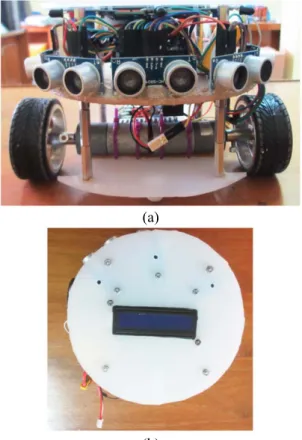
This study considers a well applied two-wheeled mobile robot equipped with 3 proximity sensors for obstacle avoidance and 1 heat sensor to track the flame resulted from a burning candle, as shown in Fig. 1. The flame sensor in this
paper can be changed into any kind of sensors based on the objective of the robot detector application.
(a)
(b)
Fig. 1. Two-wheeled mobile robot
The main idea of applying artificial intelligence design is to create a simple algorithm over a complex system. We set the fuzzy logic controller based on the designed behavior in tracking and reaching the target. The behaviors usually needed for mobile robot navigation are wall following and obstacle avoidance. However, if we can design a good controller for obstacle avoidance, it will be easy to adjust for wall following algorithm because basically it is almost the same design.
Therefore, in this study a fuzzy logic controllers are designed to navigate the robot from starting position to final position where the target is. As the robot seeks for the target, it will avoid all the obstacles found. In this scheme, three proximity sensors are utilized to avoid obstacles. Target reaching is the priority; the robot will go to target position as soon as the obstacle is avoided. The block diagram of fuzzy controllers design is shown in Fig. 2.
A. Obstacle Avoidance Control Design
Obstacle avoidance behaviors design are based on the data acquired by three proximity sensors installed on the robot, the LEFT, FRONT, and RIGHT sensor. Fig. 3 shows
the design for obstacle avoidance behavior. As the robot is deployed to reach the target, it is designed to avoid all the obstacles found on the way to reach the target. All the proximity sensors are utilized for the avoidance. The fuzzy logic rules for obstacle avoidance based on robot's behavior design is given in Table. 1. As shown in Table. 1, the input from sensors will affect the motors of the robot and finally, it will direct the movement of the robot. However, the target interception is the main priority of the robot behavior, as the robot senses the target; it will leave any other designed behavior and reach the target.
Figure 2. Fuzzy block diagram.
Fig. 3. Obstacle avoidance control design. Table 1. Fuzzy logic rules for obstacle avoidance
Sensor Left Sensor Front Sensor Right Motor Left Motor Right Robot Motion
Far Far Far Full speed Full Speed Straight
Far Far Near Reduced speed Full speed Turn slightly left
Far Near Far Full speed Reduced speed Turn right
Far Near Near Reduced speed Full speed Turn left
Near Far Far Full speed Reduced speed Turn right slightly
Near Far Near Reduced speed Reduced speed Straight slowl
Near Near Far Full speed Reduced speed Turn right slightly
III. EXPERIMENTAL SETUP
We apply the proposed method to a low cost mobile robot, equipped by 3 ultrasonic sensors as the proximity sensors with the ability to detect obstacles/wall from 2-450cm, 5 volt output sensor, 2 mA current and 5 volt input, and 1 flame sensor for tracking a fire (burning candle) as the target. To prove the effectiveness of our proposed method, various scenarios were set-up within test bed area.
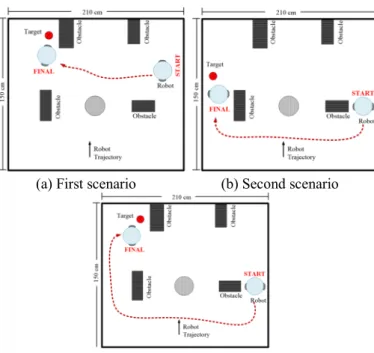
(a) First scenario (b) Second scenario
(c) Third Scenario Fig. 4. Scenarios for obstacle avoidance design
In obstacle avoidance design, we utilized all of the 3 proximity sensors for avoiding obstacles. We set 3 different scenarios shown in Fig. 4 for proving the effectiveness of the proposed method. We also do not apply cost function in this design; therefore the robot would choose its trajectory based on heat detection from the flame sensor. Different starting points and target positions were set to show the ability of robot in reaching target under environment uncertainty. The settings were not pre-map and the robot relied of its sensors for navigation and target tracking.
Figs. 5-7 show the video captures of three scenarios in Fig. 4. Fig. 4a is setting where the robot did not encounter any obstacles. We can elaborate the analysis of video captures as follow :
1. Fig. 5a is the position of robot at t = 0s, the robot is deployed from starting position to reach the target. There is no obstacles found therefore it just followed Rule 1, and went straight.
where:
Rule 1: IF SL is Far, SF is Far, and SR is Far, THEN ML is FS, and MR is FS.
2. Fig. 5b is the position of robot at t = 5s, the robot did not encounter any obstacles therefore it just followed Rule 1, and went straight.
(a) t = 0s (b) t = 5s
(c) t = 6s (d) t = 7s
Fig. 5. Video captures of wall following for the first scenario 3. Fig. 5c is the position of robot at t = 6s, the robot did not encounter any obstacles therefore it just followed Rule 1, and went straight. As the flame sensor detected the target, the robot started to approach the target.
4. Fig. 5d is the position of robot at t = 7s, the robot reached the target and stopped.
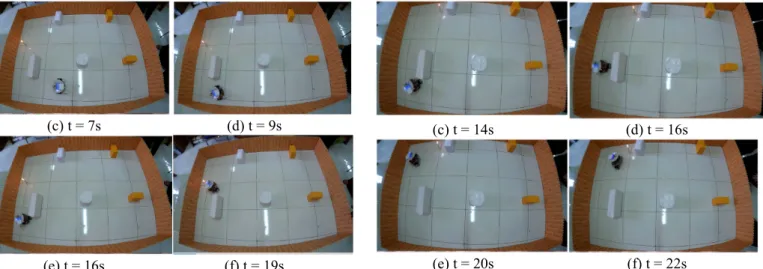
Fig. 4b shows the setting where the robot had to avoid obstacles to reach the target. The video captures of Fig. 4b scenario are given in Fig. 6. The analysis of those video captures is a follow
1. Fig. 6a gives the position of robot at t = 0s, the robot was in starting position where the condition applied according to Rule 6, and the robot went straight slowly. where
Rule 6: IF SL is Near, SF is Far, and SR is Near, THEN ML is RS, and MR is RS.
2. Fig. 6b gives the position of robot at t = 1s, where the robot encountered the condition of Rule 5. Therefore the robot turned right slightly.
where
Rule 5: IF SL is Near, SF is Far, and SR is Far, THEN ML is FS, and MR is RS.
(c) t = 7s (d) t = 9s
(e) t = 16s (f) t = 19s
Fig. 6. Video captures of obstacles avoidance for the second scenario
3. Fig. 6c gives the position of robot at t = 7s, the robot found no obstacles and just went straight as stated in Rule 1.
4. Fig. 6d gives the position of robot at t = 9s, the robot also found no obstacles and just went straight as stated in Rule 1.
5. Fig. 6e gives the position of robot at t = 16s, the robot found an obstacle where Rule 2 was supposed to be applied, however since the robot sense the target, it turned right slowly.
where
Rule 2: IF SL is Far, SF is Far, and SR is Near, THEN ML is RS, and MR is FS.
6. Fig. 6f gives the position of robot at t = 19s, the robot went to the target with the condition of Rule 6, therefore the robot moved slowly and as it reached the target, it stopped.
Fig. 4c is the extended setting of Fig. 4b. Fig. 7 shows the video captures of Fig. 4c scen,ario and we can analyze as follow
1. Fig. 7a shows the position of robot at t = 0s, the robot was in starting position where the condition applied according to Rule 6, and the robot went straight slowly. 2. Fig. 7b gives the position of robot at t = 10s, the robot
found no obstacles and just went straight as stated in Rule 1.
(a) t = 0s (b) t = 10s
(c) t = 14s (d) t = 16s
(e) t = 20s (f) t = 22s
Fig. 7. Video captures of obstacle avoidance for the third scenario
3. Fig. 7c gives the position of robot at t = 14s, the robot found an obstacle where Rule 2 was supposed to be applied, however since the robot sense the target, it turned right slowly.
4. Fig. 7d gives the position of robot at t = 16s, the robot found an obstacle where Rule 2 was supposed to be applied, however since the robot sense the target, it went forward slowly.
5. Fig. 7e gives the position of robot at t = 20s, the robot went to the target with the condition of Rule 6, therefore the robot moved slowly and went to target.
6. Fig. 7f gives the position of robot at t = 22s, the robot reached the target and stopped.
From the experimental results of obstacle avoidance setting, we can see that the robot reached the target and avoided obstacles in all the settings within proper speed.
IV.CONCLUSION
We have designed a low cost mobile robot to track and reach a target in an uncertain environmental setting; therefore the robot had to find its own trajectory to reach the target. We applied fuzzy logic controller to reach the target. We simplified the rules but the results are effective as expected. To show the effectiveness of our proposed method, we applied the robot in three settings. From the experimental results, we can see that the robot reached the target and avoided obstacles in all the settings within proper speed. Therefore, we set up originality in the sense of a low cost mobile robot with a simple artificial intelligence algorithm that can be easily upgraded into a more complicated application or swarm robots.
REFERENCES
[1] K. Senthil Kumar, G. Kavitha, R. Subramanian and G. Ramesh. Visual
- A Ubiquitous Tool for the Practical Engineer, ISBN: 978-953-307-907-3, InTech, 2011.
[2] V. Hernandez Bennetts, A. J. Lilienthal, A. Abdul Khaliq, V. Pomareda
Sese, and M. Trincavelli, Gasbot: a Mobile Robotics Platform for Methane Leak Detection and Emission Monitoring, Workshop on Robotics for Environmental Monitoring, 2012.
[3] M. Koes, I. Nourbakhsh, and K. Sycara, Constraint Optimization
Coordination Architecture for Search and Rescue Robotics, Proceeding of the IEEE International Conference on Robotics and Automation (ICRA) , pp. 3977-3982, 2006.
[4] H. Reddy A, B. Kalyan, and Ch. S. N. Murthy, Mine Rescue Robot
System - A Review, Procedia Earth and Planetary Science, Vol 11, pp. 457-462, 2015.
[5] T. Dewi, N. Uchiyama, and S. Sano, Service Mobile Robot Control for
Tracking a Moving Object with Collision Avoidance, IEEE International Workshop on Advance Robotics and its Social Impacts (ARSO15), pp. 1-6, 2015.
[6] S. Nurmaini, A. Putra, and Rendyansah, Intelligent Navigation in
Unstructured Environment by using Memory-Based Reasoning in Embedded Mobile Robot, European Journal of Scientific Research, pp. 229-244, 2012.
[7] J. Yen, and N. Pfluger, A Fuzzy Logic Based Robot Navigation
System, AAAI Technical Report FS-92-02, pp.195-199, 1992.
[8] F. Hoffmann, Evolutionary Algorithm for Fuzzy Control System
Design, Proceeding of IEEE, Vol. 89, pp. 1318-1333, 2001
[9] J. Sahu, B. B. Choudhury, M.K. Muni, and M.R. Patra, An Effective Selection of Mobile Robot Model Using Fuzzy Logic Approach, 4th International Conference on Material Processing and Characterization, pp. 2605-2614, 2015.
[10] S. Nurmaini, and S. Zaiton M. Hashim, An Embedded Fuzzy Type-2
Controller Base Sensor Behavior For Mobile Robot, International Conference on Intelligent System Design and Applications, pp. 29-34, 2008.
[11] AS. Al Yahmedi, and M. A. Fatmi (2011). Fuzzy Logic Based
Navigation of Mobile Robots, In Recent Advances in Mobile Robotics,
InTech, pp. 287-310. % Available at:
http://www.intechopen.com/books/recent-advances-in-mobile-robotics [Accessed August 24, 2016].
[12] S. T. Mitrovic, and Z. M. Djurovic, Fuzzy-Based Controller for
Differential Drive Mobile Robot Obstacle Avoidance, In IFAC Proceeding Volumes, Vol 43, pp. 67-72, 2010.
[13] P. Vadakkepat, O. C. Miin, X. Peng, and T. H. Lee, Fuzzy
Behaviour-Based Control of Mobile Robots, IEEE Transaction of Fuzzy Systems, Vol. 12, No. 4, 2004.
[14] E. Kayacan, E. Kayacan, H. Ramon, and W. Saeys, Velocity Control of
a Spherical Rolling Robot Using a Grey-PID Type Fuzzy Controller with an Adaptive Step Size, 10th IFAC Symposium on Robot Control, pp. 863-868, 2012.
[15] K. Demirli, and M. Molhim, Fuzzy Dynamic Localization for Mobile
Robots, Fuzzy Sets and Systems, Vol. 144, pp. 251-283, 2004. [16] J. P. Uribe, and J. Urzelai, Fuzzy Controller for Obstacle Avoidance
with a Non-Holonomous Mobile Robot, Mathware \& Soft Computing, Vol. 5, pp. 279-289, 1998.
[17] H. Surmann, J. Huser, and L. Peters, A Fuzzy System for Indoor
Mobile Robot Navigation, Proceeding of Fourth IEEE Int. Conf. on Fuzzy Systems, pp. 83-86, 1995.
[18] N. de Castro, R. Matias, and M. I. Ribeiro, Target Tracking Using Fuzzy Control, Actas do Encontrol CientificoO Festival Nacional de
Robotica - ROBOTICA2003, 2003.
[19] J. Hossen, S. Sayeed, and A. K. M. P. Iqbal, A Modified Hybrid Fuzzy
Controller for Real-Time Mobile Robot Navigation, IEEE International Symposium on Robotics and Intelligent Sensors IRIS 2015, Procedia Computer Science, Vol. 76, pp. 449-454, 2015.
[20] F. Abdessemed, M. Faisal, M. Emmadeddine, R. Hedjar, K. Al-Muthib,
M. Alsulaiman, and H. Mathkour, A Hierarchical Fuzzy Control Design for Indoor Mobile Robot, International Journal of Advanced Robotic Systems , InTech, 2014.
[21] B. Li, and C. Zhang, Adaptive Fuzzy Control for Mobile Robot
Obstacle Avoidance based on Virtual Line Path Tracking, Proceeding of the 2006 IEEE International Conference on Robotics and Biomimetics, pp. 1454-158, 2006.
[22] J. Z. Sasiadek, and P. Hartana, Adaptive Fuzzy Logic System for Sensor Fusion in Dead-Reckoning Mobile Robot Navigation, 15th Triennial World Congress, pp. 128-132, 2002.
[23] M. Wang, and J. N. K. Liu, Fuzzy Logic-Based Real-Time Robot
Navigation in Unknown Environment with Dead Ends, Robotics and Autonomous System, Vol. 56, pp. 625-643, 2008.