Developing an information seeking
profile for nursing students:
the role of personality, learning style
and self-efficacy
Peter Stokes
019011387
Department of Information Studies
Aberystwyth University, UK
Submitted in partial fulfilment of the requirements of the
Degree of Doctor of Philosophy
ABSTRACT
This study explored the information seeking behaviour of a group of nursing students at a single university in the United Kingdom to determine whether any of personality, learning style, or self-efficacy with information literacy impacted on this behaviour.
A concurrent embedded quantitative dominant mixed-methods approach was used comprising of a questionnaire and interviews, and took place during the academic year 2008-9. Phase 1 of the research used a questionnaire (sample n=194)
consisting of three validated scales (for personality, learning styles, and self-efficacy respectively), plus a section on information seeking preferences based on Foster’s (2004, 2005) non-linear model, and some demographic questions. For Phase 2 a sample (n=11) of students took part in semi-structured interviews using the Critical Incident Technique, the resulting data analysed using a blended method of data collection, analysis and display – Qualitative Interpretative Categorisation (QIC).
Results from the questionnaire data (through Chi-square, Odds ratios, and Binomial regression) showed clear links between differing personality traits, learning style preferences, and levels of self-efficacy with information literacy, and with particular elements of Foster’s model. This enabled seven specific profiles and a ‘level of understanding’ continuum to be formulated. The interview data enabled an
information search process model to be produced indicating the ‘route’ students’ use during their information seeking and emphasised the role of situation. Finally
incorporating the student’s personal profile into the model allowed a complete information seeking process model to be produced.
Key recommendations from the study are that students should wherever possible have their information seeking profile determined via questionnaire and that a ‘long and thin’ information skills training programme be embedded into the curriculum. This programme should contain a range of types of session and that can be moulded to the situation the students are in.
ACKNOWLEDGEMENTS
I would like to thank my supervisors Dr Christine Urquhart and Dr Allen Foster for their assistance in the preparation of this thesis. I would also like to thank Dr Stewart Piper, Dr John Adams, and the library staff at Anglia Ruskin University for their support throughout my studies.
This research benefited from a grant from the Arts and Humanities Research Council.
TABLE OF CONTENTS
ABSTRACT _______________________________________________________________ ii ACKNOWLEDGEMENTS ____________________________________________________ iii TABLE OF CONTENTS _____________________________________________________ iv LIST OF FIGURES _________________________________________________________ ix LIST OF TABLES ___________________________________________________________ x LIST OF ACRONYMS ______________________________________________________ xii Chapter 1 OVERVIEW AND INTRODUCTION __________________________________ 1-1 1.1 Background ________________________________________________________________________ 1-1 1.2 Aim _______________________________________________________________________________ 1-3 1.3 Purpose statement __________________________________________________________________ 1-4 1.4 Research questions _________________________________________________________________ 1-4 1.5 Objectives _________________________________________________________________________ 1-5 1.6 Outline of thesis ____________________________________________________________________ 1-5 Chapter 2 LITERATURE SEARCHING STRATEGY ______________________________ 2-7 Chapter 3 METHODOLOGY _______________________________________________ 3-12 3.1 Philosophical perspective ___________________________________________________________ 3-12 3.2 The quantitative strategy ____________________________________________________________ 3-14 3.3 The qualitative strategy _____________________________________________________________ 3-15 3.4 The mixed methods approach ________________________________________________________ 3-17 3.5 Pragmatism or a ‘pragmatic approach’? _______________________________________________ 3-20 3.6 Mixed-methods – for and against _____________________________________________________ 3-22 Chapter 4 INFORMATION SEEKING BEHAVIOUR _____________________________ 4-28 4.1 Information _______________________________________________________________________ 4-28 4.2 Information behaviour, Information seeking behaviour, and Information searching behaviour __ 4-30 4.3 Models ___________________________________________________________________________ 4-334.3.1 IB Models _____________________________________________________________________ 4-33 4.3.2 Factor relationship models ________________________________________________________ 4-35 4.3.3 Search process models ___________________________________________________________ 4-38 4.3.4 Task based models ______________________________________________________________ 4-39 4.3.5 Non-linear process model _________________________________________________________ 4-41 4.3.6 Integrated general models _________________________________________________________ 4-43
4.4 Tasks ____________________________________________________________________________ 4-52 4.5 Situation/Context __________________________________________________________________ 4-54 4.6 Collaborative information behaviour __________________________________________________ 4-57 4.7 Enough information ________________________________________________________________ 4-59 4.8 Serendipity ________________________________________________________________________ 4-62
4.9 Information retrieval ________________________________________________________________ 4-63 4.10 Relevance _______________________________________________________________________ 4-64 4.11 User studies ______________________________________________________________________ 4-68 4.12 Information seeking behaviour ______________________________________________________ 4-69
4.12.1 Searching for health information - The example of CANCER _____________________________ 4-69 4.12.2 HCPs ________________________________________________________________________ 4-72 4.12.3 Doctors ______________________________________________________________________ 4-74 4.12.4 Nurses and nursing education _____________________________________________________ 4-75
4.13 Information searching behaviour ____________________________________________________ 4-81
4.13.1 HCP’s _______________________________________________________________________ 4-82
4.14 Information literacy ________________________________________________________________ 4-85 Chapter 5 MEASURING PERSONALITY _____________________________________ 5-89 5.1 History ___________________________________________________________________________ 5-89
5.1.1 Neo-Freudians __________________________________________________________________ 5-91 5.1.2 Early personality theorists _________________________________________________________ 5-92
5.2 Measuring traits ___________________________________________________________________ 5-97
5.2.1 Two characteristics ______________________________________________________________ 5-97 5.2.2 The 3 factor model ______________________________________________________________ 5-98 5.2.3 Five Factor Model _______________________________________________________________ 5-98 5.2.4 The HEXACO model ____________________________________________________________ 5-101
5.3 Use of personality scales in education ________________________________________________ 5-102
5.3.1 Medical education ______________________________________________________________ 5-104 5.3.2 Nursing ______________________________________________________________________ 5-105
5.4 Suitability of the Mini-markers _______________________________________________________ 5-107 Chapter 6 MEASURING SELF-EFFICACY ___________________________________ 6-108 6.1 Development of the concept ________________________________________________________ 6-108 6.2 Problems with the concept of self-efficacy ____________________________________________ 6-112 6.3 Academic settings ________________________________________________________________ 6-113
6.3.1 Autonomous learning ___________________________________________________________ 6-114 6.3.2 Academic motivation ____________________________________________________________ 6-116
6.4 Development of research tools ______________________________________________________ 6-118
6.4.1 Efficacy in teaching _____________________________________________________________ 6-119 6.4.2 Teacher Self-efficacy scales ______________________________________________________ 6-120 6.4.3 Efficacy in computing ___________________________________________________________ 6-122 6.4.4 Efficacy in information seeking and information literacy _________________________________ 6-124
6.5 Suitability of the Information Literacy Self-Efficacy Scale (ILSES) _________________________ 6-125 Chapter 7 MEASURING LEARNING STYLES ________________________________ 7-128 7.1 ‘Learning’ styles or ‘cognitive’ styles? ________________________________________________ 7-128 7.2 Development of research tools ______________________________________________________ 7-129
7.2.1 Cognitive-based styles __________________________________________________________ 7-131 7.2.2 Learning-based styles ___________________________________________________________ 7-135 7.2.3 Learning approaches strategies, orientations and concepts of learning _____________________ 7-138 7.2.4 Summary _____________________________________________________________________ 7-141
7.3 Learning styles in nurse education ___________________________________________________ 7-143 7.4 Use of the ASSIST in research _______________________________________________________ 7-148 7.5 Autonomous learning in nurse education _____________________________________________ 7-151 7.6 Critical thinking in nurse education __________________________________________________ 7-152 7.7 Suitability of the ASSIST ___________________________________________________________ 7-152 Chapter 8 THE ROLE OF PERSONALITY, SELF-EFFICACY AND LEARNING STYLES IN ISkB _________________________________________________________________ 8-154 Chapter 9 GENERAL RESEARCH PROCEDURES ____________________________ 9-158 9.1 Ethical approval __________________________________________________________________ 9-163
9.1.1 Access arrangements ___________________________________________________________ 9-163
9.2 Sample __________________________________________________________________________ 9-164 9.3 Participant forms __________________________________________________________________ 9-166 Chapter 10 DATA COLLECTION _________________________________________ 10-168 10.1 Stage 1: quantitative _____________________________________________________________ 10-168
10.1.1 Development of questionnaire ___________________________________________________ 10-169 10.1.2 Foster’s model _______________________________________________________________ 10-169 10.1.3 Research Tools ______________________________________________________________ 10-173 10.1.4 Data analysis – statistical tests used in quantitative analysis ___________________________ 10-176
10.2 Stage 2: qualitative ______________________________________________________________ 10-177
10.2.1 Data analysis and the use of pre-determined categories ______________________________ 10-179 10.2.2 Methodological development - Qualitative Interpretative Categorisation (QIC) _____________ 10-182 10.2.3 Critical Incident Technique (CIT) _________________________________________________ 10-189 10.2.4 Development of Interview Guide _________________________________________________ 10-192 10.2.5 Coding _____________________________________________________________________ 10-194 10.2.6 Data analysis – reflecting on the QIC process ______________________________________ 10-197
Chapter 11 RESULTS __________________________________________________ 11-201 11.1 Quantitative ____________________________________________________________________ 11-201 11.1.1 Scale reliability ______________________________________________________________ 11-201 11.1.2 Self-efficacy _________________________________________________________________ 11-203 11.1.3 Learning Styles ______________________________________________________________ 11-206 11.1.4 Personality __________________________________________________________________ 11-208 11.1.5 Self-efficacy and Learning Style _________________________________________________ 11-209 11.1.6 Self-efficacy and Personality ____________________________________________________ 11-210 11.1.7 Learning Style and Personality __________________________________________________ 11-210 11.1.8 ISkB _______________________________________________________________________ 11-211
11.1.9 ISkB and Self-efficacy _________________________________________________________ 11-212 11.1.10 ISkB and Learning Style ______________________________________________________ 11-214 11.1.11 Odds Ratios ________________________________________________________________ 11-215 11.1.12 ISkB and Personality _________________________________________________________ 11-217 11.1.13 Regression analysis _________________________________________________________ 11-220
11.2 Qualitative _____________________________________________________________________ 11-222
11.2.1 Category 1: Amount of Information _______________________________________________ 11-224 11.2.2 Category 2: Confidence ________________________________________________________ 11-226 11.2.3 Category 3: Pertinence ________________________________________________________ 11-228 11.2.4 Category 4: Revision of searching _______________________________________________ 11-231 11.2.5 Category 5: Satisfaction with searching ___________________________________________ 11-235 11.2.6 Category 6: Search strategy ____________________________________________________ 11-237 11.2.7 Category 7: Sources used ______________________________________________________ 11-240
Chapter 12 DISCUSSION _______________________________________________ 12-245 12.1 Quantitative element _____________________________________________________________ 12-245
12.1.1 Self-efficacy _________________________________________________________________ 12-246 12.1.2 Learning styles ______________________________________________________________ 12-247 12.1.3 Self-efficacy and learning style __________________________________________________ 12-247 12.1.4 Personality __________________________________________________________________ 12-248 12.1.5 Personality with self-efficacy and learning style _____________________________________ 12-248 12.1.6 ISkB with self-efficacy and learning style __________________________________________ 12-250 12.1.7 Linking in personality traits _____________________________________________________ 12-253
12.2 Qualitative element ______________________________________________________________ 12-259
12.2.1 Use of the Qualitative Interpretive Categorisation (QIC) technique ______________________ 12-259 12.2.2 Amount of information _________________________________________________________ 12-259 12.2.3 Confidence _________________________________________________________________ 12-260 12.2.4 Pertinence __________________________________________________________________ 12-260 12.2.5 Revision of searching _________________________________________________________ 12-261 12.2.6 Satisfaction _________________________________________________________________ 12-262 12.2.7 Search strategy ______________________________________________________________ 12-262 12.2.8 Sources used _______________________________________________________________ 12-263 12.2.9 Summary ___________________________________________________________________ 12-264 12.3 Mixed element __________________________________________________________________ 12-266 Chapter 13 CONCLUSIONS AND RECOMMENDATIONS ______________________ 13-269 13.1 Introduction ____________________________________________________________________ 13-269 13.2 Literature review ________________________________________________________________ 13-270 13.3 Methodological approach _________________________________________________________ 13-271 13.3 Main findings ___________________________________________________________________ 13-273 13.3.1 Quantitative _________________________________________________________________ 13-273 13.3.2 Qualitative __________________________________________________________________ 13-278
13.3.3 Mixed ______________________________________________________________________ 13-279
13.4 Recommendations ______________________________________________________________ 13-280 13.5 Contributions of this study _______________________________________________________ 13-282 13.6 Limitations and further research ___________________________________________________ 13-282 Chapter 14 REFERENCES ______________________________________________ 14-284 Chapter 15 APPENDICES _______________________________________________ 14-336 Appendix A: Mind Map for literature search ______________________________________________ 14-337 Appendix B: Selection of learning styles reviews _________________________________________ 14-339 Appendix C: Letter of invitation ________________________________________________________ 14-342 Appendix D: Participant information sheet ______________________________________________ 14-344 Appendix E: Consent forms ___________________________________________________________ 14-348 Appendix F: Interview schedule _______________________________________________________ 14-351 Appendix G: Questionnaire ___________________________________________________________ 14-354
LIST OF FIGURES
Figure 1-1: outline of thesis ... 1-6 Figure 3-1: the aspects of the quantitative and qualitative research approaches .. 3-17 Figure 3-2: the aspects of the quantitative, qualitative, and mixed-method research approaches ... 3-19 Figure 3-3: the revised relationships within the research process when a pragmatic approach is utilised ... 3-22 Figure 4-1: communication model from Shannon and Weaver (1949 p98) ... 4-28 Figure 4-2: Wilson's (1999 p263) nested IB model (reproduced with publisher’s permission) ... 4-33 Figure 4-3: Dervin's Sense-Making theory modified by Wilson (1999 p254)
(reproduced with publisher’s permission) ... 4-34 Figure 4-4: Wilson's 1981 model of Information Behaviour - updated by Wilson
(1999) (reproduced with publisher’s permission) ... 4-36 Figure 4-5: Representation of Kuhlthau's (1993) 6 stage model of the information search process ... 4-38 Figure 4-6: Ellis's (1989) model shown as a stage process version (from Wilson 1999) (reproduced with publisher’s permission) ... 4-39 Figure 4-7: Bystrom and Jarvelin's (1995) task-based ISkB model (reproduced with publisher’s permission) ... 4-40 Figure 4-8: Foster's (2004, 2005) model of non-linear ISkB (reproduced with
publisher’s permission) ... 4-42 Figure 4-9: Wilson's (Wilson and Walsh, 1996) model of ISkB (reproduced with permission of copyright holder). ... 4-44 Figure 4-10: Sonnenwald and Iivonen's (1999) model of IB (reproduced with
publisher’s permission) ... 4-45 Figure 4-11: Niedzwiedzka's (2003) model of ISkB. (Reproduced under Creative Commons) ... 4-46 Figure 12: Godbold's (2006) model of IB (Reproduced under Creative Commons) 4-47
Figure 4-13: Spink and Cole’s integrated HIB model. This version has been adapted from (Spink and Cole, 2006a and Spink et al., 2006). ... 4-49 Figure 4-14: Urquhart and Rowley’s (2007) model of student ISkB (reproduced with publisher’s permission) ... 4-50 Figure 4-15: Dervin’s Sense-Making model adapted to the nurse-patient information need situation ... 4-80 Figure 4-16: the steps involved in the information literacy process with the inclusion of elements of reflection. Adapted from Craig (2009) ... 4-88 Figure 6-1: Bandura's (1986) three core sets of Social Cognitive Theory (reproduced from BANDURA, A. 1986. Social foundations of thought and action: a social cognitive theory, Engelwood Cliffs, NJ, Prentice Hall, p. 24 and reprinted by permission of Pearson Education, Inc., Upper Saddle River, New Jersey). ... 6-108 Figure 6-2: Bandura (1977b) self-efficacy expectations (reproduced from BANDURA, A. 1977. Social learning theory, Englewood Cliff, NJ, Prentice Hall, p.79 and
reprinted by permission of Pearson Education, Inc., Upper Saddle River, New
Jersey). ... 6-112 Figure 7-1: the cognitive – learning continuum summarized from Coffield et al 2004a ... 7-130 Figure 7-2: representation of the two dimensions of Gregorc’s Style Delineator
(adapted from Guild 1998 pp92-93). ... 7-133 Figure 7-3: Kolb’s (1984) Learning Styles Inventory expectations (reproduced from KOLB, D. A. 1984. Experiential learning: experience as the source of learning and development, New Jersey, Prentice Hall, p.42and reprinted by permission of
Figure 9-1: the methods used in the research ... 9-162 Figure 10-1: the Qualitative Interpretive Categorisation (QIC) framework in relation to Creswell’s (2009 p185) seven step data analysis overview. ... 10-188 Figure 11-1: tree hierarchy of the nodal structure within the category for ‘Amount of information’ ... 11-224 Figure 11-2: tree hierarchy of the nodal structure within the category for ‘Confidence’ ... 11-226 Figure 11-3: tree hierarchy of the nodal structure within the category for ‘Pertinence’ ... 11-228 Figure 11-4: tree hierarchy of the nodal structure within the category for ‘Revision of searching’ ... 11-231 Figure 11-5: tree hierarchy of the nodal structure within the category for ‘Satisfaction with searching’ ... 11-235 Figure 11-6: tree hierarchy of the nodal structure within the category for ‘Search strategy’ ... 11-237 Figure 11-7: tree hierarchy of the nodal structure within the category for ‘Sources used’ ... 11-240 Figure 12-1: the relationship between learning styles (Surface, Strategic, and Deep), confidence with information literacy, and “level of understanding” ... 12-248 Figure 12-2: four potential profiles. Profiles ST1 and ST2 contain Advanced ILSE, but this was not a strong link with the Strategic learners hence the uncertainty ... 12-250 Figure 12-3: those information seeking micro-processes with strong links to learning styles and information literacy self-efficacy ... 12-252 Figure 12-4: the seven ISkB profiles. Profiles DE1, DE2 and DE3 are for the Deep learners; ST1 and ST2 are for the Strategic learners; and SU1 and SU2 are for the Surface learners ... 12-257 Figure 12-5: the five personality traits and their links with the information seeking micro-processes, learning styles and information literacy self-efficacy ... 12-258 Figure 12-6: the information search process ... 12-265 Figure 12-7: the information search process including the ISkB profile ... 12-267
LIST OF TABLES
Table 3-1: the differences between quantitative and qualitative research strategies (from Bryman (2008)) ... 3-16 Table 3-2: the different aspects of the qualitative, quantitative, and pragmatic
research approaches (source: Morgan (2007)) ... 3-20 Table 4-1: summarizing eleven recent studies into the ISkB of various types of
qualified nurses, nurse teachers and nursing students. ... 4-78 Table 5-1: Freud’s stages of psychological development adapted from Hergenhahn and Olson (2003), Patterson and Watkins-Jr (1996); and Funder (2007)... 5-90 Table 5-2: Murray’s list of forty-four variables (Murray, 1938 p144-149) ... 5-94 Table 5-3: Cattell’s 16 surface traits (Cattell and Kline, 1977) ... 5-96 Table 1: self-efficacy core concepts adapted from Baranowski et al (2004 p169) .. 6-109
Table 7-1: Dunn and Dunn’s LSI groupings (from Coffield et al., 2004a p21) ... 7-132 Table 7-2: Honey and Mumford’s Learning Styles Types - strengths and weaknesses (adapted from Honey and Mumford, 2006) ... 7-137 Table 7-3: the defining features of Approaches to Learning and Studying, taken from Entwistle et al (2001 p109 and p112) and, Entwistle and Peterson (2004) ... 7-139 Table 7-4: the four areas of the ILS (adapted from Vermunt and Vermetten, 2004, Coffield et al., 2004a) ... 7-141 Table 9-1: the major mixed methods design types (adapted from Creswell and Plano-Clark, 2007) ... 9-158
Table 9-2: the overall research design framework in this study. ... 9-161 Table 9-3: the sample of students taking part in the quantitative analysis of the study. ... 9-165 Table 9-4: the participants taking part in the interviews ... 9-166 Table 10-1: the strengths and weaknesses of using questionnaires in research
(Watson and Coombes, 2009) ... 10-168 Table 10-2: the three core processes and eighteen micro-processes within Foster’s ISkB model. ... 10-170 Table 10-3: the Core Processes of Foster’s non-linear information seeking model along with the two juxtaposed options developed for the questionnaire. ... 10-171 Table 4: initial ‘start list’ of pre-determined categories used in the QIC process 10-181
Table 10-5 Comparison of QIC, Template analysis, and Grounded Theory ... 10-185 Table 10-6: the strengths and weaknesses of the critical incident technique (Aveyard and Neale, 2009) ... 10-191 Table 10-7: the initial start list of categories, rationalisation, and which questions they relate to. ... 10-196 Table 11-1: Cronbach’s alpha scores for the ASSIST ... 11-202 Table 11-2: Cronbach’s alpha scores for the Mini-markers ... 11-203 Table 11-3: the relationship between information literacy self-efficacy and course. RM given but not analysed ... 11-204 Table 11-4: the relationship between information literacy self-efficacy and current year of course ... 11-204 Table 11-5: the relationship between information literacy self-efficacy and age of student ... 11-205 Table 11-6: the relationship between different learning styles and course. RM given but not analysed ... 11-206 Table 11-7: the relationship between different learning styles and current year of course ... 11-206 Table 8: the relationship between different learning styles and age of student .. 11-207
Table 11-9: the average personality scores of students at different stages of their course ... 11-208 Table 10: the relationship between mean personality score and age of student 11-208
Table 11-11: the relationship between self-efficacy level and different learning styles ... 11-209 Table 11-12: the relationship between self-efficacy level and mean personality score ... 11-210 Table 11-13: the relationship between different learning styles and mean personality score ... 11-210 Table 11-14: the number of students agreeing with the micro-process ... 11-212 Table 11-15: the relationship between the number of students agreeing with the micro-process and self-efficacy level ... 11-213 Table 11-16: the relationship between the number of students agreeing with the micro-process and learning style type ... 11-214 Table 11-17: an example contingency table used for calculating odds ratios .... 11-215 Table 11-18: micro-processes most likely to be undertaken by students with different self-efficacy levels ... 11-215 Table 11-19: micro-processes most likely to be undertaken by students with different Learning Styles ... 11-216 Table 11-20: the relationship between students agreeing with the micro-process and mean personality score ... 11-217 Table 11-21: the relationship between students disagreeing with the micro-process and mean personality score ... 11-218
Table 11-22: single personality traits associated with micro-processes ... 11-220 Table 11-23: regression analysis showing relationships between the five personality traits and each ISkB micro-process ... 11-221 Table 11-24: codes referring to participants in the interviews ... 11-222 Table 25: the initial start list and final set of categories used in the QIC process 11-223
LIST OF ACRONYMS
ALSI Approaches to Learning and Studying Inventory ASI Approaches to Studying Inventory
ASSIST Approaches and Study Skills Inventory for Students CIT Critical Incident Technique
CPD Continuing Professional Development CSA Cognitive Styles Analysis (Riding) CSC Classroom and School Context model CSES Computer Self-Efficacy scale
CSI Cognitive Styles Indicator (Allinson and Haynes) CTS Computer Technologies Survey
CTSES College Teaching Self-Efficacy Scale EPQ Eysenck’s Personality Questionnaire
EVINCE Establishing the Value of Information to Nursing Continuing Education FFM Five Factor Model
GEFT Groups Embedded Figures Test GP General Practitioner
GSD Gregorc’s Style Delineator HCP Health Care Professionals HEXACO A six factor personality model
ICT Information and Computer Technology ILS Inventory of Learning Styles (Vermunt) ILSE Information Literacy Self-Efficacy ILSES Information Literacy Self-Efficacy Scale IPIP International Personality Itinerary Pool ISS Internet self-efficacy scale
IT Information Technology
JUSTEIS JISC Usage Surveys: Trends in Electronic Information Services KLSI Kolb’s Learning Styles Inventory
LSI Learning Styles Inventory (Dunn and Dunn)
LSQ Learning Styles Questionnaire (Honey and Mumford) LSS Learning Styles Survey
MBTI Myers-Briggs Type Indicator
MSLQ Motivated Strategies for learning Questionnaire NEO-FFI – NEO Five Factor Inventory
NEO-PI-R Personality scale by Costa and McCrae PBL Problem Based Learning
PEPS Productivity Environmental Preference Survey QIC Qualitative Interpretative Categorisation RASI Revised Approaches to Studying Inventory RM Registered Midwife/Midwifery
RN Registered Nurse/Nursing SCT Social Cognitive Theory SDL Self Directed Learning
SRL Self Regulated Learning
TEBS-Self Teachers’ Efficacy Beliefs System – Self Form TES Teacher Efficacy Scale
Chapter 1 OVERVIEW AND INTRODUCTION
1.1 Background
Nurses handle information all the time – from patient counselling through recording of care to reflection on practice, with (following the advent of Project 2000 which made nursing a graduate profession) increasing emphasis on working in an ‘evidence-based’ manner. Evidence-based practice (or more specifically evidence-based nursing) is a process that has evolved over time from describing clinical decision making to guidance that informs decisions and has many ‘definitions’ (Bucknall and Rycroft-Malone, 2010). In a critical review of the literature Scott and McSherry (2009) identify thirteen separate definitions of evidence-based practice and evidence-based nursing with the main requirement that clinical decisions are made based on the best available evidence. Indeed nurses are impelled to base their practice on research (Spencer, 2011). Recently updated competencies for entry to the nursing register state that “all nurses must appreciate the value of evidence in
practice, be able to understand and appraise research, apply relevant theory and research findings to their work, and identify areas for further investigation” (Nursing and Midwifery Council, 2010). In addition at the university where this research has taken place the assessment grading criteria for full-time
undergraduate nursing students allocates 25% of the marks for written assignments to ‘use of literature as an evidence base’, with a progression in the highest grade from “some analysis and interpretation of appropriate literature” in year 1, to “varied, contemporary and well-referenced evidence base” in year 2, to “impressive depth and breadth of reading enhances
discussion. Varied and contemporary evidence base” in year 3 (Anglia Ruskin University, 2011). This requirement for students to obtain more evidence for their work and to evaluate and critique this evidence as they progress through their course necessarily requires additional searching skills. With the growth of Web 2.0, nurses will need to work with fellow professionals and patients in different ways, and nursing students will need to acquire more sophisticated information seeking skills to cope with new roles.
Those demands impact on the curriculum in higher education, nursing educators and librarians. With a large student cohort of around 172,000 nursing students enrolled at higher education institutions in 20010/11 (Higher Education Statistics Agency, 2011), a validated profile of information
behaviour in this group would inform design and evaluation of information support services for a diverse student group, composed of mature students as well as the school-leavers.
Information seeking behaviour research has centred on the creation of
models; from factor relationship models (Wilson, 1981, Wilson, 1999), through sense-making models (Dervin et al., 2003), search process models (Kuhlthau, 1993), task based models (Bystrom and Jarvelin, 1995), to non-linear models (Foster, 2004); and on to integrated general models (Spink and Cole, 2006a). These models have been generated from a range of empirical studies on different types of users, but all aim to show how individuals orientate and ‘go about’ the act (or acts) of information seeking. All these models will be discussed at length, but do they apply to nurses and nursing students? Nurses are expected to practice in an evidence based manner, but many studies have shown that their preferred sources of information tend to be informal (Dee and Stanley, 2005, Tannery et al., 2007, Thompson et al., 2001b, Thompson et al., 2001a). In addition barriers to evidence-based practice are cited as poor IT skills and time pressures (Lathey and Hodge, 2001, McKnight, 2006). Academic institutions and library services have developed various information literacy initiatives in an attempt to improve the skill set of nurses (Henderson et al., 2011, Karshmer and Bryan, 2011,
Hegarty and Carbery, 2010), but many of these are based on assumptions of what students should do, not what they do, why they do it, and whether the searching strategy is idiosyncratic. Factors that affect the way nursing students search may be as important as being taught how to search.
A range of studies has shown previously that personality traits impact on information seeking to varying degrees (Kernan and Mojena, 1973, Hertzum and Pejtersen, 2000, Halder et al., 2010). Learning style has also been found
to be a determining factor in the process (Palmer, 1991b, Palmer, 1991a, Tenopir et al., 2008). Both personality factors and learning style in
combination have been investigated (Diseth, 2003, Diseth and Martinsen, 2003, Heinstrom, 2002, Heinstrom, 2006a) and these showed clear links between these aspects and also with the way individuals searched. Students with higher information literacy confidence levels have been found to be more positive about the search process (Franks and McAlonan, 2007, Kim and Sin, 2007); and a recent study has found links between personality and
self-efficacy (Kwon and Song, 2011). Personality, learning style and self-self-efficacy with information literacy have all been shown to have a role to play in the success or otherwise of student information seeking, but no study has investigated the possible interactions of all three. Indeed the perspective of much of the research into IB has often been limited in terms of these factors and it is important to take a comprehensive, systematic approach to reviewing the literature on both the definition and development of the concepts; and their interactions with each other and IB. To this end a wide-ranging, inclusive review is necessary to ensure that a complete picture of these factors is attained.
It is therefore relevant to investigate these interactions and whether the three in combination create an overall student ‘type’ who searches for information in a particular way. This ‘profile’ if applied to a distinct group (in this case nursing students) would provide the opportunity for information professionals to better tailor instruction/tuition on searching skills/strategies to individual students (or smaller groups). It is also useful to know how nursing students utilise
resources for resource allocation and subscriptions.
1.2 Aim
This research aims to produce an information seeking behaviour profile for nursing students.
1.3 Purpose statement
This mixed methods study aimed to produce an information seeking
behaviour profile for nursing students. An embedded mixed methods design was used, a design in which one data set provides a supportive, secondary role in a study based primarily on the other data set. To collect data for the primary purpose of this study a questionnaire containing validated research tools was used, to test Foster’s information seeking model, which predicts that individuals search using a range of different methods in a non-linear process, to determine whether any of personality, self-efficacy, or learning styles impacts on the information seeking behaviour of nursing students. A secondary purpose gathered qualitative interview data to explore the information needs and seeking processes of a sample of nursing students. The reason for collecting this secondary database was to provide support for the primary purpose.
1.4 Research questions
The research investigated three aspects: personality, self-efficacy, and learning style and mapped these to the information seeking behaviour of the student.
Quantitative
1. What is the relationship between personality, self-efficacy, learning styles, and information seeking behaviour?
2. What is the impact of differing personalities, self-efficacy levels, and/or learning styles on information seeking behaviour
Qualitative
3. Why do users search the way they do?
4. What are the preferred methods of information seeking? Mixed-method
5. How do the qualitative findings enhance the understanding of the quantitative results?
1.5 Objectives
The following objectives were addressed: Quantitative
Determine whether ‘different’ students (type of course; stage of course) search differently.
Identify (by literature review) how personality, learning styles, and self-efficacy are defined and applied to ISkB..
Determine the role of personality, self-efficacy and learning style in the context of ISkB and how these act and interact on ISkB.
Qualitative
Examine how nursing students perceive their ISkB and needs.
Investigate the processes and methods nursing students utilise to find information.
Mixed-method
Investigate how the qualitative data can be linked back to the quantitative data to better inform the production of an information seeking behaviour profile.
1.6 Outline of thesis
This mixed-methods study investigates whether personality, learning styles, and self-efficacy with information literacy impact on the information seeking processes employed by nursing students; and whether a viable information seeking profile can be generated from the findings.
The literature search (Chapter 2), for the literature review (Chapters 4-7) informed the empirical mixed methods methodology used for the research study as described in Chapter 3, with rationalisation for the strategies and approach. The thesis moves on to the discussion of information seeking behaviour at length (Chapter 4), analysing models and focusing on a range of elements that impact on the process. This is then applied to the health
self-efficacy, and learning styles are then discussed (Chapters 5, 6, 7 and 8) with an examination of the development of research tools and analysis of previous research findings. Ethical approval and a description of the sample used in the study forms Chapter 9. Chapter 10 covers data collection and here the development of the quantitative research tool and justification for the method used in the qualitative data collection is given. The study results and
discussion are Chapters 11 and 12. The thesis ends with conclusions and recommendations (Chapter 13). This outline is provided in figure 1-1.
Figure 1-1: outline of thesis
The thesis adheres to the Harvard system of referencing as found on the EndNote bibliographic management system.
Chapter 2 LITERATURE SEARCHING STRATEGY
The literature search undertaken for this study took various forms. The bulk of the literature was obtained from bibliographic databases supplemented by browsing current issues of key journals (including utilizing electronic table of contents services), and ancestry searching (using reference lists of quality articles to locate further research).
The initial phase of the search concerned the construction of a Mind Map (Appendix A) which produced a range of keywords that could be used as search terms. This can be shown schematically below.
Education Health science Nursing Continuing Diploma Research-based Midwifery Graduate Doctoral Post-Doctoral Masters Baccalaureate Post-RN Education Learning methods Cognitive styles Learning styles Health Learning strategies Health Experiential Health Problem-based learning Health Self-directed learning Health Professional practice Evidence-based nursing Research-based nursing
Research Disciplines Midwifery Nursing Mixed-methods Efficacy Teaching efficacy Self-efficacy
Information literacy self-efficacy Computer efficacy
Confidence
Personality
Traits
Big five factors Health
Other factor models
Motivation Motivation to learn Health Data analysis Chi-square Odds ratios Regression
Critical incident technique
Students Nursing Graduate Masters Doctoral Diploma Baccalaureate Post RN Information science Literature searching Information retrieval Health
Information seeking behaviour Models
Information searching behaviour Health
Tasks Relevance Information literacy
Health Informatics Information needs Health Information systems Databases Health
(NB: Some of these terms have been rephrased to reflect the preferred terms in the CINAHL database)
It was important to begin searching using broad terms e.g.: education, learning, professional practice, as this led to the discovery of further more focussed, related terms e.g.: evidence based nursing practice. This serendipitous approach can be time consuming, but is vital to retrieve the maximum amount of relevant material. Once key headings are found a more targeted approach can then be employed to refine the search. Many of the chosen terms were combined using the appropriate linking Boolean or proximity operators. Limiting was rarely used as the topic covered a broad area and was not restricted to most recent literature.
Databases used to locate pertinent information were:
Health related: British Nursing Index
CINAHL (Cumulative Index for Nursing and Allied Health Literature) MEDLINE
Information studies related:
LISA (Library and Information Science Abstracts)
Education related: British Education Index ERIC
Science related: Web of Knowledge
General:
ZETOC (British Library journal holdings)
Monographs were sought through the Aberystwyth University; Anglia Ruskin University, and from the British Library
The following journals were either browsed or had TOC alerts set up:
Advances in Librarianship
Bulletin of the American Society for Information Science and Technology
College and Research Libraries
Education for Information
Health Information and Libraries Journal
Information Processing and Management
Information Sciences
Information Society
Information Technology and Libraries
International Journal of Information Management
Journal of Academic Librarianship
Journal of Computer Information Systems
Journal of Documentation
Journal of Information Processing and Management
Journal of Information Science
Journal of Librarianship and Information Science
Journal of the American Society for Information Science and Technology
Journal of the Medical Library Association
Library and Information Science Research
Library Quarterly
Library Resources and Technical Services
Medical Reference Services Quarterly
Nurse Education in Practice
Nurse Education Today
Nursing Education Perspectives
Reference Services Review
In addition keyword alerts were also set up via the British Library for the following phrases: information behaviour/behavior, information seeking behaviour/behavior, self-efficacy, personality, learning style(s), information literacy, digital literacy. Whilst these keywords were not exhaustive and could only be applied to the title of articles they did provide an additional method of locating articles not picked up through the TOC alerts. More in depth
Chapter 3 METHODOLOGY
This section discusses the methodological foundations of the empirical
elements of this study. It focuses on obtaining a more detailed understanding of the information seeking of undergraduate nursing students to help support their education and factors that impinge on that.
The theory underpinning any empirical research can take two forms: deductive or inductive. Using deductive theory research is conducted with reference to hypotheses (Bryman, 2008) and ideas are tested against observable empirical evidence (Neuman, 2011). Alternatively, in inductive theory the researcher reflects on what is taking place, starting with vague ideas and refining them into theoretical concepts (Neuman, 2011); in essence theory is generated from research (Bryman, 2008).
3.1 Philosophical perspective
Before embarking on an empirical research study, it is necessary to define both the ontological and epistemological viewpoint of the researcher.
Ontology which is the theory of the nature of social entities (Bryman, 2008) is concerned with understanding ‘what is?’ (Crotty, 1998); whereas
epistemology which is the study of how we know things (Bernard, 2000 p8) is concerned with understanding ‘what it means to know’ (Crotty, 1998). As ontology relies on ‘meaning’, making sense of the world, it necessarily also relies on epistemology as the world only makes sense when “meaning-making beings make sense of it” (Crotty, 1998 p10). Thus from Crotty’s viewpoint ontology and epistemology tend to merge together.
There are two extreme ontological positions: objectivism and constructivism. Although some commentators suggest many more categories, (e.g. Blaikie (2007) offers six different categories of ontological position: shallow realist, conceptual realist, cautious realist, depth realist, idealist, and subtle realist) simplifying to two extremes makes the differences clear.
Objectivism – social phenomena and their meanings have an
existence independent of or separate from social actors (Bryman, 2008 p696); it adheres to the idea that there exists an objective reality and absolute truths (Sarantakos, 2005 p34).
Constructivism - social phenomena and their meanings are
continually being accomplished by social actors (Bryman, 2008 p692) and are in constant state of revision; “focuses on the firm belief that there is in practice neither objective reality nor objective truth” (Sarantakos, 2005 p37).
(Constructivism is sometimes treated as synonymous with constructionism (Bryman, 2008), although others consider them to differ (Talja et al., 2005) with constructionism focussed more on language and constructivism on mental processes).
There are also two main epistemological positions: positivism and interpretivism. Again Blaikie (2007) provides six categories linked to the ontological positions, but the extreme positions better illustrate the relationship between ontology and epistemology.
Positivism – “advocates the application of the methods of the natural
sciences to the study of social reality and beyond” (Bryman, 2008 p13). This position emphasises “discovering causal laws”, and “value-free research” (Neuman, 2011 p95). Positivism is often used synonymously with ‘quantitative research’ due to the methodology adopted in research (Sarantakos, 2005 p34). A derivative of positivism is ‘post-positivism’, which according to
Creswell (2009) is the thinking after positivism that recognises that we cannot be ‘positive’ about claims of knowledge when studying human subjects, although the methods of research linked to this position are positivist. In essence post-positivism is positivism with a tip of the hat to interpretivism; it is ‘open’ to other means of inquiry (Clark, 1998).
Interpretivism – holds the alternative view to positivism. Interpretivism
“respects the differences between people and then objects of the natural sciences” taking into account subjective meaning of social action (Bryman, 2008 p16). People construct meaning in natural settings and the researcher
sees a social setting from the point of view of the person being studied, social interactions (Neuman, 2011 p101). It is a “reflective assessment of the
reconstructed impressions of the world” (Sarantakos, 2005 p39), creating a new unit.
The philosophical perspective of the researcher leads the strategy that will be undertaken in the research process; either quantitative or qualitative. These strategies are often likened to separate paradigms “organizing framework for theory and research that includes basic assumptions, key issues, models of quality research, and methods for seeking answers” (Neuman, 2011 p94); models that contain law, theory, application, and instrumentation within coherent traditions of scientific research (Kuhn, 1996 p10), or worldviews (Creswell, 2009). Within these paradigms the research methodology which is the translation of the ontological and epistemological principles into the way the research is conducted (Sarantakos, 2005 p30) can be defined. The methodology is not to be confused with research methods which are the “instruments employed in the collection of data” (Sarantakos, 2005 p30).
3.2 The quantitative strategy
The quantitative paradigm:what can be measured objectively?
uses deduction – the testing of hypotheses
collecting and analyzing objective (often numerical) data that can be organised into statistics.
Quantitative research is the “testing (of) objective theories by examining the relationship between variables” (Creswell, 2009 p4). These variables are measured in order to obtain data that can be analyzed with statistical tests. The preoccupation with measurement in quantitative research is because it allows the delineation of fine differences between people, it provides a consistent device for these distinctions, and it provides the basis for precise estimates of the level of relationships (Bryman, 2008). Measurement in this
way allows other researchers to replicate quantitative studies in order to verify results, and for results to be generalised to a wider population. This of course relies on initial results being valid (measured what it was supposed to
measure) and reliable (measures are consistent) (see: (Bryman, 2008 pp: 149-153)).
3.3 The qualitative strategy
The qualitative paradigm:subjective data
uses induction – researchers’ inferences are fed back into stock of knowledge
the perceptions of the people involved
intention is to illuminate these perceptions and, thus, gain greater insight and knowledge.
Qualitative research is the exploring and understanding of the meaning individuals or groups ascribe to a problem (Creswell, 2009). It relies on the researcher interpreting the data, and constructing theory from initial (often vague) research questions. Researchers do not measure data – rather they look for relationships between elements of the data. Due to the subjective nature of the results in this method qualitative researchers need to address validity and reliability in order for the results to be accepted within the field. Whilst it is possible to use similar criteria as used for quantitative research, alternative assessment criteria developed by Guba and Lincoln are often used. Guba and Lincoln (1989 pp233-243) suggest there are two criteria for assessing a qualitative study: authenticity and trustworthiness.
Authenticity:
does it fairly represent differing viewpoints?
does it provide a better understanding of the social setting and of other members?
Trustworthiness has four criteria
credibility – getting confirmation from participants that the correct interpretation was reached
transferability – collect rich accounts to apply in other settings dependability – keeping complete records
confirmability – researcher acts in good faith to be true to the data
Other commentators suggest that no predetermined criteria are necessary to assess the quality of the research (Rolfe, 2006); that it is up to the individual researchers to ensure the rigour of the research by implementing verification strategies during the study (Morse et al., 2008); or that detailed
communication of the research process is the key to trustworthiness (Chenail, 1995). The notion of rigour has also been debated with some researchers suggesting that a careful audit of the events using a decision trail is sufficient to assess the level of rigour (Koch, 2006), whilst others advocate a more prescriptive approach to rigour and validity (Long and Johnson, 2000, Whittemore et al., 2001). Similarly clear audit trails are used in quantitative systematic reviews of randomised controlled trials by Cochrane review groups. What is clear is that whichever position is taken, it must be justified.
The fundamental differences between quantitative and qualitative research are presented in table 3-1.
Table 3-1: the differences between quantitative and qualitative research strategies (from Bryman (2008))
Quantitative Qualitative Role of theory in relation
to research
Deductive Inductive
Epistemology Positivism Interpretivism
Ontology Objectivism Constructivism
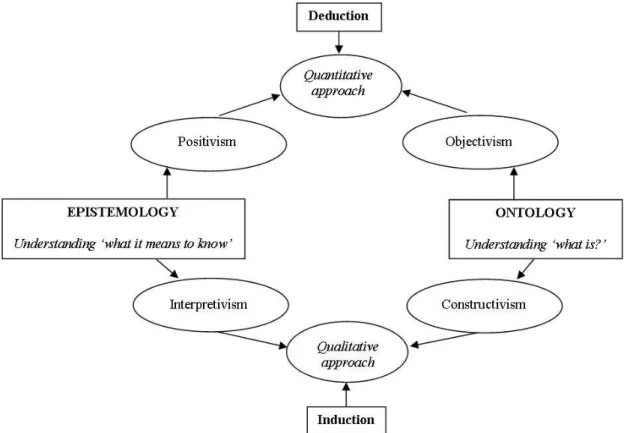
The overall philosophical underpinnings and research strategies between quantitative and qualitative research strategies is shown in the following diagram (figure 3-1).
Figure 3-1: the aspects of the quantitative and qualitative research approaches
So far the two separate research strategies have remained separate entities. Increasingly, however, research adopts both strategies in the same study. This approach is the mixed (or multi) methods approach and is outlined below.
3.4 The mixed methods approach
Researchers using a mixed-methods approach view that the distinctive epistemological and ontological assumptions of quantitative and qualitative research are able to be fused, they are compatible (Bryman, 2008). According to Kuhn (1996) however, paradigms are incommensurable so if quantitative and qualitative approaches are separate distinct paradigms then mixing them together is not possible.
As many researchers have adopted this type of approach and the technique has been used in an ever increasing number of research projects (Lipscombe, 2008, Bryman, 2008), there appears to be some room for manoeuvre. The
use of mixed-methods enables researchers to ‘triangulate’ the results of one part of the study with another, in essence cross-checking using different methods (Bryman, 2008 p611). Bryman (2008) believes that there are two versions of the nature of quantitative and qualitative research: an
epistemological version and a technical version. The epistemological version is essentially the paradigm argument. There are incompatible epistemological principles that make mixed methods impossible. Countering this is the
technical version in which prominence is given to the strengths of data collection and analysis. The epistemological assumptions of quantitative and qualitative research are not fixed; research methods are perceived as
autonomous. Creswell and Plano-Clark’s (2007) definition draws on this emphasis on data collection and analysis:
Mixed methods research is a research design with philosophical assumptions as well as methods of inquiry. As a methodology, it involves philosophical assumptions that guide the direction of the collection and analysis of data and the mixture of qualitative and quantitative approaches in many phases of the research process. As a method; it focuses on collecting, analysing, and mixing both quantitative and qualitative data in a single study or series of studies. Its central premise is that the use of quantitative and qualitative approaches in combination provides a better
understanding of research problems than either approach alone (Creswell and Plano-Clark, 2007 p5)
This lengthy definition is useful because it encompasses both the underpinnings of the research (assumptions) and techniques used in obtaining data. A more succinct definition from Johnson and Onwuegbuzie (2004) that mixed-methods research is “the class of research where the researcher mixes or combines quantitative and qualitative research
techniques, methods, approaches, concepts or language into a single study” emphasises the notion of combining strategies in some way, but steers clear of including the methodological assumptions.
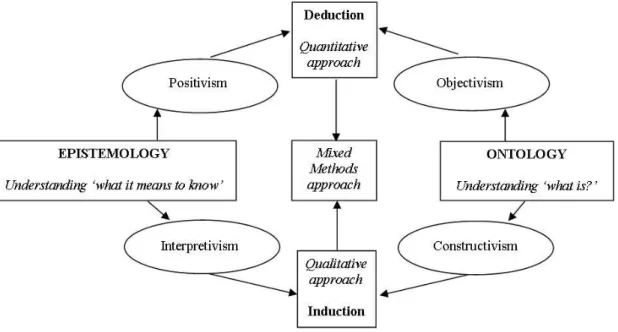
Figure 3-2: the aspects of the quantitative, qualitative, and mixed-method research approaches
Clearly when a challenge is made to a fundamental worldview some
controversy ensues. As has already been suggested if the research strategies are not considered incommensurable, then there appears little to prevent them being used together. Indeed many commentators (Johnson and Onwuegbuzie, 2004, Gilbert, 2006, Lipscombe, 2008, Morgan, 2007, Denscombe, 2008, Johnson et al., 2007)agree that mixed methods is a legitimate strategy that can - in some cases - provide superior results than either quantitative or qualitative research alone (Johnson and Onwuegbuzie, 2004) and raise the notion that mixed-methods should in fact be considered a third paradigm thus negating the argument against merging competing
paradigms (Johnson and Onwuegbuzie, 2004, Denscombe, 2008, Johnson et al., 2007). The idea of additional paradigms had in fact been extended with other commentators advocating five distinct traditions (Teddlie and
Tashakkori, 2009). Morgan (2007) justifies his view of mixed-methods being akin to a ‘pragmatic’ approach as during the design of research, data
collection, and data analysis “it is impossible to operate in either an
exclusively theory or data-driven fashion” (Morgan, 2007 p71). Teddlie and Johnson (2009) concur that pragmatism is the philosophical partner for mixed-methods that embraces and synthesises ideas from both sides (quantitative and qualitative). Patton (2002) agrees that pragmatism – being adaptable and creative – is a valid approach as gathering the most relevant information
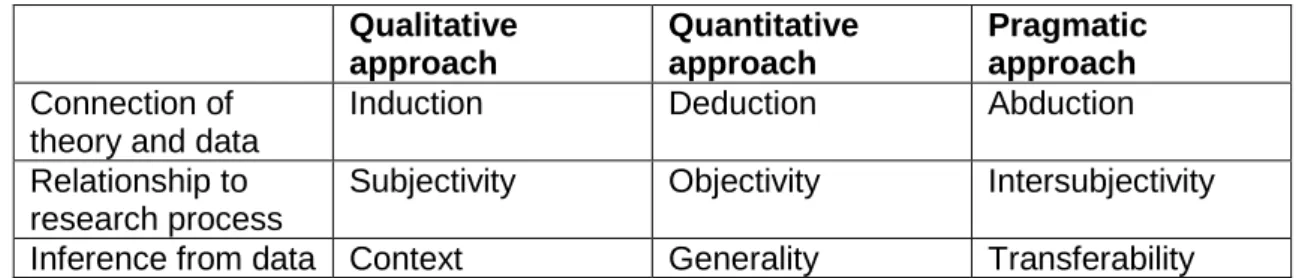
outweighs methodological purity. The pragmatic approach (table 3-2) relies on abductive reasoning that moves back and forth between deductive and
inductive reasoning.
Table 3-2: the different aspects of the qualitative, quantitative, and pragmatic research approaches (source: Morgan (2007)) Qualitative approach Quantitative approach Pragmatic approach Connection of
theory and data
Induction Deduction Abduction
Relationship to research process
Subjectivity Objectivity Intersubjectivity
Inference from data Context Generality Transferability
In this way observations are converted to theories which are then assessed through action. Morgan believes that researchers in the quantitative and qualitative fields would benefit from looking for ‘points of connection’ between the two approaches. Morgan also emphasises ‘intersubjectivity’ – moving between objectivity and subjectivity, thus negating any problems with single ‘real worlds’ and individual interpretations of that world; and ‘transferability’ – can the knowledge gained be transferred to other settings or contexts without abstract arguments regarding generalisations (Morgan, 2007 p72)?. Morgan’s view of pragmatism appears to offer a plausible approach, but is it really tenable in terms of mixed-methods research?
3.5 Pragmatism or a ‘pragmatic approach’?
The notion of pragmatism is not new, originating at the end of the 19th and start of the 20th centuries through various philosophers including Peirce, James and Dewey, and taken on more recently (neo-pragmatism) by such thinkers as Rorty and Putnam (see: Mounce, 1996, Goodman, 1995).
Pragmatism (according to James) is concerned with facts and concreteness; and is in essence an amalgam of ‘competing’ theories and practices (James, 1995). Pragmatism has evolved and developed and there are many variations on James’ theme, but the underlying principle common to all pragmatists is the emphasis on “usefulness” (Rorty, 1999, Cornish and Gillespie, 2009). Pragmatism is pluralist as it accepts the variety of competing interests and
forms of knowledge, allowing knowledge to be evaluated according to whether it works in relation to a particular goal (Cornish and Gillespie, 2009); focusing on what practical difference can be made, and whether any theory or idea is successful in accomplishing a desired effect (Baert, 2005, Plowright, 2011). This is all well and good, but so far this is pragmatic interpretation of findings – are they useful for a given interest?
In order for pragmatism to be relevant to the method or approach used to acquire knowledge, it is paramount that Morgan’s (2007) and Patton’s (2002) take on pragmatism – that it allows for shard meanings and joint actions; connecting theory and methods; and pursuing a desired end – be the founding premise of the research project at the outset. Once this view is endorsed the researcher must remain open-minded throughout so that any presuppositions and expectations can be affected by the research which can then change any informed view (Baert, 2004). The pragmatic approach is not the abstract pursuit of knowledge through enquiry, but the attempt to gain knowledge in the pursuit of a desired end (Morgan, 2007); and the
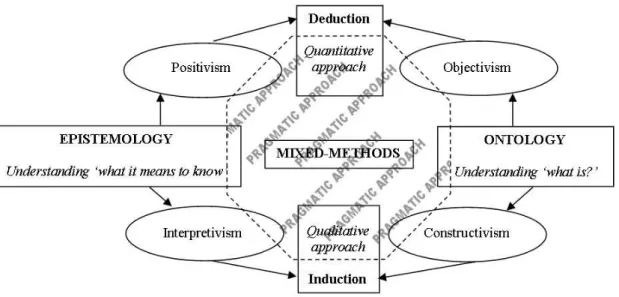
acknowledgement that there is no one ‘best’ method in achieving this end (Baert, 2004). Indeed Morgan goes further to suggest that the pragmatic approach should devote “equal attention to studying both the connection between methodology and epistemology and the connection between methodology and methods” (Morgan, 2007); and as such the pragmatic approach impacts on all aspects of a research study, constantly influencing philosophical assumptions and the research process (figure 8-3).
Figure 3-3: the revised relationships within the research process when a pragmatic approach is utilised
Figure 3-3 shows that whilst the mixed-methods research process still takes into account philosophical assumptions and alternative theoretical stances; these are peripheral to the central tenets of the two research approaches (qualitative and quantitative) which form the mixed-methods project and the core concept of the pragmatic approach that impacts on all aspects of the research process.
In sum the pragmatic approach recognises the validity of a variety of interests and perspectives; and that acquired knowledge is evaluated for whether it works in relation to a certain goal (Cornish and Gillespie, 2009). The
pragmatic approach by its very nature then offers leeway and compromise in the research process without impinging on validity, and seen in this light, mixed-methods appears a viable approach to take.
3.6 Mixed-methods – for and against
As has already been suggested there are difficulties with mixed-methods if looked at from the viewpoint of paradigms. Sale et al (2002) argues that the quantitative and qualitative paradigms do not measure the same phenomena and thus cannot be combined for cross validation. They suggest that although researchers from the two paradigms often appear to study the same
phenomena, the way these phenomena are labelled relates to different things. In quantitative research the label refers to an ‘external referent’, in qualitative research it is a personal interpretation (Sale et al., 2002 p48), and as such the only way for mixed-methods research to exist is as a separate paradigm. This view (upheld by Morgan (see table 3-2)) is not shared by others. Giddings and Grant (2007) believe pragmatism as outlined by Morgan is an “ideological position available within any paradigm rather than a paradigm in its own right” (Giddings and Grant, 2007 p53), in essence research can be done in a
pragmatic manner; although the traditional view of positivism and
interpretivism is more dogmatic than pragmatic. Giddings and Grant also believe that what is being ‘mixed’ influences the understanding of the strategy. They argue that often it is only the methods employed that are mixed, rather than the methodology, and these are ‘a-paradigmatic’ in the sense that any given method can be used in either paradigm (Giddings and Grant, 2007 p56). Indeed mixing methods from this viewpoint would be feasible within a single paradigm. Giddings (2006) raises the issue of how ‘mixed’ the research is. She states that “mixed methods as it is currently promoted is not a
methodological movement, but a pragmatic research approach that fits most comfortably within a postpositivist epistemology” (Giddings, 2006 p195) and backs up this assertion by claiming that mixed methods research “rarely reflects a constructionist or subjectivist view of the world. The majority of studies use the analytic and prescriptive style of positivism” (Giddings, 2006 p200). Whilst this may be true, it is only an observation and reflects the current state of research. Over the coming years this situation may reverse and interpretivism catches up. Johnson and Onwuegbuzie (2004) see no reason why mixed methods cannot have a dominant paradigm emphasising either qualitative or quantitative, or indeed for equal status to be given.
Perhaps the most comprehensive ‘dissection’ of mixed-method research is in a recent commentary by Symonds and Gorard (2008) who eloquently state the potential benefits and difficulties before concluding that the notion of paradigms has no place in social science research. They start by listing the rationale for mixed methods as follows:
Epistemological rationale
All methods and data types are classified within two distinct paradigms (quantitative and qualitative)
Elements from these two paradigms can coexist in a single study; and that this requires a third category
This third category should be a separate paradigm based on pragmatism
Empirical rationale
The focus is on ‘mixing’ the different elements
Using elements from competing approaches provides better quality data
Thus mixed methods is an effective research method
They then go on to counter these rationales within six areas.
1. Qualities of the data – although the two paradigms are based on differing data qualities (either objective or subjective; closed category data or open-ended data), it is argued that closed category data requires human perception in order to be created (a notion underlying much classification). The participant must understand the question and the terminology in order to proffer the response. In addition what the researcher decides to include can either reduce or increase the amount of objectivity. As such if all methods and evidence can be equally
subjective or objective, then there is no need for a third paradigm.
2. Data collection tools – in a similar manner both paradigms can use many of the same data collection tools (questionnaires, interviews, observation), it is quantifying or qualifying of the data that fits into a certain paradigm. So the assignment of data collecting tools into separate paradigms is based on ‘common use’ not their potential, as such mixed methods as a paradigm is not needed.
3. Sampling – large, potentially representative samples are linked to the quantitative paradigm, small non-representative samples to the
qualitative paradigm. It is argued however that small samples can be representative (30 out of 120 children at a primary school), and large samples may not be representative (2000 nurses out of the total within an industrialised country). As generalisations are not restricted to sample sise, nor a specific paradigm; mixed methods cannot claim that it is mixing different types of data in accordance with one paradigm or the other.
4. Type of data produced – linked to the sampling issue, quantitative data is numeric, qualitative is anything else. But very often the ‘number’ started out as something different (words on a questionnaire) and got counted. Therefore justifying mixed-methods as using two types of data is flawed as there is no justification for numbers to have a separate paradigm in the first place.
5. Validity – although validity checks in quantitative research often uses statistical analysis, as has already been described qualitative research may use similar checks. So the idea that mixed methods would need separate validity checks is irrelevant.
6. Method of analysis – there does not appear to be an obvious distinction between the two paradigms on this point. Both use data that can be counted, displayed pictorially or in maps, and can use statistical analysis. As no method of analysis is fixed to a paradigm, the separation is artificial and does not support mixed methods.
It follows that both quantitative and qualitative research can be seen as not having fixed, countering positions and are in fact not polarised, a pragmatic notion. In this case there is no need for a third paradigm, as there is ‘none’ to start with. Symonds and Gorard whilst appearing to quash the very idea of mixed methods are actually stating that in the effort to get mixed-methods to ‘fit’ within the paradigm argument commentators are creating unnecessary boundaries and limitations within the research arena, a pragmatic notion. Symonds and Gorard (2008) contend that often two types of data are used without being mixed, and that these should be referred to as ‘multiple-method’
research the likes of which should publish results separately; ‘true’ mixed-method research should purposefully integrate multiple techniques to create a final set of data. This is not a pragmatic view as there is surely no compulsion to mix the data; knowledge can be created from different sets of data and used to answer different questions quite legitimately within a single study. If different questions are answered then there may be justification in publishing results separately to enable more focus be given to a particular dataset. This does not mean that a mixed-methods study has not taken place as throughout any such study the researcher has worked with a mixed-method, pragmatic mentality to acquire the data. If desired triangulating findings in a mixed-methods study can be successfully accomplished and techniques for this have been outlined elsewhere (O’Cathain et al., 2010).
Symonds and Gorard (2008) along with Giddings (2006) and Giddings and Grant (2007) contest the notion of a third paradigm, but whereas Giddings, and Giddings and Grant, argue that mixed methods is not the third parad