San José State University
School of Social Work
ScWk 242, Research Methods, Data Analysis and Evaluation, Section 3
Course Code: 26994, Spring 2012
Instructor: Fred Prochaska, Ph.D., M.P.H., M.S.W.
Office Location: WSQ 217-I (shared with others)
Telephone: (408) 924-5849 (shared with others)
Email: [email protected]
Office Hours: Wednesdays 1 to 3 PM and
Fridays, 3 to 5 PM, or by appointment
Class Days/Time: Fridays, Noon to 2:45 PM
Classroom: SH 346
Prerequisites: ScWk 240
Faculty Web Page and MYSJSU Messaging
Copies of the course materials such as the syllabus, major assignment handouts, etc. may be found on my faculty web page at http://www.sjsu.edu/people/fred.prochaska or accessible through the Quick Links>Faculty Web Page links on the SJSU home page. You are responsible for regularly checking with the messaging system through MySJSU (or other communication system as indicated by the instructor).
Catalog Description
Basic concepts and models for research methodology applied to the analysis of data in social work. Emphasis on quantitative analysis, using statistics software. Qualitative research is also incorporated. (Prerequisite: ScWk 240, 3 Units).
Course Description
This required foundation year course provides students with the opportunity to apply concepts and skills for conducting research that were introduced last semester in ScWk 240. The course also emphasizes content designed to prepare students to build knowledge in the profession of social work, using both qualitative and quantitative methods. The course builds on the first semester by engaging students in the selection and implementation of appropriate methodology and analysis tools for the evaluation of social work practice and policy. These concepts and skills are applied to the further development of a research proposal, for which students laid the conceptual foundations in the ScWk 240 course. Students also apply these concepts and skills to the critical assessment of social work research on Latinos, African Americans, Asian Americans, and other diverse and oppressed populations. ScWk 242 concludes the first-year core research curriculum, which provides the conceptual knowledge and skills for the Master of Social Work Special Project (ScWk 298).
ScWk 242 presupposes a foundational knowledge of quantitative and qualitative research
methods, basic research design concepts, sampling methodology, models for group comparisons, single-system methodology, as well as basic computer literacy. Prerequisite: ScWk 240 or equivalent
The following Competencies/Program Objectives (PO) are realized through this course: PO 2. Apply social work ethical principles to guide professional practice
PO 3. Apply critical thinking to inform and communicate professional judgments
PO 4. Engage diversity and difference in practice
PO 6. Apply research skills to the evaluation of practice and the use of research to inform practice.
PO 7. Apply knowledge of human behavior and the social environment
PO10. Engage, assess, intervene, and evaluate with individuals, families, groups, organizations, and communities
Upon completion of ScWk 242 students will be able to:
1. Student demonstrates the ability to critically appraise, integrate and apply evidence-based knowledge and practice principles (Program Objective 3a)
2. Student demonstrates the capacity to gather assess and evaluate information to inform practice model design and use (Program Objective 3b)
3. Student demonstrates a beginning capacity and skills to gather and synthesize practice evaluation findings, including client feedback, to support and increase the professional knowledge base (Program Objective 6a)
4. Student demonstrates knowledge of how to consult and utilize research evidence to inform ongoing practice and policy at all levels (Program Objective 6b)
5. Student demonstrates a beginning ability to systemically monitor, analyze and evaluate interventions, including the use of evidence to determine future action (Program Objective 10d)
6. Student demonstrates knowledge of ethical decision making methods and the capacity to apply these in research (Program Objective 2c)
7. Student demonstrates the ability to critically evaluate the effectiveness of particular research methods within the transcultural perspective, for special populations and populations at risk including, cultural and ethnic minorities, women, gays and lesbians and the disenfranchised and other marginalized groups. (Program Objectives 3b; 5a)
8. Student demonstrates effective professional, oral and written communication skills in
understanding general process of social work research and application to real social problems. (Program Objective 3c)
Required Texts/Readings
The following textbooks are required:
Weinbach, R. W., & Grinnell, R. M. Jr. (2006). Statistics for social workers (7th ed.).
Boston: Allyn and Bacon.
Creswell, J. W. (2007). Qualitative inquiry and research design: Choosing among five traditions (2nd ed.). Thousand Oaks, CA: Sage.
The following textbooks used in ScWk 240 will also be used in ScWk 242:
American Psychological Association. (2009). Publication manual of the American
Psychological Association (6th ed.). Washington, DC: Author. ISBN 9781557987914. Available at Spartan Bookstore.
Pyrczak, F., & Bruce, R. R. (2011). Writing empirical research reports: A basic guide for students of the social and behavioral sciences (7th ed.). Los Angeles: Pyrczak Publishing. ISBN 1-884585-97-3. Available at Spartan Bookstore.
Rubin, A., Babbie, E., & Lee, P.A. (2008). Research methods for social work: Custom edition prepared exclusively for San Jose State University. Belmont, CA: Wadsworth/Thomson Learning.
School of Social Work Research Sequence. (2011). ScWk 240 course reader: articles assigned in ScWk 240.
Note: Some readings referred to on this syllabus were assigned during the Fall 2011 ScWk 240 course. In ScWk 240 the focus was on the conceptual foundations for the research. This semester some of these readings will be re-addressed, with special attention to the methodology and data analysis.
Library Liaison
For assistance in the library go to the King Library Reference Desk (2nd floor; 808-2100) and/or utilize the Social Work Research Guide available at http://libguides.sjsu.edu/scwk. The Social Work Library Liaison is: Teresa Slobuski, [email protected] or
408-808-2318.
Classroom Protocol
• Each student is expected to attend all class sessions on time, complete all readings before coming to class and participate in class discussion. Students are expected to share ideas, listen to the ideas of others and participate in class discussions. There will be periodic in-class assignments of written review/summary of presentations, discussions and debates.
• If you are not attending class, you are not participating. According to University policy F69-24, “Students should attend all meetings of their class, not only because they are responsible for material discussed therein, but because active participation is frequent essential to insure maximum benefit for all members of the class. Attendance per se shall not be used as a criterion for grading.”
• During the class session, personal business is the secondary priority. This includes cell phone conversation, text messaging, emailing, web surfing, making social plans, or reading/studying for other classes. Laptops are allowed for note-taking only. For expectation about classroom behavior, see Academic Senate Policy S90-5 on Student Rights and Responsibilities found at: http://www.sjsu.edu/senate/s90-5.htm
• The MSW is a professional degree and appropriate professional behavior expected. Chronic tardiness, more than one unexcused absence, and/or disruptive behavior (including the use of laptops for other than class-related activities, texting during the class) will be reflected in the participation grade. Class attendance will be usually taken and recorded during the first part of class sessions. Timely communication with the instructor is expected. All class time is valuable, and if a student needs to leave due to illness or emergency, the instructor expects to be informed.
Dropping and Adding
Students are responsible for understanding the policies and procedures about add/drops, academic renewal, etc. Refer to the current semester’s Catalog Policies section at
http://info.sjsu.edu/static/catalog/policies.html. Add/drop deadlines can be found on the current academic calendar web page located at
http://www.sjsu.edu/academic_programs/calendars/academic_calendar/.
The Late Drop Policy is available at http://www.sjsu.edu/aars/policies/latedrops/policy/. Students should be aware of the current deadlines and penalties for dropping classes.
Assignments and Grading Policy
Assignment Points Due Date Course Student Learning Objective/Competency
(SLO)
Assignment 1: Qualitative Article Critique
15 2/17/12 SLO: 3a, 3b, 6a, 6b, 2c
Assignment 2: Qualitative Analysis Labs 1-3 15 3/2/12 SLO: 3a, 3b, 10d Assignment 3: Quantitative Article Critique
15 4/6/12 SLO: 3a, 3b, 6a, 6b, 2c
Assignment 4: Quantitative Analysis Labs 1-6
Exam 20 5/4/12 SLO: 3a, 3b, 6a, 6b, 2c, 10d Assignment 5:
Revised methods and analysis plan for ScWK 240 proposal
10 5/11/12 SLO: 3b, 5a
Participation 10 SLO: 3c
The grading and evaluation distribution for the class is outlined below.
Percentage. Grade. 97-100%. A + 93-96%. A. 90-92%. A - 87-89%. B + 83-86%. B. 80-82%. B - 77-79%. C + 73-76%. C. 70-72%. C - 67-69%. D + 63-66%. D. 60-62%. D - Below 60%. F..
Penalty for Late Work
Late submission of assignments will result in a deduction in points and delayed review. If you submit an assignment after the due date and time without discussing with me, 10% of the total assignment point value will be deducted automatically. For example, if an assignment is worth 20 points, 2.0 points will be deducted prior to grading. Another 10% of the total grade will be deducted for each additional week, or fraction thereof, that the assignment is late. You can avoid the late deduction(s) by planning ahead and contacting me to make alternative arrangements. If you are unable to submit an assignment by the date and time indicated on this syllabus (or announced in class), you must discuss your situation with me at least 48 hours prior to the time the assignment is due.
Assignment 1: Qualitative Article Critique
Assignment 1 includes a qualitative article critique. Students will choose a qualitative article from ScWk 240 listed on the assignment directions and will write a 3-4 page (double-spaced) APA formatted article critique. Specific assignment directions will be provided in class. Assignment is worth 15 points and is due 2/17/12
Assignment 2: Qualitative Labs 1-3
Assignment 2 includes 3 qualitative analysis labs. Each lab will include a written report of no more than 2 pages (double-spaced, total of 6 pages for all 3 labs) that includes an analysis of qualitative data generated from: 1) interviews, 2) focus groups, and 3) observations. Data will be obtained through in-class exercises. Specific assignment directions will be provided in class. Assignment is worth 15 points and is due 2/29/12.
Assignment 3: Quantitative Article Critique
Assignment 3 includes a quantitative article critique. Students will choose a quantitative article from ScWk 240 listed on the assignment directions and will write a 3-4 page (double-spaced) APA formatted article critique. Specific assignment directions will be provided in class. Assignment is worth 15 points and is due 4/6/12.
Assignment 4: Quantitative Labs 1-6
Quantitative labs will use the Statistical Package for the Social Sciences (SPSS) computer program and the quantitative labs will involve hands-on exercises with the computer, utilizing SPSS for Windows for data analysis. Students will complete formal lab exercises involving the analysis of data provided by the instructor. Skills and examples necessary to complete these exercises will be taught and can be completed in class or on your own time. This information will be directly applicable to material covered in the course examinations. The main analysis topics are as follows: Chi-square test, t-test (dependent and independent), ANOVA, correlation and multiple regression. Write-ups for the 6 labs are worth 15 points and are due 4/27/12.
Exam
This exam will cover all course materials, i.e., readings, lecture notes, class examples, and lab material. The format of this exam may consist of short answer and essay questions that will ask you to synthesize what you have learned and apply it to an area of social work practice. Multiple-choice questions may also be included The exam is worth 20 points and will take place on 5/4/12.
Assignment 5: Revised methods and analysis plan for ScWK 240 proposal
This is an extension of your research proposal begun in ScWk 240. It is the application of both the methodological and analysis skills learned during the first year of the MSW research sequence. In particular, you will be asked to 1) refine your research methodology begun in ScWk 240, 2) add an analysis section which outlines which analysis procedures and statistical tests you will employ, and 3) revise your demographics questionnaire, quantitative instrument(s), and a qualitative interview guide as needed. Assignment 5 is worth 10 points and is due 5/11/12.
Class Participation: Class participation will be assessed according to engagement in class discussions and involvement in-group exercises.
APA Format and Writing Requirements:
ScWk 242 papers must follow current American Psychological Association (APA) format
guidelines (6th edition) with the following exceptions: (1) margins should be 1.00 inches left and 1.00 inches top, right, and bottom; (2) pages must be consecutively numbered within either the top right or bottom center margins starting with the abstract; and (3) the use of running heads is optional. All papers must use standard, 12-point fonts (e.g., Times Roman) and be free of typographical, formatting, spelling, and content errors. Be sure to carefully review and edit all drafts prior to submission. All ideas, quotes, and information taken or derived from other sources must be appropriately cited and referenced in accordance with APA rules.
Use of Turnitin.com:
Due to the increase of scholarly works being plagiarized, San José State University and its faculty are beginning to implement safeguards, one of which is an electronic anti-plagiarism service called Turnitin.com. For the protection and education of all students, using an anti-plagiarism service will add your scholarly papers to the academic database so that others cannot plagiarize your hard work. Details will be discussed in class.
University Policies Academic integrity
Your commitment as a student to learning is evidenced by your enrollment at San Jose State University. The University’s Academic Integrity policy, located at
http://www.sjsu.edu/senate/S07-2.htm, requires you to be honest in all your academic course work. Faculty members are required to report all infractions to the office of Student Conduct and Ethical Development. The Student Conduct and Ethical Development website is available at http://www.sa.sjsu.edu/judicial_affairs/index.html.
Instances of academic dishonesty will not be tolerated. Cheating on exams or plagiarism
(presenting the work of another as your own, or the use of another person’s ideas without giving proper credit) will result in a failing grade and sanctions by the University. For this class, all assignments are to be completed by the individual student unless otherwise specified. If you would like to include your assignment or any material you have submitted, or plan to submit for another class, please note that SJSU’s Academic Policy S07-2 requires approval of instructors.
Campus Policy in Compliance with the American Disabilities Act
If you need course adaptations or accommodations because of a disability, or if you need to make special arrangements in case the building must be evacuated, please make an appointment with me as soon as possible, or see me during office hours. Presidential Directive 97-03 requires that students with disabilities requesting accommodations must register with the Disability Resource Center (DRC) at http://www.drc.sjsu.edu/ to establish a record of their disability.
School of Social Work Policies
School of Social Work Writing Policy
The Instructor will return selected assignments (as specified elsewhere in the syllabus) ungraded if at least five unique errors are found in grammar, punctuation, sentence structure, spelling, typos, APA style, or other basic writing errors. Late penalty points may apply, as specified in the syllabus.
A unique error is an error that will be counted 1 time. For example, if a possessive
apostrophe is left off of a word 5 times in a paper, it will be counted as 1 error (i.e. a possessive apostrophe error). It is the student’s responsibility to make corrections throughout the paper and ensure there are no additional instances of the error in the paper before re-submitting the paper and submitting next assignments.
ScWk 240/242 and Social Work Professional Writing Competency Policy
Students admitted after September 1, 1987 must comply with the English Competency policy adopted by the Academic Senate of SJSU (S94-7). In the MSW Program the Professional Writing Competency policy is that all students must successfully pass a written assessment assignment administered in ScWk 240 (i.e., Assignment #3). Students who do not pass the written assessment assignment in ScWk 240 may be reassessed in ScWk 242 through the final research proposal. Please refer to the full policy located at the end of the syllabus.
University Resources
Student Technology Resources
Computer labs for student use are available in the Academic Success Center located on the 1st floor of Clark Hall and on the 2nd floor of the Student Union. Additional computer labs may be available in your department/college. Computers are also available in the Martin Luther King Library. A wide variety of audio-visual equipment is available for student checkout from Media Services located in IRC 112. These items include digital and VHS camcorders, VHS and Beta video players, 16 mm, slide, overhead, DVD, CD, and audiotape players, sound systems, wireless microphones, projection screens and monitors.
Learning Assistance Resource Center
The Learning Assistance Resource Center (LARC) is located in Room 600 in the Student Services Center. It is designed to assist students in the development of their full academic potential and to inspire them to become independent learners. The Center's tutors are trained and nationally certified by the College Reading and Learning Association (CRLA). They provide content-based tutoring in many lower division courses (some upper division) as well as writing and study skills assistance. Small group, individual, and drop-in tutoring are available. Please visit the LARC website for more information at http://www.sjsu.edu/larc/.
SJSU Writing Center
The SJSU Writing Center is located in Room 126 in Clark Hall. It is staffed by professional instructors and upper-division or graduate-level writing specialists from each of the seven SJSU colleges. Our writing specialists have met a rigorous GPA requirement, and they are well trained to assist all students at all levels within all disciplines to become better writers. The Writing Center website is located at http://www.sjsu.edu/writingcenter/about/staff/.
Peer Mentor Center
The Peer Mentor Center is located on the 1st floor of Clark Hall in the Academic Success Center. The Peer Mentor Center is staffed with Peer Mentors who excel in helping students manage university life, tackling problems that range from academic challenges to interpersonal struggles. On the road to graduation, Peer Mentors are navigators, offering “roadside assistance” to peers who feel a bit lost or simply need help mapping out the locations of campus resources. Peer Mentor services are free and available on a drop –in basis, no reservation required. The Peer Mentor Center website is located at http://www.sjsu.edu/muse/peermentor/
ScWk 242, Research Methods, Data Analysis and Evaluation, Spring
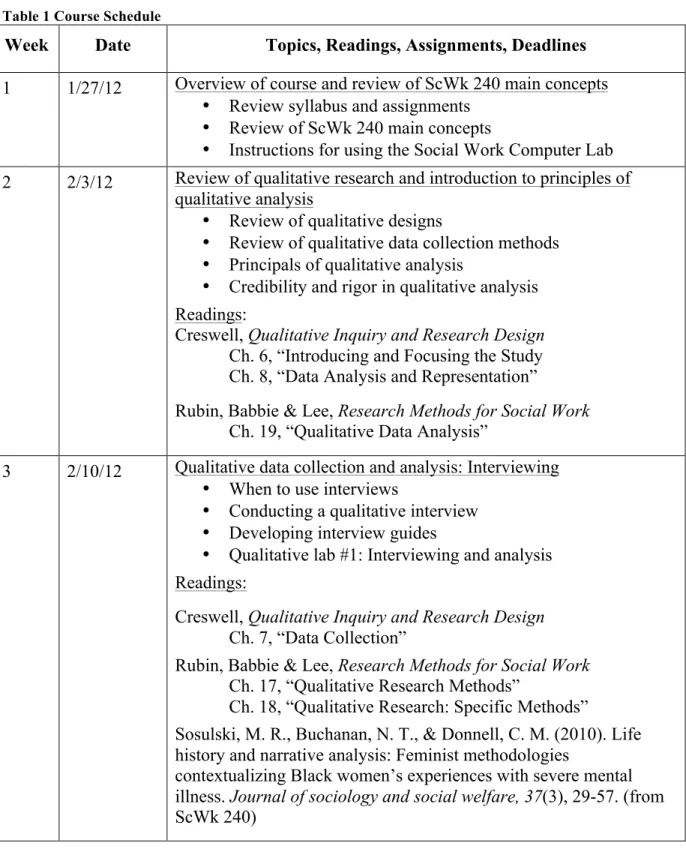
2012, Course Schedule
This schedule is subject to change with fair notice. I will announce any changes in class.
Table 1 Course Schedule
Week Date Topics, Readings, Assignments, Deadlines
1 1/27/12 Overview of course and review of ScWk 240 main concepts • Review syllabus and assignments
• Review of ScWk 240 main concepts
• Instructions for using the Social Work Computer Lab 2 2/3/12 Review of qualitative research and introduction to principles of
qualitative analysis
• Review of qualitative designs
• Review of qualitative data collection methods • Principals of qualitative analysis
• Credibility and rigor in qualitative analysis Readings:
Creswell, Qualitative Inquiry and Research Design
Ch. 6, “Introducing and Focusing the Study Ch. 8, “Data Analysis and Representation” Rubin, Babbie & Lee, Research Methods for Social Work
Ch. 19, “Qualitative Data Analysis”
3 2/10/12 Qualitative data collection and analysis: Interviewing • When to use interviews
• Conducting a qualitative interview • Developing interview guides
• Qualitative lab #1: Interviewing and analysis Readings:
Creswell, Qualitative Inquiry and Research Design
Ch. 7, “Data Collection”
Rubin, Babbie & Lee, Research Methods for Social Work
Ch. 17, “Qualitative Research Methods”
Ch. 18, “Qualitative Research: Specific Methods”
Sosulski, M. R., Buchanan, N. T., & Donnell, C. M. (2010). Life history and narrative analysis: Feminist methodologies
contextualizing Black women’s experiences with severe mental illness. Journal of sociology and social welfare, 37(3), 29-57. (from ScWk 240)
Week Date Topics, Readings, Assignments, Deadlines
4 2/17/12 Qualitative data collection and analysis: Focus Groups • When to use focus groups
• Conducting focus groups
• Developing focus group questions
• Qualitative lab #2: Focus group and analysis Readings:
Creswell, Qualitative Inquiry and Research Design
Ch. 9, “Writing the Narrative Report
Ch. 10, “Standards of Quality and Verification” (review from ScWk 240)
Assignment #1: Qualitative Article Critique due
5 2/24/12 Qualitative data collection and analysis: Observation • When to use observation
• Conducting observations
• Developing observation protocols and field notes • Qualitative lab #3: Observation and analysis Readings:
Creswell, Qualitative Inquiry and Research Design
Ch. 11, “Turning the story and conclusion”
6 3/2//12 Review of quantitative designs and introduction to principles of quantitative analysis
• Review of quantitative research designs
• Review of quantitative data collection methods • Principles of quantitative analysis
• Descriptive statistics with categorical variables (frequency and percentage) and continuous variables (mean, range, standard deviation)
• Introduction to SPSS in the computer lab • Generating descriptive statistics in SPSS Readings:
Weinbach & Grinnell, Statistics for Social Workers
Ch. 1, “Introduction”
Ch. 2, “Frequency Distributions and Graphs”
Ch. 3, “Measures of Central Tendency and Variability”
Week Date Topics, Readings, Assignments, Deadlines
7 3/9/12 Descriptive statistics continued and introduction to testing hypotheses
• Descriptive statistics continued
• Generating descriptive statistics in SPSS continued • Statistical significance and null hypothesis
• Normal curves, outliers, confidence level • Parametric and nonparametric tests Readings:
Rubin, Babbie, & Lee, Research Methods for Social Work, Supplement Ch. 15, “Analyze This...”
Supplement Ch. 16, “Basic Statistical Analysis Using SPSS” Supplement Ch. 17, “Data Tips and SPSS Settings”
Supplement Ch. 18, “Common SPSS Procedures”
Supplement Ch. 19, “SPSS Exercise on Basic Recoding and Computing”
Weinbach & Grinnell, Statistics for Social Workers
Ch. 4, “The Normal Distribution”
Ch. 5, “The Basics of Hypothesis Testing”
Ch. 6, “Sampling Distributions and the Hypothesis Testing”
8 3/16/12 Working with Cross-tabulations • When to use a Chi-square test
• Relationships involving nominal variables • Binomial test and one variable Chi-Square test
• Cross-tabulations and Chi-Square test of association or independence
• SPSS Lab #1: Chi-Square Readings:
Rubin, Babbie, & Lee, Research Methods for Social Work, Chap. 20, “Quantitative Data Analysis”
Chap. 21, “Inferential Data Analysis: Part 1” Chap. 22, “Inferential Data Analysis: Part 2” Weinbach & Grinnell, Statistics for Social Workers
Ch. 7, “Selecting a Statistical Test” Ch. 10, “Cross-Tabulation”
Week Date Topics, Readings, Assignments, Deadlines
9 3/23/12 Comparing Two Groups, t-Tests • When to use a t –Test
• Dichotomous variables with continuous variables
• Comparing two independent means, the independent-samples
t-Test
• Comparison of pre- and post-test means, the paired samples t -Test
• SPSS Lab #2: Dependent t test Readings:
Weinbach, & Grinnell, Statistics for Social Workers
Ch. 11, “t-Tests and Analysis of Variance”
10 3/30/12 Spring Break!
11 4/6/12 Comparing Two Groups, t-Tests continued and introduction to ANOVA (comparing 3 or more groups)
•
• SPSS Lab #3: Independent t-test
• One-way and two-way, between-groups and within subjects ANOVA
• Beginning SPSS Lab #4: ANOVA Readings:
Weinbach & Grinnell, Statistics for Social Workers
Ch. 11, “t-Tests and Analysis of Variance” (Repeat from Week 9)
Assignment 3: Quantitative Article Critique due
12 4/13/12 ANOVA continued and introduction to correlation • Complete SPSS Lab #4 ANOVA
• Correlation: Relationships between continuous variables, Pearson’s r
• SPSS Lab #5: Correlation Readings:
Weinbach & Grinnell, Statistics for Social Workers
Week Date Topics, Readings, Assignments, Deadlines
13 4/20/12 Simple and Multiple (Linear) Regression (multivariate models) • Introduction to multivariate models
• When to use multivariate models
• Use of “dummy” coding in multiple (linear) regression • Lab #6: Multiple regression
Readings:
Weinbach & Grinnell, Statistics for Social Workers
Ch. 9, “Regression Analysis”
14 4/27/12 Multiple regression continued and introduction to logistic regression • Multiple regression continued
• Introduction to logistic Regression and dichotomous outcomes
• Testing models with multivariate analysis Readings:
Weinbach & Grinnell, Statistics for Social Workers
Ch. 9, “Regression Analysis”
Assignment 4: Quantitative Labs 1-6 write-ups due
15 5/4/12 Applying course concepts to analysis section of the ScWk 240 paper • How to decide on an analysis plan for your paper
Exam
16 5/11/12 Course Review
• Course review and celebration • Preparation for ScWk 298
Assignment 5: Revised methods and analysis plan for ScWk 240 proposal due
RESEARCH SEQUENCE BIBLIOGRAPHY
Bloom, M., Fischer, J., & Orme, J. G. (2006). Evaluating practice: Guidelines for the accountable professional (5th ed.). Boston, MA: Allyn & Bacon.
Bye, L., & Alvarez, M. (2007). School social work: Theory to practice. Belmont, CA: Thomson Brooks/Cole.
Cox, D., & Pawar, M. (2006). International social work: Issues, strategies, and programs. Thousand Oaks, CA: Sage Publications.
Fong, R., & Furuto, S. (2001). Culturally competent practice. Boston, MA: Allyn & Bacon. Frame, M. W. (2003). Integrating religion and spirituality into counseling: A comprehensive
approach. Belmont, CA: Thomson Brooks/Cole.
Gibbs, J.T., & Huang, L.N. (2003). Children of color: Psychological interventions with culturally diverse youth (2nd ed.). San Francisco, CA: Jossey-Bass Publishers. Glicken, M. D., & Sechrest, D. K. (2003). The role of the helping professions in treating the
victims and perpetrators of violence. Boston, MA: Allyn & Bacon.
Johnson, J. (2004). Fundamentals of substance abuse practice. Belmont, CA: Thomson Brooks/Cole.
McGoldrick, M., Giordano, J., & Garcia-Preto, N. (2005). Ethnicity and family therapy (3rd ed.). New York: Guilford Press.
McInnis-Dittrich, K. (2005). Social work with elders: A biopsychosocial approach to assessment and intervention. Boston, MA: Pearson Education, Inc.
Moniz, C. & Gorin, S. (2007). Health and mental health care policy: A biopsychosocial perspective (2nd ed.). Boston, MA: Allyn & Bacon.
Morgan, D. L. (1988). Focus groups as qualitative research. Newbury Park, CA: Sage Press. Neukrug, E. S., & Fawcett, R. C. (2006). Essentials of testing and assessment: A practical guide
for counselors, social workers, and psychologists. Belmont, CA: Thomson Brooks/Cole. Polansky, N. A. (1986). There is nothing so practical as a good theory. Child Welfare, 65(1),
3-15.
Rothman, J. (2003). Social work practice across disability. Boston, MA: Allyn & Bacon. Royse, D., Thyer, B. A., Padgett, D. K., & Logan, T. K. (2006). Program evaluation: An
introduction (4th ed.). Belmont, CA: Wadsworth Publishing.
van Wormer, K., Wells, J., & Boes, M. (2000). Social work with lesbians, gays and bisexuals: A strengths perspective. Boston, MA: Allyn & Bacon.
Winton, M. A., & Mara, B. A. (2001). Child abuse and neglect: Multidisciplinary approaches. Boston, MA: Allyn & Bacon.
Social Work Professional Writing Competency Policy and The Graduate Writing Assessment Requirement (GWAR)
Students admitted after September 1, 1987 must comply with the English Competency policy adopted by the Academic Senate of SJSU (S94-7). This policy states: “…all students entering California State Universities after implementation of the proficiency / diagnostic examination shall be required to demonstrate their competency with regard to writing skills as a requirement for graduation.” In addition to these admission requirements, “…each department may establish its own criteria within these policy guidelines and candidates must abide by the department decision” (see http://info.sjsu/web-dbgen/catnarr/policies/n15.html, Nov. 2, 2001). Current Implementation of Policy
1. In the MSW Program the Professional Writing Competency policy is that all students must successfully pass a written assessment assignment administered in ScWk 240. This policy applies to all students, including those who have already passed:
• English 100W (or equivalent). • The WST exam.
• TOEFL
2. Transfer students from other graduate programs within or outside the state of
California, as well as BASW students who are substituting another course for ScWk 240, must also complete the written assessment assignment.
3. If a student is deficient in writing ability, the student will be referred to the Graduate Advisor to develop a remedial plan. The student may also be reassessed in ScWk 242.
4. Students must successfully complete the Professional Writing Competency requirement before they can be advanced to candidacy with Graduate Studies & Research during fall semester of their final year. Students must also successfully complete this requirement prior to enrolling in ScWk 298.
San José State University
Social Work Programs Evaluation and Grading Criteria
Instructors in the Social Work program promote and evaluate critical thinking1 and communication2 skills to help
students achieve academic and professional excellence. These skills encompass one’s ability to organize ideas, reason concretely and abstractly, and apply objective and subjective reasoning to ideas, situations, and theories. One method to evaluate students’ critical thinking and communication skills is via written assignments. The
Publication Manual of the American Psychological Association (APA; 5th ed.) is a format guide widely used in
many social work assignments. However, alternate formats may be expected for writing assignments such as, but not limited to, process recordings, case or progress notes, court reports, and bio-psycho-social and family
assessments. Please refer to your course syllabus for guidance on APA assignment requirements. If you need writing or editing assistance, please consult with your instructor.
Grades are calculated based upon the scale below:
98-100 A+ 87-89 B+ 77-79 C+ 67-69 D+ 59 or less F
93-97 A 83-86 B 73-76 C 63-66 D
90-92 A- 80-82 B- 70-72 C- 60-62 D-
Plagiarism3 is unacceptable. It may be monitored by your instructor with commercial plagiarism detection services.4
Cheating is also unacceptable. 5 Any student who plagiarizes or cheats will be dealt with according to San José State
University policies and procedures, which may include expulsion from the university.
______________________________________
1 Critical thinking is the use of intellectual skills that address relevance, accuracy, clarity, depth, and breadth of ideas,
situations, and theories. It enables one to self-assess mindfully her or his understanding and thought processes; it includes analyzing an issue or situation, its context, and its elements from multiple perspectives; and, it generates self-improvement as one becomes sophisticated in theorizing, conceptualizing, and communicating.
2 Communication is fundamental to social work and occurs in written, oral, and nonverbal forms. All
communications, including case notes, reports, and proposals, should be clear and cohesive. Effective communication is essential to effective and efficient social work practice on micro, mezzo, and macro levels.
3 According to SJSU Academic Senate policy F88-10, “. . . plagiarism is the act of representing the work of another
as one’s own (without giving appropriate credit) regardless of how that work was obtained, and submitting it to fulfill academic requirements. Plagiarism at SJSU includes, but is not limited to, 1.2.1. The act of incorporating the ideas, words, sentences, paragraphs, or parts thereof, or the specific substance of another’s work, without giving appropriate credit, and representing the product as one’s own work”
(http://www.cob.sjsu.edu/FACSTAFF/KWAN_S/conduct.htm).
4 See Academic Senate policy on plagiarism detection (http://www.sjsu.edu/senate/S02-4.htm)
5 At SJSU, cheating is the act of obtaining or attempting to obtain credit for academic work through the use of any
dishonest, deceptive, or fraudulent means. Cheating at SJSU includes but is not limited to:
Copying in part or in whole, from another’s test or other evaluation instrument; submitting work previously graded in another course unless this has been approved by the course instructor or by departmental policy; submitting work simultaneously presented in two courses, unless this has been approved by both course instructors or by
departmental policy; altering or interfering with grading or grading instructions; sitting for an examination by a surrogate, or as a surrogate; any other act committed by a student in the course of his or her academic work which defrauds or misrepresents, including aiding or abetting in any of the actions defined above.
SJSU Campus Emergency Procedures
FIRES EARTHQUAKES AND OTHER DISASTERS
• Call 911 or use a blue light telephone to summon University Police assistance for all campus police, fire or medical emergencies. Give your name, the nature of the emergency and your specific location. Stay on the line until the University Police Dispatcher tells you to hang up. • Use extinguishers for minor fires. If a fire appears uncontrollable, close all room doors to
confine the fire and evacuate the area or building.
• Remain calm during an earthquake. “Duck and cover” under a desk or table or stand in a doorway or against an interior wall. Move away from exterior wall windows, overhead lights, etc. Wait at least two minutes after shaking stops before leaving a building. Move to a dear area well away from structures or overhead hazards such as trees or power lines.
• Help disabled persons evacuate the building. Follow instructions of Building Emergency Team members and University Police.
• Tune to radio station KSJS 90.7 FM for campus information.
MEDICAL EMERGENCIES
• Call 911. Give your name, the nature of the emergency and your specific location. Tell the University Police Dispatcher what assistance you need (ambulance, paramedics, etc.) • Assist the victim until help arrives. If you or someone in the area is trained in CPR perform
CPR or Rescue Breathing if necessary. Stop the bleeding with direct pressure to the wound. Do not move a victim unless his or her life is in immediate danger. Do not leave victims unattended.
• For first aid, report in person to the Student Health Center weekdays from 8:00 am - 5:00 pm or call University Police at 924-2222.
EVACUATION PROCEDURES
• Leave by the nearest safe exit when you hear the building emergency alarm (fire alarm) or if you are told to do so by University Police or a Building Emergency Team member.
• Take keys, books, wallets or billfolds, prescription medicines and important personal
belongings with you in case this building cannot be reentered immediately. Move at least 150 feet away from all structures.
• Use the stairs. Do not use elevators — in case of fire or earthquake many elevators stop in place and you may be trapped.
• Reenter a building only when University Police or Building Emergency Team members tell you that it is safe to do so.
POLICE - FIRE - MEDICAL EMERGENCY DIAL 9 – 1 – 1