On the Use of Behavioural Equivalences for Web Services’
Development
∗Filippo Bonchi, Antonio Brogi, Sara Corfini, Fabio Gadducci Department of Computer Science
University of Pisa, Italy
{fibonchi,brogi,corfini,gadducci}@di.unipi.it
Abstract. Web services are emerging as a promising technology for the development of next
gener-ation distributed heterogeneous software systems. We define a new behavioural equivalence for Web services, based on bisimilarity and inspired by recent advances in the theory of reactive systems. The equivalence is compositional and decidable, and it provides a firm ground for enhanced behaviour-aware discovery and for a sound incremental development of services and service compositions.
1.
Introduction
Web services are emerging as a promising technology for the development of next generation distributed heterogeneous software systems [33]. Roughly, a Web service is any piece of software that makes itself available over the Internet. A Web service is identified by a URI, it is universally accessible by means of standard protocols (WSDL [45], UDDI [42], SOAP [44]), and it self-describes its functionalities by exposing a public interface.
WSDL [45] is the currently employed standard for describing services. A WSDL description details what a service provides, by listing its operations in terms of input and output messages, and how a service can be invoked, by specifying one or more network locations where it can be accessed. WSDL descriptions do not include any information on the interaction behaviour of services, that is, on the order with which messages can be received or sent by each service. Unfortunately, the lack of behavioural information inhibits the possibility of a priori determining whether two services have the same behaviour as well as the possibility of verifying properties of service compositions, such as deadlock-freedom.
Various proposals have been recently put forward to feature more expressive service descriptions that include both semantics (viz., ontology-based) and behaviour information about services. One of the ∗
major efforts in this direction is OWL-S [35], a high-level ontology-based language for describing ser-vices. Since OWL-S is a computer-interpretable semantic mark-up language providing all the needed information for describing services, OWL-S paves the way for the full automation of service discovery, invocation and composition. In particular, OWL-S service descriptions include a declaration of the inter-action behaviour of services (the so-called process model), which provides the needed information for the a priori analysis and verification of service invocations and compositions.
The objective of this paper is to define a notion of behavioural equivalence for Web services. An immediate application of such a notion is the possibility of establishing whether syntactically different services feature the same behaviour, and hence for instance of verifying whether the upgrade of a ser-viceS with a new versionS0 may affect the interoperability with existing clients ofS. The availability of a well-founded notion of behavioural equivalence can also be exploited to develop enhanced service discovery techniques so as to go beyond functional matching and determine whether a given service (or service composition) features a desired interaction behaviour. Two fundamental properties of any equiv-alence relation are computability and compositionality. Computability is a key requirement in ensuring the viability of an equivalence relation, that is, in allowing the development of automated software capa-ble of determining whether two services are behaviourally equivalent or not. Compositionality permits to exploit the equivalence relation for a disciplined incremental development of services, by means of sound compositions and replacements. Namely, compositionality permits for instance to verify whether a sub-serviceP of a serviceScan be replaced by a new versionP0 without altering the behaviour of the entire service.
In this paper we first show how the behaviour of a Web service can be suitably described by means of a Petri net. Petri nets [39] are one of the best known and most widely adopted formalisms to express the concurrent behaviour of (software) systems. Besides providing a clear and precise semantics, Petri nets feature an intuitive graphical notation, and a number of techniques and tools for their analysis, simulation and execution are available. Petri nets have also been already employed to model Web services (e.g., see [17, 25, 3]). We introduce a simple variant of standard condition/event Petri nets (viz., CPR nets for Consume-Produce-Read nets) to naturally model the behaviour of Web services, and in particular the persistence of data. We then show how OWL-S process models can be directly mapped into CPR nets, borrowing from the translation from OWL-S to place/transition nets (P/T for short) described in [13].
Our next step is the identification of a suitable behavioural equivalence for our class of nets. Indeed, the dynamics of a Petri net, as well as those of most functional and process calculi, is usually defined in terms of reduction relations among its markings (viz., the states of a system). Despite its simplicity, the main drawback of reduction semantics is poor compositionality, in the sense that the dynamic behaviour of an arbitrary stand alone net may become unpredictable whenever it becomes a part of a larger net. Recently, Leifer and Milner [21] devised a methodology for distilling from a reduction relation a set of labels satisfying suitable requirements of minimality, in order to build a labelled reduction relation, such that the associated behavioural notion of bisimilarity is a compositional equivalence. The methodology has been later applied to P/T nets [30] as well as to their condition/event variant [41] (C/E for short). Thus, after discussing a motivating example, we define a novel notion of net equivalence, based on bisimilarity and inspired by the recent theoretical advances we just mentioned above. We show that this new equivalence relation is indeed compositional (i.e., it is a congruence), and that it is also decidable.
This paper is an extended version of [8]. Besides adding the formal proofs of the statements occurring there, the paper presents (1) the formal encoding from OWL-S to open CPR nets, only sketched in the original paper, as well as (2) a sample scenario discussing the issue of service replaceability, inspired by a
case study proposed by the European project SENSORIA. Moreover, (3) the streamlining of the decidable equivalence presented in [8], by proving that it coincides with weak bisimilarity: the latter equivalence is well-known in the literature, and thus easier to be understood and automatically checked with available tools. We believe that such a flexible notion of service equivalence allows for fruitful applications at the design level. It is worth mentioning here that in [9], exploiting the behavioural congruence introduced in [8] and making use of the formal encoding of OWL-S presented here, we extend the sample scenario (2) to outline a formal methodology addressing two main issues in Service-oriented Computing, i.e., publication of correct service specifications and replaceability of (sub)services.
The rest of the paper is organised as follows. In Section 2 we provide a short introduction to OWL-S, a formal definition of CPR nets and a first intuitive, yet informal encoding from OWL-S to CPR nets. The need of a weak, compositional behavioural equivalence for services is argued in Section 3, where some motivating examples are briefly discussed. Section 4 is devoted to present our notion of behavioural congruence, and to prove that it is both compositional and computable. Next, in Section 5, we define the formal encoding from OWL-S to open CPR nets. A sample scenario is presented in Section 6, where we employ our notion of service equivalence to tackle the issue of service replaceability. Related work is discussed in Section 7, while some concluding remarks are drawn in Section 8. Furthermore, we include the proof of the main theorem of the paper in Appendix A, and we discuss semi-saturated bisimulation (the computable service equivalence originally introduced in [8]) in Appendix B.
2.
Modelling Web Services with Petri nets
Before showing our use of Petri nets for modeling Web services, we recall the essence of OWL-S, a high-level ontology-based language for describing Web services. An OWL-S service advertisement consists of three documents: the service profile, providing a high-level specification of the service by describing its functional (inputs and outputs) and extra-functional attributes; the process model, describing the service behaviour by providing a view of the service in terms of process composition; and the service grounding, stating how to interact with the service by specifying protocol and message format information.
In the paper we focus on the OWL-S process model, as it details the behavioural information needed to represent a service as a Petri net. More precisely, the process model describes a service as a composite process which consists, in turn, of composite processes and/or atomic processes. An atomic process can-not be decomposed further and it has associated inputs and outputs, while a composite process is built up by using a few control constructs: sequence(i.e., sequential execution),choice(conditional exe-cution),split(parallel execution),split+join(parallel execution with synchronization),any-order
(unordered sequential execution),repeat-whileandrepeat-until(iterative execution).
In [13] the second and third author proposed a mapping from OWL-S service descriptions to P/T nets with the objective to exploit the Petri net representation of services for a behaviour-aware service discovery. Given a query specifying the inputs and outputs of the service to be found, first the functional attributes of the available services are considered, in order to discover a composition capable of satisfying the query functionally. Next, the found composition is translated into a P/T net and analysed in order to verify properties such as deadlock-freedom.
The mapping presented in [13] takes into account the fact that an OWL-S atomic operation can be executed only if all its inputs are available and all the operations that must occur before its execution have been completed. Hence, atomic operations are mapped into transitions, and places and transition
firing rules are employed to model both the availability of data (i.e., the data flow) and the executability of atomic operations (i.e., the control flow). Indeed, an atomic operationT is modelled as a transitiont
having an input/output data place for each input/output ofT, an input control place to denote that tis executable, as well as an output control place to denote thatthas completed its execution.
However, the specific features concerning the Web service framework (already emphasised in [13]) suggest more specific nets. In this paper we introduce a simple variant of standard Petri nets [39] as a tool for properly modelling Web services. Given a netN modelling a Web service, we first of all noted that the portion ofN restricted to transitions and control places should behave as a classical C/E net, that is, at most one token should occur for each place. Furthermore, we opted for a model stressing the persistence of data, meaning that, once a data has been produced by some service operation, it has to be kept available for all the service operations that input it. In other words, whilst control places can be produced and consumed, data places can be read, produced but not consumed. Hence, the behaviour of the portion ofN restricted to data places recalls contextual nets [31].
To encompass into the same structure the different net behaviour determined by data and control places, we introduce our own particular flavour of contextual C/E nets, which is going to be formally presented in the following subsection.
We are going to discuss later a few alternative proposals for observational equivalence of Web ser-vices, often specified using BPEL, encoded into suitable Petri nets. It is worth mentioning here that a Petri nets semantics for DAML-S (the predecessor of OWL-S) was originally defined by Narayanan and McIl-raith in [32]. The proposed mapping was incomplete, since the encoding of theany-orderconstruct was not provided; most importantly, though, it exploited P/T nets, whose behaviour is quite different from our C/E based proposal. It is also worth mentioning the E-service nets [28], namely, nets equipped – sim-ilarly to our nets – with control places and input/output message places. Additional orchestration places are employed to compose different E-service nets. However, as for [32], also the proposal in [28] is not suitable to represent data persistency and, moreover, neither of them provide any (formal) definition of net composition.
2.1. Consume-Produce-Read nets
This subsection introduces consume-produce-read nets. These are a slight extension of standard Petri nets, since they are equipped with two disjoint sets of places, namely, the control (for consume-produce) places and the data (for produce-read) places.
Definition 2.1. (CPR net)
A consume-produce-read net (simply, CPR net)N is a five-tuple(CPN, DPN, TN, CFN, DFN)where
• CPN is a finite set of control places,
• DPN is a finite set of data places (disjoint fromCPN), • TN is a finite set of transitions,
• CFN ⊆(CPN ×TN)∪(TN ×CPN)is the control flow relation, • DFN ⊆(DPN ×TN)∪(TN ×DPN)is the data flow relation.
Our nets behave as standard C/E nets with respect to control places, while, as we are going to see, data places are never emptied, once they are inhabited.
As for standard nets, we associate a pre-set and a post-set with each transitiont, together with two additional sets, called read- and produce-set.
Definition 2.2. (pre-, post-, read-, and produce-set) Given a CPR netN, we define for eacht∈TN the sets
• t={s∈CPN |(s, t)∈CFN} • t ={s∈CPN |(t, s)∈CFN} • •
t={s∈DPN |(s, t)∈DFN} • t• ={s∈DPN |(t, s)∈DFN}
which denote respectively the pre-set, post-set, read-set and produce-set oft.
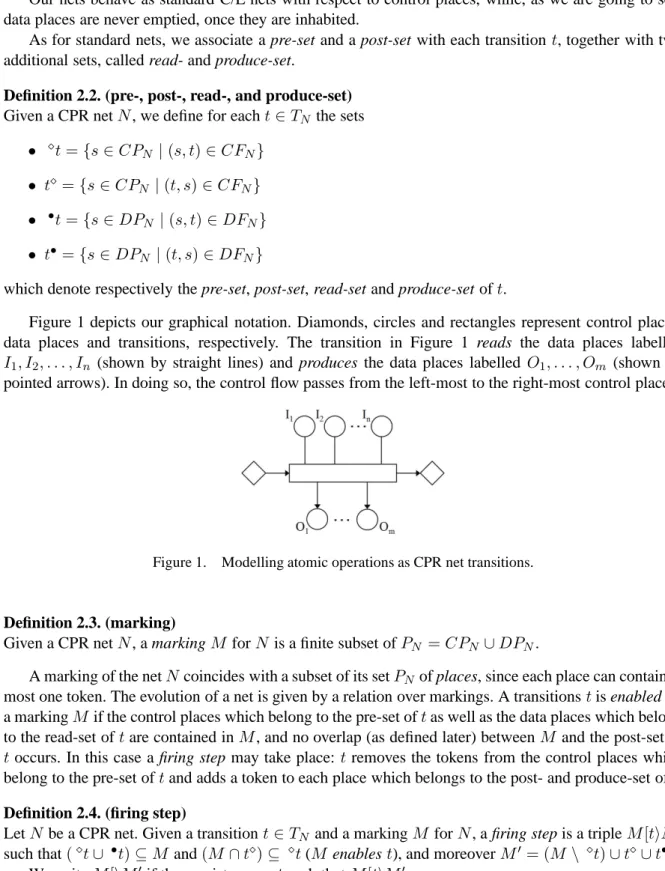
Figure 1 depicts our graphical notation. Diamonds, circles and rectangles represent control places, data places and transitions, respectively. The transition in Figure 1 reads the data places labelled
I1, I2, . . . , In (shown by straight lines) and produces the data places labelled O1, . . . , Om (shown by pointed arrows). In doing so, the control flow passes from the left-most to the right-most control place.
Figure 1. Modelling atomic operations as CPR net transitions.
Definition 2.3. (marking)
Given a CPR netN, a markingM forN is a finite subset ofPN =CPN∪DPN.
A marking of the netN coincides with a subset of its setPN of places, since each place can contain at most one token. The evolution of a net is given by a relation over markings. A transitionstis enabled by a markingMif the control places which belong to the pre-set oftas well as the data places which belong to the read-set oftare contained inM, and no overlap (as defined later) betweenM and the post-set of
toccurs. In this case a firing step may take place: tremoves the tokens from the control places which belong to the pre-set oftand adds a token to each place which belongs to the post- and produce-set oft.
Definition 2.4. (firing step)
LetN be a CPR net. Given a transitiont∈TN and a markingMforN, a firing step is a tripleM[tiM0 such that(t∪ •
t)⊆M and(M∩t)⊆
t(M enablest), and moreoverM0 = (M \
t)∪t∪t•. We writeM[iM0if there exists sometsuch thatM[tiM0.
The enabling condition states that(i)all the tokens of the pre-set of a transition have to be contained in the marking, and(ii) that the marking does not contain any token in the post-set of the transition, unless it is consumed and regenerated. The second condition characterizes C/E nets. Data places act instead as sinks, hence, any token can be added and only the occurrence of a token is checked. The read-only feature of data places is reminiscent of so-called contextual C/E nets by Montanari and Rossi [31].
2.2. From OWL-S to CPR nets
After introducing CPR nets, we informally discuss how OWL-S service descriptions can be mapped into CPR nets. For the sake of clarity, a formal presentation of the encoding is delayed until Section 5, after the introduction of open CPR nets and of their semantics.
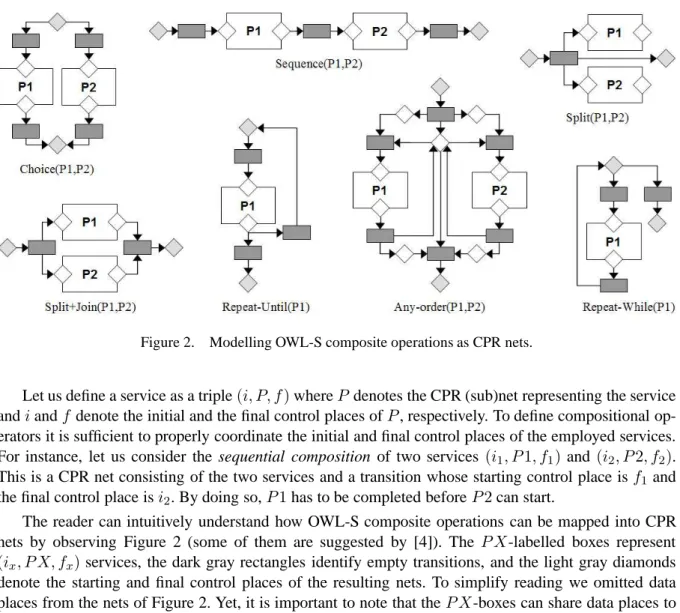
Figure 2. Modelling OWL-S composite operations as CPR nets.
Let us define a service as a triple(i, P, f)wherePdenotes the CPR (sub)net representing the service andiandf denote the initial and the final control places ofP, respectively. To define compositional op-erators it is sufficient to properly coordinate the initial and final control places of the employed services. For instance, let us consider the sequential composition of two services (i1, P1, f1) and (i2, P2, f2). This is a CPR net consisting of the two services and a transition whose starting control place isf1 and the final control place isi2. By doing so,P1has to be completed beforeP2can start.
The reader can intuitively understand how OWL-S composite operations can be mapped into CPR nets by observing Figure 2 (some of them are suggested by [4]). The P X-labelled boxes represent
(ix, P X, fx)services, the dark gray rectangles identify empty transitions, and the light gray diamonds denote the starting and final control places of the resulting nets. To simplify reading we omitted data places from the nets of Figure 2. Yet, it is important to note that theP X-boxes can share data places to simulate the exchange of data amongst services, as formally defined in Section 4.1.
3.
Motivating examples
The ultimate objective of this paper is to introduce a decidable and compositional notion of equivalence between Web services represented as CPR nets. This notion establishes whether two service behaviours are equivalent and it can be employed to suitably address the following issues:
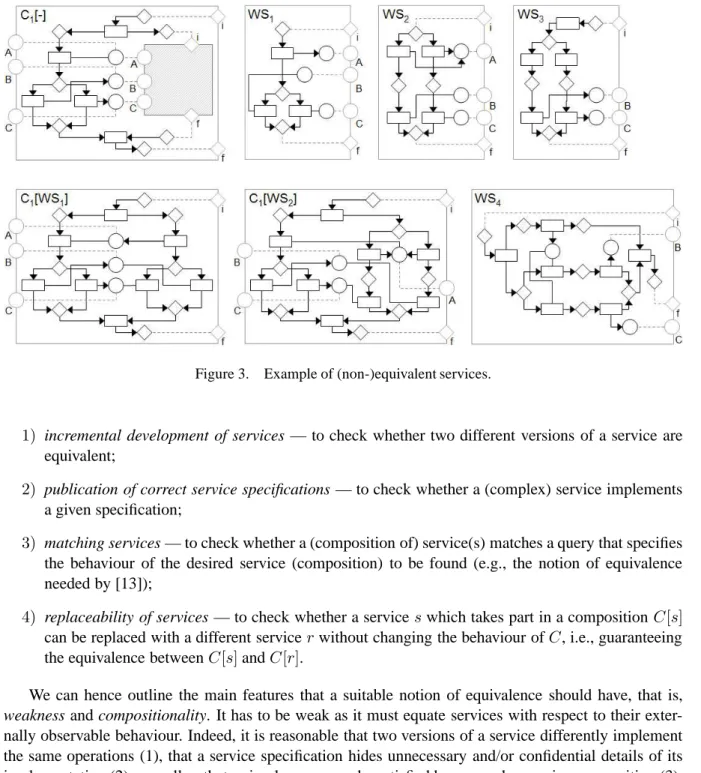
Figure 3. Example of (non-)equivalent services.
1) incremental development of services — to check whether two different versions of a service are equivalent;
2) publication of correct service specifications — to check whether a (complex) service implements a given specification;
3) matching services — to check whether a (composition of) service(s) matches a query that specifies the behaviour of the desired service (composition) to be found (e.g., the notion of equivalence needed by [13]);
4) replaceability of services — to check whether a serviceswhich takes part in a compositionC[s]
can be replaced with a different servicerwithout changing the behaviour ofC, i.e., guaranteeing the equivalence betweenC[s]andC[r].
We can hence outline the main features that a suitable notion of equivalence should have, that is, weakness and compositionality. It has to be weak as it must equate services with respect to their exter-nally observable behaviour. Indeed, it is reasonable that two versions of a service differently implement the same operations (1), that a service specification hides unnecessary and/or confidential details of its implementation (2), as well as that a simple query can be satisfied by a complex service composition (3).
Therefore, this notion of equivalence has to be abstract enough to equate services that differ only on in-ternal transition steps. Furthermore, (4) also asks for compositionality, and if two services are equivalent, then they can be always used interchangeably.
Let us now consider some examples (inspired by [26]). Figure 3 illustrates the CPR nets of seven services, where rectangles, circles and diamonds represent transitions, data places and control places, respectively. Note the boxes that limit each service. As we formalise in the following section, a box rep-resents the outer interface of a service, that is, the set of places which can interact with the environment. Hence, those places that in Figure 3 lie on the border of boxes are the ones that can be observed exter-nally. Consider the servicesW S1andW S2of Figure 3. As one may note,W S1andW S2have the same behaviour with respect to the notion of trace equivalence. Indeed, they have identical sets of traces, since after producingAthey may alternatively read eitherB orC. Consider now the contextC1[−], depicted in Figure 3, which represents a possible environment in whichW S1 andW S2 can be embedded. Note the gray area contained inC1[−]. Its border is the inner interface ofC1[−]. As formalised in Section 4.1, a serviceW Scan be inserted inside a contextC[−]if the outer interface ofW Sand the inner interface of
C[−]coincide. The resulting compositionC[W S]consists of the fusion of such interfaces, as well as of the fusion of the data places and the union of the transitions ofW SandC[−]. We note thatC1[−]inputs
A, produced by W S1, and yields B orC, taken as input by W S1. Hence, the composition C1[W S1] works and finishes properly. Now, in order to test if the trace equivalence is the notion suitable for our purpose, we replaceW S1with the trace equivalent serviceW S2and we check whether the composition
C1[W S2]works properly as well. Yet,C1[W S2]produces a possibly deadlocking system.
Let us now describe a second example arguing for the need of weakness. Consider the servicesW S3 andW S4. For instance,W S4could be a composition candidate to satisfy the query represented byW S3. Although W S3 andW S4 appear different as they perform a different number of transitions, they both produceBorC. Namely,W S3andW S4have identical externally observable behaviour, and they indeed should be considered equivalent.
By taking into account the requirements briefly outlined in this motivating section, we define a novel notion of equivalence based on bisimilarity which features weakness, compositionality and decidability.
4.
A congruence for Open CPR nets
The previous section argued about the relevance of a behavioural equivalence, formally characterizing the notion of replaceability, and motivated why such an equivalence should be compositional and weak. A first step for defining compositionality is to equip nets with a notion of interface and context. Next, we introduce two notions of equivalence: the first is conceptually the correct one, even if it turns out to be quite hard to reason about, while the second provides a simple, decidable characterization of the former.
4.1. Open CPR nets and CPR contexts
For the sake of presentation, a chosen netN = (CPN, DPN, TN, CFN, DFN)is assumed.
Definition 4.1. (Open CPR net)
LetN be a CPR net. An interface forNis a triplehi, f, ODisuch thati6=fand • iis a control place (i.e.,i∈CPN), the initial place;
• f is a control place (i.e.,f ∈CPN), the final place; and
• ODis a set of data places (i.e,OD⊆DPN), the open data places.
An interface is an outer interfaceO forN if there exists no transition t∈TN such that eitheri∈t or
f ∈ t
. An open CPR netN is a pairhN, Oi, forN a CPR net andOan outer interface forN.
Next, we symmetrically define an inner interface for N as an interface such that there is no transition
t∈TN verifying eitherf ∈tori∈ t.
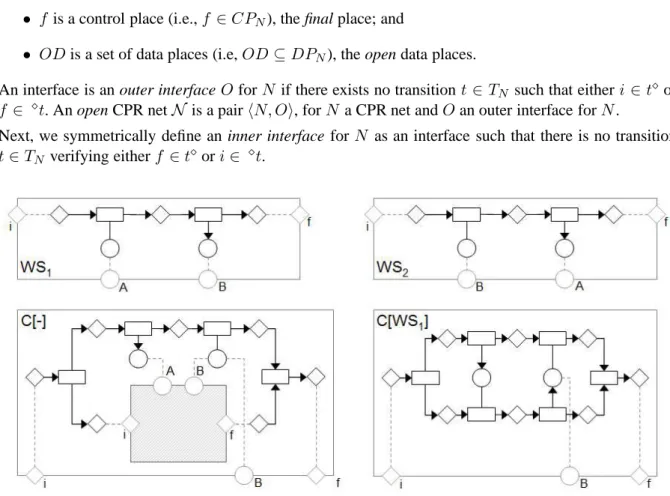
Figure 4. Two open nets, a context and a composite net.
The condition characterizing outer interfaces requires that the initial place has no incoming transition and the final place has no outgoing transition. Hence, Open CPR (OCPR for short) nets recall the Work-Flow (WF) nets advocated by van der Aalst [43]1for modeling Web services.
The components of a specific interface or open net are often denoted by adding them a subscript. Given an open netN,Op(N)denotes the set of open places, which consists of those places occurring on the interface, initial and final places included. Furthermore, the places ofN not belonging toOp(N)
constitute the closed places. It is important to note that open places are crucial for the definition of the observational equivalence that we propose in the next subsection.
Figure 4 shows the graphical notation used to represent OCPR nets. The bounding box of the OCPR netW S1 represents the outer interface of the net. Note the initial and final places used to compose the control of services (as suggested in Figure 2) as well as the open data places employed to share data. Definition 4.2. (CPR context)
A CPR context C[−] is a triple hN, O, Ii such that N is a CPR net, I = hiI, fI, ODIi and O = hiO, fO, ODOiare an inner and an outer interface forN, respectively, andiI6=fO,iO6=fI.
1
More precisely, our nets lack the connectiveness requirement, see e.g. [43, Sect. 2.2]. Note however that, even if this is not made explicit, the property holds for all the nets obtained by modeling OWL-S composite operations.
A contextC[−]is shown in Figure 4. Basically, it is an open net with a hole, represented there by a gray area. The border of the hole denotes the inner interface of the context. As for open nets, the bounding box is the outer interface. The only difference between inner and outer interfaces is that the initial place of the former has no outgoing transitions (and vice versa for final places).
Contexts represent environments into which services can be embedded, i.e., possible ways they can be used by other services. In order for an OCPR net to be inserted in a context, the net outer interface and the context inner interface must coincide.
Definition 4.3. (CPR composition)
Let N = hN, Oi be an OCPR net and C[−] = hNC, OC, ICi a CPR context, such that O = IC. Then, the composite netC[N]is the OCPR net(CPN ]OCPNC, DPN ]ODPNC, TN ]TNC, CFN]
CFNC, DFN ]DFNC)with outer interfaceOC.
The disjoint union of the two nets is performed, except for the places occurring in O, which are coalesced (hence the symbol]O). Moreover,OC becomes the set of open places of the resulting net.
Consider for instance the net W S1, the context C[−]and their composition, denoted byC[W S1], as illustrated in Figure 4. The places on the outer interface ofW S1are coalesced with the ones on the inner interface of C[−]. The outer interface of C[W S1] is the outer interface of C[−]. Note that the data place Ais open in W S1 and closed in C[W S1]: this example highlights the capability of hiding places, removing them from the outer interface of an open net. Indeed, this feature is reminiscent of the restriction operator of process calculi, such as CCS [29].
It is worth observing that contexts are composable: CPR contexts form a category where interfaces are objects and contexts are arrows going from the inner interface to the outer interface2and OCPR nets are arrows whose source is the empty interface and target is the outer interface.
4.2. Saturated bisimilarity for OCPR nets
This section addresses the question of the equivalence between nets. Our answer relies on an obser-vational approach, equating two systems if they can not be told apart by an external observer. More precisely, the observer can only examine the open places of a net, which is otherwise a black box, and only those places may be checked for verifying whether they are actually inhabited or if they are empty.
For the sake of presentation, a chosen OCPR netN =hN, Oiis assumed. Definition 4.4. (observation)
Let N be an OCPR net, and M a marking of N. The observation on N at M is the set of places
Obs(N, M) =Op(N)∩M.
Thus, an observer can look at the evolution of the system by observing if tokens are either produced or consumed in the open places. Accordingly, two OCPR netsN and N0 with the same outer interface and with initial markingsM and M0 are considered equivalent ifObs(N, M) = Obs(N0, M0) and if every state reachable fromMinN is equivalent to a state reachable fromM0 inN0 (and vice versa).
The previous remark is formalized below, whereMN denotes the set of all OCPR nets with markings andN denotes the reflexive and transitive closure of the firing relation[ifor the netN underlyingN. 2
CPR nets and their morphisms (not defined here) form an adhesive category [19]. The category of CPR contexts is the cospan bicategory over such category [40], thus it is amenable to the borrowed context technique [16] for distilling a set of labels from a reduction relation. That technique is implicitly exploited in the next section.
Definition 4.5. (naive bisimulation)
A symmetric relationR⊆ MN × MN is a naive bisimulation if whenever(N, M)R(N0, M0)then • ON =ON0 andObs(N, M) =Obs(N0, M0), and
• M N M1impliesM0 N0 M0
1&(N, M1)R(N0, M10). The union of all naive bisimulations is called naive bisimilarity.
The equivalence above is “naive” in the sense that it clearly fails to be compositional. Indeed, consider the OCPR nets W S1 and W S2 in Figure 4. They are trivially equivalent since none of them can fire. However, if we insert them into a context with a transition generating a token in the initial place and in the data placeA, we obtain two different contexts (one can now produce a token onBreaching the final statef, while the latter can not move).
The solution out of the impasse, which is quite standard in functional languages and process calculi, is to allow the observer to perform more complex experiments, inserting a net into any possible context. Definition 4.6. (saturated bisimulation)
A symmetric relationR⊆ MN × MN is a saturated bisimulation if whenever(N, M) R(N0, M0)
then
• ON =ON0 andObs(N, M) =Obs(N0, M0), and • ∀C[−].M C[N]M1 impliesM0C[N0]M
0
1&(C[N], M1)R(C[N0], M10). The union of all saturated bisimulations is called saturated bisimilarity (≈S).
Clearly,≈S is by definition a congruence. Indeed, it is the largest bisimulation that preserves com-positionality, as stated below.
Proposition 4.1. ≈S is the largest bisimulation that is also a congruence.
The above proposition ensures the compositionality of the equivalence, hence, the possibility of re-placing one service by an equivalent one without changing the behaviour of the whole composite service. Moreover, the equivalence is “weak” in the sense that, differently from most of the current proposals, no explicit occurrence of a transition is observed. The previous definition leads to the following notion of equivalence between OCPR nets, hence, between services.
Definition 4.7. (bisimilar nets) LetN,N0
be OCPR nets. They are bisimilar, denoted byN ≈ N0
, if(N,∅)≈S(N0,∅).
The choice of the empty marking guarantees that the equivalence is as general as possible. Indeed, the presence of a token in an open place can be simulated by closing the net with respect to a transition adding a token in that place, and if any two nets are saturated bisimilar with respect to the empty marking, they are so also with respect to any marking with tokens in the open places.
The negative side of≈is that this equivalence seems quite hard to be automatically decided because of the quantification over all possible contexts. In the following subsection we introduce an alternative equivalence, easier to reason about and to automatically verify, and we prove that it coincides with≈S.
4.3. An equivalent decidable bisimilarity
Saturated bisimulation seems conceptually the right notion, and this is further argued in Section 7. How-ever, it seems quite hard to analyze (or automatically verify), due to the universal quantification over contexts. In this section we thus introduce weak bisimilarity, based on a simple labelled transition sys-tem (LTS) distilled from the firing semantics of an OCPR net.
The introduction of a LTS is inspired to the theory of reactive systems [21]. This meta-theory suggests guidelines for deriving a LTS from an unlabelled one, choosing a set of labels with suitable requirements of minimality. In the setting of OCPR nets, the reduction relation is given by[i, and a firing is allowed if all the preconditions of a transition are satisfied. Thus, intuitively, the minimal context that allows a firing just adds the tokens needed for that firing.
Definition 4.8. (labelled transition system)
LetN be an OCPR net andΛ ={τ} ∪({+} ×PN)∪({−} ×CPN)a set of labels, ranged over byl. The transition relation forN is the relationRN inductively generated by the set of inference rules below
o∈Op(N)\(M ∪ {f}) M →+oN M ∪ {o} f ∈M M →−fN M\ {f} M[iM0 M →τN M0
whereM →Nl M0 means that hM, l, M0i ∈ RN, andi, f denote the initial and the final place ofN, respectively.
Thus, a context may add tokens in open places, as represented by the transition →+oN, in order to perform a firing. Similarly, a context may consume tokens from the final place f. A context cannot interact with the net in other ways, since the initial place ican be used by the context only as a post condition and the other open places are data places whose tokens can be read but not consumed. Instead,
τ transitions represent internal firing steps, i.e., steps needing no additional token from the environment. The theory of reactive systems ensures that, for a suitable choice of labels, the (strong) bisimilarity on the derived LTS is a congruence [21]. However, often that bisimilarity does not coincide with the saturated one. In the case at hand, we introduce a notion of weak bisimilarity, abstracting away from the number of steps performed by nets, that indeed coincides with the saturated one.
Definition 4.9. (weak bisimulation)
A symmetric relationR⊆ MN × MN is a weak bisimulation if whenever(N, M)R(N0, M0) then • ON =ON0 andObs(N, M) =Obs(N0, M0),
• M →N+o M1impliesM0 +o→N0 M0 1 &(N, M1)R(N0, M10), • M →N−f M1impliesM0 − f →N0 M0 1 &(N, M1)R(N0, M10), and • M →Nτ M1impliesM0 N0 M0 1 &(N, M1)R(N0, M10). The union of all weak bisimulations is called weak bisimilarity (≈W).
The key theorem of the paper is stated below. Theorem 4.1. ≈S=≈W.
Thus, in order to prove that two OCPR nets are bisimilar, it suffices to exhibit a weak bisimulation between the states of the two nets that includes the pair of empty markings. Most importantly, though, this verification can be automatically performed, since the set of possible states of an OCPR net are finite. Hence, the result below immediately follows.
Corollary 4.1. ≈Sis decidable.
5.
A compositional encoding for OWL-S
This section presents the formal encoding of OWL-S service descriptions into OCPR nets: it first in-troduces the notion of binary context, and then use it for modelling composite services. This section is rounded up by a simple result on hiding that is useful for the sample scenario discussed in Section 6.
5.1. On binary contexts
As depicted in Figure 1, an atomic process is encoded by a net containing a single transition. Instead, the encoding of a composite service requires to extend the notion of interface, in order to accommodate the plugging of two nets into a context.
Definition 5.1. (binary contexts)
A CPR binary context C[−1,−2]is a 4-tuplehN, O, I1, I2isuch that the triples hN, O, I1i,hN, O, I2i are CPR contexts, and{iI1, fI1} ∩ {iI2, fI2}=∅.
Since it suffices for our purposes, we restrict our attention to binary contexts, the general definition being easily retrieved. In addition, it is explicitly required that the control places of the inner interfaces are all different, while no condition is required for data places.
Definition 5.2. (binary composition)
LetN1 = hN1, O1i, N2 = hN2, O2ibe OCPR nets, and C[−1,−2]a CPR binary context, such that
O1 = I1 and O2 = I2. Then, the composite net C[N1,N2]is the OCPR net (CPN1 ]U CPN2 ]U
CPN, DPN1]UDPN2]UDPN, TN1]TN2]TN, CFN1]CFN2]CFN, DFN1]DFN2]DFN)with
outer interfaceOC.
As for unary contexts, the disjoint union of the three nets is performed, except for coalescing those places occurring either inO1orO2(denoted by]U).
5.2. Presenting the encoding
In order to define the encoding, we first introduce the notion of context extension. Definition 5.3. (context extension)
LetAbe a set of data places and letC[−] =hN, O, Iibe a context. The context extensionCA[−]is the context whose net isNA= (CPN, DPN]UA, TN, CFN, DFN), inner interface isIA=hiI, fI, ODI∪
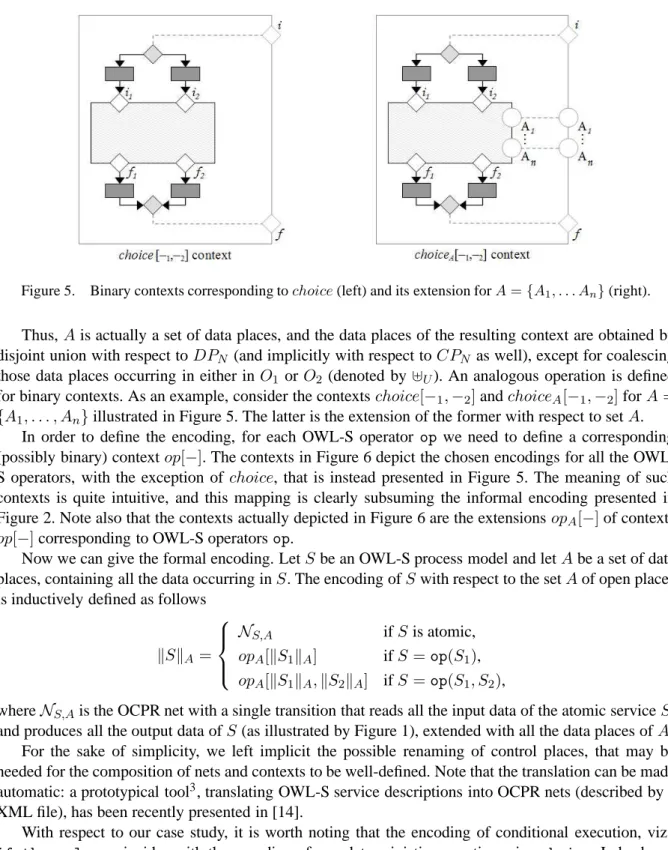
Figure 5. Binary contexts corresponding tochoice(left) and its extension forA={A1, . . . An}(right).
Thus,Ais actually a set of data places, and the data places of the resulting context are obtained by disjoint union with respect toDPN (and implicitly with respect toCPN as well), except for coalescing those data places occurring in either inO1 orO2 (denoted by]U). An analogous operation is defined for binary contexts. As an example, consider the contextschoice[−1,−2]andchoiceA[−1,−2]forA= {A1, . . . , An}illustrated in Figure 5. The latter is the extension of the former with respect to setA.
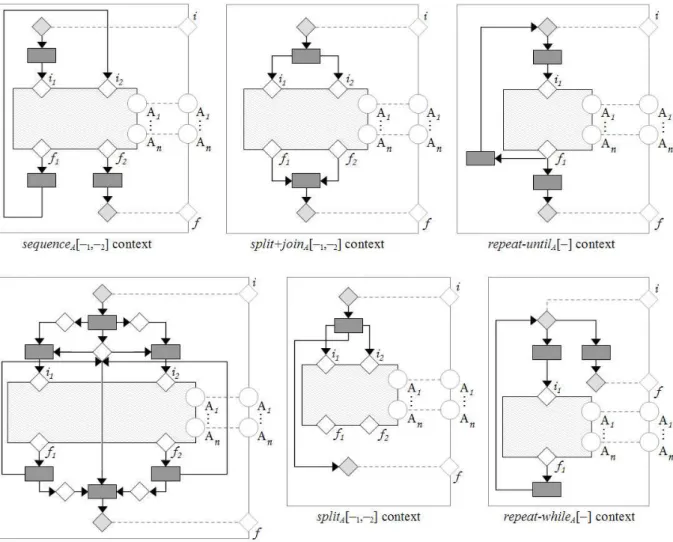
In order to define the encoding, for each OWL-S operator op we need to define a corresponding (possibly binary) contextop[−]. The contexts in Figure 6 depict the chosen encodings for all the OWL-S operators, with the exception ofchoice, that is instead presented in Figure 5. The meaning of such contexts is quite intuitive, and this mapping is clearly subsuming the informal encoding presented in Figure 2. Note also that the contexts actually depicted in Figure 6 are the extensionsopA[−]of contexts
op[−]corresponding to OWL-S operatorsop.
Now we can give the formal encoding. LetSbe an OWL-S process model and letAbe a set of data places, containing all the data occurring inS. The encoding ofSwith respect to the setAof open places is inductively defined as follows
kSkA= NS,A ifSis atomic, opA[kS1kA] ifS=op(S1), opA[kS1kA,kS2kA] ifS=op(S1, S2),
whereNS,Ais the OCPR net with a single transition that reads all the input data of the atomic serviceS, and produces all the output data ofS (as illustrated by Figure 1), extended with all the data places ofA. For the sake of simplicity, we left implicit the possible renaming of control places, that may be needed for the composition of nets and contexts to be well-defined. Note that the translation can be made automatic: a prototypical tool3, translating OWL-S service descriptions into OCPR nets (described by a XML file), has been recently presented in [14].
With respect to our case study, it is worth noting that the encoding of conditional execution, viz.,
if-then-else, coincides with the encoding of non-deterministic execution, viz.,choice. Indeed, our implementation of the process model abstracts away from data values.
Figure 6. Contexts corresponding to OWL-S operators extended forA={A1, . . . An}.
5.3. Hiding data places
The above presented encoding maps an OWL-S service into an OCPR net, where all the data places are open, i.e., they belong to the outer interface. Proposition 5.1 will turn out to be of use for those cases where it might be necessary to abstract away from irrelevant/confidential data.
Definition 5.4. (hiding operator)
LetO=hiO, fO, ODOibe an outer interface andAa set of data places such thatA⊆ODO. The hiding operator (with respect toAandO)νA,Ois the context whose net has no transition, inner interface isO and outer interface ishiO, fO, ODO\Ai.
For the sake of readability, we leave out the second index of a restriction operator, whenever it is clear from the context. As an example, consider the OCPR nets depicted in Figures 11 and 13. The
latter is obtained from the former by simply hiding the (sub)set of open data places A ={firstRating,
secondRating,thirdRating}, i.e., by applying the hiding operatorνA.
We round up the section with a simple result on disjoint compositionality, which is needed later on when discussing about (sub)service replaceability.
Proposition 5.1. LetN be a net,A⊆Op(N)a set of data places, andC[−] =hN, O, Iia context such thatODO∩A=∅. IfC[νA[N]]is well-defined, thenνA[CA[N]]≈SC[νA[N]].
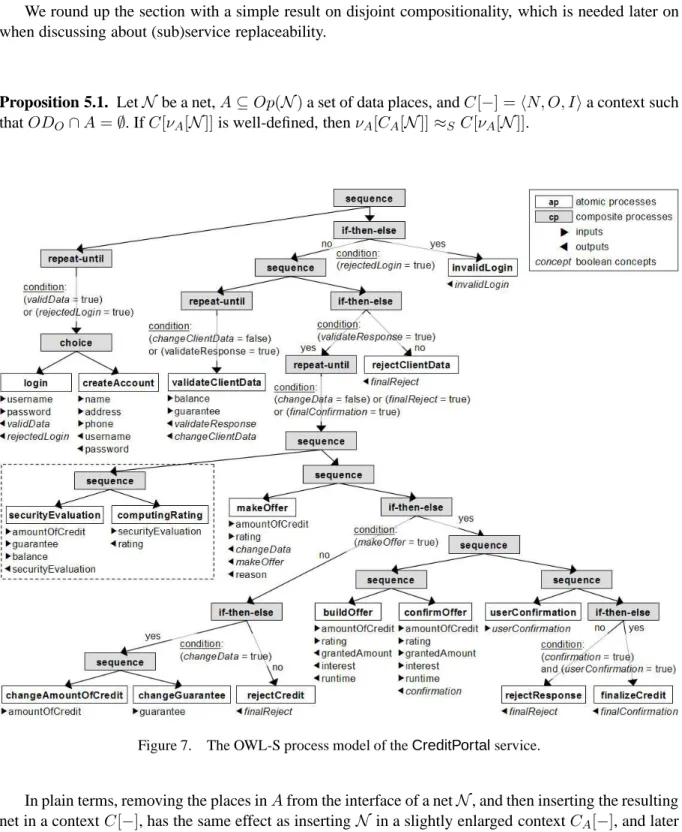
Figure 7. The OWL-S process model of theCreditPortalservice.
In plain terms, removing the places inAfrom the interface of a netN, and then inserting the resulting net in a contextC[−], has the same effect as insertingN in a slightly enlarged contextCA[−], and later removing those same places.
6.
A sample scenario on service replaceability
As we anticipated in Section 3, the notion of service equivalence introduced in this paper can be suitably employed to address some crucial issues such as (1) incremental development of services, (2) publication of correct service specifications, (3) matching services and (4) replaceability of services. In particular, in this section, we illustrate how the theoretical results presented in Section 4 can be employed to resolve the issue of service replaceability. To this end, a concrete sample scenario4 concerning banking systems is introduced.
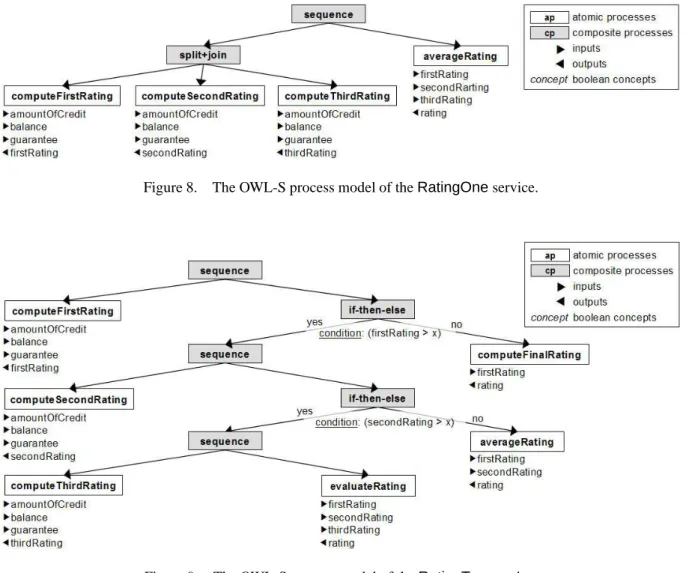
Figure 8. The OWL-S process model of theRatingOneservice.
Figure 9. The OWL-S process model of theRatingTwoservice.
Let us first consider the CreditPortal service, that grants loans to bank customers. CreditPortal
implements three steps, namely, (1) authentication of the customer and upload of her/his personal data, 4
The banking scenario – whose extended description can be found in [9] – is inspired by the finance case study by
S&N AG netBank solutions(http://www.s-und-n.de/), one of the enterprises involved in the SENSORIAproject (http://www.sensoria-ist.eu/).
(2) evaluation of the customer credit request, and (3) formulation of the loan offer. In the first step, after logging into the bank system, the customer has to upload information regarding balance and offered guarantees. In the second step,CreditPortalevaluates the customer reliability and computes a rating of the credit request. Finally, in the last stepCreditPortaleither decides to grant the loan to the customer and to build an offer, or it rejects the credit request.
The OWL-S specification ofCreditPortalis available at [1]. Yet, for the convenience of the reader, we show in Figure 7 a more compact tree representation of the CreditPortalprocess model. Each in-ternal node is labelled with the type of the composite process it represents, and, in case of conditional and iterative control constructs, also with a condition. Each leaf is associated with the inputs and the outputs of the corresponding atomic process. It is worth noting that in the actual OWL-S description of
CreditPortaleach input and output parameter is annotated with a concept defined in a shared ontology.
Figure 10. The sub-service ofCreditPortalto be externalized.
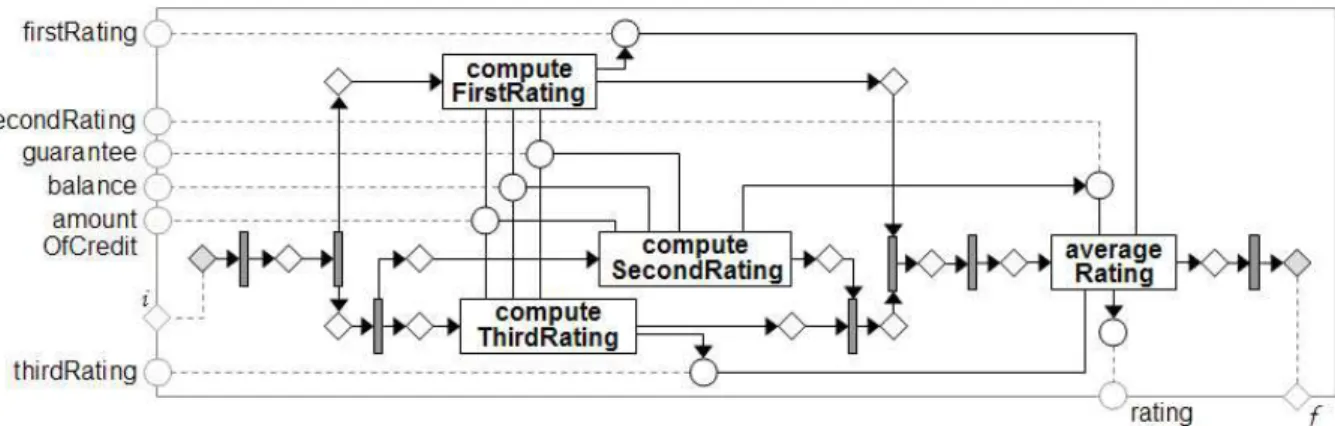
Figure 11. OCPR net representation of theRatingOneservice.
As depicted in Figure 7, theCreditPortalprocess model is a sequence process whose left-most child is a repeat-until construct representing the customer authentication phase. The customer can repeatedly choose between logging in with an existing account (login) or creating a new account (createAccount) until either the log in to the system is successful (validData = true), or the system rejects the login definitively (rejectedLogin = true). Next, if the customer did not provide a valid login, CreditPortal
terminates (invalidLogin). Otherwise, it continues by repeatedly asking the customer for the personal financial data (validateClientData) until either a valid information is uploaded (validateResponse = true) or the system rejects the credit request (changeClientData = false). Then, if the customer did not provide valid financial data,CreditPortalterminates (rejectClientData), otherwise the customer credit
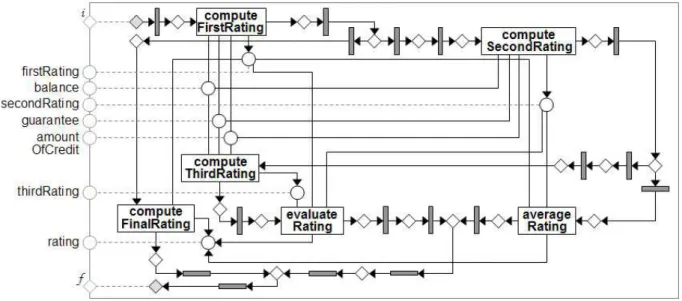
Figure 12. OCPR net representation of theRatingTwoservice.
request evaluation phase starts.CreditPortal, taking into account the requested amount of credit, firstly evaluates the customer security (securityEvaluation), computes the customer rating ( computingRat-ing) and next decides whether or not to make an offer to the customer (makeOffer). If so (makeOffer = true), it builds the offer (buildOffer), formally confirms the offer (confirmOffer) and asks the cus-tomer for a final confirmation (userConfirmation). Next, ifCreditPortaland the customer agree on the offer (confirmation = trueanduserConfirmation = true), the offer is finalized (finalizeCredit), other-wiseCreditPortalrejects the credit request (rejectResponse). Instead, ifCreditPortaldoes not want to make an offer (makeOffer = false), it can choose either to reject the credit request (rejectCredit) or to allow the customer to update the financial data (changeAmountOfCreditandchangeGuarantee). In the latter case, the customer credit request evaluation phase is repeated.
Consider now the dotted section of theCreditPortalspecification represented in Figure 7. It consists of a sequence of two atomic processes, i.e.,securityEvaluationand computingRating, that takes as input the requested amount of credit, the balance and the provided guarantees of a customer, and then evaluates the reliability and the rating. Let us now suppose that theCreditPortalprovider (i.e., the bank) wants to enhance its service and hence decides to externalize theCreditPortalsection which computes customer rating, viz., the dotted area of Figure 7. For instance, suppose that two services which compute customer rating are available, that is,RatingOneandRatingTwowhose OWL-S process models (avail-able at [1]) are illustrated in Figures 8 and 9, respectively. More precisely,RatingOnefirstly computes three separate evaluations of the customer and then it returns an average rating, RatingTwocomputes the customer rating and only if necessary (e.g., if the first rating exceeds a threshold value) it performs a second and possibly a third evaluation of the customer. RatingTwomay be more convenient for the bank, as it does not always compute three separate and expensive customer evaluations, yet,RatingOne
provides a more accurate customer evaluation. In both cases, the bank needs to verify whether the dot-ted area ofCreditPortalin Figure 7 can be replaced withRatingOneorRatingTwo, not affecting the internal behaviour ofCreditPortal.
Such a replaceability problem can be solved by suitably exploiting our notion of behavioural con-gruence for Web services. We first translate the dotted area of CreditPortal as well as the services
RatingOneandRatingTwointo OCPR nets, according to the OWL-S encoding presented in Section 5. The resulting nets are depicted in Figures 10, 11 and 12, respectively. Next, we check whether these three nets are equivalent with respect to Definition 4.7. If so, the dotted area ofCreditPortal,RatingOneand
RatingTwocan be used interchangeably. Yet, clearly, the nets of Figures 10, 11 and 12 are not equivalent, since they expose different interfaces, and they are obviously externally distinguishable. This is not sur-prising: the bank describes which are the information it needs for each customer (namely,balanceand
rating), while the additional information (i.e.,firstRating,secondRatingandthirdRating) provided by the enterprises may be used by the bank in order to choose a service according to some criteria.
Figure 13. The net corresponding toνA[RatingOne] forA={firstRating,secondRating,thirdRating}.
However, as one may notice in Figure 7, the bank is just interested in observing the final rating, not the intermediate ones. Hence, we can equate the nets of Figures 10, 11 and 12 after hidingfirstRating,
secondRatingandthirdRating(e.g., Figure 13 illustrates the net resulting from applying such a hiding to the net of Figure 11). By doing so, these three nets become equivalent, i.e., they are structurally different, but externally indistinguishable. Hence, bothRatingOneandRatingTwocan be employed to properly replace the sub-service ofCreditPortalevaluating the customer reliability.
7.
Related work
The successful introduction of observational equivalences for process calculi in the early 1980s spawned similar researches on nets, as witnessed for instance by the survey [37]5. According to the taxonomy there, saturated bisimilarity is a state-based equivalence, since it encompasses a notion of interface (a set of observable places) and it is dictated by the way the firing relation crosses the interfaces. Indeed, our bisimilarity is reminiscent of ST-equivalence, as in [37, Def. 4.2.6].
This section does not aim at providing a survey of the field. First of all, the literature is very large, and its retelling would be definitely too space consuming, even if our main interest is in a compositional equivalence, thus restricting the area of possible intersection with former works. Additionally, our CPR 5
The analysis there is restricted to contact-free C/E nets, i.e., such that the requirement(M∩t )⊆
tof the enabling condition in Definition 2.4 holds for any reachable markingM.
nets have distinctive features, since data places act as sinks, thus any comparison should take that fact into account, putting an additional layer of complexity.
In the rest of the section we thus first focus on two issues that are closely related to the main nov-elties introduced in our framework: the use of the theory of reactive systems for obtaining a tractable equivalence, and the use of (equivalences on) nets for dealing with the specification of Web services and of their composition. We then finally overview a few works explicitly addressing service replaceability, even if not necessarily using net formalisms for modeling purposes.
7.1. Nets, open places and labels
Most recent formalisms for system specification come equipped with a reduction semantics: a suitable algebra of states is defined, and system evolution is represented by a relation between states. However, the lack of observable actions (either associated to the states, or to the reductions) inhibits the development of observational equivalences, which are often handier and more tractable.
Concerning Petri nets, the need of primitives for expressing the interaction with an environment was recognized early on, and notions of “net interface”, intended as a subset of the items of the net, are already reported in [37]. Interfaces are key ingredients for defining an observation, as well as for expressing net operators: along this line, a classical approach is the Box Algebra [7]. The main difference with our proposal is in the use of a set of labels for obtaining a labelled reduction relation, on top of which to define the weak semantics.
Quite related to our solution are open nets: place/transitions nets where two distinguished sets of input and output places (where tokens may be added or removed, respectively) are identified, and then used to compose nets by coalescing places [6]. The approach in [6] however differs from ours in that the authors stick to P/T nets and introduce a dichotomy between input and output places, which reflects on the type of the net composition. We refer to [6], and the references therein, for a survey and comparison with other interface-based techniques, mostly important the net components proposed by Kindler [18].
The most important source of inspiration for our work is the theory of reactive systems [21], in-troducing a technique for synthesising labels with suitable minimality requirements from a reduction relation that guarantees that the bisimilarity on the derived labelled relation is a congruence. Indeed, our approach benefits from the general definition of interface deriving from the theory. Concerning Petri nets, the technique was first applied by Milner in [30], after implementing nets into a more complex graphical structure, bigraphs, and later by Sassone and Soboci´nski [41], whose labelled relation largely coincides with ours. The main difference with respect to [41], besides the use of our flavour of C/E nets, is the introduction of saturated bisimilarity and the corresponding characterisation by weak bisimilarity. More-over, our equivalence is weak (the number of transitions is not observed) and interleaving (parallelism is reduced to non-determinism). To the best of our knowledge, the treatment of such a bisimilarity for nets, and its decidable characterisation, is original to our paper.
7.2. Nets for service equivalence
The application of Petri nets to the specification and the modelling of distributed systems has been around since their inception. Concerning Web services, the use of nets has been strongly advocated in the works by van der Aalst, see e.g. [43] and the position paper [3]. More specifically, he and his coauthors address
the issue of equivalences for nets in [5]: they propose a trace-based, probabilistic equivalence for nets which is however quite far from our proposal.
Tightly related to us is the work of Martens, which actually inspired some of our examples in Sec-tion 3. More precisely, we refer to [25], where van der Aalst’s WF Petri nets (with disjoint sets of input, output and internal places) are analysed for checking structural properties of Web services. The author introduces there the notions of net module and net composition, which recall the open nets formalism mentioned above, and roughly coincide with our own solution.
Martens introduces in [25] the notion of net soundness and net usability, basically related to state reachability with respect to composition with suitable modules. We sketch here a solution for recasting those notions in terms of saturated bisimilarity. Let us start considering the OCPR net 1 depicted in Figure 14. Moreover, for any OCPR netN, letO =hi, f, ODiits outer interface, and considerνOD,O, i.e. the hiding operators that closes all the open data places ofN. According to [25], we say that a netN is weakly sound if and only ifνOD,O[N]≈1; a contextC[−]utilizes a netN ifνOD,O[C[N]]≈1; and a netN is usable if there exists a contextC[−]using it.
Figure 14. The OCPR net 1.
Next, Martens considers a few notions of observational equivalence for his flavour of WF nets, dis-cussing trace, bisimulation and simulation equivalences. He identifies the weakness of trace equiva-lence with respect to deadlock, as we echoed in Section 3. He further argues on bisimulation, reaching the conclusion that simulation is the most adequate equivalence. Note that Martens’ notion of simula-tion (denoted here by≡) can be expressed by saturated bisimilarity. Indeed, N ≡ N0 if and only if
νOD,O[C[N]] ≈ 1 ⇔ νOD,O[C[N0]] ≈ 1 for all possible contexts C[−]: intuitively, this means that the two nets are usable by exactly the same environments. Note that our solution is stricter, since≈⊆≡, while the converse does not hold. Indeed, the netsM3 andM4 of Figure 4 in [26], now reproduced ac-cording to our notation in Figure 15, are equivalent acac-cording to Martens, even if they are not bisimilar.
7.3. On formalisms for service replaceability
In the emerging world of Service-Oriented Computing – where applications are built by combining existing services – the issue of service replaceability gained a prominent role, and thus new approaches are often introduced. The discussion below briefly sums up some of the most recent proposals that we are aware of.
A logic-based approach for service replaceability has been recently presented in [36], where a context-specific definition of service equivalence is introduced. According to [36], given a µ-calculus formulaφdescribing some property, a serviceS, taking part in a specific contextC[−], can be replaced by a serviceTifφholds also inC[T]. Intuitively, such a notion of context-specific replaceability relaxes the requirements imposed by a notion of service (bi)simulation like [8].
Another relaxed replaceability relation on services is induced by the definition of interaction sound-ness presented in [38]. Given an environmentE, a serviceSin an orchestrationO[S]can be replaced by
T if the interaction ofO[T]andE is lazy sound, that is, if the final node of the graph which represents the interaction ofO[T]andEcan be reached from every initial node.
Although not presented in term of replaceability, the notion of operating guidelines, introduced in [27, 23] and employed in [22] to formally analyze the interactional behaviour of BPEL processes, also implicitly induces a replaceability relation on services — yet not compositional. An operating guideline is an automaton that concisely represents all the partners that properly interact with a service. A service
Sinteracting withCcan be replaced with a serviceT ifT belongs to the operating guidelines ofC. A theory for checking the compatibility of service contracts based on aCCS-like calculus is presented in [15, 20]. Using a simple finite syntax (featuring the sequencing and external/internal choice construc-tors) to describe service contracts, they define a notion of preorder on processes (based on must testing) reflecting the ability of successfully interacting with clients. Such a notion induces a replaceability rela-tion that, informally, allows one to replace a serviceS1withS2 only if all clients compliant withS1 are also compliant withS2. Such a notion of replaceability is uncomparable with ours, as the former emerges from a synchronous model while the latter emerges from an asynchronous model. It is also worth not-ing that, in particular, [20] shows the existence of the principal dual contract (reminiscent of operatnot-ing guideline), i.e., the smallest (namely, the most general) service contract that satisfies the client request.
Other interesting notions of service replaceability were introduced also in [12]. The approach in [12] models service behaviour as deterministic automata and defines substitutability with respect to three dif-ferent notions of compatibility. In particular, context dependent substitutability states that given a service made of two sub-servicesS1andS2,S1can be replaced byS10 ifS
0
1is compatible withS2, while context independent substitutability states that a serviceScan be replaced by a serviceS0ifS0is compatible with all those services which are compatible withS (analogously to [24, 20]). Our notion of substitutability resembles the notion of context independent substitutability (w.r.t. definition of compatibility 1 of [12]) in an asynchronous and non-deterministic setting.
8.
Concluding remarks
In this paper we first introduced Open Consume-Produce-Read (OCPR) nets to naturally model the behaviour of OWL-S Web services (although our approach can be extended to WS-BPEL services as well, in the line of [34]). Next, we defined the notion of saturated bisimilarity between two OCPR nets, which relies on the concepts of interface and CPR context. An interface is a set of open (i.e.,
externally observable) places which interact with the environment, while a CPR context represents a possible environment where a service can be embedded in.
The use of interfaces and contexts represents the main difference with respect to the standard theory of Petri nets. These two concepts are fundamental when modelling interactive systems, but they are not commonly exploited for net specification. Moreover, an important novelty of our approach is the fact that tokens in the data places of an OCPR net can be produced and read (analogously to contextual nets [31]), but never consumed. This choice allow us to model data persistency, i.e., once a data have been produced or received from another service, it remains available until the end of the execution of the service.
To the best of our knowledge, the proposed bisimilarity is the first equivalence employing Petri nets for Web services that features
• weakness – It abstracts from internal transition steps by equating structurally different, yet exter-nally indistinguishable services. An obvious application of such a notion is for checking whether a (complex) service implements a given specification. Indeed, it is often the case that a service provider publishes simple service specifications by hiding unnecessary and/or confidential details of their implementations, as well as, similarly, a matchmaking system verifies whether a (compo-sition of) service(s) matches a client query.
• compositionality – It is the largest bisimulation that is also a congruence. Thus, two equivalent services can be always used interchangeably. Consider, for instance, a complex application where a sub-serviceS fails (e.g., it becomes unavailable). S can be replaced with an equivalent service
S0without changing the behaviour of the whole application.
• decidability – As the set of the states of an OCPR net is finite, the saturated bisimilarity is decid-able. It can hence be employed by automated software in order to check whether two services are behaviourally equivalent.
We note that our relying on a standard notion of observational equivalence allows the reuse of existing theoretical techniques and practical tools, such as e.g. the characterizations of minimal equivalent nets and the the algorithms for calculating them. We are currently implementing the algorithm for building the transition system, and we are developing a more efficient algorithm for checking saturated bisimilarity based on normalized minimization [11].
Finally, it is important to note that – for the sake of simplicity – we used a single range of names for identifying the parameters of the presented services, so that the mapping among parameters of different services is obvious. Yet, it is often the case that different services employ different parameter names. In the case of OWL-S descriptions, each functional parameter is annotated with a concept defined in a shared ontology. Hence, we can (semi-)automatically determine the mapping between parameters of separate services by employing suitable tools for crossing ontologies. Otherwise, in the case of WS-BPEL [2], for example, such a mapping has to be provided manually. In this perspective our approach can be easily extended to WS-BPEL services, exploiting, e.g., a translation from BPEL processes to workflow nets in [34].
References
[2] A. Alves et al.: WS-BPEL 2.0, 2006,http://docs.oasis-open.org/wsbpel/2.0/wsbpel-v2.0.pdf. [3] van der Aalst, W.: Pi Calculus Versus Petri Nets: Let Us Eat “Humble Pie” Rather Than Further Inflate the
“Pi Hype”, BPTrends, 3(5), 2005, 1–11.
[4] van der Aalst, W., ter Hofstede, A., Kiepuszewski, B., Barros, A.: Workflow Patterns, Distributed and Parallel Databases, 14(1), 2003, 5–51.
[5] van der Aalst, W., Alves de Medeiros, A., Weijters, A.: Process Equivalence: Comparing Two Process Models Based on Observed Behavior, Business Process Management, LNCS 4102 (S. Dustdar, J. Fiadeiro, A. Sheth, Eds.), Springer, 2006.
[6] Baldan, P., Corradini, A., Ehrig, H., Heckel, R.: Compositional semantics for open Petri nets based on deter-ministic processes, Mathematical Structures in Computer Science, 15(1), 2005, 1–35.
[7] Best, E., Devillers, R., Koutny, M.: The Box Algebra = Petri Nets + Process Expressions, Information and Computation, 178(1), 2002, 44–100.
[8] Bonchi, F., Brogi, A., Corfini, S., Gadducci, F.: A Behavioural Congruence for Web services, Fundamentals of Software Engineering, LNCS 4767 (F. Arbab, M. Sarjani, Eds.), Springer, 2007.
[9] Bonchi, F., Brogi, A., Corfini, S., Gadducci, F.: Compositional Specification of Web Services via Behavioural Equivalence: A Case Study, Applications and Theory of Petri Nets, LNCS 5062 (K. van Hee, R. Valk, Eds.), Springer, 2008.
[10] Bonchi, F., K¨onig, B., Montanari, U.: Saturated Semantics for Reactive Systems, Logic in Computer Science, IEEE Computer Society, 2006.
[11] Bonchi, F., Montanari, U.: Coalgebraic Models for Reactive Systems, Concurrency Theory, LNCS 4703 (L. Caires, V. Vasconcelos, Eds.), Springer, 2007.
[12] Bordeaux, L., Sala¨un, G., Berardi, D., Mecella, M.: When are Two Web Services Compatible?, Technologies for E-Services, LNCS 3324 (M.-C. Shan, U. Dayal, M. Hsu, Eds.), Springer, 2005.
[13] Brogi, A., Corfini, S.: Behaviour-aware discovery of Web service compositions, International Journal of Web Services Research, 4(3), 2007, 1–25.
[14] Brogi, A., Corfini, S., Iardella, S.: From OWL-S descriptions to Petri nets, ICSOC 2007 Workshops, LNCS 4907 (E. D. Nitto, M. Ripeanu, Eds.), Springer, 2009.
[15] Castagna, G., Gesbert, N., Padovani, L.: A theory of contracts for Web services, Principles of Programming Languages (G. C. Necula, P. Wadler, Eds.), ACM 2008.
[16] Ehrig, H., K¨onig, B.: Deriving Bisimulation Congruences in the DPO Approach to Graph Rewriting, Foun-dations of Software Science and Computation Structures, LNCS 2987 (I. Walukiewicz, Ed.), Springer, 2004. [17] Hamadi, R., Benatallah, B.: A Petri Net-based Model for Web Service Composition, Australasian Database Conference, Conferences in Research and Practice in Information Technology 17 (K.-D. Schewe, X. Zhou, Eds.), Australian Computer Society, 2003.
[18] Kindler, E.: A Compositional Partial Order Semantics for Petri Net Components, Applications and Theory of Petri Nets, LNCS 1248 (P. Az`ema, G. Balbo, Eds.), Springer, 1997.
[19] Lack, S., Soboci´nski, P.: Adhesive Categories, Foundations of Software Science and Computation Structures, LNCS 2987 (I. Walukiewicz, Ed.), Springer, 2004.
[20] Laneve, C., Padovani, L.: The Must Preorder Revisited, Concurrency Theory, LNCS 4703 (L. Caires, V. Vas-concelos, Eds.), Springer, 2007.
[21] Leifer, J., Milner, R.: Deriving bisimulation congruences for reactive systems, Concurrency Theory, LNCS 1877 (C. Palamidessi, Ed.), Springer, 2000.
[22] Lohmann, N., Massuthe, P., Stahl, C., Weinberg, D.: Analyzing Interacting BPEL Processes, Business Process Management, LNCS 4102 (S. Dustdar, J. L. Fiadeiro, A. Sheth, Eds.), Springer, 2006.
[23] Lohmann, N., Massuthe, P., Wolf, K.: Operating Guidelines for Finite-State Services, Application and Theory of Petri Nets, LNCS 4546 (Y. Kleijn, A. Yakovlev, Eds.), Springer, 2007.
[24] Martens, A.: On Compatibility of Web Services, Petri Net Newsletter, 65, 2003, 12–20.
[25] Martens, A.: Analyzing Web service based business processes, Fundamental Approaches to Software Engi-neering, LNCS 3442 (M. Cerioli, Ed.), Springer, 2005.
[26] Martens, A.: Consistency between Executable and Abstract Processes, Technology, Commerce, and e-Services, IEEE Computer Society, 2005.
[27] Massuthe, P., Reisig, W., Schmidt, K.: An Operating Guideline Approach to the SOA, Annals of Mathematics, Computing & Teleinformatics, 1(3), 2005, 35–43.
[28] Mecella, M., Parisi-Presicce, F., Pernici, B.: Modeling E-service Orchestration through Petri Nets, Technolo-gies for E-Services, LNCS 2444, (A. P. Buchmann, F. Casati, L. Fiege, M. Hsu, M.-C. Shan, Eds.), Springer, 2002.
[29] Milner, R.: A Calculus of Communicating Systems, LNCS 92, Springer, 1980.
[30] Milner, R.: Bigraphs for Petri Nets, Lectures on Concurrency and Petri Nets, LNCS 3098 (J. Desel, W. Reisig, G. Rozenberg, Eds.), Springer, 2004.
[31] Montanari, U., Rossi, F.: Contextual Nets, Acta Informatica, 32(6), 1995, 545–596.
[32] Narayanan, S., McIlraith, S.: Analysis and simulation of Web services, Computer Networks, 42(5), 2003, 675–693.
[33] Newcomer, E.: Understanding Web Services: XML, WSDL, SOAP, and UDDI, Addison-Wesley, 2002. [34] Ouyang, C., Verbeek, E., van der Aalst, W. M. P., Breutel, S., Dumas, M., ter Hofstede, A. H. M.: Formal
Semantics and Analysis of Control Flow in WS-BPEL, Science of Computer Programming, 67(2-3), 2007, 162–198.
[35] OWL-S Coalition: OWL-S: Semantic Markup for Web Service, 2006,
http://www.ai.sri.com/daml/services/owl-s/1.2/overview/.
[36] Pathak, J., Basu, S., Honavar, V.: On Context-Specific Substitutability of Web Services, Web Services, IEEE Computer Society, 2007.
[37] Pomello, L., Rozenberg, G., Simone, C.: A Survey of Equivalence Notions for net based Systems, Advances in Petri nets, LNCS 609 (G. Rozenberg, Ed.), Springer, 1992.
[38] Puhlmann, F., Weske, M.: Interaction Soundness for Service Orchestrations, Service-oriented Computing, LNCS 4294 (A. Dan, W. Winfried Lamersdorf, Eds.), Springer, 2006.
[39] Reisig, W.: Petri Nets: An Introduction, vol. 4 of EATCS Monographs in Theoretical Computer Science, Springer, 1985.
[40] Sassone, V., Soboci´nski, P.: Reactive systems over cospans, Logic in Computer Science, IEEE Computer Society, 2005.
[41] Sassone, V., Soboci´nski, S.: A Congruence for Petri Nets, Petri Nets and Graph Transformation, ENTCS 127 (H. Ehrig, J. Padberg, G. Rozenberg, Eds.), Elsevier, 2005.
[42] UDDI Coalition: The UDDI Technical White Paper, 2000,http://www.uddi.org/.
[43] Verbeek, H., van der Aalst, W.: Analyzing BPEL processes using Petri nets, Applications of Petri Nets to Coordination, Workflow and Business Process Management (D. Marinescu, Ed.), 2005.
[44] W3C: Simple Object Access Protocol (SOAP) 1.2, W3C working draft, 17 December 2001, 2001,
http://www.w3.org/TR/2001/WD-soap12-part0-20011217/. [45] W3C: WSDL 1.1, 2001,http://www.w3.org/TR/wsdl.
A.
Appendix: Proof of Theorem 4.1
In this section a formal proof of Theorem 4.1 is given. Since the proof is quite long, we give a modular presentation of it, proving several intermediate steps. We first define some notational convention and then we enounce several lemmas that will be pivotal in the rest of the proof.
We say that a context C[−]is compatible with an open net N if C[N]is well-defined, i.e., if the outer interface ofN coincides with the inner interface ofC[−]. WritingC[N]we implicitly mean that
C[−]is compatible withN. Similarly,Op(N)f denotes the setOp(N)\ {f}, implicitly assuming that
f is the final place of the outer interface of the OCPR netN. The following lemma is tacitly used during the whole section. Lemma A.1. (contexts preserves observations)
Let(N, M) and(N0
, M0)be OCPR nets with markings,C[−]a context compatible with the two nets, andU ⊆Op(N)f(=Op(N0)f)a marking. IfObs(N, M) =Obs(N0, M0), thenObs(C[N], M∪U) =
Obs(C[N0], M0∪U).
Hence, when proving that a bisimulation is a congruence, we just consider the dynamic part, since the lemma above ensures that the static part (represented by the conditionObs(N, M) =Obs(N0, M0)) is preserved under context closure.
The next lemma just states that all the internal reductions of a component net are also enabled in the composite net or, in other words, that contextual composition can not inhibit internal reductions.
Lemma A.2. (contexts preserve reductions)
Let (N, M) be an OCPR net with marking, and C[−] a compatible context. If M N M1, then
M C[N]M1.
Weak bisimilarity is a congruence
In order to prove that ≈W=≈S, we start here by proving that ≈W is a congruence, with respect to contexts and to possible markings over the contexts.
The first step is to prove that that ≈W is a congruence with respect to the addition of tokens to the open places of a net. For the sake of readability, in the following we denoteM\ {f}asM−f, implicitly assuming thatfis the final place of the outer interface of the OCPR net at hand.6
Lemma A.3. (≈W is a congruence with respect to markings)
Let (N, M) and (N0, M0) be OCPR nets with markings, such that ON = ON0, and U ⊆ Op(N)f a marking. If (N, M) ≈W (N0, M0), then (N, M ∪U) ≈W (N0, M0 ∪U) and (N, M −f) ≈W
(N0
, M0−f). Proof:
Suppose(N, M) ≈W (N0, M0)and leto ∈ U. The caseo ∈ M is obvious. Ifo 6∈ M, thenM →N+o
M +o; and since(N, M) ≈W (N0, M0), thenM0 +o
→N0 M0+oand (N, M +o) ≈W (N0, M0+o). By iterating the process, it holds(N, M +U)≈W (N0, M0+U).
Analogous reasoning holds forM−f. ut