Lexicon Expansion
System for Domain and
Time Oriented
Sentiment Analysis
Nuno Ricardo Pinheiro da Silva Guimarães
Mestrado em Ciência de ComputadoresDepartamento de Ciência de Computadores 2016
Orientador
Luís Torgo, Professor Associado, Faculdade de Ciências da Universidade do Porto
Coorientador
Todas as correções determinadas pelo júri, e só essas, foram
efetuadas.
O Presidente do Júri,
To my parents
Acknowledgements
First, I would like to express my gratitude to my supervisor Luís Torgo, for always being available to help and for his guidance and mentoring throughout the course of this work. I would also like to thanks my co-supervisor Álvaro Figueira, not only for giving me the necessary tools to perform the evaluation component (which was essential to my work), but also for his advices and constant support.
In addition, I would also like to thank project REMINDS for my research grant. I would also like to express my gratitude to the remaining persons on project for the help provided during this work. Project REMINDS was financed by ERDF – Euro-pean Regional Development Fund through the COMPETE Programme (operational programme for competitiveness) and by National Funds through the FCT (Portuguese Foundation for Science and Technology) within project «Reminds»/UTAP-ICDT/EEI-CTP/0022/2014.
I would also like to thank all the "incredible" persons on the Department of Computer Science. Their presence has always be constant and helpful throughout the course of this thesis.
A special thanks to João Queirós, Joana Gonçalves, Jorge Silva, Patrícia Santos, Rui Fonseca, Tânia Rodrigues, António Pinto, Diogo Teixeira, Rui Monteiro, Rafael Carolo and Rui Gomes for the friendship and for the happiness they provided me, even through tough times. I would also like to thank Inês for her support, kindness and tenderness. Last but definitely not least, I would like to express my gratitude to my family. They will always be there for me and I am eternally grateful for that.
Nuno Guimarães Porto, 2016
Abstract
In sentiment analysis, the polarity of a text is often assessed recurring to sentiment lexicons, which usually consist of verbs and adjectives with an associated positive or negative value. Research has focused in these particular parts of speech. However, in short informal texts like tweets or web comments, the absence of such words does not necessarily indicates that the text lacks opinion. Tweets like "First Paris, now Brussels... What can we do?" imply an opinion without the use of words included in sentiment lexicons, but rather due to the general sentiment or public opinion associated with terms in a specific time and domain.
In order to complement general sentiment dictionaries, we propose a novel system for lexicon expansion that automatically extracts the more relevant and up to date terms on several different domains and then assesses their sentiment through Twitter. Experimental results on our system show a 90% accuracy on extracting domain and time specific terms and 80% on correct polarity assessment. In addition, an analysis on the sentiment dynamics and "trending" factor of a sample of terms (that were frequently referred in the news) was carried out. An association on the term polarity change and trend was not possible. However, the variation on the terms sentiment seems to be the expected through the time interval analysed. The achieved results provide evidence that our lexicon expansion system can extract and determine the sentiment of terms for domain and time specific corpora in a fully automatic form. However, some flaws were detected during the evaluation. Namely, the large number of terms evaluated with a neutral score provided evidence that terms that appear on news may not have always a positive/negative value. Therefore, the implementation of a three class ensemble sentiment method was included in the workflow of our system. Evaluation using tweets datasets from different domains proved that our ensemble
system ENS17 outperformed 19 other sentiment analysis methods. In addition, a tweet domain disambiguation process was included for the specific cases where the same term appears in more than one domain.
Preliminary evaluations were made by adding the resulting lexicons to state of the art sentiment systems and testing them on a dataset containing tweets and Facebook posts and comments. The results show that our expanded lexicons cannot be used directly on texts retrieved from the web (namely in factual or news texts). However, they improve the sentiment classification of all three methods on opinion texts, providing evidence of their usefulness on sentiment analysis classification.
Keywords: sentiment lexicon, sentiment lexicon expansion, sentiment analysis, term extrac-tion, text mining
Resumo
Na análise de sentimento, a polaridade de um texto é frequentemente calculada usando léxicos de sentimento, que normalmente são constituídos por verbos e adjectivos classificados com um valor positivo ou negativo. No entanto, em textos curtos e informais (como tweets ou comentários) a ausência desse tipo de palavras não significa necessariamente que o texto não contém opinião. Tweets como “Primeiro Paris, agora Bruxelas. . . O que podemos fazer?” implicam uma opinião, não porque contêm palavras pertencentes aos léxicos de sentimento, mas sim devido ao conhecimento da opinião pública associada a alguns termos, num domínio e intervalo de tempo específico. De modo a complementar os dicionários de sentimento gerais com esses termos, este trabalho propõe um sistema para expansão de léxico que automaticamente extrai os termos mais actuais e relevantes em diferentes domínios e avalia o seu sentimento através doTwitter.
Resultados experimentais mostram uma exactidão de 90% na extracção correcta dos termos relativos ao domínio e tempo e 80% na classificação correcta em termos de polaridade. Além disso, foi conduzida numa amostra de termos (que consistentemente apareciam nas notícias), uma análise da dinâmica temporal do sentimento e factor “trending”. Não foi possível concluir uma relação entre a mudança de polaridade e factor “trending” de um termo. No entanto, a variação do sentimento detectada aparenta ser a expectável durante o intervalo de tempo analisado. Os resultados obtidos indicam que o sistema de expansão de léxico proposto consegue extrair e classificar termos de uma forma completamente automática.
No entanto, algumas falhas foram detetadas. Por exemplo, um elevado número de termos classificados como neutros sugere que nem sempre os termos relevantes e que aparecem nas notícias estão associados a um sentimento positivo ou negativo.
Portanto, foi incluída no nosso sistema, uma combinação de métodos (ensemble) para a classificação de sentimento. A avaliação usando datasets detweets provaram que o nosso sistema por combinação de métodos, supera 19 métodos individuais de análise de sentimento. Além disso, foi criado um processo de desambiguação de tweets para os casos onde o mesmo termo aparece em domínios diferentes.
Foram realizadas avaliações preliminares adicionando os léxicos resultantes a 3 diferentes métodos de análise de sentimento, testando-os num dataset com tweets e posts e comentários do Facebook. Os resultados mostram que os nossos dicionários não podem ser aplicados diretamente em todo tipo de textos provenientes da web. No entanto, os dicionários criados melhoram a classificação de sentimento nos 3 sistemas testados em textos não-factuais, provando assim a eficácia do método proposto.
Palavras-chave: léxicos de sentimento, expansão de léxicos de sentimento, análise de sentimento, extração de termos, text mining
Contents
Abstract v
Resumo vii
List of Tables xiv
List of Figures xvi
1 Introduction 1
1.1 Context . . . 1
1.2 Definition of concepts . . . 2
1.3 Research Hypothesis . . . 3
1.4 Thesis Structure . . . 5
2 State of the Art 7 2.1 Sentiment Analysis Overview . . . 7
2.1.1 Social Network Sentiment Analysis . . . 10
2.1.2 Sentiment Analysis Features . . . 11
2.1.3 Supervised and Unsupervised Methods . . . 13
2.1.4 Non-English Sentiment Analysis . . . 15 ix
2.2 Domain and Time Specific Sentiment Analysis . . . 16
2.3 Sentiment Lexicons and Expansion Methods . . . 17
2.3.1 Manual Labelling . . . 18
2.3.2 Lexicon Expansion Methods . . . 18
2.3.2.1 Thesaurus-Based . . . 19
2.3.2.2 Corpus-Based . . . 19
3 The Proposal 23 3.1 Problem . . . 23
3.2 Conceptual Design and Solution . . . 25
3.3 System Proposal . . . 27
3.3.1 Term Extraction . . . 27
3.3.2 Term Sentiment Analysis . . . 32
4 Evaluation of the System 41 4.1 Term Extraction Evaluation . . . 42
4.2 Tweets Sentiment Analysis . . . 42
4.3 System Evaluation . . . 46
4.3.1 Our System vs DatumBox . . . 49
4.4 Analysis on sentiment changes through time . . . 49
4.5 Result Analysis and Discussion . . . 53
5 System Improvements 57 5.1 Domain Disambiguation Method . . . 58
5.2 3-Classes Sentiment Analysis Component . . . 60 x
5.2.1 Evaluation of sentiment component against other systems . . . 60
5.2.2 Ensemble System Description . . . 67
5.2.3 Ensemble System Evaluation . . . 70
5.2.4 New Sentiment Component Overview . . . 73
6 Preliminary Lexicons Evaluation 75 6.1 Factual and Non-Factual Text . . . 77
6.2 Non-Factual Texts . . . 79
6.3 Results Overview and Discussion . . . 80
7 Conclusion 83 7.1 Review/Synthesis . . . 83 7.2 List of Contributions . . . 84 7.3 Future Work . . . 85 Bibliography 89 8 Appendix 105 8.1 Appendix I: Chapter 5 Extended Results . . . 105
8.2 Appendix II: Trend x Sentiment Plots . . . 107
8.3 Appendix III: Documentation IFeelR Package . . . 111
8.4 Appendix IV: Submitted Papers . . . 117
8.4.1 Lexicon Expansion System for Domain and Time Oriented Sen-timent Analysis . . . 117
8.4.2 The Importance of Public Opinion on Sentiment Analysis in Subjective Texts . . . 129
List of Tables
2.1 Example of emoticons and emojis . . . 12
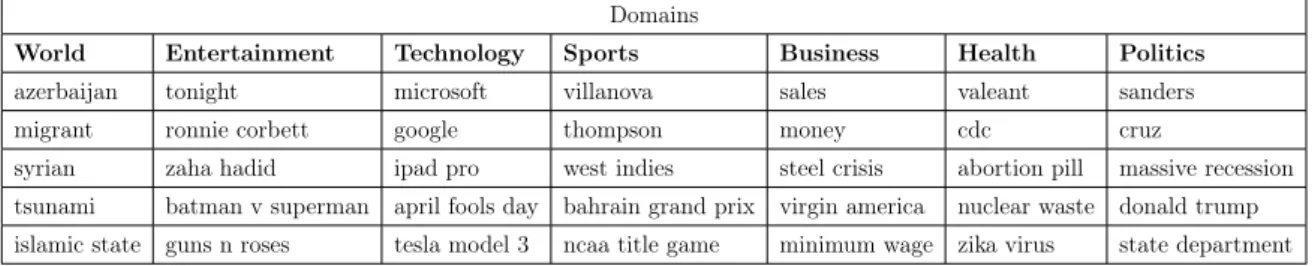
3.1 News Sources by domain . . . 29 3.2 Sample of terms for each domain . . . 32 3.3 Main differences between Twitter’s Stream API and REST API . . . . 34 3.4 Sentiment components weights in each score . . . 38
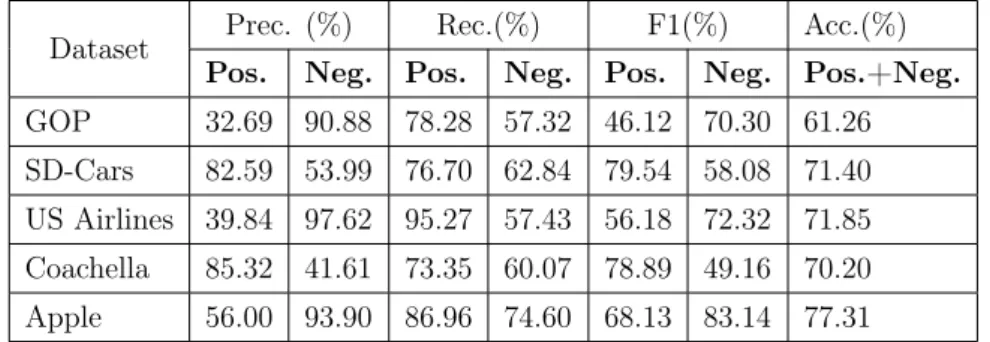
4.1 Results in terms of precision (Prec.), recall (Rec.), F1-score (F1), and accuracy (Acc.) . . . 46 4.2 Comparison of results of our system (SR) against a random baseline(Rbl)
and a majority baseline (Mbl) . . . 48 4.3 Comparison of results of our system (SR) against the results from
DatumBox framework (Datum) . . . 49 4.4 Sample of unfit terms . . . 54
5.1 Comparison of ensemble method against the more accurate individual systems in each domain . . . 71 5.2 Comparison of ensemble method against the most accurate individual
systems. . . 72 5.3 Comparison of ensemble method against the top individual systems
(according to F1-metric) in each domain . . . 72 xiii
5.4 Comparison of ensemble method against the top individual systems (according to F1-metric) in each class . . . 73
6.1 Pages used for Facebook posts and comments . . . 76 6.2 Variation between the Sentiment Systems with and without the
Ex-panded Lexicons . . . 78 6.3 Variation between the Sentiment Systems with and without the
Ex-panded Lexicons in non factual text . . . 79 6.4 Variation between the Sentiment Systems with and without the
Ex-panded Lexicons in non factual text with sentiment justification word in the Expanded Lexicons . . . 80
8.1 Results in terms of precision (Prec.), recall (Rec.), F1-score (F1), and accuracy (Acc.) of score with 100% text evaluation and 0% emoticon/emoji evaluation . . . 105 8.2 Results in terms of precision (Prec.), recall (Rec.), F1-score (F1),
and accuracy (Acc.) of score with 30% text evaluation and 70% emoticon/emoji evaluation . . . 106
List of Figures
1.1 Sentiment change in the word "Paris" . . . 5
2.1 Number of papers published by year in Sentiment Analysis and Opinion Mining . . . 8
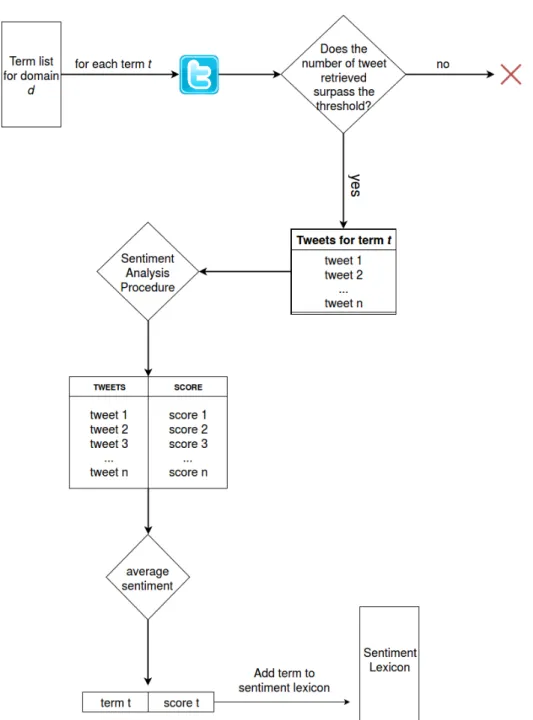
3.1 Terms Extraction Workflow . . . 33 3.2 Tweet posted in "The New York Times" official Twitter account . . . . 34 3.3 Term Sentiment Analysis Workflow . . . 39
4.1 Trend for "donald trump" using Google Trends . . . 51 4.2 Trend and sentiment for the term "donald trump" in "politics" domain 51 4.3 Plots of trend and sentiment for different terms from different domains 52
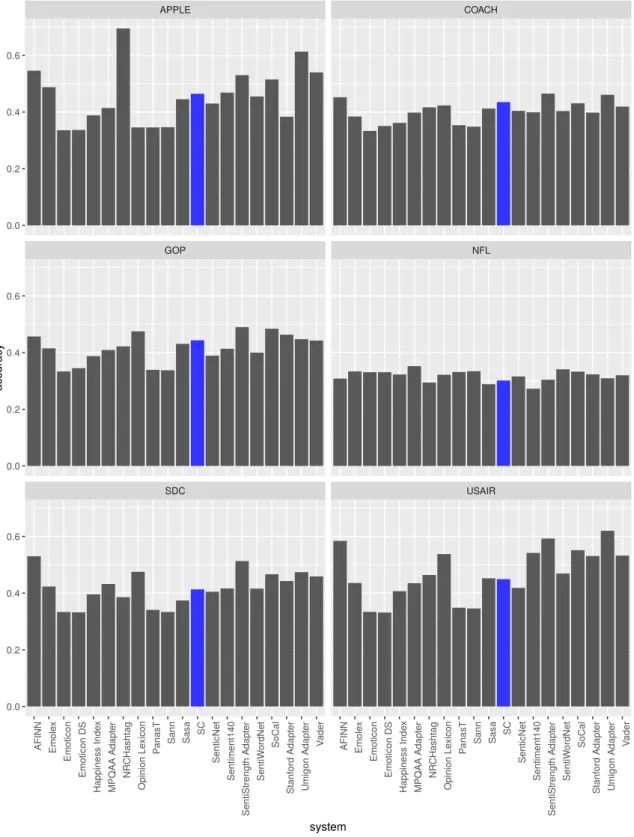
5.1 Tweet Domain Disambiguation Procedure . . . 59 5.2 Accuracy comparison of our SC against other Sentiment Analysis systems
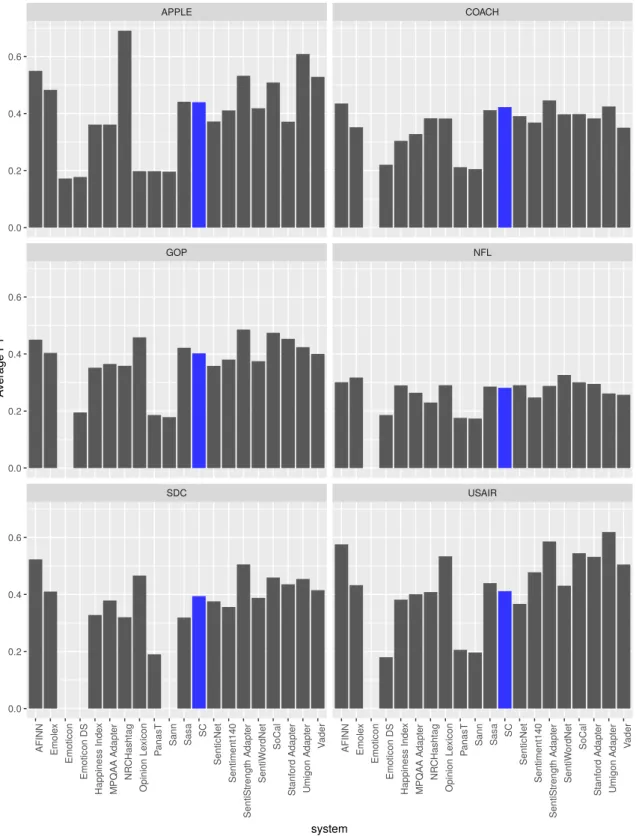
by domain . . . 65 5.3 Average F1-score comparison of our SC against other Sentiment Analysis
systems by domain . . . 66 5.4 Sentiment Analysis Systems Comparison across different classes using
F1-score . . . 68 5.5 Sentiment Analysis Systems Comparison across different classes using
Accuracy . . . 69 xv
5.6 Ensemble system example . . . 70
7.1 Sarcastic tweets (retrieved using the hashtag #sarcasm) . . . 86
7.2 Prototype of a visualization tool . . . 87
8.1 "apple" in "technology" domain . . . 107
8.2 "facebook" in "technology" domain . . . 107
8.3 "hillary clinton" in "politics" domain . . . 108
8.4 "bernie sanders" in "politics" domain . . . 108
8.5 "leicester" in "sports" domain . . . 109
8.6 "islamic state" in "world" domain . . . 109
Chapter 1
Introduction
1.1
Context
Throughout the years, opinion had significant importance on decision making across several fields. It is common knowledge that people ask and consider friends opinions before making decisions, whether it is on the quality of a certain product or a service (like restaurants and hotels). Therefore, people’s opinion has an impact on the economy since, for example, client’s opinion regarding a company products may influence the growth or downfall of sales [131] and in the release of a new product, negative opinion reviews represent a major influence on sales [25].
Opinion has also an important role in politics. During campaign periods several polls are conducted in order to predict the winner. Furthermore, it helps candidates to know which concerns to address or to avoid in different states or regions and how to manage campaign funds in order to get more voters. Moreover, the polls themselves can also influence voters [11], thus increasing the importance of public opinion.
Before the World Wide Web, companies spent time and resources in the elaboration of surveys to keep track of public opinion of their products. In same way, in a political domain and during the campaign periods, several polls were conducted in order to predict the winner and help candidates to plan the next steps.
Nowadays, information has become much more accessible. The emergence of blogs, reviews sites, and social networks have facilitated the decision making process. If a
2 CHAPTER 1. INTRODUCTION
buyer wants to assess the quality of the product that intends to purchase, the Internet has provided means to make a much more informative decision.
Therefore, company’s interest to evaluate and track the global opinion on their products or services has also grown, since now, million of users express their opinion online in social networks, blogs, review sites and forums, just to name a few. However, due to its unique characteristics, Twitter has been the more common and widely used service to access sentiment or opinion on different topics.
Twitter is a social network that allows users to send small pieces of text, called tweets, up to a limit of 140 characters. Besides normal text, tweets allow users to include hashtags, emojis and mentions to other users. Hashtags are tag words beginning with the character "#" whose purpose is to identify tweets with common topics and emojis are special figures that can be incorporated in the text. Other users can be mentioned in tweets by using the "@" character followed by the username. External links can also be included.
Twitter makes a good data source for public opinion analysis since it includes millions of users, from famous people to companies and presidents. The number of tweets and active users is also a factor. Since June 2015, on average, 500 million tweets are sent per day. The micro blogging site has also approximately 316 million active users per month [121]. Moreover, Twitter provides developers a public API allowing, among others features, the retrieval of tweets, getting user information and monitoring tweets in real time making it easier to retrieve large quantities of data for analysis [122]. Finally, Twitter also is an updated source of information since tweets are sent in real time about different topics from users with different opinions.
With such large amount of data publicly available and easily accessible, the interest on methods to automatically analyse and extract the opinion from that data has arise.
1.2
Definition of concepts
With the technological evolution, the volume of data that can be stored has increased significantly. This amount of information has reached a state where human analysis
1.3. RESEARCH HYPOTHESIS 3
and comprehension is impossible without the help of data analysis tools that could transform raw data into useful knowledge.
Data Mining is the process of automatically extracting that knowledge. One of the most common example where Data Mining techniques can be applied is supermarket purchases. Several Data Mining techniques are used to analyse customers transactions and suggest other related products (recommendation systems).
This concept can be further divided in more specific areas. Text Mining is the one we will focus and consists on retrieving relevant information from texts. Common goals in Text Mining are for example topic extraction from a document, automatic summarising and automatic translation of texts. This work falls within another field of Text Mining called Sentiment Analysis or Opinion Mining.
The main goal of Sentiment Analysis is to determine the opinion or sentiment in a text. This sentiment can be relatively to the totality of the text or to the entities presented in the text. The sentiment classification can also be done in a polarity fashion (positive/negative sentiment) or in a ranged scale (e.g. from −5 to 5). Sentiment analysis can also be done using supervised methods (where a model is trained with sentiment labels and then tries to predict new unclassified data) or unsupervised methods (where no prior knowledge is given to the model).
In several sentiment analysis approaches, it is common to use sentiment dictionaries or lexicons. They consist of lists of words with a specific sentiment associated to each word and are used to identify the general sentiment of a text. For example, a common and simple unsupervised approach is to sum the sentiment of all the words found in the text that are present in the dictionary.
1.3
Research Hypothesis
One of the main problems related with sentiment dictionaries (or lexicons) is the source used and the words they contain. Currently, there are several automatic and manually labelled sentiment dictionaries in different sizes. However, the vast majority focus on opinion words such as adjectives like "beautiful" and "awful" or verbs like "lost" and "wins". Connotative words that are neither a verb nor an adjective, such as "cancer"
4 CHAPTER 1. INTRODUCTION
and "terrorist", are not normally considered. Furthermore, when evaluating short informal texts, the absence of opinion words does not always implies the absence of sentiment. People often tend to use common knowledge to express an opinion without the use of opinion words. For example, in the sentence "After Paris, Brussels. When it will end?" there is a clear presence of a negative sentiment (due to the terrorist attacks that happened in both cities), but no opinion words to support it. This is because the opinion is expressed using facts regarding Paris and Brussels which are normally common knowledge due to the impact that they had on news and the way the public reacted to it. In addition, time gains a specific importance when we are dealing with this type of sentiment analysis with absence of opinion words. In fact, for most people, the fragment above would have no meaning by itself or sentiment associated prior to the terrorist attacks [37].
Besides time, these words must also have a domain associated to them. For example, if we consider the text fragment "listening to Prince, I still can believe it". "Prince" is, in a general context, a member of royalty. However, in this particular sentence (which we can associate to the entertainment/music domain) "prince" refers to the artist. Therefore, it is plausible to say that the sentiment of terms, like the ones mentioned above, may vary through time and according to the domain. This is more visible if we consider entities like persons or enterprises. Again, in the example of the word "Paris", it is fair to presume that the sentiment of the word was different before and shortly after the terrorist attacks on the city as Figure 1.1 illustrates. Furthermore, tweets with a sense of irony can also be misinterpreted by general sentiment lexicons. For example in the following tweet "I used to think that Britain produced best comedy programs but where else but here could we watch a team like Sarah Palin and Donald Trump on TV?" words like "best" could lead to a positive sentiment classification.
However, the tweet is pointing to an overall negative sentiment "disguised" with irony. Therefore, our research questions state the following:
• Can Twitter be a good source on the sentiment of time and domain dependent terms?
• Can domain and time dependent sentiment lexicons (consisting of parts of speech other than verbs and adjectives) improve the performance of sentiment analysis methods?
1.4. THESIS STRUCTURE 5
Figure 1.1: Sentiment change in the word "Paris"
To assess these hypotheses, our proposal is to develop a system that automatically extracts terms which are domain and time specific. Next, using Twitter, we will assign a sentiment to those terms to build domain and time specific lexicons. In order to evaluate if our system assigns these terms the correct domain and sentiment, we will test it using volunteers. Next, we will use the resulting lexicons with sentiment analysis methods, to evaluate if they perform better in the presence of the dictionaries created by our system.
1.4
Thesis Structure
The thesis structure is the following: in the next section we will provide an overview on the state of the art of sentiment analysis. After, we will detail the workflow and implementation of our system. In Chapter 4 we describe the evaluation made to assess the quality of our generated sentiment lexicons. Next, we refer to the changes made in the system (resulting from the evaluation made). Finally, we will evaluate if the
6 CHAPTER 1. INTRODUCTION
lexicons created improve the sentiment analysis task in Chapter 6 and draw some conclusions and future work in Chapter 7.
Chapter 2
State of the Art
2.1
Sentiment Analysis Overview
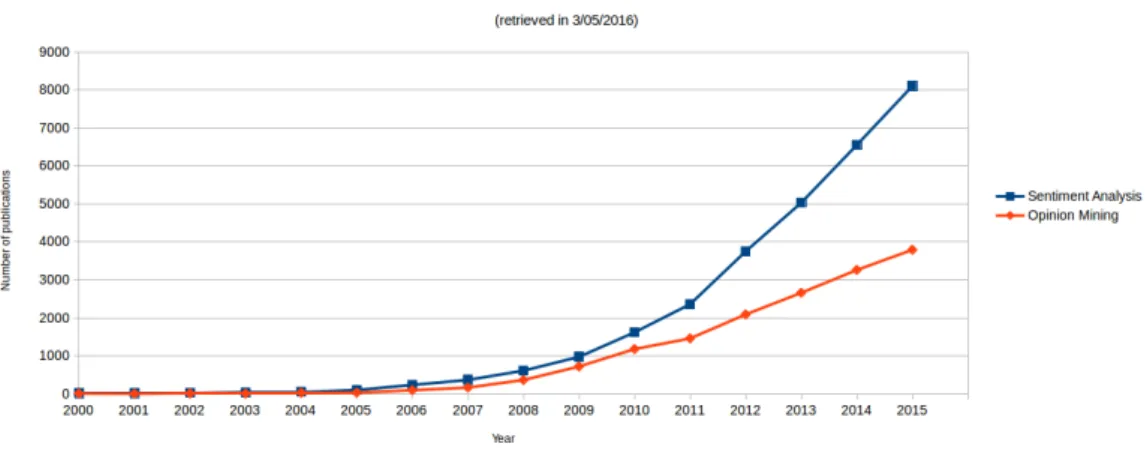
Sentiment Analysis and Opinion Mining interest has significantly grow in the last decade. The expansion of Social Web combined with the expression of opinion by its users on several different domains, has motivated the research on these topics. In fact, a query by year on Google Scholar1 reveals that the number of studies published in Sentiment Analysis and Opinion Mining has increased with time. In Figure 2.1 we present a plot with the number of hits in Google Scholar using "Sentiment Analysis" and "Opinion Mining" as keywords and filtering the result by publication year. It is important to notice that there is a significant number of publications that are included in both topics since they are, generally, used interchangeably. However, the plot intends to demonstrate that the research in sentiment analysis/opinion mining continues to grow and that it is an active research topic.
In order to comprehend the meaning of sentiment analysis, we first need to define the problem. Let us consider the following review extracted from IMDB2:
"Brilliant adaptation of the story of Bletchley Park and the cryptanalysis team, ran by Alan Turing, that cracked the code of the German Enigma Machine during World War II. Featuring an outstanding starring perfor-1
https://scholar.google.pt/
2http://www.imdb.com/title/tt02084970/
8 CHAPTER 2. STATE OF THE ART
Figure 2.1: Number of papers published by year in Sentiment Analysis and Opinion Mining
mance from Benedict Cumberbatch as war hero Turning and supporting acts from a brilliant cast including Keira Knightley, Charles Dance and Mark Strong, ’The Imitation Game’ is a powerful and eminently well-made biopic that illuminates the facts whilst respecting the story it is based upon. The English-language debut of ’Headhunters’ director Morten Tyldum, this
British World War II thriller is a highly conventional story about humanity that creates a fascinating character, anchored by a hypnotically complex performance."
Sentiment analysis methods evaluate the sentiment polarity in fragments of text. In the example above, strong evidence of positive sentiment is hand over by the presence of words such as brilliant,outstanding andfascinating. Studies to determine the polarity of reviews have been frequently published. For example Turney [119] proposes assessing the sentiment in reviews using an approach based on the extraction of opinion words. The method consisted in extracting pairs containing adverbs or adjectives (normally used in sentences which express opinion) and estimate the semantic orientation of those pairs. For that purpose, an adaptation of the point-wise mutual information algorithm for measuring the distance of the pairs to the word "poor" and "excellent". This distance is achieved using the operator NEAR in queries on the Altavista search engine. However, depending on the text, not always the detection of polarity words is enough. Let us consider the following review from Amazon:
2.1. SENTIMENT ANALYSIS OVERVIEW 9
"The original Star Wars trilogy was a defining part of my childhood. Born as I was in 1971, I was just the right age to fall headlong into this amazing new world Lucas created. I was one of those kids that showed up early at toy stores [...] anxiously awaiting each subsequent installment of the series. I’m so glad that by my late 20s, the old thrill had faded, or else I would have been EXTREMELY upset over Episode I: The Phantom Menace ... perhaps the biggest let-down in film history."
Although there are a significant higher number of positive opinion words, as a whole the review is negative. To address this issue, Taboada et al [106] analyse the sentiment of the text considering also the position of the opinion words.
Another way to tackle this issue is to identify the opinion or sentiment target. In other words, to which entity (movie, person, city...) is the sentiment referring to since sometimes different sentences may express sentiment on different topics. For instance, in a laptop review, we might want more details about what the user thinks about a specific aspect or feature (battery, storage, memory...). In this case, we can use sentiment analysis at an aspect level to have a more detailed opinion on certain component. Yohan et al. [59] propose an unsupervised model (ASUM) to discover pairs of (feature, sentiment) in reviews. Another study [115] uses specific techniques to perform sentiment analysis in movie reviews. The authors start by using a database of movie titles to differentiate sentiment words present in the titles from the ones present in the review. Then, analysis at a clause level is performed and positive or negative scores are assigned to words, having in consideration the dependency between them. Several other works [58, 20, 72] have studied methods for extracting sentiment words regarding specific entities.
Sentiment analysis can be performed at other levels besides the one mentioned previously. In fact, there are three distinct levels:
• Feature based/ Aspect level
• Sentence level
10 CHAPTER 2. STATE OF THE ART
Document level sentiment analysis refers to the task of identifying the overall sentiment in a document. Studies like [85, 119] use sentiment analysis in a document level to classify reviews based on its polarity. Another approach is sentence level sentiment analysis. Meena et al. [70] use linguistic analysis like sentence construction and conjunctions to infer the sentiment in the sentence. In another study [130], the authors try to differentiate the general polarity of a word from the polarity of the same word in a certain sentence context (contextual polarity).
Not only is important to identify the target of the opinion, but also in some contexts the source (or opinion holder). For example in a news domain, where the opinion holder can be a group, person or enterprise (e.g. "the president is pleased with the work done"). The authors in [61, 31] provide techniques for opinion holder extraction in online news texts.
2.1.1
Social Network Sentiment Analysis
Although early sentiment analysis studies are, in their majority, focus on reviews, with the grow of social networks, Twitter also became a main target source for sentiment data. The particular characteristics of this social network where users share their opinion on several different topics through short informal posts, has motivated sentiment analysis researchers to analyse and evaluate texts from it. Several works [80, 74, 46, 42] developed sentiment lexicons based on Twitter whereas in [112, 55, 95] the authors have used this social network data for evaluating sentiment analysis methods. Other approaches have used Twitter to track the sentiment on different topics such as elections [126, 118, 17] and stock market [13].
Fewer studies have been conducted on other well known social networks or websites. In [101] Youtube video comments are analysed in order to find relations between sentiment words in the comment and the rating that the same achieved. In the same study, the comment ratings are also used to evaluate whether a video has a polarity score associated to it or not. Furthermore, the study concludes that ratings are not equally distributed through different categories and that some categories (like music) have more positive ratings than others (such as vehicles, gaming and science).
2.1. SENTIMENT ANALYSIS OVERVIEW 11
Some studies have also used Facebook comments and status updates as source for sentiment analysis. The authors in [66] analyse sentiment in the comments of a Facebook fan page. They also try to retrieve the most important topic using keyword extraction with: term frequency, TD-IDF (measures the importance of a word in a set of documents), and Positive, Neutral, and Negative words. Another study tries to classify the different posts into three distinct categories: entertainment, posts from pages the user liked, and life events (labelling this last one according to the sentiment) [100].
2.1.2
Sentiment Analysis Features
Important features have been considered for better performance in sentiment analysis. Part of speech (POS) tags such as the Stanford Log-linear Part-Of-Speech Tagger [116] and OpenNLP3 have been used to identify what words are nouns, verbs and adjectives with the goal of determining if a certain text is subjective and consequently classify it with sentiment. Other textual features include the use of valence shifters [88]. Valence shifters are words that reverse, amplify or attenuate the strength on sentiment words. For example:
• Negation: "the food was delicious" → "the food was not delicious"
• Amplification: "the movie was bad" → "the movie was very bad"
• Attenuation: "the product was better than I expected" →"the product wasslightly
better than I expected"
• Negation and Amplification: "this album is good" → "this album is not very
good"
• Negation and Attenuation: "the results are not bad ..." →"the results are not only bad ...."
We can notice by the examples provided that negation combined with an amplification or attenuation reverses the polarity effect on the sentiment word. In other words, amplification words with negation become attenuation words and vice-versa.
12 CHAPTER 2. STATE OF THE ART
Besides textual features, in a web context other indicators can be extracted to support sentiment classification. Emoticons, for example, have also been pointed out as major, non textual, intensifiers of sentiment. At this point, it is important to distinguish three concepts that are, most of the time, used interchangeably. Emoticons or smileys refer to a representation of a face using punctuation symbols whether emojis are pictures that can represent anything from a happy face to an air-plane or car [49]. Table 2.1 provides a sample of some emoticons and emojis.
Emoticons :) :( :D :’(
Emojis
Table 2.1: Example of emoticons and emojis
This feature can be particularly helpful in short length texts. If we consider the tweet:
"In the Lock Tavern waiting to see Andrew Bird. Last time I was here b4 a @RoundhouseLDN gig we were seeing Prince :("
we can observe that the emoticon ":(" is crucial for sentiment detection since none of the traditional opinion words occurs.
To address emoticons as sentiment features, in [52] an emoticon lexicon is created and classified with sentiment by 3 annotators. Then, results of combining this particular lexicon with text-based sentiment analysis yield in an accuracy increase of 37% when compared with a text-based only analysis. Another work [92] infers that emoticons can be used in a semi-supervised method to assign polarity labels to text. Consequently, these texts are used as training data for supervised sentiment classifiers instead of the more traditional way of manual labelling by volunteers. Other studies [67, 57] also use emoticons as relevant feature in sentiment classification.
Some works have also studied emojis as sentiment cues. In [82] the authors assigned a sentiment classification to each emoji based on the polarity of the tweets where they are present. A more recent work [71] studies the perception of the same emoji in different platforms (since they are represented by different figures) in terms of sentiment and semantic.
2.1. SENTIMENT ANALYSIS OVERVIEW 13
The works on emoticons use, in it’s majority, data from Twitter or Twitter-like social networks (e.g. Weibo4). Another specific characteristic from this social network that has been studied as a sentiment feature are hashtags. Works [127, 26] consider hashtags as features for sentiment classification.
2.1.3
Supervised and Unsupervised Methods
The features mentioned previously can be used in both supervised and unsupervised methods. The main difference lies on the presence/absence of labelled data for learning. For instance, if we want to predict a variable y with a set of features x1, x2, x3,
supervised learning uses classified entries to learn and predict the outcome in future test cases. Some classifier examples are Support Vector Machines [21], Naïve-Bayes [98], Max-Entropy [81] and Decision Trees [90]. On other hand, unsupervised learning does not require the labelled data making it a low resource method. One of the most common example is the k-means clustering [68].
One of the first approaches using supervised learning in sentiment analysis classification was the study in [86]. The authors proposed using supervised techniques, that prove to be effective in text categorisation, to classify a text with positive or negative sentiment instead of a topic like sport or politics. The authors used three algorithms: Naive-Bayes, Maximum Entropy and SVM’s. Results showed that SVM’s performs better and Naive-Bayes the worst in a movie reviews dataset. As a matter of fact, Pang et al. also prove how the presence and frequency of unigrams and bigrams can influence the accuracy on polarity classification of reviews. Results show that unigram presence is the more effective for learning than bigram presence or unigram and bigram frequency. However, in other work [26] the bigrams and trigrams achieved better performance. Works like [77, 42, 132, 129] also used supervised algorithms, however some research has also focus on alternatives approaches such as Dynamic Artificial Neural Networks [40] or even, more recently, a Deep Learning approach using a Recursive Neural Tensor Network and a sentiment tree bank which achieves 85.4% accuracy in short phrases sentiment classification [103].
In unsupervised methods, most of the work on sentiment analysis has been done using dictionary-based approaches. The general idea is to use list of opinion words such as
14 CHAPTER 2. STATE OF THE ART
"good", "bad" and "awful" rated with a sentiment and then match the words present in the text with the ones present in the list. It is important to mention that most authors agree that supervised methods in sentiment analysis are the ones which require labelled texts for a learning phase. Although sentiment lexicons can be considered labelled information, they are normally classify as semi-supervised or unsupervised methods. In this work, we will use the latter to categorise these approaches.
A simple sentiment classification can be done by summing all opinion words sentiment values and divide by the number of opinion words presented. This method can be complemented with the features mentioned before. For example, lists of amplification, attenuation and negation words can be included for increasing, decreasing and reversing the level of polarity respectively in a rule based form (i.e. amplification/attenuation words increase/decrease 0.3 the sentiment word, negation reverses it and so on). Emoticon and emojis sentiment dictionaries can also be integrated.
Systems have been developed for unsupervised sentiment analysis. For instance, SentiStrength unsupervised approach [114, 113, 111] not only combines the features mentioned earlier but also assigns different sentiment for words with repeated letters ("love" and "loooooooove"), uppercase words ("this is bad", "this is BAD") or repeated punctuation ("awesome!", "awesome!!!!!"). It also includes a spelling correction procedure due to common errors in social web messages. Vader [55] also follows the same rule based approach which includes giving different sentiment to text with uppercase words, repeated punctuation and "emoticon extension" ( i.e. from :) to :)))))))).
It is also worth mentioning that there are several works that implemented ensemble sentiment analysis systems by combining different methods (supervised and unsuper-vised) into one. For example the work in [6] uses an ensemble classifier based on 9 different lexicon based approaches to evaluate reviews from different domains. The assessed sentiment on each review is done by each method by simply counting how many positive words occur in the review from that lexicon and subtracting by the number of negative words. The authors prove that this ensemble system is faster and have similar or better accuracy than supervised approaches, using six different reviews datasets each one with a specific domain. In another work [128] the authors proved that ensemble learning algorithms like boosting [38], random subspace [50], and bagging [18] are more accurate in sentiment classification than a single SVM
2.1. SENTIMENT ANALYSIS OVERVIEW 15
model. Similar conclusion are reached in [125] where an ensemble system by majority vote is built and compared with a lexicon based and several supervised methods in a dataset of tweets of airline companies. Results achieved provide evidence that assemble methods perform better than other individual methods in both Negative/Positive and Negative/Neutral/Positive classification.
Finally, although there is a large number of published works on sentiment analysis, they are normally evaluated on different datasets. Therefore, a direct comparison between methods is hard to achieve. As the authors in [117] refer, there is a need to aggregate the different sentiment methods into a framework in order to directly compare them across different text datasets. With this goal in mind, the authors in [1] make an exhaustive comparison of 20 different twitter sentiment analysis tools on five different domain datasets. They use metrics like accuracy and F1-score in each sentiment class as well as in each different domain. Another work [44] provides a detailed sentiment system comparison with 24 different systems (including paid sentiment analysis systems) in 18 different datasets, where some of them were used as a gold standard in previous publications. In addition, they provided a system (IFeel5) which can be used to replicate the results in the non-paid sentiment analysis methods.
2.1.4
Non-English Sentiment Analysis
Whereas the majority of studies on sentiment analysis are based on methods applied on data in the English language, some work has also been done in other vocabularies. For example, as Lee et al. [63] explain, sentences in Chinese are formed by a continuous stream of Chinese characters. Each character has a specific meaning but, when combined with other characters, that meaning may differ. In cases like this, simple sentiment analysis approaches (like Bag of Words) without taking this segmentation property into account may lead to inaccurate results. Due to the particularities of the Chinese language, besides segmentation treatment, the same study uses other steps (like conjunction rules and negation handling) combined with Max-Entropy to achieve high accuracy in Chinese online reviews. In [107] a comparative study is made using different feature selection methods and different learning models for the Chinese language. The results showed that the combination of using Information
16 CHAPTER 2. STATE OF THE ART
Gain (a feature selection procedure that uses the changes on information entropy to determine the best features) to decide which set of features behave the better and SVM’s as the sentiment classification model, perform the better amongst all other. Other works [94, 124] present lexical resources to perform sentiment analysis in the German language, while [102] presents a sentiment analysis system for user based political content (such as blog posts or news) in Portuguese vocabulary.
2.2
Domain and Time Specific Sentiment Analysis
In most of the cases, sentiment analysis is domain specific. However, time can also play an important role (for example when we analyse tweet data).
The authors in [92] state that, in the specific case of supervised techniques, exists a domain and time dependency on the models. A good example is the sentence "Go read the book" that has positive sentiment if the domain is book reviews but negative sentiment if it is movie reviews [85]. Adjective like "unpredictable" can also have opposite sentiment polarities on different domains. More specifically, the expressions "the plot was unpredictable" in a movie review and "the steering was unpredictable" in a car one [119]. In fact, several studies on sentiment analysis use datasets from different domains ("movies", "cars", "travel") to assess the performance of their proposal, since the results vary from domain to domain [111, 112].
Moreover, traditional data mining approaches make the assumption that the training data and test data are equally distributed and have the same feature space, something that may not be correct on the case of sentiment analysis on different domains. Transfer learning may help to tackle this problem by training a model based on a data from a domain and test it in several others [84]. The study in [133] classifies words regarding three attributes: polarity, domain and domain dependency/independence. For words that are domain independent only the polarity is identified. However, for domain dependence vocabulary, a polarity classification is assigned to each domain. Another study [41] introduces a deep learning approach for domain adaptation. Results show that domain adaptation was successfully achieved in 22 different domains using a two step procedure (consisting of an unsupervised feature extraction method in all domains and a SVM for sentiment classification).
2.3. SENTIMENT LEXICONS AND EXPANSION METHODS 17
As for time specific sentiment analysis, the majority of publications have focus on sentiment topic tracking through Twitter. This research subject studies how opinion varies on specific topics using Twitter for public opinion assessment. Approaches for sentiment topic tracking on Twitter generally use a term or set of similar terms as search query for retrieving tweets related to the topic. Then, sentiment analysis procedures are performed on the sample. In topic tracking systems, the output is normally displayed in a more graphical style (such as plots or histograms) for a quicker reasoning on results [27] and the evaluation is normally done by correlating real time events to sentiment changes. Several studies present sentiment topic tracking monitoring on different domains [126, 10, 56, 62, 3].
A peculiar controversy on sentiment topic tracking it’s the capability of Twitter on predicting elections outcomes. While [8] defend that Twitter data can be a good predictor on election results, the works [17] refute that hypothesis. A more specific example is the study conducted in [118] where tweets are retrieved prior to the 2009 german election. The study concluded that Twitter can be used for real time analysis of political sentiment suggesting a predictive power close to polls. However, a later work using the U.S. 2011 congress election stated that no relation has been found between the predictions and elections results [39].
2.3
Sentiment Lexicons and Expansion Methods
One of the most important parts for achieving high accuracy on sentiment analysis is the "sentiment lexicons" (or sentiment dictionaries). Each of the words in these lexicons can have a binary (positive and negative), ternary (positive, neutral, negative) or numerical (e.g. a -5 to 5 interval) sentiment value. Some studies also evaluate sentiment as emotions like fear, joy and sadness.
Some sentiment lexicons were already discussed previously. However, they were not properly categorised. There are three main groups where sentiment lexicons creation or expansion methods can be included: manual labelling, dictionary based and corpus based.
18 CHAPTER 2. STATE OF THE ART
2.3.1
Manual Labelling
This approach consists in the labelling of a list of words with sentiment by one or several volunteers/workers. Then, using metrics to determine inter-worker agreement, is established a ground truth for the sentiment of each opinion word [75, 105, 55, 79]. The lexicon used in Vader [55], for example, was created by concatenating several list of words from previous state of the art sentiment lexicons, and emoticons and acronyms. Then, using Amazon’s Mechanical Turk [2], each word was classified with a sentiment value (ranging from -4 to 4) by ten different workers. In addition, four quality control tests were implemented with monetary rewards to the workers who performed better. This careful method on sentiment lexicon construction complemented with a rule based system makes Vader outperform several state of the art sentiment analysis methods. Another example is the AFINN lexicon [80] which was built specifically for microblogs. The author began by adding a set of obscene words and common positive terms. Then, manual analysing a set of tweets, the lexicon was extended with other sentiment words and common slang used online. The resulting sentiment dictionary surpassed the ANEW on tweet sentiment analysis.
However, this approach can be time consuming, increasing with the size of the word list and the number of different evaluations required for each word. It can also be expensive if we resort to services like Mechanical Turk [2] or CrowdFlower [23] since a fee must be paied to each worker who completes the classification task.
2.3.2
Lexicon Expansion Methods
More automatic ways of creating sentiment lexicons were proposed. These require a small sample of sentiment labelled terms normally named seed words and then expanding the lexicon having as a base these words. Two different approaches have been used for expanding the lexicon in semi-supervised fashion6: thesaurus-based approaches and corpus-based approaches.
6To avoid confusion, here we use semi-supervised to classify the lexicon expansion method not the sentiment analysis itself.
2.3. SENTIMENT LEXICONS AND EXPANSION METHODS 19
2.3.2.1 Thesaurus-Based
Thesaurus-based approaches rely on other syntactic resources like the General Inquirer (GI) [104] or WordNet [35]. WordNet is a large lexical resource containing nouns, verbs,
adverbs and adjectives grouped by synsets which are sets of cognitive synonyms. If the word is an adjective, a set of antonyms is also available. Some works like SentiWordNet used this features and a small number of labelled words to expand sentiment lexicons by assigning the same polarity of a word to its synonyms and opposite to antonyms [7, 32]. However, the authors in [73] present better sentiment accuracy in words than SentiWordNet1.0 by using a Roget[97] like thesaurus, which is a tree schema dictionary with over a thousand branches and whose leaf nodes are cluster words aggregated by meaning.
Studies [60, 53] also used WordNet to expand sentiment lexicon making it one of the most used resources for lexicon expansion.
2.3.2.2 Corpus-Based
One of the major problems on thesaurus-based approaches is the domain specific context on each opinion word. The word "loud" can have a negative orientation in a car review but positive sentiment in a speaker review. For more domain specific lexicon expansion, the corpus-based approaches are a better solution.
Let us focus our attention in the following two reviews, extracted from a television and video game review, respectively.
• The Samsung remote is awesome and easy to use.
• The game has beautiful graphics but easy to complete.
Here the word "easy" has different sentiment polarity depending on the domain. Whether in television reviews points out to a positive sentiment, in video game reviews is associated with negative. For this type of problem, corpus based lexicons are more viable solutions.
In [47] a corpus based lexicon expansion method is proposed using conjunction rules to infer new opinion words specific to the domain. Using the television review above, if
20 CHAPTER 2. STATE OF THE ART
we know that "awesome" has a positive sentiment then, due to the conjunction AND, we can infer that "easy" or "easy to use" has also a positive sentiment associated. In the same way, on the video game review, if we know that "beautiful" has a positive polarity we can infer that the conjunction BUT will reverse the polarity on "easy". The authors named this concept as "sentiment consistency".
Another proposal for lexicon expansion is presented in [89]. It uses a set of seed words combined with conjunction rules for extracting entities and opinion terms. Then, through an iterative process, the new pairs of entities/opinion words are used for finding more pairs; the algorithm ends when no new entities or opinion words are found. Evaluation on reviews dataset showed that this method outperforms other state of the art approaches (such as the one in [53]).
However, opinion words polarity may vary, even in the same domain. For instance, in a laptop review, "the battery is long" is identified as positive whereas "it takes to long to start" is associated with a negative sentiment. So, to avoid erroneous sentiment classification, the use of entity level sentiment analysis techniques and the extraction of the ternary (word,entity, sentiment) was proposed for lexicon expansion [28]. Besides reviews and similar to sentiment analysis classifiers, social networks have been explored for corpus based lexicon expansion. As a matter of fact, many social networks have specific opinion words that are normally not covered by the general sentiment lexicons (e.g. "ahahahah", "LOL", "OMG", "#hatemonday"). The study in [15] present two models for creating a Twitter specific lexicon from a unlabelled corpus of tweets using tweet-centroid word vectors. The lexicon is classified into Positive, Neutral and Negative scores. Another work by the same authors [16] presents a supervised algorithm for lexicon expansion using tweets label with emoticons and a combination of several seed word lexicons. Another supervised approach [108] uses SkipGram (for learning continuous phrases representation) and a seed lexicon (expanded with contents from the Urban Dictionary7) as training data for a sentiment lexicon expansion classifier. One more study [30] shapes the information bottleneck method with cross-domain and inter-domain knowledge to extract a domain oriented lexicon. A rather different approach is the one presented in [36]. Whereas most of the methods presented focus on expanding sentiment lexicons with adjectives and verbs, the Feng et al. [36] study the influence of words with connotative polarity such as cancer,promotion andtragedy.
2.3. SENTIMENT LEXICONS AND EXPANSION METHODS 21
Furthermore, they also use an unusual graph approach which incorporates with the PageRank algorithm and a seed of opinion words to propose a connotative lexicon creation system.
In fact, the majority of works study how to expand sentiment lexicons with verbs and adjectives. In some contexts, nouns may also imply opinion. Consider the following extracted sentences from different reviews:
• Mattress Review: "Within a month, a valley formed in the middle of the mattress"
• Tablet Review: "It came with a scratch in the screen"
• Hotel Review: "The bedroom walls had a lot of stains"
The authors in [134] study nouns that may imply sentiment in product features. The study relies on an seed lexicon to identify the sentiment on reviews and then select candidates for feature nouns that suggest opinion.
The detection of sentiment in words other than adjectives and verbs is yet an understudied research area. Therefore, in this thesis it is the exploration of assigning sentiment to connotative words, nouns that imply opinion, entities and topics that will be highlighted. We intend to expand even more the sentiment lexicons in this studies by using public opinion as a measure of polarity for domain and time specific terms, combining topic sentiment tracking and lexicon expansion methods to study if the dictionaries created can improve state of the art sentiment classifiers.
Chapter 3
The Proposal
3.1
Problem
Approaches on lexicon expansion are widely based on the exploration of sentiment in adjectives or verbs. This is due to the fact that they are the most significant cues on detecting if a text infers sentiment or not. Tweets like "We are winning!" or "@Nike these new tennis are beautiful", are associated to a positive sentiment from the author of those tweets. However, as mentioned before, not only verbs and adjectives are important for sentiment detection. Sometimes, other terms can also be an important factor. Consider the following sentences.
• "First Paris now Brussels... What can we do?"
• "Listening to Bowie. Still can believe it"
• "I’m not travelling in Egyptair the next few years!!!"
Although there are some subjectivity cues (such as repeated exclamation marks or the presence of suspension points), analysing the sentiment polarity based only on syntax is a difficult task, mostly due do the absence of verbs and adjectives that can infer positive or negative opinion. However, our capability to understand the sentiment on these sentences relies on the knowledge from the nouns, topics or entities we acquire on a daily basis. For example, we are aware of the negative sentiment on the first and
24 CHAPTER 3. THE PROPOSAL
third sentence due to the tragic events that occur on Paris and Brussels and the crash of the Egyptair plane 1. The second sentence also points out to a negative sentiment appealing to a fact that is common knowledge for most of the people (the death of David Bowie 2) without mention it.
Another difficulty in sentiment analysis is the detection of irony. Irony is when there is a difference between the literal meaning of the words and the truth meaning of the text. Irony can be a hard obstacle to sentiment analysis methods. Some examples follow:
• "Donald Trump will be such a great president! Hitler would be proud!"
• "’Your cheering for Leicester? Such a weak team.’ I guess they were right though. We barely stayed on Premier League "
In the first set of examples, the detection of sentiment can be hard using traditional sentiment lexicons (even the domain specific ones) due to the absence of verbs or adjectives that usually infer sentiment. On the second set, although there are some adjectives such as "proud" on the first sentence and "weak" on the second, traditional approaches would classify the sentences as positive and negative respectively. However, once again, human perception can determine that there is irony present and, in fact, the polarity of each sentence is contrary to what individual adjectives point to. This is mostly because we are aware of the events occurring in the world and the opinion that such events generate in the public (i.e. public opinion). In this particular case, we are informed about Hitler as a negative word for the general public. Therefore, we can determine that although there are positive words in the text, irony is present and consequently the general sentiment of the sentence is negative. The same occurs in the second example where the presence of irony is detected due to the fact that the Leicester football team has won the Premier League 3 and therefore is associated to a positive sentiment .
To address the problem of lack of public opinion and general knowledge on sentiment lexicons, we must retrieve a sample of what that public opinion would be on each 1 http://www.telegraph.co.uk/news/2016/05/19/egyptair-flight-ms804-disappears-what-we-know-so-far/
2http://www.bbc.com/news/entertainment-arts-35278872
3 https://www.theguardian.com/football/2016/may/02/leicester-city-win-the-premier-league-title-after-fairytale-season
3.2. CONCEPTUAL DESIGN AND SOLUTION 25
term in a particular time interval. We define term as a word or set of words which may be connotative words such as "cancer", "terrorism" and "tumor" or that are usually associated to a sentiment which globally and in a certain period of time, tends to a specific polarity ("Donald Trump", "Brexit", "Isis"). Assessing the sentiment on a specific term within a specific time automatically can be a difficult task. Let us consider the example when politician X, which public opinion is fairly divided (some people think s/he is a good politician and others the opposite) is caught in a money laundry scheme. It’s fair to assume that the weight of public negative sentiment towards that politician will increase significantly. However, let us consider that some progress has been made on finding the cure of disease Y. Although this can attenuate the negative sentiment regarding the term Y this fact by itself should not be strong enough to change the polarity of the term. It is also plausible that most of public opinion sentiment changes emerge from news whether they are posted online, through television, or even in newspapers. For example a user reads the headlines on a news site and forms a personal opinion on certain terms (topics, events or entities) involved. If most of the public shares the same opinion, then there is a tendency on negative or positive sentiment. The assessing of those terms and sentiment associated can be important to improve sentiment classification, specially in short informal texts. However, for that effect, the terms and sentiment retrieved have to be constantly updated and aware of the events which may change public opinion on certain terms. In summary, there are two important issues which sentiment analysis methods do not contemplate:
• The lack of sentiment words does not always means the lack of sentiment
• The miss classification of sentiment due to irony can be improved if we assess the public opinion on some domain and (specially) time specific terms.
3.2
Conceptual Design and Solution
In order to create a lexicon expansion method that includes nouns, connotative words and other words or terms whose sentiment may fluctuate, we must: 1) identify what terms are relevant at the time and are subjected to sentiment change and 2) assess the public opinion on those specific terms.
26 CHAPTER 3. THE PROPOSAL
From the different lexicon expansion methods discussed in the previous chapter (manual, thesaurus/dictionary based and corpus based), the corpus based approach seems the more suitable. The manual approach is quickly discarded due to the time variable which would require an exhaustive and constantly labelling task from annotators. The dictionary based approach is also not appropriate because we are not only using verbs or adjectives but nouns which do not contain synonyms or antonyms. Therefore, the corpus based approach seems the more reasonable method.
With the lexicon expansion method selected, we must now determine what corpus or set of corpus we will use. Unlike other approaches where an unlabelled corpus is provided for detecting opinion words [15, 16] our approach will focus on detecting the more relevant terms and extracting a corpus based on public opinion for each of the terms. Then, our assumption is that the sentiment assessed in that corpus will be the general sentiment of the term.
In order to test that hypothesis and since we want to extract the more relevant and up to date terms, we will resort to news sources, more specifically the news headlines. As a matter of fact, headlines are the first part of the news scanned by readers and therefore, the decision of whether they will read or not the article relies on its relevance. For example, a study was conducted in [29] where the authors investigate how headlines relevance is important to capture readers attention. Since headlines summarise the information on the news, they should include the more relevant terms to hold the attention of the reader. So, searching relevant terms on news headlines should provide the more relevant ones without noisy words, which may be present in news body. Furthermore, since news are normally organised in different sections (world, sport, entertainment), we can create a domain specific sentiment lexicon by using ternary entries composed by <term,domain,sentiment>.
Since we are going to use headlines to determine the more relevant terms, we could apply sentiment analysis procedures on the same news corpus to determine the polarity of the term. However, headlines (and news content) tend to report facts which consequently lead to an absence of opinion. Even if there is sentiment expressed, it may not be the same as public opinion. As an example, if we consider the headline "Afghanistan intelligence agency confirms death of terrorist leader" 4, the presented sentiment is
4 http://www.foxnews.com/world/2016/05/22/afghan-taliban-leader-mullah-mansour-likely-killed-in-us-airstrike-official-says.html
3.3. SYSTEM PROPOSAL 27
clearly negative (due to the presence of the "death" word) but, public opinion may not share the same polarity.
Therefore, to assess the public opinion on a term, we rely on Twitter and its API. Our approach has solid foundations on several studies who conclude that Twitter is good for assessing public opinion on a certain topic [126, 10, 56, 62, 3].
3.3
System Proposal
In this section, we describe the workflow of the proposed method. The system is divided in two main components: the term extraction procedure and the sentiment evaluation method.
To the best of our knowledge, no lexicon expansion method uses an automatic way to extract and infer sentiment analysis on a term based on tweets retrieved on that term. Our main assumption is that the polarity of a sample of tweets on that term represents the public opinion of the term and therefore, that must be evaluated before assessing how the terms from our lexicon expansion method influence dictionary based sentiment analysis. That evaluation is explained in the next chapter.
3.3.1
Term Extraction
The first component of our system is the term extraction procedure. Since we want to extract the most relevant terms at the present time, we use news headlines as our corpus. For that purpose, we use RSS feeds from news sources for our extractions. RSS (or Rich Site Summary) is a specific format for dynamic web content. It is often used in media websites and allows an aggregation of content from different sources through a RSS reader [12]. Although RSS seems an outdated technology, the fact is that Feedly, which is one of the most used RSS reader for Android has over 1.5 million downloads [34] and reached 60.000 of paid subscribers in 2015 [33]. Furthermore, Google News RSS feeds extension for Chrome browser has over 1.2 million users [69].
Several news sites still maintain RSS for their news feeds. In addition, the RSS feed, like the news present in website, are categorised by news sections, providing to the
28 CHAPTER 3. THE PROPOSAL
extracted terms a specific domain. In our approach, we select several major news sites as news sources. We also restrain our research to seven specific news domains: world, entertainment, technology, sports, business, health, and politics. This selection was based on the majority of the domains found for RSS news sources (e.g. we would like to include the domain science but the number of sources found was relatively small) and the wide scope of the domains. For example we could use global markets news feeds but achieving a public opinion on such narrow scope could be a hard task due to the specificity of the terms.
We only used news sources in the English language and whose origin countries are the United States or included in the United Kingdom. We restrain our research to these two location specific news (and consequently location specific terms). In domains like politics, it is fair to assume that in the U.S. terms like the names of presidential candidates (e.g. "Bernie Sanders", "Donald Trump", "Ted Cruz"), "White House", "GOP" or "Obama" are likely to appear. However, in the United Kingdom it should be expected more terms like "David Cameron" or "Prince Charles". This geographical dependency inside domain specific terms should be an interesting topic to explore in future research, but for now we focus on the aggregation of these two due to their influential status. In fact, a survey puts the US and UK as the two most influential countries in the world according to several different factors [48]. Therefore, we argue that international media coverage is bigger in these countries and consequently, public opinion data should also be vast and easier to acquire using terms from these geographical sources.
Table 3.1 shows the sources on each of the selected domains. We left out Google News RSS feed since their redirect their news from other sources and, in order to achieve at least nine sources on each domain we were forced to include a domain specific news site (MedicineNet).
Our term extraction procedure begins with the retrieval of news headlines from the different sources for each specific domain. It is important to mention that the number of headlines on each source is dynamic. Then, headlines are aggregated and a corpus is constructed for each domain.
With the constructed corpus, some filters were made to avoid "noisy" terms. We will refer to noisy terms as terms who are not relevant to be classified with sentiment in
3.3. SYSTEM PROPOSAL 29
Table 3.1: News Sources by domain
News Source Domain
World Entertainment Technology Sports Business Health Politics
CNN x x x x x
BBC x x x x x x x
The Economist x x x x
The Wall Street Journal x x x
ABC News x x x x x x x
CBS News x x x x x x
The Washington Post x x x x x
NBC x x x x x The Guardian x x x x x Reuters x x x x x x x Yahoo News x x x x x x x Sky News x x x x x Daily Mail x x x x x
The New York Times x x x x x x
Financial Times x x
Forbes x x
MedicineNet x
Total 13 13 14 10 14 9 9
our lexicon. First, punctuation is removed from the corpus and lower case is imposed to every word. Additionally, stop words (e.g. "a", "at" and "this") are also removed because they occur with relatively high frequency and are not relevant to be included in our sentiment assignment task.
The next step is to build three different term-document matrices. One for unigrams (i.e. individual words) other for bigrams (i.e. two words terms) and the last one for trigrams (i.e. three word terms). Through experimentation we realise that most of the times, terms above trigrams were unique (in other words, they only occur once) so we discarded them. Furthermore, it is important to establish a limit for each set of terms. One way is to define a minimum number of occurrences of the term depending on the number of sources in that particular domain. Therefore, this threshold must be a percentage value of the number of sources so that 1) we can easily adapt and scale the system to more domains and sources 2) the number of terms extracted is restrained avoiding possible noisy terms which are not filtered. The minimum number