Automatic Extraction of
Facts, Relations, and Entities for
Web-Scale Knowledge Base Population
Ndapandula T. Nakashole
A dissertation presented for the degree of
Doctor of Engineering
in the
Faculty of Natural Sciences and Technology
U
NIVERSITY OFS
AARLANDM
AXP
LANCKI
NSTITUTE FORI
NFORMATICSDean: Prof. Mark Groves
Faculty of Natural Sciences and Technology Saarland University
Saarbücken, Germany
Colloquium: 2012-12-20
Max Planck Institute for Informatics Saarbücken, Germany
Advisor and Prof. Gerhard Weikum
First Reviewer: Department of Databases and Information Systems Max Planck Institute for Informatics
Saarbücken, Germany
Second Reviewer: Dr. Fabian Suchanek
Department of Databases and Information Systems Max Planck Institute for Informatics
Saarbücken, Germany
Third Reviewer: Prof. Tom M. Mitchell School of Computer Science Carnegie Mellon University Pittsburgh, PA, USA
Research Assistant: Dr. Rainer Gemulla
Department of Databases and Information Systems Max Planck Institute for Informatics
Saarbücken, Germany
Chairman: Prof. Jens Dittrich
Department of Computer Science Saarland University
Declaration
I hereby solemnly declare that this work was created on my own, using only the resources and tools mentioned. Information taken from other sources or indirectly adopted data and concepts are explicitly acknowl-edged with references to the respective sources. This work has not been submitted in a process for obtaining an academic degree elsewhere in the same or in similar form.
Eidesstattliche Versicherung
Hiermit versichere ich an Eides statt, dass ich die vorliegende Arbeit selb-stständig und ohne Benutzung anderer als der angegebenen Hilfsmittel angefertigt habe. Die aus anderen Quellen oder indirekt übernommenen Daten und Konzepte sind unter Angabe der Quelle gekennzeichnet. Die Arbeit wurde bisher weder im In- noch im Ausland in gleicher oder ähn-licher Form in einem Verfahren zur Erlangung eines akademischen Grades vorgelegt.
Saarbücken, December 2012
———————————— Ndapandula T. Nakashole
A
BSTRACT
Equipping machines with knowledge, through the construction of machine-readable knowledge bases, presents a key asset for semantic search, ma-chine translation, question answering, and other formidable challenges in artificial intelligence. However, human knowledge predominantly resides in books and other natural language text forms. This means that knowl-edge bases must be extracted and synthesized from natural language text. When the source of text is the Web, extraction methods must cope with ambiguity, noise, scale, and updates.
The goal of this dissertation is to develop knowledge base population methods that address the afore mentioned characteristics of Web text. The dissertation makes three contributions. The first contribution is a method for mining high-quality facts at scale, through distributed constraint rea-soning and a pattern representation model that is robust against noisy patterns. The second contribution is a method for mining a large com-prehensive collection of relation types beyond those commonly found in existing knowledge bases. The third contribution is a method for extract-ing facts from dynamic Web sources such as news articles and social media where one of the key challenges is the constant emergence of new entities. All methods have been evaluated through experiments involving Web-scale text collections.
K
URZFASSUNG
Maschinenlesbare Wissensbasen sind ein zentraler Baustein für seman-tische Suche, maschinelles Übersetzen, automaseman-tisches Beantworten von Fragen und andere komplexe Fragestellungen der Künstlichen Intelligenz. Allerdings findet man menschliches Wissen bis dato überwiegend in Büch-ern und anderen natürlichsprachigen Texten. Das hat zur Folge, dass Wissensbasen durch automatische Extraktion aus Texten erstellt werden müssen. Bei Texten aus dem Web müssen Extraktionsmethoden mit einem hohen Maß an Mehrdeutigkeit und Rauschen sowie mit sehr großen Daten-volumina und häufiger Aktualisierung zurechtkommen.
Das Ziel dieser Dissertation ist, Methoden zu entwickeln, die die automa-tische Erstellung von Wissensbasen unter den zuvor genannten Unwäg-barkeiten von Texten aus dem Web ermöglichen. Die Dissertation leistet dazu drei Beiträge. Der erste Beitrag ist ein skalierbar verteiltes Verfahren, das die effiziente Extraktion hochwertiger Fakten unterstützt, indem lo-gische Inferenzen mit robuster Textmustererkennung kombiniert werden. Der zweite Beitrag der Arbeit ist eine Methodik zur automatischen Kon-struktion einer umfassenden Sammlung typisierter Relationen, die weit über die in existierenden Wissensbasen bekannten Relationen hinausgeht. Der dritte Beitrag ist ein neuartiges Verfahren zur Extraktion von Fak-ten aus dynamischen WebinhalFak-ten wie NachrichFak-tenartikeln und sozialen Medien. Insbesondere werden Lösungen vorgestellt zur Erkennung und Registrierung neuer Entitäten, die bislang in keiner Wissenbasis enthalten sind.
Alle Verfahren wurden durch umfassende Experimente auf großen Text-und Webkorpora evaluiert.
S
UMMARY
Knowledge bases are data resources that encode knowledge in machine-readable formats. Such knowledge bases are enabling progress in seman-tic search, machine translation, question answering and other formidable challenges in artificial intelligence. Knowledge bases are populated by means of information extraction techniques. This dissertation contributes to three aspects of information extraction: fact extraction, relation extrac-tion, and entity extraction.
Fact extractionis central to knowledge base construction. It entails find-ingsubject-predicate-objecttriples in text. State-of-the-art approaches com-bine pattern-based gathering of fact candidates with logical reasoning over feasibility constraints. However, they face challenges regarding the trade-offs between precision, recall, and scalability. Techniques that scale well are susceptible to noisy patterns that degrade precision, while techniques that employ deep reasoning for high precision cannot cope with Web-scale data. The approach presented in this dissertation aims at a scalable system for high-quality fact extraction. For high recall, a new notion of ngram-itemsets for richer patterns is introduced. For high precision, the method makes use of MaxSat-based constraint reasoning on both the quality of patterns and the validity of fact candidates. For scalability, all parts of the approach are developed as distributed algorithms in the form of MapRe-duce algorithms. Collectively, these components form PROSPERA, a sys-tem which reconciles high recall, high precision, and scalability.
Relation extractionidentifies phrases that denote binary relations which are deemed interesting for fact extraction. Relations in existing knowledge bases are mostly hand-specified and limited to around 1000 or less. On the other hand, systems that yield a large number of relational textual patterns do no attempt to organize these according in a meaningful scheme. This dissertation presents PATTY, a method for extracting textual patterns that denote binary relations. In a departure from prior work, the patterns are semantically typed and organized into synonym sets and in a subsumption taxonomy. In particular, the method defines an expressive family of re-lational patterns, which combines syntactic features (S), ontological type signatures (O), and lexical features (L). The novelty is the addition of the ontological (semantic) dimension to patterns. PATTY also comes with effi-cient and scalable algorithms that can infer patterns and subsumptions at scale, based on instance-level overlaps and an ontological type hierarchy. On the Wikipedia corpus, PATTY produced 350,569 pattern synsets with 84.7% precision.
Entity extractionidentifies noun phrases in text that define entities. Large-scale knowledge bases are often restricted to popular entities such as fa-mous people and locations that are found in encyclopedias such as Wi-kipedia. Therefore, knowledge bases are never complete in the entities they contain. However, when extracting facts from rapidly updated data sources, such as news articles and social media, new entities emerge all the time. Simply considering all noun phrases as entities would intro-duce noise and make it difficult to relationships between new entities. To overcome this limitation, this dissertation presents PEARL, a method for enhancing previously unseen entities with type information. PEARL in-troduces an ILP-based method for typing out-of-knowledge-base entities that leverages type disjointness constraints. Typing new entities enables the fact extractor to generate more accurate facts. The value of extract-ing facts from rapidly updated sources is shown through the application of identifying emerging stories. Prior work on story identification generate stories as clusters of related entities, without specifying how the entities are related. In contrast, the method presented here succinctly states how a set of entities in a story are semantically related.
Z
USAMMENFASSUNG
Wissensbasen sind Datenquellen, die Wissen in maschinenlesbarer Form darstellen. Sie unterstützen damit Entwicklungen im Bereich der seman-tischen Suche, des maschinellen Übersetzen, des automaseman-tischen Beant-wortens von Fragen und ähnlich komplexer Fragestellungen der Künstlich-en IntelligKünstlich-enz. Die Erstellung von WissKünstlich-ensbasKünstlich-en erfolgt mit TechnikKünstlich-en der Informationsextraktion. Diese Dissertation trägt zu den folgenden drei Aspekten der Informationsextraktion bei: Extraktion von Fakten, von Re-lationen und von Entitäten.
DieExtraktion von Fakten ist eine zentrale Aufgabe bei der Erstellung von Wissensbasen. Dies beinhaltet das Auffinden von Subjekt-Prädikat-Objekt-Tripeln in Texten. Neuere Verfahren kombinieren dazu muster-basierte Methoden zum Auffinden von potentiellen Fakten mit logischen Inferenzmethoden zur Sicherstellung von Konsistenzbedingungen. Allerd-ings existieren hier Zielkonflikte bezüglich Güte, Auffindbarkeit und Skalier-barkeit. Einerseits sind Verfahren, die sich durch eine gute Skalierbarkeit auszeichnen, anfällig gegen Rauschen, was wiederum die Güte negativ beeinflusst. Andererseits skalieren Methoden zumeist nicht, wenn sie Kon-sistenzbedingungen durch logisches Schließen berücksichtigen. Der in dieser Arbeit vorgestellte Ansatz zielt darauf ab, hochwertige Fakten zu ex-trahieren. Um gute Auffindbarkeit zu gewährleisten, wird ein neuer Ansatz unter dem Einsatz semantisch bedeutungsvollerer Muster auf Grundlage von N-Grammen eingeführt. Zum Erzielen einer hohen Güte wird ein lo-gisches Inferenzverfahren auf der Basis eines MaxSat-Approximationsalgo-rithmus verwendet, das sowohl die Qualität der Muster als auch die Gültig-keit der Fakten bewertet. Die Implementierung in Form verteilter Algorith-men auf einer MapReduce-Plattform skaliert sehr gut. Die Kombination dieser Verfahren bildet das PROSPERA-System, das sich durch ein hohes Maß an Auffindbarkeit, Güte und Skalierbarkeit auszeichnet.
Bei der Relationsextraktion werden zunächst Phrasen identifiziert, die als binäre Relationen für die Extraktion von Fakten interpretiert werden können. In existierenden Wissensbasen sind diese Relationen in der Regel manuell spezifiziert worden; daher gibt es dort typischerweise nur 1000 oder weniger Relationen. Auf der anderen Seite gibt es Systeme, die au-tomatisch auf eine große Zahl relationaler Muster abzielen. Diese sind jedoch nicht in der Lage, die gesammelten Muster in semantischer Weise zu organisieren. Diese Dissertation präsentiert die PATTY-Methode zur Ex-traktion und semantischen Organisation textueller Muster, die binäre Re-lationen darstellen. Abweichend von früheren Arbeiten sind die hier ver-wendeten Muster semantisch typisiert und sowohl in Synonymgruppen als
auch in einer hierarchischen Taxonomie eingeordnet. Der hier vorgestellte Ansatz bietet damit ausdrucksstarke relationale Muster, die syntaktische Eigenschaften (S), ontologiebasierte Typsignaturen (O) und lexikalische Charakteristika (L) zu SOL-Mustern kombinieren. Neuartig an PATTY ist vor allem die Dimension einer ontologiebasierten (semantischen) Kom-ponente für relationale Muster. Die Algorithmen zur Konstruktion der Relationen und ihrer Synonymgruppen sind hochgradig skalierend und basieren auf Überlappungsmaßen zwischen Instanzmengen. Auf dem Voll-text von Wikipedia erzeugte PATTY 350,569 relationale Synonymgruppen bei einer Güte von 84,7%.
ZurEntitätenextraktionwerden zunächst Nominalphrasen in Texten iden-tifiziert, die Entitäten beinhalten. Große Wissensbasen sind zumeist auf populäre Entitäten wie berühmte Persönlichkeiten, Orte und Organisatio-nen eingeschränkt, wie sie zum Beispiel in Wikipedia vorkommen. Daher sind diese Wissensbasen inhärent unvollständig in Bezug auf die enthal-tenen Entitäten. Wenn man Fakten aus häufig aktualisierten Webinhal-ten wie NachrichWebinhal-tenartikeln und sozialen Medien extrahiert, stößt man ständig auf neue Entitäten. Ein denkbarer Ansatz, dem entgegenzuwirken, wäre, jede neu auftauchende Nominalphrase als Entität zu interpretieren, was jedoch semantisch unbefriedigend ist. Um dieses Dilemma aufzulösen, entwickelt diese Dissertation die PEARL-Methode, die bis dato unbekannte Entitäten mit Typinformation anreichert. PEARL basiert auf einer ganzzahlig-linearen Optimierung, die u.a. die Disjunktheit bestimmt-er Typen berück-sichtigt. Durch das zeitnahe Extrahieren neuer Entitäten in sich schnell än-dernden Datenquellen werden neue Anwendungsfelder erschlossen, beispiel-sweise das automatische Zusammenstellung von Stories aus einer Fülle von Einzelnachrichten. Frühere Arbeiten, die sich mit Story-Konstruktion befasst haben, haben einfach häufig zusammen auftretende Entitäten grup-piert, ohne die Relationen zwischen den Entitäten zu interpretieren. Im Gegensatz dazu stellt das hier vorgestellte Verfahren den semantischen Zusammenhang einer Gruppe von Entitäten in einer Story her.
A
CKNOWLEDGEMENTS
This work has been made possible through the outstanding guidance and support of my advisor Prof. Gerhard Weikum. I am fortunate and grateful to have had the opportunity to work with him. Members of the Databases and Information Systems group provided a stimulating working environ-ment, I thank them. I thank my co-authors Martin Theobald and Fabian Suchanek with whom I collaborated on parts of this work. I thank Marc Spaniol for translating the abstract and summary to German. I acknowl-edge with gratitude, financial assistance from the International Max Planck Research School for Computer Science (IMPRS-CS). Last but not least, I express gratitude to my parents, David and Secilia Nakashole, who have always encouraged me.
Table of Contents
1 Introduction 19
1.1 State-of-the-Art . . . 20
1.2 Contributions . . . 22
1.3 Dissertation Organization . . . 23
2 Background, Preliminaries, & Related Work 26 2.1 Background . . . 26
2.1.1 Template Filling . . . 26
2.1.2 Message Understanding Conferences (MUC) . . . 27
2.1.3 Pattern Learning . . . 28
2.1.4 Open Relation Discovery . . . 28
2.1.5 Exploiting Semi-Structured Sources . . . 29
2.1.6 The Semantic Web . . . 30
2.2 Knowledge Base Preliminaries . . . 31
2.2.1 Knowledge Base . . . 31
2.2.2 Ontology . . . 31
2.2.3 Classes . . . 31
2.2.4 Entities . . . 32
2.2.5 Relations . . . 32
2.3 Storage and Access Management . . . 32
2.3.1 Relational Databases . . . 32 2.3.2 NoSQL Databases . . . 33 2.3.3 Triplestores . . . 33 2.4 Related Work . . . 34 2.4.1 SOFIE . . . 34 2.4.2 ReadTheWeb/NELL . . . 35 2.4.3 TextRunner/Reverb . . . 35 2.4.4 Probase . . . 36 2.4.5 WebTables . . . 36
2.4.6 YAGO, DBpedia, Freebase . . . 37
3 Fact Extraction with PROSPERA 39 3.1 Motivation . . . 39 3.2 Contribution . . . 42 3.3 Related Work . . . 43 3.4 Overview of PROSPERA . . . 46 3.5 Pattern Analysis . . . 47 3.6 Reasoning . . . 52 3.7 Distributed Implementation . . . 54 3.8 Evaluation . . . 58 3.9 Summary . . . 68
4 Relation Extraction with PATTY 69 4.1 Motivation . . . 69
4.2 Contribution . . . 70
4.3 Related Work . . . 71
4.4 Overview of PATTY . . . 73
4.5 Pattern Extraction . . . 74
4.6 SOL Pattern Model . . . 75
4.7 Lexico-Syntactic Pattern Generalization . . . 77
4.8 Semantic Pattern Generalization . . . 78
4.9 Taxonomy Construction . . . 78
4.10 Evaluation . . . 84
4.11 Applications . . . 88
4.12 Summary . . . 92
5 Entity Extraction with PEARL 95 5.1 Motivation . . . 95
5.2 Contribution . . . 98
5.3 Related Work . . . 98
5.4 Overview of PEARL . . . 100
5.5 Detection of New Entities . . . 101
5.6 Typing Out-of-Knowledge-Base Entities . . . 102
5.7 Emerging Story Mining . . . 108
5.8 Evaluation . . . 112
5.9 Summary . . . 123
6 Conclusion 125 6.1 Contributions . . . 125
6.2 Future Directions . . . 126
A PATTY vs. Other Resources 129
B PEARL vs. Baselines 135
Bibliography 141
List of Tables
3.1 Example seed patterns with computed confidence values . . . 50
3.2 Performance for thehasAcademicAdvisorrelation . . . 59
3.3 Performance for all relations . . . 60
3.4 Precision and recall for the hasAcademicAdvisorrelation for vary-ing numbers of seeds . . . 61
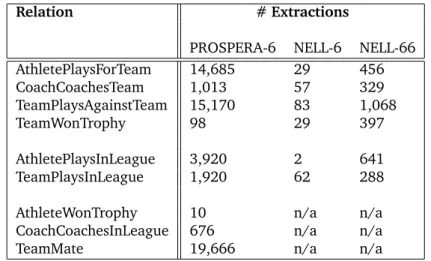
3.5 Performance comparison between PROSPERA and NELL on sports relations: number of extractions . . . 62
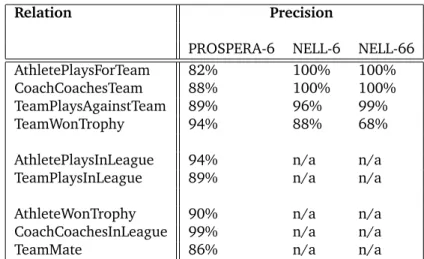
3.6 Performance comparison between PROSPERA and NELL on sports relations : precision . . . 63
3.7 Performance of PROSPERA: precions@1000 . . . 63
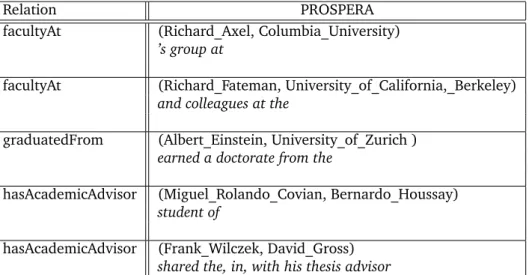
3.8 Sample output from PROSPERA . . . 64
3.9 Sample output from NELL . . . 64
3.10 PROSPERA variants on sports relations (2 iterations). . . 66
3.11 Sample output from PROSPERA . . . 67
3.12 Extracted facts and estimated precision for academic relations ob-tained from two iterations of PROSPERA. . . 67
3.13 PROSPERA variants on academic relations . . . 67
4.1 Pattern Synsets and their Support Sets . . . 79
4.2 Inverted data for Map-Reduce algorithm . . . 83
4.3 Precision of Relational Patterns . . . 85
4.4 Quality of Subsumptions . . . 85
4.5 Coverage of Music Relations . . . 86
4.6 Results for Different Pattern Language Alternatives . . . 87
4.7 Sample Results for Relation Paraphrasing Precision . . . 87
4.8 Sample Results for Relation Paraphrasing . . . 88
5.1 Results for entity typing (NS: not sure, W: wrong, S:satisfactory, VG:very good). . . 113
LIST OF TABLES LIST OF TABLES
5.3 Results for entity typing by PEARL variants (NS:not sure, W:wrong,
S:satisfactory, VG:very good). . . 115
5.4 Inter-judge agreement in entity-typing assessments. . . 115
5.5 NDCG for various entity-typing methods. . . 116
5.6 Example source sentences for PEARL results. . . 119
5.7 Example results from PEARL, HYENA, NNPLB . . . 120
5.8 Sample results for typing out-of-knowledge-base entities . . . 121
5.9 Quality assessment of story representations. . . 122
5.10 Precision of PEARL stories . . . 122
5.11 A categorization of the evaluated stories. . . 123
List of Figures
2.1 An excerpt of a MUC-3 template filling task, adapted from [47]. The template is filled by extracting the relevant fields from a
ter-rorist attack story. . . 27
2.2 An example infobox from Barbara Liskov’s Wikipedia page . . . 29
2.3 Wiki-markup corresponding to the infobox in Barbara Liskov’s Wi-kipedia page . . . 30
3.1 The fact extraction problem. . . 39
3.2 Architecture of the PROSPERA System. . . 48
3.3 MapReduce pseudo-code for frequent n-gram-itemset mining . . . 55
3.4 MapReduce pseudo-code for seed pattern confidence . . . 56
3.5 Mapper pseudo-code for pattern similarity and fact-candidate ex-traction. . . 57
3.6 PROSPERA runtimes on the sports domain (a) and number of ex-tractions across iterations (b). . . 65
4.1 Architecture of the PATTY System. . . 73
4.2 An example type system. . . 74
4.3 Prefix-tree for the Synsets in Table 4.1. . . 79
4.4 An example type-segmented tree. . . 82
4.5 PATTY paraphrases for the YAGO relation actedIn . . . 89
4.6 A part of the PATTY taxonomy . . . 90
4.7 Schema-free search for costars of Brad Pitt . . . 91
4.8 Simple join query to find visionaries affiliated with MIT . . . 92
4.9 Explaining relatedness through a direct triple . . . 93
4.10 Explaining relatedness through a join-query . . . 94
5.1 Out-of-knowledge-base entities per day . . . 95
5.2 Example of output from dynamic sources . . . 97
LIST OF FIGURES LIST OF FIGURES
5.4 A fact graph depicting a single story . . . 110 5.5 Precision of entity typing methods at 0.4 minimum fuzzy match
score. . . 117 5.6 Precision of entity typing methods at 0.8 minimum fuzzy match
score. . . 118 5.7 Relative recall for varying degrees of minimum fuzzy matches. . . . 118
CHAPTER
1
Introduction
B
UILDINGcomputers with human-level intelligence has been a long-standing goal in Artificial Intelligence. Alan Turing posed a philosophical test for assessing a machine’s ability to exhibit intelligent behavior [111]. A ma-chine passes the Turing test if it has the ability to carry on a conservation, in nat-ural language, well enough to be indistinguishable from a person. It is clear that today’s computers have not reached that kind of intelligence. Researchers in Nat-ural Language Processing (NLP) have instead focused on specific sub-challenges, including semantic search, question answering, machine translation, and sum-marization. Literature from these areas shows that knowledge plays a critical role in building intelligent systems [19, 25, 35, 40, 44, 89, 108, 116]. Therefore, it is important to capture knowledge and store it in machine-readable format — this is the goal of knowledge base construction.With much of human knowledge residing in books and other text documents, large-scale knowledge bases have to be constructed by extracting and synthe-sizing information from natural language text. Therefore, knowledge base con-struction requires methods for natural language text understanding. Machine understanding of text refers to parsing and transforming unstructured text into a structured representation. Such a representation has no ambiguity in it — mak-ing it suitable for machine readmak-ing and machine interpretation.
Encoding text as machine-readable knowledge requires transforming syntactic constructs to semantic constructs. One such transformation maps names in text to real world entities. For example, the wordApplemay refer to the company Ap-ple Inc.or to the apple fruit. Similarly, the name Madonna may refer to the popu-lar singer or the Christian painting. Mapping names to entities requires methods for entity disambiguation and co-reference resolution. Another transformation towards semantic data identifies relationships between pairs of entities. For ex-ample, simply stating thatApple Incco-occurs a lot withCupertino, Californiadoes not convey any semantics about the nature of the relationship. Instead, the goal is to explicitly state thatApple isHeadquarteredInLocation Cupertino, California. This requires methods for fact and relation extraction. The last transformation towards knowledge entails shifting from a document-centric view of
informa-1 INTRODUCTION 1.1 State-of-the-Art
tion to a knowledge-centric view by constructing knowledge bases consisting of factual assertions. These factual assertions are entities that exist and the rela-tionships that hold among them. By assimilating relarela-tionships and entities from several documents, a knowledge base can unveil not only direct relationships but also complex relationships through inference. For example, a knowledge base may reveal that the relationship betweenApple Inc. and the disk drive company Seagate Technologyis that they are both headquartered inCurpertino. As basic as it is for a human to uncover such a relationship, a document-centric view of the data would not be able to establish such a connection.
The above-mentioned transformations are challenging due to the inherent ambi-guity of natural language. There is ambiambi-guity in entity names and in relational phrases. Determining when a sentence mentions an entity or relation at all is not trivial. Also determining which of many relations a piece of text refers to is not simple. For example, it may not be clear if the text refers to the relation isHeadquarteredInLocationor the relationhasOfficesInLocation. The multiplicity of relations between entity pairs is also a challenge, Apple and Seagate may not only be headquartered in the same location, they might also have been led by the same executives at different time periods. Because of these factors, knowl-edge base construction is a best-effort process. It may produce conflicting and erroneous facts. In spite of these challenges, large-scale knowledge bases have been constructed in academia and industry. Such knowledge bases contain mil-lions of entities and hundreds of milmil-lions of facts about them. Example academic projects include: opencyc.org,dbpedia.org [8], knowitall [38, 10],stat-snowball [134],readtheweb[20], and yago-naga[108]. Industry has produced products such as :wolframalpha.com,freebase.com, andtrueknowledge.com.
Although these projects underline progress made to date, much remains to be done. Thus, the goal of this dissertation is to move forward the state-of-the-art in knowledge base construction research. It brings together ideas from previous work while also proposing new ideas for better coverage and quality.
1.1
S
TATE
-
OF
-
THE
-A
RT
Information extraction (IE) [104] is the technology for extracting knowledge from text by transforming unstructured text into a structured format. The out-put of information extraction is usually facts in the form:subject-predicate-object triples. For example, in the triple Apple-isHeadquateredIn-Cupertino, Apple is thesubject, isHeadquateredIn is the predicate, and Cupertino is the object. In extracting facts from text, there are two important questions to ask. The first is: what constitutes a subject and object? In other words, which noun phrases in text are worth extracting facts about? The second question is: which rela-tions should be extracted? In other words, which verb phrases or other types of phrases denote relations between entities? In answering these questions, two paradigms of information extraction have emerged, each at a different end of the spectrum of the conceivable answers to these questions. The two paradigms are: Ontology-based IE[109] andOpen IE[10].
In Ontology-based IE, at least one ontology is used to guide the extraction
1.1 State-of-the-Art 1 INTRODUCTION
cess. The ontology serves the purpose of providing a dictionary of entities. It also defines relations of interest in a specific domain, such as books and their authors or companies and their headquarters. The relations in ontologies are generally hand-specified by either developers of the ontology [108] or by domain experts [43]. What this means for ontology-based IE is that there is a major limitation in the number of relations that can be populated. Open IE aims to address this limitation by not making assumptions about the existence of entities or relations. Instead, all noun phrases are considered to be entities. For relations, the most open form of Open IE considers any phrase appearing between pairs of entities to be a relation. While Open IE counters the recall issue, it is highly susceptible to noise [70], due to the lack of tightly enforced semantics on relations and en-tities. Evidently, each of these IE paradigms have their respective strengths and weaknesses as outlined in more detail next.
Ontology-based IE vs. Open IE
Ontology-based IE: Pre-specified relations. The task of specifying all relations of interest is laborious. As a result, Ontology-based IE systems have tradition-ally only been applied to a small number of relations, typictradition-ally in the order of hundreds or less [20, 81, 109]. This leads to sparse knowledge in terms of the relations populated. Commonly covered relations arewasBornInCity, wasBornOn-Date, isHeadquatredIn, isMarriedTo, hasWonPrize. However there are many more interesting relations that are usually not covered.
Ontology-based IE: Dictionary of entities. Dictionaries of entities are never complete and often focus on popular entities. Entities in the long tail such as a cathedral in a small french city may not be in any of the major knowledge bases. On the other hand, Notre Dame in Paris has a high chance of being included in all major knowledge bases. Furthermore, new entities are constantly emerging, for example a new singer or a new hurricane. This and the issue of pre-specified relations point to a general coverage limitation in Ontology-based IE methods.
Open IE: Unspecified relations.Instead of using a set of pre-specified relations, Open IE systems consider every phrase appearing between a pair of entities to denote a relation. This permissiveness addresses the coverage limitation seen in Ontology-based IE. However, it introduces a substantial amount of noise. The is-sue is partly addressed by recent work, which has attempted to improve precision by restricting relations to specific part-of-speech tag sequences that are presumed to express true relations [41]. However, this does not improve much on the front of tighter semantics, for example, what each of the relations could mean and what constraints apply to such relations. Such semantics and constraints are key to accuracy in Ontology-based IE, for example, using type constraints to deter-mine which types of entities are valid for a given relation [109].
Open IE: No noun phrase left behind.Open IE systems do not use pre-existing dictionaries to define entities. In Open IE systems, every noun phrase is a possible entity. This raises a number of issues. First, the system picks up noun phrases that are not proper entities, such as “John and David" or “three girls". Second, there is no attempt to determine which noun phrases refer to the same entity or what type
1 INTRODUCTION 1.2 Contributions
of entity a given noun phrase is. Therefore, it is difficult to construct a consistent knowledge base. This may, for example, result in two different birth dates for the same person. Ontology-based IE enables entity disambiguation where each entity is mapped to a unique identifier in the ontology. For example, Wikipedia-derived ontologies use a short descriptive text after ambiguous names; for Michael Jor-dan the Berkeley professor, the identifier isMichael_Jordan_(computer scientist). Therefore the knowledge base clearly distinguishes which information is related to which Michael Jordan.
Challenges
Given the shortcomings of the two paradigms of information extraction, the ap-proach taken in this dissertation aims for a middle-ground. The goal is to avoid the limitations of the two paradigms while reaping the benefits of both. Aiming for such a middle-ground requires addressing the following limitations:
Efficiency bottleneck at Webscale.One limitation in the state-of-the art is that high accuracy has only been attained by expensive methods that do not scale to large data collections. In order to deal with Web-scale data collections, a scalable architecture for high accuracy fact extraction is needed.
High accuracy only for pre-specified relations.Another limitation in the state-of-the art is that high accuracy has only been attained for pre-specified relations in Ontology-based IE. Overcoming this limitation means discovering and main-taining a dynamically evolving open set of relations. This needs to go beyond common relations such as “bornIn” or “ isHeadquarteredIn”. For example, ma-jor knowledge bases lack potentially interesting relations such as “firedFrom” or “hasGoddaughter”. For completeness, there is a need to automatically discover such relations. At the same time, any approach that simply considers every phrase to be a possible relation should be avoided. In order to boost accuracy, there must be some semantics associated with the relations.
Static Knowledge.Another limitation is that previous methods have largely been snapshot-based. Facts are extracted from a snapshot of a corpus and some weeks or months later, another round of facts is extracted from a new snapshot. This process is repeated at irregular and long intervals resulting in incomplete and partly stale knowledge bases. For comprehensive coverage and to avoid stale-ness, rapidly updated sources such as news and social media must be brought into scope. One key challenge for this kind of data is that new entities are con-stantly emerging, methods need to discover new entities as they emerge. At the same time, resorting to treating every noun phrase as a valid entity without any semantic information to verify their validity should be avoided.
1.2
C
ONTRIBUTIONS
This dissertation presents methods that, to a large extent, address the challenges outlined above. In particular, the dissertation makes the following contributions:
1.3 Dissertation Organization 1 INTRODUCTION
PROSPERA: Fact Extraction. The first contribution of this dissertation is a sys-tem named PROSPERA, for high-quality knowledge harvesting at Web-scale. Fact extraction approaches that have achieved the highest accuracy to date [109] combine pattern-based gathering of fact candidates with constraint-based rea-soning. However, such approaches face major challenges regarding the trade-offs between precision, recall, and scalability. Techniques that scale well are suscepti-ble to noisy patterns that degrade precision, while techniques that employ deep reasoning for high precision cannot cope with Web-scale data. PROSPERA in-troduces a new notion of n-gram-itemsets for richer patterns, and uses MaxSat-based constraint reasoning on both the quality of patterns and the validity of fact candidates. PROSPERA incorporates these building blocks into a scalable archi-tecture which is implemented on top of a MapReduce-based distributed platform. PROSPERA’s results were presented at WebDB 2010 [79] and WSDM 2011 [80].
PATTY: Relation Extraction. The second contribution of this dissertation is a system named PATTY, for extracting patterns that denote binary relations be-tween entities. PATTY’s output is a large resource for relational phrases. Unlike open IE patterns, PATTY’s patterns are semantically typed and organized into a subsumption taxonomy. The PATTY system is based on efficient algorithms for frequent itemset mining and can process Web-scale corpora. It harnesses the type system and entity population of large knowledge bases. PATTY extends the state-of-the-art on lexical resources and knowledge bases in two ways. Compared to WordNet-like resources, it provides synsets for binary-relation patterns, in an unsupervised and open-domain manner. Compared to knowledge collections like ReVerb or NELL, it provides much more precise pattern synsets with semantic typ-ing, greatly reducing the noise in extracting relational-pattern instances. PATTY is available for download and for online browsing at http://www.mpi-inf.mpg. de/yago-naga/patty/. PATTY’s results were presented at EMNLP 2012 [81] and VLDB 2012 [82].
PEARL: Populating Knowledge Bases in Real-time. The third contribution of this dissertation is a system called PEARL, for real-time fact extraction from rapidly updated data sources such as news and social media. PEARL focuses on one of the key challenges of dynamic data — previously unseen entities. PEARL introduces an ILP-based method for typing out-of-knowledge-base entities that leverages type disjointness constraints. Furthermore, PEARL demonstrates the value of fact extraction from news and social media through the application of emerging story identification. Prior work on story identification generate stories as clusters of related entities. The stories PEARL generates state how a set of entities in a story are related. Some parts of the PEARL approach were presented at AKBC-WEKEX 2012 [83].
1.3
D
ISSERTATION
O
RGANIZATION
The outline of the rest of this dissertation is as follows.Chapter 2begins by sum-marizing the evolution of the field of information extraction; it then defines some of the central concepts in knowledge base construction and ends with a review of related projects, building a case for the novelty of our methods by outlining the
1 INTRODUCTION 1.3 Dissertation Organization
characteristics of competing methods.Chapter 3presents PROSPERA, a system for large scale fact extraction; it discusses how high recall, precision and scalabil-ity are brought together in one system. Chapter 4presents PATTY, a system for mining a large collection of patterns that denote binary relationships between entities; the chapter presents a thorough evaluation of PATTY, comparing it to similar resources. Chapter 5presents the PEARL system for populating knowl-edge bases with rapidly update data; in particular it focuses on handling new entities as they emerge and showcases a novel application. Chapter 6provides concluding remarks and puts forward possible directions for future work.
CHAPTER
2
Background, Preliminaries, &
Related Work
Recent years have seen a growing interest in automatic knowledge base construc-tion. However, research in information extraction, the technology for extracting knowledge from text, spans over three decades. This chapter places the contri-butions of this dissertation in the context of the previous body of work. It first gives a brief history of information extraction. It then introduces concepts cen-tral to knowledge base construction. The chapter ends by reviewing some of the ongoing related work.
2.1
B
ACKGROUND
Information extraction emerged out of the natural language processing commu-nity as a way of automatically understanding text. The past two decades have seen it become a challenge of interest to other computer science communities in-cluding databases, Web mining, and information retrieval. This section explains the progression of the field from the early days, up to where it currently stands, highlighting some of the defining works.
2.1.1
Template Filling
Early systems defined information extraction as a template filling task [28, 32, 46, 106, 133]. As in contemporary projects, these systems aimed to transform nat-ural language text into tabular structures. Each such tabular structure, referred to as a template, consists of slots to be filled up. Schank et al. [106] described template filling in the context of story comprehension. They argued that stories follow patterns, for example, stories on corporate mergers or management suc-cessions have recurring role players. Knowing who the players are for a given story enables understanding other stories. These ideas were implemented in the FRUMP system [32] in the early 1980s. Also in the early 1980s, Cowie [28] de-veloped a system for extracting templates about plants from wild flower guides.
2.1 Background 2 BACKGROUND, PRELIMINARIES, & RELATEDWORK
19 March – A bomb went off this morning near a power tower in San Salvador leaving a large part of the city without energy, but no casualties have been reported. According to unofficial sources, the bomb – allegedly detonated by urban guerrilla com-mandos – blew up a power tower in the northwestern part of San Salvador at 0650 (1250 GMT).
Sample text:
Incident type Bombing
Date March 19
Location San Salvador Perpetrator urban guerrilla c.
Target power tower
Effect on target destroyed
Effect on human target no injury or death Instrument bomb
Example template:
Figure 2.1: An excerpt of a MUC-3 template filling task, adapted from [47]. The template is filled by extracting the relevant fields from a terror-ist attack story.
Cowie made use of pre-defined phrases which correspond to various slots of the template being extracted. In the case of plants, the slots correspond to properties of plants. Rules were then applied to match the pre-defined phrases to phrases in text in order to extract values for the slots. Zarri [133] developed a system in the early 1980s, to extract information about the roles of historical figures in French historical documents. The template slots consisted of roles in particular historical events, such as the appointment of a historical figure on a particular date at a given location.
Systems based on template filling were among the first systems in the area of information extraction.
2.1.2
Message Understanding Conferences (MUC)
The next development was the introduction of the DARPA-sponsored Message Understanding Conferences [47, 78, 110]. The MUC conferences first started with institutions in the US that were extracting information from naval messages. The idea was for systems from different institutions to work on common mes-sages as training data and then meet at the conferences to compare performance of the different systems on unseen messages. The MUC conferences focused on extracting domain-specific information such as ship sightings, terrorism in Latin America, management successions, and business joint-venture information. Fig-ure 2.1 is an example template filling task from MUC-3, pertaining to terrorist stories [78]. For each terrorist story, systems had to extract the type of attack
2 BACKGROUND, PRELIMINARIES, & RELATEDWORK 2.1 Background
(e.g., bombing, arson, etc.), the date, location, targets, etc. Systems were com-paratively assessed against human performance for the same task. Thus, the con-ferences provided a means of measuring performance of language understanding systems.
2.1.3
Pattern Learning
In the late 1990s, along with the rapid growth of the Web came the first systems to extract information from Web sources. Among them were the DIPRE [14] and Snowball [3] systems. These systems take as input the relations to be extracted and a few seed example pairs for each of the relations. The goal is to then build-up the initial set of example pairs by extracting more pairs from Web text through pattern learning over multiple iterations. The first step is to spot the example pairs in text and then extract the patterns they occur with as good phrases for expressing the relations. For example, seeds like
teamHasWonTrophy(Germany, FIFA_World_Cup),
which was true in 1954, 1974 and 1990, may lead, after a few iterations, to patterns such as
X won the final of Y
and may then pick up new facts such as
teamHasWonTrophy(Spain, FIFA_World_Cup), which was true in 2010.
Pattern learning is a powerful technique which is still in use today. It can scale to large data collections. The major limitation of pattern learning systems is that they require manual specification of relations along with seed examples. This is a laborious process, requiring human supervision. While our first contribution makes use of pattern learning in PROSPERA (Chapter 3), our second contribu-tion, PATTY (Chapter 4), shows how to avoid manual specification of relations by automatically learning relations from text [81].
2.1.4
Open Relation Discovery
In an effort to overcome the limitation of pattern learning systems, work has emerged that aims to learn relations without requiring a pdefined set of re-lations and their seeds. Among these is the work on preemptive IE [127] and the TextRunner/Reverb system [10, 41]. These systems have the ability to learn a large number of relations by considering all phrases as denoting some kind of relation. However they do not provide any semantics with the phrases. This re-sults in a substantial amount of noise [70]. More importantly, it is not clear how to apply logical reasoning on the resulting output. Logical reasoning needs some specification to reason over: without any semantics attached to the phrases such as domain and range type constraints, the value of the data is reduced, especially for logical reasoning purposes.
2.1 Background 2 BACKGROUND, PRELIMINARIES, & RELATEDWORK
2.1.5
Exploiting Semi-Structured Sources
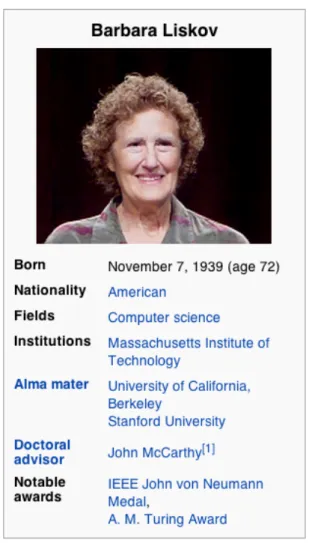
Figure 2.2: An example infobox from Barbara Liskov’s Wikipedia page The Internet has made it possible for geographically remote humans to collabo-rate on massive-scale projects. This phenomenon has led to the development and growth of knowledge sharing communities such as Wikipedia and a plethora of online forums including question answering websites such asanswers.yahoo.com andquora.com. The semi-structured nature of these sources means that knowl-edge can be extracted with relatively higher precision compared to natural lan-guage text. This has been shown by projects such as DBpedia [8], YAGO [108], and Freebase [13]. These projects have transformed Wikipedia into knowledge bases of structured data. The extractors are based on rules that extract relations from Wikipedia infoboxes and categories. Wikipedia infoboxes and categories follow a specific structure based on the Wiki-markup language. Thus the rules employed by these methods are not applicable to general Web text. An example infobox is shown in Figure 2.2 and its corresponding markup is shown in Figure 2.3.
2 BACKGROUND, PRELIMINARIES, & RELATEDWORK 2.1 Background
Figure 2.3: Wiki-markup corresponding to the infobox in Barbara Liskov’s Wikipedia page
2.1.6
The Semantic Web
The World Wide Web Consortium (W3C) ’s Semantic Web vision aims to advance the Web by augmenting documents with machine-readable data [12]. Towards this end, the Semantic Web strives to develop standards that enable data publish-ers on the Web to enrich their data with metadata. It is envisioned that by rely-ing on common standards, Web applications can interoperate with one another to perform complex tasks on behalf of users. In comparison to the Web of doc-uments, the uptake of the Semantic Web has been relatively slow [105]. While speculation as to why this is the case is beyond the scope of this dissertation, requiring additional work from content publishers likely plays a role. Therefore, knowledge base construction aim for semantic web capabilities from a different perspective: develop tools to parse unstructured or semi-structured data and con-vert it to structured data. Rather than have a uniform schema, knowledge base construction projects have been evolving in parallel, with different knowledge bases constructed at multiple sites each with its own schema.
2.2 Knowledge Base Preliminaries 2 BACKGROUND, PRELIMINARIES, & RELATEDWORK
2.2
K
NOWLEDGE
B
ASE
P
RELIMINARIES
2.2.1
Knowledge Base
Formally, a knowledge base is a special-purpose database used for the collection and management of knowledge in the form of logical statements. Some knowl-edge bases are manually constructed; for example lexical knowlknowl-edge bases such as WordNet [43] are compiled by domain experts. Other manually constructed knowledge bases include Cyc [69], health databases like MeSH and SNOMED, and semantic search engines like Wolfram Alpha (www.wolframalpha.com). Though manually constructed knowledge bases are of high quality, especially those au-thored by domain experts such as WordNet, they tend to be small in size. In this dissertation, the focus is on developing tools for automatically populating knowledge bases.
2.2.2
Ontology
Ontology is a term borrowed from philosophy where it is defined as the study of the nature of being, existence, or reality. In Computer Science and knowledge representation, Gruber [48] made the first attempt at a definition. He defines an ontology as a (logical) description of the concepts and entities that exist in a domain and the relationships that hold among them. Different from other kinds of knowledge bases, ontologies have the ability to reason about entities and relationships within a domain.
To encode knowledge in ontologies, several knowledge representation languages have emerged. Ontology languages vary in structure. Early ontology languages were frame-based. There has also been languages based on first-order logic such as CycL and KIF. Description logic-based languages produced the most com-monly used ontology language today, RDFS/OWL. RDFS/OWL is a standard of the World Wide Web Consortium (W3C). In RDFS/OWL all entities and relations are defined as RDF resources, and identified by Uniform Resource Identifiers (URIs). With RDF, data is stored as subject-predicate-object (SPO)triples. Contemporary ontologies are structurally similar, even though they adapt differ-ent ontology languages. Most ontologies consist of classes, differ-entities and relations.
2.2.3
Classes
Each ontology defines a type system around which its entities are organized. These classes (unary predicates) may include common types such as person, politician, scientist, location, etc. They may also include finer grained types such asfemale person, computer scientist, governor, etc. In addition, subsumption rela-tions among classes may also be specified. Examples of subclass-superclass are:
subclassOf (governor, politician), subclassOf (scientist, person),
subclassOf (computer scientist, scientist), . . .
2 BACKGROUND, PRELIMINARIES, & RELATEDWORK 2.3 Storage and Access Management
2.2.4
Entities
Each ontology also defines individual entities. For example, it contains instances of people, companies, and so on. Entity type information is provided in order to specify the classes to which each of the entities belongs. For example, the instanceOf relation may specify the following:
instanceOf (Arnold Schwarzenegger, governor), instanceOf (Bill Clinton, politician),
instanceOf (Bill Clinton, philanthropist), . . .
Additionally, a way of mapping names to entities is provided. Real-world entities can have multiple names including nicknames. These are different from the en-tity’s full name. Natural language text documents typically introduce the entity by its full name and thereafter refers to it by a shorthand form (e.g., a person’s last name). The official name of an entity in the ontology, is used as a canonical representation of the entity. Therefore, names are mapped to entity identifiers through some kind of “means" relation. For example, the “means” relation of a given ontology may specify the following mappings of names to entities.
means ( “Bill Clinton”, William Jefferson Clinton), means (“President Clinton”, William Jefferson Clinton), means (“Paris”, Paris, France),
means (“Paris”, Paris Hilton), . . .
2.2.5
Relations
Ontologies define sets of relation types that are deemed interesting. The list of relations varies from ontology to ontology. Common relations include: hasWon-Prize(person, award),headquarteredIn(organization, location),isMarriedTo(person, person). The number of relations in ontologies is a well-known shortcoming. They are typically less than 1000 relations in each ontology. There are often many interesting relations that are not covered, for example, competedAgainst(team, team),nominatedForPrize(person, award). As discussed in Chapter 4, the second contribution of this dissertation, PATTY, addresses this limitation.
2.3
S
TORAGE AND
A
CCESS
M
ANAGEMENT
Knowledge representation languages provide a conceptual description or model of knowledge data. RDF models data as subject-predicate-object (SPO) triples. Once the data is modeled as RDF triples, it needs to be made persistent for later use and access.
2.3.1
Relational Databases
A relational database is a common choice for storing data. It is created using the relational model by Codd [27]. The relational model organizes data in tables
2.3 Storage and Access Management 2 BACKGROUND, PRELIMINARIES, & RELATEDWORK
where rows correspond to distinct real-world entities, and columns are attributes of the entities. For example, a company might store information about its em-ployees in a database table where each row has information about a different employee and each column stores a particular employee attribute (name, ad-dress, salary, etc.).
A relational database requires a schema to be defined upfront before loading the data. The schema describes and prescribes how the data will be organized in the database, specifically how it is divided into database tables. There are multiple ways to organize the same data into a database. For RDF triples, the simplest schema is to store the data in a single table, consisting of three columns, one column for subject, one for predicate, and one for object. The problem with this approach is that, accessing the data may be slow if the query requires multiple self-joins on the same table. An alternative schema is to organize the data into a wider, sparser table, containing one column for each unique predicate. So far the dominant way of storing RDF in relational databases is the three-column-table. The ontologies used and developed in this dissertation are typically stored in relational databases, following a three-column-table schema.
2.3.2
NoSQL Databases
The requirement for a pre-defined schema in relational databases makes it dif-ficult to deal with highly dynamic and unpredictable data. Data in certain do-mains is not amenable to fixed schemas. As a result, recent years have seen a new type of database management systems emerge — key-value oriented NoSQL databases [90]. These types of databases are not built on tables as the rela-tional model, consequently, they do not use SQL for data manipulation. Instead, NoSQL databases store structured data as documents with dynamic schemas. For example, MongoDB[9] is based on lightweight XML(JSON)-like documents with dynamic schemas.
NoSQL databases started to gain ground in major Internet companies such as google.com,facebook.comandtwitter.com, which have to deal with huge quanti-ties of data. NoSQL databases are specifically designed to deal with large volumes of data as they can be seamlessly deployed on distributed hardware architectures such as clusters of multiple machines. Data can be partitioned among different servers. The system can easily scale out by adding more servers and failure of a server can be managed.
We use the MongoDB[9] system to store the large number of triples produced along with the relations extracted in Chapter 4.
2.3.3
Triplestores
Triplestores [102] are special-purpose databases designed for storing and retriev-ing triples. Example triplestores include Apache Jena, RDF-3X and Sesame. Some triplestores are built on top of relational databases, others have built their own in-house database engines. For example, Freebase [13] runs on a database cre-ated by Metaweb based on a graph model. The underlying data structures are
2 BACKGROUND, PRELIMINARIES, & RELATEDWORK 2.4 Related Work
not based on tables, instead Freebase uses a set of nodes and a set of links that establish relationships between the nodes. Queries to the database are made in Metaweb Query Language (MQL).
2.4
R
ELATED
W
ORK
There are many contemporary projects on knowledge base construction. Col-lectively, our contributions aim for a Web-scale, yet high-accuracy approach to knowledge base construction. The following characteristics set apart our ap-proach from previous work.
1. Web-scale. For scaling to large data collections, our algorithms are devel-oped as distributed MapReduce algorithms which scale to large data collec-tions.
2. Canonical entities. In order to ensure consistency among the extracted facts, we extract facts between canonical entities. This is in contrast with approaches that extract facts between noun phrases without any attempt to detect which noun phrases refer to the same entities and which noun phrases refer to different entities.
3. Newly emerging entities. Because we map noun phrases to canonical en-tities, in the event of a new entity we may not be able to process and accept facts pertaining to such previously unseen entities. Our contributions in-clude a method for adding type information to new entities.
4. Open set of relations. Our methods extract facts pertaining to a large set of binary relations.
5. Dynamic knowledge.The above four characteristics enable fact extraction from dynamically updated data sources such as news and social media. We now discuss previous work, focusing on the degree to which they possess the above characteristics.
2.4.1
SOFIE
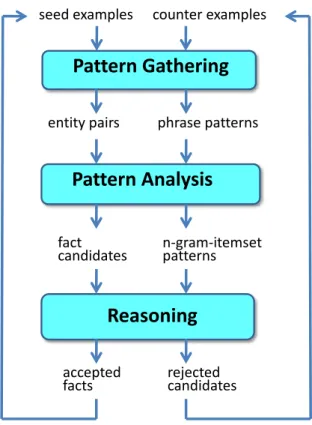
SOFIE [109] is an Ontology-based IE system for fact extraction. SOFIE’s main premise is to use logical reasoning to verify the plausibility of potential new facts against prior knowledge already in the YAGO ontology[108]. In particular SOFIE brings together entity-disambiguation, pattern matching and rule-based reason-ing in one framework. For entity disambiguation SOFIE first looks up, in YAGO, all the possible entities a noun phrase may refer to. It then determines which of the candidate entities the noun phrase likely refers to. This is done by com-puting similarity overlaps between the context of the noun phrase and what the ontology knows about the entities. SOFIE has the ability to re-assess disambigua-tion decisions if further evidence is found that contradicts the chosen entity. In a similar vein, SOFIE can reason about the plausibility of patterns. It reasons about the likelihood that a pattern expresses a given relation based on the pairs of entities the pattern occurs with. SOFIE applies the pattern-fact duality [14] to
2.4 Related Work 2 BACKGROUND, PRELIMINARIES, & RELATEDWORK
reason about patterns. SOFIE also takes into account other background knowl-edge, such as type constraints of relations, functional constraints on relations, and other domain-specific rules if available.
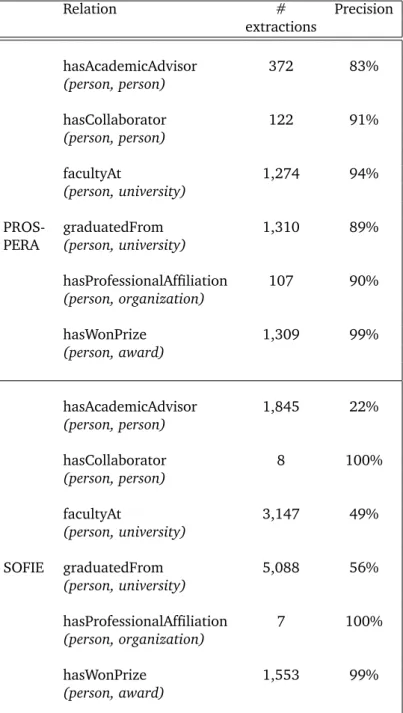
The experiments reported in [109] dealt with 1,000’s of input documents in about 10 hours on a single computer. Therefore, in its original form SOFIE is not designed forWeb scale. SOFIE produces fact aboutcanonical entities. However, it was run for a few hand-specified relations only and does not handle out-of-knowledge base entities; thus it cannot accumulate out-of-knowledge for rapidly chang-ing data sources. Our contribution in Chapter 3 builds on SOFIE; we compare SOFIE with PROSPERA in some of our experiments.
2.4.2
ReadTheWeb/NELL
The ReadTheWeb project developed ensemble methods to populate its NELL on-tology [20]. The idea behind NELL is a Never-Ending-Language-Learning system which learns new facts 24 hours a day, 7 days a week, and corrects itself over time as it learns to better understand natural language. NELL learns new entities and new facts. It employs a combination of methods in an ensemble manner cou-pled with constraints for extracting entities and facts from a large Web corpus. Like SOFIE, NELL automatically takes into account type constraints and other domain-specific constraints. The NELL method also learns constraint rules from the facts that it gathers.
NELL scales to Web data as it was applied to a corpus of 500 million pages. In addition, its architecture was deployed on a cluster of multiple machines. NELL extracts facts between pairs of noun phrases instead ofcanonicalized entities. In this sense NELL can tackle new entities as they emerge. NELL was originally based on a fixed set of relations. It was recently extended in OntExt [77], to automatically extract new relations (beyond the pre-specified ones) for a given type signature of arguments. However, OntExtonly learned 250 relations. It is not clear if NELL’s set of relations can compile facts from rapidly changing sources in a comprehensive and large-coverage manner, due to its relatively small set of relations.
2.4.3
TextRunner/Reverb
TextRunner [130, 10] is anOpen IEsystem which harvests facts by considering all relationships between pairs of noun phrases. ReVerb[41] extended TextRunner by constraining patterns to verbs or verb phrases that end with prepositions [41]. The TextRunner method is a three step process:
1. TextRunner first creates a self-supervised classifier which extracts a few facts from the input corpus and then labels them as good or bad based on a few hand-specified linguistic rules. This training portion of the corpus is run through expensive linguistic processing that produces enough information for the classifier to self-train. Example rules for determining if a fact is good or bad include: the relation string contains a verb, or the left-hand entity is the clause subject, etc.
2 BACKGROUND, PRELIMINARIES, & RELATEDWORK 2.4 Related Work
2. Second, TextRunner extracts facts from the entire corpus, using the self-trained classifier to determine if the facts are good or bad.
3. In the third and final step, TextRunner uses frequency statistics to determine if the fact is indeed true or not.
TextRunner is designed forWeb-scale, it was applied to 9 million Web pages. Like NELL, TextRunner extracts facts pertaining to pairs of noun phrases as opposed tocanonical entities. Also like NELL, it can tackle new entities as they emerge. TextRunner is not restricted to pre-defined relations, therefore it can likely handle dynamic Web content. However, it must be noted that due to its relaxation on what constitutes an entity or relation, the output of TextRunner is relatively noisy and makes it very difficult to apply any form of consistency reasoning on the extracted data. This generally leads to low quality output.
2.4.4
Probase
Probase [124] is a large probabilistic taxonomy of concepts based on extracting isArelations at Web-scale. The Probase concept taxonomy is similar to type hi-erarchies in other knowledge bases. The main difference is that it includes both widely used concepts such ascities, mucisians, etc, as well as highly specific con-cepts such asrenewable energy technologies, common sleep disorders, etc. Further-more, there are probabilities attached to each isAassertion. Probase extracted concepts from1.68billion Web pages, resulting in a taxonomy of2.7million con-cepts.
Probase does not extract facts pertaining to relations other than the isA rela-tion. Furthermore, ProbaseisAassertions pertain to noun phrases as opposed to canonical entities.
2.4.5
WebTables
There is a line of work that extracts information from tables on the Web. One of the early work along these lines is the WebTables system [18]. Recent work has gone a step further to annotate data extracted from tables with semantics [74, 112]. Venetis et al. [112] add class labels to columns and binary relation-ships between pairs of columns. They leverage a database of entities, their types and the relationships that hold among them. A table is assigned a class label (se-mantic type) if a large number of the entities in that column are identified with that label. Similarly, a pair of columns is labeled with a relationship if a large number of pairs from the two columns occur in the facts of that relationship. The WebTables system extracted over 100 million tables[18]. WebTables and related work primarily focus on HTML tables and are not concerned with natural language text. Furthermore, the output pertains to noun phrases as opposed to canonical entities.
2.5 Summary 2 BACKGROUND, PRELIMINARIES, & RELATEDWORK
2.4.6
YAGO, DBpedia, Freebase
Knowledge bases like YAGO, DBpedia, and Freebase extract facts from specific data formats such as the Wikipedia infobox structure for YAGO and DBPedia. As shown in Figure 2.3, the format of infoboxes is semi-structured. Therefore these system are not meant for full-fledged natural language processing but instead leverage domain-specific rules. In addition to extracting data from structured sources such as Wikipedia and musicbrainz.com, Freebase also takes human up-dates in a crowd-sourcing manner similar to the way Wikipedia is authored. Each of the knowledge bases defines it own population of entities, which grow with updates to the knowledge base. All the three knowledge bases are limited to less than a 1000 relations. These limited sets of relations are not amenable to extracting facts from rapidly changing data sources.
2.5
S
UMMARY
This chapter provided a brief history of information extraction, starting with early work on IE as a template filling task, proceeding to modern day pattern learn-ing systems, and to even more recent work on open relation discovery. It also presented methods that leverage semi-structured resources. The chapter then defined central concepts in knowledge base construction, including classes, enti-ties and relations. It then discussed some of the storage options for knowledge bases, covering relational databases, NoQSL databases and triplestores. Lastly, the chapter gave a discussion of related projects, comparing them to the contri-butions of the dissertation with respect to a number of design decisions.
CHAPTER
3
Fact Extraction with PROSPERA
Harvesting relational facts from text is a task central to automatic knowledge base construction. Fact extraction is a formidable challenge, thus state-of-the-art approaches still suffer from a number of limitations. In pstate-of-the-articular, there are major challenges regarding the trade-offs between precision, recall, and scala-bility. Techniques that scale well are susceptible to noisy patterns that degrade precision, while techniques that employ deep reasoning for high precision cannot cope with Web-scale data. This chapter presents this dissertation’s contribution toward Web-scale, high-quality fact extraction — the PROSPERA system.
3.1
M
OTIVATION
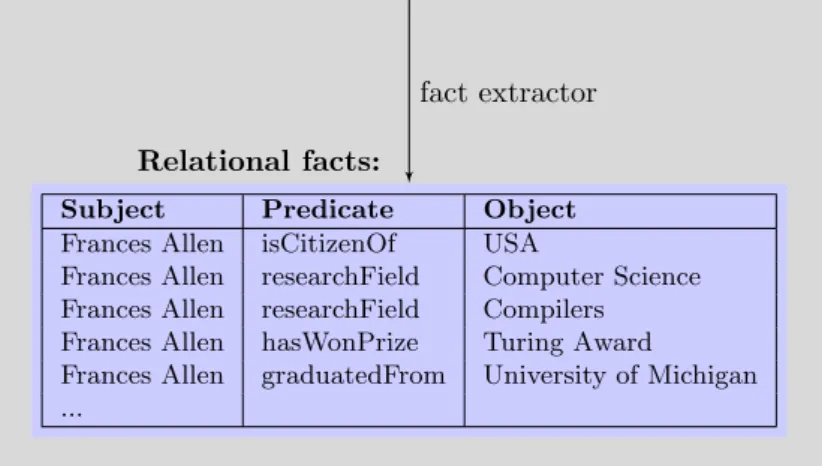
Frances Allenis anAmerican computer scientistand
pio-neer in the field ofoptimizing compilers. In 2006, she became the first woman to win theTuring Award. She earned an M.Sc. degree at theUniversity of Michigan.
Unstructured text:
Subject Predicate Object
Frances Allen isCitizenOf USA
Frances Allen researchField Computer Science Frances Allen researchField Compilers Frances Allen hasWonPrize Turing Award
Frances Allen graduatedFrom University of Michigan ...
Relational facts:
fact extractor
3 FACTEXTRACTION WITHPROSPERA 3.1 Motivation
The process of fact extraction, as illustrated in Figure 3.1, takes as input a corpus of unstructured, natural language text documents, and produces structured data in the form ofsubject-predicate-objecttriples.
The prevalent approach to fact extraction is to usepattern-based extractors. Some methods additionally employconsistency constraint reasoning(or some form of constraint-aware statistical learning).
Pattern-based Extractors
In a pattern-based approach (e.g., [14, 3, 10, 19]), the system starts with a few seed factsto bootstrap the extraction process. For example the relation teamWon-Trophy, that holds between soccer teams and trophies might have a seed fact:
teamWonTrophy(Germany, FIFA_World_Cup)
This seed fact was true in 1974 and 1990 and by finding it in text we can auto-matically detect textualpatternslike:
X won the final and became the Y champion
Such a pattern can, in turn, discover new facts such as: teamWonTrophy(Spain, FIFA_World_Cup)
This was indeed true in 2010. While this approach is good for high recall, it however may lead to noisy patterns and degrade precision. For example, the same seed may lead, after a few iterations, to frequent but spurious patterns such as:
X lost the final of Y.
Such a pattern can erroneously pick up the false positive: teamWonTrophy(Netherlands, FIFA_World_Cup), which was never true as of 2012.
Consistency Constraint Reasoning
Reasoning-enhanced systems (e.g., [109, 134, 20]) check the plausibility of the extractedfact candidatesby their mutual consistency based on specified logical constraints. For example, suppose the system picked up a spurious pattern for thehasAcademicAdvisor:
X benefitted from the deep insight of Y The pattern may lead to the fact candidate:
hasAcademicAdvisor(Tim_Berners-Lee, Max_Planck).
A constraint-aware system can invalidate this hypothesis by using prior knowl-edge about the birth year of Berners-Lee (1955), the death year of Max Planck (1947) and a rule that a student must be born (or at least, say, 15 years old)
3.1 Motivation 3 FACTEXTRACTION WITHPROSPERA
before graduating. Similarly, type constraints can be used to eliminate false pos-itives such as:
graduatedFrom(Tim_Berners-Lee, Real_Madrid).
This is not a plausible fact because Real_Madrid is a sports team not a university. Consistency reasoning is expensive and facesscalability problems. TheReadTheWeb project [20, 21] recently showed how to parallelize a constraint-aware approach, using an ensemble-learning method over coupled pattern learners. However, this method yields relational pairs betweennamesof entities rather than referring to entitiesthemselves. For example, the result may contain instances such as:
playsInLeague(Real_Madrid_CF, Champions_League), playsInLeague(Real_Madrid, UEFA),
playsInLeague(Real, UEFA_Champions_League). The above three instances refer to the very same fact.
This is much lower-quality knowledge than a canonical representation that would state the fact in terms of uniquely named entities:
playsInLeague(Real_Madrid_CF, UEFA_Champions_League).
There would then be a separate relation for capturing the synonyms of entities, for example:
means(Real, Real_Madrid_CF).
Note that many names are ambiguous, so they appear inmeansfacts for different entities. For example, Wikipedia knows more than 20 soccer clubs called Real, there are several currencies named Real, and so on.
PROSPERA builds on the SOFIE approach [109], which combines a pattern-gathering phase with aconsistency-reasoning phase. Experiments in [109] dealt with 1,000’s of input documents and 10,000’s of hypotheses in about 10 hours on a single computer. Clearly, this is not good enough for Web scale. Moreover, while precision was very high, the constraint-based reasoning severely limited recall. To increase recall, one could relax the pattern gathering and allow more patterns and co-occurring fact candidates to enter the reasoning phase. However, this entails two problems:
1. Efficiency: it presents the reasoner with a much larger hypotheses space (more clauses for a Weighted-MaxSat solver [109]);
2. Quality: it introduces noisy patterns such as “X played in the qualification round of Y” for teamWonTrophy, and sparsely occurring patterns such as “P scored her third goal in the triumph of T” for the athletePlaysForTeam relation, which is hardly generalizable for learning given that female players (“ her goal") have less coverage in Web sources and“three”(goals in the same match) is a rare feature.
In summary, Web-scale knowledge harvesting is not yet as robust and scalable as we wish it to be. Key limitations are:
• non-canonical output:shallow and scalable methods yield pairs of (ambigu-ous) names rather than truly entity-based facts;
3 FACTEXTRACTION WITHPROSPERA 3.2 Contribution
• scalability:
![Figure 2.1: An excerpt of a MUC-3 template filling task, adapted from [47]. The template is filled by extracting the relevant fields from a terror-ist attack story.](https://thumb-us.123doks.com/thumbv2/123dok_us/777055.2598259/31.892.196.712.127.548/figure-excerpt-template-filling-adapted-template-extracting-relevant.webp)