THE ECONOMIC DIPLOMACY OF A SMALL STATE: THE CASE
OF NAMIBIA
by
Peya Mushelenga
Submitted in accordance with the requirements for the Degree of
DOCTOR OF LITERATURE AND PHILOSOPHY
in the subject
INTERNATIONAL POLITICS
at the
UNIVERSITY OF SOUTH AFRICA
Promoter: Professor Jo-Ansie van Wyk
Co-Promoter: Professor Clive J Napier
Student Number: 312 887 15
I declare that ‘The economic diplomacy of small state: the case of Namibia’ is my own work and that all the sources that I have used or quoted, have been indicated and acknowledged by means of complete references.
____________________ __________________
DEDICATION
I dedicate this study to the memories of my late mother Elizabeth Nashilongo Mushelenga (néé Shihepo) who passed away on 10 October 2013 while I was busy with the final chapters of this study, and my eldest sister Taimi Kamati (néé Mushelenga) who passed away on 02 August 2014. Taimi was the language editor of the first chapters of this study.
ACKNOWLEDGEMENTS
This study would not have been completed without the support that I have received from a number of people. First and foremost, I would like to express my humble gratitude to my late beloved mother, Elizabeth Nashilongo Mushelenga (néé Shihepo), who constantly gave me moral support to pursue my studies. My sincere thanks go to my late eldest sister, Taimi Kamati (néé Mushelenga), who language-edited the first chapters of the study. My mother and sister have not lived to see the completion of this study, and for all good reasons, I dedicate this study to their memories.
My gratitude goes to my wife Eunike, a pillar of support in my life. I also acknowledge my son Panduleni, and daughter Pamwenatse, who played with me and provided the humour needed to ease the stress of the studies. I am grateful to André du Pisani and William (Bill) Lindeke, who made critical comments on the research proposal. Sadly, Bill has not lived to see the completion of the study. I shall for ever remain indebted to Jo-Ansie van Wyk for her constructive criticism, advice and continuous encouragement. Clive Napier made critiques that enabled me to make the necessary improvements on the thesis.
I am grateful to the staff of the Namibian Parliament Library, the National Library, the Namibia Chamber of Commerce and Industry, officials from the Ministries of Foreign Affairs, Trade and Industry and from Namibian embassies who provided me with the information that I needed in writing this thesis. I am further indebted to officials from the Bank of Namibia, University of Namibia, Namibia Tourism Board and the Ministry of Finance for providing me with statistical data used in this study. I would like to particularly single out Nelago Indongo, Anacy Mwanyangapo and Aloysius Tsheehama.
I would like to thank all individuals whom I have interviewed, whose names appear on annex 1. They provided valuable primary information that enriched this study. I remain indebted to President Hifikepunye Pohamba, who took a personal interest in my studies and constantly encouraged me. My gratitude further goes to former President Sam
Nujoma, for his moral support. Theo-Ben Gurirab inspired and nurtured my passion for diplomacy and international relations. Ndeutapo Amagulu provided me with his personal study materials on foreign policy. Sadly, he did not live to see the completion of the study.
I would like to thank my successive secretaries, Josephine Boois, Tashiya Shivoro and Selma Hailonga for arranging my appointments for the interviews conducted during the research. I am indebted to my drivers/protection officers, Warrant Officers, Immanuel Abed and Tonata Moongo, who took me around when I was carrying out the research.
Viviette Rittmann contributed to the language-editing of the thesis. I am most grateful to Professor Jairos Kangira who language-edited the final version of the thesis.
The economic diplomacy of a small state: The case of Namibia By: Peya Mushelenga
Degree: Doctor of Literature and Philosophy Subject: International Politics
Supervisor: Prof Jo-Ansie Van Wyk Co-Supervisor: Prof Clive J Napier
Summary
This study is about the economic diplomacy of Namibia, as a small state, for the period 1990 – 2015. Liberalism, as a theory of International Relations (IR) studies, is the adopted analytical framework. Namibia’s economic diplomacy is anchored in the foreign policy principles enshrined in article 96 of her constitution, which advocate, inter alia,
the maintenance of mutual beneficial relations. Namibia, further enacted laws and adopted policies that serve as domestic instruments of economic diplomacy. The stakeholders in Namibia’s economic diplomacy include both state and non-state actors.
The study adopts a population of 8 million as the benchmark for small states, plus one of the following characteristics of small states: small size of the territory; low economy and the perception by the government leaders and nationals.
Namibia’s bilateral economic diplomacy covers over one hundred countries. Her major trade partners, in terms of export trade and inward investments are Angola, Canada, China, Germany, The Netherlands, Spain, South Africa, Switzerland, The United Kingdom and the United States. Bilateral economic diplomacy is further pursued through the Export Processing Zone (EPZ) exports.
The Namibian Government pursues multilateral economic diplomacy with the European Union, as part of the Africa Caribbean Pacific states and with regional and international economic and trade organisations such as the Southern Africa Customs Union, the Southern Africa Development Community, the United Nations Conference in Trade and
Development and the World Trade Organisation. Namibia also adopts conference diplomacy as a form of multilateral economic diplomacy.
The study makes an epistemological contribution to the study of IR, that the world is constructed under the hierarchical order that constrains power-based relations and minimises conflicts in international trade. A minimal trend of pursuing interests is, however, observed. The study further makes an ontological contribution to the study of IR, that the behaviour of state and non-state actors are inclined to cooperation on the continuum of conflict and cooperation.
The study concludes that, contrary to the assumptions in small states literature, that small states have limitations of capacity and play an insignificant role in multilateralism, Namibia has skilled negotiators who have led negotiations in regional and international organisations.
Ten key terms:
Bilateral economic diplomacy; economic diplomacy; economic partnership agreements; foreign policy; liberalism; multilateral economic diplomacy; Namibia; small states diplomacy; trade partners; and international relations studies.
TABLE OF CONTENTS
Page Chapter One
Introduction
1. Introduction 1
1.2 Namibia in the world economy 1
1.3 Conceptual clarification 3
1.3.1 Foreign policy 3
1.3.2 Foreign policy doctrine 4
1.3.3 Economic diplomacy 4
1.3.4 Economic statecraft 5
1.3.5 Re-circling diplomacy 6
1.3.6 Deep-pocket or cheque book diplomacy 7
1.3.7 Developmental diplomacy 7
1.3.8 Public diplomacy 8
1.4 A historical overview of Namibia’s economic diplomacy 9 1.5 Economic diplomacy as a foreign policy principle and objective 10
1.6 Literature survey 13
1.7 Gaps in the existing literature on Namibia’s economic diplomacy 18
1.8 Statement of the research problem 19
1.9 Analytical framework and research methodology 21 1.9.1 Theoretical approaches to the International Political Economy and economic
diplomacy 21 1.9.1.1 Realism 22 1.9.1.2 Constructivism 22 1.9.1.3 Post-structuralism 23 1.9.1.4 Marxism 24 1.9.1.5 New theories 24
1.9.2 Theoretical perspective of the study: Liberalism 25
1.9.3 Research methodology 29
1.11 Scope and limitations of the study 35
1.12 Chapter outline 36
1.13 Summary 38
Chapter Two
The diplomacy of small states: a conceptual analysis
2.1 Introduction 40
2.2 The importance of a conceptual analysis in the study 41
2.3 Small states: a definition 42
2.4 Middle powers and large states 48
2.5 Diplomacy as an instrument of foreign policy 50
2.6 Nature and scope of small states 55
2.6.1 Small states diplomacy and multilateralism 57 2.6.2 Distinct diplomatic behaviour and preference for multilateralism 58
2.6.3 Dependence and limitations 60
2.6.4 Scarcity of human resources 60
2.6.5 Preference for negotiation rather than conflict 62
2.6.6 Limited use of economic statecraft 63
2.7 Factors affecting the diplomacy of small states 63
2.7.1 Identity 64
2.7.2 Size of national market and a limited domestic resources base 65
2.7.3 Vulnerability 65
2.7.4 Limited scope of public policy 67
2.8 Limitations of small states’ diplomacy 68
2.8.1 Attitude of large states 68
2.8.2 Constraints in influencing international agenda 69 2.8.3 Invisibility and weakness in the international political system 70
2.9 Diplomatic opportunities for small states 71
2.9.2 Macro-economic stability 73
2.9.3 Resilience of small states 74
2.10 The contribution of the study of small states to the study of diplomacy and
International Relations 75
2.11 Summary 81
Chapter Three
The formative years of Namibia’s economic diplomacy: 1990 to 1995
3.1 Introduction 84
3.2 Namibia’s economic status at independence 85
3.3 Independence and economic diplomacy 88
3.3.1 Economic diplomacy as a new phase of post-independence struggle 89
3.3.2 Promotion of manufacturing industry 91
3.4 Regional economic diplomacy 93
3.5 Selected instance of re-circling diplomacy: the Nordic outreach 98 3.6 Domestic instruments of Namibia’s economic diplomacy 100 3.6.1 Investment and export-related legislation 100
3.6.2 Policies 105
3.7 Specialised economic diplomacy: conference diplomacy 107 3.8 Establishment of diplomatic actors and institutions 108
3.8.1 Specialised diplomatic training 109
3.8.2 Opening of embassies 110
3.8.3 Commercial Counsellors and Honorary Consuls 112
3.8.4 Budgetary allocations 114
3.9 An assessment of economic diplomacy during its formative years 115 3.9.1 Establishment of diplomatic missions as well as bi- and multilateral trade
agreements 115
3.9.2 Creating a market for Namibian commodities, product diversification
and increased exports 116
3.10 Challenges to early economic diplomacy 119 3.10.1 Lost business opportunities due to attitudes and perceptions 120
3.10.2 Lack of support for Honorary Consuls 121
3.10.3 Controversial investment projects 122
3.11 Summary 124
Chapter Four
Actors and key stakeholders in the practice of Namibia’s economic diplomacy
4.1 Introduction 129
4.2 Constitutional provisions on foreign policy and diplomacy 129
4.3 State actors and economic diplomacy 130
4.3.1 The President as an economic diplomacy actor 131 4.3.1.1 President Nujoma and Namibia’s economic diplomacy: initiatives, drives
and strategies 131
4.3.1.2 The Nujoma Doctrine: Maintaining old friends and winning new ones 134
4.3.1.3 President Pohamba’s personal diplomacy 137
4.3.1.4 President Pohamba’s economic diplomacy trends: Continuity with 140 improvements
4.3.1.5 The Pohamba Doctrine: Promoting people-to-people contacts 142
4.3.2 The Prime Minister 145
4.3.3 The Ministry of Foreign Affairs 147
4.3.4 The Ministry of Trade and Industry 151
4.3.5 Other government ministries and institutions 153
4.3.6 The Parliament 155
4.3.7 Sub-state structures 156
4.3.8 State-Owned Enterprises 159
4.3.9 Coordination among state actors 160
4.4 The role of non-state actors on economic diplomacy 163
4.5 Assessment of the actors 167
Chapter Five
Namibia’s bilateral economic diplomacy
5.1 Introduction 173
5.2 The institutional foundation of Namibia’s bilateral economic diplomacy 174 5.3 Bilateral economic diplomacy: Practice and process 175
5.4 The Fisheries sector 177
5.4.1 Europe 178
5.4.2 Southern Africa 180
5.4.3 Namibianisation of the fishing sector and value addition 183
5.5 Agriculture 186 5.5.1 Meat 186 5.5.2 Grapes 189 5.5.3 Karakul pelts 191 5.6 Mining 192 5.6.1 Diamond 192 5.6.2 Uranium 195 5.6.3 Copper 197
5.6.4 Ownership and value addition 199
5.7 The Export Processing Zone 199
5.8 Setbacks in economic diplomacy: the Africa Growth and Opportunity Act
(AGOA) 202
5.9 Tourism and Construction as avenues for general inward investments and
Foreign Direct Investments 204
5.9. 1 Construction 204
5.9.2 Tourism 208
5.10 Domestic disagreement on bilateral economic diplomacy: the case of
Chinese investors 211
5.11 An assessment of Namibia’s bilateral economic diplomacy 216 5.12 The gap in the literature: forms and types of bilateral economic diplomacy 220
Chapter Six
Namibia’s multilateral economic diplomacy
6.1 Introduction 227
6.2 The institutional foundation of Namibia economic diplomacy 228 6.3 Multilateral economic diplomacy: Practice and process 230 6.4 Multilateral Economic diplomacy with the European Union: The
Economic Partnership Agreements 231
6.4.1 The European Union and Southern Africa Development Community
Economic Partnership Agreement negotiations 232
6.4.2 Namibia and the European Union trade negotiations 236 6.5 Membership to and participation in multilateral organisations as
multilateral economic diplomacy 240
6.5.1 The World Trade Organisation 240
6.5.2 The United Nations Conference on Trade and Development 240
6.5.3 The Southern Africa Development Community 243
6.5.3.1 Fisheries 244
6.5.3.2 Transport 245
6.5.3.3 Energy 247
6.5.3.4 Intra-regional trade 248
6.5.4 The Southern Africa Customs Union 251
6.6 Sino-SADC relations 253
6.7 Conference diplomacy as multilateral economic diplomacy 255
6.7.1 Smart Partnership Dialogues 255
6.7.2 World Economic Forum 258
6.7.3 An assessment of Namibia’s conference diplomacy 259 6.8 An assessment of Namibia’s multilateral economic diplomacy 260
Chapter Seven
Summary and conclusions
7.1 Introduction 266
7.2 Main research question and rationale for study 267 7.3 Analytical, conceptual and theoretical approach of study 269
7.4 Summary of Chapters 270
7.4.1 The formative years of Namibia’s economic diplomacy 270
7.4.2 Actors on Namibia’s economic diplomacy 271
7.4.3 Bilateral economic diplomacy 272
7.4.4 Multilateral economic diplomacy 273
7.5 Main findings 273
7.5.1 Namibia’s bilateral economic diplomacy and small states perspectives 274 7.5.2 Namibia’s multilateral economic diplomacy and small states
perspectives 275
7.5.3 Forms and types of diplomacy 277
7.5.4 Agenda and goals of Namibia’s diplomacy 279
7.6 Instances of ineffectiveness in the practice of economic diplomacy 280
7.7 Significance of the findings 282
7.8 Epistemological contribution of the study 283
7.9 Ontological contribution of the study 284
7.10 Recommended areas for further research 284
7.10.1 Inter-regional trade 285
7.10.2 Namibia’s economic diplomacy with emerging economic blocs 285
7.10.3 Conference diplomacy 285
7.10.4 The role of Honorary Consuls 286
7.10.5 Domestic disagreement on foreign policy 286
7.10.6 Economic Partnership Agreement negotiations 286
7.11 Final comments 287
Appendix 1
List of persons interviewed for the study 319
Appendix 2 323
The researcher’s background on international relations
Appendix 3
Trade and investment related agreements signed between Namibia and Spain 324
Appendix 4
Trade and investment related agreements signed between Namibia and South
Africa 325
Appendix 5
Trade and investment related agreements signed between Namibia and Angola 326
Appendix 6
Trade, investment and development related agreements signed between Namibia and the
US 327
Appendix 7
LIST OF ABBREVIATIONS AND ACRONYMS
ACP African, Caribbean and Pacific states
ADB African Development Bank or Asian Development Bank AGOA Africa Growth and Opportunity Act
AIA Angolan Industrial Association ANC African National Congress
ANINAM Association of Nigerians in Namibia ANSA Angola, Namibia and South Africa AST Additional Sales Tax
ATF Agricultural Trade Forum
BCIU Business Council for International Understanding
BENEFIT Benguela Environment Fisheries Interactions and Training BLNS Botswana, Lesotho, Namibia and Swaziland
BRICS Brazil, Russia, India, China and South Africa CAR Central African Republic
CARIBCAN Caribbean Basin Initiative and Canadian program CCIA Chamber of Commerce and Industry of Angola CIF The Construction Industries Federation of Namibia CIFIC China International Fair for Investment and Trade CMEA Council for Mutual Economic Assistance
CSCSD Centre for the Study of the Chines Southern Diaspora CZI Confederation of Zimbabwean Industry
DTA Democratic Turnhalle Alliance
EBRD European Bank for Reconstruction and Development EAC Eastern Africa Community
EC European Commission
EEC European Economic Community EEZ Exclusive Economic Zone
EIA Environmental Impact Assessment
ENE Empresa Nacional de Eletricidade (National Electricity Company) EPAs Economic Partnership Agreements
EPZ Export Processing Zone ESA Eastern and Southern Africa EU European Union
FDI Foreign Direct Investment
FILDA Feira International de Luanda (International Fair of Luanda) FISIM Financial services indirectly measured
FISHCOR National Fishing Corporation of Namibia G8 Group of 8 countries
G20 Group of 20 countries G77 Group of 77countries
GATT General Agreements on Tariffs and Trade GDP Gross Domestic Product
GST General Sales Tax
IEPA Interim Economic Partnership Agreement IFIC Iran Foreign Investments Company IMF International Monetary Fund IPE International Political Economy IR International Relations
ISA International Students Association
LaRRI Labour Resource and Research Institute (LaRRI) LDC Least Developed Country
Kg Kilo-gram
KOMID Korea Mining Development Trading Corporation
MA Master of Arts
Meatco Meat Corporation of Namibia
MERCOSUR Mercado Común der Sul (Southern Common Market) MFN Most Favoured Nation
MNC Multinational Corporations MP Member of Parliament
N$ Namibia Dollar
NAM Non-Aligned Movement NamPower Namibia Power Corporation NamWater Namibia Water Corporation
NATO North Atlantic Treaty Organisation NBC Namibian Broadcasting Corporation
NCCI Namibian Chamber of Commerce and Industry NDP National Development Plan
NEPAD New Economic Partnership for Africa’s Development NGO Non-Governmental Organisation
NPF National Patriotic Front
NPT Treaty on the Non-Proliferation of Nuclear Weapons NTB Namibia Tourism Board
NTC National Transitional Council
NUNW National Union of Namibian workers OAU Organisation of African Unity ODC Off-shore Development Corporation
OECD Organisation for Economic Cooperation and Development OPC Owambo People’s Congress
OPO Owambo People’s Organisation PfP Partnership for Peace
Pidico Projects Industrial Developments Investment Company PJTC Permanent Joint Technical Committee
PPP Purchasing Power Parity PSC Peace and Security Council RTR Regional Trunk Road
SACU Southern Africa Customs Union
SADC Southern Africa Development Community
SADCC Southern Africa Development Coordinating Conference SFPI South African Foreign Policy Initiative
SAID Southern Africa International Dialogue
SANEC South Africa Netherlands Chamber of Commerce SAP Structural Adjustment Programme
SAPP Southern Africa Power Pool SOE State-Owned Enterprise
START Strategic Arms Reduction Treaty SWANU South West Africa National Union SWAPO South West Africa People’s Organisation TBT Technical Barriers to Trade
TIIPEG Targeted Intervention Program for Employment and Economic Growth TIPS Trade and Industries Policy Strategies
TKC Trans Kalahari Corridor TNCs Transnational corporations TSE Toronto Stock Exchange UDF United Democratic Front
UN United Nations
UNCTAD United Nations Conference on Trade and Development UNGA United Nations General Assembly
UNTAG United Nations Transitional Assistance Group
UNESCO United Nations Education, Scientific and Cultural Organisation UNISA University of South Africa
UNITA União Nacional pela Independência Total de Angola (The Union for the Total Independence of Angola)
UNMISET United Nations Mission of Support in Timor Leste UNSC United Nations Security Council
UPS United Parcel Services US United States (of America) US$ United States Dollar
USSR Union of Soviet Socialist Republics USV Ştefan cel Mare University of Suceava PPCS Institute of Peace and Conflict Studies WEF World Economic Forum
WTO World Trade Organisation WWI First World War
WWII Second World War ZAR South African Rand
LIST OF TABLES
Table Page
1: Small states of the world 44
2: Typology of diplomacy 53
3: Gross Domestic Product by activity at independence (current prices – N$
millions) 86
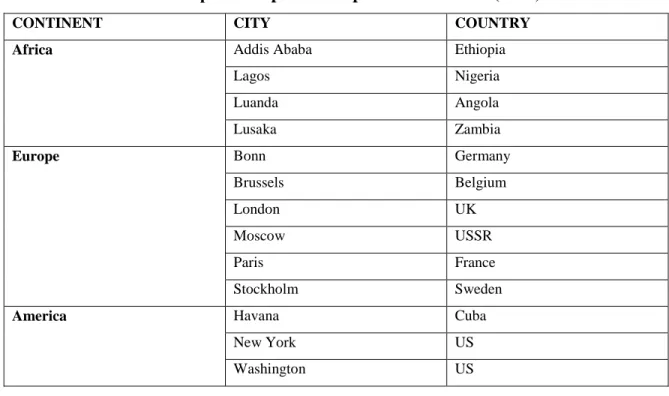
4: Namibia’s diplomatic missions opened in 1990 111
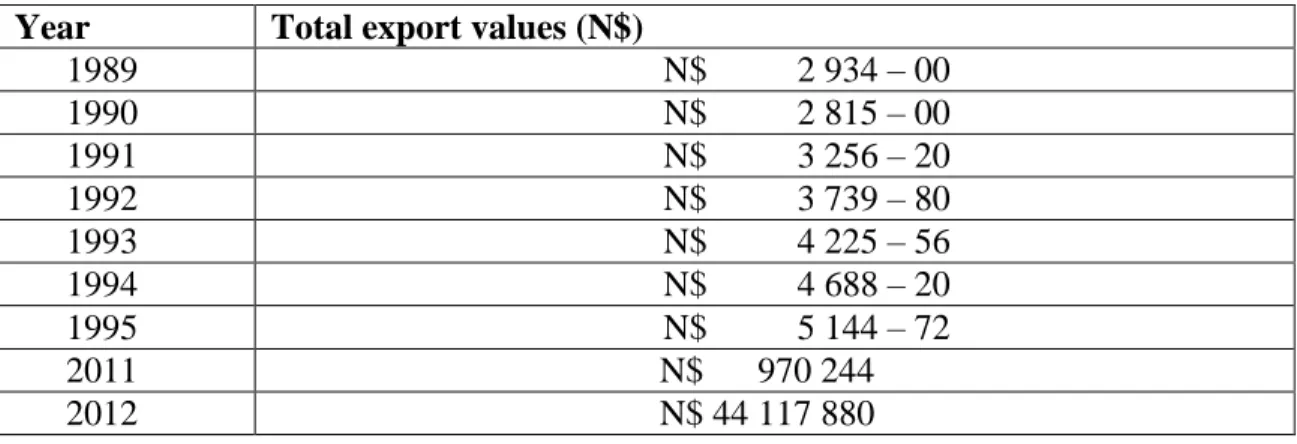
5: Total export value (N$ billions) 116
6: Foreign Direct Investment (1990-1995) 118
7: Export values per different economic sectors in N$ 173
8: Namibia’s pelt exports, from 2008 to 2012 192
LIST OF FIGURES
Figure Page
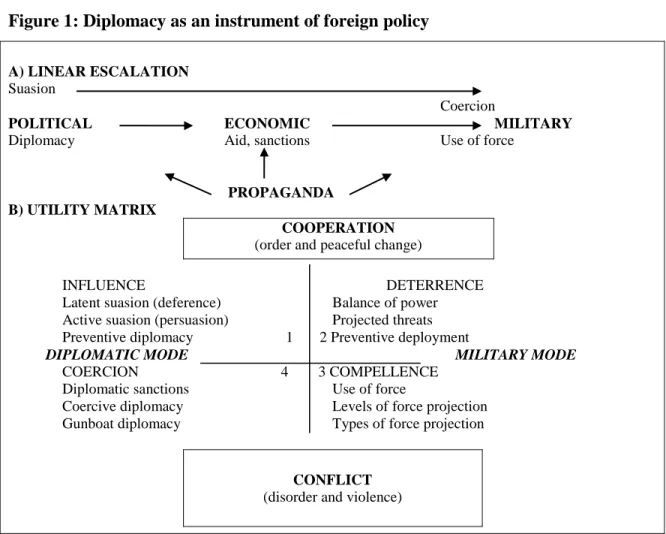
1: Diplomacy as an instrument of foreign policy 51
CHAPTER ONE INTRODUCTION
1. Introduction
The Republic of Namibia (hereafter, Namibia) is a small developing state on the south western coast of Africa, with a population of approximately 2.1 million (National Planning Commission 2012a: 2). Independent only since 1990, as a small state, the country is particularly vulnerable to the negative forces of globalisation. In this regard, Namibia’s Minister of Finance, Saara Kuugongelwa-Amadhila, stated in the Parliament that
Namibia is a small open economy. Global economic developments therefore, have a profound impact on our country’s economy and fiscal policy (NationalAssembly2008: 71).
In contrast, Namibia has been able to use the positive forces of globalisation to assert herself in the international political arena. The National Development Plan (NDP) 1 recognises that Namibia, a small country with an economy relying on international trade and support, will promote herself through relations that are fair and bring common benefits (National Planning Commission 1995: 55 – 56).
1.2 Namibia in the world economy
Namibia is a member of international organisations and institutions that deal with economic diplomacy and international trade. These include, inter alia, the Southern Africa Customs Union (SACU), the Southern Africa Development Community (SADC), the United Nations Conference on Trade and Development (UNCTAD) and the World Trade Organisation (WTO) (Ministry of Foreign Affairs 2005a: 25 – 30; Ministry of Foreign Affairs 2006: 25 – 28). It is through these organisations and institutions that Namibia participates in the world economy and pursues multilateral economic diplomacy. Namibia is further part of the Africa, Caribbean, Pacific (ACP) states which negotiate with the European Union (EU) for the Economic Partnership Agreements (EPAs).
Namibia’s foreign policy was formulated against the global political economy that, according to Leysens & Thompson (2006: 69), is divided into five structures, namely, security, production, finance, knowledge and trade. Trade has motivated an integrated world economy and has, therefore, played a role in the relations among states.
Lee (2003: 9 – 10) states that Africa’s economy has been subjected to neo-liberalism, with the International Monetary Fund (IMF) and the World Bank imposing Structural Adjustment Programmes (SAPs) to limit governments’ intervention on economic affairs of states and the free movement of goods and services. The free movement of goods and services is one of the issues of concern raised by Angola, Namibia and South Africa in the EPA negotiations between the ACP and the EU. Addressing the 16th Session of the African, Caribbean and Pacific-European Union (ACP-EU) Joint Parliamentary Assembly, held in Port Moresby, Papua New Guinea, from 24 to 28 November 2008, in his capacity as Chairman of the Parliamentary Standing Committee on Economics, Natural Resources and Public Administration of the National Assembly of Namibia, the researcher of this study stated:
We are further concerned about the free movement of goods. This will negatively affect agricultural procedures in our countries, which are currently protected by a ban of wheat imports during the harvesting period. These protective measures are in accordance with the provisions under SACU agreements (Mushelenga 2008).1
Namibia wants to protect her local producers against competition from imports during the season of harvesting. These measures, which are practised by other SACU member-states, ensure the growth of the local agronomic industry but also allows competition, since the ban on imports is only seasonal.
1 This quote, though stated by the researcher, is used as it represents a policy position of the Namibian Parliament.
1.3 Conceptual clarification
It is important to define some of the concepts that are used in the study. Some of these concepts are old concepts but they may have different meaning within the context of this study. Others are relatively new concepts that this study introduces to IR studies.
1.3.1 Foreign policy
In modern times, where foreign policy encompasses both political and economic issues, it is defined as the amount of external relations carried out by independent actors in the international system (Hill 2003:3). Although the actors are usually states, non-state actors have gained prominent influence on foreign policy matters in modern times. In a foreign policy blueprint, a government sets the goals that it would like to achieve in international relations and employs the techniques to achieve these goals. Among the techniques that a government employs to achieve its goals is diplomacy, which involves negotiations, conflict resolutions and peaceful settlement of disputes (Schmidt et. al. 1991: 554).
Foreign policy is determined by the domestic and external environments. Among the domestic environment that determines the foreign policies are the geographic location, economy, populace and the leadership that manages the public affairs of the state. The external determinants are the political and economic dynamics in the region and emerging trends in the international political system (Du Pisani 2000: 298 – 299).
Adherents to Interdependence Theory argue that the foreign policies of states promote multilateralism, as states become entangled in a network of organisations, to augment their economic and security interests. These organisations comprise states with common interest, where they share information and strategise on solutions to their respective problems. Interdependence leads to multilateral organisations impacting on the development and essence of foreign policy (Karns & Mingst 1991: 454).
1.3.2 Foreign policy doctrine
A foreign policy doctrine is a strategic vision and belief, organised into thoughts or slogans, which foreign policy-makers pronounce as a guiding principle of their foreign policy conducts. It becomes a catch phrase that explains the dogma of the foreign policy of the leader concerned (Grigoriadis 2010: 4; Tierney 2012: 1).
There is a distinction between foreign policy doctrine and foreign policy practice. While foreign policy is a broader concept that refers to the rules, principles, strategies and guidelines of a state’s external relations, foreign policy doctrine, is a component of foreign policy, as it is a philosophy of key foreign policy-makers that defines their vision within the broader foreign policy agenda and structure. Foreign policy practice refers to the culture, the forms and types of foreign policy making (Du Plessis 2006: 140). The practice of foreign policy can result from the influence of a foreign policy doctrine.
1.3.3 Economic diplomacy
Diplomacy, in general, is the manner in which a state conducts foreign policy matters (Du Pisani 2000: 299). Economic diplomacy refers to the techniques employed by states to promote economic development and prosperity in their foreign relations. It is a persuasive marketing strategy to attract investors to explore trade and investment opportunities. The objectives of economic diplomacy, as a technique, are to strengthen and expand economic relations between a state, other states and international institutions, to yield beneficial results in areas covering economic cooperation, tourism and investment (Ministry of Foreign Affairs 2004: 19; Institute of Foreign Affairs 2002: 11).
Liberalism, as a theory of IR studies, supports the essentials of economic diplomacy, as it is about mutual interdependence resulting from, inter alia, economic development and technology advancement. Liberalism’s theory of interdependence suggests that cooperation between states brings mutual benefits and trade relations are in the interest of participants. It further acknowledges the fact that mutual dependence of two states may
not necessarily be equal in proportion. One state may have an edge over benefits derived from a relationship with another state (Goldstein 2003: 317 – 318).
1.3.4 Economic statecraft
This concept has its limitation, in terms of this study, as it limits actors to the state. It will, nevertheless, be used to discuss other states’ economic diplomacies when making comparative analyses. Economic statecraft refers to the use of economic influence by a state to influence the behaviour of another state in order to achieve certain goals (Mastanduno 2001: 4; Wong 2005: 55).
Large states have used economic sanctions to influence the behaviour of smaller states. They also apply economic statecraft differently with regard to large states and economies. This proposition is confirmed by de Wilde d’Estmael (1997: 1, 11 – 12) who writes about the imposition of economic sanctions against the Third World states by the EU. The sanctions applied only to the territories controlled by the rebel movement, the União Nacional pela Independência Total de Angola (The Union for the Total Independence of Angola – UNITA) led by Jonas Savimbi. However, in 1995, the EU was reluctant to impose sanctions against Nigeria, a large power, following the execution of nine Ogoni human rights activists. Similarly, when the EU imposed sanctions against the Soviet Union, a superpower, after she imposed martial law in Poland, it took three months before the sanctions were implemented and these sanctions were merely ‘symbolic’ entailing the ‘reduction on luxury goods coming from [the] USSR’ (de Wilde d’Estmael 1997: 8).
While literature generally focuses on negative sanctions, states may also adopt positive sanctions. Baldwin (1971: 23) differentiates between the concepts of positive and negative sanctions, explaining that positive sanctions refer to rewards, while negative sanctions refer to threatened punishment. He states that the US government, for example, views its aid programmes as positive sanctions, where countries are encouraged to adopt behaviours in international relations in return for aid development assistance.
Baldwin (1971: 26 – 27) argues that while positive and negative sanctions differ in the form, but their behavioural consequences are the same because either a state is punished, or its reward is withheld.
Small states do not use statecraft in their foreign relations. This study will state alternative methods to the use of sanctions that small states in general and Namibia in particular apply pursing economic diplomacy (see Chapters Two and Five).
1.3.5 Re-circling diplomacy
This study introduces the concept “re-circling diplomacy”, referring to revisiting a pre-independence diplomatic programme, in a post-pre-independence period. As a contribution to IR studies, the concept “re-circling” is used by this study, instead of recycling. The term “recycling” could be confusing as it could mean the return of diplomacy to the same stage (Soanes & Stevenson 2004: 1203). However, pre-independence diplomacy was carried out by SWAPO but post-independence diplomacy was carried out by the Namibian Government, led by SWAPO Party.2 Re-circling diplomacy, therefore, means that Namibia’s pre-independence diplomacy, spearheaded by SWAPO that was circulating among countries such as the Nordic countries, for example, was going in a circle, now as the Namibian government’s diplomacy. The concept can further be used referring to revitalising relations that exist in a given region during a different period in modern history, for example, the Cold War and post-Cold War periods. This is arguably so because the turning points in history could result in changing foreign policies in which states could possibly change allies and drift away from their old friends (Hill 2003: 11 – 15). In re-circling diplomacy, states’ bilateral relations are based on previous foundations. Arguably, these foundations would maintain or strengthen relations of old friends.
2 For the pre-independence period, reference is made to SWAPO. For the post-independence period, reference is made to SWAPO Party, as SWAPO transformed itself from a liberation movement to a political party, governing Namibia.
1.3.6 Deep-pocket or cheque book diplomacy
Deep-pocket or cheque book diplomacy are terms used to refer to the use of economic resources by a country in return for diplomatic favours by another country. Deep-pocket refers to when an entity has a lot of money and resources through which it is able to sustain itself and enough to share with others. Deep-pocket diplomacy refers to the use of money and resources in diplomatic transactions in order to have strategic diplomatic influence over others. It is a broader concept which includes resource diplomacy, granting aid and the backing of private sector investment by the state to boost economic diplomacy (Ghoshal 2010: 1; Cheru & Obi 2009). Bathromew (2012: 2) contends that deep-pocket diplomacy has advantaged Chinese business influence in a number of countries ahead of the US because of the incentives extended to those countries. Accordingly, when a state has a deep pocket, not only is it able to use its resources to give grants to other states, but it can also use its resources to support its private businesspersons, to pursue trade and investment.
Deep-pocket or cheque book diplomacy is characterised by exerting influence to win the diplomatic support of one state by another using economic resources such as aid. Countries with strong economies apply deep-pocket or cheque book diplomacy to countries with weak economies. Small states generally are subject to cheque book diplomacy, as they are led to diplomatically align themselves with powerful states, resulting in the rendering of significant financial, material and other forms of support (Seib 2009: 11 – 12). Dobell (2007: 16) explains that cheque book diplomacy is an aid game used to buy diplomatic influence and this only happens when a country that uses this type of diplomacy has enough resources. Lack of resources results in an inability to spend on resources for the purpose of gaining diplomatic favours.
1.3.7 Developmental diplomacy
Developmental diplomacy is a type of diplomacy characterised by development assistance and humanitarian cooperation (Haşimi 2014: 1). Countries practise
developmental diplomacy by rendering donor assistance and providing priority to humanitarian assistance and development cooperation area. Developmental diplomacy is based on relations between developed states, as the donor states with developing states, as the beneficiaries. As part of developmental diplomacy, countries allocate funds for aid development programmes to beneficiaries. NGOs in donor countries are sometimes involved in developmental diplomacy programmes, as together with the government they identify economic and social policies and programmes (Saner 2006: 98).
The developmental diplomacy in a form of developmental assistance that Namibia receives will be discussed in Chapter Five in respect of French-Namibian and Chinese-Namibian economic diplomacy.
1.3.8 Public diplomacy
Public diplomacy refers to the use of media and public platforms, articulating foreign policy issues, targeting large audiences with a view to achieve a diplomatic goal (Mingst 2008: 114). Berridge (2010: 179) explains that public diplomacy is propaganda by diplomats and government officials working on foreign policy matters aimed at influencing domestic public opinion or a foreign public. He maintains that it is a form of white propaganda, where the true origin of such propaganda is known, as opposed to black propaganda, which has no traceable origin and characterised by falsified information.
Hamilton & Langhorne (2011: 235 – 236) state that the Ministries of Foreign Affairs use electronic communication, like websites, to portray a positive national image and reach out to investors. They further state that public diplomacy takes the form of news-briefing and national branding, sometimes using funded radio and television programmes, or paid advertisements in both print and electronic media.
Hamilton & Langhorne (2011: 235) propound that public diplomacy is not limited to government, but it also involves non-state actors like the non-governmental organisation
(NGOs). This is because influencing foreign public opinion does not only require governments, but those non-state actors who have a role to play as global actors.
1.4 A historical overview of Namibia’s economic diplomacy
Foreign policy is a tool that a government uses to guide relations and interactions with other governments, international organisations and other entities in the global arena. It is, therefore, an outward approach of a country to the rest of the world. Foreign policy goals and objectives are achieved through the use of diplomacy. Diplomacy refers to the manner in which international relations are managed through the process of negotiations, bargaining, mediation and conflict resolutions (Landsberg 2004: 10 – 11). It is arguable that diplomacy is a decent and civilised norm of behaviour which embodies courteous dialogues.
Namibia has a pre-independence and post-independence economic diplomacy. Pre-independence economic diplomacy covers the period under German colonialism, from 1884 – 1915 and under South African colonialism, from 1915 – 1990.
During the period of South African colonialism, two nationalist movements, the South West Africa National Union (SWANU) and the South West Africa People’s Organisation (SWAPO), were formed in 1959 and 1960, respectively, to fight for Namibia’s independence. The formation of SWAPO was preceded by the Owambo People’s Congress (OPC) in 1957, which became the Owambo People’s Organisation (OPO) in 1959 and was renamed SWAPO in 1960 (Katjavivi 1988: 41; SWAPO 1981: 172).
Pre-independence economic diplomacy was based more on dependency, where the liberation movements did not trade with partners; rather, they lived on assistance from friendly countries. Meanwhile, as a colony of South Africa, the Namibian economy was dependent on South Africa and as a result, Namibia could not trade in the global market independently from South Africa.
Post-independence economic diplomacy departed from the colonial one. Du Pisani (2003: 17) states that Namibia’s pursuance of economic diplomacy is based on the principle and goal of mutual benefits and interdependence, respectively.
1.5 Economic diplomacy as a foreign policy principle and objective
The Namibian foreign policy is entrenched in article 96 of the Namibian Constitution, which reads as follows:
The state shall endeavour to ensure that in its international relations it:
(a) adopts and maintains a policy of non-alignment; (b) promotes international cooperation, peace and security;
(c) creates and maintains just and mutually beneficial relations among nations; (d) fosters respect for international law and treaty obligations;
(e) encourages the settlement of international disputes by peaceful means(Ministry of Information and Broadcasting 1990: 53).
The first three foreign policy principles have an impact on Namibia’s economic diplomacy (as defined under conceptual clarification – see section 1.3.3). The non-alignment with either the East or West Bloc puts Namibia in good stead to maintain trade with countries from either bloc. The East and West Blocs were a division of the international community along the ideologies, with the pro-communist East Bloc led by the Union of Soviet Socialist Republics (USSR), while the pro-capitalist West Bloc was led by the United States (US). The promotion of international cooperation as a foreign policy objective arguably includes trade cooperation. The third principle of mutually beneficial relations is further elaborated in the NDP 1 as a foreign policy objective. Namibia adopts these foreign policy principles cognisant of the fact that the international economy has largely become competitive and interdependent (National Planning Commission 1995: 18). Namibia stands to benefit from this aspect of economic diplomacy, since in the context of interdependence, which is a theory of the neo-Liberalism perspective, states mutually benefit in, among others, areas of trade, finance, communication, environment and technology transfer (Viotti & Kauppi 1999: 215).
In addition to the foreign policy principles enshrined in the Namibian Constitution, the first Minister of Foreign Affairs, Theo-Ben Gurirab, informed Parliament about the five objectives set by his Ministry, namely to:
Promote Namibia’s security and territorial integrity and ensure the return of Walvis Bay and the off-shore islands of Namibia;
Promote Namibia’s national identity and counter any remnants of apartheid and colonialism;
Promote Namibia’s economic development and prosperity, by working to secure better terms of trade for Namibian commodities;
Enhance peace in the region like the end of civil war in Angola and the transformation of South Africa into a non-racial and democratic state; and
Promote world peace through an active role in the international organisations, like the UN, OAU and NAM (National Assembly 1991: 80 – 81).
In elaborating the third objective which relates to economic diplomacy, Minister Gurirab stated that the objective was aimed at seeking additional markets for Namibian commodities in Latin America, Asia and the Middle East. Namibia further wanted to attract finance and foreign investment and promote economic and industrial cooperation within SADC and Africa (NationalAssembly 1991: 80).
After one year of independence, in March 1991, the Government of Namibia produced a White Paper on National and Sectoral Policies, where, under the heading of foreign affairs it was stated that SWAPO, the ruling party, is committed to the equitable distribution of wealth both nationally and in the international arena, in the context of the north-south relations (National Assembly 1991: 80). The North refers to developed countries from America and Europe, while the South refers to developing and least developed (also referred to as Third World) refers to countries from Asia, Africa and Latin America and the Caribbean (Calvert 1986: 3 – 6; Van der Westhuisen 2006: 186).
In 2004, the White Paper of Foreign Policy and Diplomacy Management was tabled in the Parliament by the then Minister of Foreign Affairs, Hidipo Hamutenya. This is a policy document, outlining the principles and policies governing Namibia’s foreign relations. The White Paper was adopted unanimously by the National Assembly on 15 July 2004 (National Assembly 2004b: 350). It is important to note that in Namibia, after
the White Paper has been adopted by Parliament, it becomes a policy document, but it does not necessarily mean that it will be followed by legislation.
Chapter Two of the White Paper discusses economic diplomacy. Emerging economic issues such as the rise of globalisation, increased trade, foreign direct investment and technology transfer pose a challenge to Namibia’s foreign policy. Accordingly, Namibia’s foreign policy should focus on achieving optimal benefits in these areas. Namibia’s economic diplomacy, therefore, centres on attracting investment and promoting trade (Ministry of Foreign Affairs 2004: 17 – 19).
The White Paper sets out other factors that influence economic diplomacy. Investors are concerned about issues of the investment climate such as peace and stability, investment relations and policies and transport and communications infrastructure. The essence of economic diplomacy, therefore, lies in the ability to address these issues in an effective manner. Economic diplomacy further needs skilled actors to provide sufficient information to investors (Ministry of Foreign Affairs 2004: 19 – 20). The then Minister of Foreign Affairs, Hidipo Hamutenya, explaining the White Paper at a public lecture held at the University of Namibia in April 2004, stated that the tasks of diplomats include the promotion and enhancing of Namibia’s image abroad. This is done to advance socio-economic, scientific and technological interests to ensure economic growth and development (Hamutenya 2004).
Addressing the conference of Heads of Missions, Minister Hamutenya informed the Namibian diplomats that they were required to be analytical of the environment in which they operated and they should become more involved in the conduct of economic diplomacy. The result of their active role on economic diplomacy would be discerned from the foreign investment output and expansion of the market access for the Namibian products (Hamutenya 2003).
1.6 Literature survey
Apart from the official sources cited earlier, there is limited academic literature on the foreign policy of Namibia, as there are only nine3 academic publications on Namibia’s foreign policy which refer to economic diplomacy and its key elements. Most of the literature on economic diplomacy is found in the speeches of the President, Minister of Foreign Affairs, White Paper on Foreign Policy and Diplomacy Management, National Development Plan (NDP) 1, 2, 3 and 4, and Vision 2030.
Academic publications on Namibia’s economic diplomacy are limited to nine sources, although there are some other publications with sections related to Namibia’s economic diplomacy, but whose main focus is not necessarily on Namibia’s economic diplomacy. Four were published by Andre Du Pisani, Professor of Political Science at the University of Namibia (Du Pisani 1992, 1994, 2000 and 2002). One is a dissertation for the Master of Arts (MA) degree at the University of South Africa (UNISA) which was written by the researcher of this study (Mushelenga 2008). One is a thesis for the MA degree at Rhodes University by Amadhila (2012). Two are publications by Robin Sherbourne, a Namibian economist (Sherbourne 2009 and 2013). The latest publication is the one that was edited by Bösl, Du Pisani and Zaire (2014). Du Pisani’s publications predominantly deals with the same topic and, therefore, for the purpose of discussion in this section, reference will only be made to new insights that he contributed to the literature. Amadhila’s MA thesis was reproduced into a book, the same year, but for the purpose of this study reference will be made to the thesis.
Meanwhile, some academic researches were carried out on the foreign policy of Namibia’s neighbour and former colonial power, South Africa, within the first ten years after the first democratic election held in 1994. This resulted in literature sources like Landsberg (2004); McGowan, Cornelissen & Nel (2006) and Webber & Smith (2002). Du Pisani (2000: 307) states that,
[E]conomic considerations weigh heavily in determining the thrust of Namibia’s foreign policy…In an attempt to enhance trade and investment, the government has deputed commercial counsellors to its foreign missions in Bonn, London and Brussels. There are also trade representatives in Asia and the emerging markets in select Arab countries. At home, the Ministry of Foreign Affairs collaborates with that of Trade and Industry in the mounting of trade fairs.
Du Pisani’s views are supported by Webber & Smith (2002: 18) who state that the traditional image of foreign policy, which depends on issues of national security has changed, giving way to new challenges in the foreign policy agenda focusing on economic priorities. The prominence of economic issues in foreign policy is typical of small states perspectives. It is stated that small states employ diplomatic and economic foreign policy instruments as opposed to military instruments (Hey 2003: 5).
Du Pisani’s underscoring of the importance of economic consideration on foreign policy further corresponds to that of the first Minister of Foreign Affairs, Theo-Ben Gurirab, who stated in the Parliament in 1991 that,
By now, there is hardly an area that is not a subject of foreign policy. Areas which fell exclusively in the sphere of domestic politics in the broadest sense…are now just as much a subject of foreign policy…For Namibia, as for other developing states, economic policy objectives are now the focal point of foreign policy (National Assembly 1991: 84).
Mushelenga (2008: 80)4 states that although Namibia is a small state, she broadens her foreign policy scope to embrace economic diplomacy, which entails exploring new markets for Namibian commodities and enhancing opportunities for foreign direct investment. This is in accordance with the foreign policy objective spelt out by Theo-Ben Gurirab, namely “…[the promotion] of Namibia’s economic development and prosperity, by working to secure better terms of trade for Namibian commodities” (National Assembly 1991: 80).
Amadhila (2012) discusses Namibia’s foreign relations with China with regard to how non-state actors react to government policy. She concludes that Chinese aggressive
4 This literature by the author is cited, as it is an academic literature that deals with the same subject discussed by the thesis, namely foreign policy.
inward investments in the Namibian construction industry which has driven out Namibians out of business has contributed to negative perceptions from some quarters of the Namibian public about Namibia’s foreign relations with China.
Amadhila (2012: 74 – 75) suggests that the Namibian government needs to adopt decisive measures to ensure compliance with Namibian laws by Chinese investors. In the current state of affairs, Chinese businesses remain unfairly competitive to local businesses.
The publication edited by Bösl and Du Pisani (2014) has chapters by different authors including the researcher of this study. In this publication, four other authors cited the researcher of this study’s MA thesis stated above. Du Pisani (2014: 121) discusses the construction projects by Asian companies in Namibia, from China and Democratic People’s Republic of Korea (DPRK). Hamutenya (2014:0 85) discusses the geographical, historical and political significance of Angola as a strategic trade partner for Namibia. Katjavivi (2014: 146 - 147) focuses on Namibia’s relations with Germany, developmental diplomacy and levels of personal diplomacy. Lindeke (2014: 196 – 197) discusses the setbacks of Namibia’s economic diplomacy with the US under the Africa Growth and Opportunity Act (AGOA), as it resulted in job losses after the closure of Ramatex textile factories in Namibia.
Blaauw (2014) observes that non-state actors are not accommodated in driving the regional integration agenda in the southern Africa region. He refers to the role of the Namibia Agricultural Trade Forum in the EPA negotiations (see Chapter Six).
Blaauw (2014: 406) acknowledges that in terms of regionalism in economic diplomacy within the southern Africa region, states play prominent roles. Since economic diplomacy embraces non-state actors, he advocates that there is a need to have domestic cooperation between states and non-state actors in pursuing economic diplomacy.
Hengari and Saunders (2014) contend that Namibia’s relations with South Africa have been characterised by differences on regional policies during the presidential tenure of Presidents Nujoma and Mandela. They state that this reflects acrimonious relations, especially after Namibia’s deployment of her armed forces in the DRC to assist government armed forces there, following the insurgence of rebels fighting the government of President Laurent Kabila (Hengari & Saunders 2014: 178).
Meanwhile, Hengari and Saunders (2014: 178) state that the relationship between Namibia and South Africa became close during the presidential tenure of Presidents Pohamba and Zuma. The two countries took similar stances on regional issues, like the suspension of the SADC Tribunal and congratulating President Mugabe following disputed elections in Zimbabwe.
Sherbourne (2013) discusses exports from various economic sectors like fisheries, mining and agriculture. These have a bearing on Namibia’s economic diplomacy, as countries that trade with each other forge stronger ties.
White (2001: 391) states that new diplomatic trends witness intergovernmental (with governments only as members) and non-governmental (with private individuals and groups as members) entities sharing the international platform with states. Governments broaden the scope of their foreign policies to include the social and economic well-being of their respective citizens. White further emphasises that,
The agenda of the new diplomacy contained a number of new issues…diplomatic activity also began to focus more on economic, social and welfare issues related to material well-being. These became known as ‘low politics’ issues in contrast to the ‘high politics’ issues associated with the traditional diplomatic agenda (White 2001: 391).
The world economy presents an opportunity for states to have multiple channel communication systems characterised by formal and informal relations among government institutions, NGOs and MNCs. Keohane & Nye (1989: 243) term these relations as interstate, transgovernmental and transnational relations.
According to Leysens & Thompson (2006: 91), the WTO operates on the basis of ‘comparative advantage’, a theory which supposes that all states benefit from a free trade system in the world economy. This theory further advocates that states should allow the market to re-direct human, technological and capital resources, from one economic sector where there are constraints, to another sector where production for export will be more efficient. The shortage of products from the abandoned sector will be filled with imports from other countries.
The post-Cold War global economy has witnessed the emergence of globalisation. Globalisation refers to the increasing level of connectivity between different entities in the international system, resulting in economic, social and political activities from one place affecting other activities in another place (Smith, Baylis & Owens 2008: 8). In the world of globalisation, there are no closed economic units but economies are open to other societies’ economies. Communication and technology are so advanced that people are able to observe issues in the world efficiently. Technological advancements expedite time and curtail distance which previously impacted on trade efficiency (Hoogvelt 2001:135).
With regard to the reduced role of the state in the economy, it is argued that industrial states have a control over their economies and are not bound by globalisation aspects as it is commonly believed (Rodrik 2000: 228; Scholte 2008: 465). Also underscoring the important role of the state, Strange (2003: 79) states,
The role of the state, working through financial and industrial policies, is something that the literature from business schools, with their eyes focused on the corporation at the receiving end of policy, has sometimes underplayed.
Slaughter (2008: 113), too, underscores the relevance of states in the international system when she states that a new world order has emerged, where states do not disappear. Instead, smaller units of a state-like agencies and departments liaise with their counterparts in other states and establish networks creating a transgovernmental order.
From the arguments of a number of writers cited above, there appears to be a general assertion that the global political economy cannot be managed exclusively by non-state actors. Thus, Strange (2003: 80) argues that the management of an international political economy is a combination of, among others, policies by the state and trends in the market.
1.7 Gaps in the existing literature on Namibia’s economic diplomacy
There are some gaps in the existing literature on Namibia’s economic diplomacy that need to be filled. Du Pisani concentrated mostly on multilateral economic diplomacy, which he said is guided by the belief that economic development depends on regional and international cooperation, as these present opportunities for common benefits (Du Pisani 2003: 16). Aspects of bilateral economic diplomacy are minimally discussed as they are limited to one or two paragraphs in the publications. Du Pisani only referred to a few instances of bilateral economic diplomacy like the Protective Investment Agreement signed between Namibia and Germany in 1993; the Protective Investment Agreement between Namibia and the US in 1995; the financial assistance rendered to Namibia by Germany and Sweden (Du Pisani 2000: 308) and Namibia’s trade with South Africa (Du Pisani 1992: 61). Meanwhile, foreign investments in Namibia come from countries like Belgium, China, Germany, India, Israel, Malaysia, The Netherlands, Pakistan, South Africa, Spain, Russia, UK and US (Off-shore Development Company [ODC] 2008). These trade engagements form part of Namibia’s economic diplomacy and need to be broadly discussed.
Although Du Pisani wrote about the interdependence of Namibia’s economic diplomacy, he did not write about the role of non-state actors on the conduct of economic diplomacy. He made a mere reference to the role of non-state actors on foreign policy issues (Du Pisani 2003: 19). Saner & Yiu (2003: 3 – 4) state that non-state actors are gaining a greater influence in economic policy debates, organising and lobbying across national boundaries to make impacts on international economic policy-making. In Namibia, the Agricultural Trade Forum (ATF), for example, has on a number of occasions engaged
government policy-makers and the Parliamentary Standing Committee on Economics, Natural Resources and Public Administration to influence negotiations on the EPAs between the ACP countries and the EU (Hoffman 2013: interview).
The study by Mushelenga (2008) did not discuss the EPAs negotiations which have dominated the trade between EU member-states and ACP states. The discussion on the EPAs negotiations is important as this issue is among topical issues in international trade and essential issues of Namibia’s economic diplomacy. Further, the study has also not discussed Namibia’s economic diplomacy towards major trade partners like Angola, Canada, The Netherlands, South Africa, Spain, Switzerland, the United Kingdom (UK) and the US (Namibia Statistics Agency 2013a; Namibia Statistics Agency 2013b). It will be important to conduct an in-depth study on bilateral relations with these countries and the performance of trade relations with the US in particular during the economic recess. The existing literature on Namibia’s foreign policy does not discuss the role of the Investment Centre and the Off-Shore Development Corporation (ODC in forging economic diplomacy. The Investment Centre and the ODC, under the auspices of the Ministry of Trade and Industry, are responsible for trade promotion (Ministry of Trade and Industry 2008). The promotion of trade and investment has gained prominence in economic diplomacy that Namibia will endeavour to engage in trade and investment promotion programmes that will improve her competitiveness in the regional and global markets as embodied in NDP 3 (National Planning Commission 2008a: 153 – 154).
1.8 Statement of the research problem
Namibia’s independence came at the major turning point in the world history, namely at the end of the Cold War. The end of the Cold War changed the traditional foreign policy agenda of states. Shridharan (2002: 58) says that in the post-Cold war period the growing connection between foreign policy and economics became prevalent and states had to adjust themselves to intertwine their foreign policies with economic dynamics. The main question that the study concerns itself with is: How does a small state, such as Namibia,
formulate economic diplomacy policies and effectively negotiate favourable trade terms, against the assumptions of small states institutional capacity limits, to comprehend trade settings in the international system? The main thesis of this study is that Namibia pursues economic diplomacy which adheres to the foreign policy principle that says she will create and maintain just and mutually beneficial relations among nations. Accordingly, she does not allow herself to be subjected to manipulation and pressures in international trade.
Namibia is cognisant of the fact that non-state actors gained prominence in foreign policy-making. With the emerging markets of Asia and Latin America in the post-Cold War era, new players entered the world market and entities within the international political system adjusted themselves to forge links with new market opportunities. Leysens & Thompson (2006: 68) state that in the global political economy, the market and its actors are not easily restricted by states. There is a growing trend of interdependence where multinational corporations (MNC), business corporations and NGOs are increasingly becoming influential in economic diplomacy, to make an impact on international trade and investment.
Therefore, the objectives of this study are to:
analyse the conceivable confrontations in pursuing economic diplomacy by a small state and how Namibia responds to these;
examine the role of the foreign-policy makers and institutions. This will also look at the broader capacity (capital and idiosyncrasies’) of the foreign policy agents and structures; and
attempt to determine to what extent the objectives and goals of economic diplomacy as set in the NDP 1, NDP 2, NDP 3, NDP 4 and Vision 2030 have feasibly been realised, using the theoretical approaches to the study of IR, namely Liberalism and Realism.
In this study, Namibia’s economic diplomacy is analysed within the framework of domestic, regional and international contexts. The first level of analysis is based on domestic factors, looking at the policies and regulations that are put in place to promote economic diplomacy and the role of policy-makers.
The second level of analysis focuses on the regional multilateral diplomacy in southern Africa. This analysis looks at regional economic institutions like SADC, SACU and their impact on Namibia’s economic diplomacy.
The third level of analysis includes international multilateral economic diplomacy focusing on trade negotiations at the WTO and the EPAs. Leysens & Thompson (2006: 68) state that institutions like the WTO play a role in the coordination and regulation of trade for its member-states. In the second and third level of analysis, non-state actors have a role to play and influence the agenda of their country’s economic diplomacy. The analysis is made in the context of the dynamics of a small state.
1.9 Analytical framework and research methodology
The study of IR includes theories which explain state actors and their behaviours in the world political and economic systems. They are discussed in this section in order to determine the IR theories that are applicable to Namibia’s economic diplomacy.
1.9.1 Theoretical approaches to the International Political Economy and economic diplomacy
There is enough literature on the international political economy and economic diplomacy in general. This literature is used to make a comparative analysis in order to comprehend Namibia’s economic diplomacy.