Strategic Plan
2013-2020
Tropical Agricultural Research and Higher Education Center 2015
3
Contents
1. Introduction ...5
2. Context
...6
3. CATIE’s identity ...8
What is CATIE?...8
Collaboration with IICA ...9
What is the unique character of CATIE’s systems approaches? ...10
Effect of context on CATIE’s basic functions ...11
4. Mission, Vision and
Institutional Strategy
...12
Institutional mission ...13
Institutional vision ...13
Declaration of institutional strategy ...14
Institutional values ...15
5. Objectives, goals and indicators ...17
Strategic plan ...17
Central strategic objective ...17
Strategic objectives ...20
Strategic products ...23
Strategic objectives, goals and indicators in the
medium and long term ...24
6. System of planning, monitoring and evaluation ...31
5
1. Introduction
The 2013–2020 Strategic Plan was developed from the premise that CATIE’s greatest strength is its unique nature as a regional organization with an international university based on the model of land-grant universities in the United States, which integrates three basic functions: research, education and outreach (extension, transfer of technology and application of knowledge in the field). CATIE’s mandate focuses on supporting sustainable management of agriculture and natural resources in Latin America and the Caribbean. This strategic plan highlights the deepening of the process toward an even greater integration of these three essential functions.
Since 2008 and as part of the process of review and adjustment to the 2003–2012 Strategic Plan, we set about to identify the niche or differentiating element where we believe we can take maximum advantage of this nature and mandate that makes CATIE unique in the region. During this period, it was possible to identify how the Center could contribute solutions to the challenges that confront the region and the world. These challenges are complex because of their high degree of interrelatedness (for example, poverty and malnutrition, energy, climate change and variability, food and nutritional security, environmental degradation) and therefore require the integration of diverse disciplines and forms of knowledge, sectors, spatial scales and actors at all levels. Based on this, we identified the need to develop systems approaches that offer practical and effective holistic solutions to the various challenges of today and the future in alliances with our multiple partners.
With the plan, we have gone one step further by proposing a concrete tool, which we call “climate- smart territories” (CSTs), that will enable us to offer these solutions and through which we can combine our diverse capabilities and those of our partners and allies to help the territories develop four main characteristics: provide stable, quality ecosystem goods and services; be more resilient to global changes; do this through development strategies low in greenhouse-gas emissions; and reach higher levels of inclusiveness and equity in all previous aspects. As explained later, the CST becomes the central objective and integrator of CATIE’s work over the next years, supported by the experience of four decades of work with hundreds of partners. This Strategic Plan has been designed taking into account that the economic environment and international governmental cooperation for development in Latin America and the Caribbean (LAC) has changed drastically, significantly affecting the way in which CATIE has traditionally been financed. In this plan we recognize that in coming years, CATIE requires a new management model that will allow it to diversify its financial mechanisms, including a high proportion of self-generation of financial resources in its different units, as well as effective financial management. To achieve this, it will be necessary to not only create new forms of financing but also create an organizational structure and enabling environment in decision making and procedures that make CATIE more agile and competitive. The application of this new model of financing will demand operational modernization and strengthening of the Center that permits “planned change,” not disorganized change driven by external circumstances. The favorable internal and external conditions that exist suggest that coming years will be very positive for CATIE and for the target population we serve.
6
2. Context
In the 10 years that separated the beginning and end of the 2003– 2012 Strategic Plan, global and regional contexts changed rapidly and significantly.
A summary of the analysis of these changes follows:
At a global scale
o A profound crisis in the global economic system, which affects industrialized nations and, to a lesser degree, emerging countries and with consequences that apparently will last for a good part of the 2013–2020 period.
o An accumulation of deep sectorial problems at a global
scale that affect different parts of the system, such as the persistence of poverty (despite specific improvements), nutritional and food insecurity, degradation of ecosystems and the environment, climate variability and change, decreasing availability and quality of water, desertification and degradation of soils, and the need to change to a renewable energy base, among others.
o The convergence of this crisis and these problems requires and will continue to require intense innovations of all types (scientific, technical, methodological, educational, economic, social, political and institutional) as well as formation of qualified human resources that allow us to successfully address the problems.
o The necessity to generate innovations, to put them into
practice and disseminate them, opens an enormous opportunity for organizations such as CATIE worldwide.
7
At a regional scale
o Latin America and the Caribbean do not escape the crisis and global problems, although they are affected to varying degrees.
o The region has a natural-resource base in a better state than other regions in the world;
its population density is less; and its level of technological, economic and educational development is relatively good despite the heterogeneities.
o This relatively better situation, together with other considerations of the cooperating countries themselves, has led to an almost massive withdrawal of international
governmental cooperation for development and the environment, which is concentrating actions in Africa and Asia. As already mentioned and detailed later, this process
significantly affects CATIE’s management model.
o The population of the region has benefited in general in recent years from diverse
redistribution policies in the different countries, which has mobilized domestic consumption and social mobility.
o In other parts of the region, problems linked to public safety, affected by the cultivation and
traffic of narcotics, contraband and other illegal activities, have increased. In some regions the problem of insecurity extends to aspects related to food.
o Rural areas, in spite of the continuous process of migration to urban areas, continue to retain a significant proportion of the population and a high proportion of them live in poverty. These areas are the principal suppliers of foods, materials and essential ecosystem
services, though their contribution to the gross domestic product of the countries continues to decline, largely due to the fact it is not properly registered in economic terms. These areas also have an ample ethnic, cultural and social diversity, as well as a wealth of traditional knowledge that should be seriously considered when seeking solutions to their various problems.
o Five of the 10 countries most affected by climate risks at a global level during the past
20 years are in this region, led by Honduras and Nicaragua (positions one and three, respectively).
8
3. CATIE’s identity
What is CATIE?
This Strategic Plan proposes to consolidate CATIE in its two central pillars that reinforce each other: as an international land-grant type of university combining education, research, extension, transfer of technology and application in the area of innovative solutions for sustainable development and as a regional scientific platform. Both pillars are in the specialized fields of agriculture and natural resources. In this sense, the nucleus of CATIE’s work is knowledge management, from its generation to its dissemination, use and adoption. In the coming years, we propose a significant effort to effectively align the functions of research and projection with the academic function, thereby offering our students a unique educational opportunity grounded in the best science and its application in the field.
Consistent with this concept, CATIE has advanced significantly in recent years in positioning itself as a regional platform for research with prestigious international centers that have outstanding researchers, equipment and programs, in both permanent and temporary arrangements at CATIE headquarters and in the countries. In the coming years we propose to consolidate these actions even more.
At the same time, CATIE has made its educational offer more flexible, opening more options for diplomas and both distance and hybrid (combining face-to-face and online work) courses in the countries. It has also broadened its graduate offerings, adding professional master’s programs to the traditional academic master’s programs and the option of doctoral studies in Spanish. In all cases, the opportunity for students, guided by their professors, to work on real problems in the field, with a solid scientific base and linked to projects that seek to contribute to development, is a central, unique element of an international land-grant type of university based on three main pillars: education, research and outreach.
As such, CATIE is a unique regional organization, different from traditional universities, research centers and extension or service entities because it achieves an integrated combination of all of them in an enriching international and multicultural environment for its scientists and students, concentrated on attaining integrated knowledge management.
This international character, found only in some of the prestigious universities around the world, is evidenced by a staff, students and graduates representing 50 nationalities and, above all, by its presence and
participation in all countries of Latin America, in particular in the tropical regions, through its offices, projects, hundreds of partners, educational activities, publications and graduates.
9
CATIE is a regional scientific and academic organization founded in 1973 for the purpose of scientificresearch, graduate education and outreach in the countries in the fields of agriculture and natural resources, based on the successful model of land-grant universities in the United States of America. It is governed by the Inter-American Board of Agriculture (IABA); by the Council of Ministers, made up of ministers of member countries and the director general of the Inter-American Institute for Cooperation on Agriculture (IICA); and by its own autonomous, international Board of Directors.
Its area of service encompasses tropical America, Mesoamerica in particular, and it has a membership system of countries and regions that includes Belize, Bolivia, Colombia, Costa Rica, Dominican Republic, El Salvador, Guatemala, Honduras, Mexico, Nicaragua, Panama, Paraguay, Venezuela and IICA as regular members and the state of Acre in Brazil as an affiliated member.
CATIE orients its actions through a strategic management system with a time horizon of eight years, which allows a medium-term plan every four years and development of biennial and annual operating plans. The last of these plans (2003–2012), which was revised in 2008, set the stage for the 2013–2020 planning process, which was initiated in mid-2012 and has resulted in the development and approval of this document.
Collaboration with IICA
From its beginnings as the American Institute of Agricultural Sciences and later in its role and the Inter-American Institute for Cooperation on Agriculture, IICA has been a strong CATIE partner.
IICA has as its main objective to support its member states in their efforts to strengthen the agricultural sector, making it more competitive, productive and sustainable, and the natural resource base, as well as to achieve an inclusive rural development in harmony with the environment. IICA offers technical assistance in these areas.
The General Directors of CATIE and IICA continue to encourage the development and execution of initiatives and action plans that permit collaborative actions to attain greater coordination, synergies and culmination of successful experiences and that enable transparent mechanisms of cooperation to be established between the two institutions to benefit the member countries.
10
What is the unique character of CATIE’s
systems approaches?
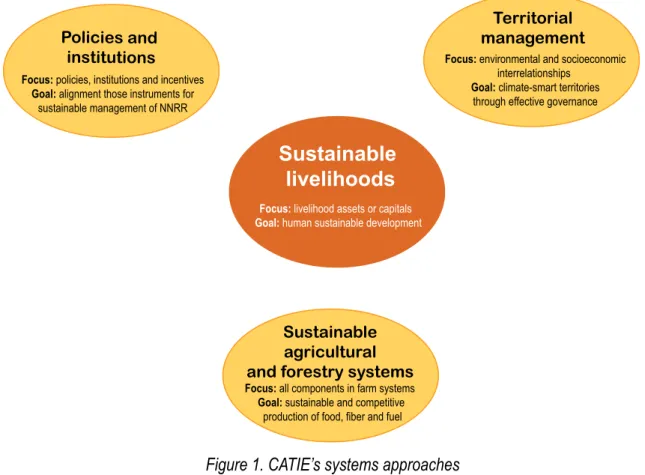
CATIE’s most significant characteristic for many years now has been its emphasis on systems
approaches, that is, integrated and integrating efforts in research, development and work in the field. This essential characteristic is represented in the following figure that shows the manner in which work at the Center is currently based on these approaches.
In this figure, the element of sustainable livelihoods stands out as central to human well-being and its direct interrelation with other systems approaches, such as territorial management, sustainable agricultural and forestry systems and systems of policies, institutions and incentives aligned with sustainable and equitable development. This combination of systems constitutes the center of CATIE’s systems approaches.
Figure 1. CATIE’s systems approaches
CATIE recognizes the importance and necessity of specialized approaches and values this work that many organizations have been carrying out, both in the region and at an international level. However, the importance of interdisciplinary and intersectorial approaches to the different challenges has increasingly been recognized and this is where CATIE adds value and demonstrates competence through its experience and characteristics.
Sustainable agricultural and forestry systems Focus: all components in farm systems Goal: sustainable and competitive
production of food, fiber and fuel
Sustainable
livelihoods
Focus: livelihood assets or capitals Goal: human sustainable development Policies and
institutions Focus: policies, institutions and incentives
Goal: alignment those instruments for
sustainable management of NNRR
Territorial management Focus: environmental and socioeconomic
interrelationships
Goal: climate-smart territories
11
Effect of context on CATIE’s basic
functions
The basic functions of CATIE are research, graduate education and training, outreach, with concrete actions in extension and transfer of technology to apply better knowledge in different territories of the region. Other essential functions of the Center are management of projects, communications, operation of its commercial units, financial management and administration.
All of these functions depend on the CATIE financial model, which is highly relevant since the Center has no funds of its own and the stable external budgetary allocations it receives through membership quotas only represent about 5% of its total budget. Therefore this section concentrates on this central aspect. These functions can be grouped in two different categories:
1. Offer of and attention to demands for goods and services (research, education, training, extension, transfer of technology and management of projects in the territories)
2. Internal services (communications, administrative and financial management, and commercial operations)
Given that the second is financed largely by the first, the main consideration is the influence of context on the demand for the goods and services offered by CATIE. These influences include:
• Transfer of support from international government cooperation to other regions of the world that has affected the historic model of CATIE financing, as well as that of many other organizations in the region. International development cooperation has not disappeared nor does CATIE intend to renounce it, but it is evident that it has changed its way of operation (for example, competitive funds) and is not enough to sustain the operation of the institution.
• Growing participation of the private business sector in various basic activities and functions of CATIE (research, graduate education and training and outreach). This change implies greater competition for CATIE but also new opportunities for joint ventures.
• Diversification and privatization of graduate education and training opportunities, which
• also implies greater competition with other organizations and the need to innovate CATIE’s educational offerings and ways to finance them to maintain and improve positioning in this area.
• The growing economic development of Latin American countries and the distancing of international governmental cooperation have led countries of the region to augment their activities in different sectors aligned with the functions of CATIE, opening opportunities for greater involvement in projects in the countries, including South-South cooperation. CATIE has been attentive to this evolution and has increased its participation in this new field, but it is definitely necessary to intensify actions in this direction.
12
It is reasonable to conclude the dynamics of the global and regional context are leading to a CATIE business model of growing self-financing through the supply of useful products to national and regional actors. This mechanism for securing resources constitutes a great opportunity to project the institution externally on the basis of its technical, scientific and academic offerings and capture resources to finance basic operation the Center.
To a certain extent, this implies the need to gradually transform the institutional culture toward an approach based on better current and prospective analyses of the opportunities and demands of global, regional, national and local actors in order to maintain and improve the fit between them and CATIE activities—along with a rapid and effective response capacity. At the same time, we must strengthen our regional operations, especially where processes are implemented based on research and innovation for development and strengthening capabilities through education and training. Equally, and as a result of the vision to consolidate the model of CATIE as a land-grant university, we propose to transform the role of operation in the countries so that they contribute significantly to the academic function, which confers a differentiating aspect and a great comparative advantage to our offer.
In the research area, there is a growing interest nationally and internationally in strengthening the impact of research in development (CGIAR, for example). This is giving unprecedented opportunities for strategic alliances among research centers and organizations linked to development in the field. This opens an enormous area pf opportunity for CATIE, which has been growing as a regional scientific platform with influences in development processes in the region. In this light, CATIE intends to continue developing and consolidating its position as a regional scientific center in the fields of agriculture and natural resources.
13
4. Mission, Vision and
Institutional Strategy
Institutional mission
The institutional mission presents the ultimate reason for the existence of an organization, or the purpose that justifies its existence. The CATIE mission is defined in the following manner:
The fact that the CATIE mission takes on achievement of sustainable and inclusive human well-being does not imply that this is a task for which CATIE has sole responsibility or that CATIE proposes to achieve it alone. What it does mean is that CATIE will consider that it has fulfilled its mission until this well-being has been achieved throughout the region of its mandate.
Institutional vision
The institutional vision succinctly presents the state CATIE aims to achieve in order to maximize its contribution within the region of its mandate.
This vision relates the future that CATIE intends to achieve with its institutional identity, presented earlier and that is based on the two pillars that constitute its strength and its niche: international university and regional scientific platform.
Increase sustainable and inclusive human well-being in Latin America and the Caribbean, promoting education, research and outreach for the sustainable management of agriculture and conservation of natural resources.
To be an excellent international land-grant type of university specialized in agriculture and natural resources that effectively integrates education, research and outreach in alliance with multiple partners and countries through a solid regional scientific platform.
14
Declaration of institutional strategy
The focus of the institutional mission on sustainable and inclusive human well-being and the emphasis on systems approaches has, for some time, led CATIE to identify territorial rural areas as points of convergence for its different efforts and capabilities at different spatial scales, which are nested in each of the territories.
For many years it was thought that these territories were stable and that they were subject only to human action as a transforming element (both positive and negative). However, accumulated scientific evidence shows that this idea is incomplete and that territories are now under another trans- forming factor of equal or greater force than human action—climate change and variability. In other words, the challenge of “producing while conserving and conserving while producing,” which was the slogan of CATIE a few years ago, now adds doing it in the context of rapid global systems change, little controlled and with impacts hard to predict. In more concrete terms and as an example, the challenge now in the ecosystems of pine forests in Central America is not only sustainable and inclusive human well-being but also that these ecosystems could become savannas without availability of water to satisfy the growing demand for foods, according to today’s best scientific understanding.
This unexpected situation in the history of the region and of the world is what leads CATIE to incorporate in this strategic plan the topic of climate change and variability as a basic strategic element across all of its areas of work. As a representation of this significant addition to the institutional paradigm, the expression “climate-smart territories (CSTs) has been adopted as an institutional strategy, which implies that the topic of climate change and variability, with all of the other associated elements and human security (poverty, food and water security, environmental degradation, etc.), is incorporated as a transversal cross-cutting element in a majority of its actions. Consistent with this introduction, the institutional strategy is defined in terms of the following:
This institutional strategy summarizes the central elements of how CATIE proposes to advance toward achievement of its mission and vision.
The drive toward development of the CSTs will be through the development, application and dissemination of systems and collaborative approaches that facilitate innovative and sustainable solutions to the complex challenges that confront agriculture and natural resources in Latin America
To promote the development of climate-smart territories in the American tropics as a tool to achieve sustainable and inclusive human well-being and the effective integration of actions in education, research and outreach, in alliance with multiple public and private partners through a solid regional scientific platform.
15
and the Caribbean. This implies a greater emphasis and deepening of territorial approaches that CATIE had been working with for more than three decades—such as watershed management, biological
corridors, model forests and key territories in its Mesoamerican Agroenvironmental Program (MAP). More recently, this process has found new expression in cooperation with CGIAR centers in development of sentinel landscapes.
The complexity in managing that the various territories in the region carry out processes of continuous adaptation to climate change, along with ensuring food production and sustainable and inclusive human development of their populations, requires the systems and collaborative approaches mentioned previously. They must be developed in each one of the strategic functions of CATIE, as well as in the interactions among them. These collaborative approaches include different forms of partnership with the private sector that ensure mutual benefits.
The coordinated and joint action of CATIE’s various functions is at the center of its unique character, the motor of its innovative capacity and its main differentiator.
Institutional values
The implementation of this strategic plan requires a specific organizational structure suited to the nature of CATIE that leads to achievement of its stated objectives. Following are the values that we consider fundamental for that purpose.
Appreciation of diversity: we respect and value each one of our collaborators, students and partners, regardless of social status, ethnic identity, gender, age, beliefs, physical condition and ideology and we recognize that their work enriches the operation of the institution.
Entrepreneurial spirit: we take advantage of opportunities and resources with energy and enthusiasm in order to complete an idea or a project and attract the resources necessary for a successful and sustainable operation.
Excellence: we give the best that we have to develop our potential to the maximum and free the talent of all collaborators to permanently nourish individual and organizational excellence. Innovation: we make an effort to introduce new ideas, approaches, methodologies, products, services and practices to improve our individual and collective work in order to be more competitive and relevant.
16
Integration: we work in a unified way in order to reach the same objective and to position CATIE as an international university that combines research, education and outreach using systems and collaborative approaches.
Accountability: we respond to the actions and decisions that we make in accordance with our duties and individual and collective responsibilities and we keep our organs of government, target audiences and partners informed.
Service: we respond to the needs of our external and internal publics with efficiency, quality and on time.
17
5. Objectives, goals and
indicators
Strategic Plan
Since the beginning of the process in 2012, it was decided that the 2013–2020 Strategic Plan would be different from traditional ones (for example, the 2003–2012 plan) because of the substantial changes that are occurring in the region and the world.
This plan is oriented to the strategic products that CATIE already has or will develop over the next years and that respond to the offerings created by institutional innovation, both external demands and the needs of different partners, allies and strategic beneficiaries.
Therefore, CATIE’s intellectual production will combine products in strong demand by partners and users of CATIE with products where the need is evident and unsatisfied and whose generation and offer by CATIE will immediately result in a strong demand and major impact.
These products have been proposed on the basis of institutional strengths, some of which are strongly rooted in CATIE’s trajectory, others more recent that seek to increase demand and some that can be developed working in conjunction with partners and allies as part of our answer to a changing environment.
Central strategic objective
In accordance with the mission, vision and institutional strategy, CATIE’s central strategic objective for this period is defined in the following manner:
In this context, “development” means both development and validation of methods, instruments,
technologies and policies as well as its dissemination at all levels for the purpose of technical and political incidence and the formation of graduate students and training of qualified professionals to put them into practice.
18
Why climate-smart territories (CSTs)?
Human-caused climate change is the greatest challenge for humanity in this time period. Its effects reach the planet’s entire human population and all of its ecosystems, affecting them differently -depending on countries, regions, ethnical groups, gender and other characteristics. Stabilizing the climate in a new balance is a task of decades or perhaps even centuries. Something thought to be stable in years past is changing; natural ecosystems and their environmental services are being altered, as well as productive ecosystems. These alterations will force important adaptation processes at the local scale in a context where the conventional knowledge on which production is based quickly loses its usefulness and validity. This opens the way to innovation in all dimensions and requires bringing together diverse forms of scientific and traditional knowledge.
In the context of a stable climate, it is possible, though not desirable, to work in an isolated way on different aspects of rural development at different levels (from the farming or pasture parcel to great landscapes). In a context of climate change, this is not now possible because in complex natural systems of multiple nested scales, all components are interrelated and all are changing due to the effects of essential climate factors. Therefore development of CSTs requires not only understanding climate but also adjusting governance and its instruments; political platforms and citizen participation; equity and inclusion; management of water and watersheds; genetic improvement; and soil management and on and on, completing a list that reaches the ultimate corners of human activities and knowledge. A central role of CST is to create the conditions for collective action of the greatest number of actors in each territory; we believe that this is the most effective way to restore the ecosystems and their goods and services.
There is consensus that prevailing models of development have resulted in a global ecological footprint that the planet cannot sustain for a long period and that there is no other option than to promote new
19
models of truly sustainable development. Even when the region does not have an extremely negative ecological footprint, there are not many possibilities of expanding it to improve the socioeconomic situation of less-favored inhabitants or of growing demands. Therefore, the dimension of social and environmental challenges for improving human well-being (reducing poverty; increasing food and nutritional, climatic, water and energy security; and improving equity and inclusiveness) requires more effective and significantly greater investment than currently made. It also requires a systems approach that can identify and gather social groups with their different types of knowledge.
In light of this panorama, CATIE proposes to promote climate-smart territories, understood as geographic and social spaces where agricultural and forest ecosystem services are maintained or restored, improving the well-being of the local population while continuously optimizing actions of mitigation and adaptation to climate change. This concept is supported by the findings and recommendations of the Millennium Ecosystem Assessment Scenarios and of various authors such as Elinor Ostrom, who points out the need to foster collective action (or collective impact) in management of natural resources in order to attain sustainable and inclusive human well-being. This proposal is also based in CATIE’s own experience in its research and development projects during the past 40 years, which justifies the need to integrate the various disciplines and knowledge, sectors and scales to have visible and lasting impacts through processes of local endogenous development. Among several relevant aspects that can be considered in an agenda for climate-smart territories, four basic characteristics have been prioritized:
a) optimization of the production of foods, timber, fibers, biofuels and other ecosystem services b) greater social and ecological resilience
c) reduction in greenhouse gas emissions and the ecological footprint
d) inclusive and equitable use of ecosystem goods and services and of agrobiodiversity We are aware that the greatest impacts are achieved through coordinated action by diverse stakeholders responsible for the management of lands and natural resources, taking into account the different cultural and gender perspectives and the diverse types of knowledge in the territories. In addition, we begin from the premise that each territory is the result of a social construction and, therefore, its restoration and sustainable management must be based on social and institutional processes where shared visions for the territory converge. For this, joint agreement and planning for interventions in the territory are necessary, in harmony with political and institutional actions at local, national and global levels, thereby broadly spreading an enabling environment that promotes good practices and use of the best technologies and knowledge on the farms and in the management units that make up each territory. Thus the sum of parallel actions in the various CSTs will permit transformation of the regions and countries as a whole.
20
This central objective serves as the element of articulation and convergence in the work of CATIE’s different units and for the consequent generation, dissemination and use of the corresponding strategic products. In other words, this objective articulates a chain of research and development actions, followed then by processes of innovation in the field and by strengthening capabilities through the education and training necessary for meeting the new and changing challenges that the region faces now and will face in coming years.
Strategic objectives
The central strategic objective incorporates numerous strategic areas of work in which CATIE is rec-ognized as an innovative leader. The Center is in the vanguard of the institutions that work with a terri-torial approach and in its different internal and external processes and with its different situations and stakeholders.
CATIE’s action combines continual improvement in innovation products that are in different stages of development in various areas of its work (research, validation, transference, education and training, technical assistance) and the generation of new strategic products that contribute to the central objec-tive of contributing to the design and establishment of different territories so that they are socioenviron-mentally resilience and climate-smart.
21
In this plan, CATIE has also decided to undertake the important process of strengthening and mod-ernizing its general operation to ensure proper adjustment of the Center to the new situations in the institutional context and of financing in the region of its mandate and to the proposal to consolidate the model of an international land-grant type of university and regional scientific platform. This is not a new theme for CATIE, which has been in a gradual process of adjustments in several aspects of internal operation. Nevertheless, the profound changes in the context, which also imply changes in the culture of the institution, require a process of generalized strengthening that merits its being placed at the level of an institutional strategic objective for this time period.
These strategic objectives will be met through the work of the different units and offices of research, edu-cation, training and external outreach at CATIE. Its intrinsic modes of work (means) will go on with varia-tions that tend to strengthen the proposed strategy, even more when they are geared to generation of new strategic products guided by the mission. These means include the human capabilities that they possess, their equipment and facilities, the resources needed for development of specific tasks and the necessary support services.
The strategic objectives proposed for the 2013–2020 period are the following:
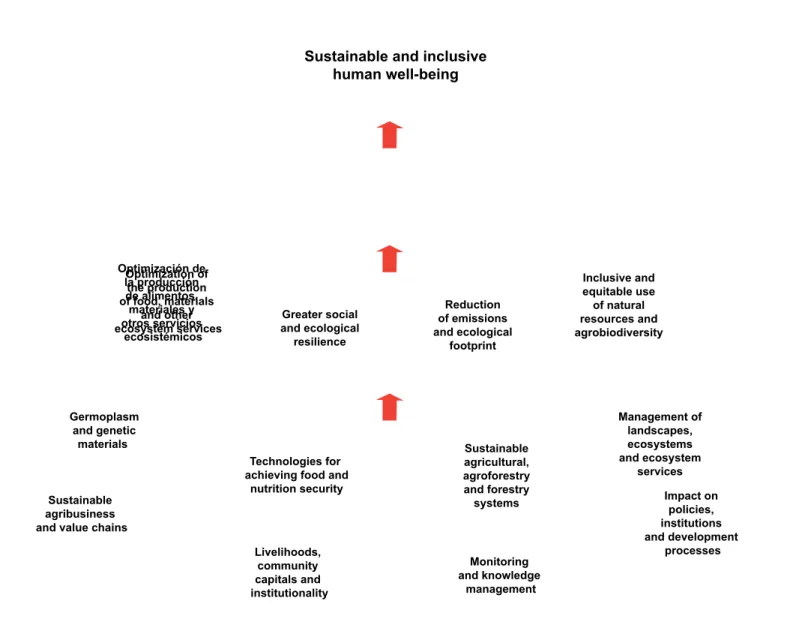
The following figure illustrates the alignment of the institutional mission with the central objective of the strategic plan (CST), the characteristics that should be developed in these territories and CATIE’s strategic product areas.
1. Contribute to reaching sustainable livelihoods, agricultural and forestry systems, territories and value chains through systems and interdisciplinary research.
2. Strengthen scientific and professional formation in systems approaches through the development of innovation educational products, both at graduate as well as professional, on-site and at-a- distance levels.
3. Strengthen and establish innovative and participatory processes with partners and allies that lead to widespread use of systems solutions for development.
4. Carry out a process of institution-wide modernization and strengthening that gives the Center the organizational competencies and competitiveness it needs for effective and efficient execution of the strategic plan.
22
Optimización de la producción de alimentos, materiales y otros servicios ecosistémicos Climate-smart territories Germoplasm and genetic materials Sustainable agricultural, agroforestry and forestry systems Management of landscapes, ecosystems and ecosystem services Sustainable agribusiness and value chainsLivelihoods, community capitals and institutionality Monitoring and knowledge management Impact on policies, institutions and development processes Optimization of the production of food, materials and other
ecosystem services and ecological Greater social resilience Reduction of emissions and ecological footprint Inclusive and equitable use of natural resources and agrobiodiversity
Sustainable and inclusive human well-being
Technologies for achieving food and
nutrition security
Figure 2. Alignment of the components of CATIE’s strategic plan
The objective of modernization and strengthening of CATIE’s overall operation has a specific character different to the preceding ones; it highlights the idea of an institutional change through internal design and decision rather than from external pressures. CATIE recognizes the changes in context, feels the effects, and decides to rethink so that it can adjust in an orderly, effective and efficient manner before external impacts force urgent and potentially prejudicial processes on the institution. A modernization and strengthening of general operation at CATIE encompasses both structural changes and the necessary adjustment in the formulas for decision-making, operation and performance (rules of the game).
23
Strategic products
The strategic objectives will be achieved through strategic products that guide the actions of CATIE’s different units. The types of strategic products corresponding to each objective follow.
Strategic objective Types Of Strategic Products 1. Contribute to reaching sustainable
livelihoods, agricultural and forestry systems, territories and value chains through systems and interdisciplinary research
1. Germplasm and genetic materials
2. Technologies for attaining food and nutritional security 3. Sustainable agricultural, agroforestry and forestry systems 4. Methodologies for management of territories, ecosystems and
ecosystem services
5. Sustainable, competitive, inclusive and equitable value chains and agribusinesses
6. Sustainable livelihoods, community and institutional capitals (gender, equity, dialogue, collective action and local leadership)
7. Policies and better institutionality
8. Research products appropriate for education and extension activities 2. Strengthen scientific and professional
formation in systems approaches through the development of innovation educational products, both at graduate as well as professional, on-site and distance levels
1. Graduate and training educational programs 2. Financing systems for education
3. System for management of educational quality 4. Work with graduates and their association
5. Greater involvement of research and extension personnel in education efforts at headquarters and in the countries 3. Strengthen and establish innovative and
participatory processes with partners and allies that lead to widespread use of systems solutions for development
1. Projects and innovative actions for development (field) 2. External and internal communication, institutional positioning,
marketing and promotion of the CATIE brand
3. Greater contribution of personnel in the countries to education efforts and outreach
4. Complete a process of institution wide modernization and strengthening that gives the Center the organizational competencies and competitiveness it needs for effective and efficient execution of the strategic plan
1. Deepen and intensify the integration among the functions of education, research and projection that define the Center with the model of an international land-grant type of university
2. Strengthen an institutional culture that facilitates implementation of institutional strategy
3. Ensure the presence of highly qualified and competent personnel who identify with institutional strategy
4. Rethinking of the internal processes and norms
5. Financial strategy and fund management, planning, internal allocation and follow-up based on recovery of indirect costs
6. Businesses and commercial operations that contribute to the core budget
24
Strategic objectives, goals and indicators in
the medium and long term
Execution of the actions needed to obtain the proposed strategic objectives requires definition of the specific goals and indicators that demonstrate advances as well as final attainment of the objectives. The proposed indicators are subdivided in two groups corresponding to different time periods in implementation of the strategic plan. Indicators for the medium term (2016) and long term (2020) are proposed in order to guide the other plans based on this strategic plan (such as biennial and annual operating plans) and as-sess progress during the planned period.
SO1.Contribute to reaching sustainable livelihoods, agricultural and forestry systems, territories and value chains through systemic and interdisciplinary research
GOAL 2016 INDICATORS (medium term) 2020 INDICATORS (strategic) CATIE consolidated as a
principal regional research and development platform in interdisciplinary systems approaches in agriculture and natural resources in Latin America and the Caribbean.
- New collaboration in research and development on systems approaches is carried out with CIRAD (France), KFRI (South Korea), Bioversity International, ICRAF, CIFOR, CIAT, ILRI, AIRCA, CATAS (China), EfD and others.
- Open-access database (sensu CGIAR) is established and functioning according to agreed-upon guidelines with a follow-up committee that includes representatives of at least six sectors (academic, public, private, NGO, international research and development centers, civil society).
- CATIE receives funds for research and development through international partners according to its financial strategy because of its role as a principal platform in Latin America and the Caribbean for agricultural, forestry and environmental research, anddevelopment with a territorial and integrated approach.
- At least one new “Platform of International Scientific Cooperation” (PCP type) is established with CATIE as the main partner - At least 10 analyses are completed by
CATIE and partners using the CATIE open- access database as a strategic input for decision making.
Climate-smart territories (CSTs) established in tropical countries.
The systems and methodological approach to establish and manage a CST are available for publication of articles, manuals and other media- to scale out to other regions, based on research and application in key territories of MAP, model forests, and biological corridors.
The CST model promoted by CATIE and its partners is being used successfully as a tool to achieve sustainable and resilient development in at least 20 territories (principally in Latin America and the Caribbean).
CATIE recognized and used as the first option for obtaining models,
methodologies, technologies, trustworthy data and inputs for policies to achieve sustainable management of lands from a systems point of view.
At least three “centers of excellence” (or of thought) established in CATIE: 1) environmental economics, 2) agroforestry systems with coffee and cocoa and 3) conservation and sustainable forest management.
At least six “centers of excellence”(or think tanks) established at CATIE: 1) environmental economics, 2) agroforestry systems with coffee and cocoa, 3) conservation and sustainable forest management, 4) sustainable livestock, 5) value chains and 6) climate change (mitigation, adaptation and their synergies). Germplasm from the
collections and genetic improvement programs at CATIE distributed throughout the region.
Genetic material of coffee and cocoa is distributed by CATIE in at least 10 countries in the region.
At least half a million farmers in Latin America and the Caribbean have plants derived from genetic materials distributed by CATIE on their farms.
25
SO2. Strengthen scientific and professional formation in systemic approaches through the development of innovative educational products at graduate and professional levels through on-site, virtual and at-a-distance modes.
GOAL 2016 INDICATORS (medium term) 2020 INDICATORS (strategic) CATIE is the best option
in tropical America as an international university in agriculture and natural resources with interdisciplinary and systems approaches that differentiate us from other universities and with broad academic offerings that respond to the expectations, needs and demands of the countries through joint programs with other universities.
- CATIE academic offerings are significantly broadened and diversified with respect to 2012. - CATIE strengthens academic
chairs in key areas of its scientific and academic work.
- CATIE initiates new mechanisms to assess academic excellence in the graduate programs.
- CATIE and two graduate programs are accredited.
- CATIE has 25 current cooperation agreements and strategic alliances with international universities. - CATIE develops and implements
three cooperative graduate programs with universities in the region.
- Academic offerings stay aligned with the demands in the region.
- CATIE leads a regional network of cooperation among universities committed to its systemic approaches.
- CATIE consolidates at least seven new
internationally recognized academic chairs in key topics of its scientific and academic work. - CATIE consolidates at least four mechanisms
to assess academic excellence in its graduate programs.
- CATIE and all of its graduate programs are accredited.
- CATIE has 50 current cooperation agreements and strategic alliances with international universities. CATIE develops and implements 10 cooperative graduate programs with universities in the region and with international universities.
- CATIE strengthens its national offices as Academic Management Centers that link alumni, potential students and current students.
CATIE is consolidated as a leading university in excellent virtual distance education in agricultural and natural resource topics.
- The distance-education program offers at least 15 training courses and 10 graduate courses. - At least two graduate programs
have important components of distance education and virtual education.
- The distance-education program has at least 25 training courses and 15 graduate courses - At least two graduate programs are offer through
distance education and/or virtual education.
Academic offerings in the Training Areas are recognized and used internationally as the main option for excellence in education and technical and professional training in agriculture, natural resources and environmental economics.
- Strategic and special courses planned and implemented grow from 25 to 35 activities per year. - Planned and implemented courses
in the Cooperative Study Abroad Program increase from 11 to 17 activities per year.
- Strategic and special courses planned and implemented reach 50 activities per year. - Excellence in the training courses offered leads
to international recognition and a 50% increase in participants.
- Planned and implemented courses in the Cooperative Study Abroad Program reach 25 activities per year.
26
The Orton Memorial Library (OML, IICA-CATIE) strengthens its role and international recognition as a source of technical and scientific knowledge in agriculture and natural resources, using the most advanced communication and information (IT) technologies and training in management of agricultural information.
- OML implements a digital library with open-access technologies to harvest information with global-level systems.
- OML shows concrete advances in innovation of bibliographic services that are most relevant to agriculture and natural resources at a global level.
- The library develops and implements a training program in informational competencies with participation of at least 250 clients per year.
- OML harvests institutional information at a global level using technologies of information and communication.
- OML is the principal access point to knowledge generated by CATIE in agriculture and natural resources and monitors the status of excellence of publications in scientific domain portals.
- The library positions its training program in informational competencies with geographic coverage to CATIE’s member countries..
*The Division of Education has an organizational structure for development of funds and financial management that ensures permanent financial self- sustainability, with a team having the highest standards of professional, academic, scientific and technical quality to support, facilitate and promote innovation and leadership in its graduate students and students in the training program.
- Business plans of the Graduate Program and the Training Area are implemented.
- CATIE increases the number of in- house professors and associates who carry out educational activities by 20% compared to 2012. - Increase in external scholarships
for students in accordance with the financial strategy.
- The Graduate Program and the Training Area are financially solvent and obtain surpluses from their educational activities.
- Increase in external scholarships for students in accordance with the financial strategy.
GOAL 2016 INDICATORS (medium term) 2020 INDICATORS (strategic)
27
OE3. Strengthen and establish innovative and participatory processes with partners and allies that lead to widespread use of systemic solutions for development
GOAL 2016 INDICATORS (medium term) 2020 INDICATORS (strategic) CATIE transforms the offices
in the countries to national Academic Management Centers, obtaining a greater participation in the functions of research, education and innovation in the field, operating efficiently in at least 10 countries in tropical America and contributing goods and services to members, partners and allies.
- Five national Academic Management Centers operate efficiently and five are in process of consolidation. - Four of these centers manage
institutional offerings in research, education and innovation in the field. - Coordinators of these Academic
Management Centers and other key personnel are effectively integrated into the academic work, induction of students and graduate fieldwork.
- CATIE has 10 national Academic Management Centers in its member countries, which facilitate the investment in programs, projects and educational services. - 10 member countries implement policies and co-implement processes of innovation with the centers.
CATIE has an entity specialized in knowledge management for innovation, which positions the Center as a prestigious scientific-academic referent with specialized information for its target audience. This entity coordinates with other internal units its scope for education, training, and research.
- The Office of Communication and Incidence (OCI) and the national Academic Management Centers manage 20 processes per year that consolidate the CST approach. - OCI develops a digital communication
platform.
- Information alliances are formed with at least four organizations that are leaders in dissemination of scientific knowledge, which increases by 100%. the demand for materials, services and visits, among others.
- CATIE consolidates at its headquarters a specialized knowledge-management center that directs an innovative offer for processes of innovation and development, facilitates processes of virtual education and effectively promotes institutional offerings.
- CATIE has 10,000 key persons in the database for dissemination of information.
CATIE has an entity for
institutional offerings in research, education and outreach and advances in implementation of joint initiatives with other regional organizations.
- Five national Academic Management Centers in nonmember countries in Latin America facilitate and execute joint initiatives in research, education and outreachs with organizations active in those countries.
- 15 Academic Management Centers operate in LAC countries, facilitating and executing joint initiatives in research, education and outreach with organizations active in those countries.
CATIE and IICA maintain close collaboration in programs promoting sustainable management of agriculture and natural resources that benefit member countries.
- CATIE and IICA establish a joint plan of activities that identify opportunities for synergies in education, research and extension in support of technical cooperation on priorities of the agricultural sector in the countries.
- CATIE and IICA manage prioritized projects of joint cooperation based on a specified roadmap.
28
OE4. Complete a process of institution-wide modernization and strengthening that gives the Center the organizational competencies and competitiveness it needs for effective and efficient execution of the strategic plan
GOAL 2016 INDICATORS (medium term) 2020 INDICATORS (strategic) CATIE strengthens joint work
among its divisions to achieve greater effectiveness and efficiency in the integration of its essential functions as an international land-grant type of university and regional scientific platform.
- Broadening of the functions of the Division Directors as Associate Deans to increase their contribution to the academic component and integration of the three basic functions. - Creation of a Council of Associate Deans as
an advisory body to the Dean of the Graduate School.
- Redefine the role of CATIE offices in the countries to fit them to the role of national Centers of Academic Management.
Mechanisms for joint work among divisions is maintained and improved and continues to strengthen the integrative work that characterizes CATIE as an international land-grant type of university and regional scientific platform
CATIE configures its regulatory and operational framework for management of human talent to achieve development and strengthening of attitudes and aptitudes that ensure motivated, high-performance teams.
- Revision, actualization and systematization of at least three essential processes in management of human resources achieved at the Center; regulations for international professional personnel (IPP) and national personnel (NP), salaries and incentives and performance evaluation.
- A system for measurement of organizational health is functioning.
- A system for management of organizational change is functioning.
- Integration of processes to Enterprise Resources Planning (ERP) is underway. - Professional development and successional
plans in process.
- Revision, actualization and systematization of at least three essential processes in management of human resources in all of the Center’s business models: consultants: professional development and successional plans and automation of paperwork and generation of reports. - Improvement achieved in the operation
of established systems.
CATIE expresses it plans, organization and operational- strategic control in financial and accounting terms through balanced budgets that ensure its health and financial sustainability.
- Financial statements in accordance with international standards, free of caveats and with a clean bill of health from the auditor. - Total budget of USD 33.3 million and a core
budget of USD 6.6 million
- Recuperation of at least 70% of indirect institutional costs.
- The total budget of USD 39.8 million and a core budget of USD 8.1 million. - Recovery of 90% of indirect
institutional costs (USD 1.3 million).
CATIE operates a system of modern and up-to-date information systems that contribute effectively to the Center’s operations.
- Communications and connectivity platforms are consolidated.
- The website is the Center’s main portal of entry and marketing tool.
- Platform for administration of projects functioning and in harmony with the Center’s financial accounting system.
- Application of the knowledge management system is in operation under the platform of the institutional website.
- Systems and processes are kept up to date and contribute to improve efficiency and effectiveness of CATIE’s operation.
- System of Enterprise Resources Planning (ERP) is implemented and consolidating all of the strategic technology of the Center.
29
Institutional agribusinesses consolidated as a generator of resources for the core budget and as a platform of support for scientific and educational programs.
- Total contributions to the core budget in accordance with the financial strategy. - The dairy consolidated as a spearhead of
the farm’s agribusinesses (including cane, cocoa and coffee) and certified by Rainforest Alliance with seal for sustainable livestock.
- Increased contributions to the core budget in accordance with the financial strategy
- Dairy continues as spearhead of farm’s agribusinesses (also including cane, cocoa and coffee).
Housing strengthened to support the student and scientific community on campus, focusing its management in maintenance, ecoefficiency, reinvestment and financial support to core functions.
- Contributions to the core budget in accordance with the financial strategy.
- Contributions to the core in accordance with the financial strategy.
- Maintenance of previous achievements.
Institutional services function as a support platform for operation of the Center within a framework of ecoefficiency and assistance to operational budgets.
- Formulation and execution pf a preventive maintenance plan, with compliance greater than 70%.
- Sustained reduction of 15% demonstrated in electricity consumption yearly, replaced by appropriate renewable energy.
- Achievement of a positive rating of at least 70% by internal clients for concessioned services.
- Formulation and implementation of a preventive maintenance plan, with compliance greater than 90%. - 100% of requests for corrective
maintenance attended to in the following 22 days.
- Sustained reduction of 10% in electricity consumption demonstrated yearly, replaced by internal renewable energy.
CATIE’s current contract (Law 8028) is extended for an additional 20-year period beginning in 2020.
- Promote the corresponding agreements before the established legal governmental bodies to automatically extend Law 8028 for an additional period of 20 years.
- Extension of CATIE’s contract (Law 8028) enters into force for an additional 20-year period and the institutional mandate continues in all of its functional dimensions.
31
6. System of planning,
monitoring and evaluation
This institutional strategic plan will serve as a basis for divisional strategic plans, management plans and annual and biennial operating plans (AOP) of the dependencies and units. That is, each division of CATIE will develop its respective plan aligned with this institutional strategic plan. In addition, each dependency in each division will develop its management plan (combination of the strategic plan and business plan) and their corresponding annual and biennial operating plans, identifying the partial goals for the year planned. As for monitoring and assessment, the Balanced Scorecard (BSC, Kaplan and Norton, 1992, Harvard Business School) currently employed by CATIE will continue to be used, with the adjustments necessary to include the innovations presented in this strategic plan, maintaining CATIE’s traditional approach of manage-ment by results.
The divisional plans will be monitored by the Office of the Director General using the BSC, while the insti-tutional strategic plan will serve as a measure of the Director General’s accountability to the Center’s gov-erning bodies, donors and strategic allies. The accountability to the govgov-erning bodies will be guided by the indicators referred to in the mission, vision and strategic objectives of this plan, assisted by the evidence generated by the monitoring and evaluation system based on the BSC.
At the same time, and as a fundamental part of the monitoring system, CATIE plans to develop a risk man-agement plan in 2014 that will identify and provide follow-up to a set of aspects critical to the Center’s opera-tional security and achievement of the goals.
Also proposed in 2014 is implementation of a new evaluation methodology for individual performance, aligned with this strategic plan and operating plans.
32
7. Financial Strategy and
Management of Funds
In 2012, CATIE composed a financial strategy for 4 years (2012–2016) that serves as the base for the first years of execution of the strategic plan for 2013–2020 while CATIE’s modernization and general operations strengthening process is completed. This process will drive a financial strategy adjusted to the new conditions and one that should take in to account the proposals of the new administration for 2016–2020.
In an organization that is dependent financially on generating about 95% of its income from its own activities and services, budget projections are not an exercise in commitments of expenditures but are structured around challenges in the matter of financial goals proposed to the various sectors and whose achievement will depend on a number of factors external to CATIE and out of its control. Given this caveat, he following chart summarizes the goals of financial evolution established for short, medium, and long terms (estimates in millions of USD).
2014 2016 2020
Research and development 12.4 12.0 14.5
Education 2.7 3.9 5.5
Projection and development 7.03 9.14 9.83 Commercial operations and administration 4.35 5.65 7.02 Contributions from countries and members 1.65 1.65 1.65
Trusts 0.82 0.98 1.30
TOTAL CATIE BUDGET 29.0 33.3 39.8
Core budget 5.8 6.6 8.1
Proportion of core budget over the total (%) 19.9 19.7 20.4
In the previous table, it is clear that the growth strategies are centered on three principal areas: education, projection and development, and research and development. The first two are expected to triple and double their respected budgets and incomes. In the case of research, an important increase is expected, but it doesn’t appear in the estimates due to the fact that in the period up to 2016, two large projects currently underway will end (MAP, FINNFOR) and their renewal is not assured due to changes in the international cooperation policies of Norway and Finland and, at the same time, negotiations with other international cooperation partners.
A limited increase in commercial operations is also expected due to the fact that opportunities to use campus resources and its commercial farm are near maximum capacity and also those of institutional trusts, thanks to the continued politics of systematic reinvestment of part of the interests that are earned.
33
The strategies proposed to achieve the financial goals presented are summarized by the following points: a. Securing resources for research and development projects at headquarters and in the
countries.
b. Securing resources for trust funds (for example, new academic chairs, scholarship funds). c. Expand number of students in the Graduate School student population due to improved
academic offerings.
d. Increasing revenue generated by the Training Area and Virtual Education in the Education Division.
e. Producing greater surpluses through the offer and sale of professional, educational and other services in the countries.
f. Significantly increase payment of quotas of member countries and reduce debts.
g. Increasing support from commercial activities as the investments made enter a phase of maturity and as the biotechnology laboratories achieve greater commercial development. h. Recuperating more of indirect costs that are reflected in a growing proportion of the core
budget in relation to the total budget.
i. Increasing efficiency in financial and environmental management with a concentration in energy aspects.
As can be seen, the financial strategy rests on two pillars: more efficient use of funds and better management of fundraising and generation of funds. For the latter, four lines will be pursued simultaneously and concurrently.
1. Securing funds for research and development projects. This will continue to be led by the Research and Development Division with its scientific personnel at headquarters and in countries, with assistance from the Office of the Director General and Board of Directors.
2. Fundraising for scholarships, academic chairs, infrastructure and equipment for educational purposes. This will be led by an office specialized in fundraising in close coordination with the
Education Division and with the support of the Office of the Director General, The Tropics Foundation, Fundatropics and the Board of Directors.
3. Generating income from participation in competitions and contests in the region, developed through strengthening a specialized unit (Management and Service Offer Unit) led by the Projection and Development Division, to take advantage of the increased demand for professional services and consultancies in the region.
4. Increasing income from commercial activities. Through commercial operations led by the Administration and Finance Division, consolidating current investments and exploring new opportunities, such as private-sector companies and joint ventures with the private sector in biotechnology, clean technology, scientific tourism and others.
34
Through these proposals and achievement of financial goals , the aim is to • Ensure the financing of all of CATIE’s core functions.
• Improve the auto-financing capacity of operative units. • Strengthen and develop the core budget.
• Improve the offering and stability of the Graduate School’s academic programs. • Significantly increase the Center’s financial reserve.
In this manner, financial support for CATIE’s functions will be attained and this will assure the success of CATIE’s strategic goals and progress toward its vision and institutional mission.