Original Article
Impact of a Regional Pharmacy Call Center on Telephone
Access Metrics Within the Veterans Health Administration
Christina A. White, PharmD, MBA, BCPS*; Marshall R. Jones, PharmD, MBA†; Melanie K. Kuester, PharmD, BCPS‡; Kelly L. Myers, BS-BBA/Mgt, HAC§; and Barbara A. Schnarr, RPh¶
ABSTRACT
Purpose: To establish a cost-effective centralized pharmacy call center to serve the patients of
Veterans Integrated Service Network (VISN) 11 that would meet established performance metrics.
Methods: A pilot project began in August 2011 with the Indianapolis VA Medical Center (VAMC)
and the Health Resource Center (HRC) in Topeka, Kansas. The Indianapolis VAMC used a first-call resolution business model consisting of pharmacy technicians receiving tier 1 phone first-calls that could be escalated to a tier 2 line that consisted of lead technicians and pharmacists, while the HRC utilized general telephone agents that would transfer unresolved calls to the primary facility. Pre- and post-VISN 11 Pharmacy Call Center performance metrics were compared for each of the 7 facilities in the network with the goals being monthly average abandoned call rate less than 5% and average speed to answer less than 30 seconds. Cost per call was also compared.
Results: The average abandoned call rate for the network during the year prior to VISN 11
Phar-macy Call Center implementation (August 2010-July 2011) was 15.66% and decreased to 3% in July 2014. The average abandoned call rate decreased for each individual facility. In fiscal year 2014, the VISN 11 Pharmacy Call Center was operating at a cost of $4.35 per call while providing more services than the HRC, resulting in less workload being transferred back to the individual facilities.
Conclusion: A centralized VISN pharmacy call center is a reasonable alternative to individual
facil-ity call centers or the HRC.
Key Words—hospital pharmacy, hospitals, telemedicine, telephone, veterans Hosp Pharm—2015;50:370-375
V
eterans Integrated Service Network (VISN) 11 is comprised of 7 medical centers (India-napolis, Northern Indiana Healthcare Sys-tem, Illiana Healthcare SysSys-tem, Saginaw, Ann Arbor, Battle Creek, and Detroit) along with their associated community-based outpatient clinics. With the excep-tion of the Indianapolis facility, each facility was his-torically responsible for answering pharmacy-related calls with existing resources in their respective outpa-tient pharmacies. In the late 1990s, the IndianapolisVA Medical Center (VAMC) began its own call center to meet the needs of patients and providers regarding medication-related concerns. The service was called “Pharmacy Triage.” Any call regarding medications received anywhere in the medical center was transferred to the pharmacists in the triage call center. These pharmacists would review the medical record and provide clarification on courses of ther-apy, provide medication renewals of non-controlled substances per approved protocol, and serve as a
*Associate Chief, †Chief, §Management Analyst, Pharmacy Service, Richard L. Roudebush VA Medical Center, Indianapolis, Indiana;
‡Staff Development Program Manager, Richard L. Roudebush VA Medical Center, Indianapolis, Indiana; ¶Supervisor, VISN 11
Phar-macy Call Center, Indianapolis, Indiana. Corresponding author: Christina White, PharmD, MBA, Department of PharPhar-macy, Richard L. Roudebush VA Medical Center, 1481 West 10th Street, Dept. 119, Indianapolis, IN 46202; phone: 317-988-2946; e-mail: Christina. [email protected]
liaison between the Veteran patient or caregiver and the provider. The triage group was able to address the Veteran’s pharmaceutical care needs between vis-its more quickly than the prior process involving the medical care provider.
Because not all of the telephone calls needed pharmacist involvement, this group merged with the outpatient pharmacy technicians to provide a better-integrated pharmacy call center in 2004. The phar-macy technicians answered the initial call, reviewed the medical record and pharmacy history, initiated the medication renewal process, and provided basic pharmaceutical and logistical information to the Vet-eran. Integrating technicians into the Indianapolis VAMC Pharmacy Triage service allowed the depart-ment to improve both internal and external customer satisfaction by reducing telephone transfers and providing first-call resolution. From 2004 to 2009, the pharmacy triage group continued to refine and improve its business model to meet an ever-increasing workload demand.
The Veterans Health Administration (VHA) has explored similar centralization opportunities. In 2002, the VHA Chief Business Office centralized pro-cesses related to Veterans’ health benefits, eligibility, and billing inquiries and created the Health Resource Center (HRC) in Topeka, Kansas. Due to the success of the HRC in meeting billing and eligibility needs, expansion into other service lines was pursued.1 In
2008, a proposal was developed that utilized the resources at the HRC to pilot a national pharmacy call center. The HRC began contracting with individ-ual facilities and networks to receive their pharmacy calls in an effort to reduce interruptions in the respec-tive outpatient pharmacies.
MODEL OF CARE
The Indianapolis VAMC Pharmacy Service already had a small call center comprised of phar-macy technicians and pharmacists to handle this vol-ume and provide high-quality service to the Veteran. A key difference between the HRC and Indianapolis VAMC call center models was the composition of personnel. In the HRC model, individuals, many of whom had little or no pharmacy experience, were trained to receive Veterans’ calls and provide first-line help. Calls for a clinical issue, medication renewal, or facility-specific question were documented accord-ing to HRC’s procedures and then forwarded to the appropriate VA facility for resolution. As described by Kharlamb et al, a scope of practice to renew
medications better equipped the Indianapolis phar-macy staff to handle call issues than the HRC model, which transferred that workload back to the primary medical center.2 Within VISN 11, available data
indi-cated that the Indianapolis VAMC Pharmacy Triage service was operating closer to desired goals, so a discussion began in June 2009 for the Indianapolis VAMC pharmacy service to begin assuming calls for all of VISN 11 in an effort to improve patient sat-isfaction, meet call center performance metrics, and reduce costs through centralization of efforts.
METHODS
From June 2009 through May 2011, dialogue at many levels in the VHA led to the initiation of a pilot project with the VISN 11 Pharmacy Call Cen-ter at Indianapolis and the Health Resource CenCen-ter Pharmacy Customer Care group (HRC PCC). This pilot would evaluate standard call center metrics while comparing the different workflows between the HRC PCC and the VISN 11 Pharmacy Call Center. The Indianapolis VAMC pharmacy staff visited the HRC and received training on the phone system and customer relationship management (CRM) software used to track phone calls. Performance metrics used to measure the success of the call center included average speed of answer (goal, <30 seconds) and abandoned call rate (goal, <5%). An internal driver identified in achieving these goals was the call handle time (goal, <3 minutes 30 seconds).
Call Ticketing Technology
In August 2011, Indianapolis began the pilot by taking all pharmacy calls from the Northern Indiana Health Care System (NIHCS). In September 2011, VA Illiana Health Care System was added, and Indianap-olis took the second-tier call transfers from the HRC. By January 2012, it was evident based on the data and the user experience that the pilot would not continue; the Indianapolis VAMC call center model was prov-ing to be more efficient in achievprov-ing first-call resolu-tion, and the additional CRM licenses that would be needed to keep up with workload were going to be too costly. To prepare for a separation, the Indianapo-lis facility changed the name of their Pharmacy Tri-age service to the VISN 11 Pharmacy Call Center and developed a homegrown CRM system that was more user-friendly and avoided the costly licensing fees of a commercial system. The original CRM system used by the HRC did not have the capabilities to preload patient information prior to a patient’s call. Thus, for
any new patient, additional demographic information had to be keyed into the software. The additional key-strokes involved in entering patient demographic data added to the total call handle time and was not value-added time for the Veteran. Additionally, based on the licensing constraints, non–call center staff did not have the capability to view call tickets or provide any assistance if contacted by the Veteran or local staff. By working with a development team within the India-napolis Office of Information & Technology, a new call ticketing system was created that better suited the needs of the call center. The system was customized for VISN 11 and has fewer menu options than the HRC CRM system, but it does have additional features to make working through open tickets, ticket tracking functions, and reporting functions easier. The system was built to read information from the VA’s electronic medical record system, VistA; thus it has the ability to upload patient demographic information from the VISN data warehouse, and it is updated each quarter with demographic information for any new patients enrolled in the VA since the last update. This feature saves a significant amount of time for first-time callers when compared to the previous system. Additionally, since it is already part of the VA, any VISN pharmacy staff member can request viewing capabilities to see the call and patient history. All of these factors resulted in a system that has saved the VISN 11 Pharmacy Call Center time and money and that is more transparent to all facilities involved in the process.
In March 2012, the new software solution was put into limited production. In mid April 2012, it was determined by both parties to separate. VISN 11 decided that the technician/pharmacist call center model had results that better met the needs and bud-get of the VISN. Thus the VISN 11 Pharmacy Call Center began the process of expanding to receive all VISN 11 pharmacy telephone calls. All of Illiana’s calls were incorporated into the call center in May 2012, followed by Saginaw in June 2012, Ann Arbor in December 2012, Detroit in March 2013, and end-ing with Battle Creek in June 2013.
Recruitment and Retention
The Erlang C model and historical call volume data were utilized to estimate and determine staffing requirements.3 Due to space constraints on the
India-napolis VAMC campus and the need for additional growth, the Indianapolis call center relocated off-campus to Fort Benjamin Harrison in January 2010. Recruitment and hiring were performed in phases according to the timeline for acquiring facilities until
all 58.5 full-time equivalent (FTE) employees were on board. These 58.5 FTE employees consist of 1 supervisory pharmacist, a supervisory pharmacy technician, an administrative officer, 10 clinical phar-macists, 3 lead technicians, and 42.5 FTE pharmacy technicians. Call center management was successful in recruiting talented pharmacists and technicians primarily through word-of-mouth referrals from cur-rent staff. Because the call center is only open dur-ing the day Monday through Friday and closed on major holidays, it was relatively easy to recruit new staff through the promotion of work-life balance. Additionally, Indianapolis offers a nontraditional postgraduate year 1 (PGY-1) pharmacy residency program for pharmacists desiring to enhance their clinical skills and to create additional employment opportunities.
The majority of technicians hired for these entry-level GS-5 positions have pharmacy technician cer-tification board (PTCB) cercer-tification, which permits them to be considered for GS-6 positions within the department (and eventually for GS-7 lead technician and GS-8 technician supervisor positions), creating a technician career ladder. This feature has been a key selling point when technicians are recruited from retail pharmacy chains. Because these are entry-level pharmacist and technician positions, the emphasis has been on skill development so these employees will be prepared to assume higher level positions in the future (eg, call center supervisor and lead techni-cian). During the pharmacist and technician training periods, the employees first work in the outpatient pharmacy to learn the operations so as to better serve their customers over the phone.
RESULTS
Performance Metrics
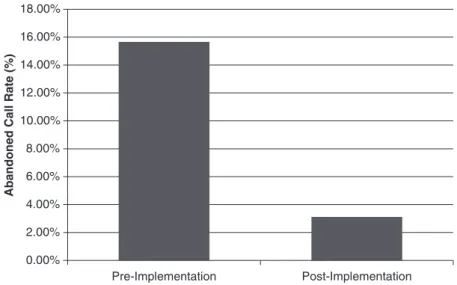
Through the use of first-call resolution, the VISN 11 Pharmacy Call Center pilot was a success and the model has been fully implemented since July 2013. In July 2014, the call center answered 82,938 calls, with an average abandoned call rate of 3.12% and average speed to answer of 34 seconds. This is a significant improvement over the August 2010-July 2011 performance metrics when each medical center was answering its own pharmacy calls. During that time frame, the average abandoned call rate for VISN 11 was 15.66% (range, 5.71%-29.22%) and aver-age speed to answer was 139 seconds (range, 79-193 seconds) (Figures 1 and 2). From March to August 2014, the call center averaged 80,291 calls received
per month, with an abandonment rate of 2.95% and average speed to answer of 36 seconds.
Cost Savings
The VISN 11 Pharmacy Call Center recognized significant cost savings and cost avoidance. By sep-arating from the HRC and developing local CRM software, Indianapolis saved $180,000 in licen -sing fees.
In addition, HRC provides services to the 6 facili-ties comprising VISN 2 in Upstate New York for $4.20/call with an average transfer rate of 11.09% (range, 8.94%-16.24% per facility) (G. Knight, writ-ten communication, March 6, 2014). These transfers are made to either the pharmacy or the clinic, depend-ing upon the agreement made with the facility. For the 2014 fiscal year, the VISN 11 Pharmacy Call Center was operating at $4.35/call and an average transfer
0.00% 2.00% 4.00% 6.00% 8.00% 10.00% 12.00% 14.00% 16.00% 18.00% Pre-Implementation Post-Implementation A b and on ed Cal l Rate (% )
Figure 1. Monthly average abandoned call rate (%) before and after Veterans Integrated Service Network call center implementation. 0 20 40 60 80 100 120 140 160 Pre-Implementation Post-Implementation
Average Speed to Answer (seconds)
Figure 2. Monthly average speed to answer (seconds) before and after Veterans Integrated Service Network call center implementation.
rate of 9.74% (range, 7.31%-14.23% per facility). Approximately 97% of transferred calls in VISN 11 are non-pharmacy-related calls that are being trans-ferred to the primary site for scheduling issues, ben-efits inquiries, questions for a specific clinic, and so on. Because VISN 11 utilizes the tiered model, each facility realizes additional cost avoidance from not having local staff respond to calls and electronic task notifications that would otherwise be sent to them by the HRC (Figures 3 and 4). Considering the workload that is transferred back to the primary facility and the subsidization that is received, the HRC cost per call is theoretically higher than the $4.20 that is charged. DISCUSSION
By utilizing trained pharmacy technicians to answer calls, first-call resolution is increased. Veter-ans have the majority of their issues addressed by
the first-tier representative (technician) rather than having their calls transferred to multiple points. Any medication-related calls that cannot be resolved by a pharmacy technician are quickly passed to a call center pharmacist.
The call center has experienced several chal-lenges, including phone system and network outages that resulted in dropped calls. To remedy this, a new phone system has been installed, software upgraded, and the server relocated to prevent port lock-ups and allow for continued service in the event that primary links go down. Another technological challenge is the computerized patient record system, which requires 7 sessions to be open simultaneously on the user’s computer – one for each facility, as there is currently not a singular interface that allows write access to each facility’s medical record. Navigating 7 screens can lead to errors.
Figure 3. Health Resource Center process flow diagram.
Veteran calls
Close ticket
Transfer call to facility Agent answers call
How does agent process call?
Send ticket to facility for closure
Figure 4. Veterans Integrated Service Network11 Pharmacy Call Center process flow diagram.
Veteran calls
Close ticket
Transfer call to facility Tier 1 technician
answers call
How does technician
One challenge associated with staffing and recruitment was the limited availability of part-time pharmacy technicians. Call center staffing theory recommends a significant number of part-time employees to cover peaks in call volume (ie, Mondays for the VISN 11 Pharmacy Call Center).3
Unfortunately, there were very few applicants inter-ested in part-time employment; this necessitated the hiring of more FTE employees than what the staff-ing model would require. Findstaff-ing space for 58.5 FTE employees can also be a challenge, so telework agreements have been implemented for some staff. Another challenge associated with rapid growth is the requirement for real-time training versus protected time available for simulation and demo training.
Each facility processed approximately 20% more call volume than was initially estimated. Thus, our initial staffing estimates were a little low. Accurate telephone volume was difficult to obtain prior to call center implementation, because not all facilities used telephone lines or software that was able to capture that data.
As was alluded to by VISN 3 (VA New York/ New Jersey Veterans Health Care Network), one of the most challenging aspects of a centralized call center is the variation between individual facility policies and procedures.2 Call center staff must be
trained on these intricacies and be kept informed of any changes to policy. Future initiatives include reviewing these differences in an effort to create more standardization across the network and to reduce the percentage of calls that are transferred to the respective facilities.
Additional Plans
Customer analysis has begun to gauge patient satisfaction with the service. Additional clinical phar-macy services are being explored, including outbound call services such as postdischarge follow-up. The call center has served as a training site for pharmacy residents, and it will become an advanced pharmacy practice experience rotation site for pharmacy stu-dents beginning with the 2014-2015 academic year. CONCLUSION
The implementation of the VISN 11 Pharmacy Call Center has resulted in significant improvement to individual facility performance metrics, has reduced pharmacy workload at each site, and is a reasonable, cost-effective alternative to an individual facility call center or the HRC.
ACKNOWLEDGMENTS
Financial disclosures/support: The VISN 11
Pharmacy Call Center is funded solely by the Veter-ans Health Administration – VISN 11.
REFERENCES
1. Health Resource Center. US Department of Veterans Affairs. http://www.va.gov/HEALTHRESOURCECENTER/ index.asp. Accessed September 22, 2014.
2. Kharlamb V, Erato M, Foldes D, et al. Implementation of a pharmacy call center. Am J Health Syst Pharm. 2011;68: 2018-2022.
3. Reynolds P. Fundamentals of call center staffing and technologies. http://c.ymcdn.com/sites/www.naquitline.org/ resource/resmgr/issue_papers/callcentermetricspaperbestpr.