University of Massachusetts Amherst University of Massachusetts Amherst
ScholarWorks@UMass Amherst
ScholarWorks@UMass Amherst
Doctoral Dissertations Dissertations and Theses
October 2019
Neural Generative Models and Representation Learning for
Neural Generative Models and Representation Learning for
Information Retrieval
Information Retrieval
Qingyao AiFollow this and additional works at: https://scholarworks.umass.edu/dissertations_2
Part of the Artificial Intelligence and Robotics Commons, and the Databases and Information Systems Commons
Recommended Citation Recommended Citation
Ai, Qingyao, "Neural Generative Models and Representation Learning for Information Retrieval" (2019). Doctoral Dissertations. 1676.
https://doi.org/10.7275/nejy-3840https://scholarworks.umass.edu/dissertations_2/1676
This Open Access Dissertation is brought to you for free and open access by the Dissertations and Theses at ScholarWorks@UMass Amherst. It has been accepted for inclusion in Doctoral Dissertations by an authorized administrator of ScholarWorks@UMass Amherst. For more information, please contact
NEURAL GENERATIVE MODELS AND
REPRESENTATION LEARNING FOR INFORMATION
RETRIEVAL
A Dissertation Presented by
QINGYAO AI
Submitted to the Graduate School of the
University of Massachusetts Amherst in partial fulfillment of the requirements for the degree of
DOCTOR OF PHILOSOPHY September 2019
c
Copyright by Qingyao Ai 2019 All Rights Reserved
NEURAL GENERATIVE MODELS AND
REPRESENTATION LEARNING FOR INFORMATION
RETRIEVAL
A Dissertation Presented by
QINGYAO AI
Approved as to style and content by:
W. Bruce Croft, Chair
James Allan, Member
Erik G. Learned-Miller, Member
Rajesh Bhatt, Member
Jiafeng Guo, Member
James Allan, Department Head
ACKNOWLEDGMENTS
First and foremost, I would like to thank my adviser, W. Bruce Croft, without whom this dissertation would not have been possible. Bruce taught me how to conduct research and, more importantly, how to think critically and independently. He gave me all the support I needed for developing my research projects, and he also gave me great freedom to explore the research problems that I’m excited about. These help me build my own research agenda and have a deep influence on my future career.
I would like to thank my committee members, James Allan, Erik Learned-Miller, Rajesh Bhatt, and Jiafeng Guo. They provided important support and valuable comments on my thesis proposal and dissertation, which help me better formulate the problems and successfully defend the thesis. Especially, I would like to thank Jiafeng for helping me overcome many problems in the early days of my Ph.D. He gave me great guidance on how to develop a research idea and write a good research paper. He is not only a great friend but also a wonderful mentor to me.
I would like to thank all the mentors and friends who helped me in the past of my research career. I thank Yiqun Liu for introducing me to the field of information retrieval; I thank Susan Dumais and Nick Craswell for teaching me how to conduct solid work and studies in Microsoft Research; I thank Xuanhui Wang and Michael Bendersky for giving me the opportunities to work on cutting edge problems with the best people in Google; and I thank Daniel Hill and Choonhui Teo for helping me and giving me better understanding of real users and customers during my time at Amazon Search.
I would like to thank all the staffs of our lab, Kate Morruzzi, Jean Joyce, Dan Parker, Stephen Harding, Michael Zarozinski and Glenn Stowell for their great
tech-nical and logistical support. I cannot finish my Ph.D. such easily without their help. Also, I thank our Graduate Program Manager Eileen Hamel, who helped me a lot for my Ph.D. program.
I thank all my friends and colleagues in the lab for creating such a productive and friendly working environment. In alphabet order: Keping Bi, Hamed Bonab, Ethem Can, Daniel Cohen, Laura Dietz, Shiri Dori-Hacohen, John FoleyHelia Hashemi, Myung-ha Jang, Jiepu Jiang, Youngwoo Kim, Chia-Jung Lee, Yen-Chieh Lien, Ali Montazeralghaem, Shahrzad Naseri, Chen Qu, Sheikh Muhammad Sarwar, Manmeet Singh, Lakshmi Vikraman, Liu Yang, and Hamed Zamani.
Finally, I would like to thank my parents and my girlfriend Pingping for their immense love and support for me. They are the light that guides me in the dark-est moments. I cannot accomplish this without them. It is my great fortune and happiness to have them in my life.
This work was supported in part by the Center for Intelligent Information Re-trieval and in part by NSF grant number IIS-1160894. Any opinions, findings and conclusions or recommendations expressed in this material are those of the authors and do not necessarily reflect those of the sponsor.
ABSTRACT
NEURAL GENERATIVE MODELS AND
REPRESENTATION LEARNING FOR INFORMATION
RETRIEVAL
SEPTEMBER 2019
QINGYAO AI
B.S., TSINGHUA UNIVERSITY
M.S., UNIVERSITY OF MASSACHUSETTS, AMHERST Ph.D., UNIVERSITY OF MASSACHUSETTS AMHERST
Directed by: Professor W. Bruce Croft
Information Retrieval (IR) concerns about the structure, analysis, organization, storage, and retrieval of information. Among different retrieval models proposed in the past decades, generative retrieval models, especially those under the statistical probabilistic framework, are one of the most popular techniques that have been widely applied to Information Retrieval problems. While they are famous for their well-grounded theory and good empirical performance in text retrieval, their applications in IR are often limited by their complexity and low extendability in the modeling of high-dimensional information. Recently, advances in deep learning techniques provide new opportunities for representation learning and generative models for information retrieval. In contrast to statistical models, neural models have much more flexibil-ity because they model information and data correlation in latent spaces without
explicitly relying on any prior knowledge. Previous studies on pattern recognition and natural language processing have shown that semantically meaningful represen-tations of text, images, and many types of information can be acquired with neural models through supervised or unsupervised training. Nonetheless, the effectiveness of neural models for information retrieval is mostly unexplored. In this thesis, we study how to develop new generative models and representation learning frameworks with neural models for information retrieval. Specifically, our contributions include three main components: (1) Theoretical Analysis: We present the first theoretical analysis and adaptation of existing neural embedding models for ad-hoc retrieval tasks; (2) Design Practice: Based on our experience and knowledge, we show how to design an embedding-based neural generative model for practical information re-trieval tasks such as personalized product search; And (3) Generic Framework: We further generalize our proposed neural generative framework for complicated hetero-geneous information retrieval scenarios that concern text, images, knowledge entities, and their relationships. Empirical results show that the proposed neural generative framework can effectively learn information representations and construct retrieval models that outperform the state-of-the-art systems in a variety of IR tasks.
TABLE OF CONTENTS
Page
ACKNOWLEDGMENTS . . . v
ABSTRACT. . . vii
LIST OF TABLES. . . .xiii
LIST OF FIGURES. . . xv
CHAPTER 1. INTRODUCTION . . . 1
1.1 Information Representation and Generative Models . . . 1
1.2 Neural Embedding Framework . . . 5
1.3 Neural Generative Models for Information Retrieval . . . 8
1.3.1 How to adapt neural embedding models for information retrieval . . . 9
1.3.2 How to combine neural embeddings with generative models . . . 10
1.3.3 How to build a generic neural generative framework . . . 10
1.4 Contributions . . . 11
1.5 Dissertation Outline . . . 13
2. BACKGROUND AND RELATED WORK. . . 15
2.1 Statistical Generative Models for IR . . . 15
2.1.1 Classic Probabilistic Models . . . 16
2.1.2 Language Modeling Approach . . . 17
2.1.3 Latent Semantic Modeling . . . 19
2.2 Deep Learning . . . 20
2.2.2 Parameter Optimization . . . 22
2.3 Information Retrieval Applications . . . 23
2.3.1 Homogeneous Information and Ad-hoc Retrieval . . . 23
2.3.2 Heterogeneous Information and Product Search . . . 24
2.4 Neural Models for Information Retrieval . . . 27
2.4.1 Discriminative Neural Retrieval Models . . . 28
2.4.2 Generative Neural Retrieval Models . . . 29
3. ADAPTING NEURAL EMBEDDING MODELS FOR AD-HOC RETRIEVAL . . . 31
3.1 Introduction . . . 31
3.2 Paragraph Vector Model for IR . . . 33
3.2.1 PV-DBOW . . . 33
3.2.2 PV-based Retrieval Model . . . 34
3.2.3 Stability of the Model . . . 35
3.3 Problems and Modifications . . . 36
3.3.1 Over-fitting on Short Documents . . . 37
3.3.2 Improper Noise Distribution . . . 40
3.3.3 Insufficient Modeling for Word Substitution . . . 43
3.4 Experiments . . . 45
3.4.1 Data Set and Baselines . . . 45
3.4.2 Evaluation Framework . . . 47
3.4.3 Settings for Paragraph Vector Models . . . 48
3.4.4 Results and Discussion . . . 49
3.4.4.1 Overall Performance . . . 49
3.4.4.2 Iteration Number . . . 51
3.4.4.3 Vector Dimensionality . . . 52
3.4.4.4 Case Studies . . . 54
3.5 Conclusion . . . 55
4. EMBEDDING-BASED NEURAL GENERATIVE MODEL FOR PERSONALIZED PRODUCT SEARCH. . . 57
4.1 Introduction . . . 57
4.2.1 Personalized Product Search in Latent Semantic Space . . . 60
4.2.2 Hierarchical Embedding Model . . . 61
4.2.2.1 Embedding-based User/Item Language Model . . . 63
4.2.2.2 Query Embeddings . . . 63
4.2.2.3 Item Generation Model . . . 65
4.2.3 Joint Learning Framework . . . 65
4.3 Experimental Setup . . . 68 4.3.1 Datasets . . . 68 4.3.2 Query Extraction . . . 70 4.3.3 Evaluation Methodology . . . 71 4.3.4 Baselines . . . 72 4.3.5 Model Training . . . 74
4.4 Results and Discussion . . . 76
4.4.1 Retrieval Performance . . . 76
4.4.2 Personalization Weight . . . 80
4.4.3 Embedding Size . . . 81
4.5 Conclusion . . . 83
5. EXTENDABLE AND EXPLAINABLE NEURAL REPRESENTATION LEARNING FRAMEWORK . . . 84
5.1 Introduction . . . 84
5.2 Model Description . . . 86
5.2.1 Overview . . . 86
5.2.2 Static Relation Modeling . . . 88
5.2.3 Dynamic Relation Modeling . . . 91
5.2.4 Time Complexity . . . 94 5.3 Explanation Extraction . . . 95 5.3.1 Explanation Path . . . 95 5.3.2 Extraction Algorithm . . . 96 5.4 Experimental Setup . . . 98 5.4.1 Datasets . . . 98 5.4.1.1 Query Extraction . . . 100
5.4.2 Baselines . . . 101 5.4.2.1 QL . . . 101 5.4.2.2 BM25 . . . 102 5.4.2.3 LambdaMART . . . 102 5.4.2.4 LSE . . . 104 5.4.2.5 HEM . . . 104 5.4.3 Evaluation Methodology . . . 105 5.4.4 Implementation Details . . . 105
5.5 Results and Discussions . . . 106
5.5.1 Retrieval Performance . . . 108
5.5.1.1 Overall Results . . . 108
5.5.1.2 Usefulness of Different Relationships . . . 109
5.5.1.3 Parameter Sensitivity . . . 111
5.5.2 Case Study . . . 113
5.6 Conclusion . . . 116
6. SUMMARY AND FUTURE WORK. . . 118
6.1 Constructing Neural Generative Models for IR . . . 118
6.2 Summary of Experimental Results . . . 119
6.2.1 Ad-hoc Retrieval with Homogeneous Information . . . 119
6.2.2 Product Search with Heterogeneous Information . . . 121
6.3 Future Work . . . 123
LIST OF TABLES
Table Page
3.1 The cosine similarities betweenclothing, garment and four relevant documents in Robust04 query 361 (“clothing sweatshops”). EPV-DR represents the PV-based retrieval model with document-frequency based negative sampling and L2
regularization. EPV-DRJ is EPV-DR with a joint objective. . . 43 3.2 Statistics of experimental data sets. . . 46 3.3 Results on Robust04 collection measured by mean average precision
(MAP), normalized discounted cumulative gains at 20
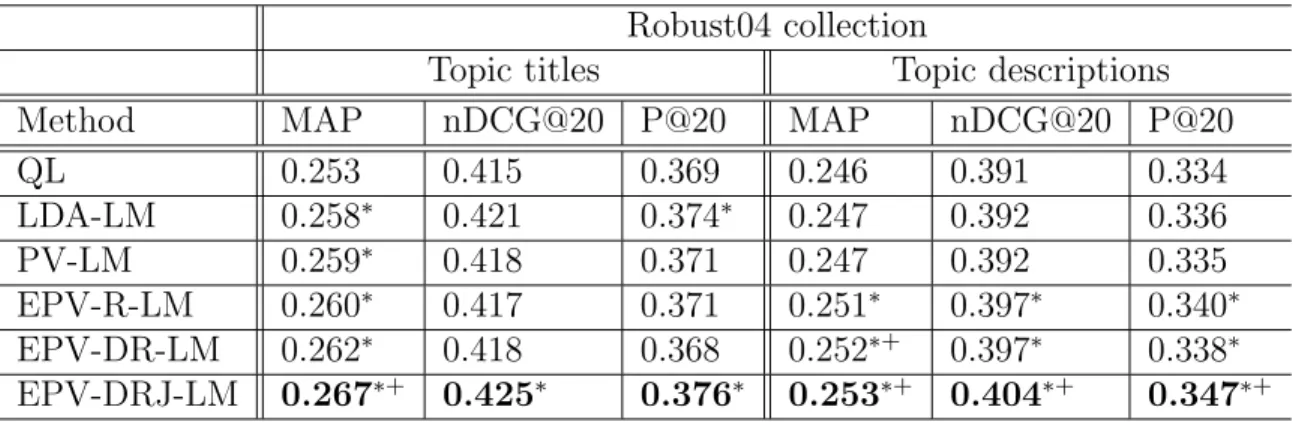
(NDCG@20), and precision at 20 (P@20). ∗, + means significant difference over QL, LDA-LM respectively at 0.05 significance level measured by Fisher randomization test. . . 49 3.4 Comparison of different models over GOV2 collection measured by
mean average precision (MAP), normalized discounted cumulative gains at 20 (NDCG@20), and precision at 20 (P@20). ∗, + means significant difference over QL, LDA-LM respectively at 0.05 significance level measured by Fisher randomization test. The
best performance is highlighted in boldface. . . 50 4.1 Statistics for the 5-core data forElectronics,Kindle Store, CDs&Vinyl
and Cell Phones&Accessories [65]. For example, a±v means that the average value is a and the standard deviation is v. . . 69 4.2 Example queries extracted following the paradigm proposed by Gysel
et al. [97] from Amazon product data. . . 71 4.3 Comparison of baselines and our hierarchical embedding models on
the Amazon product search datasets. MAP and MRR are
computed with top 100 items while NDCG is computed with top 10 items. ∗, + and‡ denote significant differences to QL, UQL and LSE in Fisher randomization test [91] with p≤0.01. The
5.1 Statistics for the 5-core datasets for Electronics, Kindle Store,
CDs&Vinyl and Cell Phones&Accessories [65]. For example,
a±v means that the average value is a and the standard
deviation is v. . . 99 5.2 A summary of the ranking features extracted for constructing a
learning-to-rank model on the Amazon product search
dataset. . . 103 5.3 Comparison of baselines and DREM on the Amazon product search
datasets. ∗, + and †denote significant differences to all baselines (QL, BM25, LambdaMART, LSE, and HEM), DREMN oM eta, and all tested models, respectively, in Fisher randomization test [91] with p≤0.01. The best performance is highlighted in
boldface. . . 107 6.1 Test set results on Robust04 and GOV2 collection with topic titles as
the search queries. Retrieval performance is measured by mean average precision (MAP), normalized discounted cumulative gains at 20 (NDCG@20), and precision at 20 (P@20). ∗, + means significant difference over QL [80], LDA-LM [99] respectively at
0.05 significance level measured by Fisher randomization test. . . 120 6.2 Test set results on Robust04 and GOV2 collection with topic
descriptions as the search queries. Retrieval performance is measured by mean average precision (MAP), normalized
discounted cumulative gains at 20 (NDCG@20), and precision at 20 (P@20). ∗, + means significant difference over QL [80], LDA-LM [99] respectively at 0.05 significance level measured by
Fisher randomization test. . . 120 6.3 Comparison of different product search baselines with the hierarchical
embedding model (HEM) and the dynamic relation embedding model (DREM) on the Amazon search datasets with products from different categories. Mean average precision (MAP) and mean reciprocal rank (MRR) are computed with top 100 items, while normalized discounted cumulative gain (NDCG) is
computed with top 10 items. ∗ and + denote significant
differences to all baselines (QL, BM25, LambdaMART, LSE) and all tested models, respectively, in Fisher randomization test [91] with p≤0.01. The best performance is highlighted in
LIST OF FIGURES
Figure Page
1.1 An example of how heterogeneous information creates challenges for
generative models in information retrieval tasks. . . 4 1.2 An example of neural language models based on a multi-layer neural
network. The input layer is the bag-of-words vector of a piece of text (where w is one possible word in it), and the output layer is the distribution of generation probability for each word given the
text and the model. . . 5 2.1 An illustration of three popular architectures of deep learning models,
which are the Deep Neural Network (DNN), the Convolutional Neural Network (CNN), and the Recurrent Neural Network
(RNN). The inputs and outputs of each network are referred to as
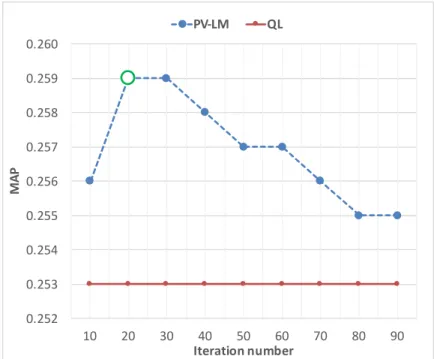
x and o, respectively. . . 21 3.1 The MAP of QL and the PV-based retrieval model with the original
PV-DBOW on Robust04 with title queries in respect of different
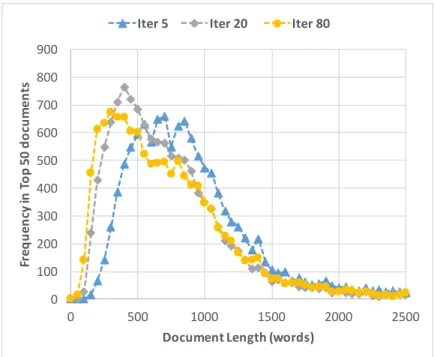
training iteration. . . 35 3.2 The distribution of documents in respect of document length for top
50 documents retrieved by PV-based retrieval model on Robust04 (title queries). Documents with more than 2500 words are
ignored. . . 36 3.3 The distribution of vector norms in respect of document length for
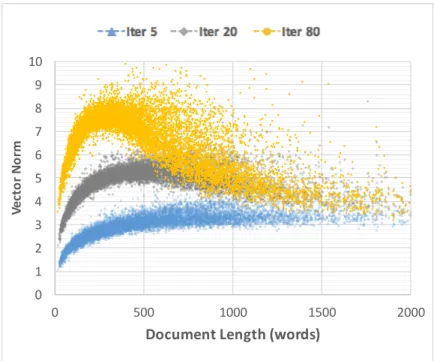
10,000 documents randomly sampled from Robust04. . . 39 3.4 The distribution of the original negative sampling (PV) and the
document-frequency based negative sampling (PD). The horizontal axis represents log value of word frequency with log
base 10. . . 42 3.5 The structure of two-layer PV-DBOW. The document is trained to
predict the observed word and then the observed word is trained
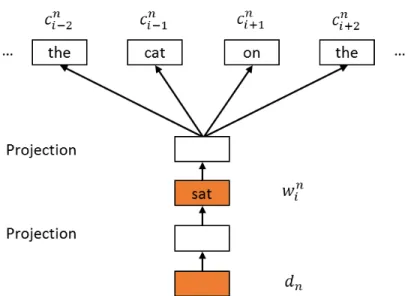
3.6 MAP variation of PV-based retrieval models with respect to iteration number. The horizontal axis represents the number of training iterations, and the vertical axis represents MAP on Robust04 title queries. . . 52 3.7 MAP variation of PV-based retrieval models with respect to vector
dimensions. The horizontal axis represents vector dimensions, and the vertical axis represents MAP on Robust04 title queries. . . 53 4.1 Personalized product search in a latent space with queryq, user u,
personalized search modelMuq and item i. . . 61 4.2 The structure of our hierarchical embedding model for personalized
product search. Ru, Ri denote the sets of reviews for user uand item i; wu, wi,wq denote the words inRu,Ri and query q; and Muq is the personalized search model constructed with query
models and user models. . . 62 4.3 The performance of HEMpm and baselines on the Amazon
personalized product search benchmark datasets with different query model weight λ. The red solid line with triangles represents the numbers of HEMpm; the blue, green and cyan dashed lines with circles, squares and pentagons are results for LSE, QL and
UQL respectively. . . 78 4.4 The performance of HEMpm and baselines on the Amazon
personalized product search benchmark datasets with different embedding size α. The red solid line with triangles represents the numbers of HEMpm; the blue, green and cyan dashed lines with circles, squares and pentagons are results for LSE, QL and UQL
respectively. . . 82 5.1 An example of the knowledge graph created by DREM for product
search. . . 87 5.2 An example explanation path from user Alice to itemDress through
word “fashion” in DREM. . . 95 5.3 The performance of DREM with different dynamic relation weight
λ. . . 111 5.4 The performance of DREM and baselines with different embedding
size α. The red solid line with triangles represents the numbers for DREMAll; the green and blue dashed lines with circles and
5.5 The knowledge graph created by DREMAll onCell Phones & Accessories for query “sports outdoors accessory electronics gadget fitness track”. Six top retrieved entities and the
corresponding probabilities (Equation (5.14)) are shown for each
CHAPTER 1
INTRODUCTION
Information Retrieval is a field concerned with the structure, analysis, organiza-tion, storage, and retrieval of information. Typically, given an explicit or implicit information need, the goal of information retrieval systems is to efficiently and ef-fectively find materials that are relevant in the current search or recommendation context. In web search, for example, this means retrieving and ranking web pages based on whether they can satisfy the user’s need expressed with text-based queries. Therefore, there are two fundamental challenges in the studies of information re-trieval – how to represent information, and how to retrieve information by matching materials with information needs.
1.1
Information Representation and Generative Models
Ever since the beginning of human civilization, people are searching for effective methods to express information. One of the most well-known examples is the cre-ation of language. Language is a special communiccre-ation method that stores, inherits, and transmits information with symbols (i.e., words) and special rules that connects them (i.e., grammar). Based on this paradigm, the simplest way to retrieve relevant information is to express both materials and information needs with language and match them accordingly.
To conduct efficient language matching with machines, the bag-of-words repre-sentation has been proposed and widely used in information retrieval systems. The idea of bag-of-words representations is to represent information with a set of words
so that each material and information need can be converted to fixed-length vectors that are processable by machines. By sacrificing the context information hidden in the linguistic structure of language, bag-of-words representations achieves great effi-ciency while maintaining surprisingly good effectiveness at the same time. They can precisely keep the key information of each material while maintaining simple data structures that are easy to store and index. Thus, considerable information retrieval models have been proposed based on bag-of-words representations.
Broadly speaking, existing retrieval models based on bag-of-words representations can be broadly categorized into two groups – discriminative models and generative models. Discriminative models usually extract matching features for each pair of ma-terial (e.g., document) and information need (e.g., query) to analyze their relevance. One of the first discriminative models proposed for information retrieval is the vector space model [88], which retrieve and rank documents based on their similarities to the current query in bag-of-words representations. More complicated discriminative methods include learning-to-rank models that apply machine learning algorithms to predict the relevance score of each material based on their feature vectors [61]. Gener-ative models, on the other hand, focus on modeling the generation process of relevant information (relevance model) based on statistical probabilistic frameworks so that documents can be retrieved and ranked by their probabilities to be generated from the relevance model. In ad-hoc retrieval scenarios, where each document is a piece of text and users search documents with queries composed by several keywords, ex-ample generative models include the binary independence retrieval model [84] and the language modeling approach [80]. Due to their good empirical performance and well-grounded theoretical frameworks, generative retrieval models are popular and widely studied in the research community of information retrieval.
Nonetheless, there are several problems of existing generative retrieval models con-structed based on the bag-of-words representations that restrict their applications in
information retrieval. One of the most well-known examples is vocabulary mismatch. In many cases, the words people used to construct their queries may not be the same as those used by the creator of the corpus. We refer to this phenomenon as the vocabu-lary gap. While we can easily identify the appearance of a keyword in documents with bag-of-words representations and inverted indexing techniques, it is difficult to ana-lyze the semantic relationships between words and documents with them. Therefore, finding relevant information with bag-of-words representations could be challenging when there are vocabulary gap between queries and documents, even when the words they used are semantically related.
The most straightforward method to handle vocabulary mismatch is by construct-ing information representations that can capture the semantic meanconstruct-ings of words and documents. Therefore, the studies of latent semantic representations have received a lot of attention in information retrieval. Instead of representing words with high-dimensional sparse vectors that are orthogonal to each other (e.g., bag-of-words), latent semantic representations create low-dimensional dense vectors for text so that their semantic similarities and relationships can be mathematically measured in the latent space. For example, a famous line of studies is the topic modeling approaches that convert words and documents into probabilistic distributions over a fixed num-ber of hidden topics. In the topic space, words and documents could have non-binary relationships that can be measured with the similarity of their topic distributions. Again, statistical generative models are popular in the scope of latent representation learning due to their well-grounded theories and explainable frameworks.
Unfortunately, while the latent representations learned from topic models can alleviate the vocabulary mismatch problem of statistical generative models based on bag-of-words, they suffer from high computational cost and, more importantly, low generalization ability in information retrieval tasks. In many cases, the needs of information retrieval problems involve more than language and topic matching. For
Figure 1.1: An example of how heterogeneous information creates challenges for gen-erative models in information retrieval tasks.
instance, Figure 1.1 shows an example search result page of Amazon.com where we issue a query of “TV” in order to purchase a television. Usually, having the query word “TV” in the product’s title is not the reason why we prefer this product over others. There is a variety of information hidden in the appearance, prices, and brands of each product that affect the final purchase decisions of each user, and this information is not explicitly expressed in text data. Designing a generative model that can jointly model heterogeneous information from different sources, however, is difficult under existing statistical frameworks. It can require significant human effort and expertise to identify the intrinsic relationships between two types of information. Therefore, new paradigms are needed for the study of generative models and representation learning for information retrieval.
= =
w
~
w
w
Input Layer Hidden Layer Output Layer
Network Parameters Network Parameters
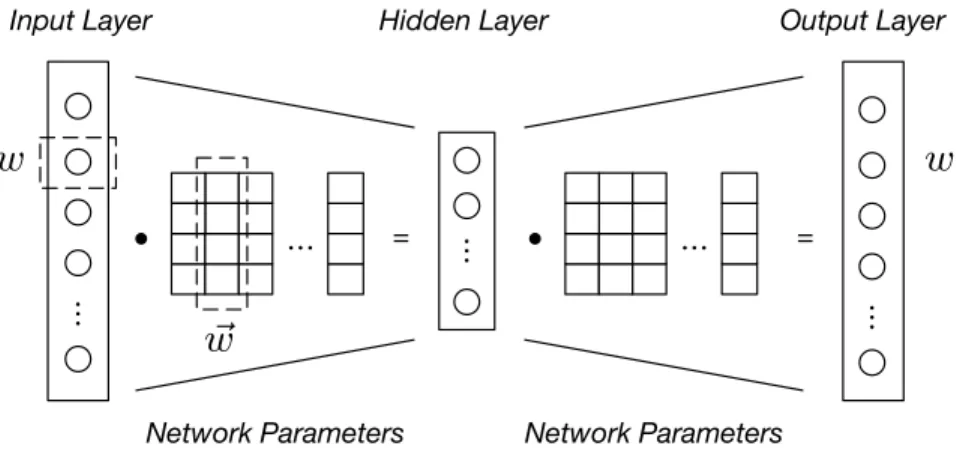
Figure 1.2: An example of neural language models based on a multi-layer neural network. The input layer is the bag-of-words vector of a piece of text (where wis one possible word in it), and the output layer is the distribution of generation probability for each word given the text and the model.
1.2
Neural Embedding Framework
Recently, advances in deep learning techniques provide new opportunities for rep-resentation learning and generative models in information retrieval. Deep learning, which is vaguely inspired by information processing and communication patterns in biological nervous systems, represents a broader family of machine learning methods based on a set of algorithms that attempt to model high-level abstractions of data with artificial neural networks1. One of the most well-known deep learning architectures is the deep neural network (DNN) that are constructed with multi-layer perceptrons built on linear or non-linear functions. Typically, the structure of a deep neural net-work includes an input layer, which converts raw data into a machine-processable format, a couple of hidden layers, which transform and process the input data with linear/non-linear projections, and an output layer, which produces the final results needed for each specific task.
Figure 1.2 shows an example structure of DNN built for the task of language modeling. Here, the object of the model is to predict the probability of observing
each word in the vocabulary within a certain piece of text. The input layer of the network is a raw representation of the text (e.g., bag-of-words vectors), the output layer of the network is a probability distribution over words in the vocabulary, and the input and output are connected with a hidden layer and several projection functions parameterized with vectors or matrixes of variables. Usually, network parameters are learned by optimizing a task-specific loss function defined over the model output in the training process. Depending on how the loss functions are designed, deep neural networks and other deep learning architectures can be broadly categorized as supervised methods, which compute training loss based on human annotations,
unsupervised methods, which construct loss functions with unlabeled data, and semi-supervised methods, which train neural networks with both human annotated data and unlabeled data.
In fact, DNN-based language models are similar to traditional topic modeling approaches as they both create latent representations for words and texts. As we can see in Figure 1.2, the input data (i.e., the bag-of-words vector of the text) in the input layer is multiplied with a matrix of parameters to construct a latent representation in the hidden layer. Suppose thatw is a word in the vocabulary V, which represents one dimension in the input vector, then the computation of the hidden representation
~h given the text d can be formulated as
~h =X w∈V
#(w, d)·w~ (1.1)
where #(w, d) is the number of times thatwappears ind, andw~ is one column of the parameter matrix that corresponds to the dimension ofwin the input vector. In other words, the DNN model creates dense vectorw~ for each wordwin its parameter space so that we can compute the latent representation of the text d (i.e. ~h) based on the distributed representations of words. Thus, we refer to the distributed representation
of w as the embedding of w, and models that represent each information entity with a numerical vector in the network space as Neural Embedding Models.
Previous studies have proven that neural embedding models can effectively ac-quire semantically meaningful representations of words and text. Ever since Miklov et al. [72] introduced the famous word embedding techniqueword2vec in 2013, neural embedding models have significantly changed the landscape of many research fields including natural language processing and social network analysis. It has been shown that the distributed representations of words built with neural networks and unsuper-vised learning can significantly outperform traditional models built with human an-notations and statistical analysis in synonyms identification (e.g., “large” and “big”), word analogy analysis (e.g., “big” to “biggest” as “small” to “smallest”), and many natural language processing applications such as machine translation and reading comprehension. Also, given a proper design of the network, the word representations learned with neural embedding models could capture important semantic relation-ships and have good compositionality (e.g., the embedding of “queen” is similar to the embedding of “king” minus “man”).
Behind the power of neural embedding models is a flexible model framework. While it is not the first paradigm proposed for latent semantic representation learn-ing, the neural embedding framework is no doubt the “simplest” one. The design of a neural embedding model could require no prior knowledge of the corpus’s topic distri-butions, and have no restriction on how the network topological structure should be constructed. All parameters can be learned directly from optimizing predefined loss functions with standard gradient descent methods. This essentially means that we could apply any linguistic rules or heuristic knowledge into the design of the model. For example, Devlin et al. [31] introduce a novel method that builds word embedding with neural transformer networks and combines the optimization objectives of lan-guage modeling and next sentence prediction in a single model. The proposed BERT
model successfully beats the state-of-the-art representation learning techniques in a variety of natural language processing tasks.
Because the computation of artificial neural networks mostly built on simple func-tions such as matrix multiplication and maximum pooling, the training of neural embedding models could be highly efficient and scalable. Today, advanced Graphics Processing Units (GPUs) can handle trillions of simple mathematical operations in seconds. This means that we could train a neural model with millions of parameters on millions of documents in a couple of hours. In addition, most computations in the training of neural embedding models are orthogonal, which can be easily distributed among thousands of machines without affecting the final performance of the model. With distributed programming frameworks such as Tensorflow2 and PyTorch 3, neu-ral models have already been successfully deployed on large computer clusters and serve for the online products of Google, Microsoft, Facebook, and etc.
1.3
Neural Generative Models for Information Retrieval
In the thesis, we develop new techniques that combine the merits of generative models and neural embedding models for information retrieval. Our goal is to create a generic representation learning framework that can capture complicated relationships between structured and unstructured data. Specifically, we construct distributed representations with neural embedding models by directly modeling the generation of relevant information in search. The final outcome of this thesis is a neural generative model with flexible structures that can be easily extended and applied to a majority of information retrieval tasks.
2https://www.tensorflow.org
3
As discussed in the rest of this section, this thesis identifies and tackles three fundamental challenges for the applications of neural generative models in informa-tion retrieval: (1) how to theoretically adapt neural embedding models for retrieval proposes, (2) how to construct neural models under a generative retrieval framework, and (3) how to generalize the neural generative framework to capture complicated relationships between arbitrary types of data for information retrieval.
1.3.1 How to adapt neural embedding models for information retrieval Although the introduction of distributed representation learning with neural em-bedding models is revolutionary in the community of natural language processing, its value had not been well-recognized in information retrieval until recent years. As discussed previously, neural embedding models are highly flexible in terms of model structures and parameter optimization. While this makes them handy in tasks with straightforward goals (e.g., predict the next term in a sentence given previous terms), it also creates challenges for its adaption to information retrieval – there is limited theoretical guidance for how to design learning objectives for search applications. In-formation retrieval concerns about the evaluation and ranking of inIn-formation based on their relevance – an abstract relationship between queries and documents that in-volves multiple factors, such as keyword matching, term salience, topic diversity, etc. Without theoretical design principles, it is difficult to develop well-grounded neural embedding models that suit the need of information retrieval. Previous studies that directly applying word embeddings learned from natural language processing tasks to information retrieval applications often lead to poor experiment results and low system extendability. In this dissertation, we explicate the theoretical foundation of neural embedding models and their optimization process, and propose several modifi-cations to existing neural embedding techniques that can improve their performance in information retrieval tasks.
1.3.2 How to combine neural embeddings with generative models
While the combination of classic bag-of-words representations and distributed representations learned with unsupervised neural embedding models indeed brings benefits to statistical generative retrieval models, this paradigm is considered subop-timal in practice. To the best of our knowledge, most unsupervised neural embedding models are optimized based on the linguistic semantics and relationships of text. The objectives of information retrieval problems, however, often involve factors beyond the literal meanings of queries and documents. For instance, in product search, users who search for “cell phone” would not purchase a product only because it has the terms “cell phone” in its description. Capturing the implicit relevance between queries and documents requires us to organically integrate the power of neural embedding mod-els with generative retrieval frameworks and directly optimize them for information retrieval problems. To address this problem, we propose an embedding-based neural generative model that simultaneously models the generation of information and their relevance with distributed information representations.
1.3.3 How to build a generic neural generative framework
In general information retrieval scenarios, complicated relationships and corre-lations often exist between information entities from different sources. Exploiting heterogeneous information with statistical generative retrieval models, however, is challenging. In most cases, it requires significant human effort and expertise to iden-tify the intrinsic relationships between two types of information. Most existing studies focus on a simplified problem in which documents only contain homogeneous infor-mation stored in multiple fields (e.g. text in title, description, and body) [77, 54, 53]. They assume that information is independent in different fields and try to find heuris-tic weighting schemes that combine the results of generative models built in each field separately. There have been some attempts [51, 117] to tackle more complicated tasks
such as cross-media retrieval, but their methods also rely on human heuristics to com-bine information. Thus, these models are domain-specific and cannot be generalized to incorporate other types of information. In this thesis, we extend neural genera-tive models by creating a generic representation learning framework to incorporate heterogeneous information and multi-relational data for information retrieval.
1.4
Contributions
The contribution of this thesis can be summarized as follows:
• Theoretical analysis on neural embedding models for IR. In Chapter 3, we conduct a theoretic analysis of neural embedding models for information re-trieval. Specifically, we focus on a famous unsupervised embedding model, i.e. theParagraph Vector Model [58], and a classicad-hoc retrieval task where users specify their information need through a query that initiates a search for docu-ments that are likely to be relevant to them [9]. While paragraph vector models show impressive performance in many natural language processing tasks, inte-grating it with traditional retrieval models, however, produces unstable perfor-mance and limited improvements. In the first chapter of this thesis, we formally discuss three intrinsic problems of the original paragraph vector model that re-strict its performance in retrieval tasks: (1) The unregulated training process of the paragraph vector is vulnerable to short document over-fitting that produces length bias in the final retrieval model; (2) The corpus-based negative sam-pling of the paragraph vector leads to a weighting scheme for words that overly suppresses the importance of frequent words; And (3) the lack of word-context information makes paragraph vector unable to capture word substitution rela-tionships. Accordingly, we propose three modifications to the paragraph vector model that make it more suitable for ad-hoc retrieval. The analysis results
and proposed techniques provide important theoretical guidance for the future adaption of neural embedding models for information retrieval.
• A design example of embedding-based neural generative retrieval models. To combine the merits of generative retrieval models and neural em-bedding models for information retrieval, in Chapter 4, we propose an emem-bedding- embedding-based neural generative model that simultaneously models the generation of in-formation and their relevance with distributed inin-formation representations. Our experimental test bed is a product search task where users issue text queries to find items that satisfy their information needs and purchase intents. In product search, user behaviors are often affected by their personal preferences and there is a severe mismatch between the language of queries, products, and users. To handle this problem, we propose to learn semantic representations for products, users and queries from different levels with a hierarchical neural embedding model. Specifically, we build a multi-level probabilistic generative model that requires the representations of products to predict the words in their reviews and the representations of users and queries to predict the products that have been purchased in each search session. Ranking is conducted based on the probability of each product to be generated by the user model and the query model. The proposed model not only has the good theoretical foundations and explainability of generative models but also inherits the advantages of neural embedding models in terms of effectiveness and flexibility.
• An extendable and explainable neural representation learning frame-work. To further develop a generic neural generative framework for information retrieval, in Chapter 5, we propose to jointly model both entities and their rela-tionships with neural embeddings. Again, we use product search as our experi-mental test bed. Product search is a well-established information retrieval tasks
which naturally involve structured (e.g., prices, ratings, brands, categories, etc.) and unstructured data (e.g., titles, reviews, images, etc.) from heterogeneous sources. Understanding the relationships between these data is difficult under a statistical generative framework but essential for the effectiveness of a product search engine. To address this problem, we propose an extendable and explain-able neural generative framework that creates a session-dependent knowledge graph based on multi-relational data. Despite their types, all entities are em-bedded into latent semantic spaces and all relationships are modeled as linear transpositions that connect one entity to another. For any entity pair (eh, et) with relationr (whereeh is often referred to as thehead entity andetis referred to as thetail entity), we create generative models that generate the tail entities
et by transforming the head entities eh with relation transposition functions based on r and their distributed representations. We also define “search and purchase” as a dynamic relation between users and products so that we can re-trieve items according to their probability to be generated from the user model and “search and purchase” relation. The proposed neural generative model is extendable as it can incorporate any types of information in its training process, and it also creates a graph embedding structure that naturally supports logical inference and reasoning.
1.5
Dissertation Outline
The remainder of the dissertation is organized as follows:
• In Chapter 2, we survey the related work of this thesis, which include the gen-erative retrieval models based on bag-of-words representations (e.g., language modeling approaches, BM25, etc.) and the latent semantic models for informa-tion retrieval (e.g., Latent Semantic Indexing, LDA-based language modeling
approach, etc.). We also provide necessary background information for deep learning techniques and different retrieval applications.
• In Chapter 3, we present our effort on adapting unsupervised neural embedding models for ad-hoc document retrieval. This include a theoretical analysis of the optimization process of the paragraph vector models and empirical experiments on combining neural language models with generative retrieval models based on statistical probabilistic frameworks.
• In Chapter 4, we discuss how to construct embedding-based neural generative models for product search. We formulate the relationship between products, queries and users in a generative way and learn distributed representations for them simultaneously by optimizing the posterior likelihood of observed user interactions in product search.
• In Chapter 5, we further extend the embedding-based neural generative model to a generic representation learning framework for search on multi-relational data and heterogeneous information. The proposed model framework has good extensibility and transparency, and our experiments show that it achieves the state-of-the-art performance on product retrieval through the joint modeling of multiple product information such as reviews, brands, categories, etc.
• In Chapter 6, we summarize our contributions and discuss the potential direc-tions for future studies.
CHAPTER 2
BACKGROUND AND RELATED WORK
In this chapter, we review the research topics related to this thesis. They are statistical generative models, deep learning techniques, and the information retrieval applications we use for our test bed. We also briefly discuss the existing neural models for information retrieval.
2.1
Statistical Generative Models for IR
The research on statistical generative models has a long history in the information retrieval (IR) community started from the mid-1900s. Numerous studies in the early years of IR focused on developing probabilistic frameworks to rank documents ac-cording to the posterior probability of relevance [26], which we refer to as the classic probabilistic models. Towards the end of the 1990s, a new family of probabilistic mod-els that try to estimate a probability distribution that captures statistical regularities of the document’s language emerged and quickly became popular [63]. These models, which we refer to as the language modeling approaches for IR, share a common root with statistical generative models used in many research fields such as Natural Lan-guage Processing and Speech Recognition. Their design principles have been used as the foundation of many generative retrieval models including those discussed in this dissertation. In the meantime, another line of studies that focus on construct-ing latent semantic information representations with statistic probabilistic framework gradually receive more and more attention in the field. By capturing the semantic meanings of information beyond bag-of-words, these studies kick off a new direction
for the design and application of generative models for information retrieval. In this section, we give a brief introduction of different statistical generative models proposed for retrieval and representation learning in IR.
2.1.1 Classic Probabilistic Models
In classic probabilistic models, relevance is considered as a basic, dichotomous criterion variable defined independently with information retrieval systems [83]. Given this idea, the retrieval of information can be formulated as a process of ranking documents according to the probability ranking principle (PRP) as
Probability Ranking Principle (PRP) [83]: If a reference retrieval system’s response to each request is a ranking of the documents in the collections in order of decreasing probability of usefulness to the user who submitted the request, where the probabilities are estimated as accurately as possible on the basis of whatever data has been made available to the system for this purpose, then the overall effectiveness of the system to its users will be the best that is obtainable on the basis of that data.
Therefore, the key to probabilistic retrieval models is to compute the probability that a document would be relevant to a query.
Let d, q and r be random variables that denote a document, a query and their relevance, respectively. In the classic probabilistic models for IR, the probability that
dandqhave relevancer(P(d, q|r)) is formulated asP(d, q|r) = P(q|r)·P(d|q, r) [26], where the relevance model r is separately modeled with the documents to rank. One of the best-known examples is the Binary Independence Retrieval Model (BIR), which is also known as the Okapi model, the City model and the Robertson-Sparck Jones model [70, 26]. In the BIR models, documents are represented as bag-of-words vectors and term occurrences are assumed to be conditionally independent given a relevance class. Thus, the probability that d is generated by the relevance model
of q can be directly estimated by how likely its terms will appear in q’s relevant documents. Because we cannot acquire this relevance information in advance, many techniques have been proposed to estimate it based on the statistics of words and corpus, including Tree Dependence Model [23], 2-Poisson Model [44, 84, 85], and BM25 [86].
Take BM25 as an example. The BM25 ranking function is inspired by the theory of relevance generation in the BIR model [83] and the 2-Poisson model [84]. It assumes that term frequencies are distributed according to a mixture of two Poissons, but estimates the probability that document d is generated by the relevance model of a query q with a heuristic function tuned empirically in the experiments. Specifically, BM25 ranks documents with the probability of d given q and relevance r as
P(d|q, r = 1)≈ X w∈q∩d ·#(w, d) (k+ 1)#(w, d) k (1−b) +b|d||d| avg + #(w, d)log N −dfw+ 0.5 dfw+ 0.5 (2.1)
where #(w, d) is the term frequency of wordwind,|d|is the length ofd,|d|avg is the average document length of the corpus, dfw is the number of documents in which w appears, and N is the total number of documents in the corpus. The effect of term frequency and document length in final results are controlled by hyper-parameter
k and b. As we can see, the final forms of classic probabilistic models usually are constructed based on term statistics and are straight forward to compute.
2.1.2 Language Modeling Approach
The first language modeling approach for IR was proposed by Ponte and Croft [80] in the late 1990s, and it initiated a new branch of studies on statistical generative retrieval models in 2000s. Different from classic probabilistic models, language mod-eling approaches do not explicitly separate the relevance model from the modmod-eling of documents. Instead, it factors the probability of a documentd having relevance r to a query q as P(d, q|r) = P(d|r)·P(q|d, r) [26]. In other words, language modeling
approaches assume that a query is generated from relevant documents that satisfy the corresponding information need, and a retrieval system can retrieve relevant doc-uments by ranking them according to how likely they can generate the query.
To estimateP(q|d, r), the original language modeling approach treats queries and documents as bags of words and computes the query likelihood as the posterior prob-ability of observing each query word (unigram) given the document [80]. Specifically, the probability of a query q given a documentd can be derived with maximum like-lihood estimation as P(q|d) = Y w∈q P(w|d) = Y w∈q #(w, d) |d| (2.2)
Unfortunately, naive methods that construct language models based on the bag-of-words representations fail when the query bag-of-words are not observed in documents. Therefore, an important direction of research on language modeling approaches is how to effectively smooth the estimation of word probabilities. To solve this problem, most existing work adopts a simple paradigm that incorporates a corpus language model for unobserved query words. Example techniques include the Jelinek-Mercer method, absolute discounting, and Bayesian smoothing with Dirichlet priors [112]. For instance, the famous Query Likelihood model (QL) with Dirichlet smoothing is defined as
P(q|d) = X w∈q
#(w, q) log#(w, d) +µP(w|C)
|d|+µ (2.3)
whereP(w|C) is the posterior probability of observing wordwin the corpusC, which is usually computed as the term frequency ofwinC divided by the number of words inC;|d|is the length of documentd;µis a hyper-parameter for Dirichlet distribution; and #(w, q) and #(w, d) are the term frequency of w inq and d, respectively.
While the first language modeling approach for IR is constructed based on uni-grams, more sophisticated models that consider biuni-grams, trigrams and their
impor-tance were developed under the same framework later in the 2000s [39, 68, 32, 11]. For example, Gao et al. [39] introduce a dependence language model that estimates the generation probability of bigrams for information retrieval. Metzler et al. [68] propose the sequential dependence model that jointly combine the language models of unigrams and bigrams in ordered and unordered windows with the markov random field. These models generally produce the state-of-the-art performance in a variety of retrieval tasks including ad-hoc retrieval and verbose query analysis [57, 69, 12, 13].
2.1.3 Latent Semantic Modeling
As discussed in Section 1.1, statistical generative models with bag-of-words repre-sentations often suffer from the vocabulary mismatch between queries and documents. Because classic probabilistic models and language modeling approaches for IR com-pute document scores purely based on term statistics, they cannot explicitly model the semantic relationships between words and documents. Thus, another line of stud-ies on statistical generative models focuses on developing better representations that capture the high-level semantic meanings of information. One of the famous exam-ples is the Latent Semantic Indexing (LSI) techniques proposed by Deerwester et al.[29] in 1990. The idea of LSI is to construct a term frequency matrix for words and documents in the corpus and factorize it with SVD analysis. The output vectors of SVD for each dimension of the matrix can be treated as latent representations for each word and document. In this latent parameter space, words and documents with similar meanings tend to be close to each other. Later, Hoffman [47] constructs a Probabilistic Latent Semantic Indexing (pLSI) that represents documents as mix-tures of topics. Given a fixed topic pool Z, the probability of a wordw generated by the language model of document d can be computed as
P(w|d) =X z∈Z
wherez is the language model of a topic in Z and θdis the topic model of d. Further, Blei et al. [16] extended pLSI by drawing topic mixtures from a conjugate Dirichlet priori. The topic distributions of words and documents can further be used as their latent semantic representations. The semantic relationships between information can be directly measured in latent space so that vocabulary mismatch would be less of a problem. Previous studies have shown that these latent semantic representations are effective for language smoothing in IR applications [62, 99].
The neural generative models studied in this thesis share a similar design prin-ciple with the topic models as they both try to model the generation of words from documents at a semantic level. However, the existing topic models are built under the statistical probabilistic framework while our proposed model directly models the correlations between words and documents with neural networks.
2.2
Deep Learning
The advance of deep learning techniques has significantly changed the landscape of machine learning studies and applications in the 2010s. Artificial neural network models have produced the state-of-the-art performance in a variety of Computer Vision (CV), Pattern Recognition (PR) and Natural Language Processing (NLP) tasks, and its effectiveness in IR problems have been recognized by more and more researchers today. In this section, we introduce some basic concepts of deep learning that are necessary for the understanding of this dissertation.
2.2.1 Neural Architecture
Deep learning refers to a broader family of machine learning methods based on algorithms that tackle specific tasks or model high-level abstractions of data with artificial neural networks1. As far as we know, there is no theoretical restriction
CNN DNN
x o
x
Convolution Max Pooling
o xn xn 1 xn 2 x1 … s0 sn on on 1 on 2 o1 … … RNN
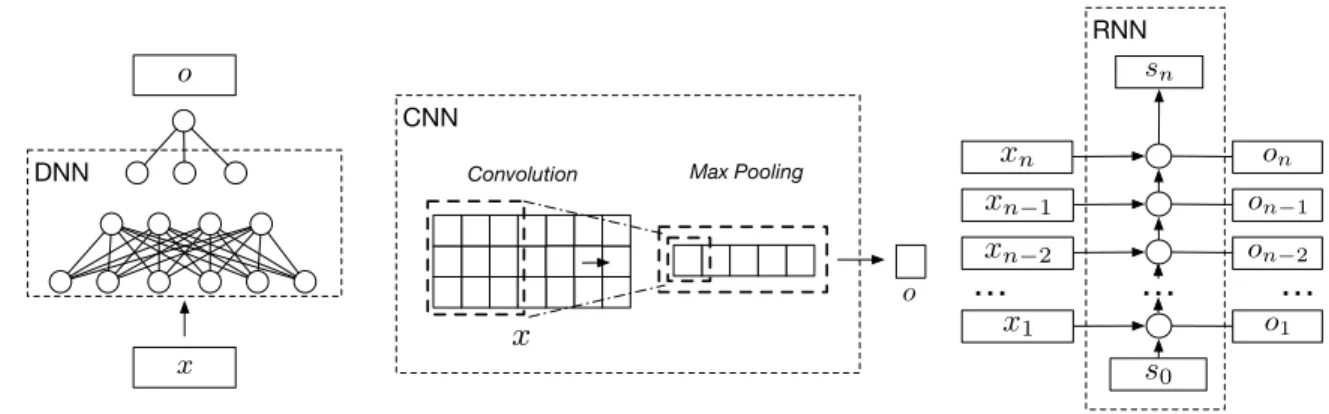
Figure 2.1: An illustration of three popular architectures of deep learning mod-els, which are the Deep Neural Network (DNN), the Convolutional Neural Network (CNN), and the Recurrent Neural Network (RNN). The inputs and outputs of each network are referred to as x and o, respectively.
on how the topological structure of a neural network should be constructed, so the design of deep learning models could be fairly flexible and diverse. In general, there are three types of neural networks that are popular among many machine learning related tasks, which are Deep Neural Network (DNN), Convolutional Neural Network (CNN), and Recurrent Neural Network (RNN).
DNN refers to the multi-layer neural networks that transform the input data with stacks of linear or non-linear projections in order to achieve certain objects (e.g., label predictions, data compression, etc.). As shown in Figure 2.1, given the input datax, the DNN model converts x to the output data o with multi-layer perceptrons. Both the input and the output of the DNN could have arbitrary dimensions depending on the applications.
CNN is similar to DNN as they both have multi-layer networks in their main structures. The main difference is that CNN models usually include one or multiple layers of convolution processes that project the input data with sliding windows and kernel functions. Therefore, CNN is more capable of capturing local data patterns with different granularity [2]. Also, in order to convert the final output into a fixed size vector or matrix, CNN models often apply a pooling layer over the convolution layer.
For instance, the max pooling of CNN in Figure 2.1 would convert the convolution output into a single value o by picking the maximum number in the vector.
RNN is a special deep learning architecture that does not explicitly have multiple layers in its network structure. Instead, it uses a “single” layer network to sequen-tially read and encode input data as a list. Let the input data be a list of vectors
{x1, x2, ..., xn}and the initial state of RNN bes0, then RNN takes one input vectorxi in theith step and interacts it with the state vector si−1 to produce an output oi and the new state si, as shown in Figure 2.1. Due to this structure, RNN is particularly good at sequential modeling and context understanding [1].
In this dissertation, most proposed models under our neural generative framework are designed with architectures similar to DNN. As discussed in Section 1.2, DNN models naturally construct latent representations for input data with their network parameters. Our goal is to learn such representations in a generative manner and directly optimize the performance of retrieval systems.
2.2.2 Parameter Optimization
The training of a neural model usually involve three steps – defining a loss func-tion, computing the training loss and parameter gradients, and update the param-eters. Depending on how the training data are constructed, the training process of neural models can be broadly categorized into three groups: supervised training, un-supervised training, and semi-un-supervised training. Supervised training refer to the methods where loss functions are computed based on model outputs and human an-notated data. For example, the training of a digit recognition model is considered as a supervised method as we manually provide labels for each input picture and teach the model to recognize the digit in pictures accordingly. Unsupervised training refer to the cases where loss functions are computed directly based on the input data with-out human annotation. In Section 1.2, we describe a DNN model where the input is
the bag-of-words representation of a document and the output is a probability distri-bution of words. Because we can directly train the model by requiring it to predict the words that have been observed in the documents, it is an unsupervised method that doesn’t use any human labeled data. Semi-supervised methods, in contrast, is a combination of supervised training and unsupervised training. It usually includes parameter optimizations on a small set of human annotated data as well as on a large set of unlabeled data. Most proposed models described in this thesis could be seen as semi-supervised methods.
In order to update model parameters in the training process, a variety of opti-mization strategies have been proposed for deep learning. The most popular one is the Stochastic Gradient Descent (SGD) that computes parameter gradients with re-spect to the training loss on batches of data and update parameters by applying the gradients with a fixed learning rate. There are also complicated methods that jointly consider the current parameter gradients and history information in previous training steps, such as Adagrad [35] and Adam [55].
2.3
Information Retrieval Applications
Information retrieval applications such as web search and product search have significantly changed people’s lives in the last 30 years. Depending on how the queries and materials are stored and represented, search problems in IR can be categorized into two groups: search on homogeneous information and search on heterogeneous information.
2.3.1 Homogeneous Information and Ad-hoc Retrieval
Search on homogeneous information refers to the scenarios where information needs and materials are constructed and stored in similar forms. One of the most well-known examples is ad-hoc retrieval where both queries and documents are
rep-resented with unstructured text. In a standard ad-hoc retrieval task, queries are formulated with a couple of keywords while documents are formulated with sentences and articles with variable lengths. Because they share the same information units (i.e., words), matching queries and documents in their raw forms is theoretically principled and straight forward to do. Therefore, ad-hoc retrieval models often focus on model-ing the matchmodel-ing patterns between queries and documents directly [38]. For example, classic probabilistic models and language modeling approaches for IR computes docu-ment scores based on matching query unigrams with docudocu-ment unigrams [84, 86, 80]. Complicated statistical retrieval models incorporate bigram matching and trigram matching in the construction of ranking functions [36, 27]. Also, there are many studies focusing on modeling the term dependency and matching proximity in words and documents [39, 73, 75, 68]. In this dissertation, we use ad-hoc retrieval as our initial test bed for the study of neural generative retrieval models.
2.3.2 Heterogeneous Information and Product Search
In many IR tasks, documents may contain or be related to information from dif-ferent structures and multiple sources. For example, a document could have text structured in multiple fields such as title and body (e.g., Web pages); in more com-plicated cases, a document could consist of information from different sources such as image, category, etc. (e.g. products on e-shopping websites). Integrating information in heterogeneous forms for effective retrieval has been an important research topic in IR.
Depending on the sources of data, studies on heterogeneous information retrieval can be broadly split into two directions: retrieving information from a single source with both structured and unstructured forms, i.e., the semi-structured data, and re-trieving information from multiple sources. Semi-structured data are common today as most articles and web pages involve both unstructured text and structured fields
such as titles, descriptions, etc. Despite that they are expressed with words sharing the same semantic meanings, information from different fields often have different effects on how people determine the relevance of a document with respect to a query. In fact, using evidence from document structures to improve search engines is well studied in the IR community [100, 79, 82, 110]. A variety of models has been pro-posed to tackle the problem of combining information from multiple fields for doc-ument retrieval. For instance, Wilkinson [100] introduced a number of hypotheses to combine section-level and document level information, including a weighted sum, a max-pooling process and a combination of section scores and document scores. There is also a number of studies that try to construct probabilistic retrieval mod-els for semi-structured data [79, 74, 94]. Robertson et al. [82] extended the original BM25 model based on the bag-of-words assumption [86] and proposed a BM25F that combines the frequency information across fields to produce a balanced BM25 score. Ogilvie and Callan [77] proposed a couple of methods to combine document represen-tations for a known-item search task under the language modeling framework. Kim et al. [54] developed a probabilistic model for XML retrieval, and Kim and Croft [53] later proposed to weight different document fields with a model based on relevance feedback.
Most existing work on semi-structured data simplifies the problem by focusing on text only. Part of the reason is that modeling information from multiple sources is challenging under a statistical probability framework. However, as web applications accumulate more and more information in heterogeneous forms such as text, image, and knowledge graphs, the problem of how to model heterogeneous information from different sources for retrieval tasks has become increasingly important. Recently, some studies were conducted on cross-media retrieval, a special case of heterogeneous information retrieval with a focus on media data [102, 117, 107, 106]. They devel-oped separate modules for each type of data and mapped them into a semantic space.
The retrieval of documents is conducted in a similar paradigm to vector space mod-els [88] which ranks documents by their distances to the query representation. Jeon et al. [51] propose a Fixed Annotation-based Cross-media Relevance Model (FACMRM) for cross-media retrieval. In FACMRM, images are described with a vocabulary of blobs generated from image features using clustering. Retrieval is conducted with a probabilistic model that ranks images with the probability of generating a word given the blobs in an image. Despite their differences, these methods are constructed with human heuristics that require significant domain expertise to build, which makes them difficult to be extended for new information sources. Constructing a unified generative framework that is both effective and extendable for information retrieval is still an open question.
In this thesis, we use the task ofproduct search to explore the potentials of neural generative models for search on heterogeneous information. Product search is a well-established retrieval task which focuses on retrieving relevant products for customers to satisfy their purchase intents. Previous studies on product search mainly focus on retrieving products based on their structured aspects such as brand, category, etc. For example, Lim et al. [60] propose a document profile model to suggest semantic tags for each item based on their structural aspects, so that we can retrieve prod-ucts by matching queries with multiple product aspects simultaneously. Despite their success, searching with structured data cannot satisfy the need of e-shopping users today as their intents become more and more complicated. As shown by Duan et al. [34], writing structured search queries (e.g., SQL) is usually considered hard and inconvenient for search users. In most cases, queries submitted to product search engines are free-form text that is difficult to structure. However, there often exists a large vocabulary gap between the descriptions of products and user queries [97, 6]. Nurmi et al. [76] find that the words customers used to write their shopping lists are often different from those sellers used to describe their products. Because of
these problems, IR researchers have proposed to construct semantic latent space for product search and conduct matching between queries and products with their latent representations. For instance, Yu et al. [108] construct a Latent Dirichlet Alloca-tion model with product informaAlloca-tion and use it to diverse e-commerce search results. Van Gysel et al. [97] introduce a Latent Semantic Embedding model that maps and matches n-grams from queries and product descriptions into a hidden space. Guo et al. [43] propose a TranSearch model that can directly match text queries with product images. Also, there is a variety of studies [8, 52, 48] on extracting different text and product features and feeding them into learning-to-rank models for the optimization of different product retrieval objectives. Wu et al. [101] manually extract multiple statistic features from product search logs and construct an ensemble tree model to predict user clicks. Wu et al. [103] developed a special ranking loss function that optimizes product search engines by maximizing the revenue generated from online transactions. While they are effective for product search on unstructured free text, it is difficult to extend these methods with structured metadata and their relationships. As discussed in Chapter 4 and 5, we propose to combine neural embedding techniques with generative models for product search and develop a generic representation learn-ing framework for heterogeneous information retrieval.
2.4
Neural Models for Information Retrieval
Recently, inspired by the advances in deep learning techniques, neural models have received considerable attention in the IR community. They have been proven to be effective at extracting relevance signals directly from low-level data represen-tations such as raw text, and have good performance in a variety of IR tasks such as ad-hoc retrieval [3], question answering [105], and recommendation [45]. Based on their optimization goals, existing neural models for IR can be broadly categorized as discriminative models and generative models.
2.4.1 Discriminative Neural Retrieval Models
The basic idea of discriminative neural models for IR is to treat retrieval tasks as a classification or regression problem in which the goal is to find the most relevant document in the candidate sets. Thus, the loss functions for parameter optimization in discriminative retrieval models are often designed based on the labels of each document or the comparison of two or more documents (e.g. hinge loss [93]). Also, the structure of their networks usually focuses on modeling the match between queries and documents. For example, Huang et al. [49] proposed to represent documents with trigrams and introduced a Deep Structured Semantic Model that constructs a deep neural network for short text retrieval. The trigram representations of documents are directly fed into a multi-layer network and the loss function is computed using a softmax function over the network outputs of one relevant document and multiple negative samples. Guo et al. [41] conducted a theoretical analysis of IR tasks and proposed a Deep Relevance Matching Model that explicitly models the interaction patterns between queries and relevant documents. They notice that both the exact matching and semantic matching of words in queries and documents are important for understanding their relevance, and combine the two matching signals together to create a neural matching model for ad-hoc retrieval. Later on, many papers [90, 30, 21, 104] have been published in this research direction following similar design paradigms. Also, there are many studies on applying deep learning technology on other complicated IR problems such as user modeling [64, 20] and context-aware relevance modeling [1, 10].
Although these discriminative neural models produce state-of-the-art performances in many retrieval applications, they are completely data-driven and it is difficult for a human to understand what exactly they do to evaluate the relevance of documents. Thus, another line of studies on neural retrieval models focus on directly modeling
the generation of relev