The use of information architecture guidelines
by Australian libraries
Philip Hider Senior Lecturer
School of Information Studies Charles Sturt University
[email protected] Sally Burford Senior Lecturer
School of Professional Communication University of Canberra
[email protected] Stuart Ferguson
Senior Lecturer
School of Information Studies Charles Sturt University
Abstract:
This paper reports the results of a survey which aimed to examine the extent to which the information architecture (IA) of Australian library web sites is developed with reference to documented methods and guidelines. It was found that a majority of libraries used either in-house or external documents, or both, but that the nature of these documents varied greatly. The extent of libraries’ control over their own web sites also varied very widely. Although documentation was considered useful in some ways, respondents were more interested in developing the necessary IA skills and competencies than in standardisation.
Introduction
Many librarians are aware of the importance of sound information architecture (IA) to enable the effective use of their libraries’ web sites, portals, and intranets – that is, organising and structuring their sites’ content so that it can be readily navigated and retrieved by users. However, it is unclear to what extent Australian librarians are implementing IA through the application of documented design methods and guidelines that provide a framework for best practice. Such documentation is now well established at a general level, although development of guidelines for libraries as a specific type of institution has been limited. Whether, instead, in-house methods and guidelines are being developed for specific libraries is also unclear.
Indeed, it is not only unclear whether documentation is playing a significant role in the design of library web sites, but also what need there is for such documentation and what types of written resources best support library web IA. Furthermore, it is worth examining whether librarians are the ones doing the designing, with or without documentation, or whether they are heavily constrained by stipulations handed down by parent bodies and external authorities and embodied in the form of templates, policies, regulations, etc.
This paper attempts to shed some light on these issues, at least with respect to Australian libraries, through the results of a survey administered to a broad sample of libraries across the country. It should be noted that the subject of the survey was limited to IA design, and that the graphical design of web sites (images, fonts, colours, etc.) was not covered. IA design was thus defined in terms of structural design, i.e. the way the pages and sections in a site are linked and arranged, and the provision of navigational and retrieval tools.
Literature review
Batley (2007) considers the work of web IA for information professionals and suggests two approaches to web IA. First, from a traditional librarianship perspective, she considers the core information management functions of indexing, categorising, classifying, recording and organising information. The second aspect of IA that Batley (2007) identifies is one of design – user centred design that enables easy and intuitive access to information for users of web sites.
Morrogh (2002), Morville and Rosenfeld (2006) and Nielsen (2004) support Batley’s assertions that IA is largely a design activity. Morrogh (2002) tells us that the focus of IA is the design of information environments and that ‘information architecture design problems are complex’ (p. 109). Design processes which may begin as skills–based craft traditions can be supported by evolving design methods (Morrogh 2002). He defines (p.110) a design method thus:
A structured design process – a method – introduces control or discipline into the design process. Design methods are concerned with principles and processes of design based on the nature of design and how designers identify problems and generate and evaluate solutions. The overarching goal of a design method is to improve the efficiency and effectiveness of design
The practice of IA has been guided by the development of a structured design process that was pioneered by Rosenfeld and Morville in 1998. Since then, the design methods of IA have been reviewed, refined, updated and rephrased (Rosenfeld and Morville 2002, 2006; Garrett 2003; Wodtke 2003; Lynch and Horton 2004; Batley 2007), to the extent that a mature documented process for the activity of designing web information structures is now in existence. This solid and detailed body of knowledge is in need of simplification for the average practitioner of IA. We see abbreviated structured design processes promulgated by the Australian Government Information Management Organisation and presented in checklists such as Information architecture for websites (2004) for Australian Government organisations. The challenge continues for further refinement and articulation of the complex IA design process as a form of support for IA practitioners.
A second approach to guiding the work of IA is the development and use of guidelines, standards and style guides. Stewart and Travis (2003, p.992) distinguish between these terms, describing guidelines as ‘recommendations of good practice that rely on the credibility of their authors for their authority’; standards as ‘formal documents published by standards making bodies that are developed through some form of consensus and formal voting process’; and style guides as sets of agreed recommendations to increase consistency of design outcomes and good design practice. In common use, the terms are frequently interchanged.
Web design guidelines and standards, argue Nielsen (1999) and Stewart and Travis (2003), are essential for creating a usable environment consistent with user expectations. Whereas design methods are process-oriented, guidelines and standards are results-oriented. The quality and consistency of the IA of a web site can be improved, and good practice and a shared understanding can emerge by the use of guidelines (Stewart and Travis 2003).
An example of published web guidelines that are inclusive of IA are the Research-based web design and usability guidelines developed by the American Health and Human Services department. These guidelines, which are comprehensive and grounded in research, contain elements of IA, but do not distinguish them from other aspects of web design such as visual design.
Mariage et al. (2005) discuss the role of web site development guidelines, in particular for usability. Documented advice for those practicing IA will vary from general in-principle objectives to unambiguous rules with no latitude for interpretation. Mariage et al. (2005) point out that guidelines are important for consolidating bodies of knowledge, but note that the existence of and adherence to guidelines does not ensure a usable web site. In creative problem-solving design processes, guidelines are interpretive and inexact. The quality of the guidelines, the degree of precision and their ability to meet the needs of a varied audience dictate their usefulness. Cherry et al. (2006) warn that the use of design guidelines in human-computer interaction is a difficult challenge ‘particularly because of the intractably large number of potential interactions among guidelines’. One or more interactions occur if the usefulness of a guideline is in some way dependent on whether other guidelines are being followed. Milne et al. (2005, p. 565) stress that ‘a designer is unlikely to derive the best solution for a particular scenario from a generalised guideline in isolation’ and that guidelines for web design should ‘be
complemented by a deeper understanding of the issues, rather than simple rules or instructions that should be followed blindly’.
Basden (2003), however, challenges the status quo of web site design guidelines. He points to the difficulty in effectively compiling and presenting supportive guidelines for web design. Guidelines need to be structured, categorised and presented in a useful, logical and coherent manner and, he claims, this has not yet been achieved. He draws on the philosophy of Dooyeweerd (1955) to suggest a radical change in the way that web design guidelines are arranged. Drawing on a set of irreducible ‘aspects’ that apply to any human activity, which might include using a web site, Basden proposes these aspects as potential categories for web design guidelines. He describes aspects or categories of sensory/psychic (seeing, hearing, feeling); analytical (making meaningful distinctions); formative (user mental models of site); lingual/social (meaning from symbols) as those that would provide a framework of meaning for human activity in using a web site and thus its design. The great value in Basden’s challenge is taking the design process back to the human user of the site and framing guidelines around their needs.
Nielsen (1999) distinguishes between surface or web interface design and deep design – deep design being a web site’s information organisation and structures. Elements of IA occur at the surface or interface level of web sites, eg. positioning of company logos and the accompanying link to the homepage or the horizontal positioning of breadcrumbs. These aspects of IA, says Nielsen (2004) are the simplest and most localised design features to standardise and many web design guidelines fall into this category. ‘The confusing design elements are the bigger issues that contribute more strongly to users’ ability to master the whole site’ (Nielsen 2004, p.2 of 5). Nielsen (1999) claims that a web site’s deep and important information structures cannot be standardised, since they are individual and contextual and require dedicated and creative information design activity.
Looking to solve this problem, however, Nielsen (2004) and Symonenko (2006) propose the use of design patterns in web IA. Nielsen (2004) claims that high-level design patterns for the IA of sites in a particular domain should be possible. He has developed three similar but distinct information architectures for investor relations web sites that can be used as patterns or starting points for other web sites in this domain. Design patterns are known and tested solutions to web design problems that have a particular context. They capture a proven and insightful solution for reuse as need arises (Van Duyne et al. 2007). Symonenko’s (2006) preliminary research reveals that patterns exist in the visible structure of information within web sites of similar types (e.g. university, government, libraries) and that user expectations of these patterns also exist.
Golding et al. (2000) call for the use of guidelines in library web site development and management, stating that a clear direction for the type of information provided by the site is a key benefit of web guidelines that are developed in house. Although Golding et al. make reference to page layout in their schema for guidelines, their guidance falls short of supporting the practice of IA. Hider and Ferguson (2006) considered the use of IA principles in the development of Australian library web sites by evaluating the outcome – the web site itself. Using a constructed set of IA
heuristics, Hider and Ferguson (2006) found evidence that Australian libraries were generally adhering to the principles of web IA.
However, Maloney and Bracke (2004) insist that library web sites must move beyond the general approach to web IA proposed by Rosenfeld and Morville (2002). A library’s web site is a display platform for many and disparate systems and services. Maloney and Bracke (2004) consider that integration of the multiple, legacy systems that expose information to library users requires a new framework. Much of the information sought on a library web site is provided by external sources and libraries are not in full control of the format of this content. Internal legacy systems such as catalogues are also an integral part of the library’s web and may not have been designed for web access. Maloney and Bracke (2004, p.147) propose an extended IA framework that sees the general web site as the co-ordinating structure that relates iteratively with embedded services, ‘with service elements constraining the coordinating structure and the coordinating structure informing the design of the service elements.’
Research design
An online questionnaire survey was created with the aim of revealing the use of web IA documentation by Australian libraries. IA was defined in contrast to graphic
design, specifically as ‘the way in which the content of the site is organised, including how content is organised across different pages, the layout of pages, the headings and menus used, the navigation and search systems, etc.’A structured sample of library web sites was derived from the Australian Libraries Gateway on the National Library of Australia web site at www.nla.gov.au/libraries. The libraries represented included national/state, university, public and special. Personnel with responsibility for managing and developing the web sites were identified and invited by email to participate in the survey, on behalf of their respective libraries. In total, 58 libraries responded, in August-September 2007. The questions in the survey are contained in Appendix A.
Results
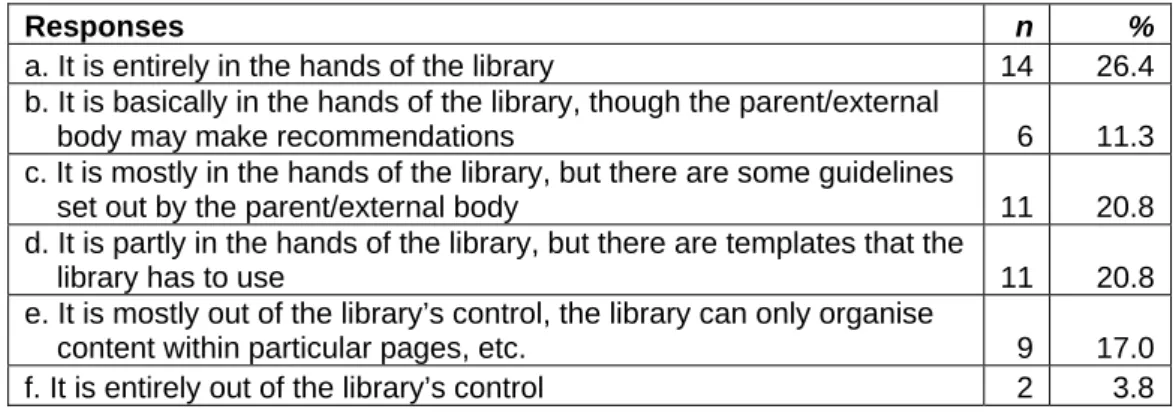
Of the 58 respondents, 51 (87.9%) are staff of the libraries. This ties in quite well with the responses to the question of how responsible the library is for its own web site, as shown in Table 1 below.
Table 1 - Libraries’ IA responsibility
Responses n %
a. It is entirely in the hands of the library 14 26.4
b. It is basically in the hands of the library, though the parent/external
body may make recommendations 6 11.3
c. It is mostly in the hands of the library, but there are some guidelines
set out by the parent/external body 11 20.8
d. It is partly in the hands of the library, but there are templates that the
library has to use 11 20.8
e. It is mostly out of the library’s control, the library can only organise
content within particular pages, etc. 9 17.0
Most libraries have at least partial responsibility for their web sites’ IA, but there is a wide range of degrees of responsibility, with a quarter of libraries enjoying complete control, but over 60% being subject to external decisions.
Although about equal numbers of university, public and special libraries were invited to participate, responses were most forthcoming from the universities, as Table 2 shows. The response rates for public and special libraries were nevertheless reasonable (about half).
Table 2 - Respondents by library type Type n %
State/National 4 7.0
University 23 40.4
Public 16 28.1
Special/Other 14 24.6
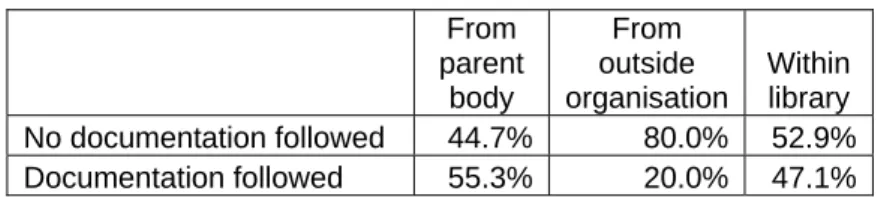
Table 3 indicates that many Australian libraries are applying written guidelines and other documentation in their IA. About half follow guidelines handed down from within their parent organisation and about half have developed internal documentation. Eighteen of 29 (62.1%) libraries that followed external guidelines (whether issued from inside or outside of a parent body) also have internal documentation. Thirty-six of 49 (73.5%) libraries with some responsibility for IA followed some documentation, whether internal or external.
Published external documents include standards handed down by state governments (e.g. South Australian Government Web Site Standards), W3C standards and guidelines (e.g. Web content accessibility Guidelines 1.0), and metadata standards such as Dublin Core, EdNA and AGLS. However, all these standards are applied by just a handful of libraries, at the most.
Table 3 - Adherence to documentation by source
From parent body From outside organisation Within library No documentation followed 44.7% 80.0% 52.9% Documentation followed 55.3% 20.0% 47.1%
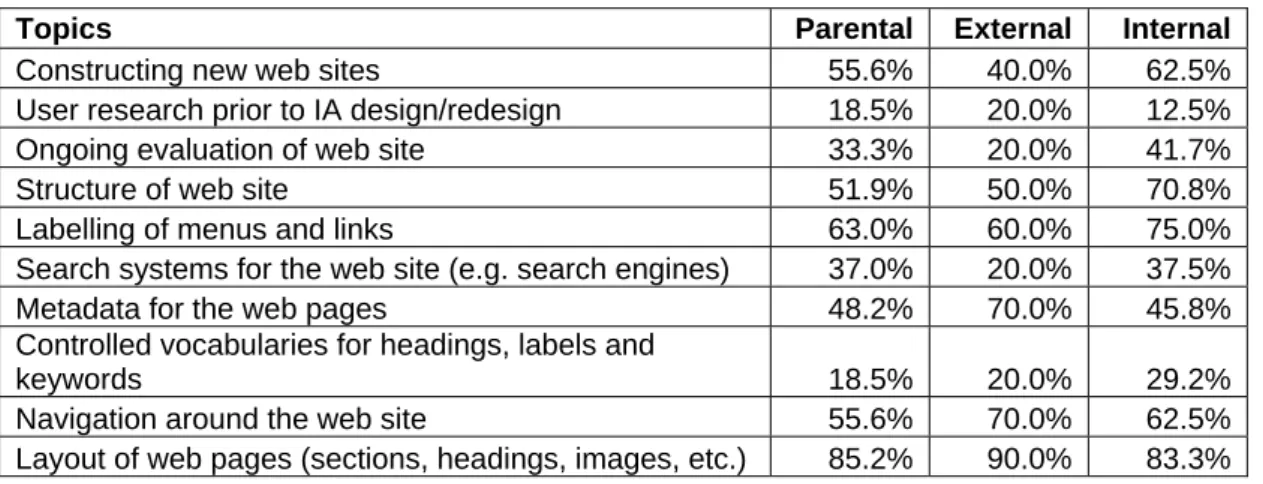
The topics all this documentation covers are listed in Table 4. Much of it covers web page layout; it also often covers new site construction, site structure, labelling, and navigation. In-house documentation tends to cover a wider range of topics than external guidelines. Libraries appear to pay particular attention to external metadata standards.
Table 4 - IA topics covered by documentation
Topics Parental External Internal
Constructing new web sites 55.6% 40.0% 62.5%
User research prior to IA design/redesign 18.5% 20.0% 12.5%
Ongoing evaluation of web site 33.3% 20.0% 41.7%
Structure of web site 51.9% 50.0% 70.8%
Labelling of menus and links 63.0% 60.0% 75.0%
Search systems for the web site (e.g. search engines) 37.0% 20.0% 37.5%
Metadata for the web pages 48.2% 70.0% 45.8%
Controlled vocabularies for headings, labels and
keywords 18.5% 20.0% 29.2%
Navigation around the web site 55.6% 70.0% 62.5%
Layout of web pages (sections, headings, images, etc.) 85.2% 90.0% 83.3%
Although only a fifth of libraries are following external standards and guidelines, a much larger number – 38.3% – refer to IA publications in general, which would include guides as well as guidelines, offering broader advice on approaches, methods, usability, etc. However, a majority of libraries do not refer to any IA publications. Documents that were cited include those listed below.
The papers & case studies on the Step Two web site (http://www.steptwo.com.au)
W3C standards
Works by Jakob Nielsen AGIMO web site
Kupersmith, J. Library terms that users understand (http://www.jkup.net/terms.html)
Theofanos, M.F., & Redish, J. Guidelines for accessible and usable web sites (http://redish.net/content/papers/interactions.html)
Dublin Core & EdNA standards
Kaiser, S. (2006). Deliver first class web sites. Collingwood, Vic., SitePoint. National Library of Australia. Guidelines for the content of library web sites (http://www.nla.gov.au/libraries/resource/guidelines.html)
Usability.gov web site guidelines and checklists
Rosenfeld, L., & Morville, P. Information Architecture for the World Wide Web
Boxes and Arrows web site (http://www.boxesandarrows.com) Krug, S. Don't make me think
This list represents many of the most consulted resources in IA, and a mix of standards, guidelines, checklists and guides. No document was cited by more than two or three respondents.
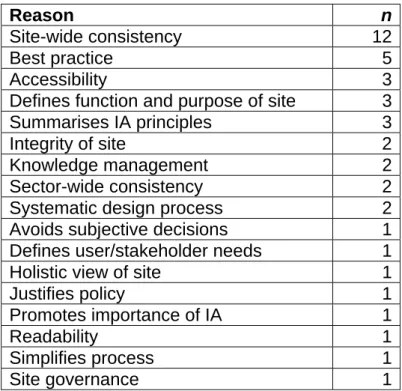
Almost two-thirds of respondents (64.4%) are of the view that some documentation, whether internal or external, should be used. Interestingly, this percentage is less than the number of responding library web sites actually supported by documentation (70.6%). Reasons why they thought so are listed in Table 5. Providing consistency and standardisation is clearly seen as an important function, but there were a variety of other reasons. Documentation could set out the purpose of the web site, in the context of the library’s goals, user needs, and so on. It could
serve as a summary of IA principles for the uninitiated, and it could help systematise the design process.
Table 5 - Reasons for documentation
Reason n
Site-wide consistency 12
Best practice 5
Accessibility 3 Defines function and purpose of site 3
Summarises IA principles 3
Integrity of site 2
Knowledge management 2
Sector-wide consistency 2
Systematic design process 2
Avoids subjective decisions 1 Defines user/stakeholder needs 1
Holistic view of site 1
Justifies policy 1
Promotes importance of IA 1
Readability 1
Simplifies process 1
Site governance 1
Tables 6 and 7 show the level of perceived IA expertise and commitment on the part of library web site developers. Although over half of the web site development teams give IA high or very high priority, over half also rated their level of expertise as moderate or worse. A similar level of commitment on the part of the libraries as a whole was reported (see Table 8).
Table 6 - IA expertise of web site developers Level n % Expert 0 0.0 Advanced 15 32.6 Moderate 23 50.0 Low 7 15.2 Minimal 1 2.2
Table 7 - IA commitment of web site developers Level n % Very high 12 26.7 High 15 33.3 Moderate 13 28.9 Low 5 11.1 Very low 0 0.0
Table 8 - IA commitment of libraries Level n % Critical 8 17.8 High 17 37.8 Moderate 11 24.4 Low 8 17.8 Nil 1 2.2 Don’t know 0 0.0
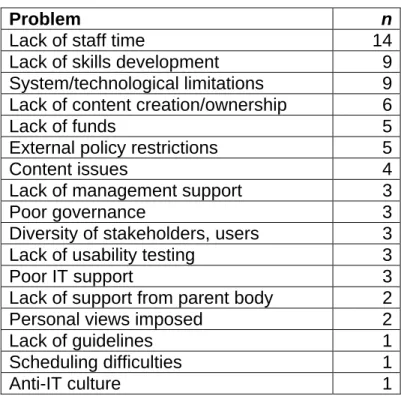
Finally, respondents were asked to list the main problems the library has with the ongoing development of its web site. Table 9 summarises these problems. Web site development was mostly limited because of resource issues. Several libraries also reported a lack of autonomy. Management issues were also quite often cited. Only one respondent mentioned a lack of guidelines as a major problem.
Table 9 - Problems facing ongoing web site development
Problem n
Lack of staff time 14
Lack of skills development 9 System/technological limitations 9 Lack of content creation/ownership 6
Lack of funds 5
External policy restrictions 5
Content issues 4
Lack of management support 3
Poor governance 3
Diversity of stakeholders, users 3 Lack of usability testing 3
Poor IT support 3
Lack of support from parent body 2
Personal views imposed 2
Lack of guidelines 1
Scheduling difficulties 1
Anti-IT culture 1
The sample sizes are too small to make categorical assertions, but it appears that university and state libraries use written guidelines more than other libraries, particularly internal guidelines. They are also especially supportive of the use of documentation, and prioritise IA issues more. Interestingly, the proportion of public libraries with complete control over their web site (37.5%) is higher than that for libraries overall, and the percentage which has to work with externally issued templates (6.3%) is significantly less.
Discussion and conclusions
The survey results suggest that many Australian libraries are taking IA seriously, if the libraries’ apparent commitment to it is anything to go by, but perhaps not quite as seriously as might be expected, given that information provision is their central function. Almost half of the libraries sampled assign IA only moderate priority or less. Even amongst their web site developers, 40% gave IA moderate priority or less. It is also worth noting that these results are likely to paint a slightly rosier picture of IA activities and attitudes than might be the case overall, as respondents may well be more pro-IA than non-respondents.
Libraries’ web IA is supported by documentation from a wide variety of sources, covering a range of IA issues. Although some libraries use external guidelines, there is little sign of standardisation across Australian libraries. No publication is anywhere near to becoming a de facto standard, though some of the metadata schemas are used by certain groups of libraries. Indeed, the results suggest that cross-library guidelines and ‘design patterns’ may not be particularly effective, with libraries enjoying quite different levels of control over their web sites, from complete autonomy to complete dependence. Library-specific standards might not be so useful when standards issued by parent bodies – in some cases based on standards for another type of institution – take precedence. It is also clear that different types of library have web sites for different purposes, with different types of users and stakeholders.
Many library web managers are reading the IA literature that can be readily accessed on the Internet and in popular book stores. However, a majority of web managers do not refer to this literature, despite IA being acknowledged as an important activity. The survey suggested that one reason for this was lack of time. Apart from their libraries’ web sites, many web managers may have other responsibilities. Other reasons may include the fragmented nature of the IA literature and a lack of an introduction to it through appropriate professional development. Specific guidelines and checklists are both used and considered worth using by many libraries. In most cases, they are considered results-oriented; that is, they improve the end-user’s experience of the site, by ensuring consistency, accessibility, navigation, searchability, etc. However, in other cases, these guidelines are aimed at improving the design process, by focussing design on overall purpose, user needs, etc. And it is the process that appears to be pivotal for many web managers, and where problems occur. Although some web site development problems pertain to content, and might be alleviated by the adoption of written standards, many were about a lack of skills, which can only be addressed by more time and funds for professional development and more management support.
As a design activity, IA can be usefully supported by both methods and guidelines, but it can also be constrained by them. Fewer respondents wanted documentation than were actually using it. What they wanted more, it would seem, is a deeper understanding of best practice and the skills to move their web sites beyond the rigidities of imposed guidelines. To achieve this, more general guides may be more helpful than detailed standards. One respondent commented that ‘A list outlining a
and principles of information architecture … The bigger the team, then perhaps a more formal document agreeing on which resources is required to assist with consistency.’ Guidelines were sometimes used in lieu of skills development, acting as summaries of best IA practice for the uninitiated. As another respondent commented, ‘While no replacement for ongoing reading and professional development, some written guidelines for developing information architecture may be of benefit for people new to web administration …’
It appears that a lack of documentation or standards is not the main problem facing developers of Australian library web sites. Rather, it is their lack, in some cases at least, of high-level IA design skills. Only as their IA skills mature will librarians be in a position to effectively apply guidelines and standards to those aspects of IA that might benefit from them. The sort of documentation that best supports the maturation of IA design skills is likely to be more general in nature, focussing on process as much as on specific output. Finally, it is worth noting that some libraries appear to have staff with far more advanced IA skills than do other libraries, and are
correspondingly far more IA-focused. The question remains why this is so – it may be due to a number of factors other than money – and is worthy of further research. Furthermore, it would be interesting to see whether this range of self-assessed skill and commitment levels was actually borne out by the quality of IA found on the web sites: in other words, whether the range of IA best practice implementation found by Hider and Ferguson (2006) in their earlier study correlated with the range of skill and commitment levels found in this survey.
Acknowledgement
The authors wish to thank Ms Carole Gerts for her assistance in administering the questionnaire survey described in this paper.
References
Australian Government Information Management Organisation 2004, Information architecture for websites: Better practice checklist, AGIMO, ACT.
Basden, A. 2003, "Levels of guidance", Proceedings of 2nd International Conference on Universal Access in Human-Computer Interaction UAHCI'2003, ed. C.
Stephanidis, Lawrence Erlbaum Associates, Mahwah, NJ., pp. 23-27. Batley, S. 2007, Information architecture for information professionals, Chandos
Publishing, Oxford England.
Cherry, J., Muter, P. & Szigeti, S. 2006, "Bibliographic displays in web catalogs: Does conformity to design guidelines correlate with user performance?",
Information Technologies & Libraries, vol. 25, no. 3, pp. 154-162.
Dooyeweerd, H. 1955, A new critique of theoretical thought, Paideia Press, Ontario.
Garrett, J.J. 2003, The elements of user experience: User-centered design for the web, 1st edn, New Riders Publishing, Indiana.
Golding, J., Carter, A. & Koina, C. 2000, "Library website management guidelines: What you need to know", Australian Library Journal, vol. 49, no. 1, pp. 51-56.
Hider, P. & Ferguson, S. 2006, “An evaluation of the information architectural qualities of Australian library websites”, ALIA 2006 Biennial Conference, Perth, 19-22 September 2006: Conference papers, [Online]. Available:
http://conferences.alia.org.au/alia2006/Papers/Philip_Hider.pdf [12/9/2007]. Lynch, P.J. & Horton, S. 2004, Web style guide, 2nd edn, [Online]. Available:
http://www.webstyleguide.com [12/9/2007].
Maloney, K. & Bracke, P. 2004, "Beyond information architecture: A systems
integration approach to web-site design", Information Technologies & Libraries,
vol. 23, no. 4, pp. 145-152.
Mariage, C., Vanderdonckt, J. & Pribeanu, C. 2005, "State of the art of web usability guidelines" in Handbook of human factors in web design, eds. R. Proctor & K. Vu, 1st edn, Lawrence Erlbaum Associates, New Jersey, pp. 688-700.
Milne, S., Dickinson, A., Carmichael, A., Sloan, D., Eisma, R. & Gregor, R. 2005, "Are guidelines enough? An introduction to designing web sites accessible to older people", IBM Systems Journal, vol. 44, no. 3, pp. 557-571.
Morrogh, E. 2002, Information architecture: An emerging 21st century profession, 1st edn, Prentice Hall, New Jersey.
Morville, P. & Rosenfeld, L. 2006, Information architecture for the World Wide Web,
3rd edn, O'Reilly and Associates, USA.
Nielsen, J. 2004, 01/09/2004-last update, The need for web design standards
[Homepage of Jakob Nielsen's Alertbox], [Online]. Available: http://www.useit.com/alertbox/20040913.html [17/08/2007].
Nielsen, J. 1999, 22/08/1999-last update, Do interface standards stifle design creativity? [Homepage of Jakob Nielsen's Alertbox], [Online]. Available: http://www.useit.com/alertbox/990822.html [18/8/2007].
Rosenfeld, L. & Morville, P. 2002, Information architecture for the World Wide Web,
2nd edn, O'Reilly and Associates, USA.
Rosenfeld, L. & Morville, P. 1998, Information architecture for the World Wide Web,
1st edn, O'Reilly and Associates, USA.
Stewart, T. & Travis, D. 2003, "Guidelines, standards, and style guides" in The human-computer interaction handbook: Fundamentals, evolving technologies and emerging applications, eds. J. Jacko & A. Sears, Lawrence Erlbaum Associates, Mahwah, New Jersey, pp. 991-1005.
Symonenko, S. 2006, 25/03/2006-last update, Exploring patterns in web site content structure [Homepage of ASIS&T 2006 Information Architecture Summit],
[Online]. Available: http://iasummit.org/2006/files/177_Presentation_Desc.pdf [10/08/2007].
US Department of Health and Human Services (ed) 2006, Research-based web design & usability guidelines, 2nd edn, US Government Printing Office.
Van Duyne, D., Landay, J. & Hong, J. 2007, The design of sites: Patterns for creating winning web sites, 2nd edn, Prentice Hall, Upper Saddle River, NJ.
Wodtke, C. 2003, Information architecture: Blueprints for the web, New Riders, Boston, Massachusetts.
Appendix A – Survey questions
(1) Are you a member of the library’s staff? (2) What type of library is it?(3) How much of the information architecture design (and redesign)of the library website is in the hands of the library, rather than a separate web unit, parent body or external authority?
(4) Does the library follow any written policies, guidelines or checklists for information architecture issued by its parent body (e.g. from a central web unit)?
(5) Please check all the topics below that these policies/guidelines/checklists cover.
(6) Does the library follow any written policies, guidelines or checklists for information architecture issued by an external body (outside of any parent body)?
(7) Please check all the topics below that these policies/guidelines/checklists cover.
(8) Does the library follow any internal policies, guidelines or checklists for information architecture, written by and for its staff within the library? (9) Please check all the topics below that these policies/guidelines/checklists cover.
(10) In the process of designing or redesigning its website, has the library referred to any published guidelines, checklists or guides (including online ones) on information architecture?
(11) Do you see any need for written policies, guidelines, etc. to assist in the information architecture of the library’s website?
(12) Please indicate the level at which the library website development team understands information architecture principles.
(13) Please indicate the level of priority the library website development team gives to information architecture issues.
(14) Please indicate the level of importance the library as a whole attaches to the information architecture of its website.
(15) Please indicate the main problems the library has with the ongoing development of its website.