Dipartimento di Ingegneria Chimica, Gestionale, Informatica, Meccanica Settore Scientifico Disciplinare ING-INF/05
Embedded Biometric Sensor Devices:
Design and Implementation on Field Programmable Gate Array
IL DOTTORE IL COORDINATORE
Ing. Giuseppe Vitello Prof. Ing. Antonio Gaglio
IL TUTOR
P
REFACE
During the research activity in my Ph.D. course, I thoroughly studied the biometric systems and the relevant design and implementation techniques allowing the employment of such systems in embedded devices. I focused my attention on the fingerprint-based recognition and classification systems, and on their implementation on Field Programmable Gate Array (FPGA) devices. I was prompted to study biometric systems mainly because these systems may play a key role in the new emerging market of mobile devices (for example, they are recently available in the new generation of Apple and Samsung smart phones). Such market is rapidly growing and influencing the way people use network resources and functionalities (such as commercial, banking, and government services), requiring a security level higher than in the past. Consequently, novel design techniques and technologies for user recognition and are required to be investigated, in order to provide a secure services and resources access. The traditional authentication systems based on username and password are not able to guarantee a suitable protection level. Unlike password, instead, user biometric information is unique and unchangeable; therefore the biometric identity has the advantage to guarantee that only the authorized users have access to available resources and services. However, traditional biometric approaches involves interactions among a large number of entities: passive access points for user biometric trait acquisition, networked databases for user biometric identity storing, and trusted servers running the user recognition systems. So, traditional systems usually undergo several types of attacks, such as Communication Attack (attacking the channel between the server and the database), Replay Attack (replication of user biometric trait processed during the acquisition phase), and Database Attack (manipulation of the stored user biometric identity). Embedded architectures, instead, provide a more secure and flexible infrastructure, since all elaboration steps are performed on board, so biometric identities are securely managed and stored inside the system without any data leaking out.
The goal of this thesis is to illustrate the analysis and results of my research activity focused on the design and development of new fingerprint-based recognition systems for embedded devices. The study of the state-of-the-art about biometric systems led me to realize novel approaches to improve the performance of standard systems in order to enable their employment in embedded
contribution of this work. There are many literature approaches to deal with software systems, but few on design and implementation of embedded hardware prototypes. Referring to the developed and proposed fingerprint-based systems, this thesis represents an advancement of embedded biometrics respect to state-of-the-art. The step-over proposed in this work is focused on:
1. a heuristic fingerprint classification technique, requiring only a little set of images as training dataset;
2. an advanced matching technique for personal recognition based on partial fingerprint, able to enhance the system accuracy;
3. the design and implementation of an efficient fingerprint features extractor;
4. the design and implementation of a quality evaluator of raw fingerprint images (able to identify poor quality areas, such as dry and moist portions), allowing to define a novel flow of image processing steps for user recognition.
This thesis is divided into two parts, creating a path connecting the state-of-the-art about biometric systems and the novel implemented approaches. The knowledge of the state-of-the-art about biometrics is fundamental to understand the step over presented in this work. For this reason, in the first part, general characteristics of biometric systems are presented with particular reference to fingerprint-based approaches used in literature to realize embedded systems. The second part proposes the developed innovative sensor. A novel flow of image processing steps for user recognition is outlined. Successively, an efficient micro and macro fingerprint features extractor is illustrated. Then, an advanced matching technique for personal recognition using partial fingerprints is presented. Finally, an innovative fingerprint classification approach based on the fusion of Fuzzy C-Means and Naive-Bayes technique is detailed. Experimental results and comparisons with analogous literature systems show the effectiveness on the proposed sensor.
All the innovative approaches proposed in this thesis have been published in international conferences and journals.
S
UMMARY
Preface ... 1
Summary ... iii
Biometric Systems: State-of-the-art ... 1
Chapter 1: Biometric Systems ... 2
1.1 Introduction ... 2 1.2 Motivations ... 2 1.3 Biometric Traits ... 3 1.3.1 Physiological Traits ... 4 1.3.1.1 Fingerprint ... 4 1.3.1.2 Hand Geometry ... 5 1.3.1.3 Face Geometry ... 5 1.3.1.4 Facial Thermogram ... 6 1.3.1.5 Iris ... 6 1.3.1.6 Retina ... 6 1.3.2 Behavioral Traits... 7 1.3.2.1 Calligraphy ... 7 1.3.2.2 Voice ... 7 1.4 Recognition Systems ... 8 1.4.1 Operation Modes ... 8 1.4.2 Performance Indexes ... 9 1.4.3 Security Issues ... 10
Chapter 2: Fingerprint-Based Systems ... 11
2.1 Introduction ... 11
2.2 Fingerprint Recognition ... 12
2.2.1 Correlation-Based Approaches ... 12
2.2.1.1 Phase Only Correlation (POC) Approach ... 13
3.1.1 Minutiae-Based Approaches ... 17
2.2.1.2 Theoretical Remarks ... 17
2.2.1.3 Processing Steps ... 19
3.1.2 Singularity Points Approaches ... 20
2.3.3 Syntactic Approaches ... 24
2.3.4 Structural Approaches ... 24
2.3.5 Neural Network Approaches ... 25
The Proposed Innovative Techniques and Approaches ... 27
Chapter 3 – The Proposed Innovative Embedded Sensor ... 28
3.2 Introduction ... 28
3.2.1 Remarks on Fingerprint Image Quality Evaluation Methods ... 30
3.3 The Proposed Novel Embedded Fingerprint Authentication System ... 32
3.3.1 Fingerprint Image Quality Evaluation module ... 33
3.3.2 Fingerprint Features Extraction module ... 40
3.3.3 Minutiae-based Matching module ... 45
3.3.4 Experimental Results ... 47
3.3.5 Sensor Storage Capabilities of User’s Templates... 51
3.3.6 Extracted Minutiae Comparison ... 52
3.3.7 Discussion and Comparisons... 52
3.4 The Proposed Novel Fingerprint Classification System ... 53
3.4.1 Datasets Building Module ... 55
3.4.2 Training Dataset Extraction Module ... 55
3.4.3 Fingerprint Classification Module ... 56
3.4.4 Experimental Results and Comparison ... 59
Conclusions ... 61
B
IOMETRIC
S
YSTEMS
:
S
TATE
-
OF
-
THE
-
ART
Behavioural and physical human traits are unique and unchangeable, so they can be used to distinguish and to recognize a user from others.
Biometric systems can be classified as recognition systems or classification systems. Depending on the application context, a biometric recognition system may be used as authentication or identification system. An authentication system checks the person identity by comparing the captured biometric characteristic with his/her own biometric template enrolled in the system. It conducts a one-to-one comparison to determine whether the identity claimed by the individual is true. An identification system recognizes the subject by searching the entire template database for a match. It conducts one-to-many comparisons and establishes person identity or fails if he/she is not enrolled in the system database, without the subject having to claim an identity.
In real-time recognition systems it is required high response speed, so classification systems play a key role. One of the main goals of such systems is to reduce the item search time within the database without affecting the accuracy rate. The identification process performed in a database divided in classes is faster, since the number of necessary comparisons can be reduced by searching the fingerprint only in the same class of the database.
Chapter 1: Biometric Systems
1.1
Introduction
Biometrics, from the Greek ‘bios’ (life) and ‘metros’ (measure), is the scientific analysis and study of human recognition techniques, referring to his/her physical and behavioral traits [1]. Biometric systems provide a more secure paradigm than traditional approaches for user recognition, since human biological traits are unique and can be used to distinguish a user from the others. The traditional authentication systems based on username and password are not able to guarantee a suitable protection level, since whoever can illegitimately know or reproduce the secret user password and ID.
1.2
Motivations
Secure systems allow user access only if the recognition phase of the user digital identity is correctly performed [2]. Such phase usually performs one of the following three approaches:
it checks something that user knows, for example if the user knows his/her information account, generally represented by a public ID and a secret password. Unfortunately, the probability that an impostor can know the password is high. This approach is called knowledge-based, because it uses information that only the user knows;
it checks something that user has, for example if the user possesses a predetermined token (generally a magnetic badge or a smartcard). The system allows user access without asking other additional information. Unfortunately, the probability that an impostor can steal the token is high. This approach is called token-based, because it uses information that the user has;
it checks something that user is, if the system compares user biological traits with stored values, known as template. Unlike passwords or badge, user biometric information is unique; therefore the biometric identity has the advantage to guarantee that only the
Most common recognition systems use the first and the second approach. However, these two approaches are not able to guarantee a suitable protection level. In additions, they require the user remembers or carries with him “something” containing the necessary information for the recognition. In the third approach, instead, all information belong to the user: physical and behavioral traits (such as fingerprints, face, iris, retina and so on) are the core of biometric systems. Biometric characteristics cannot be stolen; therefore, biometric systems are not easily violable.
1.3
Biometric Traits
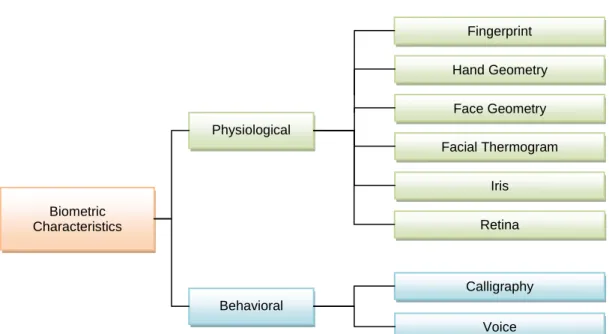
Figure 1.1 shows a classification of the most commonly used biometric traits.
Figure 1.1. Classification of the most commonly used biometrics traits.
To be used in biometric systems, such traits must have the following properties [3]:
Universality: they must be present in each person;
Distinctiveness: they must be distinguishable;
Permanence: they must not change during the life;
Acceptability: the technology used to acquire them must be user-friendly and not intrusive. The following Table 1.1 shows the properties of the most commonly used biometric traits.
Calligraphy Voice Facial Thermogram Iris Retina Hand Geometry Physiological Behavioral Biometric Characteristics Face Geometry Fingerprint
Table 1.1. Properties of the most commonly used biometric traits. Biometric
Technology Universality Distinctiveness Permanence Acceptability
Fingerprint Medium High High Medium
Hand Geometry Medium Medium Medium Medium
Face Geometry High Low Medium High
Facial
Thermogram High Low Medium High
Iris High High High Low
Retina High High Medium Low
Calligraphy Low Low Low High
Voice Medium Low Low High
1.3.1
Physiological Traits
1.3.1.1 Fingerprint
Fingerprints (Figure 1.2) are unique (also in identical twins) and they not change during the life. However, the technology using these traits has some limits: wet and dry skin, cuts, scars, image quality and so on can compromise the systems performances. Such technology is the most commonly used but its implementation requires high computational costs and a lot of processing resources [4, 5].
1.3.1.2 Hand Geometry
Hand geometry recognition systems [6] use the hand form and dimensions as distinctive traits (Figure 1.3). They have many advantages than fingerprints systems (they require less space to store the template, are less expensive, meet a less psychological resistance, and so on) and few disadvantages (usually the user do not want to put its palm where many other have put theirs, the performances depend on the weather conditions and on the hand cleanness, they have a big dimension (so they can’t be implemented in portable devices), and so on).
Figure 1.3. Hand geometry.
1.3.1.3 Face Geometry
Face geometry recognition systems [7] use the distance among facial attributes and the face shape as distinctive traits (Figure 1.4). This technology is not expensive and is less intrusive having a good impact on the user. However, they are very susceptible to illumination variations, face position and expressions; their performances decrease when the dimension of the database increases; and finally twins are hardly distinguishable.
1.3.1.4 Facial Thermogram
Facial thermogram recognition systems [8] use the blood vases and the temperature of many face points as distinctive traits (Figure 1.5). They are susceptible to the user health and emotional state.
Figure 1.5. Facial thermogram.
1.3.1.5 Iris
Iris is one of the most discriminating biometric traits (also identical twins have different iris). It is less susceptible to damage than other parts of the body, and the relevant template requires only few bytes [9]. Iris recognition systems use special cameras not needing the contact with the user eye. They work fine even if the user is carrying glasses, and utilize the following features as distinctive traits: nucleus, collarets, valleys and strike off channels (Figure 1.6).
Figure 1.6. Iris features.
1.3.1.6 Retina
Retina recognition systems [10] uses the veins conformation under the retina surface of the eye as distinctive traits (Figure 1.7). In the acquisition task, they send a beam of low intensity light inside
Figure 1.7. Human eye retinal blood vessel distribution.
1.3.2
Behavioral Traits
1.3.2.1 Calligraphy
Calligraphy can be used for personal recognition since every user has a distinctive style to write. However, two writings of the same user are never perfectly identical. Therefore, this technology has a medium reliability and can be used only on small target of population.
Two different approaches for calligraphy recognition are static and dynamic [11]. The latter uses also acceleration, speed and pressure of writing for improving the accuracy.
1.3.2.2 Voice
The voice recognition (Figure 1.8) is the preferred method by the users since it is not intrusive and can be used through the telephone lines. However, it is least accurate technology [12]: environmental noises can affect the recognition, twins and the brothers are hardly distinguishable, etc. It can be text-dependent (user says a predetermined sentence) or text-independent (user simply says something). The second case is less accurate.
1.4
Recognition Systems
1.4.1
Operation Modes
Depending on the application context, a biometric recognition system may be used as authentication or identification system. An authentication system checks the person identity by comparing the captured biometric characteristic with his/her biometric template enrolled in the system. It conducts a one-to-one comparison to determine whether the identity claimed by the individual is true. An identification system recognizes the subject by searching the entire template database for a match. It conducts one-to-many comparisons and establishes person identity or fails if he/she is not enrolled in the system database, without the subject having to claim an identity. Two different phases are performed:
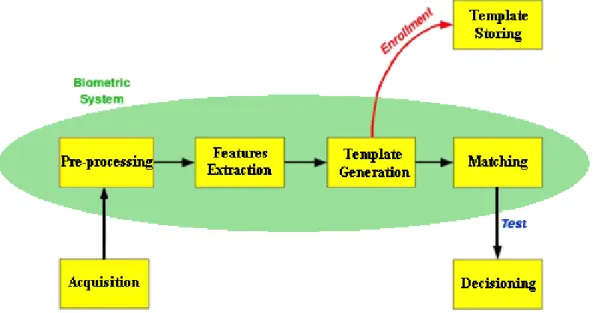
Enrolment phase: the system stores the user biometric identity (and the user ID only in authentication systems) in the database. Three specific tasks are performed: biometric trait acquisition, digital biometric features extraction and template storing in the database (Figure 1.9);
Verification phase: the system compares the acquired biometric trait with the template previously stored in the enrolment phase.
1.4.2
Performance Indexes
Biometric systems can be evaluated considering two aspects: the database dimension and the performance (speed and accuracy about user recognition). The answer time is fundamental in real-time applications; while the recognition accuracy determines the system security.
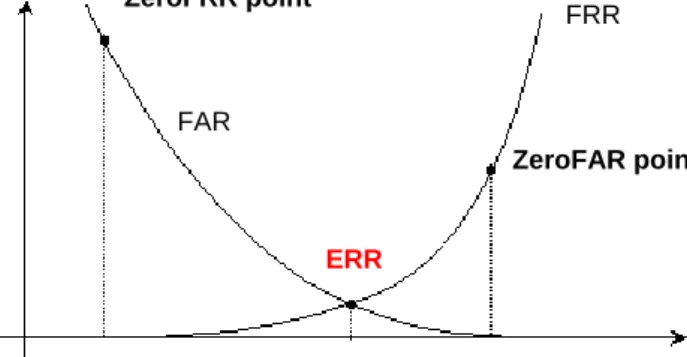
The recognition performance is evaluated using the following two correlated indexes (Figure 1.9):
FAR (False Acceptance Rate), percentage of approved impostors;
FRR (False Rejection Rate), percentage of refused registered user.
Besides, to evaluate the global percentage of error is used the EER (Equal Error Rate) index, defined as the percentage when the FAR and FRR are equal (Figure 1.10), or the ROC (Receiver Operating Characteristic) index, defined as FAR versus FRR.
To establish the closeness of a comparison the system uses a metric: only if the value associated to the measured biometric trait overcomes a pre-defined threshold value, then the system will recognize the user identity. The threshold value is usually a trade-off between the probability of false acceptances (FAR) and the probability of false rejections (FRR).
Figure 1.10. Typical course of FAR and FRR of a biometric system.
To choice the right biometric system usually the administrator considers many factors. Some of these factors are reported in Table 1.2.
Error Threshold ZeroFRR point ZeroFAR point ERR FRR FAR
Table 1.2. Comparison between the biometric recognition systems previously described. Biometric Systems FRR range (%) FAR range (%) Cost Template dimension (Bytes) Fingerprint 3÷7 0.0001÷0.001 Medium 300÷1200
Hand Geometry 1÷10 1 Medium <10
Face Geometry 10÷20 0.001÷1 Medium Few bytes
Iris 1÷10 ~0 High 512
Retina 1 0.01 Very High <1000
Calligraphy 3÷10 1 Medium 1500
Voice 10÷20 2÷5 Low 1500
1.4.3
Security Issues
The traditional authentication systems based on username and password are not able to guarantee a suitable protection level. Unlike passwords, instead, user biometric information is unique and unchangeable; therefore the biometric identity has the advantage to guarantee that only the authorized users have access to the system available resources and services. However, traditional biometric approaches involves interactions among a large number of entities: passive access points for user biometric trait acquisition, networked databases for user biometric identity storing, and trusted servers running the user recognition systems. So, such traditional systems usually undergo several types of attacks as [13,14]:
Communication Attack (attacking the channel between the server and the database);
Replay Attack (resubmitting the user biometric trait, or overriding the extracted features and/or the final decision);
Database Attack (tampering with the stored user biometric identity);
Software Attack (corrupting the matcher).
Embedded architectures, instead, provide a more secure and flexible infrastructure, since all elaboration steps are performed on board, so biometric identities are securely managed and stored inside the system without any data leaking out. In addition, their hardware implementation
Chapter 2: Fingerprint-Based Systems
2.1
Introduction
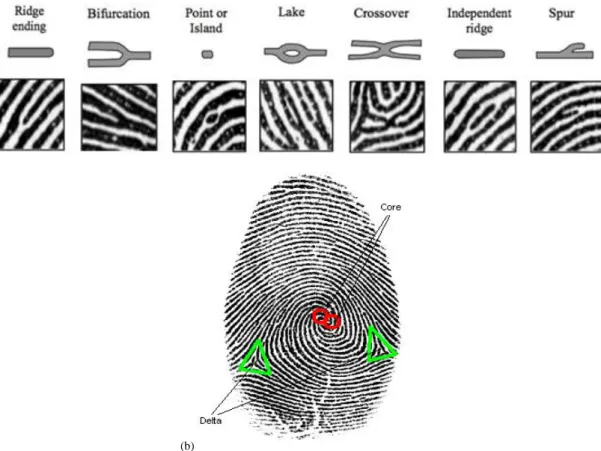
Fingerprint is composed of ridges and valleys which form unique geometric patterns in the skin [15]. With more details, ridge lines are characterized by minutiae (Figure 2.1 a)) such as end-points (the point where the ridge line terminates) and bifurcations (point where the ridge line intersects another ridge line). Usually, fingerprint area contains about 30 to 60 minutiae points depending on the finger size and the sensor area dimension. Fingerprints are also characterized by singularity points, called Delta and Core, in which the ridge line flow is irregular. With more details, the Core point is the center of a circular edge pattern, and the Delta point is the center of a triangular edge pattern (Figure 2.1 b)).
(a)
(b)
2.2
Fingerprint Recognition
Fingerprint recognition is a well-researched problem, and automatic fingerprint authentication /verification techniques have been successfully adapted to both civilian and forensic applications for many years. Although, automated systems, software and hardware implementation, are usually adopted in commercial and security applications for access and denial operations, the relative technology can also be used in other emerging areas of interest. One of the most important areas of considerable utility to law enforcement agencies is concerning to partial fingerprints identification. Since the fingerprint templates constitute the largest data in the biometric field, considering partial fingerprint samples, the amount of data in the database shall be decreased and this will consequently lead to a faster processing for fingerprint identification [16]. Matching the small parts (partial) fingerprint to the stored images in database usually has different problems. The partial fingerprints (for example, obtained from a crime scene) are normally small, noisy and have the following characteristics:
a less minutiae number with respect to complete fingerprint image;
high probability of loss of singularity points;
unspecified roto-translation problems due to uncontrolled acquisition environments;
distortions introduced by human skin such as elasticity;
difficult to determine correspondence of the obtained partial fingerprint to one of the fingers. In literature many fingerprint-based recognition systems have been proposed and implemented [17, 18]. According to the used technique, they can be divided into systems using correlation-based approaches, and systems using minutiae-based approaches. Since the minutia-based fingerprint representation is an ANSI-NIST standard [19], all approaches and techniques implemented following these recognition guidelines have the advantage of being directly applicable to existing systems and databases.
2.2.1
Correlation-Based Approaches
These approaches compute the correlation between pixels of two fingerprint images (previously superimposed) for different alignments (e.g., various displacements and rotations), considering the global pattern of ridges and valleys. However, they require several points to register the fingerprint
Let f and g be the two fingerprint images (the template and the input fingerprint, respectively) [21]. The Sum of Squared Differences (SSD) measures their diversity and is calculated by the Equation (2.1):
SSD(f, g) = ‖f − g‖2 = (f − g)T(f − g) = ‖f‖2+ ‖g‖2− 2fTg = ‖f‖2+ ‖g‖2− 2CC (2.1) If ||f||2 and ||g||2 are constant and the CC (Cross-Correlation) between f and g is maximized, then the diversity between the two images is minimized. Therefore, CC can be considered as a measure of the images similarity, however in Equation (2.1) also displacement and rotation are considered. If
g(∆x,∆y,θ) is the roto-translation of the input image g by an angle θ around the origin (usually the image center) and by (∆x, ∆y) pixels; then the similarity between f and g can be measured through the Equation (2.2):
S(f, g) = max
∆x,∆y,θCC(f, g
(∆x,∆y,θ)) (2.2) However, it is computationally very expensive and rarely leads to acceptable results mainly due to skin condition, impressing pressure and non-linear distortions. In these scenarios, it is useful adopt more sophisticated correlation measures, such as the normalized cross-correlation or the zero-mean normalized cross-correlation.
2.2.1.1 Phase Only Correlation (POC) Approach
This approach considers only the correlation among phase components [22]. It is immune to image displacements and rotations, to changes in light exposure, and to noisy acquisitions.
Let f n n( ,1 2) and g n n( ,1 2) be two N1N2 images, where:
1 1,..., 1 n M M (M1 0) 2 2,..., 2 n M M (M2 0) 1 2 1 1 N M 2 2 2 1 N M
The relevant Discrete Fourier Transforms are defined by the following equations, respectively:
1 1 2 2 1 2 1 2 ( , ) 1 2 1 2 1 2 ( , ) ( , ) k n k n ( , ) j F k k N N F F k k
f n n W W A k k e (2.3)1 2 1 1 2 2 1 2 ( , ) 1 2 1 2 1 2 ( , ) ( , ) k n k n ( , ) jG k k N N G G k k
g n n W W A k k e (2.4) where: 1 2 ( , ) FA k k and A k kG( ,1 2) are the module components 1 2
( , )
F
j k k
e and ejG( ,k k1 2) are the phase components
1 1,..., 1 k M M 2 2,..., 2 k M M 1 1 2 j N N W e 2 2 2 j N N W e
The Cross-Spectrum RFG( ,k k1 2) between F k k( ,1 2) and G k k( ,1 2)is calculated by the Equation (2.5): 1 2 ( , ) 1 2 1 2 1 2 1 2 1 2 ( , ) ( , ) ( , ) ( , ) ( , ) j k k FG F G R k k F k k G k k A k k A k k e (2.5) where: 1 2 ( , )
G k k is the complex conjugate of G k k( ,1 2)
1 2 ( ,k k )
= F( ,k k1 2)G( ,k k1 2) is the phase difference
The ordinary correlation function rfg( ,n n1 2) is calculated by the Inverse Discrete Fourier Transform (IDFT) of the Equation (2.5).
The normalized cross-spectrum is calculated by the Equation (2.6):
1 2 ( , ) 1 2 1 2 1 2 1 2 1 2 ( , ) ( , ) ˆ ( , ) ( , ) ( , ) j k k FG F k k G k k R k k e F k k G k k (2.6)
The POC function rfg( ,n n1 2) is the normalized spectrum IDFT, and it is calculated by the following equation:
1 1 2 2 1 2 1 2 1 2 1 2 1 ˆ ( , ) ( , ) k n k n fg FG N N r n n R k k W W N N
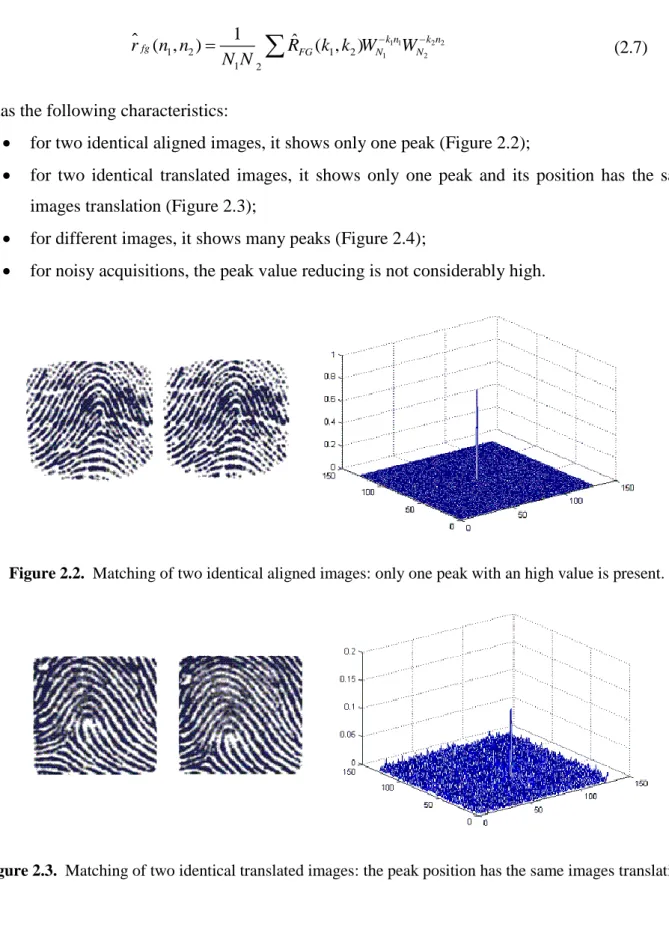
(2.7)It has the following characteristics:
for two identical aligned images, it shows only one peak (Figure 2.2);
for two identical translated images, it shows only one peak and its position has the same images translation (Figure 2.3);
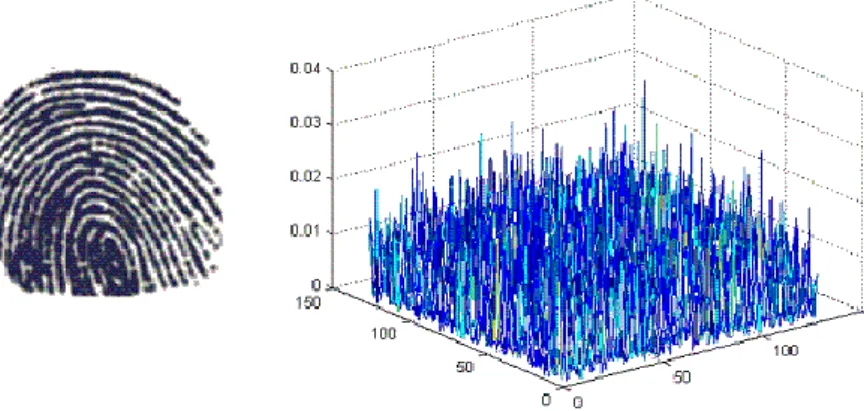
for different images, it shows many peaks (Figure 2.4);
for noisy acquisitions, the peak value reducing is not considerably high.
Figure 2.2. Matching of two identical aligned images: only one peak with an high value is present.
3.1.1
Minutiae-Based Approaches
2.2.1.2 Theoretical Remarks
Let T
m m1, 2,...mm
and I
m m1', 2',...,m'n
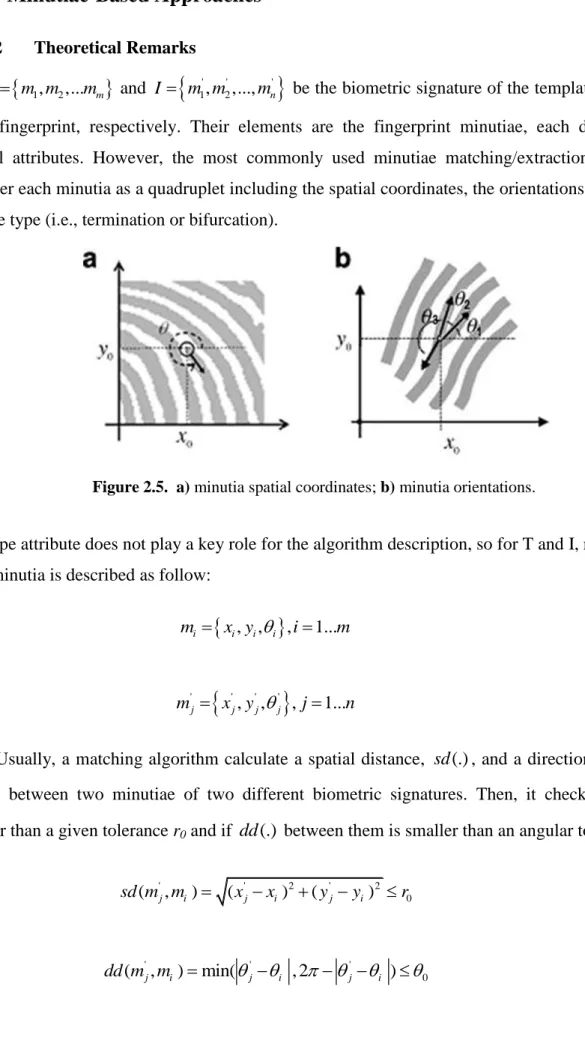
be the biometric signature of the template and of the input fingerprint, respectively. Their elements are the fingerprint minutiae, each described by several attributes. However, the most commonly used minutiae matching/extraction algorithms consider each minutia as a quadruplet including the spatial coordinates, the orientations (Figure 2.5) and the type (i.e., termination or bifurcation).Figure 2.5. a) minutia spatial coordinates; b) minutia orientations.
The type attribute does not play a key role for the algorithm description, so for T and I, respectively, each minutia is described as follow:
, ,
, 1... i i i i m x y i m
' ' ' ' , , , 1... j j j j m x y j nUsually, a matching algorithm calculate a spatial distance, sd(.), and a direction difference, (.)
dd , between two minutiae of two different biometric signatures. Then, it check if sd(.) is smaller than a given tolerance r0 and if dd(.) between them is smaller than an angular tolerance0:
' ' 2 ' 2 0 ( j, i) ( j i) ( j i) sd m m x x y y r (2.8) ' ' ' 0 ( j, i) min( j i , 2 j i ) dd m m (2.9)
The r0 and 0 tolerances compensate the inevitable errors in fingerprint acquisition and features
extraction phases.
Before the matching task, an aligning task is performed. It requires the following geometrical transformations:
displacement (in x and y);
rotation ();
scale, if the two fingerprints have different resolutions;
other distortion-tolerant geometrical transformations could be useful to match minutiae in case of one or both of fingerprints are affected by severe distortions.
According to a given geometrical transformation, map(.) is the function that maps a minutia m'j into m". For example:
' ' ' ' " " " ' , , ( , , ) , , x y j j j j j j j j map m x y m x y where " ' " ' cos sin sin cos j j j j x x x y y y (2.10)is a roto-translation considering a displacement of ( x, y) and a counter clockwise rotation around the origin.
Let mm(.)be the function described in Equation (2.11):
" " " 1 ( , ) 0 ( , ) 0 ( , ) 0 j i j i j i and sd m m r dd m m mm m m otherwise (2.11)
that returns 1 only when the minutiae m"and m' match according to Equations (2.8) and (2.9). Therefore, the matching problem can be formulated as in Equation (2.12):
' , , ( ) , , , 1 max ( ( ), ) m x y P i i x y P i imize mm map m m
(2.12)where P i( ) is an unknown function that determines the pairing between minutiae of I and T. With more details, each minutia can have either exactly one mate in the other fingerprint or have no mate at all, therefore:
1. P i( ) j if the mate of the mi in T is the minutia m'j in I; 2. P i( )null if the minutia mi in T has no mate in I; 3. i 1... , ( )m P i j if a minutia '
j
m in I has no mate in T;
4. i 1.. ,m k1.. ,m i k P i( )P k( )null (if each minutia in I is associated with only one minutia in T).
Note that ( )P i j is not necessarily linked to the m'j and mi match using the Equations (2.11) and (2.12), but it only means that they are the most likely pair under the current transformation.
2.2.1.3 Processing Steps
The minutiae-based approach is the most commonly used for fingerprint matching [21]. However it is a complex and intensive task. Usually, to increase the system speed and accuracy a fingerprint image pre-processing task, a dedicated extraction algorithm [15, 17], and a post processing task are performed.
The most commonly used pre-processing task steps are:
Normalization, used to force the fingerprint gray levels to an average value within a desired variance;
Segmentation [23, 24], used to erase the fingerprint background;
Directional image extraction. Every element in the directional image represents the local orientation of the fingerprint ridges in the original gray-scale image. Usually the directional image is extracted in three steps [25]: extraction of the direction for each pixel; processing of the previous step output assembling the pixels in blocks; and computing of the predominant direction for each block;
Enhancement, used to improve the quality image. Many fingerprint image enhancement filters have been proposed in literature, such as Gabor filter [26], Median filter [27], Morphological filter [28], and so on. The most used filter in fingerprint recognition systems is the Gabor filter; however, its implementation requires a lot of computational resources and a not negligible execution time;
Binarization, used to obtain an image where pixels assume a binary value: white as background and black as foreground. Generally, it uses static thresholds to determine the binary pixels;
Thinning [29], used to reduce the ridge thickness to the unitary value.
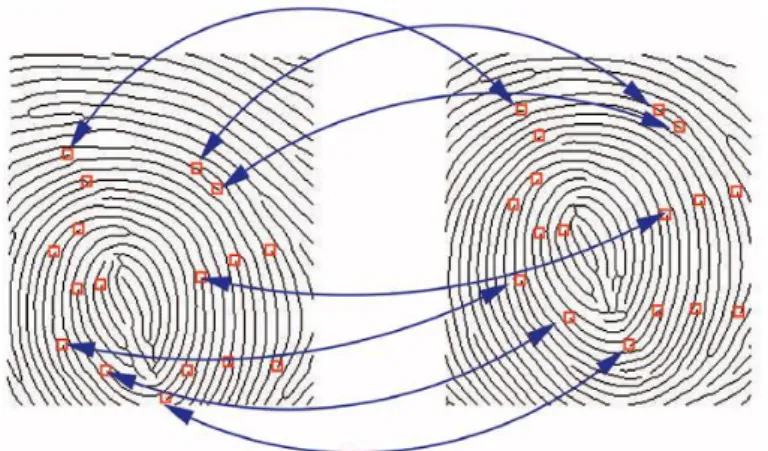
The minutiae extraction is performed after the pre-processing task: for each minutia, it determines the type (i.e. ending or bifurcation point), the spatial coordinates and the orientations. Then, a post processing task is performed in order to reduce the potential false minutiae number [72]. It is usually based on the Euclidean distance between minutiae pair. Finally, the biometric signature is created and the matching is performed (Figure 2.6). It calculates the correspondence between the obtained biometric signature and one or more stored templates, assigning a matching score to each template pair comparison.
Figure 2.6. Example of a minutiae-based matching: each arrow is linked to a pair of matched minutiae.
3.1.2
Singularity Points Approaches
Typical fingerprint recognition systems use singularity points for classification tasks. On the other hand, the common and available optical and photoelectric sensors give high quality fingerprint images with well-defined Core and Delta points, if they are present in the complete fingerprint.
In [75] authors propose a fingerprint matching based on singularity points position, orientation, and relative distance detection. As result, fingerprint matching involves the comparison between few features leading to a very fast system with recognition rates comparable to the standard minutiae based recognition systems. Their approach can be divided in two main steps:
delta extraction. The matching phase is performed using singularity regions analysis and topological region analysis. The most interesting technique of this approach is related with the two analysis in the matching phase. With more details, the singularity regions, concerned on core and delta points, have the following characteristic: the matching algorithm can be performed only if there is almost one singularity point for region of the same type. In the follows, a brief description of this techniques outlined.
In the singularity regions analysis, the algorithm receives as input two fingerprint images and the type of extracted singularity points. The comparison between the same type of singularity points (Core/Core and Delta/Delta) is performed analyzing the directional image. The considered part of image is a round neighbor centered on the singularity point with a dimension of 45x45 pixel. To perform the comparison between two singularity regions, the sum of the modules of difference among corresponding angles, using kernel of 5x5 pixel, is computed. The computed value represents the error distance (Equation (2.13)) This distance is used as input in an exponential function, (Equation (2.14)), to calculate the similarity index (Equation (2.15)). In the following equations the values K1, K2 and K3 are constant experimentally fixed.
5 5 ( , ) ( , ) 1 1 m dTest i j dTemplate i j i j (2.13)
(
2
)
(
1)
1
K
m
error
K
e
(2.14)3
similarity
K
error
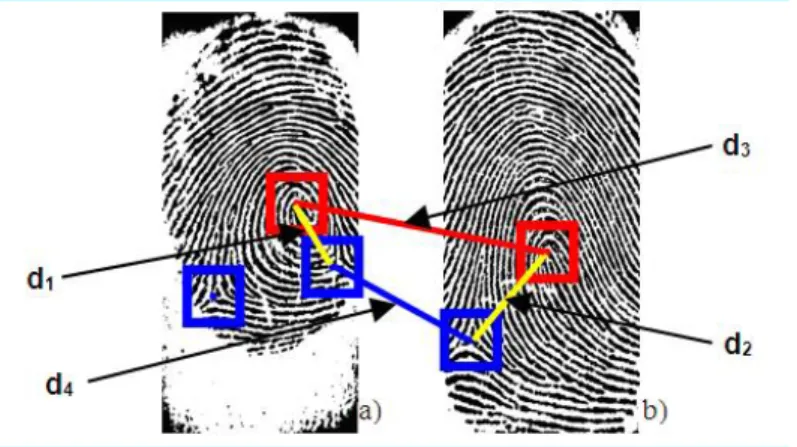
(2.15)In the topologic relations analysis, if the two fingerprint images have at least two singularity points then for each image the pair with smaller distance is chosen to perform the next comparison based on global characteristics (Figure 2.7). The smaller pairs is chosen to decrease the distortion problem and to increase the probability to extract real singularity points. After pairs individualization step, the type of these points is checked. For each pair of same points the Euclidean distance is calculated and this value is used as parameter. This parameter is the input of the exponential function, used for the singularity regions analysis (Equation (2.14)). If the distances are very near, the directional fields, of the four singularity points, will be checked:
if the two extracted pairs are composed by one Core and one Delta then a comparison between the two Core and the two Delta is performed respectively;
The pair with the lower error is chosen. The three error measures obtained are weighted and added to individualize the similarity index: the error measure related to the Core, the error measure related to the Delta and the error measure related to the topological relations.
Figure 2.7. a) fingerprint template image, b) test fingerprint image.
2.3
Fingerprint Classification
User identification requires a comparison of his/her template with all the ones stored in the database. When the database is very large, as in forensic scenarios, the identification time could be not acceptable. This time can be strongly reduced by simply dividing the fingerprint database into several classes, since the matching is performed only with fingerprints of the same class.
Fingerprint classification aims to assign a fingerprint to a class in a consistent and reliable way. It is generally based on global features, structural information, neural networks, fuzzy-neural networks, probabilistic model, artificial intelligence techniques and so on. Unfortunately, singularity points are not always present in fingerprint images, for example due to image acquisitions not correctly performed such as in partial fingerprint; in this case, may be useful the approach proposed in [30] using pseudo-singularity points.
2.3.1
Probabilistic Approaches
Jung and Lee in [31] use a probabilistic approach (Markov model) based on the ridge characteristics of fingerprint classes on FVC2000 DB1 and FVC2002 DB1 databases.
2.3.2
Singularity Points Approaches
This approach is commonly used by both automatic devices and human experts for manual classification [21].
The National Institute Standard Technology (NIST) has classified human fingerprints in five classes (Figure 2.6 a)), each characterized by n Core and m Delta, where n0,.., 2 and m0,.., 2 [19]. The Whorl class can be further divided into 4 sub-classes (Figure 2.6 b)).
Figure 2.6. a) The five NIST fingerprint standard classes.
Figure 2.6. b) Whorl classification in 4 sub-classes.
Generally, before the singularity points extraction the following steps are performed: directional map extraction, and computation of the Poincarè index [33].
Authors in [34] reduce the image distortion and contrast, before computing the fingerprint directional image on NIST Database. From this image, successively, they extract singular points and classify the fingerprint using topological and numerical considerations about these points
extraction and feature encoding. Successively, a fuzzy-neural network is used to implement the classification of input feature codes obtaining an average classification accuracy of 98.5% on NIST-4 database.
2.3.3
Syntactic Approaches
These approaches describe fingerprint patterns using terminal symbols and production rules. Then, they define a grammar or a string-matching technique for each class. Finally, by a parsing process they classify each new pattern [21]. Due to the great diversity of fingerprint patterns, syntactic approaches generally require very complex grammars. Their inference requires complicated and unstable techniques, therefore, the use of syntactic methods for fingerprint classification is not commonly used.
In [36], authors propose an approach based on the analysis of ridge line flow represented by a set of connected lines (Figure 2.7). It labels the lines according to the direction changes, thus obtaining a set of strings. Ad hoc grammars is used for the fingerprint classification.
Figure 2.7. String-construction approach proposed in [36].
2.3.4
Structural Approaches
In structural approaches a relational organization of low-level features into higher-level structures is performed. It can be represented by several symbolic data structures, such as trees and graphs [37]. Usually, these approaches split the directional image into connected regions characterized by homogeneous orientations, and analyze the relations among these regions.
Maio and Maltoni in [38] compute a relational graph, summarizing the fingerprint macro-structure, from the segmentation of the directional image into regions by minimizing a cost function that takes into account the variance of the element orientations within each region (Figure 2.8). The obtained graph is compared with model graphs in order to classify the fingerprint. They don’t say
Figure 2.8. Approach proposed in [38]: a) a fingerprint image; b) directional image partitions; c) related relational graph.
2.3.5
Neural Network Approaches
Literature neural network approaches are generally based on multilayer perceptrons and use the orientations of directional images as inputs [39].
Authors in [40] use a neural network as a decision stage. The network is ready to perform matching process and is successfully developed to identify and classify the fingerprint using back propagation algorithm. Their methodology has been validated on a standard database of 800 images (they don’t say the database name) classified into six classes obtaining a classification rate of 80.2%.
Authors in [41] uses a pyramidal architecture constituted of several multilayer perceptrons. Each perceptron is trained to recognize fingerprints belonging to a different class.
Authors in [42] uses a Weightless Neural Network (WNN) and 30 images per class for the training phase. WNNs represent a technique for building pattern recognition systems, belonging to the memory-based architectures. They are composed by a set of discriminators and each discriminator by a set of RAMs, where each RAM corresponds to a different pattern of the input data. The used WNNs based on the WISARD (Wilkie, Stonham’s, Alexander Recognition Device) approach use as discriminators the number of the different classes. Contrary to standard multi-layer neural networks, they can be implemented in simple hardware structures and trained very rapidly. Figure 2.9 shows the discriminator and the WISARD-based WNN architectures, where the 0 or 1 values are stored in RAMs: a value of 1 corresponds to a specific feature of the training set for a specific class. The RAM output value corresponds to a partial input data, while the discriminator output value is linked to the whole input data. The Winner-Take-All (WTA) module, on the basis of the maximum between the discriminators output value, performs the input pattern classification.
Figure 2.9. a) Discriminator architecture; b) WISARD-based WNN architecture.
In [43] authors use a feed-forward neural network (Figure 2.10 a)). Figure 2.10 b) shows the class separation obtained by their neural network.
Authors in [44] uses two disjoint neural networks. The singularity points location and a 20 x 20 orientation image are used for the training phase. The outputs of the two disjoint neural networks are then passed to a third network for the fingerprint classification.
Figure 2.10. a) feed-forward neural network; b) the obtained class separation.
T
HE
P
ROPOSED
I
NNOVATIVE
T
ECHNIQUES
AND
A
PPROACHES
Emerging ubiquitous technologies, such as Wireless Sensor Networks (WSNs) and Internet of Things (IoT), have attracted a lot of attention and are expected to bring benefits to several application areas. However, they are changing the way people communicate and use network services and functionalities. So, it is arguably required to investigate novel design techniques and technologies for user recognition, in order to provide a secure access to systems, data and resources.
The traditional authentication systems based on username and password are not able to guarantee a suitable protection level. Unlike passwords, instead, user biometric information is unique and unchangeable; therefore the biometric identity has the advantage to guarantee that only the authorized users have access to available resources and services. So, biometric recognition systems are a valid alternative to this traditional approach. Fingerprint authentication systems are the most commonly used. They are a rapidly evolving technology in mobile devices, with a very strong potential to be widely adopted in a broad range of human scenarios. However, there are many challenges to overcome in designing completely automatic and reliable systems, especially when input data are of poor quality and contains partial information.
Traditional biometric approaches involves interactions among a large number of entities: passive access points for user biometric trait acquisition, networked databases for user biometric identity storing, and trusted servers running the user recognition systems. So, traditional systems usually undergo several types of attacks. Embedded architectures, instead, provide a more secure and flexible infrastructure, since all elaboration steps are performed on board, so biometric identities are securely managed and stored inside the system without any data leaking out.
Chapter 3 – The Proposed Innovative
Embedded Sensor
3.2
Introduction
The growing number of mobile users has deeply influenced scenarios such as commercial, banking, and government applications. Due the increasing security requirements, the way people access information resources, data communication and processing, is radically changing. In this field, biometric recognition systems are a good solution for the security issues. They are a rapidly evolving technology in mobile devices: for example, they are recently available in the new generation of Apple [45] and Samsung smart phones [46].
Depending on the application context, a biometric recognition system may be used as authentication or identification system. An authentication system checks the person’s identity by comparing the captured biometric characteristic with his/her own biometric template enrolled in the system. It conducts a one-to-one comparison to determine whether the identity claimed by the individual is true. An identification system recognizes the subject by searching the entire template database for a match. It conducts one-to-many comparisons and establishes person’s identity or fails if he/she is not enrolled in the system database, without the subject having to claim an identity. A biometric recognition system may be further classified as unimodal, when one or more instances of a single biometric trait (e.g., multiple impressions of a finger) are processed. The system is classified as multimodal, when it uses one or more instances of multiple biometric characteristics (e.g., fingerprint and face images) [21]. Multi-algorithmic systems represent a particular multimodal systems class, where the same biometric trait is processed with different algorithms [47].
To reduce the processing time in identification systems, biometric characteristics can be classified in an accurate and consistent way such that the input needs to be matched only with a database subset. Fingerprint classification, for example, can be performed using a wide variety of algorithms, almost all based on one or more of the following features: neural network [42], Gabor filter and support vector machine [48], genetic programming [49], singularity points [50], etc.
fingerprint image acquisition). In that case, it may be useful the approach proposed in [51], where pseudo-singularity points are detected and extracted for fingerprints classification and matching.
Fingerprint recognition is a well-researched problem, and automatic techniques could be successfully adapted in a broad range of human scenarios. However, there are many challenges to overcome in designing completely automatic and reliable systems, especially when input data are of poor quality. For example, fingerprint acquisitions not correctly performed, because of skin humidity, impressing pressure, large translation on sensor area, sensing mechanism and so on, could lead to the following issues [52]:
Quite different ridges quality;
Ridges and valleys pattern deformation;
Insufficient contrast;
Small foreground area;
Inadequate overlapping area between different images although they are captured from the same finger.
In this thesis, a novel embedded Automatic Fingerprint Authentication System (AFAS) for mobile users is described. The goal of the proposed approach is to improve the performance of a standard embedded AFAS, in terms of used resources, execution time and working frequency, in order to enable its employment in mobile devices architectures. Starting from the work described in [53], focused only on an advanced matching technique for partial fingerprints, the novel embedded AFAS has been prototyped adding the proposed fingerprint image quality evaluation module. This module is designed to find a measure that can characterize the quality of raw fingerprint images, only using the information achieved in the acquisition step. The quality index calculates and merges six different global quality indexes based on: image contrast, ridges orientation certainty level, fingerprint’s center position, impressing pressure and fingerprint size over the entire image. It is also specialized in identifying areas of poor quality. If the image overcomes the quality constraints only good areas are processed reducing the potential false minutiae number. Otherwise, if the image is rejected, the system suggests to user a set of information about the not correct acquisition step, helping him to follow correct guidelines to obtain a better image quality in the next fingerprint acquisition task (Figure 3.1).
Figure 3.1. Image Quality Evaluation Module classifies the fingerprint image quality, identifies high quality areas. It checks if the fingerprint is centred over the image. If an image is rejected, a suggestions feedback is given, to the user for the next fingerprint acquisition tasks.
The proposed AFAS architecture has been designed for Field Programmable Gate Array (FPGA) devices using pipeline techniques and parallelisms in order to reduce the execution time. It has been prototyped on the Agility RC2000 development board, equipped with a Xilinx Virtex-II xc2v6000 FPGA [54]. To evaluate the effectiveness of the proposed embedded sensor, three tests have been conducted starting from two different free databases, chosen for their different characteristics in terms of resolution and image dimensions.
The AFAS described in [55] has been extended with the proposed fingerprint image quality evaluation module and the efficient features extractor described in [70]. Experimental trials on the FVC2002 DB2-B database [56] show that the accuracy performance has been strongly increased. Then, the matching algorithm has been replaced with the advanced technique for partial fingerprints proposed in [53]. Experimental results on the PolyU database [57] show an interesting trade-off between required hardware resources, authentication time and accuracy rate. Finally, the fingerprint image quality evaluation module has been replaced with a pre-processing module to enhance fingerprint images, a Gabor filter, and the system has been tested on the same PolyU database. The obtained experimental results prove the validity of the proposed novel AFAS.
3.2.1
Remarks on Fingerprint Image Quality Evaluation Methods
One of the main techniques to test the performance of an automatic fingerprint recognition system relies heavily on the quality analysis of the acquired fingerprint image [58]. In literature many researchers have studied, proposed and implemented different methods for evaluating the images quality, using for example artificial neural networks, micro and macro features analysis, texture feature estimates and so on.
the number of minutiae and the existence of singular points. The authors define seven quality indexes and also two weighting methods, an overlapping area based method and a linear regression method, for computing the correlation between the final quality value and each quality index.
In [76] the authors present a fast fingerprint enhancement algorithm, based on the estimated local ridge orientation and frequency, which can adaptively improve the clarity of ridge and valley structures of input fingerprint images. It models the ridge and valley patterns as a sinusoidal wave, and then calculates the amplitude, frequency, and variance of the wave to determine the quality of the fingerprint regions.
In [59] the authors define a method not aimed at selecting images of good visual appearance, but aimed at identifying poor quality as well as invalid fingerprints for automatic fingerprint identification systems. It analyses the image in the spatial domain and uses the orientation certainty to certify the localized texture pattern, while ridge and valley structure to detect invalid images.
In [60] the authors implement an effective quality classification method for fingerprint images based on neural networks. It uses effective area, energy concentration, spatial consistency and directional contrast as quality indexes. A comparison with individual quality index thresholding and linear weighted sum method, on a private database, shows the higher quality classification accuracy of their method.
In [61] the authors describe a novel method for estimating the quality of fingerprint images using both local and global analyses. They propose a fusion method mixing the information from ridge and valley line resolution, fingerprint area and gray levels average and variance, using the golden section method to select the relevant weights value.
In [62] the authors propose a novel quality-checking algorithm which considers the condition of the input fingerprints and the orientation estimation errors. First, the 2-D gradients of the fingerprint image is separated into two sets of 1-D gradients, and then, the shape of the probability density functions of these gradients is measured in order to determine the fingerprint quality.
In [63] the authors present an image quality assessment technique for a novel fingerprint multimodal algorithm to provide high accuracy under non-ideal conditions. It uses the Redundant Discrete Wavelet Transform to assess the image quality, for high resolution fingerprint databases, by determining the presence of noise, smoothness, and edge information in a fingerprint image. Successively, in [64] the authors extend this technique designing a local image quality assessment algorithm. They use it as the first step of a novel algorithm for fast extraction and identification of level-3 features, such as pores, ridge contours, dots and incipient ridges.
mobile devices, a mixed method has been designed and integrated in the proposed novel embedded AFAS. It is based on a fingerprint image global analysis in the spatial domain and it is inspired by works described in [52][59].
3.3
The Proposed Novel Embedded Fingerprint Authentication
System
The proposed minutiae based AFAS is focused on the acquired raw image quality evaluation identifying poor quality areas, such as dry and moist portions, in order to overcome the common problems in wrong acquisitions on mobile devices. The system checks if the distance between image center and the fingerprint center coordinates is lower than an experimental fixed threshold in order to extract the maximum number of corresponding minutiae. If this condition is verified and the image overcomes the quality constraints, only high quality image portions are processed. Otherwise, the image is rejected and the system gives to the user suggestion feedbacks about the wrong acquisition step, helping him to obtain a better image quality in the next fingerprint acquisition task. In addition, an advanced matching technique for user recognition, based on partial fingerprints, is performed to improve the system accuracy [53]. This technique calculates a likelihood ratio by trying every possible overlaps of the acquired fingerprint with the enrolled one. The roto-translation parameters computation is based on the similar minutiae pairs identification belonging to both fingerprints.
Considering the functionalities of the proposed system, three main components can be identified: the User Interface (UI), which enables the user to interact with the system, the Acquisition Module (AM), which deals with the fingerprint image acquisition, and the Processing Module (PM), based on the FPGA processing engine implementing the authentication phase (Figure 3.2).
Using the proposed PM, no image enhancement after fingerprint acquisition is performed. Therefore, a considerable savings in terms of execution time and hardware resources has been achieved with respect to a standard AFAS implementation. With more details, the proposed AFAS requires an Image Quality Evaluation module, including a Binarization module, a Thinning module, a Feature Extraction module, an Alignment module, and, finally, a Matching module. Despite to a standard AFAS implementation no Normalization, Enhancement, Field Orientation, Filtered Orientation and Smoothing tasks are required (Figure 3.3).
Figure 3.3. Comparison between the proposed AFAS (on the left) and the standard AFAS (on the right).
In the following subsections the main sub-modules of the proposed novel AFAS will be described.
3.3.1
Fingerprint Image Quality Evaluation module
This module, inspired by works described in [52][59], evaluates the fingerprint image quality through a global analysis in the spatial domain. With more details, it analyses the image by blocks, calculates the fingerprint central position, identifies the dry and moist blocks, and classifies the image quality into two levels.
Figure 3.4 shows the architecture of the proposed module. It is composed of Image Blocks Analyzer sub-module, Indexes Calculator sub-module, Quality Level Evaluator sub-module. The Image Block Analyzer sub-module is composed of Max Min Level Calculator sub-module, Orientation Certainty Level Calculator sub-module, Average Calculator sub-module, Variance
In the follow, the sub-modules are described.
Image_Blocks_Analyzer sub-module
This sub-module is able to process block by block the fingerprint image. For each block it calculates, in a concurrent way, the following features:
Max and min gray level. These local values are used to calculate the global max and min gray level of the entire image;
Gray levels average and variance. These values are used to classify blocks as foreground/background and as dry/moist/good;
Ridges orientation certainty level (ocl). This value, only for foreground blocks, is added to the ocl_accumulator signal, subsequently used for the calculation of the 2nd index.
After that, in a concurrent way, it identifies the fingerprint high quality areas and calculates the fingerprint central position. The following subsections describe the main sub-modules of the proposed Image_Blocks_Analyzer sub-module.
Orientation_Certainty_Level_Calculator sub-module
A fingerprint image block generally consists of ridges separated by valleys with the same orientation. Ridges and valleys constant structure and regular orientation can be used to evaluate the quality of each considered block. They are analytically calculated through the gradient of the gray levels along the x and y directions of a pixel [59]. The covariance matrix C of the gradient vector for an image block of M points is given by:
C = E {[dxdy] [dx dy]} = [a cc b]
where
E{•} = 1
M∑•
M
The ridges orientation certainty level (ocl) is calculated as shown in Eq. (3.1).
ocl = 100 ∗ (a + b) − √(a − b)2+ 4c2
sub-module is further composed of two sub-modules, implementing a two stage pipeline (Figure 3.6). While the first module calculates the covariance matrix C of block j, the second sub-module calculates the ocl value of j-1 block.
Figure 3.5. Examples of different ocl values.
Figure 3.6. Orientation_Certainty_Level_Calculator sub-module.
Average_Calculator and Variance_Calculator sub-modules
Average and variance are important characteristics for evaluating the block quality: average measures the luminosity, while variance measures the contrast. A low average value is linked to a block prevalently containing ridges (because it is dark), while a low variance value entails the block doesn’t contain any useful portion of the fingerprint (because it has a low contrast).
Block_Analyzer sub-module
The ocl characteristic is not sufficient to quantify the clearness of the fingerprint ridges and valleys pattern when the skin humidity is also considered. For a moist block the ridges are too thick, since it has low average value. On the other hand, the ridges are too thin for a dry block, since it has a high average value. So, the average value is heavily influenced by the background gray level intensity (Figure 3.7). In this work, the gray level intensity of the image background is fixed to be the average value of the first image block, since it does not usually contain part of the fingerprint. If the block contains part of the fingerprint (i.e. the fingerprint covers the entire image) the background gray level is assumed as dark.
Figure 3.7. Examples of average and variance values with dark and bright background.
This sub-module compares the average value of the first block with an experimental fixed threshold classifying the background as dark or bright and setting moist and dry thresholds. These values are experimentally fixed and depend on the used database. As example, on the FVC2002 DB2-B, the dry thresholds are 140 and 180 for bright and dark background, respectively, while the moist thresholds are 80 for dark background and 100 otherwise. Successively, it classifies each block as foreground or background using the incoming variance value. The foreground threshold is not influenced by the background gray level and it is experimentally fixed to 190.
Fingerprint_Center_Calculator sub-module
This sub-module calculates, in a concurrent way, the fingerprint central position (Figure 3.8). It checks if the considered block belongs to the column Nx/2, Nx/4 or 3Nx/4. If so then, if it is of foreground, a value equal to the block size is added to the relevant column foreground accumulator (an accumulator for each considered column), otherwise only if this accumulator value is zero, the same value is added to the relevant column background accumulator (i.e. the background blocks below the fingerprint are discharged). Concurrently, the same check is performed on the rows Ny/2, Ny/4 or 3Ny/4, and, in the same way, the relevant row background or foreground accumulator is increased. Finally, for the last block, the column foreground accumulator with the highest value is
Avg=162 Avg=255 Avg=64 Avg=84 Avg=145 Avg=89 Var=4514 Var=997 Var=1885 Var=3348 Var=530 Var=1299
stored in the selected foreground accumulator and the relevant column background accumulator value. Concurrently, the x-coordinate of the fingerprint’s center is calculated in the same way.
Figure 3.8. Example of a FVC2002 fingerprint’s center calculation.
Indexes_Calculator sub-module
Among common quality indexes present in literature and reported in the related works section, this subsystem concurrently calculates six global indexes, designed in order to realize a module reducing used resources and execution time. To make all indexes compatible, they have normalized in the range of [0, 100]. High index value entails a good image quality.
Index1_Calculator sub-module
The first index measures the contrast between fingerprint and background. This value is calculated as the difference between the maximum and the minimum gray level value of the entire image, Eq. (3.2):
index_1 = 100 ∗ (max_gl − min_gl )/255 (3.2)
Index2_Calculator sub-module
The second index extends to the whole image the considerations about the block orientation certainty level estimation, thus, globally measuring the clarity and continuity of ridges and valleys orientation. It is calculated by averaging all the ocl values relating to only foreground blocks, Eq. (3.3):
Index3_Calculator sub-module
The third index measures the humidity of the entire image and it is calculated as the ratio between the number of moist blocks and the number of foreground blocks, Eq. (3.4):
index_3 = 100 − (100 ∗ moist_blocks
foreground_blocks) (3.4)
Index4_Calculator sub-module
The fourth index measures the dryness of the entire image and it is calculated as the ratio between the number of dry blocks and the number of foreground blocks, Eq. (3.5):
index_4 = 100 − (100 ∗ dry_blocks
foreground_blocks) (3.5)
Index5_Calculator sub-module
The fifth index measures the image area occupied by the foreground blocks. It is an estimate of the fingerprint