www.ijtra.com Volume 3, Issue 2 (Mar-Apr 2015), PP. 241-245
INTELLIGENT CLOUD SECURITY BACK-UP
SYSTEM
Tanay Kulkarni
1, Sumit Memane
2, Onkar Nene
3, Krupali Dhaygude
4 Students of Department of Computer Engineering,RMD Sinhgad School of Engineering, Pune, Maharashtra, India
Abstract: Data generated in electronic form are in large amount in cloud computing. There is a necessity of data recovery services to maintain this data efficiently. To cater this, in this paper we have obtained a smart remote data backup plan using Seed Block Algorithm (SBA) with Advance Encryption Standard (AES) Algorithm. In this paper we have obtained and implemented a procedure which allows users to store their data onto the cloud, as soon as the file is stored at the first cloud server it gets encrypted using AES Algorithm. SBA helps to recover that file from a backup file which is stored at a remote location in case if the certain file gets deleted due to any reason. The time related issues are also being solved by the obtained method such that it will take minimum time for the recovery process. Described method also focuses on the security concept for the back-up files stored at remote server using AES encryption algorithm.
Keywords: - Seed Block Algorithm, AES, Cloud back-up, Remote cloud, Main Cloud
I. INTRODUCTION
Today, Cloud Computing is itself a gigantic technology because of its advantages over previous systems like grid or cluster computing. Cloud storage provides online storage where data stored in form of virtualized pool that is usually hosted by third parties. Number of users share the same cloud storage provided by a certain service provider.
Faulty equipments, a human error, network connectivity, a bug or any criminal intent may put our cloud storage’s security at stake. Cloud service provider may also make some changes in the configuration; this may lead to loss of alteration of the information stored by user. There is possibility of data loss. To solve these difficulties we need to provide data integrity for our cloud. In literature many techniques have been proposed PCS[1], HSDRT[2], Linux Box [3], ERGOT[4], Cold/Hot backup strategy [5] etc. that, discussed the data recovery process. However, still various successful techniques are lagging behind in some critical issues like implementation complexity, low cost, security and time related issues.
To overcome the disadvantages of previously proposed systems we have proposed and are implementing a new method based on Seed Block Algorithm (SBA) and Advance Encryption Standards (AES) Algorithm. The mentioned procedure works in following manner: in first step it allows users to collect and store their files onto the main cloud. As soon as the files get stored at the cloud, those get encrypted using AES algorithm. In step two, in case of file deletion it
helps user to recover the files. This paper is organized as follows: Section II focuses on the related literature of existing methods those are successful to some extent in the cloud computing domain. In Section III, we discuss about the remote data backup server. Section IV describes the obtained method based on AES and SBA algorithms and section V shows the results and experimentation analysis of the proposed and implemented method. In the last section VI conclusion is mentioned of the mentioned method.
II. LITERATURE SURVEY
In literature survey, we have studied the most recent back-up and recovery techniques that have been developed in cloud computing domain such as PCS[1], HSDRT[2], Linux Box [3], ERGOT[4], Cold/Hot backup strategy [5] etc. When we studied the existing methods in detail we found that, performance of the system is not satisfactory with respect to cost, security, low implementation complexity, redundancy and recovery in short span of time.
We inferred after study of various present techniques that PCS is comparatively reliable, simple, easy to use and more convenient for data recovery totally based on parity recovery service. It makes use of the Exclusive–OR functionality for creating Parity information. However, there are some problems associated with this method.
On the other side, HSDRT[2] method ensures as a powerful technique for the movable clients such as laptop, smart devices, palmtops etc. However it is not economical for the implementation of the recovery and also unable to control the data replication.
We also observed that Linux Box model is having very simple concept of data back-up and recovery with very low cost. But in this model protection level is very low. The limitation we found that a consumer can backup not only the Data but Sync the entire Virtual Machine[3] which somehow waste the bandwidth because every time when backup takes place it will do back-up of entire virtual machine.
Moreover, Efficient Routing Grounded on Taxonomy (ERGOT) [4] features the semantic analysis and fails to focus on time constraints and implementation complexity. It is a Semantic-based System which helps for Service Discovery in cloud computing. ERGOT is built upon 3 components viz. 1) A DHT (Distributed Hash Table) protocol 2) A SON (Semantic Overlay Network), 3) A measure of semantic similarity among service description [4].
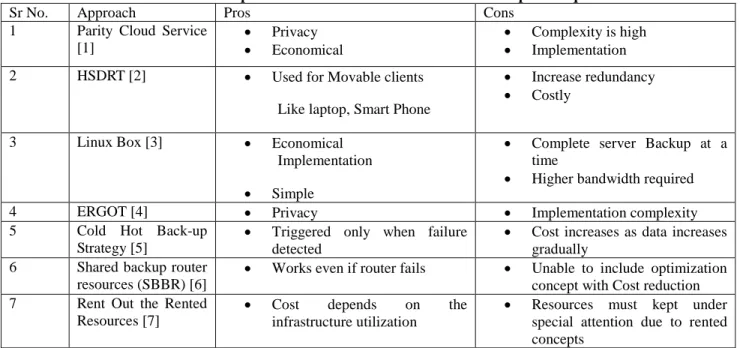
www.ijtra.com Volume 3, Issue 2 (Mar-Apr 2015), PP. 241-245 Table No.1 Comparison Between Various cloud data back-up techniques
Sr No. Approach Pros Cons
1 Parity Cloud Service [1]
Privacy Economical
Complexity is high Implementation
2 HSDRT [2] Used for Movable clients
Like laptop, Smart Phone
Increase redundancy Costly
3 Linux Box [3] Economical
Implementation Simple
Complete server Backup at a time
Higher bandwidth required
4 ERGOT [4] Privacy Implementation complexity
5 Cold Hot Back-up
Strategy [5]
Triggered only when failure detected
Cost increases as data increases gradually
6 Shared backup router resources (SBBR) [6]
Works even if router fails Unable to include optimization concept with Cost reduction 7 Rent Out the Rented
Resources [7]
Cost depends on the
infrastructure utilization
Resources must kept under special attention due to rented concepts
All the existing solutions for cloud back-up system somehow fail in various aspects. The pros and cons of all these foresaid techniques are described in the Table-I. The role of a remote data back –up server is very crucial and hot research topic due to the high applicability of backup process in the companies.
III. REMOTE DATA BACKUP SERVER AND ITS ARCHITECTURE
When we think about Backup server of main cloud, we only talk about the replicate of main cloud server. When this Backup server is at remote location and having the complete state of the main cloud, then this remote location server is identified as Remote Data Backup Server.
And in case if the central repository loses its data under any scenarios both of any natural calamity or by human attack or deletion that has been done by mistake and then it uses the information from the remote server. The main purpose of the remote backup facility is to help user to collect information from any remote location even if data not available on main cloud. As shown in Fig-1 clients can access the files from remote repository even if the data is not available on central repository.
Figure 1. Remote data Backup Server and its Architecture
The Remote backup services should fulfill the following aspects:
A. Data Confidentiality
Client’s data files should be kept confidential such that if no. of users simultaneously accessing the cloud, then data files that are personal to only particular client must be able to hide from other clients on the cloud during accessing of file.
B. Data Integrity
Data integrity verifies the data such that it remains unaltered during transmission and reception. It is the measure of the validity and fidelity of the data present in the server.
3. Data security
Data Security deals with protecting the client’s data is also the utmost priority for the remote server.
4. Trustworthiness
The cloud should be trustworthy. Clients may store their private data on the main cloud, so the main as well as the remote back-up cloud should be trustworthy.
5. Cost efficiency
The recovery cost should be lesser. Lesser the cost of recovery, better the system’s rating will be.
In the next section we will be discussing a technique of back-up and recovery in cloud computing domain that will cover the issues mentioned before.
IV. DESIGN OF THE IMPLEMENTED SYSTEM
As discussed in previous sections, to overcome the limitations of the existing system we have proposed and are implementing a new system which makes use of Seed Block Algorithm with Advance Encryption Standard algorithm. In this section complete analysis of this method is mentioned.
A. Advance Encryption Standard
Encryption Phase:
The Advanced Encryption Standard (AES) is a symmetric key encryption standard. The standard consists of three block
www.ijtra.com Volume 3, Issue 2 (Mar-Apr 2015), PP. 241-245 Rijndael. Each of these ciphers has a 128-bit block size with
key sizes of 128, 192 and 256 bits respectively. The key size used for an AES cipher denotes the number of repetitions of transformation rounds that converts the input called the plaintext into the final output called as cipher text. After generating the cipher text from the plain text, the encrypted file is stored on the main cloud and that file is only getting backed-up on the remote server.
B. Seed Block Algorithm (SBA)
This algorithm basically uses the concept of Exclusive– OR (XOR) operation of the computing world. Seed Block has two sequences first is back-up sequence and second is restore sequence. In the main cloud we set a random number and seed for each client that wants to store data onto the cloud. In the next step, previously generated random number and seed are EXORed to form the seed. The seed which is generated by this process is unique for each client. Whenever client creates the file in cloud first time, it is stored at the main cloud and gets encrypted using AES. After that the main file of client is being EXORed with the Seed Block of the particular client. In this manner a back-up file for the main file is created by the server and the back-up file is stored at the back-up cloud which is at remote location. Unfortunately if the file in the main cloud server gets deleted due to any reason, user can retrieve the lost file from remote back-up server with the help of Seed Block which is unique for each user.
The Seed Block Algorithm is as follows: Initialization:
Main Cloud Server: - Mc; Remote Cloud Server: - Rs;
Clients of Main Cloud: - Ci; Files:-a1, a1’ and a1’’;
Seed Block: - Seedi;
Random Number: - Rani; Client’s Id: - Clientid
Input: Client ci is created at main server; a1 created by client;
a1’ is generated after applying AES to a1; Rani is generated at
Mc.
Output: Recovered File a1’ after deletion at main cloud Mc.
Given: Authenticated clients allow uploading, downloading and do modification on its own files only.
Step 1: Generate a random number. int Rani =ran_no( );
Step 2: Create a Seed Block for each Ci and Store Seedi at Rs.
Seedi = Rani XOR Clientid (Repeat Step2 for all clients).
Step 3: If Ci modifies a1 and stores at Mc, then a1’ is created
after applying AES and a1’’ is created as a1’’=a1’ XOR Seedi;
Step 4: Store a1’’ at remote cloud server Rs;
Step 5: If server crashes a1’ deleted from Mc, then we do
EXOR to retrieve the original a1’ as a1’=a1’’ EXOR Seedi;
Step 6: Return a1 to Ci after decrypting a1’.
Step 7: End.
V. EXPERIMENTATION AND RESULT ANALYSIS
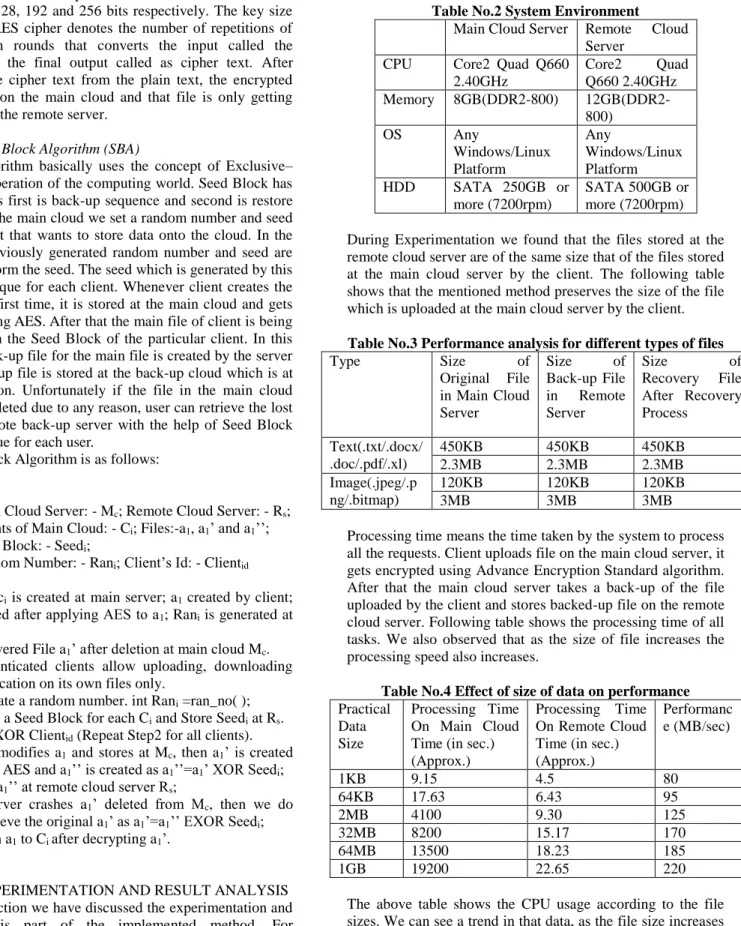
In this section we have discussed the experimentation and result analysis part of the implemented method. For experimentation purpose we have taken a system with minimal specification for main cloud as well as remote cloud. Minimal specifications are given as per in the following table:
Table No.2 System Environment Main Cloud Server Remote Cloud
Server CPU Core2 Quad Q660
2.40GHz Core2 Quad Q660 2.40GHz Memory 8GB(DDR2-800) 12GB(DDR2-800) OS Any Windows/Linux Platform Any Windows/Linux Platform HDD SATA 250GB or more (7200rpm) SATA 500GB or more (7200rpm) During Experimentation we found that the files stored at the remote cloud server are of the same size that of the files stored at the main cloud server by the client. The following table shows that the mentioned method preserves the size of the file which is uploaded at the main cloud server by the client. Table No.3 Performance analysis for different types of files
Type Size of Original File in Main Cloud Server Size of Back-up File in Remote Server Size of Recovery File After Recovery Process Text(.txt/.docx/ .doc/.pdf/.xl) 450KB 450KB 450KB 2.3MB 2.3MB 2.3MB Image(.jpeg/.p ng/.bitmap) 120KB 120KB 120KB 3MB 3MB 3MB
Processing time means the time taken by the system to process all the requests. Client uploads file on the main cloud server, it gets encrypted using Advance Encryption Standard algorithm. After that the main cloud server takes a back-up of the file uploaded by the client and stores backed-up file on the remote cloud server. Following table shows the processing time of all tasks. We also observed that as the size of file increases the processing speed also increases.
Table No.4 Effect of size of data on performance Practical
Data Size
Processing Time On Main Cloud Time (in sec.) (Approx.)
Processing Time On Remote Cloud Time (in sec.) (Approx.) Performanc e (MB/sec) 1KB 9.15 4.5 80 64KB 17.63 6.43 95 2MB 4100 9.30 125 32MB 8200 15.17 170 64MB 13500 18.23 185 1GB 19200 22.65 220
The above table shows the CPU usage according to the file sizes. We can see a trend in that data, as the file size increases the time taken to process task also increases.
www.ijtra.com Volume 3, Issue 2 (Mar-Apr 2015), PP. 241-245 User Interface:-
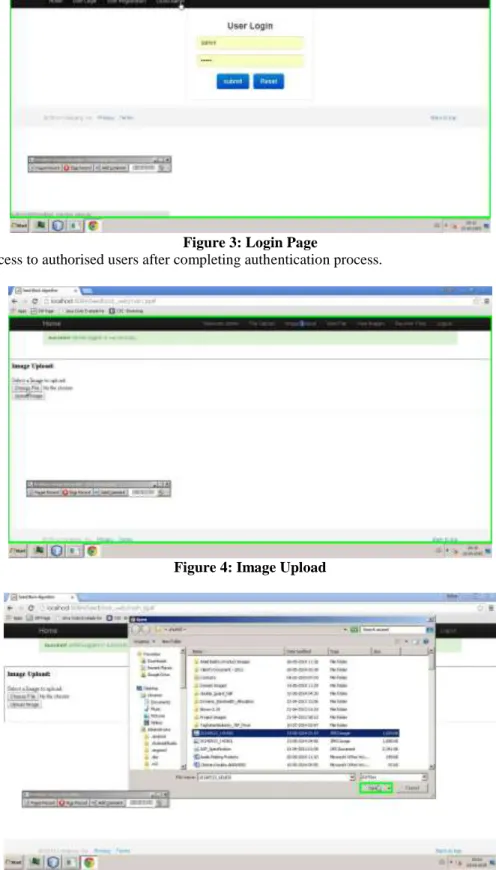
Login
Figure 3: Login Page
This page will provide access to authorised users after completing authentication process. Image Upload
Figure 4: Image Upload
Figure 5: Image Selection View These two pages give the details about image uploading
procedure that takes place in the system
www.ijtra.com Volume 3, Issue 2 (Mar-Apr 2015), PP. 241-245 0 50 100 150 200 Without Verifiaction Link With Verification Link
ti
me
in
s
e
co
n
d
s
Sign up time with
and Without
Verification Link
VI. CONCLUSION
In this paper, we presented detailed design of SBA and AES algorithms. Implemented system helps clients to collect their files from remote server cloud. Experimentation and result analysis shows that implemented system also focuses on the security concept for the back-up files stored at remote server, by using AES algorithm. The time related issues are also being solved by proposed system such that it will take minimum time for the recovery process.
REFERENCES
[1] Chi-won Song, Sungmin Park, Dong-wook Kim, Sooyong Kang, 2011, “Parity Cloud Service: A Privacy-Protected Personal Data Recovery Service,” International Joint Conference of IEEE TrustCom-11/IEEE ICESS-11/FCST-11. [2] Yoichiro Ueno, Noriharu Miyaho, Shuichi Suzuki,Muzai
Gakuendai, Inzai-shi, Chiba,Kazuo Ichihara, 2010, “Performance Evaluation of a Disaster Recovery System and Practical Network System Applications,” Fifth International Conference on Systems and Networks Communications,pp 256-259.
[3] Vijaykumar Javaraiah Brocade Advanced Networks and Telecommunication Systems (ANTS), 2011, “Backup for Cloud and Disaster Recovery for Consumers and SMBs,” IEEE 5th International Conference, 2011.
[4] Giuseppe Pirr´o, Paolo Trunfio , Domenico Talia, Paolo Missier and Carole Goble, 2010, “ERGOT: A Semantic-based System for Service Discovery in Distributed Infrastructures,” 10th IEEE/ACM International Conference on Cluster, Cloud and Grid Computing.
[5] Lili Sun, Jianwei An, Yang Yang, Ming Zeng, 2011, “Recovery Strategies for Service Composition in Dynamic Network,” International Conference on Cloud and Service Computing.
[6] Eleni Palkopoulouy, Dominic A. Schupke, Thomas Bauscherty, 2011, “Recovery Time Analysis for the Shared Backup Router Resources (SBRR) Architecture”, IEEE ICC. [7] Sheheryar Malik, Fabrice Huet, December 2011, “Virtual
Cloud: Rent Out the Rented Resources," 6th International Conference on Internet Technology and Secure Transactions,11-14 ,Abu Dhabi, United Arab Emirates. [8] r. Rathika1, dr. K. Raja2 “secured searching of valuable data
in a metric space based on similarity measure” ijcsmc, vol. 2, issue. 4, april 2013, pg.507 – 512.
[9] A.V. Evfimievski, R. Srikant, R. Agrawal, and J. Gehrke. Privacy preserving mining of association rules. In KDD, pages 217–228, 2002.