
Standard
Business
Reporting
IFRS AU Taxonomy 2014 Guide
Program name:
Standard Business Reporting
Date: 19
thJune 2014
Production Release – suitable for use
This document and its attachments are Unclassified
For further information or
questions, contact the SBR
Service Desk at
[email protected]
or call 1300 488 231.
International callers may use
+61-2-6216 5577
Version
Release date
Description of changes
2011
29 July 2011
The release of the IFRS AU Taxonomy 2011 Guide
2012
26 July 2012
The release of the taxonomy guide for the IFRS AU
Taxonomy 2012. This version of the taxonomy
includes the IFRS Taxonomy 2012 (as released by the
IFRS Foundation on 29 March 2012) and other
updates to the AU Extension.
2013
20 June 2013
The release of the taxonomy guide for the IFRS AU
Taxonomy 2013. This version of the taxonomy
includes the IFRS Taxonomy 2013 (as released by the
IFRS Foundation on 27 March 2013) and other
updates to the AU Extension.
2014
19 June 2014
The release of the taxonomy guide for the IFRS AU
Taxonomy 2014. This version of the taxonomy
includes the IFRS Taxonomy 2014 (as released by the
IFRS Foundation on 5 March 2014) and other updates
to the AU Extension.
ENDORSEMENT
APPROVAL
Chief Solutions Architect
Standard Business Reporting
Doug Niven
Senior Executive Leader
Financial Reporting & Audit
Australian Securities and Investments Commission
Copyright
© Commonwealth of Australia 2014
This work is copyright. Use of this Information and Material is subject to the terms and
conditions in the "SBR Disclaimer and Conditions of Use" which is available at
http://www.sbr.gov.au. You must ensure that you comply with those terms and conditions. In
particular, those terms and conditions include disclaimers and limitations on the liability of the
Commonwealth and an indemnity from you to the Commonwealth and its personnel, the SBR
Agencies and their personnel.
You must include this copyright notice in all copies of this Information and Material which you
create. If you modify, adapt or prepare derivative works of the Information and Material, the
notice must still be included but you must add your own copyright statement to your
adaptation or derivative work and you must include an acknowledgement that the adaptation,
modification or derivative work is based on Commonwealth or SBR Agency owned Information
and Material. Copyright in SBR Agency specific aspects of the SBR Reporting Taxonomy is
owned by the relevant SBR Agency.
Table of contents
1
Introduction... 6
1.1
Purpose... 6
1.2
Audience and Scope ... 6
1.3
References... 6
1.4
Change Management... 7
2
Financial reporting content ... 8
2.1
Introduction ... 8
2.2
Compliance requirements ... 8
2.3
Comparisons with other SBR reports ... 9
2.3.1
Public Availability... 9
2.3.2
Free-form Disclosure ... 9
2.3.3
Lodgement and Assurance Requirements... 10
3
IFRS AU Taxonomy Architecture... 11
3.1
Australian Extension of the IFRS Taxonomy ... 11
3.1.1
Background ... 11
3.1.2
Content ... 11
3.1.3
Changes to the previous version ... 12
3.1.4
Company extensions ... 12
3.1.5
Issue, releases, and effective date ... 13
3.2
Modelling of the IFRS AU Taxonomy 2014... 14
3.2.1
Hierarchical modelling ... 14
3.2.2
Axes Modelling ... 15
3.3
Structure of the IFRS AU Taxonomy 2014 ... 18
3.3.1
Folders and file structures ... 18
3.3.2
Absolute and relative paths ... 19
3.3.3
DTS discovery ... 20
3.3.4
Namespaces ... 20
3.3.5
Core, role and entry-point schema... 21
3.3.6
Deprecated schema ... 21
3.3.7
Linkbases ... 21
3.3.8
Reference linkbase... 23
3.3.9
Label linkbase ... 24
3.3.10
Negated labels ... 24
3.3.11
Presentation linkbases... 25
3.3.12
Calculation linkbases... 26
3.3.13
Definition linkbases... 26
3.3.14
Generic label and reference linkbases... 26
3.4
Dimensions Specification ... 26
3.4.1
"Applied" dimensions... 27
3.4.2
"For application" dimensions ... 28
4
Preparer's guide ... 31
4.1
Mapping to THE IFRS AU Taxonomy 2014 ... 31
4.2
Context Specifications... 31
4.3
Additional guidance for tagging line items presented in primary financial statements35
4.4
Units and Decimals ... 37
4.4.1
Monetary Amounts ... 38
4.4.2
Share Counts ... 38
4.4.3
Earnings Per Share ... 38
4.5
Validation of instance document... 39
5
Messaging Instructions ... 41
Terminology
For definition of the terminology and acronyms used within this document please refer to the glossary
on the SBR website and on the IFRS Foundation website.
Click http://www.sbr.gov.au/software-developers/developer-tools/glossary to go to the SBR glossary.
Click http://www.ifrs.org/XBRL/Resources/Glossary.htm to go to the IFRS glossary
The key words “MUST”, “MUST NOT”, “REQUIRED”, “SHALL”, “SHALL NOT”, “SHOULD”, “SHOULD
NOT”, “RECOMMENDED”, “MAY”, and “OPTIONAL” in this document are to be interpreted as
described in RFC 2119 http://www.ietf.org/rfc/rfc2119.txt. The use of the word “Mandatory” is to be
read as “MUST”.
1
INTRODUCTION
1.1
PURPOSE
The purpose of this document is to support software developers with the implementation of the SBR taxonomy used for creating XBRL financial reports (instance documents) that is lodged with ASIC.
1.2
AUDIENCE AND SCOPE
This document is the supplementary guide for the implementers of SBR ASIC Forms 388, 7051, FS70, and 405 and it should be read in conjunction with the Message Implementation Guides (MIGs) for the abovementioned forms. It can also be used by implementers of the instance documents as standalone functionality.
This document is designed to explain the Australian jurisdictional extension to the International Financial
Reporting Standards (IFRS) Taxonomy (referred to as "the IFRS AU Taxonomy" or "the Taxonomy") to an extent that will allow software developers to understand the mapping and tagging requirements involved in implementing the Taxonomy for financial reporting and how to produce valid instance documents for lodgement with ASIC through SBR.
It is assumed that the readers are familiar with XBRL terminology and concepts and therefore this guide is not designed to be a XBRL technical guide or to address any specific software product issues. For certain parts of the document, it is also assumed that readers are familiar with the basic financial reporting concepts.
This version of the IFRS AU Taxonomy (referred to as "the IFRS AU Taxonomy 2014") is based on the IFRS Taxonomy 2014 (as issued by the IFRS Foundation). It is recommended that relevant reference documentation of the IFRS Taxonomy 2014 should be referred to in conjunction with this document.
The IFRS Taxonomy 2014 is compliant with the provisions of the Global Filing Manual (GFM), published by the Interoperable Taxonomy Architecture (ITA) project, a joint initiative between the US Securities and Exchange Commission (SEC), the Japan Financial Supervision Agency (FSA) and the International Financial Reporting Standards (IFRS) Foundation XBRL team. The GFM should also be referred to in conjunction with this document to the extent to which its provisions are relevant for extensions to the IFRS Taxonomy 2014.
1.3
REFERENCES
List of relevant references
Ref Document Link Document description
1) IFRS Taxonomy 2014
http://www.ifrs.org/XBRL/IFRS-Taxonomy/2014/Pages/default.aspx
Reference documentation of the IFRS Taxonomy 2014 as issued by the IFRS Foundation. Contains the taxonomy files and support material such as:
• Taxonomy files and information
• Versioning information
• The IFRS Taxonomy Guide
• Illustrative examples
2) Global Filing Manual – Version 2011-04-19
http://www.ifrs.org/xbrl/resources/global
+filing+manual.htm
The Global Filing Manual contains a set of rules which provide guidance on the preparation, filing and validation of XBRL filings created using the IFRS Taxonomy, the EDINET (Electronic Disclosure for Investors’ NETwork) Taxonomy or the U.S. GAAP Taxonomy.
3) The SBR Web Service Implementation
Guide document can be downloaded at
http://www.sbr.gov.au/software-
developers/developer-tools/web-Technical interface data that is common to all business processes and messages that use the SBR channel:
services
• Standard message header structure• Standard error codes
• Authentication protocol and trust broker
4) The Software Developer Kit documentation
can be accessed at
http://www.sbr.gov.au/software-
developers/enabling-sbr-in-my-application/productivity-tools
Reference information for software developers using the SBR software developer kit
5) The ASIC 388 Message Implementation
Guide can be downloaded at
http://www.sbr.gov.au/software-developers/developer-tools/asic
Reference document that supports the software developers in the implementation of the ASIC Form 388 Copy of Financial Statements and Reports
6)
The ASIC 7051 Message ImplementationGuide can be downloaded at
http://www.sbr.gov.au/software-developers/developer-tools/asic
Reference document that supports the software developers in the implementation of the ASIC Form 7051 Half Yearly Reports
7)
The ASIC FS70 Message ImplementationGuide can be downloaded at
http://www.sbr.gov.au/software-developers/developer-tools/asic
http://www.sbr.gov.au/Developers/D
ownloads_-_2009_December/ASIC_-_Profit_and_loss_statement_and_ba
lance_sheet_FS70.aspxhttp://www.s
br.gov.au/Developers/Downloads_-
_2009_December/ASIC_-_Profit_and_loss_statement_and_ba
lance_sheet_FS70.aspx
Reference document that supports the software developers in the implementation of the ASIC Form FS70 Australian financial services licensee profit and loss statement and balance sheet
8)
The ASIC 405&406 MessageImplementation Guide can be downloaded at
http://www.sbr.gov.au/software-developers/developer-tools/asic
Reference document that supports the software developers in the implementation of the ASIC Form 405 - Statement to verify financial statements of a foreign entity & 406 - Annual return of a foreign entity.
1.4
CHANGE MANAGEMENT
If a material change is required to the IFRS AU Taxonomy 2014 Guide the document will be re-released. The Taxonomy Approval Committee must approve any change.
2 FINANCIAL REPORTING CONTENT
2.1 INTRODUCTION
Following the adoption of the International Financial Reporting Standards (IFRSs) in Australia, effective from 1 January 2005, Australian Accounting Standards (AASBs) largely mirror the requirements of IFRSs. However, for the compliance with financial reporting requirements in Australia, the following Australian specific requirements also exist:
• Additional Australian specific requirements that are included in AASBs and not required by IFRSs (those
requirements are numbered in AASBs by adding "Aus" in front of the paragraph number);
• Additional Australian specific legislative requirements arising from provisions of the Corporations Act
2001 ("the Act"), Corporations Regulations, Australian Auditing Standards, ASX Listing Rules and ASX Governance Principles;
• Some IFRSs do not apply in Australia (e.g. IAS 26 Accounting and Reporting by Retirement Benefit
Plans); and
• Unlike IFRS for small and medium-sized entities (SMEs), which is a standard separate from full IFRSs,
Reduced Disclosure Requirements in Australia (RDR) are an integral part of AASBs.
The Financial Reports must be lodged as part of a lodgement for one of the ASIC Forms 388, 7051, FS70 or 405. The lodgements must contain the following:
I. The pro-forma (coversheet) 388 or 7051 or FS70 or 405
II. Financial report, generally comprising:
• Directors' declaration that the financial statements comply with accounting standards, give a true and fair
view, there are reasonable grounds to believe that the company/scheme/entity will be able to pay its debts, the financial statements have been prepared in accordance with the Act;
• Directors' report including the auditor's independence declaration;
• Auditor's report (audit or review report);
• The primary financial statements for the consolidated entity and/or parent entity in accordance with the
Act and Accounting Standards' requirements comprising:
- Income statement;
- Statement of financial position;
- Statement of comprehensive income;
- Statement of changes in equity; and
- Statement of cash flows.
• Notes to financial statements (disclosures required by regulations, notes required by accounting
standards and any other information necessary to give a true and fair view).
The financial statements are:
a) The financial statements in relation to the consolidated entity reported on that are required by the Act prepared in accordance with the accounting standards; and
b) If elected by the entity in accordance with ASIC Class Order 10/654 Inclusion of parent entity financial statements in financial reports, the financial statements in relation to the parent (separate) entity prepared in accordance with the accounting standards.
2.2 COMPLIANCE REQUIREMENTS
Although lodgement of Forms 388, 7051, FS70, 405 and accompanying financial reports using XBRL (instance document) is voluntary, entities should aim to ensure that their instance documents include all the information contained in the financial reports prepared in accordance with:
• the Act including the Australian Accounting Standards and Australian Auditing Standards and the Corporations Regulations 2001;
• any ASIC Class Orders that were applied in the preparation of the paper or PDF version of the financial
report; and
• applicable ASX Listing Rules.
Attention should be paid to including zeros ("0") where required by the Act or Australian Accounting Standards. For example, an entity must show zeros where zeros appear for a particular element in the financial report e.g. for a comparative item which did not occur in the current year.
Any rounding in a financial report must comply with Class Order 98/100 Rounding in financial reports and
directors’ reports and reflect the numbers reported in the paper or PDF copy of the financial report. For example, if an entity reports total assets of $123,456 with a notation at the top of the columns that the amounts are in thousands (i.e. the application of Class Order 98/100 has meant that the reported total assets are $123,456,000), then the instance document should show 123456000 with "decimals" attribute of -3.
The instance document lodged with ASIC should always include the same information as provided in the paper or PDF financial report. For example the Directors' report including the auditor independence declarations is
required when an entity is lodging their Form FS70 'Australian financial services licensee profit and loss
statement and balance sheet' but is not required when non-company licensee (e.g. individual, partnership, foreign entity) is lodging the same report. Therefore in each case the instance document should include only the
appropriate elements that are provided in the paper or PDF financial report.
2.3 COMPARISONS WITH OTHER SBR REPORTS
The IFRS AU Taxonomy, due to its nature and design, has a number of differing characteristics to the other reporting taxonomies developed within the SBR program as follows:
2.3.1 Public Availability
Financial reports lodged using the IFRS AU Taxonomy (instance documents) are the only SBR-enabled lodgements that will be available to the public through ASIC. Similar to existing hard copy and/or PDF lodgements of financial reports, instance documents will be available to be used by the general investing public, creditors, employees, business analysts, financial institutions and others. All XBRL instance documents lodged with the other agencies participating in SBR are not publicly available.
2.3.2 Free-form Disclosure
Financial reports are not developed and presented in a fixed form basis in the way that other government forms are (e.g. Tax File Number Declaration). Although the Australian Accounting Standards do refer to minimum and prescribed disclosures that are required to be made in the financial report the form of the disclosures may vary between entities due to the different circumstances of each entity and because many of the disclosures required under the Standards are ‘principles based’. Additional disclosures are also required to meet the 'true and fair view’ requirement.
The fact that the content of the financial report is not restricted means the Taxonomy could consist of an endless number of disclosures, especially for statements such as the Cash Flow Statement for which there is little line by line guidance in the accounting standards.
The elements within the IFRS AU Taxonomy have been designed to best encompass the free-form nature of the financial report. The design and development of these elements is discussed in detail below.
2.3.3 Lodgement and Assurance Requirements
Unlike other forms within the scope of the SBR Program, where entities choose to lodge the financial information as an XBRL instance document instead of lodging forms using traditional means (paper or PDF), the entities lodging financial reports with ASIC must also lodge the financial report either as paper lodgements or as PDF attachments. The public availability and free-form nature of the financial report discussed above mean that human users accessing financial reports from ASIC are heavily reliant on being able to read and understand financial reports in the manner intended by the reporting entity. As XBRL is a language specifically designed for consumption by computers, it is impractical to expect human users to be able to read and properly understand an entity’s financial report in the format of an XBRL instance document. Therefore, the paper or PDF lodgement continues to be required until the time when XBRL and human readable formats become integrated into one document.
Although the financial report in PDF format may be required to be audited under existing requirements, the XBRL instance document is not required to be audited.
3
IFRS AU TAXONOMY ARCHITECTURE
3.1
AUSTRALIAN EXTENSION OF THE IFRS TAXONOMY
3.1.1 Background
The overall goal of the SBR Program is to reduce the regulatory reporting burden on business. The integration of the IFRS Taxonomy as part of the IFRS AU Taxonomy represents a practical step in achieving this goal in the area of financial reporting. This approach is considered appropriate not only because of the close alignment of the International Financial Reporting Standards (IFRS) and the Australian Accounting Standards (AASBs) but also because it is anticipated that companies reporting internationally will be able to reuse a significant portion of their XBRL lodgements prepared using either the IFRS AU Taxonomy or taxonomies in other jurisdictions that are based on the IFRS Taxonomy.
The IFRS AU Taxonomy 2014 is based on the IFRS Taxonomy 2014 as issued by the IFRS Foundation being extended to include Australian specific jurisdictional requirements.
The reference documentation for the IFRS Taxonomy 2014 as issued by the IFRS Foundation (see point 1 of the list in section 1.3) is important in understanding the IFRS AU 2014 Taxonomy, as its architecture follows the architecture designed by the IFRS Foundation and the guidelines for its extension as described in the IFRS Taxonomy 2014 Guide.
The IFRS AU Taxonomy 2014 may also be reused by businesses to meet the requirements of any stakeholders to which the business wants or needs to send XBRL financial statements, (e.g. banks) once they are capable of consuming information in this way.
3.1.2 Content
As mentioned in the introduction, AASBs largely mirror the requirements of full IFRSs. Therefore, users should be aware that references to IFRSs in the IFRS AU Taxonomy 2014 for concepts originally belonging to the IFRS Taxonomy 2014 have not been changed for the purpose of its integration into the IFRS AU Taxonomy 2014. Therefore, references to IFRSs, IASs, IFRICs or SICs should be read as representing references to
corresponding AASBs or Interpretations. For example, the reference "IFRS 1.24" is identical to "AASB 1.24", "IAS 1.51" is identical to "AASB 101.51". Australian specific concepts arising from additional local requirements (see section 2 above) are created and referenced to relevant authoritative requirement such as AASBs, Act, etc. The additional Australian requirements have been added as a jurisdictional extension to the IFRS Taxonomy following the IFRS principles for creating extensions (referred to as "AU Extension"). The integration of the IFRS Taxonomy and the AU Extension required the following additions:
For additional Australian disclosures to existing IFRS requirements, AU Extension concepts are added to
the IFRS Taxonomy 2014 concepts within the hierarchical structure contained in the IFRS Taxonomy 2014 Extended Link Roles (ELRs);
For additional Australian disclosures without corresponding IFRS requirements, AU Extension concepts
are grouped within the following new ELRs:
o [105005] – Australian Extension – other jurisdictional disclosures;
o [836505] Notes – General Insurance contracts;
o [836501] Notes – Life Insurance contracts; and
Australian specific references are added to IFRS concepts where appropriate, such as the reference to Reduced Disclosure Requirements and Corporations Regulations. No existing IFRS Taxonomy 2014 references have been removed.
The IFRS AU Taxonomy 2014 file structure follows the SBR file structure and the reportable facts are all defined in the definitional layer of the SBR taxonomy - the “sbr_au” folder – in a specific folder designed to contain taxonomies that are external to the SBR taxonomy but are somehow related to it or leveraged in it. This folder is called “external folder” and the folder name is [extl]. The [extl] folder contains two folders that are relevant for the IFRS AU 2014 taxonomy:
1. ifrs_20140305 which contains schemas and linkbases of the IFRS Taxonomy 2014;
2. ifrs_au_20140619 which contains schemas and linkbases of the IFRS AU Taxonomy 2014. As mentioned above, even though this taxonomy has been developed within the SBR Program, it has been developed consistently with the IFRS Taxonomy Architecture principles and rules. Therefore, it is considered external to the SBR Taxonomy and for this reason it has been placed in the [extl] folder.
The entry points for the report schema are finrpt.0005.consolidated.request.02.00.report.xsd and finrpt.0005.consolidatedandseparate.request.02.00.report.xsd and they are placed in the
[asic/finrpt/finrpt_0005] folder, which is located in the [sbr_au_reports] folder. See Illustration 5 – Folders and Files Structure at section 3.3.1 for more information.
The entry point "finrpt.0005.consolidated.request.02.00.report.xsd" ("entry point one") will be used by entities presenting consolidated financial statements only. Other entities, presenting both consolidated and separate financial statements in accordance with ASIC class order 10/654 or by AFS licensees that are reporting entities, will use the entry point "finrpt.0005.consolidatedandseparate.request.02.00.report.xsd" ("entry point two"). The entry point "finrpt.0005.formula.request.02.00.report.xsd" in the [asic/finrpt/finrpt_0005] folder is used to validate the instance using the IFRS AU Formula linkbase 2014. Refer to the IFRS AU Taxonomy Formula Linkbase Guide 2014 for more information.
3.1.3 Changes to the previous version
The main changes in the IFRS AU Taxonomy 2014 relate to the following:
Updates to IFRS Taxonomy 2014 in relation to changes to IFRSs;
Inclusion of further common practice elements in the IFRS Taxonomy 2014;
Inclusion of documentation label roles providing additional textual descriptions to the elements in the
taxonomy; and
Updates to AU Extension taxonomy in relation to changes in AASBs.
3.1.4 Company extensions
The IFRS AU Taxonomy 2014 has been designed to capture all of the disclosures prescribed in the accounting standards. In some circumstances the accounting standards may require disclosure of certain information at a more detailed level than is currently provided for in the Taxonomy. This detailed information can be different from entity to entity (for example, business segment disclosures) and are not prescribed in the accounting standards. The way in which this kind of detail is usually captured is by creating extensions to the Taxonomy (referred to as "Company extensions").
Currently SBR does not support company extensions to the IFRS AU Taxonomy 2014. Therefore, entities cannot extend the Taxonomy when creating an instance document for the purpose of lodging with ASIC. Instead, the preparer needs to provide the necessary level of detail by block-tagging the information using appropriate [text block] concepts. This is discussed further in section 4.2 below.
The use of company extensions may be considered for future releases
.
3.1.5 Issue, releases, and effective date
As accounting standards continue to develop and change over time, the Taxonomy will inevitably grow and change as well. Naturally, the number of versions published will increase over time. It is therefore fundamental that consumers of the Taxonomy are able to quickly and effectively determine what is the correct entry point schema to use, because each lodgement period (start and end dates) has only one valid entry point schema. The valid and active entry point schema that must be used is determined by the reporting period for the data being reported in the Financial Reports.
At this point, it is expected that the IFRS AU Taxonomy releases will be aligned with the release of the IFRS Taxonomy. Ordinarily, there would be, at a minimum, a single version of the Taxonomy released each year. However depending on the nature and extent of changes to accounting standards in any given reporting period, there may be additional releases, normally known as "interim releases". The timing of such "interim releases" is dependent on the significance of any changes in each release of the IFRS Taxonomy, together with the AASB's adoption of the underlying accounting standard requirements. In addition, the IFRS AU Taxonomy may also require ongoing updates as and when there are changes to the Australian specific disclosure requirements. Each taxonomy release is identified by a taxonomy release date which appears in the namespaces, in the file names of schemas and linkbases and in most folder names following the prescriptions of the IFRS Taxonomy Guide. The release date for the IFRS Taxonomy 2014 is 2014-03-05. The release date for the IFRS AU Taxonomy 2014 is 2014-06-19.
3.2 MODELLING OF THE IFRS AU TAXONOMY 2014
The main principles applied when creating the IFRS AU Taxonomy 2014 in accordance with the IFRS Taxonomy 2014 guidelines and the GFM are:
• Reuse of existing IFRS Taxonomy concepts wherever possible
• In cases where a concept is not already defined in the IFRS Taxonomy only then an IFRS AU specific
concept has been created
• Each concept (i.e. reportable items, tables, axes or members) that is added includes a number of
characteristics consistent with the architecture of the IFRS Taxonomy. Therefore the Concept name, Concept ID, Item type, Period type, Abstract concepts, Axes and Tables and Labels all follow the IFRS Taxonomy architecture
• IFRS Taxonomy relationships are directly copied into Australian extension linkbases becoming the IFRS
AU specific linkbases and then modified where appropriate
• Australian specific ELRs have been created only for presentation and definition linkbases (the usedOn
attribute indicates the application of an ELR to a specific linkbase)
• Generic labels and references have been created and assigned to each Australian specific ELR, in
compliance with the provisions of the IFRS Taxonomy 2014 Guide
• The IFRS AU Taxonomy maintains consistency across and within the presentation, calculation and
definition linkbases. In cases where a numeric concept has been added or moved and it forms part of a calculation then both the calculation and presentation linkbase have been updated so that they reflect the change without altering the accounting meaning of the concept
The physical location of the IFRS AU Taxonomy is within the SBR file structure. The source IFRS Taxonomy 2014 has been imported (copied) into the IFRS AU Taxonomy in the folder named External Taxonomies [extl]. Refer to 3.1.2 for more details.
As discussed, the IFRS AU Taxonomy includes all applicable IFRS Taxonomy concepts for disclosure requirements and a number of additional concepts required to meet the Australian specific disclosure
requirements. There are a number of reportable items that are not used in the Australian jurisdiction which are available in the IFRS core schema but have not been included in IFRS AU linkbases.
The list of all concepts is included in Appendix A grouped into ELRs mirroring their presentation structure and roles.
The IFRS Taxonomy concepts and the additional Australian concepts are modelled in the IFRS AU Taxonomy in two ways: via hierarchies and/or via axes (dimensions). Any IFRS Taxonomy concept not used in the IFRS AU Taxonomy has not been included in any linkbases.
3.2.1 Hierarchical modelling
The most common modelling technique used in the IFRS AU Taxonomy is hierarchical/list modelling in the presentation, definition and calculation linkbases (or if there are no calculation relationships between the concepts, then only the presentation and definition linkbases are modelled).
The new elements created for the AU Extension are inserted between the IFRS elements at the appropriate place in the presentation, definition and where applicable calculation linkbases.
An example of hierarchical modelling is shown in Illustration (below) in the ELR [822200] Notes – Exploration for and evaluation of mineral resources. Hierarchical modelling is used for most statements and notes in the IFRS AU Taxonomy.
Illustration 1 ELR [822200] Notes – Exploration for and evaluation of mineral resources
[822200] Notes - Exploration for and evaluation of mineral resources
AU Disclosure of consolidated and separate financial statements [abstract] AU Disclosure of consolidated and separate financial statements [line items] IFRS Disclosure of exploration and evaluation assets [text block]
IFRS Description of accounting policy for exploration and evaluation expenditures [text block] IFRS Assets arising from exploration for and evaluation of mineral resources
IFRS Liabilities arising from exploration for and evaluation of mineral resources IFRS Income arising from exploration for and evaluation of mineral resources IFRS Expense arising from exploration for and evaluation of mineral resources IFRS
Cash flows from (used in) exploration for and evaluation of mineral resources, classified as operating activities
IFRS
Cash flows from (used in) exploration for and evaluation of mineral resources, classified as investing activities
AU
Disclosure of additional information about recoverability of exploration and evaluation assets recognised for any of areas of interest
AU Disclosure of consolidated and separate financial statements [table] AU Consolidated and separate financial statements [axis]
AU Consolidated [member] AU Separate [member]
Legend:
IFRS - IFRS concept integrated into the IFRS AU Taxonomy
AU - Australian Extension concept integrated into the IFRS AU Taxonomy
AU - Application of [913000] dimension applicable for entry point two only (see 3.4.2 below)
3.2.2 Axes Modelling
The second modelling technique used in the IFRS AU Taxonomy is modelling via tables (hypercubes) and axes (explicit dimensions).Each such axis can be connected to any set of line items (reportable concepts) via a table, thereby creating a dimensional structure. Consistent with the approach adopted for IFRS Taxonomy architecture, in modelling the IFRS AU Taxonomy negative hypercubes are not used.
Illustrations 2 and 3 provide an example model of the [610000] Statement of Changes in Equity by the means of axes. Line items (reportable concepts) can be reported for various members (domain members) of the axis.
Illustration 2 [610000] Statement of changes in equity – domain members
[610000] Statement of changes in equity – domain members
Consolidated and separate financial statements [axis] Consolidated [member]
Separate [member]
Components of equity [axis] Equity [member]
Equity attributable to owners of parent [member] Issued capital [member]
Share premium [member] Treasury shares [member] Other equity interest [member] Other reserves [member]
Revaluation surplus [member]
Reserve of exchange differences on translation [member] Reserve of cash flow hedges [member]
Reserve of hedges of net investment in foreign operations [member]
Reserve of gains and losses on remeasuring available-for-sale financial assets [member] Reserve of share-based payments [member]
Amount recognised in other comprehensive income and accumulated in equity relating to non-current assets or disposal groups held for sale [member]
Reserve of gains and losses from investments in equity instruments [member]
Reserve of change in fair value of financial liability attributable to change in credit risk of liability [member] Reserve for catastrophe [member]
Reserve for equalisation [member]
Reserve of discretionary participation features [member] Retained earnings [member]
Non-controlling interests [member]
Retrospective application and retrospective restatement [axis] Currently stated [member]
Previously stated [member]
Increase (decrease) due to changes in accounting policy and corrections of prior period errors [member] Increase (decrease) due to changes in accounting policy [member]
Increase (decrease) due to changes in accounting policy required by IFRSs [member] Increase (decrease) due to voluntary changes in accounting policy [member] Increase (decrease) due to corrections of prior period errors [member]
Illustration 3 [610000] Statement of changes in equity – reportable concepts
[610000] Statement of changes in equity- reportable concepts
Statement of changes in equity [line items] Equity at beginning of period
Changes in equity [abstract] Comprehensive income [abstract]
Profit (loss)
Total comprehensive income Issue of equity
Dividends recognised as distributions to owners Increase through other contributions by owners Decrease through other distributions to owners
Increase (decrease) through transfers and other changes, equity Increase (decrease) through treasury share transactions
Increase (decrease) through changes in ownership interests in subsidiaries that do not result in loss of control Increase (decrease) through share-based payment transactions
Total increase (decrease) in equity Equity at end of period
Any reportable concept (line item) can be linked to any domain member via the table Statement of changes in equity [table]. A simplified example is provided below linking all reportable segments to selected domain members within Equity attributable to owners of parent [member].
Illustration 4 Statement of changes in equity [table]
Equity [member]
Equity attributable to owners of parent [member] Issued capital [member] Revaluation surplus [member] Other reserves [member] Retained earnings [member]
Statement of changes in equity [abstract]
Statement of changes in equity [line items]
Equity X X X X X
Changes in equity [abstract]
Comprehensive income [abstract]
Profit (loss) X X X X X
Other comprehensive income X X X X X
Comprehensive income X X X X X
Issue of equity X X X X X
Dividends recognised as distributions
to owners
X X X X X
Increase through other contributions
by owners
X X X X X
Decrease through other distributions
to owners
X X X X X
Increase (decrease) through transfers
and other changes, equity
X X X X X
Increase (decrease) through treasury
share transactions
X X X X X
Increase (decrease) through changes
in ownership interests in subsidiaries that do not result in loss of control
X X X X X
Increase (decrease) through
share-based payment transactions
X X X X X
C u rr e n tl y s ta te d [ m e m b e r] C o n so lid a te d [ m e m b e r]
3.3 STRUCTURE OF THE IFRS AU TAXONOMY 2014
3.3.1 Folders and file structures
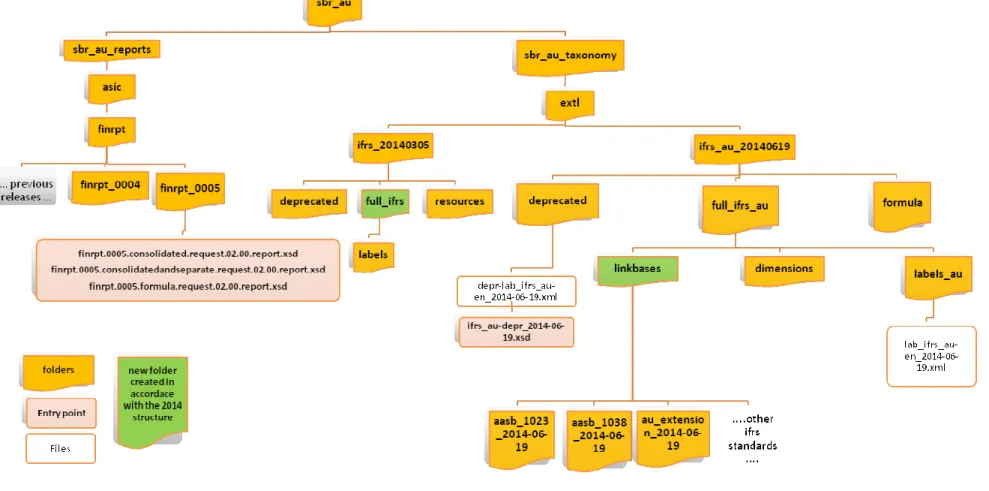
Taxonomy structure refers to the general composition of the files and folders within taxonomy. In the IFRS AU Taxonomy 2014, files are placed in a folder structure as shown in Illustration 5 below.
Illustration 5 Folders and files structure
There are some changes in the file structure of the IFRS Taxonomy 2014 which results in the following corresponding changes in the file structure of the IFRS AU Taxonomy 2014:
• The new folder full_ifrs is created in the folder ifrs_20140305 to contain the folder [label]. The folder
label was under the folder ifrs_20130328 in the 2013 file structure;
• The folder label contains the new label linkbase file "doc_full_ifrs-en_2014-03-05.xml" which contains documentation labels to provide additional textual descriptions to elements in the taxonomy;
• The new folder linkbases is created in the folder full_ifrs_au to contain all the standard folders (such as:
folders aasb_1023_2014-06-19, aasb_1038_2014-06-19, etc.). These standard folders were contained in the folder full_ifrs_au in the 2013 file structure;
• The folder label_au is now the sub-folder of the folder full_ifrs_au. This folder was the sub-folder of the
folder ifrs_au_20130620 in the 2013 file structure.
For each taxonomy release, the IFRS Taxonomy release date appears in all taxonomy files.
The folders and their contents, and the guidelines for folder and file names, are as follows (folder names are in bold):
• sbr_au_taxonomy is the SBR folder where all SBR reportable facts are defined and classified;
• extl – is the folder reserved by SBR for external taxonomies;
• ifrs_20140305 is the folder where the original IFRS Taxonomy has been copied;
• ifrs_au_20140619 is the folder where the AU Extension is stored;
• full_ifrs-cor_2014-03-05.xsd is the core schema which contains reportable concepts from IFRS
Taxonomy;
• ifrs_au-cor_2014-06-19.xsd is the core schema which contains the additional reportable concepts
required for the Australian extension;
• finrpt.0005.lodge.consolidated.02.00.report.xsd is the entry point schema that combines all of the files for
IFRS Taxonomy 2014 and the IFRS AU Extension Taxonomy 2014 compiled specifically to present consolidated financial statements only;
• finrpt.0005.lodge.consolidatedandseparate.02.00.report.xsd is the entry point schema that combines all of
the files for IFRS Taxonomy 2014 and the IFRS AU Extension Taxonomy 2014 compiled specifically to present consolidated and separate (parent) financial statements;
• full_ifrs_au contains folders for standards, references and dimensions;
• {ias | ifrs | ifric | sic | ps_mc}† _{“number”}_2014-03-05 are folders that contain modular presentation,
calculation, definition and reference linkbase files for each standard or interpretation;
• {pre | cal | def | dim}_{ias | ifrs | ifric | sic | ps_mc}_{“number”}_2014-03-05_role-{“unique role number”}.xml are modular presentation, calculation, definition and reference linkbase files for eachstandard or interpretation;
• {pre | def}_{ias | ifrs | ifric | sic |}_{“number”}_2014-03-05_role-{“unique role
number”}_{-2}.xml are modular presentation and definition linkbase files for each standard or interpretation used in both entry point one and entry point two. Those files represent duplicated files saved in the same folders as original files required to facilitate the development of entry point two.
• ref_{ias | ifrs | ifric | sic | ps_mc}_{“number”}_2014-03-05.xml are modular reference linkbase files
• for each standard or interpretation;
• rol_{ias | ifrs | ifric | sic | ps_mc}_{“number”}_2014-03-05.xsd are modular schemas that contain ELRs for
the presentation, calculation and definition linkbases for each standard or interpretation
;
3.3.2 Absolute and relative paths
The root resource location (URL) of the IFRS AU Taxonomy 2014 are
http://sbr.gov.au/rprt/asic/finrpt/finrpt.0005.consolidated.request.02.00.report and
http://sbr.gov.au/rprt/asic/finrpt/finrpt.0005.consolidatedandseparate.request.02.00.report. This is formed according to the file and folder structure set out in section 3.3.1
Table 1 below provides examples of absolute paths to IFRS AU Taxonomy 2014 files.
File
Absolute path
IFRS Core schema http://sbr.gov.au/taxonomy/sbr_au_taxonomy/extl/ifrs_20140305/full_ifrs/full_ifrs-cor_2014-03-05.xsd IFRS AU Core schema http://sbr.gov.au/taxonomy/sbr_au_taxonomy/extl/ifrs_au_20140619/full_ifrs_au/ifrs_au-cor_2014-06-19.xsd English label linkbase for the IFRS AU Taxonomy additional concepts http://sbr.gov.au/taxonomy/sbr_au_taxonomy/extl/ifrs_au_20140619/full_ifrs_au/labels_au/lab_ifrs_au-en_2014-06-19.xml IAS 1 presentatio n linkbase used in entry point one http://sbr.gov.au/taxonomy/sbr_au_taxonomy/extl/ifrs_au_20140619/full_ifrs_au/linkbases/ias_1/pre_ias_1_201 4-03-05_role-210000.xml IAS 1 presentatio n linkbase used in entry point two http://sbr.gov.au/taxonomy/sbr_au_taxonomy/extl/ifrs_au_20140619/full_ifrs_au/linkbases/ias_1/pre_ias_1_201 4-03-05_role-210000-2.xml IAS 36 reference linkbase http://sbr.gov.au/taxonomy/sbr_au_taxonomy/extl/ifrs_au_20140619/full_ifrs_au/linkbases/ias_36/ref_ias_36_2 014-03-05.xmlIFRS AU Taxonomy 2014 files can be referenced using both absolute and relative paths. Software vendors should note that IFRS AU Taxonomy 2014 files should not be amended and should therefore be referenced via absolute paths in order to avoid file changes being made by preparers.
3.3.3 DTS discovery
In IFRS AU Taxonomy 2014 is modularised as described in section 3.3.1 and the entry points are the schemas finrpt.0005.consolidated.request.02.00.report.xsd and
finrpt.0005.consolidatedandseparate.request.02.00.report.xsd.
The discovery process is conducted in accordance with the XBRL 2.1 Specification discovery rules.
3.3.4 Namespaces
The namespaces used by IFRS AU Taxonomy 2014 are aligned and follow the same pattern as the one used in the IFRS Taxonomy 2014. In order to differentiate between concepts (and to modularise the schemas) in subsequent IFRS AU Taxonomy 2014 releases and also to support taxonomy versioning, namespace unique resource identifiers (URIs) are used for each taxonomy release date. The IFRS AU Taxonomy 2014 uses namespaces constructed according to the guidelines presented in Table 2 below.
Table 2 Namespace prefixes
Namespace prefix
Namespace URI
Use
ifrs
http://xbrl.ifrs.org/taxonomy/2014-03-05/ifrs
Main namespace for all IFRS taxonomy concepts
(where YYYY-MM-DD is the taxonomy release date).
cor_20140619/ifrs_au-cor_2014-06-19
Taxonomy concepts
(where YYYY-MM-DD is the taxonomy release date).
rol_{ias | ifrs | ifric | sic | ps_mc}_{“number”}_YY YY-MM-DD
http://xbrl.ifrs.org/role/ifrs/rol_{ias | ifrs |
ifric | sic | ps_mc}_{“number”}_ YYYY-MM-DD
Namespace for the standards’ roles schemas (where
YYYY-MM-DD is the standard or interpretation issue date related to the latest taxonomy release date). This namespace is not used for concepts. Example of such role is rol_ias_1_2014-03-05 with URI
http://xbrl.ifrs.org/role/ifrs/IAS_1_2014-03-05_role-210000
rol_dim http://xbrl.ifrs.org/role/ifrs/dimensions Namespace for the dimensional roles schema. This namespace is not used for concepts.
3.3.5 Core, role and entry-point schema
In the IFRS AU Taxonomy 2014, the reportable concepts are contained in two physical files (core schemas):
- full_ifrs-cor_2014-03-05.xsd
- ifrs_au-cor_2014-06-19.xsd
In compliance with the IFRS Taxonomy Guide and the GFM provisions, the AU Extension does not use tuples or typed axes. Items and explicit axes are used instead. The IFRS AU Taxonomy uses three substitution groups defined by XBRL Specifications - item, hypercubeItem and dimensionItem.
As well as the core schema, an additional role schema is placed in each standard (and axes) folder for both IFRS and the AU Extension. These role schemas contain definitions of the presentation, calculation and definition ELRs. Role schemas do not contain concepts, tables, axes or members.
In the IFRS AU Taxonomy, concept names and identifiers (IDs) follow IFRS standards and implicitly ‘Camel Case’ best practice. For example, a concept that has the label “Accumulated impairment losses of goodwill” has the name “AccumulatedImpairmentLossesOfGoodwill” and the ID “ifrs_AccumulatedImpairmentLossesOfGoodwill”. Similar with the IFRS Taxonomy, concept names and IDs are not updated if there are changes in IFRS
terminology, IFRS AU terminology or labels. They remain stable for mapping purposes (although this may cause variations to the general ‘Camel Case’ rule). However because of this, concept names and IDs should not be used to infer the meaning or semantics of a concept. Labels and information from other linkbases should be used instead. Concept names and IDs should be treated as technical identifiers only.
3.3.6 Deprecated schema
In addition to the core schema, the IFRS AU Taxonomy 2014 provides a deprecated schema in similar manner with IFRS Taxonomy. The deprecated schema contains concepts from the previous taxonomy release which are no longer used in the current release. Deprecated concepts use deprecated labels and date label roles to provide information about the deprecation. A deprecated schema uses the namespace URI from the taxonomy that it is deprecating (i.e. the previous core schema namespace). The deprecated schema does not constitute an official IFRS Taxonomy file. The IFRS AU deprecated schema is located in the [deprecated] folder within the
[ifrs_au_20140619] folder in the [extl] folder.
3.3.7 Linkbases
The Standard Approach used to develop the IFRS AU Taxonomy (please refer to section 3.1.1) enables linkbases to be organised and viewed in the same way as in the IFRS Taxonomy. The linkbases can be viewed by
their definitions). The IFRS AU Taxonomy includes six-digit numbers in square brackets at the beginning of each ELR definition which provide viewing and sorting functionality (this number is not related to the underlying legislative requirement). IFRS AU Taxonomy contains only ELRs between [100000] and [899999] referring to
hierarchies and applied dimensional structures. TheELRs between [900000] and [999999] represent “for
application” dimensional components copied from IFRS, with the exception of ELR [913000] which has been applied in IFRS AU Taxonomy. The definition linkbase and the calculation linkbase contain a number of separate ELR that provide modelling in definition linkbase (for isolation of hypercubes) or for conflicts in double calculations that are expressed as a six digit number followed by letter a, b, c etc. The additional letters are not provided in the presentation linkbase ELRs.
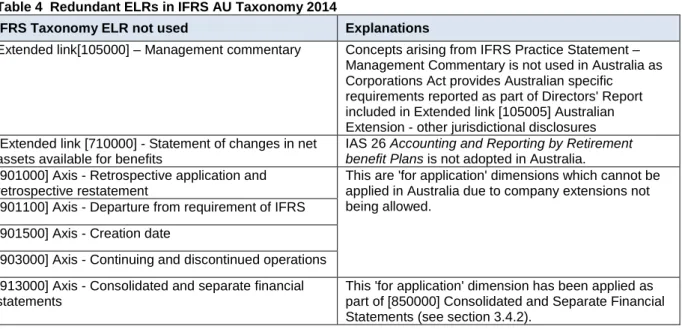
The Australian extension has defined five new ELRs that are specific to the jurisdictional requirements as per table 3. In the same time, it is not making use of seven of the IFRS ELRs as per 4 below.
Table 3 Additional ELRs in IFRS AU Taxonomy 2014
IFRS AU Taxonomy 2014 Additional ELR Explanations
Extended link [105005] Australian Extension - other jurisdictional disclosures
Reportable concepts representing financial reporting requirements provided in Corporations Act,
Corporations Regulations, Auditing Standards, ASX Listing Rules and ASX Corporate Governance Principles
Extended link [836505] Notes - General Insurance contracts
Reportable concepts for disclosures required under AASB 1023 General Insurance which does not have a corresponding IFRS standard
Extended link [836501] Notes - Life Insurance Contracts
Reportable concepts for disclosures required under AASB 1038 Life Insurance which does not have a corresponding IFRS standard
Extended link [833000] Notes - Parent entity disclosure
Reportable concepts required only when consolidated financial statements are prepared as required in Corporations Regulations. Therefore, this ELR appears in the entry point one only.
Table 4 Redundant ELRs in IFRS AU Taxonomy 2014
IFRS Taxonomy ELR not used Explanations
Extended link[105000] – Management commentary Concepts arising from IFRS Practice Statement – Management Commentary is not used in Australia as Corporations Act provides Australian specific requirements reported as part of Directors' Report included in Extended link [105005] Australian Extension - other jurisdictional disclosures Extended link [710000] - Statement of changes in net
assets available for benefits
IAS 26 Accounting and Reporting by Retirement benefit Plans is not adopted in Australia. [901000] Axis - Retrospective application and
retrospective restatement
[901100] Axis - Departure from requirement of IFRS [901500] Axis - Creation date
[903000] Axis - Continuing and discontinued operations
This are 'for application' dimensions which cannot be applied in Australia due to company extensions not being allowed.
[913000] Axis - Consolidated and separate financial statements
This 'for application' dimension has been applied as part of [850000] Consolidated and Separate Financial Statements (see section 3.4.2).
Linkbase modularisation
The IFRS AU Taxonomy uses five types of standard XBRL 2.1 linkbases, as well as generic label and reference linkbases. The linkbase files are referenced via a linkbaseRef from the entry point.
Presentation, calculation and definition linkbases are modularised according to IFRSs and the additional
Australian requirements. They are then modularised again in single files for sets of disclosures (statements and notes). Consequently, single statements including note disclosures are the smallest files that can be referenced from the entry point.
3.3.8 Reference linkbase
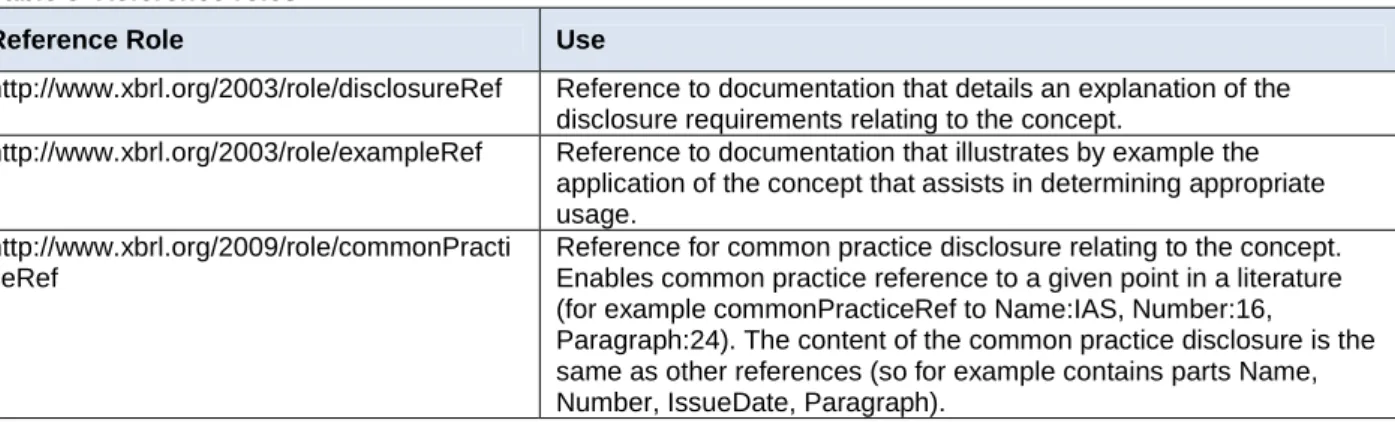
The IFRS AU Taxonomy uses the reference roles as listed in Table 5 (below).
Table 5 Reference roles
Reference Role Use
http://www.xbrl.org/2003/role/disclosureRef Reference to documentation that details an explanation of the disclosure requirements relating to the concept.
http://www.xbrl.org/2003/role/exampleRef Reference to documentation that illustrates by example the application of the concept that assists in determining appropriate usage.
http://www.xbrl.org/2009/role/commonPracti ceRef
Reference for common practice disclosure relating to the concept. Enables common practice reference to a given point in a literature (for example commonPracticeRef to Name:IAS, Number:16,
Paragraph:24). The content of the common practice disclosure is the same as other references (so for example contains parts Name, Number, IssueDate, Paragraph).
The IFRS AU Taxonomy uses the reference parts listed in Table 6 as defined by XBRL International in the reference schema.
For each IFRS AU reference resource, the IFRS AU Taxonomy provides, in general, the Name, Number, IssueDate, and Paragraph or Section. Generic references provide only the Name, Number and IssueDate.
Table 6 Reference parts Reference part IFRS Use
(adopted by SBR unchanged)
IFRS AU Use
(for AU Extension only)
Note Empty or “Effective YYYY-MM-DD” or “Expiry date YYYY-MM-DD”
Available to be used but currently empty Name {IFRS|IAS|IFRIC|SIC|IFRS for SMEs|MC} {AASB|ASA|ASRE|ASIC Class
Order|Corporations Act| Corporations LegislationsIASX CGC PrinciplesIASX Listing Rules}
Number Number of the standard or interpretation Number of the standard or interpretation, ASX CGC principle or Listing rule
IssueDate Issue date of the standard or interpretation
Applicable date of AASBs, being 1 January 2014.
Section Not used Section of the Corporations Act or Corporations
Regulations
Subsection Not used Sub-section of the Corporations Act or
Corporations Regulations
Paragraph Paragraph (number) in the standard Paragraph (number) in the standard Subparagraph Subparagraph (number) of a paragraph Subparagraph (number) of a paragraph Clause Subcomponent of a subparagraph Subcomponent of a subparagraph URI Link to text of the standard in xIFRS Not used for AU concepts URIDate Validity date of the link in xIFRS Not used for AU concepts
Generally the IFRS reference linkbases have been used in the IFRS AU Taxonomy “as is” unless additional Australian specific references had been added. The IFRS AU Taxonomy 2014 Illustration (see Appendix A) provides details of the additional Australian references.
3.3.9 Label linkbase
The IFRS AU Taxonomy defines labels (label resources) which are constructed according to the IFRS Style Guide to ensure consistency. Table 7 below presents the label roles introduced in the IFRS Taxonomy. Terse label roles are used at various points in the IFRS Taxonomy to enhance readability. Total and net label roles are used to indicate calculated hierarchies in the presentation linkbase as preferred labels.
The standard label roles are used for all Australian specific elements except for the following elements for which "totalLabel" roles are also applied:
• Total net premium revenue,
• Total net life insurance premium revenue,
• Total underwriting result
• Total life insurance underwriting result
Table 7 Label roles
Label role Use
http://www.xbrl.org/2009/role /negatedLabel http://www.xbrl.org/2009/role /negatedTotalLabel http://www.xbrl.org/2009/role /negatedTerseLabel
Label for a concept, when the value being presented should be negated (sign of the value should be inverted). For example, the standard and standard positive labels might be profit (loss) after tax and the negated labels loss (profit) after tax.
http://www.xbrl.org/2009/role /netLabel
The label for a concept when it is to be used to present values
associated with the concept when it is being reported as the net of a set of other values. Net labels allow the expression of labels, other than the one to be used as total label, if the presentation tree represents a gross/net calculation instead of a traditional calculation roll-up. For example, the standard label for Property, plant and equipment can have the total label Total property, plant and equipment and the net label Net property, plant and equipment.
http://www.xbrl.org/2009/role /deprecatedLabel
http://www.xbrl.org/2009/role /deprecatedDateLabel
The label for a concept indicating that the concept has been deprecated (used only for deprecated schema).
http://www.xbrl.org/2003/role /label
Standard label role for a concept. The IFRS Taxonomy uses standard labels to guarantee uniqueness of the labels
http://www.xbrl.org/2003/role /totalLabel
The label role for a concept when it is to be used to present values associated with the concept when it is reported as the total of a set of other values. This role should not be used to infer semantics of facts reported in instance documents.
http://www.xbrl.org/2003/role /periodStartLabel
http://www.xbrl.org/2003/role /periodEndLabel
The label role for a concept with the periodType="instant" when it is to be used to present values associated with the concept when it is reported as a start (end) of period value. These roles should not be used to infer semantics of facts reported in instance documents.
http://www.xbrl.org/2003/role /terseLabel
Short label role for a concept, often omitting text that should be inferable when the concept is reported in the context of other related concepts.
3.3.10 Negated labels
Negated labels in the IFRS Taxonomy use a set of label roles from the XBRL International Link Role Registry (LRR). The use of negated labels does not affect the sign of a reported value in XBRL. Negating a label only affects the visualisation of the reported data, it does not affect the data itself (there is no influence on the sign of reported facts). A processor should multiply the displayed amount by -1 for visualisation purposes only.
3.3.11 Presentation linkbases
The IFRS AU Taxonomy follows the same rules as the IFRS Taxonomy whereby a non-abstract concept that is a parent in a corresponding calculation linkbase is (generally) represented in the presentation linkbase as the last of its calculation siblings, unless a different ordering is more practicable.
Due to the introduction of the new AU elements, the following IFRS presentation linkbases have been modified for the purpose of entry point one:
[834120] Notes - Share-based payment arrangements
[822200] Notes - Exploration for and evaluation of mineral resources [822390] Notes - Financial instruments
[210000] Statement of financial position, current/non-current [220000] Statement of financial position, order of liquidity
[310000] Statement of comprehensive income, profit or loss, by function of expense [800100] Notes - Subclassifications of assets, liabilities and equities
[800500] Notes - List of notes
[810000] Notes - Corporate information and statement of IFRS compliance [880000] Notes - Additional information
[826380] Notes – Inventories
[510000] Statement of cash flows, direct method [851100] Notes - Cash flow statement
[835110] Notes - Income taxes [818000] Notes - Related party
[825480] Notes - Separate financial statements [813000] Notes - Interim financial reporting
Due to the application of the “Consolidated and separate financial statements’ dimension most of the IFRS presentation linkbases in the entry point two have been further modified with the exception of the following: [110000] General information about financial statements,
[825480] Notes - Separate financial statements, [800500] Notes - List of notes,
[800600] Notes - List of accounting policies.
Additional presentation linkbases have been created for the additional Australian reporting requirements and are listed in Table 8 below.
Table 8 IFRS AU – Additional presentation linkbases IFRS AU Taxonomy 2014 additional presentation
linkbases Explanations
pre_au_extension_2014-06-19_role-105005.xml
Includes reportable concepts representing financial reporting requirements provided in Corporations Act, Corporations Regulations, Auditing Standards, ASX Listing Rules and ASX Corporate Governance Principles
pre_aasb_1023_2014-06-19_role-836505.xml
Includes the reportable concepts for disclosures required under AASB 1023 General Insurance which does not have a corresponding IFRS standard pre_aasb_1038_2014-06-19_role-836501.xml
Includes the reportable concepts for disclosures required under AASB 1038 Life Insurance which does not have a corresponding IFRS standard
pre_au_extension_2014-06-19_role-833000.xml
Includes the reportable concepts required when only consolidated financial statements are prepared as required in Corporations Regulations.
3.3.12 Calculation linkbases
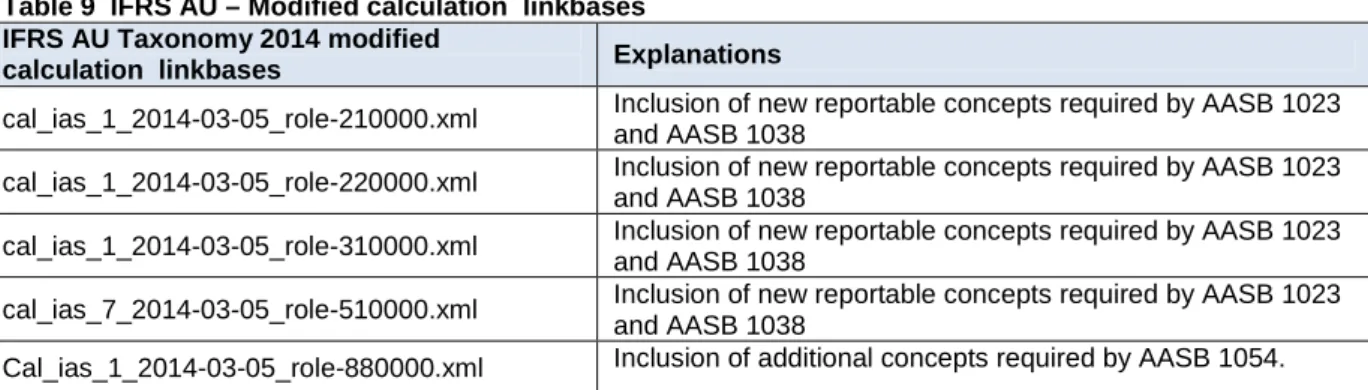
The IFRS AU Taxonomy 2014 uses calculation linkbases in the manner prescribed by the XBRL 2.1 Specification and provides all possible calculations for hierarchies. Some of the calculations linkbases are directly imported from IFRS Taxonomy and some have been substituted with new linkbases that include the new elements introduced by the AU Extension. The list of the modified calculation linkbases is contained in Table 9 below.
Table 9 IFRS AU – Modified calculation linkbases IFRS AU Taxonomy 2014 modified
calculation linkbases Explanations
cal_ias_1_2014-03-05_role-210000.xml Inclusion of new reportable concepts required by AASB 1023 and AASB 1038
cal_ias_1_2014-03-05_role-220000.xml Inclusion of new reportable concepts required by AASB 1023 and AASB 1038
cal_ias_1_2014-03-05_role-310000.xml Inclusion of new reportable concepts required by AASB 1023 and AASB 1038
cal_ias_7_2014-03-05_role-510000.xml Inclusion of new reportable concepts required by AASB 1023 and AASB 1038
Cal_ias_1_2014-03-05_role-880000.xml Inclusion of additional concepts required by AASB 1054.
3.3.13 Definition linkbases
The IFRS AU Taxonomy uses definition linkbases in the same way as the IFRS Taxonomy to express
dimensional relationships. The IFRS Taxonomy defines axes and members for listed relationships, and therefore only uses explicit axes. Typed axes are not used in the IFRS AU Taxonomy. The IFRS Taxonomy defines tables where an axis has clearly been applied to a set of line items. Consequently, axes in the IFRS Taxonomy are only ‘applied’ (to line items) and the axes ‘for application’ are not provided as they cannot be used.
There are two types of definition linkbases in the IFRS Taxonomy. The first is the definition linkbase file placed in the standards folder, which mirrors the structure of the presentation linkbase if the presentation linkbase contains a table. These filenames have the prefix def_, they represent hierarchies of line items, and they link axes to a given set of reportable items (line items) within the IFRS AU Taxonomy.
The second type of definition linkbase represents axes, and these are placed in the dimensions folder or in the standards folder (if they represent axes that are applied to a set of line items). Dimensional definition linkbases also have an equivalent in the structure of the presentation linkbase. These filenames have the prefix dim_ or pre_.
All defaults for axes (dimensions) are placed in a single ELR number [990000] to avoid redundancies. This ELR does not have an equivalent in the presentation linkbase.
3.3.14 Generic label and reference linkbases
The IFRS AU Taxonomy uses generic labels and references to provide ELR definitions in compliance with the provisions of the IFRS Taxonomy Guide.
3.4
DIMENSIONS SPECIFICATION
The IFRS AU Taxonomy implementation of dimensional hypercubes uses only positive hypercubes for consistency with the approach used in the IFRS Taxonomy design.
The IFRS Taxonomy 2014 contains two types of dimensions – 'applied' dimension/axis, and 'for application' dimensions/axis. All dimensions in the IFRS AU Taxonomy 2014 are 'applied' dimensions. The dimensions 'for application' are not supported in the Australian extension due to the fact that the company extensions are not allowed at this time and therefore it would not be possible to create new tables to apply those dimensions.
3.4.1 "Applied" dimensions
The IFRS AU Taxonomy 2014 has implemented all of the ‘applied’ dimensions available in the IFRS Taxonomy. However it is recognised that some 'applied' dimensions provided in IFRS Taxonomy 2014 have to be extended by entities in order to be effectively used. Examples of ‘applied’ dimensions that may require company extensions and the rationale for extending is provided in Table 10 below.
Table 10 Examples of ‘applied’ dimensions requiring extensions Extended Link Role [Member] that requires
extending
Reasons for extending
Share-based payment arrangements [member – default]
Companies will often have more than one arrangement, which need to be identified and for each of those AASB 2.45 requires the disclosure of terms and conditions.
Ranges [member-default] [834120] Notes -
Share-based payment arrangements
Ranges of exercise prices for outstanding share options [member – default]
AASB 2.45(d) requires that outstanding options be divided into meaningful ranges of outstanding contractual life if the range is too wide.
Business combinations [member]
[817000] Notes - Business Combinations
Items of contingent liabilities [member]
The information about business combination, reconciliation of changes in goodwill, acquired receivables, acquired contingent liabilities etc is required under AASB 3.B64 for each material business combination.
External credit grades [member] Internal credit grades [member]
AASB 7.IG24(a) and (b) require the disclosure of amounts of credit disclosures for each external and internal credit grade.
[822390] Notes - Financial instruments
Transferred financial assets that are not derecognized in their entirety [member]
AASB 7.42D requires this disclosure for each class of such assets.
Reportable segments [member] Products and services [member] Foreign countries [member] [871100] Notes -
Operating segments
Customers [member]
AASB 8 requires certain disclosure for all reportable segments individually, for each group of similar products and services, by individual foreign countries and significant customers.
Reclassified items [member] AASB 1.41 b requires the disclosure for each item or class of items that is reclassified.
[810000] Notes - Corporate information and statement of IFRS
compliance Capital requirements [member] AASB 101.136 requires a separate disclosure for each capital requirement if the disclosure of aggregated information would distort user's understanding of an entity's capital resources. [861200] Notes - Share
capital, reserves and other equity interest
Share capital [member] AASB 101.79(a) specifically requires this disclosure for each class of share capital.
[811000] Notes - Accounting policies, changes in accounting estimates and errors
New IFRSs [member] AASB 108.31 requires this disclosure for each new accounting standard
Subsidiaries [member] Jointly controlled entities [member] [825480] Notes - Consolidated and separate financial statements Associates [member]
AASB 127.42 requires that in separate (parent) financial statements specific information be disclosed for each significant investment in controlled entities, joint ventures and associates.
Individual assets or cash generating units [member] [832410] Notes -
Impairment of assets
Reportable segments [member]
AASB 136.130 requires this information for each impairment loss, including the disclosure of individual cash-generating units for each material impairment loss.
![Illustration 2 [610000] Statement of changes in equity – domain members [610000] Statement of changes in equity – domain members](https://thumb-us.123doks.com/thumbv2/123dok_us/9845947.2477620/15.892.97.781.222.638/illustration-statement-changes-equity-members-statement-changes-members.webp)
![Illustration 3 [610000] Statement of changes in equity – reportable concepts [610000] Statement of changes in equity- reportable concepts](https://thumb-us.123doks.com/thumbv2/123dok_us/9845947.2477620/16.892.96.815.145.899/illustration-statement-changes-reportable-concepts-statement-reportable-concepts.webp)
![Illustration 4 Statement of changes in equity [table]](https://thumb-us.123doks.com/thumbv2/123dok_us/9845947.2477620/17.892.103.801.132.426/illustration-statement-changes-equity-table.webp)


![Table 10 Examples of ‘applied’ dimensions requiring extensions Extended Link Role [Member] that requires](https://thumb-us.123doks.com/thumbv2/123dok_us/9845947.2477620/27.892.97.821.260.1132/examples-applied-dimensions-requiring-extensions-extended-member-requires.webp)
