Volume 2010, Article ID 696345,7pages doi:10.1155/2010/696345
Research Article
Efficient Use of Variation in Evolutionary Optimization
John W. Pepper
Santa Fe Institute, 1399 Hyde Park Rd, Santa Fe, NM 87501, USA
Correspondence should be addressed to John W. Pepper,[email protected]
Received 19 July 2009; Accepted 6 January 2010 Academic Editor: Chuan-Kang Ting
Copyright © 2010 John W. Pepper. This is an open access article distributed under the Creative Commons Attribution License, which permits unrestricted use, distribution, and reproduction in any medium, provided the original work is properly cited.
Evolutionary algorithms face a fundamental trade-offbetween exploration and exploitation. Rapid performance improvement
tends to be accompanied by a rapid loss of diversity from the population of potential solutions, causing premature convergence on local rather than global optima. However, the rate at which diversity is lost from a population is not simply a function of the
strength of selection but also its efficiency, or rate of performance improvement relative to loss of variation. Selection efficiency
can be quantified as the linear correlation between objective performance and reproduction. Commonly used selection algorithms
contain several sources of inefficiency, some of which are easily avoided and others of which are not. Selection algorithms based
on continuously varying generation time instead of discretely varying number of offspring can approach the theoretical limit on
the efficient use of population diversity.
1. Introduction
“Premature convergence”, or the loss of diversity before a satisfactory solution is found, is a persistent problem in
evolutionary optimization [1]. This reflects the fundamental
trade-offbetween exploration and exploitation, or between
thoroughness and speed in evolutionary search [2]. If
selection is too weak, progress is slow and many generations are required to find a solution. On the other hand, if selection is too strong, the population rapidly loses diversity and may become stranded on a local fitness peak. A wide variety of techniques have been proposed to address this problem, but it has generally been approached on an ad hoc empirical basis, and little theory has been available to guide the design of selection algorithms.
While the trade-offbetween improving performance and
preserving diversity cannot be avoided, it can be ameliorated
through the efficient use of variation. Diversity within a
population acts as the fuel of the selection process: it is required for selection to act, but is itself consumed in the
pro-cess. However, selection algorithms differ not only in speed,
but also in “fuel efficiency”, or rate of improvement relative
to loss of variation. In the following sections, I develop a
method for quantifying the efficiency of fitness functions,
defined here as mappings from objective performance to reproduction. (Such mappings are sometimes referred to
as “selection methods”.) The approach is based on the powerful formalism from evolutionary biology known as the “Price equation”, which is increasingly used in evolutionary
genetics [3]. I next compare several widely-used selection
methods to characterize their sources of inefficiency, and to
illustrate the advantages of more efficient selection. I also
consider whether less efficient algorithms have any offsetting
advantages that justify their use. Finally, I discuss the design
of fast and efficient fitness functions, and propose a new kind
of algorithm, based on varying generation time instead of
number of offspring, which can approach perfect efficiency
in the use of genetic variation.
2. Quantifying Selection Efficiency
The ultimate goal of evolutionary optimization is to maxi-mize some objective measure of performance on a given task. Here I measure progress toward optimization in terms of the mean performance level of the population (In evolutionary computation applications, the ultimate interest may be in the highest performance level in a population of candidate solutions, rather than the mean. However, mathematical theory is only available to quantify change in population mean through selection rather than change in popula-tion maximum. As a practical matter, maximizing mean
performance will also maximize best performance, all else being equal). The goal of improving performance conflicts partially with a subsidiary goal: maintaining the diverse population of candidate solutions or “individuals” needed to thoroughly explore search spaces and find the best possible solutions. The conflict arises because the unequal repro-duction that drives improvement in average performance also reduce population diversity. Unequal contributions to
the next generation’s gene pool by different individuals
always reduces diversity except in the special case of negative frequency-dependent selection (which increases diversity). If selection is frequency-independent, unequal reproduction reduces diversity, in direct proportion to the reproductive variance among individuals (see the appendix).
Although selection cannot improve a population’s aver-age performance in the next generation without unequal reproduction, the converse is not true. Unequal reproduction and resulting loss of diversity need not improve average performance. Variance in reproduction that is uncorrelated with performance can reduce genetic diversity (though
genetic drift) just as quickly as can effective selection, but
without increasing mean performance. Because correlation between performance and reproduction is what makes
selection effective at optimization, I focus on the strength of
this correlation to quantify the efficiency of fitness functions.
In addition to selection, genetic operators such as mutation and recombination can also change a population’s mean performance (although in an unpredictable direction).
Here I focus exclusively on the effects of selection, or
differential reproduction, because this is the source of
premature convergence in evolutionary optimization. Let each individual in the population (indexed by i) have a
measured performance level pi. The average population
performance before selection is p = pi/N, where N =
population size. After one generation of selection, average population performance will be the average of the parent performances weighted by the contribution of each parent
to the next generation: p = piwi/wi, where wi =
the number of offspring produced by the i’th individual.
(Note that this assumes perfect heritability of performance
from parent to offspring.) To simplify the notation, it is
convenient to replace absolute reproductionwiwith relative
reproduction,wi =wi/w, so that mean performance in the
offspring generation isp=ave(piwi). The change in average
performance caused by one round of selection is thenΔp=
p−p, or
Δp=avepw−avep. (1)
As a result of selection, performance improvement across one
generation is exactlyΔpabove. We can rewrite (1) in a useful
form by using two identities: firstly, ave(pw) = ave(p)·
ave(w) + cov(pw), where “cov” represents covariance.
Sec-ondly, ave(w) =1 by definition. With these substitutions,
the improvement in performance from parent to offspring
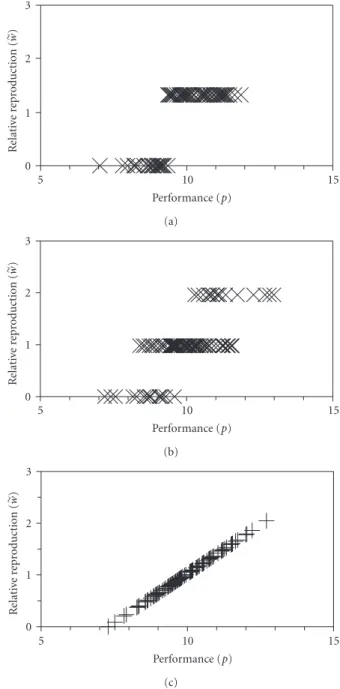
generation is Δp=covp,w (2) 0 1 2 3 R elati ve re pr oduction ( w ) 5 10 15 Performance (p) (a) 0 1 2 3 R elati ve re pr oduction ( w ) 5 10 15 Performance (p) (b) 0 1 2 3 R elati ve re pr oduction ( w ) 5 10 15 Performance (p) (c)
Figure 1: Three fitness functions illustrated using the same set of 100 simulated individuals with performance values drawn from a
normal distribution with mean=10 and standard deviation=1.
(a) threshold selection (b) stochastic proportionate selection (SPS),
(c) deterministic proportionate selection (using (8)). Each mark
represents one individual.
(see [4]). To highlight the factors affecting optimization rate,
it is useful to use another identity to rewrite this covariance as a product of its three factors:
Δp=σp·σw·ρpw, (3)
where σis a standard deviation among individuals in
performance (p) or relative reproduction (w), andρpwis the
linear correlation coefficient between the two [4].
Equation (3) provides insight into how to maximize
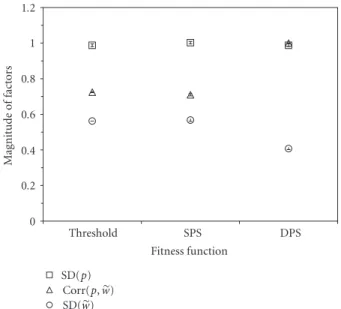
0 0.2 0.4 0.6 0.8 1 1.2 M ag nitude o f fact o rs Threshold SPS DPS Fitness function SD(p) Corr(p,w) SD(w)
Figure 2: The three factors contributing to performance improve-ment compared over 1 round of selection across three fitness func-tions using numerical simulafunc-tions: threshold selection, stochastic proportionate selection (SPS), and deterministic proportionate selection (DPS). Each sample consisted of 100 simulated individuals with performance values drawn from a normal distribution with
mean = 100, SD = 1. Markers show means, and bars show ±
standard error over 100 samples. (Note that error bars are too small to extend beyond marker symbols.)
−8 −6 −4 −2 0 2 4 Change (%) Threshold SPS DPS Fitness function Performance (p) Diversity (H)
Figure 3: The same three fitness functions shown in Figure 2
compared for the one-generation change produced in mean performance, and in population diversity. Bars show standard errors. (Note that error bars are too small to extend beyond marker symbols).
to loss of diversity. Deviation in individual performance (σp)
is fixed for a given population, butσw andρpw depend on
the selection method. Deviation in reproduction (σw) varies
with the strength of selection. Increasingσw can increase
performance improvement, but at the cost of faster loss of diversity. The linear correlation between performance and
reproduction (ρpw) corresponds to the efficiency of selection,
in the sense that increasing this term increases performance improvement without increasing loss of diversity and
per-formance variation. Whenρpw =0, selection is completely
inefficient: it consumes variation without improving average
performance. In the language of evolutionary theory, this is termed “drift” instead of “selection”. At the other extreme
ofρpw= 1, the ratio of performance increase to variance
reduction is maximized. Thus the rate at which variation is lost from a population is not simply a function of selection
strength (σw), as is sometimes assumed, but also of selection
efficiency (ρpw).
3. Sources of Inefficiency in Fitness Functions
The perfectly linear fitness function (ρpw=1) is an ideal of
efficiency that is not realized by any algorithm in general
use. All standard fitness functions depart from linear correla-tion either through deterministic nonlinearities, fluctuating stochastic nonlinearities, or both. An example of a deter-ministically nonlinear fitness function is threshold selection, in which reproduction is an all-or-nothing step function
of performance (Figure 1(a)). Any such highly nonlinear
fitness function will necessarily have a linear correlation well below 1. Fitness functions without any deterministic nonlinearity are termed “fitness-proportionate selection” because expected reproduction is directly proportional to
performance [1]. However, these functions introduce
fluctu-ating stochastic nonlinearity in converting expected to actual reproduction, so that expected reproduction has perfect linear correlation with performance, but actual reproduction does not. This is hard to avoid because unlike the expected
number of offspring, the actual number of offspring is
con-strained to whole numbers and so must vary stochastically around the expected number. For example, the commonly
used “stochastic universal sampling” algorithm [5] works as
follows: an expected reproduction of ωis partitioned into
a fractional portion (ω%1) and a whole-number portion
[ω−(ω%1)], where % is the modulo operator. The algorithm
produces the whole number of offspring, plus one additional
offspring with a fractional probability of (ω%1). Despite its
lack of deterministic nonlinearity, the correlation between
performance and actual number of offspring is less than 1
because of stochastic fluctuations (e.g., Figure 1(b), where
ω=1 for each individual, butwvaries stochastically). I will
refer to this algorithm as “stochastic proportionate selection” (SPS).
Such stochastic fluctuations in actual reproduction are larger in other implementations of fitness-proportionate
selection, such as “roulette wheel” sampling [2]. Still other
algorithms, such as tournament selection [1], include both
selection of a pair of individuals to compare is stochastic, while the choice of which of the two reproduces depends on their relative performance rank, which is a deterministic nonlinear function of performance. Both deterministic and stochastic nonlinearities in fitness functions reduce the correlation between performance and actual reproduction,
and thereby reduce selection efficiency.
To examine the effect of selection efficiency on diversity,
I used a numerical simulation consisting of a population of 100 individuals (candidate solutions) with performance
values drawn from a normal distribution with mean =
10 and standard deviation = 1. I compared the effects
of a single round of selection using threshold
selec-tion (Figure 1(a)), stochastic proportionate selection (SPS)
(Figure 1(b)), and deterministic proportionate selection
(DPS) ((8),Figure 1(c)). The numerical simulation allowed
fractional offspring, but the problem of how deterministic
proportionate selection can be implemented with whole
numbers of individuals is deferred to Section 6 below.
To tune the threshold fitness function to give the same performance improvement as the other two functions, I allowed reproduction only by the best-performing 76% of the population. Deterministic proportionate selection generated less variance in reproduction than the other two, but reproduction was more highly correlated with
performance (Figure 2). These two differences resulted in an
equal performance increase in the offspring generation for
all three fitness functions (Figure 3). Thus the deterministic
proportionate selection function consumed less performance variation while producing the same performance improve-ment. I next investigated whether DPS also preserved more genotype diversity while producing the same performance improvement.
To quantify diversity, I used the Shannon-Weiner diver-sity index from evolutionary biology, which is equivalent to the entropy of the genotypes in the population:
H= −
g
fglog2fg, (4)
wheregindexes the genotypes in the population, and fgis the
population frequency of genotype g. Entropy is maximized when each individual is unique, and minimized when all individuals share the same genotype. To simplify calculations I assumed that each individual in the population was unique prior to selection, but violating this assumption would not change the outcome qualitatively. Selection reduced diver-sity several-fold less under the deterministic proportionate function than under either the stochastic proportionate or threshold functions, while improving performance at the
same rate (Figure 3).
4. Is Inefficient Selection Ever Useful?
I have focused here on the advantages of linear fitness functions for conserving genetic diversity. However, both
deterministic nonlinearities and stochastic effects have some
potential advantages. Might these justify the use of nonlinear
fitness functions despite their lower efficiency?
Deterministically nonlinear fitness functions permit
stronger selection (higher σw) than linear functions. At
the extreme, reproduction by only the individual(s) with the highest performance increases average performance by
Δp = pmax − p. More generally, larger one-generation
improvements are possible with nonlinear than with linear fitness functions. However, this rapid short-term improve-ment comes at the cost of the variation required for longer-term improvement. Genetic variation could be created anew in each generation, but this is computationally expensive and
reduces evolutionary search algorithms to inefficient
hill-climbers. For this reason, deterministic nonlinearity in fit-ness functions is unlikely to be helpful in most applications.
Stochastic fitness functions offer a different potential
advantage by helping populations escape from local per-formance peaks. Slightly deleterious mutations can persist or spread under stochastic selection, making it possible for populations to cross low-performance fitness valleys
requiring multiple mutations. Stochastic effects also allow
the population to drift among different genotypes with equal
performance. This may facilitate the exploration of “neutral networks” in genotype space, leading to the discovery of
higher performance peaks [6]. However, stochastic effects
on reproduction also have drawbacks. They can push populations away from global as well as local peaks. In some algorithms, they may also slow the discovery of higher-performance peaks by allowing beneficial new mutations to be lost. It remains an open question how often stochastic fitness functions improve evolutionary optimization, and how much stochasticity is desirable. To investigate these questions, it will help to have algorithms in which stochastic
effects can be directly controlled by the experimenter rather
than being a by-product of the particular algorithm used. This is easily achieved by adding a stochastic term to a deterministic linear fitness function. This approach has the
additional advantage that stochastic effects can be reduced to
any desired magnitude without incurring a computational cost. In contrast, intrinsically stochastic algorithms require
very large population sizes to drive stochastic effects to low
levels.
5. Fast and Efficient Fitness Functions
How can a fitness function be designed to maximize the rate
of performance increase while also optimizing efficiency?
Efficiency defined as the linear correlationρpwis maximized
when reproduction is a linear function of performance. It is convenient to represent such fitness functions in the standard linear form:
wi=api+b, (5)
where piandwiare individual performance and
reproduc-tion, respectively, and a and b are system parameters. With discrete generations, it is usually desirable to maintain a stable population size across generations, which constrains
the average number of offspring per individual (w) to 1. This
constrains the value ofato
a= 1
avepi+b =
1
p+b. (6)
Substituting (6) into (5) gives us a linear fitness function
yielding a stable population size:
wi=
pi+b
p+b. (7)
What value of b will maximize the rate of performance
improvement? Recall from (3) that the one-generation
improvement in average performance due to selection is a
product of three quantities:σp,ρpw, andσw. The first of these
is a fixed property of the population. The second is already maximized at 1 under linear fitness functions. This leaves
only variance in individual reproductionσwto be maximized
in order to maximize the performance improvement Δp.
When wi is a linear function of pi, its variance σw is
maximized by maximizing the slope of the fitness function,
which is defined in (5) as a. Equation (6) shows that a
increases as b approaches −p, so thatb should be as close
as possible to−pto maximize improvement. However, there
is a constraint that individual reproduction (wi) cannot be
negative, which means that b ≥ −pi for all i (5). If the
worst performance in the population is denoted aspmin, then
the lowest possible value for b is −pmin, which results in
the individual(s) with the lowest performance having exactly
zero offspring. Substituting this value for binto (7) yields
the stable linear fitness function with the maximum rate of performance increase: wi= pi−pmin p−pmin . (8)
6. A Variable-Generation Algorithm for
Efficient Selection
If a deterministic linear fitness function is the theoretical ideal, how can it be implemented in practice? As discussed
above, inefficiency in commonly used fitness functions
arises in part from easily avoidable sources of nonlinearity. However, all standard algorithms also contain nonlinearities arising from the fact that performance is a continuous
vari-able, while the number of offspring is discrete. Stochastically
converting real numbers of expected offspring to whole
numbers of actual offspring reduces the linear correlation
between performance and actual reproduction.
We can overcome this problem by recognizing that selec-tion on genotypes acts through their rate of reproducselec-tion
per unit time. Instead of varying the number of offspring,
one can independently vary the generation time for each
individual [7]. This requires an algorithm incorporating
overlapping generations and a continuous representation of time. Individual reproductive rates can then vary continu-ously rather than discretely, and can correlate perfectly with individual performance.
To implement this idea, individual reproduction is treated as a growth rate, by analogy with population growth rates. A population growth rate tells us how large a population will be after a given time:
st=s0wt, (9)
wheres0 is initial population size,st is population size after
ttime units, andwis growth rate. Rearranging (9) tells us
how long it will take the population size to change by a given
factorst/s0under a given growth ratew:
t=ln(st/s0)
ln(w) . (10)
Our current problem concerns individuals rather than populations, but we can use the same reasoning to ask how long it will take an individual to die (equivalent to shrinking to size zero) or reproduce (equivalent to doubling
in size) as a function of its individual growth ratewi. Because
individuals are discrete, we round off individual “size” to
the nearest whole number. Thus forwi < 1, we can ask
how long it will take for the individual to fall below half its initial size, given its negative growth rate. At this point, the individual’s size is closer to zero than one, and we recognize this by removing it from the population. Similarly, if an individual’s growth rate is greater than one, we ask how long it will take for its size to rise above 1.5. At this point it is closer to being two individuals than one, and we recognize this by doubling it via reproduction. (Note that
unlike rounding the number of offspring under stochastic
fitness-proportionate algorithms, rounding individual size to whole numbers is not stochastic and does not introduce stochastic nonlinearity into the fitness function. Because waiting times vary continuously, genotype growth rates also vary continuously as a deterministic linear function of performance.)
Forw <1, waiting time to death is found by substituting 0.5
forst/s0in (10), giving
td= −0.693
ln(w) . (11)
For w > 1, waiting time to reproduction is found by
substituting 1.5 forst/s0, giving:
tr= 0.405
ln(w). (12)
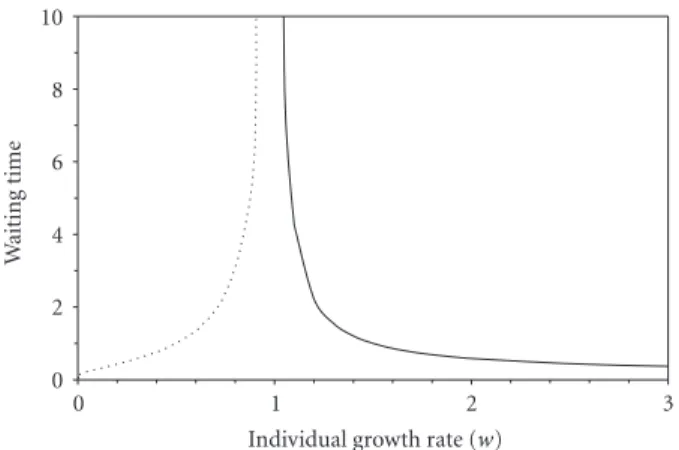
When an individual’s reproductive rate is evaluated, its future death or reproduction is scheduled for a time point in the future designated as a real number on a time line. These events will be scheduled in the distant future when the reproductive rate is close to 1, and in the near future when it
is far from 1 (Figure 4).
At the beginning of a run, each individual’s performance is evaluated and its reproduction or death is scheduled. After this, the algorithm simply consists of repeatedly cycling through the following steps: (1) carry out the first event on the schedule. (2) If the event was a birth, evaluate the new individual’s performance. (3) recalculate all waiting times
0 2 4 6 8 10 W aiting time 0 1 2 3
Individual growth rate (w)
Figure 4: Waiting time to death (dotted line) or reproduction (solid
line) as a function of individual growth rate. (From (11) and (12).)
to reflect the new average performance, and update the schedule. In practice, it might be useful to recalculate waiting times less often in order to reduce the computational load. For example, each individual’s waiting time could be calcu-lated at birth and then not recalcucalcu-lated until its scheduled event was within some specified time horizon.
7. Conclusions
In these results, truly linear fitness functions, in the form of deterministic proportionate selection, reduced population diversity and performance variation less than other fitness functions that improve performance the same amount in one round of selection. This strongly suggests that over multiple generations, the same rate of performance improvement would be sustained with less loss of diversity. Consequently, DPS should yield better solutions, particularly for tasks where premature convergence is otherwise a problem. The variable-generation algorithm outlined above allows actual reproductive rates to be exactly proportional to performance, providing one way to implement DPS. Although stochastic fitness functions may eventually prove useful on some fitness landscapes, intrinsically linear fitness functions provide the best foundation for designing them because they allow stochastic terms to be added in a controlled fashion.
One important caveat is that these conclusions are based on consideration of a single round of selection in
isolation. Longer-term selection is also affected by the
genetic operators that create variation, such as mutation and recombination, and by their interactions with selection. In particular, this paper does not address the issue of how selection interacts with recombination among epistatic
loci (e.g., [8]). While I am not aware of any reason the
conclusions reached here would not hold in the broader context of long-term evolution with recombination; this remains to be investigated.
Appendix
The purpose of this appendix is to quantify the extent to which unequal reproduction reduces diversity in a
population. It will show that when selection is frequency-independent, unequal reproduction reduces diversity in direct proportion to the reproductive variance among
indi-viduals. I followSection 3above in quantifying diversity with
the Shannon-Wiener diversity index, which is equivalent to the entropy of genotypes.
Before selection, variance in the frequencies of alternative genotypes is
varf=Ef2−Ef2
, (A.1)
and after one round of selection it is
varw f =Ew2f2−Ew f 2
, (A.2)
where variance (var) and expectation (E) operate across
genotypes, f is the frequency of each genotype, and w is
the reproduction of each genotype relative to the population
mean. If selection is frequency-independent, thenwand f
are independent, so that (A.2) can be rewritten as
varw f =Ew2·Ef2− E(w)2·
Ef2. (A.3)
Because E(w)=1 by definition, (A.3) simplified to
varw f =Ew2·Ef2−Ef2
. (A.4)
LetΔvar(f) represent the change in var(f) caused by one
round of selection. Subtracting (A.1) from (A.4) gives
Δvarf=Ef2·Ew2−1. (A.5)
Because E(w)=1, the second term on the right, E(w2)−1=
E(w2)−[E(w)]2=var(w). Substituting var(w) for E(w2)−1
gives
Δvarf=Ef2·var(w). (A.6)
Thus the decrease in the variance of genotype frequencies is proportional to the variance in reproduction. Thus minimizing variance in reproduction also minimizes loss of
diversity (H).
Acknowledgments
This work was supported by and carried out at the Santa Fe Institute. The author thanks H. Bagheri-Chaichian, L. Pagie, and C. Shalizi for helpful discussions, and John. H. Holland for comments on an earlier draft, as well as for suggesting the idea of variable-generation selection methods.
References
[1] M. Mitchell, An Introduction to Genetic Algorithms, MIT Press, Cambridge, UK, 1996.
[2] J. H. Holland, Adaptation in Natural and Artificial Systems, University of Michigan Press, Ann Arbor, Mich, USA, 1975. [3] S. A. Frank, “George Price’s contributions to evolutionary
genetics,” Journal of Theoretical Biology, vol. 175, no. 3, pp. 373– 388, 1995.
[4] G. R. Price, “Selection and covariance,” Nature, vol. 227, pp. 520–521, 1970.
[5] J. E. R. Baker, “Reducing bias and inefficiency in the selection
algorithm,” in Proceedings of the 2nd International Conference
on Genetic Algorithms and Their Applications, J. J. Grefenstette,
et al., Ed., pp. 14–21, Erlbaum Associates, Hillsdale, NJ, USA, 1987.
[6] W. Fontana and P. Schuster, “Continuity in evolution: on the nature of transitions,” Science, vol. 280, no. 5368, pp. 1451– 1455, 1998.
[7] J. H. Holland, “Building blocks, cohort genetic algorithms, and hyperplane-defined functions,” Evolutionary Computation, vol. 8, no. 4, pp. 373–391, 2000.
[8] J. W. Pepper, “The evolution of evolvability in genetic linkage patterns,” BioSystems, vol. 69, pp. 115–126, 2003.
Submit your manuscripts at
http://www.hindawi.com
Computer Games Technology
International Journal of
Hindawi Publishing Corporation
http://www.hindawi.com Volume 2014
Hindawi Publishing Corporation
http://www.hindawi.com Volume 2014 Distributed Sensor Networks International Journal of Advances in
Fuzzy
Systems
Hindawi Publishing Corporation
http://www.hindawi.com Volume 2014
International Journal of
Reconfigurable Computing
Hindawi Publishing Corporation
http://www.hindawi.com Volume 2014
Hindawi Publishing Corporation
http://www.hindawi.com Volume 2014
Applied
Computational
Intelligence and Soft
Computing
Advances inArtificial
Intelligence
Hindawi Publishing Corporation http://www.hindawi.com Volume 2014 Advances in Software Engineering Hindawi Publishing Corporationhttp://www.hindawi.com Volume 2014
Hindawi Publishing Corporation
http://www.hindawi.com Volume 2014
Electrical and Computer Engineering
Journal of
Journal of
Computer Networks and Communications
Hindawi Publishing Corporation
http://www.hindawi.com Volume 2014
Hindawi Publishing Corporation
http://www.hindawi.com Volume 2014
Multimedia
International Journal of
Biomedical Imaging
Hindawi Publishing Corporation
http://www.hindawi.com Volume 2014
Artificial
Neural Systems
Advances in
Hindawi Publishing Corporation
http://www.hindawi.com Volume 2014
Robotics
Journal ofHindawi Publishing Corporation
http://www.hindawi.com Volume 2014 Hindawi Publishing Corporationhttp://www.hindawi.com Volume 2014
Computational Intelligence and Neuroscience
Hindawi Publishing Corporation
http://www.hindawi.com Volume 2014
Modelling & Simulation in Engineering Hindawi Publishing Corporation
http://www.hindawi.com Volume 2014
The Scientific
World Journal
Hindawi Publishing Corporationhttp://www.hindawi.com Volume 2014
Hindawi Publishing Corporation
http://www.hindawi.com Volume 2014
Human-Computer Interaction Advances in Computer EngineeringAdvances in
Hindawi Publishing Corporation