thesis, University of Nottingham.
Access from the University of Nottingham repository:
http://eprints.nottingham.ac.uk/13101/1/ESSAYS_ON_CREDIT_DEFAULT_SWAPS.pdf
Copyright and reuse:
The Nottingham ePrints service makes this work by researchers of the University of Nottingham available open access under the following conditions.
· Copyright and all moral rights to the version of the paper presented here belong to
the individual author(s) and/or other copyright owners.
· To the extent reasonable and practicable the material made available in Nottingham
ePrints has been checked for eligibility before being made available.
· Copies of full items can be used for personal research or study, educational, or
not-for-profit purposes without prior permission or charge provided that the authors, title and full bibliographic details are credited, a hyperlink and/or URL is given for the original metadata page and the content is not changed in any way.
· Quotations or similar reproductions must be sufficiently acknowledged.
Please see our full end user licence at:
http://eprints.nottingham.ac.uk/end_user_agreement.pdf
A note on versions:
The version presented here may differ from the published version or from the version of record. If you wish to cite this item you are advised to consult the publisher’s version. Please see the repository url above for details on accessing the published version and note that access may require a subscription.
I
ESSAYS ON CREDIT DEFAULT SWAPS
BIAO GUO, BA, MA.
Thesis submitted to the University of Nottingham
for the degree of Doctor of Philosophy
II
ABSTRACT
This thesis is structured to research on a financial derivative asset known as a credit default swap (CDS). A CDS is a contract in which the buyer of protection makes a series of payments (often referred to as CDS spreads) to the protection seller and, in exchange, receives a payoff if a default event occurs. A default event can be defined in several ways, including failure to pay, restructuring or rescheduling of debt, credit event repudiation, moratorium and acceleration.
The main motivation of my PhD thesis is to investigate the determinants of the changes of CDS spreads and to model the evolution of spreads. Two widely traded types are corporate and sovereign CDS contracts, the first has as its underlying asset a corporate bond and, hence, hedges against the default risk of a company; the second type hedges against the default risk of a sovereign country. The two contract types have different risk profiles; for example, it is known that liquidity premium with different maturity varies significantly for a corporate CDS but less so for a sovereign CDS because, in contrast with the corporate markets where a majority of the trading volume is concentrated on the 5-year CDS, the sovereign market has a more uniform trading volume across maturities.
In light of the difference, this thesis is divided into four parts. Part A introduces the motivation and research questions of this thesis, followed by literature review on debt valuation, with emphasis on default and liquidity spreads modelling. Part B aims at the role liquidity risk plays in explaining the changes in corporate CDS spreads. Part C models sovereign CDS spreads with
III macro and latent factors in a no-arbitrage framework. Part D concludes this thesis with a list of limitations and further research direction.
Keywords: credit default swap; credit risk; liquidity risk; regime switching; sovereign risk; spillover; term structure; macroeconomic factors; principal component analysis; Kalman Filter
IV
ACKNOWLEDGEMENTS
I would like to express utmost thanks to my supervisor, Professor David Newton, for his continued encouragement, support and guidance throughout the course of this research. Our frequent meeting and the insightful discussion have laid the foundation for this work. I am grateful for his patience, interest and willingness to accept these topics for my PhD research. Not only does he provide me with research guidance but also his advice for my career drives the whole course of research and makes the three-year PhD study in Nottingham much more interesting. My appreciation goes to Dr Ye Bai and Dr Dimitrios Gounopoulos who provided greatly helpful and insightful comments on the thesis.
This thesis is dedicated to my parents for their unconditional love and understanding. My life wouldn‟t be as it is now without their selfless support. I also want to thank Haoyu Ma, who has always been at my side supporting me throughout this whole research. Your love and support make every mission possible.
I also take this opportunity to show my thanks to my PhD colleagues and friends at the Nottingham University Business School for their encouragement and help. Spending three fantastic years with you is memorable for the rest of my life. In particular, I would like to thank Dr. Huainan Zhao, Dr. Kai Dai, Ting Qiu and Ding Chen, who have always provided me with invaluable advice and suggestions, and helped me in the many ways they can. Finally, I would like to express my warm gratitude to all other members of
V staff and friends who have helped to make my research project an enjoyable and fruitful journey.
VI
Table of Contents
Abbreviation List ... X List of Tables ...XI List of Figures ... XIV
Part A: Introduction and Literature Review on Debt Research ... 1
Abstract A ... 2
Chapter A1. Introduction ... 3
Chapter A2. Model Review ... 7
A2.1 The interest rate model ... 7
A2.2 The credit spread model ... 8
A2.3 The liquidity spread model ... 11
Chapter A3. Methodology Review ... 15
A3.1 Simple independent world... 15
A3.2 Advanced correlated world ... 19
Chapter A4. CDS Valuation Review ... 24
Chapter A5. Conclusion... 27
Part B: Regime Dependent Liquidity Determinants of Credit Default Swap Spread Changes ... 28
Abstract B ... 29
Chapter B1. Introduction ... 30
VII Chapter B3. Theoretical Determinants of Spread Changes and Regression
Models ... 39
Chapter B4. Data Description ... 43
B4.1 CDS data ... 43
B4.2 Determinants proxies ... 45
Chapter B5. Empirical Results and Discussion ... 50
B5.1 OLS regression results... 50
B5.2 Dummy-variable pooling regression results ... 53
B5.3 Regime dependent determinants ... 56
B5.4 Discussion ... 61
B5.4.1 The BBB- ~ BBB+ group case study ... 61
B5.4.2 Can the explanatory variables explain CDS spreads levels? ... 61
B5.4.3 Is the regime switching model accurate? ... 62
B5.4.4 Alternative liquidity proxy ... 65
B5.4.5 Alternative risk-free rate proxy ... 72
B5.4.6 Alternative volatility proxy... 77
B5.4.7 Are leverage ratios serially correlated? ... 83
B5.4.8 The role of counterparty risk ... 85
B5.4.9 Liquidity shocks against number of quotes ... 88
Chapter B6. Conclusion ... 91
Appendix B.A: Hamilton (1989)‟s Markov Two-regime Switching Model Estimation ... 92
VIII
Appendix B.B: Tables ... 94
Appendix B.C: Figures ... 100
Part C: Modelling Sovereign Credit Term Structure with Macroeconomic and Latent Variables ... 101
Abstract C ... 102
Chapter C1. Introduction ... 103
Chapter C2. Determinants of Sovereign CDS Spread ... 108
Chapter C3. Pricing Sovereign CDS Contracts ... 111
C3.1 Macroeconomic variables... 111
C3.2 Factors extraction ... 112
C3.3 No-arbitrage pricing model ... 114
Chapter C4. Data Description ... 118
Chapter C5. Empirical Results and Discussion ... 122
C5.1 Extracted macro factors ... 122
C5.2 Number of latent factors ... 124
C5.3 The Greek case study ... 126
C5.4 Countries analysis ... 132
C5.4.1 Model estimation ... 132
C5.4.2 Model fit ... 133
C5.4.3 Macro factors variance explanation ... 134
C5.5 Spillover effect from the US ... 136
IX
Chapter C6. Conclusion ... 144
Appendix C.A Extended Kalman Filter... 145
Appendix C.B Sovereign CDS Valuation ... 147
Appendix C.C Tables... 149
Appendix C.D Figures ... 161
Part D: Conclusion and Further Research ... 167
X
Abbreviation List
ADF Augmented Dickey-Fuller BPS Basis points
CAPM Capital asset pricing model CBOE Chicago board options exchange CDS Credit default swap
CIR Cox-Ingersoll-Ross
COCB Cash-only part of convertible bond CPI Consumer price index
ELCB Equity-like part convertible bond
EWMA Exponentially weighted moving averaged GDP Gross domestic production
LEV Leverage ratio
Libor-Tbill Spread between 3-month Libor and 3-month Treasury Bill yield IPI Industrial production index
NBER National bureau of economic research ODE Ordinary differential equation
OLS Ordinary least squares
PCA Principal component analysis PCE Personal consumption expenditure PPI Producer price index
RMSE Root mean square error SD Standard deviation
STLFSI St. Louis federal reserve's financial stress index VOL Volatility
XI
List of Tables
Table 1. Expected Sign between Changes in Credit Spreads and Determinants
... 38
Table 2. Description of CDS Spreads ... 44
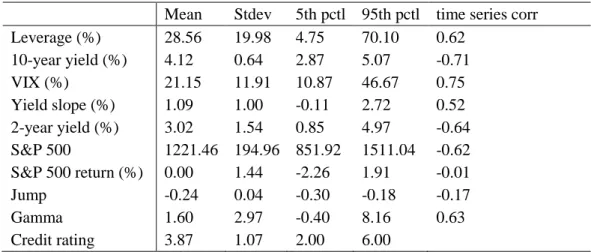
Table 3. Description of All Explanatory Variables in Sample ... 49
Table 4. Multivariate OLS Regression ... 52
Table 5. Pooling Regression with Crisis as a Dummy Variable... 55
Table 6. Pooling Regression with Credit Rating as a Dummy Variable ... 56
Table 7. Markov Regime Switching Regression Model for Four Determinants ... 58
Table 8. Testing of Equal Means between Regimes... 60
Table 9. Univariate Regression of Averaged Probability of Being in Crisis Regime on STLFSI ... 64
Table 10. Multivariate Regression Using Determinants with Alternative Liquidity Proxy ... 67
Table 11. Pooling Regression with Crisis as a Dummy Variable with Alternative Liquidity Proxy ... 69
Table 12. Pooling Regression with Credit Rating as a Dummy Variable with Alternative Liquidity Proxy ... 70
Table 13. Markov Regime Switching Regression Model for Four Determinants with Alternative Liquidity Proxy ... 71
Table 14. Testing of Equal Means between Regimes with Alternative Liquidity Proxy ... 72
XII Table 16. Multivariate OLS Regression with Alternative Risk-free Rate Proxy
... 74
Table 17. Pooling Regression with Crisis as a Dummy Variable and Alternative Risk-free Rate Proxy... 76
Table 18. Pooling Regression with Credit Rating as a Dummy Variable and Alternative Risk-free Rate Proxy... 77
Table 19. Multivariate OLS Regression with Alternative Volatility Proxy ... 79
Table 20. Pooling Regression with Crisis as a Dummy Variable and Alternative Volatility Proxy ... 81
Table 21. Pooling Regression with Credit Rating as a Dummy Variable and Alternative Volatility Proxy ... 82
Table 22. Unit Root Test for Leverage Ratios of Wal-Mart Stores, Inc ... 85
Table 23. Multiple Regression Controlling for Counterparty Risk ... 87
Table 24. Univariate Liquidity Shock Regression ... 88
Table 25. Liquidity Sensitivity against Number of Quotes ... 89
Table 26. Quantile Group Based on Number of Quotes ... 89
Appendix Table 27. Multiple OLS and Dummy-variable Pooling Regression for BBB- ~ BBB+ Rated CDS ... 94
Appendix Table 28. Multiple OLS Regression for CDS Spreads Level ... 96
Appendix Table 29. Pooling Regression for CDS Spreads Level with Crisis as a Dummy Variable ... 98
Appendix Table 30. Pooling Regression for CDS Spreads Level with Credit Rating as a Dummy Variable ... 99
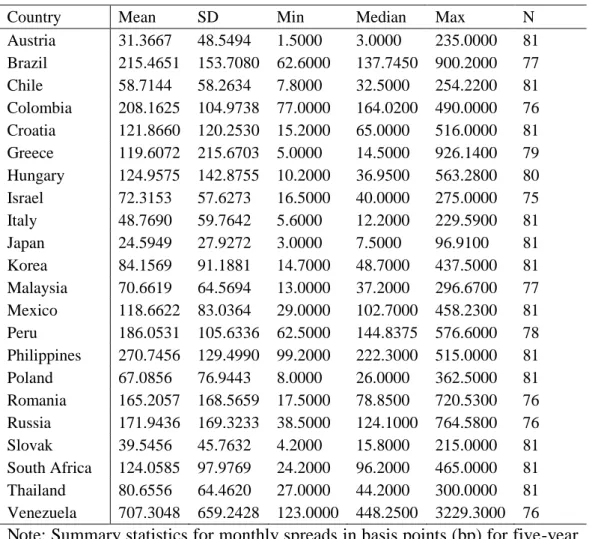
Table 31. Descriptive Statistics for Sovereign CDS Spreads (bp) ... 120
XIII
Table 33. Regression results of CDS spreads on two macro factors ... 126
Table 34. Macro Factor Loadings for Macroeconomic Variables for Greece 129 Table 35. Market Prices of Risk for Greece ... 129
Table 36. Instantaneous Credit Spread for Greece ... 130
Table 37. RMSE (bps) for All Sovereign CDSs ... 130
Table 38. Variance Explained by Macro Factors ... 131
Table 39. Spillover Effect from United States... 139
Table 40. Out-of-sample RMSE (in bps) ... 142
Appendix Table 41. Macro Factor Loadings for Macroeconomic Variables . 149 Appendix Table 42. Market Prices of Risk ... 154
Appendix Table 43. Instantaneous Credit Spread ... 158
XIV List of Figures
Figure 1. The Average of All CDS spreads (%) ... 32
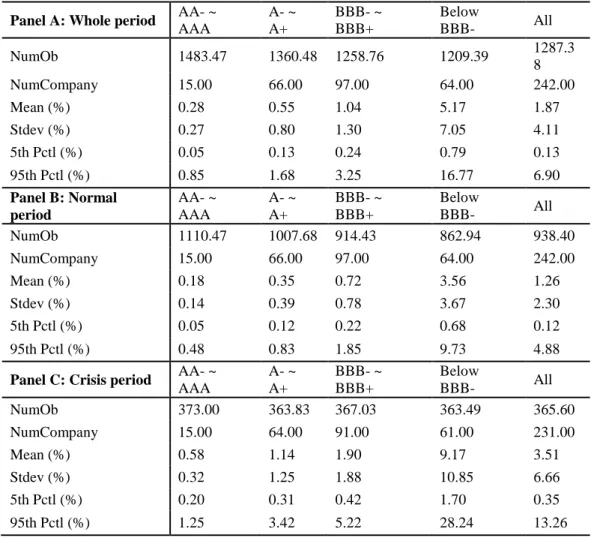
Figure 2. The Average CDS Spreads for Each Credit Rating Class (%) ... 45
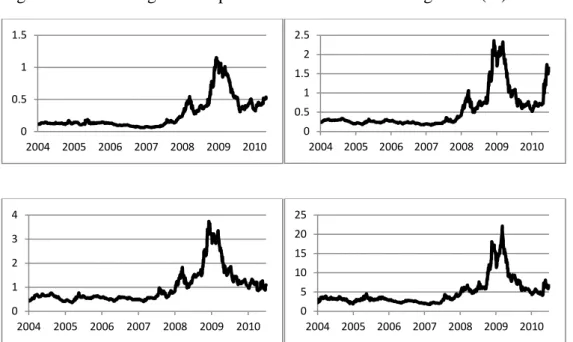
Figure 3. Time Series Plot of CDS Spreads Against Four Determinants ... 49
Figure 4. Time Series Plot of Averaged Probability of Volatile Regime ... 65
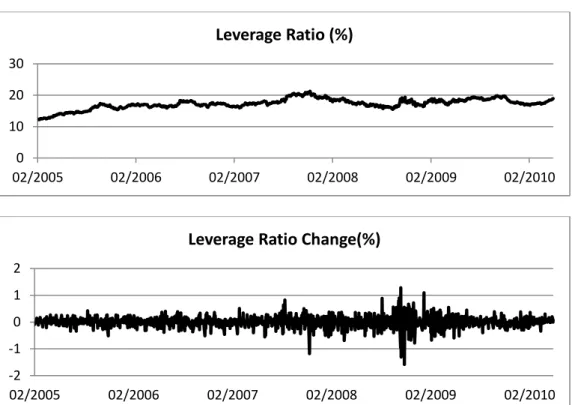
Figure 5. Time Series Plot of Leverage Ratios of Wal-Mart Stores, Inc... 85
Appendix Figure 6. Time Series Liquidity Measure for BBB- ~ BBB+ Rated CDS ... 100
Figure 7. Time Series Plot of Five Sovereign CDS Spreads (bps) ... 121
Figure 8. Time Series Plot of Extracted Macro Factors ... 124
Figure 9. Time Series Plot of Model Pricing Errors (bps) for Greece ... 132
Figure 10. Instantaneous CDS Spread (bps) and Variance Explained by Macro Factors... 136
Figure 11. Averaged Adjusted R2 of a Rolling Regression on Spillover Effect ... 140
Appendix Figure 12. Time Series Plot of All Sovereign CDS Spreads (bps) 161 Appendix Figure 13. Time Series Plot of Extracted Macro Factors ... 163
Part A
1
Part A: Introduction and Literature Review on
2
Abstract A
In this chapter I propose the research questions and the motivation of this thesis. In order to find its contributions I then review the current literature on valuation of debt assets considering credit risk, liquidity risk or both. Pros and cons of selected papers are analysed. The purpose of this section is to summarize different pricing models under several assumptions of the dynamics of pricing factors and, therefore, to link the empirical studies in Chapters B and C to the existing literature.
Part A Chapter A1. Introduction
3
Chapter A1. Introduction
Pioneered by Black and Scholes (1973) and Merton (1974), research on default has grown extensively in the last three decades. Black and Scholes (1973) is undoubtedly one of the most influential papers in the financial economics world, attempting to pricing options and corporate liabilities. Merton (1974) assesses the credit risk of a company by treating the company‟s
equity as a call option on its assets, and the company‟s credit risk can then be
measured by the value of a put option. Since then, researchers have been working hard to improve the modelling on default, to produce more accurate results and to explain default spreads more realistically. For instance, searching
the keywords “default risk” in Google scholar returns 284,000 articles since
2005.
Yet much remains to be done, default risk in financial markets has changed dramatically over the last few years, especially since the beginning of the financial crisis in 2007. A report in Moody (2011) shows the average credit loss rate has increased exponentially from 0.17% in 2007 to 3.41% in 2009, the highest in last 20 years. To be specific, I list several major recent credit events as follows (Guillen, 2012):
February 7, 2007: HSBC announces losses linked to US subprime mortgages; April 3, 2007: New Century Financial, which specializes in sub-prime
mortgages, files for Chapter 11 bankruptcy protection and cuts half of its workforce;
June 2007: Two Bear Stearns-run hedge funds with large holdings of
4 August 28, 2007: German Sachsen Landesbank faces collapse after investing
in the sub-prime market;
September 14, 2007: Depositors withdraw £1bn from Northern Rock in what
is the biggest run on a British bank for more than a century;
March 16, 2008: Bear Stearns is bought by J.P. Morgan Chase;
September 7, 2008: Mortgage lenders Fannie Mae and Freddie Mac are
rescued by the US government in one of the largest bailouts in US history;
September 15, 2008: Bank of America agrees to a $50 billion rescue package
for Merrill Lynch. Lehman files for bankruptcy;
1 April 2009: Unemployment across the Eurozone rose to its highest level.
All the events above indicate the strong impacts of default risk on the financial world, on the other hand, researchers realize a large fraction of the variation in default spreads remains unexplained by existing models (see Huang and Huang, 2002, Ericsson, et al., 2009). Therefore the main objective of this thesis is to extend existing models and to improve our understanding on default risk. It is acknowledged in the literature that CDS (credit default swap) spreads are superior to bond spreads for default research through more accurate data and higher trading frequency. Two widely traded CDS types are corporate and sovereign CDS, the first has as its underlying asset a corporate bond and, hence, hedges against the default risk of a company; the second type hedges against the default risk of a sovereign country. In this thesis I focus on the analysis on CDS contracts by asking the research questions:
Part A Chapter A1. Introduction
5
How can existing models explain default spreads using more recent data? The financial crisis has changed the risk profile of the financial
market, an examination of models‟ performance before and after the
beginning of financial crisis is therefore necessary.
Can I find other determinants implied by conventional models of default to explain corporate default spreads more accurately? Specifically, the increasing significance of liquidity risk for the valuation of equity and corporate bond has been investigated (Liu, 2006, Chen et al., 2007), I will aim to examine the role of liquidity for CDS valuation.
Can I propose an accurate pricing model for sovereign default spreads by incorporating macro and latent factors? There is extensive literature on modelling credit risk by either macro factors (Hilscher and Nosbusch, 2010, Longstaff et al.,2011) or latent factors (Duffie, et al., 2003, Houweling and Vorst, 2005, Pan and Singleton, 2008). I will combine these factors, take the advantages of each approach and compare the performance of my model.
Answering those research questions will allow me to make both empirical and methodological contributions. Before presenting my empirical results and possible gaps this thesis has filled, I review the literature on valuation of debt assets considering credit risk, liquidity risk or both. In Chapter A2 I review the models on interest rate, credit and liquidity spread. Chapter A3 summarizes the methodology commonly applied in default research, and Chapter A4 reviews the popular models for CDS valuation, given
6 the focus of this thesis is on CDS contracts. Finally Chapter A5 concludes this chapter by providing a link to the empirical studies in Chapter B and C.
Part A Chapter A2. Model Review
7
Chapter A2. Model Review
Bearing in mind to fill the gap of default research, in this section, I summarize influential papers relevant to the pricing of a defaultable corporate bond and some associated derivative asset, such as a convertible bond, bond with embedded options, CDS, with emphasis on credit and liquidity spread modelling.
A2.1 The interest rate model
Let the dynamics of risk-free interest rate be given by the following diffusion process: r t d dt t r u dr ( , ) ( , )
where is a Wiener process, u and are the time dependent expected rate of return and volatility of the spot interest rate. In selecting the specific form of interest rate model for valuation, note that Brennan and Schwartz (1980) and Ammann et al. (2008) find a rather small effect of stochastic interest rate models on a convertible bond fair price. Cox et al. (1985), and Mallier and Deakin (2002) choose a general affine model, the Cox-Ingersoll-Ross (CIR), model by assuming the dynamics of interest rate follows a square root process1
) (b r a
u and rr1/2
This ensures a mean reversion of the interest rate towards the long run value b, with speed of adjustment governed by the strictly positive parameter a; the standard deviation factor rr1/2 avoids the possibility of negative interest rates
1
8 for all nonnegative values of a and b. Duffee (1999), Duffie and Singleton (1997), and Jarrow et al. (2010) use a two-factor affine model for the spot interest rate r,
t t
t s s
r 1, 2,
Where is a constant, and the two state variables s1,t,s2,t represent the slope
and level of the interest rate yield curve, respectively, with each one following an independent square root process.
A2.2 The credit spread model
The most influential and representative papers on credit risk are the following. Jarrow and Turnbull (1995) draw an analogy between credit spread and foreign exchange rate, where a zero-coupon corporate bond can be converted into a zero-coupon government bond by the spot exchange rate derived on the condition of no prior default. Further, they assume the probability of default is independent of the constant recovery rate as well as the risk-free interest rate process, despite the fact that they are known to be correlated from empirical studies, such as Bakshi et al. (2006). Jarrow et al. (1997) extend and refine this model by assuming that the bankruptcy process follows a discrete state space and there exists a time-homogeneous Markov chain in credit ratings. In Duffie and Singleton (1999), when recovery rate is defined as a fraction of the market value rather than the face value or Treasury value in earlier reduced-form research, the credit spread y can be expressed as y(t) = h(t)(1- ) in an equivalent martingale measure, where h(t) is the hazard
Part A Chapter A2. Model Review
9 conveniently accommodate the default-adjusted short term rate (i.e. the sum of risk-free short rate and credit spread) with any desired risk-free term structure model. However, their method makes it difficult to decompose a credit spread into a hazard rate and a recovery rate and to model them separately. In order to overcome this problem, Bakshi et al. (2006) present a framework for studying the role of recovery rate on defaultable debt prices for a wide class of processes describing the recovery rates and default probability. These debt models have the ability to differentiate the impact of recovery rate and default probability on debt prices, and can be employed to infer the market expectation of recovery rates implicit in market prices. They are, therefore, able to model separately the recovery and hazard rate and allow a negative correlation between the two rates, which is found by their empirical work. In addition, Bakshi et al. (2006) find that the recovery specification relying on discounted face value provides a better fit to the data, when their defaultable debt models are tested using a sample of BBB-rated bonds.
Campbell and Taksler (2003) explore the effect of equity volatility on corporate bond yields. Panel data for the late 1990s show that idiosyncratic firm-level volatility can explain as much cross-sectional variation in yields as credit ratings. This finding supports Madan and Unal (1998), in which the authors decompose default risk into timing and recovery risks, and demonstrate that the default intensity process and, thus, the probability of default, is a function of the discounted equity value. Later Madan and Unal (2000) extend the process to a two-factor model including both non-interest sensitive asset value and risk-free interest rate processes. Their model allows
10 stochastic interest rates to impact current asset values as well as their evolution, and generates credit spreads consistent with empirical observations.
Jarrow et al. (2010) develop a reduced-form approach for valuing callable corporate bonds by characterizing the call probability via an intensity process. Their approach extends the reduced-form model of Duffie and Singleton (1999) for defaultable bonds to callable bonds and captures some important differences between call and default decisions. A comprehensive empirical analysis of callable bonds shows that the reduced-form model by Jarrow et al. (2010) fits callable bond prices well and outperforms the traditional American option approach by Duffie and Singleton (1999) both in- and out-of-sample. Analogous to Duffie and Singleton (1999), Jarrow et al. (2010) jointly estimate the recovery rate and default intensity, and allow them to be correlated with the risk-free interest rate only. Tsiveriotis and Fernandes (1998) value a convertible bond with credit by separating it into two securities: a cash-only part of convertible bond (COCB) and an equity-like part convertible bond (ELCB). The holder of a COCB is entitled to all cash flows but no equity flows and, therefore, is subject to default, discounted at a risky rate (risk free + credit spread); conversely, the ELCB is default-free and discounted at a risk free rate. Since both parts are derivative securities with the same underlying stock, the COCB price and ELCB price can be calculated under the Black Scholes framework. However, the whole explanation on loss and recovery processes in case of default is missing from Tsiveriotis and Fernandes (1998), which does not say what actually happens to the convertible bond if default occurs. Takahashi et al. (2001) characterize default risk exogenously based on Duffie and Singleton (1999) and assume equity value
Part A Chapter A2. Model Review
11 itself is subject to default risk. They model the hazard rate as a decreasing function of stock price, hence naturally incorporating a negative relation between the probability of default and the level of stock price, and providing a consistent and practical reduced-form approach for relative pricing of securities including convertible and non-convertible corporate bonds and equities by treating the recovery rate as a constant. Ayache et al. (2002) argue that recovery to market value when default happens is not an optimal policy for the holders of convertible bonds, since the holders have the right to change the bonds to shares of stock - and, indeed, the model of Tsiveriotis and Fernandes (1998) is a special case of their optimal model.
A2.3 The liquidity spread model
Despite the large effort on credit risk modelling, little has been done for liquidity risk, which has gained increasing attention since the beginning of the 2007/2008 financial crisis in the credit markets. Aleksandrov and Hambly (2010) conclude that, along with credit risk, liquidity risk is very important and should not be underestimated. Longstaff et al. (2005) use the information in credit default swaps to obtain direct measures of the size of the default and non-default components in corporate spreads. They find that the majority of the corporate spread is due to default risk. This result holds for all rating categories and is robust to the definition of the risk-free rate curve. They also find that the non-default component is time varying, mean-reverting and strongly related to measures of bond-specific illiquidity as well as to macroeconomic measures of bond market liquidity. Furthermore, they only find weak evidence that the non-default component is related to the differential
12 state tax treatment given to Treasury and corporate bonds. In their paper, Longstaff et al. (2005) specify the risk-neutral dynamics of the intensity process as square root and of the liquidity process as Gaussian; they assume the recovery rate is constant and there is an independence among risk free interest rate, default intensity and liquidity yield; and, finally, they derive a closed-form solution for corporate bonds, although they note that the in-sample correlations shows that these variables are not independent. Kempf and Uhrig-Homburg (2000) propose a theoretical continuous-time model to analyze the impact of liquidity on bond prices. This model values illiquid bonds relative to liquid bonds and provides a testable theory of illiquidity-induced price discounts. The empirical findings suggest that bond prices not only depend on the dynamics of interest rates but also on the liquidity of bonds. Thus, bond liquidity should be used as an additional pricing factor. The findings of the out-of-sample test demonstrate the superiority of the model over traditional pricing models without a liquidity factor. The authors use the square root dynamics for both risk free interest rate and liquidity discount, and solve the partial differential equation numerically after assuming a zero instantaneous correlation between them, similar to Longstaff et al. (2005). Kempf and Uhrig-Homburg (2000) also find from their empirical analysis that the correlation between the changes in the interest rate and changes in liquidity spread is significantly different from zero. Koziol and Sauerbier (2007) present an easily applicable option-theoretical approach to quantify liquidity spreads of corporate bonds. They describe the value of liquidity as that of multiple lookback options. After valuing these lookback options in a framework with uncertain interest rate, Koziol and Sauerbier (2007) find a liquidity factor is
Part A Chapter A2. Model Review
13 able to explain to a large part the empirically observed spreads, while credit risk has nearly no explanatory power for the bond prices. This is contradictory to what we usually find in the literature and explained by the authors thus: it is not easy to define those non-trading dates for illiquid bonds and the choice of those dates is important for the performance of their pricing model. Aleksandrov and Hambly (2010) suggest a framework for valuing defaultable bonds that allows for capturing not only the default risk but also the liquidity risk by expanding a credit intensity model. They then investigate defaultable bonds empirically and extract their liquidity risk within this model. Based on the dozens of corporate bonds in the finance industry, they observe a regime shift at the beginning of the credit crisis for the liquidity risk of a range of defaultable bonds. They also note that liquidity spread is very significant and is, in some cases, even larger than credit spread. Unfortunately, the authors ignore the dependence structure among risk free interest rate, default intensity and liquidity yield and also specify the dynamics of them as square root processes, hence eliminating the possibility of negative liquidity spread, which is found in Longstaff et al. (2005).
Empirical research supports the argument that a liquidity factor is significant in corporate bond pricing. A number of recent studies indicate that neither levels nor changes in the yield spread of corporate bonds over Treasury bonds can be fully explained by credit risk. For example, Chen et al. (2007) find that liquidity is priced in corporate yield spreads. Using a battery of liquidity measures covering over 4,000 corporate bonds and spanning both investment grade and speculative categories, they find that more illiquid bonds earn higher yield spreads and an improvement in liquidity causes a significant
14 reduction in yield spreads. They find that liquidity is a key determinant in yield spread, explaining as much as half of the cross-sectional variation in yield spread levels and as much as twice the cross-sectional variation in yield spread changes than is explained by credit rating effects alone. Their findings justify the concern in the default risk literature that neither the level nor the dynamics of yield spreads can be fully explained by default risk determinants. Li et al. (2009) provide a comprehensive empirical analysis of the effects of liquidity and information risks on expected returns of Treasury bonds. They document a strong positive relation between expected Treasury returns and liquidity and information risks, controlling for the effects of other systematic risk factors and bond characteristics. This relation is robust to many empirical specifications and a wide variety of traditional liquidity and informed trading proxies.
Part A Chapter A3. Methodology Review
15
Chapter A3. Methodology Review
In this section, I review the valuation models on different assumptions of the dynamics of pricing factors: risk free interest rate, default intensity and liquidity yield. Unless otherwise defined, a general debt asset is maturing in time T, paying a principal B at maturity if still alive on that date, paying a fixed coupon amount c at times ti. It may be callable by the issuer at a price Bc
at any time after the call date Tc, convertible at any time after the conversion
date Tcv to k shares of stock with price S, and the spot interest rate is denoted
by r.
A3.1 Simple independent world
Kempf and Uhrig-Homburg (2000) model the dynamics of interest rate and liquidity yield as square root processes, Aleksandrov. and Hambly (2010) define the dynamics of interest rate, default intensity and liquidity yield as square root, which avoids negative values and is a good choice for interest rate and default intensity modelling. However, as noted by Longstaff et al. (2005) and Fernandez (2005), liquidity spread can sometimes be negative; one possible reason is that investors prefer to hold long term bonds even if their returns are low. Longstaff et al. (2005) therefore assume that the risk-neutral dynamics of the liquidity process t as
dZ d
Where is a positive constant and Z is a standard Brownian motion. These dynamics allow the liquidity process to take on both positive and negative
16 values. The authors also explore alternative specifications for that allow for a mean-reverting drift but these specifications generally do not perform better. In addition, the risk-neutral dynamics of the intensity process t is
dt dZ d ( )
Here, and are positive constant, and Z is another Brownian motion. These dynamics allow for both mean reversion and conditional heteroskedasticity in corporate spreads, and guarantee that the default intensity process is always nonnegative. Define the value of a riskless zero-coupon bond D(T) with maturity T by
T tdt r T D 0 exp ) (A bondholder recovers a fraction 1-w of the par value of the bond in the event of default. The value of a corporate bond is given by a closed form solution under the independence assumption:
T t T T t dt e t H t G t D t C t B w e T D T C T B t A dt e t D t C t B t A c T w c CB 0 0 ) ) ( ) ( )( ( ) ( ) ) ( exp( ) 1 ( ) ( ) ( ) ) ( exp( ) ( ) ( ) ( ) ( exp ) ( ) , , ( Where and denote the current values of the intensity and liquidity process, respectively, and
2 / 2 2 1 1 ) ( exp ) ( t e t t A ) 1 ( 2 ) ( 2 2 t e t B
Part A Chapter A3. Methodology Review 17 6 exp ) ( 3 2 t t C 1 2 2 2 1 1 ) ( exp ) 1 ( ) ( t t e t e t G 2 2 2 2 2 1 1 ) ( exp ) ( t e t t H 2 2 2 ) /( ) ( .
For callable corporate bonds, Duffie and Singleton (1999) propose valuing them as American options written on otherwise identical non-callable bonds values using a reduced-form approach. This assumes that the firm calls the bond to minimize the market value of the particular bond under analysis; however, as argued by Jarrow et al. (2010), this assumption ignores the bond‟s
impact on the firms‟ remaining liabilities and, hence, shareholders‟ equity
might not be maximized. Alternatively, Jarrow et al. (2010) develop a reduced-form approach for valuing callable corporate bonds by characterizing the call probability via an intensity process, analogous to that of default intensity. ) , , ( ) 1 ( k c,t chc,t c s1,t s2,t
Where k is the ratio of recovery to the market value of the bond when call action occurs, c,t is the call intensity, c is a constant to permit a non-zero call spread even for firms with close-to-zero call risk, s1,t,s2,t represent the
18 slope and level of the Treasury yield curve, respectively, the systematic component (c,s1,t,s2,t) captures the portion of the standard call spread, and the idiosyncratic component hc,t captures the extra part that cannot be explained by the standard call spread. By carefully choosing parsimonious representations for the systematic and idiosyncratic component, the authors are able to derive a closed-form approximation for callable bond prices. Specifically t c t c t t s c s s s s c , 2 2 1 , 1 1 , 2 , 1 , ) ( ) , (
where c is the coupon rate of the callable bond and s is the average of slope 1 factor of the Treasury yield curve. This specification captures the idea that, all else equal, a high-coupon bond is more likely to be called than a low-coupon bond and all callable bonds are more likely to be called when interest rates are
low. Moreover, the nonlinear functional form of t s2,
1
captures the nonlinear
dependence of the call spread on interest rates. The idiosyncratic component follows an independent square root process,
t c t c c t c c c t c h dt h dZ dh, ( ,) , ,
The authors find the liquidity premium is insignificant after adding a liquidity spread to their pricing model and specifying the liquidity process as another independent square root process, although they note that the liquidity process is mean reverting and there is a negative risk premium associated with liquidity risk.
Part A Chapter A3. Methodology Review
19 A3.2 Advanced correlated world
Duffee (1999), Jarrow et al. (2010) use a two-factor affine model for the spot risk-free interest rate
t t r
t s s
r 1, 2,
where r is a constant, s1,t,s2,t represent the slope and level of the Treasury yield curve, respectively. The dynamics for each of the two factors follow a square root process
t i t i i t i i i t i s dt s dZ ds, ( , ) , , , for i=1, 2
Here Zi,t is an independent standard Brownian motion. Jarrow et al. (2010) then model the default spread by the following representation:
) ( ) ( ) 1 ( d,t dhd,t d1 s1,t s1 d2 s2,t s2 and t d t d d t d d d t d h dt h dZ dh , ( ,) , ,
Where Zd,t is independent of Zi,t. By this setting, default spread is naturally connected with Treasury rate and so is the call spread. In their empirical analysis of the importance of a liquidity premium, the authors ignore the influence of default intensity and Treasury rate on the liquidity process by letting the liquidity spread l follow another independent square-root process t
t l t l t l l t l dt ldZ dl ( ) ,
20 Following Lando (1998), Duffie and Singleton (1999), Jarrow et al. (2010), the price of a zero-coupon corporate bond CB(c,w,T) can be expressed as2
T t t t w dt r T w c CB 0 ( (1 ) ) exp ) , , ( There are two potential methods to impose a dependence structure on the dynamics of interest rate, default intensity and liquidity processes. One method is to relax the independence assumption, and specify their dynamics as
r r r r r dt rdZ dr ( ) dt dZ d ( ) dZ d Where (dZr,t,dZd,t)r,d 0,(dZr,t,dZl,t)r,l 0, and 0 ) , (dZd,t dZl,t d,l .
AÏT-Sahalia (2008) provides closed-form expansions for the log-likelihood function of multivariate diffusions sampled at discrete time intervals. The coefficients of the expansion are calculated explicitly by exploiting the special structure afforded by the diffusion model. After achieving an
2
It is straightforward to value a coupon bond given the price of a zero-coupon bond by treating a coupon bond as a portfolio of zero-coupon bonds.
Part A Chapter A3. Methodology Review
21 approximated transition function ~pr,,(t), we can value the corporate bond with a closed-form solution.
The other method is, analogous to Jarrow et al. (2010), to model the default spread and liquidity spread as functions of Treasury rate. Specifically, spot interest rate is modelled as
t t r t s s r 1, 2, where t i t i i t i i i t i s dt s dZ ds, ( ,) , , , for i=1, 2.
Here, Zi,t is an independent standard Brownian motion. Default spread is
) ( ) ( ) 1 ( wt d hd,t d1 s1,t s1 d2 s2,ts2 and t d t d d t d d d t d h dt h dZ dh , ( ,) , , where Zd,t is independent of Zi,t. Finally liquidity spread is
) ( ) ( 1, 1 2 2, 2 1 , s s s s hlt l t l t l t and t l l t l l l t l h dt dZ dh, ( ,) ,
where Zl,t is independent of Zi,t and Zd,t. Here, systematic factors in the liquidity process are included and the liquidity process is simple Gaussian for
22 two reasons. First, empirical research has found that the change of Treasury rate and that of liquidity spread are correlated - see Kempf and Uhrig-Homburg (2000), and Longstaff et al. (2005). By the above specifications, default spread and liquidity spread are connected exogenously. Second, liquidity spreads are mean-reverting and can take on both positive values and negative values by following the Ornstein–Uhlenbeck process. A closed form solution can, therefore, be derived since Zl,t , Zi,t (i=1,2) and Zd,t are independent given the affine model structure.
The same argument can be applied to convertible bonds, Takahashi et al. (2001) explicitly take default risk into consideration based on Duffie and Singleton (1999), and provide a consistent and practical method for convertible bonds pricing. An associated partial differential equation is derived as 0 ) ( )) , ( ) ( ( )) , ( ) , ( ( 2 1 2 2 t c V t S w t r V SV t S t S V S ss S t
where c is the coupon.
In sum, numerous empirical studies have found the following phenomena:
Equity volatility helps to explain default spread, see Campbell and Taksler (2003);
Recovery rates are negatively associated with default probability, see Bakshi et al. (2006);
Hazard rate should be a decreasing function of stock price, the probability of default is negatively related with the level of stock
Part A Chapter A3. Methodology Review
23 price, see Takahashi et al. (2001).
Treasury rate, default intensity and liquidity premium are correlated, see Longstaff et al. (2005).
For example, to capture the negative correlation between recovery rate and default probability, Bakshi et al. (2006) assume that the recovery rate is related to the hazard rate as
) ( 1 0 ) (t w we t w And hazard rate is linear in the short interest rate
) ( )
(t 01r t
Here, the change of r follows a square-root process. To capture the decreasing relation between hazard rate and stock price, Takahashi et al. (2001) take the function b t t S c S ( )
Therefore, an ideal model should (i) reflect those findings listed above, and (ii) allow a tractable solution, such as a closed or semi-closed form approximation, or have a fast convergence rate if numerical methods apply.
24
Chapter A4. CDS Valuation Review
Given the critical role of CDS contracts in this thesis, it is necessary to summarize influential approaches in the literature on valuation of CDSs and how these take into account the relationship between default and liquidity components. Three research branches existing in the current literature are briefly summarized in this chapter and more detailed review will be undertaken in Chapter B and C separately.
Reduced form. Longstaff et al. (2005) assume a premium is paid continuously. By setting the values of the premium leg and protection leg equal to each other, they are able to value CDS spreads in a closed form solution. Pan and Singleton (2008) apply a reduced form model to Mexico, Turkey, and Korea sovereign CDSs, showing that a single-factor model for default spread following a lognormal process captures most of the variation in the term structures of spreads. Nashikkar et al. (2011) assume a constant default process and calculate CDS par yield in a reduced-form framework. Chen et al. (2008) assume risk-free rates and default rates are correlated and solve the CDS pricing model using a reduced-form model. Lin et al. (2011) value corporate bonds and CDSs simultaneously using a reduced form model, for CDS part, the authors assume there are both default and non-default part, and solve the model by assuming the two parts are independent. Jankowitsch et al. (2008) attribute the difference between corporate bond yields and CDS premium to one covenant of a CDS: cheapest-to-deliver option, and solve the covenant by relating it to recovery rate. Their empirical
Part A Chapter A4. CDS Valuation Review
25 analysis does not support a liquidity premium. Carr and Wu (2010) propose a dynamically consistent framework that allows joint valuation and estimation of stock options and credit default swaps written on the same reference company. By assuming the stock price follows a jump-diffusion process with stochastic volatility and that the instantaneous default rate and variance rate follow a bivariate continuous process, the authors solve the reduced form model analytically. Brigo and Alfonsi (2005) introduce a two-dimensional correlated square-root diffusion (SSRD) model for interest-rate and default process, then value a CDS via Monte Carlo simulation. Zhang (2008) uses a three-factor model, namely interest rates, firm-specific distress variable, and hazard rate. He is able to link hazard rate with interest rate by assuming the former is a function of the latter, and then he solves the model analytically and applies it to Argentina sovereign CDSs.
Structural model. The pioneering research on the structural model of default comes from Merton (1974) and Black and Cox (1976) and is summarized by RiskMetrics (2002). Zhong et al. (2010) argue a CDS is similar to out-of-the-money put options in that both offer low cost and effective protection against downside risk. They conclude that the put option implied volatility is an important determinant of CDS spreads. Bedendo et al. (2009) use an extended version of RiskMetrics (2002) to find that the gap between the model CDS premium and market premium is time-varying and widens substantially in times of financial turbulence. The authors note that CDS liquidity shows a
26 significant impact on the gap and should, therefore, be included when pricing CDS contracts.
CAPM framework. Valuation of CDS spreads under the Capital Asset Pricing Model (CAPM) framework is rather new and developing. It was pioneered by Bongaerts et al. (2011) and these authors imply that the equilibrium expected returns on the hedge assets can be decomposed into several components: priced exposure to the non-hedged asset returns, hedging demand effects, an expected illiquidity component, liquidity risk premium and hedging transaction costs. They then estimate CDS spread under market equilibrium.
Part A Chapter A5. Conclusion
27
Chapter A5. Conclusion
The financial crisis beginning in 2007 inspires new research on default risk, how to reflect the reality before and after the financial crisis more accurately is challenging and increasingly important. In this chapter I introduce the motivation of this thesis under such a volatile financial market, the research questions of this thesis and why they are important. To fill the literature gap, I then review the models and methodologies widely applied for default research, with a concentration on CDS valuation.
In summary, two widely traded CDS contract types are corporate and sovereign CDS, the first hedges against the default risk of a company and the second type hedges against the default risk of a sovereign country. Generally the research on CDS valuation can be classified into three dimensions: reduced form model, structural form model and CAPM framework model. A detailed overview is undertaken by Brigo et al., (2012). So the Chapter B examines the determinants of corporate CDS spreads from a structural form model point of view, with a concentration on the role of liquidity risk; and the Chapter C investigates the determinants of sovereign CDS spreads mostly from a reduced form point of view. The research using a CAPM framework will be beyond the scope of this thesis and will be my future research.
28
Part B: Regime Dependent Liquidity
Determinants of Credit Default Swap Spread
Changes
Part B Abstract
29
Abstract B
In this section I construct a liquidity measure for Credit Default Swaps (CDS) and investigate the relationship between the changes in CDS spreads and the determinants implied by structural models of default, including firm leverage, volatility, risk-free interest rate, and liquidity. Using a dummy-variable pooling regression and a Markov regime switching model, I find strong evidence that these determinants, especially the liquidity determinant, are significant and time-varying. Among the four determinants, the effects of liquidity shock on CDS spreads differ significantly across rating groups when the CDS market is tranquil but when it is turbulent the effects become similar, regardless of credit rating.
30
Chapter B1. Introduction
A credit default swap (CDS) is a contract in which the buyer of protection makes a series of payments, often referred to as CDS spreads, to the protection seller and, in exchange, receives a payoff if a default event occurs. CDSs have existed since the early 1990s and the market increased greatly from 2003, such that by the end of 2007 the outstanding notional amounts were $62.2 trillion, falling to $30.4 trillion by the end of 2009. The corresponding amounts for total equity derivatives were $10.0 trillion and $6.8 trillion (ISDA Market Survey, 2010). Understanding the variation of CDS spreads has become important for investors, given the large market size and the hedging function of CDSs against default.
In this chapter I investigate the relationship between the changes in CDS spreads and the determinants implied by structural models of default. It is acknowledged in the literature that CDS spreads are superior to corporate bond spreads for default research through more accurate data and higher trading frequency. Empirical studies focus on analyzing three determinants suggested by the pioneering model of Merton (1974), namely leverage ratio, volatility and risk-free rate (Collin-Dufresne et al., 2001; Campbell and Taksler, 2003; Zhang, 2008; Zhang et al., 2009; Ericsson et al.. 2009; Zhong et al., 2010). Recent research provides both a theoretical foundation and evidence that liquidity is priced in CDS spreads (Ericsson and Renault, 2006; Bedendo et al., 2011; Bongaerts et al., 2011; Bhanot and Guo, 2012; Pu et al., 2011). In particular, Ericsson and Renault (2006) develop a structural model for both liquidity and credit risk, and Bongaerts et al. (2011) derive an equilibrium asset pricing model incorporating liquidity. Their results are important since they
Part B Chapter B1. Introduction
31 demonstrate how a model with a fourth determinant, liquidity, could improve the understanding of the nature of CDS spreads.
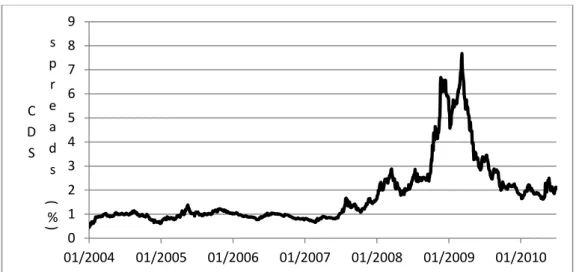
The financial crisis that began in 2007 has changed financial markets dramatically. For example, Figure 1 plots the average CDS spreads in my sample - clearly spreads behave differently after June, 2007, when the financial crisis began. Underlying determinants of CDS spreads may differ in their effects when the CDS market is in either tranquil or turbulent circumstances. Therefore, I am motivated to examine the four determinants both unconditionally and conditionally by using recent US corporate CDS data. Proxies for the leverage ratio, volatility and risk-free rate are standard and I construct a liquidity measure for CDS at a market level analogous to the measure for corporate bond proposed by Bao, et al. (2011). I then conduct tests on the significance and time-varying magnitude of these determinants by a dummy-variable pooling regression and a Markov regime switching model, with emphasis on the liquidity determinant.
Two main results emerge from the analysis. First, unconditionally, by regressing the daily changes in 5-year senior unsecured debt CDS spreads from January 2004 to June 2010 on the changes in leverage ratio, volatility, risk-free rate and liquidity, I find the coefficients for all four determinants are statistically significant. These findings hold after controlling for other explanatory variables implied by extended structural models of default such as the changes in treasury yield curve slopes, jump magnitudes, business climate, and nonlinear effects of Treasury yields. Second, conditionally, both the dummy-variable pooling regression and the standard Hamilton (1989) Markov two-regime switching model indicate that these determinants are indeed
time-32 varying. The crisis dummy variable is strongly significant for all CDSs, suggesting that the crisis shifts the level of the change in CDS spreads. In addition, the significant interaction terms between the crisis dummy variable and the four determinants indicate the slope sensitivities change dramatically during the crisis.
Figure 1. The Average of All CDS spreads (%)
Note: Y axis is CDS spreads (%) and X axis is date.
Furthermore, the regime switching model finds that the effect of liquidity is more pronounced in crisis regime than in normal regime; specifically, the coefficient for liquidity determinant represented by my liquidity measure in crisis regime is 17.07 times as large as that in normal regime, compared with the 3.22, 2.73, and 3.56 times for leverage ratio, volatility and risk-free rate, respectively. A t-test strongly rejects the coefficients of the determinants being equal between regimes. The intuition of applying a regime switching model is that, due to the financial crisis, determinants may change in their shocks to CDS spreads. We may ask whether the statistical significance of these determinants is robust under different
market conditions, when the CDS market is in either „normal‟ or turbulent
0 1 2 3 4 5 6 7 8 9 01/2004 01/2005 01/2006 01/2007 01/2008 01/2009 01/2010 C D S s p r e a d s ( % )
Part B Chapter B1. Introduction
33 circumstances. From an economic perspective, it is reasonable to believe that the effect of liquidity on default spreads can be small when the financial market is healthy and can be high when the market is in danger. As an illustration, Figure 1 clearly shows spreads behave differently after the financial crisis began.
My work is most closely related to Pu et al. (2011) and Alexander and Kaeck (2008). Pu et al. (2011) find evidence that liquidity is priced in CDSs unconditionally; however, the sample is restricted to monthly data from January 2001 to December 2007 and so does not fully cover the financial crisis, which restricts conducting a conditional analysis. Alexander and Kaeck (2008) employ a similar Markov regime switching model for the iTraxx Europe CDS index from June 2004 to June 2007 and so they are unable to distinguish the influences on different credit rating classes of reference entities; moreover, they do not explicitly take a liquidity determinant into account.
The structure of the Chapter is as follows. Chapter B2 reviews literature on the developments of the determinants of corporate CDS, with emphasis on liquidity determinant. Chapter B3 presents the regression models including standard univariate and multivariate ordinary least square regressions (OLS), dummy variable regression and Markov regime switching regression. Chapter B4 reports the data set and summary statistics. The empirical results and discussion are presented in Chapter B5, in which I explain the results I find, discuss their economic meaning, and conduct robustness tests, followed by conclusions in Chapter B6.
34
Chapter B2. Literature Review
Pioneered by Merton (1974), the basic structural model of default and its extensions have become a standard for default spread analysis. While these models have their own theoretical variables or functional forms, typically they have common variables that are central to determine the changes of default spreads. Merton (1974) values a defaultable risky asset as a risk-free asset less
a put option on the issuing firm‟s value; as a result, three core determinants are
leverage ratio, risk free rate, and volatility. Leverage ratio measures the
distance to the strike price (the issuing firm‟s value) of a put option and the
likelihood of triggering default; risk free rate decides the value of a risk free asset; and volatility determines the value of a put option. Collin-Dufresne, Goldstein et al. (2001) regress the changes of corporate bond yield spreads on variables that should determine credit spread changes in the theory of structural models of default, including leverage ratio, volatility, and risk free rate. They find those variables are statistically significant. Using similar variables but with the change of CDS spreads instead of the change of corporate bond yields spreads as a dependent variable, Ericsson, Jacobs et al. (2009) draw an identical conclusion that the variables suggested by the basic structural model pioneered by Merton (1974) are crucial to explain the changes of CDS spreads, even after controlling for extra variables of extended structural models. Boss and Scheicher (2002) investigate the determinants of credit spread changes in the euro area and conclude leverage, volatility and risk-free rate are important factors. Avramov, et al. (2007) provide further evidence that a parsimonious set of common factors including leverage, volatility and spot rate are able to explain more than 54% of the variance in credit spread changes.
Part B Chapter B2. Literature Review
35 Among the three core determinants, leverage ratio has long been an important determinant for debt research. All else equal, the higher leverage ratio is, the higher is the risk of default and the larger is default spread. Therefore, credit spread should increase as the leverage ratio increases. For example, Collin-Dufresne and Goldstein (2001) propose a structural model of default that captures the change of debt levels in response to changes in firm value; furthermore, their model generates mean-reverting leverage ratios. They find the credit spreads their model generates are more consistent with empirical findings, which suggests a critical role of leverage ratio in explaining credit spread. Both Collin-Dufresne, Goldstein et al. (2001) and Ericsson, Jacobs et al. (2009) find that credit spread is an increasing function of leverage ratio via a regression. Cesare and Guazzarotti (2010) analyse the determinants of credit default swap spread changes between Janauary 2002 and March 2009. They document that the spreads have become much more sensitive to the level of leverage since the breakout of the financial crisis.
All else equal, the higher volatility is, the higher is the risk of default and, thus, the larger is default spread. Therefore, credit spread should increase as volatility increases. Campbell and Taksler (2003) explore the effect of equity volatility on corporate bond yields and find equity volatility is a significant factor in explaining the cross-sectional variation in yields. Benkert (2004) investigates the effects of equity volatility on credit default swap premia and finds evidence that option-implied volatility is an important factor in explaining variation in CDS spreads, using panel data of CDS on 120 international firms from 1999 to mid-2002. Zhang et al. (2009) explain CDS spreads by volatility and jump risk of equity prices. Zhong et al. (2010) argue
36 that a CDS is similar to an out-of-the-money put option in that both offer a protection against downside risk, their result indicates the put option implied volatility is an important determinant of CDS spreads. Again, both Collin-Dufresne, Goldstein et al. (2001) and Ericsson, Jacobs et al. (2009) find, via regression, that credit spread is an increasing function of volatility.
All else equal, the higher risk-free rate is, the lower is the risk of default and, thus, the smaller is default spread. Therefore, the credit spread should decrease as risk-free rate increase. Longstaff and Schwartz (1995) argue that an increase in risk-free rate increases a company‟s value which, in turn, decreases the probability that the value of the company will fall below the default threshold and, consequently, reduces the default risk and leads to a smaller credit spread. Based on that argument, they test empirically the negative relationship between risk-free rates and credit spreads. Duffee (1998) provides further evidence that changes in credit spreads and interest rates are negatively related by testing a sample of non-callable bonds.
Besides the three core determinants, other variables are found to be significant in explaining credit spreads by an extended structural model of default. For instance, Fama and French (1989) argue that an increase in the yield-curve slope suggests an improvement of economy, which leads to higher recovery rates and lower credit spreads. Litterman and Scheinkman (1991) find that an increase in the slope also increases the expected future spot rate, and then a steeper slope leads to a decrease in credit spreads. Altman and Kishore (1996) argue that an improving economy narrows credit spreads. Zhang (2008) finds that the default risk premium in a CDS is affected by business cycle, credit conditions and the overall strength of economy. Collin-Dufresne,
Part B Chapter B2. Literature Review
37 Goldstein et al. (2001) and Ericsson, Jacobs et al. (2009) investigate jumps in firm value and square of risk-free rate as extra determinants of credit spreads. They argue that a larger jump in firm value increases the probability of default and leads to a higher credit spread, while adding the square of risk-free rate controls the possible nonlinear relationship between credit spread and risk-free rate.
All the above mentioned papers do not explicitly consider liquidity as a determinant. However, researchers started to realize that liquidity is significant for CDS valuation. Longstaff et al. (2005) find that non-default components in corporate bond credit spreads are strongly related to liquidity measures. Tang and Yan (2007) present an empirical study of the pricing effect of liquidity in the CDS market and find evidence that liquidity risk is priced in CDS spreads. Buhler and Trapp (2006, 2008) explicitly incorporate a liquidity intensity rate process into their reduced form models. Pan and Singleton (2008) examine the term structure of sovereign CDS spreads and claim that a second principal component (possibly related to the liquidity spread) is needed to explain the severe mispricing of one-year contracts. More recently, Bhanot and Guo (2011) show that the deviations between the CDS spread and corporate bond spread can be explained by funding liquidity and asset-specific liquidity. Bedendo, Cathcart et al. (20011) demonstrate that liquidity in the CDS market should be taken into account when pricing CDS contracts. Bongaerts, de Jong et al. (2011) derive an equilibrium asset pricing model incorporating liquidity and find an economically small but significant effect of liquidity for CDS market. Ericsson and Renault (2006) develop a structural model for both liquidity and credit risk, and find evidence of a liquidity component of yield spreads.
38 Annaert et al. (2013) decompose the CDS spread changes of 32 listed Euro area banks and find evidence that liquidity-related variables complement credit-related variables in explaining credit spread changes. All else equal, the higher illiquidity is, the higher is the risk of default and, thus, the higher is default spread. Therefore, the credit spread should increase as liquidity becomes worse.
Table 1 summarizes the predicted sign of the correlation between changes in credit spreads and changes in the main determinants I investigate in this work.
Table 1. Expected Sign between Changes in Credit Spreads and Determinants
Determinant Predicted sign
Leverage ratio +
Volatility +
Risk-free rate -