DEVELOPMENT
https://www.mlsjournals.com/Innovation-Technological-Develop
How to cite this article:
Arruda Ramos, A. (2020). Influence of PPCDAM in combating deforestation in the brazilian legal Amazon.
Innovation & Technological Development, 1 (1), 99-122.
INFLUENCE OF PPCDAM IN COMBATING DEFORESTATION
IN THE BRAZILIAN LEGAL AMAZON
Anderson Arruda Ramos
Universidade Federal do Ceará (Brasil)
Abstract. Deforestation in the Brazilian Legal Amazon region has been worrying the local population, environmentalists, the Brazilian government and even the international community for decades. As a way to address the issue, the federal government created the PPCDAm, a program to combat illegal deforestation. Over the course of its fourteen years of operation, the PPCDAm achieved remarkable results, encouraging the country to commit itself to reducing the rate of deforestation to 3,925 km2 by the year
2020. In recent years, however, its results have not been sufficient to reach the stipulated goal. Therefore, the present work seeks to study the dynamics of PPCDAm in its different phases, observing the scope of the proposed results and what factors were decisive for them. For this purpose, the official Brazilian publications and the academic community were used as a research source, based on analyzes of governmental data, but also of independent studies, in order to guarantee the suitability of the research. As a result, although in a still inconclusive character due to the deadline stipulated for the target, but with a fairly reliable prognosis, it is expected that the goal of deforestation will not be reached in a timely manner. In addition, hypotheses are raised to justify such a conclusion and suggestions are made as to how PPCDAm can achieve its objectives again.
Keywords: Legal amazon, deforestation, PPCDAm.
INFLUÊNCIA DO PPCDAM NO COMBATE AO
DESMATAMENTO NA AMAZÔNIA LEGAL BRASILEIRA
Resumo. O desmatamento na região da Amazônia Legal Brasileira tem preocupado a população local, os ambientalistas, o governo brasileiro e até a comunidade internacional por décadas. Como forma de enfrentamento da questão, o governo federal criou o PPCDAm, um programa de combate ao desmatamento ilegal. Ao longo de seus quatorze anos de atuação, o PPCDAm obteve resultados memoráveis, encorajando
o país a se comprometer em reduzir a taxa de desmatamento a 3.925 km2 até o ano 2020. Durante os últimos
anos, porém, seus resultados não se tem mostrado suficientes para alcançar a meta estipulada. Desta forma, o presente trabalho busca estudar a dinâmica do PPCDAm em suas diferentes fases, observando o alcance dos resultados propostos e quais fatores foram decisivos para os mesmos. Para tanto, utilizou-se as publicações oficiais brasileiras e da comunidade acadêmica como fonte de pesquisa, partindo de análises de dados governamentais, mas também de estudos independentes, a fim de garantir a idoneidade da pesquisa. Como resultado, embora em caráter ainda inconclusivo devido a vigência do prazo estipulado para a meta, mas com um prognóstico bastante confiável, prevê-se que a meta de desmatamento não será atingida em tempo hábil. Em adição, são levantadas hipóteses para justificar tal conclusão e propõem-se sugestões sobre como o PPCDAm pode voltar a alcançar seus objetivos.
Palavras-chave: Amazônia legal, desmatamento, PPCDAm.
INFLUENCIA DEL PPCDAM EN LA LUCHA CONTRA LA
DEFORESTACIÓN EN LA AMAZONIA LAGAL BRASILEÑA
Resumen. La deforestación en la región legal de la Amazonia brasileña ha preocupado a la población local, a los ambientalistas, al gobierno brasileño e incluso a la comunidad internacional durante décadas. Como una forma de abordar el problema, el gobierno federal creó el PPCDAm, un programa para combatir la deforestación ilegal. A lo largo de sus catorce años de operación, el PPCDAm logró notables resultados, alentando al país a comprometerse a reducir la tasa de deforestación a 3,925 km2 para el año 2020. Sin
embargo, en los últimos años, sus resultados no han sido suficientes para Alcanzar la meta estipulada. Por lo tanto, el presente trabajo busca estudiar la dinámica de PPCDAm en sus diferentes fases, observando el alcance de los resultados propuestos y qué factores fueron decisivos para ellos. Para este propósito, las publicaciones oficiales brasileñas y la comunidad académica se utilizaron como fuente de investigación, basándose en análisis de datos gubernamentales, pero también en estudios independientes, para garantizar la idoneidad de la investigación. Como resultado, aunque en un carácter aún no concluyente debido a la fecha límite estipulada para el objetivo, pero con un pronóstico bastante confiable, se espera que el objetivo de la deforestación no se alcance de manera oportuna. Además, se plantean hipótesis para justificar tal conclusión y se hacen sugerencias sobre cómo PPCDAm puede lograr sus objetivos nuevamente.
Palabras clave: Amazonia legal, deforestación, PPCDAm.
Introduction
The Amazon is not only of great interest for Brazilians but the entire international community. The richness of the Amazons wildlife and vegetation and the amount of not discovered species its of most interest for the investigators in the region as well as the indisputable importance for the biodiversity and the climate of our planet. Fearnside (2006) reports, besides these already known facts, the forest evapotranspiration influences the rain in the countries alongside the amazon and the center and southern parts of Brazil, which also affects the water and electricity supplies in several Brazilian regions. Despite all of this, the Brazilian amazon is threatened by a constant danger known as deforestation.
Deforestation in the Amazonian region has grown drastically in the last decades. Studies show that 20% of its original vegetation has decreased through diverse anthropogenic activities (MMA, 2018).
Stopping deforestation in the Amazon is essential not only to preserve the region the conforms the Legal Amazon, -nine Brazilian states- but for the other countries. Terra (2017) reports that "the continued degradation and loss of forests in tropical countries is the result not only of economic and demographic forces, but mainly of institutional failures." Parting from this principal the Federal Government created important programs to fight deforestation in the decade of 2000. One of the programs is PPCDAm,
PPCDAm gathers the efforts of several ministries to develop strategies to fight deforestation in the Amazonian region. Its origin was impulse by a historic spike of deforestation found by the INPE. The actions taken by the PPCDAm are divided in strategically. The create new action proposals in each cycle called “Phases”.
PPCDAm is currently in its fourth phase of implementation. The results of the projects where experimented in the first years. After a decade of action, we can conduct thorough studies to analyze the influence in the fight against deforestation in the Amazon.
Method
This work is based on the official scientific literature revision of the subject. The information is gathered in the publications by the federal government, like investigation institutions that provide environmental data as well as the collaborations of the academic community that discuss this subject.
Results
The Deforestation in the Legal Amazon
Pará, Amazonas, Maranhão, Goiás, Mato Grosso, Acre, Amapá, Rondônia e Roraima, share an area of approximately of 4,871,000 square kilometers (Ferreira; Venticinque & Almeida, 2005). Its constitution was produced through the law of 1806/1953, that was created by the superintendence of execution of the economical valorization plan in the amazon. The determination of the territory it is not limited to the circumstance of the biome of the Amazonian jungle, it was mainly due to socio-political and geographical parameters.
With time, this area has suffered a predator deforestation of big harm to the nation. Prates and Bracha (2011) carried out a bibliographical poll about the history of the development of the Amazonian region in parallel with deforestation. They pointed out that during the military government, the deforestation stated to intensify itself in the region, culminating in the mid-1980s in approximately 10% of the already cleared forest area. "
The PPCDAm Inter-ministerial Working Group, since the 1970s, the opening of long highways in the middle of the forest was a determining factor in the progress of deforestation (GPTI, 2009). As well as the political subsidies and other taxable benefits like the stimulation of mixed farming in the region that resulted in the reduction of large forest extensions.
After the military government period and international interest in the amazon surged, that brought foreign investment used in environmental programs. One of these
programs was the pilot program for the protection of the Tropical Forest in Brazil (PP-G7) raised around $250 million USD, that where invested in the delimitation of the indigenous lands, extractive reserves, implementation of sustainable production projects, training and investigation programs in the fight against wild fires. (Prates & Bracha, 2011).
The deforestation in the Legal Amazon is closely related with its plantation: when the measures of plantation become effective the deforestation can be more perceptive. This can be easily verified by observing the demographic growth of the nine states involved by comparing the deforested area during the same period of time
We can observe in graphic one below, the population in the region had a notable increase between the years 1970 and 2000 specially in the Maranhão y Pará states.
Figure 1 - Population in the Legal Amazon states since 1970 to 2000 (Thousand habitants)
Note: Adapted by the IBGE (2002) apud Prates & Bacha (2011).
This demographic increase was manifested in the increase of deforestation in the region as shown in Table 1.
Table 1
Evolution in the forest cover area and deforested area in the Amazon
Period Estimation of the remaining
vegetation cover in the Amazon (km2) Plant cover percentage. Deforestation (km2) 1970 4,100,000 76.70 98,400 1977 4,001,600 75.82 45,730 1978-1987 3,955,870 71.77 211,300 1988 3,744,570 71.37 21,050 1989 3,723,520 71.03 17,770 1990 3,692,020 70.76 13,730 1991 3,680,990 70.55 11,030 1992 3,667,204 70.29 13,786 1993 3,652,308 70.00 14,896 1994 3,637,412 69.72 14,896 1995 3,608,353 69.16 29,059 1996 3,590,192 68.81 18,161 1997 3,576,965 68.56 13,227 1998 3,559,582 68.22 17,383 1999 3,542,323 67.89 17,259 2000 3,524,097 67.54 18,226
Nota: Fuente: Adaptado de Prates & Bacha (2011).
The most recent phase of occupation of the Amazon was driven by plant and agricultural exploitation, which has led to the expansion and transformation of the border. Para Alencar et al. (2004, p. 21):
The Amazon has always been in the on the periphery of the national economy it is now at the crossroads of the South American continent. The highways that cross the basin and connect the region with the mid-south part of the country, the Pacific Ocean, The Caribbean and through the Amazon river and the Atlantic Ocean. What may differentiate this new phase of occupation from the previous ones is the existence, for the first time, of economic, demographic and political conditions for the definitive occupation of the region in a few decades.
Although deforestation is a natural consequence in the process of expansion in the agropastoral line, its occurrence in an uncontrolled and disorderly way ends up threatening the biomes involved. According to the authors, deforestation has worsened
due to the traditional model of occupation in the region it involves two forms of occurrence: “Legal deforestation” , that follows the law, and “illegal deforestation”
Performed by law.
In the words of Alencar et al. (2004, p. 14):
In the three main activities responsible for the deforestation in the Amazon are: livestock, family agriculture and most recently mechanized agriculture. The conversion of the forest into green pastures has been the main cause of deforestation and one the main was of “illegal deforestation”, especially when we use a speculative form. The extensive livestock especially in big farms has experimented a constant increase during the last decade and it is responsible of approximately the 75% of the forest deforestation in the region. In the decade of the 2000 important spikes where registered in deforestation in the Legal Amazon. In 2003 there was a record of 25.396 kilometers squares of deforested area. In 2005 the extension of deforestation reached 27.772 kilometers squared. These figures were only exceeded by those recorded in 1995, which reached 29,059 square kilometers (Prates & Bacha, 2011).
Faced with alarming data, The federal government reacts to two initiatives: the action plan for the preventions and the control for the deforestation in the Legal Amazon (PPCDAm) and the plan for a sustainable Amazon (PAS), launched by the federal government in 2006. Speaking about the PAS, Prates and Bacha (2011) comment that the government recognized the "exhaustion of public land occupation policies" and offered guidelines for states to address the issue.
As explained above, it is understood that the problem does not allow an easy solution, since it is a chronic problem and requires joint efforts of political and educational measures.
Action plan for the Controlled and Prevention in the deforestation in the Legal Amazon (PPCDAm) -1st Phase
Since 1988 through Amazon Deforestation Calculation Program (PRODES) the national institute of spatial investigation (INPE) they were monitoring deforestation by open cut in the Legal Amazon. Their data published in 2003 on projected deforestation between August 2001 and August 2002 indicated a 40% growth over the previous period (GPTI, 2004). These data were the motivating factor for the publication of the Presidential Decree of July 3, 2003, which created the Permanent Inter-ministerial Working Group to Reduce the Legal Index of Amazonian Deforestation (GPTI).
This inter-ministerial group established the Action Plan for the Prevention and Control of Deforestation in the Legal Amazon (PPCDAm), which is responsible for coordinating actions against deforestation in the Amazon region. The action instruments that where number where:
i) Control in municipal lands that are part of the Arc of deforestation. ii) Tax incentives and accreditation destinated to increase the economic efficiency and the sustainability of the deforested areas.
ii) Implementation of procedures of environmental sustainability infrastructures.
iv) Creation of jobs and income in activities that help healing the affected areas.
v) Managing forestry areas by incorporating a productive process in open and abandoned areas.
vi) The integrated action of the federal agencies responsible for monitoring the application of illegal activities in the Arc of deforestation.
vii) Other topics considered relevant (GPTI, 2004).
The members of FPTI where: The minister of agriculture, farming and sourcing (MAPA), Minister of science and technology (MCT) Minister of defense (MD), Minister of agriculture development ( MDA), Minister of industry and exterior commerce development. (MDIC), Ministry of National Integration (MI), Ministry of Justice (MJ), Ministry of transportation (MT), Ministry of labor (MTE), Minister of planning, Budgeting and Management (MPOG)and the Ministry of foreign affairs (MRE), coordinated under the House of Representatives
The PPCDAm indicated that the largest part of the deforestation in the Amazon occurs in the Arc of Deforestation. The Arc is a region that covers the West and Northeast part of Maranhão; the West and the North of Tocantins, The South West of Para, the East and Mid-West and North of Grosso, the states of Rondônia and Acre and the south part of the Amazon. All of these add up to two hundred and fifty-six municipalities. When observed from satellite images the region is similar to an “Arc”, that is where the name comes from.
The explanations raised for the increase in deforestation ranged from the advance of the agricultural frontier, especially the expansion of soybeans, to the exploitation of the timber industry, as well as the already known reasons for illegal deforestation and burning.
The first phase document of the PPCDAm points out that there is a “series of historical deficiency and contradictions in the public politics that have been a strong influence in this matter” (GPTI, 2004) States the following contradictions:
• The implementation of highways and other infrastructures with strong impacts in
the occupation and uses of natural resources and the absence of action in previous land Planification, prevention and mitigation of environmental damage.
• Conflicts between the environmental legislation and local politics in relation to the
alienation in public territories, local regulation and agricultural reform.
• Within the reach of productive policy ( credit, tax incentives, technical assistance,
and rural extension, scientific investigation and technology The lack of priority to better the use of deforested areas (in sustainability and economic efficiency) and the valorization of the forest for management of timber and non-timber products, and for the provision of environmental services (GPTI, 2004).
The GPTI established four subgroups to prepare the strategical answers as it shows in table 2:
Table 2.
Working Sub-groups PPCDAm
Sub-Groups Area of action
Territorial Planification - Instruments of territorial Planification
centered in terrestrial policy, conversation units and local sustainability and development
strategies.
Monitoring and control - Monitoring instruments, license and
Taxation for deforestation, slash and burn
Promotion of productive sustainability
activities - Rural credit and tax incentives. - Technical assistance and Rural Extension.
- Scientific Investigation and Technology
Environmental sustainable infrastructure - Political infrastructure focused to the
transportation and energy sectors. Note: Source: Adapted by GPTI (2004).
The forecast for the budgeting plan for 2004 was of R$ 394 million, with the following distribution (GPTI, 2004):
• 62% for territorial Planification;
• 21% for control and monitoring;
• 17% for the promotion of sustainable activities:
PPCDAm – 2nd Phase
The 2nd phase of the project took place in 2009 to 2011 and had the following slogan “ Zero towards the illegal deforestation” the slogan came from an evaluation report publish on December of 2008 (Abdala, 2008) which offered a critical analysis towards the plan during the period of 2004 to 2007.
During this period, the first statewide plans for prevention and deforestation control where created and implemented (PPCD) with the technical support of the MMA. They were based in the PPCDAm axes - Planning, Promotion and Monitoring. The main activities presented synergy as “ The forecast support for the Rural Environmental Register, implementation of UCs, promotion of the sustainable productive chains, tendency regulation of the land and the environment and the improvement of the monitoring of the systems.” (MMA & GPTI, 2013)
The main innovation of the PPCDAm in its 2nd phase was the validation of the Logical Model Plan (GPTI, 2009). It defined the main problem for facing illegal deforestation. This possess several “critical causes” such as:
1. Extensive livestock growth through the implementation of pastures for medium and large farmers.
2. Impunity of environmental crimes.
3. Weakness in the National Systems for the environment SISNAMA; 4. Community terrains not used;
5. Weakness in the verification process for titles legality 6. Monopolization of public lands;
7. Emergent sustainable economic activities (GPTI, 2009).
Another innovation of the plan was the identification of several strategical guidelines that where no contemplated before, like:
• Support certification and valorization process with biodiversity products that add
value to these products and products derived from local activities such as - agriculture, livestock and others;
• Improvement of monitoring instruments, license and inspection of deforestation
with innovative methodologies. This includes an integration with incentives to prevent environmental damage.
• Promote the implementation of the environmental rural register, an instrument
which the environmental agencies use which have georeference of rural properties to rate and monitor remotely the efficiency of the operations of field inspections and guide the process of environmental regularization in the rural properties.
• Effectiveness of environmental responsibility for illegal deforestation, with the
intention of improving inter-institutional cooperation for the effective administrative, criminal and civil responsibility of offenders, through the exchange of information that will allow to accurately identify the precise authorship of deforestation and ownership from the deforested area, as well as locating criminals to respond for bad actions;
• Support the implementation of state plans and the prevention and control of the
deforestation in the Brazilian Amazon. Extend and promote the sectoral agreements as a way to establish and engagement with the entities in the productive sectors (Soy, wood and vegetable carbon) with the objective to preserve the forests and woods.
• Give visibility to the actions of the Plan, through the dissemination of information,
involving the communication advisory services of the Ministries and the SECOM of the Presidency of the Republic.
The financing had been foreseen in the Pluriannual Plan (PPA) in the Amazonian fund and the private fund administered by the National Bank of Economic and Social Development (BNDES).
In respect with Phase one there where three of the four axes proposed: territorial Planification, environmental monitoring and control, promotion of sustainable productive activities. The sustainable infrastructure axis has been transferred to PAS.
In December of 2001 the evaluation for the plan of action was launched for the prevention and control of deforestation in the Legal Amazon (IPEA; GIZ & CEPAL, 2011) the results of the program where analyzed in the years of 2007 to 2010 contemplating the 1 and 2 phases of PPCDAm. This document was produced by an association between the Institute for Investigation of Applied Economics (IPEA), the Economical Commission for Latin America and the Caribbean (CEPAL), the German Cooperation Agency for Development (Deutsche Gesellschaft für Internationale Zusammenarbeit - GIZ GmbH). The data presented in this report will be commented in the discussion session of this document.
PPCDAm – 3rd Phase
The third phase of PPCDAm took place between 2012 and 2015. It motto was “The sustainable use and conservation of the forest” (MMA and GPTI, 2013) During this phase the coordination of the project abandoned the House of Representatives and moved to the Minister of Environment through the decree number 7.957 March 12 of 2013. Other GPTI members where added; the security office of institutional presidential (GSI/PR) the Minister of Finances (MF) the Minister of Fishing and Agriculture (MPA) the Secretary of Strategical Presidential Affairs. (SAE/PR).
The evaluation was executed by the cooperation of (IPEA-CEPAL-GIZ and was used to prepare this phase program. Several suggestions where implemented in the evaluation report emphasizing the following:
• Revision of the governance structure plan increasing the participation and the
interaction of other federal entities and civil society.
• Rearrangement of the development of sustainable activities; We adopted a new
territorial focus that was designed for the prioritization of strategical actions of important sectors. It is important to mention that this is the hardest challenge for the third phase of PPCDAm; implemented a promotion strategy the will change the “modus operandi” and the different actions of the ministers including the governmental and non-governmental sectors of different levels that are important agents for change in the economic model in the Amazon.
• Articulation for the axis Territorial Planification actions. We have had important
advances in terms of prioritization in areas and institutional articulation in a federal level to accelerate the processes to solve barriers and promote the assignment of public and federal lands. The analysis of the actions and resources that will be invested in this third phase shows that the achievement of the desired new level of ambition (in line with that recommended by the evaluation) will depend on the approval of additional resources for greater integration with other governmental levels to various actions of land governance and territorial management. (MMA & GPTI, 2013).
Another recommendation of the evaluation report that was approached n regard to the inclusion of PPCDAm in the PPA through the themed programs like “Forest, Deforestation and Fire Prevention and Control”.
The Program, “Forest, Deforestation and Fire Prevention and Control” covers all the Brazilian biomes and not only in the Amazon jungle and mountains. It had the following objectives:
• Promote the continuous fall of illegal deforestation, with emphasis on
environmental supervision and articulation between federated entities;
• Promote shared forest management and sustainable forest development through the
improvement of standards and instruments for promotion, research, information and control, in coordination with the organs of the National Environment System (SISNAMA);
• Promote the recovery of degraded areas, with emphasis on permanent preservation
and legal reserve areas, through research and instruments for the adaptation and environmental regularization of rural properties;
• Establish sustainable rural production systems and implement payment instruments for environmental services in priority areas for the prevention and control of deforestation;
• Promote sustainable and multi-use forest management, with a community and
family approach, with the aim of reconciling the maintenance and use of forests and integration with other production systems, expanding the supply of forest products and generating income;
• Expand and prioritize sustainable forest production through the concession of
federal public forests;
• Encourage the expansion of planted forests, in order to meet the demand for forest
raw materials and reduce pressure on native remains;
• Prevent and fight forest fires by focusing on the remaining areas of Brazilian
biomes;
• Control land cover and the impact of fire using satellite images to support
environmental management actions and control deforestation, burning and forest fires (MMA and GPTI, 2013).
Two other inclusions in the PPA correlated with the actions developed by the PPCDAm were the "Agriculture, Supply and Sustainable Marketing" Program and the "Regional Development, Sustainable Territorial and Solidarity Economy" Program. The first one aims to develop organic agriculture and other sustainable systems, adding environmental, social and economic values to production systems, improving products and generating benefits and income distribution. The Regional Development, Sustainable Territorial Development and Solidarity Economy Program aims to implement the legal frameworks of the National Policies for Regional Development and Territorial Planning, as well as develop and implement the Ecological-Economic Zoning to promote territorial planning and environmental management.
In the study for the implementation of the 3rd phase, deforestation dynamics were verified throughout the years in which it has been monitored. Studies were conducted on the variation of deforestation when:
• To the space and time by states;
• To the density devastated by zone each year;
• To the deforestation patterns;
• To the priority municipalities (Responsible for the major part of the deforestation);
• The territorial typology (Category).
All these studies are significant to understand the process and the elaboration of combat policies, but what provides a better clarification on the variation of deforestation during the PPCDAm period is the analysis of the change in deforestation patterns, which will be presented in The discussions of this work.
PPCDAm – 4th Phase
Phase four covers the period of 2016 to 2020 that is still underway. The incorporation of PPCDAm in national climate policies is clearly evident through its union
with the Action Plan for the Prevention and Control of Deforestation and Burning in the Closed (PPC) as the main instruments of the National Climate Change Policy (PNMC).
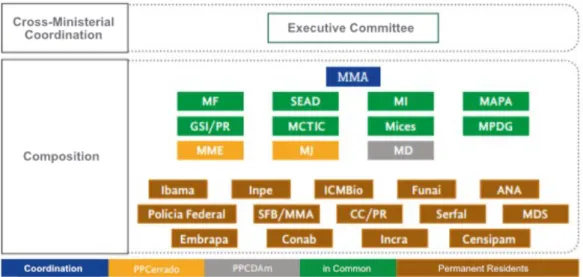
The Unified Executive Committee, responsible in this new phase of the joint management of PPCDAm and PPCerrado, is under the subordination of MMA, member and coordinator of GPTI. Figure 1 is represented by the governance model in the new phase.
Figure 2 Composition of the executive committee unified (PPCDAm and PPCerrado).
Note: Adapted by MMA (2018).
A new thematic axis was also added to the three existing ones: the axis of economic and regulatory instruments. The plan has four main strategical axes, the same number as it had when it was created.
To guarantee an efficient governance we have unified the objectives of PPCDAm and PPCerrado. Theses have nine objectives distributed in the axis as shown on table 3. The consolidation of the objectives was necessary for the executive committee and structured in both planes and defined its respective results for 2020. This was the deadline as an arrangement with the country to reach the objective and reduce deforestation by an 80% of 12.194 miles (annual rate between 1996 and 2005) reducing annual deforestation by 2.438 miles.
Table 3.
Common objectives of PPCDAm abd PPCerrado by axis
Axis Objective
Territorial Planification 1. Promote the regularization of the land.
2. Promote the territorial planification strengthening the protected areas.
Monitoring and control 3. Promote responsibility through
environmental infractions and offenses.
4. Perform a shared forest management
5. Prevent and fight forest fires.
6. Improve and strengthen the monitoring of
the vegetation cover. Promote sustainable and productive
activities.
7. Promote sustainable forestry management. 8. Promote sustainability of productive
agricultural systems.
Economical and normative instruments 9. Implement normative and economical tools towards control of illegal deforestation. Note: Source: Author (2019))
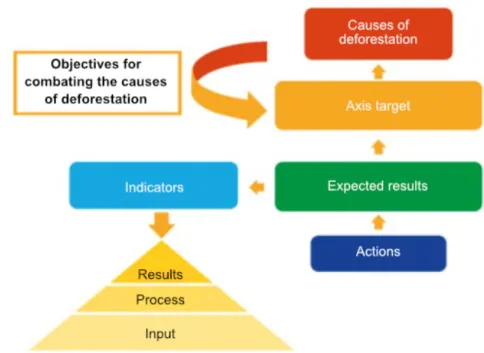
The logical model of the plan is the same as the last phase. The causes for the deforestation guide the creation of objectives that at the same time guide the lines for action. The diverse instructions involved follow the lines of action described in the Operative Plan to acquire the desire results. When necessary the government organs of PPCDAm make corrections and adjustments to these actions during the period of the phase.
To measure the effectiveness of the results, indicators are used. This is an innovation in PPCDAm, since in the previous phases the monitoring of the results was carried out through actions by the management of the executive secretary of the plan. Figure 3 illustrates the logical model of phase four.
Figure 3. Logical structure elaborated in phase four of PPCDAm
Note: Adapted by MMA (2018).
To reach the objectives of PNMC for 2020 the PPCDAm is centered in critical areas with high deforestation rates. The list of priority municipalities continues, as well as the classification of deforestation by territorial type and size of the deforested area.
The monitoring arsenal of the plan has improved with two new projects. Terra Class and Deter-B. Terra Class is a project of INPE in association with the Brazilian corporation of agricultural investigation (Embrapa) Its objective is to provide an analysis of the dynamics of deforested areas over time.
Deter-B is a satellite monitoring system capable of identifying "classes of deforestation, forest degradation and logging in areas of less than 25 ha, maintaining the ability to generate almost real-time estimates of the area deforested in the Amazon" (MMA, 2018 , p. 91). It addresses the deficiency of the old Deter project, which had a maximum monitoring resolution of 25-acre areas and could not investigate smaller areas.
Discussion
Results presented by the PPCDAm – 1st Phase
The first stages of PPCDAm achieved visible results. During the years of 2004 and 2008 several plan-based guided actions where implemented. The results where significant for the reduction in deforestation.
The execution axis and the territorial Planification invested rigorously in the creation of several Conservation Units (CU) located in critical areas by approximately a total of 25 million hectares. We made approvals in indigenous lands and inhibited thousands of titles in rural properties.
The monitoring and Control actions supported y PRODES created the DETER (Real Time Deforestation Detection Project) system, that is responsible to emit alerts
through studies executed by satellites. The satellites used in DETER have a high temporal resolution (frequency of two days) and a low spatial resolution, limited to the analysis of regions not less than 25 ha. The audit also played an important role in the success of the program. The Brazilian Institute of Environment and Renewable Natural Resources (Ibama), the Brazilian Army, the Federal Police and the Federal Highway Police acted with seizures of illegal timber, fines and even arrests of offenders.
The third thematic axis, for the Promotion of Sustainable Activities, presented as results the creation of the Public Forest Management Law (Law 11.284 / 06) and the implementation of the Brazilian Forest Service. Despite its best efforts, the need to invest in more actions of this axis to achieve a long-term change in the use of the legal lands of the Amazon is remarkable.
Deforestation rates in the region were reduced from 27,772 km2 of deforested area in 2004 to 11,651 km2 in 2007, a reduction of approximately 58% in the deforestation rate between these two years. These very optimistic results gave the program credibility. Table 4 lists the main results of the first phase by thematic axis.
Table 4
Main results of the PPCDAm by thematic axis, in the period 2004-2008
Axis Main results
Territorial Planification a) Creation of more than 25 million hectares of
Conservation Units generally located in conflict zones;
b) Approval of more than 10 million hectares in indigenous lands, including Raposa Serra do Sol; c) Inhibition of more than 60 thousand rural real estate titles.
Environmental monitoring and control. a) Creation of the DETER system, which
indicates deforestation warnings, and
improvement of the PRODES system, which measures the rate;
b) New inspection methodology in Ibama, with the planning of operations in priority areas and the participation of the Army, the Federal Police and the Federal Highway Police, resulting in the express seizure of records and equipment, and the application of fines;
c) Fight against corruption, with the arrest of more than 600 officials who committed crimes against the environment and public order. Promotion of productive sustainability
activities
a) Public forest management law (Law 11.284 / 06), which grants transparency to the identification of public forests and speeds up the process of forest concession;
b) Implementation of the Brazilian Forest Service;
c) Creation of the BR-163 Sustainable Forest District;
d) First public tender for a forest concession (Flona Jamari –RO).
Note: Source: Adapted by GPTI (2009).
Results – 2nd Phase
The second phase of the plan continued to show promising results. The average deforestation rate during its period (from 2009 to 2011) was 6,960 km2, the lowest recorded in 2011 (6,418 km2), a record so far.
Once again, the greatest impulse was given by the Monitoring and Control axis, through the application action, using satellite detection systems. The repressive action took place once again by the security agencies and Ibama.
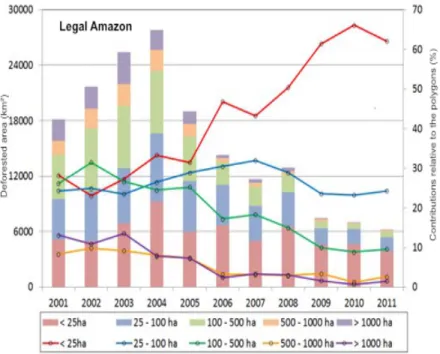
The strong action of the Monitoring and Control axis can be felt by observing the change in the pattern of deforestation polygon areas (cited in item 4.3 of this document). Traditionally, deforested areas formed polygons with areas of 100 to 500 ha. Many deforested areas that measure between 500 and 1000 ha and even more than 1000 ha were also found. At the end of the second phase of PPCDAm (2011), this pattern was quite different, with a clear reduction of polygons of 25-100 ha and even greater than 100-500 ha. As for the 500-1000 ha polygons, their current participation in the deforestation pattern has been reduced compared to the years before 2006 and the polygons with a deforested area of more than 1000 hectares have disappeared. Figure 2 shows the change in the profile of the deforested area from 2001 to 2011.
Figure 4. Historical series of deforestation by deforested area size and relative contribution of the deforestation polygon area classes to total deforestation (2001-2011).
Evaluation of the Action Plan for the Prevention and Control of Deforestation in the Legal Amazon 2007-2010 IPEA-GIZ-ECLAC
The report prepared by the IPEA-GIZ-ECLAC consortium addressed the performance of PPCDAm during the 2007-2010 period and was carried out between October 2010 and July 2011.
An adapted methodology of the environmental performance evaluations of the OECD was used. The studies were conducted based on document analysis and qualitative interviews with more than 130 people directly or indirectly involved in the plan.
The structure of the report was divided into three axes of the PPCDAm. For each axis, praise ("positive aspects") and criticism ("recommendations" ') were given, covering the various activities developed in the plan with very specific analyzes.
Among the successes indicated by the evaluation is the allocation of the coordination of the plan in the Civil House:
The assignment of the PPCDAm coordination in the Civil House reinforced the political priority of the plan. There is a consensus that this represents a breakthrough in terms of coordination of environmentally oriented public policies, which are normally the responsibility of a single thematic ministry. Many respondents interpret this as one of the main success factors of the plan. (IPEA; GIZ & ECLAC, 2011, p. 51)
In summary, the evaluation highlighted the visible success achieved in the early stages. But despite the recognition of the merit of the plan to reduce deforestation, the evaluation was very emphatic about the need for policies that make the transition from the economic model of the region to a sustainable base model:
However, the effectiveness of the PPCDAm remains strongly concentrated in the command and control actions, while the actions that should promote the transition to a sustainable development model in the Amazon, thus ensuring a lasting reduction of deforestation, have obtained a Low degree of success. Therefore, regularization of land implementation and structuring of productive and sustainable supply chains remain the main challenges for the implementation of the plan, replacing current predatory practices in the region and promoting the change in the incentive structure , in order to reward the options that lead to environmental sustainability, in addition to curbing activities related to illegal deforestation. (IPEA; GIZ & CEPAL, 2011, p. 20) It is noteworthy that the third phase of the PPCDAm incorporated several evaluation recommendations and tried to answer the question about the worst performance of sustainable development activities.
Results – 3rd Phase
The launch report for the third phase (2012-2015) demonstrates managers' awareness of the challenges facing current deforestation patterns:
In the first and second phase of the PPCDAm (from 2004 to 2011), the actions with the greatest impact on reducing deforestation come from the Monitoring and Control axis and are closely associated with the development of the DETER (Deforestation Detection Project in Casí Real Time) and integrated surveillance planning. Currently, however, the pattern of deforestation has
changed, causing most deforestation to be below the DETER detection threshold. The reduction in the area of the polygons and their dispersion (spraying) consequently increases the cost of inspection, which is limited by human and budgetary resources. Therefore, the reduction of annual deforestation rates up to 2020 by at least 80% compared to the average verified between 1996 and 2005 in the Legal Amazon will also depend on the scope of public policies to polygons under 25 ha by strengthening land axes and land planning and promoting sustainable production activities. (MMA & GPTI, 2013, p. 20).
At this stage we can see the strong influence exerted by the IPEA-GIZ-ECLAC evaluation in the orientation of the plan. Although the rate of deforestation reduction decreased, the results continued to show a decrease in deforestation.
Among the various actions taken (initiated or continued) in this phase, include:
• Amount of 50 million hectares of Conservation Units created;
• Approval of 10 million hectares of indigenous lands;
• Creation of the Technical Chamber of Land Regularization;
• 842,000 ha of managed forests;
• Moratorium on soybeans produced in areas of illegal deforestation;
• Creation of the Rural Environmental Registry - CAR;
• Improvement of the monitoring systems PRODES, DETER, DEGRAD, DETEX
and Terra Class;
• Investment of 1.2 billion reales of the Amazon Fund in sustainability projects;
The Monitoring and Control axis was strengthened, among other initiatives, with the Deter-B system. Currently, images from seven satellites are used, including two Chinese-Brazilians, one Indian and one English, reaching a minimum area of 6.25 ha.
The deforested area in 2012 was 4,571 km2, which represents a decrease and a new reduction record. However, in 2013 it grew to 5,891 km2, in 2014, 5,012 km2 and ended 2015 with 6,207 km2. The average for the period was 5,420 km2. Although these values are lower than those obtained in the second phase, however, there is a tendency for deforestation to increase. This means that despite all the effort made, the deforestation rate has increased since the previous phase.
Previous Results – 4th Phase (in execution)
The fourth phase began in 2016 and will only end in 2020, so its results are still inconclusive, but they already provide relevant information on the progress of the plan.
The deforestation rate continued to increase, as evidenced in the previous phase. The annual deforested area rate in 2016 increased to 7,893 km2, in 2017 it was reduced to 6,947 km2 and in 2018 the INPE estimate is 7,900 km2.
The goal for annual deforestation set by the PNMC is 3,925 km2 in 2020. However, with the values that show a high trend in recent years and so close to the stipulated date, the environmental community discredits the achievement of the objective.
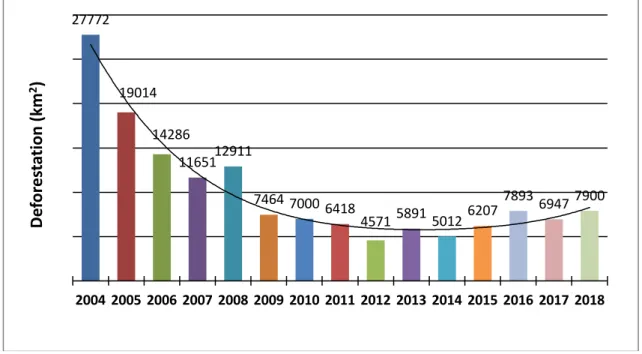
Figure 5 presents a summary of the historical deforestation series during the program period, which allows an analysis of the performance of the PPCDAm, which began in 2004. It is possible to observe the sharp decrease in the rate in the first years of the plan, reaching a minimum value in 2012 and has shown a resumption of growth since then.
Figure 5. Annual deforestation rates in Amazonian Legal.
Note: INPE data (2019).
Castelo et al. (2018), when studying the influence of recent policy on the Brazilian environmental scenario, reached the following conclusion:
The new forest code can mean a setback in most of the achievements related to the protection of forest resources, such as the reduction of deforestation in the Amazon, since it makes the use of natural resources by the rural producer more flexible. In addition to the forestry code, other measures taken by the Dilma government, such as reducing the budget for environmental policies, such as the PPCDAm, and returning the development vision of Michel Temer's interim government through mass regularization of public lands (lands Illegal located near APA) tend to generate new rural conflicts and greater deforestation in areas of dense forests. At the same time, international organizations and countries that finance preservation projects dislike the government's lack of commitment to environmental policies, which diverts significant financial resources for the Amazon. (Castelo et al., 2018, p. 144). PNMC for deforestation in 2020 and in advance. In 2016, annual deforestation reached 6,777 km2, well below the 9,421 km2 defined as its target for 2020. For 2018, the INPE estimate is that the deforestation of the closed reached 6,657 km2, even less than in 2016.
Some have suggested in the past a relationship between the growth of GDP (Gross Domestic Product) and the increase in the rate of deforestation. However, it has been
27772 19014 14286 1165112911 7464 7000 6418 4571 5891 5012 62077893 6947 7900 2004 2005 2006 2007 2008 2009 2010 2011 2012 2013 2014 2015 2016 2017 2018 D ef or es ta tio n (km 2 )
shown that this relationship does not have such a direct cause-effect relationship, since in the first phase of the PPCDAm deforestation decreased by 77%, while GDP increased by around 300% (MMA and GPTI , 2013). It is evident, then, that a more complex analysis is necessary for the complete clarification of the question.
Fearnside (2006, p. 399), discussing how to stop deforestation in the Amazon, argues that political will is the main success factor:
The key to stop deforestation, and one day stop it, is the political will to do so. The monetary flows of environmental services to curb deforestation could motivate this, just as the motivation could come from the direct impacts of Brazil, such as the loss of water vapor supply to the main population centers of the country in the central region -south. Above all, the country's leaders must trust that government action can really stop or even stop deforestation. There is a strong tendency for people to see the Amazon in fatalistic terms, including deforestation and the consequences of climate change. But these changes depend on human decisions. We have free will and we have to have the courage to use it.
Observing political measures in recent governments, Castelo et al. (2018) indicated a relationship between the decrease in PPCDAm financing and the increase in deforestation. The authors also noted that other measures, such as the mass legalization of public lands, also aggravated deforestation.
Despite being a complex problem because it involves the environmental, social and economic areas, there is no doubt that deforestation should be addressed primarily by public authorities. After all, this is the great challenge of sustainability: an economically viable, socially fair and ecologically sound policy.
Conclusions
Deforestation in the Legal Amazon is not only an environmental problem, but also a social and economic one. It directly affects the residents of the region and indirectly reaches the rest of the country and the world.
PPCDAm is a plan created by the federal government in 2004 to reduce deforestation in the Amazon to tolerable standards and put an end to illegal devastation. It has been able to attract great attention and cooperation from public authorities since its implementation and during its four phases, the last of which is being executed by 2020.
The PPCDAm organization was very assertive in assigning the various activities programmed in thematic areas. These axes vary in number from three to four during the phases of the plan. Another advantage of PPCDAm was its inclusion in PPA to guarantee its budgetary support.
Another advantage of PPCDAm was its inclusion in PPA to guarantee its budgetary support. Between 2004 and 2011, annual deforestation fell by 77%. During this period, PNMC promised to reduce the annual rate to 3,925 km2 by the year 2020.
From the third phase, the challenges become greater, since maintaining the pace of deforestation reduction requires more human and financial resources. Until 2012, the
reduction continued, reaching its climax of 4,571 km2, the lowest recorded since monitoring forest degradation began to be registered in 1988.
The resumption of deforestation growth began in 2013 and, still shy but constant, has increased every year. This suggests that the plan has failed to maintain efficiency in its actions, which, although varied, are not always completed successfully.
Some theories have emerged to try to explain the decrease in the effectiveness of actions against deforestation. The vast majority argue that the government has a direct participation in the success or failure of policies against deforestation.
There is little time for public authorities to contain the resumption of the recent increase and reduce the annual rate to the target to which they have committed, given an unfavorable forecast.
References
Abdala, G. (2008). Plano de Ação para Prevenção e Controle do desmatamento na
Amazônia Legal (PPCDAM): Documento de avaliação 2004-2007. Brasília: MMA.
Alencar, A., Nepstad, D., McGrath, D., Moutinho, P., Pacheco, P., Diaz, M. D. & Soares Filho, B. (2004). Desmatamento na Amazônia: indo além da emergência crônica.
Disponible en:
https://www.researchgate.net/publication/253238220_Desmatamento_na_Amazô nia_Indo_Alem_da_Emergencia_Cronica
Castelo, T. B., Adami, M., Almeida, C. A. & Almeida, O. T. (2018). Governos e mudanças nas políticas de combate ao desmatamento na Amazônia. Revista Iberoamericana
de Economía Ecológica, 125-148. Disponible en:
https://redibec.org/ojs/index.php/revibec/article/view/161
Decreto Nº 7.957, de 12 de marzo de 2013. Diário Oficial da União, Seção 1, p. 9. Brasília, 13 de marzo de 2013.
Fearnside, P. M. (2006). Desmatamento na Amazônia: dinâmica, impactos e controle.
Acta Amazonica, 36(3), 395-400. doi: 10.1590/S0044-59672006000300018 Ferreira, L. V., Venticinque, E. & Almeida, S. (2005). O desmatamento na Amazônia e a
importância das áreas protegidas. Estudos Avançados, 19(53), 157-166. doi:
10.1590/S0103-40142005000100010
GPTI. (2004). Plano de ação para a prevenção e controle do desmatamento na Amazônia
Legal. Disponible en:
http://combateaodesmatamento.mma.gov.br/images/conteudo/PPCDAM_1aFase .pdf
GPTI. (2009). Plano de ação para a prevenção e controle do desmatamento na Amazônia Legal: 2ª Fase (2009-2011). Rumo ao desmatamento ilegal zero. Disponible en:
http://combateaodesmatamento.mma.gov.br/images/conteudo/PPCDAM_2aFase .compressed.pdf
INPE. (2019). PRODES - Programa de Monitoramento da Floresta Amazônica Brasileira por Satélite. Disponible en: http://www.obt.inpe.br/prodes/dashboard/prodes-rates.html
IPEA; GIZ & CEPAL. (2011). Avaliação do Plano de Ação para Prevenção e Controle do Desmatamento na Amazônia Legal: PPCDAm 2007-2010. Disponible en: http://combateaodesmatamento.mma.gov.br/images/conteudo/Avaliacao-do-PPCDAm-2007-2010.pdf
Lei 1806, de 06 de enero de 1953. Diário Oficial da União. Seção 1, p. 276. Brasília, 07 de enero de 1953. Disponible en: http://www2.camara.leg.br/legin/fed/lei/1950-1959/lei-1806-6-janeiro-1953-367342-publicacaooriginal-1-pl.html
Lei 11.284, de 2 de marzo de 2006. Diário Oficial da União, Seção 1, p. 1. Brasília, 03 de marzo de 2006. Disponible en https://www2.camara.leg.br/legin/fed/lei/2006/lei-11284-2-marco-2006-541235-norma-pl.html
MMA. (2018). Plano de Ação para Prevenção e Controle do Desmatamento e das Queimadas no Cerrado (PPCerrado) e Plano de Ação para Prevenção e Controle do Desmatamento na Amazônia Legal (PPCDAm): fase 2016-2020. Disponible en:
http://combateaodesmatamento.mma.gov.br/images/Doc_ComissaoExecutiva/Li vro-PPCDam-e-PPCerrado_20JUN2018.pdf
MMA & GPTI. (2013). Plano de Ação para Prevenção e Controle do Desmatamento na Amazônia Legal: 3a Fase (2012-2015). Pelo uso sustentável e conservação da
floresta. Disponible en:
http://combateaodesmatamento.mma.gov.br/images/conteudo/PPCDAM_3aFase .pdf
Prates, R. C. & Bacha, C. J. (2011). Os processos de desenvolvimento e desmatamento
da Amazônia. Economia e Sociedade, 20(3), 601-636. doi:
10.1590/S0104-06182011000300006
Terra, G. (2017). A efetividade da fiscalização do desmatamento ilegal nas unidades de
Date received: 23/07/2019
Date reviewed: 04/09/2019