The challenge consists in curbing the trend of increasing energy consumption without accepting losses in the quality of life. This can be achieved on the one hand by an amelioration of final energy effi-ciency and on the other hand by a shift in energy con-sumption behaviour.
Technical energy efficiency measures comprise activ-ities that provide for an increase in energy efficiency by technical improvements, therefore contributing to a reduced energy input for a given service demand. But if the service demand itself increases, this leads generally to an increased energy demand despite technical energy efficiency measures.
The measures having an impact on behaviour are starting with service demand by trying to influence the energy consumption behaviour of selected cus-tomer groups in a way to provide incentives for energy saving behaviour.
Both areas of activity have to be covered to tap the full energy saving potential.
The Programme is based on technical energy efficiency measures and awareness-raising activities.
Interested parties can download the Viennese Urban
Energy Efficiency Programme (SEP) from the Internet
(www.sep.wien.at) or order a printed copy
(Phone: +43(1)4000 27007).
Urban Energy Efficiency Programme (SEP)
After having achieved a multitude of successful results in energy saving within the Viennese munici-pal administration, the energy division has co-ordi-nated the development of the first comprehensive energy efficiency programme for the City of Vienna. The Urban Energy Efficiency Programme (SEP) comprises and co-ordinates more than 100 single measures, providing guidelines for the city’s con-sumer-side energy policy up to 2015.
Starting points for energy efficiency and energy saving activities
The Urban Energy Efficiency Programme represents a milestone in the energy policy of the City of Vienna. Efficient use of energy will make Vienna more com-petitive, especially in the face of rising energy prices. This is to the benefit of everyone, because saving energy always implies saving costs!
The following factors recommend higher energy effi-ciency:
economic:e.g. lower energy supply costs, value
appre-ciation of real estate, long-term competitive advan-tages
ecological: e.g. lower consumption of resources,
cli-mate relevance, air quality
advertising effect:e.g. Vienna as model eco-city
socially equitable: energy efficiency contributes
towards securing access to energy services for all levels of population.
Energy efficiency
SEP stands for „Städtisches Energieeffizienz
Programm“ that has been enacted by the Viennese Municipal Council on June 28th 2006.
It could reduce the pro-jected increase in energy consumption until 2015 from 12 % to 7 %.
Analysis
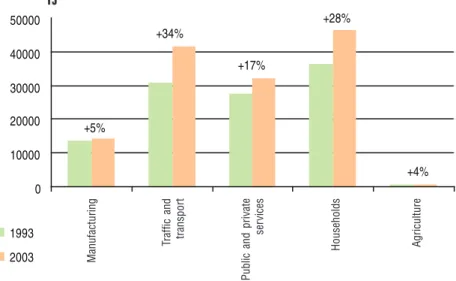
Within the framework of drafting the Urban Energy Efficiency Programme, the energy situation in Vienna was analysed and energy-saving potentials were assessed. In 2003 final energy consumption amounted to 135,040 TJ (37,511 GWh). This corresponds to an increase by 24 %.
While coal was almost completely eliminated over the past ten years, all other sources of energy exhibited continuously rising consumption rates. The most pronounced rise in percentage terms was observed for renew-able energy sources, even though these sources are (still) of little signifi-cance in terms of volume.
Final energy consumption broken down by sector shows the following picture:
34 % private households accounting for 46,436 TJ 31 %traffic and transport accounting for 41,495 TJ 24 %public and private services accounting for 32,068 TJ 12 %manufacturing and agriculture accounting for 15,040 TJ
As regards the increase in energy consumption in volume terms since 1993, it becomes evident that energy demand rose in all sectors.
0 10000 20000 30000 40000 50000 P ro d u zi e re n d e r B e re ic h V e rk e h r Ö ff e n tli ch e u n d p ri va te D ie n st le is tu n g e n P ri va te H a u sh a lte L a n d w ir ts ch a ft 1993 2003 +5% +34% +17% +28% +4%
Fig. End energy consumption by sector in theBAU scenario1993-2015 in TeraJoules Source: Statistics Austria, own calculations TJ M a n u fa c tu ri n g T ra ff ic a n d tr a n s p o rt P u b li c a n d p ri v a te s e rv ic e s H o u s e h o ld s A g ri c u lt u re
Forecast
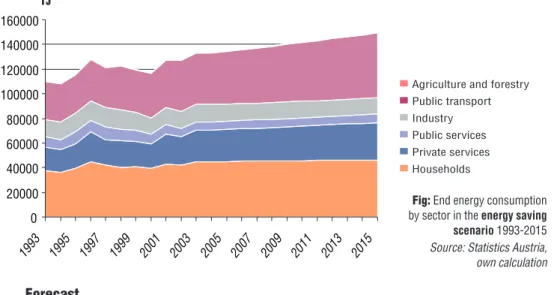
A “business as usual” (BAU) scenario and an energy-saving scenario were drawn up with the objective of assessing the impact of different measures on energy consumption up to 2015. For this purpose, Vienna University of Technology developed a model that permits mapping of the energy consump-tion of each year up to 2015 as a funcconsump-tion of technical and economic param-eters. The BAU scenario starts out from the assumption that no further energy policy measures will be implemented up to 2015. Against this back-ground energy consumption is set to rise by 12 % (about 1% annually) in the analysed period 2003 to 2015. The highest rate of increase is observed in the traffic and transport sector; the latter, however, is not covered by this con-cept, but treated separately in the Master Plan on Traffic and Transport. Total household consumption is set to increase by +3 % between 2003 and 2015. In 2015, about 83 % of final energy supply will be used for room heat-ing, the preparation of hot water and cooking.
With a +21 % increase between 2003 and 2015 the private services sector accounts for the highest rate of consumption growth after the traffic and transport sector.
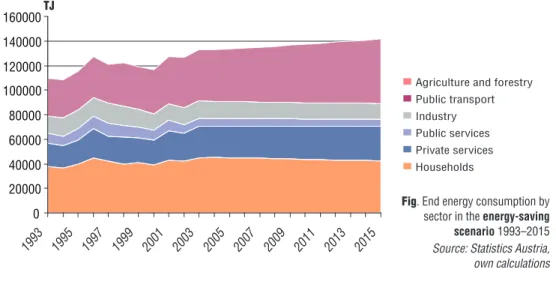
With the improvements proposed in the catalogue of measures energy con-sumption growth would only rise by +7 % in the energy-saving scenario. This corresponds to annual energy savings of 640 TJ (180 GWh) in comparison to the BAU scenario in the period 2003 to 2015.
Agriculture and forestry Public transport Industry Public services Private services Households 0 20000 40000 60000 80000 100000 120000 140000 160000 199 3 199 5 199 7 199 9 200 1 200 3 200 5 200 7 200 9 201 1 201 3 201 5
Fig:End energy consumption by sector in theenergy saving scenario1993-2015 Source: Statistics Austria, own calculation TJ
Sectoral development of measures
The measures of the SEP have been developed specifically for the following sectors: households, private services, public services, industry and manu-facturing.
Further sectors are agriculture and traffic & transport; for measures and instruments regarding the latter, however, the interested reader is specifi-cally referred to the Master Plan on Traffic and Transport.
SEP comprises more than 100 specific activities in the following areas: • Provision for energy related aspects in urban and spatial planning • Continuation of awareness creation with final customers
• Increase of building refurbishment rates and quality • Qualitative energetic improvement of new buildings • Efficiency increase in heating and cooling technology
• Increased market penetration and use of energy efficient devices and promotion of energy efficient technologies for circulating pumps, ele-vators, ventilators and lighting
• Increased use of waste heat potential in industrial installations • Energy management
The structure of the SEP implicates that similar activities may be arranged for several sectors, but they differ considerably regarding their
implemen-0 20000 40000 60000 80000 100000 120000 140000 160000 1993 1995 1997 1999 2001 2003 2005 2007 2009 2011 2013 2015
Agriculture and forestry Public transport Industry Public services Private services Households
Fig. End energy consumption by sector in theenergy-saving scenario1993–2015 Source: Statistics Austria, own calculations TJ
tation and responsibilities. This is the case for the promotion of ener-getic refurbishment of buildings that is an important issue in several sectors. But the implementation of this activity requires different strategies according to each sector.
To act as a model the Viennese Municipal Administration has set the fol-lowing targets:
• Sustainable savings in its own sphere of action of 15 GWh / year • Stabilisation of power consumption
• Reduction of power consumption for public lighting by 5 % • Increased energy management for own assets
• Promotion of low energy buildings (funding)
• Increased focus on energy efficiency criteria in all tendering proce-dures of the City of Vienna (especially in the sector “buildings”).