University of Kentucky University of Kentucky
UKnowledge
UKnowledge
Theses and Dissertations--Educational PolicyStudies and Evaluation Educational Policy Studies and Evaluation
2017
Measuring Learning, Not Time: Competency-Based Education and
Measuring Learning, Not Time: Competency-Based Education and
Visions of a More Efficient Credentialing Model
Visions of a More Efficient Credentialing Model
Jessica E. HorohovUniversity of Kentucky, [email protected]
Digital Object Identifier: https://doi.org/10.13023/ETD.2017.074
Right click to open a feedback form in a new tab to let us know how this document benefits you. Right click to open a feedback form in a new tab to let us know how this document benefits you.
Recommended Citation Recommended Citation
Horohov, Jessica E., "Measuring Learning, Not Time: Competency-Based Education and Visions of a More Efficient Credentialing Model" (2017). Theses and Dissertations--Educational Policy Studies and
Evaluation. 46.
https://uknowledge.uky.edu/epe_etds/46
This Doctoral Dissertation is brought to you for free and open access by the Educational Policy Studies and
Evaluation at UKnowledge. It has been accepted for inclusion in Theses and Dissertations--Educational Policy Studies and Evaluation by an authorized administrator of UKnowledge. For more information, please contact
STUDENT AGREEMENT: STUDENT AGREEMENT:
I represent that my thesis or dissertation and abstract are my original work. Proper attribution has been given to all outside sources. I understand that I am solely responsible for obtaining any needed copyright permissions. I have obtained needed written permission statement(s) from the owner(s) of each third-party copyrighted matter to be included in my work, allowing electronic distribution (if such use is not permitted by the fair use doctrine) which will be submitted to UKnowledge as Additional File.
I hereby grant to The University of Kentucky and its agents the irrevocable, non-exclusive, and royalty-free license to archive and make accessible my work in whole or in part in all forms of media, now or hereafter known. I agree that the document mentioned above may be made available immediately for worldwide access unless an embargo applies.
I retain all other ownership rights to the copyright of my work. I also retain the right to use in future works (such as articles or books) all or part of my work. I understand that I am free to register the copyright to my work.
REVIEW, APPROVAL AND ACCEPTANCE REVIEW, APPROVAL AND ACCEPTANCE
The document mentioned above has been reviewed and accepted by the student’s advisor, on behalf of the advisory committee, and by the Director of Graduate Studies (DGS), on behalf of the program; we verify that this is the final, approved version of the student’s thesis including all changes required by the advisory committee. The undersigned agree to abide by the statements above.
Jessica E. Horohov, Student Dr. Jane Jensen, Major Professor Dr. Jeffrey Bieber, Director of Graduate Studies
MEASURING LEARNING, NOT TIME: COMPETENCY-BASED EDUCATION AND
VISIONS OF A MORE EFFICIENT CREDENTIALING MODEL
DISSERTATION
A dissertation submitted in partial fulfillment of the requirements for the degree of Doctor of Philosophy in the
College of Education at the University of Kentucky
By Jessica Horohov Lexington, Kentucky
Director: Dr. Jane Jensen, Professor of Education Policy Studies and Evaluation Lexington, Kentucky
2017
ABSTRACT OF DISSERTATION
MEASURING LEARNING, NOT TIME: COMPETENCY-BASED EDUCATION AND
VISIONS OF A MORE EFFICIENT CREDENTIALING MODEL
Competency-based education is intended to benefit working non-traditional students who have knowledge and skills from prior work experiences, but it also enables self-motivated students to accelerate their time to degree, thereby increasing affordability and efficiency. Competency-based education clarifies what a credentialed student will be able to do and makes assessment more transparent and relevant to those outside of higher education. Competency-based education has arisen in response to the problem defined by the national reform discourses of accountability and affordability.
In the first manuscript, History & Objections Repeated: Re-Innovating Competency-Based Education, I review the history of social efficiency reform efforts in American education in order to re-contextualize the “innovation” of competency-based education as a repackage of older ideas to fit the public’s current view of what needs to be fixed in higher education. I discuss the concept of “efficiency” and how it has been interpreted in the past and today with regard to competency-based education and its rejection of an earlier attempt at increasing efficiency in education: the Carnegie credit hour.
For the second manuscript, Framing Competency-Based Education in the Discourse of Reform, I analyzed four years of news articles and white papers on competency-based education to reveal the national discourses around competency-based education. I used thematic discourse analysis to identify diagnostic and prognostic narrative frames (Snow & Benford, 1988) that argue for and against competency-based education. These frames were put in the context of the politicized conversation around the current main issues in higher education: access, attainment, accountability, and affordability. Each of these issues provided a foundation of coding the discourse which was then shaped by the context of competency-based education, particularly its positioning as a solution to the Iron Triangle dilemma of decreasing cost while increasing access and quality.
The third manuscript, Idea and Implementation: A Case Study of KCTCS’s CBE Learn on Demand, involves an institutional case study of a competency-based education program, Learn on Demand (LOD), within the Kentucky Community and Technical College System (KCTCS). Eleven semi-structured interviews were conducted with student success
coaches, faculty, and staff who are directly involved with the program across seven different colleges, and documents such as marketing materials, presentations, and administrator-written articles were also analyzed as a representation of the official discourse of the program. As institutions start to explore and develop competency-based education programs, the faculty and administrators at those institutions are likely influenced by the intersection of pre-existing organizational and subgroup culture, societal beliefs about the definition and purpose of education, and how innovations may shape the experiences of individuals. Through interviewing individuals, I was able to parse out the impacts of both institutional politics and innovation-related concerns on the success of implementation.
KEYWORDS: Competency-Based Education, Credentialism, Institutionalism, Higher Education Reform, Accountability
Jessica Horohov April 19, 2017
MEASURING LEARNING, NOT TIME: COMPETENCY-BASED EDUCATION AND
VISIONS OF A MORE EFFICIENT CREDENTIALING MODEL
By Jessica Horohov Jane Jensen Director of Dissertation Jeffrey Bieber
Director of Graduate Studies April 19, 2017
iii
ACKNOWLEDGEMENTS
I would like to acknowledge those individuals who inspired me or challenged me to reach this point in my educational journey. First, of course, is my advisor, Jane Jensen, who I identified as a tough reader and thus an asset to my writing in the first course I took with her. The fact that our research interests aligned was a bonus! This dissertation is only one example of the many things I have been able to do thanks to you. I also acknowledge and thank the other members of my committee, for their input and discussions – Joe Ferrare, Jeffrey Bieber, and Shaunna Scott – and my outside examiner, Richard Allday. I am also grateful for the time that Richard Angelo had to serve on my committee. Thank you for inspiring me to go all-in with competency-based education. I also want to thank other faculty who have aided in this research –Willis Jones, Kristen Perry, Jungmin Lee, and Michael Olneck.
I also want to acknowledge my friends and family who supported me. I especially want to thank my parents, who have both gone through this process themselves and thus provided my original inspiration, and my fiancé, David, who supported and challenged me through all this and, most importantly, made sure that I finished.
I am also grateful to those at KCTCS who offered their time and knowledge for the benefit of my case study.
And finally, I want to acknowledge Sydney Baseheart and Becky Harp-Stephens, who hired me for my first position at Bluegrass Community & Technical College and thus changed the course of my academic and professional career. Thank you.
iv
TABLE OF CONTENTS
Acknowledgements ... iii
List of Figures ... vi
Chapter One: Introduction Statement of Problem: What is Competency-Based Education? ... 1
Purpose and Significance of Study ... 2
Project Overview ... 3
Researcher Statement ... 4
References ... 7
Chapter Two: History & Objections Repeated: Re-Innovating Competency-Based Education Introduction ... 8
Literature Review ... 9
Progressivism, or Social Efficiency? ... 10
The Carnegie Credit Hour ... 12
Problematizing the Carnegie Unit ... 13
The New Efficiency ... 14
Social Efficiency and Individual Mobility ... 16
Story of a Re-Innovation: Competency-Based Education ... 18
Early Forms of CBE ... 18
A New Credentialing Model ... 19
Growing Outside Support and Resistance ... 21
Early Adopters and Advocates ... 23
Getting Approval from the Feds ... 25
Two Steps Forward, One Step Back ... 28
Discussion and Conclusion ... 30
References ... 33
Chapter Three: Framing Competency-Based Education in the Discourse of Reform Introduction ... 43
Theoretical Context: Credentialing and the Purpose of Education ... 45
Methodology: Discourse Analysis and Framing ... 47
Research Design ... 51
Scope and Objective ... 51
Thematic Coding ... 52
Findings ... 53
Overview of Document Attributes ... 53
Identifying Major Actors and Institutions ... 54
Discourse Analysis ... 58
Framing the Iron Triangle Solution ... 58
Access and Attainment: Catering to the Non-Traditional Student ... 59
From Inputs to Quality Outcomes ... 64
v
Discussion ... 79
Conclusion ... 80
References ... 83
Chapter Four: Idea and Implementation: A Case Study of KCTCS’s CBE Learn on Demand Introduction ... 86
Theoretical Framework ... 87
Background ... 89
What is CBE ... 89
CBE in Community College History ... 90
The Context of KCTCS ... 91
Research Design ... 93
Document Selection and Analysis ... 94
Semi-Structured Interviews ... 94
Design for Case Study Analysis ... 96
Findings and Discussion ... 97
Idea versus Implementation ... 97
Implementation for Students: Access If You Can ... 100
Implementation for Faculty: From Instructor to Facilitator ... 102
Implementation for Competence: More than Learning Outcomes ... 104
Implementation for Institution: Resistance and Inevitability ... 106
Conclusion ... 110
References ... 112
Chapter Five: Discussion & Conclusions Institution vs. Innovation ... 114
Accountable to Whom? ... 116
The Next Big Thing? ... 117
Future Research ... 118
Conclusion ... 119
References ... 121
Appendices Appendix A. Acronym Glossary ... 123
Appendix B. Semi-Structured Interview Protocol ... 124
References ... 125
vi
LIST OF FIGURES
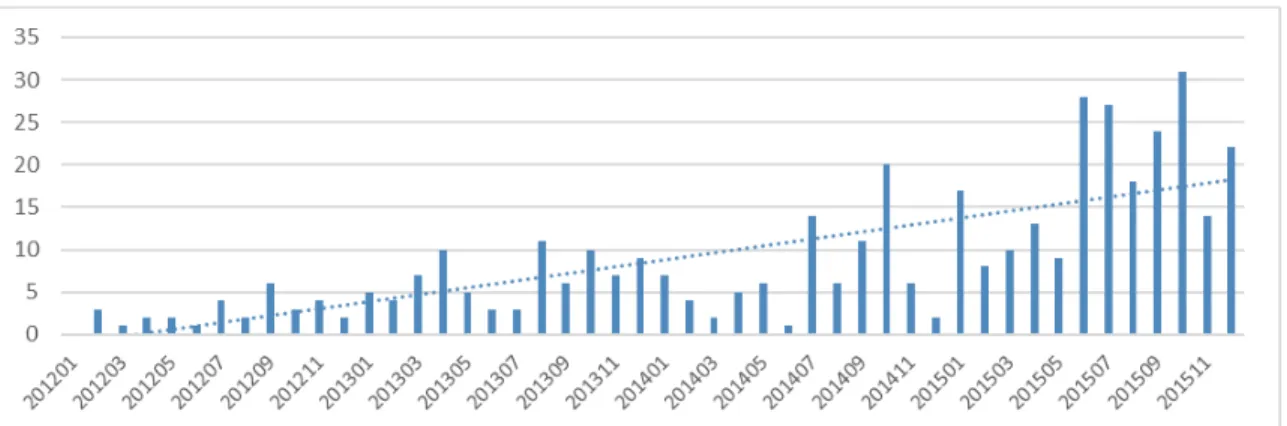
Figure 1, Distribution of analyzed CBE articles from 2012 to 2015 ... 54 Figure 2, Membership and participation in C-BEN, CBEinfo,
1
CHAPTER ONE: INTRODUCTION
Statement of Problem: What is Competency-Based Education?
Proponents will admit that there is no single definition of competency-based education, but in general, it refers to those programs of study that give credit to students based on their evidence of subject mastery rather than a set number of credit hours determined by weekly participation in a course (“seat time”) (Public Agenda, 2015; Gervais, 2016). Competency-based programs use a mix of prior learning credit (e.g. written portfolios of work
experiences, or credit by exam) and self-paced coursework to grant students credentials upon demonstration of competencies rather than time in the classroom. These programs are intended to benefit working non-traditional students who have knowledge and skills from prior work experiences (Kelchen, 2015), but they also enable self-motivated students to accelerate their time to degree, thereby increasing affordability and efficiency (Porter & Reilly, 2014). Competency-based education clarifies what a credentialed student will be able to do with what they know and makes assessment more transparent and relevant to those outside of higher education.
Competency-based education has arisen in response to the problem defined by the national reform discourses of accountability and affordability. As an innovation, it is disruptive to the institution of higher education, both in its structure and symbolism. By unbundling the degree and the role of faculty, the traditional business model of higher education is changed, offering education by subscription and having students be the drivers of their own programs. As learning outcomes are encouraged to be more transparent to both students and prospective employers, the curriculum is not reflective of what the faculty’s vision of what a student should learn. Instead, content and assessments are shaped by what outside stakeholders deem as an appropriate use of time and money with the end goal of job-relevance. These changes can dismantle the institution from the inside, but the rhetoric that supports the growth of these policies is creating a more substantial dismantling of how society views the institution as a symbol of higher learning, versus a bloated bureaucracy of irrelevance.
This dissertation consists of three analyses. For these studies, I utilized discourse analysis to locate competency-based education in the history of education reform, identified
2
how proponents of CBE have framed the program as a solution to politicized issues in higher education, and analyzed the experience of faculty and staff at one institution in the implementing of such an innovation. The goal of this collection is to understand how
competency-based education became positioned as a possible revolution in higher education and how it, like many revolutions before, has struggled to realize its vision.
Purpose and Significance of Study
The public discourses heard most often regarding competency-based education are those that have been reported in the media and in publications by advocates, and thus are often optimistic about the model’s potential to revolutionize higher education (Kelchen, 2015; Meyer, 2005; Klein-Collins, 2013). My research, however, contextualizes that discourse in the history of education reform, current concerns about problems in higher education, and the realities of implementation through an institutional case study. In each of my three studies, I unpack the optimism about CBE being a panacea to such issues as rising college costs and gaps in relevance between the classroom and the workplace.
This study has implications that extend beyond competency-based education, which may end up as a mere blip in the history of fly-by-night innovations. The critiques
embedded within the argument for competency-based education inherently challenge the current institutional model of American higher education. Changes in regulation of the credit hour and how institutions can award credentials for learning outside of the classroom have implications that go beyond CBE and include non-traditional providers: coding academies, MOOCs, badges, and course-offering companies such as StraighterLine and Udemy. Remarks by Lumina Foundation President Jamie Merisotis (2015) reflect an issue not just with the relevance of college degrees and their proof of outcomes, but the monopoly that higher education institutions have on credentialing: “Today’s students have more options than ever before to get an education beyond high school, but federal rules that govern the way they pay for higher education are stuck in the last century.”
While competency-based education has appeared more often in news stories and in the political arena than in higher education research journals, the literature on it is still dominated by traditional forms of CBE that incorporate competency tests into traditional classroom experiences, such as clinical exercises in nursing programs, and
administrator-3
conceived studies on best practices in program development. Competency-based education has existed for decades, but what sets this new form apart is its comprehensiveness in making competencies the foundation of entire programs which can then be entirely self-paced by the student. This study adds to the literature of this new form of competency-based education and its attempt at innovation in response to issues in higher education. It also adds methodologically to the literature of using critical discourse and frame analysis in higher education research. Critical discourse analysis is an approach to texts that takes into consideration its socio-cultural context and seeks to uncover how the nuances of policy are influenced by wider discourses. The framing narratives referenced in texts represent how the discourses of which they are a part define problems and their solutions. This study
underscores the value that discourse analysis has for future studies in higher education research, particularly with regard to political and policy issues both outside and inside higher education institutions. It is the story of an innovation that attempts to challenge the structure of higher education to resolve issues that critics outside and within the system have, in ways, always seen, while contrasting the ideas of innovation in the reality of implementation as it struggles in the face of those structures which it challenges.
Project Overview
In the first manuscript, History & Objections Repeated: Re-Innovating Competency-Based Education, I review the history of social efficiency reform efforts in American education in order to re-contextualize the “innovation” of competency-based education as a repackage of older ideas to fit the public’s current view of what needs to be fixed in higher education. I discuss the concept of “efficiency” and how it has been interpreted in the past and today with regard to competency-based education and its rejection of an earlier attempt at
increasing efficiency in education: the Carnegie credit hour. I also discuss the development of this form of competency-based education from its beginning in the comprehensive degree programs at Western Governors University through the approval of Federal Student Aid Experimental Sites which would then be able to provide federal financial aid to students in these programs without relying on currently time-based regulations.
For the second manuscript, Framing Competency-Based Education in the Discourse of Reform, I analyzed four years of news articles and white papers to identify the national
4
discourses around competency-based education. I used thematic discourse analysis to reconstruct the diagnostic and prognostic narrative frames (Snow & Benford, 1988) that argue for and against competency-based education. These frames were put in the context of the politicized conversation around the current main issues in higher education: access, attainment, accountability, and affordability. Each of these issues provided a foundation of coding the discourse which was then shaped by the context of competency-based education, particularly its positioning as a solution to the Iron Triangle dilemma of decreasing cost while increasing access and quality.
The third manuscript, Idea and Implementation: A Case Study of KCTCS’s CBE Learn on Demand, involves an institutional case study of a competency-based education program, Learn on Demand (LOD), within the Kentucky Community and Technical College System (KCTCS). This study asked: How do individuals working in the program “make sense” of it, and how does the context of the institution impact those impressions? Eleven semi-structured interviews were conducted with student success coaches, faculty, and staff who are directly involved with the program across seven different colleges, and documents such as marketing materials, presentations, and administrator-written articles were also analyzed as a representation of the official discourse of the program. I also drew from my own experiences with the program both prior to and during this research in my roles as a former employee of KCTCS and a third-party evaluator of a LOD enhancement grant. Discussions on the national level have the potential to influence future policy and how the public thinks about change in the system of American postsecondary education, but their impact upon individuals within the system have immediate implications. As institutions start to explore and develop competency-based education programs, the faculty and
administrators at those institutions are likely influenced by the intersection of pre-existing organizational and subgroup culture, societal beliefs about the definition and purpose of education, and how innovations may shape the experiences of individuals. Through
interviewing individuals, I was able to identify some of the impacts that institutional politics and change-related concerns have on the success of an innovation’s implementation.
5
I first became interested in doing the study that became my third manuscript due to my experience working at Bluegrass Community & Technical College for three years, during which time I heard of Learn on Demand from my coworkers but never had any direct experience with it. Since then, I have also been part of the third-party evaluation team for two grants – one from the Gates Foundation and one from the Department of Labor – that KCTCS has used to build upon different aspects of the Learn on Demand program. It is through these experiences that I became aware of the controversy that exists around the program, both for ideological issues regarding proper collegiate pedagogical practices and for organizational and governance issues between the systems office and individual colleges.
My background was an asset in that it allows me to delve more quickly into the finer details of the program and to be able to speak the language of KCTCS acronyms and jargon, and I used my knowledge as a foundation for building rapport with my participants. Yet it risked an ethical issue, in that my preconceived notions about the program – specifically in what has been said to or around me informally – may result in my looking for empirical data to support my preconceived notions, creating a tunnel vision towards conflict rather than more nuanced perceptions that my participants may have. I hoped that by using discourse analysis as my primary method of analysis, I could focus on what is actually being said rather than what I am expecting to find. However, it is in the nature of critical discourse analysis for the analysis to be subjective with regard to my own interpretations of how individuals’ words connect to broader discourses.
I did not want this project to be an evaluation of the KCTCS Learn on Demand program specifically but rather an investigation of the issues surrounding competency-based education as an innovative move in higher education. Thus, I developed the research studies for the first and second manuscripts in order to analyze the discourse of competency-based education in a historical and national context to see how the program fits into broader reform efforts in higher education. The first manuscript started as a timeline for my own reference, tracking the story of competency-based education in recent years through the news, and I was able to contextualize that timeline through my knowledge of the history of efficiency-minded education reform with special attention to the role of the credit hour in both old and new ideas of reform. The second manuscript began as contextualization for the
6
discourse I would uncover around the Learn on Demand program. My thought was that the conflicts around the program at the local level would potentially reflect those nationally. This contextual work quickly grew larger than expected as the national discourse proved fascinating in itself. With these three pieces, I learned much about competency-based education in particular and the public discourse’s role in higher education overall.
The value of this dissertation is in part methodological – serving as a model for discourse analysis in higher education policy studies. Its value is also historical, as the story of a current idea in higher education reform which documents the motivation behind that reform and how it has been positioned as a revolutionary fix of essential defects in the traditional higher education model. The idea of outcomes-based education makes a degree of common sense – no pun intended – but a holistic analysis of the conversation both for and against enables a discussion about how higher learning can and should be defined and measured. Depending the result, the role that the institution and its faculty might have in the future may look very different from that of today.
7
References
Gervais, J. (2016). The operational definition of competency-based education. The Jorunal of Competency-Based Education, 1(2), 98-106.
Kelchen, R. (2015, January 25). The landscape of competency-based education: Enrollments, demographics, and affordability. Washington, DC: American Enterprise Institute.
Klein-Collins, R. (2013). Sharpening our focus on learning: The rise of competency-based approaches to degree completion. Bloomington, IN: National Institute for Learning Outcomes Assessment, Occasional paper #20.
Merisotis, J. (2015, October 8). Free the funds! Student aid: It shouldn’t just be for college anymore. Politico. Retrieved from
http://www.politico.com/agenda/story/2015/10/free-the-funds-000253
Meyer, K. A. (2005). Critical decisions affecting the development of Western Governors University. Innovative Higher Education, 30(3): 177-194.
Porter, S. R., & Reilly, K. (2014). Maximizing resources for student success:
Competency-based education as a potential strategy to increase learning and lower costs. Washington, DC: HCM Strategists, LLC.
Public Agenda. (2015). Shared design elements and emerging practices of competency-based education programs. Retrieved from
http://www.cbenetwork.org/sites/457/uploaded/files/Shared_Design_Elements_N otebook.pdf
Snow, D. A., & Benford, R. D. (1988). Ideology, frame resonance, and participant mobilization. International Social Movement Research, 1, 197-218.
8
CHAPTER TWO: HISTORY & OBJECTIONS REPEATED: RE-INNOVATING COMPETENCY-BASED EDUCATION
Introduction
Given the growing public push for more affordable and efficient education and job training options, competency-based education (CBE), measuring learning by mastery and not classroom hours, has been increasing in popularity. It is replacing MOOCs as the new solution in an industry that has been plagued by public concern over rising costs without clear outcome measures. It has been called a “disruptive innovation” with the potential to overhaul the structure of a higher education system characterized by its stalwartness (Weise & Christensen, 2014). Competency-based education refers to programs of study, which give credit to students based on their evidence of subject mastery, often through rubric-based assessment, rather than after completion of courses with a set number of credit hours determined by the amount of interaction time between student and instructor (“seat time”). CBE offers students the opportunity to earn college credit for work or other life experiences and to fast-track completion through self-paced degree programs.
These programs are intended to benefit working non-traditional students who have knowledge and skills from prior work experiences, but they also enable self-motivated students to accelerate their time to degree, thereby increasing tuition-cost affordability and time-to-degree efficiency. Competency-based education also reflects a broader movement to make institutions of higher education accountable for student learning outcomes through quantifiable performance-based funding. Rather than assuming a correlation between classes taken and employability, CBE clarifies what a graduate will know and be able to do by prioritizing transparency and work-relevance in program curricula. The potential for CBE to act as a panacea to major issues in higher education, such affordability and degree
completion, has attracted the interest of multiple postsecondary institutions, as well as the Department of Education. At a Federal Student Aid conference in 2011, then Education Secretary Arne Duncan remarked, “While such [CBE] programs are now the exception, I want them to be the norm.”
Competency-based education is considered an innovation, but like many
innovations, it is preceded by a cycle of problem and reform, many of which are rehashes of older attempts at solution. Competency-based education itself has existed as outcomes-based
9
education, proficiency-based education, and programs that award college credit for experiences outside the classroom. These efforts at reform have been intended to improve the efficiency and quality of education productivity, but some researchers have argued that this as structurally impossible. Archibald and Feldman (2011) explained the rising cost of higher education as resulting from its nature as a service-providing industry that employs highly skilled professionals. Unlike a factory, which can produce more gadgets and maintain cost and quality through increased efficiency of the production of those gadgets, increasing the output of credentials while maintaining cost would result in larger class sizes, arguably reducing the quality of the education provided. Online learning has suggested a possible way around this, but its ability to maintain quality has been doubted. CBE, however, assures consistent quality through clearly demonstrated outcomes and thus has possibly opened a door for efficiency and productivity to enter education.
In this paper, I contextualize the innovativeness of competency-based education in the history of efficiency-motivated reform efforts, noting how efficiency changed from a public societal goal to one more private and consumer-oriented. As access to higher education has expanded, its credentials have become a commodity subject to economic demands, such as providing a good return on investment for students and the public, defined by both cost efficiency and a meaningful product. Turned into a commodity, the credential becomes the gadget, and competency-based education is enabled to produce a more efficient gadget, ironically, by attacking one of the original attempts at standardization and thus efficiency in education: the Carnegie credit hour. The focus upon competency-based education also enables a concrete look at how ideas in education reform are recycled and suggest why ideas continue to come short of true change.
Literature Review
The tension over the need for and direction of reform is a narrative that has run throughout the history of American education. For much of the 20th century, equality of access to higher education was a major concern of reformers, but since universal access – defined by Trow (1974) as entry above fifty percent of the age cohort – has been nearly achieved in the United States, that concern for equality has increasingly shifted focus to outcomes. The rising cost of college tuition, accompanied by consumer protectionism and economic
10
recession, has made the public more alert to questions over the return on investment of education. But the concept of a “return on investment” from education is more than just a phrase; it is an example of the capitalist economic discourse that has shaped America’s view of the purpose of education.
In this section, I overview the history of reform movements in education and postsecondary education to draw comparisons with how competency-based education is being promoted as a reform now. I do this primarily through Kliebard’s account of the diverse voices within the early 20th century progressive education movement and Barrow’s
of the influx of capitalist ideals into the university a few decades later. I also touch upon the Carnegie credit hour, comparing its origin to the current critique levied by proponents of competency-based education, through Lagemann’s history of the Carnegie Foundation for the Advancement of Teaching (CFAT) and New America Foundation Higher Education Director Amy Laitinen’s direct critique. I end by discussing the new form which efficiency has taken under the influence of current neoliberal discourse and how this efficiency goal challenges postsecondary credentials.
Progressivism, or Social Efficiency?
The critiques levied against higher education today in 21st century public discourse – accountability for student learning outcomes, affordability and access for all populations – mirror some of the critiques that faced primary and secondary education at the turn of the 20th century. In each era, these themes produced multiple versions of what was causing the problem and thus how the problem could be solved. The way that proponents of
competency-based education define the problem of higher education and CBE as the solution is a continuation of the strain of thought which promoted efficiency during the progressive era of education reform. Yet this continuation has included nuanced changes over the decades as broader societal values have influenced ideas of what education should produce and for whom. Below, I discuss the beginnings of these nuances and how they evolved over time.
Kliebard (2004) unpacked the historical concept of a unified early 20th century progressive movement in education to reveal four main interest groups: humanists,
11
the eyes of the public. He followed the ideologies rather than the actual impact they had in the schools, arguing that, ultimately, these interest groups were striving for their beliefs to be sanctioned. Part of the reason why the different groups have been previously grouped under the over-generalized umbrella of a single progressive education movement is that, often, separate interest groups would support the same change for different reasons. One of the main tenets of the efficiency doctrine was that the elements in a curriculum should serve the purpose of preparing the student for the specific role that they will hold in adult society. This curriculum would necessarily be as diverse and individualized as each of those roles, with the social utility of each class justifying its inclusion, thus rejecting the humanists’ idea for a uniform and classically liberal arts curriculum. Efficiency reformers saw individualization as a way to reduce waste by offering education only to those who would benefit from it. Behaviorists also believed in the benefits of individualized curricula, but their intention was to benefit the student by attending to their interests regardless of the overall impact on the system.
The proponents of social efficiency within American schools do not initially appear prominently in Kliebard’s history, but he conceded that it is this group that has ultimately dominated the curriculum, as evidenced by focus on the economic and “tangible” benefits of education. Sharing the view of the behaviorists that the humanist form of education was impractical outside of the school, the social efficiency supporters approached the question of preparation for life with a more logical approach than merely appealing to child
development theories and student interests. Curriculum could be leveraged to maintain order and stability within society through reflecting the needs of industry according to the ability of each student. The value of each course would be measured not by its cost, but by its social utility outside of the school.
At the level of higher education, the influx of efficiency was influenced more directly by business interests. Barrow (1990) followed the early-20th century capitalization
of the university, documenting the struggle between liberal-leaning academics and the influx of capital-rich businessmen trustees. He did not label the trustees’ goal as being one of efficiency, but he identified the influence of business tactics, including fiscal calculations of teacher loads and the cost of particular subjects. What has resulted is a division of faculty and administrative labor of the university, allowing administration to become
12
professionalized and reflect corporate values as executives of the university. By applying management principles to higher education, the “material means of mental production” have been wrested from the intellectuals, and tenure has been reduced to bureaucratic rather than ideological protection (p. 217). To achieve greater productivity in teaching and research, professional administrators would need to apply business management techniques and the stakes of competition would have to be raised for faculty positions. Education turned from an end in itself to a means toward a more economically valuable end. The influence of businessmen within higher education turned institutions of higher learning into machines for economic growth.
The Carnegie Credit Hour
Higher education was also encouraged to mimic the corporate arena through the actions of the Carnegie Foundation for the Advancement of Teaching (CFAT), which advocated efficiency in the system through the introduction in 1906 of the Carnegie unit standard of measuring instruction time. By creating a system out of an array of
postsecondary institutions, industry was allowing students, too, to behave as rational market consumers by assuring consistency in classroom time across colleges and universities. Barrow draws comparison from the monopolization efforts of industry and the use of the Carnegie credit hour to create a distinction between secondary and postsecondary schools. Universal adoption of the credit hour standard was assured by a requirement that only institutions that implemented could participate in a CFAT-funded pension program for professors, which still exists today as TIAA-CREF. The credit hour was intended to measure time and not learning, but the purpose of that measurement was to scientifically organize the system of American education in a way that would promote rational action on behalf of both institutions and consumer-students. The pension program enabled the creation of a hierarchy within higher education, driving out the most inefficient universities by providing pension-granted institutions a competitive edge, over those who were not eligible, to recruit the best faculty.
While federal and industry influences on higher education research have had a strong impact on research universities, the Carnegie Foundation had a broader impact on the system of higher education. Businessmen on boards of trustees and the college presidents on
13
the board of CFAT both believed in fostering greater efficiency within the system, but the nature of this efficiency differed from those of the efficiency experts in Kliebard’s account. CFAT – though eligibility requirements of the pension system – aimed at systematic rationality across institutions. In her history of CFAT, Lagemann (1999) recounts the
ambitions of the foundation’s first president, Henry Prichett, which arose from his modernist faith in the power of science to bring harmony to society and the ability of experts to guide the social structure towards maximum efficiency, which aligned with the ideology of the early 20th century. The modern era was defined by positivism’s belief in the ability of
science to reveal quantifiable truth through empirical evidence. It did not take many steps for scientific methods to morph into tactics for measuring efficiency within industry. Growth during the industrial age accelerated with each new method of increasing productivity, and the excitement from that growth cast eyes to look for other sectors that could be improved. Prichett empowered experts to reform higher education to a unified system that would put research as a priority, seeing in research the solution to problems in society.
Lagemann’s account of the formation and growth of CFAT is ultimately about the legitimacy of the few deciding what is best for the many. Each interest group can be understood as serving their own self-interests, but they are also benevolent, acting in what they believe is in the best interest of the public. Lagemann reminds her readers in the preface to her history of CFAT that “the public” is not as unified a body as many acting in its
interest would assume. Inevitably, “the public” represents the interests of certain groups more than others. Social efficiency is meant to benefit society – the public – but the way the public and its interests are defined has consequence. Which definition prevails depends upon the definition of the public for whom it should benefit. If the public is instead equated with the economy in a way that puts primacy upon the interests of employers and future workers, efficiency is when education works as a transitory point between the home and work life, spending resources on those who can best use it in benefit to the national economy.
Problematizing the Carnegie Unit
The Carnegie credit hour is fundamentally under attack in arguments for
14
invested. Barrow described the unit’s role in determining institutional eligibility for the Carnegie-funded pension fund, and this connection has been turned around in current discourse which calls it as anachronistic given current needs, especially those of online education. The standard for calculating faculty pensions has also become the standard for student enrollment and financial aid regulations. More importantly to advocates of CBE, it measures time in a classroom rather than the educational outcomes that are thus only
assumed to result. Credit hours mean little to employers when the content of those hours are unknown.
Controversy over the Carnegie unit accelerated following the release of Laitinen’s New America Foundation report, “Cracking the Credit Hour,” in 2012. In this, she recounts the history of the Carnegie unit as stemming from Andrew Carnegie’s wish for better faculty remuneration, not for the benefit of the student experience: “The move to time-based units, however, was unrelated to educational quality. And the credit hour was never intended to be a measure of, or proxy for student learning” (p. 5). Competencies, however, are meant to be measures of student learning. Laitinen’s dismissal of the Carnegie unit does not agree with the historical account given by others, particularly Barrow, who describe the unit as how CFAT established structure among educational institutions, utilizing the pension fund as a bribe to the colleges for playing along. Laitinen holds up competency-based education as a preferred alternative, with the “competency” as the new unit of learning to replace the credit hour.
For education, the issue has long been within its outcomes and whether they could be quantified. Supporters of competency-based education agree that we must consider more than the “units and hours” that go into a student’s education. CBE is allowing it to act and look more like a business. By dividing up faculty roles, each faculty-worker can then specialize and become more efficient in their niche of the learning process. Repeatable online courses require a certain standardization of the curriculum, and the objectives-turned-competencies of these courses put economic goals at the center. Online courses can be cheaper to offer through increased enrollment capacities and a removed need for a physical classroom, but efficiency today is defined by results.
15
Issues of “seat time,” workplace relevance and curricular standardization go beyond this competency-based education. The history of American higher education has been, in part, characterized by a tension between academic and vocational objectives (Grubb & Lazerson, 2007; Kliebard, 2004), as well as between the interests of the student and of society. Labaree (1997) identified three different ideologies that value education as primarily a public good (democratic equality), private good (social mobility), or public-private good (social efficiency). The discourse of social efficiency has gained prominence as access to education has become more universal. As a result, conflicts between common education as a democratic rite of citizenship and as a method to selectively train different segments of the workforce have arisen and have shaped how education is understood by the public.
Per many scholars, this is a result of the growing influence that business has had in the public sector, bringing notions of quantifiable outcomes, economic efficiency, and managerial governance to education through neoliberal ideology that equates economic growth to investments in human capital (Barrow, 1990; Olssen & Peters, 2005; Ball, 2012). The rise of neoliberalism in education reform has resulted in calls for accountability and transparency in order to create a rational market and thereby increased affordability for student-customers. The intrinsic value of education has been overtaken by the need to assure the exchange value of the credential as the student’s job market investment. Educational outcomes – degrees and other credentials – have had an assumed value in society through emulating external expectations of what a higher education institution should look like (Meyer & Rowan, 1978). What actually happens in the classroom is unknown, but it has been assumed to meet the standards of a college education, enabling the institution to develop a flexible system of loose coupling. Meyer and Rowan described higher education degrees as having value through a “ritual classification” power whereby the institutions and their credentials are trusted to have value by the public (1978), but that trust has been replaced by a neoliberal desire for market transparency.
The increasing interest in competency-based education initiatives can be considered part of a larger movement that is acting as a backlash against credentialism. Researchers in higher education have been wary of the consequences of credentialing, citing evidences of credential inflation in job listings that do not match the actual demand of the market
16
(Collins, 1979; Brown, 1995). Brown (1995) defined the position of the university as an “agent for the production of agents,” trusted to produce a uniform product that performed well in managerial positions. Growth and diversification in higher education have disrupted that uniformity, and while diversity is often thought of as one of the strengths of American higher education, current national discussions are asking institutions for clear indicators of outcomes that are consistent across institutions. Competency-based education accepts the basic idea of education as the route to social mobility but attempts to remove the layers of ambiguity between the classroom and the workplace, echoing the economic discourses of accountability and transparency that often appear in political and media reports on higher education. What makes CBE’s attempts at structural change different are by keeping the credential but altering the meaning.
Social Efficiency and Individual Mobility
Brown (1995) described the development of regional accreditation and the Carnegie credit hour as part of the process that made the American education system
“college-dominated” in the early 20th century. If so, the current push for competencies instead of credit hours could be seen as a domination of employer interests, enabling a translation of college courses into the workplace just as high school courses were translated into college preparatory credits. The discourse of scientific rationality does not exist for CBE. Instead, the discourse is that of economic rationality. The innovation is a form of consumer protection, offering transparency and clarity to both student-consumers and employer-consumers as a way to create rational actors within the free market.
In his forward to Brown’s book, Labaree praised Brown for his explanation of the growth in American higher education. Labaree’s (1997) own book, How to Succeed in School without Really Learning, rests upon his own distinctions between the public and private goods attached to education: democratic equality, social efficiency, and social mobility. Labaree’s position in the conversation of credentialism is in regard to the effect upon the student’s experience and actions within the educational system following the structural situation the previous researchers described. When the value of the credential is assumed, the education that was previously instrumental in socializing students into the status group is overshadowed by the economic value of the credential.
17
In the oft-cited Academically Adrift, researchers Arum and Roksa (2010) confirmed as much when they showed little to no growth in the abilities of college students following years of so-called education. Students are doing the work to get the credential that they need for life after education without gaining the skills that said credential is meant to represent. This, Labaree argued, is a result of social mobility overshadowing the other purposes of education, flooding the market too much to ensure social efficiency and dismissing democratic equality as irrelevant given the high stakes of the job market. While education was pushed in the direction of social efficiency through curricular reform in the first half of the 20th century, it is now, through the ideology of human capital and social mobility, seen as a resource for the private individual. It is in the best interest of that private individual to be efficient with their use of time in the competition for status, thus incentivizing him to study as little as possible as long as he can make the grade and get the “sheepskin.”
The nuances in the different definitions of credentialism do not matter with regard to what the result is – an inflation of credential value rather than a proportionate response to technological changes in the workplace – but does matter in the explanation of how it happened. While certain aspects of credentialism can be found elsewhere, the United States is experiencing the consequences of a uniquely open-access and stratified system. Students seek credentials in order to be more competitive in the labor market, but at the same time, public criticism over the actual ability of a college degree to prepare someone for the labor market has questioned the value of this increasingly expensive investment. Yet students are still enrolling because they cannot afford not to.
The increasing interest in competency-based education initiatives can be considered part of a larger movement that is acting to reverse credentialism. Brown defined the position of the university as an “agent for the production of agents,” trusted to produce a uniform product that performed well in managerial positions. Growth and diversification in higher education have disrupted that uniformity, and while diversity is often thought of as one of the strengths of American higher education, current national discussions are asking institutions for clear indicators of outcomes that are consistent across institutions. This is seen in the Lumina Foundation’s Degree Qualifications Profile (2014), which states standard objectives within the degree hierarchy (associates, bachelors, and masters) that every institution should strive toward in order to give meaning back to the degree. Given
18
what Labaree has argued regarding the hollowing out of the college education experience and the lack of retention after graduation, this distrust is unfortunately understandable. What competencies are able to provide in response to this issue is a focus on immediate project-based applications of the knowledge and skills learned. Traditional transcripts of 120 credit hours-worth of coursework are converted into statements of a student’s mastery of
competencies that are, ideally, grounded in workplace activities.
While many industries accept and build upon the rhetoric that schools are not properly preparing their graduates for the workplace, elite employers recognize that content does not matter as much as the social network that elite institutions welcome their attendees into. Credentialism, as a form of social status signaling, is a luxury for upper-level
executives and bureaucrats. Traditional college students – defined not only by age but also by family income and occupational prestige – will continue to reap the benefits of the system as it stands. For the rest, especially those non-traditional students who are either going to lower-tier institutions or are delaying their entry into higher education until later in life, their institutions will be obliged to prove their value in job training. Some of those institutions have realized that the traditional form of higher education is not the right fit for non-traditional students, and they have embraced that through redesigning higher education in a way that centers on the student and their occupational goals. One such redesign has been a new form of competency-based education which combines an occupational training concept used since the 1970s – defining a student’s achievement through demonstrated skills, or competencies – with the flexibility of self-paced online education.
Story of a Re-Innovation: Competency-Based Education Early Forms of CBE
An initial search for competency-based education in any research literature database would turn up not only time-variable degree programs but also evidence that CBE is not a new concept. It long has been a staple of nursing programs, there defined in the clinical side of the curriculum as a requirement for students to demonstrate certain skills (i.e., taking a patient’s pulse) in order to fulfill program requirements. Four institutions that are often positioned by proponents of CBE as early models for modern competency-based degree programs are Alverno College, Thomas Edison, Excelsior College (formerly Regents), and
19
Empire State University. These programs, developed in the 1970s, were designed for the adult learner and offered a form of competency-based education more akin to prior learning assessments of work experience. Also present was the American Council on Education and its push to award academic credit for military service. The Department of Education was also allocating funds towards programs that more resembled CBE as self-paced courses that focused on work-relevant competencies rather than time through the Fund for the
Improvement of Postsecondary Education (FIPSE), which focused on increasing efficiency and affordability (Gallagher, 2014). These programs, however, were outliers, being geared toward the then less common adult student demographic. The increase in non-traditional students – as well as the increased ability of technology to create flexible delivery methods – would enable competency-based education to be seen as a more viable disruption to the traditional model of higher education.
A New Credentialing Model
Ninety years after the Carnegie Foundation established the credit hour standard, thirteen state governors – led by the governors from Utah and Colorado – envisioned Western Governors University (WGU), a private non-profit institution that they believed would quickly bring the end of the tyrannical and trivial credit hour through its innovative, competency-based focus on successful student learning rather than the time schools thought was needed to teach students, and increase access to higher education (Kinser, 2002; Meyer, 2005). Rather than focusing on the inputs of time and instruction, this new form of higher education would provide a more efficient environment where students could leverage their prior experiences in order to lessen their time to graduation.
While originally, competency-based courses were only part of WGU’s intended mission, the institution moved to become independently financed and accredited, as well as produce its own courses to match its degree competency requirements, rather than
functioning as a database of online courses from other colleges (Meyer, 2005). Given those events, this new type of higher education was slow to develop and become accredited, but its focused mission of awarding students credit for learning rather than time stayed
consistent (Kinser, 2007). Previously, competency-based education existed as a component of traditional time-based courses, such as incorporating specific skill tests into a health
20
program, although Alverno College stood out as the first institution to apply this mentality to a liberal arts curriculum in the early 1970s (Alverno College, 2014).
What distinguished programs like Western Governors, and those of the innovators that followed, is the move towards awarding credit to students who move through a curriculum at their own pace. Online delivery of courses enabled the creation of a time-flexible model, resulting in a degree that is awarded once an individual student reached a pre-determined level of competency. This contrasts with most programs, which instead award credit based on set terms, with the assumption that the student learned something to pass those classes. A program that is fully divorced from credit hours is known as “direct assessment”: the degree is made up of competencies only rather than being tied back to credit-hour equivalents. Closely related to credit for prior learning tests and prior learning assessment portfolios, the focus of these programs is on individual mastery rather than a set number of instructional contact hours. By emphasizing the evidence of learning as the end goal, the program can be focused toward producing results. In addition, it is seen to be especially beneficial for those non-traditional students who may be coming into college with experience equivalent to that which would be otherwise learned in entry-level courses, and who also are particularly sensitive to time frames and tuition costs.
This new way of measuring higher learning posed challenges for accreditors – challenges that are lessening as more institutions are adopting the competency-based education method – but that challenge did not compare to the step after program
accreditation: federal student aid eligibility. Financial aid regulations were built upon the assumptions of a time-based program, either credit or clock hour (Federal Student Aid, 2014b), and thus schools that intended to break out of this assumption risk the possibility of ineligibility and thereby limiting the access of students to the program and the enrollment that could sustain such programs. While Western Governors was given the opportunity to qualify for financial aid in a direct assessment program through Section 8020 of the 2005 Higher Education Reauthorization Act after their enrollment started to pick up in 2003, the university decided to continue tying their competencies to credit hours so as not to alienate employers who would likely not trust the still unfamiliar model (Kinser, 2007; Lederman, 2012; Fain, 2012b). The efficiency of the product would be meaningless if its value was not perceived and the end-users did not buy it.
21
While WGU was the first true CBE innovator, the diffusion of the program – and support through changes in financial aid policy – was slow to occur. Due to initial accreditation delays resulting from the governors pursuing approval from four regional accrediting agencies due to the transnational nature of the university – perhaps another equally as bold and unconventional move – and slow student enrollment up until 2003, WGU was supported primarily through private funding (Kinser, 2007). Meyer’s (2005) findings on the organizational development of WGU also suggested that the fact that the innovation was being driven forward by politicians and not higher administration, as
evidenced by the initial counterproductive prioritizing of promotion for possible recognition and publicity purposes over actual program development.
Despite turning down the opportunity for financial aid eligibility with direct assessment, the university was able to follow federal regulations and thus stay eligible for federal student aid by tying competencies to their credit hour equivalents, and determining student academic progress and enrollment status through set terms and a minimum number of successful competencies for each term (Porter, 2014). In fact, the original allowance for direct assessment program eligibility likewise required institutions to tie competencies to credit hours (Experimental sites concept paper, 2014). While the federal government was open to innovation, it would not yet change the rules and welcome it through the door too soon.
Growing Outside Support and Resistance
The turning point for CBE started to appear after the 2008 recession, as third party foundations and government officials started to search for solutions for increased college access and reduced college cost. In 2008, the Center for American Progress released a critique of the credit hour, calling it outdated in comparison to programs such as WGU; and in 2009, Western Governors was given national publicity in a “What Works” segment during the NBC Nightly News (Kolowich, 2011). More importantly, however, given later events, was the Lumina Foundation’s release in January of 2011 of the Degree
Qualifications Profile (DQP), which laid out standard definitions of what students should be able to do and know at each degree level for faculty and colleges, in the five areas of applied
22
learning, intellectual skills, specialized knowledge, broad knowledge, and civic learning (Lederman, 2011; Fain, 2013b; Johnstone & Soares, 2014).
Yet support was far from universal. In April 2011, an opinion column was published in The Seattle Times by Western Washington University history professor, Johann Neem, in response to a proposal in Washington to make WGU a public state university (Neem, 2011; Kolowich, 2011). WGU had started to establish in-person campuses in multiple states while maintaining an administrative center in Utah. Reflecting the essential argument of many faculty members then and now, Neem declared that “WGU does not offer a college education.” While the competency-based method may be able to determine what skills a student knows, to Neem, a college education is something that takes time for a reason and awarding credit for prior knowledge would only rob students of the chance to discover new things with other students under the guidance of faculty (Neem, 2011). Later, others who were more accepting of the legitimacy of the program would still lament the implied differentiation between those traditional students who could afford a credit-based college education and non-traditional students who would get a near-diploma mill experience through CBE (Slaton, 2013). This concern recalls Archibald and Feldman’s assertion that the ability to improve the productivity of education is limited before quality of instruction is diminished. The need to prove the quality of programs through their outputs – given the lessened reliance on inputs – would be essential.
Education Secretary Arne Duncan, however, soon showed his own support for competency-based education in a speech made at the 2011 Federal Student Aid conference (Lewin, 2011; Duncan, 2011). Though again, this support was not shared by other federal stakeholders who were cautious to accept other CBE programs beyond WGU, too aware of the inevitability of a repeat of the abuse that occurred earlier in credit-hour-based online programs. As a result, the Office of Federal Student Aid (FSA) would only approve CBE programs for aid on a case-by-case basis, initiated through a waiver application by an individual college (Lederman, 2012). Institutions that were interested in competency-based education needed to come together to push forward policy in a comprehensive and
sustainable way.
In September 2012, this collaboration was facilitated by Lumina and the Gates Foundation, who held a meeting with 35 institutions, the Department of Education, and
23
other agencies (Fain, 2013b). That same month, both foundations sponsored a report by Amy Laitinen of the New America Foundation looking at the credit hour, describing it as an “antiquated” unit that is “putting our nation’s workforce and future prosperity at risk” due to its inability to measure actual student learning, citing grade inflation and employer
dissatisfaction with graduates (Fain, 2013b; Laitinen, 2012).
The Carnegie Foundation later conducted a response study on its own unit in December 2012 amidst this growing concern over its relevance (Fain, 2012c). The result of this was a statement agreeing that the unit does not accurately reflect a quantity of learning but supported its continued use due to a lack of other options. The need for a standardized “currency” between higher education institutions was essential, and the credit hour would just have to do until further notice (Silva & White, 2015). This was hardly the final word. While Western Governors may have provided the vision and origin of innovation, the involvement of Southern New Hampshire University (SNHU), its president, and the support of the Lumina and Gates Foundations, caused interest in CBE to take off.
Early Adopters and Advocates
Unlike Western Governors, SNHU developed a direct assessment Associate in Arts program, named College for America (CfA), which would be completely independent of credit hours from the start, consisting of 120 competencies within nine skill clusters, instead of 60 credit hours (Fain, 2013c). Also unlike WGU, SNHU was an already established non-profit private university with a traditional campus and a large number of credit-hour-based online courses. It had also slowly moved towards competency-based education, developing less radical programs that still shortened degree time and cost, without putting the cart before the horse, as WGU arguably did, including a self-described “competency-based three-year bachelors” in business program that the school began in 1995 (LeBlanc, 2013). While the governors of Utah and Colorado functioned as the main proponents for the development of WGU and its novel form of competency-based education, it is Paul LeBlanc, president of SNHU since 2003, who took a central role in the push for federal policy to support CBE.
Students in CfA were coached and evaluated by the faculty, offered a variety of resources to students for them to prepare for each assessment (SNHU, 2014). CfA was
24
introduced in the fall of 2012 and launched in January 2013. Initial partnerships with companies, along with funding from the Gates Foundation, allowed the program to enroll students without first receiving Title IV approval (Fain, 2013f). SNHU’s entry into direct assessment started a new surge of development for CBE policy in 2013. The for-profit Capella University also started a direct assessment program pilot for its employees and those of its business partners in January 2013 (Fain, 2013c). The next month, a new round of Next Generation Learning Challenge grants was announced, which is partially funded by the Gates Foundation and included CfA as one of its grantees, and Lumina released a report from a Gallup Poll on the growing public concern over the relevance of current models of higher education, suggesting mastery-based coursework as the solution (Lumina, 2013). That year’s State of the Union address called for a focus on higher education results rather than seat time, reflecting the shift from inputs to outputs in defining quality and value in education. It laid the groundwork not only for the President’s College Scorecard, but also for competency-based education (Nelson, 2013; Slaton, 2013).
In March, Federal Student Aid released a “Dear Colleague” letter in order to remind colleges of the direct assessment eligibility-granting Section 8020 of the 2005 Higher Education Act (Fain, 2013a). This letter was lauded in April by Lumina President Jamie Merisotis in a Huffington Post article promoting the organization’s Degree Qualifications Profile, which had being expanding with the new involvement of the Gates Foundation and twenty-five other institutions (Merisotis, 2013; Fain, 2013b; Fain, 2013j). Also that month, SNHU’s CfA became the first direct assessment program to take advantage of the opening that WGU had first been offered by the 2005 Higher Education Act and passed on almost decade earlier (SNHU, 2014). That summer, Northern Arizona University and the
University of Wisconsin received regional accreditation for their CBE programs (Fain, 2013d; Wisconsin’s competency-based, 2013), and the Gates Foundation announced the first cohort for their Breakthrough Models Incubator project, which included many emerging CBE programs (Next Generation Learning Challenges, 2014a). With the new push by SNHU and the financial and political support of Lumina, Gates, and other foundations, competency-based education was growing in force just as the federal government was looking for a new strategy for higher education reform.
25
Getting Approval from the Feds
In August 2013, President Obama gave a speech on making college affordable, and his administration started to see the Experimental Sites Initiative as a way to pilot certain innovations that could lower college costs, with those successful pilots potentially to be incorporated into the upcoming reauthorization of the Higher Education Act (Fain, 2013g; “U.S. seeks experiments”, 2013). Yet other CBE-supporting politicians wanted to streamline the process for institutions, leading to the introduction of the Advancing Competency-Based Education Demonstration Project Act of 2014 in the House (H.R.3136), which would allow up to 30 higher education institutions to be granted waivers from conflicting federal
regulations (Fain, 2014c). The Senate followed suit with a Committee on Health, Education, Labor, and Pensions hearing on issues in accreditation and financial aid for competency-based education programs, at which LeBlanc gave a testimony on SNHU’s success and the need for “safe spaces for innovation,” arguing for the virtues of CBE above and beyond traditional credit hours: “It requires building learning around individual students and where their strengths and weaknesses lie, not making students conform to rigid institutional structures. It requires actual demonstrated mastery, so students can no longer slide by with mediocre grades and receive a degree at the end” (Fain, 2013h; LeBlanc, 2013). SNHU had started to charge tuition for CfA the previous month at only $1250 per semester, with already 500 students enrolled (Fain, 2013f). In December, the Senate followed up by introducing the Partnerships for Affordability and Student Success Act (S.1874).
In November, the New America Foundation sponsored a conference on CBE, and in December (Fain, 2013i), Lumina formed C-BEN, the Competency-Based Education
Network, to foster sustainability communication among the stakeholders (Fain, 2013j). Between these two events, the federal government finally made its move. In 1992, Congress had given the Office of Federal Student Aid, though an amendment of the Higher Education Act, the authority to grant waivers to individual higher education programs through the Experimental Sites Initiative (FSA, 2012b). On December 6, 2013, the Department of Education released a notice asking for competency-based and prior learning assessment Ex-Site proposals (“U.S. seeks experiments”, 2013), an announcement foreshadowed by an earlier speech by Obama referring to work on a new “aggressive strategy to promote