Refereed papers
Implementation of an electronic medical
record system in previously computer-naı¨ve
primary care centres: a pilot study from
Cyprus
George Samoutis MD
Doctoral Fellow, Clinic of Social and Family Medicine, School of Medicine, University of Crete, Heraklion, Crete, Greece
Elpidoforos S Soteriades MD ScD
Adjunct Assistant Professor of Occupational Healthand Environmental Medicine, Harvard School of Public Health, Department of Environmental Health, Environmental and Occupational Medicine and Epidemiology (EOME), Boston, MA, USA
Dimitris K Kounalakis MD
Doctoral Fellow, Clinic of Social and Family Medicine
Theodora Zachariadou MD
Doctoral Fellow, Clinic of Social and Family Medicine
Anastasios Philalithis MD PhD
Associate Professor of Social Medicine, HealthPlanning Unit
Christos Lionis MD PhD
Associate Professor of Social and Family Medicine, Clinic of Social and Family Medicine School of Medicine, University of Crete, Heraklion, Crete, Greece
ABSTRACT
Background The computer-based electronic medi-cal record (EMR) is an essential new technology in health care, contributing to high-quality patient care and efficient patient management. The majority of southern European countries, however, have not yet implemented universal EMR systems and many efforts are still ongoing. We describe the develop-ment ofan EMR system and its pilot implemen-tation and evaluation in two previously computer-naı¨ve public primary care centres in Cyprus.
Methods One urban and one rural primary care centre along with their personnel (physicians and nurses) were selected to participate. Both qualitative and quantitative evaluation tools were used during the implementation phase. Qualitative data analysis was based on the framework approach, whereas quantitative assessment was based on a nine-item questionnaire and EMR usage parameters.
Results Two public primary care centres partici-pated, and a total often health professionals served
as EMR system evaluators. Physicians and nurses rated EMR relatively highly, while patients were the most enthusiastic supporters for the new infor-mation system. Major implementation impediments were the physicians’ perceptions that EMR usage negatively affected their workflow, physicians’ legal concerns, lack ofincentives, system breakdowns, software design problems, transition difficulties and lack offamiliarity with electronic equipment.
Conclusion The importance ofcombining quali-tative and quantiquali-tative evaluation tools is high-lighted. More efforts are needed for the universal adoption and routine use ofEMR in the primary care system ofCyprus as several barriers to adoption exist; however, none is insurmountable. Computer-ised systems could improve efficiency and quality of care in Cyprus, benefiting the entire population.
Keywords: Cyprus, electronic medical record, pri-mary care
Introduction
Electronic medical records (EMRs) have long been introduced into medical practice and they have proven cost-effective in different clinical settings. In addition to economic benefits, EMRs contribute significantly to the improvement ofthe quality ofcare.1Primary care constitutes a pivotal specialty in the clinical management ofpatients within a healthcare system. The use ofan EMR in primary care is ofparamount importance for the effective and timely management ofpatients.2
The computer-based EMR has been shown by several studies to be an essential technology tool for health care,3modernising the management ofmedical information and contributing to high-quality patient care and efficient patient management.4 However, significant barriers impede wide-scale adoption of electronic tools, making it essential for pilot testing before larger scale implementations.5,6
Cyprus is currently moving forward to introduce a universal healthcare coverage system for the entire population. The use ofthe EMR in the clinical setting has been considered a cornerstone component for the successful implementation and effective management ofpatients at all levels ofthe healthcare services system
in general, and in primary care in particular. At the moment, public primary care services in Cyprus are characterised by underuse ofinformation technology, during a period when healthcare reform is focusing on primary healthcare enhancement and development of the discipline ofGeneral Practice/Family Medicine (GP/FM) within the national system. Furthermore, there is currently very limited use ofEMR in the primary care clinical setting ofthe public services sector.
Within the above-published framework, the Cyprus Ministry ofHealth collaborated with the Department ofSocial Medicine, University ofCrete, with the aim ofevaluating the effectiveness ofa multifaceted inter-vention. The development ofan EMR system was an important component ofour study. Furthermore, the assessment ofthe EMR system in public primary care services in a previously computer-naı¨ve environment constituted added value for our study. The primary objective ofour pilot study was to introduce and evaluate the implementation ofan electronic medical record system tailored to primary care professional needs in selected public primary care centres. A secondary objective was the development and evalu-ation by the end users ofa Greek WindowsTM-based EMR system in relation to the episode ofcare, using the International Classification ofPrimary Care (ICPC-2-R).7–10
Methods
Setting
The study was conducted in Nicosia, the capital of Cyprus, in one urban and one rural public primary healthcare centre. The urban and rural primary health-care centres served a population ofabout 25 000 and 15 000 people, respectively.
Participants
All primary care physicians and nurses from both healthcare centres (five physicians and five nurses) participated in the study as evaluators ofthe EMR system’s performance. In addition, nine randomly-selected patients ofeach gender (a total of18 patients) underwent personal interviews in order to provide detailed feedback on their experience with the EMR system. The implementation ofthe EMR constituted the first oftwo parts ofa quality improvement intervention project in the public primary care ser-vices ofCyprus. The second part consisted ofthe implementation ofclinical guidelines for chronic diseases.
Box 1 The Cyprus primary care system . Cyprus Primary Health Care Services cover
the majority ofthe population ofthe island (approximately 700 000 people) although the system is currently under development
. The Cyprus Primary Health Care sector func-tions on an income-based system and is funded by the State. A specific segment ofthe popu-lation, based on low income criteria, have free access to health care through the public pri-mary care services
. The primary care centres operate without
practice managers; there is no list-based ser-vice; patient records are linked to patients’ IDs; however, few services are linked to computer-ised records
. Primary healthcare professionals are
compen-sated based on monthly salaries and there are no performance incentives. The directors of each primary care centre are nominated among physicians based on their seniority
. Some ofthe centres maintain an appointment-based scheduling system, while other centres provide services on a first-come, first-served basis
EMR system and software
The introduction ofthe EMR system consisted ofthe provision ofpersonal computers for the secretaries, nurses and physicians at each participating primary care centre along with a laser printer and broadband internet access. Among many other software programs, TransHis was selected after comparison with other software programs (such as PHCCIS, Fakelos, and GNUMed operating in Greece or elsewhere) on the electronic interface, content and process, based on defined criteria for appropriateness, efficiency, and feasibility for general clinical practice.11–14TransHis was used as a prototype to create an EMR system, named Primary Care Health Records (PCHR); we used the ICPC-2-R,10the International Classification ofDiseases (ICD-10),15and the Anatomical Therapeutic Chemical (ATC).16Microsoft WindowsTMwas used as the operating system, as TransHis uses a cross-platform compatible programming language, open source data-base system and a network protocol supporting mul-tiple users. All computers were connected through transmission control protocol/internet protocol (TCP/IP) in a local network, and simultaneous access to the EMR was allowed through password identification and different user profiles. A firewall machine connected with an asymmetrical digital subscriber line (ADSL) allowed encrypted remote access for EMR updates and user support through PCHelpWare.17
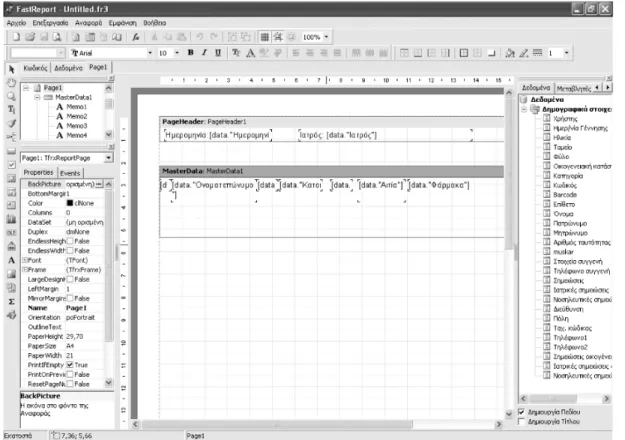
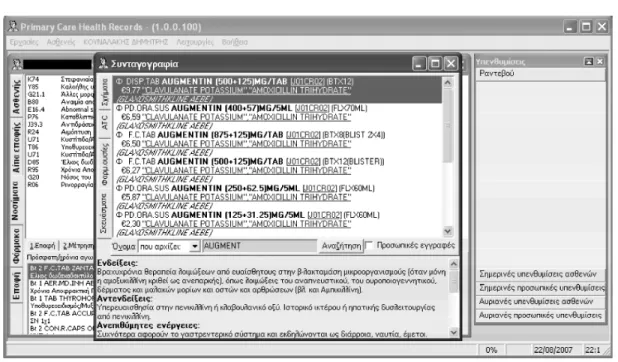
TransHis’s mini-dataset and interface was used for direct coding ofeach patient’s reason for encounter, diagnostic and result interventions in ICPC-2-R. Di-agnosis was double-coded in ICPC-2-R and ICD-10. New and customised functions for Cyprus included: patient/encounter registration, chronic diseases, re-peat medication, electronic printed prescriptions, user-customised forms for entering patient/visit data, reports from Fast-Report generator (see Figure 1),18 access to medical information, and reminders based on medical guidelines. Special software was included to identify software errors and misuses and send them in real time to the developer. Detailed description of the creation process and content ofthe EMR system has been described elsewhere.19 During the imple-mentation phase, various changes were accomplished in order to meet physicians’ and nurses’ needs. Pre-scription information (see Figure 2), changes in the electronic interface, and interactive features for lab-oratory testing (see Figure 3) were among the most significant improvements.
Data collection
The evaluation ofthe EMR system in the public primary care centres was based on information col-lected through a multitude ofmethods intermittently over a period of18 months. Information on the primary
care physicians’ and nurses’ perceptions regarding the use ofan EMR in clinical practice was obtained through consensus-building meetings during the pre-paredness phase ofthe study. Furthermore, the principal
investigator (PI) and a project facilitator visited both primary care centres on a monthly basis in order to provide periodic training for the participating phys-icians and nurses, support software implementation,
Figure 2 A screen capture from TransHis showing the EMR system prescription information that was readily available to physicians
Figure 3 A screen capture from TransHis showing the EMR system interactive feature for laboratory testing orders
and complete monthly structured written assessments. Monthly written assessments were used to document the users’ satisfaction and progress with the EMR adop-tion, the implementation barriers and any measures taken to overcome them, the number ofhours spent on both on-site and off-site activities, and the plan for each following month. Outreach visits that were not planned were documented in detail with respect to the above described structure. Personal structured inter-views were grouped into seven thematic categories as described below.20Questions focused on the familiarity ofhealth professionals with computer use, on the EMR user’s expectations, the practicality ofEMR use, potential impact on the delivery ofcare, organisational support, comparison with previous paper-based practices, and identified barriers.
Personal interviews with each participating phys-ician and nurse were conducted at six months into the EMR system implementation, and at the end ofthe follow-up period at 18 months. These interviews included ten semi-structured questions allowing interviewees to respond in their own words, and a nine-item Likert scale focusing on a broad spectrum of EMR use and implementation components. In addition, a focus group ofall EMR evaluators (physicians and nurses) was organised at the same intervals (six and 18 months). Finally, personal interviews of18 patients with chronic diseases and repeated visits to both participating primary care centres, during the EMR implemen-tation phase, were also conducted by the PI at the end ofthe study period in order to assess the patients’ perspective on the introduction ofEMR in the pri-mary care setting.
Analysis of data
Data were collected in a systematic way and entered into a computerised database. Quantitative statistical analyses were performed using standard statistical packages. Statistical significance was determined by
P<0.05. Audio tapes of face-to-face interviews and focus groups were transcribed and a framework ap-proach analysis was performed based on the five steps: familiarisation, identifying a thematic framework, indexing, mapping and interpretation.21
Results
Participants
A total often health professionals (five physicians and five nurses) participated as evaluators ofthe pilot implementation study. The vast majority ofthe primary
care physicians and nurses in the public sector in Cyprus are female; therefore, it happened that all evaluators ofour EMR program in the two public primary care centres were female. The mean age of physicians was 52 years (age range 45–56), and 40 years for nurses (age range 31–44). In addition, 18 patients (six from the rural centre and 12 from the urban primary care centre) also participated as evaluators, the mean age ofpatients being 65 years (age range 60–73). Over the 18-month study period, two pro-gramme facilitators conducted a total of 18 scheduled visits to each primary care centre lasting approx-imately 90 minutes per visit. A total of20 unscheduled visits lasting approximately 120 minutes per visit were also performed to support software upgrading and resolve software and internet connection breakdowns.
Qualitative data
The systematic analysis ofmonthly narrative reports, personal interviews and focus groups resulted in a wealth ofvaluable information; the most important findings are presented below along with the seven thematic categories that emerged from the analysis of the qualitative data. The role ofthe facilitators in the preparation and implementation phase scored highly in the evaluation and was also reported to be very useful. Access to online guidelines through the EMR system itselfand the readily-available electronic medi-cal references through electronic medimedi-cal databases was valued by the health professionals as a useful and important tool. In addition, the reminder system for periodic laboratory testing for patients with chronic diseases was an important component ofimproved delivery ofquality care and was reported by the physicians and nurses as extremely useful though not fully developed.
Overall, the vast majority ofthe physicians and nurses were satisfied with the EMR system implemen-tation (n=9); however, some complaints were presented, while the EMR components were not fully used. Firstly, most physicians from the urban primary care centre reported that EMR usage negatively affected their workflow, decreasing their productivity, especially at the introductory phase. Moreover, the software was frequently reported to have breakdowns with inad-equate information technology (IT) support, poor interface usability and non-user-friendly interactive features. With respect to organisational support, limi-tations included the lack oftimely technical support and increased workload due to the continued parallel use of paper-based records for fear of legal compli-cations in relation to the EMR documentation. In addition, the use ofthe EMR was limited due to the lack oforganisational changes such as the introduction ofan advance-notice appointment scheduling system,
adequate human resources coverage and lack ofper-formance incentives. Furthermore, two out of five physicians complained that the EMR was limiting their ability to document important information. Finally, the absence ofprevious experience ofcomputer use in clinical practice was reported as a significant barrier.
The patients provided valuable feedback on the implementation ofthe EMR in the public primary care clinics (n=18). Patients thought that the EMR system was a strong sign ofmodernisation ofprimary care delivery, along with a perception ofimproved care from both a scientific as well as an organisational perspective (n=16). One ofthe most important com-ments was the patients’ beliefthat medical records could not be lost in the future and medication errors could be limited. An indicative excerpt from a patient follows:
‘I feel that now they are looking after me in a better way. I have a feeling of security that my records and blood test
results will not be lost. In addition, I am satisfied that my doctor has everything in the computer to help him avoid any mistakes with my treatment.’
Interestingly, no negative or derogatory comment was reported from patients with respect to the EMR implementation.
Quantitative data
In Table 1 we present the quantitative assessment of different components ofthe EMR system from the health professionals/evaluators based on a nine-item Likert scale. In general, Likert scale scores were higher and closest in agreement between the primary care professionals at the end of the 18-month implemen-tation phase compared with the first six-month as-sessment. The use ofguidelines, continuous audit and feedback and the presentations and lectures provided by the programme facilitators were rated with the
Table 1 Assessment scores of the 9-item Likert scale of healthcare professionals for the EMR implementation*
Questions 6 months 18 months
Mean Median IQR Mean Median IQR 1 How important is the use ofclinical
guidelines for patient care services?
4.6 5.0 1.0 4.8 5.0 0.0
2 To what extent do you apply the clinical guidelines ofselected diseases? (diabetes, hypertension)
4.2 4.0 1.0 4.4 4.0 1.0
3 How helpful are the lectures and presentations ofthe Principal Investigator, the facilitators and the other health professionals?
4.6 5.0 1.0 4.7 5.0 1.0
4 How helpful is the use of the electronic medical record for patient care?
3.2 3.5 2.0 3.6 4.0 1.0
5 How satisfied are you with the specific computer software? (interface usability, interactive features)
3.2 3.0 2.0 3.6 4.0 1.0
6 How useful do you find the reminder system ofthe EMR?
4.0 4.0 2.0 4.4 4.0 1.0
7 How useful do you find the facilitator’s visits to your practice?
4.5 5.0 0.0 4.6 5.0 1.0
8 How useful is the component of continuous audit and feedback?
4.3 4.5 1.0 4.4 5.0 1.0
9 How satisfied do you feel with your participation in the intervention?
3.8 4.0 2.0 4.2 4.0 1.0
highest scores. It is promising that healthcare pro-fessionals rated many items much higher at the end ofthe 18-month follow-up period including the use ofEMRs, the usefulness ofthe facilitators’ visits, the electronic reminder system and most importantly their satisfaction for participating in the programme. Average ratings ofall items are higher at the end ofthe 18-month period compared with the first assessment. The estimated cost for the pilot implementation of the EMR in the two public primary care centres in Cyprus was relatively low, and certainly would not serve as a rate-limiting step in further expanding such a programme across the island. In particular, the cost of the hardware and software for the whole study was estimated at approximately e20 000 ande7000,
re-spectively. The cost ofthe additional equipment was
e5000 per healthcare centre. Finally, the cost oftraining
and surveillance was estimated at about e30 000,
summing up to a total ofe62 000.
Discussion
Our study is one ofthe first attempts to introduce an EMR system in the public primary healthcare services in Cyprus. Our study was introduced in a timely manner since a broad selection ofEMR software is available for primary care physicians; however, most ofthe EMR systems do not support a classification for diseases and drugs, nor do they provide a direct coding interface for minimising the time needed to use the EMR. Overall, the development and evaluation ofthe EMR system in a previously computer-naı¨ve environ-ment was rated relatively highly by the healthcare providers (physicians and nurses) as well as the patients, using both qualitative and quantitative tools. The most popular features of the EMR system included the laboratory ordering and surveillance reminders, the electronic prescribing, and the electronic diagnos-tic coding based on ICPC-2-R and ICD-10. Identified barriers such as the software and organisational defi-ciencies were related to lack ofan appointment-based scheduling system at the primary care centres, while increased workload impeded the full exploration of EMR benefits.
Although our EMR used a computer interface that did not require the doctors to learn the rubrics ofthe classification by heart, nor to spend a lot oftime on coding, it did demand an initial effort to learn the system. After the initial period, the EMR fulfilled the initial demand for minimal time needed for keeping a mini-dataset of information for each patient encoun-ter. A medical-oriented patient record with limited freetext fields and direct coding by the physician is in conflict with the need for freetext and the power of
expression available in paper medical records.22 How-ever, the use ofclinical interface terminologies is a proposed method for a better interaction between physicians and EMR software, but it requires previous experience with the use ofterminologies to build up a clinical interface terminology for local language and content uses.23Furthermore, novice users request dif-ferent EMR interface characteristics than experienced users, and they are uncertain concerning the best preferred workflow in an EMR software they are going to use.24Changes in requested usability features and workflow from our EMR’s users were expected as they became more experienced over time.
Some physicians reported ‘poor usability’ and ‘non-user-friendly interface features’ and this finding surprised us, since our EMR system was selected based on certain criteria ofappropriateness. This makes us believe that usability improvements are still needed following the workflow of its use; it also needs to allow for the different needs of both novice and experienced users. It is also questionable whether an EMR system should be created for local needs or with multiple pathways in its workflow in order to support different methods ofuse.
Furthermore, the parallel use ofpaper-based prac-tices due to legal concerns from the physicians, and the lack ofadequate incentives were significant limiting factors for the full adoption of the EMR. Finally, the cost ofimplementation proved to be relatively low. Previously reported financial concerns from phys-icians regarding the EMR such as high up-front cost ofEMR implementation, slow and uncertain financial payoffs, and high physician time cost were not found in our study because ofthe centralised financial man-agement ofpublic primary care services in Cyprus.12 Other important barriers, such as difficulties with technology, software deficiencies, lack of incentives, inadequate technical support, and legal concerns reported in our study as well as in other studies, may be successfully resolved in a systematic way.6,25–28
Several findings ofour study are worth further comment. First, according to patient interviews, no negative or derogatory comment was reported with respect to the EMR implementation, indicating that Cypriot patients are likely to welcome a universal EMR system in Cyprus public primary care centres without major concerns such as those reported in other studies.6,13,29In addition, the estimated cost of our pilot study and calculations on the return on investment, according to international experience, clearly shows that the implementation ofa universal EMR system in the Cyprus public primary healthcare system will effectively drive down the cost ofhealth care, while it would likely also reduce costly and preventable medical errors.30–32Furthermore, the role of facilitators in our study proved to be very helpful and was also rated high on the quantitative evaluation,33
suggesting that efforts to implement EMR in pre-viously computer-naı¨ve environments require outside promoters, in contrast to other countries where ex-perienced and computer-literate insiders play the most important role in similar processes.34 In ad-dition, user satisfaction rating (physician and nurses) for the EMR implementation was relatively high: an encouraging sign, supporting future EMR implemen-tation in subsequent years in Cyprus.35Finally, the process ofengaging physicians and nurses at the pre-paredness phase in computer activities, consensus-building and the provision ofstrong organisational support, were found to be an important factor for successful EMR implementation.
Based on our study findings, certain strategies can be recommended in order to overcome the above described adoption barriers in future efforts for uni-versal EMR implementation. First, we would like to highlight the need for subsidies and performance incentives for healthcare professionals, such as prac-tice-based incentive programmes by the government,36 and particularly pay-for-performance incentives, that could help promote wide-spread EMR adoption.17,37 Additionally, other factors are also important for widespread EMR use, such as close communication and interaction between primary care and hospital EMR systems, as well as organisational and adminis-trative changes in both settings, removal oflegal barriers, and greater use ofselected key EMR features. Furthermore, the use ofEMR – not paper – by the majority ofphysicians in particular settings for most oftheir daily tasks is also ofparamount importance to promote quality improvement.20,38It is also useful to note that periodic changes and continuous evaluation ofEMR is needed in order to meet healthcare pro-viders’ needs, since user satisfaction is important for the successful implementation of the EMR. Countries such as the USA, with a long tradition in information technology, have only recently managed to reach a 20– 25% adoption ofEMR by family physicians, estimating that EMR adoption will reach its maximum market share in 2024 in small practice settings.39 This is indicative ofthe existing barriers for universal adop-tion ofsuch programs, and despite Cyprus’ small size, future efforts for universal EMR adoption will likely require concerted and long-term continuous efforts for the achievement of a widespread positive outcome. A number oflimitations ofour study are worth noting. First, due to limited resources, the EMR system was implemented in a small number ofprimary care centres with few physicians and nurses serving as system evaluators. The small number ofevaluators and our qualitative approach limited our study’s generalisability; however there are indications ofthe directionality ofchanges and improvements observed. Existing international standardised EMR evaluation tools such as validated questionnaires were not used;
however, the EMR solution was specified based on user requirements and expectations.
In summary, our results demonstrate that the im-plementation ofan EMR system in Cyprus is feasible, with a relatively high acceptance rate and utilisation by both physicians and nurses serving in previously computer-naı¨ve public primary care centres. A com-mon finding with other EMR-based studies is that information systems are often designed considering the technical development advantages without cap-turing the proper user requirements based on actual system users. Surprisingly enough, the patients in Cyprus were the most enthusiastic welcomers ofthe EMR system, with no legal, ethical or other concerns. Moreover, our EMR system, based on the episode of care, exhibited comparatively low implementation cost, while it was specifically developed to accommo-date a future broad-scale introduction of the EMR in Cyprus public primary care centres, tailored to phys-icians’ and nurses’ needs. More systematic efforts are needed towards the above-suggested strategies in order to promote the routine use ofthe EMR in the public primary care centres ofCyprus. Several adop-tion barriers exist; however, no single factor proved to be insurmountable. Certainly, further studies are required in order to assess the effect ofthe EMR on physicians’ performance and quality of care. Finally, a universal computerised system supporting Cyprus public primary care services could improve efficiency and quality ofcare leading to significant health gains for the entire population.
AUTHORS’ CONTRIBUTIONS
CL and AP conceived ofthe idea and supervised the project. GS prepared and validated the questionnaires, performed the monthly visits, and the interviews, and collected and analysed the data. GS supervised the project implementation and the statistical analyses. DKK developed and TZ supported the EMR system. All authors reviewed and interpreted the data analyses. GS wrote and ESS contributed to the first draft of the manuscript. All authors contributed to the writing of the manuscript. All authors read and approved ofthe final version ofthe manuscript.
ACKNOWLEDGEMENTS
The authors would like to thank Professor Henk Lamberts and Dr Inge Okkes for their valuable sup-port for the project. We would also like to thank the physicians, nurses and patients ofthe primary care centres who participated in the study. This work was supported by a grant from the Ministry of Health in Cyprus.
REFERENCES
1 Dorr D, Bonner LM, Cohen AN et al. Informatics systems to promote improved care for chronic illness: a literature review. Journal of the American Medical Informatics Association2007;14:156–63.
2 McInnes DK, Saltman DC and Kidd MR. General practitioners’ use ofcomputers for prescribing and electronic health records: results from a national survey.
Medical Journal of Australia2006;185:88–91.
3 Dick RS, Steen EB and Detmer DE (eds).The Computer-based Patient Record: an essential technology for health care. Committee on Improving the Patient Record, Institute ofMedicine. Washington DC: National Academy Press, 1997.
4 Knaup P. Electronic patient records and their benefit for patient care.Methods of Information in Medicine2006;45 (Suppl1):40–2.
5 Bassinder J, Bali RK and Naguib R. Knowledge manage-ment and electronic care records: incorporating social, legal and ethical issues.Studies in Health Technology and Informatics2006;121:221–7.
6 Anderson JG. Social, ethical and legal barriers to E-health.
International Journal of Medical Informatics 2007;76: 480–3.
7 Okkes IM, Polderman GO, Fryer GEet al. The role of family practice in different health care systems: a com-parison ofreasons for encounter, diagnoses, and inter-ventions in primary care populations in the Netherlands, Japan, Poland, and the United States.Journal of Family Practice2002;51:72–3.
8 Verbeke M, Schrans D, Deroose S and de Maeseneer J. The International Classification ofPrimary Care (ICPC-2): an essential tool in the EPR ofthe GP.Studies in Health Technology and Informatics2006;124:809–14.
9 Okkes IM, Oskam SK, van Boven K and Lamberts H. EFP: Episodes ofcare in Dutch Family Practice. Epidemiological data based on the routine use ofthe International Classification ofPrimary Care (ICPC) in the Transition Project ofAcademic Medical Center/ University ofAmsterdam (1985–2003). In: Okkes IM, Oskam SK and Lamberts H (eds)ICPC in the Amsterdam Transition Project. CD-ROM. Amsterdam: Academic Medical Center/University ofAmsterdam, Department ofFamily Medicine, 2005. Downloadable from www. transitieproject.nl
10 WONCA International Classification Committee.
ICPC-2-R: International Classification of Primary Care. USA: Oxford University Press, 2005.
11 www.transitieproject.nl/
12 McDonald T. A procedure for evaluating primary health care software.Curationis1999;22:16–21.
13 Okkes IM, Oskam SK and Lamberts H. The probability ofspecific diagnosis for patients with common symp-toms to Dutch family physicians. Journal of Family Practice2002;51:31–6.
14 Okkes I, Groen A, Oskam SK and Lamberts H. Advan-tages oflong observation in episode-oriented electronic patient records in family practice. Methods of Infor-mation in Medicine2001;40:229–35.
15 World Health Organization. International statistical classification of diseases and related health problems – 10th revision. 1992.
16 www.who.int/classifications/atcddd/en/ 17 www.uvnc.com/pchelpware/index.html 18 www.fast-report.com
19 Kounalakis DK, Lionis C, Okkes I and Lamberts H. Developing an appropriate EPR system for the Greek primary care setting.Journal of Medical Systems2003; 27:239–46.
20 Miller RH and Sim I. Physicians’ use ofelectronic medical records: barriers and solutions.Health Affairs (Millwood)2004;23:116–26.
21 Pope C and Mays N.Qualitative Research in Health Care.
London: BMJ Publishing Group, 2000.
22 Lovis C, Baud RH and Planche P. Power ofexpression in the electronic patient record: structured data or narra-tive text?International Journal of Medical Informatics
2000;59:101–10.
23 Rosenbloom ST, Miller RA, Johnson KB, Elkin PL and Brown SH. Interface terminologies: facilitating direct entry ofclinical data into electronic health record systems.
Journal of the American Medical Informatics Association
2006;13:277–88.
24 Poon AD, Fagan LM and Shortliffe EH. The PEN-Ivory project: exploring user-interface design for the selection ofitems from large controlled vocabularies ofmedicine.
Journal of the American Medical Informatics Association
1996;3:168–83.
25 Loomis GA, Ries JS, Saywell RM Jr and Thakker NR. If electronic medical records are so great, why aren’t family physicians using them?Journal of Family Practice2002; 51:636–41.
26 Scott JT, Rundall TG, Vogt TM and Hsu J. Kaiser Permanente’s experience ofimplementing an electronic medical record: a qualitative study.British Medical Journal
2005;331:1313–16.
27 Schade CP, Sullivan FM, de Lusignan S and Madelev J. e-prescribing, efficiency, quality: lessons from the com-puterisation ofUK family practice.Journal of the American Medical Informatics Association2006;13:470–5.
28 Avery AJ, Savelyich BS and Teasdale S. Improving the safety features of general practice computer systems.
Informatics in Primary Care2003;11:203–6.
29 Jahn K, Gartig-Daugs A and Nagel E. Electronic health records within integrated care in Germany.Telemedicine Journal and E-Health2005;11:146–50.
30 Adler KG. Why it’s time to purchase an electronic health record system.Family Practice Management2004;11:43– 6.
31 Prather E. Embracing EMRs: physicians who have done so say change is worth the cost.Texas Medicine2006; 102:45–8.
32 Taylor R, Bower A, Girosi F, Bigelow J, Fonkych K and Hillestad R. Promoting health information technology: is there a case for more aggressive government action?
Health Affairs (Millwood)2005;24:1234–45.
33 Teasdale S and Bainbridge M. Improving information management in family practice: testing an adult learning model.Proceedings of the AMIA Annual Fall Symposium
34 Wibe T, Edwin E, Husby EH and Vedal T. Implemen-tation ofnursing care plan in the Electronic Patient Record (EPR): findings and experiences.Studies in Health Technology and Informatics2006;122:309–13.
35 Joos DA, Chen Q, Jirjis JN and Johnson KB. An elec-tronic medical record in primary care: impact on satis-faction, work efficiency and clinic processes.Proceedings of the AMIA Annual Fall Symposium2006;28:394–8. 36 Australian Government Medicare Australia.Health Care
Providers: practice incentives program (PIP).www.medicare australia.gov.au/providers/incentives_allowances/pip.htm 37 Simon JS, Rundall TG and Shortell SM. Drivers of
electronic medical record adoption among medical groups.Joint Commission Journal on Quality and Patient Safety2005;31:631–9.
38 Carr-Bains S and de Lusignan S. Moving to paper-lessness: a case study from a large general practice.
Informatics in Primary Care2003;11:157–63.
39 Ford EW, Menachemi N and Phillips MT. Predicting the adoption ofelectronic health records by physicians: when will health care be paperless? Journal of the American Medical Informatics Association2006;13:106–12.
CONFLICTS OF INTEREST None.
ADDRESS FOR CORRESPONDENCE George Samoutis 3 Messinis Street 2301 Lakatamia Cyprus Email: [email protected] Accepted August 2007