Developing Travel Behaviour Models Using Mobile Phone Data
Andrew Bwambale
Submitted in accordance with the requirements for the degree of Doctor of Philosophy
The University of Leeds Institute for Transport Studies
i
Intellectual property and publications
The candidate confirms that the work submitted is his own, except where work which has formed part of jointly-authored publications has been included. The contribution of the candidate and the other authors to this work has been explicitly indicated below. The candidate confirms that appropriate credit has been given within the thesis where reference has been made to the work of others.
The work in chapters 2, 3, 4, and 5 consists of original research, where the candidate was the lead researcher. The main ideas in these chapters were developed by the candidate during the PhD with the support and guidance of the supervisors and other researchers, who have been listed as co-authors where appropriate.
All the manuscripts were written by the candidate and improved by comments from all the co-authors. The manuscripts are summarised below;
Chapter 2 has been published as follows;
Bwambale, A., Choudhury, C.F. and Hess, S., 2017. Modelling trip generation using mobile phone data: a latent demographics approach. Journal of Transport Geography (in press)
Chapter 3 was submitted for review to Transportmetrica A: Transportation Science and the candidate has received an invitation to revise the manuscript;
Bwambale, A., Choudhury, C.F., Hess, S. (under review) Modelling long-distance route choice using mobile phone call detail record data: a case study of Senegal. Chapter 4 was submitted for review to Transportation Part A: Policy and Practice;
Bwambale, A., Choudhury, C.F., Hess, S. (under review) Modelling departure time choice using mobile phone data.
Chapter 5 has been prepared for submission to the Journal Transportation;
Bwambale, A., Choudhury, C.F., Hess, S., Iqbal, M. S. (to be submitted) Getting the best of both worlds - a framework for combining disaggregate travel survey data and aggregate mobile phone data for trip generation modelling.
This copy has been supplied on the understanding that it is copyright material and that no quotation from the thesis may be published without proper acknowledgement.
© 2018 The University of Leeds and Andrew Bwambale
The right of Andrew Bwambale to be identified as Author of this work has been asserted by him in accordance with the Copyright, Designs and Patents Act 1988.
iii
Acknowledgements
I would like to express my sincere gratitude to my supervisors Charisma F. Choudhury and Stephane Hess for their support, guidance, insightful thoughts and comments on my work. They have inspired me to always aim for the best and created opportunities for me to meet and network with like-minded researchers.
Special thanks go to my examiners Mohammed Quddus and Simon Shepherd who made my viva an interesting discussion from which I learnt new ideas and perspectives about my work and transport research in general. Simon had earlier on assessed my work at the transfer stage and I thank him for the encouraging comments.
I would also like to thank other members of staff and PhD students, particularly those in the Choice Modelling group, who always provided constructive feedback on the work I presented during the various seminars.
This research would not have been possible without the funding of the Economic and Social Research Council (ESRC) of the UK and the Institute for Transport Studies, University of Leeds through the Advanced Quantitative Methods (AQM) scholarship. I am extremely grateful to them for this great opportunity. I also acknowledge the financial support by the European Research Council through the consolidator grant 615596-DECISIONS.
The data used in this research was obtained from various institutions and service providers including, the Idiap Research Institute in Switzerland, Sonatel group in Senegal, Orange group in France, and Grameenphone Ltd in Bangladesh. I thank them for making their data available for research purposes.
Finally, I would like to thank my family: my wife Agatha, my children Angelina and Frida, my parents Mr Leo and Mrs Petronilla Bwambale, and my brothers and sisters for standing with me through the last three years, and offering their prayers and words of encouragement.
v
Abstract
Improving the performance and efficiency of transport systems requires sound decision-making supported by data and models. However, conducting travel surveys to facilitate travel behaviour model estimation is an expensive venture. Hence, such surveys are typically infrequent in nature, and cover limited sample sizes. Furthermore, the quality of such data is often affected by reporting errors and changes in the respondents’ behaviour due to awareness of being observed. On the other hand, large and diverse quantities of time-stamped location data are nowadays passively generated as a by-product of technological growth. These passive data sources include Global Positioning System (GPS) traces, mobile phone network records, smart card data and social media data, to name but a few. Among these, mobile phone network records (i.e. call detail records (CDRs) and Global Systems for Mobile Communication (GSM) data) offer the biggest promise due to the increasing mobile phone penetration rates in both the developed and the developing worlds. Previous studies using mobile phone data have primarily focused on extracting travel patterns and trends rather than establishing mathematical relationships between the observed behaviour and the causal factors to predict the travel behaviour in alternative policy scenarios.
This research aims to extend the application of mobile phone data to travel behaviour modelling and policy analysis by augmenting the data with information derived from other sources. This comes along with significant challenges stemming from the anonymous and noisy nature of the data. Consequently, novel data fusion and modelling frameworks have been developed and tested for different modelling scenarios to demonstrate the potential of this emerging low-cost data source.
In the context of trip generation, a hybrid modelling framework has been developed to account for the anonymous nature of CDR data. This involves fusing the CDR and demographic data of a sample of the users to estimate a demographic prediction sub-model based on phone usage variables extracted from the data. The demographic group membership probabilities from this model are then used as class weights in a latent class model for trip generation based on trip rates extracted from the GSM data of the same users. Once estimated, the hybrid model can be applied to probabilistically infer the socio-demographics, and subsequently, the trip generation of a large proportion of the population where only large-scale anonymous CDR data is available as an input. The estimation and validation results using data from Switzerland show that the hybrid model competes well against a typical trip generation model estimated using data with known socio-demographics of the users. The hybrid framework can be applied to other travel behaviour modelling contexts using CDR data (in mode or route choice for instance).
The potential of CDR data to capture rational route choice behaviour for long-distance inter-regional O-D pairs (joined by highly overlapping routes) is demonstrated through data fusion with information on the attributes of the alternatives extracted from multiple external sources. The effect of location discontinuities in CDR data (due to its event-driven nature), and how this impacts the ability to observe the users’ trajectories in a highly overlapping network is discussed prompting the development of a route identification algorithm that distinguishes between unique and broad sub-group route choices. The broad choice framework, which was developed in the context of vehicle type choice is then adapted to leverage this limitation where unique route choices cannot be observed for some users, and only the broad sub-groups of the possible overlapping routes are identifiable. The estimation
vi
and validation results using data from Senegal show that CDR data can capture rational route choice behaviour, as well as reasonable value of travel time estimates.
Still relying on data fusion, a novel method based on the mixed logit framework is developed to enable the analysis of departure time choice behaviour using passively collected data (GSM and GPS data) where the challenge is to deal with the lack of information on the desired times of travel. The proposed method relies on data fusion with travel time information extracted from Google Maps in the context of Switzerland. It is unique in the sense that it allows the modeller to understand the sensitivity attached to schedule delay, thus enabling its valuation, despite the passive nature of the data. The model results are in line with the expected travel behaviour, and the schedule delay valuation estimates are reasonable for the study area.
Finally, a joint trip generation modelling framework fusing CDR, household travel survey, and census data is developed. The framework adjusts the scaling factors of a traditional trip generation model (based on household travel survey data only) to optimise model performance at both the disaggregate and aggregate levels. The framework is calibrated using data from Bangladesh and the adjusted models are found to have better spatial and temporal transferability.
Thus, besides demonstrating the potential of mobile phone data, the thesis makes significant methodological and applied contributions. The use of different datasets provides rich insights that can inform policy measures related to the adoption of big data for transport studies. The research findings are particularly timely for transport agencies and practitioners working in contexts with severe data limitations (especially in developing countries), as well as academics generally interested in exploring the potential of emerging big data sources, both in transport and beyond.
vii
Table of Contents
Intellectual property and publications ...i
Acknowledgements ... iii
Abstract ... v
Chapter 1 Introduction ... 1
1.1 Context ... 1
1.2 Current progress in the application of mobile phone data to transportation studies ... 3
1.2.1 Trip generation ... 3
1.2.2 Human mobility and activity patterns ... 3
1.2.3 OD matrix estimation ... 4
1.2.4 Mode detection ... 4
1.2.5 Route identification ... 4
1.2.6 Departure time choice ... 5
1.2.7 Population synthesis ... 5
1.2.8 Summary of the research gaps ... 18
1.3 Problem statement ... 18
1.4 Research objectives ... 20
1.5 Thesis outline and contributions ... 21
References ... 23
Chapter 2 Modelling trip generation using mobile phone data: a latent
demographics approach ... 31
Abstract... 31
2.1 Introduction ... 32
2.2 Literature review ... 33
2.2.1 Demographic prediction from mobile phone data ... 33
2.2.2 Inferring dwell regions from mobile phone data ... 34
2.2.3 Extraction of trip rates from mobile phone data ... 35
2.2.4 Mathematical models of trip generation ... 35
2.3 Framework ... 35
2.4 Model structure ... 37
2.4.1 Demographic prediction ... 37
2.4.2 Trip generation ... 38
2.4.3 Evaluation criteria for model performance ... 42
viii
2.5.1 Extraction of demographic groups from the demographic data ... 42
2.5.2 Extraction of phone usage variables from the call log data ... 42
2.5.3 Extraction of trip rates from the GSM (mobility) data ... 43
2.6 Estimation results ... 44
2.6.1 Demographic group prediction model ... 44
2.6.2 Trip generation models ... 48
2.7 Validation results ... 49
2.7.1 Demographic group prediction ... 50
2.7.2 Trip generation ... 51
2.8 Summary and conclusions... 52
Acknowledgements ... 53
References ... 53
Chapter 3 Modelling long-distance route choice using mobile
phone call detail record data: a case study of Senegal ... 57
Abstract ... 57
3.1 Introduction ... 58
3.2 Literature review ... 60
3.2.1 Previous applications of mobile phone data to transportation studies ... 60
3.2.2 Existing route choice models ... 60
3.3 Data ... 61
3.3.1 Study area ... 61
3.3.2 CDR data ... 62
3.4 Data preparation for analysis ... 64
3.4.1 Route identification... 64
3.4.2 Estimation of route attributes ... 66
3.5 Modelling framework... 70
3.5.1 Basic model ... 70
3.5.2 Accounting for broad choices ... 70
3.5.3 Accounting for overlap ... 71
3.6 Model results ... 72
3.6.1 Variable specification ... 73
3.6.2 Estimation results ... 73
3.6.3 Validation results ... 76
3.7 Summary and conclusions... 78
Acknowledgements ... 78
ix
Chapter 4 Modelling departure time choice using mobile phone data ... 87
Abstract... 87 4.1 Introduction ... 88 4.2 Literature review ... 89 4.3 Data ... 90 4.3.1 Study area ... 91 4.3.2 Data description ... 91 4.3.3 Data processing ... 92
4.3.4 Comparison of the GPS and the GSM processed data ... 96
4.4 Modelling framework ... 97
4.5 Model results... 100
4.5.1 Variable specification ... 100
4.5.2 Estimation results ... 101
4.5.3 Policy insights ... 106
4.6 Summary and conclusions ... 108
Acknowledgements ... 109
References ... 109
Chapter 5 Getting the best of both worlds - a framework for
combining disaggregate travel survey data and aggregate
mobile phone data for trip generation modelling ... 115
Abstract... 115
5.1 Introduction ... 116
5.2 Literature review ... 117
5.2.1 Related studies on mobile phone data and population synthesis ... 117
5.2.2 Existing methods of population synthesis ... 118
5.3 Data ... 119
5.3.1 Data description ... 119
5.3.2 Data processing and combination ... 121
5.4 Modelling framework ... 124
5.4.1 Individual-level trip generation model (Base model) ... 124
5.4.2 Joint trip generation model ... 125
5.4.3 Model evaluation framework ... 128
5.5 Modelling results ... 129
5.5.1 Variable specification ... 129
5.5.2 Estimation results ... 129
x
5.6 Summary and conclusions... 134
Acknowledgements ... 135
References ... 135
Chapter 6 Discussion and conclusions ... 139
6.1 Summary ... 139
6.2 Progress made in achieving the research objectives ... 139
6.3 Contributions to knowledge and practice ... 144
6.4 Potential beneficiaries of the research findings ... 146
6.5 Future research directions ... 146
6.6 Concluding remarks ... 147
References ... 148
Appendices ... 153
Appendix A: Cluster identification for GPS data ... 153
Appendix B: Cleaning the trip data to identify travel modes ... 154
xi
List of Figures
Figure 2-1 Overall framework ... 36
Figure 2-2 Full path diagram of the hybrid model structure ... 41
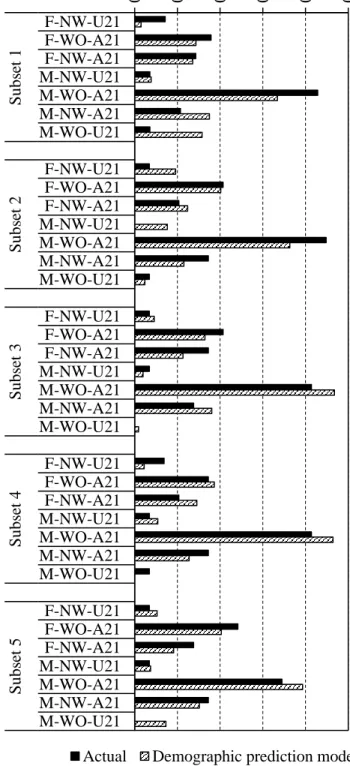
Figure 2-3 Demographic model predictive performance in the validation subsets .... 50
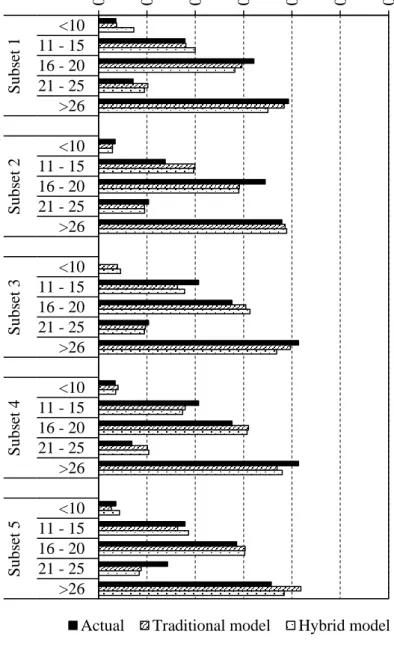
Figure 2-4 Trip generation model predictive performance in the validation subsets .. 51
Figure 3-1 Study area ... 62
Figure 3-2 Average monthly arrondissement observation frequency distribution ... 63
Figure 3-3 Summary of the route identification process ... 64
Figure 3-4 Arrondissement paths (Dakar-Bakel O-D pair as an example) ... 65
Figure 3-5 Overlapping route problem ... 71
Figure 4-1 Summary of the data processing methodology ... 93
Figure 4-2 Sample zones for travel time analysis ... 95
Figure 4-3 Travel time variation (a) Morning peak, (b) Evening peak ... 96
Figure 4-4 Differences between the GPS and GSM inferred home/ work locations .. 96
Figure 4-5 Commuter trip frequency distribution ... 97
Figure 4-6 Time period specific parameters for the number of stops ... 106
Figure 5-1 Data processing framework ... 121
Figure 5-2 Distribution of the AARD values ... 122
Figure 5-3 Distribution of the individual-level estimates ... 123
Figure 5-4 Distribution of the household-level estimates ... 123
Figure 5-5 Distribution of the CDR trip productions... 125
Figure 5-6 Temporal transferability framework... 128
Figure 5-7 Spatial transferability framework ... 128
xiii
List of Tables
Table 1-1 Excerpt of the CDR data ... 2
Table 1-2 Excerpt of the GSM data ... 2
Table 1-3 Previous studies on human and activity mobility ... 6
Table 1-4 Previous studies on OD matrix estimation ... 11
Table 1-5 Previous studies on mode detection ... 14
Table 1-6 Previous studies on route identification ... 15
Table 1-7 Previous studies on population synthesis ... 17
Table 1-8 Linkages between the overall research goals and the specific objectives .. 21
Table 2-1 Summary statistics ... 43
Table 2-2 Parameter estimates of the demographic prediction model ... 45
Table 2-3 Parameter estimates of the trip generation models ... 48
Table 2-4 Final log-likelihoods of the models on the estimation subsets ... 49
Table 2-5 Trip generation model measures of fit in the validation subsets ... 52
Table 3-1a Excerpt of the raw CDR data ... 63
Table 3-1b Excerpt of the processed arrondissement visitation data ... 63
Table 3-2 Excerpt of the route assignment data ... 66
Table 3-3 Attributes typically used in route choice models ... 67
Table 3-4 HDM-III basic input data ... 69
Table 3-5 Typical occupancy rates and mode shares in Senegal ... 69
Table 3-6 Estimation results ... 74
Table 3-7 Statistical comparison of the models ... 75
Table 3-8 Comparison of the VTT estimates with other sources ... 76
Table 3-9 Validation results ... 77
Table 4-1 Demographic data summary statistics ... 91
Table 4-2 Excerpt of the GSM data ... 92
Table 4-3 Model estimation results ... 103
xiv
Table 4-5 Comparison with time valuations from other sources ... 108
Table 5-1 Excerpt of the CDR data ... 119
Table 5-2 Summary statistics of the household survey data ... 120
Table 5-3 Variables in both the census and the household survey data ... 120
Table 5-4 Household-level control variables used in PopGen ... 122
Table 5-5 Individual-level control variables used in PopGen ... 122
Table 5-6 Base model results ... 130
Table 5-7 Joint model scaling factors... 132
Table 5-8 Temporal transferability ... 133
Table 5-9 Spatial transferability ... 134 Table 6-1 Linkages between the overall research goals and the specific objectives . 139
1
Chapter 1
Introduction
1.1
Context
Over the last few decades, technological advances have facilitated the storage, retrieval, and processing of extremely large amounts of timestamped location data. These datasets are increasingly becoming important sources of information for transportation studies (Clarke, 2016). The interest in big data is largely driven by its ability to passively capture the behavioural patterns of wider proportions of the population at a low cost compared to traditional data collection methods (such as household surveys), which are usually expensive. The high costs of traditional surveys often lead to small sample sizes and an increased risk of sampling bias. This problem is usually exacerbated by the low response rates due to survey response burden (e.g. Rolstad et al., 2011, Groves, 2006), as well as potential changes in the respondents’ behaviour due to awareness of being observed. Although the challenges with traditional data collection methods can be found in both the developed and the developing worlds, they are more prevalent in the latter context due to stringent budget constraints and limited initiatives to systematically document the few available travel survey records from related studies (San Santoso and Tsunokawa, 2005). Therefore, the emergence of low-cost big data presents a timely opportunity to address some of the data limitations especially in those contexts.
Large-scale travel patterns have previously been extracted from Global Positioning System (GPS) data (e.g. Li et al., 2018, Hess et al., 2015, Broach et al., 2012, Bierlaire et al., 2010, Papinski et al., 2009), mobile network records (e.g. Çolak et al., 2015, Iqbal et al., 2014, Jiang et al., 2013, Schlaich et al., 2010), wireless sensor data (e.g. Tubaishat et al., 2009), bluetooth sensor data (e.g. Crawford, 2017, Hainen et al., 2011), smart card transaction records (e.g. Ma et al., 2013, Munizaga and Palma, 2012, Pelletier et al., 2011, Liu et al., 2009), and social media data (e.g. Hawelka et al., 2014, Hasan et al., 2013) among others. Apart from smart card and social media data, most of the other data types are occasionally referred to as mobile phone data.
However, each data type has limitations. For example, the generation of mobile phone GPS data requires smartphones and regular access to the internet. Wireless and bluetooth data require the installation of sensor infrastructure across the study area to detect the mobile phone movements. While such datasets have been successfully used for transport studies in developed countries, they cover much smaller proportions in the developing world, where mobile internet penetration (e.g. 21% of the population in sub-Saharan Africa) and smartphone adoption (e.g. 34% of all mobile connections in sub-Saharan Africa) is still very low (GSMA, 2018), which would further increase the risk of sampling bias.
To avoid such issues, this research proposes the use of mobile phone network records, which are independent of the phone type and internet accessibility, thereby being more widely available. These records may either be event-driven, such as Call Detail Records (CDRs) and cell phone handover data, which report the timestamped locations of communication events only, or network-driven, such as location-area update, signalling or Global System for Mobile communications (GSM) data, which report the IDs of all the cells traversed by an active mobile phone at regular time intervals (irrespective of the calling or texting
2
patterns of the users). Tables 1-1 and 1-2 show typical excerpts of CDR and GSM data, respectively.
Table 1-1 Excerpt of the CDR data
Anonymous User ID Date Time Duration Tower
Longitude Tower latitude ABH03JACKAAAgfBALA 20120624 11:41:49 25 23.9339 90.2931 ABH03JAC8AAAbZfAHW 20120624 13:43:25 13 23.7931 90.2603 ABH03JAC4AAAcvbABB 20120624 13:27:39 8 23.7761 90.4261 ABH03JAC9AAAbWFAVV 20120624 15:27:27 51 23.7097 90.4036 ABH03JABkAAHvEkAQX 20120624 18:32:38 50 23.7386 90.4494
Table 1-2 Excerpt of the GSM data
Anonymous User ID GSM Cell ID Unix timestamp Time zone
8851 712 1251762486 -7200
8851 712 1251762546 -7200
8851 836 1251762606 -7200
8851 836 1251762663 -7200
Mobile phone network records have already been extensively applied in various fields of transport such as human mobility modelling (e.g. Deville et al., 2016, Jiang et al., 2013, Isaacman et al., 2012, Song et al., 2010, Gonzalez et al., 2008), traffic model calibration (e.g. Bolla et al., 2000), origin-destination matrix estimation (e.g. Çolak et al., 2015, Iqbal et al., 2014, Pan et al., 2006, White and Wells, 2002), and trip generation estimation (e.g. Çolak et al., 2015). However, the analysis has so far been limited to extracting travel patterns and trends rather than modelling behaviour.
The main advantage with mobile phone network records is that they are already being collected on a large-scale by network operators for different purposes. For example, CDR data is collected for billing purposes, while GSM data is collected for location area updating to optimise network performance. However, the former is more widely available as it is stored for longer periods of time compared to the latter. The possibility of using these for transport studies as a by-product significantly reduces the data collection burden and cost. However, this presents significant challenges in terms of data sharing, storage, and analysis as the datasets are usually noisy, complex, large, and anonymous. In most cases, it is challenging to analyse such datasets using traditional data processing and modelling techniques as it is difficult to establish direct linkages between the observed travel patterns and the underlying causal factors, thus limiting the applicability of the data for travel behaviour and policy analysis. This motivates this research where we develop methods aimed at addressing the practical challenges associated with mobile phone network records to make them more usable for travel behaviour modelling. An important point worth noting is that the data has great potential as it is more representative, large, and frequent, thereby capturing more variability over long periods of time, which opens up a lot of scope for validation beyond what is being offered by traditional travel survey data.
The models used in this study belong to the family of discrete choice models - a well-established method for estimating econometric models of travel behaviour since in most transport choices, the options are discrete and mutually exclusive (see Ben-Akiva and Lerman, 1985 for details). However, we also note that several related studies have used machine learning as the main tool of analysis (e.g. Ellis et al., 2014, Wang et al., 2010,
3
Farrahi and Gatica-Perez, 2008, Sohn et al., 2006). The reason we adopt the discrete choice framework over the machine learning framework is because the former is capable of explaining the relative importance of the different factors influencing human preferences while relying on a behavioural underpinning, which is important for testing future and alternative policy scenarios, while the latter simply aim at minimising the prediction error without due consideration to established behavioural principles and interpretability (Paredes et al., 2017). Though some of the machine learning algorithms generate regression parameters, the estimates are context dependent and hardly stable, thus, it would be risky analysing these the same way we interpret typical travel behaviour model estimation outputs (Mullainathan and Spiess, 2017).
This research is timely as it presents new ways of integrating mobile phone data into traditional transport modelling approaches. As the data typically comprises of millions of records, a significant portion of this research focussed on data preparation for analysis using state-of-the-art programming languages. The research outcomes present initial efforts to provide a feasible low-cost alternative to transport planners and policy makers working in contexts with severe budget constraints on transport studies. The promising results we obtain encourage further research to improve the proposed methods, as well as extend the application of mobile phone data to other fields of travel behaviour modelling (such as mode choice). Besides, the practical challenges encountered prompted the development and/or application of novel modelling frameworks, thus the thesis makes significant methodological and applied contributions that could be useful to other fields of choice modelling.
1.2
Current progress in the application of mobile phone data to
transportation studies
Prior to outlining the research objectives, it is important to review the state of the art in the application of mobile phone data to transportation studies. This review is aimed at highlighting the gaps in the literature forming the basis of the current research. The review covers seven key areas and focusses on studies using mobile phone network records (i.e. CDR and GSM data).
1.2.1
Trip generation
There have only been a few studies focusing on trip generation in the context of mobile phone data research (e.g. Çolak et al., 2015, Toole et al., 2015). These studies have only been able to produce anonymous trip rates, which cannot be used for policy assessment. Since trip generation is mainly influenced by the trip maker’s socio-demographics (see Bwambale et al., 2015 for details), such variables need to be incorporated into the models to allow for policy assessment, and previous studies have not addressed this challenge due to data anonymity.
1.2.2
Human mobility and activity patterns
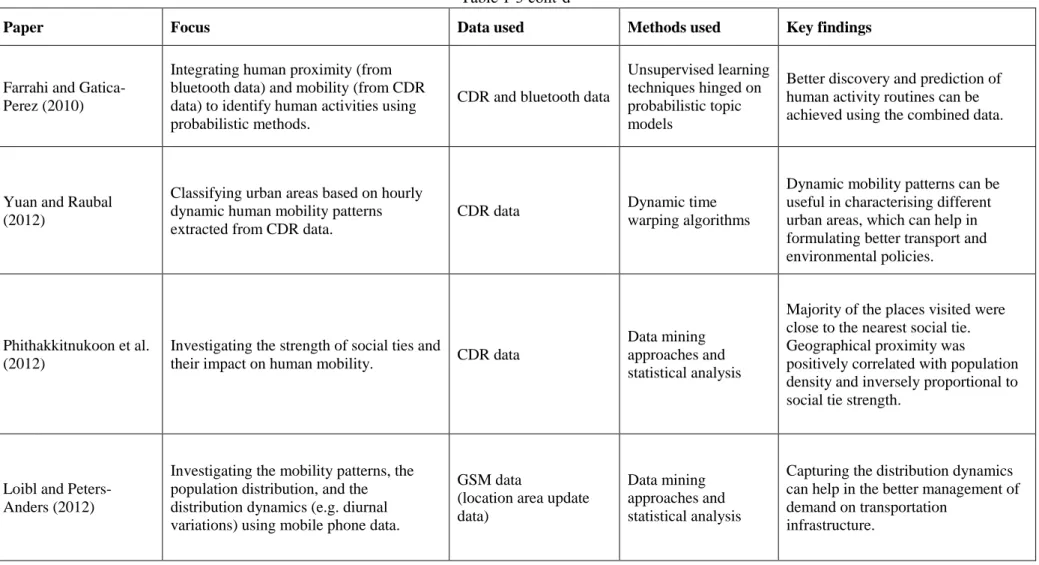
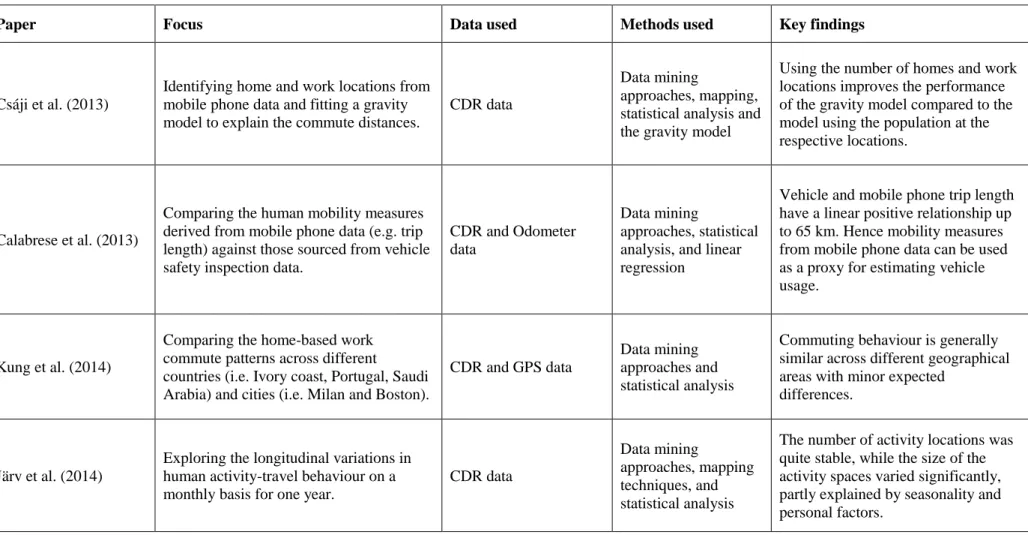
This is the most widely investigated aspect of mobile phone data research. Understanding mobility and activity patterns is essential for network planning and management. However, patterns can change over time for various reasons, and most of the reviewed studies do not incorporate ways to analyse or predict the impact of such changes. The only exception is
4
the study by Csáji et al. (2013), who use a gravity model to explain the impact of commute distance in the extracted mobility patterns. Table 1-3 presents a summary of the reviewed studies.
1.2.3
OD matrix estimation
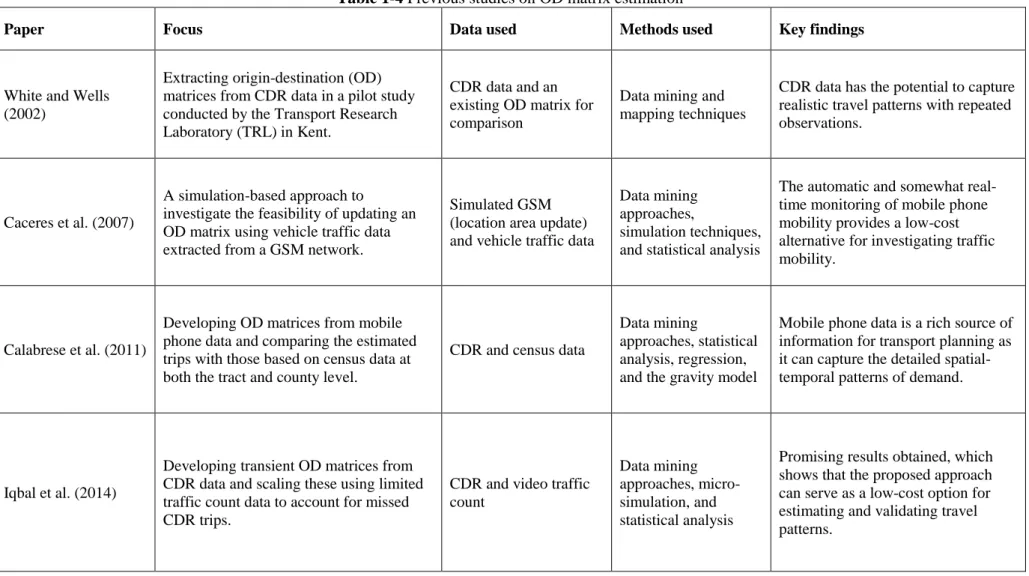
Related to mobility pattern generation is origin-destination (OD) matrix estimation. Mobile phone OD trips only represent a fraction of the actual OD trips due to several factors such as the mobile phone penetration rate, the market shares, and missed trips due to data noise. Usually, these trips need to be scaled to obtain an OD matrix representative of the entire population.
The issue of scaling mobile phone OD trips has been at the forefront of this subject area for many years. Goulding (2017) reviewed the current practices for calculating the OD matrix scaling factors and recommended the approach in Iqbal et al. (2014) as one of the best practices. In that approach, the scaling factors are based on the observed traffic counts at strategic locations within the road network.
However, beyond OD matrix scaling, it is important to understand the factors influencing the observed patterns. The calibration of appropriate gravity models represents effort in this direction, however, there is a need to specify more comprehensive deterrence functions, rather than those using distance only (e.g. Wang et al., 2014, Csáji et al., 2013). Table 1-4 presents an overview of the previous work in this field.
1.2.4
Mode detection
Mode choice is an important component in travel demand estimation. It influences the level of vehicular demand and therefore has a significant impact on traffic congestion. Traffic congestion itself influences various travel decisions such as route and departure time choice. However, mode detection from anonymous mobile phone network records is very challenging due to the noisy nature of the data. This is demonstrated by the availability of few studies as summarised in Table 1-5. Since these studies have yielded promising results, there is a need for further dedicated research to improve the transferability of these approaches to real-world urban scenarios.
1.2.5
Route identification
Route choice corresponds to the final step in the four-stage model. The identification of routes from mobile phone data has been widely investigated. Table 1-6 presents an overview of the different studies in this field. It may be noted that most of the reviewed studies stop at route identification, and do not investigate the factors affecting route choice behaviour, except in Schlaich (2010), where GSM trajectories are fused with traffic state information to model the impact of variable message signs and other factors on route choice. However, GSM data is semi-continuous in nature, thus enabling the observation of full trajectories. This makes route identification relatively easy compared to when CDR data is used. This is because the latter is event-driven and more discontinuous. To date, there is no study using CDR data to analyse route choice behaviour.
5
1.2.6
Departure time choice
The traditional four-stage model does have some limitations. For example, it does not account for the effect of traffic congestion on the changes in departure time to avoid delays. A review of the literature shows that there is no previous study using mobile phone network records to analyse departure time choices.
The only related study is by Peer et al. (2013), who use smartphone GPS data to calculate the door-to-door travel times as part of a revealed preference departure time study, in which the desired times-of-travel are reported. Knowledge about the desired times-of-travel is critical for departure time choice modelling, however, these cannot be observed in anonymous mobile phone data. This probably explains the absence of studies in this field.
1.2.7
Population synthesis
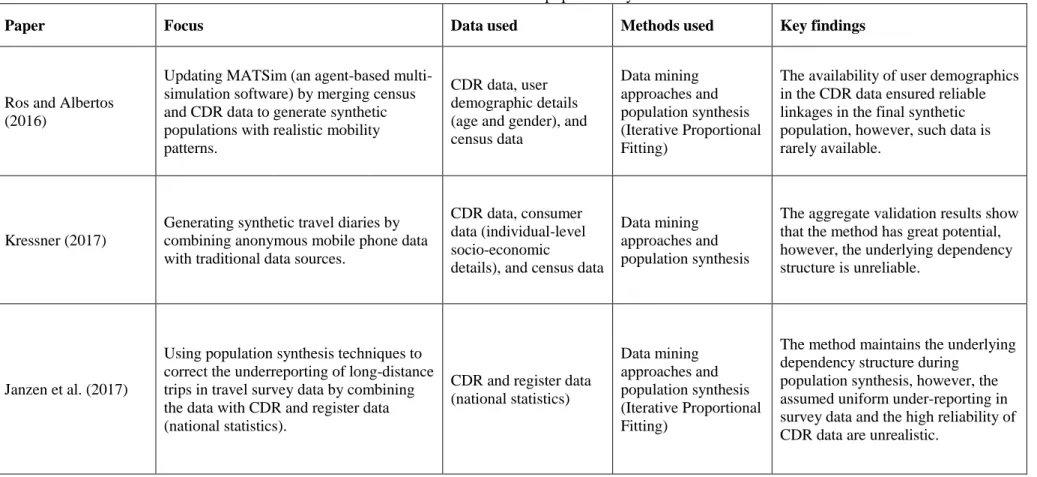
The final transport-related application of mobile phone network records is population synthesis of mobility patterns. This technique is widely applied in activity-based modelling to generate artificial populations. The main motivation behind incorporating mobile phone data has been to generate artificial populations with realistic travel patterns. Table 1-7 presents a summary of the studies in this field.
However, in most of these studies, the disaggregate dependence structure between the user demographics and the mobile phone mobility patterns seems arbitrary. Furthermore, the assumed higher reliability of mobile phone data over travel survey data is contentious and needs to be approached impartially.
6
Table 1-3 Previous studies on human and activity mobility
Paper Focus Data used Methods used Key findings
Candia et al. (2008)
Identifying unusual events using mobile phone data and characterising these based on methods from percolation theory.
Data type not reported Standard percolation theory tools
Analysing the formation and decay of spatial clusters from mobile phone data can be useful in the real-time recognition of emergencies.
Farrahi and Gatica-Perez (2008)
Classifying students’ daily routines according to the day of the week (weekday or weekend) and the course taken
(engineering or business) by combining call log and bluetooth data.
CDR and bluetooth data
Machine learning tools (support vector machine with a gaussian kernel)
Combining proximity (bluetooth) and mobility (CDR) data can lead to significant improvements in
classification when compared to using a single data source.
Choujaa and Dulay (2008)
Developing a system that relies on context sensing, time-based relationships, and anonymous landmarks for activity recognition as opposed to location data. The developed system is called TRAcME (Temporal Recognition of Activities for Mobile Environments).
GSM and bluetooth data, as well as user-reported activities for training purposes
Hierarchical learning techniques for time use graphs
The developed system can recognise multiple and consistent activities, unlike the existing techniques.
Phithakkitnukoon et al. (2010)
Investigating the correlations in the activity patterns of users based on the profiles of their work areas extracted from an activity-aware map.
CDR and point of interest (POI) data
A combination of k-means clustering and Bayes probability theory
Strong activity pattern correlations across users with the same work area profile
These correlations are inversely proportional to the distance between the work areas.
7
Table 1-3 cont’d
Paper Focus Data used Methods used Key findings
Farrahi and Gatica-Perez (2010)
Integrating human proximity (from bluetooth data) and mobility (from CDR data) to identify human activities using probabilistic methods.
CDR and bluetooth data
Unsupervised learning techniques hinged on probabilistic topic models
Better discovery and prediction of human activity routines can be achieved using the combined data.
Yuan and Raubal (2012)
Classifying urban areas based on hourly dynamic human mobility patterns extracted from CDR data.
CDR data Dynamic time warping algorithms
Dynamic mobility patterns can be useful in characterising different urban areas, which can help in formulating better transport and environmental policies.
Phithakkitnukoon et al. (2012)
Investigating the strength of social ties and
their impact on human mobility. CDR data
Data mining approaches and statistical analysis
Majority of the places visited were close to the nearest social tie. Geographical proximity was
positively correlated with population density and inversely proportional to social tie strength.
Loibl and Peters-Anders (2012)
Investigating the mobility patterns, the population distribution, and the distribution dynamics (e.g. diurnal variations) using mobile phone data.
GSM data (location area update
data)
Data mining approaches and statistical analysis
Capturing the distribution dynamics can help in the better management of demand on transportation
8
Table 1-3 cont’d
Paper Focus Data used Methods used Key findings
Yuan et al. (2012)
Investigating the relationship between mobile phone calling frequency and travel behaviour characterised by three metrics (i.e. the radius of gyration, eccentricity, and entropy).
CDR data
Data mining approaches and statistical analysis
There is a statistically significant correlation between mobile phone usage and travel behaviour.
Kang et al. (2013)
Comparing the human movements based on mobile phone data and taxicab usage in Singapore.
CDR data and GPS logs for all taxi-cabs
Data mining approaches and statistical analysis
The ratio of taxicab to mobile phone movements can help in the dynamic prediction of taxicab demand.
Jiang et al. (2013)
Generating daily mobility motifs and the purposes linked with the motif
destinations using map matching techniques.
The extracted motifs were compared against the trip chains obtained from travel survey data.
CDR and travel survey data
Data mining approaches, map-matching techniques, and statistical analysis
Similar trends in the shares of the daily mobility motifs extracted from both data sources, an indication that CDR data can serve as a low-cost alternative to survey data.
Paraskevopoulos et al. (2013)
Investigating and characterising usual and unusual human behaviour patterns based using call activity and mobility data.
CDR and aggregate tower-to-tower communication data
Data mining
approaches, mapping tools, and statistical analysis
The observed behavioural patterns could be logically connected to major national and religious events, an indication that mobile phone data can be useful for the early detection and monitoring emergency situations.
9
Table 1-3 cont’d
Paper Focus Data used Methods used Key findings
Csáji et al. (2013)
Identifying home and work locations from mobile phone data and fitting a gravity model to explain the commute distances.
CDR data
Data mining
approaches, mapping, statistical analysis and the gravity model
Using the number of homes and work locations improves the performance of the gravity model compared to the model using the population at the respective locations.
Calabrese et al. (2013)
Comparing the human mobility measures derived from mobile phone data (e.g. trip length) against those sourced from vehicle safety inspection data.
CDR and Odometer data
Data mining
approaches, statistical analysis, and linear regression
Vehicle and mobile phone trip length have a linear positive relationship up to 65 km. Hence mobility measures from mobile phone data can be used as a proxy for estimating vehicle usage.
Kung et al. (2014)
Comparing the home-based work commute patterns across different
countries (i.e. Ivory coast, Portugal, Saudi Arabia) and cities (i.e. Milan and Boston).
CDR and GPS data
Data mining approaches and statistical analysis
Commuting behaviour is generally similar across different geographical areas with minor expected
differences.
Järv et al. (2014)
Exploring the longitudinal variations in human activity-travel behaviour on a monthly basis for one year.
CDR data
Data mining
approaches, mapping techniques, and statistical analysis
The number of activity locations was quite stable, while the size of the activity spaces varied significantly, partly explained by seasonality and personal factors.
10
Table 1-3 cont’d
Paper Focus Data used Methods used Key findings
Trasarti et al. (2015)
Unravelling the linkages between different regions of a city based on correlations in the temporal distributions of the
corresponding population densities.
CDR data
Data mining
approaches to extract the event correlation patterns for a set of regions
The study developed a “c-pattern” algorithm to help explain the logic behind the inter-regional linkages within cities, which can help in understanding the causes and effects of events.
Shi et al. (2015)
Analysing the spatial structure and characteristics of community-level human mobility using kernel density maps.
CDR data
Data mining
approaches, statistical analysis, and kernel density maps
Although no spatial constraints were applied to the mobile social network, the social communities were
geographically linked, an indication that individuals generally
communicate with people who are near.
Jiang et al. (2017)
Generating the human mobility motifs for the entire population by combining CDR, survey, and census data using an activity-based approach.
CDR, household survey, and census data
Data mining
approaches, mapping techniques, and statistical analysis
Mobile phone data can provide more realistic insights and multi-day observations of human mobility motifs compared to household survey data, which is prone to reporting errors.
11
Table 1-4 Previous studies on OD matrix estimation
Paper Focus Data used Methods used Key findings
White and Wells (2002)
Extracting origin-destination (OD) matrices from CDR data in a pilot study conducted by the Transport Research Laboratory (TRL) in Kent.
CDR data and an existing OD matrix for comparison
Data mining and mapping techniques
CDR data has the potential to capture realistic travel patterns with repeated observations.
Caceres et al. (2007)
A simulation-based approach to
investigate the feasibility of updating an OD matrix using vehicle traffic data extracted from a GSM network.
Simulated GSM (location area update) and vehicle traffic data
Data mining approaches,
simulation techniques, and statistical analysis
The automatic and somewhat real-time monitoring of mobile phone mobility provides a low-cost alternative for investigating traffic mobility.
Calabrese et al. (2011)
Developing OD matrices from mobile phone data and comparing the estimated trips with those based on census data at both the tract and county level.
CDR and census data
Data mining
approaches, statistical analysis, regression, and the gravity model
Mobile phone data is a rich source of information for transport planning as it can capture the detailed spatial-temporal patterns of demand.
Iqbal et al. (2014)
Developing transient OD matrices from CDR data and scaling these using limited traffic count data to account for missed CDR trips.
CDR and video traffic count
Data mining approaches, micro-simulation, and statistical analysis
Promising results obtained, which shows that the proposed approach can serve as a low-cost option for estimating and validating travel patterns.
12
Table 1-4 cont’d
Paper Focus Data used Methods used Key findings
Wang et al. (2014)
Optimisation of the national and regional road network using mobile phone data. Mobile phone data is used to calculate OD trips, which are then used to estimate a gravity model. The gravity model outcomes are then used for traffic assignment onto the road network, after which the impact of network changes (e.g. new road links) is tested.
CDR data
Data mining
approaches, statistical analysis, mapping techniques, the gravity model, and all-or-nothing traffic assignment
Mobile phone data is able to reflect the expected behaviour in the gravity model, and can be used for network planning.
Alexander and González (2015)
Developing an OD matrix from CDR data and assigning it to the network to analyse the impact of various ride-sharing adoption rates on traffic congestion.
CDR data and various spatial and survey data sources Data mining approaches, mapping techniques, incremental traffic assignment, and statistical analysis
Mobile phone OD matrices can be applied to successfully analyse the network-wide impact of proposed policies.
Alexander et al. (2015)
Generating OD matrices by trip purpose (i.e. HBW, HBO, and NHB) and time-of-day. The departure times are
probabilistically determined using survey data from major US cities.
CDR and survey data
Data mining approaches, mapping techniques, all-or-nothing traffic assignment, and statistical analysis
CDR data can capture the travel patterns of different market segments, which is important for transport planning.
13 Table 1-4 cont’d
Paper Focus Data used Methods used Key findings
Dong et al. (2015)
Estimating commuter OD trips from CDR data and using the estimates to divide the study area into traffic zones by applying the k-means clustering algorithm to selected semantic attributes (e.g. hourly inflow and outflow).
CDR data
Data mining
approaches, k-means clustering, and statistical analysis
Mobile phone data can be used to extract valuable information on traffic flow, which can enhance our understanding of complex travel patterns.
14
Table 1-5 Previous studies on mode detection
Paper Focus Data used Methods used Key findings
Wang et al. (2010)
Inferring transport modes (i.e. driving, public transport, and walking) from CDR data by applying k-means clustering on the travel times for each OD pair
CDR data
Data mining
approaches, statistical analysis, and k-means clustering
A comparison of the travel times for each mode with those of extracted from Google maps shows that the method can reasonably detect transport modes
Doyle et al. (2011)
Using the virtual cell paths technique to extract user trajectories associated with inter-city road or rail travel from CDR data, and generating the kernel density paths for validation purposes.
CDR data and information on mode shares for validation purposes
Data mining approaches, map-matching techniques, and kernel density estimation
Kernel density maps can be used to successfully identify the routes followed and hence the travel modes used.
Qu et al. (2015)
Estimating transport mode split (car, public transport and walking) from CDR data by applying, speed-distance rules. Where the speed-distance rules do not yield a definite mode a pre-calibrated logit model is used.
CDR data, the transport network GIS data, and census data for validation purposes
Data mining approaches, logistic regression, and statistical analysis
The model correctly predicts the aggregate mode shares for the entire study area and those of a large proportion of the census tracts.
15
Table 1-6 Previous studies on route identification
Paper Focus Data used Methods used Key findings
Schlaich et al. (2010) Schlaich (2010)
Route identification by matching the location area sequences extracted from the mobile phone data against those associated with different routes in the transport network. GSM data Data mining approaches and a multi-path generation algorithm
Mobile phone data can be used to continuously monitor the travel patterns for relatively long trips (i.e. trips traversing at least 3 GSM cells) due to its low spatial resolution
Saravanan et al. (2011)
Longitudinal spatial-temporal analysis of each user’s CDR events to establish their daily routines and routes.
GSM data
Data mining approaches, route clustering, and statistical analysis
The method has great potential in the analysis of city-wide large-scale mobility patterns.
Görnerup (2012)
Using mobile phone data to
probabilistically identify common routes using locality-sensitive hashing and graph clustering.
GSM data and GPS traces
Locality-sensitive hashing and graph clustering
The method yields promising results in terms of accurately clustering the sequences and being scalable, however, it is yet to be tested on real-life complex networks.
Tettamanti et al. (2012)
Route assignment by determining the path with the smallest sum of square distance deviations from the observed mobile phone location area sequence of a user travelling between an OD pair.
GSM data
Data mining approaches and statistical analysis
The proposed method was tried on a single OD pair and needs to be tested on a more complex network.
16
Table 1-6 cont’d
Paper Focus Data used Methods used Key findings
Leontiadis et al. (2014)
Route searching by calculating the weights for each road segment within the cell areas linked to a user’s communication events and determining the shortest weighted path for a given OD pair.
Cell phone handover and GPS data
Data mining approaches and statistical analysis
The accuracy of path determination increases with its distance potentially because individuals are more
cautious of the shortest route for distant OD pairs.
Hoteit et al. (2014)
Identifying human mobility trajectories and the most crowded regions using various interpolation techniques (e.g. linear, cubic and nearest neighbour).
CDR data Data mining approaches, mapping techniques, trajectory interpolation, and statistical analysis
A comparison of the different methods shows that cubic and linear interpolation give the best
performance for commuters and inactive travellers respectively.
Nie et al. (2015)
Route identification based on the degree of similarity to a subset of k-optimal cell handover sequences extracted from the full set of possible handover sequences.
Cell phone handover data
Data mining approaches
The proposed approach yields promising results, however, it needs to be tested in a more complex network, where the number of optimal sequences may be high.
17
Table 1-7 Previous studies on population synthesis
Paper Focus Data used Methods used Key findings
Ros and Albertos (2016)
Updating MATSim (an agent-based multi-simulation software) by merging census and CDR data to generate synthetic populations with realistic mobility patterns.
CDR data, user demographic details (age and gender), and census data Data mining approaches and population synthesis (Iterative Proportional Fitting)
The availability of user demographics in the CDR data ensured reliable linkages in the final synthetic population, however, such data is rarely available.
Kressner (2017)
Generating synthetic travel diaries by combining anonymous mobile phone data with traditional data sources.
CDR data, consumer data (individual-level socio-economic
details), and census data
Data mining approaches and population synthesis
The aggregate validation results show that the method has great potential, however, the underlying dependency structure is unreliable.
Janzen et al. (2017)
Using population synthesis techniques to correct the underreporting of long-distance trips in travel survey data by combining the data with CDR and register data (national statistics).
CDR and register data (national statistics) Data mining approaches and population synthesis (Iterative Proportional Fitting)
The method maintains the underlying dependency structure during
population synthesis, however, the assumed uniform under-reporting in survey data and the high reliability of CDR data are unrealistic.
18
1.2.8
Summary of the research gaps
The previous sections have highlighted the state of the art in applying mobile phone network records to transportation studies. As described, most of these applications focus on obtaining outputs that represent the existing mobility dynamics of the study area, however, they do not incorporate mechanisms to quantify the relative importance of the different factors influencing the observed mobility trends. Without information on the underlying factors, it is difficult to conduct sensitivity analysis to predict the impact of alternative transport policies. Furthermore, the absence of policy-sensitive variables affects the ability of the models to capture the effect of disruptive changes in the study area. An example is when some links in the network are closed, which affects the overall travel time and cost between a given OD pair. The effect of such changes can only be captured if the transport models for the study area already contain such variables. Moreover, this would also improve the spatial and temporal transferability of the models as it would be easier to directly incorporate new information from the application context. As a result of the limited research effort in this direction, several other gaps have been identified in the literature.
First, although it is easy to fuse anonymous mobile phone trajectories with the attributes of the alternatives (for example distance, in the context of route choice modelling), it is more challenging to combine these trajectories with person-level attributes (for example demographic information), and previous studies have not developed data fusion frameworks to specifically address this challenge.
Secondly, there is no study showing how traditional modelling approaches (i.e. components of the 4-stage model and its extensions) can benefit from combining mobile phone data with traditional data sources (such as household surveys), except in the fields of OD matrix estimation and route choice modelling. Even under route choice modelling, there is no previous study using CDR data, which is typically easier to access, and yet presents more challenges compared to GSM data.
Thirdly, there have been limited studies systematically analysing the strengths and weaknesses of different types of mobile phone data and developing or applying appropriate frameworks to address these limitations with regard to specific modelling scenarios. Finally, there is, to the best of our knowledge, no previous study that has attempted to use mobile phone network records to estimate the valuation metrics used in transport policy appraisal, for example, the value of travel time.
1.3
Problem statement
The fundamental role of transport models is to quantify the relative importance of the underlying factors influencing the observed travel behaviour as highlighted in the previous section. Traditionally, such models have been estimated using travel survey data, which reports the available travel options, the chosen alternatives, as well as the attributes of the alternatives and the decision maker, thereby enabling direct linkage between the observed travel behaviour and the influencing factors. However, the high cost of collecting travel survey data, coupled with stringent budget constraints on transport studies has motivated research into emerging low-cost big data sources to develop approaches that could be practically useful for transport practitioners working in contexts with severe data limitations, especially in developing countries.
19
With mobile phone network records offering the highest promise (due to the increasing penetration rates worldwide), most previous studies have focussed on using the data to quantify the prevailing mobility dynamics of the corresponding study areas without explaining the underlying factors influencing the observed patterns (e.g. Alexander et al., 2015, Çolak et al., 2015, Toole et al., 2015, Iqbal et al., 2014, Jiang et al., 2013, Jiang et al., 2011, Candia et al., 2008). This is due to the technical challenges associated with the data. The arguably most significant challenge is data anonymity due to privacy reasons, which makes it difficult to perform data linkages needed to make the data usable for travel behaviour modelling. There has been limited effort to address this challenge with a few applications only seen in the field of route choice modelling (e.g. Schlaich, 2010). This thesis presents more data fusion approaches in a bid to further improve the behavioural and policy underpinnings of the resulting transport models. Moreover, in some contexts, data fusion alone may not solve the problem, especially where information on key latent indicator variables is missing (for example, the desired time of travel in the context of departure time choice modelling). In such cases, approaches to use statistical distributions to estimate these variables are proposed in this thesis.
Besides data anonymity, the other key challenges are the poor location resolution and the noisy nature of the data due to various technical reasons. These have an impact on the detection and the interpretation of the extracted trajectories. Although previous studies have discussed ways of addressing these technical limitations (e.g. Çolak et al., 2015, Iqbal et al., 2014, Jiang et al., 2013), they do not present methods to appropriately incorporate such noisy trajectories into econometric models of travel behaviour. This thesis discusses this issue and provides application examples in the different chapters.
Finally, the other significant challenge is data access and control. Mobile network operators are only willing to release datasets that do not compromise the privacy of their customers. One extreme example is the Orange data for development (D4D) dataset, where the already anonymous user IDs were scrambled across the different months to prevent possible re-identification (de Montjoye et al., 2014). Although it would have been interesting to observe the same anonymous user for the whole year, the researcher is limited to monthly observations.
While the above challenges limit the realisation of the full potential of mobile phone network records, this research hypothesises that by further probing the data coupled with innovative data fusion and modelling techniques, practical benefits can be achieved in terms of making the data more usable for travel behaviour analysis. The research focusses on demonstrating the potential of the data in the fields of trip generation, route choice, and departure time choice modelling. While doing this, the practical challenges associated with the data limited the direct application of the existing modelling frameworks. Thus the thesis makes significant methodological and applied contributions to overcome the identified limitations. The modelling scenarios investigated depended on data availability and its fitness for the purpose.
An important point worth noting is that CDR data is likely to be more useful in the near future with the increasing use of mobile internet data services (Gerpott and Thomas, 2014), which will reduce the location discontinuities in the data.
20
1.4
Research objectives
The main research goal is to incorporate outputs derived from mobile phone network records into traditional transport modelling approaches. This is because traditional models have the capacity to explain the behavioural relationships between phenomena, an advantage we seek to maintain. Moreover, with traditional modelling approaches, it is possible to estimate important metrics such as the value of travel time and elasticities, which are useful in transport policy appraisal. The general objectives of the research are;
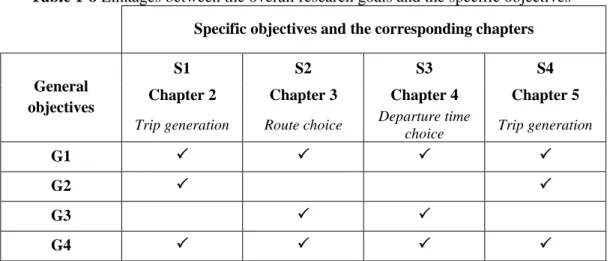
G1 To develop innovative methods for combining mobile phone network records with traditional data sources to facilitate the analysis of travel behaviour; G2 To evaluate the shortcomings of traditional modelling approaches and
propose mitigation measures using mobile phone network records to optimise the reliability and applicability of the models;
G3 To analyse the limitations of mobile phone network records with regard to specific modelling scenarios and develop appropriate methods to deal with those limitations; and
G4 To assess whether models based on mobile phone network records are able to capture the expected travel behaviour in terms of the parameter estimates and/or policy insights in terms of the derived valuation metrics.
These general objectives overlap across the different chapters and are achieved by realising the following specific objectives, which largely depended on data availability and its fitness for the purpose as mentioned earlier.
S1 To develop a hybrid modelling framework fusing the CDR, GSM and demographic data of a sub-sample of users to alleviate the need for travel diary data and facilitate the subsequent analysis of trip-making behaviour using anonymous CDR data from the application context;
S2 To develop a method for modelling long-distance route choice behaviour using partial CDR trajectories combined with information from external sources;
S3 To develop a method for modelling departure time choice decisions using passively collected data without information on the desired times of travel; and
S4 To develop a method for optimising both the aggregate and the disaggregate performance of trip generation models using a combination of CDR data, household travel survey data and census data.
The framework linking the general research objectives to the specific objectives and the chapters is presented in Table 1-8.
21
Table 1-8 Linkages between the overall research goals and the specific objectives Specific objectives and the corresponding chapters
General objectives
S1 S2 S3 S4
Chapter 2 Chapter 3 Chapter 4 Chapter 5
Trip generation Route choice Departure time
choice Trip generation
G1
G2
G3
G4
1.5
Thesis outline and contributions
The subsequent chapters in this thesis (with the exception of the conclusions) correspond to papers prepared during this research. This section briefly summarises the aims of each paper and states its original contributions.
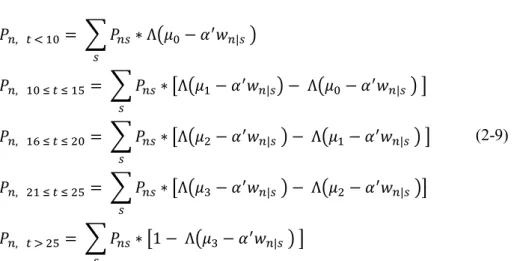
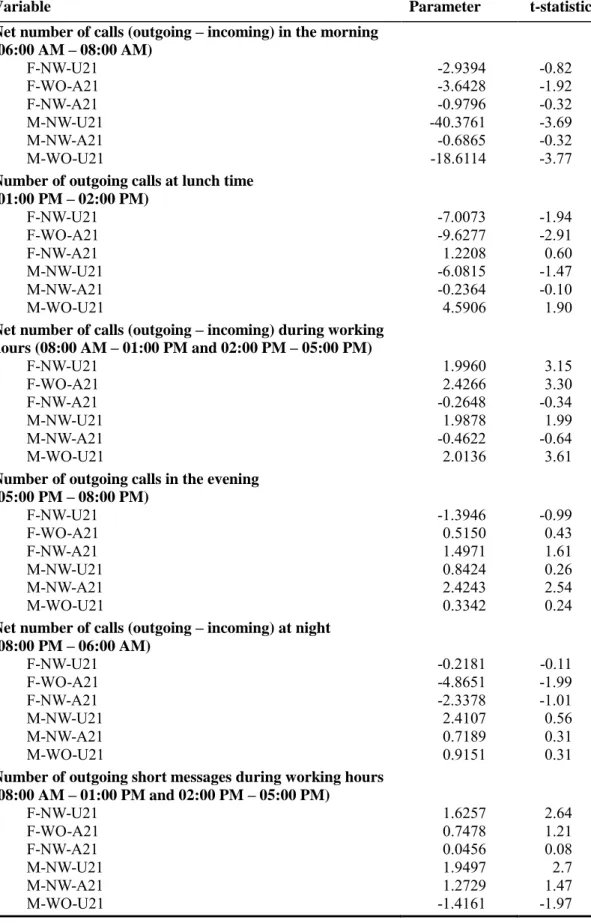
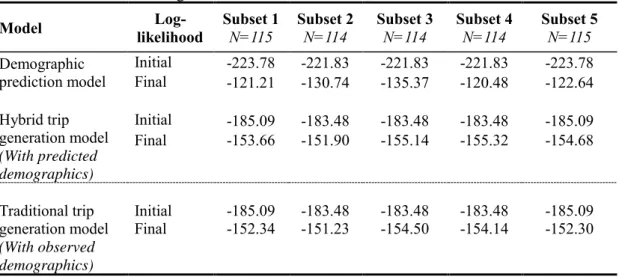
Chapter 2 presents a paper titled “Modelling trip generation using mobile phone data: a latent demographics approach”. The chapter focuses on developing a novel hybrid framework that combines the CDR, GSM, and demographic data of a sub-sample of users to develop a trip generation model that mitigates the shortcomings associated with traditional models. For a sub-sample of the users, the proposed framework first estimates a demographic group prediction model based on the observed mobile phone usage behaviour (extracted from CDR data) and the reported demographics of the users. The demographic group membership probabilities from this model are then used as class weights in a latent class model for trip generation. The trip rates used for model estimation are extracted from the GSM mobility data, which is semi-continuous, and captures all the trips made by the users, thus mitigating the burden of having to fill travel diaries, which comes along with reporting errors. However, it may be noted that GSM data is typically discarded by mobile network operators as it consumes a lot of storage space. Hence the data can only be available for a sub-sample of the users during model estimation. The proposed framework overcomes this issue as it only needs anonymous CDR data during application. The data is used to extract phone usage variables, which are then used to predict the demographic group membership probabilities, and eventually the trips rates of the users. Since the CDR data for all users is stored by mobile network operators for billing purposes, it can be anonymously applied to mitigate the problems associated with the lack of detailed demographic information during model application, thus enabling more reliable prediction of aggregate travel demand. The proposed framework presents the first attempt in literature to incorporate demographic variables into models based on mobile phone data, and is an original contribution of this thesis.
Chapter 3 presents a paper titled “Modelling long-distance route choice using mobile phone call detail record data: a case study of Senegal”. A review of the literature shows that most previous studies have focussed on using mobile phone data for route identification, and only a few studies based on semi-continuous GSM and GPS data have used the identified routes to analyse route choice behaviour. There is no previous study using CDR data (which is
22
more discontinuous and noisy) to analyse route choice behaviour. As a result of the discontinuous nature of CDR data, it is only possible to observe the partial trajectories of the users. The chapter proposes an approach for extracting and labelling the routes associated with these partial trajectories. These are then combined with travel cost, travel time, and geospatial information obtained from various sources. Due to the partial nature of the CDR trajectories, the Broad Choice Framework developed in the context of vehicle type choice (Wong, 2015) is employed to model route choice behaviour for the first time. The results show that CDR data is able to capture the behaviour towards overlapping routes, and the estimated values of travel time are reasonable. This demonstrates that CDR data can be used to inform transport policies in contexts where traditional data sources are unavailable. Chapter 4 presents a paper titled “Modelling departure time choice using mobile phone data”. Over the last few years, several studies have focussed on departure time choice modelling using GPS data, which is expensive to collect and is affected by technical issues such as signal losses and battery depletion that create gaps in the data. There has not been any study investigating the potential of mobile phone network records, which are cheaper to obtain as they are already being collected by network operators for different purposes. This chapter rigorously compares the strengths and weakness of real-world GSM and GPS data to investigate their potential use for modelling departure time decisions. It may be noted that GSM data is more appropriate for modelling departure time decisions compared to CDR data, which is event-driven and more discontinuous. The chapter presents a practical approach to impute the missing travel time information for the different departure time intervals and proposes a novel modelling framework that accounts for the fact that the desired times of travel are unobserved. The proposed framework is unique in the sense that it allows the modeller to understand the sensitivities, as well as the valuations attached to schedule delay, despite the passive nature of the data. The findings show that GSM data has fewer time gaps, which leads to more reliable model results compared to GPS data, despite the higher location accuracy of the latter. This is also supported by comparison of the valuation metrics derived from both models, where those obtained from GSM data are closer to those based on traditional data. This result could inform policy measures related to big data adoption for transportation studies.
Chapter 5 presents a paper titled “Getting the best of both worlds - a framework for combining disaggregate travel survey data and aggregate mobile phone data for trip generation modelling”. This chapter describes and tests a novel joint modelling framework combining household travel survey data, census data and CDR data to optimise both the aggregate and disaggregate reliability of trip generation models. Household survey data is the most reliable source of information on travel behaviour patterns, however, the data typically covers small proportions of the population and is prone to reporting errors, which could lead to misrepresentation of the aggregate travel demand across zones. On the other hand, CDR data covers much wider proportions of the population and is a more reliable source of information on the aggregate travel patterns across zones. However, CDR data too is not error-free due to missed trips and data noise, thus the need to optimise between the household survey and the CDR data outcomes. The proposed joint modelling framework focuses on adjusting the parameter scales to optimise model performance at both the aggregate and the disaggregate level without changing the behavioural dynamics reflected in the household survey data. The results show that the proposed joint modelling framework improves both the temporal and spatial transferability of the models, thus making them more reliable. The chapter presents the first attempt in literature to combine the benefits associated
23
with household travel survey data and low-cost CDR data to improve the reliability of transport models, and is an original contribution of this thesis.
Chapter 6 summarises the advances made towards achieving the objectives presented in Section 1.4, linking together the different contributions, and outlining the potential directions of future research.
For purposes of clarity, the key contributions of this thesis are highlighted below in bullet points.
• Extending the application of mobile phone network records to travel behaviour modelling and policy analysis;
• A hybrid modelling framework to handle the issue of unobserved user demographics in transport models based on mobile phone