
BIG PROVENANCE STREAM PROCESSING FOR
DATA-INTENSIVE COMPUTATIONS
Isuru Suriarachchi
Submitted to the faculty of the University Graduate School in partial fulfillment of the requirements
for the degree Doctor of Philosophy
in the School of Informatics, Computing and Engineering Indiana University
Accepted by the Graduate Faculty, Indiana University, in partial fulfillment of the require-ments for the degree of Doctor of Philosophy.
Beth Plale, Ph.D.
David Leake, Ph.D.
Ryan Newton, Ph.D.
Judy Qiu, Ph.D.
Copyright 2018 Isuru Suriarachchi All rights reserved
Acknowledgements
This dissertation is a result of an effort over many years. There are so many people who helped me in various ways during this endeavor. Without their generous support and encouragement, this work would not have been possible.
First of all, I am so grateful to my Ph.D. advisor, Prof. Beth Plale for her invaluable support, guidance, and encouragement throughout my Ph.D. Her research experience over many years across multiple areas of Computer Science helped me in many ways to solve hard research problems and to successfully present them as publications. In addition to that, she was so kind to me and my family during our hard times. I am truly honored to have worked with her throughout my Ph.D. studies.
I would like to thank my research committee members Prof. David Leake, Prof. Ryan Newton and Prof. Judy Qiu for their guidance and advice on my qualifying exams, thesis proposal, and final dissertation. I should thank all professors at the School of Informat-ics, Computing, and Engineering from whom I took a number of courses which helped immensely to improve my knowledge and skills.
It has been great to work with my past and present peers at the Data to Insight Center including Milinda Pathirage, Peng Chen, Inna Kouper, Yuan Luo, Quan Zhou, Kavitha Chandrasekar, Yu Luo, Charitha Dandeniya Arachchi, Samitha Liyanage, Ratharanjan Kunalan and Sachith Withana. I thank all of them for insightful research discussions and
for all the fun we had together which made a great environment to work in. Also, I should thank all past and present administrative staff members at the center including Mary Nell Shiflet, Jenny Olmes-Stevens and Jodi Stern.
My special gratitude goes to Dr. Sanjiva Weerawarana who encouraged and guided me toward graduate studies and helped me in many ways during the application process. He also was a teacher, mentor and my first CEO at WSO2 where I started my career. I take this opportunity to thank all my past colleagues at WSO2 who also supported in many ways.
I owe my special thanks to all my past teachers at the University of Moratuwa, Sri Lanka and my high school, Richmond College, Galle, Sri Lanka. They all have contributed immensely towards my success and I would not have been here without their support.
The Sri Lankan community in Bloomington has been wonderful and their love and care made our time there a great one. I thank all friends including Supun Kamburugamuve, Lahiru Gunathilake, Saliya Ekanayake, Milinda Pathirage, Udayanga Wickramasinghe, Shammi Jayasinghe, Amila Jayasekara, Thilina Gunarathne, Ratharanjan Kunalan, Wasan-tha Jayawardene and their families for their immense support. Without them, we would not have survived some of our hardest times away from family.
I have no enough words to thank my parents and two brothers for their unconditional love and encouragement throughout my life. My parents took every effort to create a great environment for me to succeed. I grew up looking at my elder brothers and they have
been role models for me. Here I thank all my close relatives and childhood friends too who helped me in many ways over the years.
Finally, there is one special person who made all of this possible. My lovely wife, Pavithri has been always behind me during our good and bad times. She sacrificed so many things for me and my daughter and took so much pain to make us comfortable. I owe so much to her for making the completion of this thesis a possibility and apologize her for all the responsibilities that I have missed over last six years. My daughter, Miheli who is the most precious gift that I have ever received has also been a great encouragement for me to succeed.
Isuru Suriarachchi
BIG PROVENANCE STREAM PROCESSING FOR DATA-INTENSIVE COMPUTATIONS
Industry, academia, and research alike are grappling with the opportunities that Big Data brings in the ability to analyze data from numerous sources for insight, decision making, and predictive forecasts. The analysis workflows for dealing with such volumes of data are said to belarge scale data-intensive computations(DICs). Data-intensive computation frameworks, also known as Big Data processing frameworks, carry out both online and offline processing.
Big Data analysis workflows frequently consist of multiple steps: data cleaning, joining data from different sources and applying processing algorithms. Critically today the steps of a given workflow may be performed with different processing frameworks simultaneously, complicating the lifecycle of the data products that go through the workflow. This is particularly the case in emerging Big Data management solutions like Data Lakes in which data from multiple sources are stored in a shared storage solution and analyzed for different purposes at different points of time. In such an environment, accessibility and traceability of data products are known to be hard to achieve.
Data provenance, or data lineage, leads to a good solution for this problem as it pro-vides the derivation history of a data product and helps in monitoring, debugging and reproducing computations. Our initial research produced a provenance-based reference
architecture and a prototype implementation to achieve better traceability and management. Experiments show that the size of fine-grained provenance collected from data-intensive computations can be several times larger than the original data itself, creating a Big Data problem referred to in the literature “Big Provenance”. Storing and managing Big Prove-nance for later analysis is not be feasible for some data-intensive applications due to high resource consumption. In addition to that, not all provenance is equally valuable and can be summarized without loss of critical information.
In this thesis, I apply stream processing techniques to analyze streams of provenance captured from data-intensive computations. The specific contributions are several. First, a provenance model which includes formal definitions for provenance stream, forward prove-nance and backward proveprove-nance in the context of data-intensive computations. Second, a stateful, one-pass, parallel stream processing algorithm to summarize a full provenance stream on-the-fly by preserving backward provenance and forward provenance. The algo-rithm is resilient to provenance events arriving out-of-order. Multiple provenance stream partitioning strategies: horizontal, vertical, and random for provenance emerging from data-intensive computations are also presented.
A provenance stream processing architecture is developed to apply the proposed parallel streaming algorithm on a stream of provenance arriving through a distributed log store. The solution is evaluated using Apache Kafka log store, Apache Flink stream processing
system, and the Komadu provenance capture service. Provenance identity, archival and reproducibility use a persistent ID (PID)-based approach.
Beth Plale, Ph.D.
David Leake, Ph.D.
Ryan Newton, Ph.D.
Contents
Abstract i
List of Figures xiii
Chapter 1. Introduction 1
Chapter 2. Related Work 9
2.1. Data Provenance 9
2.2. Scientific Workflow Provenance 9
2.3. Provenance Querying 11
2.4. Big Data Provenance 11
2.5. Provenance Stream Analysis 13
Chapter 3. Background 15
3.1. Provenance 15
3.2. Big Data Processing Models 18
3.3. Distributed Log Storage 19
3.4. Persistent Identifier (PID) 21
Chapter 4. Related Previous Work 23
4.1. Komadu 23
Chapter 5. Provenance Stream Model 52
5.1. DICs and DIC Workflows 52
5.2. Backward and Forward Provenance 55
5.3. Provenance Streams 58
Chapter 6. Parallel Provenance Stream Processing 61
6.1. Big Provenance in DICs 61
6.2. Streaming solution for Big Provenance 65
6.3. Parallel-prov-stream Algorithm 70
6.4. Partitioning a Provenance Stream 74
6.5. Early Elimination Problem 79
6.6. PID based Provenance Identity in Data Lake 81
Chapter 7. Implementation and Evaluation 84
7.1. Parallel provenance stream implementation 84
7.2. Experimental Evaluation 90
Chapter 8. Conclusion and Future Work 101
Bibliography 106
List of Figures
1.1 Reference Architecture 3
3.1 Each Kafka topic is divided into partitions (taken from Kafka docs) 19
3.2 Kafka consumer groups (taken from Kafka docs) 20
4.1 Sample Komadu provenance graph visualized using Cytoscape 27
4.2 Provenance Capture in SEAD VA using Komadu 28
4.3 Komadu Architecture 29
4.4 Data Lake Architecture 36
4.5 A high level data flow scenario in a Data Lake 41
4.6 Data Lineage 42
4.7 Data Lake use case 43
4.8 Cytoscape visualization of forward provenance for a single tweet 46 4.9 Cytoscape visualization of backward Provenance for one Spark output 47
4.10 Execution time with varying batch size 48
4.11 Hadoop Execution times for different scenarios 48
5.1 MapReduce DIC for hashtag counting 54
5.2 DIC workflow made up of six DICs 56
5.3 Provenance Graph for MapReduce job in 5.1 with Edge Types and Identifiers 56
5.4 Adding new Attributes to an Existing Node 59
6.1 Full provenance for MapReduce example illustrating forward provenance for first tweet and backward provenance for outputc: 2. Direction of arrows follow W3C
Prov convention for usage and generation. 62
6.2 How RAMP wraps Hadoop to capture provenance. Taken from [77] 64
6.3 Reduced backward and forward provenance 65
6.4 Stream processing solution for a DIC workflow 66
6.5 Stream processing solution for provenance generated by a streaming DIC 68
6.6 Possible derivation paths 69
6.7 Application of parallel stream processing on a partitioned stream of full provenance to produce a reduced provenance graph preserving backward and
forward provenance 71
6.8 Reduction through the source vertex of a new edge 73
6.9 Partitioning provenance from a function execution 75
6.10 Horizontal partitioning 76
6.11 Vertical partitioning 77
6.13 Early elimination example 79
6.14 Sliding window solution for the early elimination problem 80
6.15 Reduction with Grouped Usages and Generations 80
6.16 Extended streaming solution based on PIDs to handle provenance identity,
reproducibility and archival 82
7.1 DIC workflow to categorize hash tags in Twitter data 85
7.2 Provenance stream processing architecture for a batch processing DIC workflow 86 7.3 Provenance stream processing architecture for a stream processing DIC. 88 7.4 Provenance from a streaming function is also considered as a parallel stream 89 7.5 Percentage accuracy of backward and forward provenance results against the
percentage of out-of-order elements for “Grouping” and “Sliding Window”
methods of our algorithm and Chen algorithm 93
7.6 Number of edges emitted by local reducers against thelocal batch size(in number of elements) for horizontal, vertical and random partitioning strategies 94 7.7 Speedup (parallelism = 1 time/parallelism = n time) of the system against
increasing parallelism. Input data size is fixed at 10.1 GB and local batch size is
20000. 95
7.8 number of reductions (per minute) by the global reducer against the global batch
7.9 Output reduced provenance throughput (MB/s) emitted by the global reducer
CHAPTER 1
Introduction
With the availability of the Internet infrastructure and the related technology, collecting data from various sources has become easier than ever before. These sources include but not limited to social media, click streams, sensors, IoT devices and server logs. As the volume of data continuously generated from these sources is exponentially increasing, Internet scale organizations routinely analyze such large volumes of data – also known as Big Data – for insight, decision making, and predictive forecasts. Computations used in this analysis, often belongs to the category oflarge scale data-intensive computations(DIC), uses parallel computing techniques and processing frameworks such as Hadoop [16], Spark [108], Flink [26], Storm [99] and Samza [21], designed for online and offline analysis.
Bringing data from different sources together and aggregating them can lead to useful insights which are not possible by processing them separately. Therefore scientists tend to store differently structured data from different sources in a single infrastructure – mostly built on a distributed file system like HDFS [85] or GFS [46] – and process them later based on different requirements. Modern DIC workflows which process such data often include multiple steps like data cleaning, joining data from different sources and applying processing algorithms. These steps in a given workflow may be performed using different Big Data processing frameworks at different points of time. Therefore the lifecycle of a data product which goes through a Big Data processing workflow becomes complicated.
Data Lakes [48] [90] [96] have emerged as a solution to Big Data management and analysis. The strength of the Data Lake is that it is considered to be schema-on-read where commitments to a particular schema are deferred to time of use [91]. Schema-on-read suggests that data are ingested in a raw form, then converted to a particular schema upon need. This applies to structured, semi-structured, and unstructured data; continuously arriving or not. Large scale Big Data processing frameworks are often integrated with Data Lakes and used to perform different transformation steps in data-intensive processing workflows. All outputs from executed transformations are written back to the shared storage layer so that future transformations can use those for further processing. The environment of the Data Lake, with multiple simultaneously, and long-running DICs, motivates the work presented in this thesis.
Such data-intensive processing environments are hard to manage [9] [78] as the data lifecycle inside them is so complicated. Given a data product, tracing its sources and finding all the processing steps applied on it is challenging. This kind of traceability is extremely important for many use cases. For example, imagine a situation where some sensitive information (like credit card information in user data) has been leaked into a data set and it has been used for multiple analyses. Now to find and clean all output data products which have been derived from the original data, there should be a good tracing mechanism implemented.
In our initial work [91] [92] we assessed the traceability issues in such data-intensive computations and introduced a data provenance based solution to overcome those. Tra-ditionally data provenance is used to trace the lineage of a data product from the origin
including all processing steps and people involved. Based on this concept, we came up with a reference architecture to collect, manage and analyze provenance data within a Data Lake and evaluated it through a prototype implementation.
In ge st A PI Batch Processing Ex: Hadoop, Spark
Lineage
Raw Data from various sources
Transformations Workflow Engines
Ex: Kepler Legacy Scripts
Stream Processing Ex: Storm, Spark
Monitoring
Debugging Reproducing Data Quality Queries Visualization
Data Data Data
Data Import Lineage Data Export Data Lake Messaging System Ingest API Query API Pr ov en an ce S ub sy st em Prov Stream
Processing StorageProv Prov
Stream
FIGURE1.1. Reference Architecture
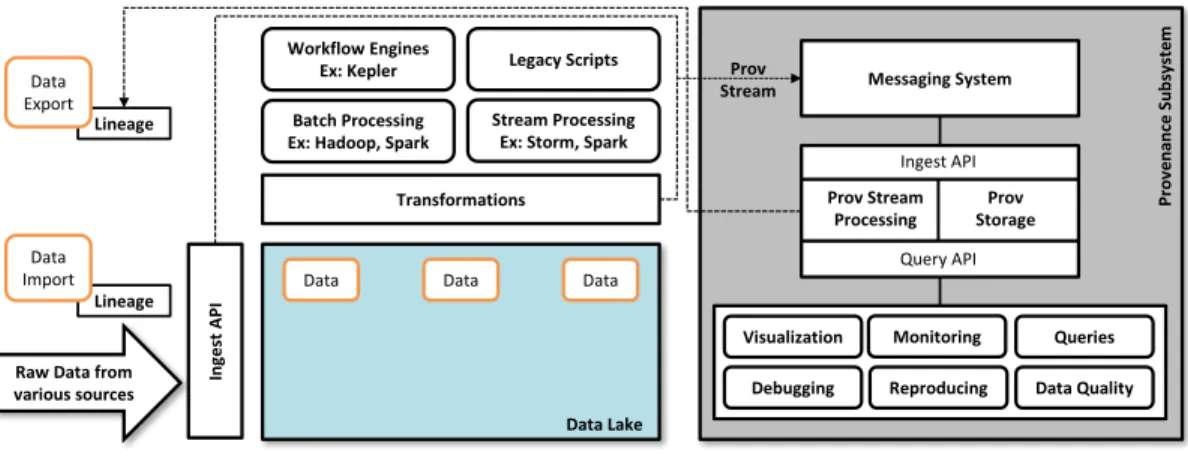
Figure 1.1 shows the reference architecture that was presented in our initial work. Provenance events from ingest APIs and from different transformations are streamed into the central provenance subsystem. Here we focus on fine-grained provenance events through which even the simplest processing steps in the transformation can be traced. Therefore, the amount of provenance data collected in the provenance store can be large. In the prototype implementation, we used Komadu [93] provenance management system to persist and query provenance. Through our experiments, we showed that the size of fine-grained provenance could be several times larger than the input data size. There is considerable evidence accumulated through years of provenance research to support that claim [53] [103]. Managing such large volumes of provenance data and providing useful analysis on them are identified as challenges [103] in Big Data provenance and named as the “Big Provenance” problem in the literature [47].
Storing and managing Big Provenance for later analysis may not be feasible for most data-intensive applications due to high resource consumption. If the collected provenance is multiple times larger than the input data for a certain DIC workflow, the storage layer should be expanded just to store provenance and more compute nodes should be allocated for provenance processing. Querying stored Big Provenance is also problematic [50] [38] due to high resource consumption for graph traversal queries. Even if the resources are available, analysis results will be delayed due to offline processing. Another point to consider is that, not all provenance is equally valuable: provenance for intermediate data products in a data-intensive computation is not directly used most of the time. Therefore, retaining full provenance could be a waste of resources in most cases.
We focus on streams of provenance data. A data stream is a sequence of data elements arriving over time. A stream processing abstraction is applied in cases where analysis occurs in real-time on a portion of the stream, often requiring only one pass over the data. In this thesis, we apply the stream processing abstraction to provenance emerging in real-time from a data-intensive computation. This minimizes the cost of retaining full provenance while providing a sufficient level of analysis in (near) real-time. Our approach is to use stateful, one-pass parallel stream processing to summarize a full provenance stream on-the-fly by preserving backward provenance and forward provenance. It does this through maintaining state within each parallel stream consumer. Intuitively,backward provenance begins with an output and traces backwards in time to the subset of input data on which the output depends.Forward provenancebegins with an input and traces forward in time to the subset of output data elements derived by it.
There are well known provenance representations like W3C PROV [67] and OPM [69]. Most of these representations model provenance information as a directed acyclic graph. A vertex in a W3C PROV graph can represent an activity, entity or agent. An edge between two vertices is always a provenance relationship between them. For example, if the entity A was generated by the activity B, the edge between them represents the wasGeneratedBy relationship. We define a “Provenance Stream” in the coming sections so that each individual provenance element in the stream either represents an edge in a provenance graph or adds attributes to an existing vertex. According to our definition, a provenance stream is always a graph stream.
Computingbackward provenancefor outputs andforward provenancefor inputs are the mostly used advantages of data provenance. Backward provenanceis the set of input data items on which a given output data item depends.Forward provenanceis the set of output data items derived by a given input data item. Traditionally, both backward and forward provenance on stored static provenance graphs are calculated using techniques such as recursively traversing through the graph [50] and maintaining transitive closure tables [38]. Such techniques do not scale for Big Provenance due to high compute and storage overhead. So we developparallel-prov-stream, a parallel stream algorithm for reducing full provenance from a data-intensive computation on-the-fly by preserving backward and forward provenance that is scalable, order independent and one-pass only. This avoids the need for full provenance storage and provides (near) real-time results.
The stream processing approach is framed in the context of a DIC workflow where multiple DICs run concurrent with each other, are long lived, and are distributed. Prove-nance is streamed to a single, standalone proveProve-nance stream processing system that is itself distributed. There are two main modes of execution in data-intensive computations: batch mode and streaming mode. A batch computation consumes a stored static dataset and terminates within a finite amount of time. A streaming computation consumes a stream of data and may run forever. We discuss our provenance streaming solution for provenance generated by both the categories. From a provenance perspective, main difference between the two modes is that a provenance stream from a batch computation is always terminating and a provenance stream from a streaming computation could be non-terminating. There-fore we adapt our streaming solution for both terminating and non-terminating provenance streams.
The final framing of the approach is its implicit treatment ofprovenance identity. The provenance system is built based on a log store abstraction that supports “topics” to which provenance events are published. Topics, and their uniqueness, is used to guarantee that provenance events are associated with the correct DIC from which they were generated. We assume that when a new DIC begins, it is configured to publish provenance to a unique topic ID in the distributed log store. Furthermore, we discuss provenance identitiy, archival of reduced provenance graphs and reproducibility of provenance stream processing runs using a Persistent Identifier (PID) [106] [7] based extended architecture.
Closest to our research is Chen and Plale [28] where a dependency matrix is computed across input parameters and variable values from a stream of data provenance from an
Agent-Based model. Our work here both extends and complements Chen and Plale through application of provenance stream processing to large scale DICs. In the context of agent-based simulations they assume that the stream of provenance is ordered agent-based on generation time when it arrives at the provenance stream processing system. This assumption may not hold for data-intensive computations and we lift it by handling out-of-order provenance events. In addition to that, they execute their algorithm using a single stream consumer which is not good enough to handle higher provenance event rates. Our algorithm is parallel and scalable for multiple consumers reading from the same stream of provenance.
Following are the main contributions of this dissertation.
• A provenance model which includes formal definitions for provenance stream, forward provenance and backward provenance in the context of data-intensive computations. Here we start from the function level provenance in a DIC and extend our definitions up to DIC workflows. For the purposes of this thesis, we use the relationships defined in W3C PROV specification.
• A stateful, one-pass, parallel stream processing algorithm to summarize a full provenance stream on-the-fly by preserving backward provenance and forward provenance. The algorithm is resilient to provenance events arriving out-of-order within some time delta. We simulated an out-of-order provenance stream to measure the accuracy of the output under varying out-of-order levels. Multiple provenance stream partitioning strategies: horizontal, vertical, and random, for data-intensive computations are also presented. We evaluate performance and accuracy of the results under each partitioning strategy.
• A provenance stream processing architecture which applies the proposed parallel streaming algorithm on a stream of provenance arriving through a distributed log store. The streaming solution is evaluated using an implementation based on Apache Kafka log store, Apache Flink stream processing system and Komadu provenance repository. Provenance identity, archival and reproducibility are also discussed using a PID based approach.
The remainder of this thesis is organized as follows. Chapter 2 provides a detailed discussion of related work. Chapter 3 presents high-level descriptions of the concepts used in the thesis. In Chapter 4 we discuss our previous works on Komadu provenance repository and provenance solution for Data Lakes. This provides a detailed explanation on Data Lakes and lays the foundation for the work we present in this thesis. Chapter 5 presents our provenance stream model which includes the formal definitions. Then in Chapter 6 we discuss our parallel provenance stream processing algorithm and provenance stream partitioning strategies in detail. Our implementation and evaluation results are presented in Chapter 7 and the thesis concludes with future work in Chapter 8.
CHAPTER 2
Related Work
2.1. Data Provenance
Research on data provenance was initiated from the database community [107] [25] [24] where the main focus is to derive the history of a given tuple or a data object in a database. Interest for provenance in eScience community increased in early 2000s as provenance in scientific workflws [111] [11] [75] was identified as a crucial component. A number of early provenance collection systems such as Vistrails [82], Karma [88], and PASS [72] took part in the first provenance challenge [71] which was held in 2006 to understand the common types of provenance queries that should be supported by a provenance system. Second provenance challenge was held shortly after that focusing on understanding the issues in interoperability in provenance and the OPM [69] standard was the outcome. As researchers identified some limitations in OPM while trying to apply it in different domains, the third provenance challenge [86] was held and the W3C PROV [67] specification was defined.
2.2. Scientific Workflow Provenance
Provenance capture, query, and visualization on traditional scientific workflows is a well-studied area [87]. Most of these studies focus on scientific workflows running on grids and captures coarse-grained provenance. Chimera [42] is a virtual data system which supports provenance. It provides derivation traces for scientific data. MyGrid [111] is a
provenance enabled middleware framework for SOA based workflows. There are similar studies such as [43] and [74] which focus on provenance in application-specific scientific workflows. In addition to the above systems, there are well known scientific workflow execution frameworks such as Kepler [11], Taverna [75], VisTrails [82] which captures provenance automatically from the workflow being executed. Most of the time, such workflows include a number of services for different tasks. Workflow provenance captures service invocations and all used and generated data products from each service.
Karma [88] is one of the first attempts to build a general purpose provenance collection framework for scientific workflows which uses a standard provenance representation lan-guage. It stores provenance events in a relational database and generates provenance graphs in OPM standard. Komadu [93] is the successor of Karma which supports W3C PROV [67] as the provenance representation language. Both Karma and Komadu can be executed as a standalone provenance repository which can be used to collect provenance events from distributed applications. They provide provenance query APIs and visualization tools as well for analyzing provenance graphs.
There are few systems like PASS [72] and SPADE [44] which collects provenance at the operating system level. PASS captures provenance at the file system level and stores with each file. SPADE captures all system calls including their inputs and outputs which leads to large volumes of low-level fine-grained provenance. SPADEv2 [45] is an improved version specially designed to support distributed applications. As it could produce large volumes of provenance, they argue against central provenance storage systems like Karma and locally stores provenance in each node in a distributed environment. However, this
leads to performance issues in query time as provenance stored in different nodes should be integrated. This kind of OS-level provenance collection is too low level and hard to manage in modern Big Data processing applications.
2.3. Provenance Querying
PASS introduced a new query language [52] which is based on paths in a provenance graph. It supports regular expression like queries as well to find paths which include certain inputs, outputs or functions. They argue against provenance storage mechanisms like relational databases, XML, RDF etc. and propose a semi-structured data model for provenance for efficient querying. QLP [12] is a declarative provenance query language which also supports regular expression like queries. It provides the advantage of executing queries on OPM as well. They use transitive closure tables on each node in a provenance graph to improve the efficiency of graph traversal queries. SPADEv2 uses a technique called provenance sketches [61] to improve query efficiency in their decentralized provenance storage architecture. They argue that recursive computation and transitive closures are less efficient in querying large provenance graphs. Heinis, T. et al. [51] also supports that argument and propose a different approach called “interval encoding” to improve query efficiency in graph traversal queries. They transform provenance graphs into trees by duplicating nodes to apply interval encoding.
2.4. Big Data Provenance
When moving from traditional scientific workflow systems to modern Big Data pro-cessing frameworks, above systems and techniques suffer number of challenges in storage,
scalability, querying etc. [35] [103] [47] [95]. Glavic, B. et al. [47] highlight the importance of provenance in Big Data for purposes like performance analysis, debugging and repro-ducibility and name itBig Provenanceas the volumes of provenance itself can grow rapidly. Wang, J. et al. [103] identify the challenges and opportunities inBig Provenance, focusing on distributed data-parallel computations. They come up with a reference architecture for Big Data provenance and identify (1) volume of provenance, (2) provenance integration and (3) collection overhead as the main challenges inBig Provenance. In this thesis, we address a few of those challenges.
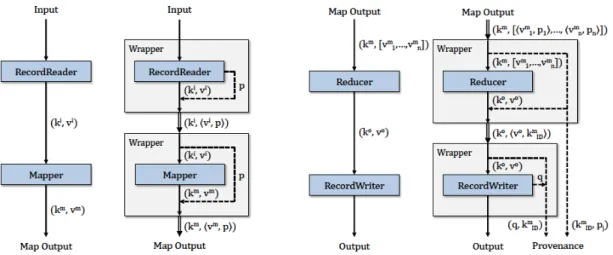
There are few studies in the recent past which focus on capturing provenance in Big Data processing frameworks like Apache Hadoop and Spark. Wang J. et al. [104] [34] present a way of capturing provenance in MapReduce workflows by integrating Hadoop into Kepler and using provenance capabilities of Kepler. RAMP [77] [53] extends Hadoop to capture provenance by propagating input identifiers through the computation. They have built wrappers for Hadoop which automatically record provenance when a job is executed. HadoopProv [5] modifies Hadoop to reduce provenance capturing overhead. Both RAMP and HadoopProv capture fine-grained provenance which includes intermediate data as well. They are capable of supporting both backward and forward provenance between inputs and outputs. Titian [54] is a modified version of Spark which automatically captures provenance from any function applied on a dataset. They have made the interactive Spark shell provenance-aware so that lineage can be accessed for any data object as soon as a function is executed. A new provenance enabled RDD interface called LineageRDD has been added to the API so that lineage can be accessed for any RDD. This helps in debugging
Spark computations quickly and easily. Sansrimahachai, W. et al. [79] presents a way of capturing provenance from stream processing systems which is useful in real-time tracing of data objects and validating processing steps.
There are few Big Data processing workflow management tools which support chained computations. Apache Falcon [14] framework manages the data lifecycle in Hadoop Big Data stack. Falcon supports creating data processing pipelines by connecting Hadoop based processing systems. It captures lineage of data while the pipeline is being executed and visualizes the lineage graph at the end. Apache Nifi [18] is another data flow tool which captures lineage while moving data among systems. However, neither tool captures de-tailed provenance information within transformation steps. Therefore they do not support detailed analysis over provenance. In our previous work [91] we presented techniques to capture and fine-grained provenance from data-intensive computations and integrate them across multiple transformations performed by different frameworks. We built our argument around a Data Lake environment where unique identifiers for data products across computations are assumed. Through the experiments, we saw that the amount of provenance collected for could be multiple times larger than the original data size and that becomes a problem when managing and querying provenance.
2.5. Provenance Stream Analysis
As a provenance stream is always a graph stream, graph streaming techniques are appli-cable in provenance stream analysis. Only a limited number of studies on graph streaming is found in the literature. Applying static graph analysis methods on graph streams is considered a difficult problem especially when the graph is directed [64]. Algorithms for
problems like triangle count [22] and page rank [81] have been studied. There are few studies on graph stream clustering [27] [2] and mining [33] as well. McConville, R. et al. [63] recently presented a vertex clustering mechanism for graph streams while Manzoor, E. A. et al. [62] presented an anomaly detection mechanism.
Capturing provenance from streaming data is another related area. Vijayakumar, N. et al. [101] [102] present techniques to capture provenance among data streams. Fine-grained provenance capturing methods for streaming data have also been studied [65] [79] [80]. Sansrimahachai, et al. [79] processes provenance as a stream and apply queries on top of it. To best of our knowledge, the only attempt in the literature to use stream processing techniques for analyzing a stream of provenance is made by Chen, P. et al. [28] where the authors compute a dependency matrix between the input parameters and the variable values in an Agent-Based simulation using a stream of provenance. However, there are multiple drawbacks in their work. Their definition of a provenance stream only allows derivation relationships and that limits its applicability in most applications. They assume that the stream of provenance is ordered based on generation time when it arrives at the provenance stream processing system. This assumption is far from reality when applied in a distributed data-intensive computation. There can be many reasons like network delays, lost packets, re-transmits etc. which breaks the creation order in provenance events. In addition to that, they execute their algorithm using a single stream consumer which is not good enough to handle higher provenance event rates.
CHAPTER 3
Background
3.1. Provenance
Provenance is information about entities, activities, and people involved in producing a piece of data. Provenance is also considered as a special type of metadata associated with data. A provenance record attached with a data product improves the value of the data as it helps in many ways. Assessing data quality, reliability, and trustworthiness, tracing the sources of data, reproducing and debugging the computations used to derive data are few advantages of provenance.
Provenance is often used in eScience to improve the reusability of scientific data. Re-search on provenance in eScience has been there for more than a decade. Provenance capture, storage, visualization, and querying are few areas which have been explored so far. Often provenance is captured from scientific workflows by using methods like log monitoring and instrumentation. Captured provenance is mostly stored in provenance management systems like Karma [88] and Komadu [93]. Visualizations and queries are also supported by such systems to make provenance information useful. Provenance repre-sentation models like OPM [69] and W3C PROV [67] have been introduced to increase the interoperability of provenance data collected from different systems.
OPM [69] was the first data model introduced for provenance in order to achieve interoperability among systems. OPM represents provenance as a directed acyclic graph in which nodes represent artifacts, processes and agents defined as follows.
Artifact:Immutable piece of state, which may have a physical embodiment in a physical object or a digital representation in a computer system.
Process:Action or series of actions performed on or caused by artifacts, and resulting in new artifacts.
Agent:Contextual entity acting as a catalyst of a process, enabling, facilitating, control-ling, or affecting its execution.
Edges between nodes are used to represent relationships between the above elements. OPM defines five types of relationships.
• used: Artifact used by a Process
• wasGeneratedBy: Artifact generated by a Process
• wasTriggeredBy: Process triggered by Process
• wasDerivedFrom: Artifact derived from Artifact
• wasControlledBy: Process controlled by Agent
With the usage in different applications, it was understood that OPM is limited in some areas. It does not define any Agent-to-Artifact or Agent-to-Agent relationships. In addition to that OPM does no allow different types of derivations between Artifacts.
W3C PROV
W3C PROV [67], [68] was introduced later to address the limitations of OPM and to define few more new concepts which are useful in recording provenance. The three main
elements defined in OPM has also been renamed and redefined as follows. However, they still carry similar meanings as in OPM.
Activity:An activity is something that occurs over a period of time and acts upon or with entities; it may include consuming, processing, transforming, modifying, relocating, using, or generating entities.
Entity: An entity is a physical, digital, conceptual, or other kind of thing with some fixed aspects; entities may be real or imaginary.
Agent: An agent is something that bears some form of responsibility for an activity taking place, for the existence of an entity, or for another agent’s activity.
PROV model defines a rich set of relationships between the elements defined above.
• Entity-Entity:wasDerivedFrom,alternateOf,specializationOf,hadMember
• Entity-Activity:wasGeneratedBy,used,wasInvalidatedBy,wasStartedBy,wasEndedBy
• Entity-Agent:wasAttributedTo
• Activity-Agent:WasAssociatedWith
• Activity-Activity:wasInformedBy
• Agent-Agent:actedOnBehalfOf
There are many improvements in these relationships compared to OPM. For example, wasDerivedFromrelationship in PROV defines multiple subcategories; Revision, Quotation, Primary Sources. Those can be used to describe exact type of derivation. In addition to that, PROV defines a model to represent collections of entities through the hadMember relationship. Connecting Entities with Agents to represent attribution is also possible using thewasAttributedTo relationship. With such improvements over OPM, W3C PROV has
become the most used and supported provenance standard in the modern day provenance applications.
3.2. Big Data Processing Models Batch Processing
Processing large sets of stored data using parallel computing techniques to achieve offline results is referred to as “Batch Processing”. The most notable feature of this kind of computations is the availability of full data. Processing algorithms are run on the full data set to generate results. Batch processing is mostly used to run complex algorithms (Ex: Machine Learning) and often take hours to complete. Time taken to produce results is not an issue and the focus is on the throughput. There are multiple batch processing techniques such as MapReduce [36] and Spark programming model [108] and frameworks such as Hadoop MapReduce [16], Spark [108] and Flink [26]. All these frameworks are highly scalable and fault-tolerant.
Stream Processing
A data stream is a sequence of data elements arriving over time. Stream Processing is used for real-time (or near real-time) analysis on a data stream considering only a time-based or rate-time-based window of the stream at a given point of time. Often, stream processing algorithms use only one pass over data. Due to such reasons, stream processing is used for simpler analysis compared to Batch Processing. Modern stream processing frameworks such as Storm [99], Twitter Heron [59], Samza [21], Spark Streaming [109] and Flink [26] focus on fault-tolerant and distributed processing of streaming data to achieve low latency
and high throughput. There are two widely used stream processing techniques: one-at-a-time and micro-batch. Each stream data element is processed immediately upon arrival in one-at-a-time processing model which is also considered as true stream processing, used by Storm and Flink. Sub-second latency is targeted in one-at-a-time processing model. Few stream data elements are batched together for processing in micro-batch processing model which is a micro version of batch processing, used by Spark Streaming. Micro-batch processing targets second level latency while providing higher throughput compared to one-at-a-time model. Stateful computations are difficult to handle in distributed stream processing. Flink and Samza support stateful computations up to some extent.
FIGURE3.1. Each Kafka topic is divided into partitions (taken from Kafka docs)
3.3. Distributed Log Storage
A distributed log storage is generally a system designed for short-term persistence of streaming data. The main goal behind such a system is to achieve low latency and high throughput for fast moving streaming data. Two widely used distributed log stores are Apache Kafka [58] and Amazon Kinesis [83]. We use Kafka in this thesis.
Apache Kafka
Apache Kafka is a distributed streaming platform originally developed by LinkedIn for collecting and delivering high volumes of log data with low latency. The concept of topicin Kafka is based on the log abstraction where alogis an append-only sequence of records with new records added to the end. A topic is a category or feed name to which records in a stream are published. There can be multiple consumers for each topic who read records from it. As shown in Figure 3.1, each topic is divided into partitions to achieve scalability and high throughput. Apartitionis an ordered, immutable sequence of records that is continually appended to. Each record within a partition is uniquely identified by an offset or a sequence number. When multiple consumers are consuming records from the same partition, they may consume at their own rates and each of them maintains an offset within the partition. Partitions are replicated for fault-tolerance.
FIGURE3.2. Kafka consumer groups (taken from Kafka docs)
Kafka records are always retained for a configurable retention period irrespective of whether they are consumed or not. Therefore, the consumers have the flexibility to read from any offset within the retention period. The concept of consumer groups can be used
for parallel consumption of records which leads to higher throughput and fault-tolerance. Figure 3.2 shows how consumers in a group can consume records from partitions in a topic. Each record can be consumed by only one consumer within a group. Partitions in a topic are distributed among the consumers in a group so that all records in a given partition are consumed by only one consumer.
3.4. Persistent Identifier (PID)
A Persistent Identifier is used to uniquely identify a digital data product which can be a file, a collection or any type of digital object. It guarantees a persistent one-to-one relationship between the identifier and the data product. Using the persistent identifier, a data product and its metadata can be retrieved at any point in time. It has become an important data practice to assign persistent identifiers for digital objects to make sure they are preserved for long-term usage, especially in use cases such as Data publishing [73], reproducibility [55] [31] and archival. DOIs [37] is the mostly used persistent identifier system for digital objects like publications and articles. Handle system [49] and Archive Resource Key [98] are among other widely used systems.
Most of the above systems are designed targeting humans as the end user of the persistent identifier. When an identifier is resolved, the user is redirected to a landing page through which the digital object and its metadata can be retrieved. However, when used by software systems, above systems suffer from issues like weak interoperability and inconsistent protocols for getting from PID to the data object. The Persistent Identifier (PID) System [106] [57] was designed to address this problem. It is intended to be used with software systems so that millions of identifiers can be resolved at internet speed. PID
architecture is based on the Handle System and RDA Data Type Registry [6]. A PID consists of a kernel which includes minimal but sufficient metadata about the digital object.
CHAPTER 4
Related Previous Work
In this chapter we present our two previous works which laid the foundation for the prove-nance stream processing solution presented in this thesis. First Komadu, a W3C Prov based provenance repository which supports provenance ingest and query capabilities. Second, an architecture and a prototype implementation for provenance collection and management in a Data Lake environment to address the accessibility and traciability concerns. Challenges identified in storing and analyzing Big Provenance in a Data Lake provided the motivation for provenance stream processing work.
4.1. Komadu
Data provenance is information about the entities, activities and agents who have effected some type of transformation on a data product through the its lifecycle. Data provenance captured from scientific applications is a critical precursor to data sharing and reuse. For researchers wanting to repurpose and reuse data, it is a source of information about the lineage and attribution of the data and this is needed in order to establish trust in a data set. Data provenance has been shown useful in results validation, failure tracing, and reproducibility. The Komadu provenance capture system is standalone, meaning it is not coupled to or dependent upon any database management system, repository, or scientific workflow system. It provides an ingest API through which provenance notifications are fed
into the system at high speeds, and a query API through which provenance information can be queried. The data model is both event oriented and graph oriented, in that graphs are pieced together in Komadu based on the events received from the environment.
Komadu has its roots in the Karma [88] provenance capture system, an earlier version that complied with the OPM [69] community standard both for defining the type of prove-nance notifications that the system accepted, and for defining the format of the results. Komadu, on the other hand, supports the W3C PROV specification [67] which provides far richer types of relationships and has a more formal model for handling time than does OPM. Karma was additionally limited by assuming that every notification belonging to the same external activity shared a common global identifier that is shared across all components (services, methods etc.) of the external environment. This limitation was found to be severe in applications where provenance is not only captured at the application level, but also at in the larger environment where the application runs. Take for instance a distributed application running on Twister [40] using PlanetLab [32] as the underlying infrastructure; it is highly limiting to expect provenance events generated from the application, from Twister, and from PlanetLab to all have shared knowledge about any single global identifier. This limitation derives from Karma’s early days where it tracked provenance for applications running within a single workflow system. Additionally, a researcher may be interested in tracking lineage starting from some data product or agent. Such scenarios are not supported by Karma.
Komadu is a complete redesign and reimplementation of Karma that supports new fea-tures while addressing the above mentioned limitations of Karma. The main contributions of Komadu are as follows.
(1) PROV Support: Komadu is completely W3C PROV specification compliant. (2) Beyond Workflow: Komadu client API is simple and designed according to
stan-dards defined in the specification. Therefore, Komadu is not restricted for scientific workflows and can be used for capturing provenance from any kind of application. (3) Context-free: Unlike Karma, the graph generation algorithm used in Komadu
does not depend on any global context identifier. This makes it possible to collect provenance from disparate and unrelated pieces of infrastructure and application. It of course introduces the challenge to be handled within Komadu of stitching together graphs based on events that are not easily identifiable as being causally re-lated. Komadu is backward compatible with Karma through graph generation that uses global context identifiers. A new user is advised to use the more convenient context-less mechanism.
(4) Multiple Perspectives: In addition to generating provenance from the perspective of an activity, Komadu is capable of generating provenance graphs starting from data products and agents as well.
Provenance is generated through first instrumenting an application, a tool, or system middleware directly; or by processing log files after executing the application. Komadu has support for both generation mechanisms. Queries can be executed any time once the
notifications are ingested. Komadu comes with an Ingest API and a Query API, both of which are exposed as a Web Service and a Messaging service.
A tool to enable the visualization of provenance graphs is included in the package as this aids the researcher in making sense of what can be gigabytes and terabytes of provenance. When the provenance is voluminous, which it can easily be, it is hard to extract important information through any other means. Komadu comes with a simple command line tool that converts the generated XML graph into a CSV file. This CSV file can be imported into most of the visualization tools. We use Cytoscape [84] to visualize provenance generated from Komadu (and Karma before it) and have written a provenance specific plugin for Cytoscape. Figure 4.1 shows a sample provenance graph generated by Komadu and visualized using Cytoscape. This graph includes dummy Activities, Entities and Agents generated by one of the Komadu integration test cases. An Agent (Agent˙16) invokes a service (Activity˙142). Activity˙142 uses a collection of files (Collection˙661) in the generation of an output file (File˙660). Service (Activity˙142) additionally invokes service (Activity˙143); the latter reads input file, File˙663, and generates output file, File˙659. All elements and relationships contain additional attributes and those are displayed in a separate window when a specific part of the graph is selected.
4.1.1. Motivation. An example of Komadu use in a scientific setting is in the Sustain-able Environment ActionSustain-able Data (SEAD) [73] DataNet project. SEAD is developing tools for data management in the long tail of science. The scientific community in the US is recognizing the need for increased availability of the data products of their research, but the mechanisms for submitting data sets to public repositories still involve considerable manual
FIGURE4.1. Sample Komadu provenance graph visualized using Cytoscape effort. SEAD tools are attempting to reduce the manual barrier to submission of data from scientists in the long tail, those that generate small but highly voluminous data sets. SEAD had adopted the notion of the Research Object (RO) [23] as the unit of preservation, and uses Komadu to track the lifecycle of the RO through derivation, revision, and reuse.
The use of Komadu in SEAD is captured in Figure 4.2. A sustainability science project sets up a shared Project Space for its work. When a collection is ready for publication to a public repository, it is published, whereupon the SEAD Virtual Archive (VA) picks it up, and curates it. A BagIt service inside VA pulls collection metadata and data from Project Spaces and generates additional metadata. An ingest workflow is then invoked, carrying out functions on the ingest package. The provenance of the activity is published into Komadu. Once the data collection is ingested, the data curator who often works in an academic library, can edit related metadata using the VA user interface. Provenance events of the curation actions are also sent to Komadu. Finally, when the curation is com-plete, the data curator publishes the collection into an appropriate Institutional Repository.
Provenance events related to publish workflow are also captured. VA components like BagIt, Workflows and Registry are distributed components that are connected using web service interfaces. All those components push provenance events into Komadu using the web service interface exposed by Komadu. The SEAD VA allows scientists to search for published data collections. When a particular collection is selected, a provenance graph related to that collection is visualized in a separate provenance window. This provenance graph contains the relationships between collections and also provenance information inside each collection.
FIGURE4.2. Provenance Capture in SEAD VA using Komadu
4.1.2. Implementation and architecture. Figure 4.3 shows the high level architecture of Komadu. Komadu can be run as a Web Service hosted on Apache Axis2 [13] or as a standalone server that listens to a RabbitMQ [100] message queue. In both cases, a client
has to be created to send messages into Komadu. A research programmer instruments a researchers application, services, and tools to ingest provenance notifications into Komadu on the fly or can use a log processing script that parses execution logs for provenance information after the execution of the application. Queries can be issued to Komadu to generate provenance graphs and retrieve provenance information related to Activities, Entities or Agents. Both ingest and query APIs are exposed through Web Services and RabbitMQ channels, the RabbitMQ channels are set up and configured by the research programmer.
FIGURE4.3. Komadu Architecture
Ingest API:The Ingest API is used to send provenance notifications into Komadu during provenance collection time. XML notifications must be compliant with the Komadu
XML Schema. For example, if a service A invokes a service B using some parameters, the notification will contain the identifiers of Service A and B and the required parameters.
Query API:The Query API is used to issue queries to the Komadu server anytime after the provenance is captured. Queries can be issued to retrieve information about certain Activities, Entities etc. or to get the generated provenance graphs. Queries also must be compliant with Komadu XML Schema.
Database: Komadu uses a MySQL database to store all incoming notifications, pro-cessed components, their relationships and generated provenance graphs. A connection pool is used to create and efficiently manage database connections under high data rates.
Raw Notification Ingester:This component is responsible for ingesting incoming XML raw notifications into the database as quickly as possible. Once the message is ingested, the incoming thread is immediately returned to make the server more responsive under high loads. Raw notifications are processed by a separate component running asynchronously.
Asynchronous Raw Notification Processor:This component is responsible for process-ing raw notifications in the database asynchronously. It consists of a pool of threads that run periodically and check whether there are unprocessed notifications left in the database. If such notifications are found, those are processed and split into Activities, Entities and Agents and stored back into the Komadu database. Once processed, raw notifications are marked as processed in the database. Each notification comes as a relationship between two elements (Ex: Activity-Activity, Activity-Entity etc.) and contains element identifiers. Raw notification processor creates elements in the database if those do not already exist and adds the relationship between those elements.
Query Processor: query processor is responsible for handling all incoming queries. There are two types of queries: (1) queries that request specific information about a certain Activity, Entity or Agent, (2) graph queries. The former are easy to handle and the Query Processor directly accesses the database to respond to such queries. For the latter, the Graph Generator is invoked with the relevant start node identifier sent by the client.
Graph Generator: The graph generator generates provenance graphs for incoming node identifiers. It starts by creating the start node with the incoming Activity, Entity or Agent identifier, then continues to add connected nodes transitively into the graph until there are no connected nodes left. The graph generation process uses a depth first approach and a stack of unexpanded nodes. Graph Generator uses caching to improve performance where the cache interval is configurable by the system administrator. When a new graph is created, it is cached in the database and if the same graph is requested again within the cache interval, cached graph is returned. If the cached version is expired, a new graph is created and the cache is updated.
RabbitMQ Messaging Channel: RabbitMQ is an eventing system supporting asyn-chronous communication. A publisher publishes messages to a middleware, often called a broker; one or more subscribers subscribe to channels on which the publishers place notifi-cations. Komadu uses RabbitMQ as a messaging broker to receive provenance notifications and send responses to the incoming queries. RabbitMQ provides a persistent and reliable store for messages.
Axis2 Web Service Channel: When Komadu is deployed as a Web Service on top of Axis2, a service client can be used to communicate with the server using the SOAP messaging protocol. A service client can be easily generated using the Komadu WSDL file.
Komadu is implemented completely in Java programming language and it uses MySQL as the backend database. Komadu uses the Prov Toolbox [14] library in the process of generating provenance graphs. Komadu API is clearly defined as an XML schema and it is exposed on both Web Services and Messaging channels.
4.1.3. Application of Komadu. The main use of Komadu is for tracking lineage of data generated and used in scientific research. As a standalone system, provenance can be aggregated from tools, services, applications, and middleware. The generated provenance traces have been shown as useful to reproduce the workflow execution and to trace failures.
As mentioned previously, Komadu is the successor of the Karma provenance capture system. One of the drawbacks of Karma is that its APIs are tightly coupled with workflows. Almost all operations in Karma client API are using workflow related terms. Therefore, it is hard to use Karma to collect provenance data in other settings. One of the main goals of Komadu was to overcome this limitation. Komadu APIs are designed using the generic definitions used in the W3C Prov [67] specification. Therefore, Komadu can be easily used by any kind of application where provenance data has to be collected.
Another area where Komadu is useful is research data preservation repositories like SEAD. Actions are taken on research/data objects that reside in long term repositories. These actions could affect the object and thus should be part of the provenance record. For example, once a dataset is submitted into a repository, number of data curators can
edit metadata or transform the dataset into different formats. Provenance can be used to distinguish changes to a research object that can be constituted a revision (e.g., by same author, to correct error) from those that should be viewed as a derivation (e.g. subset of data object used for another purpose). This can be accomplished by integrating Komadu with the preservation repository.
A single standalone provenance tool like Komadu can serve as an aggregator of prove-nance from multiple sources. There is nothing preventing Komadu from representing other data manipulation processes that occur in industry or government. Finally, it can be useful for big data processing frameworks like Apache Hadoop [16] and Apache Storm [99] in certain applications to track lineage of produced data products. Users can integrate Komadu in their application specific code (Ex: In Hadoop mapper or reducer) to collect provenance data.
4.2. Big Provenance In Data Lakes
Today’s internet scale organizations routinely analyze Big Data from various sources for decision making and forecasting. These sources (e.g., clickstream, sensor data, IoT devices, social media, server logs, databases) are external to an organization and internal. Much of it is continuously being generated (social media, sensor data). Depending on the source, data can be structured, semi-structured or unstructured. Traditional data warehouse is proving to be too inflexible and limited [90] when it comes to storing different types of data from numerous sources mainly because of the schemas enforced at ingest time. Conversion of data to fit a particular ingest schema may lose considerable amount of information even before the start of analysis.
A new response to the limits of the data warehouse is the Data Lake [8,90,97]. The Data Lake is considered as schema-on-read where commitments to a particular schema are deferred to time of use. Schema-on-read suggests that data are ingested in a raw form, then converted to a particular schema when needed to carry out analysis. This applies to structured, semi-structured, and unstructured data; continuously arriving or not. The Data Lake is closely integrated with data-intensive computation frameworks like Apache Hadoop [16], Apache Spark [108] and Apache Storm [99] to perform data analysis. The vision for the Data Lake is data from numerous sources dropped into the Lake quickly and easily, with tools “fishing” along the edges of the lake, intent on catching insight by the rich ecosystem of data within the lake.
Even though this higher flexibility in Data Lake leads to rich collections of data from various sources, it leaves greater manageability burdens on the hands of scientists. The Data Lake almost becomes a “dump everything” place due to lack of enforced schema. A data item in a Data Lake can be in different stages in its life cycle. It may be in raw stage just after coming out of a data source or may be the result of analysis by one or more of the “fishermen” analysis tools. Frequently products in the Data Lake are the results from one transformation intended for another transformation for further processing. This complicated life cycle of a data product in a Data Lake increases the requirement of proper traceability mechanisms. Without some level of organization, the Data Lake will turn into a data swamp [30]. We concentrate on mechanisms which lead to better management of Data Lakes to keep instances from turning into swamps. Critical focus of our attention is
on metadata and lineage information through a data life cycle which are key to good data accessibility and traceability [56].
In order to avoid data swamps, Data Lakes should answer questions like “how was this data item derived?, from where did it come from?”, “what transformations applied on this data item?, what other data items generated from it?”. Provenance can help Data Lakes to achieve that. If a Data Lake can ensure that every data product stored is connected with its provenance information starting from the origin, critical traceability can be had. However, ensuring that we capture all provenance information starting from the origin of a data product in a Data Lake is challenging because a data product may go through different processing systems during its life cycle inside the Data Lake. Most of the time, DIC frameworks like Hadoop, Spark and Storm do not produce provenance information by default. Even if there are provenance collection techniques for those systems, they may use their own ways of storing provenance or use different standards. Therefore generating integrated provenance traces is tough.
We argue that depending on provenance generated from various DIC frameworks used around a Data Lake and trying to integrate them to come up with end to end provenance traces is not viable due to lack of provenance support in most systems and difficulties in Big Data provenance integration. As a solution, we propose a reference architecture based on a central provenance subsystem in the Data Lake environment which stores and processes provenance events pumped into it from all connected systems. We presented our reference architecture as an early work poster [92] and construct the current work based on that. Our prototype implementation of the architecture using distributed provenance collection tools
FIGURE4.4. Data Lake Architecture
shows that the proposed technique can be introduced into a Data Lake to capture integrated provenance without introducing much overhead.
4.2.1. Data Lake Architecture. In most organizations, it is a common practice to main-tain a single Data Lake instance which is shared by all the scientists from different depart-ments. The Data Lake is designed to be schema-on-read so that scientists can ingest various types of data into the lake even without having a clear idea about the type of analysis that will be performed. That avoids the loss of information at ingest time.
The general architecture of a Data Lake, shown in Figure 4.4, contains three main activities: (1) Data ingest, (2) Data processing or transformation and (3) Data analysis. A Data Lake may open up number of ingest APIs to bring data from different sources into the lake. In most cases raw data is ingested into the Data Lake for later usage. Different scientists may use the same raw data for different purposes at different points of time. The most important activity in a Data Lake environment is the data transformation. These are the lake’s “fishermen”, which take data in the Data Lake as inputs and store the output data back into the Data Lake. Modern large scale distributed Big Data processing frameworks like Hadoop, Spark and Storm are used commonly for such transformations. Mechanisms
like scientific workflow systems (Kepler [10], Taverna [75]) and legacy scripts may apply as well. As shown in Figure 4.4, a data product which has been created as an output from one transformation can be an input into another transformation and that may produce another one as a result. There is no limit to this processing chain as different data scientists within the organization may perform different experiments using data stored in the Data Lake. Finally when all processing steps are done, resulting data products are used for different kinds of analysis reports and predictions.
Different venders and organizations may use different technologies and tools to build their Data Lakes. Hadoop and HDFS [85] based Apache Big Data stack is commonly used for most currently existing Data Lake implementations [90]. Scalability of HDFS is used to store large amounts of data and the transformations are mostly run using various tools available in the Apache Big Data stack.
4.2.2. Provenance in Data Lake.
4.2.2.1. Role of Provenance. The Data Lake achieves increased flexibility at the cost of reduced manageability. When various contributors (i.e., researchers within a community but working on different projects) ingest differently structured data through different APIs, tracking becomes an issue. In addition, chained transformations continuously derive new data from existing data in the lake. In this situation, the Data Lake has to have a mechanism to figure out information like origins and owners of the data products, rights to and suitability of transformations applied to them, rights, ownership and quality of data generated by the transformations. Without having this deep level of traceability, recovery in the event of failures and data reuse become problematic. Selective data provenance can
solve this problem and increase the traceability and accessibility of data within a Data Lake. Therefore, scientists identify provenance as an essential ingredient [56] for a Data Lake. Here we discuss several use cases to motivate the study of provenance in a Data Lake.
Use Case 1:A researcher has ingested a dataset into their community Data Lake and later realizes that it contains sensitive data which should not be shared. They wish to delete the dataset or move it to some other secure storage. However by the time they identify the security risk, there are other scientists who have already used this data in subsequent experiments. Output data schemas of such transformations may have allowed sensitive parts of input data to flow into the results as well. If that is the case, they may need to delete such derived data as well. In this situation, how can the scientists find who used the original dataset, what transformations were performed on them, what results were generated and where are they stored? All these questions can be answered by using integrated provenance across transformations starting from the origins. A forward provenance query on the original data identifier can be used here to get all needed information.
Use Case 2: When analyzing a certain dataset found in their Data Lake, a researcher sees an odd result and wishes to figure out how this dataset was generated. By tracing the input data to the methodology source, which is possibly located outside the Data Lake in a publications repository, the researcher sees that the dataset had been cleaned of data points on the basis that the data points were spurious, when in reality they were important outlier data points. A backward provenance query on their data product gives the researcher grounds for discarding their result and seeking a more fitting input dataset.
Figure


Related documents