THE RESEARCH INSTITUTE OF INDUSTRIAL ECONOMICS
Working Paper No. 574, 2002
Recognizing Macroeconomic Fluctuations in Value Based Management
by Lars Oxelheim and Clas Wihlborg
IUI, The Research Institute of Industrial Economics
P.O. Box 5501
SE-114 85 Stockholm
Sweden
Lars Oxelheim
Institute of Economic Research, Lund University, P.O.Box 7080, 220 07 Lund, Sweden, e-mail:
[email protected], and IUI, P.O.Box 5501, SE-114 85 Stockholm, Sweden, e-mail:[email protected]
and
Clas Wihlborg
Department of Finance, Copenhagen Business School, Solbjerg Plads 3, DK-2000 Fredriksberg, Denmark, e-mail:[email protected], and Department of Economics, School of Economics and Commercial Law, Göteborg
University, Box 640, 405 30 Göteborg, Sweden January 2002
Forthcoming in Journal of Applied Corporate Finance
Abstract
Value Based Management (VBM) has become a common tool for ex ante and ex post evaluation of corporate strategies and projects from the perspective of shareholder value maximization (SVM). VBM-frameworks are designed to support investment and divestment decisions, ex post evaluation of management and their major strategic decisions, and bonus-systems. Traditional VBM frameworks make no distinction between sources of temporary changes in performance, and sources of performance reflecting the intrinsic competitiveness of the firm. Temporary changes in performance are often caused by macroeconomic fluctuations. In this article we develop an approach for “filtering” the impact of macroeconomic fluctuations out of measures of performance in order for management to obtain better information for purposes of investment, divestment, and exposure management decisions. We focus on filtering for purposes of performance assessment employed in compensation schemes. A case study illustrates the approach, and shows the potential magnitude of effects from macroeconomic events.
JEL classification: D81, G31, M22
Key words: Value Based Management (VBM), Shareholder Value Analysis (SVA), Economic Value Added
2002-01-30
Recognizing Macroeconomic Fluctuations in Value Based Management
Value Based Management (VBM) has become a key instrument for ex ante and ex post evaluation of corporate strategies and projects from the perspective of shareholder value maximization (SVM). VBM-methods are designed to support, for example, investment and divestment decisions, and ex post evaluation of major strategic decisions. Measures of performance of management are another important component of VBM. The performance measures are used in bonus systems in order to align managerial incentives with those of shareholders.
There are a number of VBM frameworks. Shareholder Value Analysis (SVA), developed in Rapaport (1986) and Economic Value Analysis (EVA) developed by Stern Stewart (1990) are the two most well known ones. However, there exist many challengers as described in Black, Wright, and Backman (2001). Cash Value Analysis (CVA) developed by Ottoson and Weissenrieder (1996), and Cash Flow Return on Investment (CFROI), (Madden, 1999) are two offering serious alternatives to the different versions of EVA.
All the mentioned VBM frameworks have in common that they make no distinction between changes in cash flows that reflect a firm’s competitive position, and changes caused by relatively short term influences from the firm’s macroeconomic environment. A firm’s competitive position may be attributed to its (and its management’s) specific skills and knowledge relative to the market and competitors. Short-term influences on the other hand, are often caused by macroeconomic events, and observed most rapidly as changes in exchange rates, interest rates and aggregate price levels domestically and abroad. Macroeconomic factors have in common that they are completely beyond management’s control although the cash flow effects of such factors may be affected by managerial actions. Thus, management may gain useful information about current and future prospects of the firm by “filtering” out macroeconomic influences on current performance measures. Such “filtering” would allow management to estimate performance “under neutral macroeconomic conditions”. What is meant by “neutral” may from a practical point of view be seen as debatable. We circumvent this problem in the practical analysis below by focusing on changes in performance-related variables.
If cash flow forecasts for a new project are generated without distinguishing between sustainable demand and cost conditions, and temporary demand and cost conditions generated by macroeconomic events, an estimated positive project value may not be sustainable under normal macroeconomic conditions. Alternatively, if forecasts are generated based on observations under unfavorable macroeconomic conditions, then project values may be underestimated and the project abandoned prematurely. For instance, an undervalued currency can lead the management of an exporting firm to believe that the company is competitive whereas its profits “filtered” of the under-valuation may be decreasing. An unsustainable good performance may lead to demand for wage and dividend increases that are not motivated by the firm’s longer term competitiveness. Hence, the cost to shareholders of ignoring or remaining uninformed about the temporary impact of macroeconomic fluctuations may be very high at the end of the day.
In this paper we focus on correcting performance measures for influences of macroeconomic events. From the point of view of performance evaluation macroeconomic effects on cash flows and value could be considered noise to the extent they are not predictable. It is well known in the incentive contract literature that if risk-averse managers’ remuneration is linked to noise factors beyond their control without strong linkage to shareholder value, then their incentive to exert effort on behalf of shareholders may be weakened.1 Thus, from a SVM perspective it could be desirable to “cleanse” performance measures of macroeconomic influences with the aim of strengthening the incentives of managers.
An additional argument for filtering out macroeconomic influences on measures of firms’ performance is that they represent a possible explanation for large observed differences between economic values as measured by EVA-analysis and market values (O’Byrne, 1997). Such differences could occur if market participants were better able to identify macroeconomic influences than the EVA-analyst.
Oxelheim and Wihlborg (1997) discuss how management can develop a Macroeconomic Uncertainty Strategy (MUST) - analysis to manage exposure caused by macroeconomic events observed in, for example, exchange rates. A key component of this analysis is the estimation of exposure coefficients – within a multivariate framework - for the impact of macroeconomic price variables on commercial (non-financial) cash flows, or on the value of the assets generating such cash flows. Here we argue that these exposure coefficients can be useful in a VBM context as well. Changes in a firm’s cash flows or value from one period to another can be “cleansed” from some or all macroeconomic influences once exposure
coefficients are known. Thereby sustainable changes in cash flows or value that should be attributable to a firm’s inherent competitiveness would be identified.
The basic framework for decomposing changes in cash flows and value using exposure coefficients is laid out in Section 2. As an illustration of the decomposition procedure and the magnitude of macroeconomic influences the case of Electrolux is presented in Section 3. In Section 4 we turn to decomposition for purposes of performance assessment. The appropriate decomposition depends on the flexibility in a firm’s operations, and on the existence of real options. Conclusions follow in Section 5.
2. VBM and macroeconomic fluctuations – A framework
Value Based Management springs from the measure of firm value employed in conventional corporate finance. According to this measure the value of corporate assets (VA) is the net
present value of cash flows generated by those assets:
∞ j
VA,t = ∑δ E[Xt+j]+ PVRO (1)
j=0
whereδjis the discount factor for j periods, Xt+jrefers to cash flows in period t+j, and PVRO
represents the value of real options that cannot be captured in conventional present value analysis. The value of equity, VS,t, is the value of assets minus the value of debt VD,t. Thus,
VS,t = VA,t - VD,t (2)
In VBM the objective of management is commonly to maximize the value of equity, VS,t. If
markets for debt are well-functioning, then maximization of the value of assets, VA, leads to
the maximization of the value of equity, VS. In the following, we focus on the value of
non-financial assets that depends on expected cash flows and the risk adjusted cost of capital, δ. SVM implies a concern with cash flows, as well as with the minimization of the cost of capital. Investments in real options also increase a firm’s value by increasing the average level of cash flows.
Cash flows in any period can be decomposed into two components. One component is cash flows that would occur in the absence of macroeconomic fluctuations under hypothetical
“neutral” or “normal” macroeconomic conditions in countries of relevance for any particular firm. These cash flows for any individual firm vary as a result of changes in the firm’s competitiveness in the market place and the growth rate of demand for the firm’s output. Given a firm’s technology, knowledge among employees, managerial competence, and demand, there is at any time a level of cash flows that may be called the sustainable level of cash flows for the period. This sustainable level, denoted XL, occurs under “neutral”
macroeconomic conditions. It may not usually be observed, and it is not constant. It is independent of influences of macroeconomic events, however, and reflects the ability of management to employ resources productively. The fact that the sustainable level is not directly observable does not mean that it lacks practical significance. On the contrary, we argue that management should estimate it and use it as key-input in major business decisions.
The cash flows during a period that depend on macroeconomic conditions in countries where the firm has a presence are denoted XM.These cash flows may be positive or negative
and more or less transitory. They are by definition never permanent. Thus:
Xt+j = XL,t+j + XM,t+j (3)
The pattern of both components on the right side of (3) can be influenced by investments in real options. We defer the discussion of this issue to Section 4.
Macroeconomic events, causing fluctuations in a firm’s cash flows and economic value, may be triggered by a variety of policy and non-policy shocks originating at home or abroad. Monetary and fiscal policy shocks are the policy shocks most commonly referred to, while non-policy shocks may be caused by changes in private sector aggregate demand and supply. The cash flows caused by macroeconomic shocks may have a substantial effect on a firm’s value in a period t.
Most directly and immediately macroeconomic events are observed as changes in macroeconomic price variables among which exchange rates, interest rates, and price levels are most prominent. Underlying macroeconomic events are usually not directly observed, however. In most macroeconomic models different shocks affect these particular price variables in different combinations. The price variables are essentially signals of macroeconomic conditions. Economic models differ about the magnitude and duration of change in the price variables in response to different macroeconomic shocks but most open economy models have in common the mentioned price variables. The “market return” on
stocks could be added in order to cover price responses to macroeconomic shocks more completely but this variable seems to be less systematically related to macroeconomic shocks. We need not link the discussion here to any specific macroeconomic model. The main point is that there is a set of price variables that serve as indicators of macroeconomic conditions. For each firm there is then a more detailed and firm-specific set of these variables. For an individual firm, exchange rate vulnerability may be specified as vulnerability to changes in, for instance, the JPY/USD and Euro/USD rates, interest rates vulnerability as, for instance, vulnerability to changes in the short term euro rate and long-term US rate, and, finally, the inflation vulnerability as vulnerability to changes in German producer prices and Japanese consumer prices.
The correction to commercial cash flows that would be made to arrive at “sustainable” cash flows under neutral macroeconomic conditions in a particular period can be expressed in the following way when macroeconomic conditions are observed in exchange rates, interest rates, and prices:
t M t M t M t M p p p X i i i X e e e X X , = ( − ) + ( − ) + ( − ) δ δ δ δ δ δ (4)
In (4) (e−e)t, (i−i)t, and (p− p)t represent deviations from the exchange rates, interest rates, price levels that correspond to neutral macroeconomic conditions in period t. Each of these variables can be seen as a vector of domestic and foreign variables of relevance to a firm. The partial derivatives represent sensitivity or vulnerability coefficients with the same properties as exposure coefficients.
The coefficients in (4) capture not only the direct impact of each variable on cash flows. Each coefficient depends on correlations between the variable and all other macro-effects of the event, as well as between these effects and cash flows. In contrast, exposure management in most firms seems to presume that changes in exchange rates, interest rates, and price levels as shocks occurring independently of each other and other variables affecting a firm’s cash flows. We have discussed problems with this view of macroeconomic exposure in Oxelheim and Wihlborg (1987, 1997), and recommended that firms measure coefficients as those in (4) above for the firm-specific set of variables from the three mentioned categories of macroeconomic variables for relevant countries employing multivariate regression or scenario analysis.
The functional specification of (4) describes a linear relationship among the variables. Practical and econometric considerations dictate whether the coefficients should be estimated for levels or changes in cash flows and price variables. Other functional forms are also possible but the principles for decomposition are the same in either case.
Macroeconomic shocks may not be random but serially correlated to a substantial extent. Each of the market price variables in (4) may accordingly be expressed as a function of lagged and current changes in it. For example, for the exchange rate the current deviation from its long run values could be written as:
t t
e
t e e e s
e − =ρ ( −1− )+ (5)
where ρe is a serial correlation coefficient for the exchange rate and st is the unanticipated change in period t. The cash flow adjustment to anticipated changes may or may not be different from adjustment to unanticipated changes. Furthermore, it is possible that there are cash flow effects in period t of exchange rate changes in period t-1. Thus, the cash flows in period t explained by the exchange rate’s and the other variables’ deviations from their long run values can be written as in the following expression for the exchange rate’s effect on cash flows: t M t t M e t M s s X e e e e X X δ δ δ δ − + − = − − ) ( ) ( 1 1 , (6)
The first term in (6) includes both the lagged current period effects of exchange rates in t-1, and the current period effects of the anticipated exchange rates deviation from the long run level. The second term incorporates unanticipated (in t-1) cash flow effects of unanticipated exchange rate changes a period t. Similar expression can be written for interest rate and price levels for inclusion in a multivariate formulation of the impact of macroeconomic conditions on a firm’s performance.
It is in principle possible to decompose changes in value instead of cash flows along the lines described above. However, most VBM-frameworks use cash flows as the major input to arrive at estimates of project and firm values, as well as to measure performance.
We define the difference between the value of assets in period t and their value under neutral macroeconomic conditions as:
[
]
∑
∞ = + = − = ∆ 1 , , , , j j t M t j M t AL t A t A V V E X V δ , (7) where XM=XeM+XiM +XpM, (8)and δM is the discount factor for cash flows caused by macroeconomic conditions.2
Superscripts indicate cash flow effects of different macroeconomic variables in (4). Each of these variables can be expressed as in (6) in terms of an anticipated component and a noise component.
The formulation for value effects of cash flows caused by macroeconomic events in (7) implies that the value of real options, PVRO, is part of the “sustainable” value VAL.The
rationale for viewing the value of real options this way is that they are very much the result of managerial activity. We return to this issue in Section 4.
It is also possible to define the difference between the value of equity and the long run sustainable value of equity in the following way using (2):
∆VS,t= VS,t– VSL,t= (VA,t– VD,,t) – (VAL,,t– VDL,t) =∆VA,t-∆VD,t = VMA-VMD (9)
In (9) VDL is the value of debt under neutral macroeconomic conditions. Thus ∆VD,t is the
value of debt caused by macroeconomic variables’ deviations from values corresponding to neutral conditions. These deviations cause financial cash flows and capital gains or losses on financial positions in a period. Corporate financial exposure management can be thought of as adjusting financial positions including derivatives,∆VD, in order to create an offset between
the sensitivities of ∆VD and ∆VA - or the corresponding sensitivities for cash flows - to
macroeconomic price variables. (See Oxelheim and Wihlborg, 1997)
3. Cash flow decomposition and valuation: The case of Electrolux
Electrolux AB is one of the world’s largest manufacturers of white goods equipment. Through acquisitions the company has become a truly global player. Its headquarter is located in Sweden, and it is controlled by the so-called Wallenberg group through its holding company
Investor. In spite of widespread Swedish and international ownership of equity, control is held by Investor and the Wallenberg group through a dual-class share system.
The changes in quarterly real operating cash flows for the Electrolux group from 1986 through 1994 were obtained from the firm. The purpose was to decompose the changes into the components described in the previous section. In an initial fundamental analysis3 key variables with potential economic explanatory power were identified following the answers to a battery of questions: Where does Electrolux produce, where does Electrolux buy its input from, where are these inputs produced, which are the major markets for Electrolux and which are the major currencies and interest rates of Electrolux’s financial positions? After this initial part of the fundamental analysis the major competitors were identified and the same questions were asked for them. The fundamental analysis for Electrolux in the period under investigation generated a set of 11 macroeconomic price variables with a potential explanatory power.
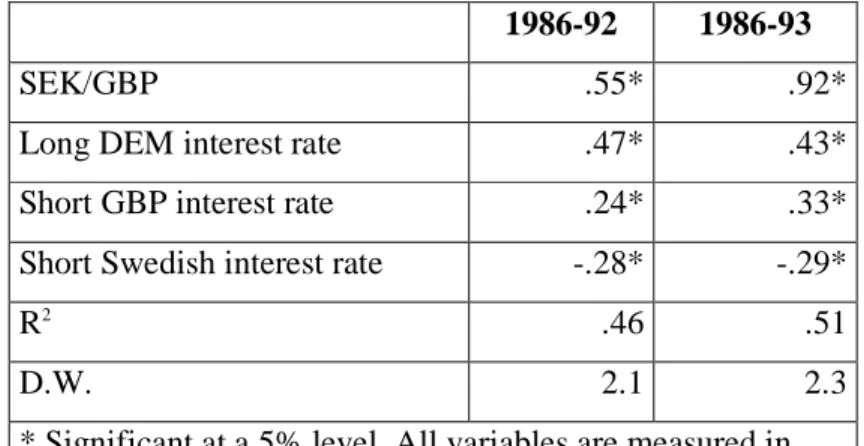
The changes in real4operating cash flows5were then regressed on changes in the variables from the fundamental analysis consisting of some exchange rates between the Swedish and a number of major currencies, interest rates, and inflation rates. Total European housing was included to control for changes in the industry’s conditions. Dummy variables were used to adjust cash flows for seasonality. Since the number of observations is limited combinations of the currencies were used. Regressions were run for the whole period 1986-94, as well as for 1986-92, and 1986-93. The latter regressions made it possible to use coefficients for out-of-sample analysis. Without going into econometric methodology and problems we present results of the analysis as an illustration of the decomposition. The following set of significant coefficients were obtained using contemporaneous dependent and independent variables:6
INSERT TABLE 1 HERE
Table 1 shows that the macroeconomic price variables explain about 50% of the fluctuations in seasonally adjusted changes in quarterly real operating cash flows. It is found that a depreciation of the Swedish Krona vis-à-vis the British Pound is beneficial for Electrolux. One percent increase in the SEK/GBP rate causes a .55 percent increase in seasonal adjusted real operating cash flow. This reflects that the Swedish Krona is the home currency of Electrolux and that the group will benefit whatever the transaction is when a net positive
foreign position is converted into that currency. In addition to that benefit, the company also benefits from a stronger competitive position in Sweden vis-à-vis foreign producing competitors. An increase in the Swedish short-term interest rate has a significant adverse impact on the real operational cash flows of Electrolux. The negative effect of an increase in the short-term Swedish interest rate captures the general decrease in the demand for capital goods as a response to raises in interest rates. The two other interest rate components are positive as they are when interest rates are correlated with business cycle developments.
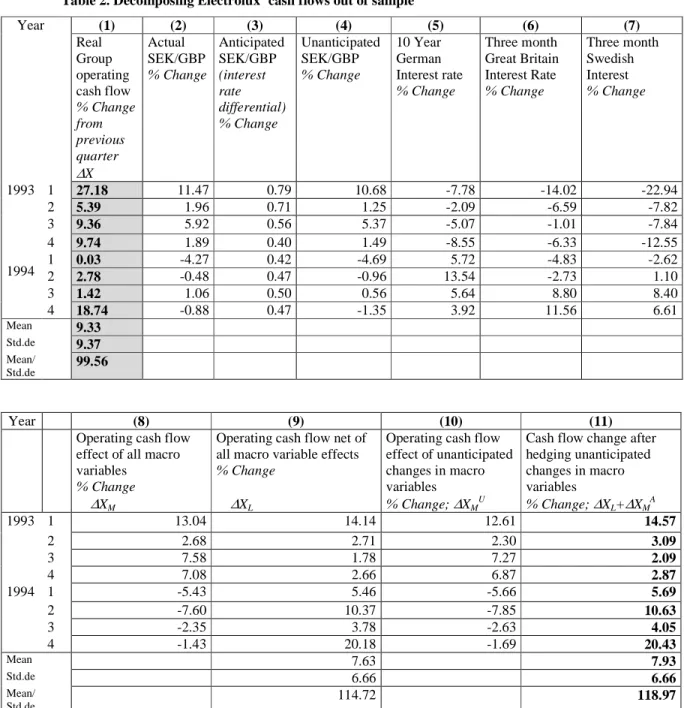
The coefficients were employed out-of-sample in such a way that the 1986-92 coefficients were used to estimate the impact of macroeconomic events in 1993, and the 1986-93 coefficients were used to estimate the impact in 1994. Table 2 shows the data and the results of the out of sample analysis. Column (1) shows actual quarterly cash flow changes in 1993 and 1994. Columns (2), (5), (6) and (7) list the changes in the price variables, which are multiplied by the coefficients in Table 1 to obtain the changes in cash flows caused by changes in the macro economy (∆XM) in column (8). Changes in “sustainable” cash flows
(∆XL) are registered in column (9).
INSERT TABLE 2 HERE
A second decomposition in Table 2 is obtained by removing only changes in cash flows caused by unanticipated macroeconomic events. The interest rate differential in the previous quarter is a proxy for the anticipated exchange rate changes in column (3). Unanticipated exchange rate changes follow in column (4). It is assumed that all changes in interest rates are unanticipated in columns (5), (6), and (7). After multiplying unanticipated changes with the coefficients in Table 1, unanticipated cash flow changes caused by macroeconomic events (∆XMU) are registered in column (10). Finally column (11) shows “sustainable” cash flow
changes plus cash flow changes caused by anticipated macroeconomic events (∆XL+∆XMA).
The distinction between the two decompositions is particularly important for performance assessments. We turn to this issue in the next section. However, the distinction can also be important for the estimation of changes in the net present value of the firm’s assets within a VBM framework, because an assumption must be made about the time pattern of expected exchange and interest rate changes.
Within EVA analysis the economic value added for a period is estimated based on the difference between a period’s actual cash flows and the cash flows required to cover the cost
of capital for the same period. Assume as an example that Electrolux at the end of 1994 employed a 15 percent cost of capital, and that the expected growth rate of cash flows was 9.33 percent. This figure is the average growth rate during 1993 and 1994 as shown in Table 2. Using the constant growth formula for estimating the present value of a dividend of 1 in 1994 would lead to a present value of 1.0933/(.15-.0933)=19.28.
If instead the true long run growth rate is the average of the growth of “sustainable” cash flow in (8), then the corrected present value is 1.0763/(.15-.0763)=14.60, if the same cost of capital is used. Thus, disregarding the temporary nature of some cash flows, the value of the firm would be exaggerated by 32% in this example. The exaggeration presumes that management has interpreted temporary growth caused by macroeconomic effects in 1993 and 1994 as sustainable growth.
In the latter estimation of the firm’s net present value it was assumed that there are no expected cash flow effects of macroeconomic shocks. If we instead would assume that current macroeconomic effects will continue but decrease over time then the present value of the firm would lie between the two examples above.
A second source of error in the economic value estimation within a VBM-framework is that the discount rate is assumed to be the same for all cash flows. Most likely the risk-adjustment on the cost of capital for cash flows caused by macroeconomic events should be lower than the risk-adjustment for the sustainable cash flows generated by the business itself. If so, the difference between the present values including and excluding the macroeconomic components of cash flows would be even larger.
4. Performance assessment and real options in VBM
An important aspect of VBM is to link bonus for management to changes in shareholder value or value-enhancing cash flows. In the following it is assumed that either cash flows during a period or changes in the estimated present value of cash flows provide the basis for a bonus for the period. Thus, stock market values do not exist for the entity or are considered excessively noisy to be used as a basis for compensation. In this case the key element of performance is the operating (or commercial) cash flows. These cash flows would provide the information based on which an economic value would be estimated. One issue here is which component or components of operating cash flows should be the major input in performance assessment for the purpose of determining managerial compensation. The choices we have
from Section 2 and Table 2 are the total operating cash flows (X, column (1)), the “sustainable” cash flows (XL, column (9)), or the total cash flows minus those caused by
unanticipated macroeconomic events (XL+ XMA, column (11)). A second issue addressed in
this section is whether the coefficients estimated as above in a linear model are appropriate when decomposing cash flows. Real options in particular imply a non-linear relation between shocks and cash flows.
Unanticipated and anticipated cash flow effects from macroeconomic events
If management has no or negligible influence on cash flows caused by macroeconomic events, an efficient compensation scheme should be linked to “sustainable” cash flows alone, or the present value of expected such cash flows. In this case the compensation based on “sustainable” cash flows creates the strongest incentives for management to devote effort towards enhancement of the firm’s long run competitiveness, while cash flows beyond its control do not affect compensation. To the extent a bonus system is linked to cash flows and value changes over which management has no control, effort may be diverted towards speculation about macroeconomic developments or towards obfuscation of information about them. Furthermore, the incentives of risk-averse managers to exert effort are weakened, if the variable to which bonus is linked contains noise relative to the variable that is of concern to shareholders as noted above. The link between effort and outcome is weakened7.
It could be argued that management should be induced to take advantage of anticipated changes in the macroeconomic environment. Naturally, if the firm’s operations in various ways can be adjusted to changes in expectations about macroeconomic events, then management should have the incentive to implement such adjustment in sales effort, production pattern, or where adjustment can be made in time to take advantage of the expectations. In this case the adjustment to total cash flows would be limited to those caused by unanticipated changes such as st in (6) and column (10) in Table 2. The compensation
would be linked to cash flows in column (11) of Table 2. Even if cash flows can be adjusted a reason for not linking the bonus to anticipated flows is that these can be affected by managerial decisions to a lesser degree relative to effort, than sustainable flow. In the latter case, scarce managerial time is most productively used to enhance the firm’s competitiveness. The ability of management to take advantage of anticipated macroeconomic conditions may vary among industries. Differences in compensation schemes may therefore be observed without any implication that one system is superior to another.
The data presented in Table 2 indicate that a very large proportion of the variability of operating cash flows is caused by macroeconomic fluctuations. Comparing columns (8) for all macro-effects and (10) for unanticipated macro-effects it can be seen that the unanticipated component dominates very strongly over the anticipated component in the particular case presented. Or to phrase it differently, more or less all macro effects seems to be unanticipated.
Cash flows and value created by investments in real options
In eq. (1) the present value of real options is one component of the value of a firm. Real options are created by investments in “flexibility”. Such investments reduce irreversible costs associated with changes in operations, and enhance a firm’s ability to take advantage of positive changes in cost and demand conditions and to reduce the impact of negative changes. By investing in flexibility the firm can narrow the range of conditions within which it cannot adjust its operations to changes in the environment. This range is defined by “trigger levels” for demand and cost conditions beyond which adjustment of operations is profitable (See, for example, Dixit and Pindyck, 1994).
Investments in real options--or “flexibility”--can be motivated by uncertainty about factors affecting “sustainable” cash flows, as well as about macroeconomic conditions. Here we are concerned with the effects of investments in “flexibility” in response to uncertainty about macroeconomic conditions. For example, investments reducing irreversible costs of switching suppliers, location of production, or marketing efforts between countries enable a firm to reduce the cash flow impact of negative changes in real exchange rates, and increase the cash flow impact of positive changes (see Capel, 1997). Another example is that investments in customer relations may enable a firm to pass through large exchange rate or interest rate changes into prices by reducing costs associated with changes in prices. This flexibility could extend even to unanticipated changes.
The options to change prices, switch suppliers, etc. in response to price incentives of certain magnitudes imply that the cash flow sensitivity coefficients tend to become smaller for large deviations from neutral macroeconomic conditions. A linear relation between cash flows caused by macroeconomic factors, and deviations from levels corresponding to neutral macroeconomic conditions is completely correct only when there are no real options that management can exercise in response to relatively large price incentives.
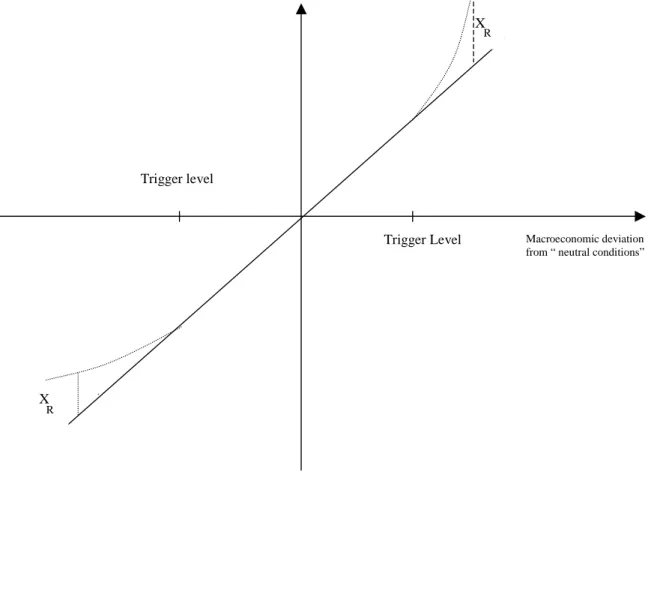
Figure 1 illustrates the cash flow effects of unanticipated macroeconomic shocks. The size of the shock is measured along the x-axis. The straight line shows the cash flow effects of the disturbance if there are no real options, i.e. if there is no flexibility in pricing, sourcing, location of production etc. no matter how large the shock is. The broken line shows the cash flow effects of the same shock, when an increasing number of real options are triggered as the magnitude of the shock increases. When the option is triggered, cash flows denoted XR,tarise.
They add increasingly to the cash flows as the magnitude of a positive event increases. When the event is increasingly negative, the cash flows created by the option reduce the impact on cash flow increasingly.
INSERT FIGURE 1
The framework developed in Section 2 can now be expanded to include cash flows, XR,
that occur in a period as a result of previous investments in real options. Total cash flows in period t can be decomposed as in e.q. (3) above into sustainable and macroeconomic components. The latter component, XM, described above in the linear expressions (4) and (6)
must now be extended to include the cash flows from real options. Using Mt to denote the
level of a vector of macroeconomic variables describing macroeconomic conditions in period t, the cash flow effects caused by macroeconomic events can be written in the following way:
(
)(
)
t Rt M t t M t M m X m X M M M M X X 1 , 1 , − + ± − = − − δ δ δ δ , (10)where the first term represents anticipated effects of lagged changes in M, the second term captures unanticipated effects, and XR,tas described in Figure 1 represents cash flow effects
of real options triggered by M in period t. As in expression 6 above
(
t)
t Mt M M m
M = ρ −1− + , (11)
whereρM is a serial correlation coefficient and mt is the unanticipated change in
The partial derivatives in the first two terms on the right hand side are assumed to be linear coefficients independent of the magnitude of change in M. Estimated coefficients for changes in cash flows were estimated and used in Table 2 to decompose cash flows into “sustainable” cash flows, XL, and cash flows caused by macroeconomic events, XM. The nonlinear cash
flows created by investments in real options were not accounted for, however.
The issue now is how the last term in (10), XR,t, should be treated when estimating the
performance of management with the objective of providing incentives for management to maximize shareholder value. Clearly, shareholder wealth maximization includes maximizing the value of real options (PVRO in (1)) whether the options refer to flexibility in responses to competitive conditions or macroeconomic events. Thus, it is clearly desirable to include the cash flows trigged by real options on macroeconomic conditions, XR,t or the value of real
options, PVRO, in measures of managers’ performance.
An econometric problem may sometimes follow from the suggested consideration of real options. Their presence implies that it is no longer appropriate to take a linear relation between cash flows and macroeconomic price-variables for granted, although the linear sensitivity coefficients in expressions like (4) and (6) are the appropriate ones to use for the decomposition of cash flows. If the relationship between cash flows and macroeconomic variables are described by the non-linear broken line in Figure 1, the analyst estimating the linear sensitivity coefficients for macroeconomic effects on cash flows may have to limit the regression to observations of macroeconomic changes within the range bounded by the trigger levels for which the relation can be assumed to be linear. The linear coefficients measured this way apply nevertheless outside this range whenever cash flows unaffected by management are to be estimated.8
5. Concluding remarks
Value Based Management is a tool that should help management maximize shareholder value in large and small investment and divestment decisions. It should also help shareholders designing bonus-systems based on performance in order to induce managers to have shareholder value as their prime objective.
Macroeconomic fluctuations affect firms’ cash flows as well as market values. These fluctuations are beyond management control. However, cash flow effects caused by them can sometimes be influenced by management to the extent macroeconomic developments can be
forecast, or if firms can invest in flexibility with respect to sourcing, pricing, location of
production, or location of sales in response to anticipated and/or unanticipated
macroeconomic development.
We have here argued that for purposes of project evaluation, ex post analysis of projects, and performance assessment it is valuable to decompose cash flows of firms into “sustainable” cash flows, i.e. cash flows under “neutral” macroeconomic conditions, and cash flows caused by macroeconomic fluctuations around these conditions. The latter flows can be decomposed further into anticipated and unanticipated cash flows. When implemented, focusing on period-to-period changes of macroeconomic effects helps circumventing the problem of defining “neutral” conditions in anabsolute sense.
We have suggested that sensitivity-coefficients describing the impact of key
macroeconomic price variables on cash flows should be estimated within a multivariate framework and used as input to filter out the cash flow effects of macroeconomic fluctuations. The data used as input in investment decisions, ex post analysis of projects and strategies, and performance measures for compensation-systems could be substantially improved if cash flows were decomposed each period as suggested above. Inclusion of this type of analysis as a key component of Value Based Management would improve conditions for shareholder wealth maximization. In particular, it would be possible to base compensation systems on measures of performance under the actual control of management.
References
Black, A., P. Wright and J.E. Bechman, 2001,In Search of Shareholder Value - Managing the Drivers of Performance, Price Waterhouse, FT Prentice Hall, London.
Capel, J., 1997, “A real option approach to economic exposure management”, Journal of International Financial Management and Accounting 8, 87-113.
Dixit, A. and R. S. Pindyck, 1995, “The option approach to capital investment”, Harvard Business Review 64, May/June, 105-115.
Lessard, D.R. and P. Lorange, 1977, “Currency changes and management control: resolving the centralization/decentralization dilemma”,Accounting Review, July, 628-637.
Madden, B.J., 1999,A total system approach to valuing the firm, Butterworth-Heinemann.
Milgrom, R. and J. Roberts, 1992,Economics, Organization and Management, Prentice-Hall,
New York.
O’Byrne, F., 1997, “EVA and Shareholder Return”, Conference paper, Financial
Management Association Annual Conference, Honolulu.
Ottosson, E. and F. Weissenrieder, 1996, “Cash Value Added (CVA) - A New Method for
Measuring Financial Performance”, Gothenburg Studies in Financial
Oxelheim, L. and C. Wihlborg, 1987,Macroeconomic Uncertainty – International Risks and Opportunities for the Corporation, John Wiley and Sons, Chichester and New
York.
Oxelheim, L. and C. Wihlborg, 1995, “Measuring Macroeconomic Exposure – the Case of Volvo Cars”,European Financial Management 1, 241-263.
Oxelheim, L. and C. Wihlborg, 1997, Managing in the Turbulent World Economy –
Corporate Performance and Risk Exposure, John Wiley and Sons, Chichester
and New York.
Rapaport, A., 1986, Creating Shareholder Value. The New Standard for Business
Performance, Free press, London.
Stewart, G. 1990, The Quest for Value: The EVA-TM Management Guide, Harper Business,
Table 1: Sensitivity coefficients of seasonally adjusted real operating cash flow to macroeconomic variables, Electrolux Group.
1986-92 1986-93
SEK/GBP .55* .92*
Long DEM interest rate .47* .43*
Short GBP interest rate .24* .33*
Short Swedish interest rate -.28* -.29*
R2 .46 .51
D.W. 2.1 2.3
* Significant at a 5% level. All variables are measured in percent rate of change.
Table 2. Decomposing Electrolux’ cash flows out of sample Year (1) (2) (3) (4) (5) (6) (7) Real Group operating cash flow % Change from previous quarter ∆X Actual SEK/GBP % Change Anticipated SEK/GBP (interest rate differential) % Change Unanticipated SEK/GBP % Change 10 Year German Interest rate % Change Three month Great Britain Interest Rate % Change Three month Swedish Interest % Change 1 27.18 11.47 0.79 10.68 -7.78 -14.02 -22.94 2 5.39 1.96 0.71 1.25 -2.09 -6.59 -7.82 3 9.36 5.92 0.56 5.37 -5.07 -1.01 -7.84 4 9.74 1.89 0.40 1.49 -8.55 -6.33 -12.55 1 0.03 -4.27 0.42 -4.69 5.72 -4.83 -2.62 2 2.78 -0.48 0.47 -0.96 13.54 -2.73 1.10 3 1.42 1.06 0.50 0.56 5.64 8.80 8.40 1993 1994 4 18.74 -0.88 0.47 -1.35 3.92 11.56 6.61 Mean 9.33 Std.de 9.37 Mean/ Std.de 99.56 Year (8) (9) (10) (11)
Operating cash flow effect of all macro variables
% Change
∆XM
Operating cash flow net of all macro variable effects % Change
∆XL
Operating cash flow effect of unanticipated changes in macro variables % Change;∆XMU
Cash flow change after hedging unanticipated changes in macro variables % Change;∆XL+∆XMA 1993 1 13.04 14.14 12.61 14.57 2 2.68 2.71 2.30 3.09 3 7.58 1.78 7.27 2.09 4 7.08 2.66 6.87 2.87 1994 1 -5.43 5.46 -5.66 5.69 2 -7.60 10.37 -7.85 10.63 3 -2.35 3.78 -2.63 4.05 4 -1.43 20.18 -1.69 20.43 Mean 7.63 7.93 Std.de 6.66 6.66 Mean/ Std.de 114.72 118.97
Figure 1.Cash flows caused by macroeconomic factors when real options are present.
Trigger Level Trigger level
Macroeconomic deviation from “ neutral conditions”
X
R
Cash flows caused by macroeconomic factors
X
21 End n otes 1 S ee fo r ex am p le , M ilg ro m a n d R o b ert s (19 92 ), Ch .5 . 2 T h e ri sk p re m iu m fo r ca sh flo ws ca us ed by m ac ro eco no m ic fl u ct u at io n s m ay d if fe r fro m th e ri sk prem iu m fo r ca sh flo ws at “neutral ” c o n d it io n s. See b el o w . 3 T h e funda m ental an al y sis wa s carr ied ou t fo ll o w in g th e tr adit io n o f th e M U S T -ana ly si s used in ri sk m ana m ent . S ee O x el h ei m an d W ih lbor g (1997). 4 D ef late d b y pr oduce r prices in m a nufactu ri n g . 5 Mea sured a s the c o mm ercial n et in c ome; re v en u es fr om g o o d s so ld m inus cost s o f g o ods so ld . 6 L a g g e d v ar ia b les w ere int ro d u ced but w it hout substanti al c ha n g es in res u lt s. 7 L essar d and L o ra n g e (197 7 ) di sc us s inc e n ti v e effects o f th e ch o ice of ex c h an g e rat e in bu dg eting d ec is In th e ir ana ly si s th e ch o ice o f e x c h an g e rat e in fl uence s measu res of p er fo rm an ce a n d therefo re ince nti 8 T h e re g re ssions re su lt in g in th e c o eff icients prese n ted in T able s 1 an d 2 d id not re v ea l er ro rs tha t c o uld be in ter pret ed a s non -lin eariti e s o f th e ty p e d is cu ss ed h ere.