This is the author’s version of a work that was submitted/accepted for
pub-lication in the following source:
Hou, Jun
&
Nayak, Richi
(2013)
A concept-based retrieval method for entity-oriented search. In
Christen, Peter, Kennedy, Paul, Liu, Lin, Ong, Kok-Leong, Stranieri,
An-drew, & Zhao, Yanchang (Eds.)
11th Australasian Data Mining Conference (AusDM 2013), Conferences
in Research and Practice in Information Technology, Australian Computer
Society, Canberra, ACT.
This file was downloaded from:
http://eprints.qut.edu.au/63174/
c
Copyright 2013, Australian Computer Society, Inc.
This paper appeared at Eleventh Australasian Data Mining Conference (AusDM 2013), Canberra, 13-15 November 2013. Conferences in Research and Practice in Information Technology, Vol. 146. Peter Christen, Paul Kennedy, Lin Liu, Kok-Leong Ong, Andrew Stranieri and Yanchang Zhao, Eds. Reproduction for academic, not-for profit purposes permitted provided this text is included.
Notice:
Changes introduced as a result of publishing processes such as
copy-editing and formatting may not be reflected in this document. For a
definitive version of this work, please refer to the published source:
A Concept-based Retrieval Method for Entity-oriented Search
Jun Hou and Richi Nayak
School of Electrical Engineering and Computer Science, Queensland University of Technology, Brisbane, Australia [email protected],[email protected]
Abstract
Entity-oriented retrieval aims to return a list of relevant entities rather than documents to provide exact answers for user queries. The nature of entity-oriented retrieval requires identifying the semantic intent of user queries, i.e., understanding the semantic role of query terms and determining the semantic categories which indicate the class of target entities. Existing methods are not able to exploit the semantic intent by capturing the semantic relationship between terms in a query and in a document that contains entity related information. To improve the understanding of the semantic intent of user queries, we propose concept-based retrieval method that not only automatically identifies the semantic intent of user queries, i.e., Intent Type and Intent Modifier but introduces concepts represented by Wikipedia articles to user queries. We evaluate our proposed method on entity profile documents annotated by concepts from Wikipedia category and list structure. Empirical analysis reveals that the proposed method outperforms several state-of-the-art approaches.
Keywords: Query Reformulation, Concept-based Retrieval, Entity-oriented Retrieval.
1
Introduction
When people use a retrieval system for focused information, they often intend to look for particular information rather than finding an entire document or a long text passage. Entities play a central role in answering such information needs. This type of retrieval can be called as entity-oriented retrieval. Considering the query “Formula 1 drivers that won the Monaco Grand Prix”, the desired result will be the list of names, instead of, finding the documents related to “Formula 1”, or “Monaco Grand Prix”. Research efforts such as Expert finding track (chen et al. 2006), INEX entity ranking track (Rode et al. 2009) and TREC entity track (Balog, Serdyukov and Vries 2010) emphasize that entities are an important information unit, in addition to a search unit, for providing exact answers to user queries.
In fact, user queries often consist of keywords and tend to be short, which makes it difficult for a search system to understand the query intent. In order to return accurate answers for user queries, researchers have
Copyright © 2013, Australian Computer Society, Inc. This paper appeared at Eleventh Australasian Data Mining Conference (AusDM 2013), Canberra, 13-15 November 2013. Conferences in Research and Practice in Information Technology, Vol. 146. Peter Christen, Paul Kennedy, Lin Liu, Kok-Leong Ong, Andrew Stranieri and Yanchang Zhao, Eds. Reproduction for academic, not-for profit purposes permitted provided this text is included.
proposed methods to interpret queries by classifying them into semantic categories which indicate the class of target entities (li et al. 2008; Manshadi and Li 2009). Query categorisation provides the ranking engine with a capability of filtering out irrelevant candidate entities. However, these methods fail to describe the semantic structure of user queries, i.e. the semantic role of individual query terms. The semantic role of individual query terms gives an insight of query of target entities. Considering the query “Formula 1 drivers that won the Monaco Grand Prix”, a search system needs to return target entities of class “Formula 1 drivers” that won the “Monaco Grand Prix” rather than other Grand Prix or just drivers competing in “Monaco Grand Prix”. Recent researches (Pound, Ilyas and Weddell 2010; Unger et al. 2012) have shown that understanding the semantic structure of a user query can be beneficial to entity-oriented retrieval.
However, simply applying query category classification or query semantic structure identification on traditional Bag-of-Words (BOW)-based information retrieval (IR) method (Moriceau and Tannier 2010; Demartini et al. 2010) fails to capture and exploit the semantic relationships that exist between terms of a query and of a document which contains entity related information. As known, different terms may be used to describe the same concept in a query and a document (the synonymy problem), and even the same term may be used to express different concepts (the polysemy problem). Consequently, a search system may return inaccurate and incomplete results without identifying the semantic concepts of related terms (Egozi, Markovitch and Gabrilovich 2011).
In this paper, solving these issues, we propose a novel concept-based retrieval method that integrates the semantic structure of a query and concept-based query expansion to expand query terms with concepts. More specifically, we define the semantic structure embedded in a query as Intent Type (IT) and Intent Modifier (IM) and automatically identify them using a Conditional Random Field (CRF) model. The semantic structure enables the retrieval system to focus only on entities that belong to the required class, i.e., Intent Type. In addition, the based query expansion introduces concept-based features from the massive human knowledge base, i.e. Wikipedia, to related query terms. Considering the query “Formula 1 drivers that won the Monaco Grand Prix”, the semantic structure can be identified as:
. The concept-based query expansion detects the following concepts:
IT: Formula One, Formula racing, List of Formula One drivers.
Input Query
Ranked Entities
Indexed Entities Intent Type &
Intent Modifier Identifying Query Semantic Structure Mapping Wikipedia articles as Concepts Expanded Intent Type &
Expanded Intent Modifier Mapping Categories and Lists as concepts Query Reformulation Concept-based Indexing
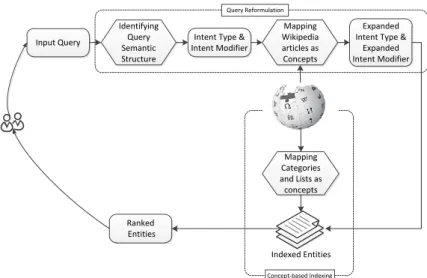
Figure 1: Overview of The Proposed Method of Concept-based Retrieval
IM: Monaco, Monaco Grand Prix, Grand Prix motorcycle racing.
This paper also presents a process of applying the proposed concept-based query structure analysis method on a collection annotated by concepts (and concept-based indexed) for retrieving target entities. Empirical analysis reveals that the proposed method outperforms several state-of-the-art approaches i.e., BOW-based model and conventional concept-based query expansion.
2
Related work
Entity-oriented retrieval (ER) aims to find a list of entities as the answer of a query. Different from the traditional document retrieval, ER includes extra processes such as Named Entity Recognition (NER) and Information Extraction (IE) for processing documents. ER can be classified into two groups based on how entities are ranked: (1) Profile-based models where entities are represented and ranked by related documents (profiles) that contain these entities; and (2) Document-based models where top-ranked entities are found from the top relevant documents (Balog, Serdyukov and Vries 2010). Our research is similar to the profile-based model where each entity has a corresponding document. Authors (Rode, Serdyukov and Hiemstra 2008) have proposed a profile-based retrieval model combing document and paragraph score to rank entities. Authors (Moriceau and Tannier 2010) proposed a lightweight document-based search system that combines entity-related syntactic information, i.e., syntactic dependency relations into classical search engine indexing. External entity repositories such as Yago (Demartini et al. 2010) and Freebase (Bron et al. 2010) have been integrated into entity-oriented search to utilize more entity-related information. However, the existing methods do not fully exploit the query semantic structure and semantic relationship between query and document terms.
The proposed method is also related to studies understanding the semantic structure of user queries that annotate individual query terms with semantic roles. Research work (Li 2010) studied the problem of labelling semantic class and attribute/value for noun phrase queries by learning a CRF-based tagger. A question analysis approach based on a set of heuristics (Moriceau and
Tannier 2010) was proposed to identify answer type for different types of questions in Question Answering (QA). Researchers (Unger et al. 2012) developed a hybrid and generative query structure template framework for a similar task. Recently, a statistic-based method (Pound et al. 2012) has been proposed by learning query semantic structures from Web query log and Knowledge Base. Our work analyses the semantic structure of a query and further introduces concepts for individual components of the semantic structure.
Concept-based Retrieval (CR), another related work, integrates concept-based features derived from external resources into the keyword-based search model. CR consists of two major processes: (1) concept-based query expansion and (2) concept-based indexing. The CR methods introduce concepts to keyword-based representation and run a retrieval algorithm to return ranked results. The CR methods can be grouped into different categories based on how they augment keyword-based representation with external resources, e.g., by using manually built thesaurus (Grootjen and Weide 2006), by relying on term co-occurrence data (Schuetze and Pedersen 1995), or by extracting latent concepts from massive human knowledge base (Egozi, Markovitch and Gabrilovich 2011; Milne, Witten and Nichols 2007). However, CR methods only augment queries and documents with concepts without modelling the semantic structure embedded in a query.
In this paper, we propose a novel concept-based retrieval method integrating concept-based query expansion and semantic structure analysis of a query, i.e., Intent Type and Intent Modifier, for entity-oriented retrieval. The proposed approach not only models the semantic structure of a query for searching target group of entities but it also introduces concepts to solve the problem of semantic relationship between query and document terms. The proposed method, therefore, is able to improve the performance of retrieval system.
3
The Proposed Concept-based Retrieval
Method
Figure 1 gives an overview of the proposed approach. An input query, formulated in natural language or in noun phrases, is analysed and represented in the form of
semantic structure, i.e., Intent Type and Intent Modifier. Next, the input search query is mapped to related concepts (represented by Wikipedia articles). Based on the semantic structure information expanded with concepts, a list of ranked entities are retrieved over the concept-based indexing annotated by concepts (Wikipedia categories and lists), and presented as search answers to users. We now present the various processes of the proposed method.
3.1
Query Reformulation
In this section, we discuss how to identify the semantic structure of an input query and introduce concepts related to the input query.
3.1.1
Identification
of
Query
Semantic
Structure
In this section, we define the semantic structure of an input query and present a method to identify the semantic roles of individual constituents of input queries. We assume an input query to be a sequence of query terms over the vocabulary . The
semantic structure for an input query is defined as Intent Type (IT) and Intent Modifier (IM):
Definition 1. Intent Type, is a query segment
where that has a conditional
probability of implying the class of target entity:
(1)
Definition 2. Intent Modifier, is a query segment
( ) that has a conditional probability of imposing constraints on the Intent Type:
(2)
Let the semantic structure be a label sequence
with labels . Our goal is to obtain:
(3)
In this paper, we propose to use Conditional Random Field (CRF) to maximizes the conditional likelihood
. More specifically, when a labelled training query instance ( ) comes, we learn a set of feature functions ( is the position of label ) and corresponding weight vector . To classify a testing query instance ( ), CRF selects the labelled semantic structure on that maximizes:
∑
(4) where is normalization function.
In order to train CRF, we define feature functions containing following features for query term with input position : (1) lexical features (all query terms and query term bigrams within a five size window around ), (2) part-of-speech (PoS) features (all PoS tags, PoS tag bigrams and PoS tag trigrams within a five size window around ), and (3) feature of a pair of adjacent labels
. The input query is first decomposed into lexical
tokens and annotated with part-of-speech (PoS) tags. Research has shown that PoS tagging has an accurate performance even on keyword queries (Barr, Jones and Regelson 2008). Here, lexical features and PoS features exploit the syntactic constraints on query terms being IT or IM. For example, IT, which implies the class of target entity, is often expressed using noun or noun phrases. For IM, named entities and adjectives are often used as context modifier. In addition, the feature of a pair of adjacent labels captures the transition pattern between adjacent labels. For example, the boundary between IT and IM is often described by prepositions such as “on” and “by”, verbs such as “won” and “situated”, and “WH” words such as “which” and “that”.
One simple example of feature function which produces binary value can be: if the current word is “italian” with its PoS tag ““JJ” (which means adjective word) and current label is “IM”:
{
(5)
In addition, the corresponding weight vector for a feature function is controlled by CRF during training stage: if , the probability of label is increased ( ); if , the probability of label is decreased ( ).
3.1.2
The Concept-based Query Expansion
Concept-based query expansion is an automatic process of adding related concepts to a given query. The relevance of added concepts determines the quality of retrieved results. In this paper, we propose to select semantically-related concepts from Wikipedia. A concept is generated from a single Wikipedia article and represented by different forms, for example, the concept “earth” is referred to by different anchor texts: “the planet”, “the world” and “the globe”. Meanwhile, a query is considered as a set of key-phrases. The key-phrases are obtained by extracting word n-grams that appears in a query. The query expansion process is triggered when a Wikipedia concept appears as a key-phrase in a query.
Given the labelled query that consists of key-phrases and Wikipedia concept set , the simplest expansion is the exact mapping that one key-phrase only maps to one Wikipedia concept, which we refer to as context concept . However, a key-phrase, for example, “bar”, may refer to many Wikipedia concepts, “bar (establishment)”, “bar (law)” or “bar (computer science)”. Here, we select the most appropriate Wikipedia concept from candidate concept set for key-phrase by a function: ∑ (6)
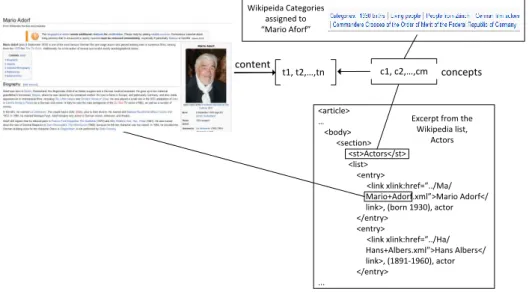
Figure 2: Overview of Concept-based Indexing
(Medelyan and Witten 2008), the similarity-based disambiguation method can accurately select the most appropriate concept. The similarity function calculates the similarity between candidate concept and context concept based on the overlap of hyperlinks between them (Milne and Witten 2008):
( )
( | |) | |
(7)
where is the number of hyperlinks. In addition, if a user query contains few text segments and there is no context evidence ( ) for selecting appropriate concept, the most commonly-used concept will be selected by a weight function and equation 6 becomes:
{ ( | ∑ ( ) | | ) (8)
where is the frequency of being an anchor text in Wikipedia and is the total number of Wikipedia concepts in which appears. Weight function measures the commonness of the concept in Wikipedia.
3.2
Concept-based Indexing
In this section, we define our concept-based indexing as a hybrid of unstructured and structured information consisting of entity profile documents and concepts introduced to them. Generally, entities and their related information are located in two categories of Web sources: unstructured information such as text in a Web document and structured information such as, records of RDF data or entries of a Web table. Research (Nie et al. 2007) found that balancing such unstructured and structured information is more suitable and is superior for entity-oriented retrieval. In this paper, the concept-based indexing adopts unstructured text (a unique Wikipedia article) as entity profile document and introduce
structured information (i.e., Wikipedia category and list structure) as concepts.
More specifically, we represent an entity as the title of a Wikipedia article and use the Wikipedia article as entity profile document. This is because Wikipedia covers most entities of general domains and each Wikipedia article contains relatively complete and much cleaner information than Web pages (Gabrilovich and Markovitch 2006). In addition, we use structured information in Wikipedia, i.e., Wikipedia category and list structure, as concept features. Generally, a concept indexing mechanism needs scanning of natural language text within a document to find related concepts. It is time-consuming for millions of entities (Wikipedia articles), especially when the article length is relatively large. Therefore, we extracted Wikipedia categories and list structure (Schenkel, Suchanek and Kasneci 2007) as concepts. For example, as shown in Figure 2, a Wikipedia category is added as a concept to an entity if the Wikipedia category (“Living people”) is assigned to the entity’s corresponding Wikipedia article (“Mario Adorf”). In addition, if an entity’s corresponding Wikipedia article is included as child element (“Mario Adorf”) in a list structure (Figure 2), the parent element (“Actors”) is introduced as a concept to the entity. As a result, the concept-based indexing includes content terms of entity profile document and introduced concepts.
3.3
Concept-based Retrieval
Figure 3 summarizes the concept-based entity retrieval algorithm. Upon receiving an input query ( ), the proposed method first identifies the query semantic structure (i.e., query Intent Type and query Intent Modifier by function ). We then expands the query Intent Type and the query Intent Modifier with concepts (i.e., with the expanded query Intent Type
and query Intent Modifier by function ). As returned results, we favour entities that match concept-expanded query terms and document score ( ) measures the score between concept-expanded query ( ) over concept-based indexing (by function
that represents the standard inverted index function that scores a document’s match to a Wikipeida Categories
assigned to “Mario Aforf”
Excerpt from the Wikipedia list, Actors concepts content <article> … <body> <section> <st>Actors</st> <list> <entry> <link xlink:href=”../Ma/ Mario+Adorf.xml”>Mario Adorf</ link>, (born 1930), actor </entry> <entry> <link xlink:href=”../Ha/ Hans+Albers.xml”>Hans Albers</ link>, (1891-1960), actor </entry> ... t1, t2,…,tn c1, c2,…,cm
INEX XER query topic 113
Query Formula 1 drivers that won the Monaco Grand Prix
Semantic structure
Introduced concepts
IT: Formula One, Formula racing, List of Formula One drivers;
IM: Monaco, Monaco Grand Prix, Grand Prix motorcycle racing.
Relevant results Ayrton Senna, Michael Schumacher, Fernando Alonso, etc.
Class of target entity racecar drivers, formula one drivers
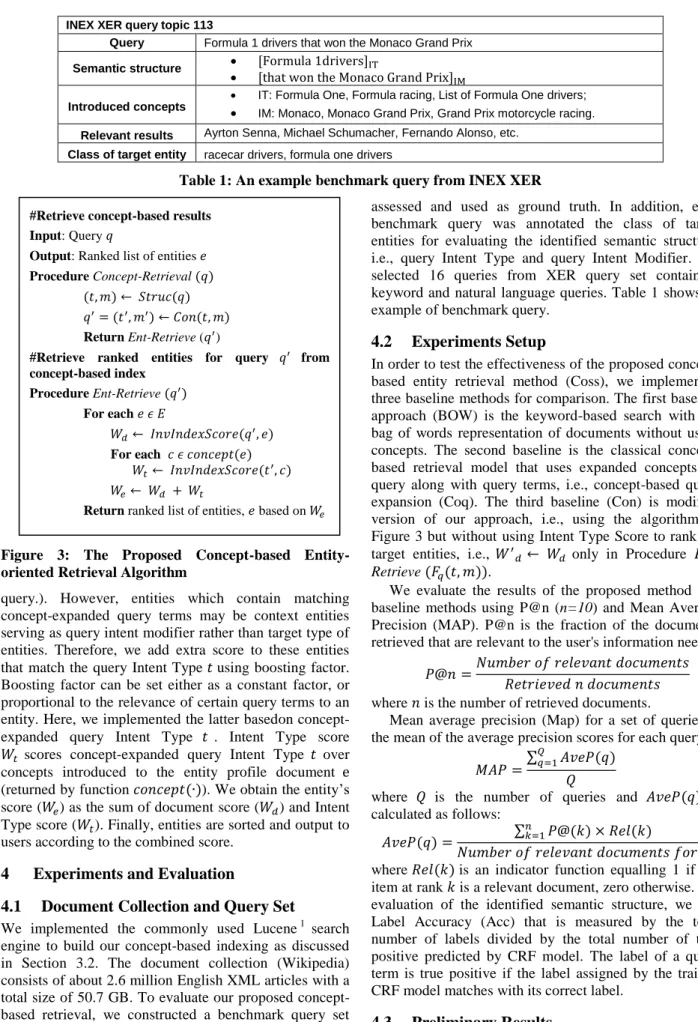
Table 1: An example benchmark query from INEX XER
Figure 3: The Proposed Concept-based Entity-oriented Retrieval Algorithm
query.). However, entities which contain matching concept-expanded query terms may be context entities serving as query intent modifier rather than target type of entities. Therefore, we add extra score to these entities that match the query Intent Type using boosting factor. Boosting factor can be set either as a constant factor, or proportional to the relevance of certain query terms to an entity. Here, we implemented the latter basedon concept-expanded query Intent Type . Intent Type score
scores concept-expanded query Intent Type over concepts introduced to the entity profile document (returned by function ). We obtain the entity’s score ( ) as the sum of document score ( ) and Intent Type score ( ). Finally, entities are sorted and output to users according to the combined score.
4
Experiments and Evaluation
4.1
Document Collection and Query Set
We implemented the commonly used Lucene1 search engine to build our concept-based indexing as discussed in Section 3.2. The document collection (Wikipedia) consists of about 2.6 million English XML articles with a total size of 50.7 GB. To evaluate our proposed concept-based retrieval, we constructed a benchmark query set from the INEX XER track (Rode et al. 2009). Relevant results for each individual XER query topic was manually
1
http://www.lucene.apache.org
assessed and used as ground truth. In addition, each benchmark query was annotated the class of target entities for evaluating the identified semantic structure, i.e., query Intent Type and query Intent Modifier. We selected 16 queries from XER query set containing keyword and natural language queries. Table 1 shows an example of benchmark query.
4.2
Experiments Setup
In order to test the effectiveness of the proposed concept- based entity retrieval method (Coss), we implemented three baseline methods for comparison. The first baseline approach (BOW) is the keyword-based search with the bag of words representation of documents without using concepts. The second baseline is the classical concept-based retrieval model that uses expanded concepts on query along with query terms, i.e., concept-based query expansion (Coq). The third baseline (Con) is modified version of our approach, i.e., using the algorithm in Figure 3 but without using Intent Type Score to rank the target entities, i.e., only in Procedure Ent-Retrieve .
We evaluate the results of the proposed method and baseline methods using P@n (n=10) and Mean Average Precision (MAP). P@n is the fraction of the documents retrieved that are relevant to the user's information need:
where is the number of retrieved documents.
Mean average precision (Map) for a set of queries is the mean of the average precision scores for each query:
∑
where is the number of queries and is calculated as follows:
∑
where is an indicator function equalling 1 if the item at rank is a relevant document, zero otherwise. For evaluation of the identified semantic structure, we use Label Accuracy (Acc) that is measured by the total number of labels divided by the total number of true positive predicted by CRF model. The label of a query term is true positive if the label assigned by the trained CRF model matches with its correct label.
4.3
Preliminary Results
Table 2 presents the Label Accuracy (Acc) for the identified semantic structure. As we can see, almost every query term is assigned with correct label. This is because CRF utilizes a rich set of feature functions to maximize
#Retrieve concept-based results
Input: Query 𝑞
Output: Ranked list of entities 𝑒
ProcedureConcept-Retrieval 𝑞
𝑡 𝑚 𝑆𝑡𝑟𝑢𝑐 𝑞 𝑞 𝑡 𝑚 𝐶𝑜𝑛 𝑡 𝑚
ReturnEnt-Retrieve (𝑞)
#Retrieve ranked entities for query 𝑞 from
concept-based index ProcedureEnt-Retrieve 𝑞 For each𝑒 𝜖 𝐸 𝑊𝑑 𝐼𝑛𝑣𝐼𝑛𝑑𝑒𝑥𝑆𝑐𝑜𝑟𝑒 𝑞 𝑒 For each 𝑐 𝜖 𝑐𝑜𝑛𝑐𝑒𝑝𝑡 𝑒 𝑊𝑡 𝐼𝑛𝑣𝐼𝑛𝑑𝑒𝑥𝑆𝑐𝑜𝑟𝑒 𝑡 𝑐 𝑊𝑒 𝑊𝑑 + 𝑊𝑡
Figure 4: P@10 of Baseline Methods (BOW, Coq, Con) and the Proposed Method (Coss)
the conditional likelihood for the label of query terms. The main reason for incorrect labels is the sporadic failure of named entity recognition. For example, query “National Parks East Coast Canada US”, the phrase “East Coast” is not recognized as named entity, which leads to false labelling “National Parks” as Intent Modifier rather than Intent Type. As a final consideration, if it is the case proposed method (Coss) can not use Intent Type as boosting factor and it is equal to baseline method (Con) but we still report the result (i.e., query 15).
Acc Incorrect
CRF 94.7% 5.3%
Table 2: Label Accuracy (Acc) of the Identified Semantic Structure
4.4
Results and Discussion
In Figure 4, we present the p@10 results returned by four retrieval methods for each query. Table 3 shows the Mean Average Precision and Average Precision@10 of all methods.
BOW Coq Con Coss
MAP 0.12 0.13 0.16 0.19
Avg P@10 0.14 0.16 0.20 0.30
Table 3: Mean Average Precision (MAP) and Average Precision at rank=10 (Avg P@10) for All Methods
We observe that the proposed method (Coss) performs significantly better than all other methods. For a number of queries, query expansion with concepts do not improve the performance over the BOW approach, however the proposed method is still able to improve the retrieval result. This demonstrates that introducing concepts to the identified query intent can effectively help search system return relevant exact answers for user queries. For the query semantic structure, we find that since method Con does not fully exploit query intent in the ranking process, the Con has limited improvement in comparison to the proposed method Coss.
Comparing concept-based methods (Coq and Con) with keyword-based only method (BOW), we observe that introducing concepts can yield better results. This shows the effectiveness of introduced concepts in terms of bridging the gap of semantic relationships between
query and document terms. Among these three methods, Con achieved the best performance. This is because concepts can be better used in both query and indexing stage, rather than just used in query expansion only.
In addition, we accumulated the number of relevant results among all queries. Figure 5 shows the sizes of the sets of results regarding to the “percentage of queries answered”. We can see that the proposed method is capable of covering more percentage of the queries than all other baseline methods. The pure bag of words and classical concept based retrieval approaches is limited to retrieving relevant results over the query set. It confirms that analysing and using the structure of query with concept-based query expansion improves the performance of entity-oriented retrieval.
Figure 5: Percentage of Relevant Result Returned when Increasing the Number of Top Retrieved Results
4.5
Time Cost
To study the time cost of our approach, we conducted experiments on a machine with Intel Xeon X5690 3.47 GHz CPU, 96 GB memory. The average result time for query semantic structure analysis and concept-based expansion for all queries is less than 1 second.
The main time cost lies in the stage of extracting and loading statistics of Wikipedia concepts for concept-based query expansion, which took roughly 600 seconds. This is because that training CRF model for query semantic structure analysis requires less time than concept-based query expansion as it implemented smaller size of feature functions. However, these processes only need to be done once and can be performed offline beforehand. Such an overhead becomes acceptable.
0 0.05 0.1 0.15 0.2 0.25 0.3 0.35 0.4 0.45 1 2 3 4 5 6 7 8 9 10 11 12 13 14 15 16 Prec o so p m @ 10 query
5
Conclusions and Future Work
In this paper we proposed a novel concept-based search system for entity-oriented retrieval. We developed a query analysis framework which integrated query semantic structure and concept-based query expansion identification. For searching target entities, we presented a concept-based retrieval system which applied query analysis results to search over annotated documents. Experiment results showed that the proposed search system significantly improved the search performance over the traditional BOW-based method and the classical concept-based method. In future, we will apply our proposed retrieval model over structured and semi-structured data, such as relational database and RDF data, since entity-related information are increasingly extracted and represented as such data.
6
References
Balog, K., Serdyukov, P. and Vries, A. de (2010): Overview of the trec 2011 entity track. In TREC 2011 Working Notes, Maryland, USA, NIST.
Barr, C., Jones, R. and Regelson, M. (2008): The linguistic structure of english web-search queries. In Proc. Conference on Empirical Methods in Natural Language Processing, 1021-1030, Honolulu, USA. Bron, M., He, J., Hofmann, K., Meij, E., Rijke, M. de,
Tsagkias, M. and Weerkamp, W (2010): The Uni versity of Amsterdam at TREC 2010: Session, Entity and Relevance Feedback. In Proceedings of the Nineteenth Text REtrieval Conference, Maryland, USA, NIST.
Chen, H., Shen, H., Xiong, J., Tan, S. and Cheng, X. (2006): Social network structure behind the mailing lists: ICT-IIIS at TREC 2006 expert fnding track. In Text REtrieval Conference (TREC), Maryland, USA, NIST.
Demartini, G., C. Firan, et al. (2010): Why finding entities in Wikipedia is difficult, sometimes. Information Retrieval13(5): 534-567.
Egozi, O., Markovitch, S. and Gabrilovich, E. (2011): Concept based information retrieval using Explicit Semantic Analysis. ACM Transactions on Information Systems29(2):8:1–8:34.
Gabrilovich, E. and Markovitch, S. (2006): Overcoming the Brittleness bottleneck using Wikipedia: enhancing text categorization with encyclopedic knowledge. Proc. American Association for Artificial Intelligence, 1301-1306, Boston, USA.
Grootjen, F. A. and Weide, van der T. P. (2006): Conceptual query expansion. Data & Knowledge Engineering56(2):174-193.
Li, Fangtao, Zhang, Xian, Yuan, Jinhui and Zhu, Xiaoyan (2008): Classifying what-type questions by head noun tagging. In Proceedings of the 22nd International Conference on Computational Linguistics, 481–488, Manchester, UK.
Li, X. (2010): Understanding the semantic structure of noun phrase queries. In Proc. 48th Association for Computational Linguistics, Uppsala, Sweden, 1337-1345, ACM press.
Manshadi, M. and Li, X. (2009): Semantic tagging of web search queries. In Proc. Joint Conference of the 47th ACL and the 4th Intl. Joint Conference on Natural Language Processing, 861-869, Singapore.
Medelyan, O., Witten, I., Milne, D. (2008): Topic indexing with wikipedia. In: Proc. Of AAAI ,Chicago, USA, ACM press.
Milne, D., Witten, I.H. and Nichols, D.M. (2007): A Knowledge-Based Search Engine Powered by Wikipedia. In Proceedings of the ACM Conference on Information and Knowledge Management, Lisbon, Portugal, ACM press.
Milne, D. and Witten, I. H. (2008): An effective, low-cost measure of semantic relatedness obtained from Wikipedia links. In Proceedings of the Workshop on Wikipedia and Artificial Intelligence: An Evolving Synergy at AAAI-08, 25–30, Chicago, USA.
Moriceau, V. and Tannier, X. (2010): FIDJI: using syntax for validating answers in multiple documents. Information Retrieval13(5): 507-533.
Nie, Z., Ma, Y., Shi, S., Wen, J.-R., and Ma, W.-Y. (2007): Web object retrieval. In Proceedings of the 16th international conference on world wide web, 81– 90, Banff, Canda.
Pound, J., Hudek, A., Ilyas, K. I. F. and Weddell, G. (2012): Interpreting keyword queries over Web knowledge bases. In CIKM2012, Maui, USA.
Pound, J., Ilyas, I. F. and Weddell, G. E. (2010): Expressive and Flexible Access to Web-extracted Data: a Keyword-based Structured Query Language. SIGMOD, Indianapolis, USA, ACM press.
Rode, H., Hiemstra, D., Vries, A., & Serdyukov, P. (2009): Efficient XML and entity retrieval with PF/Tijah: CWI and University of Twente at INEX’08. In Advances in focused retrieval: 7th international workshop of the initiative for the evaluation of XML retrieval, Dagstuhl Castle, Germany, 207–217, Heidelberg: Springer.
Rode, H. , Serdyukov, P. and Hiemstra, D. (2008): Combining document- and paragraph-based entity ranking. Proceedings of the 31st Annual International ACM SIGIR Conference on Research and Development in Information Retrieval, 851-852, Singapore, ACM press.
Schuetze, H. AND Pedersen, J. O. (1995): Information retrieval based on word senses. In Proceedings of the 4th Annual Symposium on Document Analysis and Information Retrieval, 161–175, Las Vegas, USA. Schenkel, R., Suchanek, F. and Kasneci, G. (2007):
YAWN: A Semantically Annotated Wikipedia XML Corpus. In Proceedings of Datenbanksysteme in Business, Technologie und Web, 277-291, Aachen, Germany.
Unger, C., L. Buhmann, J. Lehmann, A.-C. Ngonga Ngomo, D. Gerber, P. Cimiano (2012): SPARQL Template-Based Question Answering. In Proc. of the 22nd International World Wide Web Conference, Lyon, France, ACM press.